Explore, enjoy and protect the planet


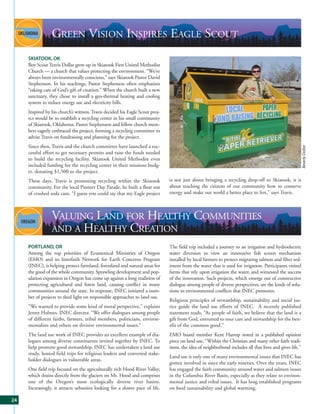
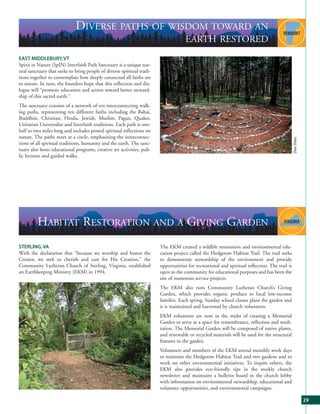
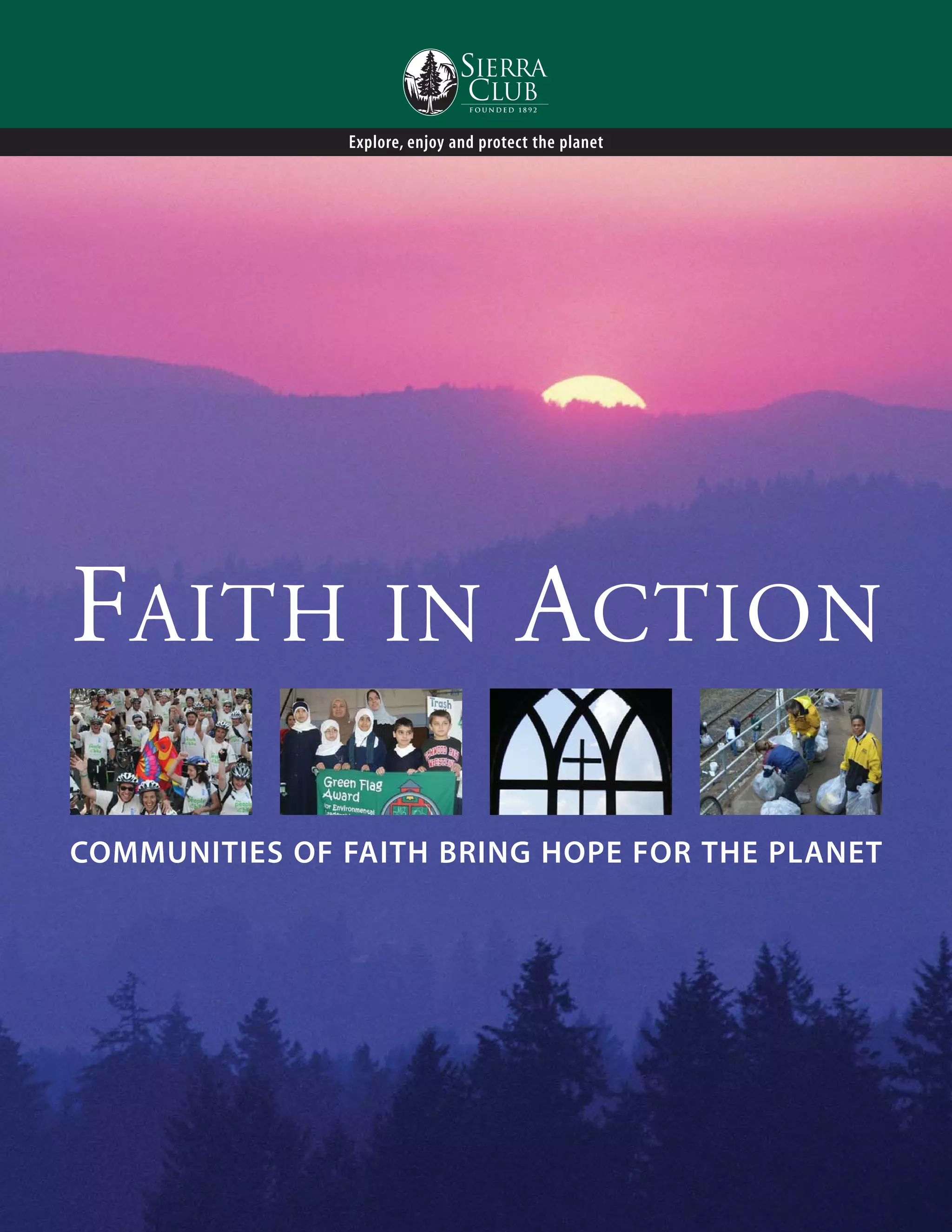
FAITH               IN                 ACTION
COMMUNITIES OF FAITH BRING HOPE FOR THE PLANET
ACKNOWLEDGEMENTS
This report was made possible through the hard work of many people, including:
PROJECT MANAGER: Lyndsay Moseley
AUTHORS: Lyndsay Moseley, Anna Jane Joyner
RESEARCH: Anna Jane Joyner, Heather Moyer, Christina Yagjian
DESIGN: Varadero Communications, LLC
COMMUNICATIONS, EDITORIAL, AND OTHER ASSISTANCE: Melanie Griffin, Kim Haddow,
Heather Moyer, Christina Yagjian, Amy Matthews, Laura Hoehn

Sierra Club’s members and supporters are more than 1.3 million of your friends and neighbors.
Inspired by nature, we work together to protect our communities and the planet. The Club is
America’s oldest, largest, and most influential grassroots environmental organization.
No Sierra Club funds were used for any 501(c)4 legislative lobbying purposes.


85 Second Street, Second Floor, San Francisco, CA 94105, (415) 977-5500
408 C Street NE, Washington, DC 20002, (202) 547-1141
www.sierraclub.org
JUNE 2008
FAITH IN ACTION: COMMUNITIES OF FAITH BRING
HOPE FOR THE PLANET
EXECUTIVE SUMMARY


S      ierra Club is proud to present its first ever national report on the environmental engagement of communities of
       faith, “Faith in Action: Communities of Faith Bring Hope for the Planet.” Highlighting one exceptional faith-
based environmental initiative from each of the fifty states, the District of Columbia and Puerto Rico, “Faith in
Action” demonstrates the breadth, depth and diversity of spiritually motivated grassroots efforts to protect the planet.
Sierra Club applauds the growing level of commitment and leadership among people of faith working to connect envi-
ronmental awareness with widely shared values including stewardship, justice, and concern for future generations. We
also recognize that lasting social change rarely takes place without the active engagement of communities of faith.

Environmental concerns continue to rise in prominence on the agenda                                                              3. North Dakota’s ecumenical Prairie Stewardship Network, edu-
of the faithful, with no sign of receding. As the implications of global                                                            cates communities of faith and others about clean energy and
warming and its disproportionate impact on the world’s poor become                                                                  global warming.
increasingly clear, prophetic voices are being raised in religious commu-
                                                                                                                                 4. Hazon, a Jewish environmental organization in New York
nities around the globe. In the United States, 67 percent of Americans
                                                                                                                                    City organizes community bike rides and educates about
say they care about the environment because it is “God’s creation.”
                                                                                                                                    sustainable living.
Faith groups highlighted in this report lead the way in crafting
                                                                                                                                 5. Catholic Bishops of the Dioceses of Pueblo and Colorado
creative and promising solutions to tremendous environmental
                                                                                                                                    Springs, CO speak out in defense communities surrounding
challenges. Religious leaders and lay persons alike are “greening”
                                                                                                                                    heavily polluted Fountain Creek.
all areas of religious life, including worship, education, communi-
ty life, buildings and grounds, and increasingly engaging in grass-                                                              6. St. Mark’s Presbyterian Church, of Tucson, AZ promotes water
roots education and organizing. In addition to crafting solutions                                                                   stewardship and conservation.
to global warming, these groups also work to protect water qual-
                                                                                                                                 7. The Islamic Environmental Group of Wisconsin helps
ity and access, protect wilderness and endangered species, stop
                                                                                                                                    mosques and Muslim families reduce their carbon footprint.
mountain-top removal coal mining and develop creative solutions
to our nation’s unsustainable and inequitable food systems.                                                                      Such passion and dedication provides tremendous hope for every-
                                                                                                                                 one working to protect the planet. We hope that this report will
Some examples from the report include:                                                                                           further encourage people of faith to become personally and pub-
1. The Texas Christian Life Commission, the largest Baptist                                                                      licly engaged in the environmental dialogue in America. We look
   organization in Texas educates congregations about creation                                                                   forward to continued and growing partnerships in the future as
   care and calls for a moratorium on building new coal-fired                                                                    we explore, enjoy and protect the planet together.
   power plants to reduce health risks.                                                                                          “Faith in Action” is a project of the Sierra Club’s Environmental
2. Community Lutheran Church of Sterling, VA, operates a                                                                         Partnerships Program.
   community garden and provides organic produce to local
   low-income families.


     TABLE OF CONTENTS
     Introduction . . . . . . . . . . . . . . . . . . . . . . . . . . . . . . . . . . . . . . . . . . . . . . . . . . . . . . . . . . . . . . . . . . . . . . . . . . . . . . . . . . . . . . . . . . . . . . . . . . . . . . . . . . . . . . . . . .4
     State Profiles (Alphabetical by state name) . . . . . . . . . . . . . . . . . . . . . . . . . . . . . . . . . . . . . . . . . . . . . . . . . . . . . . . . . . . . . . . . . . . . . . . . . . . . . . . .6 –31
     Contact Information (National & Regional Organizations) . . . . . . . . . . . . . . . . . . . . . . . . . . . . . . . . . . . . . . . . . . . . . . . . . . . . . . . . . . . . . . .32 – 35


                                                                                                                                                                                                                                                         3
INTRODUCTION


    A      lmost all of the world’s major religions have long-standing teachings and traditions that shape the way
              humans should relate to the natural world, although these teachings have not always been emphasized
    by those in leadership. After centuries of lying dormant, religious perspectives on environmental stewardship are
    being revived and communicated with great fervor, bringing new energy and vision to the movement to protect
    the planet. This awakening is not an accident.


    For at least the last two decades, religious lead-
    ers and scholars of many traditions have been
    working to articulate specifically theological,
    moral and spiritual views on the environmental
    crisis, linking core religious values such as stew-
    ardship, justice, and concern for future genera-
    tions with environmental concerns. The United
    Church of Christ (UCC) issued a groundbreak-
    ing report in 1987 documenting socioeconomic
    and racial disparities in the placement of toxic
    waste facilities throughout the United States,
    raising awareness about the connection between
    social justice and environmental concerns. In
    Pope John Paul II’s “World Day of Peace” mes-
    sage in 1990 he urged the world’s more than one
    billion Catholics to connect their belief in God
    as a creator with care for the environment.
    Scientists also play a key role in this movement,
    calling on religious leaders for dialogue and
    assistance. In the early nineties, a coalition of
    some of the world’s most eminent Nobel
    Laureate scientists including Carl Sagan wrote
    an “Open Letter” to religious leaders in which
    they acknowledged the limits of science and
    technology alone to solve the world’s environ-
    mental problems. They described the environ-
    mental crisis as “intrinsically religious.” More
    recently, world renowned biologist and secular
    humanist E.O. Wilson published a book enti-
    tled “The Creation” in which he identifies sci-
    ence and religion as “the two most powerful
    forces in the world today” and concludes that
    they need each other to solve the burgeoning
    environmental crises. Breaking stereotypes and
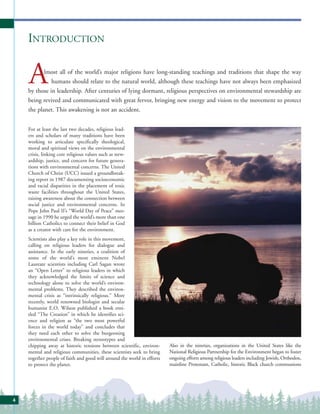
    chipping away at historic tensions between scientific, environ-      Also in the nineties, organizations in the United States like the
    mental and religious communities, these scientists seek to bring     National Religious Partnership for the Environment began to foster
    together people of faith and good will around the world in efforts   ongoing efforts among religious leaders including Jewish, Orthodox,
    to protect the planet.                                               mainline Protestant, Catholic, historic Black church communions


4
and evangelical Christians. A decade later, the Interfaith Power and     and behavior to public policy, this renewed interest and awakening
Light Campaign gained grassroots traction, forming partnerships          to the plight of the planet provides much hope for progress, espe-
with Christian, Jewish, Muslim, Buddhist, Unitarian and many             cially in light of our nation’s history; lasting societal change rarely
other congregations around the country, while the 2002 “What             takes place without the active engagement of communities of faith.
Would Jesus Drive” Campaign earned major media attention.
                                                                         Sierra Club Faith Partnerships
Many factors have contributed to this so-called “greening of reli-
gion” movement, but none so much in recent years as the looming          In the face of unprecedented environmental challenges like global
climate crisis. As the environmental implications of global warming      warming, people from all walks of life are coming together to make a
and its disproportionate impact on the world’s poor become               difference. Many Sierra Club members also come to their environ-
increasingly clear, religious leaders are speaking up. February 2006     mental activism from a place of faith. In fact, almost half of Club
marked a new era in the environmental conversation, when 86              members say that they attend worship services at least once per
evangelical Christian leaders signed the Evangelical Climate             month. Sierra Club is engaged in active partnerships with communi-
Initiative statement and called upon our nation’s leaders to address     ties of faith across the country and from nearly every faith tradition
global warming. In early 2008, a group of leading Southern Baptists      and spirituality to put their values into action. We believe that the
issued a statement calling for action on global warming and Pope         magnitude of the challenges we face necessitates such collaboration.
Benedict urged Catholics to recognize pollution as a “sin.” All of       While many of these stories involve Sierra Club partnerships, this
these initiatives coalesce around a few key broadly shared principles:   report is intended to honor the broad array of faith groups engaged
stewardship, justice and concern for “the poor,” and concern for         in environmental efforts and help share their stories as part of a larg-
one’s neighbor and future generations among them.                        er narrative of hope for the planet. Throughout this report, we seek
As people of faith embrace these principles more fully, environ-         to reflect the motivations and values of groups and individuals, some-
mental concerns continue to rise in prominence on the agenda             times using language such as “God’s creation” or “sacred” which is not
with no sign of receding. This report features one exceptional           usually found in secular environmental publications. Sierra Club’s
example of religious environmental engagement in each of the             faith partnerships efforts, including this report, are not intended as an
fifty states, the District of Columbia and Puerto Rico. We high-         endorsement of any specific religion, tradition or belief.
light the incredibly broad range of models, issues and approaches        Sierra Club is deeply grateful to the religious communities highlight-
in Christian, Jewish, Muslim, Buddhist, Unitarian and inter-             ed in this report and so many others across America who are bring-
faith/multifaith efforts. In some cases, initiatives focus on “green-    ing renewed interest, energy, and unique perspectives to the environ-
ing” religious life: preaching sermons on environmental topics,          mental conversation while taking the lead on finding solutions to our
incorporating nature oriented hymns and images in worship, and           environmental challenges. Building on our shared hope and values,
teaching “creation care” in religious education classes.                 Sierra Club seeks to empower people of faith and partner with local
Other approaches include hosting educational film screenings, tak-       congregations to translate these values into action. We hope that this
ing field trips or doing service projects, and undertaking public edu-   report will further encourage people of faith to become personally
cation campaigns. Still others promote recycling, energy conserva-       and publicly engaged in the environmental dialogue in America. We
tion, and community gardens. We discovered many amazing people           look forward to continued and growing partnerships in the future as
and organizations in the process of writing this report. We can pro-     we explore, enjoy and protect the planet together.
vide only a glimpse of the power and creativity of these efforts.
The environmental issues highlighted in this report also vary wide-
ly. Finding solutions to global warming is clearly of the utmost con-
                                                                            “All the wild world is beautiful, and it matters but
cern in these communities, with Baptist families in North Carolina
pledging to reduce their carbon footprint by 10%, Catholics in New          little where we go, to highlands or lowlands, woods
Mexico handing out more than 3,000 energy saving compact fluo-
                                                                              or plains, on the sea or land or down among the
rescent light bulbs to their friends and neighbors, and Presbyterians
in Nevada installing solar panels on their rooftops. Other important          crystals of waves or high in a balloon in the sky;
initiatives seek to protect drinking water quality and access, protect
                                                                              through all the climates, hot or cold, storms and
wilderness and endangered species, stop construction of new coal-
fired power plants, bring an end to destructive practices like moun-           calms, everywhere and always we are in God’s
tain-top removal coal mining, and develop creative solutions to our
                                                                                           eternal beauty and love.”
nation’s unsustainable and inequitable food systems.
In the United States today, due to the hard work of these organi-                    — SIERRA CLUB FOUNDER JOHN MUIR
zations and many others, 67 percent of Americans say they care
about the environment because it’s “God’s creation.” From lifestyle


                                                                                                                                                     5
THE MODERN DAY NOAH
    BIRMINGHAM, AL
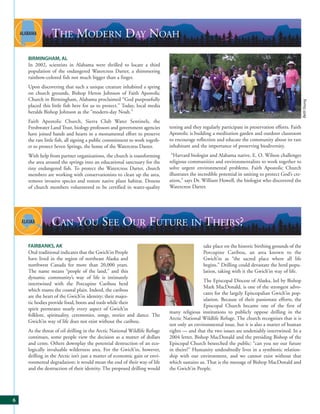
    In 2002, scientists in Alabama were thrilled to locate a third
    population of the endangered Watercress Darter, a shimmering
    rainbow-colored fish not much bigger than a finger.
    Upon discovering that such a unique creature inhabited a spring
    on church grounds, Bishop Heron Johnson of Faith Apostolic
    Church in Birmingham, Alabama proclaimed “God purposefully


                                                                                                                                                    Beth Young
    placed this little fish here for us to protect.” Today, local media
    heralds Bishop Johnson as the “modern-day Noah.”
    Faith Apostolic Church, Sierra Club Water Sentinels, the
    Freshwater Land Trust, biology professors and government agencies       testing and they regularly participate in preservation efforts. Faith
    have joined hands and hearts in a monumental effort to preserve         Apostolic is building a meditation garden and outdoor classroom
    the rare little fish, all signing a public commitment to work togeth-   to encourage reflection and educate the community about its rare
    er to protect Seven Springs, the home of the Watercress Darter.         inhabitant and the importance of preserving biodiversity.
    With help from partner organizations, the church is transforming         “Harvard biologist and Alabama native, E. O. Wilson challenges
    the area around the springs into an educational sanctuary for the       religious communities and environmentalists to work together to
    tiny endangered fish. To protect the Watercress Darter, church          solve urgent environmental problems. Faith Apostolic Church
    members are working with conservationists to clean up the area,         illustrates the incredible potential in uniting to protect God’s cre-
    remove invasive species and restore native plant habitat. Dozens        ation,” says Dr. William Howell, the biologist who discovered the
    of church members volunteered to be certified in water-quality          Watercress Darter.


                CAN YOU SEE OUR FUTURE IN THEIRS?
    FAIRBANKS, AK                                                                            take place on the historic birthing grounds of the
    Oral traditional indicates that the Gwich’in People                                      Porcupine Caribou, an area known to the
    have lived in the region of northeast Alaska and                                         Gwich’in as “the sacred place where all life
    northwest Canada for more than 20,000 years.                                             begins.” Drilling could devastate the herd popu-
    The name means “people of the land,” and this                                            lation, taking with it the Gwich’in way of life.
    dynamic community’s way of life is intimately
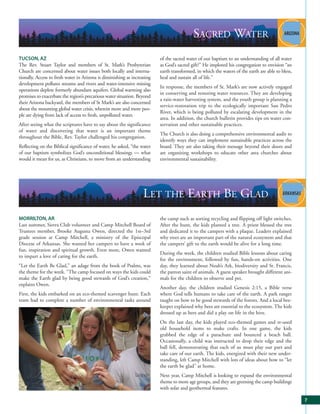
                                                                                             The Episcopal Diocese of Alaska, led by Bishop
    intertwined with the Porcupine Caribou herd
                                                                                             Mark MacDonald, is one of the strongest advo-
    which roams the coastal plain. Indeed, the caribou
                                                                                             cates for the largely Episcopalian Gwich’in pop-
    are the heart of the Gwich’in identity; their majes-
                                                                                             ulation. Because of their passionate efforts, the
    tic bodies provide food, boots and tools while their
                                                                                             Episcopal Church became one of the first of
    spirit permeates nearly every aspect of Gwich’in
                                                                            many religious institutions to publicly oppose drilling in the
    folklore, spirituality, ceremonies, songs, stories and dance. The
                                                                            Arctic National Wildlife Refuge. The church recognizes that it is
    Gwich’in way of life does not exist without the caribou.
                                                                            not only an environmental issue, but it is also a matter of human
    As the threat of oil drilling in the Arctic National Wildlife Refuge    rights — and that the two issues are undeniably intertwined. In a
    continues, some people view the decision as a matter of dollars         2004 letter, Bishop MacDonald and the presiding Bishop of the
    and cents. Others downplay the potential destruction of an eco-         Episcopal Church beseeched the public: “can you see our future
    logically invaluable wilderness area. For the Gwich’in, however,        in theirs?” Humanity undoubtedly lives in a symbiotic relation-
    drilling in the Arctic isn’t just a matter of economic gain or envi-    ship with our environment, and we cannot exist without that
    ronmental degradation; it would mean the end of their way of life       which sustains us. That is the message of Bishop MacDonald and
    and the destruction of their identity. The proposed drilling would      the Gwich’in People.


6
SACRED WATER
TUCSON, AZ                                                                of the sacred water of our baptism to an understanding of all water
The Rev. Stuart Taylor and members of St. Mark’s Presbyterian             as God’s sacred gift?” He implored his congregation to envision “an
Church are concerned about water issues both locally and interna-         earth transformed, in which the waters of the earth are able to bless,
tionally. Access to fresh water in Arizona is diminishing as increasing   heal and sustain all of life.”
development pollutes streams and rivers and water-intensive mining
                                                                          In response, the members of St. Mark’s are now actively engaged
operations deplete formerly abundant aquifers. Global warming also
                                                                          in conserving and restoring water resources. They are developing
promises to exacerbate the region’s precarious water situation. Beyond
                                                                          a rain-water harvesting system, and the youth group is planning a
their Arizona backyard, the members of St Mark’s are also concerned
                                                                          service-restoration trip to the ecologically important San Pedro
about the mounting global water crisis, wherein more and more peo-
                                                                          River, which is being polluted by escalating development in the
ple are dying from lack of access to fresh, unpolluted water.
                                                                          area. In addition, the church bulletin provides tips on water con-
After seeing what the scriptures have to say about the significance       servation and other sustainable practices.
of water and discovering that water is an important theme
                                                                          The Church is also doing a comprehensive environmental audit to
throughout the Bible, Rev. Taylor challenged his congregation.
                                                                          identify ways they can implement sustainable practices across the
Reflecting on the Biblical significance of water, he asked, “the water    board. They are also taking their message beyond their doors and
of our baptism symbolizes God’s unconditional blessings — what            are organizing workshops to educate other area churches about
would it mean for us, as Christians, to move from an understanding        environmental sustainability.


                                                                   LET THE EARTH BE GLAD
MORRILTON, AR                                                             the camp such as sorting recycling and flipping off light switches.
Last summer, Sierra Club volunteer and Camp Mitchell Board of             After the hunt, the kids planted a tree. A priest blessed the tree
Trustees member, Brooke Augusta Owen, directed the 1st–3rd                and dedicated it to the campers with a plaque. Leaders explained
grade session at Camp Mitchell, a ministry of the Episcopal               why trees are an important part of the natural ecosystem and that
Diocese of Arkansas. She wanted her campers to have a week of             the campers’ gift to the earth would be alive for a long time.
fun, inspiration and spiritual growth. Even more, Owen wanted
                                                                          During the week, the children studied Bible lessons about caring
to impart a love of caring for the earth.
                                                                          for the environment, followed by fun, hands-on activities. One
“Let the Earth Be Glad,” an adage from the book of Psalms, was            day, they learned about Noah’s Ark, biodiversity and St. Francis,
the theme for the week. “The camp focused on ways the kids could          the patron saint of animals. A guest speaker brought different ani-
make the Earth glad by being good stewards of God’s creation,”            mals for the children to observe and pet.
explains Owen.
                                                                          Another day, the children studied Genesis 2:15, a Bible verse
First, the kids embarked on an eco-themed scavenger hunt. Each            where God tells humans to take care of the earth. A park ranger
team had to complete a number of environmental tasks around               taught on how to be good stewards of the forests. And a local bee-
                                                                          keeper explained why bees are essential to the ecosystem. The kids
                                                                          dressed up as bees and did a play on life in the hive.
                                                                          On the last day, the kids played eco-themed games and re-used
                                                                          old household items to make crafts. In one game, the kids
                                                                          grabbed the edge of a parachute and bounced a beach ball.
                                                                          Occasionally, a child was instructed to drop their edge and the
                                                                          ball fell, demonstrating that each of us must play our part and
                                                                          take care of our earth. The kids, energized with their new under-
                                                                          standing, left Camp Mitchell with lots of ideas about how to “let
                                                                          the earth be glad” at home.
                                                                          Next year, Camp Mitchell is looking to expand the environmental
                                                                          theme to more age groups, and they are greening the camp buildings
                                                                          with solar and geothermal features.

                                                                                                                                                   7
BUILDING FAITH PARTNERSHIPS FOR THE FORESTS
    LOS ANGELES, CA
    Sierra Club organizer Juana Torres brings people together to protect
    the beautiful forests of Southern California. From her experience as a
    long-time Catholic youth group leader, Juana recognizes that many
    faiths offer a unique perspective on wilderness through “deep rever-
    ence and respect for God’s creation.” So when Juana came to work for
    the Sierra Club, she naturally turned to the faith community as an ally.
    First she asked local religious leaders, “Why do people of your com-
    munities value the forests?” Then she listened. Inspired by spiritual
    perspectives on wilderness, Juana began the Caring for Creation              Alberto Embry the Director of Latino Youth and Young Adults
    program to connect people of faith in Southern California to their           for the Los Angeles Catholic Archdiocese says, “Exploring our
    local forests. Offering presentations, meditative hikes and forest           local mountains has deepened the bonds between the many
    restoration projects Juana hopes to “invite participants to reflect on       churches in our large archdiocese and it has offered the hard to
    their responsibility as stewards of God’s creation and on the spiri-         reach youth a new way by which to get to know God’s love which
    tual value of forests.” and inspire them to help protect the forests.        is so evident in his gift of wilderness.”
    The Caring for Creation program is a wonderful success and many              In a recent first-ever national poll of Latino views on the environ-
    groups see Juana as a valuable resource, including churches in the           ment, ninety-three percent agreed that they have a moral respon-
    Episcopal, Methodist and Church of Christ denominations, as                  sibility to take care of God’s creation. Participants say that this
    well as Progressive Christians Uniting, a network of churches in             program provides new and innovative means of connecting with
    Southern California. The program especially resonates, however,              God through firsthand experience with the splendor of creation,
    with the Latino Catholic community in Southern California.                   as well as a new model for effective partnerships.


                 CATHOLICS CALL FOR UNITY TO PROTECT WATER
    PUEBLO AND COLORADO SPRINGS, CO                                              “God’s earth is His gift to us,” Sheridan said at the press confer-
    Citizens in Colorado found themselves caught in a tragedy of the             ence. “We are here to tend to that gift.”
    commons when a creek near the towns of Pueblo and Colorado
                                                                                 While the campaign to keep Fountain Creek clean continues,
    Springs was inundated by sewage spills. Local authorities respond-
                                                                                 Sierra Club volunteers said the Bishops’ statement has made a real
    ed by bickering over who was responsible. At a press conference
                                                                                 difference. “Their message had significant impact,” said Ross
    in 2006, Catholic Bishops from the local dioceses released a state-
                                                                                 Vincent, vice chair of the Sangre de Cristo group of the Rocky
    ment calling for a unified response. Bishops Michael Sheridan
                                                                                 Mountain Chapter. “People who wanted to believe things were
    and Arthur Tafoya, of the dioceses of Colorado Springs and
                                                                                 okay with Fountain Creek began to pay attention and realize
    Pueblo, respectively, spoke out:
                                                                                 something needed to be done. The Bishops’ statement came at a
    “It is our wish to emphasize the moral and ethical responsibilities          critical time and it was deeply appreciated.”
    we all share to find equitable and effective solutions to the problems
                                                                                 Vincent added that the publicity received from the Bishops’ state-
    impacting Fountain Creek and we want to bring a message of hope
                                                                                 ment also brought in many government officials from all levels to
    to the discussions around those issues,” said the Bishops’ statement.
                                                                                 tour Fountain Creek and see the problems first-hand.
    Sheridan and Tafoya urged cooperation and open dialogue around
                                                                                 That kind of cooperation is exactly what the Bishops wanted.
    the issue, encouraging all involved to think about how the pollution
                                                                                 “Fountain Creek should be a valued and nurtured natural asset to
    affects families and the environment. “Water is a necessity of life.
                                                                                 all of the people who live, work and play along its banks. It should
    Access to safe and clean water is a right of every person. It is our moral
                                                                                 connect and unite the communities it touches, not divide them,”
    responsibility to ensure that the water that we discharge into our
                                                                                 concluded the Bishops statement.
    waterways is not polluted. Every community along our waterways has
    the right to clean water and to protection from floods and other dam-
    ages that can be caused by ill-considered actions upstream.”


8
RIGHT RELATIONSHIP
MIDDLETOWN, CT                                                                                   that Styrofoam is completely non-
“First and foremost, I will do no harm in                                                        biodegradable and after one use, Styrofoam
thought, word or deed.” Buddha Gaia is a                                                         cups find an eternal home in one of the over
community of Buddhist individuals who                                                            1,700 landfills in the United States.
integrate Buddhist spiritual teachings with
                                                                                                 Buddha Gaia is committed to making a posi-
sustainable living. The name “Buddha Gaia”
                                                                                                 tive difference in the local community. To
applies the Buddhist practice of “mindful-
                                                                                                 encourage community pride they conduct
ness” to how we treat the environment.
                                                                                                 annual street cleanups wherein volunteers
“Being mindful means to be aware of how
                                                                                                 clean up trash littering inner city street blocks.
your actions affect the world around you,”
explains Buddha Gaia member Joe Hoydilla.                                                       The community meets monthly to meditate
                                                                                                on environmental harmony and discuss spe-
Through everyday choices, Buddha Gaia
                                                                                                cific environmental issues. Recently, they
members seek to create a lifestyle that mini-
                                                                                                focused on the connection between poverty
mizes harm to the environment, They work
                                                                                                and environmental degradation. “Buddhism
to educate and engage their faith communi-
                                                                                                is about not hiding from the pain of what’s
ty in sustainable initiatives at weekly sanghas
                                                                                                wrong with our world,” explains Hoydilla.
where they share practical and achievable
                                                                                                “It is about addressing our problems with
green living tips with the larger Buddhist
                                                                          courage and humility.” Through this approach, Buddha Gaia seeks
community, such as: recycling, switching to energy efficient light
                                                                          to overcome environmental degradation and create a more sustain-
bulbs, buying local food and investing in reusable products. One
                                                                          able human and nonhuman environment.
week, they gave away coffee mugs to encourage folks to be mindful


                                                       CLIMATE CHANGE SOLUTIONS
WILMINGTON , DE                                                                                  installing 36 kW of solar panels on the
When the Unitarian Universalist (UU)                                                             church building--the first church in
Association chose global warming as a                                                            Delaware to do so. The First Unitarian
study/action issue, retired scientist Dr. Chad                                                   Church of Wilmington has raised several
Tolman organized a study group in his local                                                      hundred dollars for environmental initiatives
UU congregation. The Coalition for Climate                                                       by selling energy saving light bulbs, and is
Change Study and Action meets regularly to                                                       working to be accredited as a Green
discuss ways that people of faith in Delaware                                                    Sanctuary. Trinity Presbyterian Church
can help mitigate the effects of global warm-                                                    formed a “Stewards of the Earth” team,
ing. “Climate change is not only a threat to                                                     installed a recycle bin, and has established an
human societies and natural ecosystems, it is                                                    environmental web site.
a profound moral and religious issue, on
                                                                                                 The Coalition also advocated for a renew-
which we must act,” declares Dr. Tolman.
                                                                                                 able energy standard in Delaware. The meas-
Members of several religious denominations,                                                      ure passed in 2005, requiring 20 percent of
including Presbyterian, Methodist and the                                                        electricity sold in Delaware to be purchased
United Church of Christ participate in the                                                       from renewable energy sources by 2019.
coalition. The Coalition seeks to identify and
                                                                          Recently, Dr. Tolman, who is the Energy Chair of the Sierra
implement practical steps that people of faith can take to reduce glob-
                                                                          Club’s Delaware Chapter received a grant to engage citizens in
al warming emissions and create a clean energy economy in Delaware.
                                                                          advocating for smart energy solutions. It is helping to engage peo-
Members work within their congregations to educate fellow parish-         ple of faith working to protect the planet, The Coalition is now
ioners about global warming and to reduce churchwide carbon diox-         expanding its educational programs and collaborating with more
ide emissions. Members of The Limestone Presbyterian Church are           faith groups and church leaders.

                                                                                                                                                      9
LET THERE BE LIGHT!
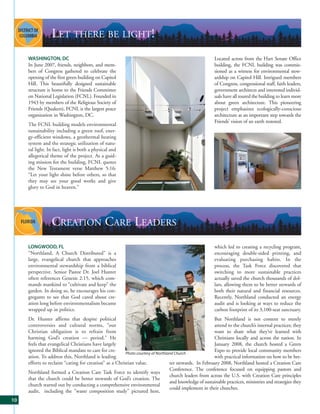
     WASHINGTON, DC                                                                                     Located across from the Hart Senate Office
     In June 2007, friends, neighbors, and mem-                                                         building, the FCNL building was commis-
     bers of Congress gathered to celebrate the                                                         sioned as a witness for environmental stew-
     opening of the first green building on Capitol                                                     ardship on Capitol Hill. Intrigued members
     Hill. This beautifully designed sustainable                                                        of Congress, congressional staff, faith leaders,
     structure is home to the Friends Committee                                                         government architects and interested individ-
     on National Legislation (FCNL). Founded in                                                         uals have all toured the building to learn more
     1943 by members of the Religious Society of                                                        about green architecture. This pioneering
     Friends (Quakers), FCNL is the largest peace                                                       project emphasizes ecologically-conscious
     organization in Washington, DC.                                                                    architecture as an important step towards the
                                                                                                        Friends’ vision of an earth restored.
     The FCNL building models environmental
     sustainability including a green roof, ener-
     gy-efficient windows, a geothermal heating
     system and the strategic utilization of natu-
     ral light. In fact, light is both a physical and
     allegorical theme of the project. As a guid-
     ing mission for the building, FCNL quotes
     the New Testament verse Matthew 5:16:
     “Let your light shine before others, so that
     they may see your good works and give
     glory to God in heaven.”


                 CREATION CARE LEADERS
     LONGWOOD, FL                                                                                       which led to creating a recycling program,
     “Northland, A Church Distributed” is a                                                             encouraging double-sided printing, and
     large, evangelical church that approaches                                                          evaluating purchasing habits. In the
     environmental stewardship from a biblical                                                          process, the Task Force discovered that
     perspective. Senior Pastor Dr. Joel Hunter                                                         switching to more sustainable practices
     often references Genesis 2:15, which com-                                                          actually saved the church thousands of dol-
     mands mankind to “cultivate and keep” the                                                          lars, allowing them to be better stewards of
     garden. In doing so, he encourages his con-                                                        both their natural and financial resources.
     gregants to see that God cared about cre-                                                          Recently, Northland conducted an energy
     ation long before environmentalism became                                                          audit and is looking at ways to reduce the
     wrapped up in politics.                                                                            carbon footprint of its 3,100-seat sanctuary.
     Dr. Hunter affirms that despite political                                                         But Northland is not content to merely
     controversies and cultural norms, “our                                                            attend to the church’s internal practices; they
     Christian obligation is to refrain from                                                           want to share what they’ve learned with
     harming God’s creation — period.” He                                                              Christians locally and across the nation. In
     feels that evangelical Christians have largely                                                    January 2008, the church hosted a Green
     ignored the Biblical mandate to care for cre-                                                     Expo to provide local community members
                                                        Photo courtesy of Northland Church
     ation. To address this, Northland is leading                                                      with practical information on how to be bet-
     efforts to reclaim “caring for creation” as a Christian value.              ter stewards. In February 2008, Northland hosted a Creation Care
                                                                                 Conference. The conference focused on equipping pastors and
     Northland formed a Creation Care Task Force to identify ways
                                                                                 church leaders from across the U.S. with Creation Care principles
     that the church could be better stewards of God’s creation. The
                                                                                 and knowledge of sustainable practices, ministries and strategies they
     church started out by conducting a comprehensive environmental
                                                                                 could implement in their churches.
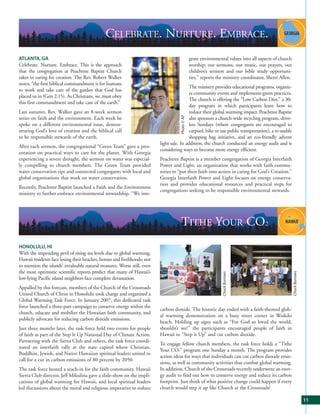
     audit, including the "waste composition study" pictured here,
10
CELEBRATE. NURTURE. EMBRACE.
ATLANTA, GA                                                                                       grate environmental values into all aspects of church
Celebrate. Nurture. Embrace. This is the approach                                                 worship: our sermons, our music, our prayers, our
that the congregation at Peachtree Baptist Church                                                 children’s sermon and our bible study opportuni-
takes in caring for creation. The Rev. Robert Walker                                              ties,” reports the ministry coordinator, Sherri Allen.
notes, “the first biblical commandment is for humans
                                                                                           The ministry provides educational programs, organiz-
to work and take care of the garden that God has
                                                                                           es community events and implements green practices.
placed us in (Gen 2:15). As Christians, we must obey
                                                                                           The church is offering the “Low Carbon Diet,” a 30-
this first commandment and take care of the earth.”
                                                                                           day program in which participants learn how to
Last autumn, Rev. Walker gave an 8-week sermon                                             reduce their global warming impact. Peachtree Baptist


                                                                                     Photo © AP
series on faith and the environment. Each week he                                          also sponsors a church-wide recycling program, drive-
spoke on a different environmental issue, demon-                                           less Sundays (where congregants are encouraged to
strating God’s love of creation and the biblical call                                      carpool, bike or use public transportation), a re-usable
to be responsible stewards of the earth.                                                   shopping bag initiative, and an eco-friendly advent
                                                                          light sale. In addition, the church conducted an energy audit and is
After each sermon, the congregational “Green Team” gave a pres-
                                                                          considering ways to become more energy efficient.
entation on practical ways to care for the planet. With Georgia
experiencing a severe drought, the sermon on water was especial-          Peachtree Baptist is a member congregation of Georgia Interfaith
ly compelling to church members. The Green Team provided                  Power and Light, an organization that works with faith commu-
water conservation tips and connected congregants with local and          nities to “put their faith into action in caring for God’s Creation.”
global organizations that work on water conservation.                     Georgia Interfaith Power and Light focuses on energy conserva-
                                                                          tion and provides educational resources and practical steps for
Recently, Peachtree Baptist launched a Faith and the Environment
                                                                          congregations seeking to be responsible environmental stewards.
ministry to further embrace environmental stewardship. “We inte-


                                                                                     TITHE YOUR CO2
HONOLULU, HI
With the impending peril of rising sea levels due to global warming,
Hawaii residents face losing their beaches, homes and livelihoods; not
to mention the islands’ invaluable natural treasures. Worse still, even
the most optimistic scientific reports predict that many of Hawaii’s


                                                                                                                                                           Chuck Burrows
                                                                                                                   Chuck Burrows


low-lying Pacific island neighbors face complete devastation.
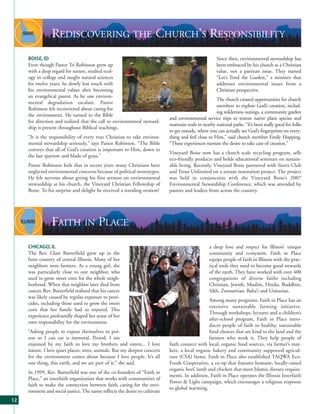
Appalled by this forecast, members of the Church of the Crossroads
United Church of Christ in Honolulu took charge and organized a
Global Warming Task Force. In January 2007, this dedicated task
force launched a three-part campaign to conserve energy within the
                                                                          carbon dioxide. The historic day ended with a faith-themed glob-
church, educate and mobilize the Hawaiian faith community, and
                                                                          al warming demonstration on a busy street corner in Waikiki
publicly advocate for reducing carbon dioxide emissions.
                                                                          beach. Holding up signs such as “For God so loved the world,
Just three months later, the task force held two events for people        shouldn’t we?” the participants encouraged people of faith in
of faith as part of the Step It Up National Day of Climate Action.        Hawaii to “Step it Up” and cut carbon dioxide.
Partnering with the Sierra Club and others, the task force coordi-
                                                                          To engage fellow church members, the task force holds a “Tithe
nated an interfaith rally at the state capitol where Christian,
                                                                          Your CO2” program one Sunday a month. The program provides
Buddhist, Jewish, and Native Hawaiian spiritual leaders united to
                                                                          action ideas for ways that individuals can cut carbon dioxide emis-
call for a cut in carbon emissions of 80 percent by 2050.
                                                                          sions, as well as community activities that combat global warming.
The task force hosted a teach-in for the faith community. Hawaii          In addition, Church of the Crossroads recently underwent an ener-
Sierra Club director, Jeff Mikulina gave a slide-show on the impli-       gy audit to find out how to conserve energy and reduce its carbon
cations of global warming for Hawaii, and local spiritual leaders         footprint. Just think of what positive change could happen if every
led discussions about the moral and religious imperative to reduce        church would step it up like Church at the Crossroads!

                                                                                                                                                                           11
REDISCOVERING THE CHURCH’S RESPONSIBILITY
     BOISE, ID                                                                                         Since then, environmental stewardship has
     Even though Pastor Tri Robinson grew up                                                           been embraced by his church as a Christian
     with a deep regard for nature, studied ecol-                                                      value, not a partisan issue. They started
     ogy in college and taught natural sciences                                                        “Let’s Tend the Garden,” a ministry that
     for twelve years, he slowly lost touch with                                                       addresses environmental issues from a
     his environmental values after becoming                                                           Christian perspective.
     an evangelical pastor. As he saw environ-
                                                                                                       The church created opportunities for church
     mental degradation escalate, Pastor
                                                                                                       members to explore God’s creation, includ-
     Robinson felt reconvicted about caring for
                                                                                                       ing wilderness outings, a community garden
     the environment. He turned to the Bible
                                                                             and environmental service trips to restore native plant species and
     for direction and realized that the call to environmental steward-
                                                                             maintain trails in nearby national parks. “It’s been really good for folks
     ship is present throughout Biblical teachings.
                                                                             to get outside, where you can actually see God’s fingerprints on every-
     “It is the responsibility of every true Christian to take environ-      thing and feel close to Him,” said church member Emily Hopping.
     mental stewardship seriously,” says Pastor Robinson. “The Bible         “These experiences nurture the desire to take care of creation.”
     conveys that all of God’s creation is important to Him, down to
                                                                             Vineyard Boise now has a church scale recycling program, sells
     the last sparrow and blade of grass.”
                                                                             eco-friendly products and holds educational seminars on sustain-
     Pastor Robinson feels that in recent years many Christians have         able living. Recently, Vineyard Boise partnered with Sierra Club
     neglected environmental concerns because of political stereotypes.      and Trout Unlimited on a stream restoration project. The project
     He felt nervous about giving his first sermon on environmental          was held in conjunction with the Vineyard Boise’s 2007
     stewardship at his church, the Vineyard Christian Fellowship of         Environmental Stewardship Conference, which was attended by
     Boise. To his surprise and delight he received a standing ovation!      pastors and leaders from across the country.


                 FAITH IN PLACE
     CHICAGO, IL                                                                                   a deep love and respect for Illinois’ unique
     The Rev. Clare Butterfield grew up in the                                                     community and ecosystem. Faith in Place
     farm country of central Illinois. Many of her                                                 equips people of faith in Illinois with the prac-
     neighbors were farmers. As a young girl, she                                                  tical tools they need to become good stewards
     was particularly close to one neighbor, who                                                   of the earth. They have worked with over 400
     used to grow sweet corn for the whole neigh-                                                  congregations of diverse faiths including
     borhood. When that neighbor later died from                                                   Christian, Jewish, Muslim, Hindu, Buddhist,
     cancer, Rev. Butterfield realized that his cancer                                             Sikh, Zoroastrian, Baha’i and Unitarian.
     was likely caused by regular exposure to pesti-
                                                                                                 Among many programs, Faith in Place has an
     cides, including those used to grow the sweet
                                                                                                 extensive sustainable farming initiative.
     corn that her family had so enjoyed. This
                                                                                                 Through workshops, lectures and a children’s
     experience profoundly shaped her sense of her
                                                                                                 after-school program, Faith in Place intro-
     own responsibility for the environment.
                                                                                                 duces people of faith to healthy, sustainable
     “Asking people to expose themselves to poi-                                                 food choices that are kind to the land and the
     son so I can eat is immoral. Period. I am                                                   farmers who work it. They help people of
     enjoined by my faith to love my brothers and sisters... I love          faith connect with local, organic food sources, via farmer’s mar-
     nature. I love quiet places, trees, animals. But my deepest concern     kets, a local organic bakery and community supported agricul-
     for the environment comes about because I love people. It’s all         ture (CSA) farms. Faith in Place also established TAQWA Eco-
     one thing, this earth, and we are part of it,” she said.                Foods Cooperative, a co-op that features humane, locally-raised
                                                                             organic beef, lamb and chicken that meet Islamic dietary require-
     In 1999, Rev. Butterfield was one of the co-founders of “Faith in
                                                                             ments. In addition, Faith in Place operates the Illinois Interfaith
     Place,” an interfaith organization that works with communities of
                                                                             Power & Light campaign, which encourages a religious response
     faith to make the connection between faith, caring for the envi-
                                                                             to global warming.
     ronment and social justice. The name reflects the desire to cultivate
12
PRAYING FOR ENVIRONMENTAL HARMONY
INDIANAPOLIS, IN                                                                                    cars, nontoxic cleaning products, environ-
In the summer of 2007, St. Luke’s                                                                   mentally conscious gift giving and green
Methodist Church in Indianapolis, IN                                                                building options.
launched the Green Ministry to “cele-
                                                                                                     Church members are encouraged to take a
brate God’s creation by educating,
                                                                                                     pledge to care for God’s creation. The pledge
encouraging and enabling the St. Luke’s
                                                                                                     reads: “I believe all creation is a gift from
United Methodist Church community to
                                                                                                     God, all parts of creation are interdependent
conserve resources and renew environ-
                                                                                                     and God calls me to act responsibly toward
mental harmony.”
                                                                                                     creation for the sake of future generations.
To kick off the ministry, the church gave out 1,200 reusable               Therefore, I will learn what adversely affects creation so that I can
shopping bags to members. Americans throw away over 100 bil-               work to reverse problems; I will live more simply so there are ade-
lion plastic bags each year. Derived from nonrenewable                     quate provisions for all; and I will pray for harmony in all of God’s
resources, these bags never break down completely and they                 creation.” As a reminder, participants sign the commitment on a leaf
harm wildlife. Each year plastic bags floating in the world’s              and hang it on the “Creation Care Tree” in the church lobby.
oceans kill millions of birds and an estimated 100,000 sea turtles
                                                                           Sheri Ballard, a Green Ministry volunteer, reports: “The Green
and marine mammals.
                                                                           Ministry has enabled me to put my faith into action. It encour-
The Green Ministry offers classes on environmental issues from a           ages me to be mindful of the environmental consequences of my
spiritual perspective. They also provide “green tips” in the church        everyday actions. In doing so, I am able to demonstrate respect for
bulletin. Each month, the Green Ministry holds educational                 all life, including humanity. This constant remembrance of the
events on sustainable living. In the past they have explored hybrid        interconnectedness of all life has enriched my faith.”


                                                                          COOL CONGREGATIONS
CEDAR FALLS, IA
Inspired by their priest’s counsel “to keep the faith, we must keep the
earth,” a small group of dedicated parishioners at St. Luke’s Episcopal
Church set out to combat energy-related environmental degradation.
Church members created the “Cool Congregations” program to help
people of faith take practical steps to slow global warming.
“Cool Congregations is a way to put your faith into action,” says
co-founder Sarah Webb.
Participating congregants attend a series of training sessions and make
a pledge to their faith community to conserve energy within their own
households. Participants calculate their carbon footprint, a measure of
how much one’s lifestyle contributes to global warming. They then
identify four or five actions that will reduce their personal global
warming impact by 10 percent. After one year, participants meet to         Speaking of her participation in Cool Congregations, Sarah Webb
recalculate their carbon footprint and submit their total carbon diox-     relayed: “I want to provide my kids with a clean and healthy envi-
ide reductions to Iowa Interfaith Power and Light, an initiative of        ronment to grow up in. When I learned they were proposing a new
Muslim, Christian, Jewish and other faith communities to mitigate          coal plant in my community, I was heartbroken. I didn’t just want
global climate change in order to “protect God’s sacred creation and       to oppose it; I wanted to offer a solution. If we reduce energy con-
safeguard public health.” IIP&L is offering a new resource this year       sumption, there will be less need for new coal plants.”
for purchasing energy efficient products at a discount, ShopIPL.org.
                                                                           Cool Congregations trained 90 congregations in 2007 and will be
In 2007, 35 families at St. Luke’s achieved their goal to reduce           holding more workshops in the future. Cool Congregations is a
global warming emissions to an amount equal to what 18 average             program of Iowa Interfaith Power and Light, in partnership with
cars produce in one year.                                                  the Sierra Club’s Cool Cities program and others.
                                                                                                                                                     13
SUSTAINABLE SANCTUARY
     PRAIRIE VILLAGE, KS                                                                        Sustainable Sanctuary’s biggest success is Village
     In 2002, Village Presbyterian Church made a                                                Presbyterian’s paper recycling program. In 2003,
     church-wide commitment to reduce its environ-                                              the church added two paper recycling bins. Since
     mental impact and become faithful stewards of                                              then, they have recycled nearly 300 tons of paper.
     God’s creation. With the goal of integrating envi-                                         Each ton of recycled paper saves 17 trees, 3.3
     ronmental awareness into all aspects of church                                             cubic yards of landfill space, 7,000 gallons of
     life, the church has since implemented a                                                   fresh water, 390 gallons of oil and 4,100 kilowatt
     “Sustainable Sanctuary” program.                                                           hours of electricity! The church receives $25 for
                                                                                                every ton of paper recycled and the proceeds go
     The Sustainable Sanctuary Task Force assesses
                                                                                                to the Youth Group Mission Fund.
     church-wide practices and recommends ways to
     green church operations. As a result of its dedicated work, Village        For Earth Day 2007, the church invited religious author Dr.
     Presbyterian now has an extensive recycling program and purchases          Marcus Borg to give a presentation on earth-keeping. In his mes-
     fair-trade organic coffee, non-toxic cleaning supplies and earth-friend-   sage, Dr. Borg declared “it is not enough to love God; we must
     ly products with minimal packaging. To emphasize that taking care of       love what God loves, including his creation.” Expanding on this
     the environment can begin with small steps, Village Presbyterian gave      theme, last fall Village Presbyterian hosted a series of classes on
     each of its 1,500 members an energy-saving light bulb.                     caring for the earth from a faith-centered perspective.
     “Whenever we engage in abuse of the environment, we sin against            Village Presbyterian Church is a member of the Sustainable
     God, against His Creation, against all species-including our own,”         Sanctuary Coalition, an interdenominational coalition of congre-
     explains the church website. “[Sustainable Sanctuary] means expand-        gations in Kansas City working to promote sustainable initiatives
     ing our church’s mission to include the promotion of ethical, life-        in religious communities.
     affirming, earth-friendly purchasing and waste disposal decisions.”


                 EDUCATING AND NURTURING
     OWENSBORO, KY
     “To cherish what remains of the earth and to foster its renewal is
     our only legitimate hope of survival,” says Kentucky author and
     farmer Wendell Berry. The Ursuline Sisters of Mount Saint Joseph
     in Owensboro, Kentucky, have taken Mr. Berry’s advice to heart.
     The Ursuline Sisters, a Roman Catholic order, were founded in
     1535 with the primary purpose of education. St. Angela Merici,
     founder of the Ursulines, was a follower of Saint Francis and inte-
     grated his love of God’s creation into her teachings. Today, the
     Sisters live on a large farm in rural western Kentucky. Each year,
     over 500 students visit to learn about caring for the environment
     and study the dynamic ecosystem of the farm. “Everything in
     nature has a purpose,” notes Sr. Amelia Stenger. She contrasts this        The partnership held energy education events each Saturday of
     natural pattern with American habits. “Americans are very blessed          the month, including a bike ride, tabling at the farmer’s market
     and yet we are so wasteful. This over consumption of resources             and an energy display at the local museum. The initiative culmi-
     leads to a great deal of environmental degradation. We want to             nated with the GREENing Western Kentucky Expo. GREENing
     inspire values of simplicity, gratitude and care for the land.”            stands for “Getting Renewable Energy Education Now.” The
                                                                                event was incredibly successful and exhibitors from across the
     The Sisters sponsor a Retreat Center which is attempting to build          state displayed energy efficient products and materials.
     a ‘green’ meeting house to demonstrate energy efficient building
     technologies. When they could not find many local resources on             Today the Retreat Center is raising funds to build the Casa del Sol
     sustainable building, Sr. Amelia, director of the Center, partnered        Environmental Education Center, a near zero energy demonstra-
     with Sierra Club and successfully petitioned the county govern-            tion building that will include solar technology, wind technology
     ment to designate July of 2007 “Energy Awareness Month.”                   and renewable, recycled or reused building materials.
14
FIGHTING FOR JUSTICE AFTER HURRICANE KATRINA
NEW ORLEANS, LA                                                          The winds of Katrina had barely died down before hazardous waste
After Hurricane Katrina, the thousands of members of Mary Queen          was being dumped perilously close to the Versailles community. To
of Vietnam Catholic Church were the first to                                                   add insult to injury, the unlined landfill is
return to their homes in the Versailles neigh-                                                 directly adjacent to a protected wildlife sanc-
borhood of East New Orleans. As city offi-                                                     tuary. Water flows in and out of the landfill,
cials considered bleak reconstruction                                                          directly contaminating the wetlands ecosys-
options, church members were already hard                                                      tem as well as the community’s canals.
at work to rebuild their community. Led by
                                                                                               It didn’t take long for Father Vien and his
the church’s charismatic Father Vien, the
                                                                                               parishioners to figure out that something
close-knit and persistent Vietnamese com-
                                                                                               was terribly wrong. Working in coalition
munity had electricity before the city even
                                                                                               with Sierra Club and others, they were
knew they were back. Despite their determination, this community
                                                                         determined to shut down the landfill. Thanks to their hard work
had yet to realize the magnitude of the fight that lay ahead.
                                                                         and persistence, the community was able to halt landfill opera-
To deal with the enormous amount of debris left behind by                tions. Although this was a huge victory, it was only one step
Katrina, city officials rapidly approved the placement of a giant        toward protecting their environmental quality of life.
landfill one mile from the Mary Queen of Vietnam Church.
                                                                         More than 200,000 cubic yards of waste from Katrina was
According to Rev. Vien, this abrupt decision was suspicious
                                                                         dumped in the landfill, which continues to leak toxins into a
because the city tried to open the landfill twice in the 1990s. The
                                                                         canal used by the Vietnamese community for irrigation and fish-
concerned community defeated both previous attempts. However,
                                                                         ing. The landfill placement is an injustice that is bad for the envi-
some residents believe that the cloak of Katrina’s aftermath enabled
                                                                         ronment, bad for the community and bad for local wildlife. The
city officials to go around normal legal proceedings and expedite
                                                                         coalition members continue to fight to have the waste removed
opening the landfill.
                                                                         and disposed of in a responsible manner.


   MAINE’S FIRST CHURCH-SPONSORED LOCAL FARM
ROCKLAND, ME
As the gravity of global warming becomes more evident, members
of First Universalist Church in Rockland seeks practical ways their
congregation can reduce its carbon footprint. After discussing sev-
eral ideas, they decided to focus on sustainable food choices in order
to reduce their energy use and combat global warming.
Many people do not realize that food choices can contribute to envi-
ronmental damage in a variety of ways. The production, processing,
transportation, and packaging of food all have substantial energy
costs, each greatly contributing to global warming. For example, the
average American meal travels 2,000 miles from farm to dinner plate!
Buying food that is grown locally avoids the pollution that trans-
portation causes — and it also provides families with fresher food. At
a time when many small farmers are going out of business due to the
growth of industrialized agriculture, eating locally can provide much    chase the land they had been leasing and build a second green-
needed support for the farmers and families in our communities.          house. The church also donates one CSA share to a local food
                                                                         pantry, presenting one more way to support the local community.
These days, many members of First Universalist participate in
community supported agriculture (CSA). A CSA is a subscription           Rev. Mark Glovin reports, “the CSA has been wonderful for our
with a local farm to provide fresh produce on a monthly or week-         church and also for Hatchet Cove Farm. It allows us to support a local
ly basis throughout the growing season. First Universalist contracts     family farm and provides us with fresh organic produce. In addition,
with Hatchet Cove Farm, a small organic family farm. Last year,          we are given an opportunity to put our faith into action in a way that
the church’s CSA subscription helped Hatchet Cove Farm pur-              benefits everyone and lets us live more lightly on the earth.”

                                                                                                                                                  15
RECONNECTING WITH THE LAND
     BALTIMORE, MD                                                                                          tice values, such as reserving part of the
     From a sophisticated water conserva-                                                                   fields for the underprivileged. The farm
     tion system to green buildings, a bio-                                                                 also donates ten percent of the harvest
     diesel truck, and an organic farm, the                                                                 to local charities. “You practice compas-
     Pearlstone Conference and Retreat                                                                      sion toward your neighbor through the
     Center, a State certified Green Center,                                                                way you treat the ground. It’s a mutual
     incorporates kindness to the earth in                                                                  relationship: as you feed the earth and
     nearly every aspect of facility opera-                                                                 the earth feeds you, so your community
     tions. And this Jewish faith-based                                                                     health reflects that,” said Jakir Manela,
     retreat center does more than just                                                                     the farm director.
     model environmental sustainability; it is
                                                                                                            Pearlstone, Kayam and BJEN work to
     committed to cultivating a spiritually-
                                                                                                            “reconnect people with their food and
     rooted environmental consciousness
                                                                                                            with the earth, inspiring social and eco-
     through its hands-on educational programs, sustainable farming
                                                                               logical responsibility in the Jewish community, greater Baltimore,
     and community-service opportunities. Pearlstone’s Baltimore
                                                                               and beyond.” Kayam at Pearlstone includes a five-acre organic
     Jewish Environmental Network (BJEN) assists community organi-
                                                                               farm, two miles of hiking trails and a large native habitat restoration
     zations in the process of “greening” their own operations.
                                                                               project. Kayam and BJEN hold a variety of hands-on agricultural
     Reconnecting Jewish spirituality with stewardship of the earth,           and environmental education programs throughout the year on
     Kayam Farm at Pearlstone integrates sustainable farming with              topics such as: sustainable agriculture, Jewish agricultural and envi-
     ancient Jewish agricultural laws. Kayam demonstrates the close con-       ronmental principles and wildlife restoration. In 2007, Pearlstone
     nections between the Jewish holiday calendar and agricultural cycles,     hosted over 11,000 guests, 2,700 of whom participated in helping
     and teaches Jewish agricultural laws, many of which reflect social jus-   on the farm, maintaining trails and planting trees.


                 INTERFAITH ACTION ON GLOBAL WARMING
     LITTLETON, MA
     The Rev. Fred Small believes that people of faith have a calling to
     take action on behalf of the environment. “To heal the wounds of
     our planet and its peoples, to restore right relations among all
     God’s creatures, to apportion the earth’s abundance with equity
     and generosity — these challenges will demand all our courage,
     creativity, devotion, and sacrifice. Will people of faith heed the
     call?” poses Rev. Small on the web site for his organization
     Religious Witness for the Earth (RWE).
     Based in Massachusetts, RWE calls itself a “national, independent,
     interfaith network dedicated to creating a society in which human
     beings live in loving, just relationships with one another and with
     all Creation.”
     Small founded the organization in 2001 because he felt that religious
     groups were not doing enough for the environment. “I wanted to
     explore how to apply the lessons of Gandhi and Martin Luther King,        meetings with decision makers and testifying at numerous state
     Jr., to a challenge of comparable moral urgency,” he explains.            and federal hearings on energy conservation.
     In only seven years RWE has achieved many great goals, including          In March 2007, RWE led hundreds of walkers across
     leading numerous interfaith prayer services calling for climate           Massachusetts on the Interfaith Walk for Climate Rescue. At the
     action, circulating a New England Interfaith Call for Climate             culmination of that walk in Boston, thousands gathered for an
     Action petition signed by hundreds of clergy and lay people, work-        interfaith worship and rally — at the time, the largest global
     ing to protect the Arctic National Wildlife Refuge via petitions and      warming demonstration in U.S. history.

16
EATING IS A MORAL ACT
ALMA, MI                                                                                   ture and environmental issues. They also encour-
In 1991, the U.S. Catholic Bishops released a                                              age and facilitate related interfaith dialogue.
statement affirming that “at its core the environ-
                                                                                           MCRLC’s most popular presentation is Eating is
mental crisis is a moral challenge. It calls us to
                                                                                           a Moral Act, which demonstrates the many eth-
examine how we use and share the goods of the
                                                                                           ical implications of our food choices. Eating is a
earth, what we pass on to future generations, and
                                                                                           Moral Act raises questions such as: “How is our
how we live in harmony with God’s creation.”
                                                                                           food produced? How are the workers treated?
Answering this call to action, a diverse group of                                          Are the animals viewed as God’s creatures? Is the
nuns, priests, farmers, educators and lay persons                                          soil, water and air cared for in the spirit of stew-
formed Michigan Catholic Rural Life Coalition                                              ardship?” Perhaps even more significantly, it asks
(MCRLC). Founded in 1991, MCRLC seeks to               Paul Stankewitz                     the question, “How often do we pause to reflect
understand the connection between food, agri-                                              upon where our food comes from?”
culture and environmental issues through the lens
                                                                                           “Food plays a central role in our cultural and
of faith, specifically Catholic social teaching. The
                                                                                           faith traditions,” said MCRLC spokesperson,
group is a member of the National Catholic Rural
                                                                                           Paul Stankewitz. “Moreover, food embodies
Life Conference, a national organization which
                                                                                           God’s grace and provision. For this reason, we
brings together the Catholic Church and care of        Paul Stankewitz
                                                                                           must examine how food is being abused and
rural communities and natural resources.
                                                                         learn to make sustainable food choices that support, rather than
MCRLC promotes a sustainable food system that nourishes peo-             exploit, people and the earth.”
ple, local communities and the earth. MCRLC serves as an educa-
                                                                         MCRLC continues to educate the public about the need to promote
tional resource for the Catholic community in Michigan and
                                                                         equitable stewardship of the land.
assists the Catholic Dioceses in advocating for land, food, agricul-


      CATHOLICS TAKE ACTION ON GLOBAL WARMING
ST. PAUL, MN                                                             “As Catholics, we profess to believe in simplicity, caring for the poor
In response to the U.S. Catholic Bishops call for action on global       and the common good,” said Deacon and GWAT coordinator Glenn
warming, the Archdiocese of St. Paul and Minneapolis co-spon-            Skuta. “These are tenets of our faith and if we apply them to caring
sored “Global Warming: A Catholic Perspective” in 2006. One              for creation, we can help sustain our earth and its inhabitants.”
thousand people from 95 parishes attended the event to address
                                                                         GWAT provides resources for organizing action on global warm-
the impacts of global warming on the environment and, in par-
                                                                         ing and other environmental issues within individual parishes,
ticular, the world’s poor communities.
                                                                         including educational materials, theological perspectives on car-
“The atmosphere surrounding us that supports life is a God-              ing for creation, ideas for individual action and ways to conserve
given gift,” said Archbishop Harry Flynn. “It must be protected.         energy within parish facilities.
And it must be protected today so that tomorrow others will
                                                                         Several parishes have now established their own GWAT teams.
enjoy this gift.”
                                                                         For example, St. Joan of Arc in Minneapolis launched a Green
Out of this gathering, the Archdiocesan Global Warming Action            Power Campaign to encourage parishioners to purchase wind
Team (GWAT) was formed. GWAT, a multi-congregational                     energy. They also produced a DVD on the moral implications of
effort, is a team of parishioners that work to reduce carbon emis-       global warming and are leading the Minnesota Energy
sions in Minnesota through grassroots organizing and education.          Challenge, where individual parish families commit to reducing
GWAT has been active in educating parishioners and public offi-          CO2 emissions.
cials about the benefits of renewable energy.


                                                                                                                                                   17
JESUS PEOPLE AGAINST POLLUTION
     COLUMBIA, MS                                                                               1992. Since its foundation this organization has
     In 1977, an explosion destroyed the Reichhold                                              fought for community access to healthcare and
     Chemical plant in Columbia, Mississippi.                                                   the relocation of local residents.
     Reichhold abandoned the plant, and left hun-
                                                                                                Evangelist Keys says her fight is not just a matter
     dreds of barrels of highly toxic waste buried
                                                                                                of justice, but rather that it’s about living out her
     precariously close to a nearby neighborhood.
                                                                                                faith in Jesus Christ. Evangelist Keys describes
     The waste leaked, contaminating the water
                                                                                                Jesus’ model as one of sacrificial love, caring for
     supply of the largely African American and
                                                                                                the poor and healing the earth. She believes Jesus
     low-income community.
                                                                                                demonstrates how humans are to treat one
     When Columbia native, Evangelist Charlotte                                                 another and live rightly on the earth. “When we
     Keys, learned about the contamination in the                                               poison our environment, we’re not only defiling
     early 1990s she decided to do some investigat-                                             God’s creation, we’re poisoning each other. Jesus
     ing. She was heart broken and infuriated by                                                cares about his people, it’s a sin to stand by and
     what she found. Many community members                                                     watch his people suffer,” she said. “I know God
     lived dangerously close to the Superfund site                                              wants me to help the people in my community.”
     where the chemicals were buried. Children
                                                                              Evangelist Keys believes that greed is one cause of pollution, and
     played in streams contaminated by the poisonous chemicals, and
                                                                              that those with money should be doing more to help communities
     she saw children and their families fall ill. What’s worse, little was
                                                                              in need. “Humanity has become self-destructive, abusing the envi-
     being done about it.
                                                                              ronment and one another for the love of money,” she said. “Wealth
     Not one to stand by and do nothing, Evangelist Keys founded the          is temporary; we’re all just passing through this world. Why not
     environmental justice nonprofit Jesus People Against Pollution in        use our resources for good instead of greed?”


                 EAT YOUR VALUES
     KANSAS CITY, MO                                                                                    ly food choices, the Green Sanctuary
     Concerned about ecological degradation,                                                            Committee hosts “Eat Your Values”
     All Souls Unitarian Universalist Church                                                            lunches for the congregation where they
     in Kansas City, MO. formed a Green                                                                 serve local, organic fare. “Local food
     Sanctuary committee to identify tangible                                                           doesn’t require the packaging, refrigera-
     ways the church community could help                                                               tion, and transport that generate huge
     restore the environment. “Respect for                                                              amounts of waste and pollution,”
     the interdependent web of all existence”                                                           explains Wiggins.
     is a foundational principle of the
                                                                                                       The lunches emphasize vegetarian fare
     Unitarian Universalist faith. “We’re all
                                                                                                       since contemporary methods of meat
     connected. If we cause harm to one part,
                                                                                                       production have an enormous impact on
     our actions affect the health of all species,
                                                                                                       the environment. Most meat comes
     all existence,” explains All Souls church
                                                                                                       from factory farms which generate mas-
     member and Sierra Club volunteer, Terry
                                                                              sive amounts of manure waste that pollute surrounding air and
     Wiggins. “The Green Sanctuary program is a way for our church to
                                                                              water resources. Furthermore, raising animals for food requires sub-
     be respectful of that connection.”
                                                                              stantially more water and other resources than producing plant-
     In 2001, the Green Sanctuary Committee launched its first initia-        based foods. The Green Sanctuary committee encourages church
     tive, a church-wide recycling program. Since then, the church has        members to eat less meat and buy local, organic meat products.
     been engaged in a number of different environmental endeavors
                                                                              To eliminate waste at the lunches, they use real dinnerware and
     from creating a native plant garden to conducting classes on glob-
                                                                              compost all of the leftovers. At the most recent lunch, they created
     al warming and selling fair trade organic coffee, tea and chocolate.
                                                                              only one pint bag’s worth of trash! The lunches have generated a
     One of the committee’s main efforts is to educate church members         wonderful response and other church committees use the “Eat Your
     about sustainable food consumption. To demonstrate planet-friend-        Values” lunch as a template for their own events.
18
CAMPUS MINISTRY EDUCATES COMMUNITY
                                       ON GLOBAL WARMING
MISSOULA, MT                                                                                     one communicates issues of the environment
In the fall of 2007, Lutheran Campus Ministry                                                    to the faith community and from the faith com-
(LCM) at the University of Montana teamed                                                        munity out into the greater community.”
up with an ecumenical group called the
                                                                                                 The speakers’ series was a big hit and inspired the
Western Montana Spiritual Development
                                                                                                 Caring for Creation Network where students,
Council to host “A Faith-full Response to
                                                                                                 local church members and other interested indi-
Global Warming: Honest Community
                                                                                                 viduals meet once or twice a month to empower
Conversations about Climate Change.” The
                                                                                                 each other and provide resources for local congre-
Rev. John Lund, the campus pastor for LCM,
                                                                                                 gations to work on environmental issues. It has
says opening up a dialogue about global warm-
                                                                                                 also spawned a series of related workshops with
ing is essential for the faith community.
                                                                                                 coalition partners on faith and the environment.
“Regarding climate change: if you recognize the dignity and sacred-
                                                                              “The real challenge still is for congregations to see this as a core
ness of life, it’s a moral imperative,” he says. “It’s our lifestyle that’s
                                                                              part of who they are, and what they’re about. What are tangible
created this problem, so we have a greater burden of responsibility.”
                                                                              and practical ways to make a difference?” says Lund.
According to Lund, when they first started thinking of educating
                                                                              When talking about faith communities caring for the environ-
people on the topic, they knew it could not just be a one-shot
                                                                              ment, Lund says its about overcoming assumed dualities that no
event. “There are so many different layers and issues when you get
                                                                              longer make sense. “God is with us, within our lives, within our
into it. You can’t do it in just one weekend,” he explains.
                                                                              relationships, and in nature and creation. We can’t separate our-
Lund arranged for speakers from many backgrounds to take part                 selves from creation and we don’t exist without creation. We’re a
in the five-week series, including experts on forestry, ethics, and           part of the ecosystem.”
philosophy, and including Lund himself. “We also talked about how


                                                                                        THE BIG GARDEN
OMAHA, NE                                                                                       Bulletin boards at all of the gardens provide
For thousands of years communities gathered to                                                  healthy recipes and advice on nutrition and dis-
cultivate the land for food and celebrate its harvest.                                          ease prevention. The project is run by the United
But due to today’s industrialized agricultural sys-                                             Methodists Ministries and is funded in part by
tem, this vital form of community collaboration                                                 grants from the USDA Community Foods
has all but disappeared. People now are often dis-                                              Project grant, The United Methodist Church,
connected from their food and the land that so                                                  other congregations, and individuals.
generously provides it. Even more disheartening,
                                                                                                The Big Garden has been a resounding success.
many of us would not even recognize our neigh-
                                                                                                In 2006, the five original gardens harvested more
bors down the street, let alone the folks in the poverty-stricken neigh-
                                                                              than 3,000 pounds of fresh produce, one-third of which was donat-
borhood across town who may suffer from malnutrition and hunger.
                                                                              ed to local food pantries. Today, there are thirteen gardens and that
When Rev. Stephanie Ahlschwede sought a way to rally her                      number is expected to expand to 30 in the near future.
Methodist community in Omaha around these issues, “The Big
                                                                              Community gardening is a great way to connect people from all
Garden” was born. One of the most extensive community garden
                                                                              different walks of life and the Big Garden project is a remarkable
projects in the country, The Big Garden seeks to develop food-
                                                                              example of community-building across diverse borders.
producing urban gardens in the impoverished neighborhoods of
                                                                              Gardeners include Burmese and Sudanese refugees, boy scouts,
east Omaha.
                                                                              80-year old Catholic nuns, members of the Latino and African-
The project empowers neighbors to grow their own nutritious food              American communities, Korean immigrants, and hundreds of
by providing individual lots on garden sites. Respect for the earth is        Methodist youth who have donated more than 1,000 hours of
a central component: the gardens are organic, and the project                 service. This amazing project demonstrates the endless potential
includes education on organic methods, composting and water con-              that community gardening provides through reconnecting us
servation. Health education is also an important part of the project.         with our food, the land, and each other.

                                                                                                                                                       19
A SUNNY SUNDAY
     ELKO, NV
     Several years ago Pastor Pat Mecham found himself contemplat-
     ing a poster with a message about not polluting the environment.
     It triggered something, “I began to wonder what God has to say
     about environmental stewardship,” says the longtime Presbyterian
     pastor. Consulting the scriptures for guidance, Pastor Mecham
     discovered a clear biblical mandate to care for the earth.
     “God put Adam and Eve in the garden to tend it, not destroy it,”
     Pastor Mecham explains. “We have a biblical obligation to take
     care of the environment.”
     With stewardship in mind, Pastor Mecham’s church, the First
     Presbyterian Church of Elko, recently installed solar panels on its roof,
     becoming the first church in Nevada to participate in a state-operated
     program to encourage renewable energy. “What we’re saying to the            Solar energy has immense potential in the sunny state of Nevada,
     community is that we’re proud to take care of the environment.”             and the First Presbyterian Church of Elko’s example is sure to be
                                                                                 followed as churches from all over the region continue contacting
     The solar panels are a great financial investment as well. The
                                                                                 Pastor Mecham for advice.
     church received a $50,000 rebate for participating in the program
     and they expect that the money saved in energy bills over the next          The First Presbyterian Church of Elko is proud to participate in
     decade will pay for the $119,200 system, which has a 25-year-plus           the renewable energy program and fulfill their Christian steward-
     lifespan. With traditional energy costs steadily going up, the              ship responsibility of both their financial and natural resources.
     church could save even more money than anticipated.


                  CHURCH GOES GREEN FOR GOD
     NASHUA, NH                                                                                                               good first step in tackling energy con-
     Taking care of the environment is catching                                                                               cerns. Following the audit’s recommenda-
     on at First Church of Nashua,                                                                                            tions, the church upgraded its fluorescent
     Congregational United Church of Christ.                                                                                  lights with new energy-saving technology.
     The Nashua, N.H. church began its move
                                                                                                                              In August 2007, First Church also sup-
     to become greener in the spring of 2007,
                                                                                                                              ported volunteers who came through town
     when member Shane Zeman proposed it
                                                                                                                              on the “Re-Energize New Hampshire”
     to the church’s social justice committee.
                                                                                                                              march, a campaign sponsored by the Sierra
                                                                                                      Photo by Bea Jillette


     To Zeman, being environmentally-friendly                                                                                 Student Coalition to promote ways indi-
     should be part of church life. “I think faith                                                                            viduals could help stop global warming.
     does play into this,” he explains. “We need                                                                              The church fed and housed the volunteers,
     to take care of what we’ve got. No matter                                                                                and also sent members to the local rally.
     what, I think God would want us to take
                                                                                                           First church is now showing environ-
     care of the Earth. It’s not that hard to take
                                                                                                           mentally-themed movies every quarter to
     steps (to be green). Everyone can do it.”
                                                                                 continue the green discussions. Zeman continues to contribute by
     The first thing Zeman and a church social justice committee did             writing a church newsletter column about green tips, noting that
     was show the movie ‘An Inconvenient Truth’ to the church. More              the church members continue to show an interest in creation care,
     than 70 people showed up for the event, which was followed by a             especially in how it relates to future generations.
     discussion on what the church should do next.
                                                                                 “We’re dealing with environmental and social justice issues,” he
     The committee then took the lead on starting a recycling and ener-          explains. “I have two kids, and to me, it’s about what kind of
     gy conservation program for First Church, and the social justice            world we leave for them. I don’t want them to suffer through what
     committee agreed that an energy audit of the church would be a              we are predicting.”

20
GREEN FLAG, GREENFAITH SCHOOLS
NEW BRUNSWICK, NJ                                                                                  environmental care. GreenFaith’s Rabbi
GreenFaith is one of the country’s oldest                                                          Lawrence Troster says, “Most people have
religious-environmental coalitions, and the                                                        very meaningful spiritual experiences out-
main reason that New Jersey has so much                                                            doors. We help them understand what these
faith-based action for the earth. One of its                                                       experiences mean, and give them the chance
flagship programs, Lighting the Way, has                                                           to discuss them with others.”
made it possible for religious groups to
                                                                                                     For select congregations and faith-based
receive a solar array at no cost, and to pay for
                                                                                                     schools, GreenFaith has offered major sup-
their system out of savings generated by the
                                                                                                     port through the Sustainable Sanctuaries
panels. 25 religious facilities have ‘gone
                                                                                                     and Green Flag, GreenFaith Schools pro-
solar’ through this program and more are on
                                                                                                     grams. These programs provide these
the way. “People get so overwhelmed by
                                                                                                     groups with support to make the environ-
environmental problems,” said the Rev. Fletcher Harper, GreenFaith’s
                                                                           ment a major focus through religious-environmental education,
Executive Director. “This shows them that they can be leaders.”
                                                                           green facility maintenance programs, and public education. Over
GreenFaith also offers energy audits to help religious institutions con-   two dozen Jewish, Christian and Muslim institutions have taken
serve energy, along with resources to help them use non-toxic clean-       part. The results have been dramatic. At Solomon Schechter Day
ing supplies, conserve water, reduce their solid waste flow, and imple-    School of Essex and Union, for example, the program helped stu-
ment ‘green’ purchasing programs. The organization also conducts           dents institute a recycling program that will save the school $9,000
Environmental Justice Tours in urban communities several times             a year in waste-hauling costs. “seeing the positive outcome of [our]
annually. GreenFaith’s interfaith staff provides religious-environmen-     work has really inspired me...” relayed Shayna Schor, a student
tal education programs and retreats to help people from diverse back-      leader. The schools program has been a joint program of
grounds connect with nature and understand the Biblical basis for          GreenFaith and the Center for Health, Environment and Justice.


                                    CATHOLIC CHURCH HELPS FAMILIES
                                  SAVE MONEY AND THE ENVIRONMENT
ALBUQUERQUE, NM                                                                              bills, and the church distributed bulbs in their
As part of a year-long education and energy                                                  food pantry baskets. Some parishioners took the
conservation campaign, New Mexico Interfaith                                                 initiative to go door to-door to elderly and
Power and Light (NMIPL), Sierra Club and                                                     homebound neighbors changing bulbs.
nearly a dozen local congregations partnered in
                                                                                             “It was exceptionally successful, especially
a “light bulb exchange program” to raise aware-
                                                                                             among the immigrant and elderly families,”
ness about saving energy and money while also
                                                                                             says Angel. “We have to be good to each other
helping stop global warming.
                                                                                             and to the environment. Everyone can make a
Holy Rosary Catholic Church in Albuquerque                                                   little difference.”
quickly turned the light bulb distribution initia-
                                                                           “We in the U.S. are the biggest users of energy and producers of
tive into a neighborhood affair. Care of creation is one of the values
                                                                           carbon dioxide, but global warming especially effects the poor
of this NMIPL member congregation. Seeing an opportunity to put
                                                                           among us and abroad. Holy Rosary’s actions reflect a deep under-
their values in action, members of the congregation and its social jus-
                                                                           standing of the gifts of creation and the call to justice,” said Joan
tice committee successfully distributed 3,000 energy-saving compact
                                                                           Brown, Franciscan sister and Vice President of NMIPL.
fluorescent light bulbs (CFLs) on two consecutive weekends.
                                                                           “When I got the call saying that all 3,000 CFLs had been distrib-
“People could exchange four old bulbs for four of the CFLs,” says
                                                                           uted during the first two weekends of March, I was in awe!” says
Don Conklin, committee member and church administrator for
                                                                           Sierra Club organizer, Shrayas Jatkar.
Holy Rosary. “We had publicized the exchange for weeks in
advance, along with information about global warming.                      The parish’s social justice committee continues to educate the
                                                                           church and community on environmental issues, says Conklin,
Holy Rosary’s social justice committee member Joanne Angel was
                                                                           because it is important for faith communities to care for the envi-
pleased to see the community working together. She enlisted the
                                                                           ronment. “This comes right from our understanding of creation.”
youth group to make posters about how the bulbs will cut electric

                                                                                                                                                   21
JEWISH COMMUNITY RIDES FOR THE ENVIRONMENT
     NEW YORK, NY                                                                                  Institute & Hazon Israel Rides, which offer a
     Hazon, which means “vision” in Hebrew, is a                                                   unique way to see Israel. The ride supports a
     Jewish environmental organization in New                                                      masters program in environmental leadership
     York City that works to create a healthier and                                                that brings together Israelis, Palestinians, and
     more sustainable Jewish community, as a step                                                  Jordanians. Hazon also runs other rides and
     towards a healthier and more sustainable world                                                hikes in the US and Israel including the
     for all. Hazon encourages the Jewish commu-                                                   Heschel Hazon Hike in early 2009.
     nity to make a difference by living more sus-
                                                                                                 Hazon’s food programs are renewing the 3,000
     tainably using a range of environmental issues
                                                                                                 year old tradition of “keeping kosher.” In the
     to renew and reframe Jewish life. Hazon has
                                                                                                 past four years they have launched 19
     two program areas: outdoor adventures and
                                                                                                 Community Supported Agriculture projects in
     the relationship between Jewish tradition, food
                                                                                                 the American Jewish community — a number
     issues, and contemporary life. They also raise
                                                                                                 they expect to grow in coming years. Hazon
     money for some of the most cutting-edge envi-
                                                                                                 has educational resources on sustainable food
     ronmental initiatives within and beyond the
                                                                                                 choices, as well as an award-winning blog The
     Jewish world. Through these programs, Hazon
                                                                                                 Jew & The Carrot (JCarrot.org) blog. Hazon
     seeks to touch people’s lives directly.
                                                                             hosts an annual Food Conference in Northern California.
     The New York Jewish Environmental Bike Ride which is part of
                                                                             Hazon’s programs foster community that is passionate, joyful, and
     Hazon’s Outdoor Adventures program is its largest annual event. It
                                                                             progressive and that emphasize respect and diversity. All of their
     takes place Labor Day weekend and combines a two-day Shabbat
                                                                             programs are open to everyone.
     retreat and a two-day ride. Hazon helps organize the 250-mile Arava


                 BAPTISTS ON AN ENVIRONMENTAL MISSION
     DURHAM, NC                                                                                    Inconvenient Truth” and “Kilowatt Ours,”
     What does faith have to do with the envi-                                                     two documentaries that demonstrate the
     ronment? At Watts Street Baptist Church in                                                    impacts of our society’s voracious energy
     Durham, North Carolina, this question                                                         appetite. The church also provided practical
     sparked a churchwide reflection on what                                                       energy conservation tips for the congregation
     members deem “God’s call for us to be in                                                      and hosted an alternative energy presentation.
     right relationship with creation.”
                                                                                                  Promoting personal responsibility, the church
     “Creation care goes beyond environmental                                                     challenged each household to reduce their
     stewardship; it recognizes the interdependence                                               global warming impact. Thirty-five families
     between humans and all aspects of creation,”                                                 participated in the challenge, each reducing car-
     explains the church’s Environmental Mission                                                  bon emissions by ten percent. The church
     Group website. Seeking a ‘kinship perspective,’                                              installed energy efficient light bulbs and is
     Watts Street provides congregational opportunities to reflect, learn,   investigating other methods of cutting churchwide carbon emissions.
     and take action to restore their relationship with the environment.
                                                                             Recently, Watts Street launched “Food and Faith,” an initiative
     Through the “Kids and Nature Connect” summer program, church            that explores the nexus of faith, food, agriculture, social justice and
     members help cultivate a love of nature by getting children outside     the environment. The church also purchases locally grown food for
     to hike, garden, spend time with animals, and participate in nature     its weekly Wednesday dinners and composts the leftovers.
     related drama and art activities. Other activities include nature
                                                                             Laura Webb Smith, coordinator of the Environmental Mission
     themed scavenger hunts and recycling old items into art projects.
                                                                             Group, said the church is inspired to do more every day. “At Watts
     Last year, the Environmental Mission Group hosted “Energy               Street, we want to provide hopeful solutions for environmental
     Matters,” an educational series on energy related environmental         issues,” she explained. “As people of faith, we believe we can work
     degradation and global warming. They held screenings of “An             together towards a better future.”

22
WORKING TOGETHER TO MAKE A DIFFERENCE
ASHLEY, ND                                                                                   to show it can be done, that it is being done
“Global warming is so different. There is not                                                and that we have to get behind it.”
one particular thing to blame or make clean up
                                                                                             Gopal added that because North Dakota is
its act. This is about all of us — so imagine
                                                                                             primarily a farming and ranching state, they
what we can do if it is about all of us.”
                                                                                             had to adjust their approach appropriately.
Those are words from Renee Gopal of North
                                                                                              The resources PSN's website offers are tailored
Dakota’s Prairie Stewardship Network (PSN).
                                                                                              for North Dakota citizens, boasting an adjust-
According to Gopal, PSN’s mission is to engage
                                                                                              ed carbon calculator worksheet with options
the faith community in climate stewardship.
                                                                                              for farming and ranching equipment. “We
“We need to understand our responsibility as                                                  emphasize energy efficiency first and fore-
people of faith to respond to the challenge of cli-                                           most, robust development of renewable ener-
mate change and to communicate to our leaders, religious and secular,   gy and deployment of technologies to reduce carbon dioxide emis-
our concerns about climate change,” says Gopal.                         sions from fossil energy sources,” she explains.
PSN was formed in early 2007 to provide a means for engaging            The response has been good so far, as PSN has been speaking at
communities of faith in North Dakota on creation care and climate       various events across the state and many congregations have
stewardship. Gopal says PSN's website is their most used resource       requested PSN’s popular memo on five things one can do at
and provides a means for engaging communities of faith in the state     home to make a difference. Gopal credits the support and com-
on creation care and climate stewardship. “We emphasize that our        mitment from PSN’s diverse board and steering committee for
response to climate change must be a cooperative one,” she says.        the organization’s success.
“Climate change comes across as an overwhelming issue. We want


        RESTORING NATURE AND RECONCILING PEOPLE
DAYTON, OH                                                                                   “Restoration teaches us how we impact
According to Jewish and Christian teachings                                                  nature and illustrates our common reliance
in the book of Genesis, God gives humanity                                                   on the services nature provides.”
a special vocation to till and tend the Earth.
                                                                                             MEEC continues this bridge building work
Since 1991, Marianist Environmental
                                                                                             by equipping scientists in the Ecological
Education Center (MEEC) has tended the
                                                                                             Society of America to collaborate with com-
“garden” at Mount St. John in Dayton,
                                                                                             munity based environmental justice groups
Ohio, home to 100 acres of woodlands, wet-
                                                                                             from low-income neighborhoods. Churches
lands and prairie. This Catholic community’s focus on land stew-
                                                                        traditionally have been at the forefront of the environmental
ardship and restoration is a unique aspect of their ministry.
                                                                        justice movement and Sister Leanne Jablonski, an ecologist and
“Human impact on the earth is so pervasive that you can’t let           pastoral minister who directs MEEC, says that education and
nature go and expect it to return to what it was,” says biologist       dialogue are the keys to breaking down cultural barriers.
and Marianist Brother Don Geiger, founder of MEEC. “You                 “Nature brings everyone together around the same table to con-
have to know the ecosystem and provide what it needs to be good         template mystery, reflect on beauty and provide for the common
stewards of God’s creation.”                                            good,” she explains.
Restoration began in a barren pit left by highway construction;         Staff and volunteers are growing the MEEC community in a vari-
today, the land is home to a thriving community of grasses and          ety of ways. They train congregational liaisons to educate and
wildflowers, and hosts ground nesting birds, amphibians and             motivate their faith communities, host public programs, offer land
other wildlife. MEEC worked with a diverse coalition of secular         consultations and publish research in secular and religious outlets.
and religious groups to create this new oasis.                          They also recognize the importance of the arts in environmental
                                                                        ministry by hosting a yearly art and education exhibit that explores
“Restoring the natural community brought together a diverse
                                                                        the relationship between human and natural communities.
community of people,” says land manager Michele Banker.

                                                                                                                                                23
GREEN VISION INSPIRES EAGLE SCOUT
     SKIATOOK, OK
     Boy Scout Travis Dollar grew up in Skiatook First United Methodist
     Church — a church that values protecting the environment. “We’ve
     always been environmentally conscious,” says Skiatook Pastor David
     Stephenson. In his teachings, Pastor Stephenson often emphasizes
     “taking care of God’s gift of creation.” When the church built a new
     sanctuary, they chose to install a geo-thermal heating and cooling
     system to reduce energy use and electricity bills.
     Inspired by his church’s witness, Travis decided his Eagle Scout proj-
     ect would be to establish a recycling center in his small community
     of Skiatook, Oklahoma. Pastor Stephenson and fellow church mem-
     bers eagerly embraced the project, forming a recycling committee to
     advise Travis on fundraising and planning for the project.
     Since then, Travis and the church committee have launched a suc-


                                                                                                                                                         Beverly Dollar
     cessful effort to get necessary permits and raise the funds needed
     to build the recycling facility. Skiatook United Methodist even
     included funding for the recycling center in their missions budg-
     et, donating $1,500 to the project.
     These days, Travis is promoting recycling within the Skiatook            is not just about bringing a recycling drop-off to Skiatook, it is
     community. For the local Pioneer Day Parade, he built a float out        about teaching the citizens of our community how to conserve
     of crushed soda cans. “I guess you could say that my Eagle project       energy and make our world a better place to live,” says Travis.


                 VALUING LAND FOR HEALTHY COMMUNITIES
                 AND A HEALTHY CREATION
     PORTLAND, OR                                                             The field trip included a journey to an irrigation and hydroelectric
     Among the top priorities of Ecumenical Ministries of Oregon              water diversion to view an innovative fish screen mechanism
     (EMO) and its Interfaith Network for Earth Concerns Program              installed by local farmers to protect migrating salmon and filter sed-
     (INEC), is helping protect farmland, forestland and natural areas for    iment from the water that is used for irrigation. Participants visited
     the good of the whole community. Sprawling development and pop-          farms that rely upon irrigation the water, and witnessed the success
     ulation expansion in Oregon has come up against a long tradition of      of the innovation. Such projects, which emerge out of constructive
     protecting agricultural and forest land, causing conflict in many        dialogue among people of diverse perspectives, are the kinds of solu-
     communities around the state. In response, INEC initiated a num-         tions to environmental conflicts that INEC promotes.
     ber of projects to shed light on responsible approaches to land use.
                                                                              Religious principles of stewardship, sustainability and social jus-
     “We wanted to provide some kind of moral perspective,” explains          tice guide the land use efforts of INEC. A recently published
     Jenny Holmes, INEC director. “We offer dialogues among people            statement reads, “As people of faith, we believe that the land is a
     of different faiths, farmers, tribal members, politicians, environ-      gift from God, entrusted to tour care and stewardship for the ben-
     mentalists and others on divisive environmental issues.”                 efit of the common good.”
     The land use work of INEC provides an excellent example of dia-          EMO board member Kent Harrop noted in a published opinion
     logues among diverse constituents invited together by INEC. To           piece on land use, “Within the Christian and many other faith tradi-
     help promote good stewardship, INEC has undertaken a land use            tions, the idea of neighborhood includes all that lives and gives life.”
     study, hosted field trips for religious leaders and convened stake-
                                                                              Land use is only one of many environmental issues that INEC has
     holder dialogues in vulnerable areas.
                                                                              gotten involved in since the early nineties. Over the years, INEC
     One field trip focused on the agriculturally rich Hood River Valley,     has engaged the faith community around water and salmon issues
     which drains directly from the glaciers on Mt. Hood and comprises        in the Columbia River Basin, especially as they relate to environ-
     one of the Oregon’s most ecologically diverse river basins.              mental justice and tribal issues. It has long established programs
     Increasingly, it attracts urbanites looking for a slower pace of life.   on food sustainability and global warming.

24
STUDENT LEGACY OF CREATION CARE
ST. DAVIDS, PA
Eastern University is a Christian school near Philadelphia with
more than 4,000 students. Recently, many of the students put
their money where their mouth is on environmental issues, voting
in 2007 to pay an additional fee to help offset the cost of using
100 percent wind power on the campus. The commitment to use
100 percent wind power was first made in 2002, and this past fall
the university finally attained this goal.
Sixty-three percent of Eastern’s 1,500 residential students voted to
pay $25 each for the wind energy surcharge. University officials
said this decision did not surprise them.                                Ben Hoover, an Eastern student, says choosing wind energy was the
                                                                         morally correct decision for the students. Hoover is part of
“Environmental stewardship is an essential component of the uni-
                                                                         Earthkeepers, a student club “devoted to promoting proper steward-
versity’s mission, and this wind energy purchase is just the latest
                                                                         ship of God’s creation through education and service.” “Members of
demonstration of our ongoing commitment,” said Eastern President
                                                                         Earthkeepers agree that environmental stewardship is a fundamental
David Black. “After considering the damaging effect of fossil fuels on
                                                                         aspect of Christian faith,” explains Hoover. “We have a biblical man-
the health of the globe and its people, our students have concluded
                                                                         date to love, serve, manage and protect what God has given to us,
thoughtfully that this ethical issue demands a response.”
                                                                         and our act of caring for the creation is a form of worshipping the
Achieving 100 percent wind power also netted the university the          Creator. Also, humans are integral members of the environment
2007 “Green Power: Turn It On” Award from Penn Future, an                and therefore will be affected by positive and negative changes with-
organization that promotes the development of renewable energy           in it. The biblical command to care and love other people must
sources in Pennsylvania.                                                 include caring for the environment in which they live.”


                    CATHOLIC CHURCH INSPIRES ISLAND-WIDE
                                  ENVIRONMENTAL ACTION
CAGUAS, PR                                                                                         an environmentally conscious community
For Father Pedro Ortiz and the Catholic                                                            equipped with tools to participate effec-
parish of Nuesta Señora De la Providencia in                                                       tively in the public and private decision
Caguas, Puerto Rico the connection between                                                         making processes that affect their quality
God, the community and environmental pro-                                                          of life. The diversity of their partnership
tection is second nature. In order to directly                                                     uniquely positions them to do so.
address issues of environmental degradation
                                                                                                    Recently, the Alliance is focusing its
and social justice which they understand to be
                                                                                                    attention on energy issues, the economy
intrinsic to their Catholic faith, the church
                                                                                                    and global climate change. In partnership
formed the Alianza Comunitaria y Ambiental
                                                                                                    with local universities, they have held five
en Accion Solidaria (ACAAS) or Community and Environmental
                                                                         public forums on related topics in various parts of the island. An
Alliance in Solidarity in April, 2007.
                                                                         April 2008 forum took a closer look at a newly proposed gas
The parish sets aside portions of its liturgical calendar for reflec-    pipeline, an issue that is growing in importance to local residents.
tion on relevant social issues. In 2007, Holy Week was dedicated
                                                                         Nuesta Señora De la Providencia functions as a coordinating body for
as a time think about creation. During this season parishioners
                                                                         ACAAS and remains at the heart of the Alliance as its parish founder.
gathered in small groups for prayer, discussion and community
                                                                         “As human beings we have not respected creation. We are not the
reflection on environmental issues. From these small group dis-
                                                                         only species on the planet, but we act like we are,” Father Ortiz
cussions, the original idea to found ACAAS was born.
                                                                         explains. “The way in which we see creation fails to recognize the bal-
ACAAS is now a group of 100 community organizations, environ-            ance and interconnectedness of all species and, ultimately, has result-
mental non-profits, churches and universities from across the island     ed in a problem of violence not only against creation but also against
who share a common concern for the environment, sustainable              the society and communities we are all a part of.” Nuesta Señora De
development and community engagement. Through grassroots                 la Providencia and ACAAS recognize human responsibility to take
community engagement and public education they work to create            care of the environment and it is what inspires them to action.
                                                                                                                                                   25
INTERFAITH SOLUTIONS TO GLOBAL WARMING
     NORTH KINGSTOWN, RI                                                        the earth and preserve life for future generations — and that in
     In January 2007, a dozen Rhode Island religious leaders from dif-          loving God and our neighbors we must protect the planet and
     ferent faiths met to discuss working together to confront the              care for the poor, who disproportionately suffer the affects of
     threat of global climate change. Out of that meeting, Rhode                global warming,” says RI-IPL Director Howard Brown.
     Island Interfaith Power and Light (RI-IPL) was born.
                                                                                To educate people of faith, RI-IPL publishes a quarterly newslet-
     “There are common themes across all faith traditions that move             ter of energy conservation tips and success stories, offers courses
     us to combat global warming: That we are called to be stewards of          on global warming for congregations, including “Greening the
                                                                                House of Worship” and “Save Energy Costs and Save the World,”
                                                                                and shows Al Gore’s “An Inconvenient Truth” film to congrega-
                                                                                tions around the state. They also organize interfaith eco-hikes for
                                                                                children, where kids learn about the environment and global
                                                                                warming through fun, interactive games.
                                                                                In January 2008, RI-IPL hosted “Greening your Congregation,”
                                                                                a conference on what religious communities can do to mitigate
                                                                                global warming. Exceeding expectations, the conference drew a
                                                                                standing-room-only crowd of more than 150 clergy, educators,
                                                                                lay leaders and interested people of faith.
                                                                                RI-IPL is affiliated with the national organization Interfaith Power
                                                                                and Light, which serves 4000 congregations in 26 states. National
                                                                                IPL is helping to mobilize a religious response to global warming
                                                                                and promoting renewable energy and efficiency and conservation.


                 CHARLESTON’S FIRST GREEN BUILDING
     CHARLESTON, SC
     Founded in 1681, the Circular Congregational Church in
     Charleston, South Carolina, is one of the oldest congregations in the
     South. The magnificent stone building is located in the heart of his-
     toric Charleston and tourists often stop to admire its unique
     Romanesque style. Members draw strength and vigor from the
     church’s rich history, which has a long record of innovative leadership.
     The congregation prides itself on being socially and ecologically
     conscious, initiating a number of environmental initiatives and
     community outreach projects. When the growing congregation
     voted to renovate and expand the church meeting house, everyone
     agreed that the new structure should incorporate as many sus-
     tainable features as possible. They wanted the new building to
                                                                                                                                                       Frank Harmon Architect PA


     stand as a public witness to the congregation’s commitment to
     being good stewards of the environment.
     In May 2007, their vision was realized and Lance Hall opened its
     doors as the first green building in Charleston. It includes a num-
     ber of green features, such as a vegetative roof, energy efficient
     windows, geothermal heating and cooling systems, and a rainwa-
     ter collection system for landscape use. The architects didn’t sac-
     rifice beauty for efficiency, either, as the stunning building repli-      Circular Church is also making plans to become carbon neutral
     cates traditional Charlestonian architecture and even boasts a             and to certify the churchyard as a backyard wildlife habitat.
     large porch overlooking a quiet meditation space.
26
WHERE THE EARTH MEETS THE SKY
                HILL CITY, SD                                                            pine forested mountains known as the Black Hills. “It is one of
                The staff members at Borderlands Education and Spiritual Center          the few places left where you can still hear the silence and see the
                recognize that nature holds immeasurable value because it is an          stars at night,” says Rev. Kramer. Antelope, elk, deer, wild turkey,
                avenue through which many people come to experience God.                 coyotes and mountain lions live in the area, and wildflowers,
                “According to the Christian tradition, there are two means through       herbs and medicinal plants cover the hills. According to Rev.
                which the character of God is revealed to us: through scripture and      Kramer, many people visit Borderlands Center to seek God in this
                God’s creation,” explains the Rev. Linda Kramer, an Episcopalian         pristine natural setting.
                priest and Borderlands Center director. Borderlands Center seeks to
                                                                                         Unfortunately, development is encroaching on the unspoiled Pe
                introduce visitors to the splendor of nature, instruct them on sus-
                                                                                         Sla prairie, a place that is sacred to the Oceti Sakowin Oyate
                tainable living and preserve the unique prairie wherein it is located.
                                                                                         (Seven Fires Nation) of Lakota, Dakota and Nakota people. Pe Sla
                Borderlands Center, an interfaith facility, is situated in the rolling   means “peace at the bare spot.” The prairie is a sacred area of prayer
                hills of the Pe Sla, or Reynolds Prairie, which is surrounded by         for peace and healing where the Lakota continue to hold cere-
                                                                                         monies and pilgrimages. Lakota spirituality is incorporated into
                                                                                         many of Borderlands Center’s educational and spiritual programs.
                                                                                         Borderlands Center is spearheading efforts to preserve the prairie,
                                                                                         including a large tract of land that had been put on the market for
                                                                                         development. Today, they are raising money to protect more vul-
                                                                                         nerable land and organizing a Neighbors Coalition to coordinate
Jim Margadant


                                                                                         preservation efforts. “Places like Reynolds Prairie, where one can
                                                                                         look all around and see nothing but nature, are vital.... We need
                                                                                         to remember that sometimes contributing to our world means
                                                                                         leaving it just as it is,” concludes Rev. Kramer.


                                                                                                            LIVING WATER
                NASHVILLE, TN                                                                                 and educational events. Members are encour-
                To Joyce Wilding, caring for the environment                                                  aged to grow native plants, which require less
                should be central to a Christian’s life. “To have                                             water, in their yards and at their workplaces.
                peace on earth, we must have peace with the
                                                                                                              Each year, the Environmental Ministry hosts
                earth,” reflects Wilding, Environmental
                                                                                                              “Weeds to Wreaths,” an intergenerational proj-
                Ministry leader at Christ Church Episcopal
                                                                                                              ect to remove invasive plants. Removing inva-
                Cathedral in Nashville, Tennessee.
                                                                                                              sive plants encourages native plants to grow,
                The Christ Church Environmental Ministry has                                                  which are adapted to local rainfall, soil and tem-
                many sustainable initiatives, but their main                                                  perature conditions. The church members use
                focus is on water conservation and stewardship.                                               the pulled vines for the base of Advent wreaths.
                “In Christianity, water symbolizes the hope of                                                Ministry leaders have sold water “gifts” at the
                renewal. Water itself conveys this spiritual meaning through its prop-   parish Alternative Christmas Fair, including funds for CRC rain gar-
                erties of cleansing and healing. Yet we continue to destroy watersheds   dens, native plants, and water-related educational projects.
                and contaminate many semi-pristine water sources,” says Wilding.
                                                                                         Recently, Christ Church Cathedral launched an effort to eliminate
                “What does it mean when water is so scarce that our primary sym-         bottled water use, educating its members and the public about the
                bol of renewal is no longer available? Or when water is so con-          withdrawal of large quantities of water from springs and aquifers for
                taminated that its capacity to heal has been lost?” asks Wilding.        bottling. Water bottling has depleted household wells in rural areas,
                                                                                         damaged wetlands, and degraded aquifers, and each year billions of
                Embodying her thoughts, Christ Church Cathedral partners with
                                                                                         plastic water bottles end up as garbage or litter. The Cathedral
                the Cumberland River Compact (CRC) to protect and preserve the
                                                                                         encourages members to purchase reusable drinking containers, and
                local Cumberland River and its tributaries. Church members partic-
                                                                                         they have eliminated bottled water from church events.
                ipate in stream restoration projects, sustainable building programs,


                                                                                                                                                                   27
A CALL TO CARE FOR GOD’S CREATION
     DALLAS, TX                                                                                      sustainable lifestyle choices, advocate for sound
     In 2006, Texas’ largest Baptist organization                                                    environmental policies and communicate con-
     affirmed that Christians have a biblical mandate                                                cern for the environment to the corporate sector.
     to take care of the environment. The Christian
                                                                                                     A number of Baptist institutions in Texas now
     Life Commission, the Ethics and Public Policy
                                                                                                     have sustainable initiatives. Hardin Simmons
     branch of the Baptist General Convention of
                                                                                                     University, a private Baptist university in Abilene,
     Texas, publicly acknowledged the threat of envi-
                                                                                                     has an extensive electronics recycling program
     ronmental degradation and resolved to “practice
                                                                                                     and is moving towards powering its campus with
     faithful stewardship of the environment in con-
                                                                                                     renewable wind energy. Mega church
     crete ways in [their] churches and in [their]
                                                                                                     Prestonwood Baptist is currently saving $1.2 mil-
     everyday lives and advocate for sound environ-
                                                                                                     lion annually from implementing an energy effi-
     mental policies in the public square.”
                                                                                                     ciency overhaul of its facilities. “We want to cel-
     Citing an environmental perspective inspired                                                    ebrate these successes and encourage individuals
     by the Bible, the Commission launched an ini-                                                   to take part and engage in caring for creation,”
     tiative to educate Texas Baptists about steward-                                                says Suzii Paynter, director of the Commission.
     ship of God’s creation. According to the
                                                                                Today, the Christian Life Commission is mobilizing Baptists to
     Commission, “Creation is God’s artwork; it reveals God’s charac-
                                                                                support efforts to put a moratorium on building new coal-fired
     ter. Scripture affirms God’s love for all of creation. [And] we are
                                                                                power plants in Texas. Suzii Paynter got involved when she saw a
     called to care for and protect it. Additionally, when we harm
                                                                                growing number of children suffering from asthma, which is
     God’s earth, we harm God’s people.”
                                                                                linked to air pollution. “Many Texas Baptists are concerned that
     The Caring for Creation initiative provides resources for Texas Baptists   emissions from the [coal] plants are jeopardizing the health of
     on how to integrate environmental stewardship into church life, make       local residents,” says Paynter. “This is a moral issue.”


                 BUILDING GREEN IN DOWNTOWN SALT LAKE CITY
     SALT LAKE CITY, UT                                                                                     walkable communities and more efficient
     The Church of Jesus Christ of Latter-day                                                               energy and water use.”
     Saints (LDS) is helping revitalize downtown
                                                                                                            CCRI’s planners used sustainable princi-
     Salt Lake City, and it’s doing so in a green
                                                                                                            ples in the design of the complex: more
     manner. City Creek Reserve, Inc. (CCRI), a
                                                                                                            than 50% of the demolition debris is
     real estate development arm of the church, is
                                                                                                            being recycled and landscaping will con-
     directing the construction of a transit-orient-
                                                                                                            sist of only native plant species.
     ed, 20-acre mixed use project which will
     include residential, retail and office space.                                                          The decision to pursue LEED certification
     The results from this smart growth strategy                                                            was a natural outflow of the values of the
                                                       Conceptual rendering provided by City Creek
     will greatly reduce Salt Lake City's depend-                                                           LDS faith. CCRI Director of Architecture
                                                       Reserve, Inc.
     ence on the automobile. This initiative is one                                                         and Engineering Bill Williams says long
     of 60 pilot projects in the country selected to help the U.S. Green          term sustainability is central to the project. “As you look at the
     Building Council finalize its new Leadership in Energy and                   tenets of our religion, there is a notion that we must be good stew-
     Environmental Design - Neighborhood Development (LEED ND)                    ards in all that we do,” explains Williams. “It is our hope that this
     certification process. They are also striving for LEED NC (New               project will be prosperous, while standing true to our values of wise
     Construction) certification in their new residential towers.                 stewardship and giving back to the community.”
     The LEED ND program looks at development of entire neighbor-               Williams and the CCRI designers hope this project will be a cat-
     hoods, not just single buildings. According to an April 2008 Deseret       alyst for further neighborhood redevelopment, noting that it
     News article, LEED ND certified projects use “construction and             allows residents and visitors to celebrate the unique natural beau-
     design methods that place a high priority on good health, the natu-        ty and rich history of Salt Lake City. City Creek Center is slated
     ral environment and quality of community life... [and] encourage           to be completed in 2012.


28
DIVERSE PATHS OF WISDOM TOWARD AN
                                                                                     EARTH RESTORED
EAST MIDDLEBURY, VT
Spirit in Nature (SpIN) Interfaith Path Sanctuary is a unique nat-
ural sanctuary that seeks to bring people of diverse spiritual tradi-
tions together to contemplate how deeply connected all faiths are
to nature. In turn, the founders hope that this reflection and dia-
logue will “promote education and action toward better steward-
ship of this sacred earth.”
The sanctuary consists of a network of ten interconnecting walk-
ing paths, representing ten different faiths including the Bahai,
Buddhist, Christian, Hindu, Jewish, Muslim, Pagan, Quaker,
Unitarian Universalist and Interfaith traditions. Each path is one-
half to two miles long and includes posted spiritual reflections on
nature. The paths meet at a circle, emphasizing the interconnec-


                                                                                                                                                Dan Shea
tions of all spiritual traditions, humanity and the earth. The sanc-
tuary also hosts educational programs, creative art activities, pub-
lic lectures and guided walks.


         HABITAT RESTORATION AND A GIVING GARDEN
STERLING, VA                                                            The EKM created a wildlife restoration and environmental edu-
With the declaration that “because we worship and honor the             cation project called the Hedgerow Habitat Trail. The trail seeks
Creator, we seek to cherish and care for His Creation,” the             to demonstrate stewardship of the environment and provide
Community Lutheran Church of Sterling, Virginia, established            opportunities for recreational and spiritual reflection. The trail is
an Earthkeeping Ministry (EKM) in 1994.                                 open to the community for educational purposes and has been the
                                                                        site of numerous service projects.
                                                                        The EKM also runs Community Lutheran Church’s Giving
                                                                        Garden, which provides organic produce to local low-income
                                                                        families. Each spring, Sunday school classes plant the garden and
                                                                        it is maintained and harvested by church volunteers.
                                                                        EKM volunteers are now in the midst of creating a Memorial
                                                                        Garden to serve as a space for remembrance, reflection and medi-
                                                                        tation. The Memorial Garden will be composed of native plants,
                                                                        and renewable or recycled materials will be used for the structural
                                                                        features in the garden.
                                                                        Volunteers and members of the EKM attend monthly work days
                                                                        to maintain the Hedgerow Habitat Trail and two gardens and to
                                                                        work on other environmental initiatives. To inspire others, the
                                                                        EKM also provides eco-friendly tips in the weekly church
                                                                        newsletter and maintains a bulletin board in the church lobby
                                                                        with information on environmental stewardship, educational and
                                                                        volunteer opportunities, and environmental campaigns.

                                                                                                                                                           29
A CUP OF JUSTICE IN THE CITY OF COFFEE
     SEATTLE, WA                                                                                      and faith-based organizations to educate
     Sunday morning coffee hour is a weekly                                                           people about Fair Trade and provide
     highlight for the members of University                                                          fairly traded products. The Sunday cof-
     Lutheran Church in Seattle, but the hot                                                          fee hour isn’t the only time congregants
     coffee and fellowship aren’t the only things                                                     can enjoy a hot cup of fair coffee, either,
     that make this gathering special. The                                                            University Lutheran also sells the Equal
     church is proud to support farmers and the                                                       Exchange coffee, tea and cocoa out of
     environment by serving and promoting                                                             the church office.
     fairly-traded and sustainably-grown coffee.
                                                                                                      Aside from Fair Trade coffee, the church is
     Many coffee-growing regions are experienc-                                                       engaged in a number of environmental
     ing widespread poverty and environmental                                                         initiatives including recycling, sustainable
     degradation. In conventional coffee trading                                                      landscaping, greening the church build-
     practices, many small farmers don’t get a fair                                                   ing, and advocating for clean, renewable
     price for their coffee beans. Their wages                                                        energy. University Lutheran Church is a
     often do not even cover basic living expens-                                                     member of Earth Ministry, a Seattle-based
     es, which prompts farmers to pile on the pesticides and overwork the     Christian ministry that works with hundreds of congregations to
     land in efforts to yield larger crops. Fair Trade certified products     advocate for environmental issues. The Earth Ministry website
     ensure that farmers are paid a fair wage, helping to stabilize commu-    asks: “Who are these good people, and why do they do what they
     nities and promote environmentally friendly farming practices.           do?” In their own words, “We are young and old. We are multi-
     Today, Fair Trade benefits over 800,000 farmers in 48 countries.         racial. We strive to be faithful stewards of God’s creation, to care
                                                                              for our neighbors, and to work for justice and peace in our com-
     University Lutheran serves Equal Exchange coffee. Equal
                                                                              munity and in the world.”
     Exchange’s Interfaith Program partners with congregations


                 CHRISTIANS FOR THE MOUNTAINS
     DUNMORE, WV
     “The Earth is the Lord’s and everything in it; the world, and all that
     lives upon it.” (Psalm 24:1) That’s a core principle of Christians for
     the Mountains, a grassroots network of Christians who fight moun-
     taintop removal mining in the Southern Appalachia Mountains.
     In places like Appalachia, mining companies blow the tops off moun-
     tains to reach a thin seam of coal and then, to minimize waste dispos-
     al costs, dump millions of tons of waste rock into the valleys below,
     causing permanent damage to the ecosystem and local communities.
     This destructive practice, known as mountaintop removal min-
     ing, has damaged or destroyed approximately 1,200 miles of
     streams, destroyed forests on some 300 square miles of land, con-
     taminated drinking water supplies, flooded communities, and
     devastated wildlife habitat.
     Christians for the Mountains works to fight mountaintop
     removal by raising awareness about the problem in conversations
     with religious leaders across America. They organize flyovers of
     mountaintop removal mine sites so that religious leaders can see
     the devastation up close. They also provide a DVD that tells the         Christians for the Mountains calls on Christians to speak out against
     stories of the individuals, families and communities who are             mountaintop removal mining and other ecologically destructive
     harmed by mountaintop removal mining.                                    practices, and to restore and care for the earth we all cherish.


30
ISLAMIC GROUP UNITES FAITHS TO
                                                    HELP ENVIRONMENT
WEST BEND, WI                                                                                                 IEGW founder Huda Alkaff said caring for the
“It is He (God) who has made you His viceroys                                                                 environment is central to the Islamic faith and is
on earth” (The Qur’an, 6:165). Inspired by this                                                               supported by many passages in the Quran and the
passage, the Islamic Environmental Group of                                                                   Hadith. To help spread the message, Alkaff said she


                                                                                Journal Sentinel/Went-Graff
Wisconsin (IEGW) shares Islamic environmen-                                                                   regularly meets with the imams from many differ-
tal teachings with its members, the larger                                                                    ent mosques and encourages them to share the con-
Muslim community and the general public.                                                                      nection between Islam and caring for the earth.
They work to apply teachings to daily life and to
                                                                                                              “They’ve been very receptive and willing to do it,”
form coalitions with interfaith environmental
                                                                                                              said Alkaff. “The earth is mentioned more than
organizations in Wisconsin in order to create a
                                                                                                              450 times in the Qur’an. I formed [IEGW] to
more just and sustainable future.
                                                                                                              bridge the gap between the practice and the belief.”
IEGW completed a successful energy awareness campaign in
                                                                  The 2007 energy awareness initiative is just one example of IEGW’s
the fall of 2007. Partnering with the Wisconsin Interfaith
                                                                  work. The organization also holds free workshops for Muslims where
Climate and Energy Campaign (WICEC), the IEGW helped
                                                                  participating individuals and families learn ways to apply the Islamic
organize Interfaith Energy Awareness Month, which garnered
                                                                  environmental and stewardship teachings to their daily lives, reduce
more than 100 pledges to use energy saving compact fluores-
                                                                  waste, conserve energy and water, eat healthier foods and build a
cent light bulbs (CFLs). Those pledges added up to savings of
                                                                  stronger sense of community. The organization also participated in the
84,600 kilowatt hours of energy and prevented 122,700
                                                                  2007 fourth annual Wisconsin Interfaith Earth Month.
pounds of greenhouse gas emissions, earning the group the dis-
tinguished 2007 Energy Star Change a Light Pledge Leader          “It’s great to work with the interfaith community,” Alkaff
recognition from the U.S. Environmental Protection Agency         explained. “It gives me strength, as we all face the same things. We
and the U.S. Department of Energy.                                just keep on encouraging each other.”


                    WALKING TOGETHER ON SACRED GROUND
CODY, WY,                                                                                 The participants quickly realized that they
In early 2007, the Rev. Warren Murphy,                                                    had a lot in common. Many of the environ-
director of the Wyoming Association of                                                    mentalists were people of faith and several
Churches, was growing more and more                                                       of the religious leaders were engaged in
                                                                                                               Jason Marsden


concerned about environmental degrada-                                                    environmental initiatives. “By the end of
tion. Rev. Murphy knew that the religious                                                 the weekend you couldn’t tell who was from
community in Wyoming had a lot to                                                         which community,” reported Rev. Murphy.
offer. What he didn’t know was how to                                                     The participants realized the incredible
overcome the traditional mistrust that kept the faith community   potential of working together to combat environmental degradation.
and environmental groups from working together. A vision was
                                                                  Out of the retreat an idea was born and in September 2007, local faith
born; Rev. Murphy decided to bring the two parties together to
                                                                  groups and environmental organizations co-sponsored a conference
consider ways they could work together to protect the planet.
                                                                  entitled “On Sacred Ground: Faith and the Environment.” With the
Rev. Murphy contacted local environmental organizations to        mission of “protecting the earth that God has given us,” the event was
discuss the idea. Remarkably, the Wyoming Conservation            the first effort in Wyoming to involve people of faith in environmental
Voters Education Fund had just received a grant to work with      initiatives. The conference was a resounding success, with over 200 par-
faith groups. Together, they planned a 3-day retreat and invit-   ticipants discussing everything from habitat loss to the social justice
ed religious leaders and representatives from local environ-      implications of global climate change.
mental groups.
                                                                  Taking home what they learned, participants from at least six
The response was phenomenal and representatives from a variety    cities in Wyoming are actively continuing “On Sacred Ground”
of religious denominations and environmental organizations par-   activities in the form of local affinity groups that bring together
ticipated, including the Sierra Club Wyoming Chapter. Aware of    faith communities and local environmental organizations to
stereotypes held by each community, Rev. Murphy was interested    address environmental issues. Wyoming’s success demonstrates
to see how the conversation would progress.                       the value of working together to protect the planet.
                                                                                                                                                                     31
NATIONAL RESOURCES
     A Rocha USA                                                         The Interfaith Power and Light Campaign and The
     P.O. Box 1338, Fredericksburg, TX 78624                             Regeneration Project
     830.992.7940 • www.en.arocha.org/usa/                               220 Montgomery Street, Suite 450, San Francisco, CA, 94104
                                                                         415.561.4891 • www.theregenerationproject.org
     Blessed Earth
     www.servegodsavetheplanet.org • contact@servegodsavetheplanet.org   Islamic Foundation for Ecology and Environmental Sciences
                                                                         93 Court Road , West Midlands, Birmingham, England, B12 9LQ
     Canfei Nesharim
                                                                         44 (0)121 440 3500 • www.ifees.org
     111 Eighth Avenue, 11th Floor, New York, NY 10011
     info@canfeinesharim.org • www.canfeinesharim.org                    National Catholic Rural Life Conference
                                                                         4625 Beaver Avenue, Des Moines, Iowa 50310
     Coalition on the Environment and Jewish Life (COEJL)
                                                                         info@ncrlc.com • 515-270-2634
     116 East 27th Street, 10th Floor, New York, NY, 10016
     212.532.7436 • www.coejl.org                                        National Council of Churches Eco-Justice Programs
                                                                         110 Maryland Ave. NE, Suite 108, Washington, DC, 20002
     Earth Sangha
                                                                         202.544.2350 • www.nccecojustice.org
     10123 Commonwealth Blvd., Fairfax, VA, 22032
     703.764.4830 • www.earthsangha.org                                  National Religious Partnership for the Environment
                                                                         49 South Pleasant Street , Suite 301, Amherst, MA, 01002
     ENERGY STAR for Congregations US EPA,
                                                                         413.253.1515 • www.nrpe.org
     Climate Protection Partnerships
     1200 Pennsylvania Ave NW, Washington, DC, 20460                     Presbyterians for Restoring Creation
     888.782.7937                                                        P.O. Box 2855, San Anselmo, CA, 94979
     www.energystar.gov/index.cfm?c=small_business.sb_congregations      415.451.2826 • www.prcweb.org
     Evangelical Environmental Network                                   Restoring Eden
     4485 Tench Road, Suite 850, Suwanee, GA, 30024                      P.O. Box 877, La Center, WA, 98629
     678.541.0747 • www.creationcare.org                                 360.574.8230 • www.restoringeden.org
     Floresta                                                            U.S. Conference of Catholic Bishops Environmental Justice Program
     4903 Morena Blvd, Suite 1215, San Diego, CA, 92117                  3211 4th Street NE, Washington, DC, 20017
     800.633.5319 • www.Floresta.org                                     202.541.3000 • www.nccbuscc.org/sdwp/ejp
     Forum on Religion and Ecology (Yale Divinity School)                Unitarian Universalist Ministry for Earth
     Bellamy Hall, 638, 354 Canner Street, New Haven, CT, 06511          P.O. Box 11, Lyme, NH, 03768
     203.432.9947 • http://environment.harvard.edu/religion              503.595.9392 • http://uuministryforearth.org
     Indigenous Environmental Network                                    Web of Creation and The Green Seminary Initiative
     P.O. Box 485, Bemidji, MN, 56619                                    www.webofcreation.org
     218.751.4967 • www.ienearth.org
                                                                         For a complete listing of national resources please visit:
                                                                         www.sierraclub.org/partnerships/faith


                 REGIONAL RESOURCES
     ALASKA                                                              ARIZONA
     Episcopal Diocese of Alaska                                         St. Mark’s Presbyterian Church
     1205 Denali Way, Fairbanks, AK, 99701                               3809 E. Third StreetTucson, AZ, 85716
     907.452.3040 • http://home.gci.net/~episcopalak/                    stutaylor@mindspring.com • 520.325.1001
                                                                         www.stmarkspresbyterian.org
     Alaska Interfaith Power and Light
     1830 East Parks Hwy., Ste. A-113; PMB #351, Wasilla, AK, 99654      ARKANSAS
     paul@akipl.org • 907.982.1231 • www.akipl.org                       Camp Mitchell
                                                                         10 Camp Mitchell Road, Morrilton, AR, 72110
     ALABAMA
                                                                         campmitchell@gmail.com • 501.727.5451 • www.campmitchell.org
     Camp McDowell Environmental Center
     105 DeLong Road, Nauvoo , AL, 35578                                 CALIFORNIA
     Maggie@campmcdowell.com • 205.387.1806•                             California Interfaith Power and Light
     www.campmcdowell.com/cmec/index.htm                                 220 Montgomery Street, Suite 450, San Francisco, CA, 94104
                                                                         susan@theregenerationproject.org • 415.391.4214
     Faith Apostolic Church
                                                                         www.interfaithpower.org
     2001 Cleburn Ave. SW, Birmingham, AL, 35211
     205.925.6098                                                        Sierra Club Caring for Creation Program
                                                                         3435 Wilshire Boulevard, Suite 660, Los Angeles, CA, 90010
                                                                         juana.torres@sierraclub.org • 213.387.6528 x 226
                                                                         www.sierraclub.org/ca/socalforests/people_of_faith.asp
32
REGIONAL RESOURCES
COLORADO                                                      IDAHO
Catholic Diocese of Pueblo                                    Vineyard Boise
1001 N. Grand Avenue, Pueblo, CO, 81003                       4950 N. Bradley, Boise, ID, 83714
info@dioceseofpueblo.com • 719.544.9861                       admin@letstendthegarden.org • 208.377.1477
www.dioceseofpueblo.com/                                      www.letstendthegarden.org
Catholic Diocese of Colorado Springs                          ILLINOIS
228 N. Cascade Avenue, Colorado Springs, CO, 80903            Faith In Place
info@diocs.org • 719.636.2345 • www.diocs.org/                2532 W. Warren Blvd., Chicago, IL, 60612
                                                              info@faithinplace.org • 312.733.4640 • www.faithinplace.org
CONNECTICUT
Buddha Gaia                                                   INDIANA
Middletown, CT • buddha.gaia@hotmail.com • 860.759.4975       St. Luke’s United Methodist Church
http://buddhagaia.bffct.net/                                  100 W. 86th Street, Indianapolis, IN, 46260
                                                              brandtb@stlukesumc.com • 317.846.3404 x 339
Connecticut Interfaith Power & Light
                                                              www.stlukesumc.com
484 Farmington Ave., Hartford, CT, 06105
info@irejn.org • 860.231.8554 • http://ctipl.org              IOWA
                                                              Iowa Interfaith Power and Light
DELAWARE
                                                              iowaipl@gmail.com • 515.270.2634 ext. 16
Coalition for Climate Change Study and Action
                                                              www.ncrlc.com/cool_congregations.html
Wilmington , DE • chadtolman@comcast.net • 302.478.3516
                                                              St. Luke’s Episcopal Church,
DISTRICT OF COLUMBIA
                                                              2410 Melrose Drive , Cedar Falls, IA, 50613
Friends Committee on National Legislation
                                                              st.lukes@cfu.net • 319.277.8520 • www.st-lukes-episcopal.org
245 Second Street NE, Washington, DC, 20002
202.547.6000 • www.fcnl.org                                   KANSAS
                                                              Village Presbyterian Church
Greater Washington Interfaith Power & Light
                                                              6641 Mission Road, Prairie Village, KS, 66208
4500 Massachusetts Ave. NW, Washington, DC, 20016
                                                              dwight.tawney@villagepres.org • 913.262.4200 • www.villagepres.org
allison@gwipl.org • 202.885.8684 • www.gwipl.org
                                                              KENTUCKY
FLORIDA
                                                              Mount Saint Joseph Conference and Retreat Center
Faiths United for Sustainable Energy
                                                              8001 Cummings Road, Maple Mount, KY, 42356
Woldenberg Center , 4144 Chase Ave , Miami Beach, FL, 33140
                                                              astenger@maplemount.org • 270.229.0200 • www.msjcenter.org
FUSE@FUSENOW.org • 877.775.3873 • www.fusenow.org
                                                              Kentucky Interfaith Power & Light
Fund for Christian Ecology
                                                              P.O. Box 5084, Louisville, KY, 40205
P.O. Box 12921, Gainesville, FL, 32604
                                                              timdarst@aye.net • 502.458.3268 • www.kentuckyipl.org
240.266.5673 • www.christianecology.org
                                                              LOUISIANA
Northland A Church Distributed
                                                              Mary Queen of Viet nam Church
530 Dog Track Road, Longwood, FL, 32750
                                                              14001 Dwyer Blvd., New Orleans, LA, 70129
info@northlandchurch.net • 407.949.4000
                                                              vinhtran@maryqueenofvietnam.org • 504.254.5660
www.northlandchurch.net
                                                              www.maryqueenofvietnam.org
GEORGIA
                                                              MAINE
Earth Covenant Ministry
                                                              First Universalist Church in Rockland
P.O. Box 5404, Atlanta, Georgia 31107
                                                              345 Broadway , Rockland, ME, 04841
404.270.9784 • www.earthcovenant.net
                                                              mail@uurockland.org • 207.594.8750 • www.uurockland.org
Georgia Interfaith Power and Light
                                                              Maine Interfaith Power and Light
P.O. Box 5866 , Atlanta, GA, 31107
                                                              P.O. Box 4834, Portland, ME, 04112
info@gipl.org • 404.588.9978 • www.gipl.org
                                                              info@meipl.org • 207.721.0444 • www.meipl.org
Peachtree Baptist Church
                                                              MARYLAND
2108 Briarcliff Road NE, Atlanta, GA, 30329
                                                              Pearlstone Conference & Retreat Center
404.634.2463 • www.peachtreebaptist.net
                                                              5425 Mt. Gilead Road, Reisterstown, MD, 21136
HAWAII                                                        dickgoldman@pearlstonecenter.org • 410.429.4400 x 203
Church of the Crossroads                                      www.pearlstonecenter.org
1212 University Avenue, Honolulu, HI, 96826
                                                              MASSACHUSETTS
ccrhi@hawaii.rr.com • 808.949.2220
                                                              Religious Witness for the Earth
http://churchofthecrossroadshawaii.org
                                                              P.O. Box 642 , Littleton, MA, 01460
Hawaii Interfaith Power and Light                             rwe@religiouswitness.org • www.religiouswitness.org
kahubt@hawaii.rr.com
                                                              Massachusetts Interfaith Power and Light
                                                              1773 Beacon Street , Brookline, MA, 02445
                                                              MIPandL@MIPandL.org • 800.406.5374 • www.mipandl.org


                                                                                                                                   33
REGIONAL RESOURCES
     MICHIGAN                                                                NEW YORK
     Au Sable Institute of Environmental Studies                             Hazon
     3770 Lake Drive SE, , Grand Rapids, MI, 49546                           45 West 36th Street, 8th Floor, New York, NY, 10018
     616.526.9952 • www.ausable.org                                          info@hazon.org • 212 644 2332 • www.hazon.org
     Michigan Catholic Rural Life Coalition                                  New York Interfaith Power and Light
     7552 N. Luce Road, Alma, MI, 48801                                      ebennet1@nycap.rr.com • www.nyipl.org
     director@michigancatholicrurallife.org • 989.466.9322
                                                                             NORTH CAROLINA
     www.michigancatholicrurallife.org
                                                                             Watts Street Baptist Church
     Michigan Interfaith Power and Light                                     800 Watts Street, Durham, NC, 27701
     138 Goodell, Wyandotte, MI, 48192                                       contact@wattsstreet.org • 919.688.1366 • www.wattsstreet.org
     info@miipl.org • 877.475.6424 • www.miipl.org
                                                                             North Carolina Interfaith Power and Light
     MINNESOTA                                                               1307 Glenwood Ave., Suite 156, Raleigh, NC, 27605
     Archdiocese of St. Paul/Minneapolis, Office for Social Justice          info@ncipl.org • 919.828.6501 • www.ncipl.org
     328 W. Kellogg Blvd., St. Paul, MN, 55102
                                                                             NORTH DAKOTA
     skuta@juno.com • 651.470.7572
                                                                             Prairie Stewardship Network
     www.osjspm.org/globalwarming.aspx
                                                                             9195 70th Avenue SE, Ashley, ND, 58413
     Congregations Caring for Creation:                                      psn@prairiestewardship.org • 701.647.2532
     MN Interfaith Power and Light                                           www.prairiestewardship.org
     651.646.4096 • www.c3mn.net
                                                                             OHIO
     Lutheran Coalition for Public Policy in Minnesota (MN)                  Marianist Environmental Education Center
     105 University Avenue West, Saint Paul, MN 55103                        4435 East Patterson Road, Dayton, OH, 45430
     651.224.5499 • http://lutherancoalitionforpublicpolicyin                meec@udayton.edu • 937.429.3582 • http://meec.udayton.edu/
     minnesota.memberlodge.org/
                                                                             OKLAHOMA
     MISSISSIPPI                                                             First United Methodist Church of Skiatook, Oklahoma
     Jesus People Against Pollution                                          1007 South Osage, Skiatook, OK, 74070
     P.O. Box 765, Columbia, MS, 39429                                       info@skiatookumc.org • 918.396.2519 • www.skiatookumc.org
     keysjpap@aol.com • 601.736.7099 • http://www.jpap.org/
                                                                             OREGON
     MISSOURI                                                                Interfaith Network for Earth Concerns a program of
     All Souls Unitarian Universalist Church of Kansas City, Missouri        Ecumenical Ministries of Oregon
     4501 Walnut Street, Kansas City, MO, 64111                              0245 SW Bancroft Street, Portland, OR, 97239
     office@allsoulskc.org • 816.531.2131 • www.allsoulskc.org               emo@emoregon.org • 503.221.1054 x 214
                                                                             www.emoregon.org/earth_concerns.php
     MONTANA
     Lutheran Campus Ministry at Univ. of Montana                            PENNSYLVANIA
     538 University Ave., Missoula, MT, 59801                                Eastern University
     lcmum@bigsky.net • 406.549.7821 • www.montanalcm.org                    1300 Eagle Road, St. Davids, PA, 19087
                                                                             lolson@eastern.edu • 610.341.5800 • www.eastern.edu
     NEBRASKA
     The Big Garden Project                                                  Interfaith Coalition on Energy
     Omaha, NE • 402.898-9862 • www.gardenbig.org                            7217 Oak Ave., Melrose Park, PA, 19027
                                                                             215.635.1122 • www.interfaithenergy.com
     NEVADA
     First Presbyterian Church                                               PUERTO RICO
     1559 Sewell Drive, Elko, NV, 89801                                      Alianza Comunitaria y Ambiental en Accion Solidaria (ACAAS)
     Pastorpat11616@frontiernet.net • 775.738.3430 • www.elkofirstpres.org   Parroquia Nuestra Sra. De la Providencia, Caguas, PR, 00725
                                                                             alianzacomunitaria@gmail.com • 787.743.8200
     NEW HAMPSHIRE
                                                                             http://alianzacomunitaria.com/alianza/
     First Congregational Church of Nashua
     1 Concord Street, Nashua, NH, 03064                                     RHODE ISLAND
     senglander@firstchurchnashua.org • 603.882.4861                         Rhode Island Interfaith Power and Light
     www.firstchurchnashua.org                                               230 Lantern Lane East, North Kingstown, RI, 2852
                                                                             info@riipl.org • 401.267.0029 • www.riipl.org
     NEW JERSEY
     GreenFaith                                                              SOUTH CAROLINA
     46 Bayard Street, Suite 401, New Brunswick, NJ, 08901                   Circular Congregational Church
     info@greenfaith.org • 732.565.7740 • www.greenfaith.org                 150 Meeting Street, Charleston, SC, 29401
                                                                             circularchurch@bellsouth.net • 843.577.6400
     NEW MEXICO
                                                                             www.circularchurch.org
     Holy Rosary Catholic Church
     5415 Fortuna Rd. NW, Albuquerque, NM, 87105                             SOUTH DAKOTA
     Donedward8308@yahoo.com • 505.836.5011                                  Borderlands Ranch
                                                                             23120 S. Rochford Road, Hill City, SD, 57745
     New Mexico Interfaith Power and Light
                                                                             Linda@borderlandsranch.org • 605.574.4746
     P.O. Box 27162, Albuquerque, NM, 87125
                                                                             www.borderlandsranch.org
     info@nm-ipl.org • www.nm-ipl.org
34
REGIONAL RESOURCES
TENNESSEE                                                           VIRGINIA
Christ Church Cathedral                                             Community Lutheran Church
900 Broadway, Nashville, TN, 37203                                  21014 Whitfield Pl. , Sterling, VA, 20165
joycewilding@comcast.net • 615.255.7729                             earthkeeping@communitylutheran.org • 703.430.6006
www.christcathedral.org/environmentalgroup.html                     www.communitylutheran.org
EarthCare                                                           Virginia Interfaith Power & Light
EarthCare, Inc. P.O. Box 23291, Chattanooga, TN 37422               P.O. Box 12516 , Richmond, VA, 23241
mail@earthcareonline.org • 706.278.3979 • www.earthcareonline.org   pat@virginiainterfaithcenter.org • 804.643.2474 • www.vipl.org
Tennessee Interfaith Power and Light                                WASHINGTON
Knoxville, TN • glenda@tn-ipl.org • www.tn-ipl.org                  Earth Ministry
                                                                    6512 23rd Ave NW, Ste 317, Seattle , WA, 98117
TEXAS
                                                                    206.632.2426 • www.earthministry.org
Christian Life Commission
333 North Washington, Dallas, TX, 75246                             University Lutheran Church
clc@bgct.org • 214.828.5190 • www.bgct.orgCLC                      1604 NE 50th Street, Seattle, WA, 98105
                                                                    pastorron@comcast.net • 206.525.7074 • www.ulcseattle.org
Texas Interfaith Power and Light
221 East 9th Street , # 403, Austin, TX, 78701                      WEST VIRGINIA
bee@texasimpact.org • 512.472.3903 • http://txipl.org               Christians for the Mountains
                                                                    Rt. 1 Box 119-B, Dunmore, WV, 24934
UTAH
                                                                    information@christiansforthemountains.org • 304.799.4137
City Creek Center
                                                                    www.christiansforthemountains.org/
15 E South Temple Street, Suite 800, Salt Lake City, UT, 84150
info@citycreekcenter.com • 866.554.5588                             WISCONSIN
http://www.downtownrising.com/city_creek/                           Islamic Environmental Group of Wisconsin
                                                                    P.O. Box 1021, West Bend, WI, 53095-1021
VERMONT
                                                                    interfaith.earth@yahoo.com
Quaker Earthcare Witness
173-B N. Prospect Street, Burlington, VT, 05401                     Wisconsin Interfaith Climate and Energy Campaign
802.658.0308 • www.quakerearthcare.org                              4032 Monona Drive, Madison, WI 53716
                                                                    info@wicec.org • 608.222.7339 • www.wicec.org
Spirit in Nature
P.O. Box 255 , East Middlebury, VT, 05740                           WYOMING
cspooner@sover.net • 802.388.3694 • www.spiritinnature.com          The Wyoming Association of Churches
                                                                    1131 13th Street, Suite 210, Cody, WY, 82414
Vermont Interfaith Power and Light
                                                                    Wychurches@wyoming.com • 866.527.7026
P.O. Box 728 , Richmond, VT, 05477
                                                                    www.wyomingassociationofchurches.org
info@vtipl.org • 802.434.7307 • www.vtipl.org


                                                                                                                                     35
NATIONAL HEADQUARTERS         NATIONAL CAMPAIGNS OFFICE
85 Second Street, 2nd Floor          408 C Street, NE
  San Francisco, CA 94105         Washington, DC 20002
   Phone: (415) 977-5500          Phone: (202) 547-1141
    Fax: (415) 977-5799            Fax: (202) 547-6009

              For more information:
       www.sierraclub.org/partnerships/faith

Faith In Action: Communities Of Faith Bring Hope For The Planet

  • 1.
    Explore, enjoy andprotect the planet FAITH IN ACTION COMMUNITIES OF FAITH BRING HOPE FOR THE PLANET
  • 2.
    ACKNOWLEDGEMENTS This report wasmade possible through the hard work of many people, including: PROJECT MANAGER: Lyndsay Moseley AUTHORS: Lyndsay Moseley, Anna Jane Joyner RESEARCH: Anna Jane Joyner, Heather Moyer, Christina Yagjian DESIGN: Varadero Communications, LLC COMMUNICATIONS, EDITORIAL, AND OTHER ASSISTANCE: Melanie Griffin, Kim Haddow, Heather Moyer, Christina Yagjian, Amy Matthews, Laura Hoehn Sierra Club’s members and supporters are more than 1.3 million of your friends and neighbors. Inspired by nature, we work together to protect our communities and the planet. The Club is America’s oldest, largest, and most influential grassroots environmental organization. No Sierra Club funds were used for any 501(c)4 legislative lobbying purposes. 85 Second Street, Second Floor, San Francisco, CA 94105, (415) 977-5500 408 C Street NE, Washington, DC 20002, (202) 547-1141 www.sierraclub.org JUNE 2008
  • 3.
    FAITH IN ACTION:COMMUNITIES OF FAITH BRING HOPE FOR THE PLANET EXECUTIVE SUMMARY S ierra Club is proud to present its first ever national report on the environmental engagement of communities of faith, “Faith in Action: Communities of Faith Bring Hope for the Planet.” Highlighting one exceptional faith- based environmental initiative from each of the fifty states, the District of Columbia and Puerto Rico, “Faith in Action” demonstrates the breadth, depth and diversity of spiritually motivated grassroots efforts to protect the planet. Sierra Club applauds the growing level of commitment and leadership among people of faith working to connect envi- ronmental awareness with widely shared values including stewardship, justice, and concern for future generations. We also recognize that lasting social change rarely takes place without the active engagement of communities of faith. Environmental concerns continue to rise in prominence on the agenda 3. North Dakota’s ecumenical Prairie Stewardship Network, edu- of the faithful, with no sign of receding. As the implications of global cates communities of faith and others about clean energy and warming and its disproportionate impact on the world’s poor become global warming. increasingly clear, prophetic voices are being raised in religious commu- 4. Hazon, a Jewish environmental organization in New York nities around the globe. In the United States, 67 percent of Americans City organizes community bike rides and educates about say they care about the environment because it is “God’s creation.” sustainable living. Faith groups highlighted in this report lead the way in crafting 5. Catholic Bishops of the Dioceses of Pueblo and Colorado creative and promising solutions to tremendous environmental Springs, CO speak out in defense communities surrounding challenges. Religious leaders and lay persons alike are “greening” heavily polluted Fountain Creek. all areas of religious life, including worship, education, communi- ty life, buildings and grounds, and increasingly engaging in grass- 6. St. Mark’s Presbyterian Church, of Tucson, AZ promotes water roots education and organizing. In addition to crafting solutions stewardship and conservation. to global warming, these groups also work to protect water qual- 7. The Islamic Environmental Group of Wisconsin helps ity and access, protect wilderness and endangered species, stop mosques and Muslim families reduce their carbon footprint. mountain-top removal coal mining and develop creative solutions to our nation’s unsustainable and inequitable food systems. Such passion and dedication provides tremendous hope for every- one working to protect the planet. We hope that this report will Some examples from the report include: further encourage people of faith to become personally and pub- 1. The Texas Christian Life Commission, the largest Baptist licly engaged in the environmental dialogue in America. We look organization in Texas educates congregations about creation forward to continued and growing partnerships in the future as care and calls for a moratorium on building new coal-fired we explore, enjoy and protect the planet together. power plants to reduce health risks. “Faith in Action” is a project of the Sierra Club’s Environmental 2. Community Lutheran Church of Sterling, VA, operates a Partnerships Program. community garden and provides organic produce to local low-income families. TABLE OF CONTENTS Introduction . . . . . . . . . . . . . . . . . . . . . . . . . . . . . . . . . . . . . . . . . . . . . . . . . . . . . . . . . . . . . . . . . . . . . . . . . . . . . . . . . . . . . . . . . . . . . . . . . . . . . . . . . . . . . . . . . .4 State Profiles (Alphabetical by state name) . . . . . . . . . . . . . . . . . . . . . . . . . . . . . . . . . . . . . . . . . . . . . . . . . . . . . . . . . . . . . . . . . . . . . . . . . . . . . . . .6 –31 Contact Information (National & Regional Organizations) . . . . . . . . . . . . . . . . . . . . . . . . . . . . . . . . . . . . . . . . . . . . . . . . . . . . . . . . . . . . . . .32 – 35 3
  • 4.
    INTRODUCTION A lmost all of the world’s major religions have long-standing teachings and traditions that shape the way humans should relate to the natural world, although these teachings have not always been emphasized by those in leadership. After centuries of lying dormant, religious perspectives on environmental stewardship are being revived and communicated with great fervor, bringing new energy and vision to the movement to protect the planet. This awakening is not an accident. For at least the last two decades, religious lead- ers and scholars of many traditions have been working to articulate specifically theological, moral and spiritual views on the environmental crisis, linking core religious values such as stew- ardship, justice, and concern for future genera- tions with environmental concerns. The United Church of Christ (UCC) issued a groundbreak- ing report in 1987 documenting socioeconomic and racial disparities in the placement of toxic waste facilities throughout the United States, raising awareness about the connection between social justice and environmental concerns. In Pope John Paul II’s “World Day of Peace” mes- sage in 1990 he urged the world’s more than one billion Catholics to connect their belief in God as a creator with care for the environment. Scientists also play a key role in this movement, calling on religious leaders for dialogue and assistance. In the early nineties, a coalition of some of the world’s most eminent Nobel Laureate scientists including Carl Sagan wrote an “Open Letter” to religious leaders in which they acknowledged the limits of science and technology alone to solve the world’s environ- mental problems. They described the environ- mental crisis as “intrinsically religious.” More recently, world renowned biologist and secular humanist E.O. Wilson published a book enti- tled “The Creation” in which he identifies sci- ence and religion as “the two most powerful forces in the world today” and concludes that they need each other to solve the burgeoning environmental crises. Breaking stereotypes and chipping away at historic tensions between scientific, environ- Also in the nineties, organizations in the United States like the mental and religious communities, these scientists seek to bring National Religious Partnership for the Environment began to foster together people of faith and good will around the world in efforts ongoing efforts among religious leaders including Jewish, Orthodox, to protect the planet. mainline Protestant, Catholic, historic Black church communions 4
  • 5.
    and evangelical Christians.A decade later, the Interfaith Power and and behavior to public policy, this renewed interest and awakening Light Campaign gained grassroots traction, forming partnerships to the plight of the planet provides much hope for progress, espe- with Christian, Jewish, Muslim, Buddhist, Unitarian and many cially in light of our nation’s history; lasting societal change rarely other congregations around the country, while the 2002 “What takes place without the active engagement of communities of faith. Would Jesus Drive” Campaign earned major media attention. Sierra Club Faith Partnerships Many factors have contributed to this so-called “greening of reli- gion” movement, but none so much in recent years as the looming In the face of unprecedented environmental challenges like global climate crisis. As the environmental implications of global warming warming, people from all walks of life are coming together to make a and its disproportionate impact on the world’s poor become difference. Many Sierra Club members also come to their environ- increasingly clear, religious leaders are speaking up. February 2006 mental activism from a place of faith. In fact, almost half of Club marked a new era in the environmental conversation, when 86 members say that they attend worship services at least once per evangelical Christian leaders signed the Evangelical Climate month. Sierra Club is engaged in active partnerships with communi- Initiative statement and called upon our nation’s leaders to address ties of faith across the country and from nearly every faith tradition global warming. In early 2008, a group of leading Southern Baptists and spirituality to put their values into action. We believe that the issued a statement calling for action on global warming and Pope magnitude of the challenges we face necessitates such collaboration. Benedict urged Catholics to recognize pollution as a “sin.” All of While many of these stories involve Sierra Club partnerships, this these initiatives coalesce around a few key broadly shared principles: report is intended to honor the broad array of faith groups engaged stewardship, justice and concern for “the poor,” and concern for in environmental efforts and help share their stories as part of a larg- one’s neighbor and future generations among them. er narrative of hope for the planet. Throughout this report, we seek As people of faith embrace these principles more fully, environ- to reflect the motivations and values of groups and individuals, some- mental concerns continue to rise in prominence on the agenda times using language such as “God’s creation” or “sacred” which is not with no sign of receding. This report features one exceptional usually found in secular environmental publications. Sierra Club’s example of religious environmental engagement in each of the faith partnerships efforts, including this report, are not intended as an fifty states, the District of Columbia and Puerto Rico. We high- endorsement of any specific religion, tradition or belief. light the incredibly broad range of models, issues and approaches Sierra Club is deeply grateful to the religious communities highlight- in Christian, Jewish, Muslim, Buddhist, Unitarian and inter- ed in this report and so many others across America who are bring- faith/multifaith efforts. In some cases, initiatives focus on “green- ing renewed interest, energy, and unique perspectives to the environ- ing” religious life: preaching sermons on environmental topics, mental conversation while taking the lead on finding solutions to our incorporating nature oriented hymns and images in worship, and environmental challenges. Building on our shared hope and values, teaching “creation care” in religious education classes. Sierra Club seeks to empower people of faith and partner with local Other approaches include hosting educational film screenings, tak- congregations to translate these values into action. We hope that this ing field trips or doing service projects, and undertaking public edu- report will further encourage people of faith to become personally cation campaigns. Still others promote recycling, energy conserva- and publicly engaged in the environmental dialogue in America. We tion, and community gardens. We discovered many amazing people look forward to continued and growing partnerships in the future as and organizations in the process of writing this report. We can pro- we explore, enjoy and protect the planet together. vide only a glimpse of the power and creativity of these efforts. The environmental issues highlighted in this report also vary wide- ly. Finding solutions to global warming is clearly of the utmost con- “All the wild world is beautiful, and it matters but cern in these communities, with Baptist families in North Carolina pledging to reduce their carbon footprint by 10%, Catholics in New little where we go, to highlands or lowlands, woods Mexico handing out more than 3,000 energy saving compact fluo- or plains, on the sea or land or down among the rescent light bulbs to their friends and neighbors, and Presbyterians in Nevada installing solar panels on their rooftops. Other important crystals of waves or high in a balloon in the sky; initiatives seek to protect drinking water quality and access, protect through all the climates, hot or cold, storms and wilderness and endangered species, stop construction of new coal- fired power plants, bring an end to destructive practices like moun- calms, everywhere and always we are in God’s tain-top removal coal mining, and develop creative solutions to our eternal beauty and love.” nation’s unsustainable and inequitable food systems. In the United States today, due to the hard work of these organi- — SIERRA CLUB FOUNDER JOHN MUIR zations and many others, 67 percent of Americans say they care about the environment because it’s “God’s creation.” From lifestyle 5
  • 6.
    THE MODERN DAYNOAH BIRMINGHAM, AL In 2002, scientists in Alabama were thrilled to locate a third population of the endangered Watercress Darter, a shimmering rainbow-colored fish not much bigger than a finger. Upon discovering that such a unique creature inhabited a spring on church grounds, Bishop Heron Johnson of Faith Apostolic Church in Birmingham, Alabama proclaimed “God purposefully Beth Young placed this little fish here for us to protect.” Today, local media heralds Bishop Johnson as the “modern-day Noah.” Faith Apostolic Church, Sierra Club Water Sentinels, the Freshwater Land Trust, biology professors and government agencies testing and they regularly participate in preservation efforts. Faith have joined hands and hearts in a monumental effort to preserve Apostolic is building a meditation garden and outdoor classroom the rare little fish, all signing a public commitment to work togeth- to encourage reflection and educate the community about its rare er to protect Seven Springs, the home of the Watercress Darter. inhabitant and the importance of preserving biodiversity. With help from partner organizations, the church is transforming “Harvard biologist and Alabama native, E. O. Wilson challenges the area around the springs into an educational sanctuary for the religious communities and environmentalists to work together to tiny endangered fish. To protect the Watercress Darter, church solve urgent environmental problems. Faith Apostolic Church members are working with conservationists to clean up the area, illustrates the incredible potential in uniting to protect God’s cre- remove invasive species and restore native plant habitat. Dozens ation,” says Dr. William Howell, the biologist who discovered the of church members volunteered to be certified in water-quality Watercress Darter. CAN YOU SEE OUR FUTURE IN THEIRS? FAIRBANKS, AK take place on the historic birthing grounds of the Oral traditional indicates that the Gwich’in People Porcupine Caribou, an area known to the have lived in the region of northeast Alaska and Gwich’in as “the sacred place where all life northwest Canada for more than 20,000 years. begins.” Drilling could devastate the herd popu- The name means “people of the land,” and this lation, taking with it the Gwich’in way of life. dynamic community’s way of life is intimately The Episcopal Diocese of Alaska, led by Bishop intertwined with the Porcupine Caribou herd Mark MacDonald, is one of the strongest advo- which roams the coastal plain. Indeed, the caribou cates for the largely Episcopalian Gwich’in pop- are the heart of the Gwich’in identity; their majes- ulation. Because of their passionate efforts, the tic bodies provide food, boots and tools while their Episcopal Church became one of the first of spirit permeates nearly every aspect of Gwich’in many religious institutions to publicly oppose drilling in the folklore, spirituality, ceremonies, songs, stories and dance. The Arctic National Wildlife Refuge. The church recognizes that it is Gwich’in way of life does not exist without the caribou. not only an environmental issue, but it is also a matter of human As the threat of oil drilling in the Arctic National Wildlife Refuge rights — and that the two issues are undeniably intertwined. In a continues, some people view the decision as a matter of dollars 2004 letter, Bishop MacDonald and the presiding Bishop of the and cents. Others downplay the potential destruction of an eco- Episcopal Church beseeched the public: “can you see our future logically invaluable wilderness area. For the Gwich’in, however, in theirs?” Humanity undoubtedly lives in a symbiotic relation- drilling in the Arctic isn’t just a matter of economic gain or envi- ship with our environment, and we cannot exist without that ronmental degradation; it would mean the end of their way of life which sustains us. That is the message of Bishop MacDonald and and the destruction of their identity. The proposed drilling would the Gwich’in People. 6
  • 7.
    SACRED WATER TUCSON, AZ of the sacred water of our baptism to an understanding of all water The Rev. Stuart Taylor and members of St. Mark’s Presbyterian as God’s sacred gift?” He implored his congregation to envision “an Church are concerned about water issues both locally and interna- earth transformed, in which the waters of the earth are able to bless, tionally. Access to fresh water in Arizona is diminishing as increasing heal and sustain all of life.” development pollutes streams and rivers and water-intensive mining In response, the members of St. Mark’s are now actively engaged operations deplete formerly abundant aquifers. Global warming also in conserving and restoring water resources. They are developing promises to exacerbate the region’s precarious water situation. Beyond a rain-water harvesting system, and the youth group is planning a their Arizona backyard, the members of St Mark’s are also concerned service-restoration trip to the ecologically important San Pedro about the mounting global water crisis, wherein more and more peo- River, which is being polluted by escalating development in the ple are dying from lack of access to fresh, unpolluted water. area. In addition, the church bulletin provides tips on water con- After seeing what the scriptures have to say about the significance servation and other sustainable practices. of water and discovering that water is an important theme The Church is also doing a comprehensive environmental audit to throughout the Bible, Rev. Taylor challenged his congregation. identify ways they can implement sustainable practices across the Reflecting on the Biblical significance of water, he asked, “the water board. They are also taking their message beyond their doors and of our baptism symbolizes God’s unconditional blessings — what are organizing workshops to educate other area churches about would it mean for us, as Christians, to move from an understanding environmental sustainability. LET THE EARTH BE GLAD MORRILTON, AR the camp such as sorting recycling and flipping off light switches. Last summer, Sierra Club volunteer and Camp Mitchell Board of After the hunt, the kids planted a tree. A priest blessed the tree Trustees member, Brooke Augusta Owen, directed the 1st–3rd and dedicated it to the campers with a plaque. Leaders explained grade session at Camp Mitchell, a ministry of the Episcopal why trees are an important part of the natural ecosystem and that Diocese of Arkansas. She wanted her campers to have a week of the campers’ gift to the earth would be alive for a long time. fun, inspiration and spiritual growth. Even more, Owen wanted During the week, the children studied Bible lessons about caring to impart a love of caring for the earth. for the environment, followed by fun, hands-on activities. One “Let the Earth Be Glad,” an adage from the book of Psalms, was day, they learned about Noah’s Ark, biodiversity and St. Francis, the theme for the week. “The camp focused on ways the kids could the patron saint of animals. A guest speaker brought different ani- make the Earth glad by being good stewards of God’s creation,” mals for the children to observe and pet. explains Owen. Another day, the children studied Genesis 2:15, a Bible verse First, the kids embarked on an eco-themed scavenger hunt. Each where God tells humans to take care of the earth. A park ranger team had to complete a number of environmental tasks around taught on how to be good stewards of the forests. And a local bee- keeper explained why bees are essential to the ecosystem. The kids dressed up as bees and did a play on life in the hive. On the last day, the kids played eco-themed games and re-used old household items to make crafts. In one game, the kids grabbed the edge of a parachute and bounced a beach ball. Occasionally, a child was instructed to drop their edge and the ball fell, demonstrating that each of us must play our part and take care of our earth. The kids, energized with their new under- standing, left Camp Mitchell with lots of ideas about how to “let the earth be glad” at home. Next year, Camp Mitchell is looking to expand the environmental theme to more age groups, and they are greening the camp buildings with solar and geothermal features. 7
  • 8.
    BUILDING FAITH PARTNERSHIPSFOR THE FORESTS LOS ANGELES, CA Sierra Club organizer Juana Torres brings people together to protect the beautiful forests of Southern California. From her experience as a long-time Catholic youth group leader, Juana recognizes that many faiths offer a unique perspective on wilderness through “deep rever- ence and respect for God’s creation.” So when Juana came to work for the Sierra Club, she naturally turned to the faith community as an ally. First she asked local religious leaders, “Why do people of your com- munities value the forests?” Then she listened. Inspired by spiritual perspectives on wilderness, Juana began the Caring for Creation Alberto Embry the Director of Latino Youth and Young Adults program to connect people of faith in Southern California to their for the Los Angeles Catholic Archdiocese says, “Exploring our local forests. Offering presentations, meditative hikes and forest local mountains has deepened the bonds between the many restoration projects Juana hopes to “invite participants to reflect on churches in our large archdiocese and it has offered the hard to their responsibility as stewards of God’s creation and on the spiri- reach youth a new way by which to get to know God’s love which tual value of forests.” and inspire them to help protect the forests. is so evident in his gift of wilderness.” The Caring for Creation program is a wonderful success and many In a recent first-ever national poll of Latino views on the environ- groups see Juana as a valuable resource, including churches in the ment, ninety-three percent agreed that they have a moral respon- Episcopal, Methodist and Church of Christ denominations, as sibility to take care of God’s creation. Participants say that this well as Progressive Christians Uniting, a network of churches in program provides new and innovative means of connecting with Southern California. The program especially resonates, however, God through firsthand experience with the splendor of creation, with the Latino Catholic community in Southern California. as well as a new model for effective partnerships. CATHOLICS CALL FOR UNITY TO PROTECT WATER PUEBLO AND COLORADO SPRINGS, CO “God’s earth is His gift to us,” Sheridan said at the press confer- Citizens in Colorado found themselves caught in a tragedy of the ence. “We are here to tend to that gift.” commons when a creek near the towns of Pueblo and Colorado While the campaign to keep Fountain Creek clean continues, Springs was inundated by sewage spills. Local authorities respond- Sierra Club volunteers said the Bishops’ statement has made a real ed by bickering over who was responsible. At a press conference difference. “Their message had significant impact,” said Ross in 2006, Catholic Bishops from the local dioceses released a state- Vincent, vice chair of the Sangre de Cristo group of the Rocky ment calling for a unified response. Bishops Michael Sheridan Mountain Chapter. “People who wanted to believe things were and Arthur Tafoya, of the dioceses of Colorado Springs and okay with Fountain Creek began to pay attention and realize Pueblo, respectively, spoke out: something needed to be done. The Bishops’ statement came at a “It is our wish to emphasize the moral and ethical responsibilities critical time and it was deeply appreciated.” we all share to find equitable and effective solutions to the problems Vincent added that the publicity received from the Bishops’ state- impacting Fountain Creek and we want to bring a message of hope ment also brought in many government officials from all levels to to the discussions around those issues,” said the Bishops’ statement. tour Fountain Creek and see the problems first-hand. Sheridan and Tafoya urged cooperation and open dialogue around That kind of cooperation is exactly what the Bishops wanted. the issue, encouraging all involved to think about how the pollution “Fountain Creek should be a valued and nurtured natural asset to affects families and the environment. “Water is a necessity of life. all of the people who live, work and play along its banks. It should Access to safe and clean water is a right of every person. It is our moral connect and unite the communities it touches, not divide them,” responsibility to ensure that the water that we discharge into our concluded the Bishops statement. waterways is not polluted. Every community along our waterways has the right to clean water and to protection from floods and other dam- ages that can be caused by ill-considered actions upstream.” 8
  • 9.
    RIGHT RELATIONSHIP MIDDLETOWN, CT that Styrofoam is completely non- “First and foremost, I will do no harm in biodegradable and after one use, Styrofoam thought, word or deed.” Buddha Gaia is a cups find an eternal home in one of the over community of Buddhist individuals who 1,700 landfills in the United States. integrate Buddhist spiritual teachings with Buddha Gaia is committed to making a posi- sustainable living. The name “Buddha Gaia” tive difference in the local community. To applies the Buddhist practice of “mindful- encourage community pride they conduct ness” to how we treat the environment. annual street cleanups wherein volunteers “Being mindful means to be aware of how clean up trash littering inner city street blocks. your actions affect the world around you,” explains Buddha Gaia member Joe Hoydilla. The community meets monthly to meditate on environmental harmony and discuss spe- Through everyday choices, Buddha Gaia cific environmental issues. Recently, they members seek to create a lifestyle that mini- focused on the connection between poverty mizes harm to the environment, They work and environmental degradation. “Buddhism to educate and engage their faith communi- is about not hiding from the pain of what’s ty in sustainable initiatives at weekly sanghas wrong with our world,” explains Hoydilla. where they share practical and achievable “It is about addressing our problems with green living tips with the larger Buddhist courage and humility.” Through this approach, Buddha Gaia seeks community, such as: recycling, switching to energy efficient light to overcome environmental degradation and create a more sustain- bulbs, buying local food and investing in reusable products. One able human and nonhuman environment. week, they gave away coffee mugs to encourage folks to be mindful CLIMATE CHANGE SOLUTIONS WILMINGTON , DE installing 36 kW of solar panels on the When the Unitarian Universalist (UU) church building--the first church in Association chose global warming as a Delaware to do so. The First Unitarian study/action issue, retired scientist Dr. Chad Church of Wilmington has raised several Tolman organized a study group in his local hundred dollars for environmental initiatives UU congregation. The Coalition for Climate by selling energy saving light bulbs, and is Change Study and Action meets regularly to working to be accredited as a Green discuss ways that people of faith in Delaware Sanctuary. Trinity Presbyterian Church can help mitigate the effects of global warm- formed a “Stewards of the Earth” team, ing. “Climate change is not only a threat to installed a recycle bin, and has established an human societies and natural ecosystems, it is environmental web site. a profound moral and religious issue, on The Coalition also advocated for a renew- which we must act,” declares Dr. Tolman. able energy standard in Delaware. The meas- Members of several religious denominations, ure passed in 2005, requiring 20 percent of including Presbyterian, Methodist and the electricity sold in Delaware to be purchased United Church of Christ participate in the from renewable energy sources by 2019. coalition. The Coalition seeks to identify and Recently, Dr. Tolman, who is the Energy Chair of the Sierra implement practical steps that people of faith can take to reduce glob- Club’s Delaware Chapter received a grant to engage citizens in al warming emissions and create a clean energy economy in Delaware. advocating for smart energy solutions. It is helping to engage peo- Members work within their congregations to educate fellow parish- ple of faith working to protect the planet, The Coalition is now ioners about global warming and to reduce churchwide carbon diox- expanding its educational programs and collaborating with more ide emissions. Members of The Limestone Presbyterian Church are faith groups and church leaders. 9
  • 10.
    LET THERE BELIGHT! WASHINGTON, DC Located across from the Hart Senate Office In June 2007, friends, neighbors, and mem- building, the FCNL building was commis- bers of Congress gathered to celebrate the sioned as a witness for environmental stew- opening of the first green building on Capitol ardship on Capitol Hill. Intrigued members Hill. This beautifully designed sustainable of Congress, congressional staff, faith leaders, structure is home to the Friends Committee government architects and interested individ- on National Legislation (FCNL). Founded in uals have all toured the building to learn more 1943 by members of the Religious Society of about green architecture. This pioneering Friends (Quakers), FCNL is the largest peace project emphasizes ecologically-conscious organization in Washington, DC. architecture as an important step towards the Friends’ vision of an earth restored. The FCNL building models environmental sustainability including a green roof, ener- gy-efficient windows, a geothermal heating system and the strategic utilization of natu- ral light. In fact, light is both a physical and allegorical theme of the project. As a guid- ing mission for the building, FCNL quotes the New Testament verse Matthew 5:16: “Let your light shine before others, so that they may see your good works and give glory to God in heaven.” CREATION CARE LEADERS LONGWOOD, FL which led to creating a recycling program, “Northland, A Church Distributed” is a encouraging double-sided printing, and large, evangelical church that approaches evaluating purchasing habits. In the environmental stewardship from a biblical process, the Task Force discovered that perspective. Senior Pastor Dr. Joel Hunter switching to more sustainable practices often references Genesis 2:15, which com- actually saved the church thousands of dol- mands mankind to “cultivate and keep” the lars, allowing them to be better stewards of garden. In doing so, he encourages his con- both their natural and financial resources. gregants to see that God cared about cre- Recently, Northland conducted an energy ation long before environmentalism became audit and is looking at ways to reduce the wrapped up in politics. carbon footprint of its 3,100-seat sanctuary. Dr. Hunter affirms that despite political But Northland is not content to merely controversies and cultural norms, “our attend to the church’s internal practices; they Christian obligation is to refrain from want to share what they’ve learned with harming God’s creation — period.” He Christians locally and across the nation. In feels that evangelical Christians have largely January 2008, the church hosted a Green ignored the Biblical mandate to care for cre- Expo to provide local community members Photo courtesy of Northland Church ation. To address this, Northland is leading with practical information on how to be bet- efforts to reclaim “caring for creation” as a Christian value. ter stewards. In February 2008, Northland hosted a Creation Care Conference. The conference focused on equipping pastors and Northland formed a Creation Care Task Force to identify ways church leaders from across the U.S. with Creation Care principles that the church could be better stewards of God’s creation. The and knowledge of sustainable practices, ministries and strategies they church started out by conducting a comprehensive environmental could implement in their churches. audit, including the "waste composition study" pictured here, 10
  • 11.
    CELEBRATE. NURTURE. EMBRACE. ATLANTA,GA grate environmental values into all aspects of church Celebrate. Nurture. Embrace. This is the approach worship: our sermons, our music, our prayers, our that the congregation at Peachtree Baptist Church children’s sermon and our bible study opportuni- takes in caring for creation. The Rev. Robert Walker ties,” reports the ministry coordinator, Sherri Allen. notes, “the first biblical commandment is for humans The ministry provides educational programs, organiz- to work and take care of the garden that God has es community events and implements green practices. placed us in (Gen 2:15). As Christians, we must obey The church is offering the “Low Carbon Diet,” a 30- this first commandment and take care of the earth.” day program in which participants learn how to Last autumn, Rev. Walker gave an 8-week sermon reduce their global warming impact. Peachtree Baptist Photo © AP series on faith and the environment. Each week he also sponsors a church-wide recycling program, drive- spoke on a different environmental issue, demon- less Sundays (where congregants are encouraged to strating God’s love of creation and the biblical call carpool, bike or use public transportation), a re-usable to be responsible stewards of the earth. shopping bag initiative, and an eco-friendly advent light sale. In addition, the church conducted an energy audit and is After each sermon, the congregational “Green Team” gave a pres- considering ways to become more energy efficient. entation on practical ways to care for the planet. With Georgia experiencing a severe drought, the sermon on water was especial- Peachtree Baptist is a member congregation of Georgia Interfaith ly compelling to church members. The Green Team provided Power and Light, an organization that works with faith commu- water conservation tips and connected congregants with local and nities to “put their faith into action in caring for God’s Creation.” global organizations that work on water conservation. Georgia Interfaith Power and Light focuses on energy conserva- tion and provides educational resources and practical steps for Recently, Peachtree Baptist launched a Faith and the Environment congregations seeking to be responsible environmental stewards. ministry to further embrace environmental stewardship. “We inte- TITHE YOUR CO2 HONOLULU, HI With the impending peril of rising sea levels due to global warming, Hawaii residents face losing their beaches, homes and livelihoods; not to mention the islands’ invaluable natural treasures. Worse still, even the most optimistic scientific reports predict that many of Hawaii’s Chuck Burrows Chuck Burrows low-lying Pacific island neighbors face complete devastation. Appalled by this forecast, members of the Church of the Crossroads United Church of Christ in Honolulu took charge and organized a Global Warming Task Force. In January 2007, this dedicated task force launched a three-part campaign to conserve energy within the carbon dioxide. The historic day ended with a faith-themed glob- church, educate and mobilize the Hawaiian faith community, and al warming demonstration on a busy street corner in Waikiki publicly advocate for reducing carbon dioxide emissions. beach. Holding up signs such as “For God so loved the world, Just three months later, the task force held two events for people shouldn’t we?” the participants encouraged people of faith in of faith as part of the Step It Up National Day of Climate Action. Hawaii to “Step it Up” and cut carbon dioxide. Partnering with the Sierra Club and others, the task force coordi- To engage fellow church members, the task force holds a “Tithe nated an interfaith rally at the state capitol where Christian, Your CO2” program one Sunday a month. The program provides Buddhist, Jewish, and Native Hawaiian spiritual leaders united to action ideas for ways that individuals can cut carbon dioxide emis- call for a cut in carbon emissions of 80 percent by 2050. sions, as well as community activities that combat global warming. The task force hosted a teach-in for the faith community. Hawaii In addition, Church of the Crossroads recently underwent an ener- Sierra Club director, Jeff Mikulina gave a slide-show on the impli- gy audit to find out how to conserve energy and reduce its carbon cations of global warming for Hawaii, and local spiritual leaders footprint. Just think of what positive change could happen if every led discussions about the moral and religious imperative to reduce church would step it up like Church at the Crossroads! 11
  • 12.
    REDISCOVERING THE CHURCH’SRESPONSIBILITY BOISE, ID Since then, environmental stewardship has Even though Pastor Tri Robinson grew up been embraced by his church as a Christian with a deep regard for nature, studied ecol- value, not a partisan issue. They started ogy in college and taught natural sciences “Let’s Tend the Garden,” a ministry that for twelve years, he slowly lost touch with addresses environmental issues from a his environmental values after becoming Christian perspective. an evangelical pastor. As he saw environ- The church created opportunities for church mental degradation escalate, Pastor members to explore God’s creation, includ- Robinson felt reconvicted about caring for ing wilderness outings, a community garden the environment. He turned to the Bible and environmental service trips to restore native plant species and for direction and realized that the call to environmental steward- maintain trails in nearby national parks. “It’s been really good for folks ship is present throughout Biblical teachings. to get outside, where you can actually see God’s fingerprints on every- “It is the responsibility of every true Christian to take environ- thing and feel close to Him,” said church member Emily Hopping. mental stewardship seriously,” says Pastor Robinson. “The Bible “These experiences nurture the desire to take care of creation.” conveys that all of God’s creation is important to Him, down to Vineyard Boise now has a church scale recycling program, sells the last sparrow and blade of grass.” eco-friendly products and holds educational seminars on sustain- Pastor Robinson feels that in recent years many Christians have able living. Recently, Vineyard Boise partnered with Sierra Club neglected environmental concerns because of political stereotypes. and Trout Unlimited on a stream restoration project. The project He felt nervous about giving his first sermon on environmental was held in conjunction with the Vineyard Boise’s 2007 stewardship at his church, the Vineyard Christian Fellowship of Environmental Stewardship Conference, which was attended by Boise. To his surprise and delight he received a standing ovation! pastors and leaders from across the country. FAITH IN PLACE CHICAGO, IL a deep love and respect for Illinois’ unique The Rev. Clare Butterfield grew up in the community and ecosystem. Faith in Place farm country of central Illinois. Many of her equips people of faith in Illinois with the prac- neighbors were farmers. As a young girl, she tical tools they need to become good stewards was particularly close to one neighbor, who of the earth. They have worked with over 400 used to grow sweet corn for the whole neigh- congregations of diverse faiths including borhood. When that neighbor later died from Christian, Jewish, Muslim, Hindu, Buddhist, cancer, Rev. Butterfield realized that his cancer Sikh, Zoroastrian, Baha’i and Unitarian. was likely caused by regular exposure to pesti- Among many programs, Faith in Place has an cides, including those used to grow the sweet extensive sustainable farming initiative. corn that her family had so enjoyed. This Through workshops, lectures and a children’s experience profoundly shaped her sense of her after-school program, Faith in Place intro- own responsibility for the environment. duces people of faith to healthy, sustainable “Asking people to expose themselves to poi- food choices that are kind to the land and the son so I can eat is immoral. Period. I am farmers who work it. They help people of enjoined by my faith to love my brothers and sisters... I love faith connect with local, organic food sources, via farmer’s mar- nature. I love quiet places, trees, animals. But my deepest concern kets, a local organic bakery and community supported agricul- for the environment comes about because I love people. It’s all ture (CSA) farms. Faith in Place also established TAQWA Eco- one thing, this earth, and we are part of it,” she said. Foods Cooperative, a co-op that features humane, locally-raised organic beef, lamb and chicken that meet Islamic dietary require- In 1999, Rev. Butterfield was one of the co-founders of “Faith in ments. In addition, Faith in Place operates the Illinois Interfaith Place,” an interfaith organization that works with communities of Power & Light campaign, which encourages a religious response faith to make the connection between faith, caring for the envi- to global warming. ronment and social justice. The name reflects the desire to cultivate 12
  • 13.
    PRAYING FOR ENVIRONMENTALHARMONY INDIANAPOLIS, IN cars, nontoxic cleaning products, environ- In the summer of 2007, St. Luke’s mentally conscious gift giving and green Methodist Church in Indianapolis, IN building options. launched the Green Ministry to “cele- Church members are encouraged to take a brate God’s creation by educating, pledge to care for God’s creation. The pledge encouraging and enabling the St. Luke’s reads: “I believe all creation is a gift from United Methodist Church community to God, all parts of creation are interdependent conserve resources and renew environ- and God calls me to act responsibly toward mental harmony.” creation for the sake of future generations. To kick off the ministry, the church gave out 1,200 reusable Therefore, I will learn what adversely affects creation so that I can shopping bags to members. Americans throw away over 100 bil- work to reverse problems; I will live more simply so there are ade- lion plastic bags each year. Derived from nonrenewable quate provisions for all; and I will pray for harmony in all of God’s resources, these bags never break down completely and they creation.” As a reminder, participants sign the commitment on a leaf harm wildlife. Each year plastic bags floating in the world’s and hang it on the “Creation Care Tree” in the church lobby. oceans kill millions of birds and an estimated 100,000 sea turtles Sheri Ballard, a Green Ministry volunteer, reports: “The Green and marine mammals. Ministry has enabled me to put my faith into action. It encour- The Green Ministry offers classes on environmental issues from a ages me to be mindful of the environmental consequences of my spiritual perspective. They also provide “green tips” in the church everyday actions. In doing so, I am able to demonstrate respect for bulletin. Each month, the Green Ministry holds educational all life, including humanity. This constant remembrance of the events on sustainable living. In the past they have explored hybrid interconnectedness of all life has enriched my faith.” COOL CONGREGATIONS CEDAR FALLS, IA Inspired by their priest’s counsel “to keep the faith, we must keep the earth,” a small group of dedicated parishioners at St. Luke’s Episcopal Church set out to combat energy-related environmental degradation. Church members created the “Cool Congregations” program to help people of faith take practical steps to slow global warming. “Cool Congregations is a way to put your faith into action,” says co-founder Sarah Webb. Participating congregants attend a series of training sessions and make a pledge to their faith community to conserve energy within their own households. Participants calculate their carbon footprint, a measure of how much one’s lifestyle contributes to global warming. They then identify four or five actions that will reduce their personal global warming impact by 10 percent. After one year, participants meet to Speaking of her participation in Cool Congregations, Sarah Webb recalculate their carbon footprint and submit their total carbon diox- relayed: “I want to provide my kids with a clean and healthy envi- ide reductions to Iowa Interfaith Power and Light, an initiative of ronment to grow up in. When I learned they were proposing a new Muslim, Christian, Jewish and other faith communities to mitigate coal plant in my community, I was heartbroken. I didn’t just want global climate change in order to “protect God’s sacred creation and to oppose it; I wanted to offer a solution. If we reduce energy con- safeguard public health.” IIP&L is offering a new resource this year sumption, there will be less need for new coal plants.” for purchasing energy efficient products at a discount, ShopIPL.org. Cool Congregations trained 90 congregations in 2007 and will be In 2007, 35 families at St. Luke’s achieved their goal to reduce holding more workshops in the future. Cool Congregations is a global warming emissions to an amount equal to what 18 average program of Iowa Interfaith Power and Light, in partnership with cars produce in one year. the Sierra Club’s Cool Cities program and others. 13
  • 14.
    SUSTAINABLE SANCTUARY PRAIRIE VILLAGE, KS Sustainable Sanctuary’s biggest success is Village In 2002, Village Presbyterian Church made a Presbyterian’s paper recycling program. In 2003, church-wide commitment to reduce its environ- the church added two paper recycling bins. Since mental impact and become faithful stewards of then, they have recycled nearly 300 tons of paper. God’s creation. With the goal of integrating envi- Each ton of recycled paper saves 17 trees, 3.3 ronmental awareness into all aspects of church cubic yards of landfill space, 7,000 gallons of life, the church has since implemented a fresh water, 390 gallons of oil and 4,100 kilowatt “Sustainable Sanctuary” program. hours of electricity! The church receives $25 for every ton of paper recycled and the proceeds go The Sustainable Sanctuary Task Force assesses to the Youth Group Mission Fund. church-wide practices and recommends ways to green church operations. As a result of its dedicated work, Village For Earth Day 2007, the church invited religious author Dr. Presbyterian now has an extensive recycling program and purchases Marcus Borg to give a presentation on earth-keeping. In his mes- fair-trade organic coffee, non-toxic cleaning supplies and earth-friend- sage, Dr. Borg declared “it is not enough to love God; we must ly products with minimal packaging. To emphasize that taking care of love what God loves, including his creation.” Expanding on this the environment can begin with small steps, Village Presbyterian gave theme, last fall Village Presbyterian hosted a series of classes on each of its 1,500 members an energy-saving light bulb. caring for the earth from a faith-centered perspective. “Whenever we engage in abuse of the environment, we sin against Village Presbyterian Church is a member of the Sustainable God, against His Creation, against all species-including our own,” Sanctuary Coalition, an interdenominational coalition of congre- explains the church website. “[Sustainable Sanctuary] means expand- gations in Kansas City working to promote sustainable initiatives ing our church’s mission to include the promotion of ethical, life- in religious communities. affirming, earth-friendly purchasing and waste disposal decisions.” EDUCATING AND NURTURING OWENSBORO, KY “To cherish what remains of the earth and to foster its renewal is our only legitimate hope of survival,” says Kentucky author and farmer Wendell Berry. The Ursuline Sisters of Mount Saint Joseph in Owensboro, Kentucky, have taken Mr. Berry’s advice to heart. The Ursuline Sisters, a Roman Catholic order, were founded in 1535 with the primary purpose of education. St. Angela Merici, founder of the Ursulines, was a follower of Saint Francis and inte- grated his love of God’s creation into her teachings. Today, the Sisters live on a large farm in rural western Kentucky. Each year, over 500 students visit to learn about caring for the environment and study the dynamic ecosystem of the farm. “Everything in nature has a purpose,” notes Sr. Amelia Stenger. She contrasts this The partnership held energy education events each Saturday of natural pattern with American habits. “Americans are very blessed the month, including a bike ride, tabling at the farmer’s market and yet we are so wasteful. This over consumption of resources and an energy display at the local museum. The initiative culmi- leads to a great deal of environmental degradation. We want to nated with the GREENing Western Kentucky Expo. GREENing inspire values of simplicity, gratitude and care for the land.” stands for “Getting Renewable Energy Education Now.” The event was incredibly successful and exhibitors from across the The Sisters sponsor a Retreat Center which is attempting to build state displayed energy efficient products and materials. a ‘green’ meeting house to demonstrate energy efficient building technologies. When they could not find many local resources on Today the Retreat Center is raising funds to build the Casa del Sol sustainable building, Sr. Amelia, director of the Center, partnered Environmental Education Center, a near zero energy demonstra- with Sierra Club and successfully petitioned the county govern- tion building that will include solar technology, wind technology ment to designate July of 2007 “Energy Awareness Month.” and renewable, recycled or reused building materials. 14
  • 15.
    FIGHTING FOR JUSTICEAFTER HURRICANE KATRINA NEW ORLEANS, LA The winds of Katrina had barely died down before hazardous waste After Hurricane Katrina, the thousands of members of Mary Queen was being dumped perilously close to the Versailles community. To of Vietnam Catholic Church were the first to add insult to injury, the unlined landfill is return to their homes in the Versailles neigh- directly adjacent to a protected wildlife sanc- borhood of East New Orleans. As city offi- tuary. Water flows in and out of the landfill, cials considered bleak reconstruction directly contaminating the wetlands ecosys- options, church members were already hard tem as well as the community’s canals. at work to rebuild their community. Led by It didn’t take long for Father Vien and his the church’s charismatic Father Vien, the parishioners to figure out that something close-knit and persistent Vietnamese com- was terribly wrong. Working in coalition munity had electricity before the city even with Sierra Club and others, they were knew they were back. Despite their determination, this community determined to shut down the landfill. Thanks to their hard work had yet to realize the magnitude of the fight that lay ahead. and persistence, the community was able to halt landfill opera- To deal with the enormous amount of debris left behind by tions. Although this was a huge victory, it was only one step Katrina, city officials rapidly approved the placement of a giant toward protecting their environmental quality of life. landfill one mile from the Mary Queen of Vietnam Church. More than 200,000 cubic yards of waste from Katrina was According to Rev. Vien, this abrupt decision was suspicious dumped in the landfill, which continues to leak toxins into a because the city tried to open the landfill twice in the 1990s. The canal used by the Vietnamese community for irrigation and fish- concerned community defeated both previous attempts. However, ing. The landfill placement is an injustice that is bad for the envi- some residents believe that the cloak of Katrina’s aftermath enabled ronment, bad for the community and bad for local wildlife. The city officials to go around normal legal proceedings and expedite coalition members continue to fight to have the waste removed opening the landfill. and disposed of in a responsible manner. MAINE’S FIRST CHURCH-SPONSORED LOCAL FARM ROCKLAND, ME As the gravity of global warming becomes more evident, members of First Universalist Church in Rockland seeks practical ways their congregation can reduce its carbon footprint. After discussing sev- eral ideas, they decided to focus on sustainable food choices in order to reduce their energy use and combat global warming. Many people do not realize that food choices can contribute to envi- ronmental damage in a variety of ways. The production, processing, transportation, and packaging of food all have substantial energy costs, each greatly contributing to global warming. For example, the average American meal travels 2,000 miles from farm to dinner plate! Buying food that is grown locally avoids the pollution that trans- portation causes — and it also provides families with fresher food. At a time when many small farmers are going out of business due to the growth of industrialized agriculture, eating locally can provide much chase the land they had been leasing and build a second green- needed support for the farmers and families in our communities. house. The church also donates one CSA share to a local food pantry, presenting one more way to support the local community. These days, many members of First Universalist participate in community supported agriculture (CSA). A CSA is a subscription Rev. Mark Glovin reports, “the CSA has been wonderful for our with a local farm to provide fresh produce on a monthly or week- church and also for Hatchet Cove Farm. It allows us to support a local ly basis throughout the growing season. First Universalist contracts family farm and provides us with fresh organic produce. In addition, with Hatchet Cove Farm, a small organic family farm. Last year, we are given an opportunity to put our faith into action in a way that the church’s CSA subscription helped Hatchet Cove Farm pur- benefits everyone and lets us live more lightly on the earth.” 15
  • 16.
    RECONNECTING WITH THELAND BALTIMORE, MD tice values, such as reserving part of the From a sophisticated water conserva- fields for the underprivileged. The farm tion system to green buildings, a bio- also donates ten percent of the harvest diesel truck, and an organic farm, the to local charities. “You practice compas- Pearlstone Conference and Retreat sion toward your neighbor through the Center, a State certified Green Center, way you treat the ground. It’s a mutual incorporates kindness to the earth in relationship: as you feed the earth and nearly every aspect of facility opera- the earth feeds you, so your community tions. And this Jewish faith-based health reflects that,” said Jakir Manela, retreat center does more than just the farm director. model environmental sustainability; it is Pearlstone, Kayam and BJEN work to committed to cultivating a spiritually- “reconnect people with their food and rooted environmental consciousness with the earth, inspiring social and eco- through its hands-on educational programs, sustainable farming logical responsibility in the Jewish community, greater Baltimore, and community-service opportunities. Pearlstone’s Baltimore and beyond.” Kayam at Pearlstone includes a five-acre organic Jewish Environmental Network (BJEN) assists community organi- farm, two miles of hiking trails and a large native habitat restoration zations in the process of “greening” their own operations. project. Kayam and BJEN hold a variety of hands-on agricultural Reconnecting Jewish spirituality with stewardship of the earth, and environmental education programs throughout the year on Kayam Farm at Pearlstone integrates sustainable farming with topics such as: sustainable agriculture, Jewish agricultural and envi- ancient Jewish agricultural laws. Kayam demonstrates the close con- ronmental principles and wildlife restoration. In 2007, Pearlstone nections between the Jewish holiday calendar and agricultural cycles, hosted over 11,000 guests, 2,700 of whom participated in helping and teaches Jewish agricultural laws, many of which reflect social jus- on the farm, maintaining trails and planting trees. INTERFAITH ACTION ON GLOBAL WARMING LITTLETON, MA The Rev. Fred Small believes that people of faith have a calling to take action on behalf of the environment. “To heal the wounds of our planet and its peoples, to restore right relations among all God’s creatures, to apportion the earth’s abundance with equity and generosity — these challenges will demand all our courage, creativity, devotion, and sacrifice. Will people of faith heed the call?” poses Rev. Small on the web site for his organization Religious Witness for the Earth (RWE). Based in Massachusetts, RWE calls itself a “national, independent, interfaith network dedicated to creating a society in which human beings live in loving, just relationships with one another and with all Creation.” Small founded the organization in 2001 because he felt that religious groups were not doing enough for the environment. “I wanted to explore how to apply the lessons of Gandhi and Martin Luther King, meetings with decision makers and testifying at numerous state Jr., to a challenge of comparable moral urgency,” he explains. and federal hearings on energy conservation. In only seven years RWE has achieved many great goals, including In March 2007, RWE led hundreds of walkers across leading numerous interfaith prayer services calling for climate Massachusetts on the Interfaith Walk for Climate Rescue. At the action, circulating a New England Interfaith Call for Climate culmination of that walk in Boston, thousands gathered for an Action petition signed by hundreds of clergy and lay people, work- interfaith worship and rally — at the time, the largest global ing to protect the Arctic National Wildlife Refuge via petitions and warming demonstration in U.S. history. 16
  • 17.
    EATING IS AMORAL ACT ALMA, MI ture and environmental issues. They also encour- In 1991, the U.S. Catholic Bishops released a age and facilitate related interfaith dialogue. statement affirming that “at its core the environ- MCRLC’s most popular presentation is Eating is mental crisis is a moral challenge. It calls us to a Moral Act, which demonstrates the many eth- examine how we use and share the goods of the ical implications of our food choices. Eating is a earth, what we pass on to future generations, and Moral Act raises questions such as: “How is our how we live in harmony with God’s creation.” food produced? How are the workers treated? Answering this call to action, a diverse group of Are the animals viewed as God’s creatures? Is the nuns, priests, farmers, educators and lay persons soil, water and air cared for in the spirit of stew- formed Michigan Catholic Rural Life Coalition ardship?” Perhaps even more significantly, it asks (MCRLC). Founded in 1991, MCRLC seeks to Paul Stankewitz the question, “How often do we pause to reflect understand the connection between food, agri- upon where our food comes from?” culture and environmental issues through the lens “Food plays a central role in our cultural and of faith, specifically Catholic social teaching. The faith traditions,” said MCRLC spokesperson, group is a member of the National Catholic Rural Paul Stankewitz. “Moreover, food embodies Life Conference, a national organization which God’s grace and provision. For this reason, we brings together the Catholic Church and care of Paul Stankewitz must examine how food is being abused and rural communities and natural resources. learn to make sustainable food choices that support, rather than MCRLC promotes a sustainable food system that nourishes peo- exploit, people and the earth.” ple, local communities and the earth. MCRLC serves as an educa- MCRLC continues to educate the public about the need to promote tional resource for the Catholic community in Michigan and equitable stewardship of the land. assists the Catholic Dioceses in advocating for land, food, agricul- CATHOLICS TAKE ACTION ON GLOBAL WARMING ST. PAUL, MN “As Catholics, we profess to believe in simplicity, caring for the poor In response to the U.S. Catholic Bishops call for action on global and the common good,” said Deacon and GWAT coordinator Glenn warming, the Archdiocese of St. Paul and Minneapolis co-spon- Skuta. “These are tenets of our faith and if we apply them to caring sored “Global Warming: A Catholic Perspective” in 2006. One for creation, we can help sustain our earth and its inhabitants.” thousand people from 95 parishes attended the event to address GWAT provides resources for organizing action on global warm- the impacts of global warming on the environment and, in par- ing and other environmental issues within individual parishes, ticular, the world’s poor communities. including educational materials, theological perspectives on car- “The atmosphere surrounding us that supports life is a God- ing for creation, ideas for individual action and ways to conserve given gift,” said Archbishop Harry Flynn. “It must be protected. energy within parish facilities. And it must be protected today so that tomorrow others will Several parishes have now established their own GWAT teams. enjoy this gift.” For example, St. Joan of Arc in Minneapolis launched a Green Out of this gathering, the Archdiocesan Global Warming Action Power Campaign to encourage parishioners to purchase wind Team (GWAT) was formed. GWAT, a multi-congregational energy. They also produced a DVD on the moral implications of effort, is a team of parishioners that work to reduce carbon emis- global warming and are leading the Minnesota Energy sions in Minnesota through grassroots organizing and education. Challenge, where individual parish families commit to reducing GWAT has been active in educating parishioners and public offi- CO2 emissions. cials about the benefits of renewable energy. 17
  • 18.
    JESUS PEOPLE AGAINSTPOLLUTION COLUMBIA, MS 1992. Since its foundation this organization has In 1977, an explosion destroyed the Reichhold fought for community access to healthcare and Chemical plant in Columbia, Mississippi. the relocation of local residents. Reichhold abandoned the plant, and left hun- Evangelist Keys says her fight is not just a matter dreds of barrels of highly toxic waste buried of justice, but rather that it’s about living out her precariously close to a nearby neighborhood. faith in Jesus Christ. Evangelist Keys describes The waste leaked, contaminating the water Jesus’ model as one of sacrificial love, caring for supply of the largely African American and the poor and healing the earth. She believes Jesus low-income community. demonstrates how humans are to treat one When Columbia native, Evangelist Charlotte another and live rightly on the earth. “When we Keys, learned about the contamination in the poison our environment, we’re not only defiling early 1990s she decided to do some investigat- God’s creation, we’re poisoning each other. Jesus ing. She was heart broken and infuriated by cares about his people, it’s a sin to stand by and what she found. Many community members watch his people suffer,” she said. “I know God lived dangerously close to the Superfund site wants me to help the people in my community.” where the chemicals were buried. Children Evangelist Keys believes that greed is one cause of pollution, and played in streams contaminated by the poisonous chemicals, and that those with money should be doing more to help communities she saw children and their families fall ill. What’s worse, little was in need. “Humanity has become self-destructive, abusing the envi- being done about it. ronment and one another for the love of money,” she said. “Wealth Not one to stand by and do nothing, Evangelist Keys founded the is temporary; we’re all just passing through this world. Why not environmental justice nonprofit Jesus People Against Pollution in use our resources for good instead of greed?” EAT YOUR VALUES KANSAS CITY, MO ly food choices, the Green Sanctuary Concerned about ecological degradation, Committee hosts “Eat Your Values” All Souls Unitarian Universalist Church lunches for the congregation where they in Kansas City, MO. formed a Green serve local, organic fare. “Local food Sanctuary committee to identify tangible doesn’t require the packaging, refrigera- ways the church community could help tion, and transport that generate huge restore the environment. “Respect for amounts of waste and pollution,” the interdependent web of all existence” explains Wiggins. is a foundational principle of the The lunches emphasize vegetarian fare Unitarian Universalist faith. “We’re all since contemporary methods of meat connected. If we cause harm to one part, production have an enormous impact on our actions affect the health of all species, the environment. Most meat comes all existence,” explains All Souls church from factory farms which generate mas- member and Sierra Club volunteer, Terry sive amounts of manure waste that pollute surrounding air and Wiggins. “The Green Sanctuary program is a way for our church to water resources. Furthermore, raising animals for food requires sub- be respectful of that connection.” stantially more water and other resources than producing plant- In 2001, the Green Sanctuary Committee launched its first initia- based foods. The Green Sanctuary committee encourages church tive, a church-wide recycling program. Since then, the church has members to eat less meat and buy local, organic meat products. been engaged in a number of different environmental endeavors To eliminate waste at the lunches, they use real dinnerware and from creating a native plant garden to conducting classes on glob- compost all of the leftovers. At the most recent lunch, they created al warming and selling fair trade organic coffee, tea and chocolate. only one pint bag’s worth of trash! The lunches have generated a One of the committee’s main efforts is to educate church members wonderful response and other church committees use the “Eat Your about sustainable food consumption. To demonstrate planet-friend- Values” lunch as a template for their own events. 18
  • 19.
    CAMPUS MINISTRY EDUCATESCOMMUNITY ON GLOBAL WARMING MISSOULA, MT one communicates issues of the environment In the fall of 2007, Lutheran Campus Ministry to the faith community and from the faith com- (LCM) at the University of Montana teamed munity out into the greater community.” up with an ecumenical group called the The speakers’ series was a big hit and inspired the Western Montana Spiritual Development Caring for Creation Network where students, Council to host “A Faith-full Response to local church members and other interested indi- Global Warming: Honest Community viduals meet once or twice a month to empower Conversations about Climate Change.” The each other and provide resources for local congre- Rev. John Lund, the campus pastor for LCM, gations to work on environmental issues. It has says opening up a dialogue about global warm- also spawned a series of related workshops with ing is essential for the faith community. coalition partners on faith and the environment. “Regarding climate change: if you recognize the dignity and sacred- “The real challenge still is for congregations to see this as a core ness of life, it’s a moral imperative,” he says. “It’s our lifestyle that’s part of who they are, and what they’re about. What are tangible created this problem, so we have a greater burden of responsibility.” and practical ways to make a difference?” says Lund. According to Lund, when they first started thinking of educating When talking about faith communities caring for the environ- people on the topic, they knew it could not just be a one-shot ment, Lund says its about overcoming assumed dualities that no event. “There are so many different layers and issues when you get longer make sense. “God is with us, within our lives, within our into it. You can’t do it in just one weekend,” he explains. relationships, and in nature and creation. We can’t separate our- Lund arranged for speakers from many backgrounds to take part selves from creation and we don’t exist without creation. We’re a in the five-week series, including experts on forestry, ethics, and part of the ecosystem.” philosophy, and including Lund himself. “We also talked about how THE BIG GARDEN OMAHA, NE Bulletin boards at all of the gardens provide For thousands of years communities gathered to healthy recipes and advice on nutrition and dis- cultivate the land for food and celebrate its harvest. ease prevention. The project is run by the United But due to today’s industrialized agricultural sys- Methodists Ministries and is funded in part by tem, this vital form of community collaboration grants from the USDA Community Foods has all but disappeared. People now are often dis- Project grant, The United Methodist Church, connected from their food and the land that so other congregations, and individuals. generously provides it. Even more disheartening, The Big Garden has been a resounding success. many of us would not even recognize our neigh- In 2006, the five original gardens harvested more bors down the street, let alone the folks in the poverty-stricken neigh- than 3,000 pounds of fresh produce, one-third of which was donat- borhood across town who may suffer from malnutrition and hunger. ed to local food pantries. Today, there are thirteen gardens and that When Rev. Stephanie Ahlschwede sought a way to rally her number is expected to expand to 30 in the near future. Methodist community in Omaha around these issues, “The Big Community gardening is a great way to connect people from all Garden” was born. One of the most extensive community garden different walks of life and the Big Garden project is a remarkable projects in the country, The Big Garden seeks to develop food- example of community-building across diverse borders. producing urban gardens in the impoverished neighborhoods of Gardeners include Burmese and Sudanese refugees, boy scouts, east Omaha. 80-year old Catholic nuns, members of the Latino and African- The project empowers neighbors to grow their own nutritious food American communities, Korean immigrants, and hundreds of by providing individual lots on garden sites. Respect for the earth is Methodist youth who have donated more than 1,000 hours of a central component: the gardens are organic, and the project service. This amazing project demonstrates the endless potential includes education on organic methods, composting and water con- that community gardening provides through reconnecting us servation. Health education is also an important part of the project. with our food, the land, and each other. 19
  • 20.
    A SUNNY SUNDAY ELKO, NV Several years ago Pastor Pat Mecham found himself contemplat- ing a poster with a message about not polluting the environment. It triggered something, “I began to wonder what God has to say about environmental stewardship,” says the longtime Presbyterian pastor. Consulting the scriptures for guidance, Pastor Mecham discovered a clear biblical mandate to care for the earth. “God put Adam and Eve in the garden to tend it, not destroy it,” Pastor Mecham explains. “We have a biblical obligation to take care of the environment.” With stewardship in mind, Pastor Mecham’s church, the First Presbyterian Church of Elko, recently installed solar panels on its roof, becoming the first church in Nevada to participate in a state-operated program to encourage renewable energy. “What we’re saying to the Solar energy has immense potential in the sunny state of Nevada, community is that we’re proud to take care of the environment.” and the First Presbyterian Church of Elko’s example is sure to be followed as churches from all over the region continue contacting The solar panels are a great financial investment as well. The Pastor Mecham for advice. church received a $50,000 rebate for participating in the program and they expect that the money saved in energy bills over the next The First Presbyterian Church of Elko is proud to participate in decade will pay for the $119,200 system, which has a 25-year-plus the renewable energy program and fulfill their Christian steward- lifespan. With traditional energy costs steadily going up, the ship responsibility of both their financial and natural resources. church could save even more money than anticipated. CHURCH GOES GREEN FOR GOD NASHUA, NH good first step in tackling energy con- Taking care of the environment is catching cerns. Following the audit’s recommenda- on at First Church of Nashua, tions, the church upgraded its fluorescent Congregational United Church of Christ. lights with new energy-saving technology. The Nashua, N.H. church began its move In August 2007, First Church also sup- to become greener in the spring of 2007, ported volunteers who came through town when member Shane Zeman proposed it on the “Re-Energize New Hampshire” to the church’s social justice committee. march, a campaign sponsored by the Sierra Photo by Bea Jillette To Zeman, being environmentally-friendly Student Coalition to promote ways indi- should be part of church life. “I think faith viduals could help stop global warming. does play into this,” he explains. “We need The church fed and housed the volunteers, to take care of what we’ve got. No matter and also sent members to the local rally. what, I think God would want us to take First church is now showing environ- care of the Earth. It’s not that hard to take mentally-themed movies every quarter to steps (to be green). Everyone can do it.” continue the green discussions. Zeman continues to contribute by The first thing Zeman and a church social justice committee did writing a church newsletter column about green tips, noting that was show the movie ‘An Inconvenient Truth’ to the church. More the church members continue to show an interest in creation care, than 70 people showed up for the event, which was followed by a especially in how it relates to future generations. discussion on what the church should do next. “We’re dealing with environmental and social justice issues,” he The committee then took the lead on starting a recycling and ener- explains. “I have two kids, and to me, it’s about what kind of gy conservation program for First Church, and the social justice world we leave for them. I don’t want them to suffer through what committee agreed that an energy audit of the church would be a we are predicting.” 20
  • 21.
    GREEN FLAG, GREENFAITHSCHOOLS NEW BRUNSWICK, NJ environmental care. GreenFaith’s Rabbi GreenFaith is one of the country’s oldest Lawrence Troster says, “Most people have religious-environmental coalitions, and the very meaningful spiritual experiences out- main reason that New Jersey has so much doors. We help them understand what these faith-based action for the earth. One of its experiences mean, and give them the chance flagship programs, Lighting the Way, has to discuss them with others.” made it possible for religious groups to For select congregations and faith-based receive a solar array at no cost, and to pay for schools, GreenFaith has offered major sup- their system out of savings generated by the port through the Sustainable Sanctuaries panels. 25 religious facilities have ‘gone and Green Flag, GreenFaith Schools pro- solar’ through this program and more are on grams. These programs provide these the way. “People get so overwhelmed by groups with support to make the environ- environmental problems,” said the Rev. Fletcher Harper, GreenFaith’s ment a major focus through religious-environmental education, Executive Director. “This shows them that they can be leaders.” green facility maintenance programs, and public education. Over GreenFaith also offers energy audits to help religious institutions con- two dozen Jewish, Christian and Muslim institutions have taken serve energy, along with resources to help them use non-toxic clean- part. The results have been dramatic. At Solomon Schechter Day ing supplies, conserve water, reduce their solid waste flow, and imple- School of Essex and Union, for example, the program helped stu- ment ‘green’ purchasing programs. The organization also conducts dents institute a recycling program that will save the school $9,000 Environmental Justice Tours in urban communities several times a year in waste-hauling costs. “seeing the positive outcome of [our] annually. GreenFaith’s interfaith staff provides religious-environmen- work has really inspired me...” relayed Shayna Schor, a student tal education programs and retreats to help people from diverse back- leader. The schools program has been a joint program of grounds connect with nature and understand the Biblical basis for GreenFaith and the Center for Health, Environment and Justice. CATHOLIC CHURCH HELPS FAMILIES SAVE MONEY AND THE ENVIRONMENT ALBUQUERQUE, NM bills, and the church distributed bulbs in their As part of a year-long education and energy food pantry baskets. Some parishioners took the conservation campaign, New Mexico Interfaith initiative to go door to-door to elderly and Power and Light (NMIPL), Sierra Club and homebound neighbors changing bulbs. nearly a dozen local congregations partnered in “It was exceptionally successful, especially a “light bulb exchange program” to raise aware- among the immigrant and elderly families,” ness about saving energy and money while also says Angel. “We have to be good to each other helping stop global warming. and to the environment. Everyone can make a Holy Rosary Catholic Church in Albuquerque little difference.” quickly turned the light bulb distribution initia- “We in the U.S. are the biggest users of energy and producers of tive into a neighborhood affair. Care of creation is one of the values carbon dioxide, but global warming especially effects the poor of this NMIPL member congregation. Seeing an opportunity to put among us and abroad. Holy Rosary’s actions reflect a deep under- their values in action, members of the congregation and its social jus- standing of the gifts of creation and the call to justice,” said Joan tice committee successfully distributed 3,000 energy-saving compact Brown, Franciscan sister and Vice President of NMIPL. fluorescent light bulbs (CFLs) on two consecutive weekends. “When I got the call saying that all 3,000 CFLs had been distrib- “People could exchange four old bulbs for four of the CFLs,” says uted during the first two weekends of March, I was in awe!” says Don Conklin, committee member and church administrator for Sierra Club organizer, Shrayas Jatkar. Holy Rosary. “We had publicized the exchange for weeks in advance, along with information about global warming. The parish’s social justice committee continues to educate the church and community on environmental issues, says Conklin, Holy Rosary’s social justice committee member Joanne Angel was because it is important for faith communities to care for the envi- pleased to see the community working together. She enlisted the ronment. “This comes right from our understanding of creation.” youth group to make posters about how the bulbs will cut electric 21
  • 22.
    JEWISH COMMUNITY RIDESFOR THE ENVIRONMENT NEW YORK, NY Institute & Hazon Israel Rides, which offer a Hazon, which means “vision” in Hebrew, is a unique way to see Israel. The ride supports a Jewish environmental organization in New masters program in environmental leadership York City that works to create a healthier and that brings together Israelis, Palestinians, and more sustainable Jewish community, as a step Jordanians. Hazon also runs other rides and towards a healthier and more sustainable world hikes in the US and Israel including the for all. Hazon encourages the Jewish commu- Heschel Hazon Hike in early 2009. nity to make a difference by living more sus- Hazon’s food programs are renewing the 3,000 tainably using a range of environmental issues year old tradition of “keeping kosher.” In the to renew and reframe Jewish life. Hazon has past four years they have launched 19 two program areas: outdoor adventures and Community Supported Agriculture projects in the relationship between Jewish tradition, food the American Jewish community — a number issues, and contemporary life. They also raise they expect to grow in coming years. Hazon money for some of the most cutting-edge envi- has educational resources on sustainable food ronmental initiatives within and beyond the choices, as well as an award-winning blog The Jewish world. Through these programs, Hazon Jew & The Carrot (JCarrot.org) blog. Hazon seeks to touch people’s lives directly. hosts an annual Food Conference in Northern California. The New York Jewish Environmental Bike Ride which is part of Hazon’s programs foster community that is passionate, joyful, and Hazon’s Outdoor Adventures program is its largest annual event. It progressive and that emphasize respect and diversity. All of their takes place Labor Day weekend and combines a two-day Shabbat programs are open to everyone. retreat and a two-day ride. Hazon helps organize the 250-mile Arava BAPTISTS ON AN ENVIRONMENTAL MISSION DURHAM, NC Inconvenient Truth” and “Kilowatt Ours,” What does faith have to do with the envi- two documentaries that demonstrate the ronment? At Watts Street Baptist Church in impacts of our society’s voracious energy Durham, North Carolina, this question appetite. The church also provided practical sparked a churchwide reflection on what energy conservation tips for the congregation members deem “God’s call for us to be in and hosted an alternative energy presentation. right relationship with creation.” Promoting personal responsibility, the church “Creation care goes beyond environmental challenged each household to reduce their stewardship; it recognizes the interdependence global warming impact. Thirty-five families between humans and all aspects of creation,” participated in the challenge, each reducing car- explains the church’s Environmental Mission bon emissions by ten percent. The church Group website. Seeking a ‘kinship perspective,’ installed energy efficient light bulbs and is Watts Street provides congregational opportunities to reflect, learn, investigating other methods of cutting churchwide carbon emissions. and take action to restore their relationship with the environment. Recently, Watts Street launched “Food and Faith,” an initiative Through the “Kids and Nature Connect” summer program, church that explores the nexus of faith, food, agriculture, social justice and members help cultivate a love of nature by getting children outside the environment. The church also purchases locally grown food for to hike, garden, spend time with animals, and participate in nature its weekly Wednesday dinners and composts the leftovers. related drama and art activities. Other activities include nature Laura Webb Smith, coordinator of the Environmental Mission themed scavenger hunts and recycling old items into art projects. Group, said the church is inspired to do more every day. “At Watts Last year, the Environmental Mission Group hosted “Energy Street, we want to provide hopeful solutions for environmental Matters,” an educational series on energy related environmental issues,” she explained. “As people of faith, we believe we can work degradation and global warming. They held screenings of “An together towards a better future.” 22
  • 23.
    WORKING TOGETHER TOMAKE A DIFFERENCE ASHLEY, ND to show it can be done, that it is being done “Global warming is so different. There is not and that we have to get behind it.” one particular thing to blame or make clean up Gopal added that because North Dakota is its act. This is about all of us — so imagine primarily a farming and ranching state, they what we can do if it is about all of us.” had to adjust their approach appropriately. Those are words from Renee Gopal of North The resources PSN's website offers are tailored Dakota’s Prairie Stewardship Network (PSN). for North Dakota citizens, boasting an adjust- According to Gopal, PSN’s mission is to engage ed carbon calculator worksheet with options the faith community in climate stewardship. for farming and ranching equipment. “We “We need to understand our responsibility as emphasize energy efficiency first and fore- people of faith to respond to the challenge of cli- most, robust development of renewable ener- mate change and to communicate to our leaders, religious and secular, gy and deployment of technologies to reduce carbon dioxide emis- our concerns about climate change,” says Gopal. sions from fossil energy sources,” she explains. PSN was formed in early 2007 to provide a means for engaging The response has been good so far, as PSN has been speaking at communities of faith in North Dakota on creation care and climate various events across the state and many congregations have stewardship. Gopal says PSN's website is their most used resource requested PSN’s popular memo on five things one can do at and provides a means for engaging communities of faith in the state home to make a difference. Gopal credits the support and com- on creation care and climate stewardship. “We emphasize that our mitment from PSN’s diverse board and steering committee for response to climate change must be a cooperative one,” she says. the organization’s success. “Climate change comes across as an overwhelming issue. We want RESTORING NATURE AND RECONCILING PEOPLE DAYTON, OH “Restoration teaches us how we impact According to Jewish and Christian teachings nature and illustrates our common reliance in the book of Genesis, God gives humanity on the services nature provides.” a special vocation to till and tend the Earth. MEEC continues this bridge building work Since 1991, Marianist Environmental by equipping scientists in the Ecological Education Center (MEEC) has tended the Society of America to collaborate with com- “garden” at Mount St. John in Dayton, munity based environmental justice groups Ohio, home to 100 acres of woodlands, wet- from low-income neighborhoods. Churches lands and prairie. This Catholic community’s focus on land stew- traditionally have been at the forefront of the environmental ardship and restoration is a unique aspect of their ministry. justice movement and Sister Leanne Jablonski, an ecologist and “Human impact on the earth is so pervasive that you can’t let pastoral minister who directs MEEC, says that education and nature go and expect it to return to what it was,” says biologist dialogue are the keys to breaking down cultural barriers. and Marianist Brother Don Geiger, founder of MEEC. “You “Nature brings everyone together around the same table to con- have to know the ecosystem and provide what it needs to be good template mystery, reflect on beauty and provide for the common stewards of God’s creation.” good,” she explains. Restoration began in a barren pit left by highway construction; Staff and volunteers are growing the MEEC community in a vari- today, the land is home to a thriving community of grasses and ety of ways. They train congregational liaisons to educate and wildflowers, and hosts ground nesting birds, amphibians and motivate their faith communities, host public programs, offer land other wildlife. MEEC worked with a diverse coalition of secular consultations and publish research in secular and religious outlets. and religious groups to create this new oasis. They also recognize the importance of the arts in environmental ministry by hosting a yearly art and education exhibit that explores “Restoring the natural community brought together a diverse the relationship between human and natural communities. community of people,” says land manager Michele Banker. 23
  • 24.
    GREEN VISION INSPIRESEAGLE SCOUT SKIATOOK, OK Boy Scout Travis Dollar grew up in Skiatook First United Methodist Church — a church that values protecting the environment. “We’ve always been environmentally conscious,” says Skiatook Pastor David Stephenson. In his teachings, Pastor Stephenson often emphasizes “taking care of God’s gift of creation.” When the church built a new sanctuary, they chose to install a geo-thermal heating and cooling system to reduce energy use and electricity bills. Inspired by his church’s witness, Travis decided his Eagle Scout proj- ect would be to establish a recycling center in his small community of Skiatook, Oklahoma. Pastor Stephenson and fellow church mem- bers eagerly embraced the project, forming a recycling committee to advise Travis on fundraising and planning for the project. Since then, Travis and the church committee have launched a suc- Beverly Dollar cessful effort to get necessary permits and raise the funds needed to build the recycling facility. Skiatook United Methodist even included funding for the recycling center in their missions budg- et, donating $1,500 to the project. These days, Travis is promoting recycling within the Skiatook is not just about bringing a recycling drop-off to Skiatook, it is community. For the local Pioneer Day Parade, he built a float out about teaching the citizens of our community how to conserve of crushed soda cans. “I guess you could say that my Eagle project energy and make our world a better place to live,” says Travis. VALUING LAND FOR HEALTHY COMMUNITIES AND A HEALTHY CREATION PORTLAND, OR The field trip included a journey to an irrigation and hydroelectric Among the top priorities of Ecumenical Ministries of Oregon water diversion to view an innovative fish screen mechanism (EMO) and its Interfaith Network for Earth Concerns Program installed by local farmers to protect migrating salmon and filter sed- (INEC), is helping protect farmland, forestland and natural areas for iment from the water that is used for irrigation. Participants visited the good of the whole community. Sprawling development and pop- farms that rely upon irrigation the water, and witnessed the success ulation expansion in Oregon has come up against a long tradition of of the innovation. Such projects, which emerge out of constructive protecting agricultural and forest land, causing conflict in many dialogue among people of diverse perspectives, are the kinds of solu- communities around the state. In response, INEC initiated a num- tions to environmental conflicts that INEC promotes. ber of projects to shed light on responsible approaches to land use. Religious principles of stewardship, sustainability and social jus- “We wanted to provide some kind of moral perspective,” explains tice guide the land use efforts of INEC. A recently published Jenny Holmes, INEC director. “We offer dialogues among people statement reads, “As people of faith, we believe that the land is a of different faiths, farmers, tribal members, politicians, environ- gift from God, entrusted to tour care and stewardship for the ben- mentalists and others on divisive environmental issues.” efit of the common good.” The land use work of INEC provides an excellent example of dia- EMO board member Kent Harrop noted in a published opinion logues among diverse constituents invited together by INEC. To piece on land use, “Within the Christian and many other faith tradi- help promote good stewardship, INEC has undertaken a land use tions, the idea of neighborhood includes all that lives and gives life.” study, hosted field trips for religious leaders and convened stake- Land use is only one of many environmental issues that INEC has holder dialogues in vulnerable areas. gotten involved in since the early nineties. Over the years, INEC One field trip focused on the agriculturally rich Hood River Valley, has engaged the faith community around water and salmon issues which drains directly from the glaciers on Mt. Hood and comprises in the Columbia River Basin, especially as they relate to environ- one of the Oregon’s most ecologically diverse river basins. mental justice and tribal issues. It has long established programs Increasingly, it attracts urbanites looking for a slower pace of life. on food sustainability and global warming. 24
  • 25.
    STUDENT LEGACY OFCREATION CARE ST. DAVIDS, PA Eastern University is a Christian school near Philadelphia with more than 4,000 students. Recently, many of the students put their money where their mouth is on environmental issues, voting in 2007 to pay an additional fee to help offset the cost of using 100 percent wind power on the campus. The commitment to use 100 percent wind power was first made in 2002, and this past fall the university finally attained this goal. Sixty-three percent of Eastern’s 1,500 residential students voted to pay $25 each for the wind energy surcharge. University officials said this decision did not surprise them. Ben Hoover, an Eastern student, says choosing wind energy was the morally correct decision for the students. Hoover is part of “Environmental stewardship is an essential component of the uni- Earthkeepers, a student club “devoted to promoting proper steward- versity’s mission, and this wind energy purchase is just the latest ship of God’s creation through education and service.” “Members of demonstration of our ongoing commitment,” said Eastern President Earthkeepers agree that environmental stewardship is a fundamental David Black. “After considering the damaging effect of fossil fuels on aspect of Christian faith,” explains Hoover. “We have a biblical man- the health of the globe and its people, our students have concluded date to love, serve, manage and protect what God has given to us, thoughtfully that this ethical issue demands a response.” and our act of caring for the creation is a form of worshipping the Achieving 100 percent wind power also netted the university the Creator. Also, humans are integral members of the environment 2007 “Green Power: Turn It On” Award from Penn Future, an and therefore will be affected by positive and negative changes with- organization that promotes the development of renewable energy in it. The biblical command to care and love other people must sources in Pennsylvania. include caring for the environment in which they live.” CATHOLIC CHURCH INSPIRES ISLAND-WIDE ENVIRONMENTAL ACTION CAGUAS, PR an environmentally conscious community For Father Pedro Ortiz and the Catholic equipped with tools to participate effec- parish of Nuesta Señora De la Providencia in tively in the public and private decision Caguas, Puerto Rico the connection between making processes that affect their quality God, the community and environmental pro- of life. The diversity of their partnership tection is second nature. In order to directly uniquely positions them to do so. address issues of environmental degradation Recently, the Alliance is focusing its and social justice which they understand to be attention on energy issues, the economy intrinsic to their Catholic faith, the church and global climate change. In partnership formed the Alianza Comunitaria y Ambiental with local universities, they have held five en Accion Solidaria (ACAAS) or Community and Environmental public forums on related topics in various parts of the island. An Alliance in Solidarity in April, 2007. April 2008 forum took a closer look at a newly proposed gas The parish sets aside portions of its liturgical calendar for reflec- pipeline, an issue that is growing in importance to local residents. tion on relevant social issues. In 2007, Holy Week was dedicated Nuesta Señora De la Providencia functions as a coordinating body for as a time think about creation. During this season parishioners ACAAS and remains at the heart of the Alliance as its parish founder. gathered in small groups for prayer, discussion and community “As human beings we have not respected creation. We are not the reflection on environmental issues. From these small group dis- only species on the planet, but we act like we are,” Father Ortiz cussions, the original idea to found ACAAS was born. explains. “The way in which we see creation fails to recognize the bal- ACAAS is now a group of 100 community organizations, environ- ance and interconnectedness of all species and, ultimately, has result- mental non-profits, churches and universities from across the island ed in a problem of violence not only against creation but also against who share a common concern for the environment, sustainable the society and communities we are all a part of.” Nuesta Señora De development and community engagement. Through grassroots la Providencia and ACAAS recognize human responsibility to take community engagement and public education they work to create care of the environment and it is what inspires them to action. 25
  • 26.
    INTERFAITH SOLUTIONS TOGLOBAL WARMING NORTH KINGSTOWN, RI the earth and preserve life for future generations — and that in In January 2007, a dozen Rhode Island religious leaders from dif- loving God and our neighbors we must protect the planet and ferent faiths met to discuss working together to confront the care for the poor, who disproportionately suffer the affects of threat of global climate change. Out of that meeting, Rhode global warming,” says RI-IPL Director Howard Brown. Island Interfaith Power and Light (RI-IPL) was born. To educate people of faith, RI-IPL publishes a quarterly newslet- “There are common themes across all faith traditions that move ter of energy conservation tips and success stories, offers courses us to combat global warming: That we are called to be stewards of on global warming for congregations, including “Greening the House of Worship” and “Save Energy Costs and Save the World,” and shows Al Gore’s “An Inconvenient Truth” film to congrega- tions around the state. They also organize interfaith eco-hikes for children, where kids learn about the environment and global warming through fun, interactive games. In January 2008, RI-IPL hosted “Greening your Congregation,” a conference on what religious communities can do to mitigate global warming. Exceeding expectations, the conference drew a standing-room-only crowd of more than 150 clergy, educators, lay leaders and interested people of faith. RI-IPL is affiliated with the national organization Interfaith Power and Light, which serves 4000 congregations in 26 states. National IPL is helping to mobilize a religious response to global warming and promoting renewable energy and efficiency and conservation. CHARLESTON’S FIRST GREEN BUILDING CHARLESTON, SC Founded in 1681, the Circular Congregational Church in Charleston, South Carolina, is one of the oldest congregations in the South. The magnificent stone building is located in the heart of his- toric Charleston and tourists often stop to admire its unique Romanesque style. Members draw strength and vigor from the church’s rich history, which has a long record of innovative leadership. The congregation prides itself on being socially and ecologically conscious, initiating a number of environmental initiatives and community outreach projects. When the growing congregation voted to renovate and expand the church meeting house, everyone agreed that the new structure should incorporate as many sus- tainable features as possible. They wanted the new building to Frank Harmon Architect PA stand as a public witness to the congregation’s commitment to being good stewards of the environment. In May 2007, their vision was realized and Lance Hall opened its doors as the first green building in Charleston. It includes a num- ber of green features, such as a vegetative roof, energy efficient windows, geothermal heating and cooling systems, and a rainwa- ter collection system for landscape use. The architects didn’t sac- rifice beauty for efficiency, either, as the stunning building repli- Circular Church is also making plans to become carbon neutral cates traditional Charlestonian architecture and even boasts a and to certify the churchyard as a backyard wildlife habitat. large porch overlooking a quiet meditation space. 26
  • 27.
    WHERE THE EARTHMEETS THE SKY HILL CITY, SD pine forested mountains known as the Black Hills. “It is one of The staff members at Borderlands Education and Spiritual Center the few places left where you can still hear the silence and see the recognize that nature holds immeasurable value because it is an stars at night,” says Rev. Kramer. Antelope, elk, deer, wild turkey, avenue through which many people come to experience God. coyotes and mountain lions live in the area, and wildflowers, “According to the Christian tradition, there are two means through herbs and medicinal plants cover the hills. According to Rev. which the character of God is revealed to us: through scripture and Kramer, many people visit Borderlands Center to seek God in this God’s creation,” explains the Rev. Linda Kramer, an Episcopalian pristine natural setting. priest and Borderlands Center director. Borderlands Center seeks to Unfortunately, development is encroaching on the unspoiled Pe introduce visitors to the splendor of nature, instruct them on sus- Sla prairie, a place that is sacred to the Oceti Sakowin Oyate tainable living and preserve the unique prairie wherein it is located. (Seven Fires Nation) of Lakota, Dakota and Nakota people. Pe Sla Borderlands Center, an interfaith facility, is situated in the rolling means “peace at the bare spot.” The prairie is a sacred area of prayer hills of the Pe Sla, or Reynolds Prairie, which is surrounded by for peace and healing where the Lakota continue to hold cere- monies and pilgrimages. Lakota spirituality is incorporated into many of Borderlands Center’s educational and spiritual programs. Borderlands Center is spearheading efforts to preserve the prairie, including a large tract of land that had been put on the market for development. Today, they are raising money to protect more vul- nerable land and organizing a Neighbors Coalition to coordinate Jim Margadant preservation efforts. “Places like Reynolds Prairie, where one can look all around and see nothing but nature, are vital.... We need to remember that sometimes contributing to our world means leaving it just as it is,” concludes Rev. Kramer. LIVING WATER NASHVILLE, TN and educational events. Members are encour- To Joyce Wilding, caring for the environment aged to grow native plants, which require less should be central to a Christian’s life. “To have water, in their yards and at their workplaces. peace on earth, we must have peace with the Each year, the Environmental Ministry hosts earth,” reflects Wilding, Environmental “Weeds to Wreaths,” an intergenerational proj- Ministry leader at Christ Church Episcopal ect to remove invasive plants. Removing inva- Cathedral in Nashville, Tennessee. sive plants encourages native plants to grow, The Christ Church Environmental Ministry has which are adapted to local rainfall, soil and tem- many sustainable initiatives, but their main perature conditions. The church members use focus is on water conservation and stewardship. the pulled vines for the base of Advent wreaths. “In Christianity, water symbolizes the hope of Ministry leaders have sold water “gifts” at the renewal. Water itself conveys this spiritual meaning through its prop- parish Alternative Christmas Fair, including funds for CRC rain gar- erties of cleansing and healing. Yet we continue to destroy watersheds dens, native plants, and water-related educational projects. and contaminate many semi-pristine water sources,” says Wilding. Recently, Christ Church Cathedral launched an effort to eliminate “What does it mean when water is so scarce that our primary sym- bottled water use, educating its members and the public about the bol of renewal is no longer available? Or when water is so con- withdrawal of large quantities of water from springs and aquifers for taminated that its capacity to heal has been lost?” asks Wilding. bottling. Water bottling has depleted household wells in rural areas, damaged wetlands, and degraded aquifers, and each year billions of Embodying her thoughts, Christ Church Cathedral partners with plastic water bottles end up as garbage or litter. The Cathedral the Cumberland River Compact (CRC) to protect and preserve the encourages members to purchase reusable drinking containers, and local Cumberland River and its tributaries. Church members partic- they have eliminated bottled water from church events. ipate in stream restoration projects, sustainable building programs, 27
  • 28.
    A CALL TOCARE FOR GOD’S CREATION DALLAS, TX sustainable lifestyle choices, advocate for sound In 2006, Texas’ largest Baptist organization environmental policies and communicate con- affirmed that Christians have a biblical mandate cern for the environment to the corporate sector. to take care of the environment. The Christian A number of Baptist institutions in Texas now Life Commission, the Ethics and Public Policy have sustainable initiatives. Hardin Simmons branch of the Baptist General Convention of University, a private Baptist university in Abilene, Texas, publicly acknowledged the threat of envi- has an extensive electronics recycling program ronmental degradation and resolved to “practice and is moving towards powering its campus with faithful stewardship of the environment in con- renewable wind energy. Mega church crete ways in [their] churches and in [their] Prestonwood Baptist is currently saving $1.2 mil- everyday lives and advocate for sound environ- lion annually from implementing an energy effi- mental policies in the public square.” ciency overhaul of its facilities. “We want to cel- Citing an environmental perspective inspired ebrate these successes and encourage individuals by the Bible, the Commission launched an ini- to take part and engage in caring for creation,” tiative to educate Texas Baptists about steward- says Suzii Paynter, director of the Commission. ship of God’s creation. According to the Today, the Christian Life Commission is mobilizing Baptists to Commission, “Creation is God’s artwork; it reveals God’s charac- support efforts to put a moratorium on building new coal-fired ter. Scripture affirms God’s love for all of creation. [And] we are power plants in Texas. Suzii Paynter got involved when she saw a called to care for and protect it. Additionally, when we harm growing number of children suffering from asthma, which is God’s earth, we harm God’s people.” linked to air pollution. “Many Texas Baptists are concerned that The Caring for Creation initiative provides resources for Texas Baptists emissions from the [coal] plants are jeopardizing the health of on how to integrate environmental stewardship into church life, make local residents,” says Paynter. “This is a moral issue.” BUILDING GREEN IN DOWNTOWN SALT LAKE CITY SALT LAKE CITY, UT walkable communities and more efficient The Church of Jesus Christ of Latter-day energy and water use.” Saints (LDS) is helping revitalize downtown CCRI’s planners used sustainable princi- Salt Lake City, and it’s doing so in a green ples in the design of the complex: more manner. City Creek Reserve, Inc. (CCRI), a than 50% of the demolition debris is real estate development arm of the church, is being recycled and landscaping will con- directing the construction of a transit-orient- sist of only native plant species. ed, 20-acre mixed use project which will include residential, retail and office space. The decision to pursue LEED certification The results from this smart growth strategy was a natural outflow of the values of the Conceptual rendering provided by City Creek will greatly reduce Salt Lake City's depend- LDS faith. CCRI Director of Architecture Reserve, Inc. ence on the automobile. This initiative is one and Engineering Bill Williams says long of 60 pilot projects in the country selected to help the U.S. Green term sustainability is central to the project. “As you look at the Building Council finalize its new Leadership in Energy and tenets of our religion, there is a notion that we must be good stew- Environmental Design - Neighborhood Development (LEED ND) ards in all that we do,” explains Williams. “It is our hope that this certification process. They are also striving for LEED NC (New project will be prosperous, while standing true to our values of wise Construction) certification in their new residential towers. stewardship and giving back to the community.” The LEED ND program looks at development of entire neighbor- Williams and the CCRI designers hope this project will be a cat- hoods, not just single buildings. According to an April 2008 Deseret alyst for further neighborhood redevelopment, noting that it News article, LEED ND certified projects use “construction and allows residents and visitors to celebrate the unique natural beau- design methods that place a high priority on good health, the natu- ty and rich history of Salt Lake City. City Creek Center is slated ral environment and quality of community life... [and] encourage to be completed in 2012. 28
  • 29.
    DIVERSE PATHS OFWISDOM TOWARD AN EARTH RESTORED EAST MIDDLEBURY, VT Spirit in Nature (SpIN) Interfaith Path Sanctuary is a unique nat- ural sanctuary that seeks to bring people of diverse spiritual tradi- tions together to contemplate how deeply connected all faiths are to nature. In turn, the founders hope that this reflection and dia- logue will “promote education and action toward better steward- ship of this sacred earth.” The sanctuary consists of a network of ten interconnecting walk- ing paths, representing ten different faiths including the Bahai, Buddhist, Christian, Hindu, Jewish, Muslim, Pagan, Quaker, Unitarian Universalist and Interfaith traditions. Each path is one- half to two miles long and includes posted spiritual reflections on nature. The paths meet at a circle, emphasizing the interconnec- Dan Shea tions of all spiritual traditions, humanity and the earth. The sanc- tuary also hosts educational programs, creative art activities, pub- lic lectures and guided walks. HABITAT RESTORATION AND A GIVING GARDEN STERLING, VA The EKM created a wildlife restoration and environmental edu- With the declaration that “because we worship and honor the cation project called the Hedgerow Habitat Trail. The trail seeks Creator, we seek to cherish and care for His Creation,” the to demonstrate stewardship of the environment and provide Community Lutheran Church of Sterling, Virginia, established opportunities for recreational and spiritual reflection. The trail is an Earthkeeping Ministry (EKM) in 1994. open to the community for educational purposes and has been the site of numerous service projects. The EKM also runs Community Lutheran Church’s Giving Garden, which provides organic produce to local low-income families. Each spring, Sunday school classes plant the garden and it is maintained and harvested by church volunteers. EKM volunteers are now in the midst of creating a Memorial Garden to serve as a space for remembrance, reflection and medi- tation. The Memorial Garden will be composed of native plants, and renewable or recycled materials will be used for the structural features in the garden. Volunteers and members of the EKM attend monthly work days to maintain the Hedgerow Habitat Trail and two gardens and to work on other environmental initiatives. To inspire others, the EKM also provides eco-friendly tips in the weekly church newsletter and maintains a bulletin board in the church lobby with information on environmental stewardship, educational and volunteer opportunities, and environmental campaigns. 29
  • 30.
    A CUP OFJUSTICE IN THE CITY OF COFFEE SEATTLE, WA and faith-based organizations to educate Sunday morning coffee hour is a weekly people about Fair Trade and provide highlight for the members of University fairly traded products. The Sunday cof- Lutheran Church in Seattle, but the hot fee hour isn’t the only time congregants coffee and fellowship aren’t the only things can enjoy a hot cup of fair coffee, either, that make this gathering special. The University Lutheran also sells the Equal church is proud to support farmers and the Exchange coffee, tea and cocoa out of environment by serving and promoting the church office. fairly-traded and sustainably-grown coffee. Aside from Fair Trade coffee, the church is Many coffee-growing regions are experienc- engaged in a number of environmental ing widespread poverty and environmental initiatives including recycling, sustainable degradation. In conventional coffee trading landscaping, greening the church build- practices, many small farmers don’t get a fair ing, and advocating for clean, renewable price for their coffee beans. Their wages energy. University Lutheran Church is a often do not even cover basic living expens- member of Earth Ministry, a Seattle-based es, which prompts farmers to pile on the pesticides and overwork the Christian ministry that works with hundreds of congregations to land in efforts to yield larger crops. Fair Trade certified products advocate for environmental issues. The Earth Ministry website ensure that farmers are paid a fair wage, helping to stabilize commu- asks: “Who are these good people, and why do they do what they nities and promote environmentally friendly farming practices. do?” In their own words, “We are young and old. We are multi- Today, Fair Trade benefits over 800,000 farmers in 48 countries. racial. We strive to be faithful stewards of God’s creation, to care for our neighbors, and to work for justice and peace in our com- University Lutheran serves Equal Exchange coffee. Equal munity and in the world.” Exchange’s Interfaith Program partners with congregations CHRISTIANS FOR THE MOUNTAINS DUNMORE, WV “The Earth is the Lord’s and everything in it; the world, and all that lives upon it.” (Psalm 24:1) That’s a core principle of Christians for the Mountains, a grassroots network of Christians who fight moun- taintop removal mining in the Southern Appalachia Mountains. In places like Appalachia, mining companies blow the tops off moun- tains to reach a thin seam of coal and then, to minimize waste dispos- al costs, dump millions of tons of waste rock into the valleys below, causing permanent damage to the ecosystem and local communities. This destructive practice, known as mountaintop removal min- ing, has damaged or destroyed approximately 1,200 miles of streams, destroyed forests on some 300 square miles of land, con- taminated drinking water supplies, flooded communities, and devastated wildlife habitat. Christians for the Mountains works to fight mountaintop removal by raising awareness about the problem in conversations with religious leaders across America. They organize flyovers of mountaintop removal mine sites so that religious leaders can see the devastation up close. They also provide a DVD that tells the Christians for the Mountains calls on Christians to speak out against stories of the individuals, families and communities who are mountaintop removal mining and other ecologically destructive harmed by mountaintop removal mining. practices, and to restore and care for the earth we all cherish. 30
  • 31.
    ISLAMIC GROUP UNITESFAITHS TO HELP ENVIRONMENT WEST BEND, WI IEGW founder Huda Alkaff said caring for the “It is He (God) who has made you His viceroys environment is central to the Islamic faith and is on earth” (The Qur’an, 6:165). Inspired by this supported by many passages in the Quran and the passage, the Islamic Environmental Group of Hadith. To help spread the message, Alkaff said she Journal Sentinel/Went-Graff Wisconsin (IEGW) shares Islamic environmen- regularly meets with the imams from many differ- tal teachings with its members, the larger ent mosques and encourages them to share the con- Muslim community and the general public. nection between Islam and caring for the earth. They work to apply teachings to daily life and to “They’ve been very receptive and willing to do it,” form coalitions with interfaith environmental said Alkaff. “The earth is mentioned more than organizations in Wisconsin in order to create a 450 times in the Qur’an. I formed [IEGW] to more just and sustainable future. bridge the gap between the practice and the belief.” IEGW completed a successful energy awareness campaign in The 2007 energy awareness initiative is just one example of IEGW’s the fall of 2007. Partnering with the Wisconsin Interfaith work. The organization also holds free workshops for Muslims where Climate and Energy Campaign (WICEC), the IEGW helped participating individuals and families learn ways to apply the Islamic organize Interfaith Energy Awareness Month, which garnered environmental and stewardship teachings to their daily lives, reduce more than 100 pledges to use energy saving compact fluores- waste, conserve energy and water, eat healthier foods and build a cent light bulbs (CFLs). Those pledges added up to savings of stronger sense of community. The organization also participated in the 84,600 kilowatt hours of energy and prevented 122,700 2007 fourth annual Wisconsin Interfaith Earth Month. pounds of greenhouse gas emissions, earning the group the dis- tinguished 2007 Energy Star Change a Light Pledge Leader “It’s great to work with the interfaith community,” Alkaff recognition from the U.S. Environmental Protection Agency explained. “It gives me strength, as we all face the same things. We and the U.S. Department of Energy. just keep on encouraging each other.” WALKING TOGETHER ON SACRED GROUND CODY, WY, The participants quickly realized that they In early 2007, the Rev. Warren Murphy, had a lot in common. Many of the environ- director of the Wyoming Association of mentalists were people of faith and several Churches, was growing more and more of the religious leaders were engaged in Jason Marsden concerned about environmental degrada- environmental initiatives. “By the end of tion. Rev. Murphy knew that the religious the weekend you couldn’t tell who was from community in Wyoming had a lot to which community,” reported Rev. Murphy. offer. What he didn’t know was how to The participants realized the incredible overcome the traditional mistrust that kept the faith community potential of working together to combat environmental degradation. and environmental groups from working together. A vision was Out of the retreat an idea was born and in September 2007, local faith born; Rev. Murphy decided to bring the two parties together to groups and environmental organizations co-sponsored a conference consider ways they could work together to protect the planet. entitled “On Sacred Ground: Faith and the Environment.” With the Rev. Murphy contacted local environmental organizations to mission of “protecting the earth that God has given us,” the event was discuss the idea. Remarkably, the Wyoming Conservation the first effort in Wyoming to involve people of faith in environmental Voters Education Fund had just received a grant to work with initiatives. The conference was a resounding success, with over 200 par- faith groups. Together, they planned a 3-day retreat and invit- ticipants discussing everything from habitat loss to the social justice ed religious leaders and representatives from local environ- implications of global climate change. mental groups. Taking home what they learned, participants from at least six The response was phenomenal and representatives from a variety cities in Wyoming are actively continuing “On Sacred Ground” of religious denominations and environmental organizations par- activities in the form of local affinity groups that bring together ticipated, including the Sierra Club Wyoming Chapter. Aware of faith communities and local environmental organizations to stereotypes held by each community, Rev. Murphy was interested address environmental issues. Wyoming’s success demonstrates to see how the conversation would progress. the value of working together to protect the planet. 31
  • 32.
    NATIONAL RESOURCES A Rocha USA The Interfaith Power and Light Campaign and The P.O. Box 1338, Fredericksburg, TX 78624 Regeneration Project 830.992.7940 • www.en.arocha.org/usa/ 220 Montgomery Street, Suite 450, San Francisco, CA, 94104 415.561.4891 • www.theregenerationproject.org Blessed Earth www.servegodsavetheplanet.org • contact@servegodsavetheplanet.org Islamic Foundation for Ecology and Environmental Sciences 93 Court Road , West Midlands, Birmingham, England, B12 9LQ Canfei Nesharim 44 (0)121 440 3500 • www.ifees.org 111 Eighth Avenue, 11th Floor, New York, NY 10011 info@canfeinesharim.org • www.canfeinesharim.org National Catholic Rural Life Conference 4625 Beaver Avenue, Des Moines, Iowa 50310 Coalition on the Environment and Jewish Life (COEJL) info@ncrlc.com • 515-270-2634 116 East 27th Street, 10th Floor, New York, NY, 10016 212.532.7436 • www.coejl.org National Council of Churches Eco-Justice Programs 110 Maryland Ave. NE, Suite 108, Washington, DC, 20002 Earth Sangha 202.544.2350 • www.nccecojustice.org 10123 Commonwealth Blvd., Fairfax, VA, 22032 703.764.4830 • www.earthsangha.org National Religious Partnership for the Environment 49 South Pleasant Street , Suite 301, Amherst, MA, 01002 ENERGY STAR for Congregations US EPA, 413.253.1515 • www.nrpe.org Climate Protection Partnerships 1200 Pennsylvania Ave NW, Washington, DC, 20460 Presbyterians for Restoring Creation 888.782.7937 P.O. Box 2855, San Anselmo, CA, 94979 www.energystar.gov/index.cfm?c=small_business.sb_congregations 415.451.2826 • www.prcweb.org Evangelical Environmental Network Restoring Eden 4485 Tench Road, Suite 850, Suwanee, GA, 30024 P.O. Box 877, La Center, WA, 98629 678.541.0747 • www.creationcare.org 360.574.8230 • www.restoringeden.org Floresta U.S. Conference of Catholic Bishops Environmental Justice Program 4903 Morena Blvd, Suite 1215, San Diego, CA, 92117 3211 4th Street NE, Washington, DC, 20017 800.633.5319 • www.Floresta.org 202.541.3000 • www.nccbuscc.org/sdwp/ejp Forum on Religion and Ecology (Yale Divinity School) Unitarian Universalist Ministry for Earth Bellamy Hall, 638, 354 Canner Street, New Haven, CT, 06511 P.O. Box 11, Lyme, NH, 03768 203.432.9947 • http://environment.harvard.edu/religion 503.595.9392 • http://uuministryforearth.org Indigenous Environmental Network Web of Creation and The Green Seminary Initiative P.O. Box 485, Bemidji, MN, 56619 www.webofcreation.org 218.751.4967 • www.ienearth.org For a complete listing of national resources please visit: www.sierraclub.org/partnerships/faith REGIONAL RESOURCES ALASKA ARIZONA Episcopal Diocese of Alaska St. Mark’s Presbyterian Church 1205 Denali Way, Fairbanks, AK, 99701 3809 E. Third StreetTucson, AZ, 85716 907.452.3040 • http://home.gci.net/~episcopalak/ stutaylor@mindspring.com • 520.325.1001 www.stmarkspresbyterian.org Alaska Interfaith Power and Light 1830 East Parks Hwy., Ste. A-113; PMB #351, Wasilla, AK, 99654 ARKANSAS paul@akipl.org • 907.982.1231 • www.akipl.org Camp Mitchell 10 Camp Mitchell Road, Morrilton, AR, 72110 ALABAMA campmitchell@gmail.com • 501.727.5451 • www.campmitchell.org Camp McDowell Environmental Center 105 DeLong Road, Nauvoo , AL, 35578 CALIFORNIA Maggie@campmcdowell.com • 205.387.1806• California Interfaith Power and Light www.campmcdowell.com/cmec/index.htm 220 Montgomery Street, Suite 450, San Francisco, CA, 94104 susan@theregenerationproject.org • 415.391.4214 Faith Apostolic Church www.interfaithpower.org 2001 Cleburn Ave. SW, Birmingham, AL, 35211 205.925.6098 Sierra Club Caring for Creation Program 3435 Wilshire Boulevard, Suite 660, Los Angeles, CA, 90010 juana.torres@sierraclub.org • 213.387.6528 x 226 www.sierraclub.org/ca/socalforests/people_of_faith.asp 32
  • 33.
    REGIONAL RESOURCES COLORADO IDAHO Catholic Diocese of Pueblo Vineyard Boise 1001 N. Grand Avenue, Pueblo, CO, 81003 4950 N. Bradley, Boise, ID, 83714 info@dioceseofpueblo.com • 719.544.9861 admin@letstendthegarden.org • 208.377.1477 www.dioceseofpueblo.com/ www.letstendthegarden.org Catholic Diocese of Colorado Springs ILLINOIS 228 N. Cascade Avenue, Colorado Springs, CO, 80903 Faith In Place info@diocs.org • 719.636.2345 • www.diocs.org/ 2532 W. Warren Blvd., Chicago, IL, 60612 info@faithinplace.org • 312.733.4640 • www.faithinplace.org CONNECTICUT Buddha Gaia INDIANA Middletown, CT • buddha.gaia@hotmail.com • 860.759.4975 St. Luke’s United Methodist Church http://buddhagaia.bffct.net/ 100 W. 86th Street, Indianapolis, IN, 46260 brandtb@stlukesumc.com • 317.846.3404 x 339 Connecticut Interfaith Power & Light www.stlukesumc.com 484 Farmington Ave., Hartford, CT, 06105 info@irejn.org • 860.231.8554 • http://ctipl.org IOWA Iowa Interfaith Power and Light DELAWARE iowaipl@gmail.com • 515.270.2634 ext. 16 Coalition for Climate Change Study and Action www.ncrlc.com/cool_congregations.html Wilmington , DE • chadtolman@comcast.net • 302.478.3516 St. Luke’s Episcopal Church, DISTRICT OF COLUMBIA 2410 Melrose Drive , Cedar Falls, IA, 50613 Friends Committee on National Legislation st.lukes@cfu.net • 319.277.8520 • www.st-lukes-episcopal.org 245 Second Street NE, Washington, DC, 20002 202.547.6000 • www.fcnl.org KANSAS Village Presbyterian Church Greater Washington Interfaith Power & Light 6641 Mission Road, Prairie Village, KS, 66208 4500 Massachusetts Ave. NW, Washington, DC, 20016 dwight.tawney@villagepres.org • 913.262.4200 • www.villagepres.org allison@gwipl.org • 202.885.8684 • www.gwipl.org KENTUCKY FLORIDA Mount Saint Joseph Conference and Retreat Center Faiths United for Sustainable Energy 8001 Cummings Road, Maple Mount, KY, 42356 Woldenberg Center , 4144 Chase Ave , Miami Beach, FL, 33140 astenger@maplemount.org • 270.229.0200 • www.msjcenter.org FUSE@FUSENOW.org • 877.775.3873 • www.fusenow.org Kentucky Interfaith Power & Light Fund for Christian Ecology P.O. Box 5084, Louisville, KY, 40205 P.O. Box 12921, Gainesville, FL, 32604 timdarst@aye.net • 502.458.3268 • www.kentuckyipl.org 240.266.5673 • www.christianecology.org LOUISIANA Northland A Church Distributed Mary Queen of Viet nam Church 530 Dog Track Road, Longwood, FL, 32750 14001 Dwyer Blvd., New Orleans, LA, 70129 info@northlandchurch.net • 407.949.4000 vinhtran@maryqueenofvietnam.org • 504.254.5660 www.northlandchurch.net www.maryqueenofvietnam.org GEORGIA MAINE Earth Covenant Ministry First Universalist Church in Rockland P.O. Box 5404, Atlanta, Georgia 31107 345 Broadway , Rockland, ME, 04841 404.270.9784 • www.earthcovenant.net mail@uurockland.org • 207.594.8750 • www.uurockland.org Georgia Interfaith Power and Light Maine Interfaith Power and Light P.O. Box 5866 , Atlanta, GA, 31107 P.O. Box 4834, Portland, ME, 04112 info@gipl.org • 404.588.9978 • www.gipl.org info@meipl.org • 207.721.0444 • www.meipl.org Peachtree Baptist Church MARYLAND 2108 Briarcliff Road NE, Atlanta, GA, 30329 Pearlstone Conference & Retreat Center 404.634.2463 • www.peachtreebaptist.net 5425 Mt. Gilead Road, Reisterstown, MD, 21136 HAWAII dickgoldman@pearlstonecenter.org • 410.429.4400 x 203 Church of the Crossroads www.pearlstonecenter.org 1212 University Avenue, Honolulu, HI, 96826 MASSACHUSETTS ccrhi@hawaii.rr.com • 808.949.2220 Religious Witness for the Earth http://churchofthecrossroadshawaii.org P.O. Box 642 , Littleton, MA, 01460 Hawaii Interfaith Power and Light rwe@religiouswitness.org • www.religiouswitness.org kahubt@hawaii.rr.com Massachusetts Interfaith Power and Light 1773 Beacon Street , Brookline, MA, 02445 MIPandL@MIPandL.org • 800.406.5374 • www.mipandl.org 33
  • 34.
    REGIONAL RESOURCES MICHIGAN NEW YORK Au Sable Institute of Environmental Studies Hazon 3770 Lake Drive SE, , Grand Rapids, MI, 49546 45 West 36th Street, 8th Floor, New York, NY, 10018 616.526.9952 • www.ausable.org info@hazon.org • 212 644 2332 • www.hazon.org Michigan Catholic Rural Life Coalition New York Interfaith Power and Light 7552 N. Luce Road, Alma, MI, 48801 ebennet1@nycap.rr.com • www.nyipl.org director@michigancatholicrurallife.org • 989.466.9322 NORTH CAROLINA www.michigancatholicrurallife.org Watts Street Baptist Church Michigan Interfaith Power and Light 800 Watts Street, Durham, NC, 27701 138 Goodell, Wyandotte, MI, 48192 contact@wattsstreet.org • 919.688.1366 • www.wattsstreet.org info@miipl.org • 877.475.6424 • www.miipl.org North Carolina Interfaith Power and Light MINNESOTA 1307 Glenwood Ave., Suite 156, Raleigh, NC, 27605 Archdiocese of St. Paul/Minneapolis, Office for Social Justice info@ncipl.org • 919.828.6501 • www.ncipl.org 328 W. Kellogg Blvd., St. Paul, MN, 55102 NORTH DAKOTA skuta@juno.com • 651.470.7572 Prairie Stewardship Network www.osjspm.org/globalwarming.aspx 9195 70th Avenue SE, Ashley, ND, 58413 Congregations Caring for Creation: psn@prairiestewardship.org • 701.647.2532 MN Interfaith Power and Light www.prairiestewardship.org 651.646.4096 • www.c3mn.net OHIO Lutheran Coalition for Public Policy in Minnesota (MN) Marianist Environmental Education Center 105 University Avenue West, Saint Paul, MN 55103 4435 East Patterson Road, Dayton, OH, 45430 651.224.5499 • http://lutherancoalitionforpublicpolicyin meec@udayton.edu • 937.429.3582 • http://meec.udayton.edu/ minnesota.memberlodge.org/ OKLAHOMA MISSISSIPPI First United Methodist Church of Skiatook, Oklahoma Jesus People Against Pollution 1007 South Osage, Skiatook, OK, 74070 P.O. Box 765, Columbia, MS, 39429 info@skiatookumc.org • 918.396.2519 • www.skiatookumc.org keysjpap@aol.com • 601.736.7099 • http://www.jpap.org/ OREGON MISSOURI Interfaith Network for Earth Concerns a program of All Souls Unitarian Universalist Church of Kansas City, Missouri Ecumenical Ministries of Oregon 4501 Walnut Street, Kansas City, MO, 64111 0245 SW Bancroft Street, Portland, OR, 97239 office@allsoulskc.org • 816.531.2131 • www.allsoulskc.org emo@emoregon.org • 503.221.1054 x 214 www.emoregon.org/earth_concerns.php MONTANA Lutheran Campus Ministry at Univ. of Montana PENNSYLVANIA 538 University Ave., Missoula, MT, 59801 Eastern University lcmum@bigsky.net • 406.549.7821 • www.montanalcm.org 1300 Eagle Road, St. Davids, PA, 19087 lolson@eastern.edu • 610.341.5800 • www.eastern.edu NEBRASKA The Big Garden Project Interfaith Coalition on Energy Omaha, NE • 402.898-9862 • www.gardenbig.org 7217 Oak Ave., Melrose Park, PA, 19027 215.635.1122 • www.interfaithenergy.com NEVADA First Presbyterian Church PUERTO RICO 1559 Sewell Drive, Elko, NV, 89801 Alianza Comunitaria y Ambiental en Accion Solidaria (ACAAS) Pastorpat11616@frontiernet.net • 775.738.3430 • www.elkofirstpres.org Parroquia Nuestra Sra. De la Providencia, Caguas, PR, 00725 alianzacomunitaria@gmail.com • 787.743.8200 NEW HAMPSHIRE http://alianzacomunitaria.com/alianza/ First Congregational Church of Nashua 1 Concord Street, Nashua, NH, 03064 RHODE ISLAND senglander@firstchurchnashua.org • 603.882.4861 Rhode Island Interfaith Power and Light www.firstchurchnashua.org 230 Lantern Lane East, North Kingstown, RI, 2852 info@riipl.org • 401.267.0029 • www.riipl.org NEW JERSEY GreenFaith SOUTH CAROLINA 46 Bayard Street, Suite 401, New Brunswick, NJ, 08901 Circular Congregational Church info@greenfaith.org • 732.565.7740 • www.greenfaith.org 150 Meeting Street, Charleston, SC, 29401 circularchurch@bellsouth.net • 843.577.6400 NEW MEXICO www.circularchurch.org Holy Rosary Catholic Church 5415 Fortuna Rd. NW, Albuquerque, NM, 87105 SOUTH DAKOTA Donedward8308@yahoo.com • 505.836.5011 Borderlands Ranch 23120 S. Rochford Road, Hill City, SD, 57745 New Mexico Interfaith Power and Light Linda@borderlandsranch.org • 605.574.4746 P.O. Box 27162, Albuquerque, NM, 87125 www.borderlandsranch.org info@nm-ipl.org • www.nm-ipl.org 34
  • 35.
    REGIONAL RESOURCES TENNESSEE VIRGINIA Christ Church Cathedral Community Lutheran Church 900 Broadway, Nashville, TN, 37203 21014 Whitfield Pl. , Sterling, VA, 20165 joycewilding@comcast.net • 615.255.7729 earthkeeping@communitylutheran.org • 703.430.6006 www.christcathedral.org/environmentalgroup.html www.communitylutheran.org EarthCare Virginia Interfaith Power & Light EarthCare, Inc. P.O. Box 23291, Chattanooga, TN 37422 P.O. Box 12516 , Richmond, VA, 23241 mail@earthcareonline.org • 706.278.3979 • www.earthcareonline.org pat@virginiainterfaithcenter.org • 804.643.2474 • www.vipl.org Tennessee Interfaith Power and Light WASHINGTON Knoxville, TN • glenda@tn-ipl.org • www.tn-ipl.org Earth Ministry 6512 23rd Ave NW, Ste 317, Seattle , WA, 98117 TEXAS 206.632.2426 • www.earthministry.org Christian Life Commission 333 North Washington, Dallas, TX, 75246 University Lutheran Church clc@bgct.org • 214.828.5190 • www.bgct.orgCLC 1604 NE 50th Street, Seattle, WA, 98105 pastorron@comcast.net • 206.525.7074 • www.ulcseattle.org Texas Interfaith Power and Light 221 East 9th Street , # 403, Austin, TX, 78701 WEST VIRGINIA bee@texasimpact.org • 512.472.3903 • http://txipl.org Christians for the Mountains Rt. 1 Box 119-B, Dunmore, WV, 24934 UTAH information@christiansforthemountains.org • 304.799.4137 City Creek Center www.christiansforthemountains.org/ 15 E South Temple Street, Suite 800, Salt Lake City, UT, 84150 info@citycreekcenter.com • 866.554.5588 WISCONSIN http://www.downtownrising.com/city_creek/ Islamic Environmental Group of Wisconsin P.O. Box 1021, West Bend, WI, 53095-1021 VERMONT interfaith.earth@yahoo.com Quaker Earthcare Witness 173-B N. Prospect Street, Burlington, VT, 05401 Wisconsin Interfaith Climate and Energy Campaign 802.658.0308 • www.quakerearthcare.org 4032 Monona Drive, Madison, WI 53716 info@wicec.org • 608.222.7339 • www.wicec.org Spirit in Nature P.O. Box 255 , East Middlebury, VT, 05740 WYOMING cspooner@sover.net • 802.388.3694 • www.spiritinnature.com The Wyoming Association of Churches 1131 13th Street, Suite 210, Cody, WY, 82414 Vermont Interfaith Power and Light Wychurches@wyoming.com • 866.527.7026 P.O. Box 728 , Richmond, VT, 05477 www.wyomingassociationofchurches.org info@vtipl.org • 802.434.7307 • www.vtipl.org 35
  • 36.
    NATIONAL HEADQUARTERS NATIONAL CAMPAIGNS OFFICE 85 Second Street, 2nd Floor 408 C Street, NE San Francisco, CA 94105 Washington, DC 20002 Phone: (415) 977-5500 Phone: (202) 547-1141 Fax: (415) 977-5799 Fax: (202) 547-6009 For more information: www.sierraclub.org/partnerships/faith