










Transcatheter Mitral Valve
Replacement (TMVR)
Transcatheter Mitral Valve Replacement (TMVR)
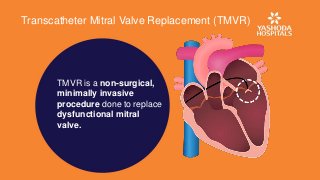
TMVR is a non-surgical,
minimally invasive
procedure done to replace
dysfunctional mitral
valve.
What Are The Indications Of TMVR?
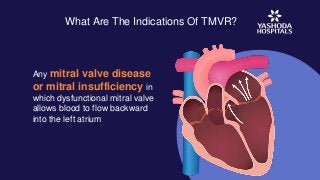
Any mitral valve disease
or mitral insufficiency in
which dysfunctional mitral valve
allows blood to flow backward
into the left atrium
Mitral valve stenosis
Types Of Mitral Valve Diseases
Mitral valve prolapse
Types Of Mitral Valve Diseases
Mitral valve regurgitation
Types Of Mitral Valve Diseases
Mitral Valve Disease Or Mitral Insufficiency
Mitral insufficiency may lead to
• Irregular heart rhythm
• High blood pressure
• Blood clots
• Heart failure
• Stroke
Thus, replacing the dysfunctional mitral valve is beneficial.
Who Are The Candidates For TMVR?
Patients who:
• cannot undergo open-heart
surgery.
• experience mitral stenosis or
mitral regurgitation in a
previously replaced valve.
How Is The Procedure Done?
A small incision is made in
the groin region and an
opening created in the
femoral vein.
A catheter (a thin, hollow
tube) is guided slowly
towards the left atrium
(upper chamber of the
heart), via a transseptal
puncture.
How Is The Procedure Done?
Transcatheter heart valve is
advanced through the
catheter and positioned
along the mitral valve.
How Is The Procedure Done?
Benefits Of TMVR
No need of surgery Shorter hospital stay
(2.9 days on average)
Immediate reduction in
blood flowback
Lesser hospital visits
for heart failure
Lifelong anticoagulant medicine
may not be necessary
Transcatheter Mitral Valve Replacement (TMVR)

Transcatheter Mitral Valve Replacement (TMVR)

  • 1.
  • 2.
    Transcatheter Mitral ValveReplacement (TMVR) TMVR is a non-surgical, minimally invasive procedure done to replace dysfunctional mitral valve.
  • 3.
    What Are TheIndications Of TMVR? Any mitral valve disease or mitral insufficiency in which dysfunctional mitral valve allows blood to flow backward into the left atrium
  • 4.
    Mitral valve stenosis TypesOf Mitral Valve Diseases
  • 5.
    Mitral valve prolapse TypesOf Mitral Valve Diseases
  • 6.
    Mitral valve regurgitation TypesOf Mitral Valve Diseases
  • 7.
    Mitral Valve DiseaseOr Mitral Insufficiency Mitral insufficiency may lead to • Irregular heart rhythm • High blood pressure • Blood clots • Heart failure • Stroke Thus, replacing the dysfunctional mitral valve is beneficial.
  • 8.
    Who Are TheCandidates For TMVR? Patients who: • cannot undergo open-heart surgery. • experience mitral stenosis or mitral regurgitation in a previously replaced valve.
  • 9.
    How Is TheProcedure Done? A small incision is made in the groin region and an opening created in the femoral vein.
  • 10.
    A catheter (athin, hollow tube) is guided slowly towards the left atrium (upper chamber of the heart), via a transseptal puncture. How Is The Procedure Done?
  • 11.
    Transcatheter heart valveis advanced through the catheter and positioned along the mitral valve. How Is The Procedure Done?
  • 12.
    Benefits Of TMVR Noneed of surgery Shorter hospital stay (2.9 days on average) Immediate reduction in blood flowback Lesser hospital visits for heart failure Lifelong anticoagulant medicine may not be necessary