1 of Y
Circular by Design
Driving Circular Innovation
across the Lifecycle of IT
Louise Koch
Corporate Sustainability Lead, EMEA
@LouiseGKoch @Dell4Good #CircularEconomy
2 of Y
Taking a
lifecycle
approach,
driving circular
innovation at
every step.
3
Circular Product design
Driving energy efficiency and
modular design for easy repair
and recyclability
4
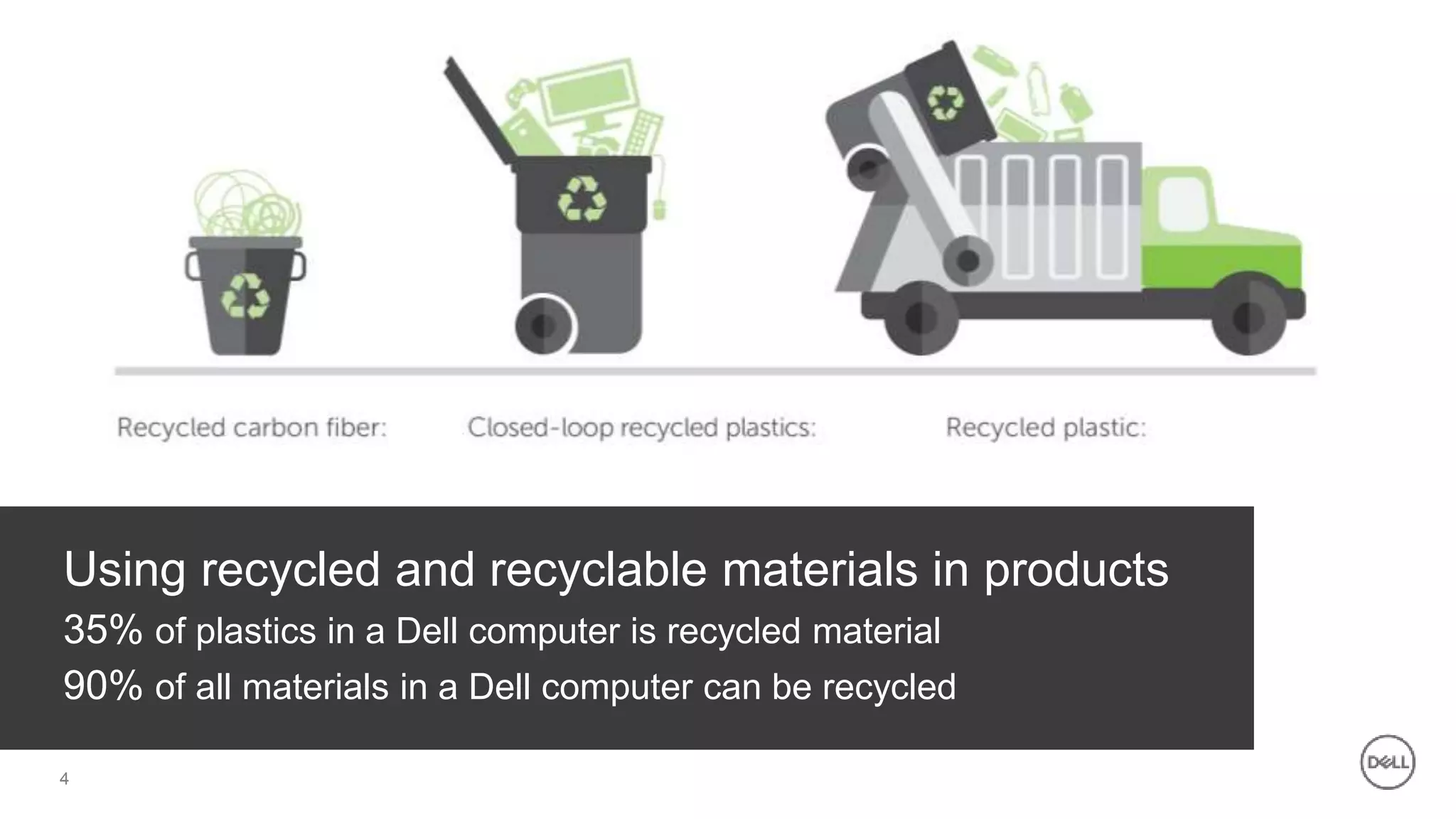
Using recycled and recyclable materials in products
35% of plastics in a Dell computer is recycled material
90% of all materials in a Dell computer can be recycled
5 of Y
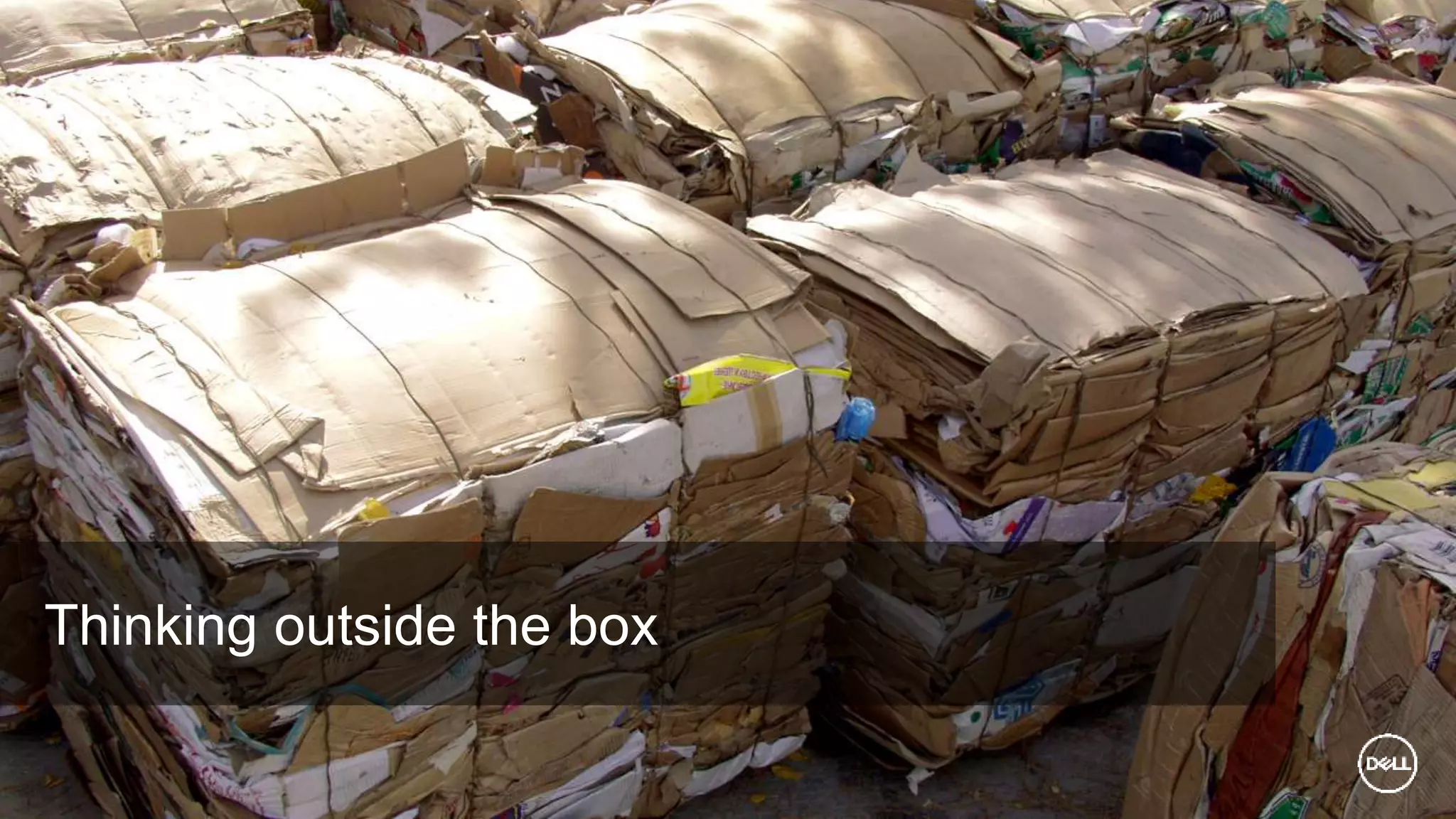
Thinking outside the box
6 of Y
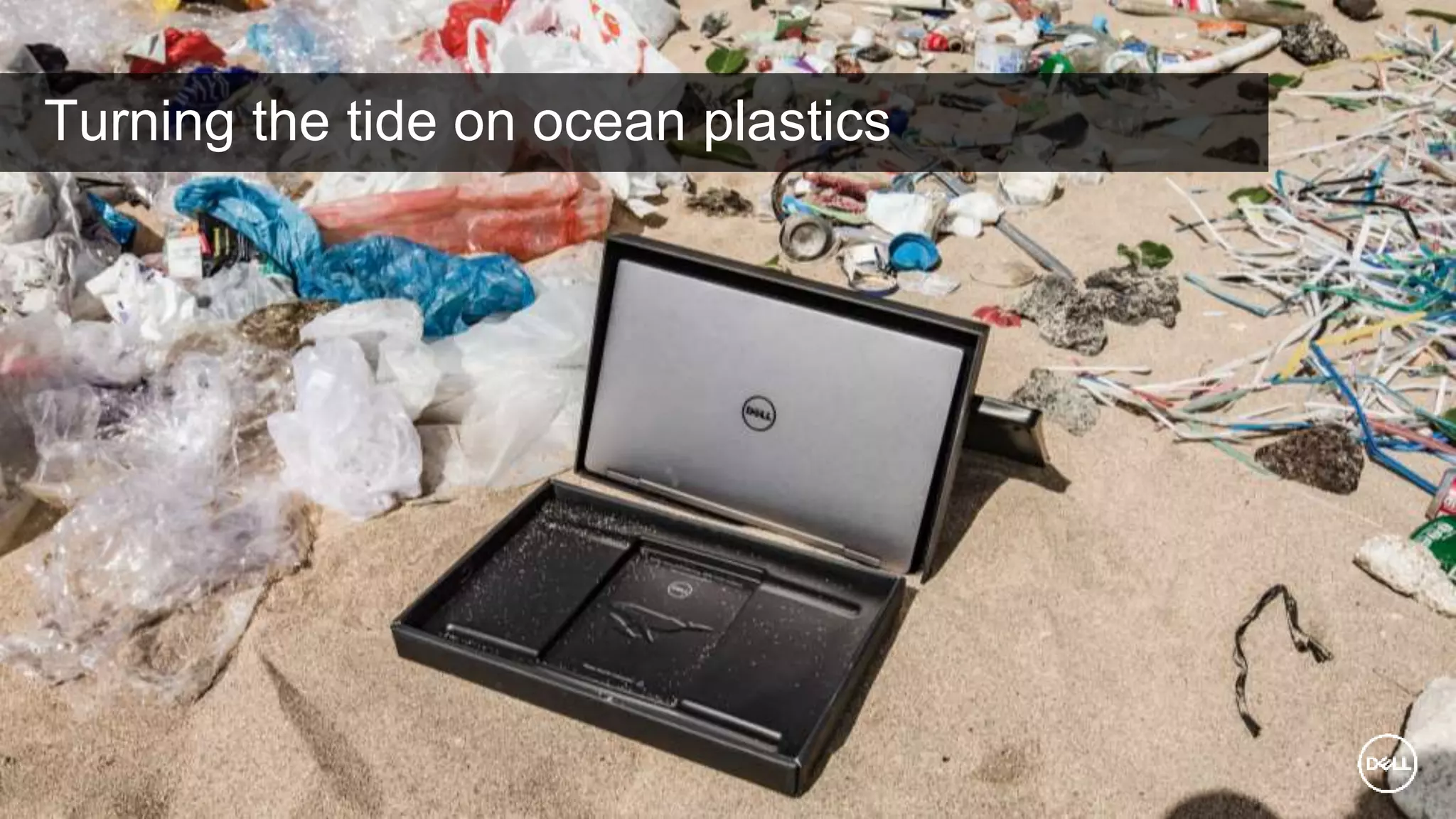
Turning the tide on ocean plastics
7 of Y
Extending product life
© Copyright 2017 Dell Inc.7
8
Giving computers a second life and
providing technology to schools
9 of Y
Closing the loop in electronics
10
Running the world’s largest electronics recycling program
11 of Y
Creating a closed-loop plastics supply chain
12 of Y
Results since 2014
• 5.000 tonnes of closed-loop plastic
• Used across 91 product models.
• Saving USD 1 million in cost
13 of Y
Natural capital benefits of Dell’s closed-loop plastics:
= 44% better than virgin ABS plastic
= $1.3M annually in natural capital benefits
14 of Y
Next steps
• Scale existing efforts
• Expand to other materials
• Collaboration and open-source
15 of Y
Barriers to circular economy:
Gaps in recycling systems and regulations
to keep materials in circular loops
Enabler: Promoting Digital Innovations
In 2030 we will have 1000X more computing power
and Everything & Everybody will be connected....
17
Join us in building
a Legacy of Good
Louise Koch
Louise.Koch@dell.com @LouiseGKoch
Visit: www.dell.com/CSR
Follow us on Twitter: @Dell4Good

Louise Koch World Circular Economy Forum 2017 Helsinki Finland

  • 1.
    1 of Y Circularby Design Driving Circular Innovation across the Lifecycle of IT Louise Koch Corporate Sustainability Lead, EMEA @LouiseGKoch @Dell4Good #CircularEconomy
  • 2.
    2 of Y Takinga lifecycle approach, driving circular innovation at every step.
  • 3.
    3 Circular Product design Drivingenergy efficiency and modular design for easy repair and recyclability
  • 4.
    4 Using recycled andrecyclable materials in products 35% of plastics in a Dell computer is recycled material 90% of all materials in a Dell computer can be recycled
  • 5.
    5 of Y Thinkingoutside the box
  • 6.
    6 of Y Turningthe tide on ocean plastics
  • 7.
    7 of Y Extendingproduct life © Copyright 2017 Dell Inc.7
  • 8.
    8 Giving computers asecond life and providing technology to schools
  • 9.
    9 of Y Closingthe loop in electronics
  • 10.
    10 Running the world’slargest electronics recycling program
  • 11.
    11 of Y Creatinga closed-loop plastics supply chain
  • 12.
    12 of Y Resultssince 2014 • 5.000 tonnes of closed-loop plastic • Used across 91 product models. • Saving USD 1 million in cost
  • 13.
    13 of Y Naturalcapital benefits of Dell’s closed-loop plastics: = 44% better than virgin ABS plastic = $1.3M annually in natural capital benefits
  • 14.
    14 of Y Nextsteps • Scale existing efforts • Expand to other materials • Collaboration and open-source
  • 15.
    15 of Y Barriersto circular economy: Gaps in recycling systems and regulations to keep materials in circular loops
  • 16.
    Enabler: Promoting DigitalInnovations In 2030 we will have 1000X more computing power and Everything & Everybody will be connected....
  • 17.
    17 Join us inbuilding a Legacy of Good Louise Koch Louise.Koch@dell.com @LouiseGKoch Visit: www.dell.com/CSR Follow us on Twitter: @Dell4Good

Editor's Notes

  • #3 With everything we do, we take a systems-level approach to designing, building and delivering the products our customers use, minimizing their environmental impact during use, and ensuring that when they are done, those materials can easily be recovered. Central to our approach is looking at design. Design for reuse, repairability, recyclability [EXPAND] Material selection – choosing recycled content, identifying sustainable materials, limiting harmful chemicals, etc. [EXPAND] These considerations must also come with a balancing of costs – environmental and economic. Sourcing recycled-content plastics then moving them half-way around the world can negate the purpose. You really need to look at the whole system and the impacts throughout. If you’ve succeeded with your design, you make it easier for products to be reused, refurbished and resold – helping to extend their lifetimes as much as possible. Of course, at some point they are done. If we have designed well, it is easy for the recyclers to disassemble and get the most value from the materials they recover. We also look at how to make it easy for our customers to recycle the products. [CLICK]
  • #4 Modularity and easy repair and disassembly Restrictions on chemicals, paints and coatings 43% increased energy efficiency since 2011 Now, let’s focus on how we drive lifecycle thinking and prepare our products for circular business models. There are a number of considerations regardless of how the product works when you’re trying to design with the circular economy in mind: Modularity: the majority of components found inside Dell products are easily removable with standardized parts. This reduces complexity for repairs and makes reuse of various components easier. Easy disassembly: by designing smarter, Dell has cut down on the number of screws in our products and the ones that remain are easier to access and more consistent in type. All parts are easily separable with common tools. This makes repairs easier and disassembly for recycling faster. Minimal glues and adhesives: glues and adhesives can create challenges for repair, reuse and recycling. Dell emphasizes other methods, like innovative snap fits, to accomplish the same design goals while making components more accessible. Restrictions on paints and coatings: Dell prefers integral finishes instead of exterior coatings. Coatings and paints can sometimes interfere with the recycling process or degrade certain plastics. When we do use paints, we choose the lowest impact paints that are also compatible with recycling. This design strategy helped us reduce VOCs in production by 25% (2014-2016). Recyclable materials: Whenever possible, we use materials that can be recycled in our products. Typically, more than 90% of a Dell or Dell EMC product can be recycled. Energy efficiency is a strong driver of our product innovation. As of February 2016, 416 or 90% of our products meet the ENERGY STAR criteria for highly energy efficient technology products. Our overall goal is to reduce energy intensity by 80% in 2020. Today, we are at 43% compared to 2011. Choice of materials is also a driver for eco-design and innovation. Since 2012, we have used 50 mio tons of recycled materials from e.g. water bottles and CD cases in new cases. And 3,400 tons came from our closed-loop recycling of old computer plastic parts.
  • #6  Our goal is to create 100% waste-free packaging by 2020. Today, 93% by weight is made from renewable and/or recyclable materials like bamboo, wheat straw, mushrooms, and ocean plastics. Now, this is the lifecycle journey of a product. Let’s also zoom into another important and sometimes overlooked opportunity for driving resource efficiency and circular economy – packaging! Packaging at Dell is the epitome of our environmental focus, driven by innovation and creativity. This includes looking at bio-based and other alternative materials for creating our packaging in a more sustainable way. Dell has worked with bamboo, mushrooms, wheat straw and even methane emissions to make packaging. The other half of the equation is what you do with it – and part of our waste-free packaging commitment is to have 100% recyclable or compostable packaging by 2020.
  • #7 We have just launched our first product packaging made with ocean plastics. This year we will turn 8 tonnes of ocean-bound plastic into packaging for the XPS 13 2-in-1, with a goal of using 10x that amount by 2025. Every year, 8 million tons of plastics enter our seas. Dell wants to help break this cycle by keeping plastics in the economy and out of the ocean. To those ends, we are processing plastics collected from beaches, waterways and coastal areas and turning them into a new packaging system for the XPS 13 2-in-1 laptop globally. These ocean-bound plastics are mixed with other recycled-content plastics for a tray that is made entirely from recycled materials. And as HDPE, they carry the #2 recycling symbol, making them recyclable in most recycling programs. Our use of recovered ocean-bound plastics is a perfect example of circular design – taking a waste material and bringing it back into the economy. While we recognize this is a small amount of material today, our goal is to scale the project and get other manufacturers to join us. We are working toward a global coalition to drive the use of reclaimed ocean-bound plastics and we have committed to the U.N. that, by 2025, we will use at least 160,000 pounds of ocean-bound plastics per year ourselves. For more information, visit www.dell.com/oceanplastics
  • #8 New technologies like thin clients with an innately longer lifecycle Providing service, support and repair tutorials 800,000 returns processed by Dell Outlet per year 90% are refurbished and resold; the other 10% get recycled
  • #9 In 2016, ABN AMRO donated more than 1,200 systems to over 80 primary schools in Amsterdam Dell handles data wiping, refurbishing and re-installation of computers Program is self-financing through sales of other used IT-equipment At second end-of-life Dell reycles with full itemized reportin In FY17, we helped ABN AMRO donate more than 1,200 systems to over 80 primary schools throughout Amsterdam to foster computer literary and coding curriculum in their public education community. As with all Dell ARR customers, the process begins with Dell collecting and tagging ABN AMRO’s used equipment and then wiping all data. We then refurbish select computers for donation to the City of Amsterdam school district, loading the systems with all necessary educational software. The remaining systems not donated are resold by Dell, and the proceeds fund the donation program (so it’s a self-funding program with no additional cost to ABN AMRO). Dell ARR handles all logistics of donating and delivering the computers to the schools. When the donated systems reach their end-of-life at schools, we collect the used IT and responsibly recycle them to divert from landfills. Dell provides customers with fully itemized reporting of each system’s journey from collection to recycling. This provides critical carbon footprint and social impact metrics for sustainability-minded companies like ABN AMRO.
  • #10  First, let’s consider the problem. Every year, 45.6 million metric tons of electronics fail to get recycled. Representing a value of 197 million USD. Those resources are lost. On a global scale, only 10-15% of electronics sold are recycled properly. According to the organization STEP – or Solving the E-Waste Problem, each year, 45.6 million metric tons of damaged, obsolete or otherwise unwanted electronics go un-recycled. Those resources are lost – buried or otherwise removed from the economy. This is a one-way process. As the global economy grows, we will see increasing pressure on resources and the traditional one-way system of take the resources, make a product, dispose of the product cannot be sustained. There has to be a better way.
  • #11 Operations in 83 countries/territories. 1.76 billion pounds recovered since 2007. Functional products resold or donated to charity. Full traceability of materials. Recycling – We’ve recovered a cumulative 1.76 billion pounds of electronics since 2007 We are well on our way to our 2 billion pound goal, even as technology becomes smaller; this keeps these important resources out of landfills. Our closed-loop recycling efforts put more than 5.3 million pounds of plastics collected through our takeback programs back back into products just this year. The program feeds into 91 different products. This award-winning process has a lower carbon footprint than using virgin plastics – and a slightly lower cost. All products are processed and if they are still functional, the customer can choose to have them resold and get the value back or to donate to a charity of your choice. If products are end of life they are recycled according to highest national standards and with full traceability of materials
  • #12 And that’s where Dell’s closed-loop supply chain comes into play.
  • #13 A lot of innovation at Dell follows a similar pathway of “crawl – walk – run.” We conduct a test to see if something works, we pilot it, and then we scale it across the business if it has value. We are beginning to run with closed-loop See results Perhaps more exciting is the information from a study we did with TruCost to examine the Natural Capital benefits of our closed-loop process. [CLICK]
  • #14 After measuring the net benefit of environmental impacts of the closed-loop plastic compared to traditional virgin plastic, we found that it provides $1.3 million annually in benefits – 44% better than virgin plastic. The closed-loop plastic’s smaller human health and eco-toxicity impacts on the system include: Being 63% better for human health based on toxics produced 65% less use of fossil fuels 42% smaller climate change impact 36% less water pollution created More than 10x less eco-toxicity We believe these are fantastic benefits. But the reality is there is much more that can be done [CLICK]
  • #15 So where do we go from here? The most important thing for Dell is to scale our existing efforts. Of course, that means looking at it from an ecosystem perspective: We want to grow our take-back infrastructure, collecting more materials and having more hubs around the globe We also want to look at other ways we can use the closed-loop plastics in our products. Right now, we have 91 products that use closed-loop plastics, but we know we can expand that to additional product lines. We also need to expand the way we look at using recycled-content materials. We are already looking at how we might make a closed-loop gold process work. As we mentioned, we are still using a lot of recycled-content plastic bought on the market. Together with our closed-loop plastics, that represents 35% of all the plastic used at Dell for products. We are also actively using recycled and rapidly renewable materials in our packaging. Bamboo grows back at up to an inch per hour. We are growing mushrooms in forms to replace foams for certain server shipments. And most recently, we have begun a project that uses recovered ocean-bound plastics for packaging on our XPS 13 2-in-1. Lastly, we recognize we cannot do this by ourselves. Collaboration is key. For the ocean-bound plastics program, for instance, we are building a coalition of like-minded companies to try to scale the use of such plastics in other industries. We also worked with UL Environment to establish a set process for how to “do” closed-loop. And as members of the Ellen MacArthur Foundation’s CE100, we are always looking to collaborate with other companies to further the aims of circular design. [CLICK/DONE]
  • #18 Sustainability is integral to everything we do across Dell. It is integrated throughout the company and at every step of our value chain. We consider people and environment at every step of our value chain and the lifecycle of our products – from design to end-of-life recycling and everything in between: [choose a few highlights from below] Design: Focus on energy efficiency, recyclability and smart material choices. We’re even using recycled plastic and carbon fiber in our new systems. Dell has 416 products qualified to the various ENERGY STAR standards, representing approximately 90 percent of our eligible products. Energy efficiency: Reduced energy intensity across our product portfolio by 43% since 2011 This is part of our goal to reduce energy intensity by 80% by the year 2020. Build: Focus on ensuring good working conditions and reducing emissions via use of renewable energy and eliminating waste 95% of our suppliers are covered by our EICC code of conduct and auditing program. We also work with capacity building of suppliers, workers engagement and full transparency Every year, we invite customer to come and visit factories themselves. Ship: Focus on developing packaging that is 100% waste-free Packaging: 93% of packaging or 7 out of every 10 product shipments arrives in packaging that is recyclable or compostable We use innovative materials, like wheat straw, bamboo and mushrooms as part of our materials portfolio. Our services packaging team reuses boxes often up to 7 times. Our packaging reductions avoided 31.3 million pounds of packaging and saved $53.3 million since 2009 Use: We help our customers deploy green technology that addresses their needs while also meeting their sustainability goals and minimizing operational expenses. We deliver a very large range of products with sustainability certifications. This include our 416 producst with Energy Star as well as a large range of EPEAT certifications In recent years we have invested in getting laptops, desktops and displays certified to the TCO-standard which covers both social and environmental criteria across the lifecycle Also, through virtualization and cloudbased solutions we are enabling our customers to increase effiency and range of performance while reducing energy consumption Recycle: Provide world’s largest recycling programs to take back any brand of used electronics. We take this one step further with our closed-loop efforts, returning recycled plastics to make new parts in the design phase for dozens of new products. We’ve recovered a cumulative 1.6 billion pounds of electronics since 2007 We are well on our way to our 2 billion pound goal, even as technology becomes smaller; this keeps these important resources out of landfills. Our closed-loop recycling efforts have put more than 5 million pounds of plastics collected through our takeback programs back into more than 45 different products. This award-winning process has a lower carbon footprint than using virgin plastics – and a slightly lower cost. Taking this integrated approach has led us to embracing the circular economy. Our closed-loop efforts are a part of this, but transitioning to the circular economy is more than just recycling. We’ve taken a leadership role in helping the world understand how technology can help change systems and drive efficiencies. Donate: We work with non-profits around the world to close the digital divide and empower kids everywhere with critical 21st century skills.