Slide 3.1
Dave Chaffey, E-Business and E-Commerce Management, 4th Edition, © Marketing Insights Limited 2009
E-business infrastructure
Slide 3.2
Dave Chaffey, E-Business and E-Commerce Management, 4th Edition, © Marketing Insights Limited 2009
Learning outcomes
• Outline the hardware and software
technologies used to build an e-business
infrastructure within an organization and with
its partners
• Outline the hardware and software
requirements necessary to enable employee
access to the Internet and hosting of e-
commerce services.
Slide 3.3
Dave Chaffey, E-Business and E-Commerce Management, 4th Edition, © Marketing Insights Limited 2009
Management issues
• What are the practical risks to the
organization of failure to manage e-commerce
infrastructure adequately?
• How should staff access to the Internet
be managed?
• How should we evaluate the relevance of web
services and open source software?
Slide 3.4
Dave Chaffey, E-Business and E-Commerce Management, 4th Edition, © Marketing Insights Limited 2009
Why the jargon?
• Why do business managers need to know
about the jargon and technology?
Slide 3.5
Dave Chaffey, E-Business and E-Commerce Management, 4th Edition, © Marketing Insights Limited 2009
Activity 3.1 Infrastructure risk
assessment
• Make a list of the potential problems for
customers of an online retailer
• You should consider problems faced by users
of e-business applications who are both
internal and external to the organization
• Base your answer on problems you have
experienced on a web site that can be related
to network, hardware and software failures or
problems with data quality
Slide 3.6
Dave Chaffey, E-Business and E-Commerce Management, 4th Edition, © Marketing Insights Limited 2009
Typical problems
• Web site communications too slow
• Web site not available
• Bugs on site through pages being unavailable
or information typed in forms not being
executed
• Ordered products not delivered on time
• E-mails not replied to
• Customers’ privacy or trust is broken through
security problems such as credit cards being
stolen or addresses sold to other companies
Slide 3.7
Dave Chaffey, E-Business and E-Commerce Management, 4th Edition, © Marketing Insights Limited 2009
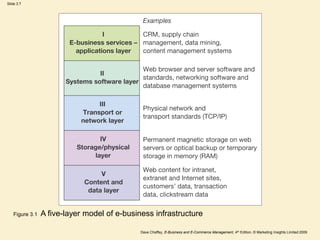
Figure 3.1 A five-layer model of e-business infrastructure
Slide 3.8
Dave Chaffey, E-Business and E-Commerce Management, 4th Edition, © Marketing Insights Limited 2009
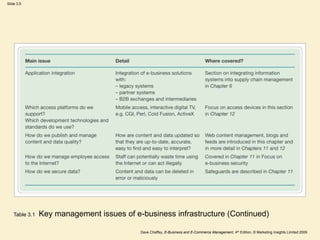
Table 3.1 Key management issues of e-business infrastructure
Slide 3.9
Dave Chaffey, E-Business and E-Commerce Management, 4th Edition, © Marketing Insights Limited 2009
Table 3.1 Key management issues of e-business infrastructure (Continued)
Slide 3.10
Dave Chaffey, E-Business and E-Commerce Management, 4th Edition, © Marketing Insights Limited 2009
Activity – Internet infrastructure
components
• Write down all the different types of hardware
and software involved from when a user types
in a web address such as www.google.com to
the web site being loaded
Slide 3.11
Dave Chaffey, E-Business and E-Commerce Management, 4th Edition, © Marketing Insights Limited 2009
Figure 3.2 Physical and network infrastructure components of the Internet
(Levels IV and III in Figure 3.1)
Slide 3.12
Dave Chaffey, E-Business and E-Commerce Management, 4th Edition, © Marketing Insights Limited 2009
Figure 3.3 Example hosting provider Rackspace (www.rackspace.com)
Slide 3.13
Dave Chaffey, E-Business and E-Commerce Management, 4th Edition, © Marketing Insights Limited 2009
Figure 3.4 Timeline of major developments in the use of the web
Slide 3.14
Dave Chaffey, E-Business and E-Commerce Management, 4th Edition, © Marketing Insights Limited 2009
Figure 3.5 The Netcraft index of number of servers
Source: Netcraft web Server Survey. http://news.netcraft.com/archives/web_server_survey.html. Netcraft
Slide 3.15
Dave Chaffey, E-Business and E-Commerce Management, 4th Edition, © Marketing Insights Limited 2009
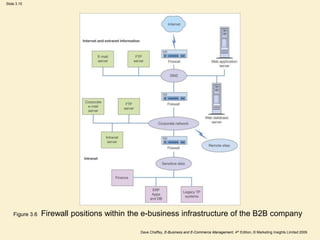
Figure 3.6 Firewall positions within the e-business infrastructure of the B2B company
Slide 3.16
Dave Chaffey, E-Business and E-Commerce Management, 4th Edition, © Marketing Insights Limited 2009
Activity – a common problem with
intranets and extranets
• A B2B Company has found that after an initial
surge of interest in its intranet and extranet,
usage has declined dramatically. The e-
business manager wants to achieve these
aims:
• Increase usage
• Produce more dynamic content
• Encouraging more clients to order (extranet)
• What would you suggest?
Slide 3.17
Dave Chaffey, E-Business and E-Commerce Management, 4th Edition, © Marketing Insights Limited 2009
Suggested answers
• Identify benefits
• Involve staff with development
• Find system sponsors, owners and advocates
• Train on benefits
• Keep content fresh, relevant and where
possible, fun
• Use e-mail to encourage usage
Slide 3.18
Dave Chaffey, E-Business and E-Commerce Management, 4th Edition, © Marketing Insights Limited 2009
Figure 3.8 Transaction log file example
Slide 3.19
Dave Chaffey, E-Business and E-Commerce Management, 4th Edition, © Marketing Insights Limited 2009
Figure 3.9 Browsershots (www.browsershots.org) – a service for testing cross-
browser compatibility
Slide 3.20
Dave Chaffey, E-Business and E-Commerce Management, 4th Edition, © Marketing Insights Limited 2009
Understanding Internet access tools
and concepts – match the definitions
• Atomisation concept
• Blogs
• Feeds
• IPTV
• Peer-to-peer
• Social networks
• Tagging
• VOIP
Slide 3.21
Dave Chaffey, E-Business and E-Commerce Management, 4th Edition, © Marketing Insights Limited 2009
Figure 3.11 Personalized feed home page from iGoogle (www.igoogle.com)
Slide 3.22
Dave Chaffey, E-Business and E-Commerce Management, 4th Edition, © Marketing Insights Limited 2009
Figure 3.12 Joost service
Slide 3.23
Dave Chaffey, E-Business and E-Commerce Management, 4th Edition, © Marketing Insights Limited 2009
URLS and domain names
• Web addresses are structured in a standard way as
follows:
• http://www.domain-name.extension/filename.html
• What do the following extensions or global top level
domains stand for?
– .com
– .co.uk, .uk.com
– .org or .org.uk
– .gov
– .edu, .ac.uk
– .int
– .net
– .biz
– .info
Slide 3.24
Dave Chaffey, E-Business and E-Commerce Management, 4th Edition, © Marketing Insights Limited 2009
Box 3.3. Identify URL components:
http://video.google.co.uk:80/videoplay?docid
=-7246927612831078230&hl=en#00h02m30s
• Protocol
• Host or hostname
• Subdomain
• Domain name
• Top-level domain or TLD
• Second-level domain (SLD)
• The port
• The path
• URL parameter
• Anchor or fragment
Slide 3.25
Dave Chaffey, E-Business and E-Commerce Management, 4th Edition, © Marketing Insights Limited 2009
HTML and XML
• HTML (Hypertext Markup Language)
A standard format used to define the text and
layout of web pages. HTML files usually have
the extension .HTML or .HTM
• XML or eXtensible Markup Language
A standard for transferring structured data,
unlike HTML which is purely presentational
Slide 3.26
Dave Chaffey, E-Business and E-Commerce Management, 4th Edition, © Marketing Insights Limited 2009
Figure 3.13 The TCP/IP protocol
Slide 3.27
Dave Chaffey, E-Business and E-Commerce Management, 4th Edition, © Marketing Insights Limited 2009
Figure 3.14 Home page index.html for an example B2B company in a web browser
showing HTML source in text editor
Slide 3.28
Dave Chaffey, E-Business and E-Commerce Management, 4th Edition, © Marketing Insights Limited 2009
Figure 3.15 Architecture of semantic web system used at EDF
Slide 3.29
Dave Chaffey, E-Business and E-Commerce Management, 4th Edition, © Marketing Insights Limited 2009
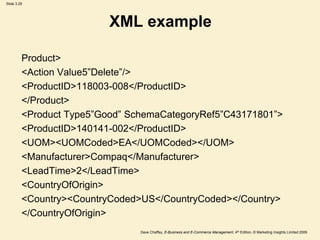
XML example
Product>
<Action Value5”Delete”/>
<ProductID>118003-008</ProductID>
</Product>
<Product Type5”Good” SchemaCategoryRef5”C43171801”>
<ProductID>140141-002</ProductID>
<UOM><UOMCoded>EA</UOMCoded></UOM>
<Manufacturer>Compaq</Manufacturer>
<LeadTime>2</LeadTime>
<CountryOfOrigin>
<Country><CountryCoded>US</CountryCoded></Country>
</CountryOfOrigin>
Slide 3.30
Dave Chaffey, E-Business and E-Commerce Management, 4th Edition, © Marketing Insights Limited 2009
Media standards
• GIF (Graphics Interchange Format) A graphics
format and compression algorithm best used for
simple graphics
• JPEG (Joint Photographics Experts Group) A
graphics format and compression algorithm best
used for photographs
• Streaming media Sound and video that can be
experienced within a web browser before the
whole clip is downloaded e.g. Real Networks .rm
format
• Video standards include MPEG and .AVI
• Sound standards include MP3 and WMA
Slide 3.31
Dave Chaffey, E-Business and E-Commerce Management, 4th Edition, © Marketing Insights Limited 2009
Figure 3.17 (a) Fragmented applications infrastructure, (b) integrated applications
infrastructure
Source: Adapted from Hasselbring (2000)
Slide 3.32
Dave Chaffey, E-Business and E-Commerce Management, 4th Edition, © Marketing Insights Limited 2009
Figure 3.17 (a) Fragmented applications infrastructure, (b) integrated applications
infrastructure (Continued)
Source: Adapted from Hasselbring (2000)
Slide 3.33
Dave Chaffey, E-Business and E-Commerce Management, 4th Edition, © Marketing Insights Limited 2009
Figure 3.18 Differing use of applications at levels of management within companies
Slide 3.34
Dave Chaffey, E-Business and E-Commerce Management, 4th Edition, © Marketing Insights Limited 2009
Figure 3.19 Elements of e-business infrastructure that require management
Slide 3.35
Dave Chaffey, E-Business and E-Commerce Management, 4th Edition, © Marketing Insights Limited 2009
Figure 3.20 Google apps (www.google.com/apps)
Slide 3.36
Dave Chaffey, E-Business and E-Commerce Management, 4th Edition, © Marketing Insights Limited 2009
Figure 3.21 Salesforce.com (www.salesforce.com)

chapter_3.ppt

  • 1.
    Slide 3.1 Dave Chaffey,E-Business and E-Commerce Management, 4th Edition, © Marketing Insights Limited 2009 E-business infrastructure
  • 2.
    Slide 3.2 Dave Chaffey,E-Business and E-Commerce Management, 4th Edition, © Marketing Insights Limited 2009 Learning outcomes • Outline the hardware and software technologies used to build an e-business infrastructure within an organization and with its partners • Outline the hardware and software requirements necessary to enable employee access to the Internet and hosting of e- commerce services.
  • 3.
    Slide 3.3 Dave Chaffey,E-Business and E-Commerce Management, 4th Edition, © Marketing Insights Limited 2009 Management issues • What are the practical risks to the organization of failure to manage e-commerce infrastructure adequately? • How should staff access to the Internet be managed? • How should we evaluate the relevance of web services and open source software?
  • 4.
    Slide 3.4 Dave Chaffey,E-Business and E-Commerce Management, 4th Edition, © Marketing Insights Limited 2009 Why the jargon? • Why do business managers need to know about the jargon and technology?
  • 5.
    Slide 3.5 Dave Chaffey,E-Business and E-Commerce Management, 4th Edition, © Marketing Insights Limited 2009 Activity 3.1 Infrastructure risk assessment • Make a list of the potential problems for customers of an online retailer • You should consider problems faced by users of e-business applications who are both internal and external to the organization • Base your answer on problems you have experienced on a web site that can be related to network, hardware and software failures or problems with data quality
  • 6.
    Slide 3.6 Dave Chaffey,E-Business and E-Commerce Management, 4th Edition, © Marketing Insights Limited 2009 Typical problems • Web site communications too slow • Web site not available • Bugs on site through pages being unavailable or information typed in forms not being executed • Ordered products not delivered on time • E-mails not replied to • Customers’ privacy or trust is broken through security problems such as credit cards being stolen or addresses sold to other companies
  • 7.
    Slide 3.7 Dave Chaffey,E-Business and E-Commerce Management, 4th Edition, © Marketing Insights Limited 2009 Figure 3.1 A five-layer model of e-business infrastructure
  • 8.
    Slide 3.8 Dave Chaffey,E-Business and E-Commerce Management, 4th Edition, © Marketing Insights Limited 2009 Table 3.1 Key management issues of e-business infrastructure
  • 9.
    Slide 3.9 Dave Chaffey,E-Business and E-Commerce Management, 4th Edition, © Marketing Insights Limited 2009 Table 3.1 Key management issues of e-business infrastructure (Continued)
  • 10.
    Slide 3.10 Dave Chaffey,E-Business and E-Commerce Management, 4th Edition, © Marketing Insights Limited 2009 Activity – Internet infrastructure components • Write down all the different types of hardware and software involved from when a user types in a web address such as www.google.com to the web site being loaded
  • 11.
    Slide 3.11 Dave Chaffey,E-Business and E-Commerce Management, 4th Edition, © Marketing Insights Limited 2009 Figure 3.2 Physical and network infrastructure components of the Internet (Levels IV and III in Figure 3.1)
  • 12.
    Slide 3.12 Dave Chaffey,E-Business and E-Commerce Management, 4th Edition, © Marketing Insights Limited 2009 Figure 3.3 Example hosting provider Rackspace (www.rackspace.com)
  • 13.
    Slide 3.13 Dave Chaffey,E-Business and E-Commerce Management, 4th Edition, © Marketing Insights Limited 2009 Figure 3.4 Timeline of major developments in the use of the web
  • 14.
    Slide 3.14 Dave Chaffey,E-Business and E-Commerce Management, 4th Edition, © Marketing Insights Limited 2009 Figure 3.5 The Netcraft index of number of servers Source: Netcraft web Server Survey. http://news.netcraft.com/archives/web_server_survey.html. Netcraft
  • 15.
    Slide 3.15 Dave Chaffey,E-Business and E-Commerce Management, 4th Edition, © Marketing Insights Limited 2009 Figure 3.6 Firewall positions within the e-business infrastructure of the B2B company
  • 16.
    Slide 3.16 Dave Chaffey,E-Business and E-Commerce Management, 4th Edition, © Marketing Insights Limited 2009 Activity – a common problem with intranets and extranets • A B2B Company has found that after an initial surge of interest in its intranet and extranet, usage has declined dramatically. The e- business manager wants to achieve these aims: • Increase usage • Produce more dynamic content • Encouraging more clients to order (extranet) • What would you suggest?
  • 17.
    Slide 3.17 Dave Chaffey,E-Business and E-Commerce Management, 4th Edition, © Marketing Insights Limited 2009 Suggested answers • Identify benefits • Involve staff with development • Find system sponsors, owners and advocates • Train on benefits • Keep content fresh, relevant and where possible, fun • Use e-mail to encourage usage
  • 18.
    Slide 3.18 Dave Chaffey,E-Business and E-Commerce Management, 4th Edition, © Marketing Insights Limited 2009 Figure 3.8 Transaction log file example
  • 19.
    Slide 3.19 Dave Chaffey,E-Business and E-Commerce Management, 4th Edition, © Marketing Insights Limited 2009 Figure 3.9 Browsershots (www.browsershots.org) – a service for testing cross- browser compatibility
  • 20.
    Slide 3.20 Dave Chaffey,E-Business and E-Commerce Management, 4th Edition, © Marketing Insights Limited 2009 Understanding Internet access tools and concepts – match the definitions • Atomisation concept • Blogs • Feeds • IPTV • Peer-to-peer • Social networks • Tagging • VOIP
  • 21.
    Slide 3.21 Dave Chaffey,E-Business and E-Commerce Management, 4th Edition, © Marketing Insights Limited 2009 Figure 3.11 Personalized feed home page from iGoogle (www.igoogle.com)
  • 22.
    Slide 3.22 Dave Chaffey,E-Business and E-Commerce Management, 4th Edition, © Marketing Insights Limited 2009 Figure 3.12 Joost service
  • 23.
    Slide 3.23 Dave Chaffey,E-Business and E-Commerce Management, 4th Edition, © Marketing Insights Limited 2009 URLS and domain names • Web addresses are structured in a standard way as follows: • http://www.domain-name.extension/filename.html • What do the following extensions or global top level domains stand for? – .com – .co.uk, .uk.com – .org or .org.uk – .gov – .edu, .ac.uk – .int – .net – .biz – .info
  • 24.
    Slide 3.24 Dave Chaffey,E-Business and E-Commerce Management, 4th Edition, © Marketing Insights Limited 2009 Box 3.3. Identify URL components: http://video.google.co.uk:80/videoplay?docid =-7246927612831078230&hl=en#00h02m30s • Protocol • Host or hostname • Subdomain • Domain name • Top-level domain or TLD • Second-level domain (SLD) • The port • The path • URL parameter • Anchor or fragment
  • 25.
    Slide 3.25 Dave Chaffey,E-Business and E-Commerce Management, 4th Edition, © Marketing Insights Limited 2009 HTML and XML • HTML (Hypertext Markup Language) A standard format used to define the text and layout of web pages. HTML files usually have the extension .HTML or .HTM • XML or eXtensible Markup Language A standard for transferring structured data, unlike HTML which is purely presentational
  • 26.
    Slide 3.26 Dave Chaffey,E-Business and E-Commerce Management, 4th Edition, © Marketing Insights Limited 2009 Figure 3.13 The TCP/IP protocol
  • 27.
    Slide 3.27 Dave Chaffey,E-Business and E-Commerce Management, 4th Edition, © Marketing Insights Limited 2009 Figure 3.14 Home page index.html for an example B2B company in a web browser showing HTML source in text editor
  • 28.
    Slide 3.28 Dave Chaffey,E-Business and E-Commerce Management, 4th Edition, © Marketing Insights Limited 2009 Figure 3.15 Architecture of semantic web system used at EDF
  • 29.
    Slide 3.29 Dave Chaffey,E-Business and E-Commerce Management, 4th Edition, © Marketing Insights Limited 2009 XML example Product> <Action Value5”Delete”/> <ProductID>118003-008</ProductID> </Product> <Product Type5”Good” SchemaCategoryRef5”C43171801”> <ProductID>140141-002</ProductID> <UOM><UOMCoded>EA</UOMCoded></UOM> <Manufacturer>Compaq</Manufacturer> <LeadTime>2</LeadTime> <CountryOfOrigin> <Country><CountryCoded>US</CountryCoded></Country> </CountryOfOrigin>
  • 30.
    Slide 3.30 Dave Chaffey,E-Business and E-Commerce Management, 4th Edition, © Marketing Insights Limited 2009 Media standards • GIF (Graphics Interchange Format) A graphics format and compression algorithm best used for simple graphics • JPEG (Joint Photographics Experts Group) A graphics format and compression algorithm best used for photographs • Streaming media Sound and video that can be experienced within a web browser before the whole clip is downloaded e.g. Real Networks .rm format • Video standards include MPEG and .AVI • Sound standards include MP3 and WMA
  • 31.
    Slide 3.31 Dave Chaffey,E-Business and E-Commerce Management, 4th Edition, © Marketing Insights Limited 2009 Figure 3.17 (a) Fragmented applications infrastructure, (b) integrated applications infrastructure Source: Adapted from Hasselbring (2000)
  • 32.
    Slide 3.32 Dave Chaffey,E-Business and E-Commerce Management, 4th Edition, © Marketing Insights Limited 2009 Figure 3.17 (a) Fragmented applications infrastructure, (b) integrated applications infrastructure (Continued) Source: Adapted from Hasselbring (2000)
  • 33.
    Slide 3.33 Dave Chaffey,E-Business and E-Commerce Management, 4th Edition, © Marketing Insights Limited 2009 Figure 3.18 Differing use of applications at levels of management within companies
  • 34.
    Slide 3.34 Dave Chaffey,E-Business and E-Commerce Management, 4th Edition, © Marketing Insights Limited 2009 Figure 3.19 Elements of e-business infrastructure that require management
  • 35.
    Slide 3.35 Dave Chaffey,E-Business and E-Commerce Management, 4th Edition, © Marketing Insights Limited 2009 Figure 3.20 Google apps (www.google.com/apps)
  • 36.
    Slide 3.36 Dave Chaffey,E-Business and E-Commerce Management, 4th Edition, © Marketing Insights Limited 2009 Figure 3.21 Salesforce.com (www.salesforce.com)