Dr. Hassan Ashraf
Assistant Professor_ Civil Engineering Department _ CU
Islamabad _ Wah Campus
Sequence 1_ Basic Concepts_
Engineering Economics
1
Types of Decisions
2
Dr. Hassan Ashraf _ Civil Engineering Department_ CU Islamabad _ Wah Campus
Types of decisions engineers take while working on projects:
1. Manufacturing/Execution related decisions.
2. Marketing related decisions.
3. Financing related decisions.
4. Economic decisions.
It is this fourth type that our course is related with.
Types of Decisions
3
Dr. Hassan Ashraf _ Civil Engineering Department_ CU Islamabad _ Wah Campus
One of the important tasks of an engineer is to do with the selection of
machinery that could help in transforming the design into reality.
We, therefore, have to keep the capital expense on the procurement of
equipment in perspective.
However, the capital expenditure does not only provide the complete
picture while taking the decision about the procurement of equipment.
It is the expected amount of rents/revenue which will be generated and
the expenses which will be incurred in maintaining the equipment.
Taking into account both revenues and expenses will help us in taking
the procurement decision.
Basic Concepts
4
Dr. Hassan Ashraf _ Civil Engineering Department_ CU Islamabad _ Wah Campus
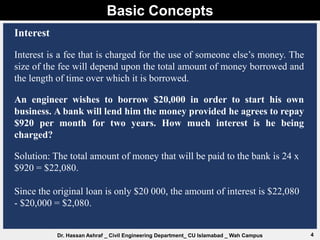
Interest
Interest is a fee that is charged for the use of someone else’s money. The
size of the fee will depend upon the total amount of money borrowed and
the length of time over which it is borrowed.
An engineer wishes to borrow $20,000 in order to start his own
business. A bank will lend him the money provided he agrees to repay
$920 per month for two years. How much interest is he being
charged?
Solution: The total amount of money that will be paid to the bank is 24 x
$920 = $22,080.
Since the original loan is only $20 000, the amount of interest is $22,080
- $20,000 = $2,080.
Basic Concepts
5
Dr. Hassan Ashraf _ Civil Engineering Department_ CU Islamabad _ Wah Campus
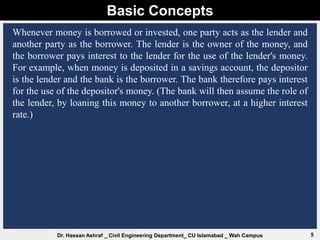
Whenever money is borrowed or invested, one party acts as the lender and
another party as the borrower. The lender is the owner of the money, and
the borrower pays interest to the lender for the use of the lender's money.
For example, when money is deposited in a savings account, the depositor
is the lender and the bank is the borrower. The bank therefore pays interest
for the use of the depositor's money. (The bank will then assume the role of
the lender, by loaning this money to another borrower, at a higher interest
rate.)
Interest Rate
6
Dr. Hassan Ashraf _ Civil Engineering Department_ CU Islamabad _ Wah Campus
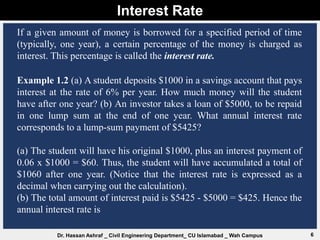
If a given amount of money is borrowed for a specified period of time
(typically, one year), a certain percentage of the money is charged as
interest. This percentage is called the interest rate.
Example 1.2 (a) A student deposits $1000 in a savings account that pays
interest at the rate of 6% per year. How much money will the student
have after one year? (b) An investor takes a loan of $5000, to be repaid
in one lump sum at the end of one year. What annual interest rate
corresponds to a lump-sum payment of $5425?
(a) The student will have his original $1000, plus an interest payment of
0.06 x $1000 = $60. Thus, the student will have accumulated a total of
$1060 after one year. (Notice that the interest rate is expressed as a
decimal when carrying out the calculation).
(b) The total amount of interest paid is $5425 - $5000 = $425. Hence the
annual interest rate is
Interest Rate
7
Dr. Hassan Ashraf _ Civil Engineering Department_ CU Islamabad _ Wah Campus
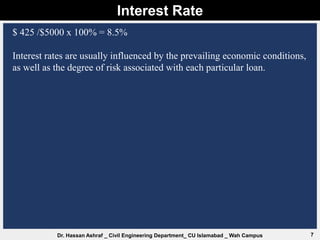
$ 425 /$5000 x 100% = 8.5%
Interest rates are usually influenced by the prevailing economic conditions,
as well as the degree of risk associated with each particular loan.
Simple Interest
8
Dr. Hassan Ashraf _ Civil Engineering Department_ CU Islamabad _ Wah Campus
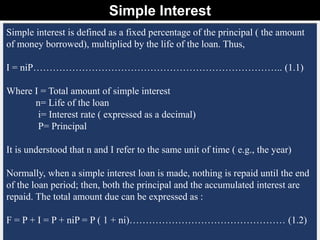
Simple interest is defined as a fixed percentage of the principal ( the amount
of money borrowed), multiplied by the life of the loan. Thus,
I = niP………………………………………………………………….. (1.1)
Where I = Total amount of simple interest
n= Life of the loan
i= Interest rate ( expressed as a decimal)
P= Principal
It is understood that n and I refer to the same unit of time ( e.g., the year)
Normally, when a simple interest loan is made, nothing is repaid until the end
of the loan period; then, both the principal and the accumulated interest are
repaid. The total amount due can be expressed as :
F = P + I = P + niP = P ( 1 + ni)………………………………………… (1.2)
Simple Interest
9
Dr. Hassan Ashraf _ Civil Engineering Department_ CU Islamabad _ Wah Campus
Example 1.3 student borrows $3000 from his uncle in order to finish
school. His uncle agrees to charge him simple interest at the rate of 5.5%
per year. Suppose the student waits two years and then repays the entire
loan. How much will he have to repay?
Using the equation above:
F = $3000[1+ (2)(0.055)] = $3330.
Compound Interest
10
Dr. Hassan Ashraf _ Civil Engineering Department_ CU Islamabad _ Wah Campus
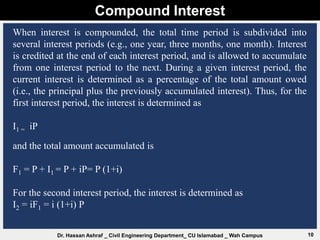
When interest is compounded, the total time period is subdivided into
several interest periods (e.g., one year, three months, one month). Interest
is credited at the end of each interest period, and is allowed to accumulate
from one interest period to the next. During a given interest period, the
current interest is determined as a percentage of the total amount owed
(i.e., the principal plus the previously accumulated interest). Thus, for the
first interest period, the interest is determined as
I1 = iP
and the total amount accumulated is
F1 = P + I1 = P + iP= P (1+i)
For the second interest period, the interest is determined as
I2 = iF1 = i (1+i) P
Compound Interest
11
Dr. Hassan Ashraf _ Civil Engineering Department_ CU Islamabad _ Wah Campus
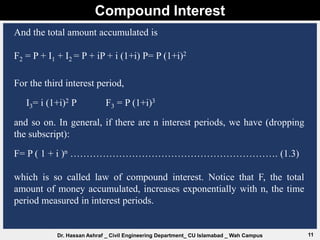
And the total amount accumulated is
F2 = P + I1 + I2 = P + iP + i (1+i) P= P (1+i)2
For the third interest period,
I3= i (1+i)2 P F3 = P (1+i)3
and so on. In general, if there are n interest periods, we have (dropping
the subscript):
F= P ( 1 + i )n ………………………………………………………. (1.3)
which is so called law of compound interest. Notice that F, the total
amount of money accumulated, increases exponentially with n, the time
period measured in interest periods.
Compound Interest
12
Dr. Hassan Ashraf _ Civil Engineering Department_ CU Islamabad _ Wah Campus
Example 1.4
A student deposits $1000 in a savings account that pays interest at the rate of
6% per year, compounded annually. If all of the money is allowed to
accumulate, how much will the student have after 12
years? Compare this with the amount that would have accumulated if simple
interest had been paid.
F = $1000(1+ 0.06)12 = $2012.20
Thus, the student's original investment will have more than doubled over the
12-year period.
If simple interest had been paid, the total amount that would have
accumulated is determined by (1.2) as
F = $1000[1+ (12)(0.06)] = $1720.00
Time Value of Money
13
Dr. Hassan Ashraf _ Civil Engineering Department_ CU Islamabad _ Wah Campus
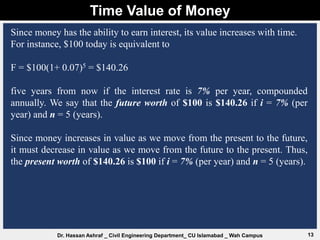
Since money has the ability to earn interest, its value increases with time.
For instance, $100 today is equivalent to
F = $100(1+ 0.07)5 = $140.26
five years from now if the interest rate is 7% per year, compounded
annually. We say that the future worth of $100 is $140.26 if i = 7% (per
year) and n = 5 (years).
Since money increases in value as we move from the present to the future,
it must decrease in value as we move from the future to the present. Thus,
the present worth of $140.26 is $100 if i = 7% (per year) and n = 5 (years).
Time Value of Money
14
Dr. Hassan Ashraf _ Civil Engineering Department_ CU Islamabad _ Wah Campus
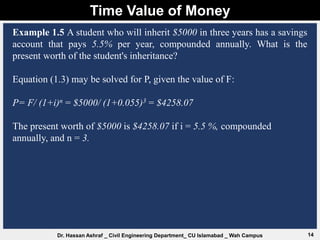
Example 1.5 A student who will inherit $5000 in three years has a savings
account that pays 5.5% per year, compounded annually. What is the
present worth of the student's inheritance?
Equation (1.3) may be solved for P, given the value of F:
P= F/ (1+i)n = $5000/ (1+0.055)3 = $4258.07
The present worth of $5000 is $4258.07 if i = 5.5 %, compounded
annually, and n = 3.
15
Dr. Hassan Ashraf _ Civil Engineering Department_ CU Islamabad _ Wah Campus
Thank You

01_Basic Concepts_15_09_2022.pptx

  • 1.
    Dr. Hassan Ashraf AssistantProfessor_ Civil Engineering Department _ CU Islamabad _ Wah Campus Sequence 1_ Basic Concepts_ Engineering Economics 1
  • 2.
    Types of Decisions 2 Dr.Hassan Ashraf _ Civil Engineering Department_ CU Islamabad _ Wah Campus Types of decisions engineers take while working on projects: 1. Manufacturing/Execution related decisions. 2. Marketing related decisions. 3. Financing related decisions. 4. Economic decisions. It is this fourth type that our course is related with.
  • 3.
    Types of Decisions 3 Dr.Hassan Ashraf _ Civil Engineering Department_ CU Islamabad _ Wah Campus One of the important tasks of an engineer is to do with the selection of machinery that could help in transforming the design into reality. We, therefore, have to keep the capital expense on the procurement of equipment in perspective. However, the capital expenditure does not only provide the complete picture while taking the decision about the procurement of equipment. It is the expected amount of rents/revenue which will be generated and the expenses which will be incurred in maintaining the equipment. Taking into account both revenues and expenses will help us in taking the procurement decision.
  • 4.
    Basic Concepts 4 Dr. HassanAshraf _ Civil Engineering Department_ CU Islamabad _ Wah Campus Interest Interest is a fee that is charged for the use of someone else’s money. The size of the fee will depend upon the total amount of money borrowed and the length of time over which it is borrowed. An engineer wishes to borrow $20,000 in order to start his own business. A bank will lend him the money provided he agrees to repay $920 per month for two years. How much interest is he being charged? Solution: The total amount of money that will be paid to the bank is 24 x $920 = $22,080. Since the original loan is only $20 000, the amount of interest is $22,080 - $20,000 = $2,080.
  • 5.
    Basic Concepts 5 Dr. HassanAshraf _ Civil Engineering Department_ CU Islamabad _ Wah Campus Whenever money is borrowed or invested, one party acts as the lender and another party as the borrower. The lender is the owner of the money, and the borrower pays interest to the lender for the use of the lender's money. For example, when money is deposited in a savings account, the depositor is the lender and the bank is the borrower. The bank therefore pays interest for the use of the depositor's money. (The bank will then assume the role of the lender, by loaning this money to another borrower, at a higher interest rate.)
  • 6.
    Interest Rate 6 Dr. HassanAshraf _ Civil Engineering Department_ CU Islamabad _ Wah Campus If a given amount of money is borrowed for a specified period of time (typically, one year), a certain percentage of the money is charged as interest. This percentage is called the interest rate. Example 1.2 (a) A student deposits $1000 in a savings account that pays interest at the rate of 6% per year. How much money will the student have after one year? (b) An investor takes a loan of $5000, to be repaid in one lump sum at the end of one year. What annual interest rate corresponds to a lump-sum payment of $5425? (a) The student will have his original $1000, plus an interest payment of 0.06 x $1000 = $60. Thus, the student will have accumulated a total of $1060 after one year. (Notice that the interest rate is expressed as a decimal when carrying out the calculation). (b) The total amount of interest paid is $5425 - $5000 = $425. Hence the annual interest rate is
  • 7.
    Interest Rate 7 Dr. HassanAshraf _ Civil Engineering Department_ CU Islamabad _ Wah Campus $ 425 /$5000 x 100% = 8.5% Interest rates are usually influenced by the prevailing economic conditions, as well as the degree of risk associated with each particular loan.
  • 8.
    Simple Interest 8 Dr. HassanAshraf _ Civil Engineering Department_ CU Islamabad _ Wah Campus Simple interest is defined as a fixed percentage of the principal ( the amount of money borrowed), multiplied by the life of the loan. Thus, I = niP………………………………………………………………….. (1.1) Where I = Total amount of simple interest n= Life of the loan i= Interest rate ( expressed as a decimal) P= Principal It is understood that n and I refer to the same unit of time ( e.g., the year) Normally, when a simple interest loan is made, nothing is repaid until the end of the loan period; then, both the principal and the accumulated interest are repaid. The total amount due can be expressed as : F = P + I = P + niP = P ( 1 + ni)………………………………………… (1.2)
  • 9.
    Simple Interest 9 Dr. HassanAshraf _ Civil Engineering Department_ CU Islamabad _ Wah Campus Example 1.3 student borrows $3000 from his uncle in order to finish school. His uncle agrees to charge him simple interest at the rate of 5.5% per year. Suppose the student waits two years and then repays the entire loan. How much will he have to repay? Using the equation above: F = $3000[1+ (2)(0.055)] = $3330.
  • 10.
    Compound Interest 10 Dr. HassanAshraf _ Civil Engineering Department_ CU Islamabad _ Wah Campus When interest is compounded, the total time period is subdivided into several interest periods (e.g., one year, three months, one month). Interest is credited at the end of each interest period, and is allowed to accumulate from one interest period to the next. During a given interest period, the current interest is determined as a percentage of the total amount owed (i.e., the principal plus the previously accumulated interest). Thus, for the first interest period, the interest is determined as I1 = iP and the total amount accumulated is F1 = P + I1 = P + iP= P (1+i) For the second interest period, the interest is determined as I2 = iF1 = i (1+i) P
  • 11.
    Compound Interest 11 Dr. HassanAshraf _ Civil Engineering Department_ CU Islamabad _ Wah Campus And the total amount accumulated is F2 = P + I1 + I2 = P + iP + i (1+i) P= P (1+i)2 For the third interest period, I3= i (1+i)2 P F3 = P (1+i)3 and so on. In general, if there are n interest periods, we have (dropping the subscript): F= P ( 1 + i )n ………………………………………………………. (1.3) which is so called law of compound interest. Notice that F, the total amount of money accumulated, increases exponentially with n, the time period measured in interest periods.
  • 12.
    Compound Interest 12 Dr. HassanAshraf _ Civil Engineering Department_ CU Islamabad _ Wah Campus Example 1.4 A student deposits $1000 in a savings account that pays interest at the rate of 6% per year, compounded annually. If all of the money is allowed to accumulate, how much will the student have after 12 years? Compare this with the amount that would have accumulated if simple interest had been paid. F = $1000(1+ 0.06)12 = $2012.20 Thus, the student's original investment will have more than doubled over the 12-year period. If simple interest had been paid, the total amount that would have accumulated is determined by (1.2) as F = $1000[1+ (12)(0.06)] = $1720.00
  • 13.
    Time Value ofMoney 13 Dr. Hassan Ashraf _ Civil Engineering Department_ CU Islamabad _ Wah Campus Since money has the ability to earn interest, its value increases with time. For instance, $100 today is equivalent to F = $100(1+ 0.07)5 = $140.26 five years from now if the interest rate is 7% per year, compounded annually. We say that the future worth of $100 is $140.26 if i = 7% (per year) and n = 5 (years). Since money increases in value as we move from the present to the future, it must decrease in value as we move from the future to the present. Thus, the present worth of $140.26 is $100 if i = 7% (per year) and n = 5 (years).
  • 14.
    Time Value ofMoney 14 Dr. Hassan Ashraf _ Civil Engineering Department_ CU Islamabad _ Wah Campus Example 1.5 A student who will inherit $5000 in three years has a savings account that pays 5.5% per year, compounded annually. What is the present worth of the student's inheritance? Equation (1.3) may be solved for P, given the value of F: P= F/ (1+i)n = $5000/ (1+0.055)3 = $4258.07 The present worth of $5000 is $4258.07 if i = 5.5 %, compounded annually, and n = 3.
  • 15.
    15 Dr. Hassan Ashraf_ Civil Engineering Department_ CU Islamabad _ Wah Campus Thank You