1
CHAPTER: 1
1.1. Introduction water jet
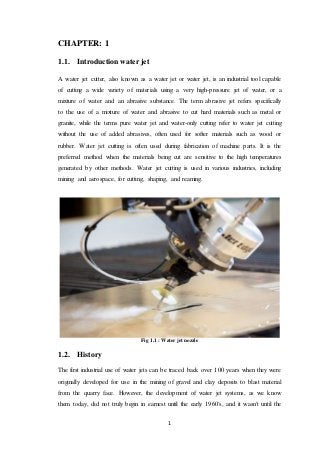
A water jet cutter, also known as a water jet or water jet, is an industrial tool capable
of cutting a wide variety of materials using a very high-pressure jet of water, or a
mixture of water and an abrasive substance. The term abrasive jet refers specifically
to the use of a mixture of water and abrasive to cut hard materials such as metal or
granite, while the terms pure water jet and water-only cutting refer to water jet cutting
without the use of added abrasives, often used for softer materials such as wood or
rubber. Water jet cutting is often used during fabrication of machine parts. It is the
preferred method when the materials being cut are sensitive to the high temperatures
generated by other methods. Water jet cutting is used in various industries, including
mining and aerospace, for cutting, shaping, and reaming.
Fig 1.1 : Water jet nozzle
1.2. History
The first industrial use of water jets can be traced back over 100 years when they were
originally developed for use in the mining of gravel and clay deposits to blast material
from the quarry face. However, the development of water jet systems, as we know
them today, did not truly begin in earnest until the early 1960's, and it wasn't until the
2
1970's that the first useable systems began to appear. In 1971 the very first
commercially useable water jet cutting system was installed for the Alton Box Board
Company, a cardboard box manufacturing facility. Known as the "Fluid Jet Cutting
System", it eliminated the use of commercial saws, and was designed for the contour
cutting of furniture packing forms for the Paper tube Division in Jackson, TN, USA.
1.2.1. Water jet
While using high-pressure water for erosion dates back as far as the mid-1800s
with hydraulic mining, it was not until the 1930s that narrow jets of water started to
appear as an industrial cutting device. In 1933, the Paper Patents Company in
Wisconsin developed a paper metering, cutting, and reeling machine that used a
diagonally moving water jet nozzle to cut a horizontally moving sheet of continuous
paper. These early applications were at a low pressure and restricted to soft materials
like paper.
Water jet technology evolved in the post-war era as researchers around the world
searched for new methods of efficient cutting systems. In 1956, Carl Johnson of
Durox International in Luxembourg developed a method for cutting plastic shapes
using a thin stream high-pressure water jet, but those materials, like paper, were soft
materials. In 1958, Billie Schwacha of North American Aviation developed a system
using ultra-high-pressure liquid to cut hard materials. This system used a 100,000 psi
(690 MPa) pump to deliver a hypersonic liquid jet that could cut high strength alloys
such as PH15-7-MO stainless steel. Used as a honeycomb laminate on the Mach
3 North American XB-70 Valkyrie, this cutting method resulted in delaminating at
high speed, requiring changes to the manufacturing process.
While not effective for the XB-70 project, the concept was valid and further research
continued to evolve water jet cutting. In 1962, Philip Rice of Union Carbide explored
using a pulsing water jet at up to 50,000 psi (340 MPa) to cut metals, stone, and other
materials. Research by S.J. Leach and G.L. Walker in the mid-1960s expanded on
traditional coal water jet cutting to determine ideal nozzle shape for high-pressure
water jet cutting of stone, and Norman Franz in the late 1960s focused on water jet
cutting of soft materials by dissolving long chain polymers in the water to improve the
cohesiveness of the jet stream. In the early 1970s, the desire to improve the durability
of the water jet nozzle led Ray Chadwick, Michael Kurko, and Joseph Corriveau of
3
the Bendix Corporation to come up with the idea of using corundum crystal to form a
water jet orifice, while Norman Franz expanded on this and created a water jet nozzle
with an orifice as small as 0.002 inches (0.051 mm) that operated at pressures up to
70,000 psi (480 MPa).
John Olsen, along with George Hurlburt and Louis Kapcsandy at Flow Research (later
Flow Industries), further improved the commercial potential of the water jet by
showing that treating the water beforehand could increase the operational life of the
nozzle.
1.2.2. High pressure
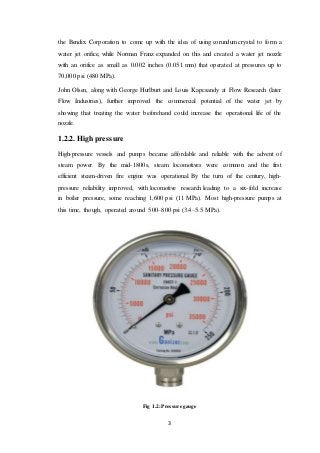
High-pressure vessels and pumps became affordable and reliable with the advent of
steam power. By the mid-1800s, steam locomotives were common and the first
efficient steam-driven fire engine was operational. By the turn of the century, high-
pressure reliability improved, with locomotive research leading to a six-fold increase
in boiler pressure, some reaching 1,600 psi (11 MPa). Most high-pressure pumps at
this time, though, operated around 500–800 psi (3.4–5.5 MPa).
Fig 1.2: Pressure gauge
4
High-pressure systems were further shaped by the aviation, automotive, and oil
industries. Aircraft manufacturers such as Boeing developed seals for hydraulically
boosted control systems in the 1940s, while automotive designers followed similar
research for hydraulic suspension systems. Higher pressures in hydraulic systems in
the oil industry also led to the development of advanced seals and packing to prevent
leaks. These advances in seal technology, plus the rise of plastics in the post-war
years, led to the development of the first reliable high-pressure pump.
The invention of Marlex by Robert Banks and John Paul Hogan of the Phillips
Petroleum company required a catalyst to be injected into the polyethylene.
McCartney Manufacturing Company in Baxter Springs, Kansas, began manufacturing
these high-pressure pumps in 1960 for the polyethylene industry. Flow Industries in
Kent, Washington set the groundwork for commercial viability of water jets with John
Olsen’s development of the high-pressure fluid intensifier in 1973, a design that was
further refined in 1976.
Flow Industries then combined the high-pressure pump research with their water jet
nozzle research and brought water jet cutting into the manufacturing world.
1.2.3. Abrasive water jet
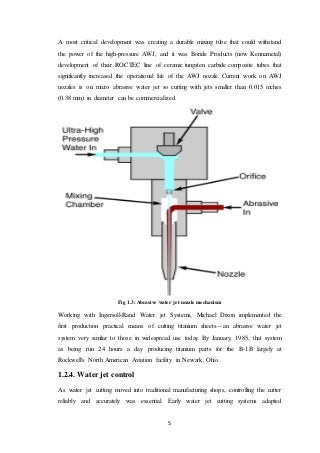
While cutting with water is possible for soft materials, the addition of an abrasive
turned the water jet into a modern machining tool for all materials. This began in 1935
when the idea of adding an abrasive to the water stream was developed by Elmo
Smith for the liquid abrasive blasting. Smith’s design was further refined by Leslie
Tirrell of the Hydroblast Corporation in 1937, resulting in a nozzle design that created
a mix of high-pressure water and abrasive for the purpose of wet blasting.
The first publications on the modern Abrasive Water jets (AWJ) cutting were
published by Dr. Mohamed Hashish in the 1982 BHR proceedings showing, for the
first time, that water jets with relatively small amounts of abrasives are capable of
cutting hard materials such as steel and concrete. The March 1984 issue of the
Mechanical Engineering magazine showed more details and materials cut with AWJ
such as titanium, aluminium, glass, and stone. Dr. Mohamed Hashish, was awarded a
patent on forming AWJ in 1987. Dr. Hashish, who also coined the new term Abrasive
Water jet (AWJ), and his team continued to develop and improve the AWJ technology
and its hardware for many applications which is now in over 50 industries worldwide.
5
A most critical development was creating a durable mixing tube that could withstand
the power of the high-pressure AWJ, and it was Boride Products (now Kennametal)
development of their ROCTEC line of ceramic tungsten carbide composite tubes that
significantly increased the operational life of the AWJ nozzle. Current work on AWJ
nozzles is on micro abrasive water jet so cutting with jets smaller than 0.015 inches
(0.38 mm) in diameter can be commercialized.
Fig 1.3: Abrasive water jet nozzle mechanism
Working with Ingersoll-Rand Water jet Systems, Michael Dixon implemented the
first production practical means of cutting titanium sheets—an abrasive water jet
system very similar to those in widespread use today. By January, 1985, that system
as being run 24 hours a day producing titanium parts for the B-1B largely at
Rockwell's North American Aviation facility in Newark, Ohio.
1.2.4. Water jet control
As water jet cutting moved into traditional manufacturing shops, controlling the cutter
reliably and accurately was essential. Early water jet cutting systems adapted
6
traditional systems such as mechanical pantographs and CNC systems based on John
Parsons’ 1952 NC milling machine and running G-code. Challenges inherent to water
jet technology revealed the inadequacies of traditional G-Code, as accuracy depends
on varying the speed of the nozzle as it approaches corners and details. Creating
motion control systems to incorporate those variables became a major innovation for
leading water jet manufacturers in the early 1990s, with Dr John Olsen of OMAX
Corporation developing systems to precisely position the water jet nozzle while
accurately specifying the speed at every point along the path, and also utilizing
common PCs as a controller. The largest water jet manufacturer, Flow International (a
spinoff of Flow Industries), recognized the benefits of that system and licensed the
OMAX software, with the result that the vast majority of water jet cutting machines
worldwide are simple to use, fast, and accurate.
1.3. Objectives of the Present Work
All water jets follow the same principle of using high pressure water focused into a
beam by a nozzle. Most machines accomplish this by first running the water through a
high pressure pump. There are two types of pumps used to create this high pressure;
an intensifier pump and a direct drive or crankshaft pump. A direct drive pump works
much like a car engine, forcing water through high pressure tubing using plungers
attached to a crankshaft.
An intensifier pump creates pressure by using hydraulic oil to move a piston forcing
the water through a tiny hole. The water then travels along the high pressure tubing to
the nozzle of the water jet. In the nozzle, the water is focused into a thin beam by a
jewel orifice. This beam of water is ejected from the nozzle, cutting through the
material by spraying it with the jet of high-speed water. The process is the same for
abrasive water jets until the water reaches the nozzle. Here abrasives such
as garnet and aluminium oxide, are fed into the nozzle via an abrasive inlet. The
abrasive then mixes with the water in a mixing tube and is forced out the end at high
pressure.
An important benefit of the water jet is the ability to cut material without interfering
with its inherent structure, as there is no heat-affected zone (HAZ). Minimizing the
effects of heat allows metals to be cut without harming or changing intrinsic
properties. Sharp corners, bevels, pierce holes, and shapes with minimal inner radii
7
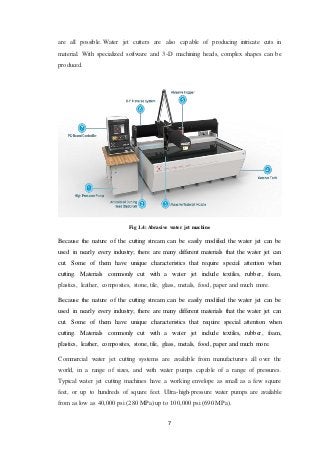
are all possible. Water jet cutters are also capable of producing intricate cuts in
material. With specialized software and 3-D machining heads, complex shapes can be
produced.
Fig 1.4: Abrasive water jet machine
Because the nature of the cutting stream can be easily modified the water jet can be
used in nearly every industry; there are many different materials that the water jet can
cut. Some of them have unique characteristics that require special attention when
cutting. Materials commonly cut with a water jet include textiles, rubber, foam,
plastics, leather, composites, stone, tile, glass, metals, food, paper and much more.
Because the nature of the cutting stream can be easily modified the water jet can be
used in nearly every industry; there are many different materials that the water jet can
cut. Some of them have unique characteristics that require special attention when
cutting. Materials commonly cut with a water jet include textiles, rubber, foam,
plastics, leather, composites, stone, tile, glass, metals, food, paper and much more.
Commercial water jet cutting systems are available from manufacturers all over the
world, in a range of sizes, and with water pumps capable of a range of pressures.
Typical water jet cutting machines have a working envelope as small as a few square
feet, or up to hundreds of square feet. Ultra-high-pressure water pumps are available
from as low as 40,000 psi (280 MPa) up to 100,000 psi (690 MPa).
8
1.4. 1D - 2D - 3D Cutting
In addition to the division of applications into Pure Water and Abrasive, the
applications can be broken down by the geometrical shape.
1.4.1. One Dimensional:
In production applications, slitting and continuous waterjet cutting is often used. The
frame of the system is usually quite simple, cutting speeds are quite high. Fig. 18
Slitter for cutting of plastic foil The very important criterion in this application is the
high reliability and short stand still times of waterjet cutting over long cutting periods.
In contrast to roll cutting, the material is not moved to the side and no airborne dust is
created. Many cutting heads can be applied and controlled at the same time.
Application areas: Paper and Plastic production, Gypsum boards, Raw drywall plates,
sheet metal, Cake, Frozen pizza, etc…
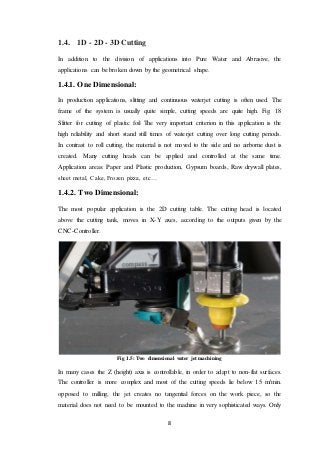
1.4.2. Two Dimensional:
The most popular application is the 2D cutting table. The cutting head is located
above the cutting tank, moves in X-Y axes, according to the outputs given by the
CNC-Controller.
Fig 1.5: Two dimensional water jet machining
In many cases the Z (height) axis is controllable, in order to adapt to non-flat surfaces.
The controller is more complex and most of the cutting speeds lie below 15 m/min.
opposed to milling, the jet creates no tangential forces on the work piece, so the
material does not need to be mounted to the machine in very sophisticated ways. Only
9
light materials must be held down in some manner in order to prevent fly-away
caused by water spurting water. This allows for quick material change. Typical table
sizes include 1x2 m, 2x3 m und 3x4 m, mainly with 2 - 93 KW. Bigger machines are
also produced.
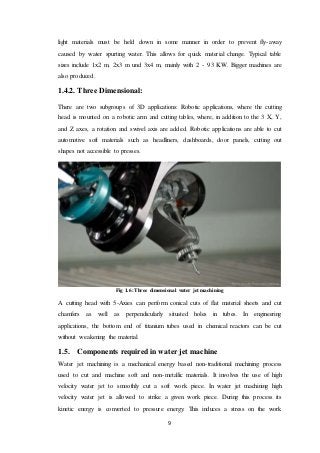
1.4.2. Three Dimensional:
There are two subgroups of 3D applications: Robotic applications, where the cutting
head is mounted on a robotic arm and cutting tables, where, in addition to the 3 X, Y,
and Z axes, a rotation and swivel axis are added. Robotic applications are able to cut
automotive soft materials such as headliners, dashboards, door panels, cutting out
shapes not accessible to presses.
Fig 1.6: Three dimensional water jet machining
A cutting head with 5-Axies can perform conical cuts of flat material sheets and cut
chamfers as well as perpendicularly situated holes in tubes. In engineering
applications, the bottom end of titanium tubes used in chemical reactors can be cut
without weakening the material.
1.5. Components required in water jet machine
Water jet machining is a mechanical energy based non-traditional machining process
used to cut and machine soft and non-metallic materials. It involves the use of high
velocity water jet to smoothly cut a soft work piece. In water jet machining high
velocity water jet is allowed to strike a given work piece. During this process its
kinetic energy is converted to pressure energy. This induces a stress on the work
10
piece. When this induced stress is high enough, unwanted particles of the work piece
are automatically removed. The apparatus of water jet machining consists of the
following components:
 Reservoir: It is used for storing water that is to be used in the machining
operation.
 Pump: It pumps the water from the reservoir. High pressure intensifier pumps
are used to pressurize the water as high as 55,000 psi. For the abrasive water
jet, the operating pressure ranges from 31,000 to 37,000 psi. At this high
pressure the flow rate of the water is reduced greatly.
 Intensifier: It is connected to the pump. It pressurizes the water acquired from
the pump to a desired level.
 Accumulator: It is used for temporarily storing the pressurized water. It is
connected to the flow regulator through a control valve.
 Control Valve: It controls the direction and pressure of pressurized water that
is to be supplied to the nozzle.
 Nozzle: It renders the pressurized water as a water jet at high velocity. Once
the water is pressurized, it is forced through a sapphire nozzle which is
composed of the natural sapphire stone due to the strength of the stone. The
diameter of the nozzle can be varied depending on the application for which
the water jet is being used. A damaged nozzle leads to poor cohesion of the
stream, thereby reducing the cutting ability greatly. The nozzle typically lasts
100 to 200 hours before it needs to be replaced.
 Catchers: After the cut has been made, the water abrasive material is
collected in a catcher. In a field situation there are still problems catching the
waste material. Often catchers need to be custom designed for a specific job.
1.5.1. Pump
A pump is a device that moves fluids (liquids or gases), or sometimes slurries, by
mechanical action. Pumps can be classified into three major groups according to the
method they use to move the fluid: direct lift, displacement, and gravity pumps.
Pumps operate by some mechanism (typically reciprocating or rotary), and
consume energy to perform mechanical work by moving the fluid. Pumps operate via
11
many energy sources, including manual operation, electricity, engines, or wind power,
come in many sizes, from microscopic for use in medical applications to large
industrial pumps.
Mechanical pumps serve in a wide range of applications such as pumping water from
wells, aquarium filtering, pond filtering and aeration, in the car industry for water-
cooling and fuel injection, in the energy industry for pumping oil and natural gas or
for operating cooling towers. In the medical industry, pumps are used for biochemical
processes in developing and manufacturing medicine, and as artificial replacements
for body parts, in particular the artificial heart and penile prosthesis.
1.5.1.(A)Types of Pump
Mechanical pumps may be submerged in the fluid they are pumping or be
placed external to the fluid. Pumps can be classified by their method of displacement
into positive displacement pumps, impulse pumps, velocity pumps, gravity
pumps, steam pumps and valve less pumps. There are two basic types of pumps i.e.
positive displacement and centrifugal. Although axial-flow pumps are frequently
classified as a separate type, they have essentially the same operating principles as
centrifugal pumps.
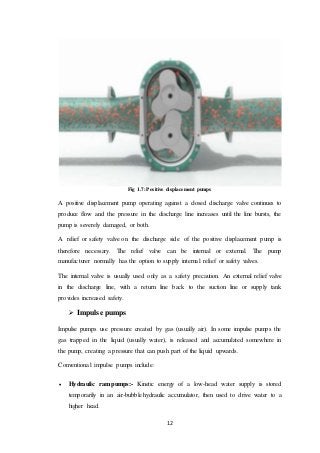
 Positive displacement pumps
A positive displacement pump makes a fluid move by trapping a fixed amount and
forcing (displacing) that trapped volume into the discharge pipe. Some positive
displacement pumps use an expanding cavity on the suction side and a decreasing
cavity on the discharge side. Liquid flows into the pump as the cavity on the suction
side expands and the liquid flows out of the discharge as the cavity collapses. The
volume is constant through each cycle of operation. Positive displacement pump
behaviour and safety: Positive displacement pumps, unlike centrifugal or roto-
dynamic pumps, theoretically can produce the same flow at a given speed (RPM) no
matter what the discharge pressure. Thus, positive displacement pumps are constant
flow machines. However, a slight increase in internal leakage as the pressure
increases prevents a truly constant flow rate. A positive displacement pump must not
operate against a closed valve on the discharge side of the pump, because it has no
shutoff head like centrifugal pumps.
12
Fig 1.7: Positive displacement pumps
A positive displacement pump operating against a closed discharge valve continues to
produce flow and the pressure in the discharge line increases until the line bursts, the
pump is severely damaged, or both.
A relief or safety valve on the discharge side of the positive displacement pump is
therefore necessary. The relief valve can be internal or external. The pump
manufacturer normally has the option to supply internal relief or safety valves.
The internal valve is usually used only as a safety precaution. An external relief valve
in the discharge line, with a return line back to the suction line or supply tank
provides increased safety.
 Impulse pumps
Impulse pumps use pressure created by gas (usually air). In some impulse pumps the
gas trapped in the liquid (usually water), is released and accumulated somewhere in
the pump, creating a pressure that can push part of the liquid upwards.
Conventional impulse pumps include:
 Hydraulic ram pumps:- Kinetic energy of a low-head water supply is stored
temporarily in an air-bubble hydraulic accumulator, then used to drive water to a
higher head.
13
 Pulser pumps:- Run with natural resources, by kinetic energy only.
 Airlift pumps:- Run on air inserted into pipe, which pushes the water up when
bubbles move upward.
Instead of a gas accumulation and releasing cycle, the pressure can be created by
burning of hydrocarbons. Such combustion driven pumps directly transmit the
impulse form a combustion event through the actuation membrane to the pump fluid.
In order to allow this direct transmission, the pump needs to be almost entirely made
of an elastomer (e.g. silicone rubber). Hence, the combustion causes the membrane to
expand and thereby pumps the fluid out of the adjacent pumping chamber. The first
combustion-driven soft pump was developed by ETH Zurich.
 Radial-flow pumps
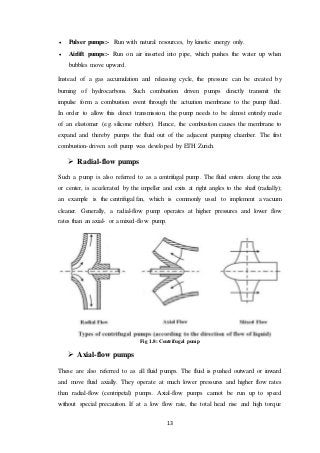
Such a pump is also referred to as a centrifugal pump. The fluid enters along the axis
or center, is accelerated by the impeller and exits at right angles to the shaft (radially);
an example is the centrifugal fan, which is commonly used to implement a vacuum
cleaner. Generally, a radial-flow pump operates at higher pressures and lower flow
rates than an axial- or a mixed-flow pump.
Fig 1.8: Centrifugal pump
 Axial-flow pumps
These are also referred to as all fluid pumps. The fluid is pushed outward or inward
and move fluid axially. They operate at much lower pressures and higher flow rates
than radial-flow (centripetal) pumps. Axial-flow pumps cannot be run up to speed
without special precaution. If at a low flow rate, the total head rise and high torque
14
associated with this pipe would mean that the starting torque would have to become a
function of acceleration for the whole mass of liquid in the pipe system. If there is a
large amount of fluid in the system, accelerate the pump slowly.
Mixed-flow pumps function as a compromise between radial and axial-flow pumps.
The fluid experiences both radial acceleration and lift and exits the impeller
somewhere between 0 and 90 degrees from the axial direction. As a consequence
mixed-flow pumps operate at higher pressures than axial-flow pumps while delivering
higher discharges than radial-flow pumps. The exit angle of the flow dictates the
pressure head-discharge characteristic in relation to radial and mixed-flow.
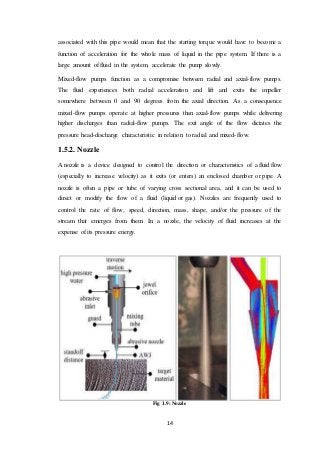
1.5.2. Nozzle
A nozzle is a device designed to control the direction or characteristics of a fluid flow
(especially to increase velocity) as it exits (or enters) an enclosed chamber or pipe. A
nozzle is often a pipe or tube of varying cross sectional area, and it can be used to
direct or modify the flow of a fluid (liquid or gas). Nozzles are frequently used to
control the rate of flow, speed, direction, mass, shape, and/or the pressure of the
stream that emerges from them. In a nozzle, the velocity of fluid increases at the
expense of its pressure energy.
Fig 1.9: Nozzle
15
1.5.2. (A)Types Of Nozzle
A fluid jet or hydro jet is a nozzle intended to eject gas or fluid in a coherent stream
into a surrounding medium. Gas jets are commonly found in gas stoves, ovens,
or barbecues. Gas jets were commonly used for light before the development
of electric light. Other types of fluid jets are found in carburettors, where
smooth calibrated orifices are used to regulate the flow of fuel into an engine, and
in Jacuzzis or spas.
Another specialized jet is the laminar jet. This is a water jet that contains devices to
smooth out the pressure and flow, and gives laminar flow, as its name suggests. This
gives better results for fountains. Jet nozzles are also used in large rooms where the
distribution of air via ceiling diffusers is not possible or not practical. Diffusers that
uses jet nozzles are called jet diffuser where it will be arranged in the side wall areas
in order to distribute air. When the temperature difference between the supply air and
the room air changes, the supply air stream is deflected upwards, to supply warm air,
or downwards, to supply cold air.
 High velocity
Frequently, the goal of a nozzle is to increase the kinetic energy of the flowing
medium at the expense of its pressure and internal energy.
Nozzles can be described as convergent (narrowing down from a wide diameter to a
smaller diameter in the direction of the flow) or divergent (expanding from a smaller
diameter to a larger one).
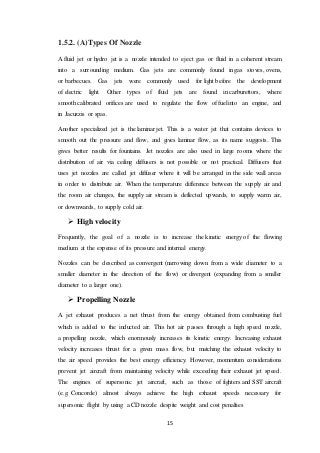
 Propelling Nozzle
A jet exhaust produces a net thrust from the energy obtained from combusting fuel
which is added to the inducted air. This hot air passes through a high speed nozzle,
a propelling nozzle, which enormously increases its kinetic energy. Increasing exhaust
velocity increases thrust for a given mass flow, but matching the exhaust velocity to
the air speed provides the best energy efficiency. However, momentum considerations
prevent jet aircraft from maintaining velocity while exceeding their exhaust jet speed.
The engines of supersonic jet aircraft, such as those of fighters and SST aircraft
(e.g. Concorde) almost always achieve the high exhaust speeds necessary for
supersonic flight by using a CD nozzle despite weight and cost penalties
16
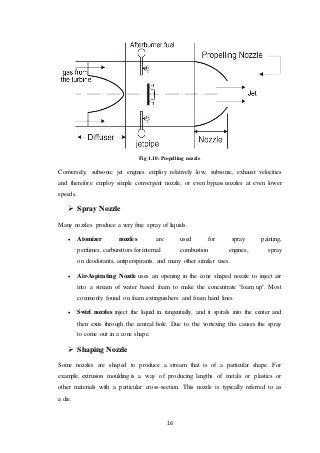
Fig 1.10: Propelling nozzle
Conversely, subsonic jet engines employ relatively low, subsonic, exhaust velocities
and therefore employ simple convergent nozzle, or even bypass nozzles at even lower
speeds.
 Spray Nozzle
Many nozzles produce a very fine spray of liquids.
 Atomizer nozzles are used for spray painting,
perfumes, carburettors for internal combustion engines, spray
on deodorants, antiperspirants and many other similar uses.
 Air-Aspirating Nozzle uses an opening in the cone shaped nozzle to inject air
into a stream of water based foam to make the concentrate "foam up". Most
commonly found on foam extinguishers and foam hand lines.
 Swirl nozzles inject the liquid in tangentially, and it spirals into the center and
then exits through the central hole. Due to the vortexing this causes the spray
to come out in a cone shape.
 Shaping Nozzle
Some nozzles are shaped to produce a stream that is of a particular shape. For
example, extrusion moulding is a way of producing lengths of metals or plastics or
other materials with a particular cross-section. This nozzle is typically referred to as
a die.
17
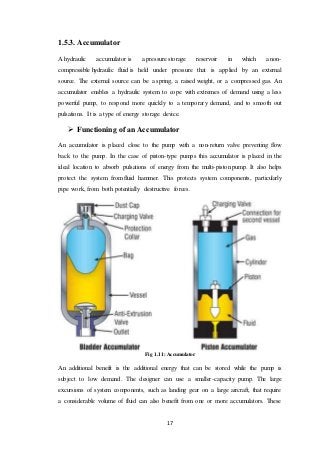
1.5.3. Accumulator
A hydraulic accumulator is a pressure storage reservoir in which a non-
compressible hydraulic fluid is held under pressure that is applied by an external
source. The external source can be a spring, a raised weight, or a compressed gas. An
accumulator enables a hydraulic system to cope with extremes of demand using a less
powerful pump, to respond more quickly to a temporary demand, and to smooth out
pulsations. It is a type of energy storage device.
 Functioning of an Accumulator
An accumulator is placed close to the pump with a non-return valve preventing flow
back to the pump. In the case of piston-type pumps this accumulator is placed in the
ideal location to absorb pulsations of energy from the multi-piston pump. It also helps
protect the system from fluid hammer. This protects system components, particularly
pipe work, from both potentially destructive forces.
Fig 1.11: Accumulator
An additional benefit is the additional energy that can be stored while the pump is
subject to low demand. The designer can use a smaller-capacity pump. The large
excursions of system components, such as landing gear on a large aircraft, that require
a considerable volume of fluid can also benefit from one or more accumulators. These
18
are often placed close to the demand to help overcome restrictions and drag from long
pipe work runs. The outflow of energy from a discharging accumulator is much
greater, for a short time, than even large pumps could generate.
An accumulator can maintain the pressure in a system for periods when there are
slight leaks without the pump being cycled on and off constantly. When temperature
changes cause pressure excursions the accumulator helps absorb them. Its size helps
absorb fluid that might otherwise be locked in a small fixed system with no room for
expansion due to valve arrangement.
1.5.4. Auxiliary Components
 Reservoir
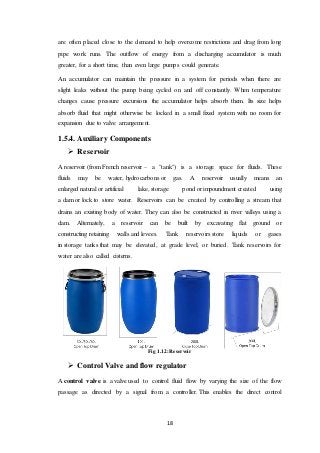
A reservoir (from French reservoir – a "tank") is a storage space for fluids. These
fluids may be water, hydrocarbons or gas. A reservoir usually means an
enlarged natural or artificial lake, storage pond or impoundment created using
a dam or lock to store water. Reservoirs can be created by controlling a stream that
drains an existing body of water. They can also be constructed in river valleys using a
dam. Alternately, a reservoir can be built by excavating flat ground or
constructing retaining walls and levees. Tank reservoirs store liquids or gases
in storage tanks that may be elevated, at grade level, or buried. Tank reservoirs for
water are also called cisterns.
Fig 1.12: Reservoir
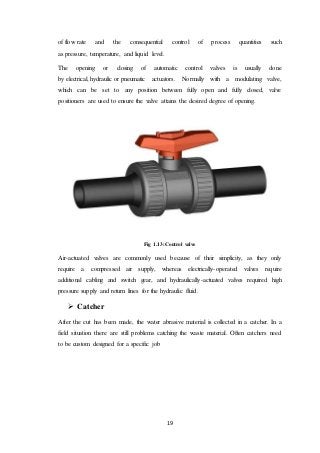
 Control Valve and flow regulator
A control valve is a valve used to control fluid flow by varying the size of the flow
passage as directed by a signal from a controller. This enables the direct control
19
of flow rate and the consequential control of process quantities such
as pressure, temperature, and liquid level.
The opening or closing of automatic control valves is usually done
by electrical, hydraulic or pneumatic actuators. Normally with a modulating valve,
which can be set to any position between fully open and fully closed, valve
positioners are used to ensure the valve attains the desired degree of opening.
Fig 1.13: Control valve
Air-actuated valves are commonly used because of their simplicity, as they only
require a compressed air supply, whereas electrically-operated valves require
additional cabling and switch gear, and hydraulically-actuated valves required high
pressure supply and return lines for the hydraulic fluid.
 Catcher
After the cut has been made, the water abrasive material is collected in a catcher. In a
field situation there are still problems catching the waste material. Often catchers need
to be custom designed for a specific job
20
CHAPTER: 2
2.1. Literature review
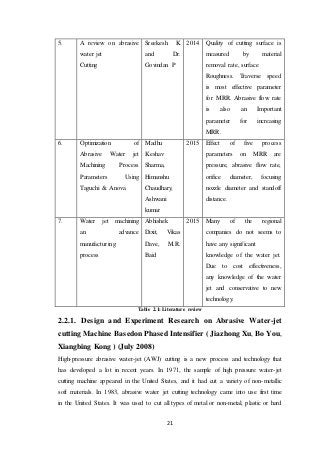
S. no. Topic Author Year Result
1. Design and
experiment research
on abrasive water-jet
cutting machine based
on phased intensifier
Jiazhong Xu,
Bo You,
Xiangbing
Kong
2008 Relationship of cutting
depth, water pressure and
target distance, and the
relationship between
erosion quantity and target
distance are conducted.
2. Abrasive water jet
machining – the
review
R. V. Shah,
Prof. D. M.
Patel
2012 Quality of cutting surface in
AWJM is depending on so
many process parameters.
Process parameter which
affect less or more on quality
of cutting in AWJM are
hydraulic pressure, Stand off
distance, types of abrasive,
size of abrasives, abrasive
flow rate, nozzle diameter,
orifice size, and traverse
speed.
3. Research on the
influence of working
parameters on cutting
water jet
Popa Liliana,
Ispas
Andreea
2013 Cost of operation, depend
upon consumption of water,
electricity and abrasive.
4. A Review on Current
Research and
Development in
Abrasive Water jet
Machining
M. M. Korat,
Dr. G. D.
Acharya
2014 Process parameters for
improvement of a single
quality characteristic such as
depth of cut, surface
roughness, material removal
rate and nozzle wear.
21
5. A review on abrasive
water jet
Cutting
Sreekesh. K
and Dr.
Govindan P
2014 Quality of cutting surface is
measured by material
removal rate, surface
Roughness. Traverse speed
is most effective parameter
for MRR. Abrasive flow rate
is also an Important
parameter for increasing
MRR.
6. Optimization of
Abrasive Water jet
Machining Process
Parameters Using
Taguchi & Anova
Madhu
Keshav
Sharma,
Himanshu
Chaudhary,
Ashwani
kumar
2015 Effect of five process
parameters on MRR are
pressure, abrasive flow rate,
orifice diameter, focusing
nozzle diameter and standoff
distance.
7. Water jet machining
an advance
manufacturing
process
Abhishek
Dixit, Vikas
Dave, M.R.
Baid
2015 Many of the regional
companies do not seems to
have any significant
knowledge of the water jet.
Due to cost effectiveness,
any knowledge of the water
jet and conservative to new
technology.
Table 2.1: Literature review
2.2.1. Design and Experiment Research on Abrasive Water-jet
cutting Machine Basedon Phased Intensifier ( Jiazhong Xu, Bo You,
Xiangbing Kong ) (July 2008)
High-pressure abrasive water-jet (AWJ) cutting is a new process and technology that
has developed a lot in recent years. In 1971, the sample of high pressure water-jet
cutting machine appeared in the United States, and it had cut a variety of non-metallic
soft materials. In 1983, abrasive water jet cutting technology came into use first time
in the United States. It was used to cut all types of metal or non-metal, plastic or hard
22
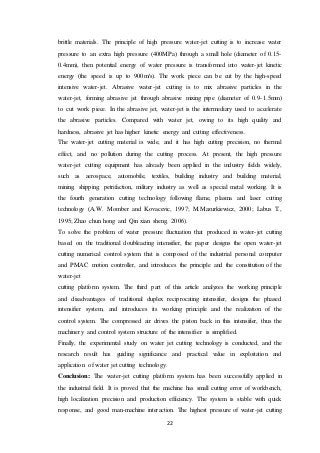
brittle materials. The principle of high pressure water-jet cutting is to increase water
pressure to an extra high pressure (400MPa) through a small hole (diameter of 0.15-
0.4mm), then potential energy of water pressure is transformed into water-jet kinetic
energy (the speed is up to 900m/s). The work piece can be cut by the high-speed
intensive water-jet. Abrasive water-jet cutting is to mix abrasive particles in the
water-jet, forming abrasive jet through abrasive mixing pipe (diameter of 0.9-1.5mm)
to cut work piece. In the abrasive jet, water-jet is the intermediary used to accelerate
the abrasive particles. Compared with water jet, owing to its high quality and
hardness, abrasive jet has higher kinetic energy and cutting effectiveness.
The water-jet cutting material is wide, and it has high cutting precision, no thermal
effect, and no pollution during the cutting process. At present, the high pressure
water-jet cutting equipment has already been applied in the industry fields widely,
such as aerospace, automobile, textiles, building industry and building material,
mining, shipping, petrifaction, military industry as well as special metal working. It is
the fourth generation cutting technology following flame, plasma and laser cutting
technology (A.W. Momber and Kovacevic, 1997; M.Mazurkiewicz, 2000; Labus T.,
1995; Zhao chun hong and Qin xian sheng, 2006).
To solve the problem of water pressure fluctuation that produced in water-jet cutting
based on the traditional doubleacting intensifier, the paper designs the open water-jet
cutting numerical control system that is composed of the industrial personal computer
and PMAC motion controller, and introduces the principle and the constitution of the
water-jet
cutting platform system. The third part of this article analyzes the working principle
and disadvantages of traditional duplex reciprocating intensifier, designs the phased
intensifier system, and introduces its working principle and the realization of the
control system. The compressed air drives the piston back in this intensifier, thus the
machinery and control system structure of the intensifier is simplified.
Finally, the experimental study on water jet cutting technology is conducted, and the
research result has guiding significance and practical value in exploitation and
application of water jet cutting technology.
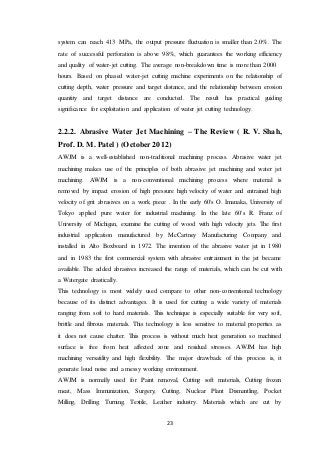
Conclusion: The water-jet cutting platform system has been successfully applied in
the industrial field. It is proved that the machine has small cutting error of workbench,
high localization precision and production efficiency. The system is stable with quick
response, and good man-machine interaction. The highest pressure of water-jet cutting
23
system can reach 413 MPa, the output pressure fluctuation is smaller than 2.0%. The
rate of successful perforation is above 98%, which guarantees the working efficiency
and quality of water-jet cutting. The average non-breakdown time is more than 2000
hours. Based on phased water-jet cutting machine experiments on the relationship of
cutting depth, water pressure and target distance, and the relationship between erosion
quantity and target distance are conducted. The result has practical guiding
significance for exploitation and application of water jet cutting technology.
2.2.2. Abrasive Water Jet Machining – The Review ( R. V. Shah,
Prof. D. M. Patel ) (October 2012)
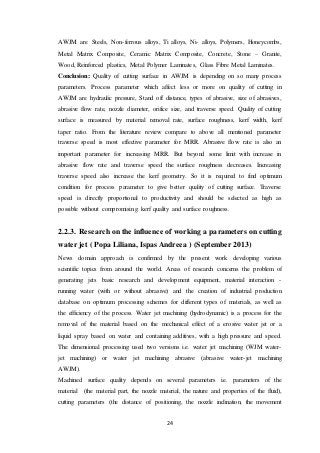
AWJM is a well-established non-traditional machining process. Abrasive water jet
machining makes use of the principles of both abrasive jet machining and water jet
machining. AWJM is a non-conventional machining process where material is
removed by impact erosion of high pressure high velocity of water and entrained high
velocity of grit abrasives on a work piece . In the early 60's O. Imanaka, University of
Tokyo applied pure water for industrial machining. In the late 60's R. Franz of
University of Michigan, examine the cutting of wood with high velocity jets. The first
industrial application manufactured by McCartney Manufacturing Company and
installed in Alto Boxboard in 1972. The invention of the abrasive water jet in 1980
and in 1983 the first commercial system with abrasive entrainment in the jet became
available. The added abrasives increased the range of materials, which can be cut with
a Watergate drastically.
This technology is most widely used compare to other non-conventional technology
because of its distinct advantages. It is used for cutting a wide variety of materials
ranging from soft to hard materials. This technique is especially suitable for very soft,
brittle and fibrous materials. This technology is less sensitive to material properties as
it does not cause chatter. This process is without much heat generation so machined
surface is free from heat affected zone and residual stresses. AWJM has high
machining versatility and high flexibility. The major drawback of this process is, it
generate loud noise and a messy working environment.
AWJM is normally used for Paint removal, Cutting soft materials, Cutting frozen
meat, Mass Immunization, Surgery, Cutting, Nuclear Plant Dismantling, Pocket
Milling, Drilling, Turning, Textile, Leather industry. Materials which are cut by
24
AWJM are Steels, Non-ferrous alloys, Ti alloys, Ni- alloys, Polymers, Honeycombs,
Metal Matrix Composite, Ceramic Matrix Composite, Concrete, Stone – Granite,
Wood, Reinforced plastics, Metal Polymer Laminates, Glass Fibre Metal Laminates.
Conclusion: Quality of cutting surface in AWJM is depending on so many process
parameters. Process parameter which affect less or more on quality of cutting in
AWJM are hydraulic pressure, Stand off distance, types of abrasive, size of abrasives,
abrasive flow rate, nozzle diameter, orifice size, and traverse speed. Quality of cutting
surface is measured by material removal rate, surface roughness, kerf width, kerf
taper ratio. From the literature review compare to above all mentioned parameter
traverse speed is most effective parameter for MRR. Abrasive flow rate is also an
important parameter for increasing MRR. But beyond some limit with increase in
abrasive flow rate and traverse speed the surface roughness decreases. Increasing
traverse speed also increase the kerf geometry. So it is required to find optimum
condition for process parameter to give better quality of cutting surface. Traverse
speed is directly proportional to productivity and should be selected as high as
possible without compromising kerf quality and surface roughness.
2.2.3. Research on the influence of working a parameters on cutting
water jet ( Popa Liliana, Ispas Andreea ) (September 2013)
News domain approach is confirmed by the present work developing various
scientific topics from around the world. Areas of research concerns the problem of
generating jets basic research and development equipment, material interaction -
running water (with or without abrasive) and the creation of industrial production
database on optimum processing schemes for different types of materials, as well as
the efficiency of the process. Water jet machining (hydrodynamic) is a process for the
removal of the material based on the mechanical effect of a erosive water jet or a
liquid spray based on water and containing additives, with a high pressure and speed.
The dimensional processing used two versions i.e. water jet machining (WJM water-
jet machining) or water jet machining abrasive (abrasive water-jet machining
AWJM).
Machined surface quality depends on several parameters i.e. parameters of the
material (the material part, the nozzle material, the nature and properties of the fluid),
cutting parameters (the distance of positioning, the nozzle inclination, the movement
25
speed, number of passes), parameters of the hydraulic (pressure in the nozzle flow
speed, the flow of water, the diameter of the nozzle orifice and the power flow which
depends on the pressure in the nozzle and the nozzle hole diameter).
Conclusion: Abrasive water jet cutting is a new process with many advantages to
cutting metal materials (no heat affected zone), optimal method (single) for cutting
composite materials, optimal method for fragile non-metallic materials glass,
ceramics, thermosetting plastics etc.
Processing costs are relatively high and are defined by abrasive consumption, cost of
pump operation, cutting head, pressure pipes, consumption of water, electricity. These
costs are given by replacing used components (pump nozzle, mixing tube and pipe
pressure replacement etc.) periodically.
2.2.4. A Review on Current Research and Development in
Abrasive Water jet Machining (M. M. Korat, Dr. G. D. Acharya)
(Jan 2014)
Water jet cutting machines started to operate in the early 1970s for cutting wood and
plastics material and cutting by abrasive water jet was first commercialized in the late
1980s as a pioneering breakthrough in the area of unconventional processing
technologies. In the early 1980s, AWJ machining was considered as an impractical
application. Today, state-of the art abrasive jet technology has grown into a full-scale
production process with precise, consistent results.
In AWJ machining process, the work piece material is removed by the action of a
high-velocity jet of water mixed with abrasive particles based on the principle of
erosion of the material upon which the water jet hits. AWJ is one of the most
advanced modern methods used in manufacturing industry for material processing.
AWJ has few advantages such as high machining versatility, small cutting forces,
high flexibility and no thermal distortion. Comparing with other complementary
machining processes, no heat affected zone (HAZ) on the work piece is produced.
High speed and multidirectional cutting capability, high cutting efficiency, ability to
cut complicated shapes of even non flat surfaces very effectively at close tolerances,
minimal heat build-up, low deformation stresses within the machined part, easy
accomplishment of changeover of cutting patterns under computer control, etc. are a
26
few of the advantages offered by this process which make it ideal for automation. Due
to its versatility, this cutting tool is finding application not only in contour cutting, but
also in other machining methods such as drilling, milling, turning, threading, cleaning,
and hybrid machining. AWJM is widely used in the processing of materials such as
titanium, steel, brass, aluminium, stone and any kind of glass and composites. Being a
modern manufacturing process, abrasive water jet machining is yet to undergo
sufficient superiority so that its fullest potential can be obtained. This paper provides a
review on the various research activities carried out in the past decade on AWJM. It
first presents the process overview based on the widely accepted principle of high
velocity erosion and highlights some of its applications for different category of
material. The core of the paper identifies the major AWJM academic research area
with the headings of AWJM process modelling and optimization, AWJM process
monitoring and control. The final part of the paper suggests future direction for the
AWJM research.
Conclusion: It was shown that AWJM process is receiving more and more attention
in the machining areas particularly for the processing of difficult-to-cut materials. Its
unique advantages over other conventional and unconventional methods make it a
new choice in the machining industry.
Apart from cutting, AWJM is also suitable for precise machining such as polishing,
drilling, turning and milling. The AWJM process has sought the benefits of
combining with other material removal methods to further expand its applications.
Very little literature available so far shows the standoff distance at the optimal value
during the AWJ cutting process by monitoring and control. This kind of work has not
been reported for any other parameters. So, more work is required to be done in this
area. In most of research work, mainly traverse speed, water jet pressure, standoff
distance, abrasive grit size and abrasive flow rate have been taken into account. Very
little work has been reported on effect of nozzle size and orifice diameter.
2.2.5. A review on abrasive waterjet cutting (Sreekesh. K and Dr.
Govindan P) (August 2014)
Abrasive water jet machining is a mechanical, non-conventional machining method in
which abrasive particles such as Silica sand, Garnet, Aluminium oxide, Silicon
carbide etc are entrained in high speed water jet to erode materials from the surface of
27
material. About 90% of machining is done by using garnet as abrasive particle. In
AWJM material removal take place by erosion induced by the impact of solid
particles. Material removal occurs by cutting wear and deformation wear, cutting
wear defines erosion at smaller impact angle. Deformation wear occur by repeated
bombardment of abrasive at larger impact angle. Abrasive water jet machined surface
are grouped into three sections they are a) Initial damage region (IDR), b) Smooth
cutting region (SCR) and c) Rough cutting region (RCR). During 60s the study of
application of pure water for cutting was conducted by O. Imanaka, University of
Tokyo, and by late 60's R. Franz of University of Michigan, analyze the cutting of
wood using high velocity water jets.
Main applications of pure water jet machining include cutting paper products, wood,
cloths, plastics etc. By the end of 1970’s composites materials was introduced and its
advantages such as high strength, low weight, resistant to heat, hard etc. increase its
use and applications, but there was no suitable method to machine such materials
economically. Thus abrasive water jet machine was made available at industries by
1980’s to machine hard to machine materials.
The abrasive water jet machine became commercially available by the end of 1983
and the various types of abrasives are garnet, silicon carbide, aluminium oxide, glass
pieces etc. The added abrasives in the water jet increase the range of cutting materials,
which can be cut with a Water jet drastically. Abrasive water jet machining is very
much suitable for cutting soft, brittle and fibrous materials.
AWJM is a non-conventional machining process without much heat generation and
the machined surface is virtually without any heat affected zone. The other
advantages of abrasive water jet machining over other unconventional machining are
rapid setup of the abrasive water jet cutting, high accuracy of the components and
features generated, extreme versatility of the system, no heat generated during the
process and above all, minimal kerf is obtained.
Therefore, in this paper, a review of the contributions by important researchers on
water jet machining using abrasives (AWJM) is presented. The idea of development
of a abrasive water jet machining system is followed by identification of relevant
processing parameters. The processing parameters, their importance and influence on
the abrasive water jet machining system are finally compared and critically
summarized to understand the process outputs as a function of input conditions.
28
Conclusions: Quality of cutting surface in AWJM is depending on so many process
parameters. Process parameter which affect less or more on quality of cutting in
AWJM are hydraulic pressure, Standoff distance, types of abrasive, size of abrasives,
abrasive flow rate, nozzle diameter, orifice size, and traverse speed. Quality of cutting
surface is measured by material removal rate, surface roughness, kerf width, kerf
taper ratio. From the literature review compare to above all mentioned parameter
traverse speed is most effective parameter for MRR. Abrasive flow rate is also an
important parameter for increasing MRR. But beyond some limit with increase in
abrasive flow rate and traverse speed the surface roughness decreases. Increasing
traverse speed also increase the kerf geometry. So it is required to find optimum
condition for process parameter to give better quality of cutting surface. Traverse
speed is directly proportional to productivity and should be selected as high as
possible without compromising kerf quality and surface roughness.
2.2.6. Optimization of Abrasive Water jet Machining Process
Parameters Using Taguchi & Anova ( Madhu Keshav Sharma,
Himanshu Chaudhary, Ashwani kumar) (2015)
However development of newer methods has always been the endeavour of
engineering personnel and scientists. The main ideas behind such endeavours have
generally been the economic considerations, replacements of existing manufacturing
methods by more efficient and quicker ones, achievement of higher accuracies and
quality of surface finish, adaptability of cheaper materials in place of costlier ones and
developing methods of machining such materials which cannot be easily machined
through the conventional methods etc. Of all this reasons, the last one has contributed
considerably to the post-war developments in machining methods, particularly
because of the use of a large number of „hard to machine‟ materials in the modern
industry. A few of such materials are tungsten, hardened and stainless steel, uranium,
beryllium and some high strength steel alloys. The increasing utility of such materials
in the modern industry has forced research engineers to develop newer machining
methods, so as to have full advantage of these costly materials.
Abrasive jet machining (AJM) process is one of the non-traditional machining
processes that have been used extensively in various industry related applications. The
basic principles of abrasive water jet machining (AJM) were reviewed in details by
29
Momber and Kovacevic 1998. This technology is less sensitive to material properties
as it does not cause chatter, has no thermal effects, impose minimal stresses on the
work-piece, and has high machining versatility and high flexibility. But it has some
drawbacks; especially it may generate loud noise and a messy working environment.
The use of composite materials becomes prominent in today‟s modern technological
applications. These materials have better mechanical properties such as low densities,
high strength, stiffness and abrasion, impact and corrosion resistances. The creation of
aramid fibers called Kevlar has lead to the big breakthrough in the development of
modern ballistic armour due to its unique properties of special application in armour
which give ballistic protection (Komanduri et al. 1991). It has unique characteristics
such as high strength to weight ratio, high chemical resistance, high cut resistance,
flame resistance and good corrosive resistance (Komanduri et al. 1991).
Conclusion: From the literature view it has been observed that lot of work is reported
on Water Jet machining of different metals using different parameters but, very little
work has been this study the effect of five process parameters on MRR and SR for the
American element named Lead Tin alloy which is cut by abrasive water jet cutting
machine was experimentally done and analyzed. Based on the Response Surface
Methodology, different sets of experiments were conducted on this element by
varying the water pressure, abrasive flow rate, orifice diameter, focusing nozzle
diameter and standoff distance. In this paper a predictive model for MRR and SR is
developed for this Lead Tin alloy using regression analysis and the effects of process
parameters on MRR and SR has been studied in abrasive water jet cutting of Lead Tin
alloy and found that all parameters and along with their interactions have significant
effect on the MRR and SR. Partek and Vijay Kumar studied that the abrasive jet
machining (AJM) is a non-conventional machining process in which an abrasive
particles are made to impinge on the work material at a high velocity. This project
deals with the fabrication of the Abrasive Jet Machine and machining on tempered
glass, calculating the material removal varying various performance parameters like
pressure, angle & abrasive grit size so on. Before performing the experiment
fabrication done on AJM which are also discussed. The different problem faced while
machining on tempered glass are also discussed. Taguchi method and ANOVA is
used for analysis of metal removal rate.
P. P. Badgujar, M. G. Rathi (2014) optimize the input parameters of AWJM, such as
pressure within pumping system, abrasive material grain size, stand-off distance,
30
nozzle speed and abrasive mass flow rate for machining SS304. The Taguchi design
of experiment, the signal-to-noise ratio, and analysis of variance are employed to
analyze the effect of the input parameters by adopting L27 Taguchi orthogonal array
(OA). In order to achieve the minimum surface roughness (SR), five controllable
factors, i.e. the parameters of each at three levels are applied for determining the
optimal combination of factors and levels. The results reveal that the SR is greatly
influence by the abrasive material grain size. Experimental results affirm the
effectiveness of the solving the stated problem within minimum number of
experiments as compared to that of full factorial design.
2.2.7. Water jet machining: An advance manufacturing process
(Abhishek Dixit, Vikas Dave, M.R. Baid) (April 2015)
Water jets were introduced in the United States during the 1970’s, and were utilized
merely for cleaning purposes. As the technology developed to include abrasive water
jets, new applications were disco verged. However, until recently this tool had not
been used to a great extent in the construction industry. In the battle to reduce costs,
engineering and manufacturing departments are constantly on the lookout for an edge.
The Water jet process provides many unique capabilities and advantages that can
prove very effective in the cost battle. Learning more about the water jet technology
gives us an opportunity to put these cost-cutting capabilities to work. Beyond cost
cutting, the water jet process is recognized as the most versatile and fastest growing
process in the world (as per Frost & Sullivan and the Market Intelligence Research
Corporation). Water jets are used in high production applications across the globe.
They complement other technologies such as milling, laser, EDM, plasma and routers.
No toxic gases or liquids are used in water jet cutting, and water jets do not create
hazardous materials or vapours. No heat effected zones or mechanical stresses are left
on a water jet cut surface. It is truly a versatile, productive, cold cutting process. The
water jet has shown that it can do things that other technologies simply cannot. From
cutting thin details in stone, glass and metals to rapid hole drilling of titanium; to
cutting of food, to the killing of pathogens in beverages and dips, the water jet has
proven itself unique.
Conclusion: It appeared after studying the advantages and disadvantages of the water
jet, that this is a tool that the construction industry should find very useful.
31
Unfortunately, this does not seem to be the case. Many of the regional companies do
not seem to have any significant knowledge of the water jet, thus remaining unwilling
to employ this technology. The responses that we have received have left us with the
inability to comment on the cost effectiveness of the water jet in the construction
industry. The majority of companies that we contacted do not employ the water jet in
their companies, nor do most of them have any knowledge of the abrasive water jet.
These companies seem to be conservative to new technology and unwilling to take
risks. This may also be due to the fact that many companies are unwilling to invest in
a new technology that is not widely used. The contractors that do employ the abrasive
water jet technology did not provide us with the percentage of cost benefit to their
company.
32
CHAPTER: 3.
3.1. Working of Water Jet Machine
It is based on the principle of water erosion. When a high velocity jet of water strikes
the surface, the removal of material takes place. Pure water jet is used to machine
softer material. But to cut harder materials, some abrasive particles mixed with the
water for machining and it is called as abrasive water jet machine.
3.1.1. Working Principle
There are two types of water jet cutting processes; pure water cutting, in which the
cutting is performed using only an ultra-high pressure jet of clean water, and abrasive
water jet cutting in which an abrasive (typically garnet) is introduced into the high
pressure stream.
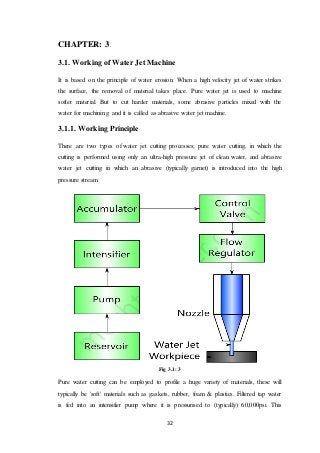
Fig 3.1: 3
Pure water cutting can be employed to profile a huge variety of materials, these will
typically be 'soft' materials such as gaskets, rubber, foam & plastics. Filtered tap water
is fed into an intensifier pump where it is pressurised to (typically) 60,000psi. This
33
ultra-high pressure water is forced through a tiny (0.15mm) orifice jewel which is
normally manufactured from sapphire. This has the effect of focusing the beam of
water into a fine, accurate stream travelling at speeds of up to 900m/sec, capable of
accurate cutting of a wide range of soft materials.
In order to cut 'harder' materials or any material containing glass or metal, then
abrasive water jet cutting would be employed. The principles of abrasive water jet
cutting are similar to pure water jet cutting, but once the stream has passed through
the orifice it enters a carbide nozzle. Within this nozzle is a mixing chamber within
which a partial vacuum is created as the water passes through. Garnet is introduced
under gravity into the nozzle and the partial vacuum within the mixing chamber has
the effect of dragging the abrasive into the water stream to create a highly abrasive
cutting jet. Abrasive cutting would typically be used on materials such as stainless
steel, aluminium, stone, ceramics & composite materials.
In both processes the head is controlled by a CNC controller, this offering great
accuracy and repeatability. The CNC controller is programmed by first drawing the
part to be manufactured using proprietary software, and then converting this drawing
into a G code format – CNC language.
3.2. Procedure followed for water jet machining
 Water from the reservoir is pumped to the intensifier using a hydraulic pump.
 The intensifier increases the pressure of the water to the required level.
Usually, the water is pressurized to 200 to 400 MPa.
 Pressurized water is then sent to the accumulator. The accumulator
temporarily stores the pressurized water.
 Pressurized water then enters the nozzle by passing through the control valve
and flow regulator.
 Control valve controls the direction of water and limits the pressure of water
under permissible limits.
 Flow regulator regulates and controls the flow rate of water.
34
 Pressurized water finally enters the nozzle. Here, it expands with a tremendous
increase in its kinetic energy. High velocity water jet is produced by the
nozzle.
 When this water jet strikes the work piece, stresses are induced. These stresses
are used to remove material from the work piece.
 The water used in water jet machining may or may not be used with
stabilizers. Stabilizers are substances that improve the quality of water jet by
preventing its fragmentation.
3.3. Application of water jet cutting machine
 Water jet machining is used in various industries like mining, automotive and
aerospace for performing cutting, shaping and reaming operations.
 The materials which are commonly machined by water jet (WJM) are rubber,
textiles, plastics, foam, leather, composites, tile, stone glass, metals paper and
much more.
 WJM is mostly used to cut soft and easy to machine materials such as thin
sheets and foils, wood, non-ferrous metallic alloys, textiles, honeycomb,
plastics, polymers, leathers, frozen etc.
 Beside Machining process the high pressure water jet is used in paint removal,
surgery, cleaning and to remove residual stress etc.
 Water jet machining is used to cut thin non-metallic sheets.
 It is used for machining circuit boards.
 It is used in food industry.
3.4. Advantages of water jet cutting machine
 It has the ability to cut materials without disturbing its original structure.
 Water jet machining is a relatively fast process.
 It prevents the formation of heat affected zones on the work piece.
 It does not produce any hazardous gas.
35
 It is capable of producing complex and intricate cuts in materials.
 The work area of in this machining process remains clean and dust free.
 It does not change mechanical properties of work piece. It is useful for
machining heat sensitive material.
 It is ideal process for laser reflective materials where laser beam machining
cannot be used.
 It has low operating and maintenance cost because it has no moving parts.
 The thermal damage to the work piece is negligible due to no heat generation.
 It is capable of cutting softer materials (WJM) like rubber, plastics or wood as
well as harder material (AWJM) like granite.
 It is environment friendly as it does not create any pollution or toxic products.
 It has greater precision of machining. The tolerances of order of ± 0.005 inch
can be achieved easily.
3.5. Disadvantages of water jet cutting machine
 It is used to cut softer materials.
 It cannot used for machining material which degrade in presence of water.
 Low metal removal rate.
 Very thick material cannot be machined by this process.
 Initial cost of WJM is high.
36
CHAPTER: 4
4.1. Results on MRR and graph obtained on glass work piece
4.1.(a) On the basis of SOD (Constant Pressure)
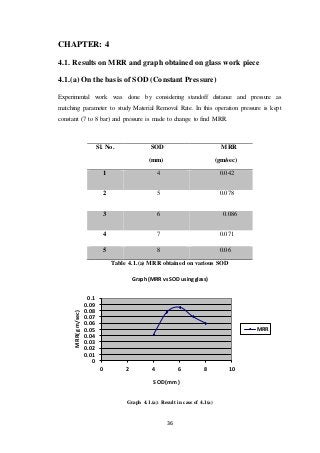
Experimental work was done by considering standoff distance and pressure as
matching parameter to study Material Removal Rate. In this operation pressure is kept
constant (7 to 8 bar) and pressure is made to change to find MRR.
Sl. No. SOD
(mm)
MRR
(gm/sec)
1 4 0.042
2 5 0.078
3 6 0.086
4 7 0.071
5 8 0.06
Table 4.1.(a) MRR obtained on various SOD
Graph 4.1.(a): Result in case of 4.1(a)
0
0.01
0.02
0.03
0.04
0.05
0.06
0.07
0.08
0.09
0.1
0 2 4 6 8 10
MRR(gm/sec)
SOD(mm)
Graph (MRR vs SOD using glass)
MRR
37
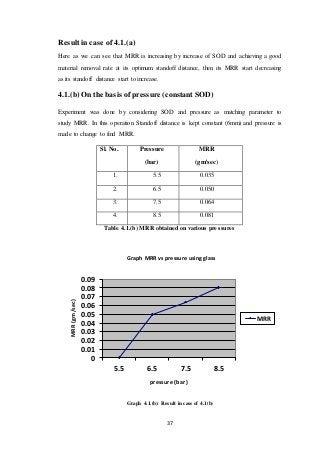
Result in case of 4.1.(a)
Here as we can see that MRR is increasing by increase of SOD and achieving a good
material removal rate at its optimum standoff distance, then its MRR start decreasing
as its standoff distance start to increase.
4.1.(b) On the basis of pressure (constant SOD)
Experiment was done by considering SOD and pressure as matching parameter to
study MRR. In this operation Standoff distance is kept constant (6mm) and pressure is
made to change to find MRR.
Sl. No. Pressure
(bar)
MRR
(gm/sec)
1. 5.5 0.035
2. 6.5 0.050
3. 7.5 0.064
4. 8.5 0.081
Table 4.1.(b) MRR obtained on various pressures
Graph 4.1.(b): Result in case of 4.1(b)
0
0.01
0.02
0.03
0.04
0.05
0.06
0.07
0.08
0.09
5.5 6.5 7.5 8.5
MRR(gm/sec)
pressure (bar)
Graph MRR vs pressure using glass
MRR
38
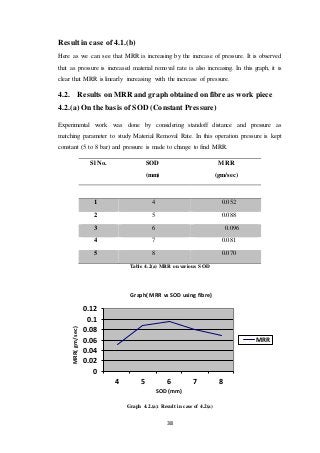
Result in case of 4.1.(b)
Here as we can see that MRR is increasing by the increase of pressure. It is observed
that as pressure is increased material removal rate is also increasing. In this graph, it is
clear that MRR is linearly increasing with the increase of pressure.
4.2. Results on MRR and graph obtained on fibre as work piece
4.2.(a) On the basis of SOD (Constant Pressure)
Experimental work was done by considering standoff distance and pressure as
matching parameter to study Material Removal Rate. In this operation pressure is kept
constant (5 to 8 bar) and pressure is made to change to find MRR.
Sl No. SOD
(mm)
MRR
(gm/sec)
1 4 0.052
2 5 0.088
3 6 0.096
4 7 0.081
5 8 0.070
Table 4.2(a) MRR on various SOD
Graph 4.2.(a): Result in case of 4.2(a)
0
0.02
0.04
0.06
0.08
0.1
0.12
4 5 6 7 8
MRR(gm/sec)
SOD(mm)
Graph( MRR vs SOD using fibre)
MRR
39
Result of case 4.2.(a)
Here as we can see that MRR is increasing by increase of SOD and achieving a good
material removal rate at its optimum standoff distance, then its MRR start decreasing
as its standoff distance start to increase.
4.2.(b) On the basis of pressure (Constant SOD)
Experiment was done by considering SOD and pressure as matching parameter to
study MRR. In this operation Standoff distance is kept constant (6mm) and pressure is
made to change to find MRR.
Table 4.2.(b) MRR obtained on various pressures
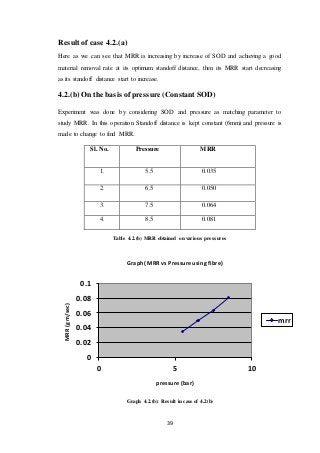
Graph 4.2.(b): Result in case of 4.2(b)
0
0.02
0.04
0.06
0.08
0.1
0 5 10
MRR(gm/sec)
pressure (bar)
Graph( MRR vs Pressure using fibre)
mrr
Sl. No. Pressure MRR
1. 5.5 0.035
2. 6.5 0.050
3. 7.5 0.064
4. 8.5 0.081
40
Result of case 4.2.(b)
Here as we can see that MRR is increasing by the increase of pressure. It is observed
that as pressure is increased material removal rate is also increasing. In this graph, it is
clear that MRR is linearly increasing with the increase of pressure.
41
CHAPTER: 5
5.1. Conclusion
It appeared after studying the advantages and disadvantages of the water jet, that this
is a tool that the construction industry should find very useful. Unfortunately, this
does not seem to be the case. Many of the regional companies do not seem to have
any significant knowledge of the water jet, thus remaining unwilling to employ this
technology.
The responses that we have received have left us with the inability to comment on the
cost effectiveness of the water jet in the construction industry. The majority of
companies that we contacted do not employ the water jet in their companies, nor do
most of them have any knowledge of the abrasive water jet. These companies seem to
be conservative to new technology and unwilling to take risks. This may also be due
to the fact that many companies are unwilling to invest in a new technology that is not
widely used.
5.2. Future scope of WJM
The major research areas in WJM are discussed in previous sections. Researchers
have contributed in different directions but due to complex nature of the process a lot
of works are still required to be done. The WJM process is a suitable machining
option in meeting the demands of today’s modern applications. The WJM of the
modern composite, glass and advanced ceramic materials, which is showing a
growing trend in many engineering applications, has also been experimented. It has
replaced the conventional means of machining hard and difficult to cut material,
namely the ultrasonic machining, laser beam machining and electro discharge
machining, which are not only slow to machining but damage the surface integrity of
the material. In addition, the WJM process has sought the benefits of combining with
other material removal methods to further expand its applications and improve the
machining characteristics.
The optimization of process variables is a major area of research in WJM.
Researchers have excluded many important factors such as nozzle size and orifice
diameter during study which otherwise would affect the performance characteristics
differently. Most of the literature available in this area shows that researchers have
42
concentrated on a single quality characteristic as objective during optimization of
WJM. Optimum value of process parameters for one quality characteristic may
deteriorate other quality characteristics and hence the overall quality. No literature is
available on multi-objective optimization of WJM process and present authors found
it as the main direction of future research. Also, various experimental tools used for
optimization can be integrated together to incorporate the advantages of both
simultaneously. No literature available so far for multi response optimization of
process variables and more work is required to be done in this area. Several
monitoring and control algorithms based on the explicit mathematical models,
expert’s knowledge or intelligent systems have been reported to reduce the inaccuracy
caused by the variation in orifice and focusing tube bore. Very little literature
available so far shows the standoff distance at the optimal value during the WJM
cutting process using the generated sound monitoring and not for any other
parameters.
43
REFERENCES
1. Jiazhong Xu, Bo You, Xiangbing Kong “Design and Experiment Research
on Abrasive Water-jet Cutting Machine Based on Phased Intensifier”
Proceedings of the 17th World Congress The International Federation of
Automatic Control Seoul, Korea, July 6-11, 2008.
2. R. V. Shah, Prof. D. M. Patel, “Abrasive Water Jet Machining – The
Review” International Journal of Engineering Research and Applications
Issue 5, September- October 2012.
3. Popa Liliana, Ispas Andreea “RESEARCH ON THE INFLUENCE OF
WORKING PARAMETERS ON CUTTING WATER JET ”
Nonconventional Technologies Review 2013 Romanian Association of
Nonconventional Technologies Romania, September, 2013.
4. M. M. Korat, Dr. G. D. Acharya “A Review on Current Research and
Development in Abrasive Waterjet Machining” Int. Journal of Engineering
Research and Applications ISSN : 2248-9622, Vol. 4, Issue 1( Version 2),
January 2014, pp.423-432.
5. Sreekesh. K and Dr. Govindan P “A REVIEW ON ABRASIVE WATER
JET CUTTING” International Journal of Recent advances in Mechanical
Engineering (IJMECH) Vol.3, No.3, August 2014.
6. Madhu Keshav Sharma, Himanshu Chaudhary, Ashwani kumar
“Optimization of Abrasive Waterjet Machining Process Parameters Using
Taguchi & Anova on Aluminium Al-6061: A Review” International
Journal of Science and Research (IJSR) ISSN (Online): 2319-7064.
7. Abhishek Dixit, Vikas Dave, M.R. Baid “WATER JET MACHINING:
AN ADVANCE MANUFACTURING PROCESS” International Journal
of Engineering Research and General Science Volume 3, Issue 2, Part 2,
March-April, 2015 ISSN 2091-2730.

Water Jet Machine/Machining Project Report

  • 1.
    1 CHAPTER: 1 1.1. Introductionwater jet A water jet cutter, also known as a water jet or water jet, is an industrial tool capable of cutting a wide variety of materials using a very high-pressure jet of water, or a mixture of water and an abrasive substance. The term abrasive jet refers specifically to the use of a mixture of water and abrasive to cut hard materials such as metal or granite, while the terms pure water jet and water-only cutting refer to water jet cutting without the use of added abrasives, often used for softer materials such as wood or rubber. Water jet cutting is often used during fabrication of machine parts. It is the preferred method when the materials being cut are sensitive to the high temperatures generated by other methods. Water jet cutting is used in various industries, including mining and aerospace, for cutting, shaping, and reaming. Fig 1.1 : Water jet nozzle 1.2. History The first industrial use of water jets can be traced back over 100 years when they were originally developed for use in the mining of gravel and clay deposits to blast material from the quarry face. However, the development of water jet systems, as we know them today, did not truly begin in earnest until the early 1960's, and it wasn't until the
  • 2.
    2 1970's that thefirst useable systems began to appear. In 1971 the very first commercially useable water jet cutting system was installed for the Alton Box Board Company, a cardboard box manufacturing facility. Known as the "Fluid Jet Cutting System", it eliminated the use of commercial saws, and was designed for the contour cutting of furniture packing forms for the Paper tube Division in Jackson, TN, USA. 1.2.1. Water jet While using high-pressure water for erosion dates back as far as the mid-1800s with hydraulic mining, it was not until the 1930s that narrow jets of water started to appear as an industrial cutting device. In 1933, the Paper Patents Company in Wisconsin developed a paper metering, cutting, and reeling machine that used a diagonally moving water jet nozzle to cut a horizontally moving sheet of continuous paper. These early applications were at a low pressure and restricted to soft materials like paper. Water jet technology evolved in the post-war era as researchers around the world searched for new methods of efficient cutting systems. In 1956, Carl Johnson of Durox International in Luxembourg developed a method for cutting plastic shapes using a thin stream high-pressure water jet, but those materials, like paper, were soft materials. In 1958, Billie Schwacha of North American Aviation developed a system using ultra-high-pressure liquid to cut hard materials. This system used a 100,000 psi (690 MPa) pump to deliver a hypersonic liquid jet that could cut high strength alloys such as PH15-7-MO stainless steel. Used as a honeycomb laminate on the Mach 3 North American XB-70 Valkyrie, this cutting method resulted in delaminating at high speed, requiring changes to the manufacturing process. While not effective for the XB-70 project, the concept was valid and further research continued to evolve water jet cutting. In 1962, Philip Rice of Union Carbide explored using a pulsing water jet at up to 50,000 psi (340 MPa) to cut metals, stone, and other materials. Research by S.J. Leach and G.L. Walker in the mid-1960s expanded on traditional coal water jet cutting to determine ideal nozzle shape for high-pressure water jet cutting of stone, and Norman Franz in the late 1960s focused on water jet cutting of soft materials by dissolving long chain polymers in the water to improve the cohesiveness of the jet stream. In the early 1970s, the desire to improve the durability of the water jet nozzle led Ray Chadwick, Michael Kurko, and Joseph Corriveau of
  • 3.
    3 the Bendix Corporationto come up with the idea of using corundum crystal to form a water jet orifice, while Norman Franz expanded on this and created a water jet nozzle with an orifice as small as 0.002 inches (0.051 mm) that operated at pressures up to 70,000 psi (480 MPa). John Olsen, along with George Hurlburt and Louis Kapcsandy at Flow Research (later Flow Industries), further improved the commercial potential of the water jet by showing that treating the water beforehand could increase the operational life of the nozzle. 1.2.2. High pressure High-pressure vessels and pumps became affordable and reliable with the advent of steam power. By the mid-1800s, steam locomotives were common and the first efficient steam-driven fire engine was operational. By the turn of the century, high- pressure reliability improved, with locomotive research leading to a six-fold increase in boiler pressure, some reaching 1,600 psi (11 MPa). Most high-pressure pumps at this time, though, operated around 500–800 psi (3.4–5.5 MPa). Fig 1.2: Pressure gauge
  • 4.
    4 High-pressure systems werefurther shaped by the aviation, automotive, and oil industries. Aircraft manufacturers such as Boeing developed seals for hydraulically boosted control systems in the 1940s, while automotive designers followed similar research for hydraulic suspension systems. Higher pressures in hydraulic systems in the oil industry also led to the development of advanced seals and packing to prevent leaks. These advances in seal technology, plus the rise of plastics in the post-war years, led to the development of the first reliable high-pressure pump. The invention of Marlex by Robert Banks and John Paul Hogan of the Phillips Petroleum company required a catalyst to be injected into the polyethylene. McCartney Manufacturing Company in Baxter Springs, Kansas, began manufacturing these high-pressure pumps in 1960 for the polyethylene industry. Flow Industries in Kent, Washington set the groundwork for commercial viability of water jets with John Olsen’s development of the high-pressure fluid intensifier in 1973, a design that was further refined in 1976. Flow Industries then combined the high-pressure pump research with their water jet nozzle research and brought water jet cutting into the manufacturing world. 1.2.3. Abrasive water jet While cutting with water is possible for soft materials, the addition of an abrasive turned the water jet into a modern machining tool for all materials. This began in 1935 when the idea of adding an abrasive to the water stream was developed by Elmo Smith for the liquid abrasive blasting. Smith’s design was further refined by Leslie Tirrell of the Hydroblast Corporation in 1937, resulting in a nozzle design that created a mix of high-pressure water and abrasive for the purpose of wet blasting. The first publications on the modern Abrasive Water jets (AWJ) cutting were published by Dr. Mohamed Hashish in the 1982 BHR proceedings showing, for the first time, that water jets with relatively small amounts of abrasives are capable of cutting hard materials such as steel and concrete. The March 1984 issue of the Mechanical Engineering magazine showed more details and materials cut with AWJ such as titanium, aluminium, glass, and stone. Dr. Mohamed Hashish, was awarded a patent on forming AWJ in 1987. Dr. Hashish, who also coined the new term Abrasive Water jet (AWJ), and his team continued to develop and improve the AWJ technology and its hardware for many applications which is now in over 50 industries worldwide.
  • 5.
    5 A most criticaldevelopment was creating a durable mixing tube that could withstand the power of the high-pressure AWJ, and it was Boride Products (now Kennametal) development of their ROCTEC line of ceramic tungsten carbide composite tubes that significantly increased the operational life of the AWJ nozzle. Current work on AWJ nozzles is on micro abrasive water jet so cutting with jets smaller than 0.015 inches (0.38 mm) in diameter can be commercialized. Fig 1.3: Abrasive water jet nozzle mechanism Working with Ingersoll-Rand Water jet Systems, Michael Dixon implemented the first production practical means of cutting titanium sheets—an abrasive water jet system very similar to those in widespread use today. By January, 1985, that system as being run 24 hours a day producing titanium parts for the B-1B largely at Rockwell's North American Aviation facility in Newark, Ohio. 1.2.4. Water jet control As water jet cutting moved into traditional manufacturing shops, controlling the cutter reliably and accurately was essential. Early water jet cutting systems adapted
  • 6.
    6 traditional systems suchas mechanical pantographs and CNC systems based on John Parsons’ 1952 NC milling machine and running G-code. Challenges inherent to water jet technology revealed the inadequacies of traditional G-Code, as accuracy depends on varying the speed of the nozzle as it approaches corners and details. Creating motion control systems to incorporate those variables became a major innovation for leading water jet manufacturers in the early 1990s, with Dr John Olsen of OMAX Corporation developing systems to precisely position the water jet nozzle while accurately specifying the speed at every point along the path, and also utilizing common PCs as a controller. The largest water jet manufacturer, Flow International (a spinoff of Flow Industries), recognized the benefits of that system and licensed the OMAX software, with the result that the vast majority of water jet cutting machines worldwide are simple to use, fast, and accurate. 1.3. Objectives of the Present Work All water jets follow the same principle of using high pressure water focused into a beam by a nozzle. Most machines accomplish this by first running the water through a high pressure pump. There are two types of pumps used to create this high pressure; an intensifier pump and a direct drive or crankshaft pump. A direct drive pump works much like a car engine, forcing water through high pressure tubing using plungers attached to a crankshaft. An intensifier pump creates pressure by using hydraulic oil to move a piston forcing the water through a tiny hole. The water then travels along the high pressure tubing to the nozzle of the water jet. In the nozzle, the water is focused into a thin beam by a jewel orifice. This beam of water is ejected from the nozzle, cutting through the material by spraying it with the jet of high-speed water. The process is the same for abrasive water jets until the water reaches the nozzle. Here abrasives such as garnet and aluminium oxide, are fed into the nozzle via an abrasive inlet. The abrasive then mixes with the water in a mixing tube and is forced out the end at high pressure. An important benefit of the water jet is the ability to cut material without interfering with its inherent structure, as there is no heat-affected zone (HAZ). Minimizing the effects of heat allows metals to be cut without harming or changing intrinsic properties. Sharp corners, bevels, pierce holes, and shapes with minimal inner radii
  • 7.
    7 are all possible.Water jet cutters are also capable of producing intricate cuts in material. With specialized software and 3-D machining heads, complex shapes can be produced. Fig 1.4: Abrasive water jet machine Because the nature of the cutting stream can be easily modified the water jet can be used in nearly every industry; there are many different materials that the water jet can cut. Some of them have unique characteristics that require special attention when cutting. Materials commonly cut with a water jet include textiles, rubber, foam, plastics, leather, composites, stone, tile, glass, metals, food, paper and much more. Because the nature of the cutting stream can be easily modified the water jet can be used in nearly every industry; there are many different materials that the water jet can cut. Some of them have unique characteristics that require special attention when cutting. Materials commonly cut with a water jet include textiles, rubber, foam, plastics, leather, composites, stone, tile, glass, metals, food, paper and much more. Commercial water jet cutting systems are available from manufacturers all over the world, in a range of sizes, and with water pumps capable of a range of pressures. Typical water jet cutting machines have a working envelope as small as a few square feet, or up to hundreds of square feet. Ultra-high-pressure water pumps are available from as low as 40,000 psi (280 MPa) up to 100,000 psi (690 MPa).
  • 8.
    8 1.4. 1D -2D - 3D Cutting In addition to the division of applications into Pure Water and Abrasive, the applications can be broken down by the geometrical shape. 1.4.1. One Dimensional: In production applications, slitting and continuous waterjet cutting is often used. The frame of the system is usually quite simple, cutting speeds are quite high. Fig. 18 Slitter for cutting of plastic foil The very important criterion in this application is the high reliability and short stand still times of waterjet cutting over long cutting periods. In contrast to roll cutting, the material is not moved to the side and no airborne dust is created. Many cutting heads can be applied and controlled at the same time. Application areas: Paper and Plastic production, Gypsum boards, Raw drywall plates, sheet metal, Cake, Frozen pizza, etc… 1.4.2. Two Dimensional: The most popular application is the 2D cutting table. The cutting head is located above the cutting tank, moves in X-Y axes, according to the outputs given by the CNC-Controller. Fig 1.5: Two dimensional water jet machining In many cases the Z (height) axis is controllable, in order to adapt to non-flat surfaces. The controller is more complex and most of the cutting speeds lie below 15 m/min. opposed to milling, the jet creates no tangential forces on the work piece, so the material does not need to be mounted to the machine in very sophisticated ways. Only
  • 9.
    9 light materials mustbe held down in some manner in order to prevent fly-away caused by water spurting water. This allows for quick material change. Typical table sizes include 1x2 m, 2x3 m und 3x4 m, mainly with 2 - 93 KW. Bigger machines are also produced. 1.4.2. Three Dimensional: There are two subgroups of 3D applications: Robotic applications, where the cutting head is mounted on a robotic arm and cutting tables, where, in addition to the 3 X, Y, and Z axes, a rotation and swivel axis are added. Robotic applications are able to cut automotive soft materials such as headliners, dashboards, door panels, cutting out shapes not accessible to presses. Fig 1.6: Three dimensional water jet machining A cutting head with 5-Axies can perform conical cuts of flat material sheets and cut chamfers as well as perpendicularly situated holes in tubes. In engineering applications, the bottom end of titanium tubes used in chemical reactors can be cut without weakening the material. 1.5. Components required in water jet machine Water jet machining is a mechanical energy based non-traditional machining process used to cut and machine soft and non-metallic materials. It involves the use of high velocity water jet to smoothly cut a soft work piece. In water jet machining high velocity water jet is allowed to strike a given work piece. During this process its kinetic energy is converted to pressure energy. This induces a stress on the work
  • 10.
    10 piece. When thisinduced stress is high enough, unwanted particles of the work piece are automatically removed. The apparatus of water jet machining consists of the following components:  Reservoir: It is used for storing water that is to be used in the machining operation.  Pump: It pumps the water from the reservoir. High pressure intensifier pumps are used to pressurize the water as high as 55,000 psi. For the abrasive water jet, the operating pressure ranges from 31,000 to 37,000 psi. At this high pressure the flow rate of the water is reduced greatly.  Intensifier: It is connected to the pump. It pressurizes the water acquired from the pump to a desired level.  Accumulator: It is used for temporarily storing the pressurized water. It is connected to the flow regulator through a control valve.  Control Valve: It controls the direction and pressure of pressurized water that is to be supplied to the nozzle.  Nozzle: It renders the pressurized water as a water jet at high velocity. Once the water is pressurized, it is forced through a sapphire nozzle which is composed of the natural sapphire stone due to the strength of the stone. The diameter of the nozzle can be varied depending on the application for which the water jet is being used. A damaged nozzle leads to poor cohesion of the stream, thereby reducing the cutting ability greatly. The nozzle typically lasts 100 to 200 hours before it needs to be replaced.  Catchers: After the cut has been made, the water abrasive material is collected in a catcher. In a field situation there are still problems catching the waste material. Often catchers need to be custom designed for a specific job. 1.5.1. Pump A pump is a device that moves fluids (liquids or gases), or sometimes slurries, by mechanical action. Pumps can be classified into three major groups according to the method they use to move the fluid: direct lift, displacement, and gravity pumps. Pumps operate by some mechanism (typically reciprocating or rotary), and consume energy to perform mechanical work by moving the fluid. Pumps operate via
  • 11.
    11 many energy sources,including manual operation, electricity, engines, or wind power, come in many sizes, from microscopic for use in medical applications to large industrial pumps. Mechanical pumps serve in a wide range of applications such as pumping water from wells, aquarium filtering, pond filtering and aeration, in the car industry for water- cooling and fuel injection, in the energy industry for pumping oil and natural gas or for operating cooling towers. In the medical industry, pumps are used for biochemical processes in developing and manufacturing medicine, and as artificial replacements for body parts, in particular the artificial heart and penile prosthesis. 1.5.1.(A)Types of Pump Mechanical pumps may be submerged in the fluid they are pumping or be placed external to the fluid. Pumps can be classified by their method of displacement into positive displacement pumps, impulse pumps, velocity pumps, gravity pumps, steam pumps and valve less pumps. There are two basic types of pumps i.e. positive displacement and centrifugal. Although axial-flow pumps are frequently classified as a separate type, they have essentially the same operating principles as centrifugal pumps.  Positive displacement pumps A positive displacement pump makes a fluid move by trapping a fixed amount and forcing (displacing) that trapped volume into the discharge pipe. Some positive displacement pumps use an expanding cavity on the suction side and a decreasing cavity on the discharge side. Liquid flows into the pump as the cavity on the suction side expands and the liquid flows out of the discharge as the cavity collapses. The volume is constant through each cycle of operation. Positive displacement pump behaviour and safety: Positive displacement pumps, unlike centrifugal or roto- dynamic pumps, theoretically can produce the same flow at a given speed (RPM) no matter what the discharge pressure. Thus, positive displacement pumps are constant flow machines. However, a slight increase in internal leakage as the pressure increases prevents a truly constant flow rate. A positive displacement pump must not operate against a closed valve on the discharge side of the pump, because it has no shutoff head like centrifugal pumps.
  • 12.
    12 Fig 1.7: Positivedisplacement pumps A positive displacement pump operating against a closed discharge valve continues to produce flow and the pressure in the discharge line increases until the line bursts, the pump is severely damaged, or both. A relief or safety valve on the discharge side of the positive displacement pump is therefore necessary. The relief valve can be internal or external. The pump manufacturer normally has the option to supply internal relief or safety valves. The internal valve is usually used only as a safety precaution. An external relief valve in the discharge line, with a return line back to the suction line or supply tank provides increased safety.  Impulse pumps Impulse pumps use pressure created by gas (usually air). In some impulse pumps the gas trapped in the liquid (usually water), is released and accumulated somewhere in the pump, creating a pressure that can push part of the liquid upwards. Conventional impulse pumps include:  Hydraulic ram pumps:- Kinetic energy of a low-head water supply is stored temporarily in an air-bubble hydraulic accumulator, then used to drive water to a higher head.
  • 13.
    13  Pulser pumps:-Run with natural resources, by kinetic energy only.  Airlift pumps:- Run on air inserted into pipe, which pushes the water up when bubbles move upward. Instead of a gas accumulation and releasing cycle, the pressure can be created by burning of hydrocarbons. Such combustion driven pumps directly transmit the impulse form a combustion event through the actuation membrane to the pump fluid. In order to allow this direct transmission, the pump needs to be almost entirely made of an elastomer (e.g. silicone rubber). Hence, the combustion causes the membrane to expand and thereby pumps the fluid out of the adjacent pumping chamber. The first combustion-driven soft pump was developed by ETH Zurich.  Radial-flow pumps Such a pump is also referred to as a centrifugal pump. The fluid enters along the axis or center, is accelerated by the impeller and exits at right angles to the shaft (radially); an example is the centrifugal fan, which is commonly used to implement a vacuum cleaner. Generally, a radial-flow pump operates at higher pressures and lower flow rates than an axial- or a mixed-flow pump. Fig 1.8: Centrifugal pump  Axial-flow pumps These are also referred to as all fluid pumps. The fluid is pushed outward or inward and move fluid axially. They operate at much lower pressures and higher flow rates than radial-flow (centripetal) pumps. Axial-flow pumps cannot be run up to speed without special precaution. If at a low flow rate, the total head rise and high torque
  • 14.
    14 associated with thispipe would mean that the starting torque would have to become a function of acceleration for the whole mass of liquid in the pipe system. If there is a large amount of fluid in the system, accelerate the pump slowly. Mixed-flow pumps function as a compromise between radial and axial-flow pumps. The fluid experiences both radial acceleration and lift and exits the impeller somewhere between 0 and 90 degrees from the axial direction. As a consequence mixed-flow pumps operate at higher pressures than axial-flow pumps while delivering higher discharges than radial-flow pumps. The exit angle of the flow dictates the pressure head-discharge characteristic in relation to radial and mixed-flow. 1.5.2. Nozzle A nozzle is a device designed to control the direction or characteristics of a fluid flow (especially to increase velocity) as it exits (or enters) an enclosed chamber or pipe. A nozzle is often a pipe or tube of varying cross sectional area, and it can be used to direct or modify the flow of a fluid (liquid or gas). Nozzles are frequently used to control the rate of flow, speed, direction, mass, shape, and/or the pressure of the stream that emerges from them. In a nozzle, the velocity of fluid increases at the expense of its pressure energy. Fig 1.9: Nozzle
  • 15.
    15 1.5.2. (A)Types OfNozzle A fluid jet or hydro jet is a nozzle intended to eject gas or fluid in a coherent stream into a surrounding medium. Gas jets are commonly found in gas stoves, ovens, or barbecues. Gas jets were commonly used for light before the development of electric light. Other types of fluid jets are found in carburettors, where smooth calibrated orifices are used to regulate the flow of fuel into an engine, and in Jacuzzis or spas. Another specialized jet is the laminar jet. This is a water jet that contains devices to smooth out the pressure and flow, and gives laminar flow, as its name suggests. This gives better results for fountains. Jet nozzles are also used in large rooms where the distribution of air via ceiling diffusers is not possible or not practical. Diffusers that uses jet nozzles are called jet diffuser where it will be arranged in the side wall areas in order to distribute air. When the temperature difference between the supply air and the room air changes, the supply air stream is deflected upwards, to supply warm air, or downwards, to supply cold air.  High velocity Frequently, the goal of a nozzle is to increase the kinetic energy of the flowing medium at the expense of its pressure and internal energy. Nozzles can be described as convergent (narrowing down from a wide diameter to a smaller diameter in the direction of the flow) or divergent (expanding from a smaller diameter to a larger one).  Propelling Nozzle A jet exhaust produces a net thrust from the energy obtained from combusting fuel which is added to the inducted air. This hot air passes through a high speed nozzle, a propelling nozzle, which enormously increases its kinetic energy. Increasing exhaust velocity increases thrust for a given mass flow, but matching the exhaust velocity to the air speed provides the best energy efficiency. However, momentum considerations prevent jet aircraft from maintaining velocity while exceeding their exhaust jet speed. The engines of supersonic jet aircraft, such as those of fighters and SST aircraft (e.g. Concorde) almost always achieve the high exhaust speeds necessary for supersonic flight by using a CD nozzle despite weight and cost penalties
  • 16.
    16 Fig 1.10: Propellingnozzle Conversely, subsonic jet engines employ relatively low, subsonic, exhaust velocities and therefore employ simple convergent nozzle, or even bypass nozzles at even lower speeds.  Spray Nozzle Many nozzles produce a very fine spray of liquids.  Atomizer nozzles are used for spray painting, perfumes, carburettors for internal combustion engines, spray on deodorants, antiperspirants and many other similar uses.  Air-Aspirating Nozzle uses an opening in the cone shaped nozzle to inject air into a stream of water based foam to make the concentrate "foam up". Most commonly found on foam extinguishers and foam hand lines.  Swirl nozzles inject the liquid in tangentially, and it spirals into the center and then exits through the central hole. Due to the vortexing this causes the spray to come out in a cone shape.  Shaping Nozzle Some nozzles are shaped to produce a stream that is of a particular shape. For example, extrusion moulding is a way of producing lengths of metals or plastics or other materials with a particular cross-section. This nozzle is typically referred to as a die.
  • 17.
    17 1.5.3. Accumulator A hydraulicaccumulator is a pressure storage reservoir in which a non- compressible hydraulic fluid is held under pressure that is applied by an external source. The external source can be a spring, a raised weight, or a compressed gas. An accumulator enables a hydraulic system to cope with extremes of demand using a less powerful pump, to respond more quickly to a temporary demand, and to smooth out pulsations. It is a type of energy storage device.  Functioning of an Accumulator An accumulator is placed close to the pump with a non-return valve preventing flow back to the pump. In the case of piston-type pumps this accumulator is placed in the ideal location to absorb pulsations of energy from the multi-piston pump. It also helps protect the system from fluid hammer. This protects system components, particularly pipe work, from both potentially destructive forces. Fig 1.11: Accumulator An additional benefit is the additional energy that can be stored while the pump is subject to low demand. The designer can use a smaller-capacity pump. The large excursions of system components, such as landing gear on a large aircraft, that require a considerable volume of fluid can also benefit from one or more accumulators. These
  • 18.
    18 are often placedclose to the demand to help overcome restrictions and drag from long pipe work runs. The outflow of energy from a discharging accumulator is much greater, for a short time, than even large pumps could generate. An accumulator can maintain the pressure in a system for periods when there are slight leaks without the pump being cycled on and off constantly. When temperature changes cause pressure excursions the accumulator helps absorb them. Its size helps absorb fluid that might otherwise be locked in a small fixed system with no room for expansion due to valve arrangement. 1.5.4. Auxiliary Components  Reservoir A reservoir (from French reservoir – a "tank") is a storage space for fluids. These fluids may be water, hydrocarbons or gas. A reservoir usually means an enlarged natural or artificial lake, storage pond or impoundment created using a dam or lock to store water. Reservoirs can be created by controlling a stream that drains an existing body of water. They can also be constructed in river valleys using a dam. Alternately, a reservoir can be built by excavating flat ground or constructing retaining walls and levees. Tank reservoirs store liquids or gases in storage tanks that may be elevated, at grade level, or buried. Tank reservoirs for water are also called cisterns. Fig 1.12: Reservoir  Control Valve and flow regulator A control valve is a valve used to control fluid flow by varying the size of the flow passage as directed by a signal from a controller. This enables the direct control
  • 19.
    19 of flow rateand the consequential control of process quantities such as pressure, temperature, and liquid level. The opening or closing of automatic control valves is usually done by electrical, hydraulic or pneumatic actuators. Normally with a modulating valve, which can be set to any position between fully open and fully closed, valve positioners are used to ensure the valve attains the desired degree of opening. Fig 1.13: Control valve Air-actuated valves are commonly used because of their simplicity, as they only require a compressed air supply, whereas electrically-operated valves require additional cabling and switch gear, and hydraulically-actuated valves required high pressure supply and return lines for the hydraulic fluid.  Catcher After the cut has been made, the water abrasive material is collected in a catcher. In a field situation there are still problems catching the waste material. Often catchers need to be custom designed for a specific job
  • 20.
    20 CHAPTER: 2 2.1. Literaturereview S. no. Topic Author Year Result 1. Design and experiment research on abrasive water-jet cutting machine based on phased intensifier Jiazhong Xu, Bo You, Xiangbing Kong 2008 Relationship of cutting depth, water pressure and target distance, and the relationship between erosion quantity and target distance are conducted. 2. Abrasive water jet machining – the review R. V. Shah, Prof. D. M. Patel 2012 Quality of cutting surface in AWJM is depending on so many process parameters. Process parameter which affect less or more on quality of cutting in AWJM are hydraulic pressure, Stand off distance, types of abrasive, size of abrasives, abrasive flow rate, nozzle diameter, orifice size, and traverse speed. 3. Research on the influence of working parameters on cutting water jet Popa Liliana, Ispas Andreea 2013 Cost of operation, depend upon consumption of water, electricity and abrasive. 4. A Review on Current Research and Development in Abrasive Water jet Machining M. M. Korat, Dr. G. D. Acharya 2014 Process parameters for improvement of a single quality characteristic such as depth of cut, surface roughness, material removal rate and nozzle wear.
  • 21.
    21 5. A reviewon abrasive water jet Cutting Sreekesh. K and Dr. Govindan P 2014 Quality of cutting surface is measured by material removal rate, surface Roughness. Traverse speed is most effective parameter for MRR. Abrasive flow rate is also an Important parameter for increasing MRR. 6. Optimization of Abrasive Water jet Machining Process Parameters Using Taguchi & Anova Madhu Keshav Sharma, Himanshu Chaudhary, Ashwani kumar 2015 Effect of five process parameters on MRR are pressure, abrasive flow rate, orifice diameter, focusing nozzle diameter and standoff distance. 7. Water jet machining an advance manufacturing process Abhishek Dixit, Vikas Dave, M.R. Baid 2015 Many of the regional companies do not seems to have any significant knowledge of the water jet. Due to cost effectiveness, any knowledge of the water jet and conservative to new technology. Table 2.1: Literature review 2.2.1. Design and Experiment Research on Abrasive Water-jet cutting Machine Basedon Phased Intensifier ( Jiazhong Xu, Bo You, Xiangbing Kong ) (July 2008) High-pressure abrasive water-jet (AWJ) cutting is a new process and technology that has developed a lot in recent years. In 1971, the sample of high pressure water-jet cutting machine appeared in the United States, and it had cut a variety of non-metallic soft materials. In 1983, abrasive water jet cutting technology came into use first time in the United States. It was used to cut all types of metal or non-metal, plastic or hard
  • 22.
    22 brittle materials. Theprinciple of high pressure water-jet cutting is to increase water pressure to an extra high pressure (400MPa) through a small hole (diameter of 0.15- 0.4mm), then potential energy of water pressure is transformed into water-jet kinetic energy (the speed is up to 900m/s). The work piece can be cut by the high-speed intensive water-jet. Abrasive water-jet cutting is to mix abrasive particles in the water-jet, forming abrasive jet through abrasive mixing pipe (diameter of 0.9-1.5mm) to cut work piece. In the abrasive jet, water-jet is the intermediary used to accelerate the abrasive particles. Compared with water jet, owing to its high quality and hardness, abrasive jet has higher kinetic energy and cutting effectiveness. The water-jet cutting material is wide, and it has high cutting precision, no thermal effect, and no pollution during the cutting process. At present, the high pressure water-jet cutting equipment has already been applied in the industry fields widely, such as aerospace, automobile, textiles, building industry and building material, mining, shipping, petrifaction, military industry as well as special metal working. It is the fourth generation cutting technology following flame, plasma and laser cutting technology (A.W. Momber and Kovacevic, 1997; M.Mazurkiewicz, 2000; Labus T., 1995; Zhao chun hong and Qin xian sheng, 2006). To solve the problem of water pressure fluctuation that produced in water-jet cutting based on the traditional doubleacting intensifier, the paper designs the open water-jet cutting numerical control system that is composed of the industrial personal computer and PMAC motion controller, and introduces the principle and the constitution of the water-jet cutting platform system. The third part of this article analyzes the working principle and disadvantages of traditional duplex reciprocating intensifier, designs the phased intensifier system, and introduces its working principle and the realization of the control system. The compressed air drives the piston back in this intensifier, thus the machinery and control system structure of the intensifier is simplified. Finally, the experimental study on water jet cutting technology is conducted, and the research result has guiding significance and practical value in exploitation and application of water jet cutting technology. Conclusion: The water-jet cutting platform system has been successfully applied in the industrial field. It is proved that the machine has small cutting error of workbench, high localization precision and production efficiency. The system is stable with quick response, and good man-machine interaction. The highest pressure of water-jet cutting
  • 23.
    23 system can reach413 MPa, the output pressure fluctuation is smaller than 2.0%. The rate of successful perforation is above 98%, which guarantees the working efficiency and quality of water-jet cutting. The average non-breakdown time is more than 2000 hours. Based on phased water-jet cutting machine experiments on the relationship of cutting depth, water pressure and target distance, and the relationship between erosion quantity and target distance are conducted. The result has practical guiding significance for exploitation and application of water jet cutting technology. 2.2.2. Abrasive Water Jet Machining – The Review ( R. V. Shah, Prof. D. M. Patel ) (October 2012) AWJM is a well-established non-traditional machining process. Abrasive water jet machining makes use of the principles of both abrasive jet machining and water jet machining. AWJM is a non-conventional machining process where material is removed by impact erosion of high pressure high velocity of water and entrained high velocity of grit abrasives on a work piece . In the early 60's O. Imanaka, University of Tokyo applied pure water for industrial machining. In the late 60's R. Franz of University of Michigan, examine the cutting of wood with high velocity jets. The first industrial application manufactured by McCartney Manufacturing Company and installed in Alto Boxboard in 1972. The invention of the abrasive water jet in 1980 and in 1983 the first commercial system with abrasive entrainment in the jet became available. The added abrasives increased the range of materials, which can be cut with a Watergate drastically. This technology is most widely used compare to other non-conventional technology because of its distinct advantages. It is used for cutting a wide variety of materials ranging from soft to hard materials. This technique is especially suitable for very soft, brittle and fibrous materials. This technology is less sensitive to material properties as it does not cause chatter. This process is without much heat generation so machined surface is free from heat affected zone and residual stresses. AWJM has high machining versatility and high flexibility. The major drawback of this process is, it generate loud noise and a messy working environment. AWJM is normally used for Paint removal, Cutting soft materials, Cutting frozen meat, Mass Immunization, Surgery, Cutting, Nuclear Plant Dismantling, Pocket Milling, Drilling, Turning, Textile, Leather industry. Materials which are cut by
  • 24.
    24 AWJM are Steels,Non-ferrous alloys, Ti alloys, Ni- alloys, Polymers, Honeycombs, Metal Matrix Composite, Ceramic Matrix Composite, Concrete, Stone – Granite, Wood, Reinforced plastics, Metal Polymer Laminates, Glass Fibre Metal Laminates. Conclusion: Quality of cutting surface in AWJM is depending on so many process parameters. Process parameter which affect less or more on quality of cutting in AWJM are hydraulic pressure, Stand off distance, types of abrasive, size of abrasives, abrasive flow rate, nozzle diameter, orifice size, and traverse speed. Quality of cutting surface is measured by material removal rate, surface roughness, kerf width, kerf taper ratio. From the literature review compare to above all mentioned parameter traverse speed is most effective parameter for MRR. Abrasive flow rate is also an important parameter for increasing MRR. But beyond some limit with increase in abrasive flow rate and traverse speed the surface roughness decreases. Increasing traverse speed also increase the kerf geometry. So it is required to find optimum condition for process parameter to give better quality of cutting surface. Traverse speed is directly proportional to productivity and should be selected as high as possible without compromising kerf quality and surface roughness. 2.2.3. Research on the influence of working a parameters on cutting water jet ( Popa Liliana, Ispas Andreea ) (September 2013) News domain approach is confirmed by the present work developing various scientific topics from around the world. Areas of research concerns the problem of generating jets basic research and development equipment, material interaction - running water (with or without abrasive) and the creation of industrial production database on optimum processing schemes for different types of materials, as well as the efficiency of the process. Water jet machining (hydrodynamic) is a process for the removal of the material based on the mechanical effect of a erosive water jet or a liquid spray based on water and containing additives, with a high pressure and speed. The dimensional processing used two versions i.e. water jet machining (WJM water- jet machining) or water jet machining abrasive (abrasive water-jet machining AWJM). Machined surface quality depends on several parameters i.e. parameters of the material (the material part, the nozzle material, the nature and properties of the fluid), cutting parameters (the distance of positioning, the nozzle inclination, the movement
  • 25.
    25 speed, number ofpasses), parameters of the hydraulic (pressure in the nozzle flow speed, the flow of water, the diameter of the nozzle orifice and the power flow which depends on the pressure in the nozzle and the nozzle hole diameter). Conclusion: Abrasive water jet cutting is a new process with many advantages to cutting metal materials (no heat affected zone), optimal method (single) for cutting composite materials, optimal method for fragile non-metallic materials glass, ceramics, thermosetting plastics etc. Processing costs are relatively high and are defined by abrasive consumption, cost of pump operation, cutting head, pressure pipes, consumption of water, electricity. These costs are given by replacing used components (pump nozzle, mixing tube and pipe pressure replacement etc.) periodically. 2.2.4. A Review on Current Research and Development in Abrasive Water jet Machining (M. M. Korat, Dr. G. D. Acharya) (Jan 2014) Water jet cutting machines started to operate in the early 1970s for cutting wood and plastics material and cutting by abrasive water jet was first commercialized in the late 1980s as a pioneering breakthrough in the area of unconventional processing technologies. In the early 1980s, AWJ machining was considered as an impractical application. Today, state-of the art abrasive jet technology has grown into a full-scale production process with precise, consistent results. In AWJ machining process, the work piece material is removed by the action of a high-velocity jet of water mixed with abrasive particles based on the principle of erosion of the material upon which the water jet hits. AWJ is one of the most advanced modern methods used in manufacturing industry for material processing. AWJ has few advantages such as high machining versatility, small cutting forces, high flexibility and no thermal distortion. Comparing with other complementary machining processes, no heat affected zone (HAZ) on the work piece is produced. High speed and multidirectional cutting capability, high cutting efficiency, ability to cut complicated shapes of even non flat surfaces very effectively at close tolerances, minimal heat build-up, low deformation stresses within the machined part, easy accomplishment of changeover of cutting patterns under computer control, etc. are a
  • 26.
    26 few of theadvantages offered by this process which make it ideal for automation. Due to its versatility, this cutting tool is finding application not only in contour cutting, but also in other machining methods such as drilling, milling, turning, threading, cleaning, and hybrid machining. AWJM is widely used in the processing of materials such as titanium, steel, brass, aluminium, stone and any kind of glass and composites. Being a modern manufacturing process, abrasive water jet machining is yet to undergo sufficient superiority so that its fullest potential can be obtained. This paper provides a review on the various research activities carried out in the past decade on AWJM. It first presents the process overview based on the widely accepted principle of high velocity erosion and highlights some of its applications for different category of material. The core of the paper identifies the major AWJM academic research area with the headings of AWJM process modelling and optimization, AWJM process monitoring and control. The final part of the paper suggests future direction for the AWJM research. Conclusion: It was shown that AWJM process is receiving more and more attention in the machining areas particularly for the processing of difficult-to-cut materials. Its unique advantages over other conventional and unconventional methods make it a new choice in the machining industry. Apart from cutting, AWJM is also suitable for precise machining such as polishing, drilling, turning and milling. The AWJM process has sought the benefits of combining with other material removal methods to further expand its applications. Very little literature available so far shows the standoff distance at the optimal value during the AWJ cutting process by monitoring and control. This kind of work has not been reported for any other parameters. So, more work is required to be done in this area. In most of research work, mainly traverse speed, water jet pressure, standoff distance, abrasive grit size and abrasive flow rate have been taken into account. Very little work has been reported on effect of nozzle size and orifice diameter. 2.2.5. A review on abrasive waterjet cutting (Sreekesh. K and Dr. Govindan P) (August 2014) Abrasive water jet machining is a mechanical, non-conventional machining method in which abrasive particles such as Silica sand, Garnet, Aluminium oxide, Silicon carbide etc are entrained in high speed water jet to erode materials from the surface of
  • 27.
    27 material. About 90%of machining is done by using garnet as abrasive particle. In AWJM material removal take place by erosion induced by the impact of solid particles. Material removal occurs by cutting wear and deformation wear, cutting wear defines erosion at smaller impact angle. Deformation wear occur by repeated bombardment of abrasive at larger impact angle. Abrasive water jet machined surface are grouped into three sections they are a) Initial damage region (IDR), b) Smooth cutting region (SCR) and c) Rough cutting region (RCR). During 60s the study of application of pure water for cutting was conducted by O. Imanaka, University of Tokyo, and by late 60's R. Franz of University of Michigan, analyze the cutting of wood using high velocity water jets. Main applications of pure water jet machining include cutting paper products, wood, cloths, plastics etc. By the end of 1970’s composites materials was introduced and its advantages such as high strength, low weight, resistant to heat, hard etc. increase its use and applications, but there was no suitable method to machine such materials economically. Thus abrasive water jet machine was made available at industries by 1980’s to machine hard to machine materials. The abrasive water jet machine became commercially available by the end of 1983 and the various types of abrasives are garnet, silicon carbide, aluminium oxide, glass pieces etc. The added abrasives in the water jet increase the range of cutting materials, which can be cut with a Water jet drastically. Abrasive water jet machining is very much suitable for cutting soft, brittle and fibrous materials. AWJM is a non-conventional machining process without much heat generation and the machined surface is virtually without any heat affected zone. The other advantages of abrasive water jet machining over other unconventional machining are rapid setup of the abrasive water jet cutting, high accuracy of the components and features generated, extreme versatility of the system, no heat generated during the process and above all, minimal kerf is obtained. Therefore, in this paper, a review of the contributions by important researchers on water jet machining using abrasives (AWJM) is presented. The idea of development of a abrasive water jet machining system is followed by identification of relevant processing parameters. The processing parameters, their importance and influence on the abrasive water jet machining system are finally compared and critically summarized to understand the process outputs as a function of input conditions.
  • 28.
    28 Conclusions: Quality ofcutting surface in AWJM is depending on so many process parameters. Process parameter which affect less or more on quality of cutting in AWJM are hydraulic pressure, Standoff distance, types of abrasive, size of abrasives, abrasive flow rate, nozzle diameter, orifice size, and traverse speed. Quality of cutting surface is measured by material removal rate, surface roughness, kerf width, kerf taper ratio. From the literature review compare to above all mentioned parameter traverse speed is most effective parameter for MRR. Abrasive flow rate is also an important parameter for increasing MRR. But beyond some limit with increase in abrasive flow rate and traverse speed the surface roughness decreases. Increasing traverse speed also increase the kerf geometry. So it is required to find optimum condition for process parameter to give better quality of cutting surface. Traverse speed is directly proportional to productivity and should be selected as high as possible without compromising kerf quality and surface roughness. 2.2.6. Optimization of Abrasive Water jet Machining Process Parameters Using Taguchi & Anova ( Madhu Keshav Sharma, Himanshu Chaudhary, Ashwani kumar) (2015) However development of newer methods has always been the endeavour of engineering personnel and scientists. The main ideas behind such endeavours have generally been the economic considerations, replacements of existing manufacturing methods by more efficient and quicker ones, achievement of higher accuracies and quality of surface finish, adaptability of cheaper materials in place of costlier ones and developing methods of machining such materials which cannot be easily machined through the conventional methods etc. Of all this reasons, the last one has contributed considerably to the post-war developments in machining methods, particularly because of the use of a large number of „hard to machine‟ materials in the modern industry. A few of such materials are tungsten, hardened and stainless steel, uranium, beryllium and some high strength steel alloys. The increasing utility of such materials in the modern industry has forced research engineers to develop newer machining methods, so as to have full advantage of these costly materials. Abrasive jet machining (AJM) process is one of the non-traditional machining processes that have been used extensively in various industry related applications. The basic principles of abrasive water jet machining (AJM) were reviewed in details by
  • 29.
    29 Momber and Kovacevic1998. This technology is less sensitive to material properties as it does not cause chatter, has no thermal effects, impose minimal stresses on the work-piece, and has high machining versatility and high flexibility. But it has some drawbacks; especially it may generate loud noise and a messy working environment. The use of composite materials becomes prominent in today‟s modern technological applications. These materials have better mechanical properties such as low densities, high strength, stiffness and abrasion, impact and corrosion resistances. The creation of aramid fibers called Kevlar has lead to the big breakthrough in the development of modern ballistic armour due to its unique properties of special application in armour which give ballistic protection (Komanduri et al. 1991). It has unique characteristics such as high strength to weight ratio, high chemical resistance, high cut resistance, flame resistance and good corrosive resistance (Komanduri et al. 1991). Conclusion: From the literature view it has been observed that lot of work is reported on Water Jet machining of different metals using different parameters but, very little work has been this study the effect of five process parameters on MRR and SR for the American element named Lead Tin alloy which is cut by abrasive water jet cutting machine was experimentally done and analyzed. Based on the Response Surface Methodology, different sets of experiments were conducted on this element by varying the water pressure, abrasive flow rate, orifice diameter, focusing nozzle diameter and standoff distance. In this paper a predictive model for MRR and SR is developed for this Lead Tin alloy using regression analysis and the effects of process parameters on MRR and SR has been studied in abrasive water jet cutting of Lead Tin alloy and found that all parameters and along with their interactions have significant effect on the MRR and SR. Partek and Vijay Kumar studied that the abrasive jet machining (AJM) is a non-conventional machining process in which an abrasive particles are made to impinge on the work material at a high velocity. This project deals with the fabrication of the Abrasive Jet Machine and machining on tempered glass, calculating the material removal varying various performance parameters like pressure, angle & abrasive grit size so on. Before performing the experiment fabrication done on AJM which are also discussed. The different problem faced while machining on tempered glass are also discussed. Taguchi method and ANOVA is used for analysis of metal removal rate. P. P. Badgujar, M. G. Rathi (2014) optimize the input parameters of AWJM, such as pressure within pumping system, abrasive material grain size, stand-off distance,
  • 30.
    30 nozzle speed andabrasive mass flow rate for machining SS304. The Taguchi design of experiment, the signal-to-noise ratio, and analysis of variance are employed to analyze the effect of the input parameters by adopting L27 Taguchi orthogonal array (OA). In order to achieve the minimum surface roughness (SR), five controllable factors, i.e. the parameters of each at three levels are applied for determining the optimal combination of factors and levels. The results reveal that the SR is greatly influence by the abrasive material grain size. Experimental results affirm the effectiveness of the solving the stated problem within minimum number of experiments as compared to that of full factorial design. 2.2.7. Water jet machining: An advance manufacturing process (Abhishek Dixit, Vikas Dave, M.R. Baid) (April 2015) Water jets were introduced in the United States during the 1970’s, and were utilized merely for cleaning purposes. As the technology developed to include abrasive water jets, new applications were disco verged. However, until recently this tool had not been used to a great extent in the construction industry. In the battle to reduce costs, engineering and manufacturing departments are constantly on the lookout for an edge. The Water jet process provides many unique capabilities and advantages that can prove very effective in the cost battle. Learning more about the water jet technology gives us an opportunity to put these cost-cutting capabilities to work. Beyond cost cutting, the water jet process is recognized as the most versatile and fastest growing process in the world (as per Frost & Sullivan and the Market Intelligence Research Corporation). Water jets are used in high production applications across the globe. They complement other technologies such as milling, laser, EDM, plasma and routers. No toxic gases or liquids are used in water jet cutting, and water jets do not create hazardous materials or vapours. No heat effected zones or mechanical stresses are left on a water jet cut surface. It is truly a versatile, productive, cold cutting process. The water jet has shown that it can do things that other technologies simply cannot. From cutting thin details in stone, glass and metals to rapid hole drilling of titanium; to cutting of food, to the killing of pathogens in beverages and dips, the water jet has proven itself unique. Conclusion: It appeared after studying the advantages and disadvantages of the water jet, that this is a tool that the construction industry should find very useful.
  • 31.
    31 Unfortunately, this doesnot seem to be the case. Many of the regional companies do not seem to have any significant knowledge of the water jet, thus remaining unwilling to employ this technology. The responses that we have received have left us with the inability to comment on the cost effectiveness of the water jet in the construction industry. The majority of companies that we contacted do not employ the water jet in their companies, nor do most of them have any knowledge of the abrasive water jet. These companies seem to be conservative to new technology and unwilling to take risks. This may also be due to the fact that many companies are unwilling to invest in a new technology that is not widely used. The contractors that do employ the abrasive water jet technology did not provide us with the percentage of cost benefit to their company.
  • 32.
    32 CHAPTER: 3. 3.1. Workingof Water Jet Machine It is based on the principle of water erosion. When a high velocity jet of water strikes the surface, the removal of material takes place. Pure water jet is used to machine softer material. But to cut harder materials, some abrasive particles mixed with the water for machining and it is called as abrasive water jet machine. 3.1.1. Working Principle There are two types of water jet cutting processes; pure water cutting, in which the cutting is performed using only an ultra-high pressure jet of clean water, and abrasive water jet cutting in which an abrasive (typically garnet) is introduced into the high pressure stream. Fig 3.1: 3 Pure water cutting can be employed to profile a huge variety of materials, these will typically be 'soft' materials such as gaskets, rubber, foam & plastics. Filtered tap water is fed into an intensifier pump where it is pressurised to (typically) 60,000psi. This
  • 33.
    33 ultra-high pressure wateris forced through a tiny (0.15mm) orifice jewel which is normally manufactured from sapphire. This has the effect of focusing the beam of water into a fine, accurate stream travelling at speeds of up to 900m/sec, capable of accurate cutting of a wide range of soft materials. In order to cut 'harder' materials or any material containing glass or metal, then abrasive water jet cutting would be employed. The principles of abrasive water jet cutting are similar to pure water jet cutting, but once the stream has passed through the orifice it enters a carbide nozzle. Within this nozzle is a mixing chamber within which a partial vacuum is created as the water passes through. Garnet is introduced under gravity into the nozzle and the partial vacuum within the mixing chamber has the effect of dragging the abrasive into the water stream to create a highly abrasive cutting jet. Abrasive cutting would typically be used on materials such as stainless steel, aluminium, stone, ceramics & composite materials. In both processes the head is controlled by a CNC controller, this offering great accuracy and repeatability. The CNC controller is programmed by first drawing the part to be manufactured using proprietary software, and then converting this drawing into a G code format – CNC language. 3.2. Procedure followed for water jet machining  Water from the reservoir is pumped to the intensifier using a hydraulic pump.  The intensifier increases the pressure of the water to the required level. Usually, the water is pressurized to 200 to 400 MPa.  Pressurized water is then sent to the accumulator. The accumulator temporarily stores the pressurized water.  Pressurized water then enters the nozzle by passing through the control valve and flow regulator.  Control valve controls the direction of water and limits the pressure of water under permissible limits.  Flow regulator regulates and controls the flow rate of water.
  • 34.
    34  Pressurized waterfinally enters the nozzle. Here, it expands with a tremendous increase in its kinetic energy. High velocity water jet is produced by the nozzle.  When this water jet strikes the work piece, stresses are induced. These stresses are used to remove material from the work piece.  The water used in water jet machining may or may not be used with stabilizers. Stabilizers are substances that improve the quality of water jet by preventing its fragmentation. 3.3. Application of water jet cutting machine  Water jet machining is used in various industries like mining, automotive and aerospace for performing cutting, shaping and reaming operations.  The materials which are commonly machined by water jet (WJM) are rubber, textiles, plastics, foam, leather, composites, tile, stone glass, metals paper and much more.  WJM is mostly used to cut soft and easy to machine materials such as thin sheets and foils, wood, non-ferrous metallic alloys, textiles, honeycomb, plastics, polymers, leathers, frozen etc.  Beside Machining process the high pressure water jet is used in paint removal, surgery, cleaning and to remove residual stress etc.  Water jet machining is used to cut thin non-metallic sheets.  It is used for machining circuit boards.  It is used in food industry. 3.4. Advantages of water jet cutting machine  It has the ability to cut materials without disturbing its original structure.  Water jet machining is a relatively fast process.  It prevents the formation of heat affected zones on the work piece.  It does not produce any hazardous gas.
  • 35.
    35  It iscapable of producing complex and intricate cuts in materials.  The work area of in this machining process remains clean and dust free.  It does not change mechanical properties of work piece. It is useful for machining heat sensitive material.  It is ideal process for laser reflective materials where laser beam machining cannot be used.  It has low operating and maintenance cost because it has no moving parts.  The thermal damage to the work piece is negligible due to no heat generation.  It is capable of cutting softer materials (WJM) like rubber, plastics or wood as well as harder material (AWJM) like granite.  It is environment friendly as it does not create any pollution or toxic products.  It has greater precision of machining. The tolerances of order of ± 0.005 inch can be achieved easily. 3.5. Disadvantages of water jet cutting machine  It is used to cut softer materials.  It cannot used for machining material which degrade in presence of water.  Low metal removal rate.  Very thick material cannot be machined by this process.  Initial cost of WJM is high.
  • 36.
    36 CHAPTER: 4 4.1. Resultson MRR and graph obtained on glass work piece 4.1.(a) On the basis of SOD (Constant Pressure) Experimental work was done by considering standoff distance and pressure as matching parameter to study Material Removal Rate. In this operation pressure is kept constant (7 to 8 bar) and pressure is made to change to find MRR. Sl. No. SOD (mm) MRR (gm/sec) 1 4 0.042 2 5 0.078 3 6 0.086 4 7 0.071 5 8 0.06 Table 4.1.(a) MRR obtained on various SOD Graph 4.1.(a): Result in case of 4.1(a) 0 0.01 0.02 0.03 0.04 0.05 0.06 0.07 0.08 0.09 0.1 0 2 4 6 8 10 MRR(gm/sec) SOD(mm) Graph (MRR vs SOD using glass) MRR
  • 37.
    37 Result in caseof 4.1.(a) Here as we can see that MRR is increasing by increase of SOD and achieving a good material removal rate at its optimum standoff distance, then its MRR start decreasing as its standoff distance start to increase. 4.1.(b) On the basis of pressure (constant SOD) Experiment was done by considering SOD and pressure as matching parameter to study MRR. In this operation Standoff distance is kept constant (6mm) and pressure is made to change to find MRR. Sl. No. Pressure (bar) MRR (gm/sec) 1. 5.5 0.035 2. 6.5 0.050 3. 7.5 0.064 4. 8.5 0.081 Table 4.1.(b) MRR obtained on various pressures Graph 4.1.(b): Result in case of 4.1(b) 0 0.01 0.02 0.03 0.04 0.05 0.06 0.07 0.08 0.09 5.5 6.5 7.5 8.5 MRR(gm/sec) pressure (bar) Graph MRR vs pressure using glass MRR
  • 38.
    38 Result in caseof 4.1.(b) Here as we can see that MRR is increasing by the increase of pressure. It is observed that as pressure is increased material removal rate is also increasing. In this graph, it is clear that MRR is linearly increasing with the increase of pressure. 4.2. Results on MRR and graph obtained on fibre as work piece 4.2.(a) On the basis of SOD (Constant Pressure) Experimental work was done by considering standoff distance and pressure as matching parameter to study Material Removal Rate. In this operation pressure is kept constant (5 to 8 bar) and pressure is made to change to find MRR. Sl No. SOD (mm) MRR (gm/sec) 1 4 0.052 2 5 0.088 3 6 0.096 4 7 0.081 5 8 0.070 Table 4.2(a) MRR on various SOD Graph 4.2.(a): Result in case of 4.2(a) 0 0.02 0.04 0.06 0.08 0.1 0.12 4 5 6 7 8 MRR(gm/sec) SOD(mm) Graph( MRR vs SOD using fibre) MRR
  • 39.
    39 Result of case4.2.(a) Here as we can see that MRR is increasing by increase of SOD and achieving a good material removal rate at its optimum standoff distance, then its MRR start decreasing as its standoff distance start to increase. 4.2.(b) On the basis of pressure (Constant SOD) Experiment was done by considering SOD and pressure as matching parameter to study MRR. In this operation Standoff distance is kept constant (6mm) and pressure is made to change to find MRR. Table 4.2.(b) MRR obtained on various pressures Graph 4.2.(b): Result in case of 4.2(b) 0 0.02 0.04 0.06 0.08 0.1 0 5 10 MRR(gm/sec) pressure (bar) Graph( MRR vs Pressure using fibre) mrr Sl. No. Pressure MRR 1. 5.5 0.035 2. 6.5 0.050 3. 7.5 0.064 4. 8.5 0.081
  • 40.
    40 Result of case4.2.(b) Here as we can see that MRR is increasing by the increase of pressure. It is observed that as pressure is increased material removal rate is also increasing. In this graph, it is clear that MRR is linearly increasing with the increase of pressure.
  • 41.
    41 CHAPTER: 5 5.1. Conclusion Itappeared after studying the advantages and disadvantages of the water jet, that this is a tool that the construction industry should find very useful. Unfortunately, this does not seem to be the case. Many of the regional companies do not seem to have any significant knowledge of the water jet, thus remaining unwilling to employ this technology. The responses that we have received have left us with the inability to comment on the cost effectiveness of the water jet in the construction industry. The majority of companies that we contacted do not employ the water jet in their companies, nor do most of them have any knowledge of the abrasive water jet. These companies seem to be conservative to new technology and unwilling to take risks. This may also be due to the fact that many companies are unwilling to invest in a new technology that is not widely used. 5.2. Future scope of WJM The major research areas in WJM are discussed in previous sections. Researchers have contributed in different directions but due to complex nature of the process a lot of works are still required to be done. The WJM process is a suitable machining option in meeting the demands of today’s modern applications. The WJM of the modern composite, glass and advanced ceramic materials, which is showing a growing trend in many engineering applications, has also been experimented. It has replaced the conventional means of machining hard and difficult to cut material, namely the ultrasonic machining, laser beam machining and electro discharge machining, which are not only slow to machining but damage the surface integrity of the material. In addition, the WJM process has sought the benefits of combining with other material removal methods to further expand its applications and improve the machining characteristics. The optimization of process variables is a major area of research in WJM. Researchers have excluded many important factors such as nozzle size and orifice diameter during study which otherwise would affect the performance characteristics differently. Most of the literature available in this area shows that researchers have
  • 42.
    42 concentrated on asingle quality characteristic as objective during optimization of WJM. Optimum value of process parameters for one quality characteristic may deteriorate other quality characteristics and hence the overall quality. No literature is available on multi-objective optimization of WJM process and present authors found it as the main direction of future research. Also, various experimental tools used for optimization can be integrated together to incorporate the advantages of both simultaneously. No literature available so far for multi response optimization of process variables and more work is required to be done in this area. Several monitoring and control algorithms based on the explicit mathematical models, expert’s knowledge or intelligent systems have been reported to reduce the inaccuracy caused by the variation in orifice and focusing tube bore. Very little literature available so far shows the standoff distance at the optimal value during the WJM cutting process using the generated sound monitoring and not for any other parameters.
  • 43.
    43 REFERENCES 1. Jiazhong Xu,Bo You, Xiangbing Kong “Design and Experiment Research on Abrasive Water-jet Cutting Machine Based on Phased Intensifier” Proceedings of the 17th World Congress The International Federation of Automatic Control Seoul, Korea, July 6-11, 2008. 2. R. V. Shah, Prof. D. M. Patel, “Abrasive Water Jet Machining – The Review” International Journal of Engineering Research and Applications Issue 5, September- October 2012. 3. Popa Liliana, Ispas Andreea “RESEARCH ON THE INFLUENCE OF WORKING PARAMETERS ON CUTTING WATER JET ” Nonconventional Technologies Review 2013 Romanian Association of Nonconventional Technologies Romania, September, 2013. 4. M. M. Korat, Dr. G. D. Acharya “A Review on Current Research and Development in Abrasive Waterjet Machining” Int. Journal of Engineering Research and Applications ISSN : 2248-9622, Vol. 4, Issue 1( Version 2), January 2014, pp.423-432. 5. Sreekesh. K and Dr. Govindan P “A REVIEW ON ABRASIVE WATER JET CUTTING” International Journal of Recent advances in Mechanical Engineering (IJMECH) Vol.3, No.3, August 2014. 6. Madhu Keshav Sharma, Himanshu Chaudhary, Ashwani kumar “Optimization of Abrasive Waterjet Machining Process Parameters Using Taguchi & Anova on Aluminium Al-6061: A Review” International Journal of Science and Research (IJSR) ISSN (Online): 2319-7064. 7. Abhishek Dixit, Vikas Dave, M.R. Baid “WATER JET MACHINING: AN ADVANCE MANUFACTURING PROCESS” International Journal of Engineering Research and General Science Volume 3, Issue 2, Part 2, March-April, 2015 ISSN 2091-2730.