1
Election Process in India
2
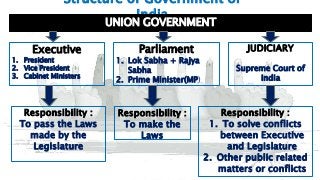
Structure of Government of
India
Parliament
1. Lok Sabha + Rajya
Sabha
2. Prime Minister(MP)
UNION GOVERNMENT
JUDICIARY
Supreme Court of
India
Executive
1. President
2. Vice President
3. Cabinet Ministers
Responsibility :
To pass the Laws
made by the
Legislature
Responsibility :
To make the
Laws
Responsibility :
1. To solve conflicts
between Executive
and Legislature
2. Other public related
matters or conflicts
3
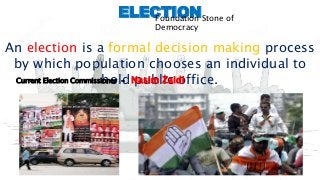
ELECTIONFoundation Stone of
Democracy
An election is a formal decision making process
by which population chooses an individual to
hold public office.Current Election Commissioner - Nasim Zaidi
4
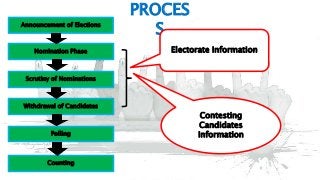
PROCES
SAnnouncement of Elections
Polling
Nomination Phase
Counting
Scrutiny of Nominations
Withdrawal of Candidates
Electorate Information
Contesting
Candidates
Information
5
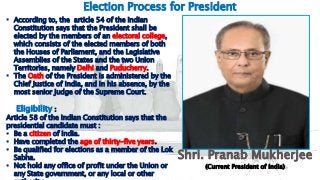
Election Process for President
 According to, the article 54 of the Indian
Constitution says that the President shall be
elected by the members of an electoral college,
which consists of the elected members of both
the Houses of Parliament, and the Legislative
Assemblies of the States and the two Union
Territories, namely Delhi and Puducherry.
 The Oath of the President is administered by the
Chief Justice of India, and in his absence, by the
most senior judge of the Supreme Court.
Eligibility :
Article 58 of the Indian Constitution says that the
presidential candidate must :
 Be a citizen of India.
 Have completed the age of thirty-five years.
 Be qualified for elections as a member of the Lok
Sabha.
 Not hold any office of profit under the Union or
any State government, or any local or other
Shri. Pranab Mukherjee
(Current President of India)
6
Why should we Vote ?
 India is the largest democracy in the
world.
 The right to vote and more
importantly the exercise of franchise
by the eligible citizens is at the heart
of every democracy.
 We, the people, through our right to
vote have the ultimate power to
shape the destiny of country by
electing our representatives who run
the Government.
 As a voter we have every right to
seek information & get it.
7
Who can vote ?
You are eligible to vote if :
• You are Indian citizen.
• You are 18 year or older.
• You are an Ordinary Resident at your current location i.e. you
have been living at your current address for 6 months or longer.
Disclosure by candidates
Election Commission of India has made it mandatory that all
candidates must file an affidavit along with their nomination form
with details such as :
 His/her Criminal antecedents.
 His/her assets & liabilities and those of his/her spouse and
dependents.
 His/her Educational background.

8
Vishesh
Vaishnav

Election Process in India

  • 1.
  • 2.
    2 Structure of Governmentof India Parliament 1. Lok Sabha + Rajya Sabha 2. Prime Minister(MP) UNION GOVERNMENT JUDICIARY Supreme Court of India Executive 1. President 2. Vice President 3. Cabinet Ministers Responsibility : To pass the Laws made by the Legislature Responsibility : To make the Laws Responsibility : 1. To solve conflicts between Executive and Legislature 2. Other public related matters or conflicts
  • 3.
    3 ELECTIONFoundation Stone of Democracy Anelection is a formal decision making process by which population chooses an individual to hold public office.Current Election Commissioner - Nasim Zaidi
  • 4.
    4 PROCES SAnnouncement of Elections Polling NominationPhase Counting Scrutiny of Nominations Withdrawal of Candidates Electorate Information Contesting Candidates Information
  • 5.
    5 Election Process forPresident  According to, the article 54 of the Indian Constitution says that the President shall be elected by the members of an electoral college, which consists of the elected members of both the Houses of Parliament, and the Legislative Assemblies of the States and the two Union Territories, namely Delhi and Puducherry.  The Oath of the President is administered by the Chief Justice of India, and in his absence, by the most senior judge of the Supreme Court. Eligibility : Article 58 of the Indian Constitution says that the presidential candidate must :  Be a citizen of India.  Have completed the age of thirty-five years.  Be qualified for elections as a member of the Lok Sabha.  Not hold any office of profit under the Union or any State government, or any local or other Shri. Pranab Mukherjee (Current President of India)
  • 6.
    6 Why should weVote ?  India is the largest democracy in the world.  The right to vote and more importantly the exercise of franchise by the eligible citizens is at the heart of every democracy.  We, the people, through our right to vote have the ultimate power to shape the destiny of country by electing our representatives who run the Government.  As a voter we have every right to seek information & get it.
  • 7.
    7 Who can vote? You are eligible to vote if : • You are Indian citizen. • You are 18 year or older. • You are an Ordinary Resident at your current location i.e. you have been living at your current address for 6 months or longer. Disclosure by candidates Election Commission of India has made it mandatory that all candidates must file an affidavit along with their nomination form with details such as :  His/her Criminal antecedents.  His/her assets & liabilities and those of his/her spouse and dependents.  His/her Educational background.
  • 8.