www.maynoothuniversity.ie/library
Get Yourself
Heard: Writing
for Publication
Helen Fallon
Deputy Librarian,
Maynooth University
Helen.b.fallon@mu.ie
@helenfallon
• What can you write about?
• Who is your audience?
• What is the purpose of your
writing?
• Where can you publish?
• How do you write the piece?
• How can you find time to write?
• How can you promote your
publishing?
www.maynoothuniversity.ie/library
Your story
Inspiring Quotes
If you’re clear in your mind about what you are going
to paint, there is no point in painting it (Picasso)
I have to start to write to have ideas (Françoise Sagan)
Writing is a process of discovery. Sometimes you don't
know what you know. You may know it but have no idea
how it fits together (Alice Walker)
www.maynoothuniversity.ie/library
What can you write about?
• Your practice/everyday work/a
project you were involved with
• Your research/thesis
• Topic that interests you/topic you
know a bit about
• Other – book you read,
conference you attended, course
you undertook etc.
• Consider what information you
have
• Consider what topics are popular
www.maynoothuniversity.ie/library
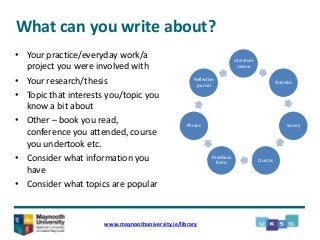
Literature
review
Statistics
Survey
Quotes
Feedback
forms
Photos
Reflective
journal
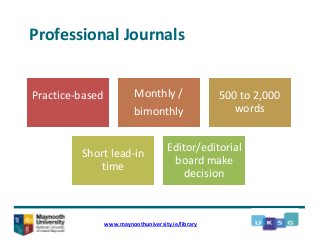
Professional Journals
Practice-based Monthly /
bimonthly
500 to 2,000
words
Short lead-in
time
Editor/editorial
board make
decision
www.maynoothuniversity.ie/library
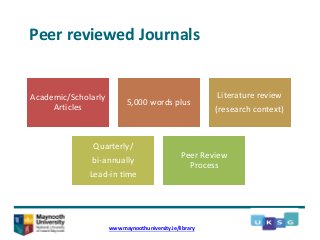
Peer reviewed Journals
Academic/Scholarly
Articles
5,000 words plus
Literature review
(research context)
Quarterly/
bi-annually
Lead-in time
Peer Review
Process
www.maynoothuniversity.ie/library
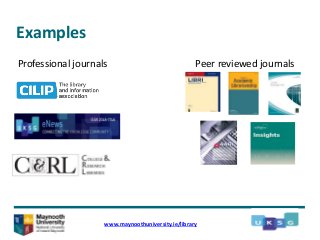
Examples
www.maynoothuniversity.ie/library
Professional journals Peer reviewed journals
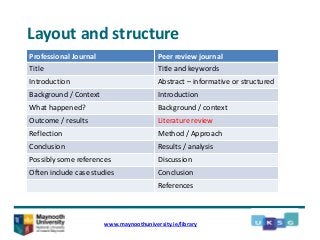
Layout and structure
Professional Journal Peer review journal
Title Title and keywords
Introduction Abstract – informative or structured
Background / Context Introduction
What happened? Background / context
Outcome / results Literature review
Reflection Method / Approach
Conclusion Results / analysis
Possibly some references Discussion
Often include case studies Conclusion
References
www.maynoothuniversity.ie/library
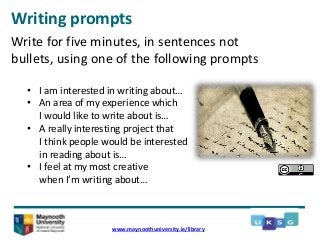
Writing prompts
www.maynoothuniversity.ie/library
Write for five minutes, in sentences not
bullets, using one of the following prompts
• I am interested in writing about…
• An area of my experience which
I would like to write about is…
• A really interesting project that
I think people would be interested
in reading about is…
• I feel at my most creative
when I’m writing about…
Writing - Outlining
• Work from an outline –
model your article on an
article in your target
journal that works well
• View structure at a glance
• Order ideas/ Sift &
eliminate ideas
• Contextualise/Give
framework
www.maynoothuniversity.ie/library
The reason many aspiring authors fail
is that they throw themselves
immediately into the activity of writing
without realizing it is the forethought,
analysis and preparation that
determine the quality of the finished
product
Day, A. (2007) How to Get Research
Published in Journals. Burlington, VT.:
Ashgate. P.9
Writing
• Adhere to journal guidelines
• Read some articles in recent issues of your target
journal/Look at structure as well as content
• Write from your outline
• Write in sections – look at your outline
• Include headings and sub-headings
• Consider tense
• Consider Voice – active or passive
• Style isn’t evident in first drafts
www.maynoothuniversity.ie/library
Writing
• Don’t look for perfection, just write - Give yourself permission
to write badly
• All writing is rewriting
• You are a storyteller – what are the elements of good
storytelling?
• Draft and redraft
• Read aloud
• Put aside for a week then reread
• Let go! (80%)
• Refer to your query e-mail in your submission
www.maynoothuniversity.ie/library
Peer Review
• Double Blind
• Accept as is
• Accept with minor changes
• Accept with major changes (revise and resubmit)
• Reject
• If rejected, need to reconsider and possibly rewrite to
some degree to match new journal style/guidelines for
authors
www.maynoothuniversity.ie/library
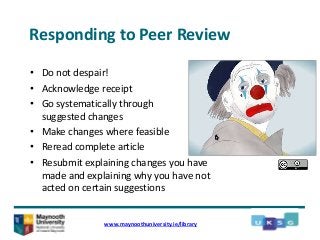
Responding to Peer Review
• Do not despair!
• Acknowledge receipt
• Go systematically through
suggested changes
• Make changes where feasible
• Reread complete article
• Resubmit explaining changes you have
made and explaining why you have not
acted on certain suggestions
www.maynoothuniversity.ie/library
After Publication
• Check Sherpa for journal guidelines on
depositing in an institutional repository
http://www.sherpa.ac.uk/
• Accepted Manuscript Online (AMO)
• Free downloads (50 T&F)
• Social media - Tweet link to your
article/create link in your e-mail
signature
• Altmetrics
• Can you develop this topic further?
• Celebrate success
www.maynoothuniversity.ie/library
Moving on With Your Writing
• Time – snack or sandwich writing
• Set goals
• Look for collaborators – within and outside your
discipline
• Collect data – your practice
• Describe, but also reflect and evaluate
• Read & discuss
www.maynoothuniversity.ie/library
Books & Articles
• Day, Abby (2017) How to get research published in journals. 2nd ed.
Gower.
• Fallon, H. (2011). The Academic Writing Toolkit
http://eprints.maynoothuniversity.ie/1387/1/HFSconul20.pdf
• Kitchin, R. & Fuller, D. (2005) The Academic’s Guide to Publishing.
London: Sage
• Morris, W (2018) Superhero Writing Tips for Librarians
http://bit.ly/2zxwFIn
• Murray, R. (2006) Writing Articles, Books and Presentations IN
Gilbert, N (ed.) From Postgraduate to Social Scientist: A Guide to Key
Skills. London: Sage, p. 149-170
• Murray, R. (2009) Writing for Academic Journals. 2nd ed. McGraw
Hill/Open University
More resources on getting published including a comprehensive bibliography are available
on my blog
www.maynoothuniversity.ie/library
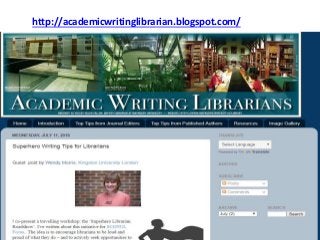
http://academicwritinglibrarian.blogspot.com/
www.maynoothuniversity.ie/library
Thank you!
Helen Fallon, Deputy Librarian, Maynooth University
Helen.b.fallon@mu.ie
@helenfallon
@library_MU
www.maynoothuniversity.ie/library

Get yourself heard: writing for publication

  • 1.
  • 2.
    Get Yourself Heard: Writing forPublication Helen Fallon Deputy Librarian, Maynooth University Helen.b.fallon@mu.ie @helenfallon
  • 3.
    • What canyou write about? • Who is your audience? • What is the purpose of your writing? • Where can you publish? • How do you write the piece? • How can you find time to write? • How can you promote your publishing? www.maynoothuniversity.ie/library Your story
  • 4.
    Inspiring Quotes If you’reclear in your mind about what you are going to paint, there is no point in painting it (Picasso) I have to start to write to have ideas (Françoise Sagan) Writing is a process of discovery. Sometimes you don't know what you know. You may know it but have no idea how it fits together (Alice Walker) www.maynoothuniversity.ie/library
  • 5.
    What can youwrite about? • Your practice/everyday work/a project you were involved with • Your research/thesis • Topic that interests you/topic you know a bit about • Other – book you read, conference you attended, course you undertook etc. • Consider what information you have • Consider what topics are popular www.maynoothuniversity.ie/library Literature review Statistics Survey Quotes Feedback forms Photos Reflective journal
  • 6.
    Professional Journals Practice-based Monthly/ bimonthly 500 to 2,000 words Short lead-in time Editor/editorial board make decision www.maynoothuniversity.ie/library
  • 7.
    Peer reviewed Journals Academic/Scholarly Articles 5,000words plus Literature review (research context) Quarterly/ bi-annually Lead-in time Peer Review Process www.maynoothuniversity.ie/library
  • 8.
  • 9.
    Layout and structure ProfessionalJournal Peer review journal Title Title and keywords Introduction Abstract – informative or structured Background / Context Introduction What happened? Background / context Outcome / results Literature review Reflection Method / Approach Conclusion Results / analysis Possibly some references Discussion Often include case studies Conclusion References www.maynoothuniversity.ie/library
  • 10.
    Writing prompts www.maynoothuniversity.ie/library Write forfive minutes, in sentences not bullets, using one of the following prompts • I am interested in writing about… • An area of my experience which I would like to write about is… • A really interesting project that I think people would be interested in reading about is… • I feel at my most creative when I’m writing about…
  • 11.
    Writing - Outlining •Work from an outline – model your article on an article in your target journal that works well • View structure at a glance • Order ideas/ Sift & eliminate ideas • Contextualise/Give framework www.maynoothuniversity.ie/library The reason many aspiring authors fail is that they throw themselves immediately into the activity of writing without realizing it is the forethought, analysis and preparation that determine the quality of the finished product Day, A. (2007) How to Get Research Published in Journals. Burlington, VT.: Ashgate. P.9
  • 12.
    Writing • Adhere tojournal guidelines • Read some articles in recent issues of your target journal/Look at structure as well as content • Write from your outline • Write in sections – look at your outline • Include headings and sub-headings • Consider tense • Consider Voice – active or passive • Style isn’t evident in first drafts www.maynoothuniversity.ie/library
  • 13.
    Writing • Don’t lookfor perfection, just write - Give yourself permission to write badly • All writing is rewriting • You are a storyteller – what are the elements of good storytelling? • Draft and redraft • Read aloud • Put aside for a week then reread • Let go! (80%) • Refer to your query e-mail in your submission www.maynoothuniversity.ie/library
  • 14.
    Peer Review • DoubleBlind • Accept as is • Accept with minor changes • Accept with major changes (revise and resubmit) • Reject • If rejected, need to reconsider and possibly rewrite to some degree to match new journal style/guidelines for authors www.maynoothuniversity.ie/library
  • 15.
    Responding to PeerReview • Do not despair! • Acknowledge receipt • Go systematically through suggested changes • Make changes where feasible • Reread complete article • Resubmit explaining changes you have made and explaining why you have not acted on certain suggestions www.maynoothuniversity.ie/library
  • 16.
    After Publication • CheckSherpa for journal guidelines on depositing in an institutional repository http://www.sherpa.ac.uk/ • Accepted Manuscript Online (AMO) • Free downloads (50 T&F) • Social media - Tweet link to your article/create link in your e-mail signature • Altmetrics • Can you develop this topic further? • Celebrate success www.maynoothuniversity.ie/library
  • 17.
    Moving on WithYour Writing • Time – snack or sandwich writing • Set goals • Look for collaborators – within and outside your discipline • Collect data – your practice • Describe, but also reflect and evaluate • Read & discuss www.maynoothuniversity.ie/library
  • 18.
    Books & Articles •Day, Abby (2017) How to get research published in journals. 2nd ed. Gower. • Fallon, H. (2011). The Academic Writing Toolkit http://eprints.maynoothuniversity.ie/1387/1/HFSconul20.pdf • Kitchin, R. & Fuller, D. (2005) The Academic’s Guide to Publishing. London: Sage • Morris, W (2018) Superhero Writing Tips for Librarians http://bit.ly/2zxwFIn • Murray, R. (2006) Writing Articles, Books and Presentations IN Gilbert, N (ed.) From Postgraduate to Social Scientist: A Guide to Key Skills. London: Sage, p. 149-170 • Murray, R. (2009) Writing for Academic Journals. 2nd ed. McGraw Hill/Open University More resources on getting published including a comprehensive bibliography are available on my blog www.maynoothuniversity.ie/library
  • 19.
  • 20.
    Thank you! Helen Fallon,Deputy Librarian, Maynooth University Helen.b.fallon@mu.ie @helenfallon @library_MU www.maynoothuniversity.ie/library