Young consumers attitudes toward unsolicited commercial messages  By Hoang Tu Quynh Lecturer: Duong Trong Hue
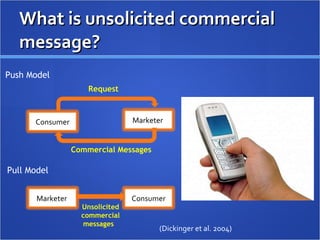
What is unsolicited commercial message? Unsolicited commercial messages  Push Model Pull Model  Request Commercial Messages (Dickinger et al. 2004) Marketer  Consumer Consumer Marketer
Unsolicited commercial messages Pull Model  Marketers send messages to consumers without their prior permission or request.
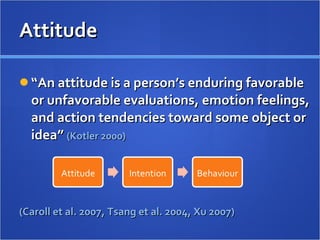
Attitude  “ An attitude is a person’s enduring favorable or unfavorable evaluations, emotion feelings, and action tendencies toward some object or idea”  (Kotler 2000) (Caroll et al. 2007, Tsang et al. 2004, Xu 2007)
Prior studies on consumers’ attitudes towards SMS advertising Consumers hold negative attitudes about receiving mobile advertisements  (Drossos et al. 2007, Tsang et al. 2004, Grant & O’Donohoe 2007)
Prior studies on consumers’ attitudes towards SMS advertising Consumers find that SMS advertising is irritating  (Muk 2007, Klassen & Cuneo 2007, Xu 2006/2007) Entertainment is the major factor that affects the attitude, followed by credibility  (Xu 2006/2007, Tsang et al. 2004) Permission based-advertising can grant positive attitude  (Tsang et al. 2004) Young consumers hold strong negative feelings when receiving mobile ads even if permission had been granted  (Grant & O’Donohoe 2007)
My Research Question What are the attitudes, intention and behaviour of young consumers to receiving unsolicited commercial messages?
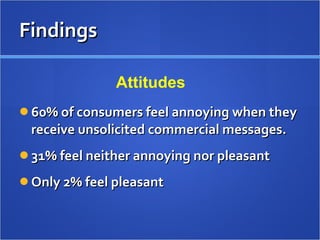
Findings 60% of consumers feel annoying when they receive unsolicited commercial messages. 31% feel neither annoying nor pleasant Only 2% feel pleasant  Attitudes
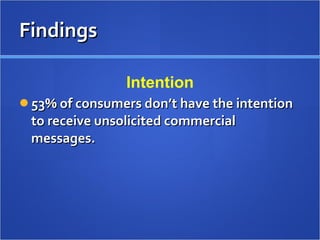
53% of consumers don’t have the intention to receive unsolicited commercial messages.  Findings Intention
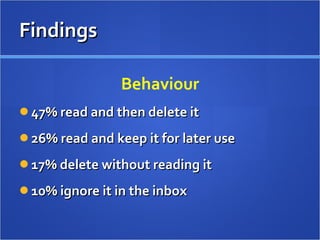
47% read and then delete it 26% read and keep it for later use 17% delete without reading it 10% ignore it in the inbox Findings Behaviour
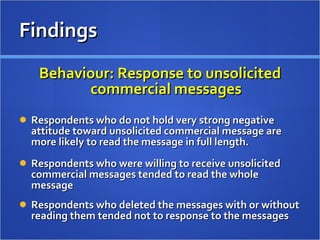
Behaviour: Response to unsolicited commercial messages Respondents who do not hold very strong negative attitude toward unsolicited commercial message are more likely to read the message in full length. Respondents who were willing to receive unsolicited commercial messages tended to read the whole message  Respondents who deleted the messages with or without reading them tended not to response to the messages  Findings
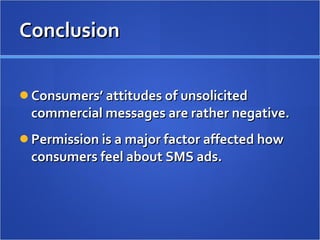
Conclusion Consumers’ attitudes of unsolicited commercial messages are rather negative. Permission is a major factor affected how consumers feel about SMS ads.
Implications for practitioners The negative attitude implies that SMS marketers have to give much effort to make the unsolicited commercial message more attractive to young people.  Or marketers should grant permission form consumers before they send commercial message.

Unsolicited commercial message

  • 1.
    Young consumers attitudestoward unsolicited commercial messages By Hoang Tu Quynh Lecturer: Duong Trong Hue
  • 2.
    What is unsolicitedcommercial message? Unsolicited commercial messages Push Model Pull Model Request Commercial Messages (Dickinger et al. 2004) Marketer Consumer Consumer Marketer
  • 3.
    Unsolicited commercial messagesPull Model Marketers send messages to consumers without their prior permission or request.
  • 4.
    Attitude “An attitude is a person’s enduring favorable or unfavorable evaluations, emotion feelings, and action tendencies toward some object or idea” (Kotler 2000) (Caroll et al. 2007, Tsang et al. 2004, Xu 2007)
  • 5.
    Prior studies onconsumers’ attitudes towards SMS advertising Consumers hold negative attitudes about receiving mobile advertisements (Drossos et al. 2007, Tsang et al. 2004, Grant & O’Donohoe 2007)
  • 6.
    Prior studies onconsumers’ attitudes towards SMS advertising Consumers find that SMS advertising is irritating (Muk 2007, Klassen & Cuneo 2007, Xu 2006/2007) Entertainment is the major factor that affects the attitude, followed by credibility (Xu 2006/2007, Tsang et al. 2004) Permission based-advertising can grant positive attitude (Tsang et al. 2004) Young consumers hold strong negative feelings when receiving mobile ads even if permission had been granted (Grant & O’Donohoe 2007)
  • 7.
    My Research QuestionWhat are the attitudes, intention and behaviour of young consumers to receiving unsolicited commercial messages?
  • 8.
    Findings 60% ofconsumers feel annoying when they receive unsolicited commercial messages. 31% feel neither annoying nor pleasant Only 2% feel pleasant Attitudes
  • 9.
    53% of consumersdon’t have the intention to receive unsolicited commercial messages. Findings Intention
  • 10.
    47% read andthen delete it 26% read and keep it for later use 17% delete without reading it 10% ignore it in the inbox Findings Behaviour
  • 11.
    Behaviour: Response tounsolicited commercial messages Respondents who do not hold very strong negative attitude toward unsolicited commercial message are more likely to read the message in full length. Respondents who were willing to receive unsolicited commercial messages tended to read the whole message Respondents who deleted the messages with or without reading them tended not to response to the messages Findings
  • 12.
    Conclusion Consumers’ attitudesof unsolicited commercial messages are rather negative. Permission is a major factor affected how consumers feel about SMS ads.
  • 13.
    Implications for practitionersThe negative attitude implies that SMS marketers have to give much effort to make the unsolicited commercial message more attractive to young people. Or marketers should grant permission form consumers before they send commercial message.

Editor's Notes

  • #3 Unsolicited commercial message is a concept in mobile marketing. Marketer utilizes the SMS technology to send commercial messages to consumers. There are two models in SMS advertising, the push and pull model. In the pull model, marketer promote the information that is requested by the consumer while in the pull model, marketer send messages to consumers without their prior permission or request.
  • #5 Why do I study attitude? Mobile advertising is a good indicator of intention to use mobile advertising to consume
  • #13 The findings from this study is similar to those in the literature review. As the study of Tsang and his colleagues, Grant & O’ Donohoe, Drossos and his colleagues) Consumers hold negative attitudes about receiving mobile advertisements and permission is a major factor affected how consumers feel about SMS ads.