
A Manifesto for the Digital Shift in Research Libraries
Report from RLUK’s Digital Shift Working Group
Dr Torsten Reimer
0000-0001-8357-9422, @torstenreimer
Head of Research Services, The British Library
@RL_UK www.rluk.ac.uk#RLUKdigishift
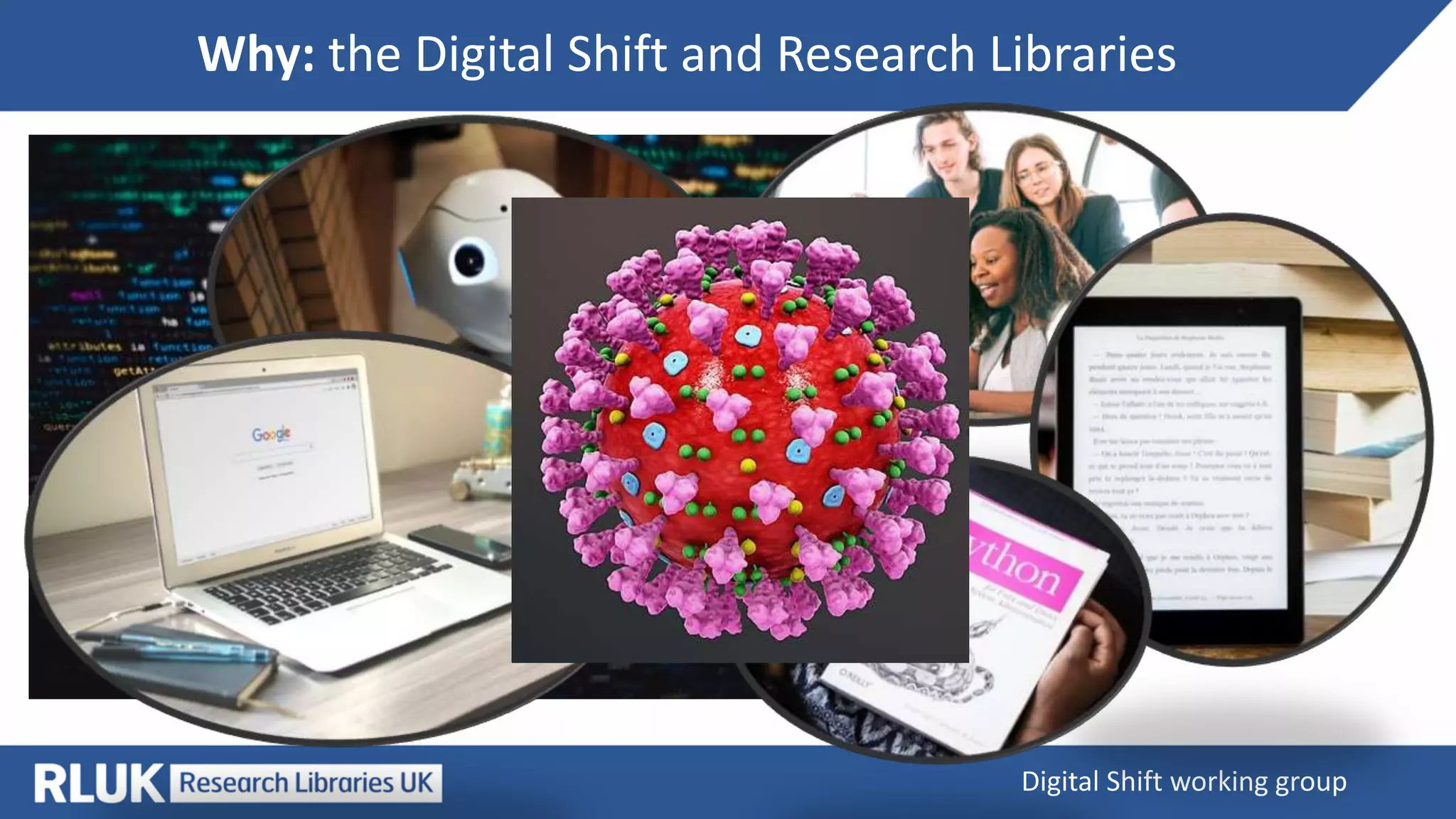
Why: the Digital Shift and Research Libraries
Digital Shift working group
How: the Digital Shift working group
Digital Shift working group
Working group from RLUK member networks:
Gabriel Sewell, Assistant Director of Library Services, St Andrews
Gavin Beattie, Associate Director, Research and Impact, Kings College London
Lorraine Beard, Associate Director, Research and Digital Horizons, Manchester
Masud Khokhar, Director of Libraries and Archives, York
Michelle Blake, Deputy Director, York
Sarah Thompson Head of Collections, York
Simon Dixon, Head of Archives and Special Collections, Leicester
Torsten Reimer, Head of Research, British Library (chair)
William Nixon, Assistant Director, Digital Strategy, Glasgow
Christina Kamposiori, Programme Officer, RLUK
Matt Greenhall, Deputy Executive Director, RLUK
https://www.rluk.ac.uk/digital-shift/
How: approach and activities
Digital Shift working group
• Virtual group meetings from October 2019
to January 2020
• RLUK community feedback via Jamboards
• Workshop at RLUK members’ meeting
in November 2019
• Input from RLUK networks, incl. Digital
Scholarship Network session in January
• Draft presented to RLUK board in February
• Sessions at RLUK conference in March
• Virtual launch May 2020
What: community needs
Digital Shift working group
• Clear vision and strategic direction for a decade-
long digital transformation
• Reliable foresight and horizon scanning
capability to inform the above
• Skills in digital innovation, ranging from
software development to service design,
business analysis, digital research, data science
and artificial intelligence
• Organisational structures, processes and
cultures that enable us to embrace and respond
to change in an inclusive way
• Sustainable investment in digital against a
constrained financial environment
• Flexible and technologically advanced spaces
that meet changing user needs
• A useful and sustainable role in discovery and
access in an open research context
• A way to innovate in services despite an often
ailing core technical infrastructure
• A way to move to an environmentally
sustainable library infrastructure
• Innovation and continual service improvement
embedded as a way of working
• Capacity and capability to meaningfully steer, or
at least engage with, Artificial Intelligence
• A way to work transparently (to our users)
despite a marketplace concentration in digital
services and the risks of increasing reliance on
closed systems
• To be trusted within our institutions to work
outside our professional boundaries and to
collaborate with academics and professional
service providers to deliver technology enabled
transformational change for the business.
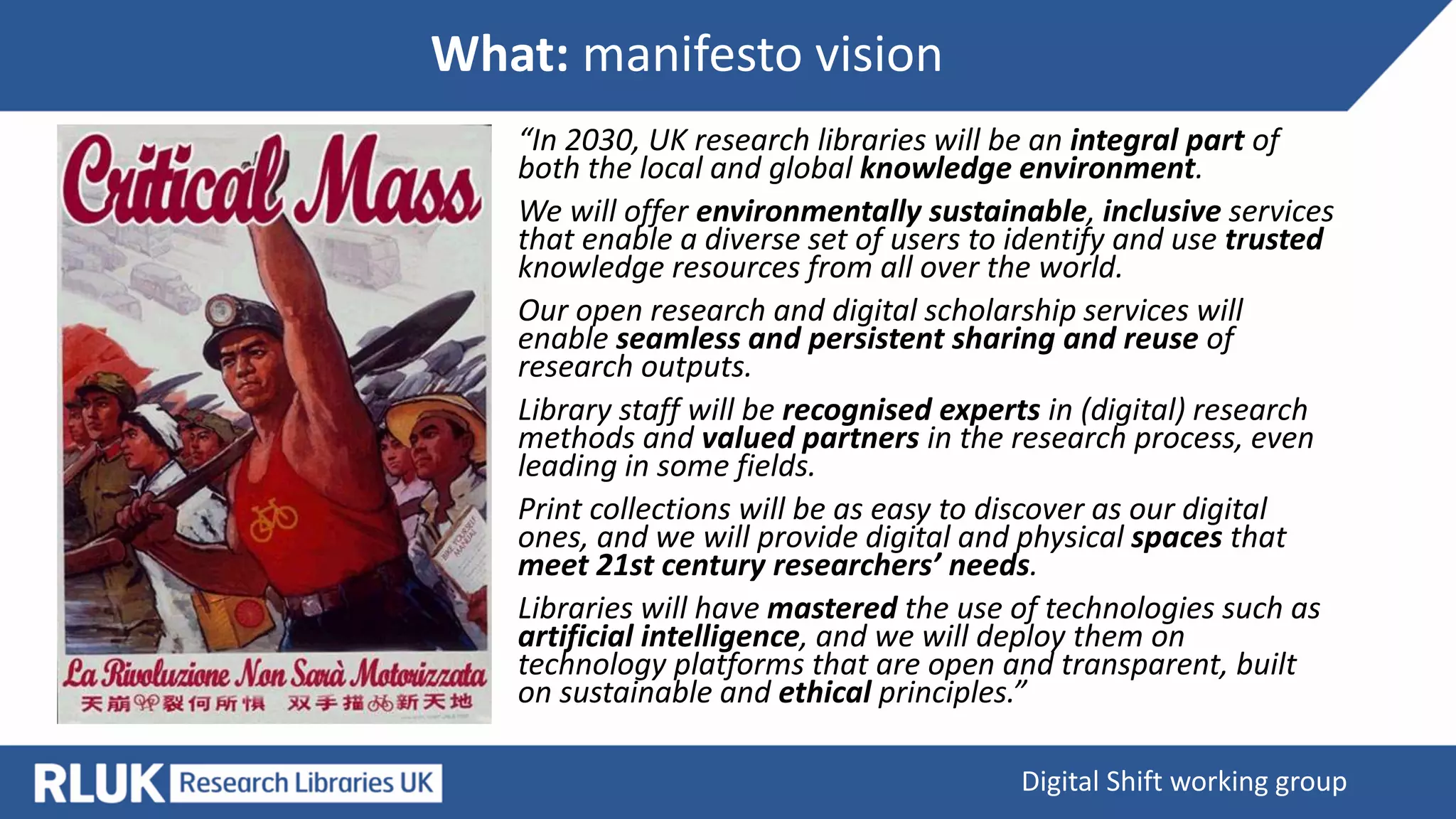
What: manifesto vision
Digital Shift working group
“In 2030, UK research libraries will be an integral part of
both the local and global knowledge environment.
We will offer environmentally sustainable, inclusive services
that enable a diverse set of users to identify and use trusted
knowledge resources from all over the world.
Our open research and digital scholarship services will
enable seamless and persistent sharing and reuse of
research outputs.
Library staff will be recognised experts in (digital) research
methods and valued partners in the research process, even
leading in some fields.
Print collections will be as easy to discover as our digital
ones, and we will provide digital and physical spaces that
meet 21st century researchers’ needs.
Libraries will have mastered the use of technologies such as
artificial intelligence, and we will deploy them on
technology platforms that are open and transparent, built
on sustainable and ethical principles.”
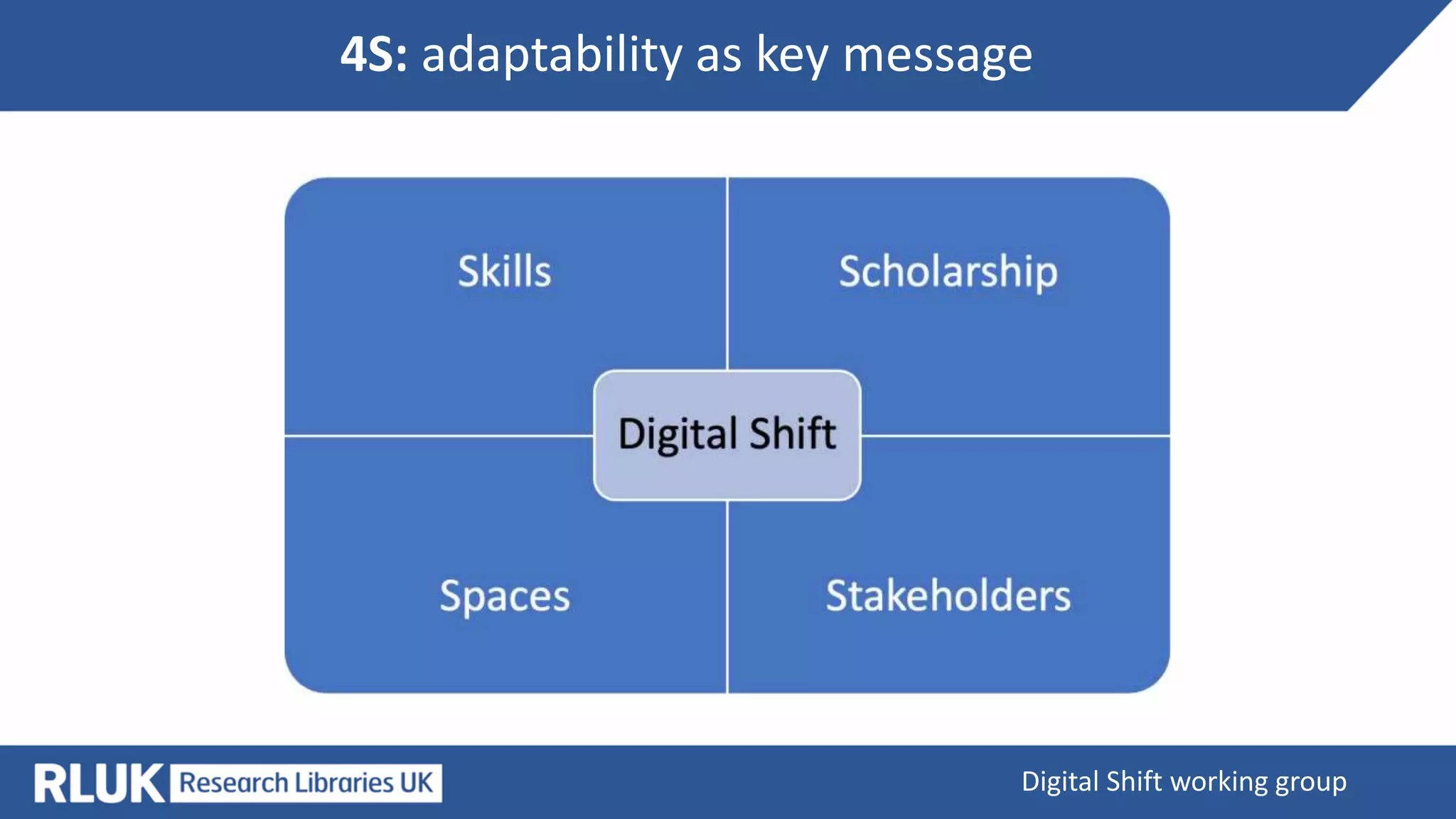
4S: adaptability as key message
Digital Shift working group
4S: Skills (and Leadership)
Digital Shift working group
• Foster leadership that empowers staff, giving them the confidence to take risks
• Implement an operating model that fully supports digital (which will have an
impact on governance, funding models and leadership skills, not just on digital
delivery)
• Wind down services that no longer add enough value to our users to free up
capacity
• Transition from largely transactional to more creative work
• Put staff in control of their time and environment through flexible working practices
• Use recruitment and training to find and retain an adaptable, diverse workforce
• Build capacity in data science, digital services, AI, foresight and licensing
• Cover a range of roles confidently (provider, partner and leader in research)
• Champion digital ethics in an age of misinformation and erosion of privacy
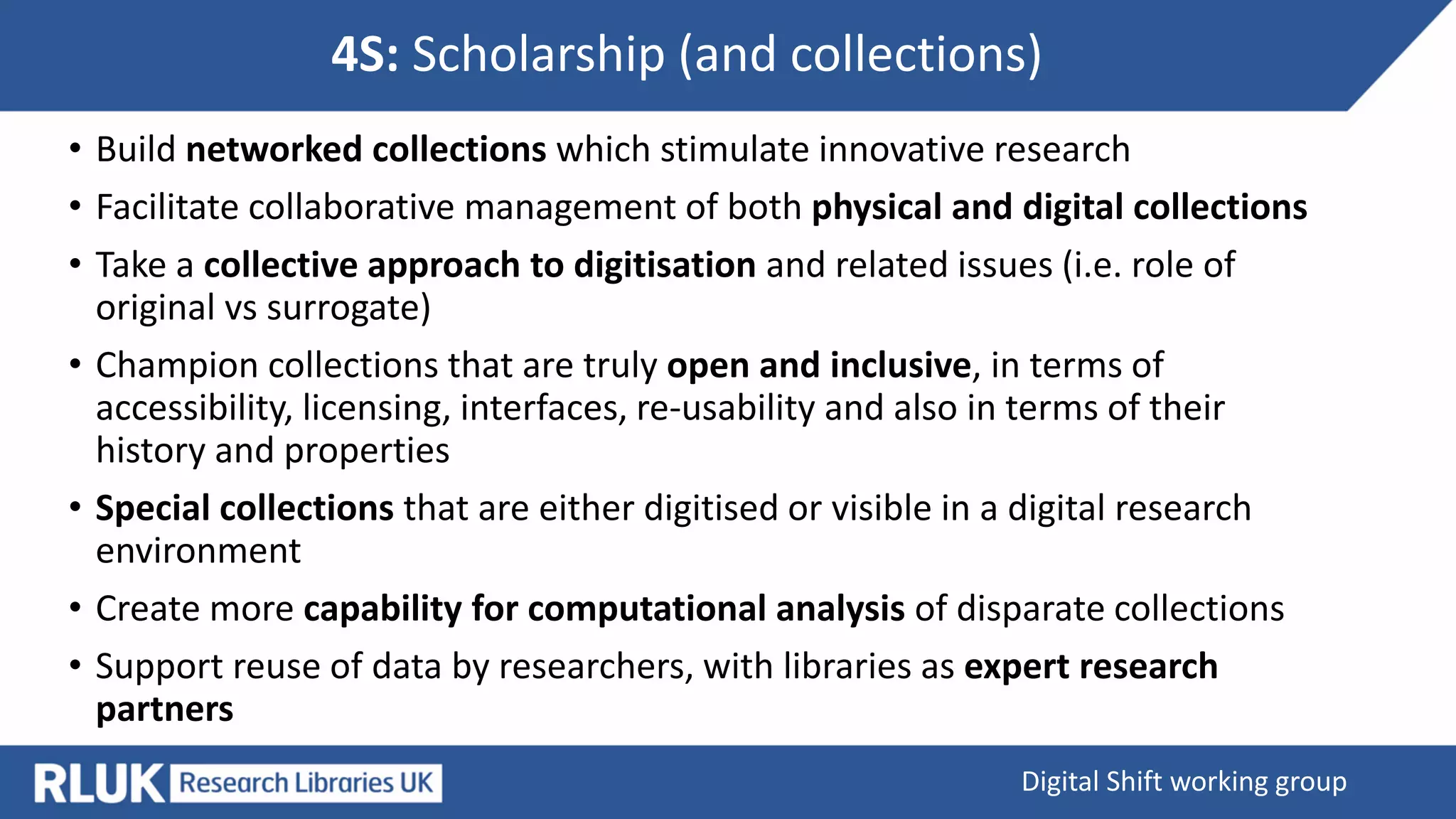
4S: Scholarship (and collections)
Digital Shift working group
• Build networked collections which stimulate innovative research
• Facilitate collaborative management of both physical and digital collections
• Take a collective approach to digitisation and related issues (i.e. role of
original vs surrogate)
• Champion collections that are truly open and inclusive, in terms of
accessibility, licensing, interfaces, re-usability and also in terms of their
history and properties
• Special collections that are either digitised or visible in a digital research
environment
• Create more capability for computational analysis of disparate collections
• Support reuse of data by researchers, with libraries as expert research
partners
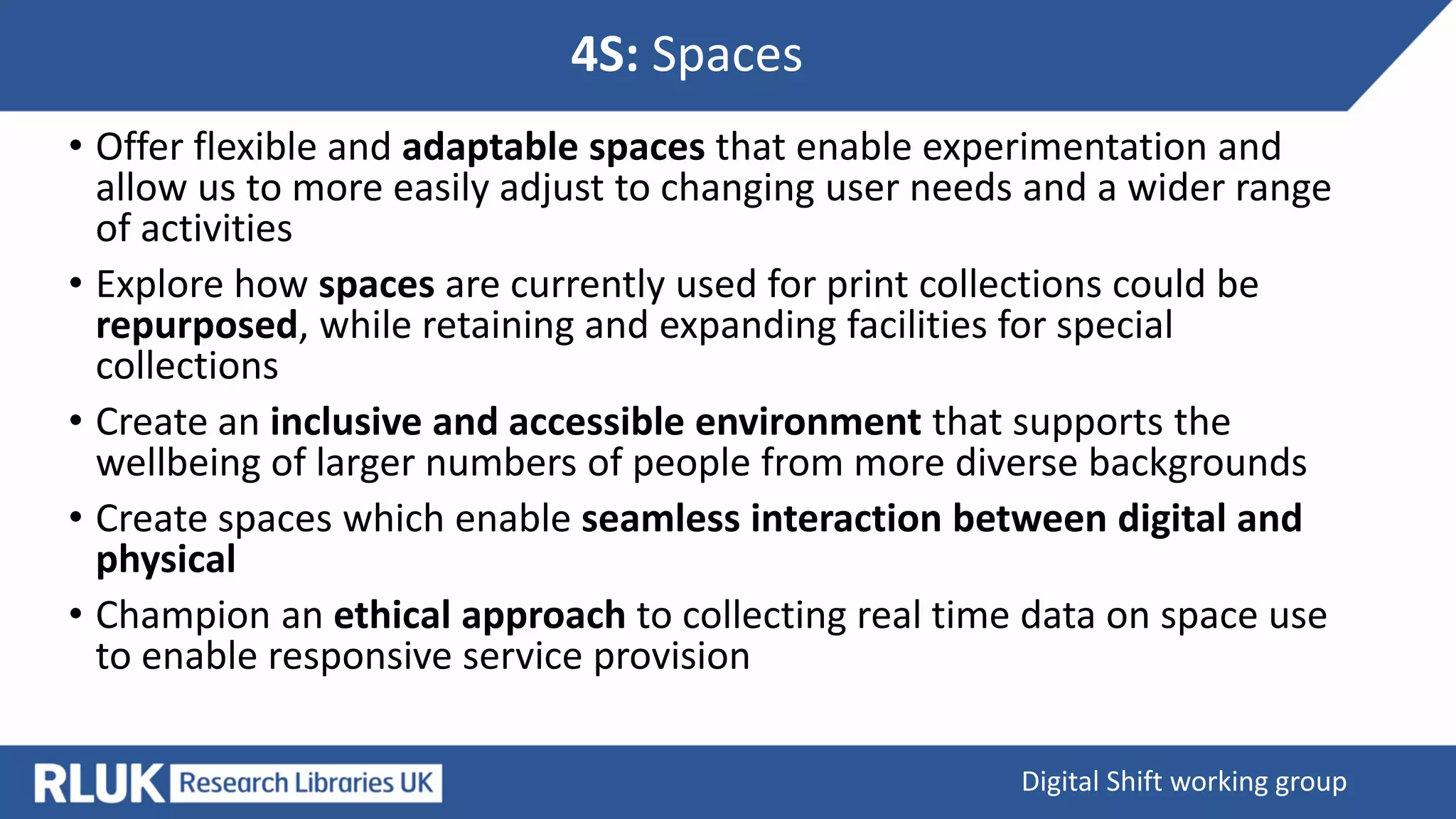
4S: Spaces
Digital Shift working group
• Offer flexible and adaptable spaces that enable experimentation and
allow us to more easily adjust to changing user needs and a wider range
of activities
• Explore how spaces are currently used for print collections could be
repurposed, while retaining and expanding facilities for special
collections
• Create an inclusive and accessible environment that supports the
wellbeing of larger numbers of people from more diverse backgrounds
• Create spaces which enable seamless interaction between digital and
physical
• Champion an ethical approach to collecting real time data on space use
to enable responsive service provision
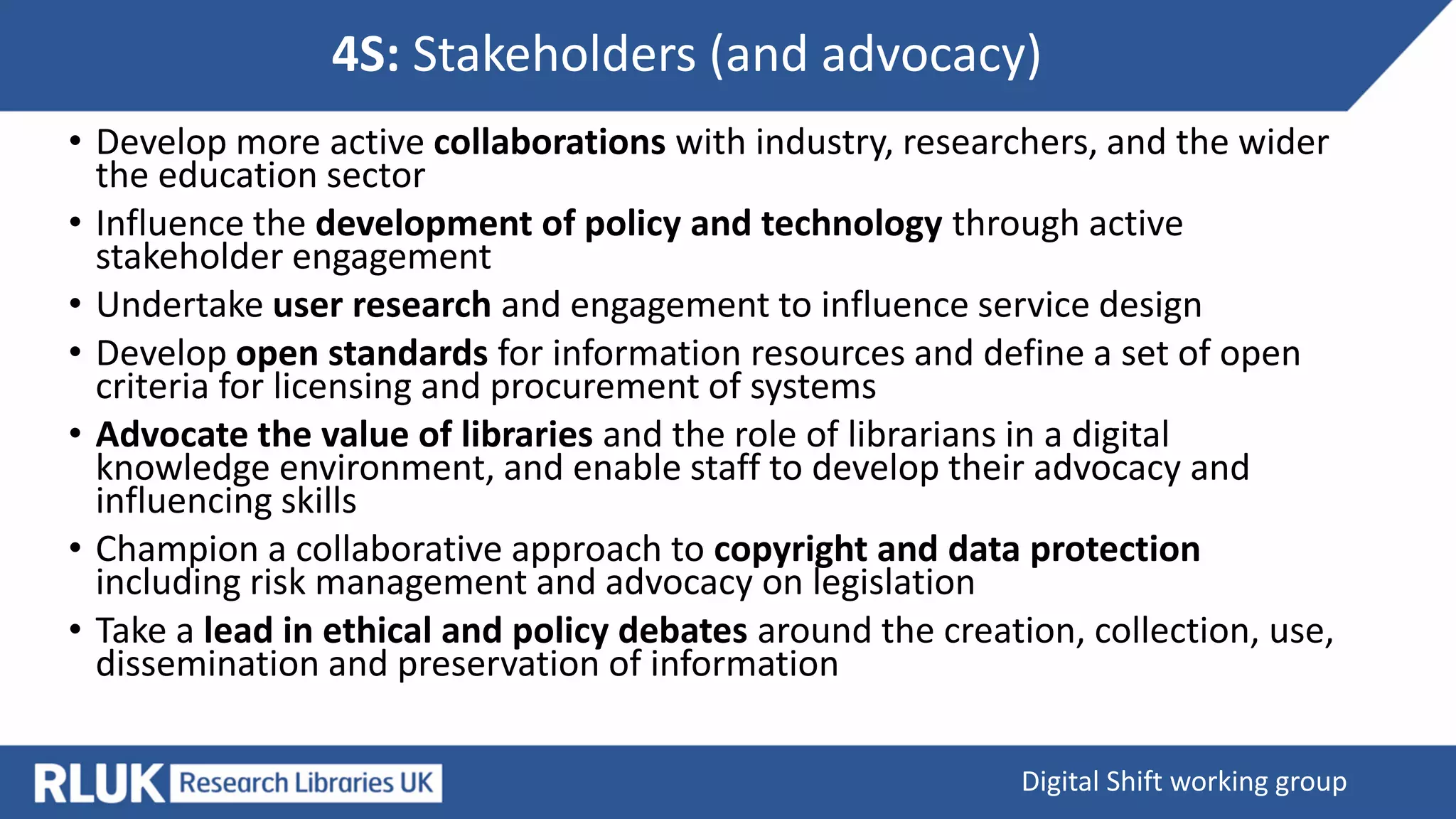
4S: Stakeholders (and advocacy)
Digital Shift working group
• Develop more active collaborations with industry, researchers, and the wider
the education sector
• Influence the development of policy and technology through active
stakeholder engagement
• Undertake user research and engagement to influence service design
• Develop open standards for information resources and define a set of open
criteria for licensing and procurement of systems
• Advocate the value of libraries and the role of librarians in a digital
knowledge environment, and enable staff to develop their advocacy and
influencing skills
• Champion a collaborative approach to copyright and data protection
including risk management and advocacy on legislation
• Take a lead in ethical and policy debates around the creation, collection, use,
dissemination and preservation of information
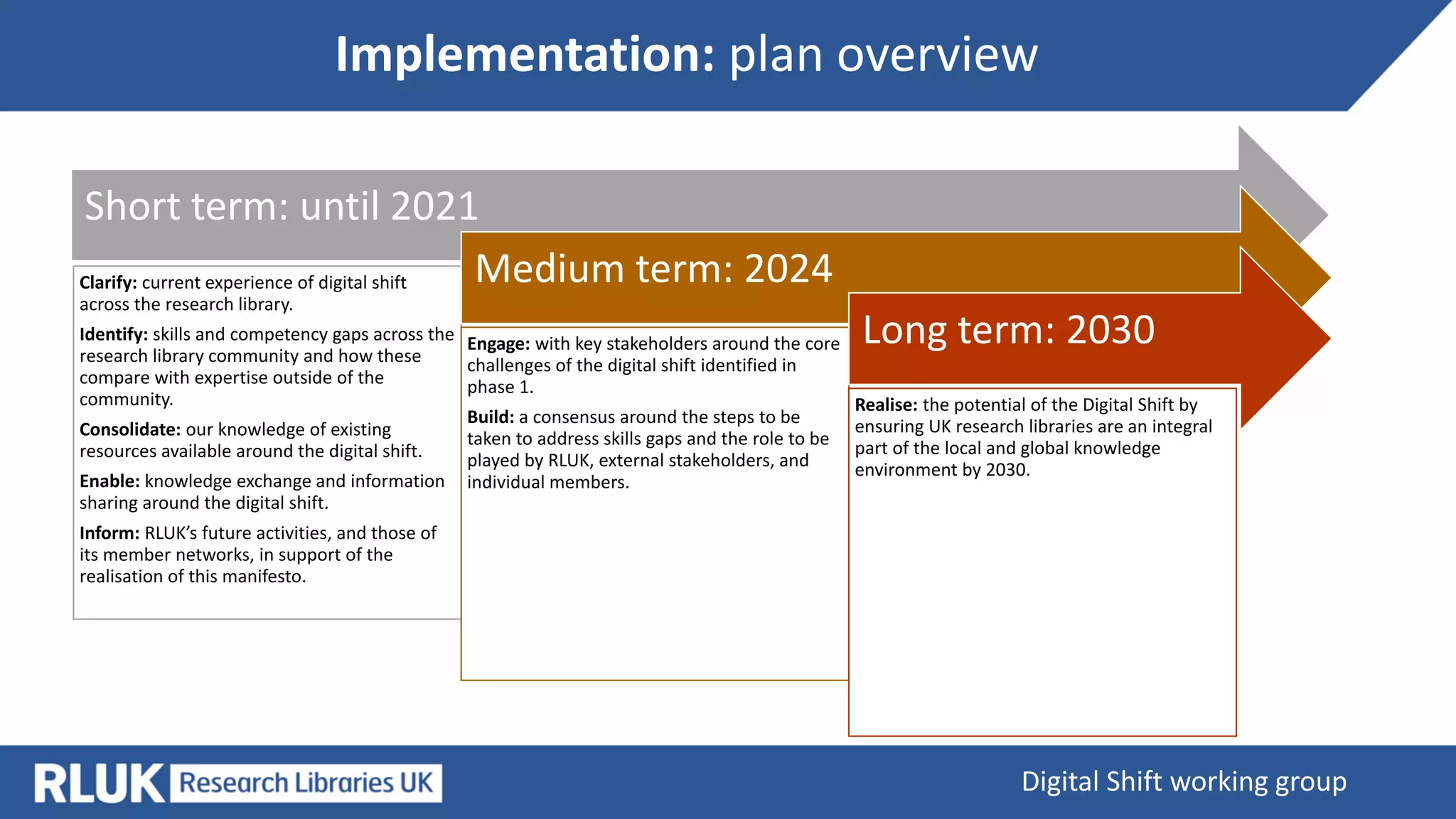
Implementation: plan overview
Digital Shift working group
Short term: until 2021
Clarify: current experience of digital shift
across the research library.
Identify: skills and competency gaps across the
research library community and how these
compare with expertise outside of the
community.
Consolidate: our knowledge of existing
resources available around the digital shift.
Enable: knowledge exchange and information
sharing around the digital shift.
Inform: RLUK’s future activities, and those of
its member networks, in support of the
realisation of this manifesto.
Medium term: 2024
Engage: with key stakeholders around the core
challenges of the digital shift identified in
phase 1.
Build: a consensus around the steps to be
taken to address skills gaps and the role to be
played by RLUK, external stakeholders, and
individual members.
Long term: 2030
Realise: the potential of the Digital Shift by
ensuring UK research libraries are an integral
part of the local and global knowledge
environment by 2030.
Implementation: short term
Digital Shift working group
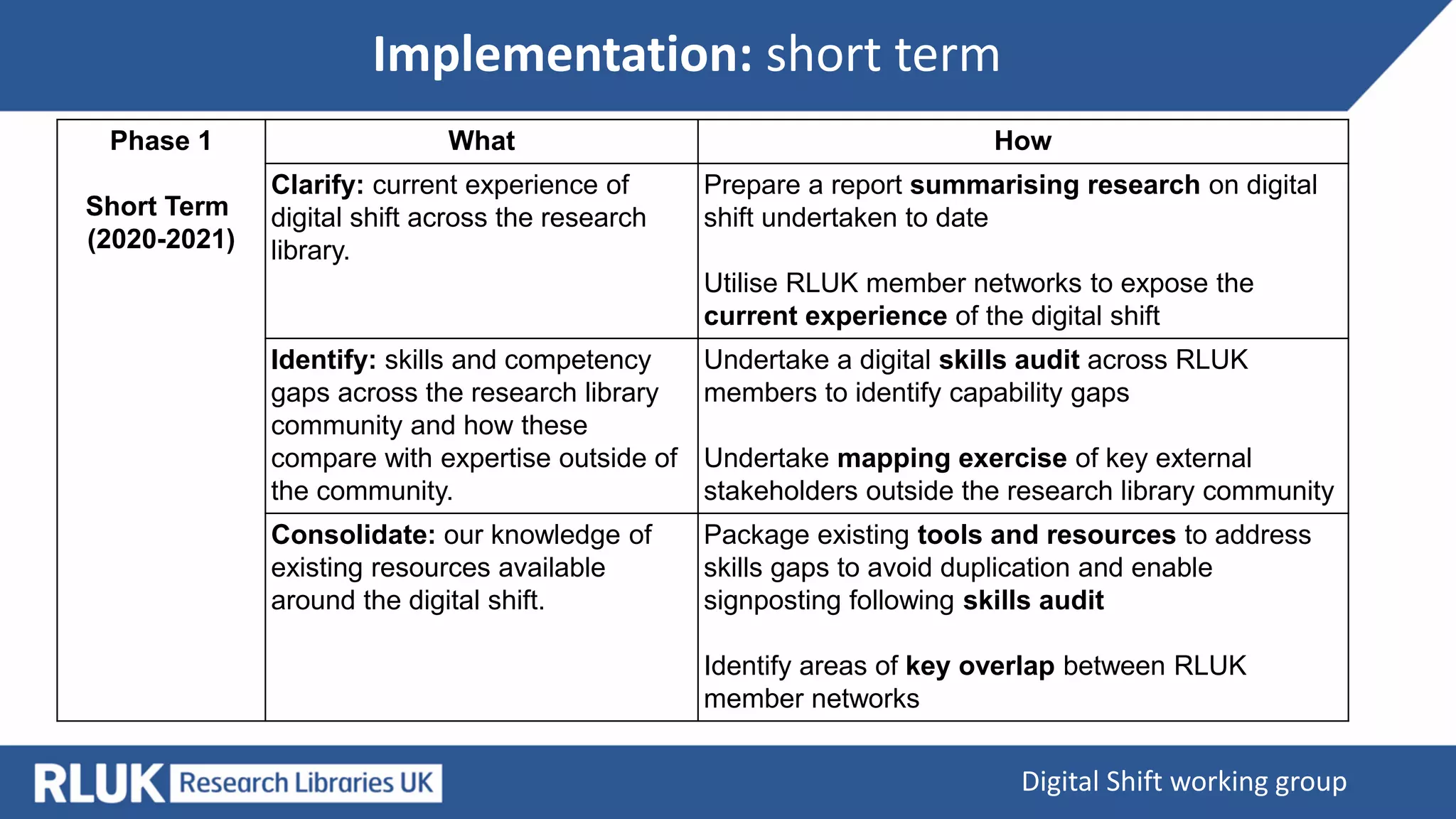
Phase 1
Short Term
(2020-2021)
What How
Clarify: current experience of
digital shift across the research
library.
Prepare a report summarising research on digital
shift undertaken to date
Utilise RLUK member networks to expose the
current experience of the digital shift
Identify: skills and competency
gaps across the research library
community and how these
compare with expertise outside of
the community.
Undertake a digital skills audit across RLUK
members to identify capability gaps
Undertake mapping exercise of key external
stakeholders outside the research library community
Consolidate: our knowledge of
existing resources available
around the digital shift.
Package existing tools and resources to address
skills gaps to avoid duplication and enable
signposting following skills audit
Identify areas of key overlap between RLUK
member networks
Implementation: short term
Digital Shift working group
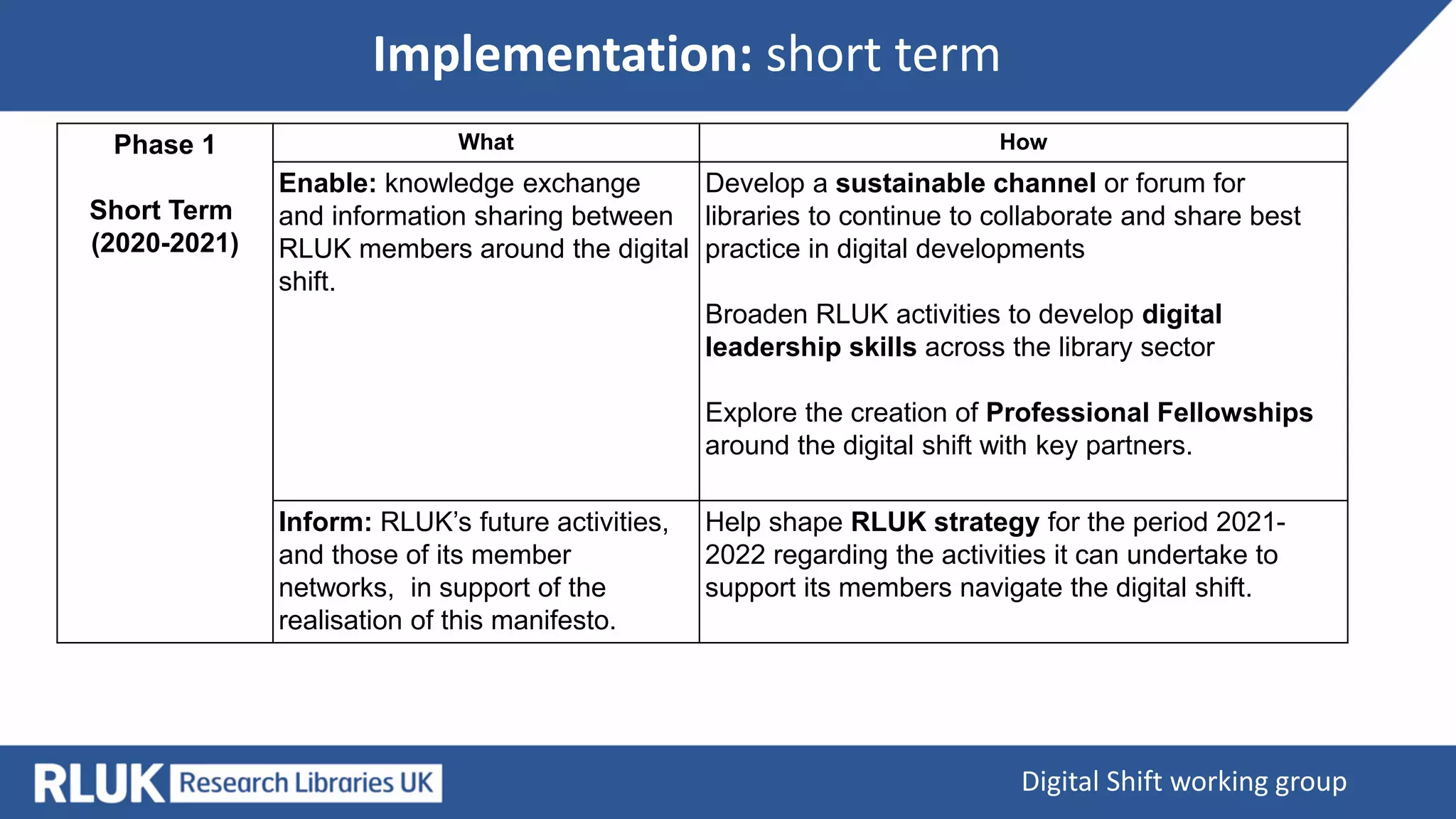
Phase 1
Short Term
(2020-2021)
What How
Enable: knowledge exchange
and information sharing between
RLUK members around the digital
shift.
Develop a sustainable channel or forum for
libraries to continue to collaborate and share best
practice in digital developments
Broaden RLUK activities to develop digital
leadership skills across the library sector
Explore the creation of Professional Fellowships
around the digital shift with key partners.
Inform: RLUK’s future activities,
and those of its member
networks, in support of the
realisation of this manifesto.
Help shape RLUK strategy for the period 2021-
2022 regarding the activities it can undertake to
support its members navigate the digital shift.
Implementation: medium term
Digital Shift working group
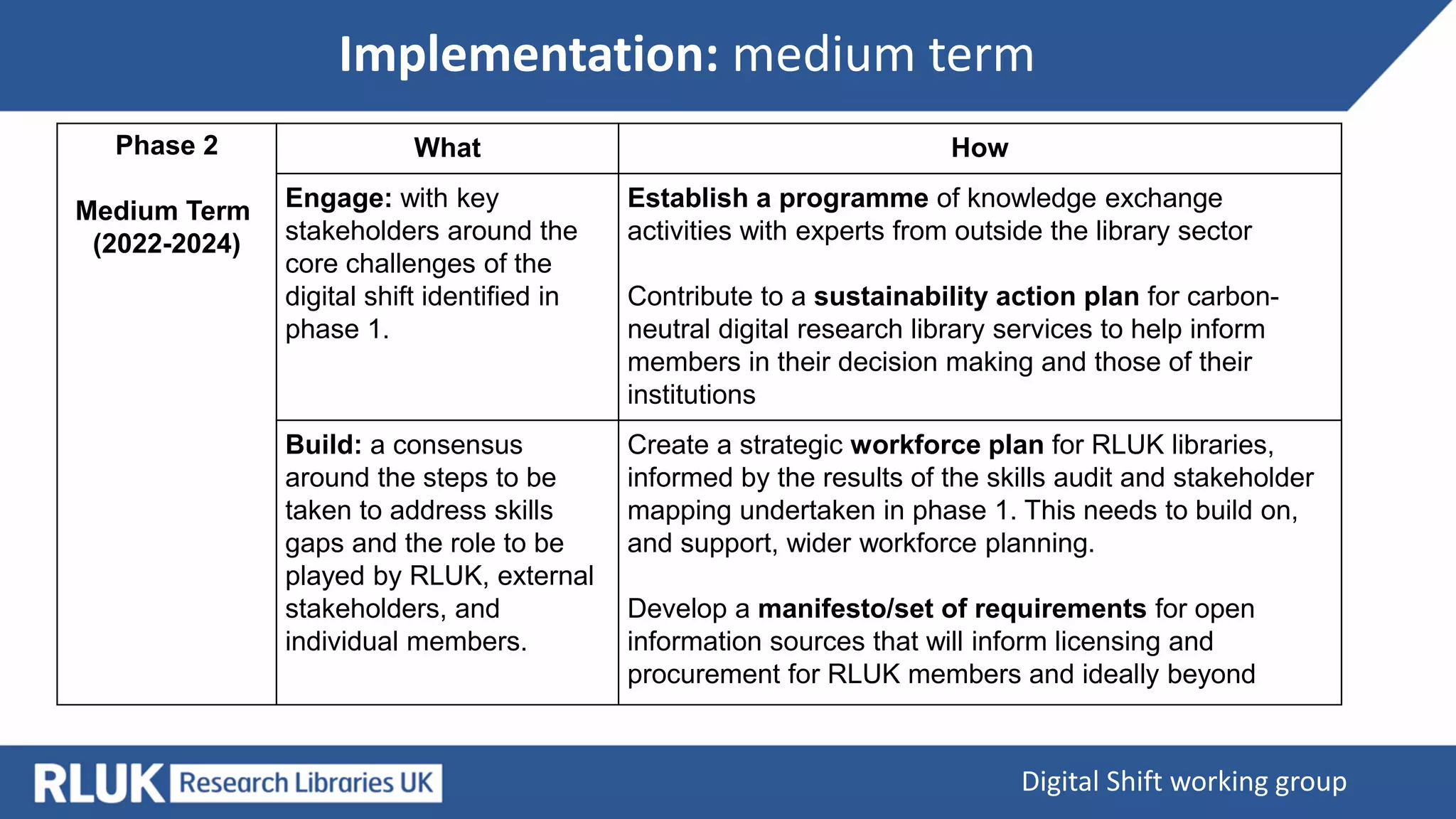
Phase 2
Medium Term
(2022-2024)
What How
Engage: with key
stakeholders around the
core challenges of the
digital shift identified in
phase 1.
Establish a programme of knowledge exchange
activities with experts from outside the library sector
Contribute to a sustainability action plan for carbon-
neutral digital research library services to help inform
members in their decision making and those of their
institutions
Build: a consensus
around the steps to be
taken to address skills
gaps and the role to be
played by RLUK, external
stakeholders, and
individual members.
Create a strategic workforce plan for RLUK libraries,
informed by the results of the skills audit and stakeholder
mapping undertaken in phase 1. This needs to build on,
and support, wider workforce planning.
Develop a manifesto/set of requirements for open
information sources that will inform licensing and
procurement for RLUK members and ideally beyond
Implementation: long term
Digital Shift working group
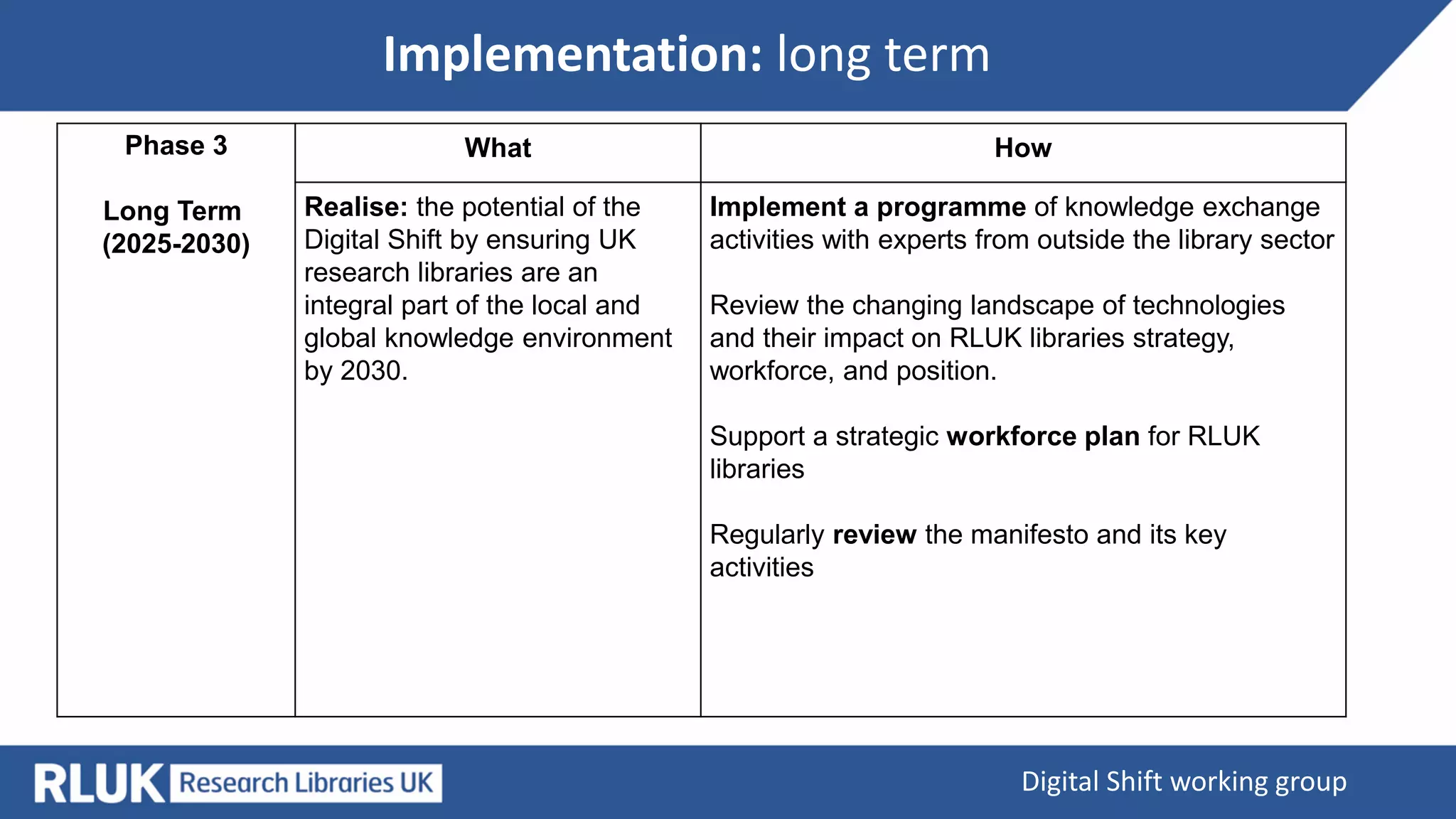
Phase 3
Long Term
(2025-2030)
What How
Realise: the potential of the
Digital Shift by ensuring UK
research libraries are an
integral part of the local and
global knowledge environment
by 2030.
Implement a programme of knowledge exchange
activities with experts from outside the library sector
Review the changing landscape of technologies
and their impact on RLUK libraries strategy,
workforce, and position.
Support a strategic workforce plan for RLUK
libraries
Regularly review the manifesto and its key
activities
Conclusion
Digital Shift working group
Dr Torsten Reimer
Head of Research Services
The British Library
Email: Torsten.Reimer@bl.uk
https://orcid.org/0000-0001-8357-9422

A Manifesto for the Digital Shift in Research Libraries

  • 1.
    A Manifesto forthe Digital Shift in Research Libraries Report from RLUK’s Digital Shift Working Group Dr Torsten Reimer 0000-0001-8357-9422, @torstenreimer Head of Research Services, The British Library @RL_UK www.rluk.ac.uk#RLUKdigishift
  • 2.
    Why: the DigitalShift and Research Libraries Digital Shift working group
  • 3.
    How: the DigitalShift working group Digital Shift working group Working group from RLUK member networks: Gabriel Sewell, Assistant Director of Library Services, St Andrews Gavin Beattie, Associate Director, Research and Impact, Kings College London Lorraine Beard, Associate Director, Research and Digital Horizons, Manchester Masud Khokhar, Director of Libraries and Archives, York Michelle Blake, Deputy Director, York Sarah Thompson Head of Collections, York Simon Dixon, Head of Archives and Special Collections, Leicester Torsten Reimer, Head of Research, British Library (chair) William Nixon, Assistant Director, Digital Strategy, Glasgow Christina Kamposiori, Programme Officer, RLUK Matt Greenhall, Deputy Executive Director, RLUK https://www.rluk.ac.uk/digital-shift/
  • 4.
    How: approach andactivities Digital Shift working group • Virtual group meetings from October 2019 to January 2020 • RLUK community feedback via Jamboards • Workshop at RLUK members’ meeting in November 2019 • Input from RLUK networks, incl. Digital Scholarship Network session in January • Draft presented to RLUK board in February • Sessions at RLUK conference in March • Virtual launch May 2020
  • 5.
    What: community needs DigitalShift working group • Clear vision and strategic direction for a decade- long digital transformation • Reliable foresight and horizon scanning capability to inform the above • Skills in digital innovation, ranging from software development to service design, business analysis, digital research, data science and artificial intelligence • Organisational structures, processes and cultures that enable us to embrace and respond to change in an inclusive way • Sustainable investment in digital against a constrained financial environment • Flexible and technologically advanced spaces that meet changing user needs • A useful and sustainable role in discovery and access in an open research context • A way to innovate in services despite an often ailing core technical infrastructure • A way to move to an environmentally sustainable library infrastructure • Innovation and continual service improvement embedded as a way of working • Capacity and capability to meaningfully steer, or at least engage with, Artificial Intelligence • A way to work transparently (to our users) despite a marketplace concentration in digital services and the risks of increasing reliance on closed systems • To be trusted within our institutions to work outside our professional boundaries and to collaborate with academics and professional service providers to deliver technology enabled transformational change for the business.
  • 6.
    What: manifesto vision DigitalShift working group “In 2030, UK research libraries will be an integral part of both the local and global knowledge environment. We will offer environmentally sustainable, inclusive services that enable a diverse set of users to identify and use trusted knowledge resources from all over the world. Our open research and digital scholarship services will enable seamless and persistent sharing and reuse of research outputs. Library staff will be recognised experts in (digital) research methods and valued partners in the research process, even leading in some fields. Print collections will be as easy to discover as our digital ones, and we will provide digital and physical spaces that meet 21st century researchers’ needs. Libraries will have mastered the use of technologies such as artificial intelligence, and we will deploy them on technology platforms that are open and transparent, built on sustainable and ethical principles.”
  • 7.
    4S: adaptability askey message Digital Shift working group
  • 8.
    4S: Skills (andLeadership) Digital Shift working group • Foster leadership that empowers staff, giving them the confidence to take risks • Implement an operating model that fully supports digital (which will have an impact on governance, funding models and leadership skills, not just on digital delivery) • Wind down services that no longer add enough value to our users to free up capacity • Transition from largely transactional to more creative work • Put staff in control of their time and environment through flexible working practices • Use recruitment and training to find and retain an adaptable, diverse workforce • Build capacity in data science, digital services, AI, foresight and licensing • Cover a range of roles confidently (provider, partner and leader in research) • Champion digital ethics in an age of misinformation and erosion of privacy
  • 9.
    4S: Scholarship (andcollections) Digital Shift working group • Build networked collections which stimulate innovative research • Facilitate collaborative management of both physical and digital collections • Take a collective approach to digitisation and related issues (i.e. role of original vs surrogate) • Champion collections that are truly open and inclusive, in terms of accessibility, licensing, interfaces, re-usability and also in terms of their history and properties • Special collections that are either digitised or visible in a digital research environment • Create more capability for computational analysis of disparate collections • Support reuse of data by researchers, with libraries as expert research partners
  • 10.
    4S: Spaces Digital Shiftworking group • Offer flexible and adaptable spaces that enable experimentation and allow us to more easily adjust to changing user needs and a wider range of activities • Explore how spaces are currently used for print collections could be repurposed, while retaining and expanding facilities for special collections • Create an inclusive and accessible environment that supports the wellbeing of larger numbers of people from more diverse backgrounds • Create spaces which enable seamless interaction between digital and physical • Champion an ethical approach to collecting real time data on space use to enable responsive service provision
  • 11.
    4S: Stakeholders (andadvocacy) Digital Shift working group • Develop more active collaborations with industry, researchers, and the wider the education sector • Influence the development of policy and technology through active stakeholder engagement • Undertake user research and engagement to influence service design • Develop open standards for information resources and define a set of open criteria for licensing and procurement of systems • Advocate the value of libraries and the role of librarians in a digital knowledge environment, and enable staff to develop their advocacy and influencing skills • Champion a collaborative approach to copyright and data protection including risk management and advocacy on legislation • Take a lead in ethical and policy debates around the creation, collection, use, dissemination and preservation of information
  • 12.
    Implementation: plan overview DigitalShift working group Short term: until 2021 Clarify: current experience of digital shift across the research library. Identify: skills and competency gaps across the research library community and how these compare with expertise outside of the community. Consolidate: our knowledge of existing resources available around the digital shift. Enable: knowledge exchange and information sharing around the digital shift. Inform: RLUK’s future activities, and those of its member networks, in support of the realisation of this manifesto. Medium term: 2024 Engage: with key stakeholders around the core challenges of the digital shift identified in phase 1. Build: a consensus around the steps to be taken to address skills gaps and the role to be played by RLUK, external stakeholders, and individual members. Long term: 2030 Realise: the potential of the Digital Shift by ensuring UK research libraries are an integral part of the local and global knowledge environment by 2030.
  • 13.
    Implementation: short term DigitalShift working group Phase 1 Short Term (2020-2021) What How Clarify: current experience of digital shift across the research library. Prepare a report summarising research on digital shift undertaken to date Utilise RLUK member networks to expose the current experience of the digital shift Identify: skills and competency gaps across the research library community and how these compare with expertise outside of the community. Undertake a digital skills audit across RLUK members to identify capability gaps Undertake mapping exercise of key external stakeholders outside the research library community Consolidate: our knowledge of existing resources available around the digital shift. Package existing tools and resources to address skills gaps to avoid duplication and enable signposting following skills audit Identify areas of key overlap between RLUK member networks
  • 14.
    Implementation: short term DigitalShift working group Phase 1 Short Term (2020-2021) What How Enable: knowledge exchange and information sharing between RLUK members around the digital shift. Develop a sustainable channel or forum for libraries to continue to collaborate and share best practice in digital developments Broaden RLUK activities to develop digital leadership skills across the library sector Explore the creation of Professional Fellowships around the digital shift with key partners. Inform: RLUK’s future activities, and those of its member networks, in support of the realisation of this manifesto. Help shape RLUK strategy for the period 2021- 2022 regarding the activities it can undertake to support its members navigate the digital shift.
  • 15.
    Implementation: medium term DigitalShift working group Phase 2 Medium Term (2022-2024) What How Engage: with key stakeholders around the core challenges of the digital shift identified in phase 1. Establish a programme of knowledge exchange activities with experts from outside the library sector Contribute to a sustainability action plan for carbon- neutral digital research library services to help inform members in their decision making and those of their institutions Build: a consensus around the steps to be taken to address skills gaps and the role to be played by RLUK, external stakeholders, and individual members. Create a strategic workforce plan for RLUK libraries, informed by the results of the skills audit and stakeholder mapping undertaken in phase 1. This needs to build on, and support, wider workforce planning. Develop a manifesto/set of requirements for open information sources that will inform licensing and procurement for RLUK members and ideally beyond
  • 16.
    Implementation: long term DigitalShift working group Phase 3 Long Term (2025-2030) What How Realise: the potential of the Digital Shift by ensuring UK research libraries are an integral part of the local and global knowledge environment by 2030. Implement a programme of knowledge exchange activities with experts from outside the library sector Review the changing landscape of technologies and their impact on RLUK libraries strategy, workforce, and position. Support a strategic workforce plan for RLUK libraries Regularly review the manifesto and its key activities
  • 17.
  • 18.
    Dr Torsten Reimer Headof Research Services The British Library Email: Torsten.Reimer@bl.uk https://orcid.org/0000-0001-8357-9422