Case No: 01-12345
______________________________________________________________________________
UNITED STATES COURT OF APPEALS
ELEVENTH CIRCUIT
______________________________________________________________________________
ANNE SINGH ROBINSON,
Plaintiff/Appellant
v.
MICHAEL ROBINSON,
Defendant/Appellee
______________________________________________________________________________
On Appeal from the
United States District Court for the Eastern District of Weisberg
Case No: 12-7
______________________________________________________________________________
BRIEF OF APPELLANT ANNE SINGH ROBINSON
______________________________________________________________________________
Thomika J. O’Bryan, Esquire
Weisberg Bar No.: 000001
765 Streat Road Suite 507
Weisbergville, Weisberg 32256
C368256@law.fcsl.edu
123-456-7890
Attorney for Appellant Anne Singh Robinson
Anne Singh Robinson v. Michael Robinson
Eleventh Circuit Case No: 01-12345
Page 2 of 27
STATEMENT REGARDING ORAL ARGUMENT
The Appellant respectfully submits that oral argument is necessary to the just resolution
of this appeal and will significantly enhance the decision making process.
Anne Singh Robinson v. Michael Robinson
Eleventh Circuit Case No: 01-12345
Page 3 of 27
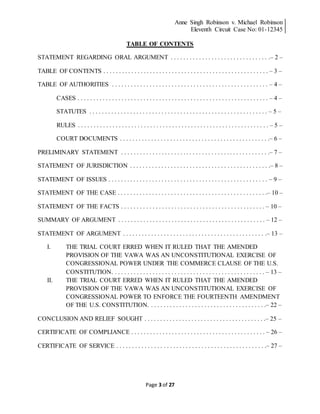
TABLE OF CONTENTS
STATEMENT REGARDING ORAL ARGUMENT . . . . . . . . . . . . . . . . . . . . . . . . . . . . . . . .– 2 –
TABLE OF CONTENTS . . . . . . . . . . . . . . . . . . . . . . . . . . . . . . . . . . . . . . . . . . . . . . . . . . . . . – 3 –
TABLE OF AUTHORITIES . . . . . . . . . . . . . . . . . . . . . . . . . . . . . . . . . . . . . . . . . . . . . . . . . . – 4 –
CASES . . . . . . . . . . . . . . . . . . . . . . . . . . . . . . . . . . . . . . . . . . . . . . . . . . . . . . . . . . . . . – 4 –
STATUTES . . . . . . . . . . . . . . . . . . . . . . . . . . . . . . . . . . . . . . . . . . . . . . . . . . . . . . . . . – 5 –
RULES . . . . . . . . . . . . . . . . . . . . . . . . . . . . . . . . . . . . . . . . . . . . . . . . . . . . . . . . . . . . . – 5 –
COURT DOCUMENTS . . . . . . . . . . . . . . . . . . . . . . . . . . . . . . . . . . . . . . . . . . . . . . . .– 6 –
PRELIMINARY STATEMENT . . . . . . . . . . . . . . . . . . . . . . . . . . . . . . . . . . . . . . . . . . . . . . . .– 7 –
STATEMENT OF JURISDICTION . . . . . . . . . . . . . . . . . . . . . . . . . . . . . . . . . . . . . . . . . . . . .– 8 –
STATEMENT OF ISSUES . . . . . . . . . . . . . . . . . . . . . . . . . . . . . . . . . . . . . . . . . . . . . . . . . . . – 9 –
STATEMENT OF THE CASE . . . . . . . . . . . . . . . . . . . . . . . . . . . . . . . . . . . . . . . . . . . . . . . .– 10 –
STATEMENT OF THE FACTS . . . . . . . . . . . . . . . . . . . . . . . . . . . . . . . . . . . . . . . . . . . . . . – 10 –
SUMMARY OF ARGUMENT . . . . . . . . . . . . . . . . . . . . . . . . . . . . . . . . . . . . . . . . . . . . . . . – 12 –
STATEMENT OF ARGUMENT . . . . . . . . . . . . . . . . . . . . . . . . . . . . . . . . . . . . . . . . . . . . . .– 13 –
I. THE TRIAL COURT ERRED WHEN IT RULED THAT THE AMENDED
PROVISION OF THE VAWA WAS AN UNCONSTITUTIONAL EXERCISE OF
CONGRESSIONAL POWER UNDER THE COMMERCE CLAUSE OF THE U.S.
CONSTITUTION. . . . . . . . . . . . . . . . . . . . . . . . . . . . . . . . . . . . . . . . . . . . . . . . . – 13 –
II. THE TRIAL COURT ERRED WHEN IT RULED THAT THE AMENDED
PROVISION OF THE VAWA WAS AN UNCONSTITUTIONAL EXERCISE OF
CONGRESSIONAL POWER TO ENFORCE THE FOURTEENTH AMENDMENT
OF THE U.S. CONSTITUTION. . . . . . . . . . . . . . . . . . . . . . . . . . . . . . . . . . . . . .– 22 –
CONCLUSION AND RELIEF SOUGHT . . . . . . . . . . . . . . . . . . . . . . . . . . . . . . . . . . . . . . .– 25 –
CERTIFICATE OF COMPLIANCE . . . . . . . . . . . . . . . . . . . . . . . . . . . . . . . . . . . . . . . . . . . – 26 –
CERTIFICATE OF SERVICE . . . . . . . . . . . . . . . . . . . . . . . . . . . . . . . . . . . . . . . . . . . . . . . .– 27 –
Anne Singh Robinson v. Michael Robinson
Eleventh Circuit Case No: 01-12345
Page 4 of 27
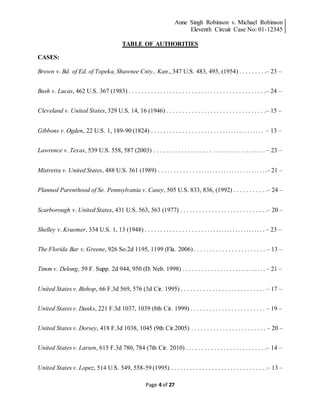
TABLE OF AUTHORITIES
CASES:
Brown v. Bd. of Ed. of Topeka, Shawnee Cnty., Kan., 347 U.S. 483, 495, (1954) . . . . . . . . .– 23 –
Bush v. Lucas, 462 U.S. 367 (1983) . . . . . . . . . . . . . . . . . . . . . . . . . . . . . . . . . . . . . . . . . . . .– 24 –
Cleveland v. United States, 329 U.S. 14, 16 (1946) . . . . . . . . . . . . . . . . . . . . . . . . . . . . . . . .– 15 –
Gibbons v. Ogden, 22 U.S. 1, 189-90 (1824) . . . . . . . . . . . . . . . . . . . . . . . . . . . . . . . . . . . . . . – 13 –
Lawrence v. Texas, 539 U.S. 558, 587 (2003) . . . . . . . . . . . . . . . . . . . . . . . . . . . . . . . . . . . . . . – 23 –
Mistretta v. United States, 488 U.S. 361 (1989) . . . . . . . . . . . . . . . . . . . . . . . . . . . . . . . . . . . . . .– 21 –
Planned Parenthood of Se. Pennsylvania v. Casey, 505 U.S. 833, 836, (1992) . . . . . . . . . . .– 24 –
Scarborough v. United States, 431 U.S. 563, 563 (1977) . . . . . . . . . . . . . . . . . . . . . . . . . . . .– 20 –
Shelley v. Kraemer, 334 U.S. 1, 13 (1948) . . . . . . . . . . . . . . . . . . . . . . . . . . . . . . . . . . . . . . . . . – 23 –
The Florida Bar v. Greene, 926 So.2d 1195, 1199 (Fla. 2006) . . . . . . . . . . . . . . . . . . . . . . . – 13 –
Timm v. Delong, 59 F. Supp. 2d 944, 950 (D. Neb. 1998) . . . . . . . . . . . . . . . . . . . . . . . . . . . . – 21 –
United States v. Bishop, 66 F.3d 569, 576 (3d Cir. 1995) . . . . . . . . . . . . . . . . . . . . . . . . . . . – 17 –
United States v. Danks, 221 F.3d 1037, 1039 (8th Cir. 1999) . . . . . . . . . . . . . . . . . . . . . . . . – 19 –
United States v. Dorsey, 418 F.3d 1038, 1045 (9th Cir.2005) . . . . . . . . . . . . . . . . . . . . . . . . – 20 –
United States v. Larsen, 615 F.3d 780, 784 (7th Cir. 2010) . . . . . . . . . . . . . . . . . . . . . . . . . .– 14 –
United States v. Lopez, 514 U.S. 549, 558-59 (1995) . . . . . . . . . . . . . . . . . . . . . . . . . . . . . . .– 13 –
Anne Singh Robinson v. Michael Robinson
Eleventh Circuit Case No: 01-12345
Page 5 of 27
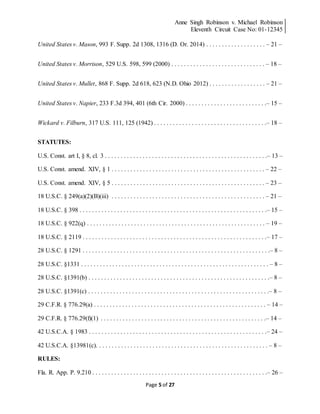
United States v. Mason, 993 F. Supp. 2d 1308, 1316 (D. Or. 2014) . . . . . . . . . . . . . . . . . . . – 21 –
United States v. Morrison, 529 U.S. 598, 599 (2000) . . . . . . . . . . . . . . . . . . . . . . . . . . . . . . – 18 –
United States v. Mullet, 868 F. Supp. 2d 618, 623 (N.D. Ohio 2012) . . . . . . . . . . . . . . . . . . – 21 –
United States v. Napier, 233 F.3d 394, 401 (6th Cir. 2000) . . . . . . . . . . . . . . . . . . . . . . . . . .– 15 –
Wickard v. Filburn, 317 U.S. 111, 125 (1942) . . . . . . . . . . . . . . . . . . . . . . . . . . . . . . . . . . . .– 18 –
STATUTES:
U.S. Const. art I, § 8, cl. 3 . . . . . . . . . . . . . . . . . . . . . . . . . . . . . . . . . . . . . . . . . . . . . . . . . . . .– 13 –
U.S. Const. amend. XIV, § 1 . . . . . . . . . . . . . . . . . . . . . . . . . . . . . . . . . . . . . . . . . . . . . . . . . – 22 –
U.S. Const. amend. XIV, § 5 . . . . . . . . . . . . . . . . . . . . . . . . . . . . . . . . . . . . . . . . . . . . . . . . . – 23 –
18 U.S.C. § 249(a)(2)(B)(iii) . . . . . . . . . . . . . . . . . . . . . . . . . . . . . . . . . . . . . . . . . . . . . . . . . – 21 –
18 U.S.C. § 398 . . . . . . . . . . . . . . . . . . . . . . . . . . . . . . . . . . . . . . . . . . . . . . . . . . . . . . . . . . . .– 15 –
18 U.S.C. § 922(q) . . . . . . . . . . . . . . . . . . . . . . . . . . . . . . . . . . . . . . . . . . . . . . . . . . . . . . . . . – 19 –
18 U.S.C. § 2119 . . . . . . . . . . . . . . . . . . . . . . . . . . . . . . . . . . . . . . . . . . . . . . . . . . . . . . . . . . .– 17 –
28 U.S.C. § 1291 . . . . . . . . . . . . . . . . . . . . . . . . . . . . . . . . . . . . . . . . . . . . . . . . . . . . . . . . . . . .– 8 –
28 U.S.C. §1331 . . . . . . . . . . . . . . . . . . . . . . . . . . . . . . . . . . . . . . . . . . . . . . . . . . . . . . . . . . . . – 8 –
28 U.S.C. §1391(b) . . . . . . . . . . . . . . . . . . . . . . . . . . . . . . . . . . . . . . . . . . . . . . . . . . . . . . . . . .– 8 –
28 U.S.C. §1391(c) . . . . . . . . . . . . . . . . . . . . . . . . . . . . . . . . . . . . . . . . . . . . . . . . . . . . . . . . . .– 8 –
29 C.F.R. § 776.29(a) . . . . . . . . . . . . . . . . . . . . . . . . . . . . . . . . . . . . . . . . . . . . . . . . . . . . . . . – 14 –
29 C.F.R. § 776.29(f)(1) . . . . . . . . . . . . . . . . . . . . . . . . . . . . . . . . . . . . . . . . . . . . . . . . . . . . .– 14 –
42 U.S.C.A. § 1983 . . . . . . . . . . . . . . . . . . . . . . . . . . . . . . . . . . . . . . . . . . . . . . . . . . . . . . . . .– 24 –
42 U.S.C.A. §13981(c). . . . . . . . . . . . . . . . . . . . . . . . . . . . . . . . . . . . . . . . . . . . . . . . . . . . . . . – 8 –
RULES:
Fla. R. App. P. 9.210 . . . . . . . . . . . . . . . . . . . . . . . . . . . . . . . . . . . . . . . . . . . . . . . . . . . . . . . .– 26 –
Anne Singh Robinson v. Michael Robinson
Eleventh Circuit Case No: 01-12345
Page 6 of 27
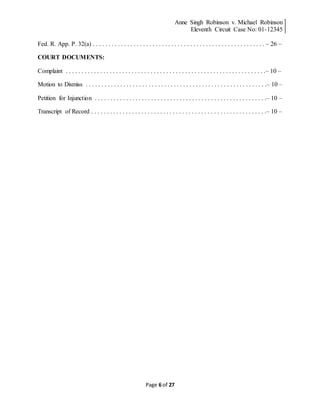
Fed. R. App. P. 32(a) . . . . . . . . . . . . . . . . . . . . . . . . . . . . . . . . . . . . . . . . . . . . . . . . . . . . . . . – 26 –
COURT DOCUMENTS:
Complaint . . . . . . . . . . . . . . . . . . . . . . . . . . . . . . . . . . . . . . . . . . . . . . . . . . . . . . . . . . . . . . . .– 10 –
Motion to Dismiss . . . . . . . . . . . . . . . . . . . . . . . . . . . . . . . . . . . . . . . . . . . . . . . . . . . . . . . . . .– 10 –
Petition for Injunction . . . . . . . . . . . . . . . . . . . . . . . . . . . . . . . . . . . . . . . . . . . . . . . . . . . . . . .– 10 –
Transcript of Record . . . . . . . . . . . . . . . . . . . . . . . . . . . . . . . . . . . . . . . . . . . . . . . . . . . . . . . .– 10 –
Anne Singh Robinson v. Michael Robinson
Eleventh Circuit Case No: 01-12345
Page 7 of 27
PRELIMINARY STATEMENT
ANNE SINGH ROBINSON hereinafter shall be referred to as Appellant. MICHAEL
ROBINSON hereinafter shall be referred to as Appellee.
Anne Singh Robinson v. Michael Robinson
Eleventh Circuit Case No: 01-12345
Page 8 of 27
STATEMENT OF JURISDICTION
The District Court had jurisdiction over the case pursuant to 42 U.S.C.A. § 13981(c)
through 28 U.S.C. §1331. Venue was proper in the Eastern District of Weisberg, pursuant to 28
U.S.C. §1391 (b), and (c), because the Complaint was a civil action and Appellee, a natural
person, was a resident within the jurisdiction.
The Court of Appeals has jurisdiction per 28 U.S.C. §1331, and 42 U.S.C.A. §13981(c)
of the Violence Against Women Act (VAWA). The Court of Appeals also has jurisdiction under
Title 28 U.S.C. § 1291, which provides that the court of appeals shall have jurisdiction of appeals
from all final decisions of the district court of the United States except where a direct review
may be had in the Supreme Court.
Anne Singh Robinson v. Michael Robinson
Eleventh Circuit Case No: 01-12345
Page 9 of 27
STATEMENT OF ISSUES
I. Whether the trial court erred by ruling that the VAWA is an unconstitutional exercise of
congressional power under the Commerce Clause of the United States Constitution?
II. Whether the trial court erred when it ruled that the amended provision of the VAWA was
an unconstitutional exercise of congressional power to enforce the Fourteenth Amendment of
the U.S. Constitution?
Anne Singh Robinson v. Michael Robinson
Eleventh Circuit Case No: 01-12345
Page 10 of 27
STATEMENT OF THE CASE
Appellant filed a Petition for Injunction for Protection against Domestic Violence in the
Fourth Judicial Circuit of the County of Duval, State of Weisberg. The petition was file on
September 10, 2014. Pet. Inj. 9 (2014). A final Judgment was granted on September 15, 2014.
Pet. Inj. 9 (2014).
Appellant filed a complaint under the VAWA on September 29, 2014 with the United
States District Court for the Eastern District of Weisberg. The Complaint was an Injunction for
Protection against Appellee. Compl. 7 (2014).
Appellee filed an Answer on October 1, 2014 and a Motion to Dismiss on the same day.
Mot. Dismiss (2014). The federal district court granted Appellee’s Motion to Dismiss on October
2, 2014, only citing to Morrison. Mot. Dismiss (2014).
STATEMENT OF THE FACTS
Parties were married in 2003. Throughout the marriage, Appellee had a substance abuse
problem coupled with a continuous cycle of violence and abuse which Appellee imposed upon
Appellant and their daughter. Transcript of Record at 1-2, Robinson v. Robinson, 339 Fla. Supp.
2d 50 (Fla. Cir. Ct. 2014). After one severe incident of abuse in 2010, Appellant required stiches
and owed an excess of $8,000.00. Tr.at 2.
On September 10, 2014, counsel for Appellant filed a Petition for Injunction for
Protection Against Domestic Violence. The Final Judgment was granted on September 15, 2014.
Tr.at 2.
Anne Singh Robinson v. Michael Robinson
Eleventh Circuit Case No: 01-12345
Page 11 of 27
After entry of the Final Judgment of Injunction for Protection, on September 17, 2014,
Appellee crossed state lines and purchased a hand gun from an unlicensed gun dealer in Georgia
named Art Dealer. Appellee travelled back to the state of Weisberg. Appellee went to
Appellant’s place of work located at Law Firm on Main Street, Weisbergville, Weisberg and shot
her in the abdomen on September 17, 2014. As Appellee shot Appellant, he yelled, “If I can’t
have you, no one can.” Tr. at 2-3.
Appellee was arrested and remains in jail. Appellant was rushed to the Weisbergville
ER. Appellant is now recovering in intensive care; however, she has an excess of $40,000 of
uninsured medical bills. Parties’ daughter is currently living with Appellant’s parents at an
undisclosed location in Flowerville, a nearby city in Weisberg. Tr. at 3.
Anne Singh Robinson v. Michael Robinson
Eleventh Circuit Case No: 01-12345
Page 12 of 27
SUMMARY OF ARGUMENT
The Trial Court erroneously relied on Morrison when it granted Appellee’s Motion to
Dismiss. Morrison does not apply to this case. The provision presented in this case is the
amended civil remedy provision of the VAWA, 42 U.S.C.A § 13981(c). Under the Commerce
Clause of the United States (U.S.) Constitution, Congress does have the power to enact this
provision. Congress also has the power to enforce the provision through the Fourteenth
Amendment to the U.S. Constitution.
Anne Singh Robinson v. Michael Robinson
Eleventh Circuit Case No: 01-12345
Page 13 of 27
STATEMENT OF ARGUMENT
I. THE TRIAL COURT ERRED WHEN IT RULED THAT THE AMENDED CIVIL
REMEDY PROVISION OF THE VAWA WAS AN UNCONSTITUTIONAL
EXERCISE OF CONGRESSIONAL POWER UNDER THE COMMERCE
CLAUSE OF THE U.S. CONSTITUTION.
On appeal, a trial court's order granting a motion to dismiss, in light of an issue pertaining to
the constitutionality of a statute, is reviewed de novo and construed in favor of the nonmoving
party. The Florida Bar v. Greene, 926 So.2d 1195, 1199 (Fla. 2006).
Under the Commerce Clause, Congress has the power to regulate commerce among the
several states. The Commerce Clause of the U.S. Constitution gives Congress the power “to
regulate commerce with foreign nations, and among the several states, and with the Indian
tribes.” U.S. Const. art I, § 8, cl. 3. Gibbons gave greater definition and understanding to the
term “commerce” and to what extent Congress may regulate it. Commerce is traffic and
intercourse between nations and parts of states. Gibbons v. Ogden, 22 U.S. 1, 189-90 (1824). The
Congress also retains a general power over navigation. Id. at 22.
Congress may regulate commerce under three broad categories. These categories include the
regulation of the use of the channels of interstate commerce, regulation and protection of the
instrumentalities of interstate commerce, or persons or things in interstate commerce, even
though the threat may come only from intrastate activities, and the regulation of those activities
having a substantial relation to interstate commerce, (those activities that substantially affect
interstate commerce). United States v. Lopez, 514 U.S. 549, 558-59 (1995).
A. PURSUANT TO THE COMMERCE CLAUSE AND THE AMENDED CIVIL
REMEDY PROVISION OF THE VAWA, CONGRESS HAS THE AUTHORITY
TO REGULATE APPELLEE’S CONDUCT SINCE HE USED THE CHANNELS
OF INTERSTATE COMMERCE IN ORDER TO PURCHASE A FIREARM, AN
INSTRUMENT OF INTERSTATE COMMERCE, IN THE STATE OF GEORIA
Anne Singh Robinson v. Michael Robinson
Eleventh Circuit Case No: 01-12345
Page 14 of 27
TO TRANSFER TO THE STATE OF WEISBERG WITH THE PURPOSE TO
SHOOT APPELLANT.
The statute at issue in this case fits into all three of the categories described in Lopez.
Congress has the power to regulate the use of the channels of interstate commerce as well as the
instrumentalities of interstate commerce. “Instrumentalities and channels [] serve as the media
for the movement of goods and persons in interstate commerce or for interstate communications
include railroads, highways, city streets….” 29 C.F.R. § 776.29(a) (1938). These are just a few
examples of the instrumentalities and channels of interstate commerce. To be more technical,
highways, county roads, and city streets within the meaning of the statute are better defined as
“…underpasses, overpasses, bypasses, county roads, access roads, city streets and alternate
roads….” § 776.29(f)(1). The statute fits into both the use of the channels of and the
instrumentalities of interstate commerce.
In 2014, Congress amended the civil remedies provision of the VAWA as a way of
regulating the use of the channels and instrumentalities of interstate commerce. The language of
the amended statute (amended part in bold) states as follows:
“[a] person (including a person who acts under color of any statute, ordinance,
regulation, custom, or usage of any State) who commits a crime of violence
motivated by gender, using a firearm or ammunition that has been shipped or
transported in interstate or foreign commerce, and thus deprives another of the
right declared in subsection (b) of this section shall be liable to the party injured,
in an action for the recovery of compensatory and punitive damages, injunctive
and declaratory relief, and such other relief as a court may deem appropriate.”
42 U.S.C.A § 13981(c) (2014).
The amended VAWA provision is similar to the statute in the Larsen case. “Congress's
legislative authority in the first and second categories is plenary.” United States v. Larsen, 615
F.3d 780, 784 (7th Cir. 2010). Larsen challenged the constitutionality of the Interstate Domestic
Anne Singh Robinson v. Michael Robinson
Eleventh Circuit Case No: 01-12345
Page 15 of 27
Violence Act, a criminal statute, which Congress had enacted through the Commerce Clause.
Quoted from the case, the Interstate Domestic Violence Act specifically states that:
“[a] person who causes a spouse, intimate partner, or dating partner to travel
in interstate or foreign commerce ... by force, coercion, duress, or fraud, and who,
in the course of, as a result of, or to facilitate such conduct or travel, commits or
attempts to commit a crime of violence against that spouse, intimate partner, or
dating partner, shall be punished....18 U.S.C. § 2261(a)(2).”
Id.
The Court upheld the constitutionality of the criminal statute in Larsen because “[t]he
Interstate Domestic Violence Act regulates the channels or instrumentalities of interstate
commerce and persons in interstate commerce—not purely intrastate activity—and therefore
falls within Lopez's first and second categories, in which Congress has plenary authority to
legislate.” Id. at 785. Being a person [or thing] in interstate commerce occurs when one has
traveled and relocated between various states. United States v. Napier, 233 F.3d 394, 401 (6th
Cir. 2000). The U.S. Supreme Court has held that the Commerce Clause authorizes Congress to
regulate the “instrumentalities of interstate commerce, or persons or things in interstate
commerce, even though the threat may come only from intrastate activities.” Lopez, 514 U.S. at
558-59.
The Mann Act, 18 U.S.C. § 398, is also similar to the amended provision of the VAWA.
“The [Mann] Act makes an offense the transportation in interstate commerce of ‘any woman or
girl for the purpose of prostitution or debauchery, or for any other immoral purpose’. The
decision turns on the meaning of the latter phrase, ‘for any other immoral purpose’.” Cleveland
v. United States, 329 U.S. 14, 16 (1946). The Court noted that while the Mann Act is primarily
aimed at the use of the channels of interstate commerce for the purpose of commercialized sex, it
is not limited to that end. Id.at 18. While polygamous practices are not specifically covered in the
Anne Singh Robinson v. Michael Robinson
Eleventh Circuit Case No: 01-12345
Page 16 of 27
Mann Act, the Court held that polygamy still fell under the statute because polygamy, like
interstate prostitution, has long been outlawed in western society. “Guilt under the Mann Act
turns on the purpose which motivates the transportation, not on its accomplishment.” Cleveland,
329 U.S. at 20. The case also discussed that marriage is within the realm of state power,
however, the Mann Act is not an “unconstitutional interference by Congress with police powers
of the States.” Id. at 19. This is because Congress has broad power over the use of the channels
of and the instrumentalities of interstate commerce. Lopez, 514 U.S. at 558-59. Congress may
use its commerce power in order to protect interstate commerce from immoral practices.
Cleveland, 329 U.S. at 19.
The same line of reasoning utilized in Cleveland applies in the present case. Congress
amended the provision of the VAWA in order to prevent an abuse of the use of the channels of
interstate commerce. The purpose which motivates the transportation is what establishes guilt.
Id. at 20. While violence and crime tend to be within the scope of general police powers of the
states, Congress is still permitted involvement into such realms to the extent that it negatively
affects the use of the channels or instrumentalities of interstate commerce. Id. at 19.
Appellee willingly submitted himself into interstate commerce when he used the channels of
interstate commerce in order to transport himself and the firearm, as instruments of interstate
commerce, between the State of Georgia and the State of Weisberg. Tr. at 2-3. Even if the Court
is to decide that Appellee’s actions were intrastate, his actions bore a great threat on interstate
commerce when taking into consideration the overall effect of domestic violence on the nation.
See infra p. 17-18.
B. APPELLEE’S CONDUCT HAS A SUBSTANTIAL EFFECT ON INTERSTATE
COMMERCE BECAUSE IT WAS AN ECONOMIC ACTIVITY WITH A
Anne Singh Robinson v. Michael Robinson
Eleventh Circuit Case No: 01-12345
Page 17 of 27
JURISDICTIONAL NEXUS TO INTERSTATE COMMERCE AND THERE ARE
CONGRESSIONAL FINDINGS AS TO THE SUBSTANTIAL BURDEN THAT
APPELLEE’S CONDUCT HAS ON INTERSTATE COMMERCE.
1. APPELLE’S ACTIVITY OF PURCHASING A FIREARM IN GEORIA TO
USE AGAINST APPELLANT IN WEISBERG IS PART OF A GREATER
ECONOMIC ACTIVITY THAT AFFECTS COMMERCE ON A NATIONAL
SCALE.
The statute in the Bishop case is similar to the amended provision of the VAWA. The
language of the statute in Bishop expresses statutory punishment against anyone who, “with the
intent to cause death or serious bodily harm[,] takes a motor vehicle that has been transported,
shipped, or received in interstate or foreign commerce from the person or presence of another by
force and violence or by intimidation, or attempts to do so….” 18 U.S.C. § 2119 (2001). The
civil remedy provision of the VAWA is strikingly similar to §2119. They both penalize an
individual, who transports the statutory item interstate, with intent to or actually does cause harm
to another individual. § 2119; see also 42 U.S.C.A. §13981(c). Bishop used Lopez to analyze the
legality of § 2119 and argued that Lopez created a rule which established that unless an activity
is “commercial” or “economic,” it is beyond the power of Congress to regulate no matter what
its effect upon interstate commerce. United States v. Bishop, 66 F.3d 569, 580 (3d Cir. 1995).
Since carjacking is not commercial, Congress cannot regulate it. Id. at 580. This argument was
rejected by the Supreme Court because carjacking is both economic and part of a greater
economic activity. Id. at 581.
The civil remedy provision of the VAWA was enacted by Congress as one aspect of national
solution to a national economic problem. See infra p.17-18. The Bishop Court further reasoned
that Congress enacted the carjacking statute as one aspect of national solution to a national
economic problem. Id. Likewise, Congress enacted and amended the civil remedy provision of
Anne Singh Robinson v. Michael Robinson
Eleventh Circuit Case No: 01-12345
Page 18 of 27
the VAWA based on finding that gender motivated violence costs the nation several billions of
dollars annually, a national solution to a national economic problem. See infra p.17-18. Congress
determined that when someone commits domestic violence against another in the midst of
interstate commerce, that act is part of a greater economic activity that affects commerce on a
national scale. See infra p. 17-18.
Appellee’s activity can be reached by Congress because it has a substantial effect on
interstate commerce. “. . . [E]ven if appellee's activity be local and though it may not be regarded
as commerce, it may still, whatever its nature, be reached by Congress if it exerts a substantial
economic effect on interstate commerce….” Wickard v. Filburn, 317 U.S. 111, 125 (1942). Even
if Appellee were to argue that his activity was only local and not commerce, Congress has a vast
amount of findings which show that his conduct contributes to a substantial effect on interstate
commerce. See infra p.17-18.
The aggregate theory applicable to Wickard or Gonzales has been rejected as an applicable
theory in cases such as the present case. United States v. Morrison, 529 U.S. 598, 599 (2000).
However, even as far back as Wickard did the Court realize that “…other cases called forth
broader interpretations of the Commerce Clause destined to supersede the earlier ones….”
Wickard, 317 U.S. at 122. Interpretations of the commerce clause tends to broaden in scope as
time and history progress based on the current events. Morrison invalidated the civil remedy
provision of the VAWA based on the theory that Congress’s Act was not within its commerce
power because violent criminal conduct was not an economic activity that substantially affected
interstate commerce. “Congress may not regulate noneconomic, violent criminal conduct based
solely on that conduct's aggregate effect on interstate commerce.” Morrison, 529 U.S. at 598.
However, regulation of violent conduct or gun sales is not the purpose of the amended civil
Anne Singh Robinson v. Michael Robinson
Eleventh Circuit Case No: 01-12345
Page 19 of 27
remedy provision of the VAWA. “Congress is empowered to regulate and protect the
instrumentalities of interstate commerce, or persons or things in interstate commerce, even
though the threat may come only from intrastate activities.” Lopez, 514 U.S.at 558.
Appellee’s conduct affects interstate commerce, based on the case-by-case analysis founded
in Lopez. Danks upheld the amended version of 18 U.S.C. § 922(q), the original version of
which was found to be unconstitutional in Lopez. United States v. Danks, 221 F.3d 1037, 1039
(8th Cir. 1999). “Section 922(q) contains language that ensures, on a case-by-case basis, that the
firearm in question affects interstate commerce.” Id. See infra p.14-15.
2. THE AMENDED PROVISION OF THE VAWA CONTAINS A
JURISDICTIONAL NEXUS BETWEEN APPELLEE’S CONDUCT AND
INTERSTATE COMMERCE.
The amended VAWA includes an express jurisdictional nexus to interstate commerce and is
within the scope of Congress’s power to enact. “By passing legislation, Congress indicates its
conclusion, whether explicitly or not, that facts support its exercise of the commerce power. The
business of the courts is to review the congressional assessment, not for soundness but simply for
the rationality of concluding that a jurisdictional basis exists in fact.” Morrison, 529 U.S.at 628
(Souter, J., dissenting).
The amended provision of the VAWA is distinguished from the statute in Lopez and the
statute in Morrison because it contains a jurisdictional element which would ensure that the
possession of the firearm affects interstate commerce. Congress saved the amended provision in
VAWA by including a jurisdictional element. See infra p. 16. “. . . § 922(q) contains no
jurisdictional element which would ensure, through case-by-case inquiry, that the firearm
possession in question affects interstate commerce.” Lopez, 514 U.S. at 561. The provision in
Anne Singh Robinson v. Michael Robinson
Eleventh Circuit Case No: 01-12345
Page 20 of 27
Lopez forbids “any individual knowingly to possess a firearm at a place that [he] knows ... is a
school zone.” Id. at 549. However, § 992(q) was soon after amended by Congress to include a
jurisdictional element. The constitutionality of the amended § 922(q) was challenged in Danks
and the statute specifically stated that “[i]t shall be unlawful for any individual knowingly to
possess a firearm that has moved in or that otherwise affects interstate . . . commerce at a place
that the individual knows, or has reasonable cause to believe, is a school zone.” Danks, 221 F.3d,
at 1038. The Morrison Court rejected the civil remedy provision under 42 U.S.C.A § 13981 of
the VAWA as a constitutional act of Congress because the statute failed to contain a
jurisdictional element that is required in the third prong of Lopez. Morrison, 529 U.S. at 598.
The statute included that:
“[a] person (including a person who acts under color of any statute, ordinance,
regulation, custom, or usage of any State) who commits a crime of violence
motivated by gender and thus deprives another of the right declared in subsection
(b) of this section shall be liable to the party injured, in an action for the recovery
of compensatory and punitive damages, injunctive and declaratory relief, and such
other relief as a court may deem appropriate.”
Id. at 605.
The substantive differences between Lopez and Dank are the same as those of
Morrison and this case. Lopez and Morrison failed to have an express jurisdictional
element in the statute while the statutes in Danks and this case do include the element.
“Incorporating a jurisdictional element into the offense has traditionally saved statutes
from Commerce Clause challenges.” United States v. Dorsey, 418 F.3d 1038, 1045 (9th
Cir.2005). Minimal nexus is required with little concern for when the nexus with
commerce occurs. Scarborough v. United States, 431 U.S. 563, 563 (1977). Appellant’s
case should survive on appeal because its relation to Morrison is just as that of Danks and
Lopez.
Anne Singh Robinson v. Michael Robinson
Eleventh Circuit Case No: 01-12345
Page 21 of 27
Part of the Hate Crimes Prevention Act (HCPA) that was questioned in Mullet is also very
similar to the amended VAWA provision. The bulk of the argument in Mullet was based on 18
U.S.C. § 249(a)(2)(B)(iii) of the HCPA which expressly “criminalizes conduct in which the
defendant used a weapon that traveled in interstate commerce or an instrumentality of interstate
commerce.” United States v. Mullet, 868 F. Supp. 2d 618, 623 (N.D. Ohio 2012); see also United
States v. Mason, 993 F. Supp. 2d 1308, 1316 (D. Or. 2014). The amended civil remedies
provision of the VAWA finds an individual civilly liable, based on his or her wrongful conduct
against another person, if that conduct includes the use of a firearm that has been transported or
shipped in interstate commerce. § 13981(c).
3. THE VAWA IS SUPPORTED BY FOUR YEARS OF CONGRESSIONAL
FINDINGS WHICH SHOW THAT APPELLEE’S CONDUCT HAS A
SUBSTANTIAL BURDEN ON INTERSTATE COMMERCE.
The amended provision of the VAWA is entitled to a strong presumption of validity and
constitutionality since the Court is assessing whether Congress has exceeded its authority under
the Commerce Clause. Mistretta v. United States, 488 U.S. 361 (1989). The Court must defer to
Congress’s discretion in amending the provision in the VAWA since the constitutionality of the
legislation is being questioned.
“In view of the doctrine of judicial restraint, the task of the court in
determining the constitutionality of the VAWA is ‘relatively narrow.’ Hodel v.
Virginia Surface Mining and Reclamation Ass'n, 452 U.S. 264 (1981); see also
United States v. Lopez, 514 U.S. 549, 568, (1995) (Kennedy, J., concurring)
(“The history of the judicial struggle to interpret the Commerce Clause ...
counsels great restraint before the Court determines that the Clause is insufficient
to support an exercise of the national power.”). Accordingly, the court must
exercise the necessary restraint and deference in evaluating Congress' authority to
enact the civil provisions of the VAWA under the Commerce Clause.”
Timm v. Delong, 59 F. Supp. 2d 944, 950 (D. Neb. 1998).
Anne Singh Robinson v. Michael Robinson
Eleventh Circuit Case No: 01-12345
Page 22 of 27
Congress conducted four years of hearings and, in so doing, obtained mountains of data
which shows the effects of domestic violence against women on interstate commerce. Morrison,
529 U.S. at 629 (Souter, J., dissenting). Justice Souter’s dissent in Morrison listed Congressional
findings in support of the civil remedy provision of the VAWA which include but are not limited
to: three of every four women will become victims of domestic violence sometime during their
life; battering is the single largest cause of injury to women in the U.S.; an estimated four-million
American women are battered each year by their husbands or partners; more than one-million
women each year seek medical attention due to domestic violence; violent crime against women
costs this country at least three-billion dollars a year; and estimates suggest that this country
spends five to ten-billion dollars a year on health care, criminal justice, and other social costs of
domestic violence.” Id. at 632 (Souter, J., Dissenting). These numbers might never have reached
such severe proportions had the states, such as Weisberg, implemented legislation which would
help deter or mitigate such costs of gender motivated violence.
II. THE TRIAL COURT ERRED WHEN IT RULED THAT THE AMENDED
PROVISION OF THE VAWA WAS AN UNCONSTITUTIONAL EXERCISE OF
CONGRESSIONAL POWER TO ENFORCE THE FOURTEENTH
AMENDMENTOF THE U.S. CONSTITUTION.
“All persons born or naturalized in the United States, and subject to the
jurisdiction thereof, are citizens of the United States and of the State wherein they
reside. No State shall make or enforce any law which shall abridge the privileges
or immunities of citizens of the United States; nor shall any State deprive any
person of life, liberty, or property, without due process of law; nor deny to any
person within its jurisdiction the equal protection of the laws.”
U.S. Const. amend. XIV, § 1.
The Fourteenth Amendment to the United States Constitution goes further to empower
Congress to enforce, by appropriate legislation, the provisions within the Fourteen Amendment.
Anne Singh Robinson v. Michael Robinson
Eleventh Circuit Case No: 01-12345
Page 23 of 27
U.S. Const. amend. XIV, § 5. There is very little evidence that the State of Weisberg has
legislated in order to provide civil remedies to victims of domestic violence.
“[The Fourteenth] Amendment erects no shield against merely private conduct, however
discriminatory or wrongful.” Shelley v. Kraemer, 334 U.S. 1, 13 (1948). “[The] Fourteenth
Amendment, by its very terms, prohibits only state action.” Morrison, 529 U.S. at 621. While
these are strong statements against Appellant’s case, they are not absolute. Throughout the
changes of history, there have been certain times in which a court has overturned its previous
rulings or closely held principles. The U.S. Supreme Court has even gone so far as to set aside
stare decisis and overturn some of the most historically controversial cases.
The Court should consider setting aside stare decisis “if: (1) its foundations have been
“ero[ded]” by subsequent decisions…; (2) it has been subject to “substantial and continuing”
criticism…; and (3) it has not induced “individual or societal reliance” that counsels against
overturning….” Lawrence v. Texas, 539 U.S. 558, 587 (2003). There is little evidence of erosion,
by subsequent decisions, of only applying the Fourteenth Amendment to state conduct against
private individuals. However, there has been substantial and continuing criticism against rulings
such as holding the civil remedies provision of the VAWA unconstitutional in Morrison.
Congress spent four (4) years disputing and discussing the harmful implications of gender
motivated violence on a national scale. See supra p.17-18. And, considering that Congress is
elected by the people and Congress has spent four years debating and discussing such matters,
stare decisis has not created a reliance that counsels against overturning.
The concept of “separate-but-equal,” as set out in Plessy, was eventually set aside by the
Court and overturned in Brown. Brown v. Bd. of Ed. of Topeka, Shawnee Cnty., Kan., 347 U.S.
Anne Singh Robinson v. Michael Robinson
Eleventh Circuit Case No: 01-12345
Page 24 of 27
483, 495, (1954). The Brown Court lawfully overturned Plessy “on the basis of facts, or an
understanding of facts, [that] changed from those which furnished the claimed justifications for
the earlier constitutional resolutions. The overruling decisions were comprehensible to the
Nation, and defensible, as the Court's responses to changed circumstances.” Planned Parenthood
of Se. Pennsylvania v. Casey, 505 U.S. 833, 836, (1992). This is when the Court may set aside
such principles and find against former rulings.
The federal district court’s ruling against Appellant must be overturned because Morrison
does not apply to this case. The civil remedy provision of the VAWA in Morrison is not the
same amended provision disputed in this case. This court should set aside stare decisis and rule
in favor of the changed circumstances.
The amended provision of the VAWA is constitutional based on the change of the times.
Prior to the 42 U.S.C.A. § 1983 Act, individuals were unable to sue government workers who
deprived private individuals of their rights. Law enforcement officials could detain or abuse
citizens without facing liability. However, this ended when the U.S. Supreme Court granted
certiorari to Bush v. Lucas, 462 U.S. 367 (1983). After Bush was able to retain civil remedy
granted by the Court, Congress enacted § 1983 which allows a private individual civil remedy
through civil litigation against a state actor who has deprived that person of their rights or
liberties. §1983. The times have changed, and so has the legislation.
Anne Singh Robinson v. Michael Robinson
Eleventh Circuit Case No: 01-12345
Page 25 of 27
CONCLUSION AND RELIEF SOUGHT
This Court should overturn the trial court’s erroneous holding based on the application of
Morrison, a case which does not apply to this case. § 13981(c) of the VAWA has been amended
since Morrison and is constitutional. Appellant demands recovery of compensatory damages in
the amount in excess of $48,000.00, punitive damages, a permanent injunction and declaratory
relief. Plaintiff also demands litigation fees and costs, court costs, and any other relief that this
Court deems fit.
Respectfully Submitted,
THOMIKA J. O’BRYAN/s/
________________________________________
Thomika J. O’Bryan, Esquire
Weisberg Bar No.: 000001
765 Streat Road Suite 507
Weisbergville, Weisberg 32256
C368256@law.fcsl.edu
123-456-7890
Attorney for Appellant
Anne Singh Robinson v. Michael Robinson
Eleventh Circuit Case No: 01-12345
Page 26 of 27
CERTIFICATE OF COMPLIANCE
I CERTIFY that this brief complies with type font, size, and style as required by Fed. R.
App. P. 32(a) as well as Fla. R. App. P. 9.210. The font is Times New Roman and size 12 font.
Anne Singh Robinson v. Michael Robinson
Eleventh Circuit Case No: 01-12345
Page 27 of 27
CERTIFICATE OF SERVICE
I HEREBY CERTIFY that on this 1st day of December, 2014, I electronically filed the
Appellate Brief as Appellant on MICHAEL ROBINSON at Duval County Jail, 500 E Adams St
Weisbergville, Weisberg 32202, on this 1st day of December, 2014. A copy of the Appellate
Brief was also electronically filed with the Clerk of the Court.
Date: 12/01/2014 THOMIKA J. O’BRYAN/s/
________________________________________
Thomika J. O’Bryan, Esquire
Weisberg Bar No.: 000001
765 Streat Road Suite 507
Weisbergville, Weisberg 32256
C368256@law.fcsl.edu
123-456-7890
Attorney for Appellant

Appellate Brief

  • 1.
    Case No: 01-12345 ______________________________________________________________________________ UNITEDSTATES COURT OF APPEALS ELEVENTH CIRCUIT ______________________________________________________________________________ ANNE SINGH ROBINSON, Plaintiff/Appellant v. MICHAEL ROBINSON, Defendant/Appellee ______________________________________________________________________________ On Appeal from the United States District Court for the Eastern District of Weisberg Case No: 12-7 ______________________________________________________________________________ BRIEF OF APPELLANT ANNE SINGH ROBINSON ______________________________________________________________________________ Thomika J. O’Bryan, Esquire Weisberg Bar No.: 000001 765 Streat Road Suite 507 Weisbergville, Weisberg 32256 C368256@law.fcsl.edu 123-456-7890 Attorney for Appellant Anne Singh Robinson
  • 2.
    Anne Singh Robinsonv. Michael Robinson Eleventh Circuit Case No: 01-12345 Page 2 of 27 STATEMENT REGARDING ORAL ARGUMENT The Appellant respectfully submits that oral argument is necessary to the just resolution of this appeal and will significantly enhance the decision making process.
  • 3.
    Anne Singh Robinsonv. Michael Robinson Eleventh Circuit Case No: 01-12345 Page 3 of 27 TABLE OF CONTENTS STATEMENT REGARDING ORAL ARGUMENT . . . . . . . . . . . . . . . . . . . . . . . . . . . . . . . .– 2 – TABLE OF CONTENTS . . . . . . . . . . . . . . . . . . . . . . . . . . . . . . . . . . . . . . . . . . . . . . . . . . . . . – 3 – TABLE OF AUTHORITIES . . . . . . . . . . . . . . . . . . . . . . . . . . . . . . . . . . . . . . . . . . . . . . . . . . – 4 – CASES . . . . . . . . . . . . . . . . . . . . . . . . . . . . . . . . . . . . . . . . . . . . . . . . . . . . . . . . . . . . . – 4 – STATUTES . . . . . . . . . . . . . . . . . . . . . . . . . . . . . . . . . . . . . . . . . . . . . . . . . . . . . . . . . – 5 – RULES . . . . . . . . . . . . . . . . . . . . . . . . . . . . . . . . . . . . . . . . . . . . . . . . . . . . . . . . . . . . . – 5 – COURT DOCUMENTS . . . . . . . . . . . . . . . . . . . . . . . . . . . . . . . . . . . . . . . . . . . . . . . .– 6 – PRELIMINARY STATEMENT . . . . . . . . . . . . . . . . . . . . . . . . . . . . . . . . . . . . . . . . . . . . . . . .– 7 – STATEMENT OF JURISDICTION . . . . . . . . . . . . . . . . . . . . . . . . . . . . . . . . . . . . . . . . . . . . .– 8 – STATEMENT OF ISSUES . . . . . . . . . . . . . . . . . . . . . . . . . . . . . . . . . . . . . . . . . . . . . . . . . . . – 9 – STATEMENT OF THE CASE . . . . . . . . . . . . . . . . . . . . . . . . . . . . . . . . . . . . . . . . . . . . . . . .– 10 – STATEMENT OF THE FACTS . . . . . . . . . . . . . . . . . . . . . . . . . . . . . . . . . . . . . . . . . . . . . . – 10 – SUMMARY OF ARGUMENT . . . . . . . . . . . . . . . . . . . . . . . . . . . . . . . . . . . . . . . . . . . . . . . – 12 – STATEMENT OF ARGUMENT . . . . . . . . . . . . . . . . . . . . . . . . . . . . . . . . . . . . . . . . . . . . . .– 13 – I. THE TRIAL COURT ERRED WHEN IT RULED THAT THE AMENDED PROVISION OF THE VAWA WAS AN UNCONSTITUTIONAL EXERCISE OF CONGRESSIONAL POWER UNDER THE COMMERCE CLAUSE OF THE U.S. CONSTITUTION. . . . . . . . . . . . . . . . . . . . . . . . . . . . . . . . . . . . . . . . . . . . . . . . . – 13 – II. THE TRIAL COURT ERRED WHEN IT RULED THAT THE AMENDED PROVISION OF THE VAWA WAS AN UNCONSTITUTIONAL EXERCISE OF CONGRESSIONAL POWER TO ENFORCE THE FOURTEENTH AMENDMENT OF THE U.S. CONSTITUTION. . . . . . . . . . . . . . . . . . . . . . . . . . . . . . . . . . . . . .– 22 – CONCLUSION AND RELIEF SOUGHT . . . . . . . . . . . . . . . . . . . . . . . . . . . . . . . . . . . . . . .– 25 – CERTIFICATE OF COMPLIANCE . . . . . . . . . . . . . . . . . . . . . . . . . . . . . . . . . . . . . . . . . . . – 26 – CERTIFICATE OF SERVICE . . . . . . . . . . . . . . . . . . . . . . . . . . . . . . . . . . . . . . . . . . . . . . . .– 27 –
  • 4.
    Anne Singh Robinsonv. Michael Robinson Eleventh Circuit Case No: 01-12345 Page 4 of 27 TABLE OF AUTHORITIES CASES: Brown v. Bd. of Ed. of Topeka, Shawnee Cnty., Kan., 347 U.S. 483, 495, (1954) . . . . . . . . .– 23 – Bush v. Lucas, 462 U.S. 367 (1983) . . . . . . . . . . . . . . . . . . . . . . . . . . . . . . . . . . . . . . . . . . . .– 24 – Cleveland v. United States, 329 U.S. 14, 16 (1946) . . . . . . . . . . . . . . . . . . . . . . . . . . . . . . . .– 15 – Gibbons v. Ogden, 22 U.S. 1, 189-90 (1824) . . . . . . . . . . . . . . . . . . . . . . . . . . . . . . . . . . . . . . – 13 – Lawrence v. Texas, 539 U.S. 558, 587 (2003) . . . . . . . . . . . . . . . . . . . . . . . . . . . . . . . . . . . . . . – 23 – Mistretta v. United States, 488 U.S. 361 (1989) . . . . . . . . . . . . . . . . . . . . . . . . . . . . . . . . . . . . . .– 21 – Planned Parenthood of Se. Pennsylvania v. Casey, 505 U.S. 833, 836, (1992) . . . . . . . . . . .– 24 – Scarborough v. United States, 431 U.S. 563, 563 (1977) . . . . . . . . . . . . . . . . . . . . . . . . . . . .– 20 – Shelley v. Kraemer, 334 U.S. 1, 13 (1948) . . . . . . . . . . . . . . . . . . . . . . . . . . . . . . . . . . . . . . . . . – 23 – The Florida Bar v. Greene, 926 So.2d 1195, 1199 (Fla. 2006) . . . . . . . . . . . . . . . . . . . . . . . – 13 – Timm v. Delong, 59 F. Supp. 2d 944, 950 (D. Neb. 1998) . . . . . . . . . . . . . . . . . . . . . . . . . . . . – 21 – United States v. Bishop, 66 F.3d 569, 576 (3d Cir. 1995) . . . . . . . . . . . . . . . . . . . . . . . . . . . – 17 – United States v. Danks, 221 F.3d 1037, 1039 (8th Cir. 1999) . . . . . . . . . . . . . . . . . . . . . . . . – 19 – United States v. Dorsey, 418 F.3d 1038, 1045 (9th Cir.2005) . . . . . . . . . . . . . . . . . . . . . . . . – 20 – United States v. Larsen, 615 F.3d 780, 784 (7th Cir. 2010) . . . . . . . . . . . . . . . . . . . . . . . . . .– 14 – United States v. Lopez, 514 U.S. 549, 558-59 (1995) . . . . . . . . . . . . . . . . . . . . . . . . . . . . . . .– 13 –
  • 5.
    Anne Singh Robinsonv. Michael Robinson Eleventh Circuit Case No: 01-12345 Page 5 of 27 United States v. Mason, 993 F. Supp. 2d 1308, 1316 (D. Or. 2014) . . . . . . . . . . . . . . . . . . . – 21 – United States v. Morrison, 529 U.S. 598, 599 (2000) . . . . . . . . . . . . . . . . . . . . . . . . . . . . . . – 18 – United States v. Mullet, 868 F. Supp. 2d 618, 623 (N.D. Ohio 2012) . . . . . . . . . . . . . . . . . . – 21 – United States v. Napier, 233 F.3d 394, 401 (6th Cir. 2000) . . . . . . . . . . . . . . . . . . . . . . . . . .– 15 – Wickard v. Filburn, 317 U.S. 111, 125 (1942) . . . . . . . . . . . . . . . . . . . . . . . . . . . . . . . . . . . .– 18 – STATUTES: U.S. Const. art I, § 8, cl. 3 . . . . . . . . . . . . . . . . . . . . . . . . . . . . . . . . . . . . . . . . . . . . . . . . . . . .– 13 – U.S. Const. amend. XIV, § 1 . . . . . . . . . . . . . . . . . . . . . . . . . . . . . . . . . . . . . . . . . . . . . . . . . – 22 – U.S. Const. amend. XIV, § 5 . . . . . . . . . . . . . . . . . . . . . . . . . . . . . . . . . . . . . . . . . . . . . . . . . – 23 – 18 U.S.C. § 249(a)(2)(B)(iii) . . . . . . . . . . . . . . . . . . . . . . . . . . . . . . . . . . . . . . . . . . . . . . . . . – 21 – 18 U.S.C. § 398 . . . . . . . . . . . . . . . . . . . . . . . . . . . . . . . . . . . . . . . . . . . . . . . . . . . . . . . . . . . .– 15 – 18 U.S.C. § 922(q) . . . . . . . . . . . . . . . . . . . . . . . . . . . . . . . . . . . . . . . . . . . . . . . . . . . . . . . . . – 19 – 18 U.S.C. § 2119 . . . . . . . . . . . . . . . . . . . . . . . . . . . . . . . . . . . . . . . . . . . . . . . . . . . . . . . . . . .– 17 – 28 U.S.C. § 1291 . . . . . . . . . . . . . . . . . . . . . . . . . . . . . . . . . . . . . . . . . . . . . . . . . . . . . . . . . . . .– 8 – 28 U.S.C. §1331 . . . . . . . . . . . . . . . . . . . . . . . . . . . . . . . . . . . . . . . . . . . . . . . . . . . . . . . . . . . . – 8 – 28 U.S.C. §1391(b) . . . . . . . . . . . . . . . . . . . . . . . . . . . . . . . . . . . . . . . . . . . . . . . . . . . . . . . . . .– 8 – 28 U.S.C. §1391(c) . . . . . . . . . . . . . . . . . . . . . . . . . . . . . . . . . . . . . . . . . . . . . . . . . . . . . . . . . .– 8 – 29 C.F.R. § 776.29(a) . . . . . . . . . . . . . . . . . . . . . . . . . . . . . . . . . . . . . . . . . . . . . . . . . . . . . . . – 14 – 29 C.F.R. § 776.29(f)(1) . . . . . . . . . . . . . . . . . . . . . . . . . . . . . . . . . . . . . . . . . . . . . . . . . . . . .– 14 – 42 U.S.C.A. § 1983 . . . . . . . . . . . . . . . . . . . . . . . . . . . . . . . . . . . . . . . . . . . . . . . . . . . . . . . . .– 24 – 42 U.S.C.A. §13981(c). . . . . . . . . . . . . . . . . . . . . . . . . . . . . . . . . . . . . . . . . . . . . . . . . . . . . . . – 8 – RULES: Fla. R. App. P. 9.210 . . . . . . . . . . . . . . . . . . . . . . . . . . . . . . . . . . . . . . . . . . . . . . . . . . . . . . . .– 26 –
  • 6.
    Anne Singh Robinsonv. Michael Robinson Eleventh Circuit Case No: 01-12345 Page 6 of 27 Fed. R. App. P. 32(a) . . . . . . . . . . . . . . . . . . . . . . . . . . . . . . . . . . . . . . . . . . . . . . . . . . . . . . . – 26 – COURT DOCUMENTS: Complaint . . . . . . . . . . . . . . . . . . . . . . . . . . . . . . . . . . . . . . . . . . . . . . . . . . . . . . . . . . . . . . . .– 10 – Motion to Dismiss . . . . . . . . . . . . . . . . . . . . . . . . . . . . . . . . . . . . . . . . . . . . . . . . . . . . . . . . . .– 10 – Petition for Injunction . . . . . . . . . . . . . . . . . . . . . . . . . . . . . . . . . . . . . . . . . . . . . . . . . . . . . . .– 10 – Transcript of Record . . . . . . . . . . . . . . . . . . . . . . . . . . . . . . . . . . . . . . . . . . . . . . . . . . . . . . . .– 10 –
  • 7.
    Anne Singh Robinsonv. Michael Robinson Eleventh Circuit Case No: 01-12345 Page 7 of 27 PRELIMINARY STATEMENT ANNE SINGH ROBINSON hereinafter shall be referred to as Appellant. MICHAEL ROBINSON hereinafter shall be referred to as Appellee.
  • 8.
    Anne Singh Robinsonv. Michael Robinson Eleventh Circuit Case No: 01-12345 Page 8 of 27 STATEMENT OF JURISDICTION The District Court had jurisdiction over the case pursuant to 42 U.S.C.A. § 13981(c) through 28 U.S.C. §1331. Venue was proper in the Eastern District of Weisberg, pursuant to 28 U.S.C. §1391 (b), and (c), because the Complaint was a civil action and Appellee, a natural person, was a resident within the jurisdiction. The Court of Appeals has jurisdiction per 28 U.S.C. §1331, and 42 U.S.C.A. §13981(c) of the Violence Against Women Act (VAWA). The Court of Appeals also has jurisdiction under Title 28 U.S.C. § 1291, which provides that the court of appeals shall have jurisdiction of appeals from all final decisions of the district court of the United States except where a direct review may be had in the Supreme Court.
  • 9.
    Anne Singh Robinsonv. Michael Robinson Eleventh Circuit Case No: 01-12345 Page 9 of 27 STATEMENT OF ISSUES I. Whether the trial court erred by ruling that the VAWA is an unconstitutional exercise of congressional power under the Commerce Clause of the United States Constitution? II. Whether the trial court erred when it ruled that the amended provision of the VAWA was an unconstitutional exercise of congressional power to enforce the Fourteenth Amendment of the U.S. Constitution?
  • 10.
    Anne Singh Robinsonv. Michael Robinson Eleventh Circuit Case No: 01-12345 Page 10 of 27 STATEMENT OF THE CASE Appellant filed a Petition for Injunction for Protection against Domestic Violence in the Fourth Judicial Circuit of the County of Duval, State of Weisberg. The petition was file on September 10, 2014. Pet. Inj. 9 (2014). A final Judgment was granted on September 15, 2014. Pet. Inj. 9 (2014). Appellant filed a complaint under the VAWA on September 29, 2014 with the United States District Court for the Eastern District of Weisberg. The Complaint was an Injunction for Protection against Appellee. Compl. 7 (2014). Appellee filed an Answer on October 1, 2014 and a Motion to Dismiss on the same day. Mot. Dismiss (2014). The federal district court granted Appellee’s Motion to Dismiss on October 2, 2014, only citing to Morrison. Mot. Dismiss (2014). STATEMENT OF THE FACTS Parties were married in 2003. Throughout the marriage, Appellee had a substance abuse problem coupled with a continuous cycle of violence and abuse which Appellee imposed upon Appellant and their daughter. Transcript of Record at 1-2, Robinson v. Robinson, 339 Fla. Supp. 2d 50 (Fla. Cir. Ct. 2014). After one severe incident of abuse in 2010, Appellant required stiches and owed an excess of $8,000.00. Tr.at 2. On September 10, 2014, counsel for Appellant filed a Petition for Injunction for Protection Against Domestic Violence. The Final Judgment was granted on September 15, 2014. Tr.at 2.
  • 11.
    Anne Singh Robinsonv. Michael Robinson Eleventh Circuit Case No: 01-12345 Page 11 of 27 After entry of the Final Judgment of Injunction for Protection, on September 17, 2014, Appellee crossed state lines and purchased a hand gun from an unlicensed gun dealer in Georgia named Art Dealer. Appellee travelled back to the state of Weisberg. Appellee went to Appellant’s place of work located at Law Firm on Main Street, Weisbergville, Weisberg and shot her in the abdomen on September 17, 2014. As Appellee shot Appellant, he yelled, “If I can’t have you, no one can.” Tr. at 2-3. Appellee was arrested and remains in jail. Appellant was rushed to the Weisbergville ER. Appellant is now recovering in intensive care; however, she has an excess of $40,000 of uninsured medical bills. Parties’ daughter is currently living with Appellant’s parents at an undisclosed location in Flowerville, a nearby city in Weisberg. Tr. at 3.
  • 12.
    Anne Singh Robinsonv. Michael Robinson Eleventh Circuit Case No: 01-12345 Page 12 of 27 SUMMARY OF ARGUMENT The Trial Court erroneously relied on Morrison when it granted Appellee’s Motion to Dismiss. Morrison does not apply to this case. The provision presented in this case is the amended civil remedy provision of the VAWA, 42 U.S.C.A § 13981(c). Under the Commerce Clause of the United States (U.S.) Constitution, Congress does have the power to enact this provision. Congress also has the power to enforce the provision through the Fourteenth Amendment to the U.S. Constitution.
  • 13.
    Anne Singh Robinsonv. Michael Robinson Eleventh Circuit Case No: 01-12345 Page 13 of 27 STATEMENT OF ARGUMENT I. THE TRIAL COURT ERRED WHEN IT RULED THAT THE AMENDED CIVIL REMEDY PROVISION OF THE VAWA WAS AN UNCONSTITUTIONAL EXERCISE OF CONGRESSIONAL POWER UNDER THE COMMERCE CLAUSE OF THE U.S. CONSTITUTION. On appeal, a trial court's order granting a motion to dismiss, in light of an issue pertaining to the constitutionality of a statute, is reviewed de novo and construed in favor of the nonmoving party. The Florida Bar v. Greene, 926 So.2d 1195, 1199 (Fla. 2006). Under the Commerce Clause, Congress has the power to regulate commerce among the several states. The Commerce Clause of the U.S. Constitution gives Congress the power “to regulate commerce with foreign nations, and among the several states, and with the Indian tribes.” U.S. Const. art I, § 8, cl. 3. Gibbons gave greater definition and understanding to the term “commerce” and to what extent Congress may regulate it. Commerce is traffic and intercourse between nations and parts of states. Gibbons v. Ogden, 22 U.S. 1, 189-90 (1824). The Congress also retains a general power over navigation. Id. at 22. Congress may regulate commerce under three broad categories. These categories include the regulation of the use of the channels of interstate commerce, regulation and protection of the instrumentalities of interstate commerce, or persons or things in interstate commerce, even though the threat may come only from intrastate activities, and the regulation of those activities having a substantial relation to interstate commerce, (those activities that substantially affect interstate commerce). United States v. Lopez, 514 U.S. 549, 558-59 (1995). A. PURSUANT TO THE COMMERCE CLAUSE AND THE AMENDED CIVIL REMEDY PROVISION OF THE VAWA, CONGRESS HAS THE AUTHORITY TO REGULATE APPELLEE’S CONDUCT SINCE HE USED THE CHANNELS OF INTERSTATE COMMERCE IN ORDER TO PURCHASE A FIREARM, AN INSTRUMENT OF INTERSTATE COMMERCE, IN THE STATE OF GEORIA
  • 14.
    Anne Singh Robinsonv. Michael Robinson Eleventh Circuit Case No: 01-12345 Page 14 of 27 TO TRANSFER TO THE STATE OF WEISBERG WITH THE PURPOSE TO SHOOT APPELLANT. The statute at issue in this case fits into all three of the categories described in Lopez. Congress has the power to regulate the use of the channels of interstate commerce as well as the instrumentalities of interstate commerce. “Instrumentalities and channels [] serve as the media for the movement of goods and persons in interstate commerce or for interstate communications include railroads, highways, city streets….” 29 C.F.R. § 776.29(a) (1938). These are just a few examples of the instrumentalities and channels of interstate commerce. To be more technical, highways, county roads, and city streets within the meaning of the statute are better defined as “…underpasses, overpasses, bypasses, county roads, access roads, city streets and alternate roads….” § 776.29(f)(1). The statute fits into both the use of the channels of and the instrumentalities of interstate commerce. In 2014, Congress amended the civil remedies provision of the VAWA as a way of regulating the use of the channels and instrumentalities of interstate commerce. The language of the amended statute (amended part in bold) states as follows: “[a] person (including a person who acts under color of any statute, ordinance, regulation, custom, or usage of any State) who commits a crime of violence motivated by gender, using a firearm or ammunition that has been shipped or transported in interstate or foreign commerce, and thus deprives another of the right declared in subsection (b) of this section shall be liable to the party injured, in an action for the recovery of compensatory and punitive damages, injunctive and declaratory relief, and such other relief as a court may deem appropriate.” 42 U.S.C.A § 13981(c) (2014). The amended VAWA provision is similar to the statute in the Larsen case. “Congress's legislative authority in the first and second categories is plenary.” United States v. Larsen, 615 F.3d 780, 784 (7th Cir. 2010). Larsen challenged the constitutionality of the Interstate Domestic
  • 15.
    Anne Singh Robinsonv. Michael Robinson Eleventh Circuit Case No: 01-12345 Page 15 of 27 Violence Act, a criminal statute, which Congress had enacted through the Commerce Clause. Quoted from the case, the Interstate Domestic Violence Act specifically states that: “[a] person who causes a spouse, intimate partner, or dating partner to travel in interstate or foreign commerce ... by force, coercion, duress, or fraud, and who, in the course of, as a result of, or to facilitate such conduct or travel, commits or attempts to commit a crime of violence against that spouse, intimate partner, or dating partner, shall be punished....18 U.S.C. § 2261(a)(2).” Id. The Court upheld the constitutionality of the criminal statute in Larsen because “[t]he Interstate Domestic Violence Act regulates the channels or instrumentalities of interstate commerce and persons in interstate commerce—not purely intrastate activity—and therefore falls within Lopez's first and second categories, in which Congress has plenary authority to legislate.” Id. at 785. Being a person [or thing] in interstate commerce occurs when one has traveled and relocated between various states. United States v. Napier, 233 F.3d 394, 401 (6th Cir. 2000). The U.S. Supreme Court has held that the Commerce Clause authorizes Congress to regulate the “instrumentalities of interstate commerce, or persons or things in interstate commerce, even though the threat may come only from intrastate activities.” Lopez, 514 U.S. at 558-59. The Mann Act, 18 U.S.C. § 398, is also similar to the amended provision of the VAWA. “The [Mann] Act makes an offense the transportation in interstate commerce of ‘any woman or girl for the purpose of prostitution or debauchery, or for any other immoral purpose’. The decision turns on the meaning of the latter phrase, ‘for any other immoral purpose’.” Cleveland v. United States, 329 U.S. 14, 16 (1946). The Court noted that while the Mann Act is primarily aimed at the use of the channels of interstate commerce for the purpose of commercialized sex, it is not limited to that end. Id.at 18. While polygamous practices are not specifically covered in the
  • 16.
    Anne Singh Robinsonv. Michael Robinson Eleventh Circuit Case No: 01-12345 Page 16 of 27 Mann Act, the Court held that polygamy still fell under the statute because polygamy, like interstate prostitution, has long been outlawed in western society. “Guilt under the Mann Act turns on the purpose which motivates the transportation, not on its accomplishment.” Cleveland, 329 U.S. at 20. The case also discussed that marriage is within the realm of state power, however, the Mann Act is not an “unconstitutional interference by Congress with police powers of the States.” Id. at 19. This is because Congress has broad power over the use of the channels of and the instrumentalities of interstate commerce. Lopez, 514 U.S. at 558-59. Congress may use its commerce power in order to protect interstate commerce from immoral practices. Cleveland, 329 U.S. at 19. The same line of reasoning utilized in Cleveland applies in the present case. Congress amended the provision of the VAWA in order to prevent an abuse of the use of the channels of interstate commerce. The purpose which motivates the transportation is what establishes guilt. Id. at 20. While violence and crime tend to be within the scope of general police powers of the states, Congress is still permitted involvement into such realms to the extent that it negatively affects the use of the channels or instrumentalities of interstate commerce. Id. at 19. Appellee willingly submitted himself into interstate commerce when he used the channels of interstate commerce in order to transport himself and the firearm, as instruments of interstate commerce, between the State of Georgia and the State of Weisberg. Tr. at 2-3. Even if the Court is to decide that Appellee’s actions were intrastate, his actions bore a great threat on interstate commerce when taking into consideration the overall effect of domestic violence on the nation. See infra p. 17-18. B. APPELLEE’S CONDUCT HAS A SUBSTANTIAL EFFECT ON INTERSTATE COMMERCE BECAUSE IT WAS AN ECONOMIC ACTIVITY WITH A
  • 17.
    Anne Singh Robinsonv. Michael Robinson Eleventh Circuit Case No: 01-12345 Page 17 of 27 JURISDICTIONAL NEXUS TO INTERSTATE COMMERCE AND THERE ARE CONGRESSIONAL FINDINGS AS TO THE SUBSTANTIAL BURDEN THAT APPELLEE’S CONDUCT HAS ON INTERSTATE COMMERCE. 1. APPELLE’S ACTIVITY OF PURCHASING A FIREARM IN GEORIA TO USE AGAINST APPELLANT IN WEISBERG IS PART OF A GREATER ECONOMIC ACTIVITY THAT AFFECTS COMMERCE ON A NATIONAL SCALE. The statute in the Bishop case is similar to the amended provision of the VAWA. The language of the statute in Bishop expresses statutory punishment against anyone who, “with the intent to cause death or serious bodily harm[,] takes a motor vehicle that has been transported, shipped, or received in interstate or foreign commerce from the person or presence of another by force and violence or by intimidation, or attempts to do so….” 18 U.S.C. § 2119 (2001). The civil remedy provision of the VAWA is strikingly similar to §2119. They both penalize an individual, who transports the statutory item interstate, with intent to or actually does cause harm to another individual. § 2119; see also 42 U.S.C.A. §13981(c). Bishop used Lopez to analyze the legality of § 2119 and argued that Lopez created a rule which established that unless an activity is “commercial” or “economic,” it is beyond the power of Congress to regulate no matter what its effect upon interstate commerce. United States v. Bishop, 66 F.3d 569, 580 (3d Cir. 1995). Since carjacking is not commercial, Congress cannot regulate it. Id. at 580. This argument was rejected by the Supreme Court because carjacking is both economic and part of a greater economic activity. Id. at 581. The civil remedy provision of the VAWA was enacted by Congress as one aspect of national solution to a national economic problem. See infra p.17-18. The Bishop Court further reasoned that Congress enacted the carjacking statute as one aspect of national solution to a national economic problem. Id. Likewise, Congress enacted and amended the civil remedy provision of
  • 18.
    Anne Singh Robinsonv. Michael Robinson Eleventh Circuit Case No: 01-12345 Page 18 of 27 the VAWA based on finding that gender motivated violence costs the nation several billions of dollars annually, a national solution to a national economic problem. See infra p.17-18. Congress determined that when someone commits domestic violence against another in the midst of interstate commerce, that act is part of a greater economic activity that affects commerce on a national scale. See infra p. 17-18. Appellee’s activity can be reached by Congress because it has a substantial effect on interstate commerce. “. . . [E]ven if appellee's activity be local and though it may not be regarded as commerce, it may still, whatever its nature, be reached by Congress if it exerts a substantial economic effect on interstate commerce….” Wickard v. Filburn, 317 U.S. 111, 125 (1942). Even if Appellee were to argue that his activity was only local and not commerce, Congress has a vast amount of findings which show that his conduct contributes to a substantial effect on interstate commerce. See infra p.17-18. The aggregate theory applicable to Wickard or Gonzales has been rejected as an applicable theory in cases such as the present case. United States v. Morrison, 529 U.S. 598, 599 (2000). However, even as far back as Wickard did the Court realize that “…other cases called forth broader interpretations of the Commerce Clause destined to supersede the earlier ones….” Wickard, 317 U.S. at 122. Interpretations of the commerce clause tends to broaden in scope as time and history progress based on the current events. Morrison invalidated the civil remedy provision of the VAWA based on the theory that Congress’s Act was not within its commerce power because violent criminal conduct was not an economic activity that substantially affected interstate commerce. “Congress may not regulate noneconomic, violent criminal conduct based solely on that conduct's aggregate effect on interstate commerce.” Morrison, 529 U.S. at 598. However, regulation of violent conduct or gun sales is not the purpose of the amended civil
  • 19.
    Anne Singh Robinsonv. Michael Robinson Eleventh Circuit Case No: 01-12345 Page 19 of 27 remedy provision of the VAWA. “Congress is empowered to regulate and protect the instrumentalities of interstate commerce, or persons or things in interstate commerce, even though the threat may come only from intrastate activities.” Lopez, 514 U.S.at 558. Appellee’s conduct affects interstate commerce, based on the case-by-case analysis founded in Lopez. Danks upheld the amended version of 18 U.S.C. § 922(q), the original version of which was found to be unconstitutional in Lopez. United States v. Danks, 221 F.3d 1037, 1039 (8th Cir. 1999). “Section 922(q) contains language that ensures, on a case-by-case basis, that the firearm in question affects interstate commerce.” Id. See infra p.14-15. 2. THE AMENDED PROVISION OF THE VAWA CONTAINS A JURISDICTIONAL NEXUS BETWEEN APPELLEE’S CONDUCT AND INTERSTATE COMMERCE. The amended VAWA includes an express jurisdictional nexus to interstate commerce and is within the scope of Congress’s power to enact. “By passing legislation, Congress indicates its conclusion, whether explicitly or not, that facts support its exercise of the commerce power. The business of the courts is to review the congressional assessment, not for soundness but simply for the rationality of concluding that a jurisdictional basis exists in fact.” Morrison, 529 U.S.at 628 (Souter, J., dissenting). The amended provision of the VAWA is distinguished from the statute in Lopez and the statute in Morrison because it contains a jurisdictional element which would ensure that the possession of the firearm affects interstate commerce. Congress saved the amended provision in VAWA by including a jurisdictional element. See infra p. 16. “. . . § 922(q) contains no jurisdictional element which would ensure, through case-by-case inquiry, that the firearm possession in question affects interstate commerce.” Lopez, 514 U.S. at 561. The provision in
  • 20.
    Anne Singh Robinsonv. Michael Robinson Eleventh Circuit Case No: 01-12345 Page 20 of 27 Lopez forbids “any individual knowingly to possess a firearm at a place that [he] knows ... is a school zone.” Id. at 549. However, § 992(q) was soon after amended by Congress to include a jurisdictional element. The constitutionality of the amended § 922(q) was challenged in Danks and the statute specifically stated that “[i]t shall be unlawful for any individual knowingly to possess a firearm that has moved in or that otherwise affects interstate . . . commerce at a place that the individual knows, or has reasonable cause to believe, is a school zone.” Danks, 221 F.3d, at 1038. The Morrison Court rejected the civil remedy provision under 42 U.S.C.A § 13981 of the VAWA as a constitutional act of Congress because the statute failed to contain a jurisdictional element that is required in the third prong of Lopez. Morrison, 529 U.S. at 598. The statute included that: “[a] person (including a person who acts under color of any statute, ordinance, regulation, custom, or usage of any State) who commits a crime of violence motivated by gender and thus deprives another of the right declared in subsection (b) of this section shall be liable to the party injured, in an action for the recovery of compensatory and punitive damages, injunctive and declaratory relief, and such other relief as a court may deem appropriate.” Id. at 605. The substantive differences between Lopez and Dank are the same as those of Morrison and this case. Lopez and Morrison failed to have an express jurisdictional element in the statute while the statutes in Danks and this case do include the element. “Incorporating a jurisdictional element into the offense has traditionally saved statutes from Commerce Clause challenges.” United States v. Dorsey, 418 F.3d 1038, 1045 (9th Cir.2005). Minimal nexus is required with little concern for when the nexus with commerce occurs. Scarborough v. United States, 431 U.S. 563, 563 (1977). Appellant’s case should survive on appeal because its relation to Morrison is just as that of Danks and Lopez.
  • 21.
    Anne Singh Robinsonv. Michael Robinson Eleventh Circuit Case No: 01-12345 Page 21 of 27 Part of the Hate Crimes Prevention Act (HCPA) that was questioned in Mullet is also very similar to the amended VAWA provision. The bulk of the argument in Mullet was based on 18 U.S.C. § 249(a)(2)(B)(iii) of the HCPA which expressly “criminalizes conduct in which the defendant used a weapon that traveled in interstate commerce or an instrumentality of interstate commerce.” United States v. Mullet, 868 F. Supp. 2d 618, 623 (N.D. Ohio 2012); see also United States v. Mason, 993 F. Supp. 2d 1308, 1316 (D. Or. 2014). The amended civil remedies provision of the VAWA finds an individual civilly liable, based on his or her wrongful conduct against another person, if that conduct includes the use of a firearm that has been transported or shipped in interstate commerce. § 13981(c). 3. THE VAWA IS SUPPORTED BY FOUR YEARS OF CONGRESSIONAL FINDINGS WHICH SHOW THAT APPELLEE’S CONDUCT HAS A SUBSTANTIAL BURDEN ON INTERSTATE COMMERCE. The amended provision of the VAWA is entitled to a strong presumption of validity and constitutionality since the Court is assessing whether Congress has exceeded its authority under the Commerce Clause. Mistretta v. United States, 488 U.S. 361 (1989). The Court must defer to Congress’s discretion in amending the provision in the VAWA since the constitutionality of the legislation is being questioned. “In view of the doctrine of judicial restraint, the task of the court in determining the constitutionality of the VAWA is ‘relatively narrow.’ Hodel v. Virginia Surface Mining and Reclamation Ass'n, 452 U.S. 264 (1981); see also United States v. Lopez, 514 U.S. 549, 568, (1995) (Kennedy, J., concurring) (“The history of the judicial struggle to interpret the Commerce Clause ... counsels great restraint before the Court determines that the Clause is insufficient to support an exercise of the national power.”). Accordingly, the court must exercise the necessary restraint and deference in evaluating Congress' authority to enact the civil provisions of the VAWA under the Commerce Clause.” Timm v. Delong, 59 F. Supp. 2d 944, 950 (D. Neb. 1998).
  • 22.
    Anne Singh Robinsonv. Michael Robinson Eleventh Circuit Case No: 01-12345 Page 22 of 27 Congress conducted four years of hearings and, in so doing, obtained mountains of data which shows the effects of domestic violence against women on interstate commerce. Morrison, 529 U.S. at 629 (Souter, J., dissenting). Justice Souter’s dissent in Morrison listed Congressional findings in support of the civil remedy provision of the VAWA which include but are not limited to: three of every four women will become victims of domestic violence sometime during their life; battering is the single largest cause of injury to women in the U.S.; an estimated four-million American women are battered each year by their husbands or partners; more than one-million women each year seek medical attention due to domestic violence; violent crime against women costs this country at least three-billion dollars a year; and estimates suggest that this country spends five to ten-billion dollars a year on health care, criminal justice, and other social costs of domestic violence.” Id. at 632 (Souter, J., Dissenting). These numbers might never have reached such severe proportions had the states, such as Weisberg, implemented legislation which would help deter or mitigate such costs of gender motivated violence. II. THE TRIAL COURT ERRED WHEN IT RULED THAT THE AMENDED PROVISION OF THE VAWA WAS AN UNCONSTITUTIONAL EXERCISE OF CONGRESSIONAL POWER TO ENFORCE THE FOURTEENTH AMENDMENTOF THE U.S. CONSTITUTION. “All persons born or naturalized in the United States, and subject to the jurisdiction thereof, are citizens of the United States and of the State wherein they reside. No State shall make or enforce any law which shall abridge the privileges or immunities of citizens of the United States; nor shall any State deprive any person of life, liberty, or property, without due process of law; nor deny to any person within its jurisdiction the equal protection of the laws.” U.S. Const. amend. XIV, § 1. The Fourteenth Amendment to the United States Constitution goes further to empower Congress to enforce, by appropriate legislation, the provisions within the Fourteen Amendment.
  • 23.
    Anne Singh Robinsonv. Michael Robinson Eleventh Circuit Case No: 01-12345 Page 23 of 27 U.S. Const. amend. XIV, § 5. There is very little evidence that the State of Weisberg has legislated in order to provide civil remedies to victims of domestic violence. “[The Fourteenth] Amendment erects no shield against merely private conduct, however discriminatory or wrongful.” Shelley v. Kraemer, 334 U.S. 1, 13 (1948). “[The] Fourteenth Amendment, by its very terms, prohibits only state action.” Morrison, 529 U.S. at 621. While these are strong statements against Appellant’s case, they are not absolute. Throughout the changes of history, there have been certain times in which a court has overturned its previous rulings or closely held principles. The U.S. Supreme Court has even gone so far as to set aside stare decisis and overturn some of the most historically controversial cases. The Court should consider setting aside stare decisis “if: (1) its foundations have been “ero[ded]” by subsequent decisions…; (2) it has been subject to “substantial and continuing” criticism…; and (3) it has not induced “individual or societal reliance” that counsels against overturning….” Lawrence v. Texas, 539 U.S. 558, 587 (2003). There is little evidence of erosion, by subsequent decisions, of only applying the Fourteenth Amendment to state conduct against private individuals. However, there has been substantial and continuing criticism against rulings such as holding the civil remedies provision of the VAWA unconstitutional in Morrison. Congress spent four (4) years disputing and discussing the harmful implications of gender motivated violence on a national scale. See supra p.17-18. And, considering that Congress is elected by the people and Congress has spent four years debating and discussing such matters, stare decisis has not created a reliance that counsels against overturning. The concept of “separate-but-equal,” as set out in Plessy, was eventually set aside by the Court and overturned in Brown. Brown v. Bd. of Ed. of Topeka, Shawnee Cnty., Kan., 347 U.S.
  • 24.
    Anne Singh Robinsonv. Michael Robinson Eleventh Circuit Case No: 01-12345 Page 24 of 27 483, 495, (1954). The Brown Court lawfully overturned Plessy “on the basis of facts, or an understanding of facts, [that] changed from those which furnished the claimed justifications for the earlier constitutional resolutions. The overruling decisions were comprehensible to the Nation, and defensible, as the Court's responses to changed circumstances.” Planned Parenthood of Se. Pennsylvania v. Casey, 505 U.S. 833, 836, (1992). This is when the Court may set aside such principles and find against former rulings. The federal district court’s ruling against Appellant must be overturned because Morrison does not apply to this case. The civil remedy provision of the VAWA in Morrison is not the same amended provision disputed in this case. This court should set aside stare decisis and rule in favor of the changed circumstances. The amended provision of the VAWA is constitutional based on the change of the times. Prior to the 42 U.S.C.A. § 1983 Act, individuals were unable to sue government workers who deprived private individuals of their rights. Law enforcement officials could detain or abuse citizens without facing liability. However, this ended when the U.S. Supreme Court granted certiorari to Bush v. Lucas, 462 U.S. 367 (1983). After Bush was able to retain civil remedy granted by the Court, Congress enacted § 1983 which allows a private individual civil remedy through civil litigation against a state actor who has deprived that person of their rights or liberties. §1983. The times have changed, and so has the legislation.
  • 25.
    Anne Singh Robinsonv. Michael Robinson Eleventh Circuit Case No: 01-12345 Page 25 of 27 CONCLUSION AND RELIEF SOUGHT This Court should overturn the trial court’s erroneous holding based on the application of Morrison, a case which does not apply to this case. § 13981(c) of the VAWA has been amended since Morrison and is constitutional. Appellant demands recovery of compensatory damages in the amount in excess of $48,000.00, punitive damages, a permanent injunction and declaratory relief. Plaintiff also demands litigation fees and costs, court costs, and any other relief that this Court deems fit. Respectfully Submitted, THOMIKA J. O’BRYAN/s/ ________________________________________ Thomika J. O’Bryan, Esquire Weisberg Bar No.: 000001 765 Streat Road Suite 507 Weisbergville, Weisberg 32256 C368256@law.fcsl.edu 123-456-7890 Attorney for Appellant
  • 26.
    Anne Singh Robinsonv. Michael Robinson Eleventh Circuit Case No: 01-12345 Page 26 of 27 CERTIFICATE OF COMPLIANCE I CERTIFY that this brief complies with type font, size, and style as required by Fed. R. App. P. 32(a) as well as Fla. R. App. P. 9.210. The font is Times New Roman and size 12 font.
  • 27.
    Anne Singh Robinsonv. Michael Robinson Eleventh Circuit Case No: 01-12345 Page 27 of 27 CERTIFICATE OF SERVICE I HEREBY CERTIFY that on this 1st day of December, 2014, I electronically filed the Appellate Brief as Appellant on MICHAEL ROBINSON at Duval County Jail, 500 E Adams St Weisbergville, Weisberg 32202, on this 1st day of December, 2014. A copy of the Appellate Brief was also electronically filed with the Clerk of the Court. Date: 12/01/2014 THOMIKA J. O’BRYAN/s/ ________________________________________ Thomika J. O’Bryan, Esquire Weisberg Bar No.: 000001 765 Streat Road Suite 507 Weisbergville, Weisberg 32256 C368256@law.fcsl.edu 123-456-7890 Attorney for Appellant