A Planetary View of Men’s
Reproductive Health
Paul J. Turek MD, FACS, FRSM
Beverly Hills and San Francisco
•Neither I, nor any member of my immediate
family, have financial relationships to disclose
relevant to the content of this presentation.
•I will not discuss off-label use of any drug or
therapy.
Disclosures
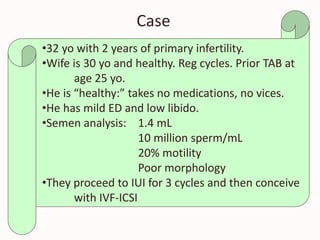
Case
•32 yo with 2 years of primary infertility.
•Wife is 30 yo and healthy. Reg cycles. Prior TAB at
age 25 yo.
•He is “healthy:” takes no medications, no vices.
•He has mild ED and low libido.
•Semen analysis: 1.4 mL
10 million sperm/mL
20% motility
Poor morphology
•They proceed to IUI for 3 cycles and then conceive
with IVF-ICSI
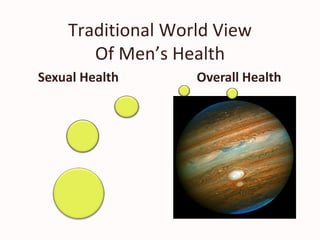
Sexual Health Overall Health
Traditional World View
Of Men’s Health
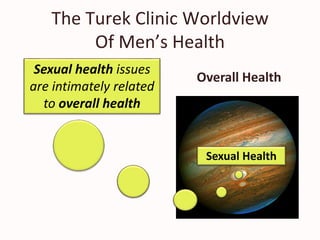
Sexual Health
Sexual health issues
are intimately related
to overall health
The Turek Clinic Worldview
Of Men’s Health
Overall Health
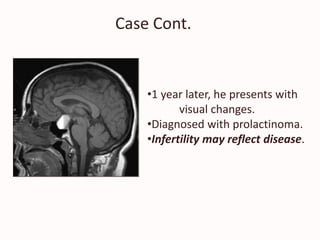
Case Cont.
•1 year later, he presents with
visual changes.
•Diagnosed with prolactinoma.
•Infertility may reflect disease.
Reasons to Evaluate Male Infertility
1. Enables infertility to be cured, not bypassed.
2. Allows discovery of potential underlying
medical conditions (i.e. infertility as a
“natural biomarker”)
3. May be a “window” into future health.
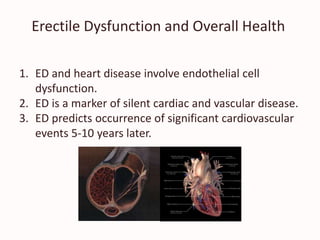
Erectile Dysfunction and Overall Health
1. ED and heart disease involve endothelial cell
dysfunction.
2. ED is a marker of silent cardiac and vascular disease.
3. ED predicts occurrence of significant cardiovascular
events 5-10 years later.
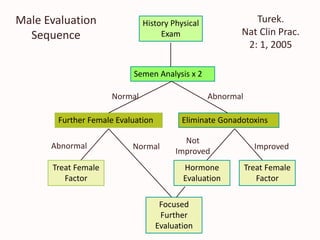
History Physical
Exam
Semen Analysis x 2
Eliminate GonadotoxinsFurther Female Evaluation
AbnormalNormal
Abnormal Normal
Treat Female
Factor
Focused
Further
Evaluation
Not
Improved
Improved
Hormone
Evaluation
Treat Female
Factor
Male Evaluation
Sequence
Turek.
Nat Clin Prac.
2: 1, 2005
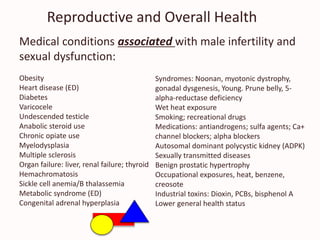
Reproductive and Overall Health
Medical conditions associated with male infertility and
sexual dysfunction:
Obesity
Heart disease (ED)
Diabetes
Varicocele
Undescended testicle
Anabolic steroid use
Chronic opiate use
Myelodysplasia
Multiple sclerosis
Organ failure: liver, renal failure; thyroid
Hemachromatosis
Sickle cell anemia/B thalassemia
Metabolic syndrome (ED)
Congenital adrenal hyperplasia
Syndromes: Noonan, myotonic dystrophy,
gonadal dysgenesis, Young. Prune belly, 5-
alpha-reductase deficiency
Wet heat exposure
Smoking; recreational drugs
Medications: antiandrogens; sulfa agents; Ca+
channel blockers; alpha blockers
Autosomal dominant polycystic kidney (ADPK)
Sexually transmitted diseases
Benign prostatic hypertrophy
Occupational exposures, heat, benzene,
creosote
Industrial toxins: Dioxin, PCBs, bisphenol A
Lower general health status
Reproductive and Overall Health
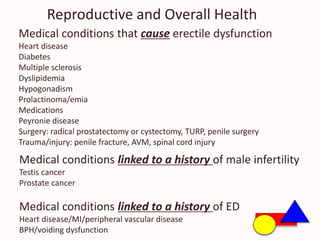
Medical conditions that cause male infertility
Y chromosome deletions
Karyotype anomalies (e.g., Klinefelter syndrome)
Congenital absence of the vas deferens (CAVD)
Hypogonadotropichypogonadism
Surgical procedures: TURP, vasectomy, orchiectomy, hernia repair
Testis cancer
Cancer treatment
Kartagener syndrome
Mumps orchitis
Prolactinoma
Androgen receptor defects
Infections—epididymitis
Impotence
Spinal cord injury
Reproductive and Overall Health
Medical conditions that cause erectile dysfunction
Heart disease
Diabetes
Multiple sclerosis
Dyslipidemia
Hypogonadism
Prolactinoma/emia
Medications
Peyronie disease
Surgery: radical prostatectomy or cystectomy, TURP, penile surgery
Trauma/injury: penile fracture, AVM, spinal cord injury
Medical conditions linked to a history of male infertility
Testis cancer
Prostate cancer
Medical conditions linked to a history of ED
Heart disease/MI/peripheral vascular disease
BPH/voiding dysfunction
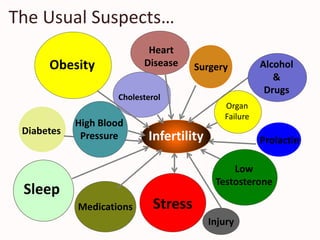
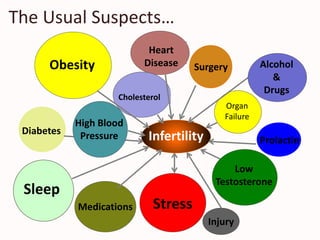
Infertility
Obesity
StressMedications
Heart
Disease
Diabetes
Cholesterol
Prolactin
Surgery
Injury
Organ
Failure
Low
Testosterone
High Blood
Pressure
Sleep
The Usual Suspects…
Alcohol
&
Drugs
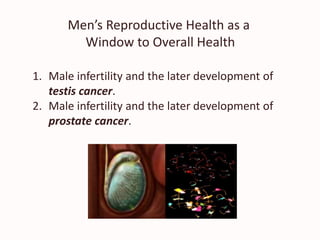
Men’s Reproductive Health as a
Window to Overall Health
1. Male infertility and the later development of
testis cancer.
2. Male infertility and the later development of
prostate cancer.
DNA mutations are a fact of life
• Constant challenges
– Chemical
– Irradiation
– Physical
• Organisms have developed an intricate network
of DNA repair systems.
• DNA repair mechanisms are more “taxed” in
germ cells
Systems Insure High Fidelity Transmission of DNA
to Next Generation
• DNA polymerase
• Nucleotide excision
repair (NEC)
• DNA mismatch repair
(MMR genes)
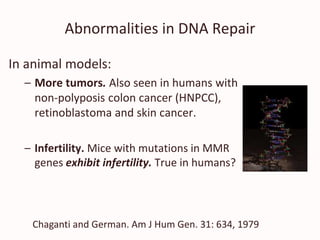
Abnormalities in DNA Repair
In animal models:
– More tumors. Also seen in humans with
non-polyposis colon cancer (HNPCC),
retinoblastoma and skin cancer.
– Infertility. Mice with mutations in MMR
genes exhibit infertility. True in humans?
Chaganti and German. Am J Hum Gen. 31: 634, 1979
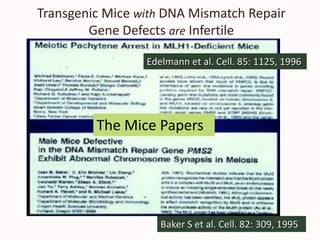
Transgenic Mice with DNA Mismatch Repair
Gene Defects are Infertile
The Mice Papers
Baker S et al. Cell. 82: 309, 1995
Edelmann et al. Cell. 85: 1125, 1996
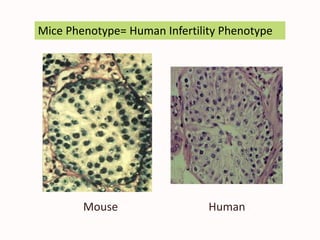
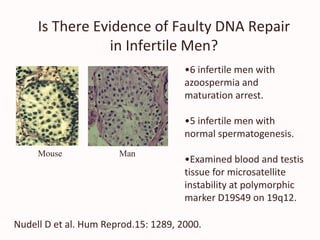
Mice Phenotype= Human Infertility Phenotype
Mouse Human
Is There Evidence of Faulty DNA Repair
in Infertile Men?
Mouse Man
•6 infertile men with
azoospermia and
maturation arrest.
•5 infertile men with
normal spermatogenesis.
•Examined blood and testis
tissue for microsatellite
instability at polymorphic
marker D19S49 on 19q12.
Nudell D et al. Hum Reprod.15: 1289, 2000.
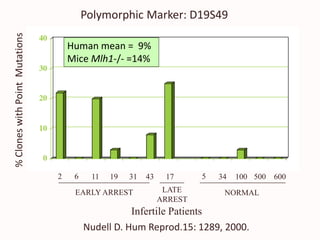
%CloneswithPointMutations
EARLY ARREST LATE
ARREST
NORMAL
2 19 31 5 34 100 500 600436 11 17
Infertile Patients
Nudell D. Hum Reprod.15: 1289, 2000.
Polymorphic Marker: D19S49
Human mean = 9%
Mice Mlh1-/- =14%
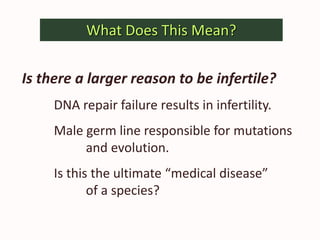
What Does This Mean?
Is there a larger reason to be infertile?
DNA repair failure results in infertility.
Male germ line responsible for mutations
and evolution.
Is this the ultimate “medical disease”
of a species?
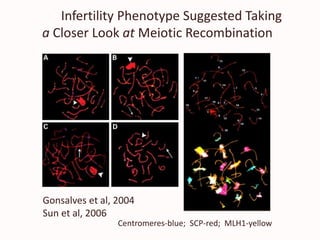
Infertility Phenotype Suggested Taking
a Closer Look at Meiotic Recombination
Centromeres-blue; SCP-red; MLH1-yellow
Gonsalves et al, 2004
Sun et al, 2006
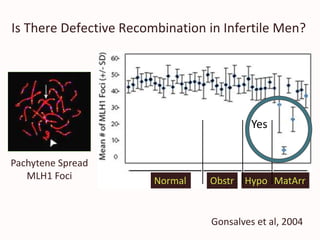
Is There Defective Recombination in Infertile Men?
Normal Obstr Hypo MatArr
Pachytene Spread
MLH1 Foci
Yes
Gonsalves et al, 2004
•There are abnormalities of chromosomal pairing in azoospermic men.
Sun et al. Cytogenet Genome Res. 111: 366, 2005
•Recombination errors show distinct patterns among chromosomes.
Sun et al. Cytogenet Hum Reprod. 15: 2376, 2006
•Localization patterns of 5 meiotic proteins well studied. MSH4
appears to stabilize recombination.
Oliver Bonet et al. Mmol Hum Reprod. 11: 517, 2005
Other Facts About Recombination in Infertile Men
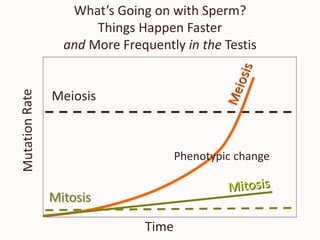
Time
Meiosis
Mitosis
What’s Going on with Sperm?
Things Happen Faster
and More Frequently in the Testis
Phenotypic change
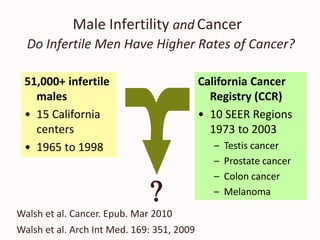
Male Infertility and Cancer
Do Infertile Men Have Higher Rates of Cancer?
51,000+ infertile
males
• 15 California
centers
• 1965 to 1998
California Cancer
Registry (CCR)
• 10 SEER Regions
1973 to 2003
– Testis cancer
– Prostate cancer
– Colon cancer
– Melanoma

Walsh et al. Arch Int Med. 169: 351, 2009
Walsh et al. Cancer. Epub. Mar 2010
Do Infertile Men Have Higher Rates of
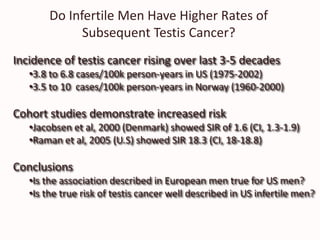
Subsequent Testis Cancer?
Incidence of testis cancer rising over last 3-5 decades
•3.8 to 6.8 cases/100k person-years in US (1975-2002)
•3.5 to 10 cases/100k person-years in Norway (1960-2000)
Cohort studies demonstrate increased risk
•Jacobsen et al, 2000 (Denmark) showed SIR of 1.6 (CI, 1.3-1.9)
•Raman et al, 2005 (U.S) showed SIR 18.3 (CI, 18-18.8)
Conclusions
•Is the association described in European men true for US men?
•Is the true risk of testis cancer well described in US infertile men?
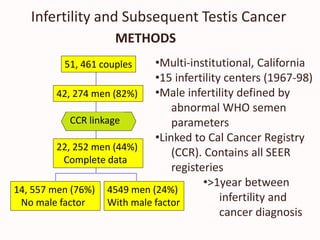
Infertility and Subsequent Testis Cancer
METHODS
51, 461 couples
42, 274 men (82%)
CCR linkage
22, 252 men (44%)
Complete data
14, 557 men (76%)
No male factor
4549 men (24%)
With male factor
•Multi-institutional, California
•15 infertility centers (1967-98)
•Male infertility defined by
abnormal WHO semen
parameters
•Linked to Cal Cancer Registry
(CCR). Contains all SEER
registeries
•>1year between
infertility and
cancer diagnosis
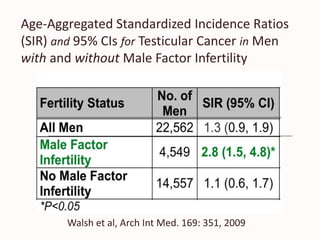
Age-Aggregated Standardized Incidence Ratios
(SIR) and 95% CIs for Testicular Cancer in Men
with and without Male Factor Infertility
Walsh et al, Arch Int Med. 169: 351, 2009
Do Infertile Men Have Higher Rates of
Subsequent Prostate Cancer?
Prostate cancer is the most common malignancy in US men
Risk factors for prostate cancer include
•Age
•Family history
•Race (African American)
Fatherhood has also been proposed as a risk factor
•Jorgensen et al, 2008: Childless men less likely to have prostate
cancer. Cancer risk declines with more children.
•Giwercman et al, 2005: Being childless was protective for
prostate cancer [OR 0.83, CI 0.81-0.86]
•Negri et al, 2006: Being childless was not protective for prostate
cancer [OR 0.95, CI 0.73-1.24]
•Ruhayel et al, 2010: Infertile men have a significantly reduced risk
of prostate cancer [OR 0.55, CI0.25-0.83]
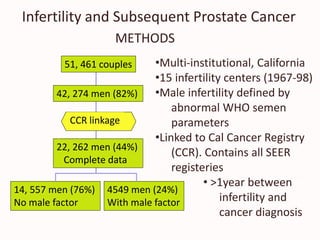
Infertility and Subsequent Prostate Cancer
METHODS
51, 461 couples
42, 274 men (82%)
CCR linkage
22, 262 men (44%)
Complete data
14, 557 men (76%)
No male factor
4549 men (24%)
With male factor
•Multi-institutional, California
•15 infertility centers (1967-98)
•Male infertility defined by
abnormal WHO semen
parameters
•Linked to Cal Cancer Registry
(CCR). Contains all SEER
registeries
• >1year between
infertility and
cancer diagnosis
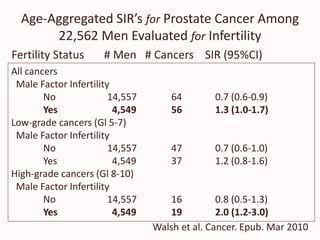
Age-Aggregated SIR’s for Prostate Cancer Among
22,562 Men Evaluated for Infertility
Walsh et al. Cancer. Epub. Mar 2010
Fertility Status # Men # Cancers SIR (95%CI)
All cancers
Male Factor Infertility
No 14,557 64 0.7 (0.6-0.9)
Yes 4,549 56 1.3 (1.0-1.7)
Low-grade cancers (Gl 5-7)
Male Factor Infertility
No 14,557 47 0.7 (0.6-1.0)
Yes 4,549 37 1.2 (0.8-1.6)
High-grade cancers (Gl 8-10)
Male Factor Infertility
No 14,557 16 0.8 (0.5-1.3)
Yes 4,549 19 2.0 (1.2-3.0)
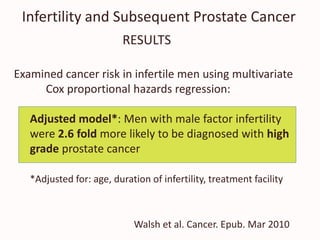
Infertility and Subsequent Prostate Cancer
RESULTS
Examined cancer risk in infertile men using multivariate
Cox proportional hazards regression:
Adjusted model*: Men with male factor infertility
were 2.6 fold more likely to be diagnosed with high
grade prostate cancer
*Adjusted for: age, duration of infertility, treatment facility
Walsh et al. Cancer. Epub. Mar 2010
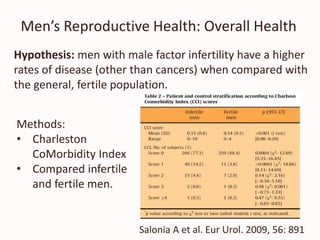
Men’s Reproductive Health: Overall Health
Salonia A et al. Eur Urol. 2009, 56: 891
Methods:
• Charleston
CoMorbidity Index
• Compared infertile
and fertile men.
Hypothesis: men with male factor infertility have a higher
rates of disease (other than cancers) when compared with
the general, fertile population.
Men’s Reproductive Health: Overall Health
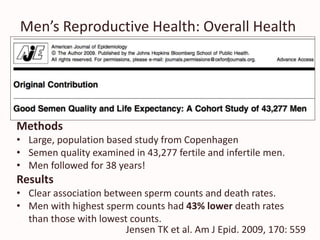
Jensen TK et al. Am J Epid. 2009, 170: 559
Methods
• Large, population based study from Copenhagen
• Semen quality examined in 43,277 fertile and infertile men.
• Men followed for 38 years!
Results
• Clear association between sperm counts and death rates.
• Men with highest sperm counts had 43% lower death rates
than those with lowest counts.
Men’s Reproductive Health: Overall Health
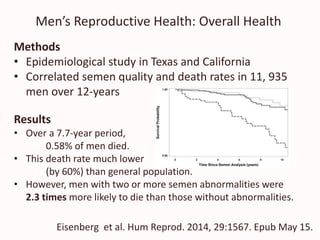
Eisenberg et al. Hum Reprod. 2014, 29:1567. Epub May 15.
Methods
• Epidemiological study in Texas and California
• Correlated semen quality and death rates in 11, 935
men over 12-years
Results
• Over a 7.7-year period,
0.58% of men died.
• This death rate much lower
(by 60%) than general population.
• However, men with two or more semen abnormalities were
2.3 times more likely to die than those without abnormalities.
Men’s Reproductive Health: Infertility
1. Male infertility is associated with the later
development of cancer.
2. Male infertility is associated with reduced
overall health and possibly higher mortality.
3. Male infertility is certainly an important disease
or marker of disease!!
Infertility
Obesity
StressMedications
Heart
Disease
Diabetes
Cholesterol
Prolactin
Surgery
Injury
Organ
Failure
Low
Testosterone
High Blood
Pressure
Sleep
The Usual Suspects…
Alcohol
&
Drugs
Male Infertility: Marker of Disease
Thanks to:
Uche Ezeh M.D. Mark Fox Ph.D
Shai Shefi M.D. Amander Clark Ph.D
Renee Reijo Pera Ph.D Jeff Simko M.D.
Thomas Walsh MD, MS Nina Kossack Ph.D
David Nudell MD Mary Croughan Ph.D
NIH; CIRM
Lance Armstrong Foundation
California Urology Foundation

East Meets West in Medicine

  • 1.
    A Planetary Viewof Men’s Reproductive Health Paul J. Turek MD, FACS, FRSM Beverly Hills and San Francisco
  • 2.
    •Neither I, norany member of my immediate family, have financial relationships to disclose relevant to the content of this presentation. •I will not discuss off-label use of any drug or therapy. Disclosures
  • 3.
    Case •32 yo with2 years of primary infertility. •Wife is 30 yo and healthy. Reg cycles. Prior TAB at age 25 yo. •He is “healthy:” takes no medications, no vices. •He has mild ED and low libido. •Semen analysis: 1.4 mL 10 million sperm/mL 20% motility Poor morphology •They proceed to IUI for 3 cycles and then conceive with IVF-ICSI
  • 4.
    Sexual Health OverallHealth Traditional World View Of Men’s Health
  • 5.
    Sexual Health Sexual healthissues are intimately related to overall health The Turek Clinic Worldview Of Men’s Health Overall Health
  • 6.
    Case Cont. •1 yearlater, he presents with visual changes. •Diagnosed with prolactinoma. •Infertility may reflect disease.
  • 7.
    Reasons to EvaluateMale Infertility 1. Enables infertility to be cured, not bypassed. 2. Allows discovery of potential underlying medical conditions (i.e. infertility as a “natural biomarker”) 3. May be a “window” into future health.
  • 8.
    Erectile Dysfunction andOverall Health 1. ED and heart disease involve endothelial cell dysfunction. 2. ED is a marker of silent cardiac and vascular disease. 3. ED predicts occurrence of significant cardiovascular events 5-10 years later.
  • 9.
    History Physical Exam Semen Analysisx 2 Eliminate GonadotoxinsFurther Female Evaluation AbnormalNormal Abnormal Normal Treat Female Factor Focused Further Evaluation Not Improved Improved Hormone Evaluation Treat Female Factor Male Evaluation Sequence Turek. Nat Clin Prac. 2: 1, 2005
  • 10.
    Reproductive and OverallHealth Medical conditions associated with male infertility and sexual dysfunction: Obesity Heart disease (ED) Diabetes Varicocele Undescended testicle Anabolic steroid use Chronic opiate use Myelodysplasia Multiple sclerosis Organ failure: liver, renal failure; thyroid Hemachromatosis Sickle cell anemia/B thalassemia Metabolic syndrome (ED) Congenital adrenal hyperplasia Syndromes: Noonan, myotonic dystrophy, gonadal dysgenesis, Young. Prune belly, 5- alpha-reductase deficiency Wet heat exposure Smoking; recreational drugs Medications: antiandrogens; sulfa agents; Ca+ channel blockers; alpha blockers Autosomal dominant polycystic kidney (ADPK) Sexually transmitted diseases Benign prostatic hypertrophy Occupational exposures, heat, benzene, creosote Industrial toxins: Dioxin, PCBs, bisphenol A Lower general health status
  • 11.
    Reproductive and OverallHealth Medical conditions that cause male infertility Y chromosome deletions Karyotype anomalies (e.g., Klinefelter syndrome) Congenital absence of the vas deferens (CAVD) Hypogonadotropichypogonadism Surgical procedures: TURP, vasectomy, orchiectomy, hernia repair Testis cancer Cancer treatment Kartagener syndrome Mumps orchitis Prolactinoma Androgen receptor defects Infections—epididymitis Impotence Spinal cord injury
  • 12.
    Reproductive and OverallHealth Medical conditions that cause erectile dysfunction Heart disease Diabetes Multiple sclerosis Dyslipidemia Hypogonadism Prolactinoma/emia Medications Peyronie disease Surgery: radical prostatectomy or cystectomy, TURP, penile surgery Trauma/injury: penile fracture, AVM, spinal cord injury Medical conditions linked to a history of male infertility Testis cancer Prostate cancer Medical conditions linked to a history of ED Heart disease/MI/peripheral vascular disease BPH/voiding dysfunction
  • 13.
  • 14.
    Men’s Reproductive Healthas a Window to Overall Health 1. Male infertility and the later development of testis cancer. 2. Male infertility and the later development of prostate cancer.
  • 15.
    DNA mutations area fact of life • Constant challenges – Chemical – Irradiation – Physical • Organisms have developed an intricate network of DNA repair systems. • DNA repair mechanisms are more “taxed” in germ cells
  • 16.
    Systems Insure HighFidelity Transmission of DNA to Next Generation • DNA polymerase • Nucleotide excision repair (NEC) • DNA mismatch repair (MMR genes)
  • 17.
    Abnormalities in DNARepair In animal models: – More tumors. Also seen in humans with non-polyposis colon cancer (HNPCC), retinoblastoma and skin cancer. – Infertility. Mice with mutations in MMR genes exhibit infertility. True in humans? Chaganti and German. Am J Hum Gen. 31: 634, 1979
  • 18.
    Transgenic Mice withDNA Mismatch Repair Gene Defects are Infertile The Mice Papers Baker S et al. Cell. 82: 309, 1995 Edelmann et al. Cell. 85: 1125, 1996
  • 19.
    Mice Phenotype= HumanInfertility Phenotype Mouse Human
  • 20.
    Is There Evidenceof Faulty DNA Repair in Infertile Men? Mouse Man •6 infertile men with azoospermia and maturation arrest. •5 infertile men with normal spermatogenesis. •Examined blood and testis tissue for microsatellite instability at polymorphic marker D19S49 on 19q12. Nudell D et al. Hum Reprod.15: 1289, 2000.
  • 21.
    %CloneswithPointMutations EARLY ARREST LATE ARREST NORMAL 219 31 5 34 100 500 600436 11 17 Infertile Patients Nudell D. Hum Reprod.15: 1289, 2000. Polymorphic Marker: D19S49 Human mean = 9% Mice Mlh1-/- =14%
  • 22.
    What Does ThisMean? Is there a larger reason to be infertile? DNA repair failure results in infertility. Male germ line responsible for mutations and evolution. Is this the ultimate “medical disease” of a species?
  • 23.
    Infertility Phenotype SuggestedTaking a Closer Look at Meiotic Recombination Centromeres-blue; SCP-red; MLH1-yellow Gonsalves et al, 2004 Sun et al, 2006
  • 24.
    Is There DefectiveRecombination in Infertile Men? Normal Obstr Hypo MatArr Pachytene Spread MLH1 Foci Yes Gonsalves et al, 2004
  • 25.
    •There are abnormalitiesof chromosomal pairing in azoospermic men. Sun et al. Cytogenet Genome Res. 111: 366, 2005 •Recombination errors show distinct patterns among chromosomes. Sun et al. Cytogenet Hum Reprod. 15: 2376, 2006 •Localization patterns of 5 meiotic proteins well studied. MSH4 appears to stabilize recombination. Oliver Bonet et al. Mmol Hum Reprod. 11: 517, 2005 Other Facts About Recombination in Infertile Men
  • 26.
    Time Meiosis Mitosis What’s Going onwith Sperm? Things Happen Faster and More Frequently in the Testis Phenotypic change
  • 27.
    Male Infertility andCancer Do Infertile Men Have Higher Rates of Cancer? 51,000+ infertile males • 15 California centers • 1965 to 1998 California Cancer Registry (CCR) • 10 SEER Regions 1973 to 2003 – Testis cancer – Prostate cancer – Colon cancer – Melanoma  Walsh et al. Arch Int Med. 169: 351, 2009 Walsh et al. Cancer. Epub. Mar 2010
  • 28.
    Do Infertile MenHave Higher Rates of Subsequent Testis Cancer? Incidence of testis cancer rising over last 3-5 decades •3.8 to 6.8 cases/100k person-years in US (1975-2002) •3.5 to 10 cases/100k person-years in Norway (1960-2000) Cohort studies demonstrate increased risk •Jacobsen et al, 2000 (Denmark) showed SIR of 1.6 (CI, 1.3-1.9) •Raman et al, 2005 (U.S) showed SIR 18.3 (CI, 18-18.8) Conclusions •Is the association described in European men true for US men? •Is the true risk of testis cancer well described in US infertile men?
  • 29.
    Infertility and SubsequentTestis Cancer METHODS 51, 461 couples 42, 274 men (82%) CCR linkage 22, 252 men (44%) Complete data 14, 557 men (76%) No male factor 4549 men (24%) With male factor •Multi-institutional, California •15 infertility centers (1967-98) •Male infertility defined by abnormal WHO semen parameters •Linked to Cal Cancer Registry (CCR). Contains all SEER registeries •>1year between infertility and cancer diagnosis
  • 30.
    Age-Aggregated Standardized IncidenceRatios (SIR) and 95% CIs for Testicular Cancer in Men with and without Male Factor Infertility Walsh et al, Arch Int Med. 169: 351, 2009
  • 31.
    Do Infertile MenHave Higher Rates of Subsequent Prostate Cancer? Prostate cancer is the most common malignancy in US men Risk factors for prostate cancer include •Age •Family history •Race (African American) Fatherhood has also been proposed as a risk factor •Jorgensen et al, 2008: Childless men less likely to have prostate cancer. Cancer risk declines with more children. •Giwercman et al, 2005: Being childless was protective for prostate cancer [OR 0.83, CI 0.81-0.86] •Negri et al, 2006: Being childless was not protective for prostate cancer [OR 0.95, CI 0.73-1.24] •Ruhayel et al, 2010: Infertile men have a significantly reduced risk of prostate cancer [OR 0.55, CI0.25-0.83]
  • 32.
    Infertility and SubsequentProstate Cancer METHODS 51, 461 couples 42, 274 men (82%) CCR linkage 22, 262 men (44%) Complete data 14, 557 men (76%) No male factor 4549 men (24%) With male factor •Multi-institutional, California •15 infertility centers (1967-98) •Male infertility defined by abnormal WHO semen parameters •Linked to Cal Cancer Registry (CCR). Contains all SEER registeries • >1year between infertility and cancer diagnosis
  • 33.
    Age-Aggregated SIR’s forProstate Cancer Among 22,562 Men Evaluated for Infertility Walsh et al. Cancer. Epub. Mar 2010 Fertility Status # Men # Cancers SIR (95%CI) All cancers Male Factor Infertility No 14,557 64 0.7 (0.6-0.9) Yes 4,549 56 1.3 (1.0-1.7) Low-grade cancers (Gl 5-7) Male Factor Infertility No 14,557 47 0.7 (0.6-1.0) Yes 4,549 37 1.2 (0.8-1.6) High-grade cancers (Gl 8-10) Male Factor Infertility No 14,557 16 0.8 (0.5-1.3) Yes 4,549 19 2.0 (1.2-3.0)
  • 34.
    Infertility and SubsequentProstate Cancer RESULTS Examined cancer risk in infertile men using multivariate Cox proportional hazards regression: Adjusted model*: Men with male factor infertility were 2.6 fold more likely to be diagnosed with high grade prostate cancer *Adjusted for: age, duration of infertility, treatment facility Walsh et al. Cancer. Epub. Mar 2010
  • 35.
    Men’s Reproductive Health:Overall Health Salonia A et al. Eur Urol. 2009, 56: 891 Methods: • Charleston CoMorbidity Index • Compared infertile and fertile men. Hypothesis: men with male factor infertility have a higher rates of disease (other than cancers) when compared with the general, fertile population.
  • 36.
    Men’s Reproductive Health:Overall Health Jensen TK et al. Am J Epid. 2009, 170: 559 Methods • Large, population based study from Copenhagen • Semen quality examined in 43,277 fertile and infertile men. • Men followed for 38 years! Results • Clear association between sperm counts and death rates. • Men with highest sperm counts had 43% lower death rates than those with lowest counts.
  • 37.
    Men’s Reproductive Health:Overall Health Eisenberg et al. Hum Reprod. 2014, 29:1567. Epub May 15. Methods • Epidemiological study in Texas and California • Correlated semen quality and death rates in 11, 935 men over 12-years Results • Over a 7.7-year period, 0.58% of men died. • This death rate much lower (by 60%) than general population. • However, men with two or more semen abnormalities were 2.3 times more likely to die than those without abnormalities.
  • 38.
    Men’s Reproductive Health:Infertility 1. Male infertility is associated with the later development of cancer. 2. Male infertility is associated with reduced overall health and possibly higher mortality. 3. Male infertility is certainly an important disease or marker of disease!!
  • 39.
  • 40.
    Male Infertility: Markerof Disease Thanks to: Uche Ezeh M.D. Mark Fox Ph.D Shai Shefi M.D. Amander Clark Ph.D Renee Reijo Pera Ph.D Jeff Simko M.D. Thomas Walsh MD, MS Nina Kossack Ph.D David Nudell MD Mary Croughan Ph.D NIH; CIRM Lance Armstrong Foundation California Urology Foundation