Democratized Data
& Analytics for the
Cloud
John de Saint Phalle | Senior Product Manager
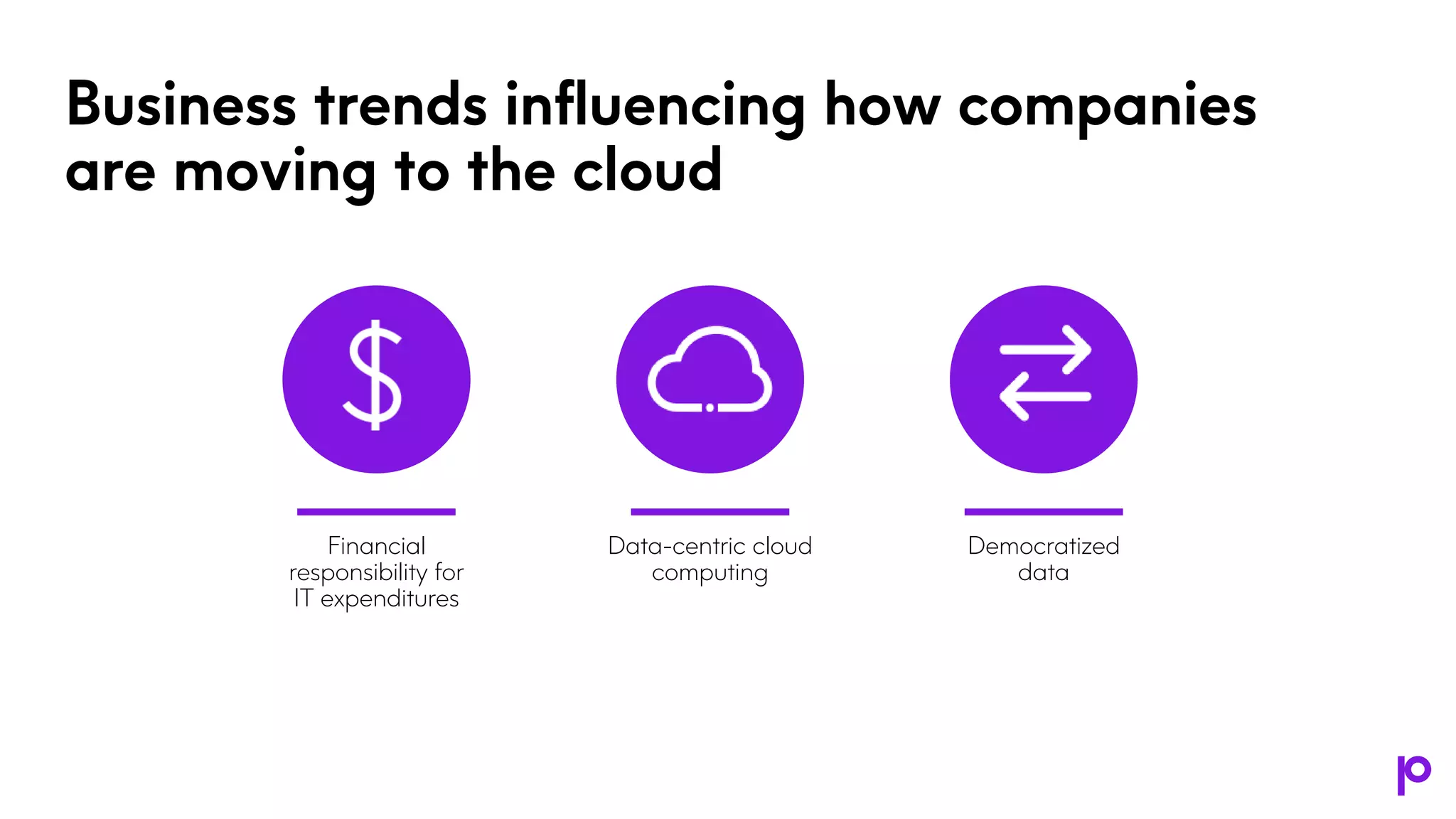
Business trends influencing how companies
are moving to the cloud
Financial
responsibility for
IT expenditures
Data-centric cloud
computing
Democratized
data
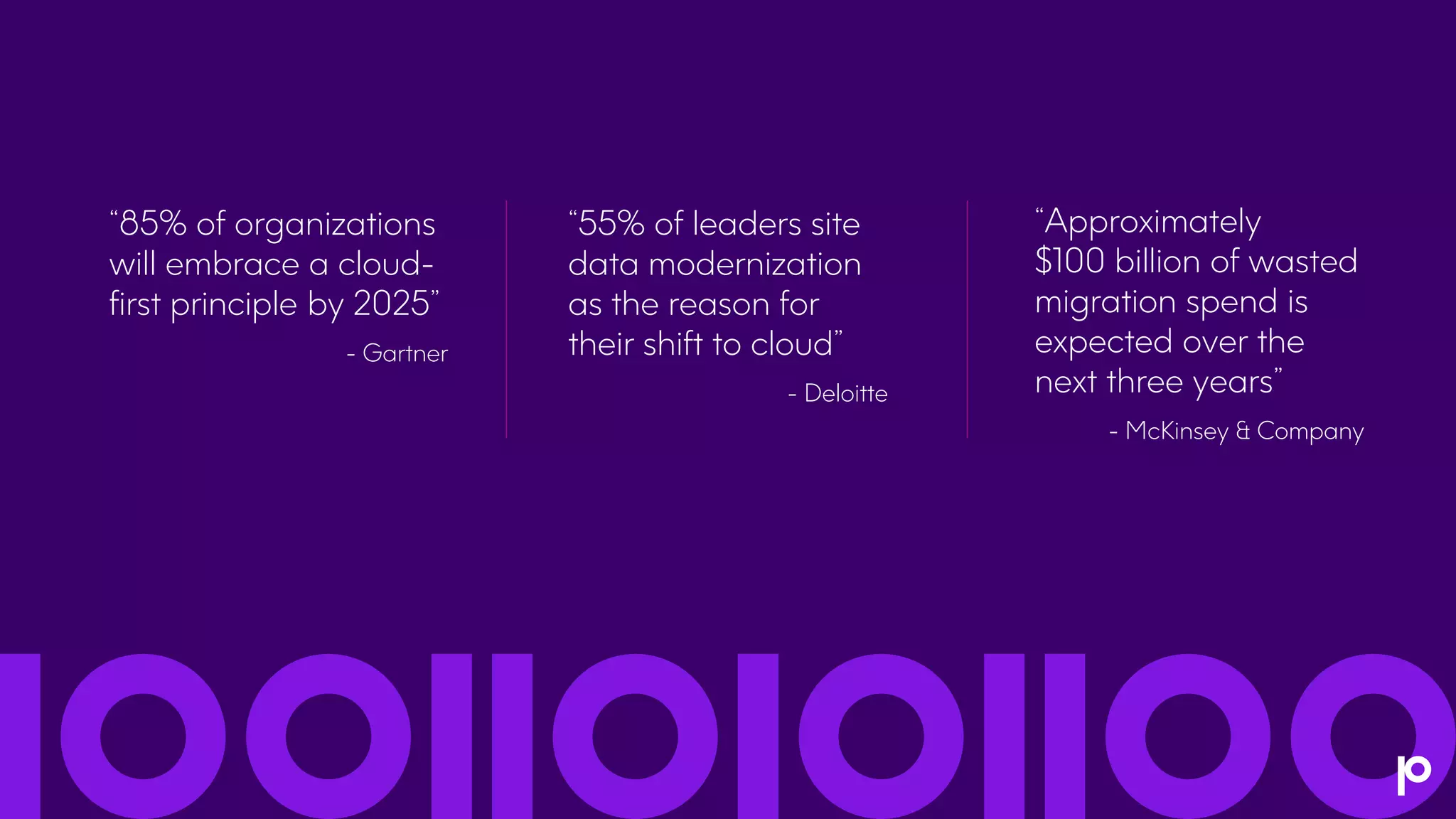
“85% of organizations
will embrace a cloud-
first principle by 2025”
- Gartner
“55% of leaders site
data modernization
as the reason for
their shift to cloud”
- Deloitte
“Approximately
$100 billion of wasted
migration spend is
expected over the
next three years”
- McKinsey & Company
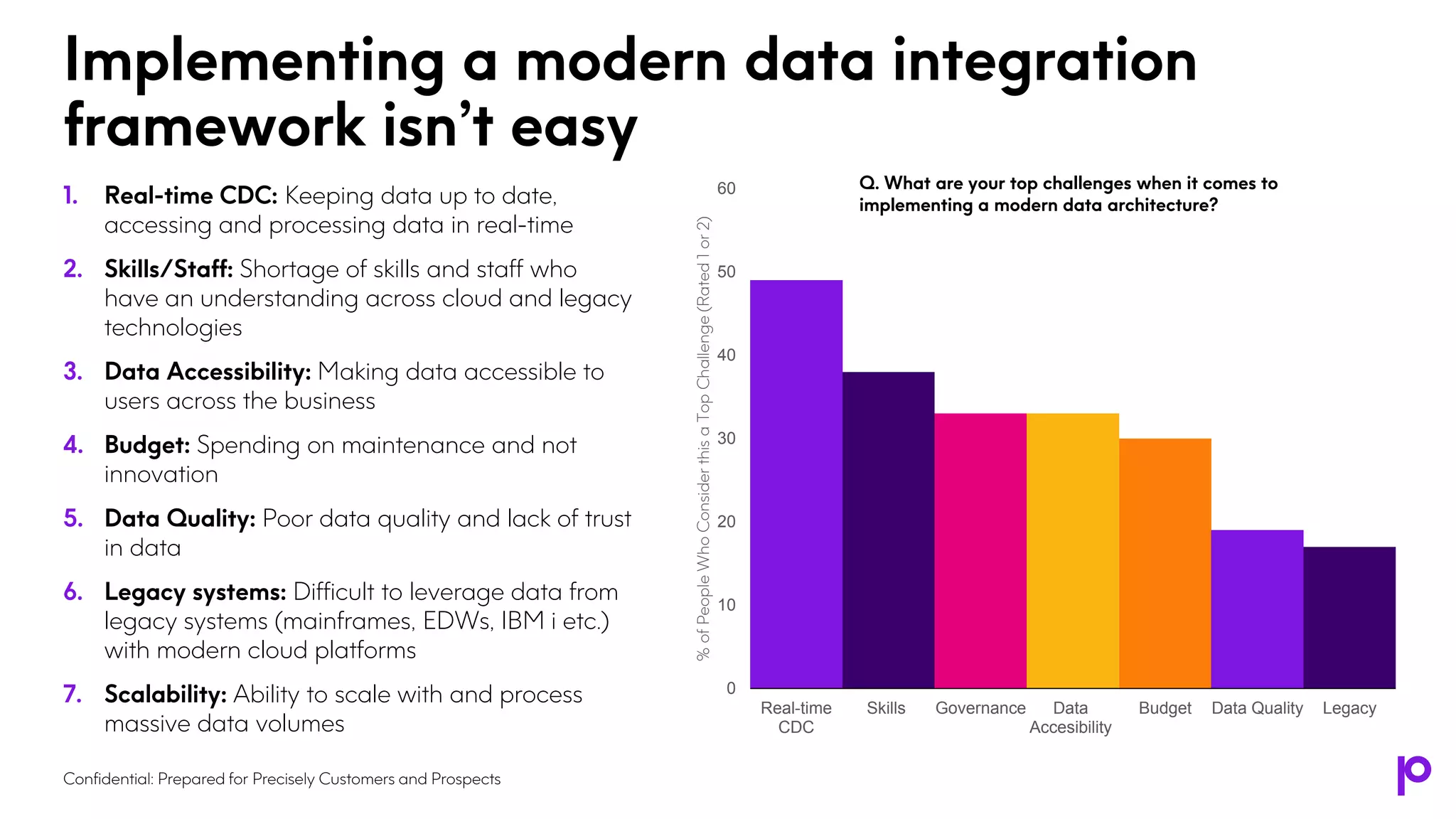
Implementing a modern data integration
framework isn’t easy
Confidential: Prepared for Precisely Customers and Prospects
0
10
20
30
40
50
60
Real-time
CDC
Skills Governance Data
Accesibility
Budget Data Quality Legacy
%
of
People
Who
Consider
this
a
Top
Challenge
(Rated
1
or
2)
1. Real-time CDC: Keeping data up to date,
accessing and processing data in real-time
2. Skills/Staff: Shortage of skills and staff who
have an understanding across cloud and legacy
technologies
3. Data Accessibility: Making data accessible to
users across the business
4. Budget: Spending on maintenance and not
innovation
5. Data Quality: Poor data quality and lack of trust
in data
6. Legacy systems: Difficult to leverage data from
legacy systems (mainframes, EDWs, IBM i etc.)
with modern cloud platforms
7. Scalability: Ability to scale with and process
massive data volumes
Q. What are your top challenges when it comes to
implementing a modern data architecture?
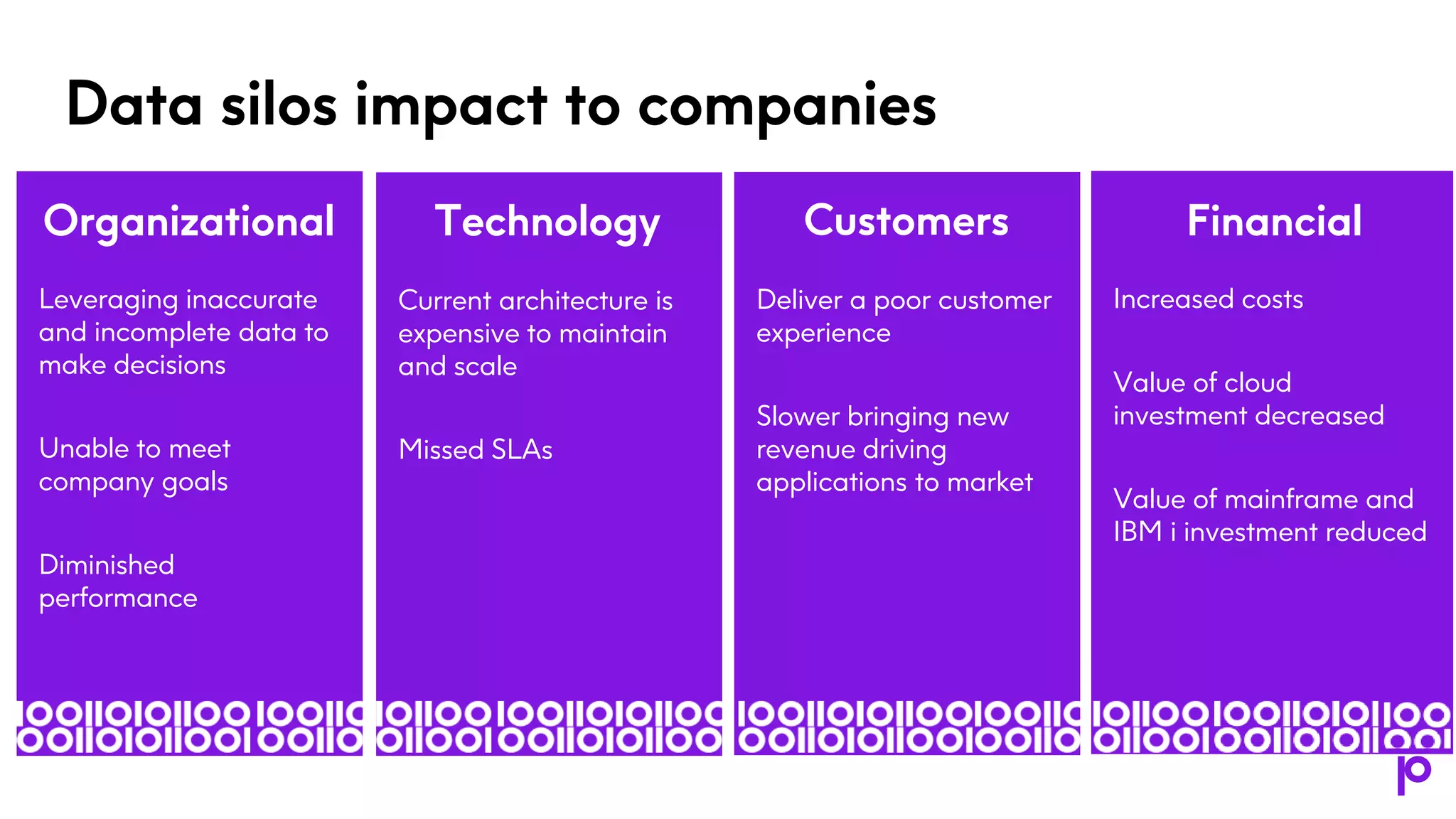
Data silos impact to companies
Expense Reduction
• $800K (annual) expense
reduction
• Today, 4-hour peak is ~1000
MIPS which costs the
enterprise $1.0M.
• An 80% cost reduction
($800K annually) is expected
once CDC is fully
implemented by reducing the
4-hour rolling avg.
Leveraging inaccurate
and incomplete data to
make decisions
Unable to meet
company goals
Diminished
performance
Organizational
Current architecture is
expensive to maintain
and scale
Missed SLAs
Technology
Increased costs
Value of cloud
investment decreased
Value of mainframe and
IBM i investment reduced
Financial
Deliver a poor customer
experience
Slower bringing new
revenue driving
applications to market
Customers
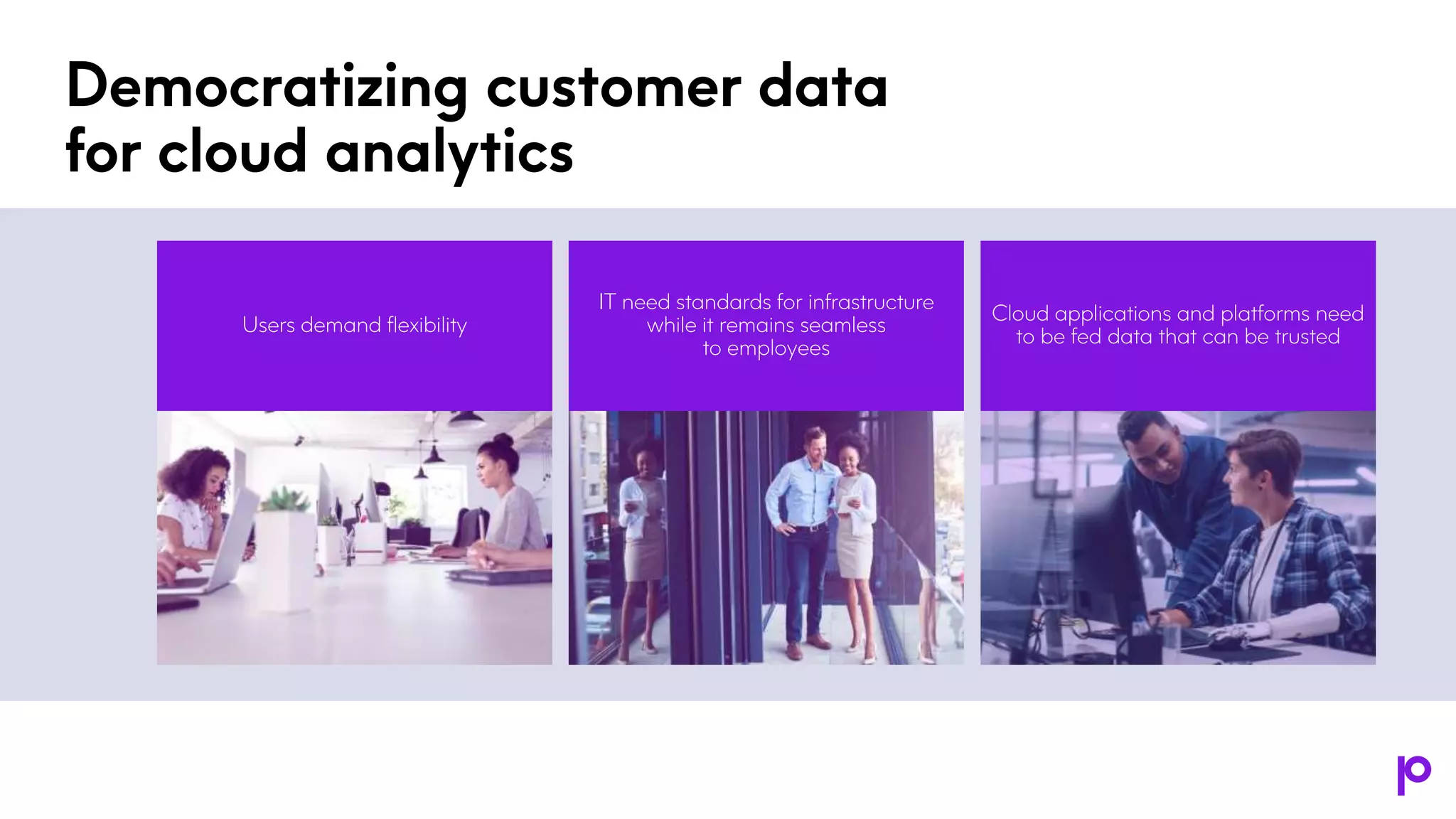
Democratizing customer data
for cloud analytics
IT need standards for infrastructure
while it remains seamless
to employees
Cloud applications and platforms need
to be fed data that can be trusted
Users demand flexibility
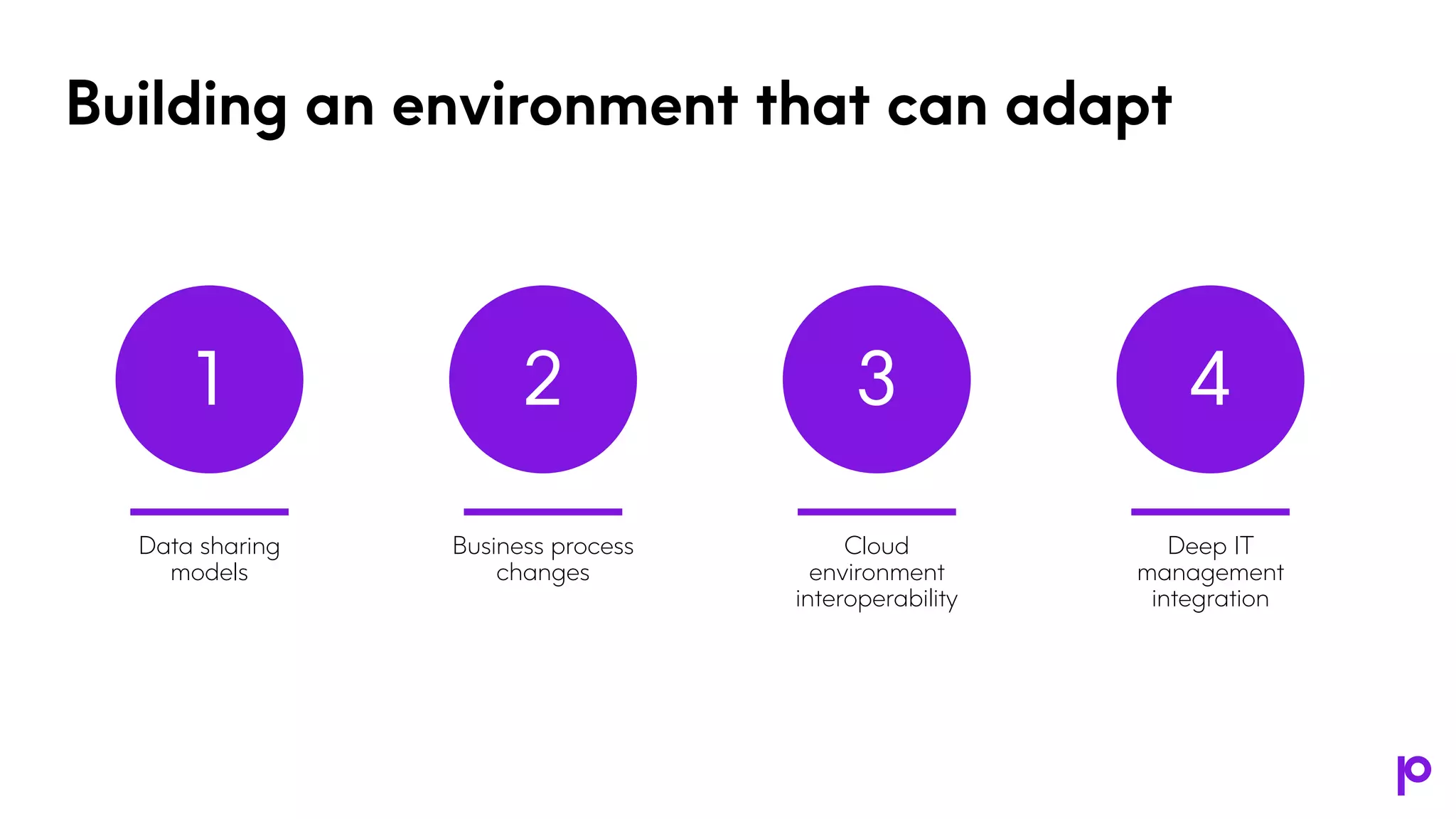
Building an environment that can adapt
1
Data sharing
models
2
Business process
changes
3
Cloud
environment
interoperability
4
Deep IT
management
integration
Precisely’s single solution for your
cloud integration needs
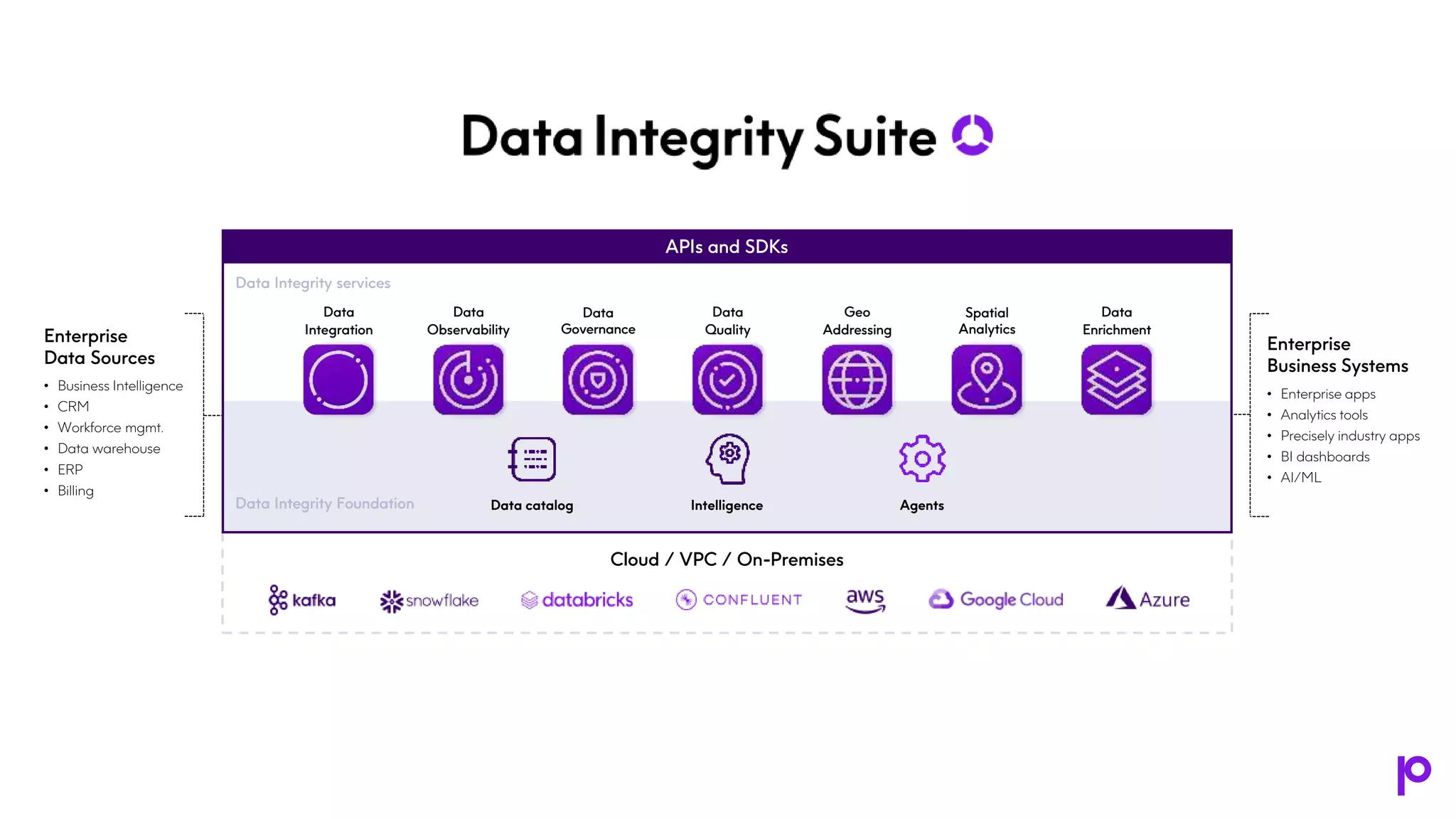
Cloud / VPC / On-Premises
Data
Integration
Data
Observability
Data
Quality
Geo
Addressing
Spatial
Analytics
Data
Governance
Data
Enrichment
APIs and SDKs
Enterprise
Business Systems
• Enterprise apps
• Analytics tools
• Precisely industry apps
• BI dashboards
• AI/ML
Enterprise
Data Sources
• Business Intelligence
• CRM
• Workforce mgmt.
• Data warehouse
• ERP
• Billing
Data Integrity services
Data Integrity Foundation Data catalog Intelligence Agents
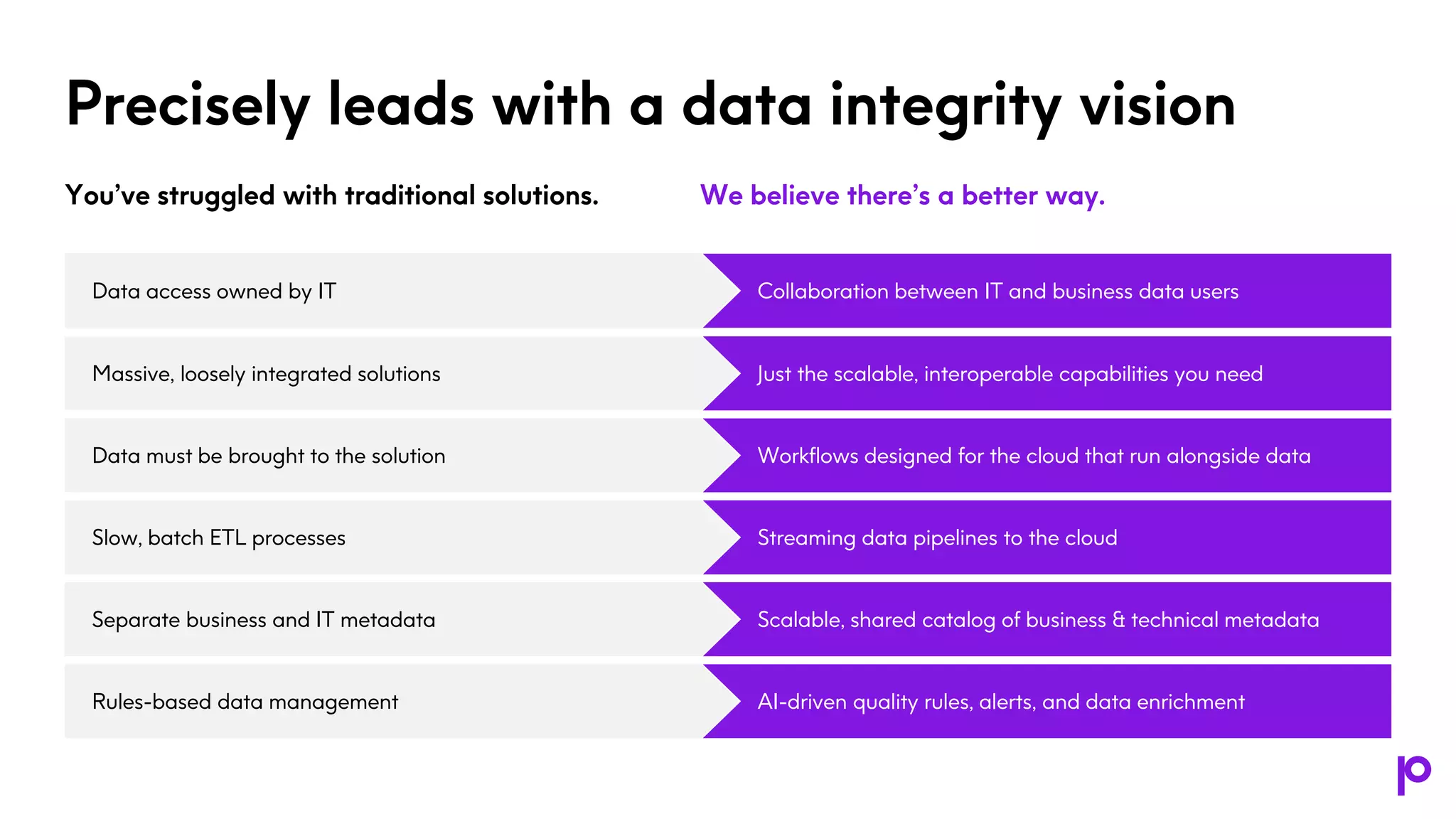
Precisely leads with a data integrity vision
You’ve struggled with traditional solutions. We believe there’s a better way.
Data access owned by IT Collaboration between IT and business data users
Massive, loosely integrated solutions Just the scalable, interoperable capabilities you need
Data must be brought to the solution Workflows designed for the cloud that run alongside data
Slow, batch ETL processes Streaming data pipelines to the cloud
Separate business and IT metadata Scalable, shared catalog of business & technical metadata
Rules-based data management AI-driven quality rules, alerts, and data enrichment
Data Integration
Break down data silos by
quickly building modern data
pipelines that drive innovation
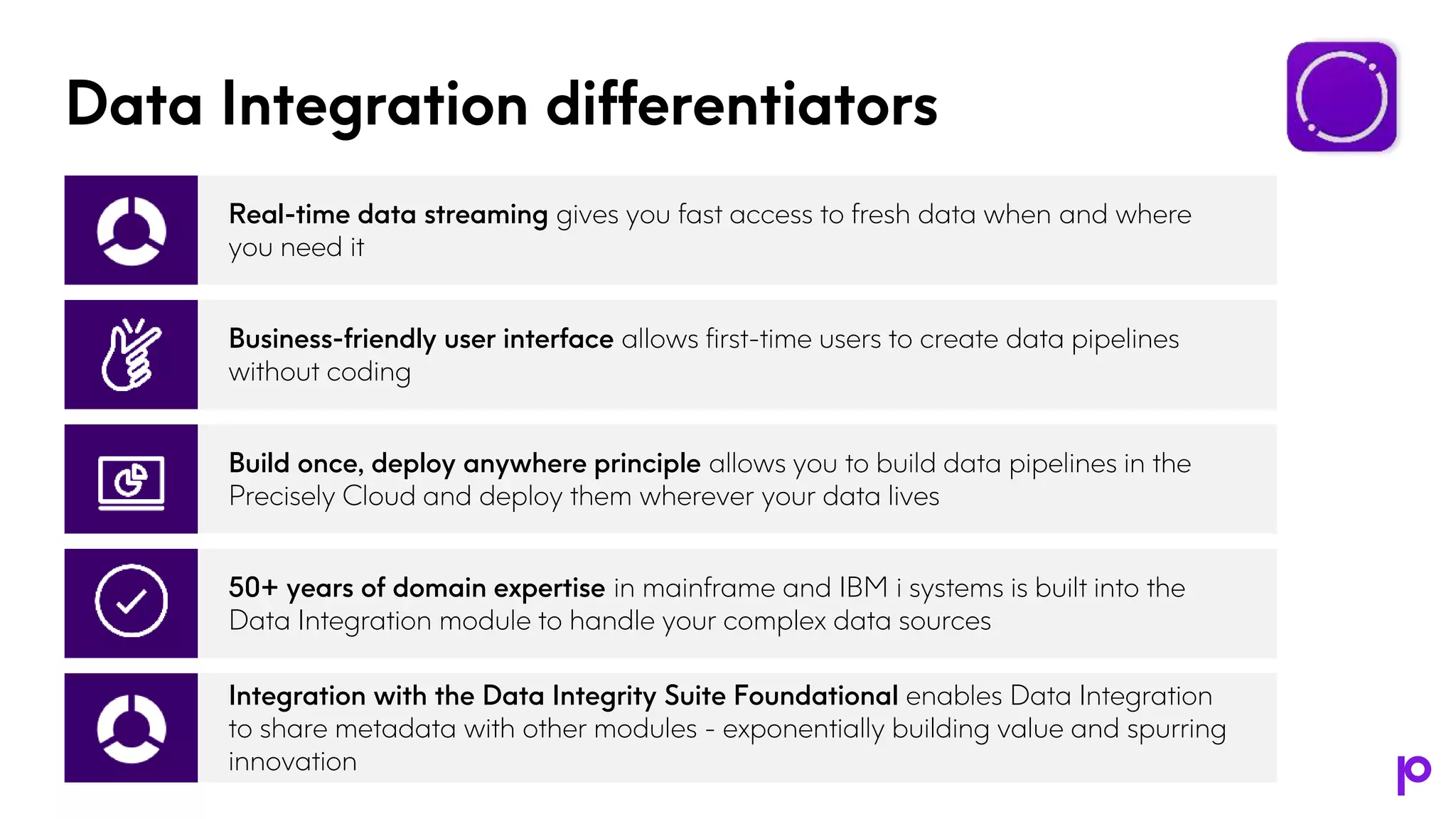
Data Integration differentiators
Real-time data streaming gives you fast access to fresh data when and where
you need it
Business-friendly user interface allows first-time users to create data pipelines
without coding
Build once, deploy anywhere principle allows you to build data pipelines in the
Precisely Cloud and deploy them wherever your data lives
50+ years of domain expertise in mainframe and IBM i systems is built into the
Data Integration module to handle your complex data sources
Integration with the Data Integrity Suite Foundational enables Data Integration
to share metadata with other modules - exponentially building value and spurring
innovation
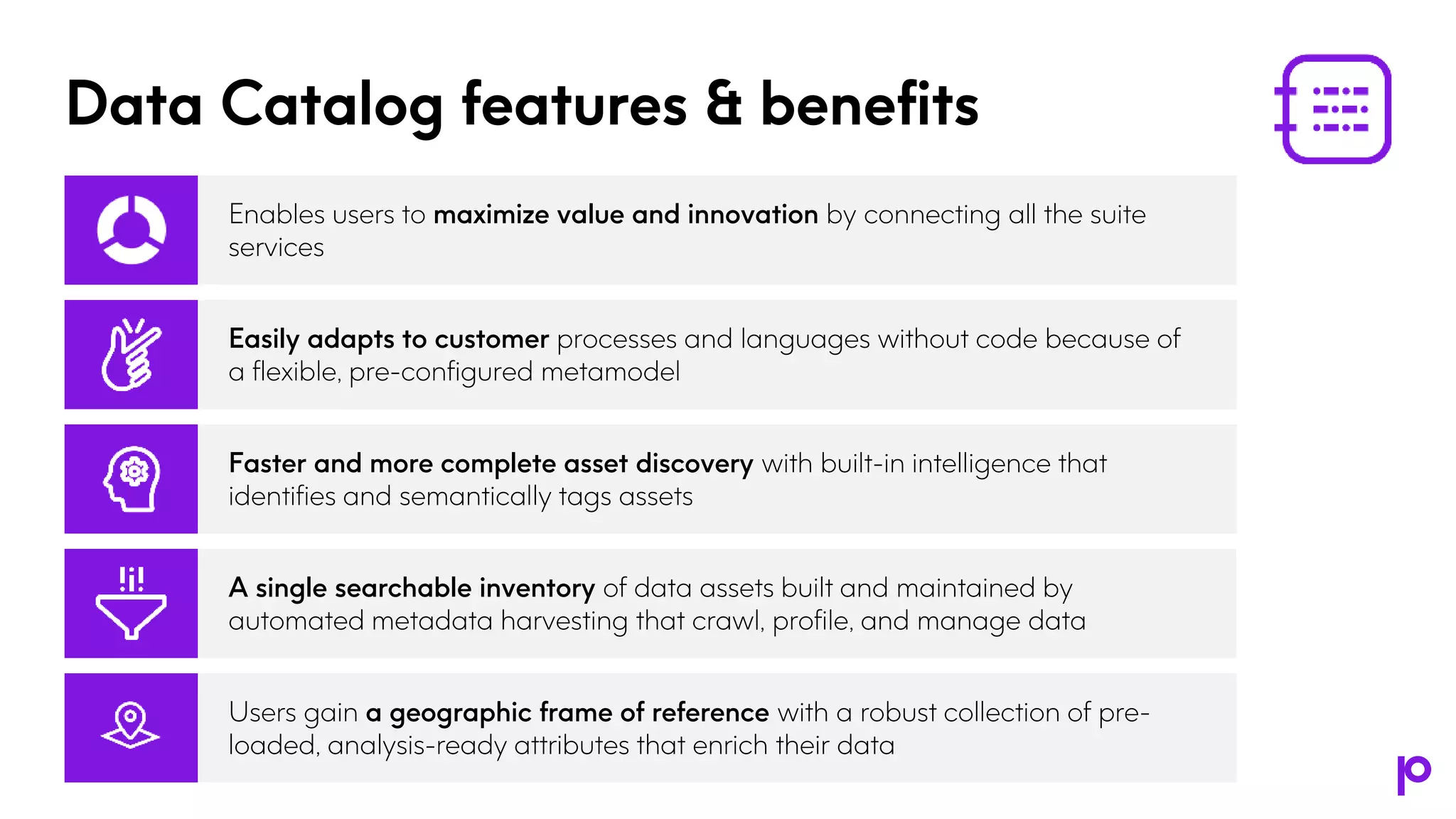
Data Catalog features & benefits
Enables users to maximize value and innovation by connecting all the suite
services
Easily adapts to customer processes and languages without code because of
a flexible, pre-configured metamodel
Faster and more complete asset discovery with built-in intelligence that
identifies and semantically tags assets
A single searchable inventory of data assets built and maintained by
automated metadata harvesting that crawl, profile, and manage data
Users gain a geographic frame of reference with a robust collection of pre-
loaded, analysis-ready attributes that enrich their data
Thank you

Democratized Data & Analytics for the Cloud​

  • 1.
    Democratized Data & Analyticsfor the Cloud John de Saint Phalle | Senior Product Manager
  • 2.
    Business trends influencinghow companies are moving to the cloud Financial responsibility for IT expenditures Data-centric cloud computing Democratized data
  • 3.
    “85% of organizations willembrace a cloud- first principle by 2025” - Gartner “55% of leaders site data modernization as the reason for their shift to cloud” - Deloitte “Approximately $100 billion of wasted migration spend is expected over the next three years” - McKinsey & Company
  • 4.
    Implementing a moderndata integration framework isn’t easy Confidential: Prepared for Precisely Customers and Prospects 0 10 20 30 40 50 60 Real-time CDC Skills Governance Data Accesibility Budget Data Quality Legacy % of People Who Consider this a Top Challenge (Rated 1 or 2) 1. Real-time CDC: Keeping data up to date, accessing and processing data in real-time 2. Skills/Staff: Shortage of skills and staff who have an understanding across cloud and legacy technologies 3. Data Accessibility: Making data accessible to users across the business 4. Budget: Spending on maintenance and not innovation 5. Data Quality: Poor data quality and lack of trust in data 6. Legacy systems: Difficult to leverage data from legacy systems (mainframes, EDWs, IBM i etc.) with modern cloud platforms 7. Scalability: Ability to scale with and process massive data volumes Q. What are your top challenges when it comes to implementing a modern data architecture?
  • 5.
    Data silos impactto companies Expense Reduction • $800K (annual) expense reduction • Today, 4-hour peak is ~1000 MIPS which costs the enterprise $1.0M. • An 80% cost reduction ($800K annually) is expected once CDC is fully implemented by reducing the 4-hour rolling avg. Leveraging inaccurate and incomplete data to make decisions Unable to meet company goals Diminished performance Organizational Current architecture is expensive to maintain and scale Missed SLAs Technology Increased costs Value of cloud investment decreased Value of mainframe and IBM i investment reduced Financial Deliver a poor customer experience Slower bringing new revenue driving applications to market Customers
  • 6.
    Democratizing customer data forcloud analytics IT need standards for infrastructure while it remains seamless to employees Cloud applications and platforms need to be fed data that can be trusted Users demand flexibility
  • 7.
    Building an environmentthat can adapt 1 Data sharing models 2 Business process changes 3 Cloud environment interoperability 4 Deep IT management integration
  • 8.
    Precisely’s single solutionfor your cloud integration needs
  • 9.
    Cloud / VPC/ On-Premises Data Integration Data Observability Data Quality Geo Addressing Spatial Analytics Data Governance Data Enrichment APIs and SDKs Enterprise Business Systems • Enterprise apps • Analytics tools • Precisely industry apps • BI dashboards • AI/ML Enterprise Data Sources • Business Intelligence • CRM • Workforce mgmt. • Data warehouse • ERP • Billing Data Integrity services Data Integrity Foundation Data catalog Intelligence Agents
  • 10.
    Precisely leads witha data integrity vision You’ve struggled with traditional solutions. We believe there’s a better way. Data access owned by IT Collaboration between IT and business data users Massive, loosely integrated solutions Just the scalable, interoperable capabilities you need Data must be brought to the solution Workflows designed for the cloud that run alongside data Slow, batch ETL processes Streaming data pipelines to the cloud Separate business and IT metadata Scalable, shared catalog of business & technical metadata Rules-based data management AI-driven quality rules, alerts, and data enrichment
  • 11.
    Data Integration Break downdata silos by quickly building modern data pipelines that drive innovation
  • 12.
    Data Integration differentiators Real-timedata streaming gives you fast access to fresh data when and where you need it Business-friendly user interface allows first-time users to create data pipelines without coding Build once, deploy anywhere principle allows you to build data pipelines in the Precisely Cloud and deploy them wherever your data lives 50+ years of domain expertise in mainframe and IBM i systems is built into the Data Integration module to handle your complex data sources Integration with the Data Integrity Suite Foundational enables Data Integration to share metadata with other modules - exponentially building value and spurring innovation
  • 13.
    Data Catalog features& benefits Enables users to maximize value and innovation by connecting all the suite services Easily adapts to customer processes and languages without code because of a flexible, pre-configured metamodel Faster and more complete asset discovery with built-in intelligence that identifies and semantically tags assets A single searchable inventory of data assets built and maintained by automated metadata harvesting that crawl, profile, and manage data Users gain a geographic frame of reference with a robust collection of pre- loaded, analysis-ready attributes that enrich their data
  • 14.

Editor's Notes

  • #3 Slides 3 Why are we moving to the cloud
  • #4 Slide 4 How prevalent is this move? Who's doing it? Research shows that: 85% of organizations will embrace a cloud-first principle by 2025 55% of leaders site data modernization as the reason for their shift to cloud Approximately $100 billion of wasted migration spend is expected over the next three years So despite the excitement around getting to the cloud, organizations need to be careful…
  • #5 It is clear that trying to bridge this integration gap is not easy. We surveyed the marketplace and these were are all identified as top challenges when it comes to implementing a modern data architecture Real-time CDC: Keeping data up to date, accessing and processing data in real-time Skills/Staff: Shortage of skills and staff who have an understanding across cloud and legacy technologies – good developers are hard to find Data Accessibility: Making data accessible to users across the business Budget: Spending on maintenance and not innovation Data Quality: Poor data quality and lack of trust in data
  • #6 Without a way to easily integrate all of their enterprise data together, organizations are left with massive data silos. And, these data silos can have a significant impact. We can bucket these impacts into 4 groups. The first is organizational where we see companies are leveraging inaccurate and incomplete data to make decisions, unable to meet company goals, and struggling with diminished performance. From a technology perspective they find that their current architecture is expensive to maintain and scale and they are dealing with missed SLAs. In the market they suffer from delivering a poor customer experience and are slower bringing new revenue driving applications to market. Finally, there is a financial impact as well. There can be increased costs, a decrease in the value of cloud investment (of which we have seen is substantial), and the value of mainframe and IBM i investment reduced.
  • #10 The modular, interoperable Precisely Data Integrity Suite contains everything you need to deliver accurate, consistent, contextual data to your business - wherever and whenever it’s needed. Data Integration: Break down data silos by quickly building modern data pipelines that drive innovation Data Observability: Proactively uncover data anomalies and act before they become costly downstream issues Data Governance: Manage data policy and processes with greater insight into your data’s meaning, lineage, and impact Data Quality: Deliver data that’s accurate, consistent, and fit for purpose across operational and analytical systems Geo Addressing: Verify, standardize, cleanse, and geocode addresses to unlock valuable context for more informed decision making Spatial Analytics: Derive and visualize spatial relationships hidden in your data to reveal critical context for better decisions Data Enrichment: Enrich your business data with expertly curated datasets containing thousands of attributes for faster, confident decisions
  • #11 You’ve likely been working on this for a long time, but legacy solutions aren’t serving you today. We have a vision for delivering data with integrity to your business.
  • #12 The first module is Data Integration. Typically, in any major data initiative, you first need to connect to sources, and sometimes move or replicate data to another environment. With Data Integration, you can easily create streaming data pipelines that integrate data from core environments such as relational, and of course, mainframe and IBM I, with modern cloud-based data platforms like Snowflake to drive analytics and innovation and extend the value of your mission-critical systems. We understand that pipelines must scale for your needs today and extend for tomorrow.
  • #13 Mainframe was announced in 1964, Precisely traces its lineage back to 1968