Using Cultural Diversity
and Understanding to
Customize Learning
CHAPTERS 6 AND 11
TECHNOLOGY INTEGRATION FOR MEANINGFUL USE
Suzanne Mozley
EIM 504
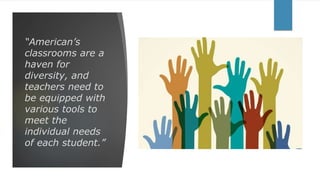
“American’s
classrooms are a
haven for
diversity, and
teachers need to
be equipped with
various tools to
meet the
individual needs
of each student.”
Chapter 6
Customizing Student Learning Activities
Each student is unique and so is their method for learning. This chapter emphasizes methods in
differentiation and stresses the importance of not adhering to a “one size fits all” mentality. Teachers are
challenged each year to find instructional methods that will reach each student and the mediums needed
to achieve the greatest success. Differentiation spans across all levels of capability and includes the special
needs population as well as the gifted population. The chapter discusses making a plan before instruction
begins. Set goals and begin to build individualized learning strategies that will be used, and develop a plan
for assessment. In addition, assistive technologies that may be needed in the individualization process are
discussed. Assisitive technologies are often part of a student’s IEP plan and are a required component of
their learning environment.
What is Differentiation?
 Differentiation is defined as providing flexibility during teaching in terms of content ,
process and product, based on the needs of your students.
 Two ideas about differentiation in the classroom:
 Differentiated Instruction – Purposefully designing instruction to accommodate the
known needs of one’s students and providing them with different content,
strategies and means of demonstrating the desired learning goal.
 Universal Design for Learning – An approach to instruction in which teachers
remove barriers to learning by providing flexibility in materials, methods and
assessments.
Using Technology to Differentiate
Instructional Content, Processes and
Products
Differentiated instruction is personalized and customized learning.
 Reactions to student questions and clarification of confusions by rewording statements or
providing alternate examples
 Provided for accommodation of student’s known needs
 Purposeful
 Flexible grouping
 Determining a student’s learning profile (a description of student’s abilities, interests, learning
preferences, and other relevant information that can impact leaning)
Universal Design for Learning
The principles of universal design for learning suggest that teachers can remove barriers to learning by
providing flexibility in materials, methods and assessments.
 Originally conceived for students with special needs
 Technology integration with universal design
 Recognition, Strategic and Affective Networks
 Recognition networks help you identify sensory data, such as objects, facts and patterns. They process
the “what” that should be learned.
 Strategic networks are the neural networks that control processes for planning, executing and
your actions. They operate on “how” things can be learned.
 Affective networks are the neural networks that relate to feelings and emotions, and which influence
motivation for engagement with a particular goal, method, medium or assessment. They process the
“why of learning.
Assistive Technologies
An assistive technology is any piece of equipment, or product system used to increase,
maintain or improve functional capabilities of individuals with disability.
 “95 percent of students between the ages of 6 and 21 with disabilities served under IDEA spent time in
education classrooms, with the majority spending 80 percent or more of the day.”(page 151) This statement is
key reason that general education teachers learn how to use and implement assistive technologies in the
classroom.
 The technologies are mandated for some under their IEP.
 A device may be considered an assistive technology for some students, but not others.
 Examples: calculators, spell-checkers, CD players, talking dictionaries, computers, computerized voice-output
devices, speech synthesizers, large print word processors and many more
Chapter 11
Diversity and Cultural Understanding
This chapter focuses on recognizing the cultural differences
and diverse population groups found within the classroom
setting. It is the teacher’s responsibility to promote cultural
awareness and provide equitable access to needed tools and
technology in order for the student to achieve success.
Learner-Centered Strategies
ISTE standard NETS-T 4b states that the teacher is to “address the diverse needs of all learners by using
learner-centered strategies and by providing equitable access to digital tools and resources.” This is done
through authentic instruction which develops as the teacher gains awareness of learner interests, skills and
needs.
 Cognitive needs of students can be met by creating tasks that require complex thinking and “doing.”
 Observe and Describe
 Build explanations and interpretations
 Reason with evidence and make connections
 Consider other viewpoints
 Form conclusions
 Ask questions
 Uncover complexity
 Metacognitive needs can be met by creating a learning environment where students reflect on their learning.
Equitable Access
Equitable Access
 Up-to-date hardware, software and connectivity
 Access to meaningful, high-quality, and culturally responsive content and the
opportunity to contribute to that content
 Access to educators who know how to use digital tools and resources
 Access to systems sustained by leaders with vision and support for change via
technology.
Promoting Cultural Understanding and
Global Awareness
ISTE NETS-T 4d ~ Teachers must ‘develop and model cultural understanding and global awareness by engaging
with colleagues and students of other cultures using digital-age communication and collaboration tools.”
 Understanding Your Culture and the Culture of Others
 Culture is made up of a variety of beliefs and behaviors
 Can be individualistic or collectivist
 Working with Students to Develop Cultural Understanding
 Get to know your students early in the year
 Teach lessons that address the issue of culture and utilize cooperative learning
 Respecting Cultural Diversity in the Classroom
 Acknowledge differences
 Establish positive relationships with students and families
 Promote equity and mutual respect
References
Johnston, L., Rutledge, V., Doolittle, A. L., Beard, L., & Crider, T. K. (2014). Assistive
technology at the University of Tennessee -Chattanooga: Providing pre-service
educators with the opportunity to utilize assistive technology as an instructional
strategy. Universal Journal of Educational Research, 2(4), 326-329.
doi:10.13189/ujer.2014.020402
Cennamo, K., Ross, J. D., & Ertmer, P. A. (2014). Technology integration for
meaningful classroom use: A standards-based approach (2nd ed.). Belmont,
CA: Wadsworth, Cengage Learning.
Graphic Source: http://www.yurtopic.com/education/teachers/language-
storytelling.html

Chapters 6 and 11

  • 1.
    Using Cultural Diversity andUnderstanding to Customize Learning CHAPTERS 6 AND 11 TECHNOLOGY INTEGRATION FOR MEANINGFUL USE Suzanne Mozley EIM 504
  • 2.
    “American’s classrooms are a havenfor diversity, and teachers need to be equipped with various tools to meet the individual needs of each student.”
  • 3.
    Chapter 6 Customizing StudentLearning Activities Each student is unique and so is their method for learning. This chapter emphasizes methods in differentiation and stresses the importance of not adhering to a “one size fits all” mentality. Teachers are challenged each year to find instructional methods that will reach each student and the mediums needed to achieve the greatest success. Differentiation spans across all levels of capability and includes the special needs population as well as the gifted population. The chapter discusses making a plan before instruction begins. Set goals and begin to build individualized learning strategies that will be used, and develop a plan for assessment. In addition, assistive technologies that may be needed in the individualization process are discussed. Assisitive technologies are often part of a student’s IEP plan and are a required component of their learning environment.
  • 4.
    What is Differentiation? Differentiation is defined as providing flexibility during teaching in terms of content , process and product, based on the needs of your students.  Two ideas about differentiation in the classroom:  Differentiated Instruction – Purposefully designing instruction to accommodate the known needs of one’s students and providing them with different content, strategies and means of demonstrating the desired learning goal.  Universal Design for Learning – An approach to instruction in which teachers remove barriers to learning by providing flexibility in materials, methods and assessments.
  • 5.
    Using Technology toDifferentiate Instructional Content, Processes and Products Differentiated instruction is personalized and customized learning.  Reactions to student questions and clarification of confusions by rewording statements or providing alternate examples  Provided for accommodation of student’s known needs  Purposeful  Flexible grouping  Determining a student’s learning profile (a description of student’s abilities, interests, learning preferences, and other relevant information that can impact leaning)
  • 6.
    Universal Design forLearning The principles of universal design for learning suggest that teachers can remove barriers to learning by providing flexibility in materials, methods and assessments.  Originally conceived for students with special needs  Technology integration with universal design  Recognition, Strategic and Affective Networks  Recognition networks help you identify sensory data, such as objects, facts and patterns. They process the “what” that should be learned.  Strategic networks are the neural networks that control processes for planning, executing and your actions. They operate on “how” things can be learned.  Affective networks are the neural networks that relate to feelings and emotions, and which influence motivation for engagement with a particular goal, method, medium or assessment. They process the “why of learning.
  • 7.
    Assistive Technologies An assistivetechnology is any piece of equipment, or product system used to increase, maintain or improve functional capabilities of individuals with disability.  “95 percent of students between the ages of 6 and 21 with disabilities served under IDEA spent time in education classrooms, with the majority spending 80 percent or more of the day.”(page 151) This statement is key reason that general education teachers learn how to use and implement assistive technologies in the classroom.  The technologies are mandated for some under their IEP.  A device may be considered an assistive technology for some students, but not others.  Examples: calculators, spell-checkers, CD players, talking dictionaries, computers, computerized voice-output devices, speech synthesizers, large print word processors and many more
  • 8.
    Chapter 11 Diversity andCultural Understanding This chapter focuses on recognizing the cultural differences and diverse population groups found within the classroom setting. It is the teacher’s responsibility to promote cultural awareness and provide equitable access to needed tools and technology in order for the student to achieve success.
  • 9.
    Learner-Centered Strategies ISTE standardNETS-T 4b states that the teacher is to “address the diverse needs of all learners by using learner-centered strategies and by providing equitable access to digital tools and resources.” This is done through authentic instruction which develops as the teacher gains awareness of learner interests, skills and needs.  Cognitive needs of students can be met by creating tasks that require complex thinking and “doing.”  Observe and Describe  Build explanations and interpretations  Reason with evidence and make connections  Consider other viewpoints  Form conclusions  Ask questions  Uncover complexity  Metacognitive needs can be met by creating a learning environment where students reflect on their learning.
  • 10.
    Equitable Access Equitable Access Up-to-date hardware, software and connectivity  Access to meaningful, high-quality, and culturally responsive content and the opportunity to contribute to that content  Access to educators who know how to use digital tools and resources  Access to systems sustained by leaders with vision and support for change via technology.
  • 11.
    Promoting Cultural Understandingand Global Awareness ISTE NETS-T 4d ~ Teachers must ‘develop and model cultural understanding and global awareness by engaging with colleagues and students of other cultures using digital-age communication and collaboration tools.”  Understanding Your Culture and the Culture of Others  Culture is made up of a variety of beliefs and behaviors  Can be individualistic or collectivist  Working with Students to Develop Cultural Understanding  Get to know your students early in the year  Teach lessons that address the issue of culture and utilize cooperative learning  Respecting Cultural Diversity in the Classroom  Acknowledge differences  Establish positive relationships with students and families  Promote equity and mutual respect
  • 12.
    References Johnston, L., Rutledge,V., Doolittle, A. L., Beard, L., & Crider, T. K. (2014). Assistive technology at the University of Tennessee -Chattanooga: Providing pre-service educators with the opportunity to utilize assistive technology as an instructional strategy. Universal Journal of Educational Research, 2(4), 326-329. doi:10.13189/ujer.2014.020402 Cennamo, K., Ross, J. D., & Ertmer, P. A. (2014). Technology integration for meaningful classroom use: A standards-based approach (2nd ed.). Belmont, CA: Wadsworth, Cengage Learning. Graphic Source: http://www.yurtopic.com/education/teachers/language- storytelling.html