David F. Larcker and Brian Tayan
Corporate Governance Research Initiative
Stanford Graduate School of Business
BOARD COMPOSITION,
QUALITY, & TURNOVER
RESEARCH SPOTLIGHT
KEY CONCEPTS
• Companies recruit directors to bring a broad array of skills needed to
advise and oversee the organization.
• Attributes of leadership, industry experience, accounting, and financial are
highly valued. Many additional, diverse skills are also looked for.
• The labor market for directors is constrained by the available supply and
demand of qualified individuals.
• Research suggests the director labor market is moderately efficient.
• Many sought-after skills are only modestly associated with performance
and governance quality.
CEO DIRECTORS
• Fich (2005) studies the stock price reaction to the appointment of an
outside CEO to the board.
• Sample: 1,493 appointments, Fortune 1000 companies, 1997-99.
• Finds a positive abnormal stock market reaction to appointment of active
CEO (0.72%, 3-day period), compared to no significant reaction for outside
directors who are not a CEO.
• Conclusion: CEOs are perceived to be better directors.
These results are “consistent with the idea that outside CEO-directors are sources
of unique expertise, industry contacts, and business acumen, and therefore are of
greater value than outside directors of other occupations.”
CEO DIRECTORS
• Fahlenbrach, Low, and Stulz (2010) also examine whether CEOs are better
directors.
• Sample: 26,231 appointments, 5,400 companies, 1989-2002.
• Find no improvement in future performance (ROA, over 1-3 years).
• Also, no impact (positive or negative) on monitoring, measured as: deal
performance, sensitivity of CEO turnover to performance, or CEO pay.
• Conclusion: CEOs are not better directors.
“We do not detect a discernable impact of CEO outside directors on high-
level corporate decisions. … [It might be that] CEO directors are simply too
busy with their day job to use their prestige, authority, and experience to
have a substantial impact on the boards they sit on.”
CEO DIRECTORS
• O’Reilly, Main, and Crystal (1988) study the relation between director
outside salaries and CEO pay.
• Sample: 104 large companies, 1984.
• Find a strong association between CEO pay levels and the outside pay level
of directors, particularly members of the compensation committee.
• Argue that, consistent with social comparison theory, committee members
refer in part to their own pay as a benchmark for reasonable pay
• Conclusion: CEO directors are associated with higher CEO pay.
CEO DIRECTORS
• Faleye (2011) also studies whether CEO directors lead to higher CEO pay.
• Sample: 3,217 CEOs, 2,105 firms, 1998-2005.
• Finds CEO pay increases with the portion of outside directors who are
CEOs.
• CEO pay at these companies is also less sensitive to performance.
• Conclusion: CEO directors are associated with higher CEO pay.
“CEO directors can distort executive incentives when they view themselves as
members of the same group, overestimating the effort and skill requirements of
their job and rationalizing higher compensation packages.”
INTERNATIONAL DIRECTORS
• Masulis, Wang, and Xie (2012) study the contribution of international
directors to a board.
• Sample: S&P 1500 companies, 1998-2006.
• Find positive share price reaction to deal announcements when the target
company is from the director’s home country.
• Also find international directors have worse attendance records and
provide worse monitoring.
• Conclusion: International directors have mixed impact on board quality.
Foreign international directors [FIDs] “can utilize their international background … [to]
benefit firms with substantial foreign operations or plans for overseas expansion. … On the
negative side, the geographic distance between FIDs and corporate headquarters … [might]
create obstacles for FIDs to effectively participate in the governance of U.S. firms.”
DIRECTORS WITH INDUSTRY EXPERTISE
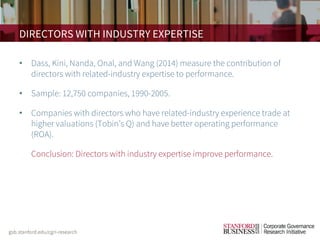
• Dass, Kini, Nanda, Onal, and Wang (2014) measure the contribution of
directors with related-industry expertise to performance.
• Sample: 12,750 companies, 1990-2005.
• Companies with directors who have related-industry experience trade at
higher valuations (Tobin’s Q) and have better operating performance
(ROA).
• Conclusion: Directors with industry expertise improve performance.
DIRECTORS WITH INDUSTRY EXPERTISE
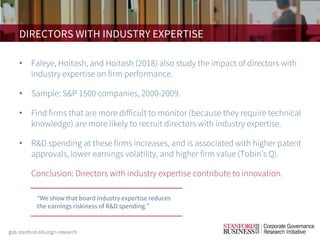
• Faleye, Hoitash, and Hoitash (2018) also study the impact of directors with
industry expertise on firm performance.
• Sample: S&P 1500 companies, 2000-2009.
• Find firms that are more difficult to monitor (because they require technical
knowledge) are more likely to recruit directors with industry expertise.
• R&D spending at these firms increases, and is associated with higher patent
approvals, lower earnings volatility, and higher firm value (Tobin’s Q).
• Conclusion: Directors with industry expertise contribute to innovation.
“We show that board industry expertise reduces
the earnings riskiness of R&D spending.”
DIRECTORS WITH INDUSTRY EXPERTISE
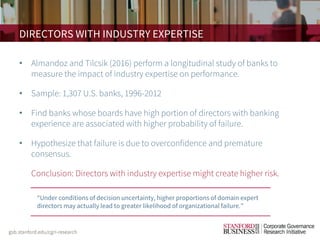
• Almandoz and Tilcsik (2016) perform a longitudinal study of banks to
measure the impact of industry expertise on performance.
• Sample: 1,307 U.S. banks, 1996-2012
• Find banks whose boards have high portion of directors with banking
experience are associated with higher probability of failure.
• Hypothesize that failure is due to overconfidence and premature
consensus.
• Conclusion: Directors with industry expertise might create higher risk.
“Under conditions of decision uncertainty, higher proportions of domain expert
directors may actually lead to greater likelihood of organizational failure.”
DIRECTOR SKILL SETS
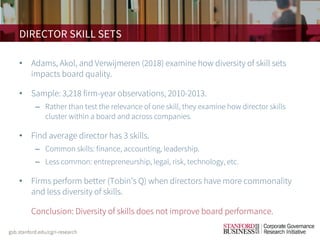
• Adams, Akol, and Verwijmeren (2018) examine how diversity of skill sets
impacts board quality.
• Sample: 3,218 firm-year observations, 2010-2013.
– Rather than test the relevance of one skill, they examine how director skills
cluster within a board and across companies.
• Find average director has 3 skills.
– Common skills: finance, accounting, leadership.
– Less common: entrepreneurship, legal, risk, technology, etc.
• Firms perform better (Tobin’s Q) when directors have more commonality
and less diversity of skills.
• Conclusion: Diversity of skills does not improve board performance.
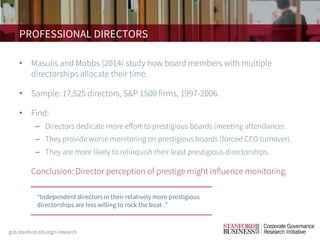
PROFESSIONAL DIRECTORS
• Masulis and Mobbs (2014) study how board members with multiple
directorships allocate their time.
• Sample: 17,525 directors, S&P 1500 firms, 1997-2006.
• Find:
– Directors dedicate more effort to prestigious boards (meeting attendance).
– They provide worse monitoring on prestigious boards (forced CEO turnover).
– They are more likely to relinquish their least prestigious directorships.
• Conclusion: Director perception of prestige might influence monitoring.
“Independent directors in their relatively more prestigious
directorships are less willing to rock the boat .”
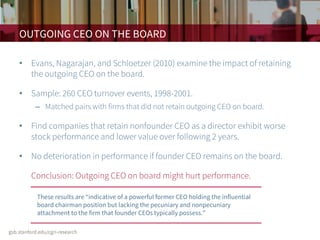
OUTGOING CEO ON THE BOARD
• Evans, Nagarajan, and Schloetzer (2010) examine the impact of retaining
the outgoing CEO on the board.
• Sample: 260 CEO turnover events, 1998-2001.
– Matched pairs with firms that did not retain outgoing CEO on board.
• Find companies that retain nonfounder CEO as a director exhibit worse
stock performance and lower value over following 2 years.
• No deterioration in performance if founder CEO remains on the board.
• Conclusion: Outgoing CEO on board might hurt performance.
These results are “indicative of a powerful former CEO holding the influential
board chairman position but lacking the pecuniary and nonpecuniary
attachment to the firm that founder CEOs typically possess.”
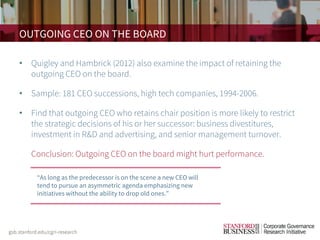
OUTGOING CEO ON THE BOARD
• Quigley and Hambrick (2012) also examine the impact of retaining the
outgoing CEO on the board.
• Sample: 181 CEO successions, high tech companies, 1994-2006.
• Find that outgoing CEO who retains chair position is more likely to restrict
the strategic decisions of his or her successor: business divestitures,
investment in R&D and advertising, and senior management turnover.
• Conclusion: Outgoing CEO on the board might hurt performance.
“As long as the predecessor is on the scene a new CEO will
tend to pursue an asymmetric agenda emphasizing new
initiatives without the ability to drop old ones.”
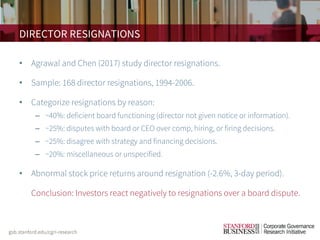
DIRECTOR RESIGNATIONS
• Agrawal and Chen (2017) study director resignations.
• Sample: 168 director resignations, 1994-2006.
• Categorize resignations by reason:
– ~40%: deficient board functioning (director not given notice or information).
– ~25%: disputes with board or CEO over comp, hiring, or firing decisions.
– ~25%: disagree with strategy and financing decisions.
– ~20%: miscellaneous or unspecified.
• Abnormal stock price returns around resignation (-2.6%, 3-day period).
• Conclusion: Investors react negatively to resignations over a board dispute.
DIRECTOR RESIGNATIONS
• Fahlenbrach, Low, and Stulz (2017) also study director resignations.
• Sample: 16,497 directors, 2,282 companies, 1999-2010.
• Find that unexpected departures are associated with:
– Lower stock price performance
– Decreased operating performance (ROA)
– Greater likelihood of future financial restatement or lawsuit
• Conclusion: Unexpected resignations might signal governance problems.
“Directors have incentives to quit to protect their reputation or to
avoid increases in their workload when the firm on whose board
they sit is likely to experience a tough time either because of poor
performance or because of disclosure of adverse actions.”
DIRECTOR RESIGNATIONS
• Harrison, Boivie, Sharp, and Gentry (2018) study the resignation of
prominent directors.
• Sample: 10,118 directors, S&P 1500 companies, 2003-2014.
• Negative press coverage and downgrades from equity analysts are
associated with higher director turnover, even in absence of future
governance problems.
• Conclusion: Directors resign to protect their reputations.
DIRECTOR TURNOVER AND LABOR MARKET
• Srinivasan (2005) study director turnover and the impact of job loss on
future directorships.
• Sample: 409 companies, 1997-2001.
• Find:
– Director turnover is higher when firms have a major financial restatement (48%
over 3-year period) compared to firms that have technical restatement (18%).
– Directors more likely to lose other directorships.
– Results are more pronounced for audit committee members.
• Conclusion: Directors are penalized for poor oversight.
“Restatements are associated with labor market penalties for
outside directors, particularly audit committee members.”
DIRECTOR TURNOVER AND LABOR MARKET
• Arthaud-Day, Certo, Dalton, and Dalton (2006) also study turnover
following adverse governance events.
• Sample: 116 firms and matched pairs, 1998-1999.
• Find:
– Executive turnover is twice as high following material restatement: CEO
turnover (43% v. 23%); CFO turnover (55% v 31%).
– Directors and audit committee members are 70% more likely to turnover.
• Conclusion: Directors and executives are penalized for poor oversight.
“Board member replacement may further help a firm restore
legitimacy following a restatement. … Director turnover signals the
firm’s commitment to preventing recurrences of similar problems.”
DIRECTOR TURNOVER AND LABOR MARKET
• Armstrong, Kepler, and Tsui (2017) study whether directors are held
accountable for individual poor performance.
• Sample: 138,970 director elections, 2000-2012.
• Poor performance determined by: negative abnormal returns over their
tenure, excess CEO compensation (for directors on comp committee), or
weak internal controls (for directors on audit committee).
• Find these directors are more likely to gain than lose board seats.
• Conclusion: Directors are not punished for individual poor performance.
DIRECTOR LABOR MARKET
• Baer, Ertimur, and Zhang (2017) study whether executives of firms with
governance failures are punished in the labor market for directors.
• Sample: 1,864 executives, 1,035 companies, 2002-2014.
– Executives named as defendants in class action lawsuits: covers a broad range
of governance failures (insider trading, GAAP violations, breach of duty, etc.).
• Find these executives are more likely to gain outside board seats.
• Shareholders react negatively to their appointment.
• Conclusion: Executives are not punished for poor oversight.
“Firms may value directors who can bring valuable advisory skills to the board,
even when there are concerns about their monitoring ability or integrity.”
CONCLUSION
• Many of the most sought-after criteria for directors—CEO experience,
industry expertise, and board experience—are only modestly associated
with director performance.
• Directors can be constrained in their monitoring if they do not have the
time and willingness to engage with the company, or if interpersonal
dynamics distract from their ability to function effectively.
• While we would expect directors to be penalized in the labor market for
governance failures, this does not appear to be the case. A sitting director
can gain more board seats without regard to performance on other boards.
• It is striking that there are few strong empirical that demonstrate an
“effective” board. Why is this?
BIBLIOGRAPHY
Eliezer M. Fich. Are Some Outside Directors Better than Others? Evidence from Director Appointments by Fortune 1000 Firms. Journal of
Business. 2005.
Rüdiger Fahlenbrach, Angie Low, and René M. Stulz. Why Do Firms Appoint CEOs as Outside Directors? Journal of Financial Economics. 2010.
Charles A. O’Reilly III, Brian G. Main, and Graef S. Crystal. CEO Compensation as Tournament and Social Comparison: A Tale of Two Theories,”
Administrative Science Quarterly 33 (1988): 257–274.
Olubunmi Faleye. CEO Directors, Executive Incentives, and Corporate Strategic Initiatives. Journal of Financial Research. 2011.
Ronald W. Masulis, Cong Wang, and Fei Xie. Globalizing the Boardroom—The Effects of Foreign Directors on Corporate Governance and Firm
Performance. Journal of Accounting and Economics. 2012.
Nishant Dass, Omesh Kini, Vikram Nanda, Bunyamin Omal, and Jun Wang. Board Expertise: Do Directors from Related Industries Help Bridge
the Information Gap? The Review of Financial Studies. 2014.
Olubunmi Faleye, Rani Hoitash, and Udi Hoitash. Industry Expertise on Corporate Boards. Review of Quantitative Finance and Accounting.
2018.
Renée B. Adams, Ali C. Akyol, and Patrick Verwijmeren. Director Skill Sets. Journal of Financial Economics. 2018.
Juan Almandoz and András Tilcsik. When Experts Become Liabilities: Domain Experts on Boards and Organizational Failure. Academy of
Management Journal. 2016.
BIBLIOGRAPHY
Ronald W. Masulis and Shawn Mobbs. Independent Director Incentives: Where Do Talented Directors Spend Their Limited Time and Energy?
Journal of Financial Economics. 2014.
John Harry Evans, Nandu J. Nagarajan, and Jason D. Schloetzer. CEO Turnover and Retention Light: Retaining Former CEOs on the Board.
Journal of Accounting Research. 2010.
Timothy J. Quigley and Donald C. Hambrick. When the Former CEO Stays on as Board Chair: Effects on Successor Discretion, Strategic Change,
and Performance. Strategic Management Journal. 2012.
Anup Agrawal and Mark A. Chen. Boardroom Brawls: An Empirical Analysis of Disputes Involving Directors. Quarterly Journal of Finance. 2017.
Rüdiger Fahlenbrach, Angie Low, and René M. Stulz. Do Independent Director Departures Predict Future Bad Events? The Review of Financial
Studies 2017.
Joseph S. Harrison, Steven Boivie, Nathan Y. Sharp, and Richard J. Gentry. Saving Face: How Exit in Response to Negative Press and Star
Analyst Downgrades Reflects Reputation Maintenance by Directors. Academy of Management Journal. 2018.
Suraj Srinivasan. Consequences of Financial Reporting Failure for Outside Directors: Evidence from Accounting Restatements and Audit
Committee Members. Journal of Accounting Research. 2005.
Marne L. Arthaud-Day, S. Trevis Certo, Catherine M. Dalton, and Dan R. Dalton. A Changing of the Guard: Executive and Director Turnover
Following Corporate Financial Restatements. Academy of Management Journal. 2006.
Chris Armstrong, John D. Kepler, and David Tsui. Inelastic Labor Markets and Directors’ Reputational Incentives. 2017.
Leah Baer, Yonca Ertimur, and Jingjing Zhang. Tainted Executives as Outside Directors. 2017.

Board Composition, Quality, & Turnover: Research Spotlight

  • 1.
    David F. Larckerand Brian Tayan Corporate Governance Research Initiative Stanford Graduate School of Business BOARD COMPOSITION, QUALITY, & TURNOVER RESEARCH SPOTLIGHT
  • 2.
    KEY CONCEPTS • Companiesrecruit directors to bring a broad array of skills needed to advise and oversee the organization. • Attributes of leadership, industry experience, accounting, and financial are highly valued. Many additional, diverse skills are also looked for. • The labor market for directors is constrained by the available supply and demand of qualified individuals. • Research suggests the director labor market is moderately efficient. • Many sought-after skills are only modestly associated with performance and governance quality.
  • 3.
    CEO DIRECTORS • Fich(2005) studies the stock price reaction to the appointment of an outside CEO to the board. • Sample: 1,493 appointments, Fortune 1000 companies, 1997-99. • Finds a positive abnormal stock market reaction to appointment of active CEO (0.72%, 3-day period), compared to no significant reaction for outside directors who are not a CEO. • Conclusion: CEOs are perceived to be better directors. These results are “consistent with the idea that outside CEO-directors are sources of unique expertise, industry contacts, and business acumen, and therefore are of greater value than outside directors of other occupations.”
  • 4.
    CEO DIRECTORS • Fahlenbrach,Low, and Stulz (2010) also examine whether CEOs are better directors. • Sample: 26,231 appointments, 5,400 companies, 1989-2002. • Find no improvement in future performance (ROA, over 1-3 years). • Also, no impact (positive or negative) on monitoring, measured as: deal performance, sensitivity of CEO turnover to performance, or CEO pay. • Conclusion: CEOs are not better directors. “We do not detect a discernable impact of CEO outside directors on high- level corporate decisions. … [It might be that] CEO directors are simply too busy with their day job to use their prestige, authority, and experience to have a substantial impact on the boards they sit on.”
  • 5.
    CEO DIRECTORS • O’Reilly,Main, and Crystal (1988) study the relation between director outside salaries and CEO pay. • Sample: 104 large companies, 1984. • Find a strong association between CEO pay levels and the outside pay level of directors, particularly members of the compensation committee. • Argue that, consistent with social comparison theory, committee members refer in part to their own pay as a benchmark for reasonable pay • Conclusion: CEO directors are associated with higher CEO pay.
  • 6.
    CEO DIRECTORS • Faleye(2011) also studies whether CEO directors lead to higher CEO pay. • Sample: 3,217 CEOs, 2,105 firms, 1998-2005. • Finds CEO pay increases with the portion of outside directors who are CEOs. • CEO pay at these companies is also less sensitive to performance. • Conclusion: CEO directors are associated with higher CEO pay. “CEO directors can distort executive incentives when they view themselves as members of the same group, overestimating the effort and skill requirements of their job and rationalizing higher compensation packages.”
  • 7.
    INTERNATIONAL DIRECTORS • Masulis,Wang, and Xie (2012) study the contribution of international directors to a board. • Sample: S&P 1500 companies, 1998-2006. • Find positive share price reaction to deal announcements when the target company is from the director’s home country. • Also find international directors have worse attendance records and provide worse monitoring. • Conclusion: International directors have mixed impact on board quality. Foreign international directors [FIDs] “can utilize their international background … [to] benefit firms with substantial foreign operations or plans for overseas expansion. … On the negative side, the geographic distance between FIDs and corporate headquarters … [might] create obstacles for FIDs to effectively participate in the governance of U.S. firms.”
  • 8.
    DIRECTORS WITH INDUSTRYEXPERTISE • Dass, Kini, Nanda, Onal, and Wang (2014) measure the contribution of directors with related-industry expertise to performance. • Sample: 12,750 companies, 1990-2005. • Companies with directors who have related-industry experience trade at higher valuations (Tobin’s Q) and have better operating performance (ROA). • Conclusion: Directors with industry expertise improve performance.
  • 9.
    DIRECTORS WITH INDUSTRYEXPERTISE • Faleye, Hoitash, and Hoitash (2018) also study the impact of directors with industry expertise on firm performance. • Sample: S&P 1500 companies, 2000-2009. • Find firms that are more difficult to monitor (because they require technical knowledge) are more likely to recruit directors with industry expertise. • R&D spending at these firms increases, and is associated with higher patent approvals, lower earnings volatility, and higher firm value (Tobin’s Q). • Conclusion: Directors with industry expertise contribute to innovation. “We show that board industry expertise reduces the earnings riskiness of R&D spending.”
  • 10.
    DIRECTORS WITH INDUSTRYEXPERTISE • Almandoz and Tilcsik (2016) perform a longitudinal study of banks to measure the impact of industry expertise on performance. • Sample: 1,307 U.S. banks, 1996-2012 • Find banks whose boards have high portion of directors with banking experience are associated with higher probability of failure. • Hypothesize that failure is due to overconfidence and premature consensus. • Conclusion: Directors with industry expertise might create higher risk. “Under conditions of decision uncertainty, higher proportions of domain expert directors may actually lead to greater likelihood of organizational failure.”
  • 11.
    DIRECTOR SKILL SETS •Adams, Akol, and Verwijmeren (2018) examine how diversity of skill sets impacts board quality. • Sample: 3,218 firm-year observations, 2010-2013. – Rather than test the relevance of one skill, they examine how director skills cluster within a board and across companies. • Find average director has 3 skills. – Common skills: finance, accounting, leadership. – Less common: entrepreneurship, legal, risk, technology, etc. • Firms perform better (Tobin’s Q) when directors have more commonality and less diversity of skills. • Conclusion: Diversity of skills does not improve board performance.
  • 12.
    PROFESSIONAL DIRECTORS • Masulisand Mobbs (2014) study how board members with multiple directorships allocate their time. • Sample: 17,525 directors, S&P 1500 firms, 1997-2006. • Find: – Directors dedicate more effort to prestigious boards (meeting attendance). – They provide worse monitoring on prestigious boards (forced CEO turnover). – They are more likely to relinquish their least prestigious directorships. • Conclusion: Director perception of prestige might influence monitoring. “Independent directors in their relatively more prestigious directorships are less willing to rock the boat .”
  • 13.
    OUTGOING CEO ONTHE BOARD • Evans, Nagarajan, and Schloetzer (2010) examine the impact of retaining the outgoing CEO on the board. • Sample: 260 CEO turnover events, 1998-2001. – Matched pairs with firms that did not retain outgoing CEO on board. • Find companies that retain nonfounder CEO as a director exhibit worse stock performance and lower value over following 2 years. • No deterioration in performance if founder CEO remains on the board. • Conclusion: Outgoing CEO on board might hurt performance. These results are “indicative of a powerful former CEO holding the influential board chairman position but lacking the pecuniary and nonpecuniary attachment to the firm that founder CEOs typically possess.”
  • 14.
    OUTGOING CEO ONTHE BOARD • Quigley and Hambrick (2012) also examine the impact of retaining the outgoing CEO on the board. • Sample: 181 CEO successions, high tech companies, 1994-2006. • Find that outgoing CEO who retains chair position is more likely to restrict the strategic decisions of his or her successor: business divestitures, investment in R&D and advertising, and senior management turnover. • Conclusion: Outgoing CEO on the board might hurt performance. “As long as the predecessor is on the scene a new CEO will tend to pursue an asymmetric agenda emphasizing new initiatives without the ability to drop old ones.”
  • 15.
    DIRECTOR RESIGNATIONS • Agrawaland Chen (2017) study director resignations. • Sample: 168 director resignations, 1994-2006. • Categorize resignations by reason: – ~40%: deficient board functioning (director not given notice or information). – ~25%: disputes with board or CEO over comp, hiring, or firing decisions. – ~25%: disagree with strategy and financing decisions. – ~20%: miscellaneous or unspecified. • Abnormal stock price returns around resignation (-2.6%, 3-day period). • Conclusion: Investors react negatively to resignations over a board dispute.
  • 16.
    DIRECTOR RESIGNATIONS • Fahlenbrach,Low, and Stulz (2017) also study director resignations. • Sample: 16,497 directors, 2,282 companies, 1999-2010. • Find that unexpected departures are associated with: – Lower stock price performance – Decreased operating performance (ROA) – Greater likelihood of future financial restatement or lawsuit • Conclusion: Unexpected resignations might signal governance problems. “Directors have incentives to quit to protect their reputation or to avoid increases in their workload when the firm on whose board they sit is likely to experience a tough time either because of poor performance or because of disclosure of adverse actions.”
  • 17.
    DIRECTOR RESIGNATIONS • Harrison,Boivie, Sharp, and Gentry (2018) study the resignation of prominent directors. • Sample: 10,118 directors, S&P 1500 companies, 2003-2014. • Negative press coverage and downgrades from equity analysts are associated with higher director turnover, even in absence of future governance problems. • Conclusion: Directors resign to protect their reputations.
  • 18.
    DIRECTOR TURNOVER ANDLABOR MARKET • Srinivasan (2005) study director turnover and the impact of job loss on future directorships. • Sample: 409 companies, 1997-2001. • Find: – Director turnover is higher when firms have a major financial restatement (48% over 3-year period) compared to firms that have technical restatement (18%). – Directors more likely to lose other directorships. – Results are more pronounced for audit committee members. • Conclusion: Directors are penalized for poor oversight. “Restatements are associated with labor market penalties for outside directors, particularly audit committee members.”
  • 19.
    DIRECTOR TURNOVER ANDLABOR MARKET • Arthaud-Day, Certo, Dalton, and Dalton (2006) also study turnover following adverse governance events. • Sample: 116 firms and matched pairs, 1998-1999. • Find: – Executive turnover is twice as high following material restatement: CEO turnover (43% v. 23%); CFO turnover (55% v 31%). – Directors and audit committee members are 70% more likely to turnover. • Conclusion: Directors and executives are penalized for poor oversight. “Board member replacement may further help a firm restore legitimacy following a restatement. … Director turnover signals the firm’s commitment to preventing recurrences of similar problems.”
  • 20.
    DIRECTOR TURNOVER ANDLABOR MARKET • Armstrong, Kepler, and Tsui (2017) study whether directors are held accountable for individual poor performance. • Sample: 138,970 director elections, 2000-2012. • Poor performance determined by: negative abnormal returns over their tenure, excess CEO compensation (for directors on comp committee), or weak internal controls (for directors on audit committee). • Find these directors are more likely to gain than lose board seats. • Conclusion: Directors are not punished for individual poor performance.
  • 21.
    DIRECTOR LABOR MARKET •Baer, Ertimur, and Zhang (2017) study whether executives of firms with governance failures are punished in the labor market for directors. • Sample: 1,864 executives, 1,035 companies, 2002-2014. – Executives named as defendants in class action lawsuits: covers a broad range of governance failures (insider trading, GAAP violations, breach of duty, etc.). • Find these executives are more likely to gain outside board seats. • Shareholders react negatively to their appointment. • Conclusion: Executives are not punished for poor oversight. “Firms may value directors who can bring valuable advisory skills to the board, even when there are concerns about their monitoring ability or integrity.”
  • 22.
    CONCLUSION • Many ofthe most sought-after criteria for directors—CEO experience, industry expertise, and board experience—are only modestly associated with director performance. • Directors can be constrained in their monitoring if they do not have the time and willingness to engage with the company, or if interpersonal dynamics distract from their ability to function effectively. • While we would expect directors to be penalized in the labor market for governance failures, this does not appear to be the case. A sitting director can gain more board seats without regard to performance on other boards. • It is striking that there are few strong empirical that demonstrate an “effective” board. Why is this?
  • 23.
    BIBLIOGRAPHY Eliezer M. Fich.Are Some Outside Directors Better than Others? Evidence from Director Appointments by Fortune 1000 Firms. Journal of Business. 2005. Rüdiger Fahlenbrach, Angie Low, and René M. Stulz. Why Do Firms Appoint CEOs as Outside Directors? Journal of Financial Economics. 2010. Charles A. O’Reilly III, Brian G. Main, and Graef S. Crystal. CEO Compensation as Tournament and Social Comparison: A Tale of Two Theories,” Administrative Science Quarterly 33 (1988): 257–274. Olubunmi Faleye. CEO Directors, Executive Incentives, and Corporate Strategic Initiatives. Journal of Financial Research. 2011. Ronald W. Masulis, Cong Wang, and Fei Xie. Globalizing the Boardroom—The Effects of Foreign Directors on Corporate Governance and Firm Performance. Journal of Accounting and Economics. 2012. Nishant Dass, Omesh Kini, Vikram Nanda, Bunyamin Omal, and Jun Wang. Board Expertise: Do Directors from Related Industries Help Bridge the Information Gap? The Review of Financial Studies. 2014. Olubunmi Faleye, Rani Hoitash, and Udi Hoitash. Industry Expertise on Corporate Boards. Review of Quantitative Finance and Accounting. 2018. Renée B. Adams, Ali C. Akyol, and Patrick Verwijmeren. Director Skill Sets. Journal of Financial Economics. 2018. Juan Almandoz and András Tilcsik. When Experts Become Liabilities: Domain Experts on Boards and Organizational Failure. Academy of Management Journal. 2016.
  • 24.
    BIBLIOGRAPHY Ronald W. Masulisand Shawn Mobbs. Independent Director Incentives: Where Do Talented Directors Spend Their Limited Time and Energy? Journal of Financial Economics. 2014. John Harry Evans, Nandu J. Nagarajan, and Jason D. Schloetzer. CEO Turnover and Retention Light: Retaining Former CEOs on the Board. Journal of Accounting Research. 2010. Timothy J. Quigley and Donald C. Hambrick. When the Former CEO Stays on as Board Chair: Effects on Successor Discretion, Strategic Change, and Performance. Strategic Management Journal. 2012. Anup Agrawal and Mark A. Chen. Boardroom Brawls: An Empirical Analysis of Disputes Involving Directors. Quarterly Journal of Finance. 2017. Rüdiger Fahlenbrach, Angie Low, and René M. Stulz. Do Independent Director Departures Predict Future Bad Events? The Review of Financial Studies 2017. Joseph S. Harrison, Steven Boivie, Nathan Y. Sharp, and Richard J. Gentry. Saving Face: How Exit in Response to Negative Press and Star Analyst Downgrades Reflects Reputation Maintenance by Directors. Academy of Management Journal. 2018. Suraj Srinivasan. Consequences of Financial Reporting Failure for Outside Directors: Evidence from Accounting Restatements and Audit Committee Members. Journal of Accounting Research. 2005. Marne L. Arthaud-Day, S. Trevis Certo, Catherine M. Dalton, and Dan R. Dalton. A Changing of the Guard: Executive and Director Turnover Following Corporate Financial Restatements. Academy of Management Journal. 2006. Chris Armstrong, John D. Kepler, and David Tsui. Inelastic Labor Markets and Directors’ Reputational Incentives. 2017. Leah Baer, Yonca Ertimur, and Jingjing Zhang. Tainted Executives as Outside Directors. 2017.