The most interesting companies
in the circular economy in Finland
A list of companies to inspire economic change.
The most interesting companies in the circular economy is a list
compiled by Sitra to showcase Finland's most inspiring examples of the
circular economy. During the first phase, the list will present the circular
economy business models of 19 Finnish companies, but will expand to
include as many as one hundred companies by the end of the year 2017.
Indeed, Sitra is using the list as a way to challenge Finnish companies to
meet the changing needs of the world.
01/02/2017
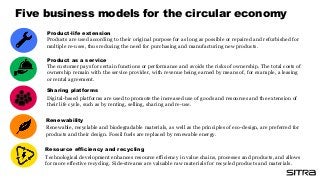
Renewable, recyclable and biodegradable materials, as well as the principles of eco-design, are preferred for
products and their design. Fossil fuels are replaced by renewable energy.
Renewability
Product-life extension
Products are used according to their original purpose for as long as possible or repaired and refurbished for
multiple re-uses, thus reducing the need for purchasing and manufacturing new products.
Sharing platforms
Digital-based platforms are used to promote the increased use of goods and resources and the extension of
their life cycle, such as by renting, selling, sharing and re-use.
The customer pays for certain functions or performance and avoids the risks of ownership. The total costs of
ownership remain with the service provider, with revenue being earned by means of, for example, a leasing
or rental agreement.
Product as a service
Resource efficiency and recycling
Technological development enhances resource efficiency in value chains, processes and products, and allows
for more effective recycling. Side-streams are valuable raw materials for recycled products and materials.
Five business models for the circular economy
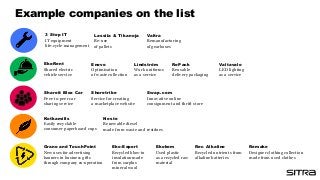
Example companies on the list
3 Step IT
IT equipment
life-cycle management
Lassila & Tikanoja
Re-use
of pallets
Valtra
Remanufacturing
of gearboxes
EkoRent
Shared electric
vehicle service
Enevo
Optimisation
of waste collection
Lindström
Work uniforms
as a service
RePack
Reusable
delivery packaging
Valtavalo
LED lighting
as a service
Shareit Blox Car
Peer-to-peer car
sharing service
Sharetribe
Service for creating
a marketplace website
Swap.com
Innovative online
consignment and thrift store
Kotkamills
Easily recyclable
consumer paperboard cups
Neste
Renewable diesel
made from waste and residues
Grano and TouchPoint
New uses for advertising
banners in business gifts
through company co-operation
Eko-Expert
Recycled blow-in
insulation made
from surplus
mineral wool
Ekokem
Used plastic
as a recycled raw
material
Rec Alkaline
Recycled nutrients from
alkaline batteries
Remake
Designer clothing collection
made from used clothes
Selected
examples from the list
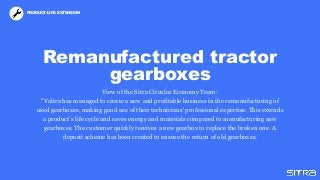
Remanufactured tractor
gearboxes
View of the Sitra Circular Economy Team:
"Valtra has managed to create a new and profitable business in the remanufacturing of
used gearboxes, making good use of their technicians' professional expertise. This extends
a product’s life cycle and saves energy and materials compared to manufacturing new
gearboxes. The customer quickly receives a new gearbox to replace the broken one. A
deposit scheme has been created to ensure the return of old gearboxes.
PRODUCT-LIFE EXTENSION
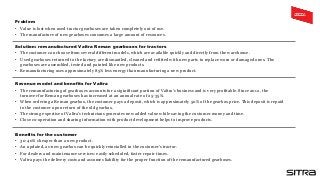
Solution: remanufactured Valtra Reman gearboxes for tractors
• The customer can choose from several different models, which are available quickly and directly from the warehouse.
• Used gearboxes returned to the factory are dismantled, cleaned and refitted with new parts to replace worn or damaged ones. The
gearboxes are assembled, tested and painted like new products.
• Remanufacturing uses approximately 85% less energy than manufacturing a new product.
Benefits for the customer
• 30-40% cheaper than a new product.
• An updated, as-new gearbox can be quickly reinstalled in the customer's tractor.
• For dealers and maintenance services: easily scheduled, faster repair times.
• Valtra pays the delivery costs and assumes liability for the proper function of the remanufactured gearboxes.
Revenue model and benefits for Valtra
• The remanufacturing of gearboxes accounts for a siginificant portion of Valtra's business and is very profitable. Since 2012, the
turnover for Reman gearboxes has increased at an annual rate of 25-35%.
• When ordering a Reman gearbox, the customer pays a deposit, which is approximately 50% of the gearbox price. This deposit is repaid
to the customer upon return of the old gearbox.
• The strong expertise of Valtra's technicians generates new added value while saving the customer money and time.
• Close co-operation and sharing information with product development helps to improve products.
Problem
• Value is lost when used tractor gearboxes are taken completely out of use.
• The manufacture of new gearboxes consumes a large amount of resources.
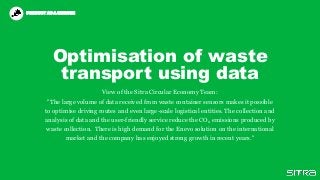
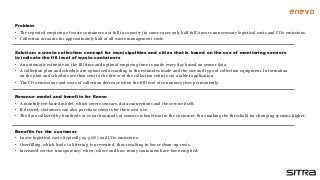
Optimisation of waste
transport using data
View of the Sitra Circular Economy Team:
"The large volume of data received from waste container sensors makes it possible
to optimise driving routes and even large-scale logistical entities. The collection and
analysis of data and the user-friendly service reduce the CO2 emissions produced by
waste collection. There is high demand for the Enevo solution on the international
market and the company has enjoyed strong growth in recent years."
PRODUCT AS A SERVICEPRODUCT AS A SERVICE
Solution: a waste collection concept for municipalities and cities that is based on the use of monitoring sensors
to indicate the fill level of waste containers
• An automatic estimate on the fill time and optimal emptying time is made every day based on sensor data.
• A collection plan and schedule are optimised according to the estimates made and the size and type of collection equipment. Information
on the plan and schedule are then sent to the driver of the collection vehicle via a tablet application.
• The CO2 emissions and costs of collection decrease when the fill level of containers rises permanently.
PRODUCT AS A
SERVICE
Benefits for the customer
• Lower logistical costs (typically 25-50%) and CO2 emissions.
• Overfilling, which leads to littering, is prevented, thus resulting in lower clean-up costs.
• Increased service transparency: when, where and how many containers have been emptied.
Revenue model and benefits for Enevo
• A monthly fee-based model, which covers sensors, data connections and the service itself.
• If desired, customers can also purchase sensors for their own use.
• The data collected by hundreds or even thousands of sensors is beneficial to the customer, thus making the threshold for changing systems higher.
Problem
• The repeated emptying of waste containers not full to capacity (in some cases only half full) incurs unnecessary logistical costs and CO2 emissions.
• Collection accounts for approximately half of all waste management costs.
An easy way to establish a
marketplace for underused goods
View of the Sitra Circular Economy Team:
"Sharetribe can justifiably be called the 'platform of platforms’. The service provided by this fast-
rising start-up allows private individuals or companies to establish a community marketplace
website without needing special IT skills. This promotes the utilisation of resources in the spirit of
the sharing economy."
SHARING PLATFORMS PRODUCT AS A SERVICE
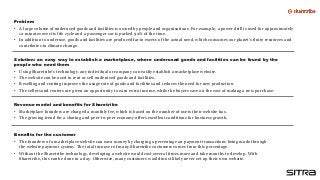
Solution: an easy way to establish a marketplace, where underused goods and facilities can be found by the
people who need them
• Using Sharetribe's technology, any individual or company can easily establish a marketplace website.
• The website can be used to rent or sell underused goods and facilities.
• Reselling and renting improves the usage rate of goods and facilities and reduces the need for new production.
• The sellers and renters are given an opportunity to earn extra income, while the buyers save on the cost of making a new purchase.
Benefits for the customer
• The founders of a marketplace website can earn money by charging a percentage on payment transactions being made through
the website payment system. The total turnover of many Sharetribe customers comes from this percentage.
• Without the Sharetribe technology, developing a website would cost several times more and take months to develop. With
Sharetribe, this can be done in a day. Otherwise, many customers would most likely never set up their own website.
Revenue model and benefits for Sharetribe
• Marketplace founders are charged a monthly fee, which is based on the number of users their website has.
• The growing trend for a sharing and peer-to-peer economy offers excellent conditions for business growth.
Problem
• A large volume of underused goods and facilities is owned by people and organisations. For example, a power drill is used for approximately
12 minutes over its life cycle and a passenger car is parked 92% of the time.
• In addition to underuse, goods and facilities are produced far in excess of the actual need, which consumes our planet's finite resources and
contributes to climate change.
Renewable diesel made from
waste and residues
View of the Sitra Circular Economy Team:
"Nearly 80% of the raw materials used in producing Neste's renewable diesel comes from
waste and residues. The CO2 emissions produced during its life cycle are considerably lower
than those of fossil fuels. Neste has demonstrated that, by innovating, even a large
corporation can create an impressive new business in a traditional industry."
RENEWABILITY RECOVERY AND RECYCLING
Solution: Neste's renewable diesel, which is made from renewable raw materials
• The raw materials used in the product are waste and residue fats from the food industry as well as vegetable oils. Nearly 80% of the raw
materials are waste and residues (2016).
• The life cycle CO2 emissions of the product are 40-90% lower than those of fossil diesel.
• This has been made possible by more than tripling the R&D investments in, for example, renewable raw material research and the NEXBTL
technology, over an approximate ten-year period.
Benefits for the customer (consumers, transport entrepreneurs, cities, distributors)
• A cost-effective alternative for increasing the use of renewable energy and reducing CO2 emissions without requiring an investment in new
vehicles.
• Less air pollution (particulate, NOx, HC and CO emissions).
• A high-quality, odourless and high-performance fuel that is suitable for use in cold temperatures and does not require any vehicle
maintenance.
• It can be used, distributed and stored like conventional diesel.
Revenue model and benefits for Neste
• The sale of renewable products: 21% of the turnover and over 40% of the comparable turnover (402 million euros) comes from
renewable products (2015; cf. ~0% in 2007).
• Neste is the world's largest producer of renewable fuels made from waste and residues.
Problem
• Fossil fuels produce a large volume of CO2 emissions.
• The planet's resources are finite, which is why the competition for raw materials is getting tougher. Many waste and residue flows are
not being utilised.
Used plastics as a recycled raw
material
View of the Sitra Circular Economy Team:
"A majority of plastics usually ends up in landfills, incinerators or nature. Ekokem is
changing that in the Riihimäki Circular Economy Village, where plastic waste
collected throughout Finland is processed into recycled plastics. The company's
business has also diversified from waste processing to the supply of raw materials."
RECOVERY AND RECYCLING
Solution: recycling, sorting and processing used plastic into a recycled raw material
• Plastic consumer packaging is collected throughout Finland and brought to Ekokem's Riihimäki Circular Economy Village (The Finnish Plastics
Recycling Ltd and Finnish Packaging Recycling RINKI Ltd).
• Different types of plastics are sorted, washed, dried and granulated in the process, which combines new technologies.
• The end product is a recycled plastic, whose properties are nearly identical to those of virgin plastic and contains impurities of only a few per cent.
• The annual plant capacity is 20,000 tonnes. Approximately one third of the plastics come from recycling collection, one third from mixed waste
and one third from commerce and industry.
• The carbon footprint of recycled plastic is 85% smaller than that of virgin plastic.
PRODUCT AS A SERICE
Benefits for the customer
• The price of recycled plastic is 20-25% lower than that of virgin raw materials.
• The smaller carbon footprint provides brand and image benefits.
• Greater security of supply with a raw material that is not so closely bound to oil price fluctuations.
• Makes it possible to increase the recycling rate and meet legal obligations.
Revenue model and benefits for Ekokem
• The company's service model has diversified along with the expansion of its operations from waste processing to raw material supply.
• This creates a new, profitable business with an industrial production revenue model.
• Company partnerships and networking are enhanced.
Problem
• Previously, the highest added value of waste plastics had not been utilised, instead ending up in incinerators or landfills.
• Plastics have an image of being unsustainable, even though they are a versatile raw material for many applications.
• Producing new plastic consumes oil, which contributes to climate change.
Finland's transition to a circular economy has begun. The goal: to become a global
leader in the circular economy by 2025. This transition is outlined in the Finnish
road map to a circular economy 2016–2025.
The world's first national road map was drafted by Finns under the direction of
Sitra. The road map consolidates individual actions, thus forming a larger entity.
The circular economy will initially be promoted through five focus areas, where
Finland already has many strengths.
The most interesting companies in the circular economy list is an example of how
companies are promoting the circular economy in the road map focus areas based
on five business models. The first version of the list is published on Slideshare (in
finnish).
Turning Finland into a circular economy pioneer!
The most interesting companies in the circular economy in Finland (Feb 2017)

The most interesting companies in the circular economy in Finland (Feb 2017)

  • 1.
    The most interestingcompanies in the circular economy in Finland A list of companies to inspire economic change.
  • 2.
    The most interestingcompanies in the circular economy is a list compiled by Sitra to showcase Finland's most inspiring examples of the circular economy. During the first phase, the list will present the circular economy business models of 19 Finnish companies, but will expand to include as many as one hundred companies by the end of the year 2017. Indeed, Sitra is using the list as a way to challenge Finnish companies to meet the changing needs of the world. 01/02/2017
  • 3.
    Renewable, recyclable andbiodegradable materials, as well as the principles of eco-design, are preferred for products and their design. Fossil fuels are replaced by renewable energy. Renewability Product-life extension Products are used according to their original purpose for as long as possible or repaired and refurbished for multiple re-uses, thus reducing the need for purchasing and manufacturing new products. Sharing platforms Digital-based platforms are used to promote the increased use of goods and resources and the extension of their life cycle, such as by renting, selling, sharing and re-use. The customer pays for certain functions or performance and avoids the risks of ownership. The total costs of ownership remain with the service provider, with revenue being earned by means of, for example, a leasing or rental agreement. Product as a service Resource efficiency and recycling Technological development enhances resource efficiency in value chains, processes and products, and allows for more effective recycling. Side-streams are valuable raw materials for recycled products and materials. Five business models for the circular economy
  • 4.
    Example companies onthe list 3 Step IT IT equipment life-cycle management Lassila & Tikanoja Re-use of pallets Valtra Remanufacturing of gearboxes EkoRent Shared electric vehicle service Enevo Optimisation of waste collection Lindström Work uniforms as a service RePack Reusable delivery packaging Valtavalo LED lighting as a service Shareit Blox Car Peer-to-peer car sharing service Sharetribe Service for creating a marketplace website Swap.com Innovative online consignment and thrift store Kotkamills Easily recyclable consumer paperboard cups Neste Renewable diesel made from waste and residues Grano and TouchPoint New uses for advertising banners in business gifts through company co-operation Eko-Expert Recycled blow-in insulation made from surplus mineral wool Ekokem Used plastic as a recycled raw material Rec Alkaline Recycled nutrients from alkaline batteries Remake Designer clothing collection made from used clothes
  • 5.
  • 6.
    Remanufactured tractor gearboxes View ofthe Sitra Circular Economy Team: "Valtra has managed to create a new and profitable business in the remanufacturing of used gearboxes, making good use of their technicians' professional expertise. This extends a product’s life cycle and saves energy and materials compared to manufacturing new gearboxes. The customer quickly receives a new gearbox to replace the broken one. A deposit scheme has been created to ensure the return of old gearboxes. PRODUCT-LIFE EXTENSION
  • 7.
    Solution: remanufactured ValtraReman gearboxes for tractors • The customer can choose from several different models, which are available quickly and directly from the warehouse. • Used gearboxes returned to the factory are dismantled, cleaned and refitted with new parts to replace worn or damaged ones. The gearboxes are assembled, tested and painted like new products. • Remanufacturing uses approximately 85% less energy than manufacturing a new product. Benefits for the customer • 30-40% cheaper than a new product. • An updated, as-new gearbox can be quickly reinstalled in the customer's tractor. • For dealers and maintenance services: easily scheduled, faster repair times. • Valtra pays the delivery costs and assumes liability for the proper function of the remanufactured gearboxes. Revenue model and benefits for Valtra • The remanufacturing of gearboxes accounts for a siginificant portion of Valtra's business and is very profitable. Since 2012, the turnover for Reman gearboxes has increased at an annual rate of 25-35%. • When ordering a Reman gearbox, the customer pays a deposit, which is approximately 50% of the gearbox price. This deposit is repaid to the customer upon return of the old gearbox. • The strong expertise of Valtra's technicians generates new added value while saving the customer money and time. • Close co-operation and sharing information with product development helps to improve products. Problem • Value is lost when used tractor gearboxes are taken completely out of use. • The manufacture of new gearboxes consumes a large amount of resources.
  • 8.
    Optimisation of waste transportusing data View of the Sitra Circular Economy Team: "The large volume of data received from waste container sensors makes it possible to optimise driving routes and even large-scale logistical entities. The collection and analysis of data and the user-friendly service reduce the CO2 emissions produced by waste collection. There is high demand for the Enevo solution on the international market and the company has enjoyed strong growth in recent years." PRODUCT AS A SERVICEPRODUCT AS A SERVICE
  • 9.
    Solution: a wastecollection concept for municipalities and cities that is based on the use of monitoring sensors to indicate the fill level of waste containers • An automatic estimate on the fill time and optimal emptying time is made every day based on sensor data. • A collection plan and schedule are optimised according to the estimates made and the size and type of collection equipment. Information on the plan and schedule are then sent to the driver of the collection vehicle via a tablet application. • The CO2 emissions and costs of collection decrease when the fill level of containers rises permanently. PRODUCT AS A SERVICE Benefits for the customer • Lower logistical costs (typically 25-50%) and CO2 emissions. • Overfilling, which leads to littering, is prevented, thus resulting in lower clean-up costs. • Increased service transparency: when, where and how many containers have been emptied. Revenue model and benefits for Enevo • A monthly fee-based model, which covers sensors, data connections and the service itself. • If desired, customers can also purchase sensors for their own use. • The data collected by hundreds or even thousands of sensors is beneficial to the customer, thus making the threshold for changing systems higher. Problem • The repeated emptying of waste containers not full to capacity (in some cases only half full) incurs unnecessary logistical costs and CO2 emissions. • Collection accounts for approximately half of all waste management costs.
  • 10.
    An easy wayto establish a marketplace for underused goods View of the Sitra Circular Economy Team: "Sharetribe can justifiably be called the 'platform of platforms’. The service provided by this fast- rising start-up allows private individuals or companies to establish a community marketplace website without needing special IT skills. This promotes the utilisation of resources in the spirit of the sharing economy." SHARING PLATFORMS PRODUCT AS A SERVICE
  • 11.
    Solution: an easyway to establish a marketplace, where underused goods and facilities can be found by the people who need them • Using Sharetribe's technology, any individual or company can easily establish a marketplace website. • The website can be used to rent or sell underused goods and facilities. • Reselling and renting improves the usage rate of goods and facilities and reduces the need for new production. • The sellers and renters are given an opportunity to earn extra income, while the buyers save on the cost of making a new purchase. Benefits for the customer • The founders of a marketplace website can earn money by charging a percentage on payment transactions being made through the website payment system. The total turnover of many Sharetribe customers comes from this percentage. • Without the Sharetribe technology, developing a website would cost several times more and take months to develop. With Sharetribe, this can be done in a day. Otherwise, many customers would most likely never set up their own website. Revenue model and benefits for Sharetribe • Marketplace founders are charged a monthly fee, which is based on the number of users their website has. • The growing trend for a sharing and peer-to-peer economy offers excellent conditions for business growth. Problem • A large volume of underused goods and facilities is owned by people and organisations. For example, a power drill is used for approximately 12 minutes over its life cycle and a passenger car is parked 92% of the time. • In addition to underuse, goods and facilities are produced far in excess of the actual need, which consumes our planet's finite resources and contributes to climate change.
  • 12.
    Renewable diesel madefrom waste and residues View of the Sitra Circular Economy Team: "Nearly 80% of the raw materials used in producing Neste's renewable diesel comes from waste and residues. The CO2 emissions produced during its life cycle are considerably lower than those of fossil fuels. Neste has demonstrated that, by innovating, even a large corporation can create an impressive new business in a traditional industry." RENEWABILITY RECOVERY AND RECYCLING
  • 13.
    Solution: Neste's renewablediesel, which is made from renewable raw materials • The raw materials used in the product are waste and residue fats from the food industry as well as vegetable oils. Nearly 80% of the raw materials are waste and residues (2016). • The life cycle CO2 emissions of the product are 40-90% lower than those of fossil diesel. • This has been made possible by more than tripling the R&D investments in, for example, renewable raw material research and the NEXBTL technology, over an approximate ten-year period. Benefits for the customer (consumers, transport entrepreneurs, cities, distributors) • A cost-effective alternative for increasing the use of renewable energy and reducing CO2 emissions without requiring an investment in new vehicles. • Less air pollution (particulate, NOx, HC and CO emissions). • A high-quality, odourless and high-performance fuel that is suitable for use in cold temperatures and does not require any vehicle maintenance. • It can be used, distributed and stored like conventional diesel. Revenue model and benefits for Neste • The sale of renewable products: 21% of the turnover and over 40% of the comparable turnover (402 million euros) comes from renewable products (2015; cf. ~0% in 2007). • Neste is the world's largest producer of renewable fuels made from waste and residues. Problem • Fossil fuels produce a large volume of CO2 emissions. • The planet's resources are finite, which is why the competition for raw materials is getting tougher. Many waste and residue flows are not being utilised.
  • 14.
    Used plastics asa recycled raw material View of the Sitra Circular Economy Team: "A majority of plastics usually ends up in landfills, incinerators or nature. Ekokem is changing that in the Riihimäki Circular Economy Village, where plastic waste collected throughout Finland is processed into recycled plastics. The company's business has also diversified from waste processing to the supply of raw materials." RECOVERY AND RECYCLING
  • 15.
    Solution: recycling, sortingand processing used plastic into a recycled raw material • Plastic consumer packaging is collected throughout Finland and brought to Ekokem's Riihimäki Circular Economy Village (The Finnish Plastics Recycling Ltd and Finnish Packaging Recycling RINKI Ltd). • Different types of plastics are sorted, washed, dried and granulated in the process, which combines new technologies. • The end product is a recycled plastic, whose properties are nearly identical to those of virgin plastic and contains impurities of only a few per cent. • The annual plant capacity is 20,000 tonnes. Approximately one third of the plastics come from recycling collection, one third from mixed waste and one third from commerce and industry. • The carbon footprint of recycled plastic is 85% smaller than that of virgin plastic. PRODUCT AS A SERICE Benefits for the customer • The price of recycled plastic is 20-25% lower than that of virgin raw materials. • The smaller carbon footprint provides brand and image benefits. • Greater security of supply with a raw material that is not so closely bound to oil price fluctuations. • Makes it possible to increase the recycling rate and meet legal obligations. Revenue model and benefits for Ekokem • The company's service model has diversified along with the expansion of its operations from waste processing to raw material supply. • This creates a new, profitable business with an industrial production revenue model. • Company partnerships and networking are enhanced. Problem • Previously, the highest added value of waste plastics had not been utilised, instead ending up in incinerators or landfills. • Plastics have an image of being unsustainable, even though they are a versatile raw material for many applications. • Producing new plastic consumes oil, which contributes to climate change.
  • 16.
    Finland's transition toa circular economy has begun. The goal: to become a global leader in the circular economy by 2025. This transition is outlined in the Finnish road map to a circular economy 2016–2025. The world's first national road map was drafted by Finns under the direction of Sitra. The road map consolidates individual actions, thus forming a larger entity. The circular economy will initially be promoted through five focus areas, where Finland already has many strengths. The most interesting companies in the circular economy list is an example of how companies are promoting the circular economy in the road map focus areas based on five business models. The first version of the list is published on Slideshare (in finnish). Turning Finland into a circular economy pioneer!

Editor's Notes

  • #3 A list full of inspiring company examples.