What is the Best
Way to Mount
Snow Retention to
a Metal Roof?
Clamp Mounted vs Structure
Attachment vs Stick-On Snow
Retention Solutions
A quality snow retention system will help:
- maintain the integrity of your roof
- avoid personal damage
- avoid property damage
- efficiently and safely allow snow to melt off your structure
Metal roofs are a smart decision.
What is the
BEST way?
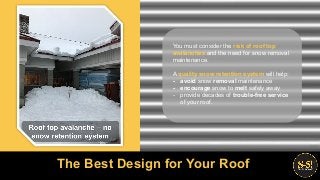
You must consider the risk of roof top
avalanches and the need for snow removal
maintenance.
A quality snow retention system will help:
- avoid snow removal maintenance
- encourage snow to melt safely away
- provide decades of trouble-free service
of your roof.
The Best Design for Your Roof
There are basic methods
available for mounting snow
retention systems to roofs.
3
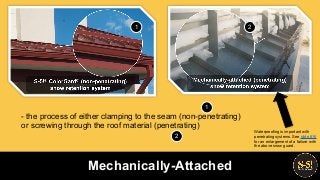
- the process of either clamping to the seam (non-penetrating)
or screwing through the roof material (penetrating)
Mechanically-Attached
1
2
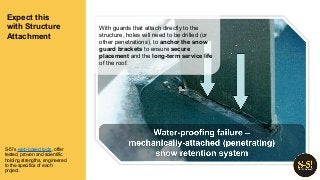
Waterproofing is important with
penetrating systems. See slide #16
for an enlargement of a failure with
the above snow guard.
1 2
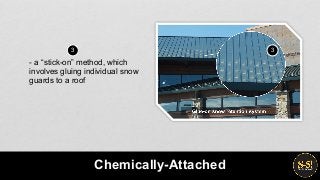
- a “stick-on” method, which
involves gluing individual snow
guards to a roof
Chemically-Attached
3 3
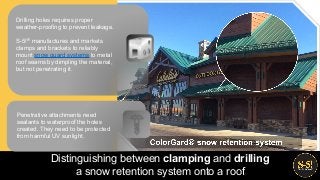
Drilling holes requires proper
weather-proofing to prevent leakage.
S-5!® manufactures and markets
clamps and brackets to reliably
mount snow guard systems to metal
roof seams by dimpling the material,
but not penetrating it.
Distinguishing between clamping and drilling
a snow retention system onto a roof
Penetrative attachments need
sealants to waterproof the holes
created. They need to be protected
from harmful UV sunlight.
The Three
Methods for
Mounting
Snow Guards:
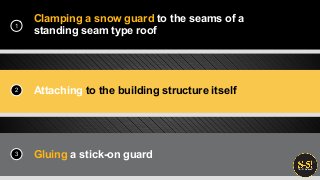
Clamping a snow guard to the seams of a
standing seam type roof
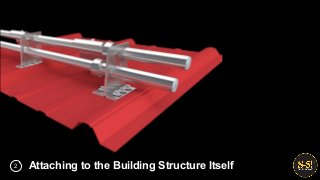
Attaching to the building structure itself
Gluing a stick-on guard
1
2
3
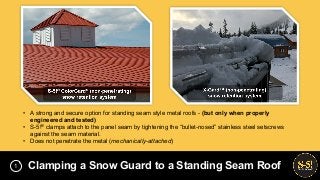
• A strong and secure option for standing seam style metal roofs - (but only when properly
engineered and tested)
• S-5!® clamps attach to the panel seam by tightening the “bullet-nosed” stainless steel setscrews
against the seam material.
• Does not penetrate the metal (mechanically-attached)
Clamping a Snow Guard to a Standing Seam Roof1
•Avoids drilling unwanted holes in
standing seam roof profiles, preserving
warranties
•Clamp-to seam attachments should
not fatigue due to thermal heating or
cooling of the roof.
FACTS
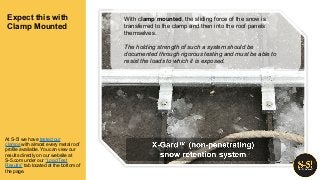
Expect this with
Clamp Mounted
With clamp mounted, the sliding force of the snow is
transferred to the clamp and then into the roof panels
themselves.
The holding strength of such a system should be
documented through rigorous testing and must be able to
resist the loads to which it is exposed.
At S-5! we have tested our
clamps with almost every metal roof
profile available. You can view our
results directly on our website at
S-5.com under our “Load Test
Results” tab located at the bottom of
the page.
Attaching to the Building Structure Itself2
• A strong, secure, and reliable
method if properly designed,
tested, installed and
waterproofed.
• Only suitable for a roof that is
attached the same way (i.e.
with screws that penetrate the
roof’s surface, attaching it to
the structure).
FACTS
Expect this
with Structure
Attachment ----
With guards that attach directly to the
structure, holes will need to be drilled (or
other penetrations), to anchor the snow
guard brackets to ensure secure
placement and the long-term service life
of the roof.
S-5!’s web-based tools, offer
tested, proven and scientific
holding strengths, engineered
to the specifics of each
project.
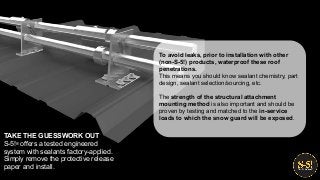
TAKE THE GUESSWORK OUT
S-5!® offers a tested engineered
system with sealants factory-applied.
Simply remove the protective release
paper and install.
To avoid leaks, prior to installation with other
(non-S-5!) products, waterproof these roof
penetrations.
This means you should know sealant chemistry, part
design, sealant selection/sourcing, etc.
The strength of the structural attachment
mounting method is also important and should be
proven by testing and matched to the in-service
loads to which the snow guard will be exposed.
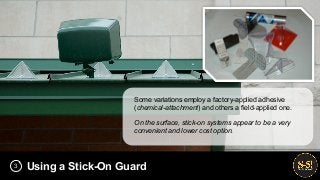
Using a Stick-On Guard
Some variations employ a factory-applied adhesive
(chemical-attachment) and others a field-applied one.
On the surface, stick-on systems appear to be a very
convenient and lower cost option.
3
• Lower cost only when considering single
part cost, not total job cost (e.g. labor,
required, guard quantity and distribution
over the roof surface).
• Remember that all adhesives diminish in
holding strength, beginning with the first
day of exposure…and will eventually have
to be replaced.
• We have witnessed thousands of
examples of this and have seen the
replacement time from one to eight years.
FACTS
Potential
Complications
with Stick-on
Mounted
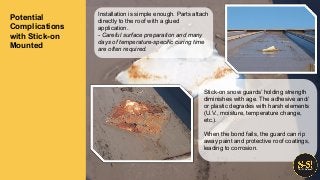
Installation is simple enough. Parts attach
directly to the roof with a glued
application.
- Careful surface preparation and many
days of temperature-specific curing time
are often required.
Stick-on snow guards’ holding strength
diminishes with age. The adhesive and/
or plastic degrades with harsh elements
(U.V., moisture, temperature change,
etc.).
When the bond fails, the guard can rip
away paint and protective roof coatings,
leading to corrosion.
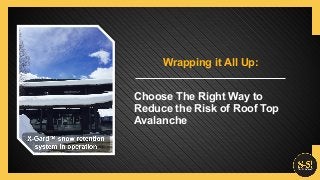
Wrapping it All Up:
Choose The Right Way to
Reduce the Risk of Roof Top
Avalanche
MCA (Metal Construction
Association) technical
documents are the greatest
aid available for snow guard
selection criteria and downloads
are free.
Learn more about installing snow retention
systems with mechanical attachment via clamp
mounting or structural attachment and weather
proofing at S-5.com.
Visit MCA for more information.
Read the complete blog here.
A quality snow retention system will
help preserve your roof and allow
snow drifts and snow melt to exit the
roof in a more controlled manner. Need more convincing?
S-5!® Attachment Solutions

Metal Roof Innovations, LTD.

(888) 825-3432

(719) 495-0045 (fax)
The Right Way!™
General Information

info@S-5.com
Sales

To find a distributor near you, visit our distributor pages.
Become a Distributor - distributorships@S-5.com
Technical Support

support@S-5.com
www.S-5.com
TESTED.
TRUSTED.
ENGINEERED.
©
A.B.M
artin
R
oofing
Supply,LLC

S-5! - Best Way to Mount Snow Retention to a Metal Roof

  • 1.
    What is theBest Way to Mount Snow Retention to a Metal Roof? Clamp Mounted vs Structure Attachment vs Stick-On Snow Retention Solutions
  • 2.
    A quality snowretention system will help: - maintain the integrity of your roof - avoid personal damage - avoid property damage - efficiently and safely allow snow to melt off your structure Metal roofs are a smart decision.
  • 3.
  • 4.
    You must considerthe risk of roof top avalanches and the need for snow removal maintenance. A quality snow retention system will help: - avoid snow removal maintenance - encourage snow to melt safely away - provide decades of trouble-free service of your roof. The Best Design for Your Roof
  • 5.
    There are basicmethods available for mounting snow retention systems to roofs. 3
  • 6.
    - the processof either clamping to the seam (non-penetrating) or screwing through the roof material (penetrating) Mechanically-Attached 1 2 Waterproofing is important with penetrating systems. See slide #16 for an enlargement of a failure with the above snow guard. 1 2
  • 7.
    - a “stick-on”method, which involves gluing individual snow guards to a roof Chemically-Attached 3 3
  • 8.
    Drilling holes requiresproper weather-proofing to prevent leakage. S-5!® manufactures and markets clamps and brackets to reliably mount snow guard systems to metal roof seams by dimpling the material, but not penetrating it. Distinguishing between clamping and drilling a snow retention system onto a roof Penetrative attachments need sealants to waterproof the holes created. They need to be protected from harmful UV sunlight.
  • 9.
  • 10.
    Clamping a snowguard to the seams of a standing seam type roof Attaching to the building structure itself Gluing a stick-on guard 1 2 3
  • 11.
    • A strongand secure option for standing seam style metal roofs - (but only when properly engineered and tested) • S-5!® clamps attach to the panel seam by tightening the “bullet-nosed” stainless steel setscrews against the seam material. • Does not penetrate the metal (mechanically-attached) Clamping a Snow Guard to a Standing Seam Roof1
  • 12.
    •Avoids drilling unwantedholes in standing seam roof profiles, preserving warranties •Clamp-to seam attachments should not fatigue due to thermal heating or cooling of the roof. FACTS
  • 13.
    Expect this with ClampMounted With clamp mounted, the sliding force of the snow is transferred to the clamp and then into the roof panels themselves. The holding strength of such a system should be documented through rigorous testing and must be able to resist the loads to which it is exposed. At S-5! we have tested our clamps with almost every metal roof profile available. You can view our results directly on our website at S-5.com under our “Load Test Results” tab located at the bottom of the page.
  • 14.
    Attaching to theBuilding Structure Itself2
  • 15.
    • A strong,secure, and reliable method if properly designed, tested, installed and waterproofed. • Only suitable for a roof that is attached the same way (i.e. with screws that penetrate the roof’s surface, attaching it to the structure). FACTS
  • 16.
    Expect this with Structure Attachment---- With guards that attach directly to the structure, holes will need to be drilled (or other penetrations), to anchor the snow guard brackets to ensure secure placement and the long-term service life of the roof. S-5!’s web-based tools, offer tested, proven and scientific holding strengths, engineered to the specifics of each project.
  • 17.
    TAKE THE GUESSWORKOUT S-5!® offers a tested engineered system with sealants factory-applied. Simply remove the protective release paper and install. To avoid leaks, prior to installation with other (non-S-5!) products, waterproof these roof penetrations. This means you should know sealant chemistry, part design, sealant selection/sourcing, etc. The strength of the structural attachment mounting method is also important and should be proven by testing and matched to the in-service loads to which the snow guard will be exposed.
  • 18.
    Using a Stick-OnGuard Some variations employ a factory-applied adhesive (chemical-attachment) and others a field-applied one. On the surface, stick-on systems appear to be a very convenient and lower cost option. 3
  • 19.
    • Lower costonly when considering single part cost, not total job cost (e.g. labor, required, guard quantity and distribution over the roof surface). • Remember that all adhesives diminish in holding strength, beginning with the first day of exposure…and will eventually have to be replaced. • We have witnessed thousands of examples of this and have seen the replacement time from one to eight years. FACTS
  • 20.
    Potential Complications with Stick-on Mounted Installation issimple enough. Parts attach directly to the roof with a glued application. - Careful surface preparation and many days of temperature-specific curing time are often required. Stick-on snow guards’ holding strength diminishes with age. The adhesive and/ or plastic degrades with harsh elements (U.V., moisture, temperature change, etc.). When the bond fails, the guard can rip away paint and protective roof coatings, leading to corrosion.
  • 21.
    Wrapping it AllUp: Choose The Right Way to Reduce the Risk of Roof Top Avalanche
  • 22.
    MCA (Metal Construction Association)technical documents are the greatest aid available for snow guard selection criteria and downloads are free. Learn more about installing snow retention systems with mechanical attachment via clamp mounting or structural attachment and weather proofing at S-5.com. Visit MCA for more information. Read the complete blog here. A quality snow retention system will help preserve your roof and allow snow drifts and snow melt to exit the roof in a more controlled manner. Need more convincing?
  • 23.
    S-5!® Attachment Solutions
 MetalRoof Innovations, LTD.
 (888) 825-3432
 (719) 495-0045 (fax) The Right Way!™ General Information
 info@S-5.com Sales
 To find a distributor near you, visit our distributor pages. Become a Distributor - distributorships@S-5.com Technical Support
 support@S-5.com www.S-5.com
  • 24.