AWS vs. Azure: 5 Differences
You Need To Know
September 28th, 2016
Ron Harnik - ron@scalr.com
Why Listen to Us?
• 8 years of multi-cloud experience
• AWS, Azure, Google, VMware, OpenStack
• Working with enterprises from the Fortune 5000
to the Fortune 5
• Seats on the advisory boards of the major cloud
providers
Market Overview
• There’s often no “Adoption Strategy”, multi-
cloud tends to happen
• Right now most shops are AWS. Some are
AWS + Azure
• Microsoft is gaining ground fast through
discounts
Market Overview
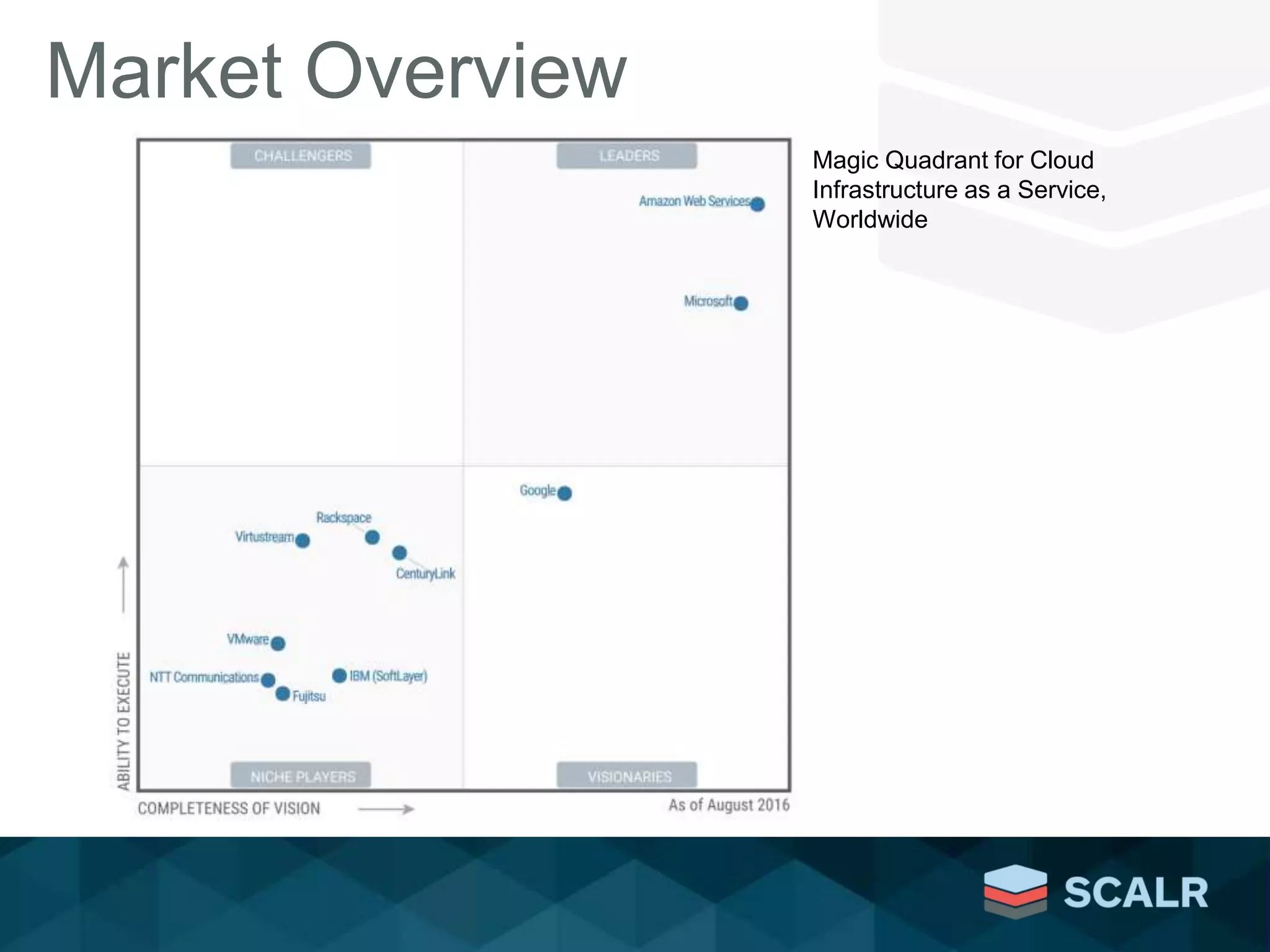
Magic Quadrant for Cloud
Infrastructure as a Service,
Worldwide
What Analysts Are Saying
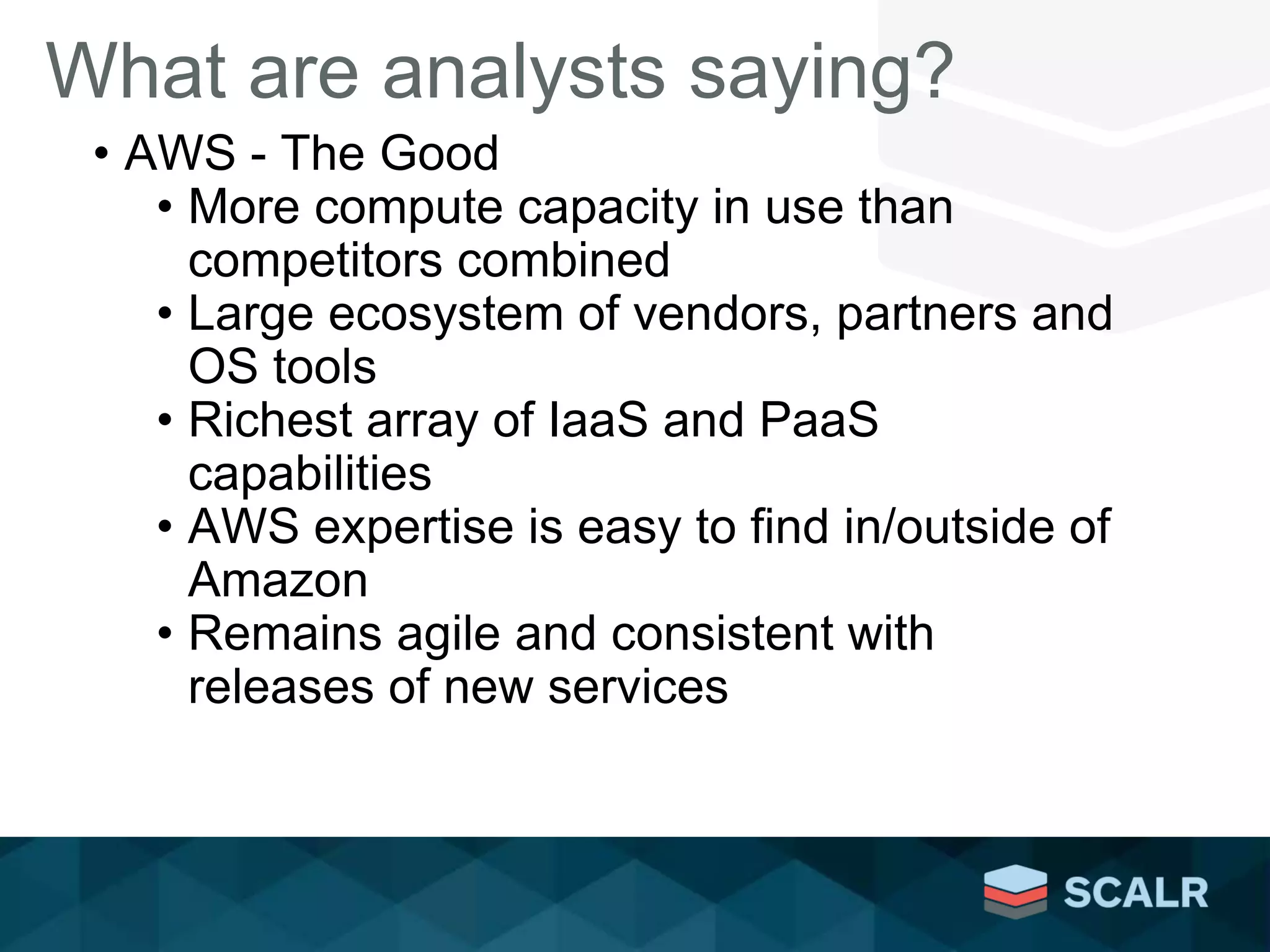
What are analysts saying?
• AWS - The Good
• More compute capacity in use than
competitors combined
• Large ecosystem of vendors, partners and
OS tools
• Richest array of IaaS and PaaS
capabilities
• AWS expertise is easy to find in/outside of
Amazon
• Remains agile and consistent with
releases of new services
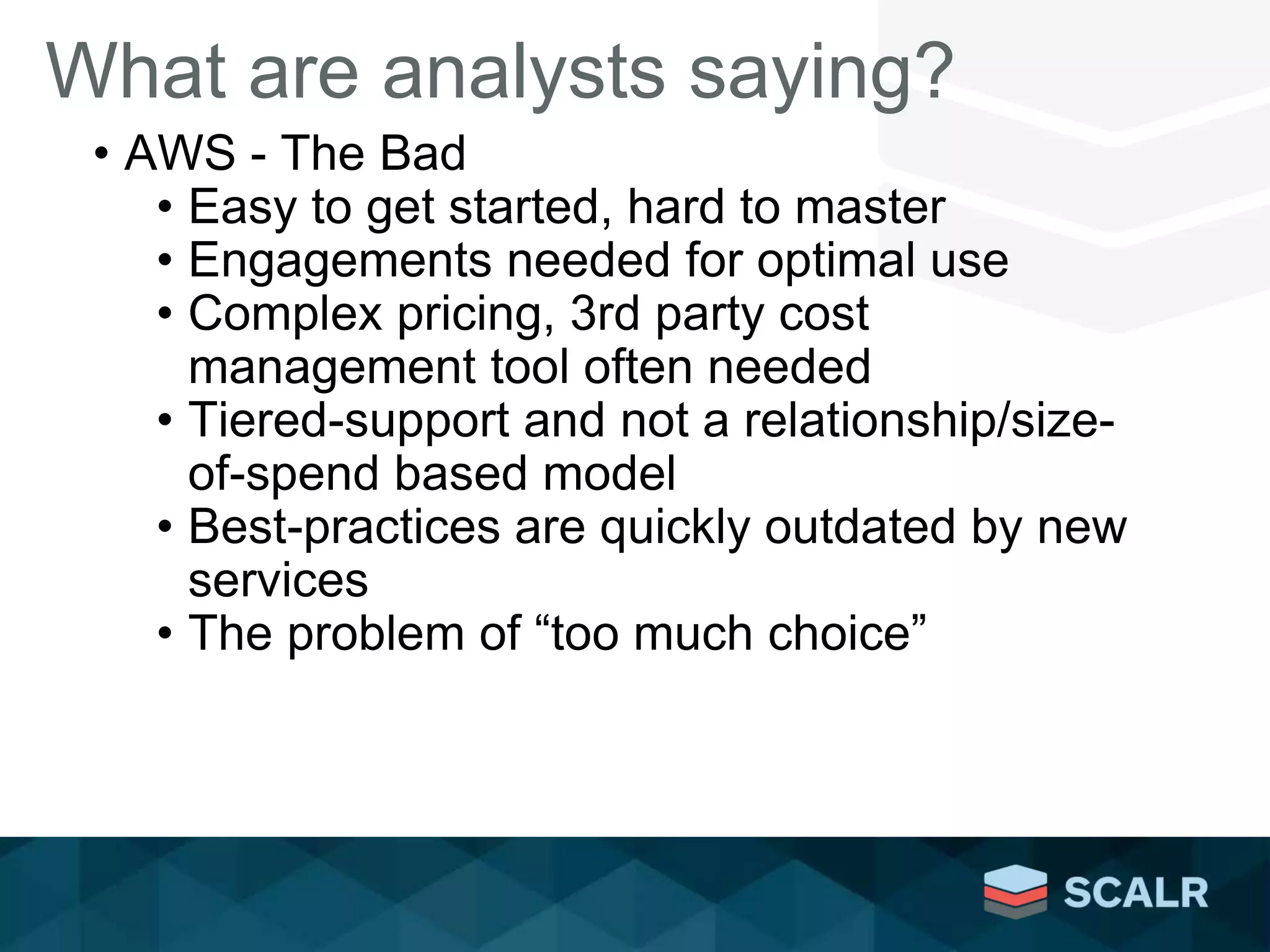
What are analysts saying?
• AWS - The Bad
• Easy to get started, hard to master
• Engagements needed for optimal use
• Complex pricing, 3rd party cost
management tool often needed
• Tiered-support and not a relationship/size-
of-spend based model
• Best-practices are quickly outdated by new
services
• The problem of “too much choice”
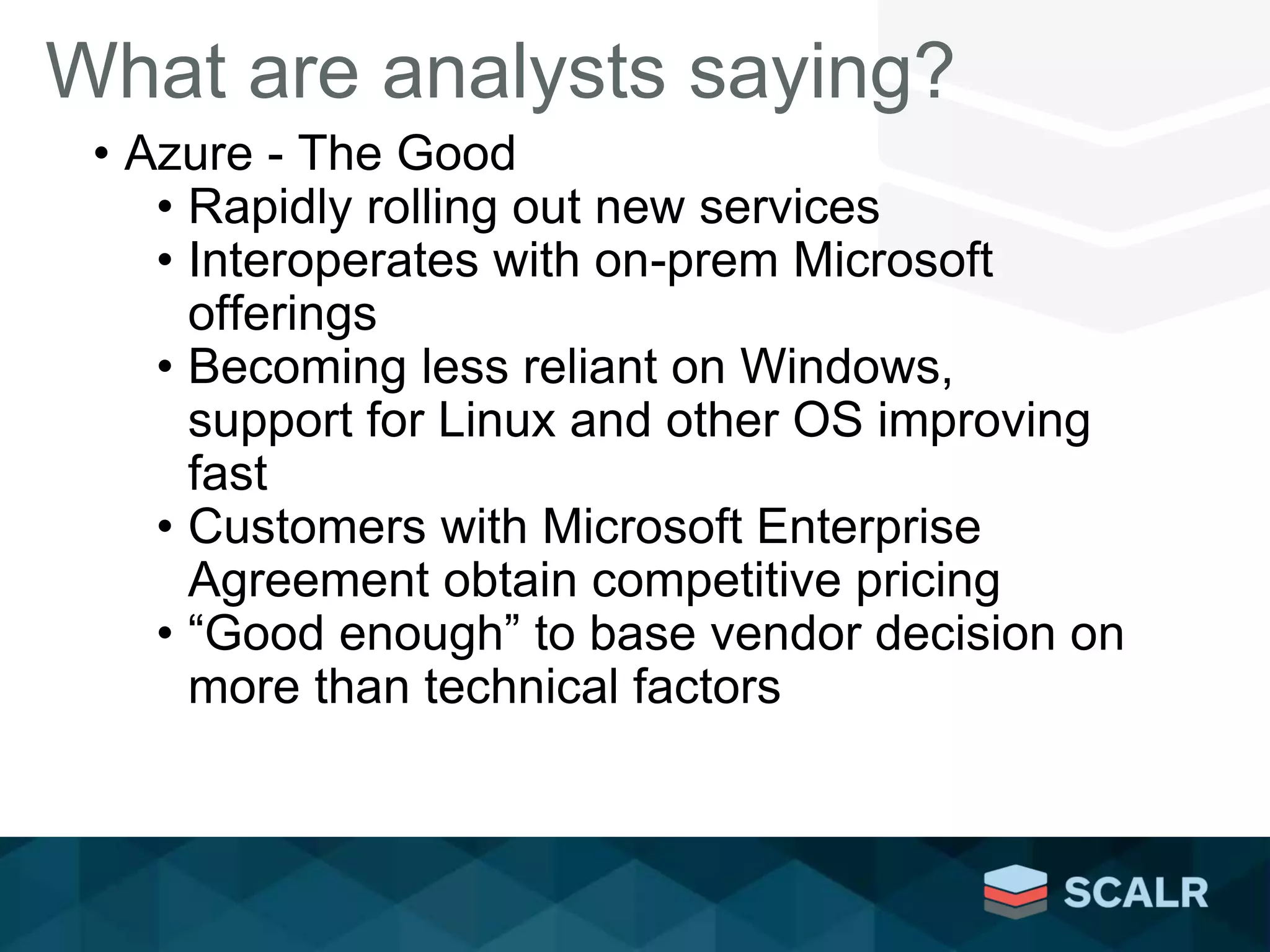
What are analysts saying?
• Azure - The Good
• Rapidly rolling out new services
• Interoperates with on-prem Microsoft
offerings
• Becoming less reliant on Windows,
support for Linux and other OS improving
fast
• Customers with Microsoft Enterprise
Agreement obtain competitive pricing
• “Good enough” to base vendor decision on
more than technical factors
What are analysts saying?
• Azure - The Bad
• Not all features are at the level of
completeness, ease of use, or API
enablement required by the enterprise
• Documentation can’t keep up with
releases
• Support is not always able to solve
complex challenges
• Limited number of Azure experts
• Vendors report challenges around API and
secure authentication
What Customers Are Saying
What are customers saying?
• AWS is ahead in richness of features, better
fit for complex use-cases
• AWS velocity and quality of services is hard
to beat
• At a basic level, Azure IaaS meets the needs
of the enterprise
• Azure Stack (2017) is shaping up to be a
powerful offering
• Azure support - not always useful at low
levels, but you’re more likely to be put in
touch with engineering
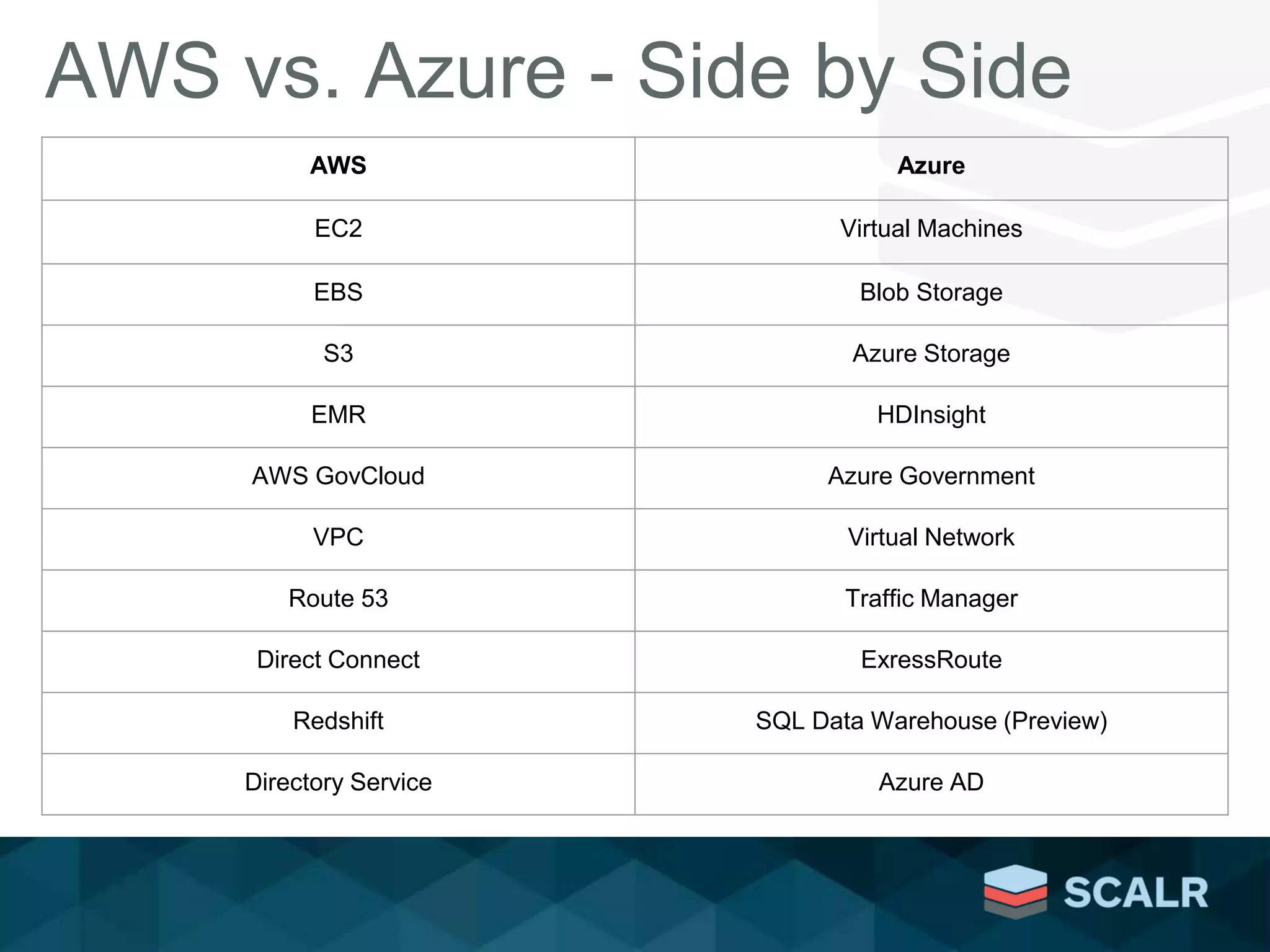
AWS vs. Azure - Side by Side
AWS Azure
EC2 Virtual Machines
EBS Blob Storage
S3 Azure Storage
EMR HDInsight
AWS GovCloud Azure Government
VPC Virtual Network
Route 53 Traffic Manager
Direct Connect ExressRoute
Redshift SQL Data Warehouse (Preview)
Directory Service Azure AD
Security
AWS vs. Azure - Security
• AWS Security Groups
• Can secure EC2, RDS, ELB
• When SGs are applied to primary ENI by
default
• Whitelist - Only “Allow” rules
• Multiple SGs per Instance
• All rules are stateful
AWS vs. Azure - Security
• Azure Network Security Groups
• Can secure VMs and Subnets
• Applied to primary NIC on servers, or all
VMs in subnet
• Both “Allow” and “Deny” rules
• One NSG per VM/Subnet
• All rules are stateful
AWS vs. Azure - Security
• Important Difference
• In AWS - SG sprawl can easily happen, as
multiple SGs can be applied to each
instance.
• In Azure - A change to a NSG will mostly
likely affect multiple VMs
Pricing
AWS vs. Azure - Pricing
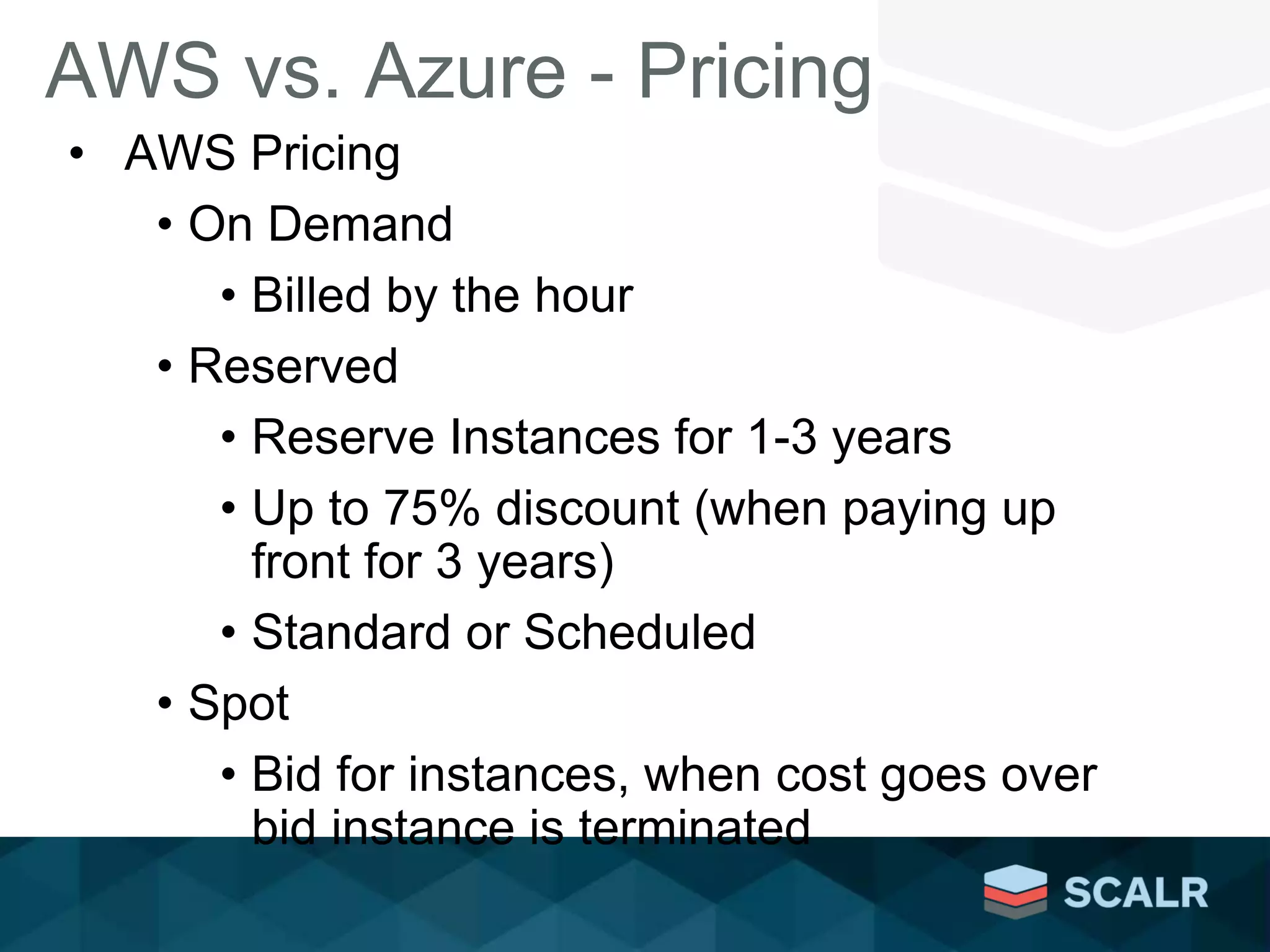
• AWS Pricing
• On Demand
• Billed by the hour
• Reserved
• Reserve Instances for 1-3 years
• Up to 75% discount (when paying up
front for 3 years)
• Standard or Scheduled
• Spot
• Bid for instances, when cost goes over
bid instance is terminated
AWS vs. Azure - Pricing
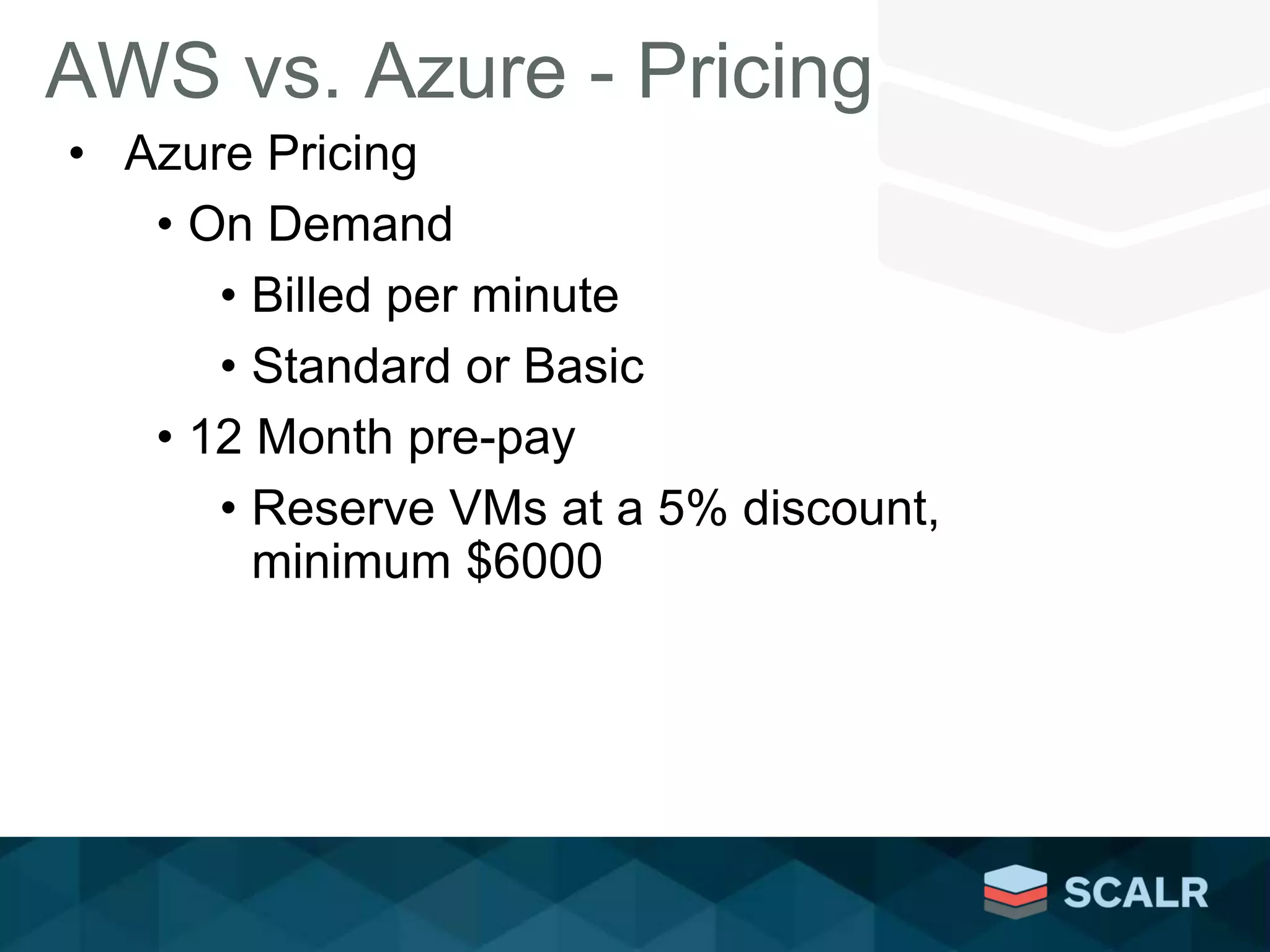
• Azure Pricing
• On Demand
• Billed per minute
• Standard or Basic
• 12 Month pre-pay
• Reserve VMs at a 5% discount,
minimum $6000
AWS vs. Azure - Pricing
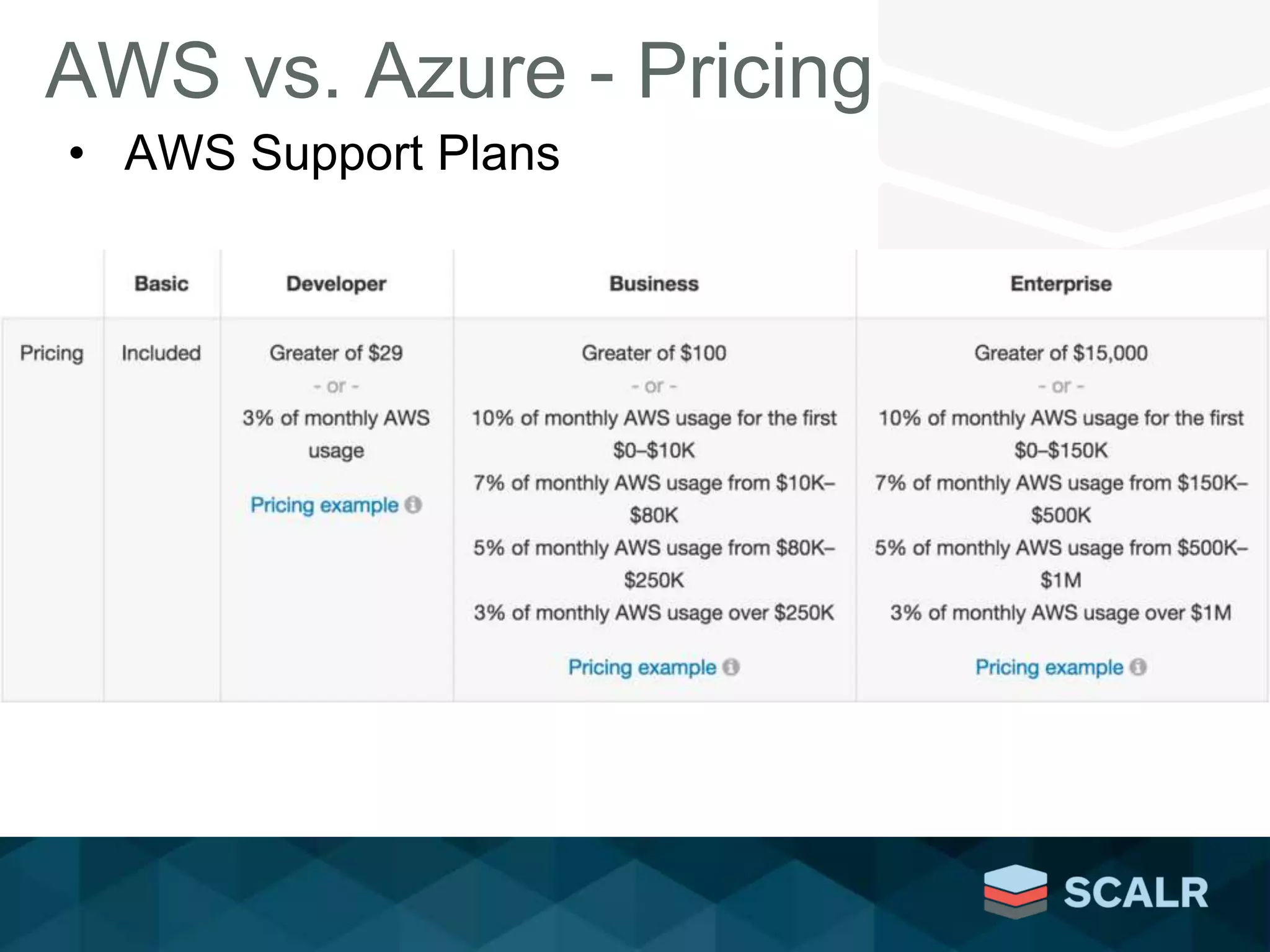
• AWS Support Plans
AWS vs. Azure - Pricing
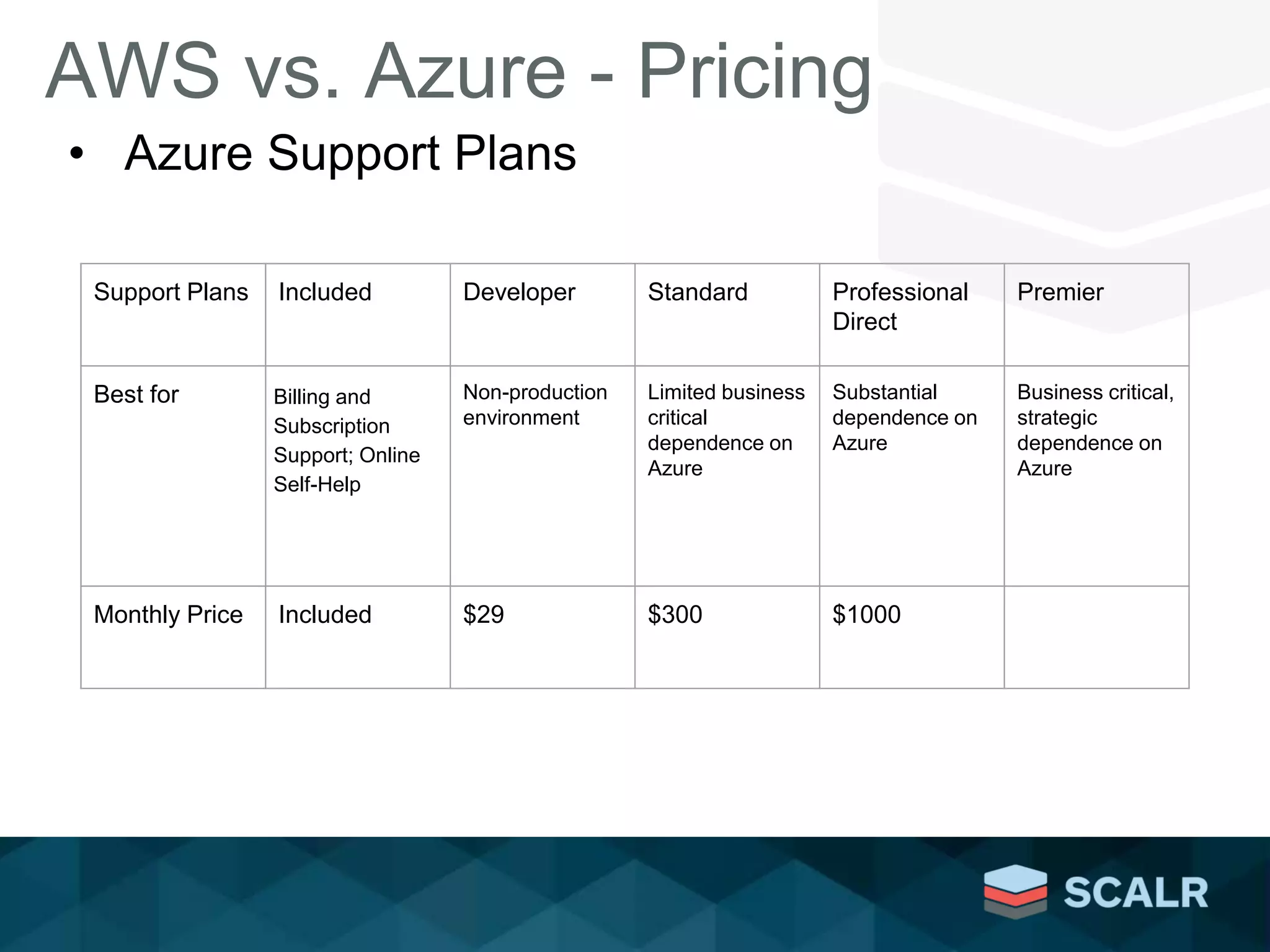
• Azure Support Plans
Support Plans Included Developer Standard Professional
Direct
Premier
Best for Billing and
Subscription
Support; Online
Self-Help
Non-production
environment
Limited business
critical
dependence on
Azure
Substantial
dependence on
Azure
Business critical,
strategic
dependence on
Azure
Monthly Price Included $29 $300 $1000
AWS vs. Azure - Pricing
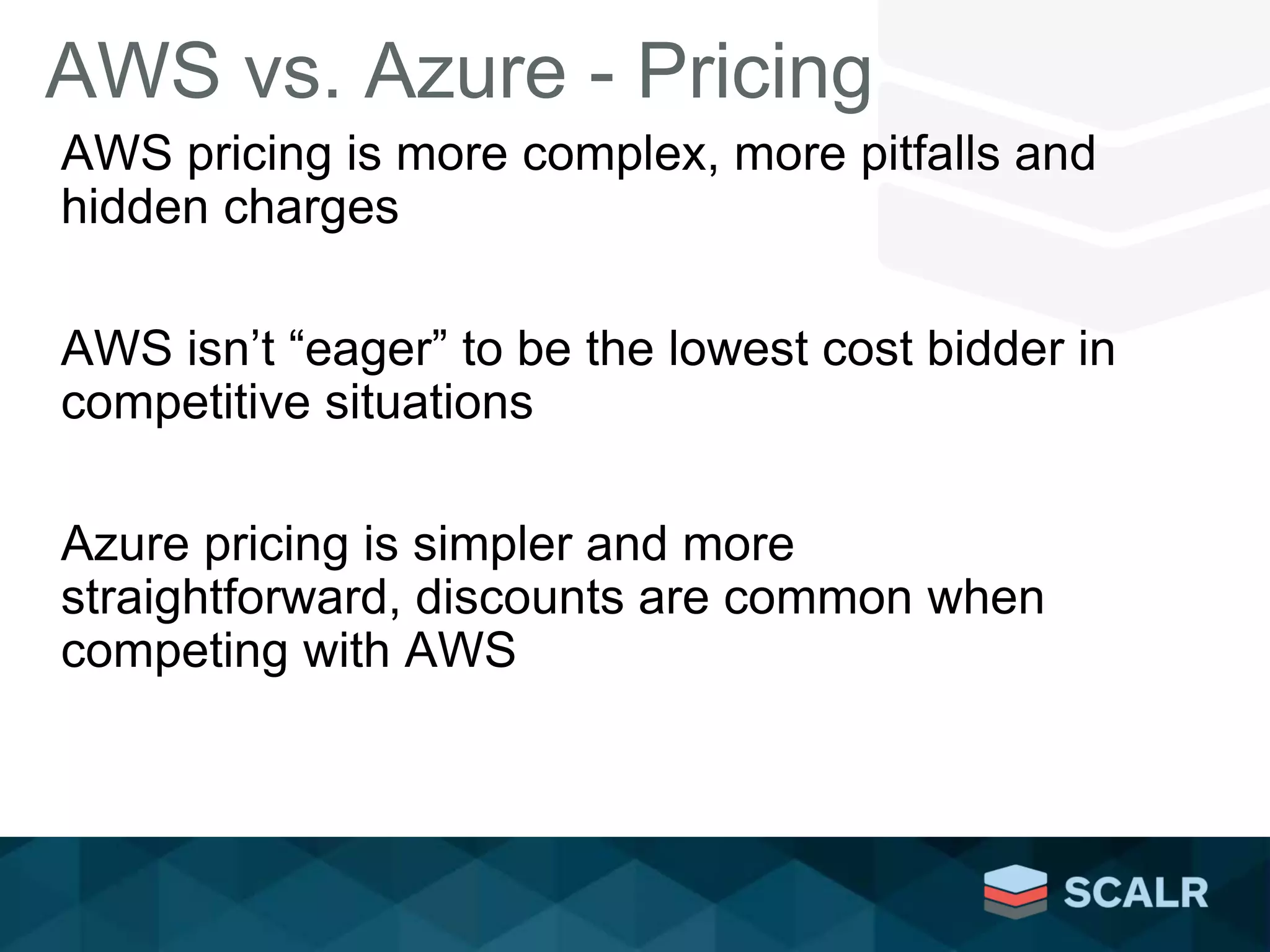
AWS pricing is more complex, more pitfalls and
hidden charges
AWS isn’t “eager” to be the lowest cost bidder in
competitive situations
Azure pricing is simpler and more
straightforward, discounts are common when
competing with AWS
Legal
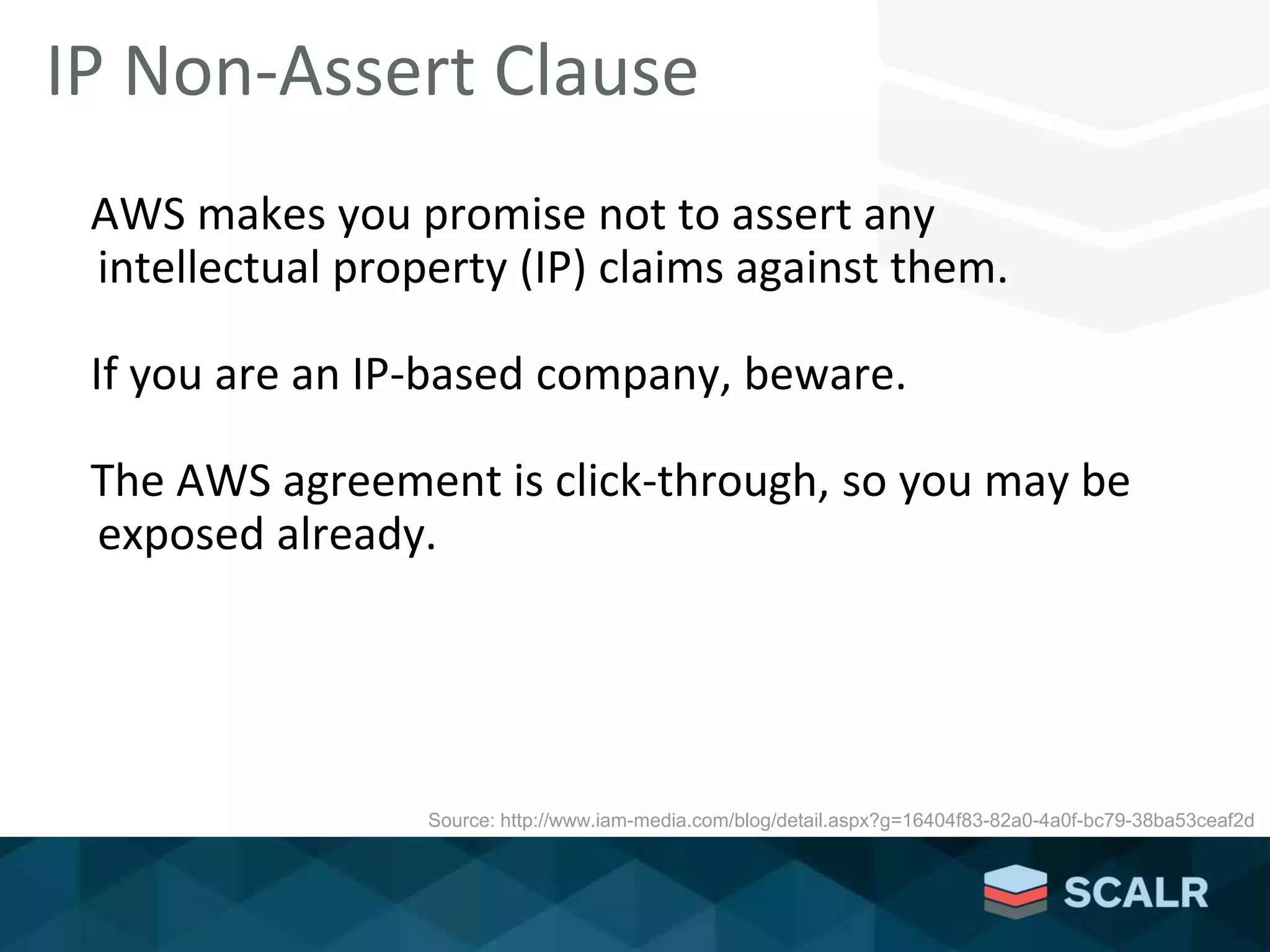
AWS makes you promise not to assert any
intellectual property (IP) claims against them.
If you are an IP-based company, beware.
The AWS agreement is click-through, so you may be
exposed already.
IP Non-Assert Clause
Source: http://www.iam-media.com/blog/detail.aspx?g=16404f83-82a0-4a0f-bc79-38ba53ceaf2d
Access and Permissions
AWS vs. Azure - Access
• AWS IAM
• Create IAM Group
• Add users
• Create Policy
• Copy and edit existing Policy
• IAM Policy generator
• Write your own JSON Policy
AWS vs. Azure - Access
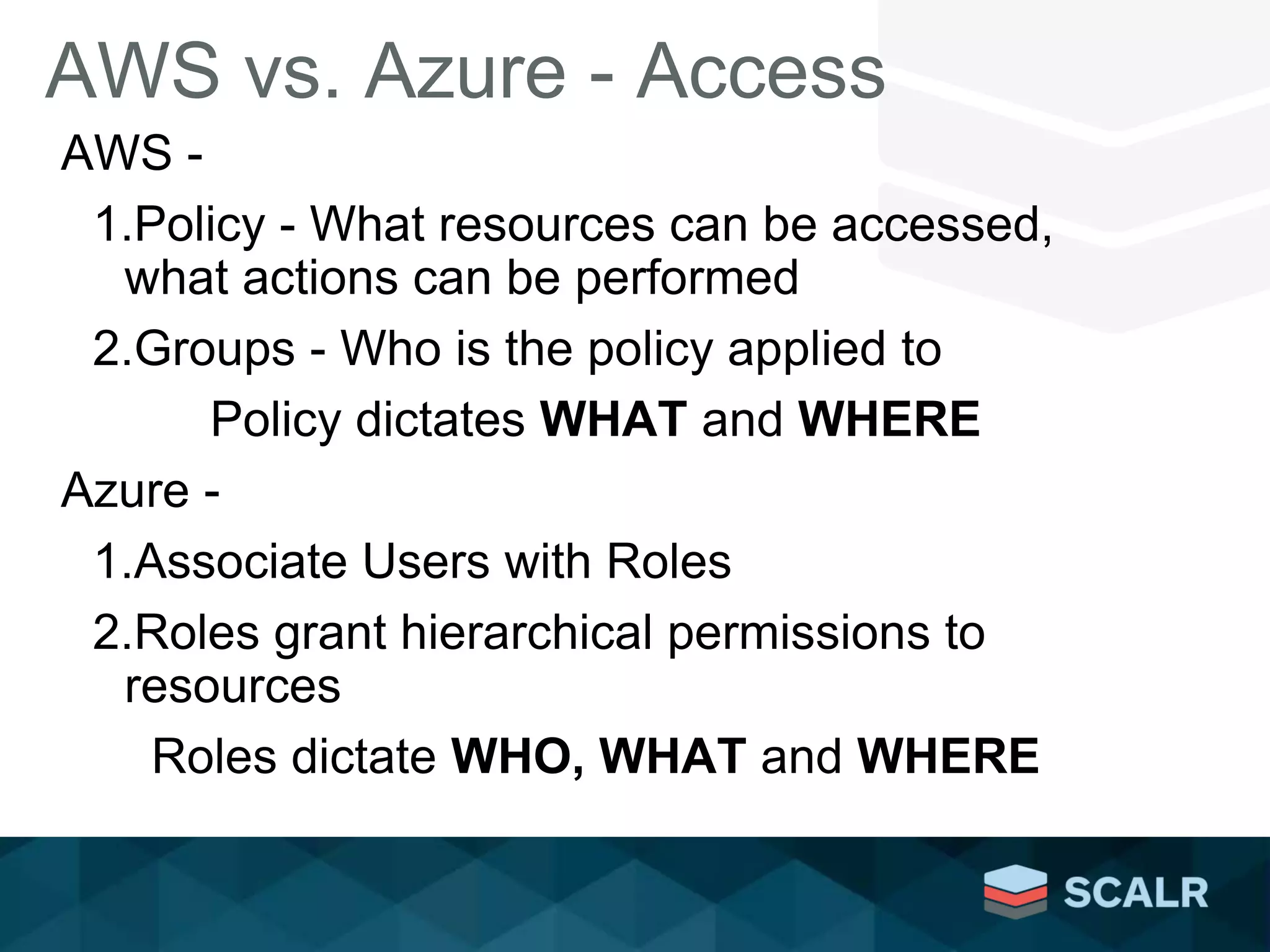
AWS -
1.Policy - What resources can be accessed,
what actions can be performed
2.Groups - Who is the policy applied to
Policy dictates WHAT and WHERE
Azure -
1.Associate Users with Roles
2.Roles grant hierarchical permissions to
resources
Roles dictate WHO, WHAT and WHERE
AWS vs. Azure - Access
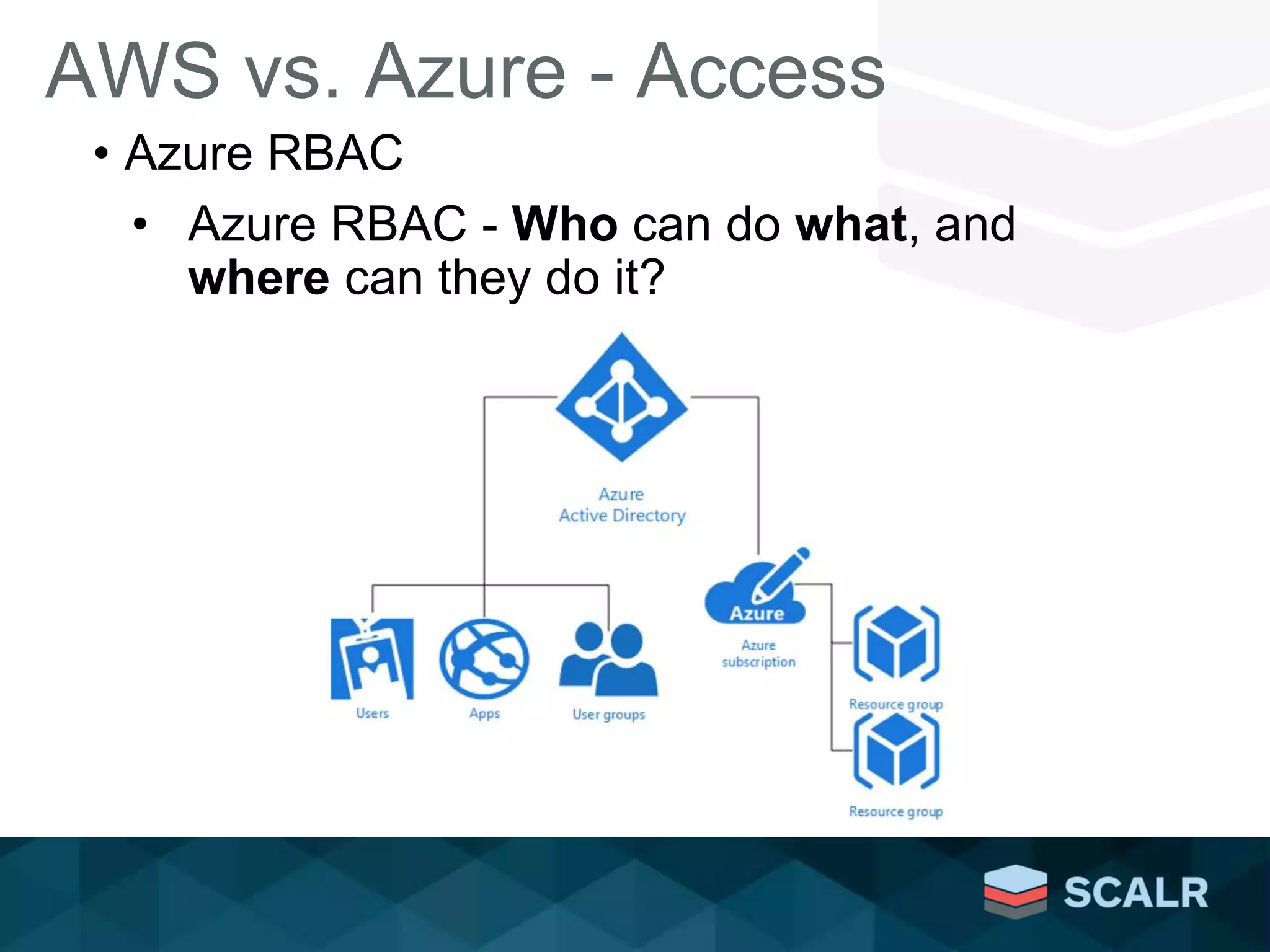
• Azure RBAC
• Azure RBAC - Who can do what, and
where can they do it?
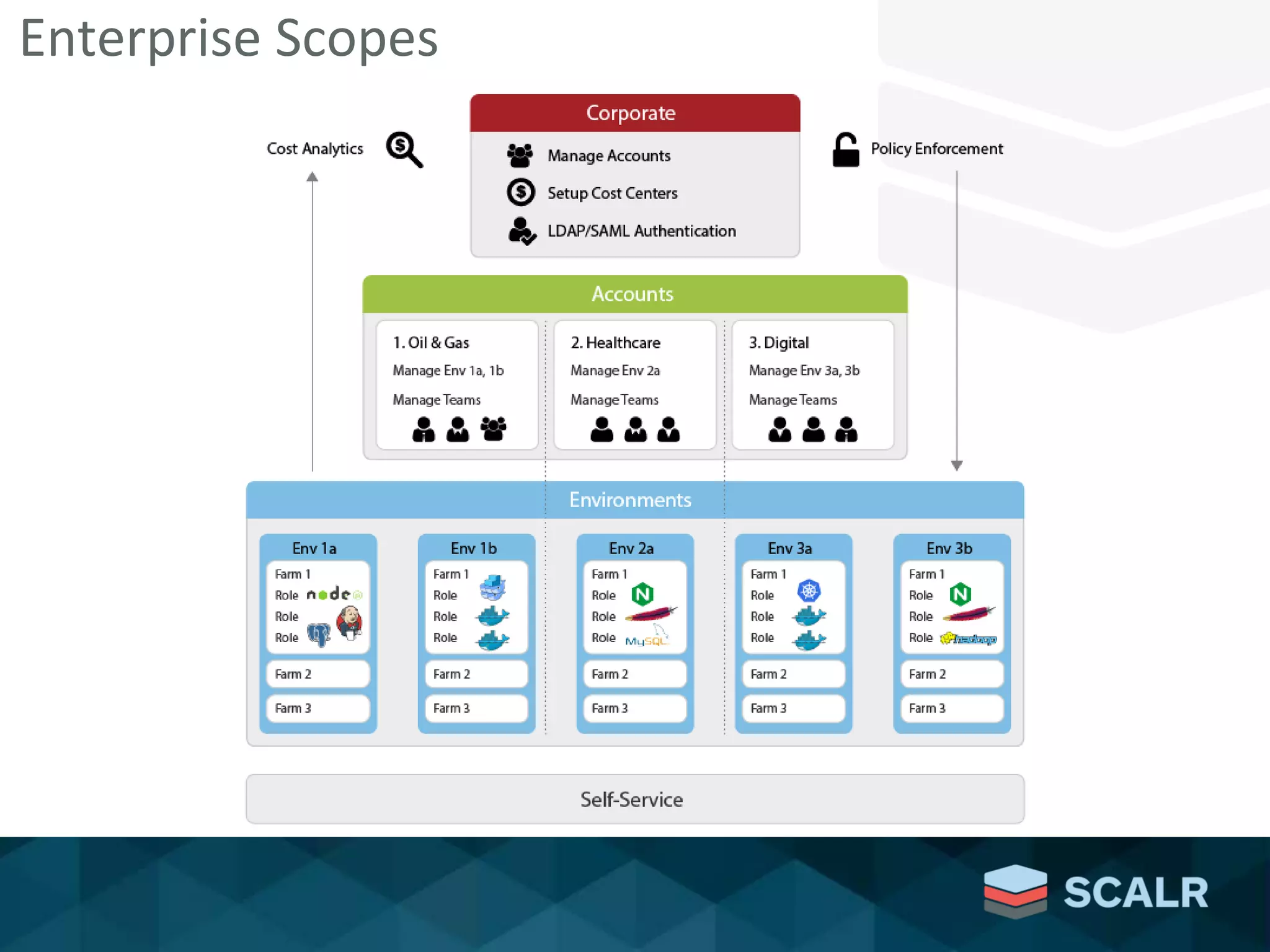
Enterprise Scopes
Self Service
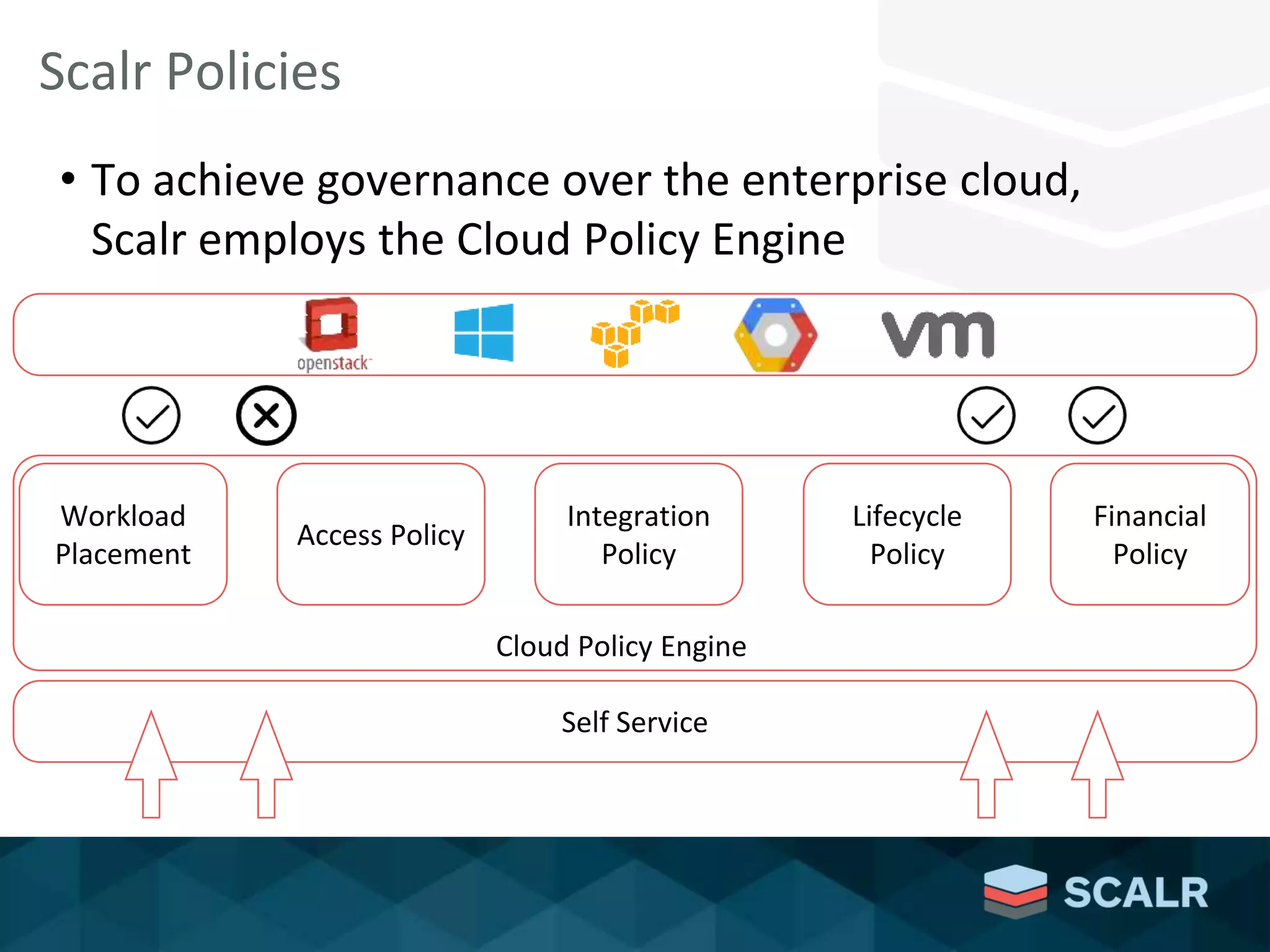
• To achieve governance over the enterprise cloud,
Scalr employs the Cloud Policy Engine
Scalr Policies
ffsdf
Financial
Policy
Lifecycle
Policy
Integration
Policy
Access Policy
Workload
Placement
Cloud Policy Engine
Thank you!

Aws vs. Azure: 5 Things You Need To Know

  • 1.
    AWS vs. Azure:5 Differences You Need To Know September 28th, 2016 Ron Harnik - ron@scalr.com
  • 2.
    Why Listen toUs? • 8 years of multi-cloud experience • AWS, Azure, Google, VMware, OpenStack • Working with enterprises from the Fortune 5000 to the Fortune 5 • Seats on the advisory boards of the major cloud providers
  • 3.
    Market Overview • There’soften no “Adoption Strategy”, multi- cloud tends to happen • Right now most shops are AWS. Some are AWS + Azure • Microsoft is gaining ground fast through discounts
  • 4.
    Market Overview Magic Quadrantfor Cloud Infrastructure as a Service, Worldwide
  • 5.
  • 6.
    What are analystssaying? • AWS - The Good • More compute capacity in use than competitors combined • Large ecosystem of vendors, partners and OS tools • Richest array of IaaS and PaaS capabilities • AWS expertise is easy to find in/outside of Amazon • Remains agile and consistent with releases of new services
  • 7.
    What are analystssaying? • AWS - The Bad • Easy to get started, hard to master • Engagements needed for optimal use • Complex pricing, 3rd party cost management tool often needed • Tiered-support and not a relationship/size- of-spend based model • Best-practices are quickly outdated by new services • The problem of “too much choice”
  • 8.
    What are analystssaying? • Azure - The Good • Rapidly rolling out new services • Interoperates with on-prem Microsoft offerings • Becoming less reliant on Windows, support for Linux and other OS improving fast • Customers with Microsoft Enterprise Agreement obtain competitive pricing • “Good enough” to base vendor decision on more than technical factors
  • 9.
    What are analystssaying? • Azure - The Bad • Not all features are at the level of completeness, ease of use, or API enablement required by the enterprise • Documentation can’t keep up with releases • Support is not always able to solve complex challenges • Limited number of Azure experts • Vendors report challenges around API and secure authentication
  • 10.
  • 11.
    What are customerssaying? • AWS is ahead in richness of features, better fit for complex use-cases • AWS velocity and quality of services is hard to beat • At a basic level, Azure IaaS meets the needs of the enterprise • Azure Stack (2017) is shaping up to be a powerful offering • Azure support - not always useful at low levels, but you’re more likely to be put in touch with engineering
  • 12.
    AWS vs. Azure- Side by Side AWS Azure EC2 Virtual Machines EBS Blob Storage S3 Azure Storage EMR HDInsight AWS GovCloud Azure Government VPC Virtual Network Route 53 Traffic Manager Direct Connect ExressRoute Redshift SQL Data Warehouse (Preview) Directory Service Azure AD
  • 13.
  • 14.
    AWS vs. Azure- Security • AWS Security Groups • Can secure EC2, RDS, ELB • When SGs are applied to primary ENI by default • Whitelist - Only “Allow” rules • Multiple SGs per Instance • All rules are stateful
  • 15.
    AWS vs. Azure- Security • Azure Network Security Groups • Can secure VMs and Subnets • Applied to primary NIC on servers, or all VMs in subnet • Both “Allow” and “Deny” rules • One NSG per VM/Subnet • All rules are stateful
  • 16.
    AWS vs. Azure- Security • Important Difference • In AWS - SG sprawl can easily happen, as multiple SGs can be applied to each instance. • In Azure - A change to a NSG will mostly likely affect multiple VMs
  • 17.
  • 18.
    AWS vs. Azure- Pricing • AWS Pricing • On Demand • Billed by the hour • Reserved • Reserve Instances for 1-3 years • Up to 75% discount (when paying up front for 3 years) • Standard or Scheduled • Spot • Bid for instances, when cost goes over bid instance is terminated
  • 19.
    AWS vs. Azure- Pricing • Azure Pricing • On Demand • Billed per minute • Standard or Basic • 12 Month pre-pay • Reserve VMs at a 5% discount, minimum $6000
  • 20.
    AWS vs. Azure- Pricing • AWS Support Plans
  • 21.
    AWS vs. Azure- Pricing • Azure Support Plans Support Plans Included Developer Standard Professional Direct Premier Best for Billing and Subscription Support; Online Self-Help Non-production environment Limited business critical dependence on Azure Substantial dependence on Azure Business critical, strategic dependence on Azure Monthly Price Included $29 $300 $1000
  • 22.
    AWS vs. Azure- Pricing AWS pricing is more complex, more pitfalls and hidden charges AWS isn’t “eager” to be the lowest cost bidder in competitive situations Azure pricing is simpler and more straightforward, discounts are common when competing with AWS
  • 23.
  • 24.
    AWS makes youpromise not to assert any intellectual property (IP) claims against them. If you are an IP-based company, beware. The AWS agreement is click-through, so you may be exposed already. IP Non-Assert Clause Source: http://www.iam-media.com/blog/detail.aspx?g=16404f83-82a0-4a0f-bc79-38ba53ceaf2d
  • 25.
  • 26.
    AWS vs. Azure- Access • AWS IAM • Create IAM Group • Add users • Create Policy • Copy and edit existing Policy • IAM Policy generator • Write your own JSON Policy
  • 27.
    AWS vs. Azure- Access AWS - 1.Policy - What resources can be accessed, what actions can be performed 2.Groups - Who is the policy applied to Policy dictates WHAT and WHERE Azure - 1.Associate Users with Roles 2.Roles grant hierarchical permissions to resources Roles dictate WHO, WHAT and WHERE
  • 28.
    AWS vs. Azure- Access • Azure RBAC • Azure RBAC - Who can do what, and where can they do it?
  • 29.
  • 30.
    Self Service • Toachieve governance over the enterprise cloud, Scalr employs the Cloud Policy Engine Scalr Policies ffsdf Financial Policy Lifecycle Policy Integration Policy Access Policy Workload Placement Cloud Policy Engine
  • 31.