Orthia & Morgain 2017
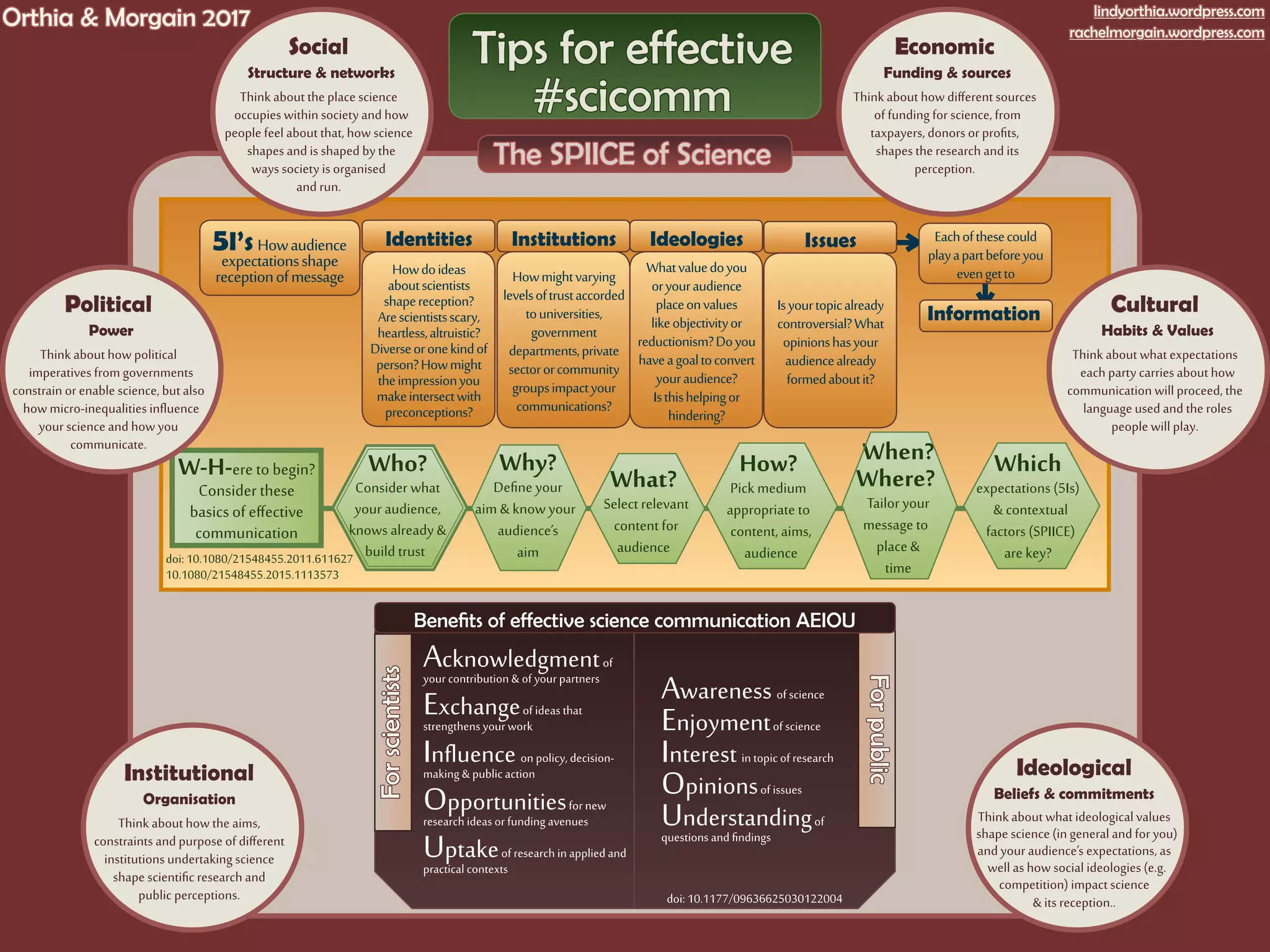
Social
Structure & networks
Think about the place science
occupies within society and how
people feel about that, how science
shapes and is shaped by the
ways society is organised
and run.
Economic
Funding & sources
Think about how different sources
of funding for science, from
taxpayers, donors or profits,
shapes the research and its
perception.
Who?
Consider what
your audience,
knows already &
build trust
Why?
Define your
aim & know your
audience’s
aim
How?
Pick medium
appropriate to
content, aims,
audience
When?
Where?
Tailor your
message to
place &
time
Which
expectations (5Is)
& contextual
factors (SPIICE)
are key?
W-H-ere to begin?
Consider these
basics of effective
communication
What?
Select relevant
content for
audience
Political
Power
Think about how political
imperatives from governments
constrain or enable science, but also
how micro-inequalities influence
your science and how you
communicate.
5I’sHowaudience
expectationsshape
receptionofmessage
Identities
Howdoideas
aboutscientists
shapereception?
Arescientistsscary,
heartless,altruistic?
Diverseoronekindof
person?Howmight
theimpressionyou
makeintersectwith
preconceptions?
Institutions
Howmightvarying
levelsoftrustaccorded
touniversities,
government
departments,private
sectororcommunity
groupsimpactyour
communications?
Ideologies
Whatvaluedoyou
oryouraudience
placeonvalues
likeobjectivityor
reductionism?Doyou
haveagoaltoconvert
youraudience?
Isthishelpingor
hindering?
Issues
Isyourtopicalready
controversial?What
opinionshasyour
audiencealready
formedaboutit?
Eachofthesecould
playapartbeforeyou
evengetto
Information
Tips for effective
#scicomm
Acknowledgmentof
your contribution & of your partners
Exchangeof ideas that
strengthens your work
Influenceon policy, decision-
making & public action
Opportunitiesfor new
research ideas or funding avenues
Uptakeof research in applied and
practical contexts
Awareness of science
Enjoymentof science
Interest in topic of research
Opinionsof issues
Understandingof
questions and findings
Forscientists
Forpublic
Benefits of effective science communication AEIOU
The SPIICE of Science
Cultural
Habits & Values
Think about what expectations
each party carries about how
communication will proceed, the
language used and the roles
people will play.
doi: 10.1080/21548455.2011.611627
10.1080/21548455.2015.1113573
doi: 10.1177/09636625030122004
lindyorthia.wordpress.com
rachelmorgain.wordpress.com
Institutional
Organisation
Think about how the aims,
constraints and purpose of different
institutions undertaking science
shape scientific research and
public perceptions.
Ideological
Beliefs & commitments
Think about what ideological values
shapescience(ingeneralandforyou)
and your audience’s expectations, as
well as how social ideologies (e.g.
competition) impact science
& its reception..

Orthia & Morgain Scicomm Tool

  • 1.
    Orthia & Morgain2017 Social Structure & networks Think about the place science occupies within society and how people feel about that, how science shapes and is shaped by the ways society is organised and run. Economic Funding & sources Think about how different sources of funding for science, from taxpayers, donors or profits, shapes the research and its perception. Who? Consider what your audience, knows already & build trust Why? Define your aim & know your audience’s aim How? Pick medium appropriate to content, aims, audience When? Where? Tailor your message to place & time Which expectations (5Is) & contextual factors (SPIICE) are key? W-H-ere to begin? Consider these basics of effective communication What? Select relevant content for audience Political Power Think about how political imperatives from governments constrain or enable science, but also how micro-inequalities influence your science and how you communicate. 5I’sHowaudience expectationsshape receptionofmessage Identities Howdoideas aboutscientists shapereception? Arescientistsscary, heartless,altruistic? Diverseoronekindof person?Howmight theimpressionyou makeintersectwith preconceptions? Institutions Howmightvarying levelsoftrustaccorded touniversities, government departments,private sectororcommunity groupsimpactyour communications? Ideologies Whatvaluedoyou oryouraudience placeonvalues likeobjectivityor reductionism?Doyou haveagoaltoconvert youraudience? Isthishelpingor hindering? Issues Isyourtopicalready controversial?What opinionshasyour audiencealready formedaboutit? Eachofthesecould playapartbeforeyou evengetto Information Tips for effective #scicomm Acknowledgmentof your contribution & of your partners Exchangeof ideas that strengthens your work Influenceon policy, decision- making & public action Opportunitiesfor new research ideas or funding avenues Uptakeof research in applied and practical contexts Awareness of science Enjoymentof science Interest in topic of research Opinionsof issues Understandingof questions and findings Forscientists Forpublic Benefits of effective science communication AEIOU The SPIICE of Science Cultural Habits & Values Think about what expectations each party carries about how communication will proceed, the language used and the roles people will play. doi: 10.1080/21548455.2011.611627 10.1080/21548455.2015.1113573 doi: 10.1177/09636625030122004 lindyorthia.wordpress.com rachelmorgain.wordpress.com Institutional Organisation Think about how the aims, constraints and purpose of different institutions undertaking science shape scientific research and public perceptions. Ideological Beliefs & commitments Think about what ideological values shapescience(ingeneralandforyou) and your audience’s expectations, as well as how social ideologies (e.g. competition) impact science & its reception..