NADAR SARASWATHI COLLEGE OF ARTS AND SCIENCE, THENI.
DEPARTMENT OF COMPUTER SCIENCE
STATIC METHOD AND ADDING METHOD
DYNAMICALLY
Presented by:
B.POORANI
I-MSC(CS)
STATIC METHOD
 Static method in python in comparison to instance methods, are not
bound to an object , object state cannot be accessed or changed by
static method.
 Python does not automatically give the self or class parameters to
static method.
 In actuality , you define utility method or group function that have
some logical relationship in a class using static method.
 It is very similar to defining a regular function to define static
method inside of a class.
EXAMPLE
Class name_of_class :
@staticmethod
def name_of_static_method(parameters_list):
pass
Print(‘static method defined’)
CALLING A STATIC METHOD:
• Without having to create a class instance , a static method can be
called directly from the class.
• Only static variables can be accessed by a static method ; instance
variables are not accessible.
SYNTAX :
name_of_class.static_method_name()
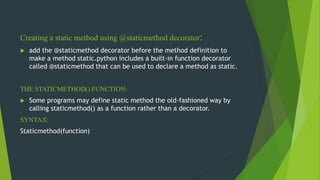
Creating a static method using @staticmethod decorator:
 add the @staticmethod decorator before the method definition to
make a method static.python includes a built-in function decorator
called @staticmethod that can be used to declare a method as static.
THE STATICMETHOD() FUNCTION:
 Some programs may define static method the old-fashioned way by
calling staticmethod() as a function rather than a decorator.
SYNTAX:
Staticmethod(function)
ADDING METHODS DYNAMICALLY
 The dynamic nature of python you can do many things in runtime , like add
method dynamically to an object or class.
Class person(object):
Pass
def play():
print(“I’m playing”)
P=person()
p.play=play
p.play()
Adding method to built-in types
 Python doesn’t allow to add method to built-in types , actually to any types
defined in C.The unique way around this is to subclass the type.
class UpperList(list):
pass
def to_upper(self):
for index, item in enumerate(self):
self[index]=item.upper()
UpperList.to_upper=to_upper
L=UpperList([‘I’,’g’,’o’,’r’])
l.to_upper()
Print (l)
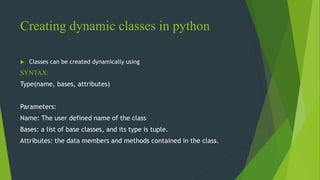
Creating dynamic classes in python
 Classes can be created dynamically using
SYNTAX:
Type(name, bases, attributes)
Parameters:
Name: The user defined name of the class
Bases: a list of base classes, and its type is tuple.
Attributes: the data members and methods contained in the class.
Create classes dynamically in python
 A class defines a collection of instance variables and method to
specify an object type.
 A class can be used to make as many object instances of the type of
object as needed.an object is an identified entity with certain
attributes and behaviour
 Group of object having similar characteristic and behaviour are the
instance of the same class.
 Python is a dynamic programming languages and due to its flexibility
python has a significant advantage over statically typed languages.
 Python code can be dynamically imported and classes can be
dynamically created at run-time.
 Classes can be dynamically created using the type() function in
python. The Type () function is used to return the type of the object.
SYNTAX:
Type(object)
THANK YOU

static method,adding method dynamically.pptx

  • 1.
    NADAR SARASWATHI COLLEGEOF ARTS AND SCIENCE, THENI. DEPARTMENT OF COMPUTER SCIENCE STATIC METHOD AND ADDING METHOD DYNAMICALLY Presented by: B.POORANI I-MSC(CS)
  • 2.
    STATIC METHOD  Staticmethod in python in comparison to instance methods, are not bound to an object , object state cannot be accessed or changed by static method.  Python does not automatically give the self or class parameters to static method.  In actuality , you define utility method or group function that have some logical relationship in a class using static method.  It is very similar to defining a regular function to define static method inside of a class.
  • 3.
    EXAMPLE Class name_of_class : @staticmethod defname_of_static_method(parameters_list): pass Print(‘static method defined’) CALLING A STATIC METHOD: • Without having to create a class instance , a static method can be called directly from the class. • Only static variables can be accessed by a static method ; instance variables are not accessible. SYNTAX : name_of_class.static_method_name()
  • 4.
    Creating a staticmethod using @staticmethod decorator:  add the @staticmethod decorator before the method definition to make a method static.python includes a built-in function decorator called @staticmethod that can be used to declare a method as static. THE STATICMETHOD() FUNCTION:  Some programs may define static method the old-fashioned way by calling staticmethod() as a function rather than a decorator. SYNTAX: Staticmethod(function)
  • 5.
    ADDING METHODS DYNAMICALLY The dynamic nature of python you can do many things in runtime , like add method dynamically to an object or class. Class person(object): Pass def play(): print(“I’m playing”) P=person() p.play=play p.play()
  • 6.
    Adding method tobuilt-in types  Python doesn’t allow to add method to built-in types , actually to any types defined in C.The unique way around this is to subclass the type. class UpperList(list): pass def to_upper(self): for index, item in enumerate(self): self[index]=item.upper() UpperList.to_upper=to_upper L=UpperList([‘I’,’g’,’o’,’r’]) l.to_upper() Print (l)
  • 7.
    Creating dynamic classesin python  Classes can be created dynamically using SYNTAX: Type(name, bases, attributes) Parameters: Name: The user defined name of the class Bases: a list of base classes, and its type is tuple. Attributes: the data members and methods contained in the class.
  • 8.
    Create classes dynamicallyin python  A class defines a collection of instance variables and method to specify an object type.  A class can be used to make as many object instances of the type of object as needed.an object is an identified entity with certain attributes and behaviour  Group of object having similar characteristic and behaviour are the instance of the same class.
  • 9.
     Python isa dynamic programming languages and due to its flexibility python has a significant advantage over statically typed languages.  Python code can be dynamically imported and classes can be dynamically created at run-time.  Classes can be dynamically created using the type() function in python. The Type () function is used to return the type of the object. SYNTAX: Type(object)
  • 10.