facts about sweden  |  Disability Policy
In Sweden, people with disabilities have the same right to an independent life as everyone else.
In 2011, the Swedish Government
launched a new strategy to guide its dis-
ability policy for the period leading up to
2016. The aim is to give people with disa-
bilities a greater chance of participating in
society on the same terms as others. Ten
priority areas have been identified, three
of which are given special attention: the
justice system, transportation and IT.
The justice system
All citizens should feel that laws are rea-
sonable and relevant, that the justice
system is there for them, and that it is
effective and ensures compliance with
their legal rights. Accordingly, police
authorities must analyse their operations
Disability Policy:
Dignity and democracy in Sweden
About 1.5 million people in Sweden have a disability of some kind. The principal goal of
Sweden’s disability policy has long been to ensure that people in this group have power and
influence over their everyday lives. To achieve this goal, the focus has been shifted from
social and welfare issues to democracy and human rights.
PHOTO:HANDIKAPPFÖRBUNDEN
sweden.se
from a disability perspective. In 2010, the
Swedish Prosecution Authority initiated
a project to assess how it disseminates
information to crime victims with disabili-
ties and how they may absorb such in-
formation. In 2012, the Swedish National
Courts Administration will develop an ac-
tion plan for making Swedish courts more
accessible.
Transportation
Having the possibility to travel without
hindrance is of vital importance to people
with disabilities. All citizens must be able
to work, study and take part in commu-
nity activities on equal terms.
	 To this end, the Swedish Government
has instructed the country’s municipali-
ties to initiate moves to make facilities
such as bus and tram stops more acces-
sible, and it is also reviewing The Disabil-
ity and Public Transportation Act. In ad-
dition, it is planning to introduce a new
law, establishing the rights of travellers
using local and regional public transport.
IT strategy
The public sector is using the internet as
an information channel to an increasing
extent. New IT tools may give people
with disabilities a greater degree of inde-
pendence. Special emphasis is therefore
being placed on digital inclusion in Swe-
den’s national IT strategy. n
facts about sweden  |  Disability Policy
2 |
sweden.se
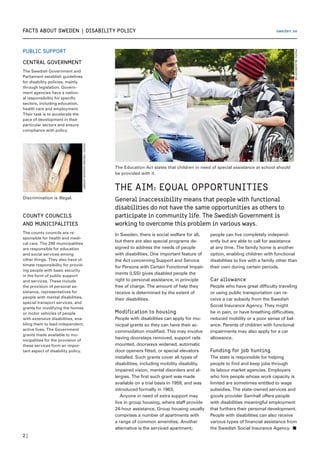
The Education Act states that children in need of special assistance at school should
be provided with it.
PHOTO:BILDARKIVET.SE
Public support
CENTRAL GOVERNMENT
The Swedish Government and
Parliament establish guidelines
for disability policies, mainly
through legislation. Govern-
ment agencies have a nation-
al responsibility for specific
sectors, including education,
health care and employment.
Their task is to accelerate the
pace of development in their
particular sectors and ensure
compliance with policy.
COUNTY COUNCILS
AND MUNICIPALITIES
The county councils are re-
sponsible for health and medi-
cal care. The 290 municipalities
are responsible for education
and social services among
other things. They also have ul-
timate responsibility for provid-
ing people with basic security
in the form of public support
and services. These include
the provision of personal as-
sistance, representatives for
people with mental disabilities,
special transport services, and
grants for modifying the homes
or motor vehicles of people
with extensive disabilities, ena-
bling them to lead independent,
active lives. The Government
grants made available to mu-
nicipalities for the provision of
these services form an impor-
tant aspect of disability policy.
The aim: equal opportunities
General inaccessibility means that people with functional
disabilities do not have the same opportunities as others to
participate in community life. The Swedish Government is
working to overcome this problem in various ways.
In Sweden, there is social welfare for all,
but there are also special programs de-
signed to address the needs of people
with disabilities. One important feature of
the Act concerning Support and Service
for Persons with Certain Functional Impair-
ments (LSS) gives disabled people the
right to personal assistance, in principle
free of charge. The amount of help they
receive is determined by the extent of
their disabilities.
Modification to housing
People with disabilities can apply for mu-
nicipal grants so they can have their ac-
commodation modified. This may involve
having doorsteps removed, support rails
mounted, doorways widened, automatic
door openers fitted, or special elevators
installed. Such grants cover all types of
disabilities, including mobility disability,
impaired vision, mental disorders and al-
lergies. The first such grant was made
available on a trial basis in 1959, and was
introduced formally in 1963.
	 Anyone in need of extra support may
live in group housing, where staff provide
24-hour assistance. Group housing usually
comprises a number of apartments with
a range of common amenities. Another
alternative is the serviced apartment;
people can live completely independ-
ently but are able to call for assistance
at any time. The family home is another
option, enabling children with functional
disabilities to live with a family other than
their own during certain periods.
Car allowance
People who have great difficulty traveling
or using public transportation can re-
ceive a car subsidy from the Swedish
Social Insurance Agency. They might
be in pain, or have breathing difficulties,
reduced mobility or a poor sense of bal-
ance. Parents of children with functional
impairments may also apply for a car
allowance.
Funding for job hunting
The state is responsible for helping
people to find and keep jobs through
its labour market agencies. Employers
who hire people whose work capacity is
limited are sometimes entitled to wage
subsidies. The state-owned services and
goods provider Samhall offers people
with disabilities meaningful employment
that furthers their personal development.
People with disabilities can also receive
various types of financial assistance from
the Swedish Social Insurance Agency. n
PHOTO:FREDRIKSWEGER/JOHNÉR
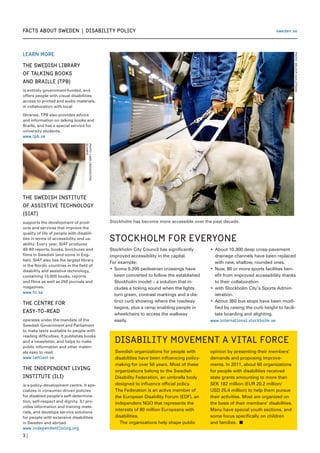
Discrimination is illegal.
facts about sweden  |  Disability Policy
Learn more
THE SWEDISH LIBRARY
OF TALKING BOOKS
AND BRAILLE (TPB)
is entirely government-funded, and
offers people with visual disabilities
access to printed and audio materials,
in collaboration with local
libraries. TPB also provides advice
and information on talking books and
Braille, and has a special service for
university students.
www.tpb.se
3 |
sweden.se
Disability movement a vital force
Swedish organizations for people with
disabilities have been influencing policy-
making for over 50 years. Most of these
organizations belong to the Swedish
Disability Federation, an umbrella body
designed to influence official policy.
The Federation is an active member of
the European Disability Forum (EDF), an
independent NGO that represents the
interests of 80 million Europeans with
disabilities.
	 The organizations help shape public
opinion by presenting their members’
demands and proposing improve-
ments. In 2011, about 60 organizations
for people with disabilities received
state grants amounting to more than
SEK 182 million (EUR 20.2 million/
USD 25.4 million) to help them pursue
their activities. Most are organized on
the basis of their members’ disabilities.
Many have special youth sections, and
some focus specifically on children
and families. n
PHOTO:MELKERDAHLSTRAND
Stockholm for everyone
Stockholm City Council has significantly
improved accessibility in the capital.
For example:
Some 5,200 pedestrian crossings have•	
been converted to follow the established
Stockholm model – a solution that in-
cludes a ticking sound when the lights
turn green, contrast markings and a dis-
tinct curb showing where the roadway
begins, plus a ramp enabling people in
wheelchairs to access the walkway
easily.
About 10,300 deep cross-pavement•	
drainage channels have been replaced
with new, shallow, rounded ones.
Now, 80 or more sports facilities ben-•	
efit from improved accessibility thanks
to their collaboration
with Stockholm City’s Sports Admin-•	
istration.
About 360 bus stops have been modi-•	
fied by raising the curb height to facili-
tate boarding and alighting.
www.international.stockholm.se
PHOTO:LARSLINDQVIST/DN/
SCANPIX
THE SWEDISH INSTITUTE
OF ASSISTIVE TECHNOLOGY
(SIAT)
supports the development of prod-
ucts and services that improve the
quality of life of people with disabili-
ties in terms of accessibility and us-
ability. Every year, SIAT produces
40-60 reports, books, brochures and
films in Swedish (and some in Eng-
lish). SIAT also has the largest library
in the Nordic countries in the field of
disability and assistive technology,
containing 13,000 books, reports
and films as well as 250 journals and
magazines.
www.hi.se
THE CENTRE FOR
EASY-TO-READ
operates under the mandate of the
Swedish Government and Parliament
to make texts available to people with
reading difficulties. It publishes books
and a newsletter, and helps to make
public information and other materi-
als easy to read.
www.lattlast.se
THE INDEPENDENT LIVING
INSTITUTE (ILI)
is a policy-development centre. It spe-
cializes in consumer-driven policies
for disabled people’s self-determina-
tion, self-respect and dignity. ILI pro-
vides information and training mate-
rials, and develops service solutions
for people with extensive disabilities
in Sweden and abroad.
www.independentliving.org
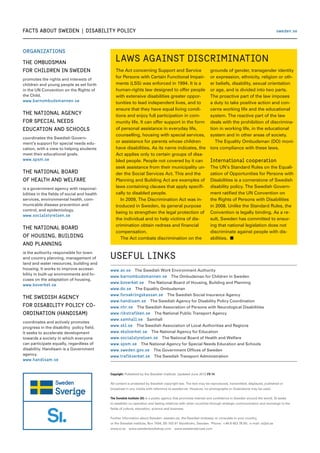
Stockholm has become more accessible over the past decade.
Organizations
THE OMBUDSMAN
FOR CHILDREN IN SWEDEN
promotes the rights and interests of
children and young people as set forth
in the UN Convention on the Rights of
the Child.
www.barnombudsmannen.se
THE NATIONAL AGENCY
FOR SPECIAL NEEDS
EDUCATION AND SCHOOLS
coordinates the Swedish Govern-
ment’s support for special needs edu-
cation, with a view to helping students
meet their educational goals.
www.spsm.se
THE NATIONAL BOARD
OF HEALTH AND WELFARE
is a government agency with responsi-
bilities in the fields of social and health
services, environmental health, com-
municable disease prevention and
control, and epidemiology.
www.socialstyrelsen.se
THE NATIONAL BOARD
OF HOUSING, BUILDING
AND PLANNING
is the authority responsible for town
and country planning, management of
land and water resources, building and
housing. It works to improve accessi-
bility in built-up environments and fo-
cuses on the adaptation of housing.
www.boverket.se
THE SWEDISH AGENCY
FOR DISABILITY POLICY CO-
ORDINATION (HANDISAM)
coordinates and actively promotes
progress in the disability policy field.
It seeks to accelerate development
towards a society in which everyone
can participate equally, regardless of
disability. Handisam is a Government
agency.
www.handisam.se
facts about sweden  |  Disability Policy
Copyright: Published by the Swedish Institute. Updated June 2012 FS 14.
All content is protected by Swedish copyright law. The text may be reproduced, transmitted, displayed, published or
broadcast in any media with reference to sweden.se. However, no photographs or illustrations may be used.
The Swedish Institute (SI) is a public agency that promotes interest and confidence in Sweden around the world. SI seeks
to establish co-operation and lasting relations with other countries through strategic communication and exchange in the
fields of culture, education, science and business.
Further information about Sweden: sweden.se, the Swedish embassy or consulate in your country,
or the Swedish Institute, Box 7434, SE-103 91 Stockholm, Sweden.  Phone: +46 8 453 78 00;  e-mail: si@si.se
www.si.se  www.swedenbookshop.com  www.swedenabroad.com
Useful links
www.av.se  The Swedish Work Environment Authority
www.barnombudsmannen.se  The Ombudsman for Children in Sweden
www.boverket.se  The National Board of Housing, Building and Planning
www.do.se  The Equality Ombudsman
www.forsakringskassan.se  The Swedish Social Insurance Agency
www.handisam.se  The Swedish Agency for Disability Policy Coordination
www.nhr.se  The Swedish Association of Persons with Neurological Disabilities
www.rikstrafiken.se  The National Public Transport Agency
www.samhall.se  Samhall
www.skl.se  The Swedish Association of Local Authorities and Regions
www.skolverket.se  The National Agency for Education
www.socialstyrelsen.se  The National Board of Health and Welfare
www.spsm.se  The National Agency for Special Needs Education and Schools
www.sweden.gov.se  The Government Offices of Sweden
www.trafikverket.se  The Swedish Transport Administration
sweden.se
Laws against discrimination
The Act concerning Support and Service
for Persons with Certain Functional Impair-
ments (LSS) was enforced in 1994. It is a
human-rights law designed to offer people
with extensive disabilities greater oppor-
tunities to lead independent lives, and to
ensure that they have equal living condi-
tions and enjoy full participation in com-
munity life. It can offer support in the form
of personal assistance in everyday life,
counselling, housing with special services,
or assistance for parents whose children
have disabilities. As its name indicates, the
Act applies only to certain groups of disa-
bled people. People not covered by it can
seek assistance from their municipality un-
der the Social Services Act. This and the
Planning and Building Act are examples of
laws containing clauses that apply specifi-
cally to disabled people.
	 In 2009, The Discrimination Act was in-
troduced in Sweden, its general purpose
being to strengthen the legal protection of
the individual and to help victims of dis-
crimination obtain redress and financial
compensation.
	 The Act combats discrimination on the
grounds of gender, transgender identity
or expression, ethnicity, religion or oth-
er beliefs, disability, sexual orientation
or age, and is divided into two parts.
The proactive part of the law imposes
a duty to take positive action and con-
cerns working life and the educational
system. The reactive part of the law
deals with the prohibition of discrimina-
tion in working life, in the educational
system and in other areas of society.
	 The Equality Ombudsman (DO) moni-
tors compliance with these laws.
International cooperation
The UN’s Standard Rules on the Equali-
zation of Opportunities for Persons with
Disabilities is a cornerstone of Swedish
disability policy. The Swedish Govern-
ment ratified the UN Convention on
the Rights of Persons with Disabilities
in 2008. Unlike the Standard Rules, the
Convention is legally binding. As a re-
sult, Sweden has committed to ensur-
ing that national legislation does not
discriminate against people with dis-
abilities. n

Disability policy in Sweden

  • 1.
    facts about sweden |  Disability Policy In Sweden, people with disabilities have the same right to an independent life as everyone else. In 2011, the Swedish Government launched a new strategy to guide its dis- ability policy for the period leading up to 2016. The aim is to give people with disa- bilities a greater chance of participating in society on the same terms as others. Ten priority areas have been identified, three of which are given special attention: the justice system, transportation and IT. The justice system All citizens should feel that laws are rea- sonable and relevant, that the justice system is there for them, and that it is effective and ensures compliance with their legal rights. Accordingly, police authorities must analyse their operations Disability Policy: Dignity and democracy in Sweden About 1.5 million people in Sweden have a disability of some kind. The principal goal of Sweden’s disability policy has long been to ensure that people in this group have power and influence over their everyday lives. To achieve this goal, the focus has been shifted from social and welfare issues to democracy and human rights. PHOTO:HANDIKAPPFÖRBUNDEN sweden.se from a disability perspective. In 2010, the Swedish Prosecution Authority initiated a project to assess how it disseminates information to crime victims with disabili- ties and how they may absorb such in- formation. In 2012, the Swedish National Courts Administration will develop an ac- tion plan for making Swedish courts more accessible. Transportation Having the possibility to travel without hindrance is of vital importance to people with disabilities. All citizens must be able to work, study and take part in commu- nity activities on equal terms. To this end, the Swedish Government has instructed the country’s municipali- ties to initiate moves to make facilities such as bus and tram stops more acces- sible, and it is also reviewing The Disabil- ity and Public Transportation Act. In ad- dition, it is planning to introduce a new law, establishing the rights of travellers using local and regional public transport. IT strategy The public sector is using the internet as an information channel to an increasing extent. New IT tools may give people with disabilities a greater degree of inde- pendence. Special emphasis is therefore being placed on digital inclusion in Swe- den’s national IT strategy. n
  • 2.
    facts about sweden |  Disability Policy 2 | sweden.se The Education Act states that children in need of special assistance at school should be provided with it. PHOTO:BILDARKIVET.SE Public support CENTRAL GOVERNMENT The Swedish Government and Parliament establish guidelines for disability policies, mainly through legislation. Govern- ment agencies have a nation- al responsibility for specific sectors, including education, health care and employment. Their task is to accelerate the pace of development in their particular sectors and ensure compliance with policy. COUNTY COUNCILS AND MUNICIPALITIES The county councils are re- sponsible for health and medi- cal care. The 290 municipalities are responsible for education and social services among other things. They also have ul- timate responsibility for provid- ing people with basic security in the form of public support and services. These include the provision of personal as- sistance, representatives for people with mental disabilities, special transport services, and grants for modifying the homes or motor vehicles of people with extensive disabilities, ena- bling them to lead independent, active lives. The Government grants made available to mu- nicipalities for the provision of these services form an impor- tant aspect of disability policy. The aim: equal opportunities General inaccessibility means that people with functional disabilities do not have the same opportunities as others to participate in community life. The Swedish Government is working to overcome this problem in various ways. In Sweden, there is social welfare for all, but there are also special programs de- signed to address the needs of people with disabilities. One important feature of the Act concerning Support and Service for Persons with Certain Functional Impair- ments (LSS) gives disabled people the right to personal assistance, in principle free of charge. The amount of help they receive is determined by the extent of their disabilities. Modification to housing People with disabilities can apply for mu- nicipal grants so they can have their ac- commodation modified. This may involve having doorsteps removed, support rails mounted, doorways widened, automatic door openers fitted, or special elevators installed. Such grants cover all types of disabilities, including mobility disability, impaired vision, mental disorders and al- lergies. The first such grant was made available on a trial basis in 1959, and was introduced formally in 1963. Anyone in need of extra support may live in group housing, where staff provide 24-hour assistance. Group housing usually comprises a number of apartments with a range of common amenities. Another alternative is the serviced apartment; people can live completely independ- ently but are able to call for assistance at any time. The family home is another option, enabling children with functional disabilities to live with a family other than their own during certain periods. Car allowance People who have great difficulty traveling or using public transportation can re- ceive a car subsidy from the Swedish Social Insurance Agency. They might be in pain, or have breathing difficulties, reduced mobility or a poor sense of bal- ance. Parents of children with functional impairments may also apply for a car allowance. Funding for job hunting The state is responsible for helping people to find and keep jobs through its labour market agencies. Employers who hire people whose work capacity is limited are sometimes entitled to wage subsidies. The state-owned services and goods provider Samhall offers people with disabilities meaningful employment that furthers their personal development. People with disabilities can also receive various types of financial assistance from the Swedish Social Insurance Agency. n PHOTO:FREDRIKSWEGER/JOHNÉR Discrimination is illegal.
  • 3.
    facts about sweden |  Disability Policy Learn more THE SWEDISH LIBRARY OF TALKING BOOKS AND BRAILLE (TPB) is entirely government-funded, and offers people with visual disabilities access to printed and audio materials, in collaboration with local libraries. TPB also provides advice and information on talking books and Braille, and has a special service for university students. www.tpb.se 3 | sweden.se Disability movement a vital force Swedish organizations for people with disabilities have been influencing policy- making for over 50 years. Most of these organizations belong to the Swedish Disability Federation, an umbrella body designed to influence official policy. The Federation is an active member of the European Disability Forum (EDF), an independent NGO that represents the interests of 80 million Europeans with disabilities. The organizations help shape public opinion by presenting their members’ demands and proposing improve- ments. In 2011, about 60 organizations for people with disabilities received state grants amounting to more than SEK 182 million (EUR 20.2 million/ USD 25.4 million) to help them pursue their activities. Most are organized on the basis of their members’ disabilities. Many have special youth sections, and some focus specifically on children and families. n PHOTO:MELKERDAHLSTRAND Stockholm for everyone Stockholm City Council has significantly improved accessibility in the capital. For example: Some 5,200 pedestrian crossings have• been converted to follow the established Stockholm model – a solution that in- cludes a ticking sound when the lights turn green, contrast markings and a dis- tinct curb showing where the roadway begins, plus a ramp enabling people in wheelchairs to access the walkway easily. About 10,300 deep cross-pavement• drainage channels have been replaced with new, shallow, rounded ones. Now, 80 or more sports facilities ben-• efit from improved accessibility thanks to their collaboration with Stockholm City’s Sports Admin-• istration. About 360 bus stops have been modi-• fied by raising the curb height to facili- tate boarding and alighting. www.international.stockholm.se PHOTO:LARSLINDQVIST/DN/ SCANPIX THE SWEDISH INSTITUTE OF ASSISTIVE TECHNOLOGY (SIAT) supports the development of prod- ucts and services that improve the quality of life of people with disabili- ties in terms of accessibility and us- ability. Every year, SIAT produces 40-60 reports, books, brochures and films in Swedish (and some in Eng- lish). SIAT also has the largest library in the Nordic countries in the field of disability and assistive technology, containing 13,000 books, reports and films as well as 250 journals and magazines. www.hi.se THE CENTRE FOR EASY-TO-READ operates under the mandate of the Swedish Government and Parliament to make texts available to people with reading difficulties. It publishes books and a newsletter, and helps to make public information and other materi- als easy to read. www.lattlast.se THE INDEPENDENT LIVING INSTITUTE (ILI) is a policy-development centre. It spe- cializes in consumer-driven policies for disabled people’s self-determina- tion, self-respect and dignity. ILI pro- vides information and training mate- rials, and develops service solutions for people with extensive disabilities in Sweden and abroad. www.independentliving.org Stockholm has become more accessible over the past decade.
  • 4.
    Organizations THE OMBUDSMAN FOR CHILDRENIN SWEDEN promotes the rights and interests of children and young people as set forth in the UN Convention on the Rights of the Child. www.barnombudsmannen.se THE NATIONAL AGENCY FOR SPECIAL NEEDS EDUCATION AND SCHOOLS coordinates the Swedish Govern- ment’s support for special needs edu- cation, with a view to helping students meet their educational goals. www.spsm.se THE NATIONAL BOARD OF HEALTH AND WELFARE is a government agency with responsi- bilities in the fields of social and health services, environmental health, com- municable disease prevention and control, and epidemiology. www.socialstyrelsen.se THE NATIONAL BOARD OF HOUSING, BUILDING AND PLANNING is the authority responsible for town and country planning, management of land and water resources, building and housing. It works to improve accessi- bility in built-up environments and fo- cuses on the adaptation of housing. www.boverket.se THE SWEDISH AGENCY FOR DISABILITY POLICY CO- ORDINATION (HANDISAM) coordinates and actively promotes progress in the disability policy field. It seeks to accelerate development towards a society in which everyone can participate equally, regardless of disability. Handisam is a Government agency. www.handisam.se facts about sweden  |  Disability Policy Copyright: Published by the Swedish Institute. Updated June 2012 FS 14. All content is protected by Swedish copyright law. The text may be reproduced, transmitted, displayed, published or broadcast in any media with reference to sweden.se. However, no photographs or illustrations may be used. The Swedish Institute (SI) is a public agency that promotes interest and confidence in Sweden around the world. SI seeks to establish co-operation and lasting relations with other countries through strategic communication and exchange in the fields of culture, education, science and business. Further information about Sweden: sweden.se, the Swedish embassy or consulate in your country, or the Swedish Institute, Box 7434, SE-103 91 Stockholm, Sweden.  Phone: +46 8 453 78 00;  e-mail: si@si.se www.si.se  www.swedenbookshop.com  www.swedenabroad.com Useful links www.av.se  The Swedish Work Environment Authority www.barnombudsmannen.se  The Ombudsman for Children in Sweden www.boverket.se  The National Board of Housing, Building and Planning www.do.se  The Equality Ombudsman www.forsakringskassan.se  The Swedish Social Insurance Agency www.handisam.se  The Swedish Agency for Disability Policy Coordination www.nhr.se  The Swedish Association of Persons with Neurological Disabilities www.rikstrafiken.se  The National Public Transport Agency www.samhall.se  Samhall www.skl.se  The Swedish Association of Local Authorities and Regions www.skolverket.se  The National Agency for Education www.socialstyrelsen.se  The National Board of Health and Welfare www.spsm.se  The National Agency for Special Needs Education and Schools www.sweden.gov.se  The Government Offices of Sweden www.trafikverket.se  The Swedish Transport Administration sweden.se Laws against discrimination The Act concerning Support and Service for Persons with Certain Functional Impair- ments (LSS) was enforced in 1994. It is a human-rights law designed to offer people with extensive disabilities greater oppor- tunities to lead independent lives, and to ensure that they have equal living condi- tions and enjoy full participation in com- munity life. It can offer support in the form of personal assistance in everyday life, counselling, housing with special services, or assistance for parents whose children have disabilities. As its name indicates, the Act applies only to certain groups of disa- bled people. People not covered by it can seek assistance from their municipality un- der the Social Services Act. This and the Planning and Building Act are examples of laws containing clauses that apply specifi- cally to disabled people. In 2009, The Discrimination Act was in- troduced in Sweden, its general purpose being to strengthen the legal protection of the individual and to help victims of dis- crimination obtain redress and financial compensation. The Act combats discrimination on the grounds of gender, transgender identity or expression, ethnicity, religion or oth- er beliefs, disability, sexual orientation or age, and is divided into two parts. The proactive part of the law imposes a duty to take positive action and con- cerns working life and the educational system. The reactive part of the law deals with the prohibition of discrimina- tion in working life, in the educational system and in other areas of society. The Equality Ombudsman (DO) moni- tors compliance with these laws. International cooperation The UN’s Standard Rules on the Equali- zation of Opportunities for Persons with Disabilities is a cornerstone of Swedish disability policy. The Swedish Govern- ment ratified the UN Convention on the Rights of Persons with Disabilities in 2008. Unlike the Standard Rules, the Convention is legally binding. As a re- sult, Sweden has committed to ensur- ing that national legislation does not discriminate against people with dis- abilities. n