Desiderata for Digital Editions
Peter Robinson
University of Saskatchewan
1. The text of both the document and of the
work should be encoded;
2. All editorial acts should be attributed;
3. All materials should, by default, be available
by a Creative Commons share-alike license;
4. All materials should be available independent
of any one interface;
5. All materials should be held in a sustainable
long-term storage system, such as an
institutional repository
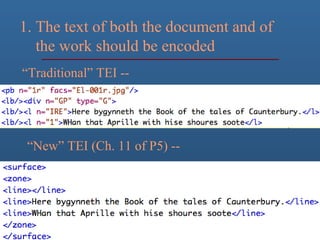
1. The text of both the document and of
the work should be encoded
“Traditional” TEI --
“New” TEI (Ch. 11 of P5) --
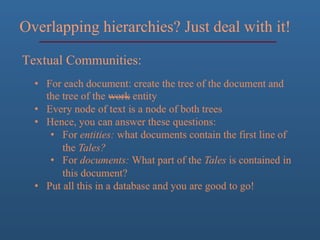
Overlapping hierarchies? Just deal with it!
Textual Communities:
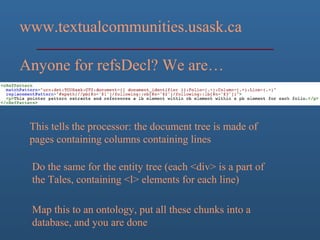
www.textualcommunities.usask.ca
Anyone for refsDecl? We are…
This tells the processor: the document tree is made of
pages containing columns containing lines
Do the same for the entity tree (each <div> is a part of
the Tales, containing <l> elements for each line)
Map this to an ontology, put all these chunks into a
database, and you are done
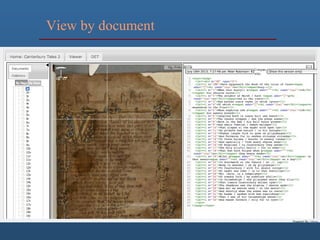
View by document
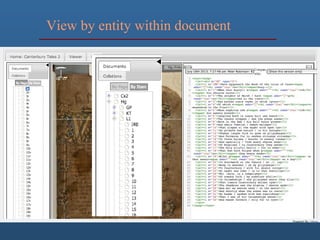
View by entity within document
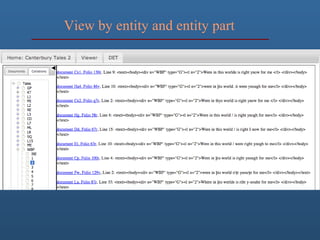
View by entity and entity part
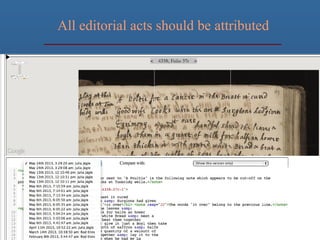
All editorial acts should be attributed
If you have the‘non-commercial’ restriction you might as
well lock it up and throw away the key
Kings College: 47 projects with digital output:
•23: “© 2011 Kings College London” or similar
•21: Specify restrictions (usually ‘non-commercial’)
•3: available without restriction (all from one group of
projects)
http://www.kuro5hin.org/story/2005/9/11/16331/0655 (“
Creative Commons -NC Licenses Considered Harmful”)
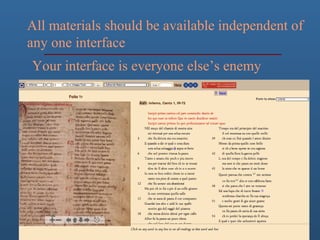
All materials should be available independent of
any one interface
Your interface is everyone else’s enemy
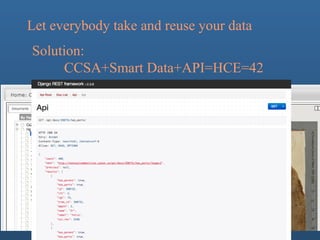
Let everybody take and reuse your data
Solution:
CCSA+Smart Data+API=HCE=42
Why digital humanists should get
out of textual scholarship
Peter Robinson
University of Saskatchewan
Social, Digital, Scholarly
Editing
Saskatoon, 11-13 July 2013
What I said
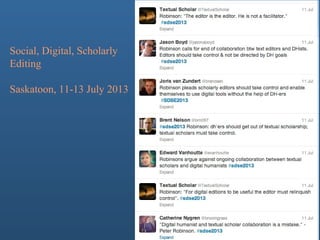
Collaboration between textual scholars and digital
humanists is a mistake
Digital humanists should get out of textual scholarship;
and if they don’t, textual scholars should throw them
out
What I did not say
Textual scholars should not use digital methods
NO. The medium has always been central to textual
scholarship. We have to know everything there is to
know about digital texts – and we have to make digital
texts.
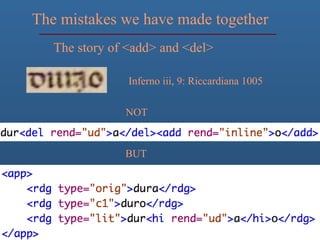
The mistakes we have made together
The story of <add> and <del>
BUT
Inferno iii, 9: Riccardiana 1005
NOT
The mistakes we have made together
• Digital scholarly editions are more than TEI
encoding
• Alan Galey is wrong. You don’t need to know PHP,
grep, Apache, the history of browsers, XSLT …
• Angle brackets are NOT good for you
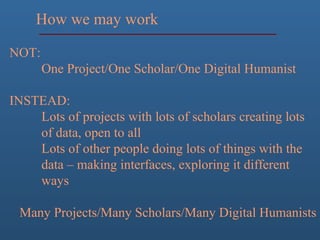
How we may work
NOT:
One Project/One Scholar/One Digital Humanist
INSTEAD:
Lots of projects with lots of scholars creating lots
of data, open to all
Lots of other people doing lots of things with the
data – making interfaces, exploring it different
ways
Many Projects/Many Scholars/Many Digital Humanists

Peter Robinson: 5 Desiderata for Digital Editions/Digital Humanists should get out of textual scholarship

  • 1.
    Desiderata for DigitalEditions Peter Robinson University of Saskatchewan
  • 2.
    1. The textof both the document and of the work should be encoded; 2. All editorial acts should be attributed; 3. All materials should, by default, be available by a Creative Commons share-alike license; 4. All materials should be available independent of any one interface; 5. All materials should be held in a sustainable long-term storage system, such as an institutional repository
  • 3.
    1. The textof both the document and of the work should be encoded “Traditional” TEI -- “New” TEI (Ch. 11 of P5) --
  • 4.
    Overlapping hierarchies? Justdeal with it! Textual Communities:
  • 5.
    www.textualcommunities.usask.ca Anyone for refsDecl?We are… This tells the processor: the document tree is made of pages containing columns containing lines Do the same for the entity tree (each <div> is a part of the Tales, containing <l> elements for each line) Map this to an ontology, put all these chunks into a database, and you are done
  • 6.
  • 7.
    View by entitywithin document
  • 8.
    View by entityand entity part
  • 9.
    All editorial actsshould be attributed
  • 10.
    If you havethe‘non-commercial’ restriction you might as well lock it up and throw away the key Kings College: 47 projects with digital output: •23: “© 2011 Kings College London” or similar •21: Specify restrictions (usually ‘non-commercial’) •3: available without restriction (all from one group of projects) http://www.kuro5hin.org/story/2005/9/11/16331/0655 (“ Creative Commons -NC Licenses Considered Harmful”)
  • 11.
    All materials shouldbe available independent of any one interface Your interface is everyone else’s enemy
  • 12.
    Let everybody takeand reuse your data Solution: CCSA+Smart Data+API=HCE=42
  • 14.
    Why digital humanistsshould get out of textual scholarship Peter Robinson University of Saskatchewan
  • 15.
  • 16.
    What I said Collaborationbetween textual scholars and digital humanists is a mistake Digital humanists should get out of textual scholarship; and if they don’t, textual scholars should throw them out
  • 17.
    What I didnot say Textual scholars should not use digital methods NO. The medium has always been central to textual scholarship. We have to know everything there is to know about digital texts – and we have to make digital texts.
  • 18.
    The mistakes wehave made together The story of <add> and <del> BUT Inferno iii, 9: Riccardiana 1005 NOT
  • 19.
    The mistakes wehave made together • Digital scholarly editions are more than TEI encoding • Alan Galey is wrong. You don’t need to know PHP, grep, Apache, the history of browsers, XSLT … • Angle brackets are NOT good for you
  • 20.
    How we maywork NOT: One Project/One Scholar/One Digital Humanist INSTEAD: Lots of projects with lots of scholars creating lots of data, open to all Lots of other people doing lots of things with the data – making interfaces, exploring it different ways Many Projects/Many Scholars/Many Digital Humanists

Editor's Notes