Nursing Care Plan
"ChronicPain"
Patient
Problem
( Actual )
Nursing diagnosis Chronic pain related to (contributing factor according to
the patient’s condition)
Subjective
Data
According to the nurse’s observation.
Objective
Data
According to the patient description.
Objectives
Short
term
In 2 days, the patient will demonstrate the use of different relaxation skills
and diversional activities as indicated for individual situation.
Long
term
In 2 weeks, the patient engage will in desired activities without an
increase in pain level.
Nursing
intervention
Assessment
Assess and document pain characteristics:
Quality (e.g., sharp, burning)
Severity (scale of 0 [meaning no pain] to 10 [meaning the most severe
pain])
Location (anatomical description)
Onset (gradual or sudden)
Duration (e.g., continuous, intermittent)
Precipitating factors.
Relieving factors.
- Rationale: Patient’s self-report is the most reliable information about the
chronic pain experience.
Assess and note for signs and symptoms related to chronic pain such as
weakness,decreasedappetite,weightloss,changesinbodyposture,sleep
pattern disturbance, anxiety, irritability, agitation, or depression.
- Rationale: Physiological changes and behaviors associated with acute
pain may not be exhibited by patients with chronic pain. The guarding
behavior of acute pain may become a persistent change in body posture
for the patient with chronic pain. Coping with chronic pain can reduce the
patient’s energy for other activities.
2.
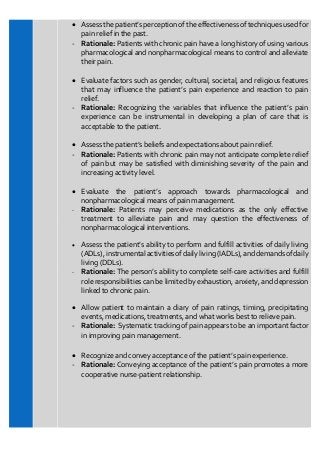
Assess thepatient’s perception of the effectiveness of techniques used for
pain relief in the past.
- Rationale: Patients with chronic pain have a long history of using various
pharmacological and nonpharmacological means to control and alleviate
their pain.
Evaluate factors such as gender, cultural, societal, and religious features
that may influence the patient’s pain experience and reaction to pain
relief.
- Rationale: Recognizing the variables that influence the patient’s pain
experience can be instrumental in developing a plan of care that is
acceptable to the patient.
Assess the patient’s beliefs and expectations about pain relief.
- Rationale: Patients with chronic pain may not anticipate complete relief
of pain but may be satisfied with diminishing severity of the pain and
increasing activity level.
Evaluate the patient’s approach towards pharmacological and
nonpharmacological means of pain management.
- Rationale: Patients may perceive medications as the only effective
treatment to alleviate pain and may question the effectiveness of
nonpharmacological interventions.
Assess the patient’s ability to perform and fulfill activities of daily living
(ADLs),instrumentalactivitiesofdailyliving(IADLs),anddemandsofdaily
living (DDLs).
- Rationale: The person’s ability to complete self-care activities and fulfill
role responsibilities can be limited by exhaustion, anxiety, and depression
linked to chronic pain.
Allow patient to maintain a diary of pain ratings, timing, precipitating
events, medications, treatments, and what works best to relieve pain.
- Rationale: Systematic tracking of pain appears to be an important factor
in improving pain management.
Recognize and convey acceptance of the patient’s pain experience.
- Rationale: Conveying acceptance of the patient’s pain promotes a more
cooperative nurse-patient relationship.
3.
interventions Aidthe patient in making decisions about choosing a particular pain
management strategy.
- Rationale: The nurse can increase the patient’s willingness to adopt new
interventions to promote pain relief through guidance and support. The
patient may begin to feel confident regarding the effectiveness of these
interventions.
Explore the need for medications from the three classes of analgesics:
opioids (narcotics), non-opioids (acetaminophen, Cox-2 inhibitors, and
nonsteroidal anti-inflammatory drugs [NSAIDs]), and adjuvant
medications.
- Rationale: Analgesic combinations may enhance pain relief
Maintain the patient’s use of nonpharmacological methods to control pain,
such as distraction, imagery, relaxation, massage, and heat and cold
application.
- Rationale: Cognitive-behavioral strategies can restore patient’s sense of
self-control, personal efficacy, and active participation in their own care.
Implement nonpharmacological interventions when pain is relatively well
controlled with pharmacological interventions.
- Rationale: Nonpharmacological interventions should be used to reinforce,
not replace, pharmacological interventions.
Health
Teaching
Provide the patient and family with adequate information about chronic pain
and options available for pain management.
- Rationale: Lack of knowledge about the characteristics of chronic pain and
pain management strategies can add to the burden of pain in the patient’s
life.
Discuss to patient and family the advantages of using nonpharmacological
pain management strategies.
Educate the patient and family about the use of pharmacological
interventions for pain management:
Evaluation
Achieved ( ) Partially achieved ( ) Not achieved ( )
Evidence by:
4.
Important Note
"We justrecommend examples of nursing care plans. There are many references and
interventions may change according to patient condition. You should consider this, search,
and see more than one reference to reach the best quality for writing the care plan"
![Nursing Care Plan
"Chronic Pain"
Patient
Problem
( Actual )
Nursing diagnosis Chronic pain related to (contributing factor according to
the patient’s condition)
Subjective
Data
According to the nurse’s observation.
Objective
Data
According to the patient description.
Objectives
Short
term
In 2 days, the patient will demonstrate the use of different relaxation skills
and diversional activities as indicated for individual situation.
Long
term
In 2 weeks, the patient engage will in desired activities without an
increase in pain level.
Nursing
intervention
Assessment
Assess and document pain characteristics:
Quality (e.g., sharp, burning)
Severity (scale of 0 [meaning no pain] to 10 [meaning the most severe
pain])
Location (anatomical description)
Onset (gradual or sudden)
Duration (e.g., continuous, intermittent)
Precipitating factors.
Relieving factors.
- Rationale: Patient’s self-report is the most reliable information about the
chronic pain experience.
Assess and note for signs and symptoms related to chronic pain such as
weakness,decreasedappetite,weightloss,changesinbodyposture,sleep
pattern disturbance, anxiety, irritability, agitation, or depression.
- Rationale: Physiological changes and behaviors associated with acute
pain may not be exhibited by patients with chronic pain. The guarding
behavior of acute pain may become a persistent change in body posture
for the patient with chronic pain. Coping with chronic pain can reduce the
patient’s energy for other activities.](https://image.slidesharecdn.com/3chronicpain-210620204651/85/Chronic-Pain-Nursing-Care-Plan-1-320.jpg?cb=1624222694)
![interventions Aid the patient in making decisions about choosing a particular pain
management strategy.
- Rationale: The nurse can increase the patient’s willingness to adopt new
interventions to promote pain relief through guidance and support. The
patient may begin to feel confident regarding the effectiveness of these
interventions.
Explore the need for medications from the three classes of analgesics:
opioids (narcotics), non-opioids (acetaminophen, Cox-2 inhibitors, and
nonsteroidal anti-inflammatory drugs [NSAIDs]), and adjuvant
medications.
- Rationale: Analgesic combinations may enhance pain relief
Maintain the patient’s use of nonpharmacological methods to control pain,
such as distraction, imagery, relaxation, massage, and heat and cold
application.
- Rationale: Cognitive-behavioral strategies can restore patient’s sense of
self-control, personal efficacy, and active participation in their own care.
Implement nonpharmacological interventions when pain is relatively well
controlled with pharmacological interventions.
- Rationale: Nonpharmacological interventions should be used to reinforce,
not replace, pharmacological interventions.
Health
Teaching
Provide the patient and family with adequate information about chronic pain
and options available for pain management.
- Rationale: Lack of knowledge about the characteristics of chronic pain and
pain management strategies can add to the burden of pain in the patient’s
life.
Discuss to patient and family the advantages of using nonpharmacological
pain management strategies.
Educate the patient and family about the use of pharmacological
interventions for pain management:
Evaluation
Achieved ( ) Partially achieved ( ) Not achieved ( )
Evidence by:](https://image.slidesharecdn.com/3chronicpain-210620204651/85/Chronic-Pain-Nursing-Care-Plan-3-320.jpg?cb=1624222694)