HEALTH CHOICES
AND
RESPONSIBILITIES
Bienvenido “Nonoy” Oplas, Jr.
Philippine Copyright © 2011
Bienvenido “Nonoy” Oplas, Jr.
Published by:
Central Book Supply, Inc.
927 Quezon Avenue, Quezon City
Philippines
in association with Minimal Government Thinkers Inc.
All rights reserved.
No part of this book may be reproduced, stored in a retrieval
system, or transmitted in any form or by electronic,
mechanical or other means, now known or hereafter
invented, including photocopying, and recording or any
information storage and retrieval system without the written
permission of the author.
ISBN 978-971-011-075-6
First printing January 2011
Quezon City, Philippines 1101
Dedication
This book is for the important women in my life:
Ella, my wife who helped edit some papers here
and watched the kids as I spent several long nights
polishing this book
Elle Marie and Bien Mary,
our young and lovely daughters
Nenita, my mother in law
Consuelo, my mother
Marycris, my sister, who provided me with various
logistical support in my work at MG Thinkers.
And
Cristela, one of our dear wedding godmothers,
who bravely fought a severe and rare cancer.
Our Creator has already taken her and gave her
eternal peace.
Acknowledgment
Aside from the people I have mentioned in the
Dedication, I would also like to thank the following
for their various support:
Bon Fernandez, for his artistic designs of the front
and back cover of this book.
International Policy Network (London), for their
continued support and confidence in Minimal
Government Thinkers, Inc.
Alas, Oplas and Co. CPAs - RSM, for providing MG
Thinkers free office space and other support all
these years.
Web Philippines, Inc. for hosting and administering
the MG website for free.
Fellow free market thinkers and leaders in Asia and
other parts of the world. People who advance the
principles of individual freedom and more personal
responsibility to create a peaceful and honest
society in the future.
Introduction
Finally, I am publishing my first book! I have been blogging
for more than five years now at
http://funwithgovernment.blogspot.com, The thought of
someday publishing my own book has been there since
about two or three years ago.
Since last year, I gave more public lectures, wrote more op-
ed articles, and posted more frequently in my blog on many
topics – health and medicines, climate, taxes and public debt,
trade, politics and political theory, humor, and so on. The
“itch” to produce a book was more intense recently. And
here it is!
I chose the topic on health for my first book for three
important reasons. One, healthcare is a very important topic
both for my policy studies and for personal reasons. Any of
my two daughters will get sick, or my wife or my old and
weak mother will get sick, I immediately get distracted from
work and writing.
Two, I have a number of first-hand information on some
public health issues in the country as I am a member of the
DOH Advisory Council on Price Regulation, recently
converted to DOH Advisory Council on Healthcare. I also
represent and head our free market think tank, Minimal
Government Thinkers (www.minimalgovernment.net) in an
alliance of mostly health and research NGOs called the
Coalition for Health Advocacy and Transparency (CHAT).
CHAT is the civil society partner of the Medicines
Transparency Alliance (MeTA) Philippines chapter. So I
have attended a number of public forum, lectures and
meetings by CHAT, MeTA Philippines and the DOH Advisory
Council over the past two years.
Three, I have written a lot about this sector in the past few
years, from intellectual property rights (IPR) to health
insurance to drug price control and so on. It is time to collate
the various papers I have written on the subject into a book.
All the short papers and op-ed articles here are posted in my
blog, including those that I have written for other media
outlets like www.thelobbyist.biz, the weekend tabloid
http://www.peoplesbrigadanews.com/wpress/index.php, and
guest op-eds in other national and international newspapers.
Those papers that I wrote just for my blog have been slightly
revised and edited here to correct some grammatical and
related errors.
Finally, I chose the title Health Choices and
Responsibilities because of my two firm beliefs: One,
people have control and choices in taking care of their body
and mind, that there are plenty of individual choices to be
healthy or be sickly, and there are many choices in financing
healthcare. And two, healthcare is mainly a personal and
parental responsibility, although a few health issues should
fall under government responsibility.
I hope that readers will find the ideas and data presented in
this book worth pondering, even if they are mostly “politically
incorrect” and contrary to mainstream perspectives on health.
Cheers!
Bienvenido “Nonoy” Oplas, Jr.
January 11, 2011 (1-11-11)
Table of Contents
Part 1. Short Articles and OpEds in 2009 Page
• DOH Advisory Council on Price Regulation, 2
meetings in June 2009
• Drug price cut without government price control 14
• Drug discount cards on facebook debate 16
• Discount cards vs. discounted competition 20
• Drug pricing and IPR on facebook 23
• MRP, GMA, DOH-K 26
• Health politics 27
• Double price control 29
• Innovation, competition and cheaper drugs 32
• Patrick Swayze, cancer and medicines 37
• One month of drug price control, initial assessment 39
• When civil society leaders embrace high taxes 41
• Patients’ vested interest: more choices 44
• Swine flu, leptospirosis and new medicines 46
• Alzheimer's and medicine innovation 49
• Mutant diseases and turtle research 51
• Healthcare is personal responsibility 55
• Drug price control, Sen. Pia style 58
• On health socialism 60
Part 2. Papers in 2 Conferences
Singapore, 2009: Access to medicines through 63
politics: Preliminary assessment of drug price
control policy in the Philippines
Cebu City, 2010: Property Right and Pricing Left 118
Under the Cheaper Medicines Law
Part 3. Short Articles and OpEds in 2010
• Drug price control and health socialism 136
• Healthcare, rights and responsibilities 137
• Prevention vs. Medication 140
• Uncontrolled passion for price control 142
• Cheap but not available 146
• Health is a right, health is personal responsibility 148
• Second round of politicized drug pricing 151
• CL and drug price control 152
• Health financing and market segmentation 155
• Medicinal elections 156
• Cancer and politics 159
• Health insurance monopoly 162
• Fat accumulation and capitalist accumulation 164
• Medicines, innovation and pricing 166
• Drug price control: 1 year of failure 169
• Drug price control a year after 171
• Drug promotions and government 174
• Centralized healthcare and malnutrition 176
• New vaccines, via competition or more regulations? 179
• Info asymmetry in healthcare 181
• Free market and better health 183
• PhilHealth bureaucracy 185
• Market segmentation vs. central planning, 189
health sector
• Mandatory drug price cuts 192
• PhilHealth's P110 B excess money 196
• New drugs, patents expiring and upcoming ones 198
• Patents, politics and personalized medicines 200
• AsPac pharma market and government 203
• Compulsory licensing deviation 205
• Drugs can heal, drugs can kill 206
• Cancer-fighting food and drugs 211
Extra: International reports where Mr. Oplas was
interviewed and quoted
PharmTech.com: Report from the Philippines 214
WSJ: Philippine Price Controls Hamper Rise of 216
Generics
Elsevier: Philippine Drug Price Controls Pinch 218
Brands And Generics
l
1
Part 1
Short Articles and OpEds in 2009
• DOH Advisory Council on Price Regulation,
meetings in June 2009
• Drug price cut without government price control
• Drug discount cards on facebook debate
• Discount cards vs. discounted competition
• Drug pricing and IPR on facebook
• MRP, GMA, DOH-K
• Health politics
• Double price control
• Innovation, competition and cheaper drugs
• Patrick Swayze, cancer and medicines
• One month of drug price control, initial assessment
• When civil society leaders embrace high taxes
• Patients’ vested interest: more choices
• Swine flu, leptospirosis and new medicines
• Alzheimer's and medicine innovation
• Mutant diseases and turtle research
• Healthcare is personal responsibility
• Drug price control, Sen. Pia style
• On health socialism
2
1. DOH Advisory Council on Price Regulation, meetings
in June 2009
(This is a merged and slightly expanded paper of my two
blog notes “DOH meeting on price regulation, part 1” and
“DOH meeting on price regulation, part 2”)
21 June 2009
The Department of Health (DOH), as mandated by the
Cheaper Medicines Law (RA 9502), is to form an “Advisory
Council on Price Regulation”. The Council was formed early
this year and so far they have conducted 5 meetings. I have
attended the last two meetings – the 4th
meeting last June 5
and the 5th
meeting last June 19. I have not attended the first
three council meetings, two of which were scheduled on
days that I was out of the country.
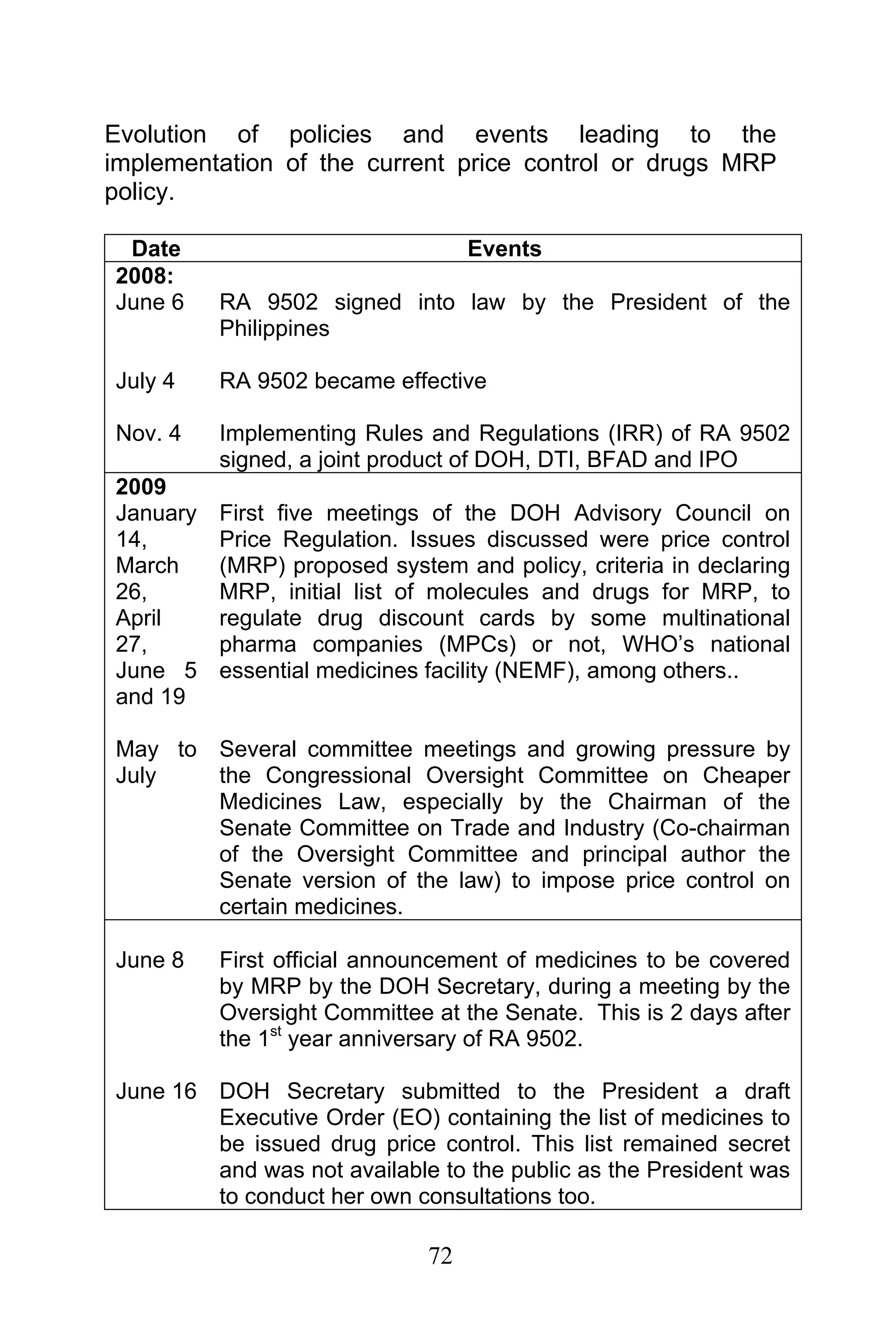
June 6 was the 1st
year anniversary of RA 9502. June 8
there was another meeting by the Senate Oversight
Committee on the law and the Committee is headed by Sen.
Mar Roxas.
The Advisory Council has a good mixture of participants. I
categorize them into 5 groups here:
(1) Federation of pharma companies, the Pharmaceutical
and Healthcare Association of the Philippines (PHAP) and
the Philippine Chamber of Pharmaceutical Industry (PCPI).
The former is composed mostly of multinational pharma
manufacturing and trading companies, while the latter is
composed of Filipino companies.
(2) Drug retailers, particularly Mercury Drugstore, the Drug
Store Association of the Philippines (DSAP), The Generics
Pharmacy, and Watsons.
3
(3) Civil society groups, particularly the Cut the Cost, Cut the
Pain Network (3CPNet) - Medical Action Group (MAG),
Cancer Warriors Foundation (CWF), Ayos na Gamot sa Abot
kayang Presyo (AGAP), and Minimal Government Thinkers.
I represent the last group.
(4) Multilateral institutions like the European Council (EC),
World Health Organization (WHO), GTZ (German foreign
aid), etc. Although I think not all of them attend the meetings
every time, only on issues where they have some
involvement or projects. The UPSE Health Policy
Development Project (HPDP), funded by USAID I think, also
attends the meeting.
(5) DOH and other government agencies like the
Department of Trade and Industry (DTI), Bureau of Food and
Drugs (BFAD), and the Philippine International Trading
Corporation (PITC).
The 4th meeting last June 5 was held at the WHO Western
Pacific Regional Office (WPRO). The main agenda then
were (a) WHO's national essential medicines facility (NEMF),
(b) list of medicines for possible issuance of maximum retail
price (MRP), and (3) a draft proposal by DOH to regulate
discount cards by pharma companies.
The goal of NEMF is to "harmonize and ensure uniform
standards of procurement across the public sector, ensure
selection of reliable suppliers of quality products" The
essential medicines targeted are for (a) TB, HIV and malaria,
(b) vaccines, (c) emergency obstetric care, (d) chronic
diseases, (e) neglected diseases, and (f) PhP program and
"botika ng barangay" (village pharmacy).
The discussion on list of medicines for issuance of maximum
retail price (MRP) or price control was long. DOH
UnderSecretary Alex Padilla, USec for Health Regulations
and convenor of the Council, narrated how difficult it is to
4
face legislators who want price control, just to show to the
public that the government is indeed "serious" in enforcing
the cheaper medicines law. The DOH understands that it's
not easy to issue price control and fully implement it, but
they are sometimes castigated in media by the legislators as
"in cahoots with multinational pharma."
One will understand if PHAP will oppose drug price control
because it is the patented and branded drugs by
multinational pharma companies that are most likely to be
targeted. One may even assume that PCPI will not object to
price control because the products of their members are
non-patented and generics. But PCPI leaders were very
vocal in opposing drug price control.
This is because price control is essentially penalizing
success. Any drug that has become popular and highly
saleable, whether patented or not, can be a target for price
control. Many PCPI members are now good manufacturers,
they are capable of producing popular medicines. That ugly
state intervention in pricing called MRP will soon hit them.
I spoke, of course, on this subject at the meeting. I noted
that price control is a favorite advocacy of socialists under
economic central planning regime. It is driven by plain envy
with "suffering of the masses" as smoke screen.
Suffice it to say that with the exception of two voices in the
meeting, almost everyone, including drug retailers, agreed
that imposing price control at this time is ill-advised. It’s a
proposal that was not supported by the majority of the
Council members.
The subject of DOH regulation of discount cards by some
multinational pharma companies was tackled next. It was the
first time I heard that it is an issue. The DOH wanted to
produce a draft Administrative Order proposing that
whatever is the current discount price by those pharma
5
companies (usually 50 percent off their regular price) should
become the “universal price” and must apply to all customers
and patients, with or without any discount card.
There were two major arguments I could remember, that
were raised in favor of this move. First, discount cards favor
the rich, they are the ones who can afford to see a doctor
regularly and doctors give out discount cards. And since
discounts represent some revenue losses to the
manufacturers, such loss has to be recouped from the
regular customers, the non-card holders, who are the poor.
Second, discount cards allow the pharma companies to have
access to some health record of the patients, and there is
ethical violation there.
I spoke twice on this subject. First, discount cards I think are
marketing tools by suppliers and manufacturers; it is a
unilateral, voluntary act on their part, hoping to increase their
revenues and profit either in the short- or long-term. Such
voluntary acts therefore, should be encouraged, not
penalized. When discount cards are to be banned and
whatever discount price was to be made mandatory, a
cousin of price control in effect, I think this is penalizing
those who initiated the discount. Such mandatory pricing
would be more palatable if government will also offer
mandatory reduction in business regulations and taxes for
the affected suppliers. Since this is not forthcoming, then the
move is pure penalty, not reward for a good job done.
Second, giving out information about the patient’s health
record is no different from filling up an application form to
apply for a credit card or open a bank account, where the
applicant is giving away his/her personal information like
monthly salary, if the house is owned or rented, how many
cars owned, etc.
The replies to my points were as follows. On the first, it is not
easy to expect the government to cut business regulations,
6
much less cut taxes, for suppliers who are offering unilateral
discount promotions. On the second, information via credit
card application is way below personal health information,
they are not comparable. Health is on the top, above almost
everything else. Hence, personal health information should
not be accessed by just anyone, much less pharmaceutical
manufacturers.
Anyway, we were asked to submit our formal position papers
on this subject as the Office of the President was also
waiting for the proposals of the DOH as collated from its
various consultations.
It was a productive and very informative meeting, and I
thanked the DOH officials and staff who were there for
conducting such meeting and inviting a diverse group of
participants.
The 5th
Advisory Council meeting
The meeting was held last Friday, June 19, at the DOH.
There were 3 topics discussed. First, an update on drugs
that were recommended for MRP issuance by the President.
Second, the proposed administrative order by the DOH on
how to implement the MRP once the draft Executive Order
(EO) is signed by the President. And third, the electronic
data base on comparable drug prices, under the DOH
website.
The DOH Secretary submitted the draft EO to the President
only last Tuesday, June 16. The first official announcement
of list of drugs under MRP was last June 8, during the
Congressional Oversight Committee hearing at the Senate,
where Sen. Mar Roxas, an LP Presidential candidate, most
likely pressured the DOH to produce a list of drugs for MRP.
The timing was suspect because it was one year since the
enactment of RA 9502, June 6, 2008, and there was no clear
national health emergency.
7
Were there new list of drugs for MRP? Maybe, no one
knows yet except the DOH and the Office of the President.
Between the announcements at the Congressional Oversight
Committee meeting last June 8 to June 16, there could have
been new drugs or those in the mentioned list may have
been removed. The DOH said from 100 molecules, they later
pared the list down to 25 molecules. The final list is with the
President, and she will also make her own consultations
before signing the draft EO.
Many of us who attended the meeting last Friday were also
surprised that the MRP was pushed through considering that
the majority sentiment during the 4th Council meeting last
June 5, was that MRP is not necessary now, it should have
not been pushed. PCPI reiterated their position that they are
not in favor of issuing MRP now. I also spoke and argued
that price-setting is not a function of the government. Since
we advocate minimal government, there is no way that we
can support State intervention in setting prices, in price
control.
After another long and extended discussion on the
inappropriateness of medicine MRP, the topic shifted to
BFAD’s Administrative Order (AO) on how the draft EO will
be implemented. About 3 pages long, saying that drug
manufacturers, distributors, retailers, etc. should put the
label "price not to exceed the MRP of ____".
This proposal was shot down, not only by the pharma
companies (multinationals and domestic) but also by leaders
of drug stores. The main argument is that if there are signs
that the prices of drugs that have been identified for MRP
are coming down to 50 percent or lower, then no labeling will
be necessary. Voluntary compliance should be encouraged.
Since there are around 5,000 to 7,000 drugstores nationwide,
the labeling will have to be done there – drugstore by
drugstore, pack by pack, capsule by capsule, etc. This will
8
present a new logistical nightmare. There was a proposal to
have a "transition period" of 3 months between the issuance
of the EO and the actual implementation of price labeling.
Some civil society groups objected, but they were later
convinced of the complexity of hurrying the labeling.
I also suggested that since the government has intervened a
lot already in drug pricing, government should show some
sacrifice. For instance, should price labeling be necessary
for some drugs, it should be the government that should do it,
not the drug suppliers who already suffered huge revenue
cuts, if not suffer losses, with the mandatory and forcible
price control. Many participants from the government
agencies howled in disapproval of my proposal.
The 3rd and last agenda was the electronic database for
comparable drug prices. Although there are some noble
goals for coming up with this list, aside from being mandated
or suggested by the new law and its implementing rules and
regulations (IRR), the list is projected to raise more high
expectations from the public which will only result in high
disappointment. For instance, some drugstores will cite
prices for the e-database that are lower than their actual
retail price and produce various reasons why they did so.
One vocal participant in the meeting commented on the side
that we need minimal government on issues like drug pricing.
Thumbs up to him, actually, a former friend way back from
our undergraduate days at the University of the Philippines
(UP) in Diliman campus.
Earlier, there was a discussion how to expand the number of
participants in the Advisory Council meetings since certain
important players were left out. For instance, people have
assumed that all multinational pharma companies are
members of PHAP and so, PHAP officials can articulate their
sentiments. Turns out that there are 3 multinational pharma
companies that are not members of PHAP – Pfizer, Servier,
9
and Merck. So these companies are expected to be invited
in the next Council meeting next month, before the State Of
the Nation Address (SONA) of the President.
The quality of discussions and debates in the Council
meetings is high and very transparent. People who have
“great” ideas on something can expect that it can be shot
down if such grand ideas are not backed up by robust
philosophies and solid data. Unlike in Congressional
hearings where the presence of legislators is very imposing
and dominating, the discussions in the Advisory Council
meetings are more free-wheeling, fast and frank.
-------
Meanwhile, below is the paper that I sent to the DOH after
the June 5, 2009 meeting.
10
Position paper on the implementation of
Maximum Retail Price (MRP) provision of RA 9502
June 6, 2009
Although the maximum retail price (MRP) or price control
provision was incorporated in the Cheaper Medicines Law or
RA 9502, it should be used only as a last resort. This is
because price control is a draconian measure that can
discourage the entry of more players that can otherwise add
to more competition, and/or result in exit of some of players
in the economy, which will ultimately lead to a monopolistic
or oligopolistic industry structure, which is contrary to public
interest.
There have been indicators that medicine prices are coming
down – PCPI, PHAP and some drug store associations’
figures would show – and this is already one proof that other
provisions of RA 9502 were successful. We just have to
encourage the entry of more players, especially among
generics manufacturers, distributors and drugstores, to
mature. Thus, draconian measures like MRP should be used
only as a last resort, not to be implemented without apparent
national health emergencies.
The eyes of the public are on the few multinational
pharmaceutical companies in the country. Many or all of
these are suspected by the public of “price gouging” and
“ultra-high profit” through transfer pricing and high patented
medicine prices.
But there are so many innovator pharmaceutical companies
in the world that are not in the Philippines yet. And even
plentier are good generics manufacturers from other
countries. Even if just 10 percent of those big innovator and
generics companies abroad that are not yet here would
come, that will greatly expand competition and the public.
11
Filipino patients especially, will benefit with wider choices of
more effective and safe medicines at competitive prices.
In a sense, it can be said that high medicine price is a
function of or determined by – aside from high and multiple
taxes on medicines – lack of competition. Although, there
may be 2 or 3 dozen innovator companies in the country, not
all of them compete on each and every medicine products
for all types of diseases. It is possible that for a particular
disease, there are is only 1 or 2 or 3 medicine manufacturers
and sellers.
This is like there are several dozen bus companies in the
Philippines. True, but they do not compete with each other in
all or most routes. The bus companies plying the north-west
Luzon provinces do not compete with bus companies in
north-east Luzon, with bus companies in southern Luzon, in
the island-provinces of southern Luzon, in the Visayas, in
Mindanao.
In the initial list of drugs made by the DOH that are
“candidates” for MRP issuance, a number of those medicine
products indeed have only 2 to 4 suppliers, both innovator
and generics. This is a thin field for competition. If the
government will impose an MRP on the price of the most
popular medicines, then the manufacturer or distributor of
that medicine may pull out because it will be losing money.
That leaves with only 1 to 3 suppliers, making the field of
competition even thinner. And, the options for the patients
become narrower.
There are various reasons for the non-entry of other
multinational and innovator pharma companies into the
Philippines in the past. Current policies therefore, should not
add to such undesirable factors that can discourage or scare
them further from entering the Philippine market and its 92
million citizens, growing at 1.8 million people per year, net of
death and migration. The MRP or price control provision
12
without apparent national health emergencies can be subject
to abuse. Politicians, health regulators, media and the public,
can clamor for price control of any popular and effective
medicines if they wish to, and the manufacturers and
distributors of such medicines will suffer revenue cuts if not
losses. This should be one of the factors that can scare
those foreign pharma companies from entering the
Philippine market.
The list of potential innovator players that can come into the
Philippines is indeed very big. Even if just 10 percent of the
above list would enter the Philippines, that would mean 15
additional innovator pharma companies here, with their wide
range of effective and safe medicines, giving additional
choices for Philippine-based patients.
The level of competition among innovator companies in the
Philippines, even among multinationals, is very limited.
There is a big challenge, therefore, for the Philippines to
provide a welcome mat for many of those companies,
innovator or generics, from anywhere in the world to come
here, to further expand competition and choice for the public.
Some Philippine-based pharma companies, innovator or
generics, multinational or domestic, may find this a “bad
news”. But this is not entirely so. Wider playing field means
that the government’s interventionist and bureaucratic hands
are staying away, allowing companies to focus more on
improving their products and services for their customers,
and they spend less time on complying with old and new
regulations, they spend less on taxes and fees.
It is a win-win situation for all – pharma companies, drug
stores, patients and the government. Pharma companies will
have more leeway for innovation and services improvement.
Drug stores will have more drugs to choose and sell.
Patients will have more choices among so many suppliers of
effective and safe medicines. And government will have
more time to focus on its core functions like maintaining
13
peace and order, justice administration, less resources and
bureaucracies to be spent on medicine procurement and
health regulations and monitoring.
When there is a wide field of competition among pharma
manufacturers and distributors, foreign patients abroad will
notice this. Thousands of them, as well as Filipinos based
abroad, who are seeking quick and quality health care will
come to the Philippines because they know that there is a
wide range of safe medicines available here from so many
innovator companies from around the world.
This will help the local "medical tourism" industry, many
private hospitals will also be putted up, which will create
thousands of jobs for Filipino nurses, physicians,
pharmacologists, and other health professionals. Many of
these Filipino professionals then need not work abroad as
foreigner and "kababayan" patients are coming here by the
thousands.
If we have to extend the discussion, in the absence of any
clear and compelling national health emergencies,
government should keep at bay the provisions not only on
MRP, but also of compulsory licensing (CL).
The main goal of RA 9502 is to bring down the price of safe
and effective medicines. If this can be achieved by greater
competition among players – and there are good indicators
that competition is kicking in slowly that result in lower prices
of a number of medicines – then the above-mentioned
provisions like MRP and CL should indeed be kept as last
resort measures.
14
2. Drug price cut without government price control
29 June 2009
I read the news report in the Inquirer today. Sanofi Aventis is
cutting the price of its anti-diabetes medicine for patients
affiliated with ISDF, a health NGO. I think this is a welcome
move, a unilateral action on the part of a pharma company to
bring down the price of its anti-diabetes medicines for
selected, target patients.
My brother who died of prostate cancer a few years ago,
was also diabetic. It was a deadly combination, diabetes +
prostate C. He was lucky to have a private HMO plus my
well-off sister's support who practically picked up most of the
tab in his 2-years of messy and expensive treatment
including chemo. The government? It was collecting taxes
left and right for all the medicines that my dying brother was
taking.
In the past 2 meetings of the DOH Advisory Council on price
regulation that I have attended, there was a general feeling
that whatever price reduction that a pharma company can
give to certain patients, should be made as mandatory and
"universal price" for all other patients.
I am not exactly in favor of such proposal because the
pharma companies, domestic or multinational that extend
such kind of price cut to certain groups or patients, have
educational programs for their patients. They know who are
the people buying their medicines, especially the poor
patients, so the pharma companies that initiated the price cut
can also give additional medical advice, like how to avoid
diabetes in the first place. If such initiative is ok, Sanofi will
make it a nationwide program, meaning nationwide price cut
of their anti-diabetes medicine. Maybe through the patients'
pysicians, if no NGO support groups like ISDF are not
around.
15
------------
http://newsinfo.inquirer.net/inquirerheadlines/metro/view/200
90629-212891/Price-of-antidiabetes-medicine-cut
Price of antidiabetes medicine cut
By DJ Yap
Philippine Daily Inquirer, 06/29/2009
MANILA, Philippines—Combating diabetes among indigent
Filipinos has taken a step for the better—and the cheaper—
thanks to a new partnership between the pharmaceutical
company Sanofi-Aventis and the Institute for Studies on
Diabetes Foundation Inc. (ISDF).
The two institutions launched on June 23 a new program
called “Innovation for Life,” a new, equitable, tiered-pricing
approach toward increased access to insulin glargine
(Lantus)—Sanofi-Aventis’ diabetes medicine—among
patients who could otherwise not afford it.
Dr. Ricardo Fernando, the founder of ISDF, said the project,
which is seen to benefit more than 500 ISDF patients at the
outset, was developed “not only for the next few months but
for the long term…. We have to remember that the most
expensive medicine is the one that does not work”….
16
3. Drug discount cards on facebook debate
19 July 2009
Yesterday, after reading some Manila newpaper columnists'
articles on drug discount cards, I posted a status in my
facebook account. Shortly after, several friends commented.
Below are the actual comments. I thank them -- Elizabeth
Cueva, a friend from UP and now a practicing lawyer in NYC;
Eric Tolentino also from UP, and Gene Peters, for giving me
permission to post here their comments.
Below are the exchanges:
----
Nonoy Oplas (is) Reading a number of news articles and
opinions on drug discount cards. I only realized recently this
is a big issue here in Manila. A marketing promo is now
being pushed to be a mandatory promo; if you don't do it,
you're an evil. hmmmm...
hi nonoy. isn't this really a way to track the doctor who
prescribes the company's medicines instead of really giving
discounts. great way to go around the senior citizen's benefit
too! - Gil
Hi Gil. Yes -- track the doctors, the med reps, the patients,
the drug stores, everyone who willingly agrees to the
scheme, in exchange for lower price and continued
patronage of a particular drug. If those pharma companies
will distribute their discount cards to all doctors nationwide,
let them continue their marketing promo, the State should
get out of such promo. The State can invite more pharma
companies to come in, launch their own promos, overall the
patients will benefit. -- Nonoy
Yeah, the State should get out of the drug discount promo
deal. It defeats the purpose as a marketing tool. The market
17
should drive it. People in the Philippines are actually luckier
when it comes to access to vital life-saving medications. The
state of the current U.S. health care system sucks big time. -
- Elizabeth
Ah, many Filipinos do not realize that, thanks Elizabeth.
Instead of recognizing the presence and merit of the few
multinational pharma companies in the Philippines -- there
are soooo many other multinational pharma companies that
are not yet here that could help increase competition -- those
few are being demonized. Even their promos, a unilateral
and voluntary act on their part, is being seen as an evil
scheme. -- Nonoy
I should know. My grandma and my mom are both
pharmacists/ med techs there and their family used to own
boticas in the Sampaloc, Manila area. The prices were lower
with these "mom and pop" boticas which were wiped out by
big drug conglomerates Mercury, Commodore. Still, the
prices are more affordable than in the U.S. and generic
medication more accessible. Thanks to Flavier for pushing
the generic brands.
Here in the U.S. when I lost a job, I lost employer-subsidized
medical and drug insurance coverage. I now have to shell
out money for COBRA medical/drug insurance coverage and
IT HURTS. The coverage is not even enough and I have to
shell out more every visit to the doctor for treatment or
prescription. So, for me prevention is really key. It is really
fatal to get even slightly sick here in the U.S. without medical
or drug insurance coverage because of the prohibitive price
of medical care, treatment and medicines. -- Elizabeth
Commodore drug, wala na yata dito. Mercury and Watsons
are the biggest drugstores now. The mom-and-pop type of
boticas are partly being wiped out by government regulations.
They make only about 5 to 15% profit margin because of
18
competition, but the senior citizens discount is 20%
mandatory. Such loss is not even tax deductible. -- Nonoy
I read somewhere that in countries like India, exactly similar
drugs (hypertension) can be purchased for just 1/5 the cost
here. How true? And how can I get my hands on those drugs?
Gimme, gimme... -- Eric Tolentino
Hi Eric, PITC, a government corporation, made that study,
no one bothered to double-check the figures and
computations. Even if the numbers are correct (ie, only 1/5
of price in India), those are prices there, not here. When
those cheap medicines are imported into the Philippines,
there are several costs to include: transport and storage,
taxes (import tax, import processing fee, import doc stamp
tax, local tax, VAT, etc.). When sold in drugstores, they are
expensive again.
Also, note that it's under a parallel importation scheme. The
foreign manufacturer abroad (say GSK or Pfizer or Roche,
etc.) is different from the foreign wholesaler or aggregator, is
different from the Philippine importer and distributor. If the
imported drugs turn out to be fake or substandard causing
allergies or death to patients, difficult to pinpoint who's to
blame. -- Nonoy
Health care problems since then is a big issue in Manila,
with a growing populace and deteriorating quality of living
Manilans are more susceptible in many forms of ailment.. the
real problem here is our policy on health care are lame and
useless that’s why they put another issue on top of one that
will never solve the basic problem of health care for all,
benefits for some sectors are mere band aid solutions..while
pharma companies rakes in the profits.. of course with the
help of our caring doctors. -- Gene Peters
Hi Gene, in the first place, health care is personal and
parental responsibility, not government responsibility. People
19
should not over-drink, over-smoke, over-eat fatty food, over-
sit and live sedentary lifestyle, over-fight and get into
frequent rumbles, etc. Pharma companies exist because
there is a demand for them, the same way that beer, burger
and cellphone producers exist because there is a demand
for them. When medicine prices are high, blame the govt.
high and multiple taxes on drugs, blame the lack of
competition among pharma companies because of govt.
bureaucracies. Soooo many multinational pharmas, the
innovator ones especially, are not yet here in the Phils. --
Nonoy
Health care is also a government responsibility, but the
policies must be salutary and not detrimental to general
welfare. Just like what Gene said, it should not be a band aid
approach. So, for me, government's role is not really to
regulate and restrict but to facilitate access to high quality
health care with lower costs for all. -- Elizabeth
Ok, I forgot to add in my earlier reply to Gene that
government has secondary responsibility to health care. Like
in cases of pandemic and outbreak of contagious diseases.
In the absence of such health emergencies, government
should back out, allow more competition among private
hospitals and clinics, more pharma and drugstore companies,
etc. When one or some pharma companies introduce fake
and substandard medicines that can result to more disease,
if not death to patients, government comes in to enforce the
rule of law -- no killing, no harming, no stealing, etc. -- Nonoy
20
4. Discount cards vs. discounted competition
09 July 2009, http://www.thelobbyist.biz
In a competitive business environment, enterprises resort to
various forms of competition in terms of (a) quality (who has
the most durable, most reliable, most effective, safest) and
(b) price (who has the cheapest, most cost-effective).
More players, more competition, more marketing schemes
and more price discounts promo. Ultimately, the consumers
will benefit because they will have lots of options and
choices among the various producers and suppliers of the
products that they need based on their particular tastes,
preferences, needs and budget.
The proper role of the government therefore, is to encourage
more competition among different enterprises and producers,
not stifle it. And for government to successfully encourage
competition, all it has to do is practically do nothing. Do not
over-regulate. Do not bureaucratize. Do not impose high
and multiple taxes and fees. Do not intervene anytime for
any alibi. Just step back and watch for whoever is doing foul
and harmful schemes. Like producing cheap but poisonous
food and drinks, cheap but structurally defective houses,
cheap but fake and substandard drugs. People will really
appreciate it when government comes in and intervene in
cases like these because there is physical harm being done
or about to happen to the public.
Recently, discount cards and coupon promos by some drug
manufacturers became a negative public issue. The issue is
that if those pharmaceutical companies are capable of
selling their drugs (patented or generic) at 30 to 50 percent
discount or higher to those who hold their discount cards,
why not make it a “universal” price for all consumers, with or
without a discount card. Why give those discount cards only
to doctors in expensive clinics and hospitals for their rich and
21
the middle class patients, why not give the same privilege
also for patients who cannot afford to see a doctor.
Since there is obvious “class” discrimination among rich and
poor patients, government should come in and mandate or
force those drug companies to remove those discount cards
altogether and sell their drugs at the existing discount price.
This does not seem to fall in the above definition of where
government is expected to keep out or come in. There was
no harm to the public when some companies would give
price discounts to patients who voluntarily signed into some
discount cards. The patients signed in voluntarily like they
sign in to their yahoo or gmail or facebook account. The
service provider – web-based email or social networking or
pharma company – asked the person to give his/her name,
age, etc. in exchange for a particular favor, like free email
account or highly-discounted medicine prices.
Should the State, through the Department of Health (DOH)
and/or the Department of Trade and Industry (DTI) and other
government agencies devote their thin resources into
coercing companies to another set of price control, then
monitor for their compliance or non-compliance, then wait for
the “offending” parties’ position paper in a public hearing,
then prepare charge sheets and go to the courts if necessary.
Is this the right way to spend taxpayers’ money?
It is true that those discount cards may be used by the
issuing pharma companies for their “intelligence gathering”.
If those pharma companies will distribute their discount
cards to all doctors nationwide, let them continue their
marketing promo. Other competing pharma companies can
bring down the prices of their drugs without discount cards,
threatening the marketing promo of the earlier companies
that issued discount cards.
Whatever dynamics and counter-promos in quality and price
22
competition among the various enterprises, the State should
get out of such deals. By keeping out, the State is indirectly
inviting more pharma companies to come in, both domestic
and multinationals, to launch their own promos, and
ultimately the patients and their families will benefit.
The State should reserve its coercive resources in tracking
and controlling those pharma companies that produce and/or
import fake or substandard drugs because of the harm they
bring to the public. For these companies, they can always
price their drugs just 1/5 of the supposedly comparable
drugs because the former just used flour or any cheap and
medically useless substances in producing their own “drugs”.
Isn’t this a better use of the taxpayers’ money?
There are still so many multinational innovator pharma
companies abroad that are not yet in the country that can
help increase competition. These multinationals are global
corporate brands that are too scared to be involved in even a
single case of producing fake or substandard or ineffective
drug. Why should the Philippines be satisfied with the
current 30 to 40 multinational pharma companies and about
the same number of reliable domestic pharma companies,
when there is a potential of 200 to 500 reliable companies
who can offer more choices for the Filipino patients?
The State, through the Department of Finance (DOH) and
the Bureau of Internal Revenue (BIR) should also consider
cutting drastically the various taxes and fees that they
impose on medicines and active ingredients.
There is nothing to fear in discount cards. We should be
afraid in discounted competition instead. Monopolists,
oligopolists and political rent-seekers thrive in an
environment of discounted and limited competition.
23
5. Drug pricing and IPR on facebook
23 July 2009
The other day, I posted some of my thoughts on drug price
control in the Philippines in my facebook status. I got
several comments after that. The one with the most
comments was Francis Bonganay. He gave me permission
to post his comments in this compilation in my blog. Here’s
the compilation of such thread:
With drug price control, if I am a pharma company with a
revolutionary and very effective drug against say, cancer, but
the drug is expensive, I won't bring that drug to countries that
have official drug price control policy. I will be seen there not
as a revolutionary innovator but as a blood-thirsty, profit-
hungry multinational-capitalist firm. -- Nonoy
Are you saying that price control is crude way to control the
price of drugs? Or that government should not ever control
the price of drugs (even if the price in its jurisdiction is
significantly higher than in other jurisdictions)? -- Boying
Government should not ever control the price of drugs
because pricing actually serves a purpose in the economy. It
allows the supply of drugs to remain available when it is
needed. This is why medicines in a hospital are usually 3x
the price of drugs found at the store. If it wasn't, people
would buy from there first and the hospital would have
shortages for their patients. Now, to keep pricing down, the
government should also not ever enforce copyright laws. --
Francis Bonganay
Price control distorts market signals that direct producers
use to direct their business. While favoring consumers
(especially the poor), price controls in the end will result in
negative outcomes as its stifles competition by removing the
incentive to innovate and discouraging new entrants. – John
24
Thanks. Price control is often driven by envy, not rational
thinking. For instance, currently there are 200+ different
drugs against hypertension, prices range from P3/tablet and
up, but people are so fixated with Norvasc (P44/tablet), they
don't consider the 200 or so competitor drugs that are priced
lower. So price control is on Norvasc. -- Nonoy
If all markets were like that you wouldn't have any money to
develop it in the first place! -- Patrick
Not true. If you actually did an audit on pharmaceutical R&D,
you'd find that almost 80% goes to administrative overhead,
government lobbying (and red tape), and an extremely costly
trials system… once more organized by the govt. – Francis
Currently all medicines vs. AIDS can only keep the virus at
bay, not really kill it. If I am capable of inventing a medicine
that can really kill the virus but other companies will say,
"your cost of R&D is yours alone but your successful
invention is also my invention", then why would I invent it? If
your figure of 80% of R&D is admin and unproductive costs
is correct, then why don’t those tens of thousands of
generics manufacturers become innovators too, and make
money early instead of just waiting for the drug patent to
expire? -- Nonoy
Because the government doesn't like it when there are drugs
out there without their holy stamp of approval (like
recreational pharmaceuticals). Hence the tests and lobbying
required. Don't forget the whole patents thing if you ever
have a similar molecule in your lab.
http://mises.org/article.aspx?Id=641&month=30 – Francis
It's the desire of the innovator company that its invention will
be protected from poaching and being claimed as "that great
invention is mine too" by any company. As long as this
protection can be assured, by govt. or NGOs or private
25
contracts, no problem, provided the innovator should be
encouraged, and protected, not discouraged. Otherwise,
societies will be full of copycatters only, very little or few
innovators. -- Nonoy
Yeah, its the "common sense" idea that everyone has.
Omigod! No protection? Who will want to do stuff if everyone
is gonna copy myself. That's why its real hard to sell the idea
that "No, with all that protection and patents gone there will
be MORE INNOVATION." -- Francis
Most inventors and authors are more than willing that their
intellectual output will be shared immediately to everyone for
free. I write an original article based on a book that I have
read or a conference that I have attended, I post my article in
my blog, everyone else can read and see it for free. Fine.
There is very little cost for me to bother asking people to
"pay" for my article. The cost of enforcement is million times
higher than whatever projected benefit. But for those where
costs are very high and they are not willing to share their
invention for free, then they should be respected. -- Nonoy
I think the big contention is not property rights, but
enforcement of intellectual property. -- Francis
Private property ownership is important under capitalism.
Absence of private property, through forced collective
property ownership, means society is under socialism. If
people want enforcement of their IPR -- say a fee for every
downloaded article from the author's website, then there is a
market for that. People who think the author really makes
sense and the fee is affordable, they will pay.
The same logic for drug invention and patent applies. If
people think the drug by the innovator company is too
expensive and there are alternative drugs, they will boycott
that drug. If they think that drug is too life-saving while other
alternative drugs are noteffective, then they will pay.-- Nonoy
26
6. MRP, GMA, DOH-K
26 July 2009
It is said that in a welfare state, politicians are well,
taxpayers pay the fare. In the case of the health sector, often
an emotional subject, politicians are not far behind.
In the current debate on drug price control or maximum retail
price (MRP) as stated in the new law, acronyms of big
politicians are indicated if not implied.
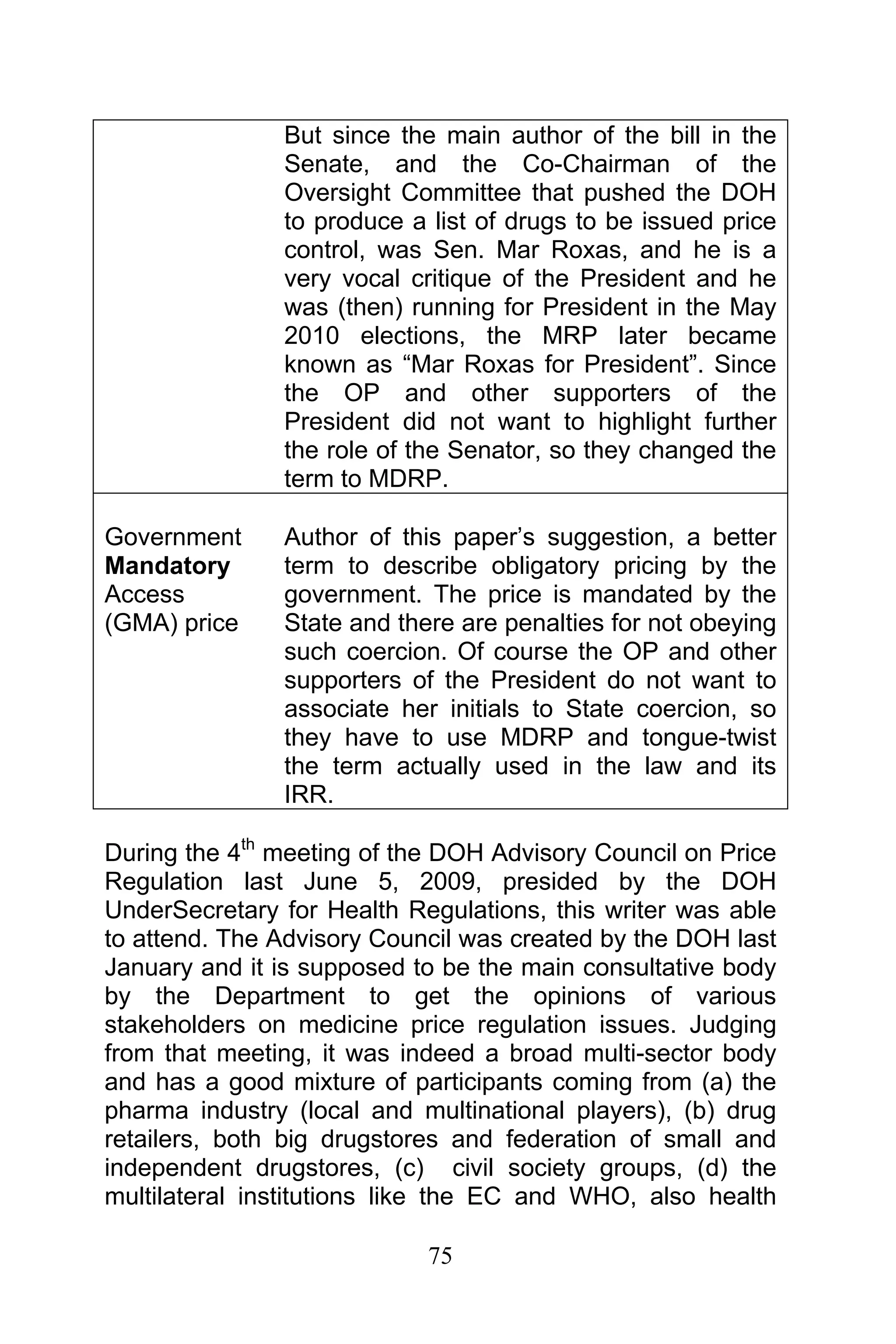
MRP becomes "Mar Roxas for President", in reference to
Sen. Mar Roxas who authored the cheaper medicines law in
the Senate and is running for President in the elections next
year. It was his strong pressure during the Congressional
Oversight Committee on the cheaper medicines law that
forced the Department of Health (DOH) to produce a list of
medicines to be issued the MRP or price control.
GMA now becomes "Government-Mediated Access" price of
the medicines that have voluntary price reduction by their
multinationals manufacturers. GMA of course, refers to the
President, Gloria Macapagal-Arroyo. The list of drugs under
GMA was released today (or perhaps yesterday) in big
newspapers. Tomorrow will be a very big day for the
President when she delivers her 9th and last State of the
Nation Address (SONA) in her 9 years in power.
The DOH Secretary, Sec. Francisco T. Duque III, has his
own motto for the Department even before the current drug
price control debate. The motto is: “OK-DOH-K!”
Which sounds like "OK Duque".
Politicians really tailor many things including health issues,
to their political interests.
27
(7) Health politics
28 July 2009
I am thankful to the DOH that I've been a part of the DOH
Advisory Council on price regulation -- a multi-sectoral, multi-
interest body that deliberates on whether government should
dip its hands in setting or dictating the price of certain
medicines, on whether to allow or restrict drug discount
cards, and related topics. The DOH's hands are tied here
because the Cheaper medicines law mandates it to take up
such matters.
I perfectly remember that the subject of voluntary drug price
reduction was extensively discussed during the 4th and 5th
Council meetings last month, and I realized that for the first
time perhaps in the history of the Philippine pharma industry,
the multinationals and Filipino pharma companies were
united -- in opposing mandatory government price control.
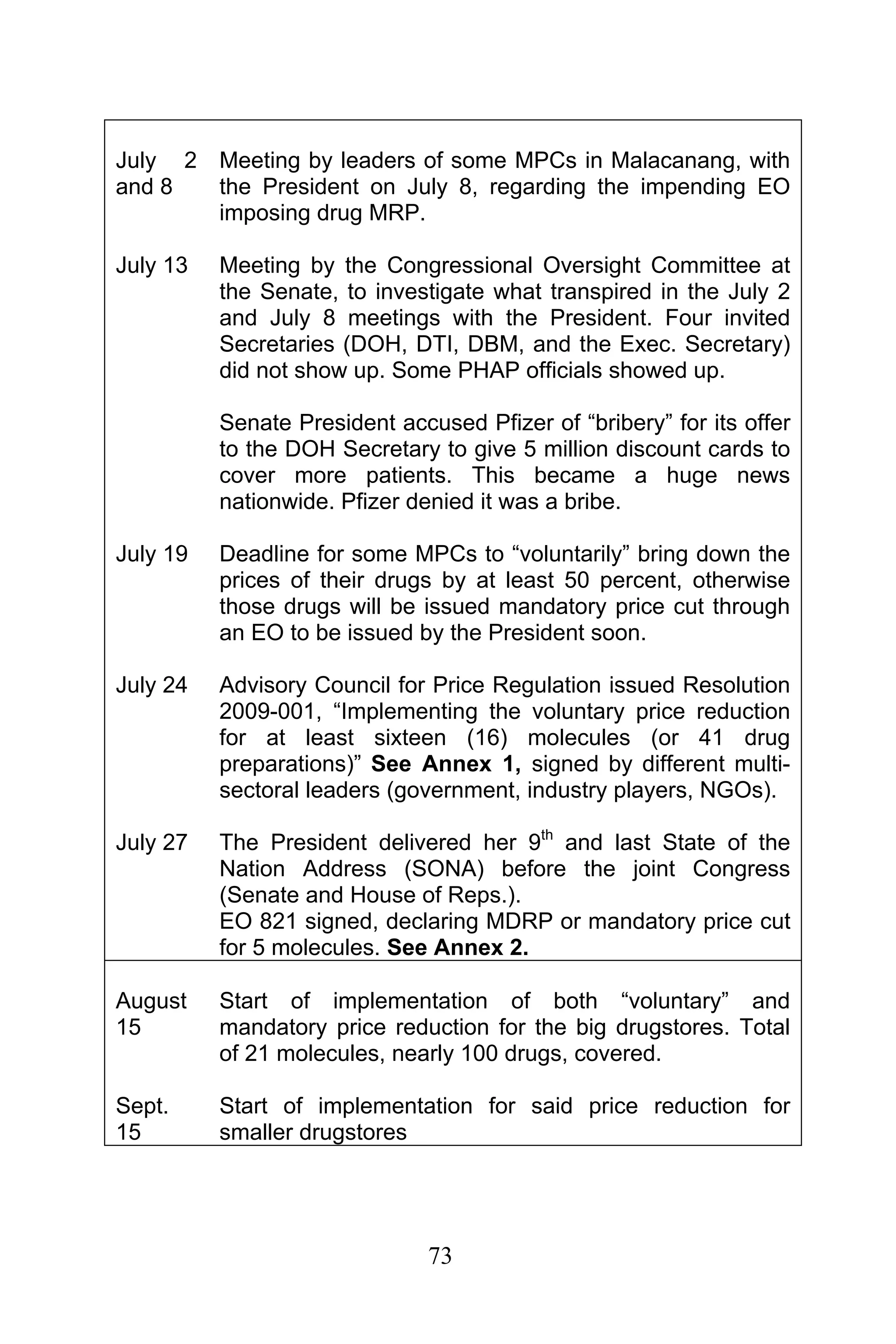
Last Saturday, July 25, the Advisory Council released its first
Resolution, "Implementing the voluntary price reduction for
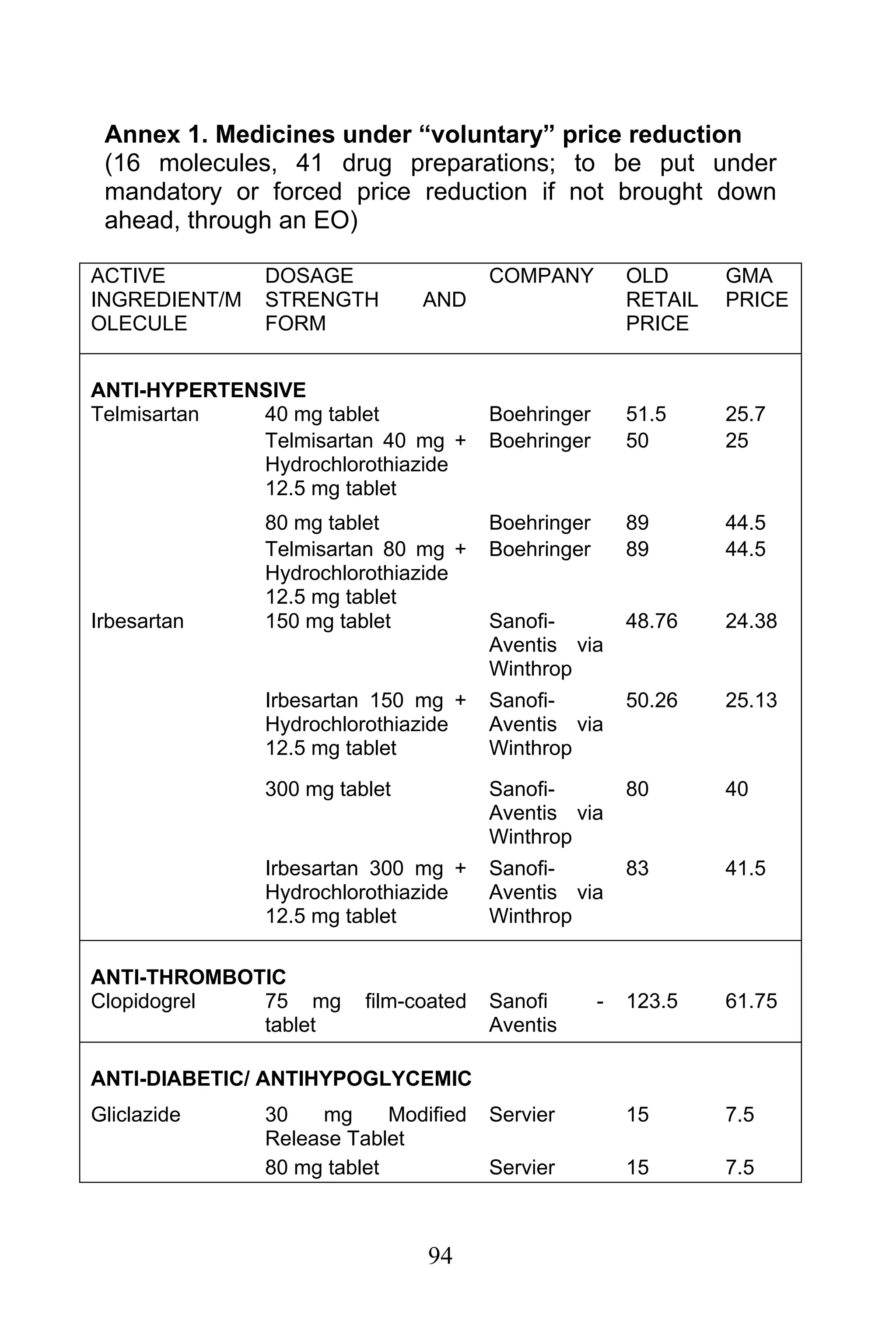
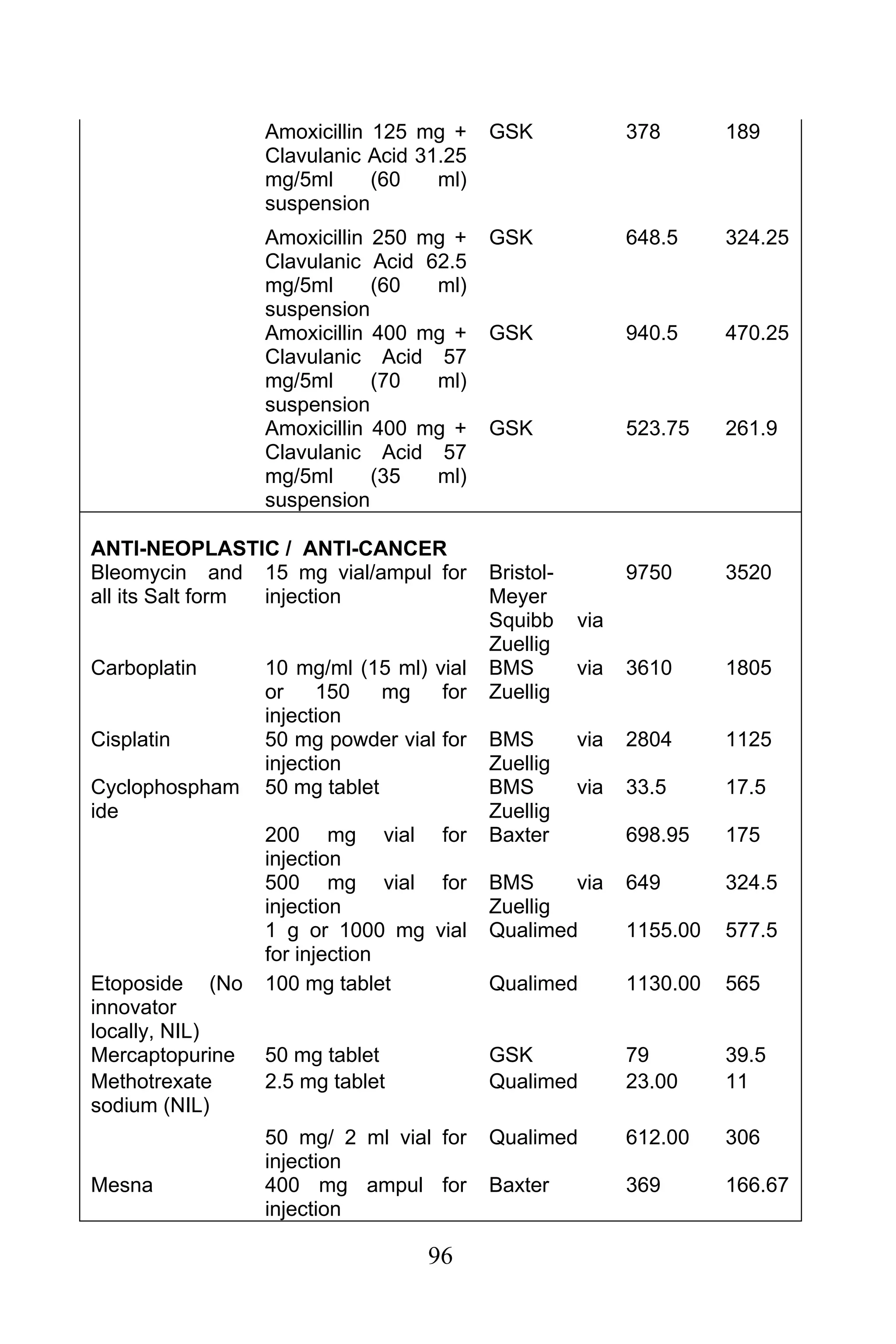
at least 16 molecules (or 41 drug preparations)". It was
signed by various stakeholders and participants that
regularly attend the Council meetings. I wasn't there
because the schedule of the meeting and announcement
was moved from 1pm to 10am, and I have an obligation for
my daughter in the morning of that day.
The big problem in the implementation of 50 percent price
cut (or any other rate) are the small drugstores in the
provinces which do not have computerized system in
tracking their inventories, sales, orders, and so on.
Otherwise, the big drugstores (Mercury, Watsons, PITC
Pharma, etc.) can easily comply within the 1 month transition
period (August 15 to September 15) before penalties for
violation will be implemented.
28
The list of medicines under voluntary price reduction was
advertised in big newspapers last Sunday. But politics set in,
as usual. What could be plain "voluntary price" became
"Government Mediated Access" (GMA) price, referring to the
initials of the name of the President. Which shows once
again the ugliness of government intervention. When
government comes in, there are always "bahid politika" or
political motives, and there are always politicians taking the
undeserved media credits.
In reality, government produces not a single tablet, not a
single medicine. Government only produces regulations,
prohibitions and lots of paper work that all private enterprises
(from barber shops to pharma companies) must comply.
When my brother was still undergoing chemo treatment
(prostate C), one injection was worth P25,000, nearly P3,000
of which was VAT alone. Eight (8) or more treatments, not
effective enough because the cancer virus has spread to his
body already. A last-attempt chemo just to prolong his life
was worth P90k (of which around P10K was VAT alone).
Days before his death, his pain was beyond description.
Cancer and Taxes, they have one similarity: they both suck,
they both kill. I know of some rich people who have cancer.
They can afford even the most expensive medicines, even
the most expensive doctors. But current breed of many
medicines are not powerful enough to beat and kill cancer
(or AIDS and Alzheimers). So they die quick once the virus
spreads in their body.
Some NGO leaders in our local health coalition in Manila
portray me as a "traitor" for consistently opposing
government price control, government confiscation of private
property in IPR. But, I sincerely believe in medicine
innovation. Only new, revolutionary, more powerful, real
killer drugs of killer diseases can save lives. The generics
and cheaper versions can follow later.
29
8. Double price control
10 August 2009
Senior citizens (60 yrs old and above) and persons with
disabilities (PWD, like blind, mute) are entitled to 20 percent
discount on medicines. That’s price control #1. Then there is
the government-mediated and government-mandated 50
percent price cut on medicines. That’s price control # 2 that
will start 5 days from now, August 15.
There have been a number of confusions already on price
control #1 alone. Among these are the following:
One, if the senior citizens are buying drugs that are
obviously for their grandchildren or for other people, can the
drugstore refuse to give the mandatory 20 percent discount?
But, there are clear penalties if the seniors will report to the
Department of Health (DOH) and the police.
Two, if a person comes to a drugstore and makes signs that
he/she is mute and deaf and demand the 20 percent
mandatory discount, how will the drugstore staff know that
he/she is indeed mute-deaf and not just pretending?
Three, most small drugstores just make 5 to 10 percent profit
margin because of stiff competition among them, but they
are all forced by the government to give 20 percent discount
to PWD and senior citizens, how will they recoup the losses?
When price control #2 is added to the above, here’s the
result: for certain drugs, a senior citizen or a man/woman on
wheelchair can get 20 percent discount on drugs that
already have 50 percent forced price reduction!
Example: a drug that originally sells for P20 a tablet, a
drugstore that earns a 10 percent gross margin will make a
P2 profit. When that drug was put under the mandatory 50
30
percent price cut. It becomes P10 a tablet. Then another 20
percent discount, the new retail price will only be P8. If a
drugstore is to retain its 10 percent margin, it will only have
P0.80 gross profit. Where office or stall rental do not come
down, where electricity, water, wages and other costs do not
come down, making thin profit margins is dangerous to the
long-term sustainability of a small business.
So pharmaceutical companies and drugstores, big and small,
are wondering how to deal with this kind of double price
control and still survive. And, there are uncontrolled taxes
and fees on medicines alone, uncontrolled taxes and fees on
entrepreneurship and doing business, the government is not
budging to reduce or abolish even one of those various
taxes and fees.
Business is business. If businessmen lose money
somewhere, they have to recoup it elsewhere; otherwise,
they better close shop and move to other industries. So the
non-senior, non-disabled persons, rich and poor, men and
women, will have to bear higher drug prices.
This morning, I attended the DOH Advisory Council Meeting
on Price Regulation. The above issues were among those
discussed. Well, the term “double price control” was not
used or mentioned there, it’s only a term I coined as I
listened to the drugstore owners and managers, including
hospital pharmacies, and pharmacists.
The big hospitals were represented there – Makati Medical
Center, St. Lukes, Asian Hospital, among others. They say
that as much as possible, they do not allow the confined
patients to buy drugs outside of the hospital so that they can
control the use of (a) cheap but counterfeit drugs, and (b)
cheap but sub-standard generics with no bio-equivalence
tests. When these drugs are used by the patients, either
they do not recover fast, and/or develop new diseases, and
some of them sue the hospital and their attending physicians.
31
So the hospital managers ask, “We usually charge higher for
drugs in our pharmacies than the drugstores outside
because there are administrative costs to us. A nurse will
get the blood pressure for instance and the physician or
pharmacist will recommend what dosage to give. Will the
new drug price control law allow us to charge additional
administrative charges for the medicines we dispense to our
patients?” To which DOH officials replied “Yes, a separate
charge, but the price of drugs under maximum retail price
(MRP) should not exceed the prices as announced.”
As a researcher and policy analyst of the effects of various
government interventions in the market, I am intrigued by the
unfolding of events, even before the actual price control (the
second control) will commence.
I have said it before and I will say it again: politicized pricing
through government price control, like mandatory discounts
and mandatory price reduction, is among the best formula to
mess up the economy. Any intervention will require another
set of intervention supposedly to correct the wastes and
inefficiencies of the earlier intervention.
Elton John sang it appropriately: “It’s the circle of life, and it
moves us all…”
32
9. Innovation, competition and cheaper drugs
2 September 2009
http://www.thelobbyist.biz/
Innovation is always the engine for change and growth in
any individual, enterprise or society. Life becomes
interesting and exciting only when there is always something
new to see and try, something new to sell and buy, even
something new to give away for free.
Innovation is encouraged under a competitive environment.
When there is no competition, there is very little incentive to
innovate. A monopolist that supplies a particular commodity
to a community and it is assured of zero competition for the
next 20 or 100 years, will have very little incentive to
innovate. Why spend money on expensive research and
developing a new and better product when consumers do
not have any other options anyway except buy their product
no matter how lousy it is?
People change, communities change and evolve. Diseases
also evolve. What used to be considered by the people as
an ordinary flu is now seen as various strains of flu – bird flu,
cat flu, cow flu, swine flu and so on. The attitude of people
towards diseases also evolve, they become more
demanding if not impatient as they assume that new
medicines are coming to cure them within a few days and
not a few weeks or months.
The traditional sources of medicine innovation are the
pharmaceutical multinational corporations (MNCs). These
are huge corporations which have the resources and
network to test and develop new drugs to respond to
different patients with different diseases with different budget.
But more local or nation-based pharma companies are also
sprouting up, first to develop off-patent and generic
medicines, and later on to start developing their own new
concoction and medicines which are both safe and effective.
33
And still slowly emerging, are individual researchers and
non-government organizations (NGOs) which have a clear
goal and mission to develop new medicines targeting
particular diseases for patients in poorer countries and
communities.
Among such innovative and tireless researchers and
scientists is Dr. Krisana Kraisintu from Thailand. Krisana is
one of the Ramon Magsaysay Awardee for 2009, for being
the Champion of Scientific Crusade for Affordable Medicines
by “producing much-needed generic drugs in Thailand and
elsewhere in the world.” She joined the Government
Pharmaceutical Organization (GPO) in 1983 and led its
research department in producing many generic medicines
for a wide range of illnesses.
In 1995, Krisana produced the world’s first generic ARV, a
generic AZT (zidovudine) for HIV that reduces the risk of
mother-to-baby HIV transmission. In 2002, she left the GPO
and went to the sub-Saharan Africa region, hit hardest by the
AIDS pandemic. Among the countries she visited and
worked with, “In war-torn Democratic Republic of Congo, she
set up a pharmaceutical factory that was able to produce
generic ARVs after three years.” In Tanzania, she upgraded
an old facility to produce not only ARVs but cheap anti-
malarial drugs as well. The Inquirer has a special news
report about her, “RM Awardee: Cheap drugs for poorest”.
Krisana’s initiatives are good. Those who have the expertise
and capacity to produce more competing products made
whether by multinationals or local pharma companies,
should join the competition. More competition is always good
for consumers and patients.
I would add that local pharmas should aspire to become
multinational themselves someday. Like San Miguel, Jollibee,
Figaro, SM, and Metrobank, companies that previously were
just confined to the Philippines, now selling their world-class
products and services in several countries around the world.
34
Yesterday, I and other NGO leaders under the Coalition for
Health Advocacy and Transparency (CHAT), the civil society
partner of the Medicines Transparency Alliance (MeTA)
Philippines, had a great opportunity to meet up with Krisana.
She was joined by the current Director of the Research and
Development Institute of GPO, Ms. Achara Eksaengsri.
After an overview of the Philippine health and
pharmaceutical situation given by former DAR Secretary and
now President of HealthWatch Philippines, Obet
Pagdanganan, we had a productive free flowing discussion.
Among the topics that we explored were the following.
One, more competition among pharma companies in
Thailand than in the Philippines. In Thailand, there are 167
local pharmas and about 500 multinational pharmas
operating. In the Philippines, I could count only about 50+
local pharma and about 40+ multinational pharmas. That’s
from the members of local pharma association PCPI, and
mostly multinationals pharma association PHAP. This partly
explains why medicine prices in Thailand are generally
cheaper than in the Philippines.
Two, there is no drug price control law being implemented in
Thailand, but they have issued compulsory licensing (CL) on
7 drugs against hypertension and cancer. The Philippines
has current drug price control program but has not issued CL
on any essential drugs yet.
Three, there is no single dominant drugstore in Thailand,
unlike in the Philippines where Mercury Drugstore corners a
big portion of the drug retailing market. The most dominant
player usually could set its own price or profit rate much
higher than competing drugstores’. Former Sec. Obet’s
figure is 60 percent share by Mercury, but I think the steady
influx of many new drugstore chains like Watsons and The
Generics Pharmacy, plus the in-house pharmacies of private
hospitals and clinics, should be eating away the market
share of Mercury to only 50 percent or less.
35
Four, both the Thai and the Philippine governments impose
taxes on medicines, despite their high profile
pronouncements that they want “cheaper medicines”.
Thailand has up to 7 percent import tax and 15 percent value
added tax (VAT) on medicines. In the Philippines, up to 5
percent import tax on finished products, 3 percent on raw
materials, and 12 percent VAT. The latter also imposes VAT
on tolling fee which can be claimed as input tax credit
against imported drugs’ sale of the tolled product, and VAT
on the sale of the tolled product to distributors. Then there
are import processing fee, import documentary stamp tax,
and local government tax. The government charges the 12
percent VAT on the landed price of imported drugs plus the
other taxes and fees. The VAT in effect, is a tax on a tax.
To my mind, both governments – and many other
governments – are hypocrites for calling for cheaper
medicines but contributing to expensive medicines because
of the various taxes and fees they impose on medicines.
They treat drugs as no different from alcohol, beer and
hamburger that must be slapped with as many taxes as
possible.
Five, Krisana says the role of NGOs is very important in their
work in Thailand in producing alternative cheaper essential
drugs, and she believes the NGOs in the Philippines are also
playing a crucial role in health policy debates. She calls the
Philippines’ Cheaper medicines law (RA 9502) “the best” law
that she has recently encountered.
I fully agree that NGOs and civil society groups have an
important role in various public policy debates, especially in
health issues. But said NGOs should not behave or expect
like they are adjunct or an “annex” of the government, by
easily running to the government to seek for more
regulations and interventions.
Here in the country, the President who signed the Executive
Order (EO) on drug price control as pressured by some
36
NGOs and media people, is the same witch that created
endless political and business scandals that include large-
scale corruption charges, the same witch that wants to be
the Prime Minister of the country by attempting to bastardize
the Constitution so she will be in power as long as she wants.
NGOs and civil society groups should fiscalize the
government in power because even the opposition political
parties are not really intent on changing certain policies like
medicine taxation because they also want to implement the
same regulations and taxation once they are in power. Not a
single big politician or political party in this country for
instance, has proposed to abolish certain taxes on
medicines to contribute to cheaper medicines. Civil society
groups should take up that role as voluntary representatives
of consumers and ordinary taxpayers.
37
10. Patrick Swayze, cancer and medicines
15 September 2009
Today, the actor of two famous movies "Dirty Dancing" and
"Ghost", Patrick Swayze, died. He was 57 years old. He died
of pancreatic cancer. He was diagnosed of that killer disease
sometime 1 1/2 years ago. And today, a number of my
friends in facebook expressed their sadness for the death of
this good looking and talented actor. Me too.
One friend posted in her facebook status today this quote
from the actor before he died: "I've had the time of my life.
No I never felt like this before. Yes I swear it's the truth. And
I owe it all to you."
Pavarotti also succumbed to pancreatic cancer. I know of a
rich lady here in Manila, a good friend of my sister, had
pancreatic cancer. When it was detected early last year, she
was on stage 4 already. Within 4 months she died. A
famous Filipino action star, Rudy Fernandez, also died of
this disease.
Former Philippine President Cory Aquino died of colon
cancer just recently. My sister-in-law died of colon cancer
too, about 4 years ago. She's the wife of my elder brother
who died of prostate cancer a few months after she died.
Some leftist guys push for IPR and patent confiscation of
important medicines via compulsory licensing (CL) plus
government-imposed price control. They say that many poor
people die of cancer and other killer diseases because the
medicines against these diseases are expensive, because of
the profit-hungry multinational pharma companies that
invented those medicines.
Well, cancer and other killer diseases do not choose their
victims. Rich and poor, men and women, they die. A number
38
of rich people also die of those diseases even if they have
the money to pay for those expensive medicines. Like
Patrick Swayze and Pavarotti. Like former President Cory,
action star Rudy Fernandez, wife of super-rich Congressman
Charlie Cojuangco, Rio Diaz, who died of breast cancer. Like
former Philippine Senator Robert Barbers who died of throat
cancer. And even the wife of the owner of Mercury Drug, the
biggest drugstore in the Philippines, also died of cancer.
Money can't kill cancer yet. That's why we need more and
continuing medicine innovation, and patent-confiscation
demand by the left does not help in encouraging medicine
innovation. Diseases evolve, people's lifestyle evolve,
physician practices evolve, treatments and medicines should
also evolve. Demonizing the medicine innovators as blood-
hungry multinational capitalists is misguided. They are
capitalists, yes, profit-seeking businessmen, and they can
only make profit by producing things which are needed by
humanity. It's among their incentives for doing so.
People normally would not patronize and buy things and
services which they do not need. That is why sustaining
many government bureaucracies have to be funded by
revenues that are coercively collected from the people, not
from revenues based on voluntary exchange.
39
11. One month of drug price control, initial assessment
18 September 2009
Below is a news report, an initial assessment of a month of
drug price control policy by the Philippine government.
Watsons drugstore says business was good, the federation
of small and independent drugstores, DSAP, says they're
bordering on bankruptcy. Private Hospitals Assn. of the
Philippines (PHAP) also complain, while the Pharmaceutical
and Healthcare Assn. of the Philippines (PHAP) and the
Philippine Chamber of Pharmaceutical Industry (PCPI) have
relatively neutral statements.
But for the first time, I read that the DOH, through USec
Padilla, is talking to the Department of Finance (DOF) re
government taxation of medicines, especially the 5 percent
import tax and 12 percent VAT.
The DOF can not just remove the VAT on medicines
because you need a new law amending some portions of the
National Internal Revenue Code (NIRC) to say that
medicines should be exempted from VAT, also amend the
tariff and customs code to say that medicines should be
exempted from import tax. These cannot be done by
administrative measures, only legislative measures. But then
again -- if no one will protest and object -- the DOF can
possibly issue an administrative order temporarily exempting
medicines from VAT, until a new law is enacted. But such
law will have to wait for the next Congress starting 2010.
It's important that government double-talk of "cheaper
medicines" and expensive medicines via taxation be
corrected. Taxes always distort prices upwards.
Government can double the taxes on alcohol and tobacco
products, but it must abolish the taxes on medicines.
-------
40
http://www.businessmirror.com.ph/home/top-news/16196-1-
month-after-big-pharma-drug-stores-hospitals-assess-mdrp.html
1 month after, big pharma, drug stores, hospitals assess
MDRP
Written by Sara D. Fabunan / Correspondent
Friday, 18 September 2009 04:00
BIG pharmaceutical companies, which feared the worst with
the cheaper- drugs law, are slowly seeing a window of
opportunity one month after the government fully enforced
an executive order implementing the year-old law: the
window is in the tradeoff between much lower prices, but
bigger sales volumes.
Small drugstores, however, are complaining, and claimed
the combination of cheaper prices and the mandatory senior-
citizen discounts are driving them out of business.
A similar complaint is being made by hospitals, who said
their in-house pharmacies, known to be adding on hefty
sums on the usual prices in drugstores outside, have said
they lost a vital profit center when the MRDP went into effect
on August 15. Some even claimed they took a big chunk of
manpower costs from the in-hospital pharmacy profits....
41
12. When civil society leaders embrace high taxes
18 September 2009
One health NGO leader narrated their campaign experience
for the removal of the tax on one anti-cancer (leukemia) drug.
They succeeded, he said, and added that it did not result in
price reduction; instead, the price of such drug kept rising.
So he concluded that only the pharma company, not the
patients, benefited from the removal of taxes on medicines.
One of my Filipino friends in California is helping the Books
for the Barrios (BftB, www.booksforthebarriors.com). He, his
family, some Filipino officemates and friends, solicit and
collect thousands of used books and other educational
materials, even toys, for elementary-level students in the US,
pack them in boxes, ship them to the Philippines. BftB
Manila receives those containers of used educational
materials.
Those books from America were donated FREE. These will
be distributed to public elementary schools in rural areas of
the Philippines for FREE.
But when those used books reach the Philippine ports, BftB
Manila pays for the following:
1. Customs duties around P65,000 – yes, there are taxes for
donated and used books!
2. Customs broker around P60,000 -- an agency that deals
everything with the Bureau of Customs (BOC).
The BftB Manila staff who narrated to me that story last year,
said that what's worse, donated medicines and vaccines by
volunteer medical missions from abroad, many of them are
parked at the Customs area to deteriorate. Why?
42
Various foreign medical missions and volunteers have
money for the airfare of the volunteers and shipment of free
drugs and vaccines. But they never expected there are high
taxes and Customs brokerage to pay for those donated
medicines, so they did not bring money for such. Those
vaccines are on refrigerated containers that run on electricity.
Since they cannot pay the taxes, and the vaccines require
continued electricity while the papers and payment are being
processed, the BOC personnel disconnect the electricity as
electricity charges are being borne by the Bureau. Within
hours, those useful, essential, and life-saving vaccines
become useless as they need to be kept at a specified
temperature.
For the imported anti-cancer drug that the NGO leader
above was talking, I think only the import tax (5%) was
waived. This tax is collected by the BOC. On top of the
import tax, there is the 12% VAT, also collected by the BOC
in behalf of the BIR. This bigger tax has to be paid to the
BIR even if the import tax or customs duties are waived.
Any company that is the sole seller of a particular product
like medicine for a particular disease is called a monopolist,
and a monopolist tends to abuse its position by pricing its
product at a high level. Government is an example of a
monopoly. It can set its price (tax) at any level, like the
personal income tax of 32%, corporate income tax of 30%,
VAT, documentary stamp tax, and so on.
The solution to a monopolistic industry structure is more
competition. Allow other players and producers to come in.
There are hundreds of other multinational innovator pharma
companies, and several thousand generic pharmas abrpad,
that are not in the Philippines yet. India alone has more than
22,000 pharma companies. Its biggest pharma company,
Ranbaxy, is not even here when Ranbaxy can put up stiff
competition to anybody here, both local or multinational
pharma.
43
I opined that the posting by said NGO leader was to
discourage the pursuance of abolishing taxes -- both import
tax and VAT -- on medicines. This government hypocrisy
should stop. We all want cheaper medicines, so taxes that
hike medicine prices, and regulations that kill competition,
should be scrapped.
The guy replied that even if the 5 percent import tax was
waived, the anti-cancer drug price did not go down by a
corresponding 5 percent. So he reasoned out that if the 12
percent VAT will be removed, then the profit of the pharma
companies will rise even bigger.
He further argued that when government tax revenues fall,
it's the public who will suffer because the government will
have lesser money to develop the country.
Typical statist argument. And this perspective is being
embraced by many civil society leaders who hate free
markets and more competition in the economy. They want
more government intervention, regulation and taxation.
These civil society leaders come to the defense of the State
on high taxes issue, including high taxes on medicines even
if said NGO leaders are supposedly campaigning for
"cheaper medicines".
Many NGOs receive big funding from the government,
national or foreign aid. Such NGOs are not exactly "non-
government". They are more of government-funded
organizations (GFOs).
44
13. Patients' vested interest: more choices
22 September 2009
A friend, Winthrop, made a comment to the article by Cito
Beltran. Wyn argued that the "mandatory" car for medical
representatives ("med reps") is a perk that he feels can be
done away with, along with various incentives to
physicians/dispensers. And that the current "live rep push-
marketing and (effectively) payola incentive schemes cost
more."
Middle of last month, there was a social dialogue between
civil society groups (including those under CHAT) and the
Pharmaceutical and Healthcare Association of the
Philippines (PHAP). Officials of PHAP explained their "Code
of Ethics" that apply -- with penalties and sanctions to
violators -- to their member-companies. Even PRRM chief
and former Sen. Bobby Tanada, and former DAR Sec. Obet
Pagdanganan, were surprised to hear about the strict code
being imposed on member-companies. If companies are not
happy with the Code, they can leave PHAP anytime.
PHAP officials and officials of some MNC pharma who were
there were emphatic that for payola-type and other unethical
promos by pharmas, "at least 85% probability, they are not
PHAP members". Personally, I have heard admissions from
some local pharma how they go out of their way to attract
physicians. Since they are not MNCs and have no global
brand or corporate name, it's difficult for them to get
physicians' patronage, unlike Unilab, the biggest pharma
company in the country.
I guess the use of med reps is inevitable. Unlike t-shirts,
shoes, underwear, ballpens, etc., where an ordinary shopper
can scrutinize these products in terms of price and quality,
medicines are another stuff. Not even the best lawyer or the
best solar physicist can analyze the properties and
45
characteristics of what's inside those tablets, capsules and
bottles. So physicians are sort of "guided" by the med reps
sent by the drug manufacturers, or physicians are invited by
the manufacturers to some continuing medical education
(CME) to introduce their new products. There are costs to all
those activities, so the producers pass on those costs to us,
patients. In addition, because of the growing competitive
nature of the local pharma industry (thanks to the generics
law), manufacturers have to embark on certain ads and
marketing, otherwise their competitors will beat them.
When manufacturers give cars to their med reps, partly this
is to protect the quality of the drugs that those sales people
bring. Most medicines require a particular temperature
control, say below 25 C always. So an air-con car will help
preserve the quality of those drugs. If the med reps wait
several minutes under the sun to wait for a taxi or jeepney or
tricycle, the quality of those delicate medicines may be
affected. So patients will not be healed by those sample
medicines that lose their efficacy already.
I don’t know what else are the other important factors that
manufacturers and distributors consider. But let the various
players over-spend or underspend if they must, it's their
business and it's their money that will be lost if they make
bad business decisions. Our business as watchers and
researchers of government policies, is to expose and fight
those regulations that kill competition.
As consumers, we have our own vested interest – we want
more choices. Let there be 200 or 400 different medicines
against hypertension, and allow us consumers, our
physicians or other health advisers, to decide which of those
200+ medicines will best fit our particular health needs given
our budget and other health conditions. Government should
not bow to the health militants who want to kill competition
via rigid and coercive policies like price control and
compulsory licensing.
46
14. Swine flu, leptospirosis and new medicines
31 October 2009, www.thelobbyist.biz
New and evolving diseases require new and evolving drugs
and other medical treatment to prevent such diseases from
spreading. The emergence of new environmental problems
like prolonged flooding of low-lying areas exacerbates some
diseases that were just minor problems in the past, but have
become major diseases recently.
In the US, swine flu has killed more than 1,000 people this
year, and up to 5.7 million may have been infected in its first
few months of outbreak, according to the US Center for
Disease Control (CDC). And the current strain may not be
the same that was discovered in late April this. US President
Obama has already declared swine flu a national emergency,
noting that "the pandemic keeps evolving". With such a big
number of deaths, this is indeed a troubling disease. The US
government has ordered some 150 million vaccines, mainly
Tamiflu made by Roche, by December.
Here in the Philippines, there is a leptospirosis outbreak in
some areas of Metro Manila and a few other provinces that
remain flooded until now, more than a month after severe
flooding that occurred last September 26. As of today, nearly
2,200 people have been infected while 167 have already
died from the disease. The spread of the disease has been
faster over the past few days.
The Department of Health (DOH) is prescribing only one
medicine so far, the anti-biotic doxycycline. The agency
notes that this medicine is not 100 percent effective. It can
only give some protection to infected persons. Besides, in
the guidelines it has issued in using this prophylaxis, it notes
47
several precautions. The medicine for instance, can NOT be
given to the following people: pregnant women, women
breastfeeding their babies, children below 8 years old.
Physician’s caution should also be taken if one has liver or
kidney disease, and the drug can cause allergy, diarrhea
and/or other side effects like esophageal damage. See the
list of precautions about doxycycline,
http://www.doh.gov.ph/files/dm2009-0250.pdf.
With a rather long list of precautions and prohibitions in the
use of the only medicine being prescribed by the DOH to
fight leptospirosis, infected patients and their loved ones will
only wish that there are other alternative medicines. But
what and where are they?
I have noted in my earlier articles before in this column:
people's lifestyle evolve, communities evolve, diseases
evolve, and so medicines and other medical treatment must
also evolve. This requires endless research and innovation,
endless invention of new and more powerful medicines not
only for old and known diseases, but also for unseen and
unknown diseases. Medicine and pharmaceutical research,
therefore, should be encouraged, not discouraged.
If more profit for the successful research companies is the
main incentive to encourage more companies and scientists
to go into this kind of work, then society should give it to
them. After all, not all pharmaceutical researches are
successful and useful. Majority of such researches are
unsuccessful and punched big losses for the companies that
undertook those research.
What is important is that more effective medicines for more
killer diseases should be invented and be made available to
the public. There should be several medicines from more
competing companies for each killer disease, so that
patients and their physicians can have more choices for the
specific needs and health/economic conditions of patients.
48
Cost or the price of medicine, though an important
consideration, therefore, becomes a secondary issue. The
primary issue is the availability of more medicines for more
various diseases.
Some rich people are willing to become poor just to save or
prolong the life of a loved one. And in many cases, money is
not the issue or the solution. It is the non-availability of more
powerful drugs and vaccines that can save people from killer
and ever-evolving diseases. So for some people, they may
have all the money in the world but if the drugs that can cure
their loved ones are not there, then early death will be
certain.
Unfortunately, for many countries in the world including the
Philippines, pricing and intellectual property rights (IPR) of
medicines have been heavily politicized. Many politicians
and the activist public do not ask about more competition in
medicines and medicine producers. They ask for quick
political fixes to non-political problems like evolving diseases.
And this is where long-term problems will crop up someday.
The short-term gains of cheaper medicines -- via price
control, via patent confiscation like compulsory licensing and
“early working” on still patented drugs -- will be defeated by
the long-term loss or non-availability of new medicines that
will be brought into the market.
It is indeed ironic that the public, the politicians and would-be
politicians did not listen to the majority of the sectors –
multinational and local pharma companies, hospitals,
drugstores, physicians, pharmacists, and a few NGOs – that
opposed drug price control policy. And this points to one ugly
reality of politics: problems or issues that could be
addressed with zero politics have become heavily politicized.
For health issues for instance, politicians and the activist
media or NGOs who do not produce even a single medicine
dictate the policies for medicine innovation and pricing.
49
15. Alzheimer's and medicine innovation
17 November 2009
In one of my yahoogroups, I learned that a number of my
friends (age mid-40s to 50s) have parents who suffer from
Alzheimer's disease. It's a "cruel, cruel disease" in the
words of one friend, as her mother can hardly remember a
number of things about her, about their family, and so on.
And I didn't know that AZ is a growing disease among
Filipinos. I know that cancer is, along with hypertension,
dengue, etc.
One confiscatory policy of the Cheaper Medicines Law is
intellectual property rights (IPR) and patent confiscation via
compulsory licensing (CL) of a patented drug or vaccine.
This scheme is a technical term for saying, "Your huge cost
of medicine R&D is yours and yours alone; your losses for
unsuccessful research, losses for less saleable medicines
are yours and yours alone. But your successful and saleable
medicine invention is also MY invention." And the
government made it a policy in the new law.
So now the world is facing various diseases, new and
emerging or re-emerging diseases. For instance, before that
was only "ordinary flu". Later on we have bird flu, cat flu, cow
flu, swine flu, etc. Tomorrow we'll have dog flu, tiger flu,
horse flu, etc. And people are becoming more demanding.
They want to get cured of their debilitating diseases if
possible within 1 week, not 1 month, not 1 year, not 10 years.
So people demand more powerful, more disease-killer drugs
and vaccines. But the medicine innovators, the only
companies who can bring such more revolutionary
medicines, are being painted as profit-hungry capitalist
multinationals, so that their products should be subjected to
confiscatory policies like CL and price control.
50
In such an environment, we are discouraging the innovators
from inventing more powerful drugs. But the richer countries
respect IPR and patent, so innovation should continue
somehow, but such innovators will think twice in bringing
their more powerful but more expensive, new medicines, to
countries like the Philippines with a nearly socialist medicine
policy. So Filipino patients in need of such medicines will
have to buy such drugs in other countries like HK, Singapore,
Korea, the US, Europe, etc. Which makes treatment
becoming more expensive, not cheaper, as envisioned by
the new law. The generics manufacturers are fine, they give
us cheaper generic, off-patent but useful drugs. But they
invent no new powerful medicines. They're no innovators.
People's lifestyle evolve, our communities evolve, diseases
evolve, so the medicines to kill or neutralize those diseases
should also evolve. More strains of AZ, Parkinsons, cancer,
swine flu, leptospirosis, etc. should be emerging. Probably
more debilitating and more cruel. The need for more new
disease-killer medicines and vaccines should continue,
endlessly. And socialist health and medicine policies are not
the way to encourage such innovation.
.
51
16. Mutant diseases and turtle research
5 December 2009, www.thelobbyist.biz
The cold season has been in the country for a month now.
Diseases that showed up during the warmer months tend to
mutate to a “cousin” and slightly different strains during the
cooler months. Such is the case of flu and its mutant
varieties – ordinary flu, bird flu, cow flu, and swine flu,
among others.
This week, both the Department of Health (DOH) and the
World Health Organization (WHO) announced that they are
tracking the flu virus in the country as it is now flu season in
the northern hemisphere and many people are traveling
across continents for the Christmas holiday season. Thus,
the flu virus can easily mutate as innocent people who
contracted the flu but do not show clear symptoms yet move
across the northern and southern hemispheres and the
tropics. The WHO noted that the strain has been mutating in
many countries.
PAGASA reported yesterday that Metro Manila’s recent
temperature records were 2 degrees Celsius colder than
average temperatures in the past 30 years. It was a cold
November and it will be another cold December as the
northeast monsoon is surging. Such cooler than average
weather means more susceptibility of more people to cold
weather diseases.
As public demand for newer and more powerful medicines
and vaccines against certain flu strains and other diseases
rise, supply of such innovative drugs should also rise. For
many diseases, this might be the case. But for some, like
HIV/AIDS, disease-killing vaccines are not invented yet.
There is turtle-pace in research.
52
Why is this so, and what are the incentives and disincentives
that are hounding the research and vaccine development
against HIV? Below are some figures and analysis.
Investment in R&D for HIV Prevention, $ million, 2008
Sector Vaccines Microbi
cides
% Dist’n.
1. Public Sector 731 207 84.4 %
U.S. 620 154
Europe 69 40
Others 43 12
2. Philantrophic Sector 104 35 12.5 %
3. Commercial Sector 33 3 3.2 %
Pharmaceutical cos. 28 *
Biotechnology cos. 5 3
Total global investment 868 244 100.0 %
* No investment reported
Source: Jeffrey Harris, “Why we don’t have an HIV vaccine,
and how we can develop one”, Health Affairs, Nov./Dec.
2009, Vol. 28 No. 6.
While pharmaceutical and biotech companies have the
expertise in vaccine development and commercialization,
and almost all vaccines used globally today come from them,
it is notable that private sector R&D investment in anti-HIV is
small. How did it come to this situation, considering that
AIDS is a high profile killer disease that has victimized
thousands of lives already?
Jeffrey Harris, “Why we don’t have an HIV vaccine, and how
we can develop one”, Health Affairs, Nov./Dec. 2009, Vol. 28
No. 6, made these 3 observations why there is low private
53
sector spending, in anti-HIV/AIDS research. One, political
risk. Governments’ decisions to implement large-scale
vaccination program or not is volatile and uncertain. Two,
another political risk, the growing threats of compulsory
licensing (CL) against the effective, safe, popular and highly
saleable products. Add also drug price control policies that
are in place in some countries like the Philippines. And three,
scientific risks: all-or-none proposition from vaccine R&D,
that an innovator company must spend big and lose big, or
earn big, in discovering a very elusive treatment against the
HIV scourge.
A combination of various interventionist and statist policies
that demonize innovator companies mainly because they are
big and are global corporations, is the main reason why
there is turtle pace in medicine R&D for both old and new or
emerging diseases.
The current drug price control policy that was imposed by
both the Department of Health and the Office of the
President is now 3½ months old. It should be noted that it
was not an ordinary price-freeze type of control, such as the
one imposed after the 2 devastating typhoons that hit Metro
Manila and northern Luzon provinces in late September to
mid-October this year. Rather, it was a coercive and
mandatory price cut by 50 percent that targeted medicines
against some of the top 10 killer diseases in the country, but
medicines that were very popular and highly saleable. An
element of envy against successful and innovative products
cannot be discounted as the main motive for such price
control order by the government.
One danger of such subjective and almost arbitrary
declaration of drug price control, is that innovator companies
that have more powerful and more revolutionary medicines
and vaccines, will not bring their products into the country.
There will always be a fear of another round of drug price
control policy anytime, without regard for explicit public
54
health emergencies , but only for consideration of political
emergencies by the politicians in power.
The ultimate loser of this situation will be the Filipino patients.
Both poor and rich patients. When we are saving the lives of
our beloved family member or friend, money becomes a
secondary issue. The main issue is the availability of life-
saving drugs and treatments that can kill the diseases that
weaken the body and spirit of persons who are close to our
heart.
Mutant diseases should be met by mutant medicines and
treatment, not by turtle-pace research and treatment,
discouraged by heavy politics and political intervention in
what are clearly non-political concerns like saving the lives of
people who are dear to us.
55
17. Healthcare is personal responsibility
16 December 2009
I got this chart by Dr. Indur Goklany, an Indian intellectual
who wrote the book, "The improving state of the world"
published a few years ago.
This chart supports my personal view, that healthcare is first
and foremost, personal and parental responsibility.
Government responsibility in healthcare is a far second.
56
Of the top 12 global health risk factors in 2004 in the above
chart, 9 are related to personal and parental irresponsibility:
1. unsafe sex
2. alcohol use
3. unsafe water, hygiene
4. high blood pressure
5. tobacco use
6. high blood glucose
7. overweight and obesity
8. physical inactivity
9. high cholesterol
and only 3 are socio-economic, or health risks mainly due to
poverty:
1. underweight (malnutrition)
2. sub-optimal breastfeeding
3. indoor smoke from solid fuels (due to lack or absence of
LPG, electricity, etc.)
A few weeks ago, I heard a talk by the Medical Director of a
pharmaceutical company here in the Philippines. He said
that 7 of the top 10 causes of mortality in the country are
directly or indirectly related to smoking.
The Top 10 Leading Causes of Mortality, 2000 to 2005 (and
probably until now) are:
1. Diseases of the heart
2. Diseases of the vascular system
3. Malignant neoplasm
4. Pneumonia
5. Accidents
6. Tubercolosis, all forms
7. Chronic lower respiratory diseases
8. Diabetis militus
9. Conditions from perinatal period
57
10. Nephritis, nephritic syndrome
Only #s 5 and 9 above seem to be external or not related to
smoking. I don't know which, is the 3rd disease above that is
not related to smoking.
Anyway, if most people are dying because of over-smoking,
and almost related, due to over-drinking, over-eating fatty
food, over-sitting in sedentary lifestyle, etc., then those
people really have no right to demand that "healthcare is a
basic right" and the government should provide it to them at
the lowest cost possible, if not free.
In this case, government therefore, has no justification to
declare drug price control, or issue IPR-confiscation policies
like compulsory licensing (CL) to have "cheaper medicines"
by blaming the multinational pharma companies as the main
cause of lack of access to good healthcare by the people.
The best healthcare is preventive, not curative. Hence, the
importance of personal hygiene, healthy lifestyle, vaccines,
competitive health insurance system, and economic growth
that lift people from poverty.
By focusing on the curative aspect of healthcare, the
government and some activist health NGOs are deliberately
losing sight of the personal responsibility aspect of
healthcare, and the distortionary effects of government
multiple taxation of medicines, vaccines and healthcare.
58
18. Drug price control, Sen. Pia style
21 December 2009
I just read that the Congressional Oversight Committee on
Cheaper Medicines Law held a committee meeting last
Wednesday, Dec. 16, at the Senate. Among those present
were Sen. Pia Cayetano and Cong. Arthur Pinggoy,
Chairman of the House Committee on Health.
Sen. Pia attacked the Department of Health (DOH) and Sec.
Duque for not coming up with a second batch of medicines
for drug price control as many people she said, still complain
that they don't feel the cheaper prices of medicines yet. She
cited the following:
1. Cisplatin 500 mg (anti-cervical cancer), original price at
P2,804, price control at P1,125, but can be bought only at
P770 from PGH's Cancer Institute.
2. Ramosetron 100 mg (anti-cervical cancer), price control at
P860, but can be bought at PGH's CI at only P156.
I do not know how such a big discrepancy can happen. I also
wish to see if the drugs cited by Sen. Pia are of the same
drug by the same manufacturer and the same distributor.
And not one is a generics counterpart, or one is parallel-
imported, or other differences.
I think the DOH should conduct a review first of the policy.
The drug price control policy is now more than 4 months old
(since August 15, 2009). A review is necessary if the policy
is beneficial to the public, both short-term and long-term, or
not. If it can be proven that it indeed benefited the public,
then an extension, if not expansion, of the policy is
warranted. Otherwise, the policy should be terminated very
soon.
59
Perhaps BFAD and the DOH can help answer these
possible questions in assessing the effectivity or benefits of
the policy:
1. Health result of some patients who are chronic or
repeated users of certain drugs that were price-controlled?
2. Instances of drug withdrawals, say generics products that
cannot compete the sudden low prices of branded and/or
innovators drugs?
3. Instances of revolutionary and more powerful medicines
against cancer, hypertension, and other killer diseases in the
country, that are available in neighboring Asian countries
which have no drug price control policy, but are not available
in the Philippines?
4. General reaction of other players in the health sector --
drugstores (big and small), hospitals (government and
private), pharma companies (local and multinational),
professionals' organizations (pharmacists, physicians,
nurses, etc.).
I hope that drugs pricing will be depoliticized as soon as
possible. When there is heavy politics involved in the pricing
of something (drugs, oil, food, house rental, electricity, bus
fare, etc.), there is always distortion that will adversely affect
the number and quality of players and producers in a given
sector.
60
19. On Health Socialism
28 December 2009
There was a continuing discussion and debate in our UPSE
Alumni Association yahoogroups, on health socialism. Some
would not consider or admit that drug price control and
similar schemes are tantamount to health socialism because
the goal of such measures is "to help only the poor have
access to medicines."
The current Cheaper Medicines Law (RA 9502) allows
"parallel importation" scheme for drugs. Thus, anyone can
now import a drug that is currently patented and sold higher
in the Philippines, from another country which sells the same
drug at a lower price. Thus, importing Pfizer India's Ponstan
into the country is technically and legally allowed.
But many doctors, pharmacists, hospital administrators and
informed patients are not comfortable with this scheme.
Even assuming that the parallel-imported drug is 100% of
the same molecule (not counterfeit, not substandard) as the
one sold expensively here, there is the question of (a)
storage, (b) handling and distribution, and (c) accountability.
Take drug A that specifies it should be stored and handled at
temp. range of 15-25 C at ALL times. When it's stored and/or
transported at 26 C or higher for 1 hour or more, it will have
a lower or lesser effectiveness already. And a patient will
either not get well, or develop new disease as the current
disease that is supposed to be controlled or killed by a
particular medicine, has already managed to mutate inside
the body of the patient.
Under a parallel import scheme, the (a) foreign manufacturer,
(b) foreign wholesaler or aggregator, (c) local importer and
distributor, can be 2 or 3 different entities. They are never
the same entity. So if something bad happens to the
61
medicine being imported and given to the patient, and
something bad happens to the patient, who is to be held
accountable? A or b or c, or the local patent holder, or the
physician and the hospital, or the drugstore, or the DOH?
Saving money is understandable. But saving lives is non-
compromisable.
That is why I am not in favor of parallel importation scheme,
not in favor of compulsory licensing, not in favor of drug price
control, not in favor of government use, etc. ALL of those
provisions are now allowed in the Cheaper medicines law.
That is why I consider the said law as part of health
socialism. The promises are holy and unquestionable –
cheaper and affordable medicines. But the schemes used
and allowed are generally confiscatory.
The law also does not say anything or amend medicine
taxation. Such taxes comprise between 13 to 20 percent of
the retail price of drugs. So government is a hypocrite, true
blue hypocrite, for calling for “cheaper medicines” but is
responsible for expensive medicines by slapping the product
with various taxes, as if medicines are like beer and
hamburger that should be taxed as much as possible.
So again, my 2 simple proposals to lower medicine prices,
both of which were not included, explicitly or implicitly, in the
cheaper medicines law:
1. abolish taxes on medicines
2. increase competition among drug manufacturers and
retailers.
62
Part 2
Papers Presented in 2 Conferences
1. Singapore, 2009
3rd
Pacific Rim Policy Exchange, October 14 – 15, 2009, Pan
Pacific Hotel, Singapore. Sponsored by the Americans for
Tax Reforms (ATR), International Policy Network (IPN),
Property Rights Alliance (PRA), Acton Institute, and the
World Taxpayers Association (WTA).
2. Cebu City, 2010
“The Impact of RA 9502”, March 6, 2010, Department of
Economics, University of San Carlos, Cebu City. Sponsored
by the Health Economics Graduate Class 2009-2010, CHAT
and Archivus.
63
Access to medicines through politics:
Preliminary assessment of drug price control
policy in the Philippines 1
Bienvenido “Nonoy” Oplas, Jr.
Abstract
This paper analyzes the philosophical, legal and political
basis for declaring price control of any commodity in general,
and medicine products in particular. It also discusses the
evolution of policies and political events that coincide with
the declaration and implementation of drug price control in
the Philippines, and the policy’s impact on the various
players and consumers in the country. The paper concludes
that more competition, not more regulations like price control,
will bring down medicine prices both in the short-term and
long-term. A number of recommendations are presented to
certain sectors for their consideration. Some important data
and relevant news reports are added as annexes that
provide additional proof to the preliminary assessment and
recommendations.
1
Paper presented at the 3rd
Pacific Rim Policy Exchange,
October 14 – 15, 2009, Pan Pacific Hotel, Singapore. The
event was, sponsored by the Americans for Tax Reforms
(ATR), International Policy Network (IPN), Property Rights
Alliance (PRA), Acton Institute, and the World Taxpayers
Association (WTA).
64
Introduction
These notes and observations are coming from someone
who is neither an expert on the science of pharmacology nor
the business of pharmaceutical industry. Rather, these notes
are from an economic researcher and NGO leader who
advocates free market policies and less government
intervention in the economy. Thus, technical aspects of
pharmacology like the properties of molecules that were
subjected to price control, and business models in the global
marketing and sales of pharmaceutical products, will not be
tackled in this paper. It will focus simply on discussing the
merit of free market and competitive pricing, and assessing
the impact of price control as experienced in the Philippines.
This paper will be presented under the following sub-topics.
One, the philosophical basis of price control, the theory and
ideology behind this thinking. Two, the legal basis of price
control, the provision of the new “Cheaper medicines law”
and its implementing rules. Three, price-setting under a
competitive market and under price control, illustrates a
graph to see the difference between the two policies. Four,
the politics of drug price control in the Philippines, discusses
the evolution of events that led to the declaration of the
policy. Five, preliminary assessment of the impact of price
control. And six, concluding notes and a short list of
important recommendations are being offered.
1. Philosophical basis of price control
Price control of anything – food, oil, medicines, house rental,
wages, fare in public transportation, and so on – is rooted on
the populist belief that competitive capitalism is not
happening in some sectors, that it is not possible to happen
even at the theoretical level, that there is always non-
competitive business situation somewhere. Therefore,
government should come in to protect the poor and
marginalized sectors of society.
65
This is an emotion-laden logic that proves very powerful and
irresistible for certain sectors of society. All big capitalists are
painted as evil, the poor are being exploited, government is
a savior, so the savior should intervene to temper the
capitalists and ensure there is justice and equity in society. It
hardly enters into public discussion that the supposed savior
is itself the main reason why dynamic competition among
plenty of players is not happening. Multiple regulations and
prohibitions, multiple and high taxes and fees, are seen not
as hurdles to more competition among more sellers, but as
necessary coercion for economic and political central
planning.
In medicines in particular, the multinational pharmaceutical
companies (MPCs) are often seen as foreign capitalists
whose main business is to make as much profit as possible
by bleeding the poor patients in poor countries. MPCs are
seldom seen by the activist public as revolutionary
innovators who create and produce new medicines for both
old and new diseases. The local pharmaceutical companies
(LPCs) are seen as some sort of local heroes that must be
protected from the onslaught of MPCs which have huge
financial and marketing clout globally. Thus, there is implicit
desire to see those MPCs to be hit hard as their price-
controlled drugs are usually among their most popular, most
saleable and hence, most profitable products. An ideology
based on deep hatred of capitalism in general, and “big
pharma” in particular is fanning the price control groups and
sentiments.
Most importantly, health care is seen by many as a “natural
right”. Rich or poor, young or old, industrious or lazy, health
conscious or health irresponsible, everyone has a “right” to
be given quality healthcare by the administrator of the
collective, the State. Thus, various measures that will ensure
cheap, if not free, medicines and healthcare, should be
66
instituted by the government, especially if it will hurt the
profit-hungry MPCs.
2. Legal basis of drug price control
The current drug price control policy is officially called
“maximum retail price” (MRP) under Chapter 3 of Republic
Act (RA) 9502 known as “The Universally Accessible
Cheaper and Quality Medicine Act of 2008” or Cheaper
medicines law for short, signed into law June 2008.
SEC. 17. Drugs and Medicines Price Regulation
Authority of the President of the Philippines. – The
President of the Philippines, upon recommendation of
the Secretary of the Department of Health, shall have
the power to impose maximum retail prices over any or
all drugs and medicines as enumerated in Section 23.
Details of the above provision are spelled out in Chapter 6,
“Maximum Retail Price” or MRP, of the Implementing Rules
and Regulations (IRR) of the law, issued in November 4,
2008. Both in the law itself and in its IRR, the list of criteria or
factors to consider in issuing price control was long, if not
tedious. Section 7 of Chapter 6 of the IRR states that the
Factors to consider in recommending the MRP are the
following:
(a) Retail prices of drugs and medicines that are subject to
regulation in the Philippines and in other countries;
(b) Supply available in the market;
(c) Cost to the manufacturer, importer, trader, distributor,
wholesaler or retailer such as but not limited to:
(i) The exchange rate of the peso to the foreign currency
with which the drug or any of its component, ingredient or
raw material was paid for;
(ii) Any change in the amortization cost of machinery
brought about by any change in the exchange rate of the
peso to the foreign currency with which the machinery was
bought through credit facilities;
67
(iii) Any change in the cost of labor brought about by a
change in minimum wage; or
(iv) Any change in the cost of transporting or distributing
the medicines to the area of
destination. (19A2)
(d) In addition to the immediately preceding section, other such
factors or conditions that may aid in arriving at a just and
reasonable determination of the MRP shall include:
(i) Marketing Costs (per drug and total global costs);
(ii) Research Costs (local and global/ per drug);
(iii) Promotion Costs;
(iv) Advertising Costs;
(v) Incentives and Discounts;
(vi) Taxes and other fees, impost, duties, and other
charges imposed by competent
authority; and
(vii) Other analogous cases (n)
When the DOH produced its list of medicines for MRP
issuance, the criteria was reduced to only four:
1. Of Public Health concern,
2. If 4‐5 times more expensive than ASEAN counterpart,
3. If less than 4 generic counterparts, and
4. If the innovator is the top selling product.
From there, the IMS study commissioned by the DOH and
DTI came up with a list of 21 molecules. 11 from DTI study
of 100 molecules that make up 70 percent of the local
pharmaceutical market, 10 for medicines to treat pediatric
cancer (leukemia).
3. Price setting under a competitive market vs. price-
controlled market
Under a competitive market, different manufacturers
(innovators and generics) produce one or more drugs on the
same generic category, and each drug has a particular
quality with its corresponding price. Consumers and patients
adjust to those prices and quality. Consumers, rich and poor
68
alike, would reach out for the “better quality” (more effective,
more disease killer) ones as much as possible, even if the
price may be high. There is ample incentive therefore, for the
drug manufacturers to continue innovation and invention of
more effective drugs as the patients are demanding it. Other
manufacturers would produce non-innovative, older and off-
patented products but are sold at a lot cheaper price, and
they attract another set or segment of consumers.
The result is a market with plenty of producers, plenty of
consumers, and plenty of “equilibrium prices” or “meeting
points” between supply and demand per generic category or
per drug molecule. There is no single, centrally-dictated
price. This is depicted in the left chart below, case A. The
upward-sloping lines represent supply curves by the sellers,
while the downward-sloping lines represent demand curves
by the consumers.
When a price control is imposed by the government, the
market will have one or several flat, horizontal supply curve/s
at a price set by the government, and can be called as
“centrally-dictated price” for producers. Price ranges and
price competition above those horizontal supply curves,
even if some consumers are willing to pay at a higher price
because of perceived or proven “better quality” drugs, are
therefore removed and abolished This new government-
controlled price level is no longer set by the various
manufacturers competing with each other, and by buyers
demanding better quality drugs, and such price can no
longer change (upward or downward) any day, anywhere.
The only price competition allowed are prices along or below
those horizontal supply curves, as shown in case B below.
69
Chart 1: Price setting among different drugs by different
manufacturers in the same molecule category
A. Competitive market B. Price Control
Price (per tablet or capsule, etc.) Price
Supply Supplier A
Supplier B
Demand Supplier C
Quant.
So there is a “hollowing out” and emptiness of price
competition and price segmentation above the horizontal
supply curve. The level of competition among different
manufacturers and their respective drug products is reduced
and shrunk. And producers of more powerful but more
expensive drugs will not be encouraged to bring such drugs
into the country because of the constant threat of
confiscation by the government of the success of innovation.
With this conceptual framework, we now go to the actual and
new experience of drug price control policy in the Philippines.
70
4. Politics of drug price control in the Philippines
There was no clear and apparent national health emergency
in the country at the time the price control provision of the
new law was pushed hard, sometime in May to June this
year. There was only “political emergency” as the
Presidential election, which happens only once every six (6)
years, was only one year away. The Senator who was the
author of the Senate version of the law, and now the Co-
Chairman of the Congressional Oversight Committee on the
cheaper medicines law, is a vocal critique of the current
administration and is running for President in the May 2010
elections. The new law is among his high profile legislative
output and he has put a lot of personal and political stake in
that law. Health and medicine prices are both economic and
emotional issues that can spark political mobilization.
There are various provisions of the new law that are meant
to bring down medicine prices. Among which are the
issuance of compulsory licensing (CL) and special CL for
certain patented drugs that are popular, highly saleable but
deemed expensive. Declaring a CL however, is not easy
because there is a clear provision there requiring the
existence of a national emergency. Section 10 of the law
amends Sec. 93 of the Intellectual Property Code to read as
follows:
Sec. 93. Grounds for Compulsory Licensing. – The
Director General of the Intellectual Property Office may
grant a license to exploit a patented invention, even
without the agreement of the patent owner, in favor of
any person who has shown his capability to exploit the
invention, under any of the following circumstances:
“93.1. National emergency or other circumstances of
extreme urgency,…
As mentioned above, there was no national health
emergency, so CL cannot be issued even for highly political
71
purposes. The most graphic provision therefore, that can be
invoked that does not require the existence of any national
emergency, would be drug price control. It says,
Sec. 17…. The power to impose maximum retail prices
over drugs and medicines shall be exercised within
such period of time as the situation may warrant as
determined by the President of the Philippines. No
court, except the Supreme Court of the Philippines,
shall issue any temporary restraining order or
preliminary injunction or preliminary mandatory
injunction that will prevent the immediate execution of
the exercise of this power of the President of the
Philippines.
Sometime in April and May this year, there were series of
meetings held by the Congressional Oversight Committee on
Cheaper Medicines Law at the Senate, pressuring the
Department of Health (DOH) to issue a list of medicines that
can be put under price control. One DOH official observed
that “for the Senators and Congressmen in the Oversight
Committee, the declaration of price control seems to be the
‘body and soul’ of the new law, the embodiment of political
will to implement the law.”
For a better understanding of this policy, below is a brief
chronology of the evolution of policies and events that this
author can recollect:
72
Evolution of policies and events leading to the
implementation of the current price control or drugs MRP
policy.
Date Events
2008:
June 6 RA 9502 signed into law by the President of the
Philippines
July 4 RA 9502 became effective
Nov. 4 Implementing Rules and Regulations (IRR) of RA 9502
signed, a joint product of DOH, DTI, BFAD and IPO
2009
January
14,
March
26,
April
27,
June 5
and 19
First five meetings of the DOH Advisory Council on
Price Regulation. Issues discussed were price control
(MRP) proposed system and policy, criteria in declaring
MRP, initial list of molecules and drugs for MRP, to
regulate drug discount cards by some multinational
pharma companies (MPCs) or not, WHO’s national
essential medicines facility (NEMF), among others..
May to
July
Several committee meetings and growing pressure by
the Congressional Oversight Committee on Cheaper
Medicines Law, especially by the Chairman of the
Senate Committee on Trade and Industry (Co-chairman
of the Oversight Committee and principal author the
Senate version of the law) to impose price control on
certain medicines.
June 8 First official announcement of medicines to be covered
by MRP by the DOH Secretary, during a meeting by the
Oversight Committee at the Senate. This is 2 days after
the 1st
year anniversary of RA 9502.
June 16 DOH Secretary submitted to the President a draft
Executive Order (EO) containing the list of medicines to
be issued drug price control. This list remained secret
and was not available to the public as the President was
to conduct her own consultations too.
73
July 2
and 8
Meeting by leaders of some MPCs in Malacanang, with
the President on July 8, regarding the impending EO
imposing drug MRP.
July 13 Meeting by the Congressional Oversight Committee at
the Senate, to investigate what transpired in the July 2
and July 8 meetings with the President. Four invited
Secretaries (DOH, DTI, DBM, and the Exec. Secretary)
did not show up. Some PHAP officials showed up.
Senate President accused Pfizer of “bribery” for its offer
to the DOH Secretary to give 5 million discount cards to
cover more patients. This became a huge news
nationwide. Pfizer denied it was a bribe.
July 19 Deadline for some MPCs to “voluntarily” bring down the
prices of their drugs by at least 50 percent, otherwise
those drugs will be issued mandatory price cut through
an EO to be issued by the President soon.
July 24 Advisory Council for Price Regulation issued Resolution
2009-001, “Implementing the voluntary price reduction
for at least sixteen (16) molecules (or 41 drug
preparations)” See Annex 1, signed by different multi-
sectoral leaders (government, industry players, NGOs).
July 27 The President delivered her 9th
and last State of the
Nation Address (SONA) before the joint Congress
(Senate and House of Reps.).
EO 821 signed, declaring MDRP or mandatory price cut
for 5 molecules. See Annex 2.
August
15
Start of implementation of both “voluntary” and
mandatory price reduction for the big drugstores. Total
of 21 molecules, nearly 100 drugs, covered.
Sept.
15
Start of implementation for said price reduction for
smaller drugstores
74
Some clarification on terminologies.
Before we proceed further, clarification of some
terminologies, even acronyms, may be in order. Here are
some of them.
Voluntary
price cut
This is not precise. Those drugs under the
16 molecules that the Department of Health
(DOH) identified (Annex 1) will be issued
mandatory price cut anyway if the drug
manufacturers will not bring down their
prices by at least 50 percent. There is a
political threat involved. So it is not the
typical unilateral, voluntary price reduction
because of competition, but price reduction
because there will be a coercive EO that will
fall upon those drugs if the manufacturers
will not cut the prices by 50 percent or more.
In addition, once the price is brought down,
the drug manufacturers cannot raise the
price anytime it wants to, it will need DOH
approval for the molecules and drugs to be
taken out of the list of price-controlled
products.
Government-
Mediated
Access
(GMA) Price.
This is one example of political opportunism.
The term refers to drugs that fall under
“voluntary” price cut, but the acronym used
is that of the initials of the President, Gloria
Macapagal-Arroyo. The Office of the
President (OP) and the DOH wanted the
initials of the President to be equated with
lower medicine prices through “voluntary”
means.
Maximum
Drug Retail
Price (MDRP)
This is one example of political tongue-
twisting. The actual term used in RA 9502
and its IRR is maximum retail price (MRP).
75
But since the main author of the bill in the
Senate, and the Co-Chairman of the
Oversight Committee that pushed the DOH
to produce a list of drugs to be issued price
control, was Sen. Mar Roxas, and he is a
very vocal critique of the President and he
was (then) running for President in the May
2010 elections, the MRP later became
known as “Mar Roxas for President”. Since
the OP and other supporters of the
President did not want to highlight further
the role of the Senator, so they changed the
term to MDRP.
Government
Mandatory
Access
(GMA) price
Author of this paper’s suggestion, a better
term to describe obligatory pricing by the
government. The price is mandated by the
State and there are penalties for not obeying
such coercion. Of course the OP and other
supporters of the President do not want to
associate her initials to State coercion, so
they have to use MDRP and tongue-twist
the term actually used in the law and its
IRR.
During the 4th
meeting of the DOH Advisory Council on Price
Regulation last June 5, 2009, presided by the DOH
UnderSecretary for Health Regulations, this writer was able
to attend. The Advisory Council was created by the DOH last
January and it is supposed to be the main consultative body
by the Department to get the opinions of various
stakeholders on medicine price regulation issues. Judging
from that meeting, it was indeed a broad multi-sector body
and has a good mixture of participants coming from (a) the
pharma industry (local and multinational players), (b) drug
retailers, both big drugstores and federation of small and
independent drugstores, (c) civil society groups, (d) the
multilateral institutions like the EC and WHO, also health
76
research project funded by foreign aid, and (e) other
government agencies like the Department of Trade and
Industry (DTI), Bureau of Food and Drugs (BFAD) and the
Philippine International Trading Corporation (PITC).
.
There was a healthy, frank and fast exchange of opinions
among the participants. And as far as this writer can
remember, everyone in the room was not in favor of
declaring price control, except two leaders of civil society. So
the impression of participants on that day, June 5, was that
drug price control will not be pursued.
To the dismay of almost everyone, three days after or June 8,
during the meeting of the Congressional Oversight
Committee at the Senate, the DOH Secretary who attended
the Committee meeting, announced that his Department
already has a draft Executive Order (EO) imposing price
control on certain medicines, and that he will soon submit it
to the President for her signature.
It was clear that there was indeed “political emergency” for
some government officials aiming for the Presidential and
Senatorial/Congressional elections that will happen 11
months away. The succeeding meetings of the DOH
Advisory Council until July this year was no longer to get the
opinions of the members of that Council whether to go
ahead in pushing the issuance of an EO or not, but how to
smoothly implement the drug price control policy. The policy
has already been firmed up at the top, without any significant
consultation with the affected enterprises, due to the growing
“political emergency”. The result of the earlier consultations
were simply ignored as there was already a centrally-
planned decision that needed quick implementation, and the
affected players, especially the MPCs and the drugstores,
had to accept that political reality.
77
5. Preliminary assessment of the effect of drug price
control policy
As early as June this year, when this writer first attended and
heard the (4th
) meeting of the DOH Advisory Council on
Price Regulation, rumblings of disapproval and discontent of
this policy was already very apparent. Not only from MPCs
through the Pharmaceutical and Healthcare Association of
the Philippines (PHAP), which are the main target of this
policy, but also from the LPCs through the Philippine
Chamber of Pharmaceutical Industries (PCPI), and the
drugstores. Later on, voices of “reserved support” –
essentially disapproving but since the policy will be
implemented anyway no matter who will oppose it – would
crop up from hospital owners and administrators,
pharmacists’ and physicians’ organizations.
Below is an assessment of the initial impact of the policy on
certain sectors and sub-sectors.
a. Multinational pharmaceutical companies (MPCs). The
main target of this policy and was projected to be the most
adversely affected group. The politics of envy, the ideology
of anti-global capitalism, the populist demand for cheap if not
free medicines from reputable producers, and the political
emergency of making political points score with voters by
lambasting some big capitalists, have conspired in the
success of implementation of this policy. One official of a
multinational company replied to this writer,
“We need to make clear that this is not just a price
control measure. It was a confiscatory price cut of
50%, in many cases for patented products!!! Even in
countries that have this type of mechanisms, it usually
applies once a patent expires, and only gradually. The
impact, of course, is very negative. There are two
impacts: the rebates to the trade, which run into the
hundreds of millions in pesos for our company alone,
78
and the impact in the price cut itself, which will affect
both this year and next, also several hundred millions
of pesos. Also, it has added a level of uncertainty in
our operations, since there is the threat of more price
cuts still to come, with no clear understanding of what
potential products could be affected, or what is the
clear rationale to demand a straight 50% cut.”
One unintentional result of the obligatory and mandatory
price reduction of some popular drugs by some MPCs,
however, is that their affected medicines will now become
more affordable even to the lower class. The MPCs will be
unintentionally “raiding” a portion of the niche market of
many LPCs, the poorer consumers who will now consider
buying the “more affordable” products of the MPCs. Whether
this will result in increased in overall revenue or not remains
to be seen. This is because many poor people do not see a
doctor when they are not feeling well, except when their
condition has deteriorated that they need to be brought to
the Emergency Room of hospitals. If they do not see a
doctor for regular check-up, then they may not even become
aware of the products of the MPCs.
If the LPCs cannot cope with further drastic price reductions,
then they will be forced to either pull out their products that
are affected by the obligatory price cut by the MPCs, which
reduces their overall market share, or worse, be forced to
close shop. Either way, the MPCs’ market share will
increase. Local operations of MPCs will be affected, but
such drop in revenues, if not losses, can be recouped via
continued sales in richer countries that frown upon price
control policies.
MPCs’ revenue from the 10 member-countries of ASEAN
(Association of South East Asian Nations) average only
around 3 percent of their global revenues in 2007. For the
whole of Asia except Japan, they got only around 8 percent
of their global revenues. The bulk of their revenues and profit
79
come from the rich countries of North America, Europe and
Japan.
The Philippines’ market share is only about 0.5 percent or
less of their total global revenues on average. MPCs
therefore can afford to endure temporary losses from selling
some of their price-controlled drugs in the country because
such losses can be recouped from their revenues elsewhere,
especially in rich countries. The local and Filipino-owned
pharma companies though, except for a few, have no other
markets to sell to, and have only limited number of products
to sell. So when some of those already limited number of
products are hit by huge price cut from competing firms,
closure of operation is certainly one possibility.
Local employment of the MPCs is also adversely affected.
The affected companies are forced to consider either of two
options: (i) Down-sizing, with up to 20 to 30 percent of
personnel may have to be retrenched, and/or (ii) Freeze-
hiring, which will deprive many qualified people from being
employed in the sector, at least temporarily.
b. Local pharmaceutical companies (LPCs). They are also
adversely affected, it goes like this. If they used to sell at say,
30 percent up to 49 percent lower than the equivalent
products of MPCs under the previous free market set-up,
they would find themselves that they are now the
“expensive” sellers. So LPCs will be pressured to further
bring down the price of their products. If they have some
allowance for such further price reduction, say they can
further cut the cost of production and marketing (like laying
off some workers), well and good. But if none, then either
they stop selling their products affected by the price control
to avoid losses, or continue selling at a loss, just to retain
and protect their overall market share in the industry.
Recover the losses by raising the price of other drugs that
are not covered by government price control.
80
One local pharma player replied to this writer’s email, he
said:
“The negative effects, we already know. What we are
doing though is to go for other products out of the
MDRP range. This I believe is the natural course of
events. Likewise we are reviewing the distribution
channels and how to become more cost effective.
Inescapably, we need to reduce our affected products'
prices and operational expenses to still have a viable
business.”
The great advantage of capitalism is that entrepreneurs and
players always develop high instinct for adaptation and
survival. Even in socialist countries like China and Vietnam,
competitive capitalism is happening in many sectors and
sub-sectors of the economy despite the heavy handed
regulations of the State. So, the main goal of enterprises
under competitive capitalism is to please customers both in
terms of good products or services and reasonable price.
Keeping a fat corporate bureaucracy even if revenues are
not sufficient is never a goal under capitalism. And the LPCs
along those lines.
MPCs have economies of scale in manufacturing and
marketing of their products. Production of certain drugs is
done in just one manufacturing plant somewhere in the world
and marketed and distributed worldwide, creating huge
economies of scale. LPCs on the other hand, only have the
Philippines as their production base. They do not have
economies of scale, compromising their capacity for big
price adjustment downwards if needed. But production and
marketing technologies keep evolving and improving.
Somehow, there is a way for enterprises that keep on
innovating to develop their own way of reducing costs while
maximizing revenues. Failure to do so will result in either
corporate stagnation or bankruptcy.
81
c. Drugstores. The big drugstores (Mercury and Watsons)
only have to worry if the manufacturers and suppliers would
give them the rebates quick after sufficient and objective
inventory of the affected drugs purchased at the old price
were made. Their system is computerized, so the inventory
issue is not a problem for them. Smaller drugstores are less
modern in their internal monitoring and auditing system as
most of them are not computerized. The drug manufacturers
also do not prioritize them in rebates.
What actually drains drugstores, both big and small, is the
double price control that government has effectively
implemented. Senior citizens (60 year old and above) and
persons with disabilities (PWD, like the blind, mute, on
wheelchair, etc.) are entitled to 20 percent discount on
medicines. Then the current price control on the 21
molecules under “voluntary” and mandatory price cut of 50
percent.
Most small drugstores just make 7 to 15 percent profit
margin because of stiff competition among drugstores, big
and small alike. The double price control of (a) 50 percent
price cut under MDRP and (b) another 20 percent discount
to senior citizens and PWDs literally and practically squeeze
out their already small profit margin. Perhaps these small
enterprises recoup the losses by putting higher profit margin
for non-prescription drugs, personal hygiene and other
consumer items like bath soap, shampoo and tissue papers.
There have been a number of confusions in the
implementation of price control #1 (mandatory 20 percent
discount for the oldies and PWDs) alone. Among these are:
c.1. Senior citizens buying medicines that are obviously for
their grandchildren or for other people like their pregnant
daughters or granddaughters.
82
c.2. Persons who come to a drugstore and make signs and
body signals saying that he/she is mute and deaf and
demand the 20 percent mandatory discount.
When those two price control policies are added, here’s one
result: for certain drugs, a senior citizen or a man/woman on
wheelchair can get 20 percent discount on drugs that
already have 50 percent forced price reduction. If
businessmen lose money somewhere, they have to recoup it
elsewhere; otherwise, they better close shop and move to
other industries. So the non-senior, non-disabled persons,
rich and poor, men and women, will have to bear higher drug
prices.
d. Hospitals. Hospitals experience difficulty recovering their
administrative costs in the process of prescription +
dispensation + monitoring + change of medication if
necessary. One President of a big private hospital in Metro
Manila argued this way:
“We are in the business of health care, world class
healthcare, not in retailing medicines. We hire good
people and give them good pay to educate patients.
We not only prescribe medicines for our patients, we
also monitor if the given medicines produce the
desired results or not. If not, then we have to
immediately change the medication to get the
desirable health results that we want for our patients.
There are costs to this.”
Before the current price control policy, hospitals incorporate
such administrative costs in the price of medicines. Now they
have to separate the actual price of medicines under price
control, and bill separately the administrative costs. Their
problem is that many private health maintenance
organizations (HMOs) do not want to shoulder such
additional bill as they are not covered in the regular health
83
insurance package. The same problem is also encountered
with PhilHealth reimbursement sometimes.
Some NGO leaders requested that patients be allowed to
buy medicines outside of hospital pharmacies because
prices there are often a lot cheaper than those in hospital
pharmacies.
Hospital administrators say that as much as possible, they
do not allow the confined patients to buy drugs outside of the
hospital to control the use of (a) cheap but counterfeit drugs,
and (b) cheap but sub-standard generics with no bio-
equivalence tests. When these drugs are used by the
patients, either they do not recover fast, and/or they develop
new diseases or allergies. Some patients of them sue the
hospital and their attending physicians.
Hospital managers also ask, “We usually charge higher for
drugs in our pharmacies than the drugstores outside
because there are administrative costs to us. A nurse will get
the blood pressure for instance, physician or pharmacist will
recommend what dosage to give. Will the new MDRP allow
us to charge additional administrative charges for the
medicines we dispense to our patients.” DOH officials replied
“Yes, a separate charge, but the price of drugs under
maximum retail price (MRP) should not exceed the prices as
announced.”
e. Other industries outside of pharma. The industries often
contracted out by both MPCs and LPCs are also adversely
affected: no procurement of new vehicles, restrictions on
travel for office-based personnel, less frequent or no
meetings at all in hotels and restaurants, drastic reduction in
procurement of office supplies, etc.
The overall investment environment of the country will be
adversely affected. About one month before the declaration
of “voluntary” and mandatory price cut in late July, the big
84
foreign chambers of commerce and industry (US, Canada,
EU, Japan, Australia-New Zealand, others) issued a joint
statement calling on the President and the DOH not to
proceed with drug price control because of the negative
image that it will send to foreign investors, not only in the
pharmaceutical industry but in almost all other industries.
The implementation of the policy, plus the continued low
ranking of the Philippines in various international studies and
surveys of economic freedom, ease of doing business, and
so on. In the World Bank-International Finance Corp. (WB-
IFC) “Doing Business 2010 Report” for instance, the
Philippines ranked 144th
out of 183 countries surveyed, in
the overall ease of doing business.
f. Non-Government Organizations (NGOs). The more
established health NGOs were generally in favor of the price
control policy. They have lobbied long in the crafting of the
law, from patent-confiscating provisions of the new law, to
price control provisions. So the implementation of the policy
is a victory for them.
At the Coalition for Health Advocacy and Transparency
(CHAT), probably the biggest coalition of NGOs in the
country engaged in health issues, mainly or partially, there
was a debate among member-NGOs whether to support the
price control policy, especially the issuance of an Executive
Order to force the price reduction by 50 percent. The
leadership of the coalition supported the move, while a few,
including MG Thinkers, dissented and just issued a
clarification position paper.
g. Politicians. The Chairman of the Senate Committee on
Trade and Industry, also the principal author of the Senate
bill before it became a law, then aspiring to run for President
in the May 2010 elections under the Liberal Party, benefited
from the price control policy. There was huge media
coverage of the Congressional Oversight Committee
85
meetings on the price control issue, and he got high media
and political visibility. The Committee was holding meetings
almost every 3 weeks then.
There was one scheduled meeting by the Oversight
Committee on September 2, 2009. But the night before,
September 1, the Senator announced in a big press
conference, that he was withdrawing from the Presidential
bid and he was supporting instead, his fellow Senator in the
same political party, who is the son of a very famous and
well-loved past President Cory Aquino. The next day,
September 2 morning, there was a message from the
Senator’s staff that the scheduled meeting that day is
cancelled. Since then until today, there have been no
meeting by the Oversight Committee on the price control
issue. And this points to one thing: those high profile,
sometimes high drama Congressional meetings and public
hearing, were done in aid of election, not in aid of legislation,
of one particular politician.
The legislators at the House of Representatives who were
the main authors of the bill before it became a law, and who
were affiliated with the President and the administration,
used also the blame-game trend and blamed the said
Senator for opposing their original provision creating a
separate drug price control body. These legislators and
some of their co-authors in the lower House, were later
reported to be planning to introduce a new bill that will
amend RA 9502 to reiterate creating a separate price control
agency in the government.
h. Patients. After all players and political groups in the health
sector have spoken, the ultimate judge who will feel the net
effect of the policy, will be the patients. There are several
impact among consumers and the patients. (i) Savings from
expenses on medication, especially for households with one
or more family members who are sickly and/or old, so the
immediate result is positive. However, (ii) more effective,
86
more disease-killer drugs that are sold at higher prices, may
not be brought into the country by their innovator MPCs.
There is a constant fear of being demonized as a profit-
hungry devil by the activist media, politicians and NGOs,
while at the same time these groups may be salivating to get
those more revolutionary drugs at a government-dictated
and controlled price.
Or the MPCs may bring in those drugs to the country but not
via formal and transparent supply channels. These
companies have high “reservation equilibrium price”, which
is above the price of the horizontal supply curve controlled
by the government shown in the chart above. If this happens,
a non-transparent “underground” or “black market” will
emerge for such more powerful drugs. These will be sold by
some unscrupulous traders and businessmen who will sell
the medicines at a much higher price. Or they may not
observe proper handling, storage, temperature control, and
transport of such important medicines as trading of such
medicines are not done in the open. If such delicate
medicines are mis-stored at wrong temperature range, their
effectiveness as disease-killer will be reduced if not negated.
Another possibility is that consumers and patients with
desperate need for such more powerful drugs will have to
order such medicines from abroad, at a lot more expensive
price. The richer ones may have to travel abroad for another
set of diagnostic tests with another team of medical
professionals who will prescribe such medicine or a new one.
Either way, the cost and inconvenience to patients will
become higher.
87
6. Conclusions and recommendations
Government-imposed price controls policy has the
undesirable result of institutionalizing and legalizing
predatory pricing. By forcing some MPCs to bring down
some of their more popular, more saleable drugs, the
government in effect has imposed unfair pricing among
competing players that can possibly result in the demise of
some LPCs which do not have enough leeway in introducing
even further price cuts.
This affirms Newton’s third law of motion: “for every action,
there is an equal, opposite reaction.” Translated to economic
policy making: for every government intervention, there is an
equal, opposite result that needs another intervention.
Politicized pricing through government price control, like
mandatory discounts and mandatory price reduction, is
among the best formula to mess up the economy. Any
intervention will require another set of intervention
supposedly to correct the wastes and inefficiencies of the
earlier intervention. Elton John sang it appropriately: “It’s the
circle of life, and it moves us all…”
Lest we be misunderstood, we support the goal of bringing
down the prices of medicines – and cell phones, appliances,
food, clothing, housing, energy, and so on. The desire to get
more of things that are needed by the individuals is a
perfectly rational human behavior. The debate therefore,
centers only on the ways and policies how to attain such
goal.
We believe that the best mechanism to stabilize, if not bring
down, the prices of almost anything, is via more producers
and sellers competing among each other to get the support
and patronage of the public and consumers. Consumer
needs, tastes and preferences are not the same. Producers
perfectly understand that, that is why there is a wide variety
88
of products and services for each category of commodity
that are available to different consumers with different needs
and different budget.
Can the Philippines afford to do away with the multinational
pharma?
The answer seems to be a clear No. Per PCPI record, out of
the 607 essential molecules, the local pharma companies
produce only about 200, so two-third (2/3) of total essential
molecules are still being supplied solely by the multinationals
in the country.
Transfer of technology from the multinationals to the local
pharma companies happens after the drug patent of the
former expire, allowing the latter to develop their own brands
and generic versions of the off-patent drugs.
But most importantly, multinationals are usually the
research-based companies that produce new and more
innovative drugs. Diseases evolve, and people are becoming
more demanding, they want to recover from their diseases
within one to three days whenever possible, and not one
week or one month or one year. Hence, the necessity of
continued development and invention of more powerful,
more revolutionary drugs that only innovator pharma
companies can do.
While humanitarian reasons – like giving more access to
important medicines for the poor, the sick and the
handicapped – provide the convenient excuse for the drug
price control policy, it is actually envy, hatred of global
capitalism, and political opportunism which are the main
reasons for the rushed declaration and implementation of
drug price control.
Here are some specific recommendations for each group
and institution.
89
1. Government in general
Government measures and policies that turn off and
discourage the entry of more players and competitors – like
price control, heavy regulation and bureaucracies, high
taxation and disrespect of private property rights like
confiscation of important invention – should be avoided. If
they have been practiced and implemented already, then
they should be discontinued, or at least relaxed.
Government targeting of the most expensive products which
are branded, even patented products that are used by the
wealthy population that can afford them, is not wise, it is
more driven by envy. Such policy has penalized successful
brands and distorted the market. Innovator and efficient
companies will now be careful not to get to #1 position in
Philippine markets for the fear that the government will target
their popular products and confiscate their success via price
control.
2. Department of Health (DOH)
Here is one advise from an official of one MPC:
“If the intention of the government was to really
provide affordable medicines for the poor, they should
have looked at the list of essential medicines from
WHO, which consists mainly of off-patent, older
products that are genericized and can be purchased
at very low prices, both here and abroad, cut those
prices and offer those products. Instead of spending
money on expensive advertisements on "MDRP" and
"GMA", they could have used that money to advertise
those generic alternatives. This is specially true in
areas like hypertension, where you can use very
inexpensive medicines like diuretics and beta blockers
that do a reasonably good job in controllin
90
hypertension, and anti-infectives, with first-generation
penicillins, amoxicillins and erythromycin, who can
also fight most infections.
Instead the government targeted the most expensive
products, which are branded, patented products that
are used by the wealthy population that can afford
them. They penalized successful brands, distorting the
market; now we will be careful not to get to #1 position
in our markets for the fear that the government will
target our products and confiscate our success via
price cuts. Furthermore, because they only used IMS
data in values, they failed to see that in many cases,
the local products were already bigger in volumes
than the original product, which was declining in sales
year after year.”
The DOH should also NOT consider expanding the list of
drugs under government price control. This will be
tantamount to expanding the distortions in the economy.
3. Congress (House of Representatives and Senate)
Do not pursue the plan to introduce new bills and/or new
amendments to RA 9502 that target to:
(a) Create a new drug price control body, replace the current
system where the DOH Secretary makes the
recommendation, the President signs an Executive Order
issuing price control on certain drugs. This is ill-advised. The
early results of the current price control policy show that
many sectors and enterprises engaged in healthcare are
affected more adversely than beneficially.
(b) Require drug manufacturers to submit annual reports of
their marketing expenses to the DOH Secretary to monitor
such expenses that contribute to expensive medicines. This
is a new form of intervention that will definitely discourage
91
the entry of more players, or push those with wobbly
financial condition to close and pack up. Allow private
enterprises to decide on their expenses – from R&D to
marketing to CME or whatever – so long as the sector is
competitive. Those who make unnecessarily high expenses .
(c) Introduce new mandatory discounts for certain groups of
people. The mandatory 20 percent discount for senior
citizens, and mandatory 20 percent discount for people with
physical and mental disabilities, are already pushing some
small drugstores and small hospitals into the verge of
bankruptcy.
Instead, introduce bills that will remove the various taxes and
fees on medicines. This move will knock off at least 13
percent of the retail price of medicines. There are at least 2
different taxes and fees imposed on medicines alone: import
tax (3 percent for raw materials, 5 percent for finished
products) and value added tax (VAT, 12 percent). There
could be other taxes and fees like import processing fee and
local government taxes. The VAT is applied as: (landed price
+ import tax) x 12% = VAT payment. In a sense, VAT is a tax
on a tax.
It should be remembered that aside from taxing products like
medicines, the government also taxes the various
companies engaged in health care -- pharma companies,
importers and distributors, hospitals, drugstores and
pharmacies.
4. Civil society and the public
Objectively monitor and assess the short-term results and
long-term implications of drug price control policy. It is
ultimately the public and the consumers, not the politicians,
who will suffer from lack of competition among players and
lack of choice among drugs, if some players will pull out or
92
go bankrupt, and/or some drugs are withdrawn from the
market because of unrealistic pricing imposed by the State.
So long as alternative drugs, so long as generic competitors
are present, then public welfare is assured. Some people
complain that even the cheapest generics are still
unaffordable for them. Well, there is a price to taking care of
our own body and that of our loved ones.
Health care is first and foremost a personal and parental,
also corporate responsibility to their employees. People
should not over-drink, over-smoke, over-eat fatty foods,
over-sit and have sedentary lifestyle, over-fight and have
stab wounds occasionally, and so on, then demand that
quality health care is their “right” and a government
responsibility.
Government responsibility in health care is only secondary to
personal and parental responsibility. Government should
come in and institute radical intervention in cases of disease
outbreak and similar health emergencies. Otherwise, it
should step back, it should not over-tax medicines and
health enterprises. Allow and encourage more competition
among them, so that the public will have more choices. More
choice means more freedom.
93
Annexes.
Attached are some data and relevant news reports that
provide additional evidence to the assessment and
conclusions.
1. Medicines under “voluntary” price reduction
2. Medicines under mandatory price reduction of 50%, under
EO 821
3. Voluntary price reduction, Add-on list
4. Some news reports about drug price control
5. Multinational pharma companies in the Philippines
6. Innovator pharma companies in selected countries not in
the Philippines yet
7. DOH Initial List for Drugs Price Freeze (after typhoon
“Ondoy”)
94
Annex 1. Medicines under “voluntary” price reduction
(16 molecules, 41 drug preparations; to be put under
mandatory or forced price reduction if not brought down
ahead, through an EO)
ACTIVE
INGREDIENT/M
OLECULE
DOSAGE
STRENGTH AND
FORM
COMPANY OLD
RETAIL
PRICE
GMA
PRICE
ANTI-HYPERTENSIVE
Telmisartan 40 mg tablet Boehringer 51.5 25.7
Telmisartan 40 mg +
Hydrochlorothiazide
12.5 mg tablet
Boehringer 50 25
80 mg tablet Boehringer 89 44.5
Telmisartan 80 mg +
Hydrochlorothiazide
12.5 mg tablet
Boehringer 89 44.5
Irbesartan 150 mg tablet Sanofi-
Aventis via
Winthrop
48.76 24.38
Irbesartan 150 mg +
Hydrochlorothiazide
12.5 mg tablet
Sanofi-
Aventis via
Winthrop
50.26 25.13
300 mg tablet Sanofi-
Aventis via
Winthrop
80 40
Irbesartan 300 mg +
Hydrochlorothiazide
12.5 mg tablet
Sanofi-
Aventis via
Winthrop
83 41.5
ANTI-THROMBOTIC
Clopidogrel 75 mg film-coated
tablet
Sanofi -
Aventis
123.5 61.75
ANTI-DIABETIC/ ANTIHYPOGLYCEMIC
Gliclazide 30 mg Modified
Release Tablet
Servier 15 7.5
80 mg tablet Servier 15 7.5
95
ANTIBIOTIC / ANTIBACTERIAL
Piperacillin
+Tazobactam
and all its Salt
form
Piperacillin 2 g +
Tazobactam 250 mg
vial
Wyeth 2175.46 730.2
4 g + Tazobactam
500 mg vial
Wyeth 4614 1270.0
6
Ciprofloxacin
and all its Salt
form
500 mg tablet Bayer 83.83 41.91
500 mg tablet
(Extended Release)
Bayer 99.23 49.62
1 g tablet Bayer 145.1 72.55
250 mg tablet Bayer 65.13 32.57
2mg/ml (100 ml) for
injection
Bayer 1884.17 942
2 mg/ml (50 ml) or
100 mg IV infusion
(50 ml)
Bayer 1440.87 720.43
400 mg (20 ml) for
injection
Bayer 3207.17 1603.5
9
Metronidazole
and all its Salt
form
125mg/5 ml (60 ml)
suspension
Sanofi-
Aventis
131 65.5
500 mg tablet S-A via
Winthrop
23.5 11.75
500 mg (100 ml) IV
infusion
Sanofi-
Aventis
379.5 189.75
Co-Amoxiclav
(Amoxicillin +
Clavulanic acid)
625 mg tablet GSK 97.75 48.9
375 mg tablet GSK 79.5 39.75
1 g tablet GSK 142.25 71.15
600 mg vial for
injection
GSK 687.5 343.75
1.2 g vial for injection GSK 1156.75 578.4
Amoxicillin 200 mg +
Clavulanic Acid 28.5
mg/5ml (70 ml)
suspension
GSK 555.5 277.75
96
Amoxicillin 125 mg +
Clavulanic Acid 31.25
mg/5ml (60 ml)
suspension
GSK 378 189
Amoxicillin 250 mg +
Clavulanic Acid 62.5
mg/5ml (60 ml)
suspension
GSK 648.5 324.25
Amoxicillin 400 mg +
Clavulanic Acid 57
mg/5ml (70 ml)
suspension
GSK 940.5 470.25
Amoxicillin 400 mg +
Clavulanic Acid 57
mg/5ml (35 ml)
suspension
GSK 523.75 261.9
ANTI-NEOPLASTIC / ANTI-CANCER
Bleomycin and
all its Salt form
15 mg vial/ampul for
injection
Bristol-
Meyer
Squibb via
Zuellig
9750 3520
Carboplatin 10 mg/ml (15 ml) vial
or 150 mg for
injection
BMS via
Zuellig
3610 1805
Cisplatin 50 mg powder vial for
injection
BMS via
Zuellig
2804 1125
Cyclophospham
ide
50 mg tablet BMS via
Zuellig
33.5 17.5
200 mg vial for
injection
Baxter 698.95 175
500 mg vial for
injection
BMS via
Zuellig
649 324.5
1 g or 1000 mg vial
for injection
Qualimed 1155.00 577.5
Etoposide (No
innovator
locally, NIL)
100 mg tablet Qualimed 1130.00 565
Mercaptopurine 50 mg tablet GSK 79 39.5
Methotrexate
sodium (NIL)
2.5 mg tablet Qualimed 23.00 11
50 mg/ 2 ml vial for
injection
Qualimed 612.00 306
Mesna 400 mg ampul for
injection
Baxter 369 166.67
97
Annex 2. Medicines under mandatory price reduction of
50%, under EO 821
ACTIVE
INGREDIENT/
MOLECULE
DOSAGE STRENGHT AND
FORM
MDRP
(Php)
ANTI-HYPERTENSIVE
Amlodipine (including
its S-isomer and all
salt form)
2.5 mg tablet 9.60
5 mg tablet 22.85
10 mg tablet 38.50
ANTI-CHOLESTEROL
Atorvastatin 10 mg film-coated tablet 34.45
20 mg film-coated tablet 39.13
40 mg film-coated tablet 50.50
80 mg film-coated tablet 50.63
Amlodipine besilate 5 mg +
Atorvastatin calcium 10 mg
tablet
45.75
Amlodipine besilate 5 mg +
Atorvastatin calcium 20 mg
tablet
66.25
Amlodipine besilate 5 mg +
Atorvastatin calcium 40 mg
tablet
84.42
Amlodipine besilate 5 mg +
Atorvastatin calcium 80 mg
tablet
89.99
Amlodipine besilate 10 mg +
Atorvastatin calcium 10 mg
tablet
51.13
Amlodipine besilate10 mg +
Atorvastatin calcium 20 mg
tablet
73.25
Amlodipine besilate 10 mg +
Atorvastatin calcium 40 mg
tablet
91.79
Amlodipine besilate 10 mg +91.79
98
Atorvastatin calcium 80 mg
tablet
ANTIBIOTIC/ANTIBACTERIAL
Azithromycin and all its
Salt Form
250 mg tablet 108.50
200 mg/5 ml powder for
suspension (15 ml)
427.50
200 mg/5 ml powder for
suspension (22.5 ml)
638.00
500 mg tablet 151.43
500 mg vial for injection 992.50
2 g granules 468.00
ANTI-NEOPLASTICS/ ANTI-CANCER
Cytarabine 100 mg/ml ampul/vial(IV/SC) 240.00
100 mg/ml ampul/vial(IV/SC)
(5 ml) or 500 mg vial
900.00
100 mg/ml ampul/vial(IV/SC)
(10 ml) or 1g vial
1800.00
20 mg/ml (5ml) ampul/vial for
injection
1980.00
Doxorubicin and all its
Salt Form
10 mg powder vial for
injection
1465.75
50 mg powder vial for
injection
2265.74
99
Annex 3. Voluntary price reduction, Add-on list
(Not implemented by the DOH yet, but manufacturers/distributors and
drugstores can implement this anytime if they want)
ACTIVE
INGREDIENT/
MOLECULE
DOSAGE
STRENGTH
AND FORM
COMPAN
Y NAME
OLD
PRICE
SRP
(PhP)
OPIOID ANALGESIC
1. Fentanyl (as
citrate) Injection
50 mcg/ mL,
10 mL
ampul
Janssen 1155.00 577.50
(50%)
50 mcg/ mL,
2 mL ampul
Janssen 304.00 152.00
(50%)
ANTI-DIABETIC /HYPOLGYCEMIC
2. Glibenclamide 5 mg tablet Sanofi-
Aventis
15.00 8.00
NEUROPROTECTIVE
3. Citicoline 500 mg
ampul
Takeda
Pharmace
uticals
498.25 348.80
1000 mg
ampul
Takeda
Pharmace
uticals
689.50 482.65
ANTI-THYROID
4. Thiiamazole
(Methimazole)
5 mg tablet Pharma
Link Asia
Pacific
10.50 6.90 (35
%)
5. Glucometamine
Glucodiamine
Nicotinamide
Ascorbate
150 mg
30 mg
20 mg
Pharma
Link Asia
Pacific
16.00 12.80
(20 %)
60 mL
bottle,
187.5
mg/5mL
50 mg/5mL
Pharma
Link Asia
Pacific
264.75 211.80
(20%)
100
25 mg/5mL
120 mL
bottle,
187.5
mg/5mL
50 mg/5mL
25 mg/5mL
Pharma
Link Asia
Pacific
481.75 385.40
(20%)
ANTI-HYPERTENSIVE
6. Sotalol 160 mg
tablet
Bristol
Myers
Squibb
91.75 76.14
7. Losartan
Potassium
50 mg tablet Chiral
22.80 13.68
ANTI-ALLERGIC
8. Cetirizine (as
dihydrochloride)
10 mg tablet Chiral 23.02 16.11
NON-STEROIDAL/ANTI-INFLAMMATORY
DRUGs (NSAIDs)
9. Diclofenac
Sodium
50 mg tablet Chiral 7.28 5.10
ANTIBIOTIC/ ANTI-INFECTIVE
10. Cefalexin (as
monohydrate)
500 mg
capsule
Chiral 27.72 22.10
11. Clarithromycin 250 mg
tablet
Chiral 70.00 36.00
500 mg
tablet
Chiral 117.60 64.00
ANTIFUNGAL
12. Miconazole 2 %, 15 g
tube
Chiral
204.60 163.11
13. Tolnaftate 1 %, 15 g
tube
Chiral 151.80 129.03
VITAMIN
14. Multivitamins Chiral
101
13.80 12.42
ANTI-INFLAMMATORY/ ANTIPRURITICS
15.
Betamethasone
15 g tube Chiral
420.00 357.00
ANTI-CHOLESTEROL
16. Simvastatin 10 mg tablet Chiral
18.00 12.60
20 mg tablet Chiral
21.60 15.12
40 mg tablet Chiral
26.40 15.84
ANTI-ANGINAL
17. Trimetazidine
HCl
20 mg tablet Chiral 18.60 13.02
ANTI-NEOPLASTIC/ ANTI-CANCER
18. Megesterol
Acetate
160 mg
tablet
Bristol
Myers
Squibb
436.75 341.13
19. Ifosfamide 1 g vial Qualimed 2600.00 2340.00
2 g vial Qualimed 5200.00 3510.00
20. Mitomycin 10 mg vial Qualimed 1430.00 1170.00
21. Erlotinib 150 mg/tab
pack of 30’s
Roche
22.Novaldex 20 mg Asta
Zeneca
VACCINE (FLU)
23. Oseltamivir Roche 150.50 107.00
102
Annex 4: Some news reports about drug price control
(1) Small pharma firms not happy with Maximum Drug Retail
Price
By Marianne V. Go (The Philippine Star) Updated August 17, 2009
12:00 AM
MANILA, Philippines - The implementation of the Maximum Drug
Retail Price (MDRP) provision of the Cheaper Medicines Act may
have the unexpected consequences of once again favoring
multinational pharmaceutical companies and squeezing the smaller
domestic pharma firms.
This was the wary assessment of Tomas Agana III, president and
chief executive officer of Pharex Health Corp., a wholly-owned
subsidiary of Pascual Laboratories Inc.
In a press conference, Agana admitted that local drug manufacturers
are also against the MDRP which went into effect over the weekend.
http://www.philstar.com/Article.aspx?articleId=496611&publicationSu
bCategoryId=66
(2) Cheap medicines law registers 90% compliance
By Dona Pazzibugan, Vincent Cabreza
Inquirer Northern Luzon
First Posted 03:21:00 08/20/2009
… The pharmaceutical industry is estimated to lose about P7 billion
to P10 billion ($146 million to $208 million) a year in sales, the
spokesperson of the Pharmaceutical and Healthcare Association of
the Philippines said last month.
Retrenchments by drug firms are the initial consequences of the price
cuts for over-the-counter medicines, according to officials and sales
representatives of pharmaceutical firms.
Drug manufacturing giant Sanofi-Aventis announced this month that it
was reducing its sales force by about 15 percent, even before drug
firms had voluntarily slashed prices to comply with the cheaper
103
medicines law, said a former official of the Sanofi-Aventis Employees
Union.
He said the firm cut its sales force by 40 people in December 2008,
and was expected to terminate 30 more this month.
Other multinational drug firms feeling the impact of the price cuts
have merged operations or dissolved Philippine-based firms, said
another official working for pharmaceutical firm Merck-Sharpe &
Dohme Ltd. (MSD).
http://newsinfo.inquirer.net/inquirerheadlines/nation/view/20090820-
221122/Cheap-medicines-law-registers-90-compliance
(3) Private Hospitals Association may seek injunction vs
medicine price cut
By Sheila Crisostomo
(The Philippine Star) Updated August 25, 2009 12:00 AM
MANILA, Philippines - The Private Hospitals Association of the
Philippines (PHAP) is studying the possibility of seeking an injunction
against the price cut imposed by the government against 43 types of
medicine.
PHAP president Dr. Rustico Jimenez said many hospitals have
already felt the impact of the price adjustment less than two months
after its implementation had begun.
“Many hospitals have already lost a lot of money. I won’t be surprised
if some of them would go bankrupt because of the medicine price cut,
especially since drug companies have not given them any assurance
of rebates,” he said in a telephone interview….
http://www.philstar.com/Article.aspx?articleId=499175&publicationSu
bCategoryId=63
104
(4) 8 drugstores probed for violating price cut order
By Sheila Crisostomo
(The Philippine Star) Updated August 28, 2009 12:00 AM
MANILA, Philippines - The Food and Drug Administration (FDA) is
now investigating eight drugstores for violating the mandatory price
cut implemented last Aug. 15, Health Secretary Francisco Duque III
said yesterday.
Four of these drugstores have been served their cease-and-desist
order personally by Duque to force them to sell concerned products
at the discounted prices.
They are Cheer-up Drugstore, Stardust Drug and Medical Supplies
Corp. and Sunburst Drug Corp., all located along Rizal Ave. in Sta.
Cruz, Manila, just a stone’s throw away from the Department of
Health (DOH) central office, and Southstar Drug along Matalino
Street in Diliman, Quezon City….
http://www.philstar.com/Article.aspx?articleId=500141&publicationSu
bCategoryId=63
(5) Price cuts on drugs could lead to retrenchments
KIMBERLY JANE TAN, GMANews.TV
09/07/2009 | 05:13 PM
The reduction in revenues brought upon by the implementation of 50-
percent price cuts on 21 essential drugs might force local
pharmaceutical firms to trim down their workforces, an industry leader
said on Monday.
Asked by reporters during a roundtable discussion at the Diamond
Hotel in Manila on the likelihood of retrenchments, Oscar Aragon of
the Pharmaceutical and Healthcare Association of the Philippines
(PHAP) said, “I think it’s a possibility."
Aragon said many of their members, especially the local firms, have
been having trouble keeping up with the losses brought about by the
price cuts.
105
“It looks like it’s hitting the big multinational companies, but the most
affected are actually the local companies," he said.
http://www.gmanews.tv/story/171700/price-cuts-on-drugs-could-lead-
to-retrenchments
(6) Pharmaceutical group to maintain drug rates under
government mediated access price
BusinessWorld, Tuesday, September 8, 2009
…In a press briefing, Pharmaceutical and Healthcare Association of
the Philippines (PHAP) President Oscar J. Aragon yesterday assured
that the prices of 38 medicines under the government mediated
access (GMAP) price would be maintained.
"We have signed an undertaking with the President that we would
continue to lower prices and if we have any issues we must first seek
the approval of the Department of Health (DoH)," said Mr. Aragon.
Under PHAP’s commitments, companies must first seek the DoH’s
approval for any rate adjustments in GMAP-covered drugs….
http://www.bworld.com.ph/BW090809/content.php?id=073
(7) Philippines - Drug firms can't take back price cuts
Global Intelligence Alliance, September 11, 2009
The pharmaceutical companies in Philippines cannot unilaterally take
back the voluntary price reduction offer for 38 medicines, as they are
legally bound to honor the voluntary price cuts offered to the
Department of Health (DOH) in August 2009. They need to ask for a
review with the government, if the companies have setback in
revenues….
http://www.globalintelligence.com/insights-analysis/asia-news-
update/asia-news-update-september-11-2009/vietnam-medicine-
prices-on-the-rise-again-philippi/
106
(8) DRUG PRICE REGULATION
Hospitals hike fees to recoup losses
By Dona Pazzibugan
Philippine Daily Inquirer, First Posted 03:50:00 09/16/2009
MANILA, Philippines—The president of a group of private hospitals
Tuesday said its members had increased fees to recoup losses from
21 commonly used medicines whose prices were cut in half under the
government’s drug price regulation scheme.
Dr. Rustico Jimenez, president of the Private Hospitals Association of
the Philippines (PrHAP), said member hospitals had jacked up prices
of their services because of the government’s maximum drug retail
price (MDRP) policy.
“We are affected. Where are we going to get the money to pay
salaries for our nurses, our pharmacists? We went to the DoH
(Department of Health) but we were told, ‘It’s your lookout,’” Jimenez
said in Filipino at a forum on the regulation of drug prices….
http://newsinfo.inquirer.net/inquirerheadlines/nation/view/20090916-
225431/Hospitals-hike-fees-to-recoup-losses
(9) MDRP: 30 days after
By SPGamil / De Luxe Drugstore, Daraga, Albay
Wed Sep 16, 2009 11:25 am
The EO is very clear that "Price differentials as an effect of this Order
shall be shouldered by the corresponding manufacturer/
trader/importer." However, as of this writing, I have NOT RECEIVED
any amount that would represent as "rebate" or reimbursement for
the price differentials (How about you? Have you received your
“check rebate”?). Since my one and only pharmacy is located within
500 meters from the provincial hospital, I have been absorbing the
50% price reduction/differential from my own pocket since August 15,
2009.
It is very disappointing to note that DOH is vigorously pressuring the
retail drugstore sector to comply with MDRP but it seemed that they
107
are half-hearted in running after non-compliant drug
companies/distributors on the issue of the "price differential rebate"
(which is likewise a clear violation of the law)….
http://dsaph.org/board/viewtopic.php?f=2&t=140&p=640#p660
(10) Hospital owners asked not to raise fees due to drug price
cut law
By Marvin Sy
(The Philippine Star) Updated September 17, 2009 12:00 AM
MANILA, Philippines - Malacañang yesterday called on the country’s
private hospitals to reconsider their decision to raise fees as a
response to the mandatory compliance with the Cheaper Medicine
Law, saying this would be counter-productive.
Executive Secretary Eduardo Ermita said that the hospitals should
also consider the welfare of their patients before making these types
of decisions.
“So, instead of thinking about how it will affect their benefits through
the gains that they’re getting from their operations, they should also
consider the welfare of the majority, the patients, most of whom are
not well-to-do,” Ermita said….
http://www.philstar.com/Article.aspx?articleid=505973
(11) 1 month after, big pharma, drug stores, hospitals assess
MDRP
Written by Sara D. Fabunan / Correspondent
Friday, 18 September 2009 04:00
BIG pharmaceutical companies, which feared the worst with the
cheaper- drugs law, are slowly seeing a window of opportunity one
month after the government fully enforced an executive order
implementing the year-old law: the window is in the tradeoff between
much lower prices, but bigger sales volumes.
Small drugstores, however, are complaining, and claimed the
combination of cheaper prices and the mandatory senior-citizen
discounts are driving them out of business….
http://www.businessmirror.com.ph/home/top-news/16196-1-month-
after-big-pharma-drug-stores-hospitals-assess-mdrp.html
108
(12) Private hospitals to raise fees to recoup losses from drug
price cut
By Sheila Crisostomo
(The Philippine Star) Updated September 20, 2009 12:00 AM
MANILA, Philippines - Private hospitals will increase their
administrative fees to recoup the losses incurred from the medicine
price cuts.
Private Hospitals Association of the Philippines (PHAP) president Dr.
Rustico Jimenez said this was the consensus of their members
during a meeting yesterday in Clark Freeport, Pampanga where they
discussed how they could sustain their operations despite the losses.
Jimenez said hospitals would charge a fee every time nurses
administer medicine or injection to a patient….
http://www.philstar.com/Article.aspx?articleId=506876&publicationSu
bCategoryId=63
(13) Cheaper drugs law change eyed
Written by Fernan Marasigan & Estrella Torres / Reporters
MONDAY, 21 SEPTEMBER 2009 22:05
BRITISH pharmaceutical companies are appealing for the
amendment of the cheaper-medicines law that significantly reduced
prices of drugs for chronic and life-threatening diseases, according to
Britain’s envoy to the Philippines.
This, as a bill to complement the cheaper-medicines law has been
filed in the House of Representatives, seeking to keep drug costs
down by requiring drug manufacturers to submit annual reports of
their marketing expenses to the secretary of health.
“Lawmakers in the country are bewildered [that] certain medicines
sold in the Philippines by a multinational pharmaceutical company are
priced higher than other countries like India and Pakistan,” said
Lakas-Kampi-CMD Rep. Diosdado “Dato” Arroyo of Camarines Sur,
author of the bill….
http://www.businessmirror.com.ph/home/top-news/16323-cheaper-
drugs-law-change-eyed.html
109
(14) Palace backs DOH on hospital audit
Written by Mia Gonzalez / Reporter
MONDAY, 21 SEPTEMBER 2009 21:58
THE plan of private hospitals to increase their administrative fees,
partly to make up for the shrinking profits from in-house pharmacies
that are now forced to comply with the cheaper- medicines law, has
sparked a dare by the Department of Health (DOH) for them to open
their books to ascertain the urgency of their plan. On Monday, Deputy
Presidential Spokesman Roilo Golez said Malacañang fully supports
the DOH demand.
The Private Hospitals Association of the Philippines (PHAP) said their
move is designed to recoup “losses from the implementation of the
cheaper-medicines law.”
But Golez said the Palace is not fully convinced that is the reason. “It
is possible that [lower-priced] medicine is not the problem. . . . All
stakeholders, including hospital administrations, DOH representatives,
PhilHealth, suppliers and other representatives of the health-care
industry in the country should sit down and have a dialogue.”…
http://www.businessmirror.com.ph/home/top-news/16319-palace-
backs-doh-on-hospital-audit.html
(15) Don’t tax medicines — Pia
September 23, 2009 06:46 PM Wednesday
By: Bernadette E. Tamayo
“There’s a lot that can be done to reduce the cost of health care in
the country if only the private sector and government would work
together,” said Ca-yetano, chairperson of the Senate committee on
social justice….
“Aside from the Cheaper Medicines Law, the government should
consider removing the 12 percent Value Added Tax on essential
medicines and medical equipment. Placing VAT on essential drugs is
like government earning from the sickness of our people,” she said.
She said the government should also consider reducing or removing
110
import duties on medical equipment being shipped in by both private
and public hospitals.
http://www.journal.com.ph/index.php?issue=2009-09-
23&sec=4&aid=103559
(16) Hospitals defer fee-hike plan
Written by Sara Fabunan / Correspondent
THURSDAY, 24 SEPTEMBER 2009 00:01
THE Department of Health (DOH) and the Private Hospitals
Association of the Philippines (PrHAP) have ironed out their
differences, with the DOH pinning down the latter to a promise not to
proceed with a plan to increase service fees to cover supposed sharp
declines in revenue from in-hospital pharmacies as the cheaper-
medicines law is enforced.
Health Undersecretary Alexander Padilla, in a phone interview on
Wednesday afternoon, said the agency’s meeting with the PrHAP,
the Drugstores Association of the Philippines (DSAP) and the
Pharmaceutical Healthcare Association of the Philippines (PHAP)
was “fruitful,” and that the DOH went away with the impression that
the private hospitals are willing to forgo their plans….
http://www.businessmirror.com.ph/home/top-news/16447-hospitals-
defer-fee-hike-plan.html
(17) Hospitals to rethink hike in medical fees
By Dona Pazzibugan, Charlene Cayabyab
Central Luzon Desk, First Posted 10:08:00 09/24/2009
MANILA, Philippines—Private hospitals may yet reconsider their plan
to increase their service fees.
Health Undersecretary Alexander Padilla said a “fruitful” meeting with
representatives of the Private Hospitals Association of the Philippines
(PrHAP), the Pharmaceutical Healthcare Association of the
Philippines and the Drugstores Association of the Philippines
discussed the process of giving rebates to drugstores and hospitals
for drugs bought at higher prices before the regulated 50 percent
price cut took effect last Aug. 15….
http://newsinfo.inquirer.net/breakingnews/nation/view/20090924-
226660/Hospitals-to-rethink-hike-in-medical-fees
111
(18) Rebate guidelines to prevent rise in hospital fees
Thursday, September 24, 2009 | MANILA, PHILIPPINES
THE DEPARTMENT of Health (DoH) will issue guidelines on rebates
under the drug price cut scheme to stem the rise in hospital fees
arising from the implementation of the cheaper medicines law.
Health Undersecretary Alexander A. Padilla said by phone yesterday
that the DoH is holding discussions with the Pharmaceutical and
Healthcare Association of the Philippines and the Private Hospitals
Association of the Philippines on the guidelines for rebates to drug
retailers, mainly drugstores and hospital pharmacies.
On the other hand, Bu C. Castro, hospital group legal counsel, said in
a separate telephone interview yesterday that pending the rebates,
the adjusted rates would be charged until such time that the losses
are recovered, and this could last for six months….
http://www.bworldonline.com/BW092409/content.php?id=074
(19) Small drugstores in Central Visayas found reluctant to
comply with Cheaper Medicines Act
PIA Press Release, 2009/09/29
Cebu City (29 September) -- Only 401 out of 1,277 small and
medium-sized drugstores in Central Visayas representing 31.4
percent have complied with the implementation of the Cheaper
Medicine Act (CMA) after the September 15 deadline imposed by the
government to reduce by half the prices of 21 selected medicines.
Bureau of Food and Drugs (BFAD-7) Head Monina Coyoca disclosed
that their two-week monitoring of small and medium-sized drugstores
and level 1 and 2 hospitals showed less than 50 percent compliance.
Coyoca said those that have not complied do not necessarily mean
they refused to heed the government’s order but that they are still in
the process of doing their inventory and making the necessary
adjustments before slashing prices of identified drugs….
http://www.pia.gov.ph/?m=12&r=&y=&mo=&fi=p090929.htm&no=27
112
(20) GSK, the first MNC to give the “Price Differential” rebate (to
me)
by deluxeds
October 1, 2009, … as far as the implementation of MDRP EO 821 is
concerned….it is the date I actually received the “price differential”
rebate for GSK products included in the MDRP list (ex. Augmentin
and Pritor). It is also significant for the drug company, because GSK
is the first MNC to give the rebate to an independent pharmacy in my
area. It therefore, took them more than 1 month to process the rebate.
Thank you very much GSK for your concern to the survival of
independent pharmacies in the Philippines!
Pfizer, the 2nd MNC to give the "Price Differential" rebate (to me)
It is typhoon Pepeng signal no.1 and raining hard, but the Pfizer
salesman in my area was not hindered by this natural calamity from
delivering the "price differential rebate" for their products Norvasc,
Lipitor and Zithromax.
Thanks, Pfizer.
http://dsaph.org/board/viewtopic.php?f=2&t=140&st=0&sk=t&sd=a&si
d=f25beba4c5388cc722b6189c9bbffa3f&start=30
113
Some op-ed in Philippine newspapers
(1) Not the solution
Written by Ding I. Generoso / Second Opinion
WEDNESDAY, 02 SEPTEMBER 2009 01:11
While we are liberalizing nearly every industry—from oil to
transportation to telecommunications—we are imposing the
strictest price controls on the entire health-care sector, from
hospitals to pharmaceutical companies.
There is no arguing that health care is an essential service and
medicines are essential goods—because good health is essential
to all, rich or poor, powerful or powerless. But so are all goods and
services that go into the production and provision of health-care
goods and services. So is food—in fact, the most essential of all
when it comes to sustaining good health for the entire population.
Yet we don’t impose price control on rice, bread, fruits and
vegetables, fish, meat and poultry products, etcetera….
http://businessmirror.com.ph/home/opinion/15439-not-the-
solution.html
(2) A brooding volcano
CTALK By Cito Beltran
(The Philippine Star) Updated September 14, 2009 12:00 AM
For sometime now, I have quietly recorded information gathered
from many sectors involved in the “medicine” business and I
guess it’s about time people got an update as to how and what the
“Cheaper Medicines Act” and the Maximum Retail Price or MRP
on medicines has achieved.
First and foremost, we now realize that “medicines” in the
Philippines is not the sole territory or concern of the
Pharmaceutical Industry. Legislators and government
concentrated on controlling pharmaceutical companies but
disregarded the impact of the law on companies that distribute
medicines, wholesalers, retailers, hospitals….
http://www.philstar.com/Article.aspx?articleId=505125
114
Annex 5. Multinational pharma companies in the
Philippines
1. Abbot Laboratories, Inc.
2. Alcon Laboratories, Inc.
3. Astra Zeneca Pharma
4. Baxter Healthcare Phils., Inc.
5. Bayer Schering Pharma
6. Boehringer Ingelheim Phils.,
Inc.
7. Catalent Pharma Solutions
8. Eli Lilly Phils., Inc.
9. Glaxosmithkline Phils.
10. Hi-Eisai Pharma, Inc.
11-. Janssen Pharmaceutica
12. Johnson & Johnson Medical
13. Merck, Sharpe & Domme
Phils.
14. Merck (Germany)
15. Novartis Healthcare Phils.
16. Pfizer, Inc.
17. Roche Phils., Inc.
18. Sanofi Pasteur
19. Sanofi-Aventis Phils. Inc.
20. Schering-Plough Corp.
21. Schwarz Pharma Phils.
Inc.
22. Servier Laboratories, Inc.
23. Stiefel Phils., Inc.
24. Swisspharma Research
Lab, Inc.
25. Takeda Chemicals, Inc.
26. Wyeth Phils.
27. Zuellig Pharma Corp.
Below is a list of other pharmaceutical companies in some
rich countries which are not yet here in the Philippines. Not
sure if all of these companies are medicine manufacturers or
biotech and research companies doing work for innovator
pharmaceutical companies. The pharmaceutical industry
associations referred to by the websites indicated are
affiliated with the International Federation of Pharmaceutical
Manufacturers Association (IFPMA, www.ifpma.org). In order
to eliminate duplication of counting, companies that are
listed in the US for instance, are no longer mentioned or
listed in Canada, UK, Sweden, etc. even if these companies
have branches or subsidiaries there.
115
Annex 6. Innovator pharma companies in selected
countries not in the Philippines yet
From the US
(www.phrma.org)
1. Amgen, Inc.
2. Amylin Pharma, Inc.
3. Astellas Pharma US, Inc.
4. Bristol-Myers Squibb Co.
5. Celgene Corp.
6. Daiichi Sankyo, Inc.
7. EMD Serono
8. Endo Pharma, Inc.
9. Genzyme Corp.
10. Hoffmann-La Roche,
Inc.
11. Lundbeck Inc.
12. Millenium Pharma Inc.
13. Otsuka America Inc.
14. Purdue Pharma
15. Sigma-Tau Pharma Inc.
From Canada
(www.canadapharma.org)
1. Aetna Zentaris Inc.
2. Ambrilia Biopharma Inc.
3. Axcan Pharma Inc.
4. Charles River
Laboratories
5. E-Z-EM Canada Inc.
6. Genome Canada
7. i3 Canada
8. Ikaria Canada Inc.
9. Inemix Pharma Inc.
10. Janssen-Ortho Inc.
11. Medicago
12. Merck-Frosst Schering
Partnership
13. Neurolmage Inc.
14. Nucrotechnics Inc.
15. Oncolytics Biotech Inc.
From UK (www.abpi.org.uk)
1. A. Menarini Pharma UK Ltd.
2. Actelion Pharma Ltd
3. Ajinomoto Pharma Europe Ltd.
4. Alexion Pharma UK
5. Alizyme Therapeutics Ltd.
6. Allergan Ltd.
7. Alliance Pharma Ltd.
8. Almirall Ltd.
9. Ardana Bioscience Ltd.
10. Basilea Pharma Ltd.
11. Bausch & Lomb Ltd.
12. Biogen IDEC Ltd.
13. Britannia Pharma Ltd.
14. Cambridge Laboratories Ltd.
15. Cephalon UK Ltd.
16. Chugai Pharma Europe Ltd.
17. CV Therapeutics Ltd.
18. Dainippon Sumitomo Pharma
Europe Ltd.
19. Daval International Ltd
20. Eisai Ltd.
21. Elan Corporation plc
22. GE Healthcare Ltd.
23. Genus Pharma Ltd.
24. Gilead Sciences Ltd.
25. Brumenthal Ltd.
26. Ipsen Ltd.
27. IS Pharma Ltd.
28. Leo Pharma
29. Lily & Co.
30. MedImmune Ltd.
31. Merck Serono
32. Merz Pharma UK Ltd
33. Napp Pharma Ltd
34. Norgine Ltd
35. Novex Pharma
36. Nycomed Ltd
37. Orion Pharma
38. Pharmion Ltd
116
16. Paladin Labs
17. Patheon Inc.
18. Pharmanet LP
19. Ropack Inc.
20. Sanofi Pasteur Ltd.
21. Shire Canada Inc.
22. Therapure Biopharma
Inc.
23. Theratechnologies Inc.
39. Pierre Fabre Ltd
40. Pliva Pharma Ltd
41. Procter & Gamble Pharma Ltd
42. ProStrakan Ltd
43. Rosemont Pharma Ltd
44. Siemens Plc
45. Smith and Nephew Ltd
46. Solvay Healthcare Ltd
47. Teikoku Pharma UK Ltd
48. Trinity-Chiesi Pharma
49. UCB Pharma Ltd
50. Vernalis
51. Vifor Pharma-Aspreva
From Sweden (www.lif.se)
1. Abcur AB
2. AGA Gas AB/Linde Healthcare
3. Air Liquide Gas AB
4. Alcon Sverige AB
5. Biovitrum AB
6. B. Braun Medical AB
7. Ceva Vetpharma AB
8. CSL Behring
9. Diamyd Medical AB
10. Ferring Läkemedel AB
11. Fresenius Kabi AB
12. Galderma Nordic AB
13. Grunenthal Sweden AB
14. Hospira Nordic AB
15. Intervet AB
16. Ipsen AB
17. IRW Consulting AB
18. Janssen-Cilag AB
19. McNeil Sweden AB
20. Merial Norden A/S
21. Mundipharma AB
22. Nordic Drugs AB
23. Novo Nordisk Scandinavia AB
24. Octapharma AB
25. Pierre Fabre Pharma Norden AB
26. G. Pohl-Boskamp GmbH & Co.
27. Quintiles AB
28. Santen Pharma AB
29. SBL-Vaccin AB
30. UCB Pharma AB
From Finland (www.pif.fi)
1.AKELA Pharma Oy
2. Algol Pharma Oy
3. Alk-Abello Finland
4. Ayanda Oy
5. Berlin-Chemie/A.
Menarini Suomi Oy
6. Biotie Therapies Oy
7. Crown CRO Oy
8. Eläinlääketeollisuus ry,
9. Encorium Oy
10. Ferring Laakkeet Oy
11. Oy Ferrosan AB
12. Finn Medi Tutkimus Oy
13. Fit Biotech Oy
14. Fresenius Kabi Ab
15. Galderma Nordic AB
16. Hormos Medical Oyj
17. Oy Leiras Finland Ab
18. Medfiles Oy
19. Oriola Oy Panfarma
20. Parexel Finland Oy
21. Sanquin Oy
22. Oy Stada Pharma Ab
23. Suomen Punainen Risti
117
Annex 7. DOH Initial List for Drugs Price Freeze
(After the calamity caused by typhoon “Ondoy” last September 25;
this list was released by the DOH last October 6, 2009)
1. Ascorbic acid 500 mg tablet
2. Ascorbic acid 100 mg/5 mL syrup, 60 mL bottle
3. Cefalexin 250 mg/ 5 mL granules/powder for syrup/suspension,
60 mL (as monohydrate)
4. Cefalexin 500 mg capsule (as monohydrate)
5. Chloramphenicol 125 mg/5 mL suspension, 60 mL (as
palmitate)
6. Chloramphenicol 500 mg tablet
7. Cloxacillin 125 mg/5 mL powder for suspension, 60 mL bottle
(as sodium salt)
8. Cloxacillin 500 mg capsule (as sodium salt)
9. Cotrimoxazole: 200 mg sulfamethazole + 40 mg trimethoprim
per 5 mL suspension, 60 mL bottle
10. Cotrimoxazole: 400 mg sulfamethazole + 80 mg trimethoprim
per tablet
11. Cotrimoxazole: 800 mg sulfamethazole + 160 mg trimethoprim
per tablet
12. Lagundi 300 mg tablet {Vitex negundo, L. Fam (Verbenaceae)}
13. Lagundi 300 mL/5 mL syrup, 60 mL bottle {Vitex negundo, L.
Fam (Verbenaceae)}
14. Mefenamic acid 500 mg capsule
15. Metronidazole 125 mg base/5 mL (200 mg/mL as benzoate)
suspension, 60 mL bottle
16. Metronidazole 500 mg tablet
17. Metroprolol 100 mg capsule (as tartrate)
18. Nifedipine 5 mg capsule
19. Paracetamol 250 mg/5 mL syrup, 60 mL bottle (alcohol free)
20. Paracetamol 500 mg tablet
21. Paracetamol 120 mg/5 mL (125 mg/5 mL) syrup/suspension,
60 mL bottle (alcohol free)
22. Povidone iodine 10% topical solution, 60 mL bottle
23. Salbutamol 2 mg tablet (as sulfate)
24. Salbutamol 2 mg/5 mL syrup, 60 mL bottle (as sulfate)
25. Salbutamol 1 mg/mL (2.5 mL) respiratory solution (for
nebulization) unit dose (as sulfate)
26. Sambong [Blumea balsamifera, L. DC (Fam. Compositea)]
27. Vitamin B1 B6 B12 (100 mg + 5 mg + 50 mcg) tablet/capsule
118
Property Right and Pricing Left Under the
Cheaper Medicines Law
2
Bienvenido Oplas, Jr.
Abstract
Property rights of drug innovator companies so far have
been generally respected under the Cheaper Medicines Law.
Pricing left though, or taking drug pricing towards a left-
leaning policy of price control, has compromised some
energy and resources of the health agencies of the
government as results of the more than six months old drug
price control policy did not produce clear and explicit positive
outcomes. Other policies that still advance the spirit and
intent of the Cheaper Medicines Law need to be explored
instead. Two economic tools were employed in analyzing the
policy, namely pricing under free market and under
government control, and game theory.
The relationship between political risks and R&D spending
on HIV prevention is also discussed. The paper argues that
improving the business environment by respecting
competitive pricing will attract more players and competitors
in the healthcare sector, that this should be prioritized rather
than demonizing the existing players. And that healthcare is
mainly personal and parental responsibility, government to
provide secondary responsibility on a few and targeted
groups.
2
Presented at the forum, “The Impact of RA 9502”, March
6, 2010, Department of Economics, University of San Carlos,
Cebu City. Sponsored by the Health Economics Graduate
Class 2009-2010, CHAT and Archivus.
119
1. Introduction
Republic Act (RA) 9502 or the “Cheaper Medicines Law”,
enacted in June 2008, is a long and comprehensive law. It
covers 6 main subjects to help bring down medicine prices:
(1) amending the Intellectual Property Code (IPC) of the
country, (2) drugs and medicines price regulation, (3)
strengthening the Bureau of Food and Drugs (BFAD), (4)
non-discriminatory clause, (5) amending the Generics Act of
1988, and (6) amending the pharmacy law.
Of these six major headings and chapters, the longest was
#1, amending the IPC, occupying nearly one-third (1/3) of
the entire law. The second longest chapter of the law is on
#2, drugs and medicines price control. Thus, the four other
issues or chapters were considered as minor factors to bring
down medicine prices.
At the time the law was heavily debated and later enacted,
intellectual property rights (IPR)-related topics like
compulsory licensing (CL) and parallel importation were
rather high on the agenda of public discourses as CL was
being used and implemented by the Thai government on
some anti-cancer and anti-HIV drugs produced by some
multinational pharma companies. Then there was a big
debate on the legality of parallel importation and the use of
flexibilities in the Agreement on Trade-Related Aspects of
Intellectual Property Rights, or TRIPS flexibilities.
Another big debate then was whether physicians should be
banned or not, from writing the brand of medicines in their
prescriptions to their patients. Later the physicians
threatened a “physicians’ or hospital holiday” as a form of
protest to the proposal in the bill to disallow them from
prescribing a certain brand to their patients, and to prescribe
just the generic name of medicines. The legislators relented
on this action by the physicians. In the implementing rules
and regulations (IRR), only physicians from government
120
hospitals and other public outlets are barred from prescribing
medicine brands, physicians from private clinics and
hospitals can do so.
The debate on imposing drug price control in the bill was
generally limited on whether to create a new price control
body or not. The “naye” won and no new drug price control
bureaucracy was created.
After the enactment of the Cheaper Medicines Law (CML), it
turned out that drug price control issue would be the main
instrument to be used by the government, not CL and other
amendments to the IPC, despite the fact that the latter was
the original intent of the bill then and that it was the most
elaborate topic or chapter out of the 6 topics of the law.
This paper therefore, will focus on drug price control issue as
the policy is now entering its 7th
month of implementation
and no formal assessment report has been issued by the
Department of Health (DOH) yet as the main implementing
agency, whether the policy has achieved its goal or not.
2. Price control and supply distortion
The purpose of government price control policy is to make
prices of certain commodities become “more affordable” to
the poor. In this case, drug prices.
The policy is deemed to have short-term and immediate
benefit to the consumers, especially the poor. About the
long-term costs and benefits of the policy, government policy
makers are usually mum and silent about it. These
measures are political in nature and hence, on the political
consequences in the long-term, “let the next administration
take care of them” is the usual mindset.
Since the audience of this forum are mostly university
students, graduate students of health economics more
121
specifically, some theoretical discussion of the subject can
be introduced.
Under free market pricing, supply meets demand at a price
that each seller and each buyer agrees. For instance, a
vendor sells mangos at P50 a kilo. Buyers A and B agree to
the price and they get a kilo or more. Buyer C does not
agree and walks away to find another mango vendor who
can sell at only P45 a kilo or even lower. So there is a
unique “equilibrium price” for each buyer and seller for each
commodity or service sold in the market.
Under government-controlled pricing, any “high” price in the
subjective assessment of government officials, should be
removed and be forced to a lower level that the same
officials deemed to be affordable enough to the poor. Thus,
the original supply curve (S1 below) of a particular
commodity, in this case, medicines, is arm-twisted to a new
supply curve (S2) where a supplier or manufacturer cannot
sell beyond such price level.
Chart 1. Comparison of market and government pricing
A. Free market pricing B.Govt-controlled pricing
Price (per bottle, per tablet, per liter,…) Price
Supply Demand S1
P1 P1
Demand S2
P2
.
Quantity
Q1 Q1 Q2
122
By forcing the price of a certain commodity, drugs in this
case, to go down from P1 to P2 (50% lower than P1), the
government hoped that quantity will increase (from Q1 to Q2)
as the poor who could not afford P1 would now be able to
afford P2.
Nice logic and looks to have good common sense, except
that sense does not appear to be common all the time. So let
us see if the projected benefit – the poor buy more of the
branded essential medicines that were subjected to price
control – was attained.
The policy was formally announced in two batches in July
2009. The so-called “voluntary” price cut of 50 percent under
the government-mediated access price (GMAP) was
announced in July 24, 2009. Then the “mandatory” price cut
of 50 percent under the maximum drug retail price (MDRP)
was announced in July 27, 2009 under Executive Order (EO)
821, after the President delivered her 9th
and last State of
the Nation Address (SONA) in Congress. Implementation of
both schemes was August 15, 2009.
Again, there was politics involved in such acronyms.
“Voluntary” price or GMAP has the subliminal meaning of
Gloria Macapagal Arroyo Price. “Mandatory” price or MDRP
is nowhere to be found in RA 9502 and its IRR IRR. It is an
illegal term, to be strict about it. The official term in the law
and its IRR is maximum retail price or MRP, not MDRP. But
MRP then was coined by some quarters to mean “Mar
Roxas for President” and the Senator was still a Presidential
candidate at that time and he was a staunch critic of the
President.
And finally, the term “voluntary” price cut is not precise
because if the manufacturers of those drug molecules that
the DOH has identified will not bring down their prices by at
123
least 50 percent, there is a political threat that they will be
covered by the Executive Order that the President will issue
anyway to force the 50 percent price cut.
3. Actual result of price control
Last February 22, 2010, there was a meeting by the DOH
Advisory Council on Price Regulation. This writer is a
member of the Council and attended the meeting. The
Council contains all the major players and stakeholders in
the sector: the pharmaceutical companies (local and
multinationals), drugstores, hospitals, medical and
pharmacist associations, NGOs and patient groups.
The second list of drugs where prices were voluntarily
brought down by their manufacturers was presented. Some
players and stakeholders also made brief presentations
about their experience of the policy after six months. It is
notable that after such period, some scattered complaints
can still be heard, among them:
1. Small drugstores: Our rebates please! Until now, some
pharma companies still did not give us our rebates. And now
there is a 2nd batch of price cut, another round of running
after our rebates.
2. Medium size drugstores: Suffering from reduced revenues,
reduced profit. The quantities sold of price-controlled drugs
did not increase, they even decreased. We may be forced to
possibly reduce our manpower just to stay competitive.
3. Private hospitals: Cannot pass on the cost of dispensing,
monitoring, change dispensing if necessary, of drugs. So we
have to raise the fees somewhere.
4. Local pharma: We are slugging out with competition with
the multinationals and among ourselves prior to price control.
124
We were forced to further bring down our prices. Also, the
labeling requirement should be strictly implemented, those
under MDRP should have labels in bottles and tablets,
"Under price control: Price should not exceed P____" But
the DOH is not strictly enforcing that.
5. Multinational pharma: Sales volume of price-controlled
drugs are either stagnant or falling, not rising, which is the
target of the law.
6. Patient groups: DOH posters in many drugstores that
specify the drugs under price control are absent or not
visible to the public.
This writer made the observation during the meeting that the
DOH is only making itself the punching bag of complaints of
the various sectors, from consumers to drugstores to
pharma companies. That unless there is an explicit,
categorical result to show that price control has achieved its
goal – making the “essential but expensive” branded
medicines more affordable to the poor – the DOH should
discontinue the policy.
Below is a chart from one presentation during the Advisory
Council meeting, from the experience of Manson and Med
Express drugstores. It is a comparison of both (a) quantities
sold and (b) total sales, before and after the drug price
control policy, August to December 2008 vs. August to
December 2009.
125
Source: Ocampo, Leonila, 2010. MDRP/GMAP: Its Effect on
Drugstore Operation,
There was a decline, not increase, of 3.4 percent in
quantities sold, and 34.3 percent decline in sales revenues.
What happened?
(35,000)
(30,000)
(25,000)
(20,000)
(15,000)
(10,000)
(5,000)
0
5,000
10,000
Aug 08 vs
Aug 09
Sept 08
vs Sept
09
Oct 08 vs
Oct 09
Nov 08 vs
Nov 09
Dec 08 vs
Dec 09
2008 VS. 2009
DIFFERENCES IN TOTAL QUANTITIES SOLD
TOTAL
(10,000,000)
(9,000,000)
(8,000,000)
(7,000,000)
(6,000,000)
(5,000,000)
(4,000,000)
(3,000,000)
(2,000,000)
(1,000,000)
0
Aug 08
vs Aug
09
Sept 08
vs Sept
09
Oct 08 vs
Oct 09
Nov 08
vs Nov
09
Dec 08
vs Dec
09
TOTAL SALES
TOTAL SALES
126
There was another presentation from an industry player
during the Advisory Council meeting, where one chart
showed there was no significant increase in total sales
volume of price-controlled drugs in 2009 compared to 2008.
And that among originator or innovator brands in particular,
there was no increase in quantities sold, contrary to
expectations that when the price of innovator brands,
including patented ones, are forced to go down to only one-
half of their original price, there will be increase access by
the poor for such drugs. The same can be said for branded
generics.
It should be noted that whatever data on sales volume of
drugs by drugstores, are not complete and understated as
there are sales of certain drugs and vaccines, innovator or
generics, that are done by physicians themselves. Getting
those figures is tricky and difficult, but such figures should be
substantial.
In further analyzing why the sale of essential branded
medicines did not show any increase, Again, it may help
perhaps to use another tool in economic analysis, game
theory.
4. Game Theory
This is an applied mathematics theory that has been
adapted in the social sciences and economics. It is useful in
analyzing players and consumers’ behavior, and from which,
certain insights for public policy can be derived.
Assume there are two players in a particular drug molecule.
Player 1 is a multinational (M1) and player 2 is a local (L2)
pharmaceutical company. Before the price control order,
M1’s price was P20 a tablet and L2’s prices was P12 a tablet.
That is, L2’s prices are 40 percent lower than M1”s.
127
With price control, M1 was forced by the DOH and the
President to bring down its price by at least 50 percent, or
down to only P10 a tablet. M1 will have 2 options: obey the
order (O), or withraw (W1) the product from the market if it
means losses for the company.
Now L2 loses its lower-price comparative advantage as M1’s
prices are now lower than its price, and M1 has a “better
brand” image in the public being a global player. So L2 will
have different options: If M1 chooses O, then L2 will either
further cut prices (CP) by say, 50 percent (from P12 to P6 a
tablet) or withraw (W2) the product if there is no more
allowance to make huge price cut without incurring losses.
If M1 chooses W1, meaning the multinational will withraw its
product from the market, then L2 will have 2 options: CP if it
anticipates that the product pull out by M1 is only temporary
and will choose O later, or retain its price (RP) and get
bigger revenues.
An extensive form game can be constructed as follows:
M1
O W1
L2 L2
CP W2 CP RP
10, 6 10, 0 0, 6 0, 12
From the data presented above, it seems that the Philippine
market went to (10, 6) situation. Very advantageous to the
rich and middle class, but disadvantageous to both M1 and
L2, and their employees.
The above is only for 2-players game form. But there are
plenty of players or pharma companies in each drug
128
molecule category. So we can introduce multinationals 2, 3,
(M2, M3) and so on. The same can be said of the local
pharma companies, so there are players L2, L3, and so on.
Since there was no product withdrawal by the multinationals,
then the right-hand side of the game form above did not
happen. We can only extend the left-hand side of the game
form.
Companies M1, M2 and M3 were all affected by the price
control and their prices were halved from 20 to 10, from 16
to 8, and from 12 to 6, respectively. Companies L1, L2 and
L3 subsequently made further cuts in their prices as a result
of the significant price cut by the multinationals. The result
may look like this:
M1 M2 M3…
L1 L2 L3
10, 6 10, 0 8, 5 8, 0 6, 3 6, 0
The market was distributed to (10, 6), (8, 5) and (6, 3)
situations but still, actual volume of drugs sold did not
significantly increase, as shown by the above drug sales
figures.
Did the poor benefit from such downward price spiral? A
number of data say that the answer is NO. Because the poor
think that P3 is still “unaffordable” for them since they may
have to take the tablet 4x a day, or P12 a day.
For those with sentiments that the price control policy should
cause pain and losses to the “profit-hungry capitalist
multinationals”, the above exercise in game theory says
there is a “law of unintended consequences” and that those
129
who were possibly hurt more, are local pharmaceutical
players L1, L2, L3 and so on. Unless the said group of
people also wanted to see local companies suffer pain and
losses as the multinationals. In which case, their goal may
be to see the collapse of capitalism in the pharmaceutical
industry and government can begin taking over the industry
in the form of drug nationalization.
If forcing and arm-twisting the multinational pharma
companies to bring down their prices did not succeed in
improving access of the poor to essential branded medicines,
then the next option for the government maybe to purchase
in bulk those medicines, the cheaper generics especially,
and give away to poor patients for free. Some health
professionals, pharmacists especially, would caution against
giving away drugs for free if there is no professional
supervision. Irrational drug use, if not more unhealthy
lifestyle among the poor, will be encouraged by free
medicines.
5. Politics and R&D don’t mix well
High government political intervention creates uncertainty
and disincentives for important research and development
R&D for new and more disease-killer drugs. The R&D for
HIV prevention is one example.
130
Table 1. Investment in R&D for HIV Prevention, $ million,
2008
Vaccines Microbicides % Dist’n.
1. Public Sector 731 207 84.4 %
U.S. 620 154
Europe 69 40
Others 43 12
2. Philantrophic Sector 104 35 12.5 %
3. Commercial Sector 33 3 3.2 %
Pharmaceutical companies 28 *
Biotechnology companies 5 3
Total global investment 868 244 100.0 %
* No investment reported
Source: Jeffrey Harris, “Why we don’t have an HIV vaccine,
and how we can develop one”, Health Affairs, Nov./Dec.
2009, Vol. 28 No. 6.
The US government has been the main financier of R&D for
HIV prevention
• 2004 and 2005, about 77 percent of total global
investments (TGI)
• 2006 and 2007, about 68 percent, and
• 2008, 71 percent of TGI
Whereas commercial sector’s investment was declining
• 2004 and 2005, about 8 percent of TGI
• 2006 and 2007, about 6 percent, and
• 2008, only 3 percent of TGI
* Same source above.
131
Dr. Harris noted that pharma and biotech companies have
the expertise in vaccine development and commercialization.
Almost all vaccines used globally today come from them. Yet,
why is private sector R&D investment in anti-HIV small and
now declining? 2 factors:
One, political risks. Like threats of compulsory licensing (CL).
A successful HIV vaccine developer may be prevented
from charging enough to recoup its investments. Plus
governments’ decisions to implement large-scale vaccination
program is volatile
Two, scientific risks. All-or-none proposition from vaccine
R&D. Manufacturers of unsuccessful vaccines failed to
convert scientific gains into financial gains.
There are existing threats of CL and drug price control in
Asia. In Thailand, CL for some anti-cancer and anti-HIV
medicines and treatment have been declared. In Indonesia,
there are proposals to mandate all multinational pharmas to
put up local manufacturing plants. And in the Philippines,
continuing price control policy.
6. On Creating Government Pharma Corporation
This subject keeps repeating in some quarters – that the
Philippine government should create its own pharmaceutical
manufacturing corporation, its own national drugs sales and
marketing corporation, and related new enterprises.
One way to consider the merit or demerit of such proposal is
to look at the food industry. There is no government
restaurant, no government carinderia, no government
supermarket, and yet people are eating. Compare that
situation in the health sector. There are plenty of government
hospitals and clinics, plenty of government drugstores, there
is government health insurance corporation, there is
132
government price control and related regulations, and health
problems are expanding. The main lesson here is clear:
where there is bigger government involvement and
intervention in sectors that are better left to private players in
a competitive environment, endless problems result.
Consider also if there is a government carinderia corporation,
government jeepney or tricycle corporation, government
clothing corporation, and so on. The list of corruption and
robbery scandals should be a lot worse, considering the
existence of corruption scandals in almost all existing
government corporations and financial institutions, due to the
poor governance culture in the country.
7. Concluding Notes
RA 9502 or the CML has a provision to tweak with property
rights, in particular the IPR through patent of innovator
pharmaceutical companies, through the issuance of
compulsory licensing (CL) and use of invention by
government. So far these have not happened. The law is
quite strict that there should be an existence of “national
emergency or other circumstances of extreme urgency”
before such provisions can be invoked.
In short, property rights by innovator companies have been
respected so far. What the implementing agencies have
focused their energy on is pricing left. That is, drug pricing
has taken a more left-leaning policy of government price
control. And it seems that the implementing agencies, the
DOH in particular, are unfortunately stuck in a situation of
continuing a policy that so far has not yielded results that will
further justify the policy.
There are other policies though that the DOH and other
government agencies, both national and local government
units, can undertake that will really address the poor’s deep
133
desire to have access to essential medicines and hence, will
still advance the spirit and intent of CML. Like bulk
purchasing of certain generic essential medicines and
distributing them for free to the really poor patients.
Another important policy is to improve the business
environment in healthcare, in order to attract more players
and competitors. More competing drugstores, more
competing hospitals and clinics, more competing health
insurance firms, more competing pharmaceutical companies
both local and multinational. It is not good to demonize
certain players that are already here with confiscatory
policies like price control. There are hundreds of potential
players abroad that can come into the country to offer more
competition to existing players. Then the Filipino people, the
patients in particular, will have more options.
Finally, it is worth repeating this advocacy of Minimal
Government Thinkers to different audience in different
occasions: Healthcare is first and foremost personal and
parental responsibility. Government responsibility in health
care should be limited in a few important cases like
conditions of health epidemics, taking care of those with
physical and mental disability, and taking care of those really
poor patients.
People should not over-drink, over-smoke, over-eat, over-sit,
over-fight, then run to the government later to demand that
“health is a right” after their internal organs have been
dilapidated.
Personal and parental irresponsibility in healthcare, more
than health epidemics and infectious diseases, is the no. 1
health risk around the world.
134
References:
A. Papers on drug price control by the author
1. “Access to medicines via competition, not protectionism
and price regulation”, February 18, 2010, 11 pages,
http://www.minimalgovernment.net/media/mg_20100218.pdf
2. “Essays on politicized drug pricing, part 2”,
December 29, 2009, 25 pages,
http://www.minimalgovernment.net/media/mg_20091229.pdf
3. “Access to medicines through politics: Preliminary
assessment of drug price control policy in the Philippines”,
presented at an international conference in Singapore, October 15,
2009, 33 pages including annexes,
http://www.minimalgovernment.net/media/mg_20091014.pdf
4. Essays on politicized drug pricing, part 1”, September 3,
2009, 24 pages,
http://www.minimalgovernment.net/media/mg_20090903.pdf
5. “Unintentional predatory pricing via government price
control”, presented at the Philippine College of Physicians (PCP)
forum, August 4, 2009, 8 pages,
http://www.minimalgovernment.net/media/mg_20090804.pdf
6. “Voluntary price reduction vs. mad rush for drug price
control”, July 17, 2009, 9 pages,
http://www.minimalgovernment.net/media/mg_20090717.pdf
B. Other papers
Harris, Jeffrey. “Why we don’t have an HIV vaccine, and how we
can develop one”, Health Affairs, Nov./Dec. 2009, Vol. 28 No. 6.
Ocampo, Leonila, 2010. MDRP/GMAP: Its Effect on Drugstore
Operation (powerpoint presentation).
135
Part 3
Short Articles and OpEds in 2010
• Drug price control and health socialism 136
• Healthcare, rights and responsibilities 137
• Prevention vs. Medication 140
• Uncontrolled passion for price control 142
• Cheap but not available 146
• Health is a right, health is personal responsibility 148
• Second round of politicized drug pricing 151
• CL and drug price control 152
• Health financing and market segmentation 155
• Medicinal elections 156
• Cancer and politics 159
• Health insurance monopoly 162
• Fat accumulation and capitalist accumulation 164
• Medicines, innovation and pricing 166
• Drug price control: 1 year of failure 169
• Drug price control a year after 171
• Drug promotions and government 174
• Centralized healthcare and malnutrition 176
• New vaccines, via competition or more regulations? 179
• Info asymmetry in healthcare 181
• Free market and better health 183
• PhilHealth bureaucracy 185
• Market segmentation vs. central planning, 189
health sector
• Mandatory drug price cuts 192
• PhilHealth's P110 B excess money 196
• New drugs, patents expiring and upcoming ones 198
• Patents, politics and personalized medicines 200
• AsPac pharma market and government 203
• Compulsory licensing deviation 205
• Drugs can heal, drugs can kill 206
• Cancer-fighting food and drugs 211
136
1. Drug price control and health socialism
20 January 2010
While searching for materials on drug price control policy in
google, I saw this entry in the LP website, "Roxas: where's
the second list?",
http://www.liberalparty.ph/news/News_LP%202009/second
%20list.html.
The article was referring to the Senator's desire to see a
second list or second round of drugs to be issued price
control. The first list of drugs (21 molecules, nearly 100 drug
preparations) was issued in late July 2009. Implementation
of drug price control policy was August 15, 2009.
Drug price control, along with IPR-confiscation policies like
compulsory licensing (CL), are examples of health socialism.
Price control policy says, "We don't care how excellent and
revolutionary your products are. Their price should not be far
from the price of the most mediocre products around. Their
price should be socialized."
CL policy says, "We non-innovator companies declare upon
you innovator companies: the high cost of your R&D and
innovation, the losses in your failed researches and
unsuccessful products marketed, are yours and yours alone.
But your successful and highly saleable invention is also
OUR invention."
It is dangerous to mix liberalism with socialism. Liberalism in
its literal meaning, is to liberate, to free, to remove or limit
coercion. Socialism in its literal meaning, is to socialize, to
collectivize, by force and coercion.
It is unfortunate, therefore, that a key leader of a Liberal
Party is advocating some populist and socialist policies.
137
2. Healthcare, rights and responsibilities
22 January 2010, www.thelobbyist.biz
The best form of healthcare is preventive, not curative.
Among the preventive measures: people should not over-
drink, over-smoke, over-eat, over-fight, over-sit in sedentary
lifestyle. People should also clean their houses and
surroundings and not live in dirty places. Taking vaccines is
also one form of preventive healthcare.
Curative healthcare becomes important in cases of old age,
accidents, pediatric diseases, not taking care of one’s body,
and so on. The best way to do it is through more choices for
the public: more private health insurance, more private
clinics and hospitals, more pharmaceutical companies, more
drugstores, more physicians and health professions – in a
competitive environment that compel all of them to improve
their services and products continuously. In short, the best
way to curative healthcare is through the market.
Government role in healthcare should be limited to a few
functions like in cases of disease outbreak, and patients with
special health needs like those with physical and mental
incapacity.
This is not the case in many parts of the world, unfortunately.
The dominant thinking which is contained in various public
policies, is that “health is a right.” Thus, government should
provide this service at a low cost or zero cost, to the public.
And such policy should not make any distinction between
people who got sick because they are old and weak, or have
in-born physical or mental defect, and those who got sick
because their internal organs were mutilated by over-
smoking and over-drinking, or their heart and blood vessels
were choked by heavy fat in their bodies. The government
should provide healthcare for all. And since the government
has no money of its own, the government should over-tax
138
the public, especially those who take care of their body well,
are productive and are earning high.
That is not the only disadvantage of forced collectivized and
socialized healthcare, or health socialism for short. The other
disadvantage is that such policy can create “moral hazards”
problem or complacency. For instance, instead of smoking
one pack a day, two packs should be fine, since government
will provide subsidized, if not free, treatment for all.
This is the main topic of a newly-released paper, “Health as
a human right: the wrong prescription”,
http://policynetwork.net/sites/default/files/righttohealth.pdf.
The author is Jacob Mchangama, head of legal affairs of a
free market think tank in Denmark, CEPOS. Mr. Mchangama
wrote,
“The right to health is highly problematic when
construed as an enforceable right, with the state
legally bound to enforce it in a particular and
ideologically skewed manner. It would be better
interpreted as a human aspiration whose
implementation should be left to the democratic
process and be decided upon the basis of the
political convictions of the electorate.”
Meanwhile, on January 26-27 next week, there will be a big
health forum, the 3rd
MeTA Forum, sponsored by the
Medicines Transparency Alliance (MeTA) Philippines,
http://www.metaphilippines.org.ph/. The theme of the forum
is “Medicines Transparency: a basic human rights issue.”
Among the topics to be explored are medicine procurement
in the public sector, PhilHealth coverage for essential
medicines, the current drug price control policy, and drugs
bioequivalence.
139
I attended the 2nd
MeTA Forum last year, and my brief
account about the event is here,
http://www.thelobbyist.biz/column_detail.php?id_article=105
5&id_category=25
On a positive note, there was a good news early this week,
“Filipino discovers new vaccine vs. malaria”,
http://globalnation.inquirer.net/news/breakingnews/view/201
00119-248174/Filipino-discovers-new-vaccine-vs-malaria
The Filipino scientist, Rhoel Dinglasan, is an entomologist
and biologist from Johns Hopkins University in the US. Dr.
Dinglasan’s invention will prevent mosquitoes from
spreading malaria if they bite someone who’s been
inoculated with the vaccine. The next questions after this
great vaccine invention, are the following:
1. When will this be available for commercial production and
distribution?
2. If this will be finally distributed, will the price be affordable
and accessible, especially to the poor in poor countries?
3. If it is not deemed "affordable", will this new vaccine be
slapped with government policies to make it "affordable", like
compulsory licensing (CL) and price control?
While the vaccine is still undergoing further clinical trials and
not available to the public yet, humanity will be stuck with old
or existing vaccines and treatment against malaria, some of
whom may not be very effective. Or the more effective ones
are just waiting for some governments' intervention like CL
and price control, which makes the inventors and
manufacturers of those more effective drugs and vaccines,
wary of bringing and selling those products to countries that
are likely to be slapped with such government interventions
like the Philippines.
140
3. Prevention vs. Medication
27 January 2010
The “3rd MeTA Forum” is on-going, January 26-27, at
Diamond Hotel, Manila. It is sponsored by the MeTA
Philippines. I attended day 1 yesterday, and the topics were
some updates on what MeTA International and MeTA
Philippines have achieved so far in making medicines
become more accessible to the poor. Other topics were
procurement of essential medicines by the public sector
(DOH-affiliated hospitals, local government units), and
financing of such medicines.
There is a long and expanded discussion on medicines, their
high prices compared to some Asian countries, the
shenanigans in public procurement of medicines, other
curative aspects of healthcare. Buried or not even mentioned
in the discussions, is the preventive aspect of healthcare.
When people live in dirty places, say under a bridge or a
creek with stagnant water, or shrubby areas that attract
mosquitoes and various insects, people there, especially
children, will be susceptible to various types of diseases. Or
when people don’t observe proper hygiene like washing their
hands well before eating. Or when people over-drink, over-
smoke, over-eat fatty food, and so on.
So when people become sickly, the eyes of the public and
political leaders are on medicines and the pharmaceutical
companies that produce medicines.
Anyway, this is a forum by an organization with explicit and
categorical mission to make access to quality medicines be
easier to the poor. So we stick to the subject. What I find
rather strange, is the continued insistence that various
government units, national and local, should be in the
business of medicine procurement and distribution.
141
Last year in the 2nd MeTA Forum, there was a speaker from
WB-Manila who documented instances of many drug
warehouses by some big LGUs in the country – where rats,
cockroaches, dust and garbage mix up in one room with
useful drugs and expired drugs, and the room has no
temperature control. In this case, even if we assume that
there was no corruption and robbery in drug procurement,
the big problem is the quality and efficacy of those medicines
that LGUs distribute to the public.
Yesterday, there was a session where speakers noted that
drug procurement prices by government units are several
times higher than those in a number of Asian countries.
Which point to either, (a) certain government personnel are
bloating the procurement value so they can pocket and steal
more money, or (b) pharma companies here, especially the
multinationals, tend to price their products a lot higher in the
Philippines than in other Asian countries. Or both happened.
If the main explanation is (a) above, then it’s one clear case
of government failure, happening persistently. Then there
should be some persecution of guilty parties in order to send
a strong signal to other government personnel that stealing
is heavily penalized, not forgotten. Then corruption in public
procurement will be drastically reduced, if not controlled.
If the main explanation is (b) above, then it’s one clear case
of the lack of competition among pharma companies, foreign
and local. One policy implication is to encourage the entry of
more players, both foreign and local, both manufacturers
and traders.
Sadly, public policy actions in either (a) or (b) are not being
done. Public procurement continues, foreign loans by the
WB and other foreign aid institutions continue, poor health
outcomes in the public continue, and endless taxation to pay
the ever-rising public debts continue.
142
4. Uncontrolled passion for price control
30 January 2010, www.thelobbyist.biz
Price control is price dictatorship. Or one form of product
coercion, or industry over-regulation.
There are many factors why the price of a particular
commodity or service is deemed “expensive” and
“inaccessible”, especially to the poor. Foremost of which are
(a) cost of production, including the cost of innovation and
R&D, (b) cost of marketing and promotion, (c) cost of
transportation, storage, distribution and retailing, (d) cost of
taxes and regulatory fees by governments (national and
local), (e) mark-up by producers and traders, depending on
the extent of competition among suppliers and producers.
Absence of any competition (monopoly) or just limited
competition (oligopoly) means bigger mark-up.
Very often, government regulations directly or indirectly,
determine the extent of competition or lack of it, in a
particular industry or sector. Government franchising, for
instance, creates monopolies. An electric cooperative, or a
cable tv operator in a particular province or region, or tricycle
route in a particular village or municipality, are given
monopoly franchise by certain government agencies.
The drug price control policy is now five and a half (5 ½)
months old since its implementation last August 15, 2009.
There has been no serious study or assessment made by
the implementing agency, the Department of Health (DOH)
yet, on whether the policy has attained its primary objective
– to make branded, popular and highly saleable medicines
produced by multinational pharmaceutical companies,
become more affordable and more accessible to the poor.
And yet, there are policy pronouncements by the DOH to
issue another round of price control. Like this news report,
143
“Therapeutic drug price cut considered”,
January 28, 2010,
http://www.bworldonline.com/main/content.php?id=5329.
A Singaporean physician has written a number of
observations about this Philippine government policy. The
latest of his discussion was “The ultimate domino effect of
ignorance”, January 28. 2010,
http://www.whitespacelab.com/2010/01/28/the-ultimate-
chain-reaction-of-ignorance/.
On the proposed round 2 of drug price control by the DOH
reported in the news story above, the occasion was during
the 3rd Medicines Transparency Alliance (MeTA) Philippines
Forum this week, January 26-27. I have attended the 2-days
forum held at Diamond Hotel in Manila. Drug price control,
aka maximum retail price (MRP), was extensively discussed
in the morning session of day 2, last January 27. The five
speakers in that panel were leaders from the Cancer
Warriors Foundation (CWF), Health Action Information
Network (HAIN), Philippine Chamber of Pharmaceutical
Industry (PCPI, the alliance of local pharma companies), the
European Commission Technical Assistance - Health Sector
Policy Support Program (ECTA-HSPSP), and Philippine
Health Insurance Corporation (PhilHealth).
Drug price control is explicitly supported by the CWF leader,
was deemed “important but not enough” by the leaders of
HAIN and ECTA, was shot down by the PCPI leader, while
the PhilHealth official has some preliminary but incomplete
assessment of the policy yet.
Succeeding discussions during the open forum showed that
the price control policy rests on a hollow base. A speaker
from a medium-size drugstore chain, for instance, said that
contrary to expectations that the volume of branded
medicines by multinational pharmaceutical companies that
were hit by the policy will increase, the lady said that their
144
sales of such medicines even suffered a decline of 3 percent
from mid-August 2009 to late January 2010. And why is this
so?
It is because those who used to buy the affected drugs did
not increase their purchase of said products. If they were
taking one tablet per day, a 50 percent mandatory price cut
did not cause them to buy two tablets per day. They just
saved money. Meanwhile, the poor still found the 50 percent
price cut not enough. Take amlodipine (most popular,
branded drug is “Norvasc” made by Pfizer). Before the MRP,
it was sold at Php44 per tablet. But the cheapest generic
amlodipine, same dosage, was already selling at Php8 per
tablet. So even at coercively reduced price of Php22 per
tablet, it is still expensive for those who get another drug for
the same disease at only Php8, or even Php11 per tablet.
In short, MRP benefited the rich and middle class, not the
poor, who are the main target beneficiaries of the policy.
Competition among pharma companies in the country made
sure that poorer households and patients would have some
alternative drugs at a lot cheaper price compared to branded
and patented drugs. Besides, pharma industry leaders (both
multinational and local) who spoke during the forum, pointed
out that some small, local generic manufacturers whose drug
prices are only about 70 percent lower than the branded
products prior to MRP, suffered erosion of their market share
as some of their customers shifted to the branded drugs that
experienced mandatory price cut of 50 percent.
An official of another medium-size drugstore chain that I
talked to said that their sales showed some increase in the
volume of the branded drugs by multinational companies
that were hit by MRP. Thus, local generic manufacturers
were also badly hit by the policy. All drugstore managers
(both chain stores and independent small ones) that I talked
to during the forum said their sales as drugstores were badly
hit too. Since they were advised by the DOH to keep their
145
percentage mark-up, say 10 percent, before and after the
MRP, their profit was affected. At 10 percent mark-up, they
make Php5.00 gross profit from a drug selling at P50. When
that drug’s price was forced by the government to be sold at
only Php25, now they make only Php2.50 gross profit. And
since drugstores are also forced by two laws to give
mandatory 20 percent discount to (a) senior citizens and (b)
persons with disabilities, the small mark-up they make from
average customers can be wiped out by the mandatory 20
percent discount that the government mandated that
drugstores alone should shoulder.
The uncontrolled passion for price control may be
understandable if the intended target beneficiaries indeed
benefit. But if it did not, such uncontrolled passion is no
longer guided by the logic of economics and healthcare for
the many. It is simply guided by politics and the deep desire
for strong power to regulate other people’s lives and
business.
146
5. Cheap but not available
03 February 2010
During the 3rd MeTA Forum last week, presentation by Dr.
Delen dela Paz of Health Action Information Network (HAIN,
www.hain.org) and also a faculty member at the UP College
of Medicine, she mentioned one result of the HAIN
medicines survey in 2009: prices of essential generic drugs
in public drugstores are about 1/3 than prices in private
drugstores. So many poor people go to government-run or
sponsored "botika". Problem is that availability of such cheap
drugs was only 31% in public outlets vs. 61% availability in
private drugstores.
One possibility here is that some private drug sellers do not
go to the drug producers and wholesalers anymore, they buy
from government drugstores at a low price, then sell these
drugs somewhere at a higher price.
So, the hard lesson remains: cheap, yes, but less or not
available publicly.
Which is better: more expensive but available vs. cheap but
not available? If one is very sick, then price becomes a
secondary issue compared to availability of a product that
can make him/her well.
And this is one long-term effect of drug price control that
advocates of the measure, especially those in the
government, seem not to realize: more effective drugs, more
disease-killer medications, will theoretically be sold
"cheaper" in the Philippines. But their availability is small if
not zero.
Manufacturers and sellers of those drugs will sell such
products in Singapore or Hong Kong or Japan or other Asian
countries which have no drug price control policy, and not
147
bring such products in countries where price control is being
implemented, or pulled out but can be re-implemented
anytime, depending not on any health emergency, but on
certain political emergencies of the big politicians and the
administration in power. So desperate patients will be forced
to purchase such drugs abroad, at a more expensive price
because of the cost of shipping and storage.
Also during the MeTA Forum, MeTA PHilippines leaders
gave a press conference on day 2 (January 27). Dr. Alberto
Romualdez, former DOH Secretary and currently MeTA
Philippines chairman, said that "More than half of the
country’s annual expenditures for health products ranging
from P100 billion to P150 billion are unnecessary because
they hardly provide any therapeutic effect", see here,
http://www.philstar.com/Article.aspx?articleId=544389.
This is related to "irrational drug use" issue. People are
buying medicines and vitamins even with little or no proven
therapeutic effect simply because such drugs are cheap, or
are heavily advertised in broadcast media, in huge outdoor
billboards, etc.
148
6. Health is a right, health is personal responsibility
19 February 2010,
http://peoplesbrigadanews.com/wpress/index.php
The concept of “Health is a basic human right” is popularly
supported by many people. Both for its emotional appeal and
for some international agreements, like the International
Covenant on Economic, Social and Cultural Rights.
A sub-set or sub-topic then are the formulations, “Access to
medicines is a basic right”, “Access to hospitals and
healthcare is a basic right”, and so on.
Thus, others would extend them further and say, “Education
is a basic human right”, “Decent housing is a basic human
right”, “Cheap and abundant food is a basic human right”,
and so on.
The term “right” implies and connotes entitlement. That is,
regardless of the circumstances why one person or
household or community has/have become sickly, they
should be entitled to decent healthcare to be provided at a
low cost if not free by the government, local or national.
This can be a big source of public debate between those
who demand entitlement and those who question it. For the
latter, for every “right” there is a concomitant “responsibility.”
Thus, while people can demand that health care is their
basic right, they are also expected to assume certain
responsibilities about their bodies and their lifestyles
I personally believe that healthcare is first and foremost, a
personal and parental responsibility. People should not over-
drink, over-smoke, over-eat, over-fight, over-sit in sedentary
lifestyle. People should not live in dirty places and should
observe basic personal hygiene like washing hands carefully
before eating.
149
Health inequity results not just because of income and social
inequity, but also because of people’s unequal inputs in
taking care of their body. A person may be poor but if he
does not over-drink and over-smoke and observe personal
hygiene in his daily life, he will have a better health outcome
than a rich person who over-drinks, over-smokes, over-eats
and over-sits. The former, even without a private health
insurance, all other things being equal, will less likely
develop lifestyle-related diseases like hypertension, high
cholesterol and obesity.
These topics are timely as the drug price control policy of the
government is now more than six months old, and there is
no formal assessment made by the Department of Health yet,
on whether it has achieved its goal or not – to make
essential but deemed expensive medicines become more
affordable to the poor.
In the absence of such formal study and assessment by the
DOH, some sectors and industry players – drugstore
operators, pharma companies, some NGO leaders – have
already produced their own findings: the answer is No. The
policy, supposed to help the poor, did not benefit the poor.
The main reason is that there was a relatively healthy
competition among pharma companies in the country
already, among innovator companies and among generic
producers. So while the rich and middle class were looking
at a branded amlodipine, for instance, at P44 per tablet,
there were cheap amlodipine generics already, sold as low
as P8 per tablet. When price control was imposed, the P44
became P22. But the poor did not buy the P22 a tablet,
because it is still high compared to what they are buying at
P8 a tablet. So the poor did not benefit, the rich and middle
class did.
150
Instead of forcing private companies to give the discounts,
the government should force itself to procure essential
medicines at no-corruption price and dispense these for free
to the really poor, especially children of poor households
who have been exposed to dirty environment for several
years, who now have weaker lungs and other internal organs.
This is where government can possibly put its limited
resources – giving essential medicines for free to these
patients.
The best form of healthcare is preventive, not curative.
People should not abuse their body simply because alcohol,
tobacco and fatty foods are more available and more
affordable compared to several decades ago. But should
they abuse their body, then they should suffer some
consequences later.
Meanwhile, the damage to the country’s investment
environment as a result of no-time table drug price control
policy should be big by now. Many revolutionary drugs, new
disease-killer drugs that are available in other countries
around the world, may no longer be introduced and sold in
the Philippines. The most adversely affected then will be the
poor and some middle class patients. The rich, the
politicians and government administrators who pushed the
price confiscation policy, will have the means and network to
buy such drugs from abroad.
That is one example of the “law of unintended
consequences.”
151
7. Second round of politicized drug pricing
02 March 2010
Last Friday, February 26, this was the headline in the DOH
website, DOH announces second wave of drug price
reduction http://www.doh.gov.ph/node/2597.html.
Four days before that, February 22, there was a meeting by
the DOH Advisory Council on Price Regulation, and one of
the main topics that day was about the 2nd list of drugs
where prices were voluntarily brought down by their
manufacturers. I attended that meeting, that's why I knew
about this. Here are a few points about the DOH
announcement, above.
One, there is the impression that the foreign pharma
manufacturers just brought down the prices of their products
almost simultaneously. I gathered from some sources that
the DOH leadership wrote to the officials of foreign pharma
companies in the Philippines, asking for a new round of drug
price cut. In short, there was a prior request from the DOH.
Two, one official of a big Filipino-owned pharma company
noted that the DOH only wrote to the foreign manufacturers,
but not to the local pharma companies. He said that the
locals also have some capacity to bring down the prices of
some of their medicines. So when the DOH advertise later
those drugs and their new prices, only the foreign
manufacturers that participated in that price cut will receive
favorable feedback from the public.
There is no need for such DOH letter asking the foreign – or
local – pharma companies for possible price discount if there
is healthy competition among the players. No need for DOH
press release on the subject, no need to deputize the Food
and Drug Administration (FDA) so that drugstores will indeed
implement another round of drug price cut.
152
8. CL and drug price control
20 April 2010
During the Coalition for Health Advocacy and Transparency
(CHAT) forum last month assessing the cheaper medicines
law (RA 9502), some friends and fellow NGO leaders argued
that price control of off-patent drugs is not effective because
there are competitor generics available already which are a
lot cheaper even if innovator drugs' prices have been
slashed to one-half. So they added that price control should
be imposed on patented drugs, where there are no generic
competitors yet, in order to force their prices down.
This logic is questionable. A friend and health NGO leader
added with the following arguments.
“The multinational drug companies have always threatened
a pull out of their products if they do not get what they want,
but they have never really done it. In this case, with
compulsory licensing or parallel import or government price
control of drug prices, they can always threaten us again.
They can again give the same threat but I doubt if they will
really implement it because they will not take the risk of
losing the huge amount of profit that they are amassing in
the Philippines.
... the government should stand firm in its position of
lowering drug prices. If the drug companies pull out, then we
can do parallel importation. It is about time that we show
these drug companies that we are not afraid of their
threatened pull out. We should not be made hostage to their
ploy.
Thus, patent protection for drugs should really be shortened
so we are not dependent on these foreign companies for so
long. We should develop our own drug industry as soon as
153
possible and encourage healthy competition among local
drug manufacturers.”
Yes, we all want cheaper medicines. My father is 82 years
old and is practically dependent on medicines. My mother is
75 years old and is totally dependent on her weekly injection
for her kidneys, for life! My wife has hypertension and is
dependent on maintenance drugs. My daughter would need
important vaccines, or would get sick from time to time.
I am lucky that I don't get sick, except on December or
January where I get nasty cough because of the cold
weather and holiday parties.
My parents are lucky to get 20% senior citizen discount on
their drugs, but at xx thousand pesos per month of
medication, it is still pocket-draining.
So competition among innovator and generic companies is
really helpful. But government's continued taxation of
medicines does not help. At 5% import tax + 12% VAT +
regulatory fees (FDA, etc.) + local government taxes, they all
contribute to expensive medicines.
Here are some of my rejoinders to my friend’s points above.
If any of those multinationals will get out of the country, not
just their products but their offices as well, then only traders
and importers will bring in their products, new and old. The
term for that is plain importation. The term "parallel
importation" applies only if the (pharma) company has an
office here, imports their patented drugs from their regional
or global HQ at a high price. Then comes another company
that will import the same patented drugs from other countries
without the permission of the patent holder and sell at a
lower price. That is why it is called "parallel" importation. In
Filipino, "magkatabi" or "magkasabay na importasyon."
154
The best way that I can think of “developing our own drug
industry" is to allow United Lab, Pascual Lab, other domestic
pharma, to flourish and become multinationals themselves,
exporting their drugs at least to other Asian countries. Let us
not push the idea of the DOH or the Office of the President
(OP) putting up a government pharma company like
Thailand's Government Pharmaceutical Organization (GPO)
as the fiscal cost of such project will be too high. If the DOH
cannot operate a big government hospital with full efficiency,
what makes us think that the DOH can operate a big pharma
company efficiently?
I sincerely wish to see local pharma companies become
multinationals themselves. SMC, Jollibbee, Figaro,
Metrobank, SM, etc. are now big multinationals abroad. The
cost of pharmaceutical R&D is so big, that only big
companies will have the resources to do such job with full
accountability. Meaning, if a local pharma company will sell
its new line of innovator drug and some adverse results
happen to patients and it gets sued, such local pharma
company should have the resources to tackle both scientific
and legal battles at the same time.
155
9. Health financing and market segmentation
20 April 2010
Market segmentation of healthcare financing via health
maintenance organizations (HMOs) deregulation and more
local government provision/participation will allow the poor to
have greater access to better healthcare.
National health agencies like PhilHealth and the DOH should
step back a bit, and allow more roles for local governments
(like in San Isidro, Nueva Ecija province) and the HMOs. Let
them be engaged in fierce competition to get more patients.
When the national government comes in to provide health
financing and insurance, there is zero competition. When the
design of the project is lousy, its implementation will also be
lousy. Wastes at the top are repeated at the bottom.
My hypothesis is that a better, wider coverage of health
financing, can be done through more HMOs deregulation,
more healthcare NGOs and more LGU participation, as add-
on to PhilHealth membership.
PhilHealth is lousy. They say they have covered up to 85
percent of all Filipinos already. if that is true, why is it that in
many hospital records, between 50-60 percent of costs
come from out of pocket (OOP) spending, only 12 to 15
percent come from PhilHealth? And if PhilHealth is lousy
after 15 yrs in existence, why should we call to further
expand PhilHealth power and mandatory contribution?
Let us try other modes, like more HMOs competition, more
cooperative and LGU health card system. If we combine
competition among HMOs, cooperatives and LGUs, it should
be challenging. Those who are lousy in providing health care
will lose clients. But not PhilHealth, because membership
there is by coercion. Whether you like it or nor, you become
a PhilHealth member.
156
10. Medicinal elections
26 April 2010, www.thelobbyist.biz
Health financing and medicine prices are among the topics
that would crop up during debates among opposing
candidates and political parties as the national and local
elections are just a few days away. Candidates tend to
embrace the more interventionist, more confiscatory policies
to become more popular with the voters. Among the populist
promises made by national politicians are (a) extend and
expand the drug price control policy, and (b) the state
confiscating drug patents to further bring down prices.
Let us expand this into a hypothetical but probable scenario.
Let the Department of Health (DOH), upon the prodding of
some influential legislators, extend drug price control,
impose compulsory licensing (CL), and push parallel
importation, to all patented drugs in the country. Do all three
policies simultaneously, since these policies are now legal
and allowed under the Cheaper Medicines Law (RA 9502)
under certain conditions, and many people think that
patented drugs = expensive = anti-poor.
With the high cost of inventing more powerful drugs, the
innovator pharmaceutical companies will stop selling their
newest drugs, their more disease-killer drugs into the
country. They say,
"The most effective anti-hypertension drugs in the
Philippines right now can bring down blood pressure in 1
hour or 30 minutes. Our new drug can do that job in 5
minutes, zero complication…. Or current anti-cancer drugs
available in the Philippines can give an average patient
some 20 to 30 percent survival chance. Our new anti-cancer
drug can improve a patient's survival chance from 50 to 60
percent…. But you can not buy our drugs in any Philippine
157
drugstore. You have to buy them in Hong Kong or
SingaporeJapan and other Asian countries with no price
control, no CL." or
Is this a good and desirable situation?
Other people will say “Nothing to worry, multinationals have
threatened in the past to pull out of the country, or pull out
some of their products in Philippine markets if they will not
get what they want. But they never did so since they still
make lots of profit here. And patents have to be shortened
as much as possible because 20 years patent is too long for
profit-making. Patients over patents.”
This answer is not plausible for the following reasons.
One, there is no need to "pull out" newly patented, more
expensive, but more disease-killer drugs from the country
because the innovator companies, as mentioned above, will
not make them available here in the first place. They will only
bring in their off-patent, or patent expiring in 1 to 2 years, but
not the newly-patented with 7 years or more patent life.
Two, the 20 years patent is only on paper. There are plenty
of regulatory approvals AFTER a patent has been filed and
approved, and regulatory scrutiny is increasing, not
decreasing, around the world. Meaning, the patent starts
from the discovery of the molecule, before undergoing
various clinical trials, and not from the time the drug is
marketed. Innovator companies say that of the 20 years
patent life, the effective patent protection and “commercial or
profit period” is only about 7 to 11 years because the first 9-
13 yrs are spent on various clinical trials (from animals to
people) and complying with various regulatory procedures by
food and drugs administrations (FDAs) of governments.
Three, any adverse result to people that will occur during
clinical trials which the innovator company cannot find a
158
solution, then that drug will be abandoned for commercial
development, even if several million dollars have been spent
already, even if that molecule has a patent already.
There are proposals also that the government should put up
its own drug industry, similar to Thailand’s Government
Pharmaceutical Organization (GPO). The best way that I can
think of developing "our own drug industry" is to allow United
Lab, Pascual Lab, and other domestic pharma companies to
flourish, via joint ventures with other big local Asian pharma
companies (say from India, China and Pakistan) and
become innovator multinational companies themselves,
exporting their new drugs to other countries.
Let us not push the idea of the DOH putting up a
government pharma company as the fiscal cost of such
project will be too high. If the DOH cannot operate a big
government hospital with full efficiency, what makes us think
that the DOH can operate a big pharma company?
Many people never tire of citing “market failure” in health and
other sectors. What they do not realize is the huge
distortions created by bigger government intervention and
taxation. At 5 percent import tax + 12 percent VAT + FDA
regulatory fees + normal corporate taxes + local government
taxes, government contribution to expensive medicines is
often overlooked.
More competition, not more government regulation and
taxation, will bring down medicine and healthcare costs over
the long term.
159
11. Cancer and politics
13 June 2010, www.thelobbyist.biz
Cancer is among the top killer diseases in the world and in
the Philippines. Personally, this disease is impossible to
brush aside because a number of people close to me have
died of it.
My elder brother, the eldest in our family, died of prostate
cancer a few years ago. His wife and my sister in law, died
of colon cancer several months before him. My mother’s first
cousin in Cebu also died of prostate cancer. One of our
wedding godmother died of cancer early this year. Another
godmother is undergoing chemotherapy with a rare type of
cancer.
The latter is very close to us, especially to my wife. News of
her having a cancer made us very sad. But news that she is
fighting back and doing well also cheers us. Sometimes she
is weakened and has to be hospitalized, on most days she is
doing well and following the medications given by her
physicians. Nonetheless, we only wish that the cancer cells
in her body will be gone and defeated, we wish nothing less
than that.
Thus, I really wish that this killer disease will be killed
someday too, or be significantly neutralized and controlled.
The role of innovator pharmaceutical companies is important
here because they are the only ones – not the generic
manufacturers, not the tobacco or alcohol or automobile or
energy companies – which do serious and very costly
research and development to find more powerful, more
disease-killer drugs and vaccines.
While some cancer cases are due to genetics, many cancer
cases are lifestyle related. Like lung cancer due to over-
smoking and liver cancer due to over-drinking. Thus, the first
160
defense or “cure” against the latter type of cancer is to have
healthy lifestyle. This highlights our main argument
explained several times in this column, that health is first and
foremost, personal and parental responsibility, not
government responsibility.
Once cancer cells have grown, whether due to genetics or
unhealthy lifestyle, the next line of defense will be by
medications and physician intervention. It is important of
course, to keep – or go back to – healthy lifestyle in order to
help keep one’s body have stronger immune system.
When medications and medicines come in, that is where
politics also come in. The immediate concern of many
sectors in society, especially the health NGOs, patient
groups, media, politicians and other political groups, is to
pressure innovator pharmaceutical companies to
significantly bring down the price of their new, more powerful,
more disease-killer, but still patented drugs. The fact that all
innovator companies are multinationals and are based in rich
countries make them even more “devil-looking” in the eyes
of such activist groups.
That there is huge cost in both actual R&D work and in
complying with various requirements of various government
drug regulatory agencies like the Food and Drug
Administration (FDA) is less important to the different activist
groups. The point is to use politics and political pressure to
demonize the innovator companies. There are several tools
to achieve this, like compulsory licensing (CL), parallel
importation and drug price control. CL on some anti-AIDS
and anti-cancer drugs has been used by the government of
Thailand while the outgoing Philippine government has used
drug price control for a number of drug molecules ranging
from anti-hypertension, anti-cancer, anti-cholesterol,
antibiotic, anti-diabetic and anti-thrombotic.
161
The high cost of new medicines is indeed a valid issue. This
is no different from the higher prices of new models of
mobile phones, flat tv, laptops and cars. New models are
seen to be more revolutionary and contain qualities that are
more powerful than the older models. But the availability of
new and more powerful drugs and vaccines is sometimes a
more basic issue than their price. There are many drugs that
are deemed powerful but are not found in drugstores.
Desperate patients and their families and friends are willing
to forego certain material things in their lives – like selling the
second car, selling other properties – just to save a beloved
person’s life. For this type of people, the price of more
powerful drugs is secondary to their availability. The typical
argument is that they can earn money later on, but they
cannot bring back to life once a beloved person and friend
has died.
Politics should step back in areas where science and
medicine have the dynamics and incentives to find treatment
to killer diseases. Where there is profit to be earned in this
sector, more pharmaceutical, biotechnology and research
companies will sprout and compete with each other in
developing more powerful drugs and treatment to cancer
and other killer diseases. The public’s desire for more
powerful but more affordable drugs will be assured by a
healthy competition among innovator and research
companies. Once the patent has expired, the next line of
competitors, the generic manufacturers, will further introduce
off-patent drugs at a lot lower price.
The important thing is that new, innovator drugs from
innovator companies should be allowed and encouraged to
come on stream regularly. Patients’ lives are more important
than politics.
162
12. Health insurance monopoly
22 June 2010, http://peoplesbrigadanews.com/wpress/index.php
To get sick is among the most difficult things to happen in a
family. Depending on the seriousness of the disease, a
household which has no health insurance coverage for
family members will encounter mental and financial anguish.
This is why having a health insurance is an important
consideration for many households.
There is an interesting news report in the New York Times
this week, about A Dirt-Poor Nation, With a Health Plan,
http://www.nytimes.com/2010/06/15/health/policy/15rwanda.html?hpw.
It is about the case of Rwanda, a very poor nation of 10
million people in Central Africa. People pay an equivalent of
$2 per person per year health insurance premium, and 92
percent of the population is covered. It is a “no frills” health
insurance system by the government that covers the basic
diseases by ordinary patients, like diarrhea, pneumonia,
malaria, malnutrition and infected cuts. The article added,
“Local health centers usually have all the medicines on the
World Health Organization’s list of essential drugs (nearly all
are generic copies of name-brand drugs) and have
laboratories that can do routine blood and urine analyses,
along with tuberculosis and malaria tests.”
The $2/person/year is definitely not enough. Two foreign aid
programs, the Partners in Health (a health charity based in
Boston), and The Global Fund, provide the bulk of health
subsidies. The former said its own costs ran $28 per person
per year in areas it serves, and it estimated that the
government’s no-frills care costs $10 to $20.
The problem with this scheme, however, is that price
differentiation and market segmentation is not practiced. A
163
millionaire and a jobless man both pay only $2/person/year.
Such ridiculous pricing is one reason why government
should step back a bit in healthcare.
Those who are rich should be encouraged to get out of
socialized healthcare system by allowing a healthy
competition among private and cooperative health medical
organizations. Since there is a long line for patients going to
government health centers, the rich will voluntarily opt out
and go to their private health insurance for quick treatment.
The really poor should get the bulk of subsidy. And those
who are irresponsible about their body should get a second
and supplementary private health insurance. The huge cost
of treating someone with lung cancer due to over-smoking,
or someone with liver cancer due to over-drinking, or
someone with diabetes or hypertension due to over-eating
fatty foods should not be borne by everyone. Let those
patients, their families and friends, pay for the extra costs of
not taking care of one’s body.
This is one way of making people be more conscious and be
more responsible about their body. And this is one way of
reducing corruption in government too, as there will be less
tax money that will be available for some arbitrary spending.
Health insurance should not be a monopoly of government.
For countries with weak promulgation of the rule of law,
where there is monopoly, there is huge waste and robbery.
The incoming administration should prioritize deregulating
the private and cooperative health insurance sector. Where
there are plenty of competitors, each player will be forced to
provide better quality services at lower or competitive cost to
the public. Of course, there will be opportunist and unethical
providers among those competitors. And this is where the
government can come in: to enforce the rule of law, that
private players should provide services to the public without
compromising on quality and safety of the patients.
164
13. Fat accumulation and capitalist accumulation
04 August
Obesity is one indicator of affluence in society. When
economic productions are efficient and modern, there is
ample production of many things -- food, beer, appliances,
cars, cellphones, and so on. When food is plentiful, its
relative price is low or cheap, so people eat and eat a lot.
When car manufacturing is efficient, thousands of cars are
churned out every month and cars are sold rather cheaply,
well at least compared to several decades ago. And people
tend to ride their cars even for short distances, they do not
walk or ride bicycles anymore. And with fast production of tv
sets, tv programs and movies, many people become couch
potatoes, they sit down for hours watching tv or movies.
The overall result in economic affluence plus personal -- and
possibly parental -- irresponsibility, is that people will have
ugly bodies, like being over-fat or obese. If they eat like a pig
and they do not burn enough energy, most likely they will
have a body like a pig. They become obese. Of course there
are also biological and medical reasons like low food
metabolism, but the dominant explanation for high incidence
of obesity is lifestyle changes and the success of economic
modernization and capitalist accumulation.
In the US, about 26.7 percent of the entire population,
around 73 million people, are considered obese. And this
figure is considered as understated as the method in
producing the figures is via phone call interviews, where
some people would tend to understate the extent of fat
accumulation of their body.
See one news report here, Obesity rates keep rising,
troubling health officials,
http://http//www.nytimes.com/2010/08/04/health/nutrition/04fat.htm
l?_r=1&hpw
165
The Center for Disease Control and Prevention estimates
that the medical costs of obesity in the US is around $147
billion a year.
But is it government responsibility when people do not take
care of their body? If people would love to eat and eat
without control, or become too lazy to walk even for short
distances, or be in love too much with their sofa and tv set
that they sit there for many hours everyday, is it then
government responsibility to treat them when they become
obese?
A corollary to this is when people would drink and drink,
smoke and smoke, almost without control, and develop
various diseases in their internal organs later. In a social
philosophy of "healthcare is a right", the State will create a
complicated system of social engineering where those who
work hard and take care of their body more responsibly will
be forced by the State to contribute to a massive healthcare
budget, in order to subsidize the health needs of those who
are less responsible about their own body.
While capitalist accumulation in the social and economic
sphere has been generally successful, the State's social
engineering scheme of over-taxing the hard-working guys
and more efficient business enterprises can be wasteful.
Accumulating fat in the body is personal choice. Using the
savings of other people to correct such self-inflected disease
is not a wise move.
166
14. Medicines, innovation and pricing
13 August 2010
It is good to find a physician with a good grasp of economics
and finance, and thus can write well on health policy issues.
One such physician that I have read is Dr. Tej Deol of Asia
Health Space blog.
In his recent long article, Little red riding hood (society)
and the big bad wolf (branded pharma),
http://www.asiahealthspace.com/2010/08/03/little-red-riding-
hood-society-and-the-big-bad-wolf-branded-pharma/, Dr. Tej
discusses about certain expectations that pharma
companies should sacrifice something for society. It is a
philosophical-economics-innovation paper, well-written.
The author wrote for instance, about the role of pricing when
a pharma company discovers a drug that is so valuable and
innovative.
“In well-functioning competitive markets, industries
don’t have to defend their pricing choices to anyone
in society (except its shareholders!). If a particular
company prices its product (i.e a new patent
protected antibiotic for urinary tract infections) too
high, consumers (patients) will substitute to cheaper
alternatives. For the vast majority of common
illnesses there are plenty of cheap and effective
treatment doctors and their patients can choose from.
Patent protection to encourage the investment in new
technologies/drugs is helpful in justifying the
investment but it does not create a monopoly nor
eliminate competition. Thus, pharma companies must
expend “more on marketing than on R&D “. In order
to achieve an acceptable market penetration to justify
investment you must market your products. If the
condition is rare, and your product is truly innovative
167
and value enhancing, then high prices are very
justified and less can be spent on marketing until
someone else can challenge your product with a
cheaper but equally effective alternative.”
Several important concepts were touched by the above
paragraph:
a) Pricing of products and to whom it should please,
b) Competition and substitution of products,
c) Patent and protection of a new invention,
d) Role of marketing for drugs on common diseases,
e) Pricing high for revolutionary drugs for rare conditions.
People wish to get something very useful and revolutionary,
something that is not available yet and wish were to be
created by some magicians or angels. When that
"something" was finally invented by humans and made
available to the public but was unfortunately priced high,
people would tend to demonize those inventors.
This is understandable somehow, part of "human nature" to
wish to have something impossible be made possible. Like
being made available to them for free or at a very low price.
But inventions and discoveries, by nature, are scarce and
limited. The scarcity (if not non-availability) of something --
like oxygen under the sea, or diamond or a super-fast car --
can be reflected by its price. The higher the price, the more
scarce that product or service is. The lower the price, the
more abundant a commodity is. Air is free and we pay
nothing to breathe the air because its supply around us is
unlimited.
Dr. Tej concluded his paper with the following observation:
Anyway, in my humble opinion both Little red riding
hood and the big bad wolf are getting screwed.
“Society” loses out on an critical source of healthcare
168
innovation and forces large deep-pocketed branded
pharma firms into consolidating with generics
manufacturers with everyone competing on price and
nobody competing on quality. Worse yet, once the
consolidation matures, the prices will rise anyway. So
in the end, no specialty pharma companies; no pure
generics manufacturers; only consolidated hybrids
and a commoditized industry with limited incentive to
compete on quality or price.
It is important that people and their private enterprises would
stick to certain division of labor. There are those who love
high risks-high returns, long gestation and lots of hard R&D
work; and there are those who love low risks, low (but
assured) returns and little or no discovery and innovation
work. Then people and their private enterprises can compete
with each other in both product quality and product price.
The spirit of competition should be retained at all times at all
places. When people feel there is too much competition on
existing products, technologies and/or processes, then this
will encourage, if not compel, them to do innovation work.
People are getting more demanding in healthcare. If they get
sick, they want to get well within 1 or 2 days, not 1 or 2
weeks or longer. Hence, they demand more powerful, more
revolutionary drugs and treatment. Health collectivism and
coercion though would force pharma companies and
retailers to focus on low price. If the price is deemed
“expensive” even if the drugs are indeed highly effective and
powerful, governments come in to impose price control and
similar schemes. And this is where health danger and
economic uncertainties would flourish.
169
15. Drug price control: 1 year of failure
19 August 2010
http://peoplesbrigadanews.com/wpress/index.php
Last August 15, the drug price control policy turned exactly
one year old. The government, through the Department of
Health (DOH), imposed a 50 percent mandatory price
reduction for many branded drugs that it deemed were
essential but expensive. Let us see some results of the
policy.
Medium-sized chain MedExpress and Manson drugstores
reported some chilling sales data. From August-December
2009, all the price-controlled drugs suffered a 3.4 percent
decline in volume and 34.3 percent decline in sales value,
compared to August-December 2009. Comparing January-
May 2010 with January-May 2009, sales volume of the price-
controlled drugs has managed to post an average of 7.3
percent, but sales value has declined by an average of 65.4
percent.
The sales value decline is bigger than the 50 percent forcible
price reduction because there are other mandatory discounts
that the government has imposed on drugstores on top of
the 50 percent mandatory price cut, like 20 percent
mandatory discount for both senior citizens and persons with
disabilities (PWDs).
There are a number of reasons why the drug price policy
failed. Four reasons stand out.
One, the policy was driven mainly by politics and not by any
national health emergency. A former Senator running for
President but lagging in Presidential surveys pushed hard
the issue some 12 to 13 months before the May 2010
elections. A very unpopular President serving the last of her
170
9 years in office rode on the emotional popularity of the
measure.
Two, competition among innovator drugs and generic drugs
was already dynamic prior to the price control measure.
Take amlodipine molecule for anti-hypertension. The most
popular drug was Norvasc 5mg, selling for P44 a tablet.
Then it became P22. But the cheapest generic available
prior to price control was selling for only P8. The poor who
buys the latter drug finds the P22 still a lot more expensive
and hence, will not buy it.
Three, the policy has the unintended consequence of hitting
the local pharmaceutical companies that produce the
competing generic drugs. They were pushed to further bring
down their already low prices.
Four, some small and independent drugstores were forced
to further cut their personnel and other cost of operations
just to survive, or close shop altogether. Which contributed
to more unemployment in the country.
It is important that the government should focus on
encouraging competition among various drug manufacturers,
among importers, drugstores and hospitals. The new
President should signify that the government will not
entertain another round of drug price control in the next six
years of its term. This will help improve the investment
environment in a country that badly needs more investors
and job creators.
171
16. Drug price control a year after
19 August 2010
www.manilatimes.net/index.php/opinion/24031-drug-price-
control-a-year-after-
The drug price control or price regulation policy will turn
exactly 1-year-old on August 15, 2010. A year after its
implementation began, has the policy achieved its goal of
making essential, popular and branded drugs become more
accessible to the poor? To help us answer this question, let
us see some sales data from two drugstore chains,
MedExpress/Manson drugstores and Watsons, which,
starting this year, has become the second biggest drugstore
chain in the country. The officials of these stores gave me
permission to use their data for this article.
MedExpress’ sales data for the price-controlled drugs
showed the following: From August to December 2009 vs.
same months in 2008, sales volume fell by 3.4 percent and
sales value tumbled 34.3 percent.
From January to May 2010 vs. same months in 2009, sales
volume has managed a 7.3-percent increase but the value
plummeted by 65.4 percent, whacking the retailers’ margins.
The sales value decline is now bigger than the mandatory
50-percent price reduction because there are additional
government-imposed discounts, such as the mandatory 20-
percent off for senior citizens and people with disabilities
(PWDs).
Data from Watsons show that from mid-August to December
2009 compared to same months of 2008, sales volume of all
price-controlled drugs increased by 35.9 percent although
sales value declined by 13.2 percent. And from January to
April 2010 vs. January to April 2009, sales volume has
172
increased even higher to 57.2 percent while the peso
revenue was flat at 0.2-percent growth.
What are the implications of these numbers?
At first glance, one may conclude that price control was a
success in making more popular, previously expensive drugs
by multinational pharma companies become more affordable
to the poor. Wrong.
Watsons drugstores are located mainly in the malls,
especially in SM malls, which the richer ABC income class of
people frequent. A 50-percent forced reduction in prices by
some of the most popular, branded drugs by multinationals
prompted the ABC class to patronize these products and
abandoned some of the generics drugs that they used to
patronize.
This result is a clear setback to the government’s 22-years
old campaign to promote generics through the Generics Law
of 1988.
Did the government, the DOH officials in particular, foresee
this huge and glaring contradiction between its old policy of
generics promotion and its new branded drugs promotion?
What about the poorer consumers and patients, those who
are in the rural areas and do not frequent the malls, did they
also join the bandwagon shift to the branded drugs?
Judging from MedExpress’ sales data, the answer seem to
be No. The 7.3-percent modest growth in sales volume in
the first five months of 2010 can be attributed to the shift by
some of MedExpress’ wealthier consumers in the provinces
to the branded drugs. If the poor also joined the bandwagon,
then the increase in sales volume would have been larger
than 7.3 percent.
173
Prior to the imposition of price control policy last year, there
was already a healthy competition among many pharma
companies, especially between the innovators and generics
manufacturers. One clear example is amlodipine molecule
used to treat hypertension. The cheapest generic available
on the market prior to price control was selling for only P8.
The most popular brand name version was Pfizer’s Norvasc,
selling for P44 a 5mg tablet. After the mandatory 50-percent
discount, it became P22.
For the poor who used to patronize the P8 generics, the P22
Norvasc was still expensive and thus, a shift to the branded
drugs is still not viable.
Meanwhile, a number of small and independent drugstores,
those which do not belong to any drugstore chains, have
been forced to drastically shrink their operating costs
including laying off some staff. Some also have had to stop
selling some of the price-controlled drugs altogether as they
encountered problems in getting rebates from the
manufacturers, and they could no longer make useful profits.
The situation of “cheap but not available” drugs in some rural
areas has become more pronounced.
If the policy is a failure, then the DOH should consider
advising the new President to recall or abrogate Executive
Order 821 issued by the past President imposing price
control on certain drugs.
It is time to move on, abandon politicized pricing of certain
drugs, and focus our energy on the bigger issue of
healthcare coverage for many Filipinos.
174
17. Drug promotions and government
02 September 2010
The Medicines Transparency Alliance (MeTA) - Philippines
conducted a series of workshops for various groups and
sectors on "Ethical Drugs Promotion and Marketing", August
31 to September 3, at the Asian Institute of Management
(AIM) in Makati. The workshop for civil society groups and
consumers was held yesterday,, September 1. Leaders of
member-NGOs of the Coalition for Health Advocacy and
Transparency (CHAT) like me attended the workshop.
The main resource speaker for all the workshop groups was
Ms. Carole Piriou of Health Action International (HAI), a think
tank based in Amsterdam. Carole gave a good presentation
but I did not agree with some of her analysis and
recommendations.
Based on some HAI surveys or studies, they say that "newer
medicines are not necessarily better" as 69 percent of new
(and patented) drugs are "nothing new." This assertion
should get the attention and counter-arguments of the
innovator pharma companies because the purpose of
medicine innovation is to develop more disease-killer drugs,
or retain the original disease-killing capacity but with the
minimum adverse effects. That should be "something new."
Another issue that Carole discussed, was that Continuing
Medical Education (CME) via sponsored symposia and
conferences by pharma companies for physicians have
direct and positive correlations to increased prescription of
the drugs produced by the sponsoring company. I think this
point is not surprising. I do not know if there is a neutral or
independent body or organization that provides CME to
physicians where all new drugs and vaccines from different
innovator and generic pharma companies are presented and
175
discussed in terms of their disease-killing capacity, any
adverse effects, price, and so on.
In the absence of such independent group, then drug
manufacturers will launch their own CME to certain
physicians to explain about the properties of their new drugs.
This has the indirect effect of active promotion and
marketing, of course. If the manufacturers themselves will
not do it and there is no independent body that will study and
analyze the properties of new drugs coming out from
different pharma companies, who will?
Dr. Kenneth Hartigan-Go, a former official of MeTA
Philippines, now a professor of health management at the
AIM, also gave a short presentation of the kind of promotions
and marketing that some pharma companies advertise in
media -- radio, tv, newspaper, and so on. The pictures that
he showed were indeed very revealing.
An important consideration why many pharma companies
resort to aggressive advertising and marketing, is because
majority of Filipinos do not have outpatient health insurance
card. PhilHealth can be used only if one is confined for at
least 24 hours. So since people do not have outpatient
health cards, they do not see a doctor for their minor
diseases and get professional advice. They resort to self-
medication, get the drugs that they heard on tv, radio, etc.
The biggest pharma company in the country is United
Laboratories or Unilab. Its gross sales in April 2009 for
instance, P25.8 billion, was slightly bigger than the combined
sales of no. 2 (GSK), no. 3 (Pfizer) and no. 4 (Wyeth). Unilab
is also the biggest drug advertiser in the country, Its ads are
visible in radio, tv, newspaper, billboards, and so on.
So, should government further regulate drug promotions to
physicians and the public? My quick answer is No. When
there is sufficient competition among various pharma
176
manufacturers, among drugstores and among healthcare
providers, that competition is the best regulator in terms of
price, product quality, and corporate accountability.
Besides, the Food and Drug Administration (FDA, previously
BFAD) has its staff over-burdened already with regulating
everything from new (and/or imported) drugs to skin
whiteners to fruit juices to processed/manufactured foods,
drinks and soda, and so on. So to ask them to create a new
set of regulations and monitoring system will simply raise
public expectation and later, public disappointment.
Civil society – NGOs, media, consumer groups, church
groups, etc. – bonding into a big coalition can monitor drugs
promotion and marketing. Then slam-dunk those firms that
exaggerate the properties and healing power of their drugs.
This public pressure and consumer vigilance is a more
effective regulator than any combined government
bureaucracies' regulation.
Comments to the article:
Hi Nonoy! While I agree that NGOs and the public can serve
to regulate drug promotions, the fact remains that we still
NEED to educate the public on what exactly
drugs/medicines are, may it be OTC OR ETHICAL drugs.
Until clear understanding on the nature of drugs and
medicines happen, regulation on promoting them must be
done. There are a lot of misinformation we see now in the
many drug advertisements that mislead the public resulting
to DRUG MISUSE. Result, disease complications happen
unnecessarily. -- Leony
Thanks Leony. I was also told by one pharmacist that giving
away drugs for free by government or other sectors, if not
done with supervision by a trained health professional like a
pharmacist, will only result in irrational drug use and hence,
might create more heatlh problems later on. – Nonoy
177
18. Centralized healthcare and malnutrition
05 September 2010
For many of us in developing countries, it is unthinkable that
public healthcare in rich countries can result in more
malnutrition among the patients, especially the senior
citizens.
But a WSJ article, Postcard from the NHS
http://online.wsj.com/article/SB1000142405274870346700457546
3772676581084.html reported the following to be happening in
UK hospitals:
In 2007, 239 patients died of malnutrition in British
hospitals, the latest year for which figures are available.
A wag might say it must be the English cuisine. But the
real roots of this tragedy lie in Britain’s government-run
medical system....
A British charity, Age U.K.... reports that in 2007-2008
148,946 Britons entered hospitals suffering from
malnutrition and 157,175 left in that state, meaning
that hospitals released 8,229 people worse-off
nutritionally than when they entered. In 2008-2009,
that figure was up to 10,443.
The problem is not a lack of food. Hospital malnutrition
mostly affects the elderly or otherwise frail, who often
need individualized mealtime assistance. Spoon-
feeding the elderly may not seem like the best use of a
nurse’s time, but for some it may literally be a matter of
life and death. Yet the constant scarcities created by
government medicine, along with the never-ending
drive to trim costs, has led the National Health Service
to give nurses additional responsibilities and powers in
recent years. Inevitably, this leaves them with less time
to make sure patients are getting fed.
178
I have read a few months ago the plan of the NHS to
decentralize healthcare provision in UK. That is, move a
number of healthcare functions from the central government
to local government units.
While decentralization is generally better than centralization
in healthcare provision and other social services, this move
still does not get away from "more government role and
responsibility" in healthcare, instead of moving a number of
responsibilities to personal and corporate responsibilities via
private healthcare insurance firms that compete with each
other.
The government will not confiscate too much money from
the people in the form of high taxes, the people keep more of
their income and savings, they get their own private health
insurance. If they are not satisfied with their current provider,
or someone else will offer a better healthcare package,
people can buy a new health insurance there.
This competitive system of health provision will do away with
less sensitive or lazy health professionals, do away with
inefficient healthcare management system.
People from developing countries should watch such
development in the healthcare system in many rich countries.
The "free healthcare" system there is not mostly a "bed of
roses."
179
19. New vaccines, via competition or more regulations?
07 September 2010
A World Health Organization (WHO) official said in an
influenza conference in Hong Kong, as reported in yahoo
news, that WHO wants faster, more flu vaccine
production,
http://news.yahoo.com/s/ap/20100906/ap_on_he_me/as_me
d_hong_kong_flu_vaccine.
The world ducked the most recent outbreak, swine flu or
H1N1 virus, that last year was feared by WHO and officials
of many government health agencies, to possibly cause
"millions" in death. The virus killed an estimated 18,600
people worldwide, still a big number.
The WHO wants anti-outbreak vaccines to be developed
quick to save more lives. It is a noble goal and many people,
me included, would support it. The world has seen "bird flu",
SARS ("civet flu"?), swine flu, other variants of ordinary flu. I
think it will not be far out for the world to see new viruses
someday that can be called "horse flu", "sheep flu", "cat flu",
"dog flu", "elephant flu", "tilapia flu", and so on.
I also think that some big pharma companies are already
doing serious research on projecting evolving and mutating
diseases from current ones where effective treatments are
already available. So that when new flu, virus and diseases
will show up someday on a global outbreak trend, those
companies will need only short notice of several weeks to
come up with an effective vaccine to kill such new diseases.
Competition among innovator pharma companies should
expand the range of choices by the people and public health
agencies by various governments. Those companies are
driven by profit and by fear of being bankrupt. Since
medicine innovation is a high risk, high returns or high losses
180
activity, the probability of going red someday is always a
possibility. Generics manufacturers do not face this kind of
high risk, high returns situation. They do not have to reinvent
the wheel as the most successful molecules to treat
particular diseases have already been discovered by the
innovator companies.
But does the WHO favor more competition and innovation
always? I remember that sometime in 2008, the WHO was
busy discussing how to kill, or shorten, or confiscate patents
of certain newly-discovered medicines and molecules. This
was through its lesser-known body, the Inter-Governmental
Working Group (IGWG) on Innovation, Intellectual Property
and Health.
The WHO as a leading international body and bureaucracy
on public health cannot hope to see more powerful vaccines
someday if its other agenda is to restrict and penalize those
who invent new drugs and new vaccines. The organization
seems to be promoting more health populism and socialism
rather than more competition and more realistic defeat of
existing and emerging diseases.
181
20. Info asymmetry in healthcare
08 September 2010
After posing "Centralized healthcare and malnutrition", an
economist friend commented,
I do agree that the "free" health care system is not a
bed of roses. However, so does unregulated private
sector provision. I think a more relevant policy is that
patients should know their options. They should know
how providers fare in quality of care measures.
Whether they be public or private providers.
Good points there. I believe in the power of market
segmentation -- different services for different
people/consumers with different needs and different budget.
Consider the food sector: there is no government carinderia
or government restaurant or government supermarket, and
people are eating. The rich may eat at P2,000/meal, the
middle class may eat at P200/...meal, the poor may eat at
P20/meal. But it does not mean that the P20/meal, only 1%
the cost of what the rich may eat, is poisonous or non-
nutritious. It can be a complete meal already (carbo, protein,
vitamins, etc.) depending on how the household would
prepare and cook the food. There is govt. presence in food,
like the National Food Authority (NFA), and all it does is
accumulate debt year after year, that we taxpayers have to
shell out year after year too.
Compare that in healthcare: there are thousands of
government rural health clinics, thousands of govt. "botika ng
barangay", dozens of govt. hospitals, there is a govt. health
insurance corp, a govt. drug price control policy, etc. and
health problems are expanding.
182
When you deregulate markets, like food, clothing, footwear,
etc., there is a market for everyone, rich and poor, young
and old.
My friend replied back:
Clothing, food, and footwear are pure private goods. I
am for private sector involvement but more
importantly, I would rather have people informed of
the quality of service they are about to take. One
important ingredient for free markets or deregulation
to work is absence of, or minimal information
asymmetry, people are informed. More tuned to
competition, minimization of information asymmetry.
Information asymmetry is a problem or a situation where one
party (say the healthcare provider (like the physician) is
more knowledgeable than the other (say the patients), and
this results in inefficiency of resource allocation in society.
Like the less-informed party will pay more than what he/she
is supposed to pay if he/she has more information.
One solution to this problem is to encourage branding.
Makati Medical Center (MMC) brand. St. Luke's Medical
Center brand. Medical City brand, Maxicare brand, Intellicare
brand, etc. People will associate the "St Luke's brand" as
expensive, great healthcare, etc. versus another hospital's
brand or image, and another HMO's brand.
Like in food sector, again. When it's Jollibee or Mcdo or
Chowking, people don't care whether the branch is in Davao
or Cubao or Tuguegarao. They assume that the food quality,
food price, service, etc. is the same for all branches. People
are buying the brand and all products and services that go
with that brand. Information asymmetry is drasticaly reduced
if not removed.
183
21. Free market and better health
22 September 2010, www.thelobbyist.biz
Free market means free individuals. Markets are composed
of individuals – sellers and buyers, producers and
consumers, rich and poor, young and old, foreigners and
locals. When individuals are free to produce and/or sell
something with the minimum or zero institutional restrictions
like high government taxes and bureaucracies, they become
more productive and soon, they become wealthier.
When people have more economic resources, they can buy
more food, more healthcare, more spacious house, better
education. The end result is healthier people in general.
This is the main message of the paper, “Free Trade for
Better Health” by Philip Stevens. The paper is one of the 11
chapters in a book, Towards a Healthy Future? Indian and
Global Experiences published last year by Bookwell and
Liberty Institute, both based in New Delhi, India.
Philip’s article discussed the following: (a) the role of
economic growth in improving health outcomes of the people,
(b) the role of free trade in economic growth, and (c) the role
of international trade in health promotion across countries
and continents. One graph that was shown is about life
expectancy and income: the higher the income, the longer
the life expectancy.
There is one table that summarizes the Modes of trade and
the corresponding Health services.
1. Cross border trade --> telemedicine service.
2. Consumption abroad --> medical tourism, or patients
seeking treatment abroad.
3. Commercial presence --> foreign commercial presence in
the hospital or insurance sectors, and
184
4. Presence of natural persons --> movement of health
professionals to provide services abroad, like the Filipino
nurses and doctors who work abroad.
Telemedicine is a fantastic development. Decreasing costs
of communication allow doctors to examine x-rays or even
perform telesurgery on a patient in another country. Health
professionals in rural areas can consult specialists in urban
centers, reducing the need for costly referrals.
Medical tourism is another fascinating development. The
Philippines can retain its highly skilled physicians, nurses,
therapists and other health professionals, create allied jobs
through modern hospitals and clinics that attract thousands
of patients from abroad seeking special medical treatment
and/or cosmetic surgery.
Commercial presence is allowing foreign hospitals, clinics,
health insurance companies, to bring in capital, new medical
technologies and processes, into another country. The
Philippines is slow or not adopting this yet due to certain
constitutional restrictions on foreign investments and the
practice of health professions by foreigners in the country.
Movement of Filipino health professionals abroad to render
their services there is often seen as “negative” because of the
perceived brain drain problem. This is a wrong attitude for at
least two reasons. One, there is limited economic and
professional development in the country due to certain
restrictions made by the Constitution, certain laws and
government bureaucracies. And two, many doctors and nurses
who work abroad come home after several years as health
entrepreneurs who put up new clinics or hospitals or health
insurance firms. They bring home their savings, the new
technologies and processes they learned abroad.
Forcing health “equality” via numerous restrictions and taxation
in global trade and movement of people tend to boomerang in
the form of slower economic growth and poorer health.
185
22. Philhealth bureaucracy
(This is merged and slightly revised version of my two blog
articles, “Expand PhilHealth coverage?” last September 24,
2010, and “PhilHealth bureaucracy” last October 13, 2010)
A friend noted in his facebook blog about the Philippine
Health Insurance Corp. or PhilHealth:
According to the National Demographic and Health
Survey (2007) only 53% of Filipinos have coverage
under PhilHealth or the National Health Insurance
Program (NIHP). IPD research shows that of these,
only half are able to use their PhilHealth card and get
the benefits. Only 34% of their hospitalization
expenses are being covered by PhilHealth. Therefore,
only 7.7% of hospitalization/medical expenses of
Filipinos is being covered by PhilHealth.
...PhilHealth does not yet cover mid-way care for
chronic diseases and other illnesses that are
potentially fatal without mid-way care, such as
hypertension, diabetes, HIV, colon cancer, asthma,
and stroke. PhilHealth benefits package should cover
these. Maintenance drugs for hypertension, monitoring
for diabetes, anti-retroviral drugs for HIV, and physical
therapy for stroke victims should also be included.
Home visits for the aged, pregnants for pre- and
neonatal care and birth planning, and undernourished
children are among the items that should further be
included under a more inclusive health insurance
program for all Filipinos.
Yes, right now, PhilHealth does not cover (a) outpatient
services, (b) dental services, (c) annual check-up, what else.
Philhealth is very strict in collecting contributions, one
should have paid at least 9 months straight, etc. before one
can possibly file for any claims. But when one claims for
186
reimbursement, he will wait for at least 60 working days, or
almost 3 months including weekends and holidays, even if
the proposed claim is as low as P1,000.
My physician friend says that he gets paid about 4 months
delayed. The hospital where he works may be filing their
fees rather late, but the bulk of the delay lies on PhilHealth.
He also observed that during election period, physicians are
paid even much later.
Doctor Alberto Romualdez, former DOH Secretary, observed
that of the top 10 hospitals in terms of volume of claims from
PhilHealth, 9 are private hospitals, only 1 is government
hospital. One way to look at this is that PhilHealth in effect is
paying more to the rich and middle class patients, not to the
poor.
Well, government hospitals do not provide drugs. Patients
(or their caretakers) have to buy their drugs outside the
hospital. Private hospitals have their own pharmacies, and
patients' total bill include the cost of drugs, where PhilHealth
will make reimbursements.
Right now, there are other sectors that provide outpatient
health insurance: local governments, cooperative or
community health insurance, private health maintenance
organizations (HMOs). Instead of PhilHealth covering
outpatient and other expanded services then slapping us
members with even higher mandatory monthly contributions,
we better allow the other healthcare providers more leeway.
The last time I was hospitalized was about 27 yrs ago, when
I was still in the university. Since I graduated and have work,
I've been paying for Medicare, then PhilHealth, zero benefit
for me. I have a private health insurance card in our office,
that one is very useful. I use it every year -- for annual
general check up (not covered by Philhealth), for outpatient
consultations and diagnostic tests like if I have a bad cough
187
or fever. I see the value of my money in having a private
health card.
I surrender to the fact that I have to part with my money
every month for the mandatory PhilHealth contribution, but
they should not make such contributions even bigger.
Remember, from our monthly paychecks, there are plenty of
mandatory deductions already -- personal income tax, Pag-
IBIG fund (housing contribution), SSS fund (pension and
other services contribution), PhilHealth, what else. For every
increase in any of those mandatory deductions, our monthly
take home pay becomes smaller and smaller. And to think
that when we spend such take home pay, the government
still collects another round of taxes like VAT.
There are many PhilHealth inefficiencies despite the limited
coverage. Expanding the coverage will most likely expand
the inefficiencies. PhilHealth -- like DPWH, DND, DepEd,
DENR, etc. -- is a monster national bureaucracy. Monsters
have a tendency to exist for themselves. That is why I don't
really trust them.
Long queues at PhilHealth
When my wife gave birth to our 2nd child early last week, I
needed to get her member data record (MDR) as one of the
requirements for PhilHealth claims/deductions. I went to
PhilHealth Quirino Ave. office to get it. The printing of that
document should not take more than 1 minute, I guess. But
the long lines just to get that MDR was que horror! About
30+ people queuing to get an MDR or PhilHealth ID and only
one PhilHealth staff to entertain them all. It took me 1:40
hours just to get that simple document.
Does PhilHealth think that their members are jobless people
who have nothing else to do and hence, can endure queuing
for hours just to get simple documents, or file claims? I filed
188
a claim, again for my wife who was hospitalized about 3
months ago. Just to file the papers took me 2:05 hours. Then
we will wait at least 60 working days to get the claims.
People endure the slowness of PhilHealth bureaucracy when
members get their rightful claims after religiously paying their
mandatory monthly contributions for years. There is a poster
inside that members can send in their contribution by texting.
When you send your contribution, PhilHealth wants to get it
within seconds or minutes. When you get your claims,
PhilHealth wants you to wait for hours queuing, and several
months waiting for the actual claims.
Now we are resigned to the fact that PhilHealth's universal
coverage will become even bigger, fine. The poor deserves
healthcare. But do we all pay bigger mandatory monthly
contributions? Do we all endure even longer queues and
longer waiting period to get PhilHealth benefits?
The future is not yet here but I think the answer to my own
questions above are all Yes. Endure more ugly government
bureaucracies.
189
23. Market segmentation vs. central planning, health
sector
16 October 2010
www.thelobbyist.biz
Market segmentation is respecting the diversity among
consumers who have different needs with different goals and
different budget and resources. It allows price and product
differentiation. Central planning abolishes market
segmentation and price differentiation. There is one
centralized service provision at a standardized and
homogenized service standard or quality at homogenized
budget and price. Where there is uniformity and homogenity,
what follows next is mediocrity.
In food sector, there is no government carinderia or
restaurant corp., no government supermarket agency, no
government fish and vegetable seller or fastfood chain or
turo-turo corporation, no government food insurance
corporation. And people are eating.
In health, there are thousands of government rural health
centers, thousands of government-sponsored “botica ng
bayan” and “botica ng barangay” (village pharmacies),
hundreds of government hospitals run by both national and
local governments, there is government health insurance
corporation, there is government drug price control policy,
government mandatory drug discount policy, various health
programs -- and health problems are expanding.
What explain for this difference? Market segmentation. In
food, clothing, shoes, buses, shipping lines and airlines,
there is price and product differentiation The rich get more
pricey services while the poor and middle class get less
glamorous but nonetheless get certain services at a lower
price. The poor's P20 per meal does not mean that it is less
nutritious or it is poisonous, compared to the rich's P1,000 or
190
more per meal. There is a market for everyone along
different income groups, along different geographical units.
When government comes in like in healthcare, market
segmentation and differentiation is generally abolished.
There is no incentive to provide extra good care, extra effort
to please and serve the public. The salary and bonuses are
the same anyway, whether one serves 30 or 50 people, so
why serve 50? This explains why the lines and queuing in
many government offices and health centers are long.
Perhaps this will discourage more claims for government
benefits, like PhilHealth claims.
There is danger in relying too much on centralized
government service delivery. Market segmentation allows
people to jump and choose from one service provider or food
seller to another, until they find one that serves their need
and budget. There is public welfare here.
The drug price control policy is another classic example of
how central planning can lead to rigid and inflexible decision
making. Since June 2009 up to early this year, there have
been many meetings by the DOH Advisory Council on Price
Regulation. Being one of the four members from the CSOs, I
have attended most of those meetings. Speakers from the
industries -- local pharma, multinational pharma, hospitals,
drugstores, pharmacist association, physician association --
are one in saying that price control does not achieve its goal
of making essential, branded (and sometimes patented)
medicines affordable to the poor. But the policy is still intact
until now, zero sign that it will be pulled out by the DOH.
Fifty percent of X is still "expensive" for the poor because the
poor want the price to be zero. The rich and middle class are
jumping with lots of savings from continued patronage of
branded products by the multinational pharma. And we
thought that the DOH is heavily promoting generics drugs,
not branded drugs? Watsons and other drugstores' data are
191
showing that more and more people are switching back to
branded drugs by multinationals. This seems to be the new
goal of the DOH now.
Government should learn to step back and allow competitive
service provision and pricing by different product and service
providers. Government should also step back from intrusive
and distortionary high taxation.
192
24. Mandatory drug price cuts
(This is a merged and slightly revised paper of my two
articles, Mandatory drug price discounts last November 3,
2010, and Drug price control or decontrol, posted in
www.thelobbyist.biz last November 17, 2010)
Last week of October, I attended the first meeting of the
DOH Advisory Council for Healthcare. This body used to be
called the “Advisory Council for Drug Price Regulation.”
Curious why a free marketer like me is attending meetings of
the government that imposed drug price control? Well, I
attend them mainly to listen to what the industry players
have to say based on their actual experience, and to help
explain to the DOH officials that price control is not the way
to achieve the goal of cheaper drugs or whatever commodity.
More competition from more players will achieve that.
Anyway, the various industry players were there in the
meeting as usual -- the multinational pharma, local pharma,
drugstores (from Mercury to Watsons to small ones),
hospital associations, medical and pharmacist associations,
NGOs. There were also participants from other government
agencies like the DTI, Food and Drug Administration (FDA),
and PITC Pharma.
The old and renewed pain of the drug retailers were raised
once more related to the obligatory, mandatory discounts for
senior citizens (SC) and persons with disabilities (PWDs).
And recently the expanded senior citizen law.
Before, it was 20% mandatory discount (SC and PWDs).
Then there was the drug price control policy, mandatory 50%
discount. And after that, the expanded SC discount of 12%
So drugstores, especially the small ones, that earn a gross
profit margin of 5 to 10 percent will now be forced to
193
shoulder the above mandatory price reductions at no cost to
the government. All costs will be borne by the drug retailers
and drug manufacturers. The mandatory revenue losses are
not subject to tax credits.
When politicians like legislators think of "welfare", one
variation is that the full cost of such welfare is entirely on the
sellers and entrepreneurs, not on them or the Executive
branch. Let the drugstores (small ones, esp.) lose and close
shop, or let them stop selling some affected drugs, or let
them sell cheap but counterfeit drugs perhaps to help
recover the losses, they won't care. So long as they can
"give welfare" at no cost to them or to the national treasury.
The other and more dominant variation of welfare, is that
taxpayers foot the bill, like the conditional cash transfer (CCT)
and various other programs.
Welfare. Politicians are well, taxpayers pay the fare. Welfare.
Drug price control or decontrol
The purpose of price control of any commodity by any
government, is to make that commodity more affordable and
more accessible to the poor. The immediate goal is price
reduction, without thinking much of whether product supply
or product quality may be adversely affected later.
Drug price control and regulation has been with us for the
past 15 months now. All players so far have somehow
adjusted to the reality that the policy is here to stay for the
next months more, or even years. So the innovator pharma
companies have resorted to various cost-cutting like laying
off some staff and reducing the floor space of rented offices.
Generic and local pharma companies have resorted to either
further price reduction to their already low prices, or pulling
194
out from the market those drugs whose price can no longer
be brought down further.
The poor have actually benefited already from the dynamic
competition among various drug producers in the country as
most drug molecules are already off-patent and can be
produced by many generic manufacturers under different
product names. So when the government forced the 50
percent mandatory price reduction for several branded drugs
by multinational pharma companies, the poor did not benefit
much, but the rich and the middle class benefited from such
move as they now enjoy a 50 percent discount to drugs that
they are going to buy anyway even if the price is deemed
“high”.
What was affected was the more than two-decades long
promotion of generic drugs by the DOH. Many middle class
consumers shifted back to the branded drugs by innovator
pharma companies as their prices have become lower.
DOH UnderSecretary for Policies, the official directly in
charge with implementing and monitoring the drug price
regulation policy, Alex Padilla, told me in an email exchange
(he gave me permission to quote him on this) that
“There were mixed results and that the voluntary price
reductions have actually led to some competition and further
lowering of some prices, including the generics. In many
respects, the medicines affected by the price reductions are
now relatively at par with other ASEAN prices.”
While the general lowering of drug prices in the country is
“good news”, what was removed from many public
discussions is the impact on the investment environment of
the country in general, and the pharma sector in particular.
I think the long term damage will be on how innovator
companies will look at the Philippines. One possibility is that
195
if they have new, more powerful, more disease-killer drugs,
they will bring those in HK, Singapore, Japan, S. Korea,
others where there are no threats of price regulation or CL
and other IPR issues, but not in the Philippines. So only old
drugs or still patented but with only about 2 yrs left in the
patent life, will be brought in here. For those desperate to get
the new and more powerful drugs, they may have to buy
them abroad, or they may have to travel abroad to seek
treatment. Either case, it will make treatment become more
expensive.
196
25. PhilHealth's P110 B excess money
04 November 2010, www.thelobbyist.biz
Here is the government's health insurance corporation
monopoly amassing P110 billion (about $2.5 billion) of
reserves and extra money, but giving out very limited
services to its contributors who were coerced to become
members. In addition, the quality of service is lousy.
I have personal experience of queuing for two hours just to
submit documents for benefit claims -- a process that takes
only about one minute when you talk to the PhilHealth staff;
or queuing for an hour and 40 minutes just to get a member
data record (MDR) -- a process that takes only about 30
seconds.
There have been a number of recent big conferences and
symposia on attaining universal health care (UHC) for all
Filipinos. The most recent was the two-day summit on UHC
held on October 27-28 at the Ramon Magsaysay Center
sponsored by MeTA Philippines, in partnership with the DoH,
WHO and AIM.
A week before that, there was a one-day forum on the same
subject held at the AIM and sponsored by the Zuellig Family
Foundation. A month ago, there was two-day forum on the
same subject held at the AIM, sponsored also by MeTA
Philippines. Among health NGOs, the Coalition for Health
Advocacy and Transparency (CHAT) also held several forum
on the subject over the past few months.
The DoH Advisory Council for Price Regulation, the council
hearing inputs on the drug price control policy of the
government, has been converted into the Advisory Council
for Healthcare. I am a member of that old and new Council
and the first meeting of the new Council was held only last
Tuesday, October 26, at the DoH compound.
197
So, what should PhilHealth do to spend the P110 billion for
its members, and not invested in government treasury or
other unrelated activities?
One measure that I can think of, is for PhilHealth to
outsource the function of (a) giving out PhilHealth
membership cards, (b) printing of MDR, (c) receiving
documents for claims and other related work. The institution
should focus its personnel and efforts on checking claims to
reduce waiting period from 60 working days (at least) to only
a week or two and to remove, investigate and prosecute
fraudulent claims -- or other core function related to
expanding and hastening payment to members.
Another is to cover out-patient consultation by members, say
to see a physician. Diagnostic tests for out-patient care may
need not be covered for now. The main reason why many
people resort to self-medication (if they feel ill, they
immediately go to a drugstore to buy drugs that are heavily
advertised or was recommended by their friends and family
members) is because they do not want to pay to see a
doctor, unless their illness is already serious. Self-
medication often results in irrational drug use.
Members should feel that they are getting some service from
the monthly contributions they are coerced to give to
PhilHealth. This way, they will pay with a light heart, and not
feeling like being held up monthly by another government
bureaucracy.
198
26. New drugs, patents expiring and upcoming ones
18 November 2010
Diseases evolve, so treatment must also evolve. As new
diseases are discovered, or old diseases emerge as a hybrid
disease, new medicines and vaccines must be discovered
and produced to treat or kill such new diseases. Hence, the
need for medicine innovation.
Patents and other forms of intellectual property rights (IPRs)
help provide the incentives to medicine inventors and
innovators. The "monopoly period" of 20 years patent life --
minus 10 to 15 years in various phases of clinical trials and
approvals by government regulatory agencies, or net "profit
period" of 5 to 10 years -- is supposed to help the drug
innovators to recoup their huge R&D costs and make profit.
I read from a physician, Dr. James Gillespie, Valuation and
the India pharmaceutical sector,
www.asiahealthspace.com/2010/09/13/valuation-and-the-
india-pharmaceutical-sector/, that "In the next 4 to 5 years,
drugs worth $80bn will go off-patent. This will open
tremendous opportunities for firms in low cost countries such
as India to successfully compete with their generic versions
of off-patents."
Wow, that's a huge opportunity for the generics
manufacturers. And good opportunity for patients to enjoy
cheaper medicines from more generics companies
competing with each other.
But if so many drugs are losing patent, to mean partly that
they are getting older while new diseases are being
discovered or are evolving, where are the new drugs?
199
According to "New medicines in development",
http://innovation.org/index.cfm/FutureofInnovation/NewMedic
inesinDevelopment,
Today, over 2,950 new medicines are in development.
Many of these potential new medicines will fail in
clinical trials, but some may represent tomorrow's new
treatments. Bringing each new medicine to patients will
require, on average, 10 to 15 years of testing and
review.[i]
This database includes medicines currently in clinical
trials or at FDA for review. The information contained
in this database was derived from Wolters Kluwer
Health's database
http://www.wolterskluwerpharma.com/ and is published
with permission under license with Wolters Kluwer
Health.
That is something that many patients can look up to. There
are old, cheaper drugs and treatment that are available from
competing generics producers. And there will be new,
patented and more expensive drugs that will be made
available by a few innovator companies. Price will definitely
be an issue, no question about that. But it's saving the life of
a loved one that is the bigger issue.
200
27. Patents, Politics and Personalized Medicines
07 December 2010,
http://manilatimes.net/index.php/opinion/34120-patents-
politics-and-personalized-medicines
Diseases evolve, patients’ expectation of getting cured
evolve, and so treatments and medicines also evolve.
Nothing is stagnant, everyone and everything keep changing,
from disease virus and bacteria to physicians and patients.
The issue of patents on newly-developed medicines by big
multinational pharmaceutical companies remains a ticklish
and emotional issue up to this day. Certain groups simply
think that developing new medicines which they expect to be
effective disease killer and safe at the same time only cost a
few thousand or a few million dollars.
Thus, these should be sold as cheaply as possible. Or if the
drug inventors will resist, governments should confiscate
their invention and make it “others’ invention” as well so that
those who did not spend a fortune on expensive R&D can
manufacture those drugs as cheaply as possible.
Here in the Philippines, despite the provision in the Cheaper
Medicines Law (RA 9502) that allows the government to
confiscate the patent of certain important drugs via
compulsory licensing (CL), there is little or no reason to rush
its implementation. Not because the Philippine government
and its politicians suddenly realize the negative long-term
effects of heavy intervention like drug price control and
confiscation of patents of costly drugs R&D. But because
there are very few patented drugs now in the market, and
the patent life of the few patented ones that are left is short
already.
What we have now is the mushrooming of many generic
manufacturers and traders in the Philippines and other
201
developing countries. And all of these companies are
beneficiaries of previously patented drug molecules whose
efficacy and safety were discovered by the innovator
companies.
Still there are global moves to kill drug patents as often as
possible. The operative slogans are “patient over patent” and
“people over profit,” as if there is inherent contradiction
between the two, and as if there is no contradiction between
unproductive bureaucracies and the public.
Given this reality of constant political threats, innovator drug
companies have various options. One is to quit being a drug
innovator and become an average generic manufacturer, or
move to inventing new shampoo, new skin whiteners, new
breast enlargers and other personal care products that are
not subject to politics and envy.
Two is to continue drug innovation, but limit the sale of newly
patented and more revolutionary drugs to countries that
respect private property rights. Patients from the Philippines
and other developing countries that are likely to declare price
control or CL will not have access to such drugs, they will
have to buy those from Hong Kong, Singapore, Japan, US
and other countries that respect private property rights.
And three, continue innovation for personalized medicines.
The latter is a new approach utilizing biomarkers to evaluate
compounds in the drug discovery process for various
patients. The new development is that all of the
biopharmaceutical research companies that were surveyed
in the US by the Tufts Center for the Study of Drug
Development at Tufts University, are now investing in
personalized medicines. See their press release,
http://campaign.r20.constantcontact.com/render?llr=dfmcosn
6&v=001iXIUy3Vz-
XxtROhsjrqW1FDyhclq_qbAPqMR5mCTW17JmXrqvvtxTT4
VhXcSgRMmyxuub2dakLYgSh07W6Eef7WLsGj2gNsR_sK7
202
-eOR8EVxWQdZ__zE6fTgbl-
27riXEAFwsoTVfHG8tAii4YKAJA==.
The implication here is that in the treatment of a particular
disease, say prostate cancer or hypertension, there will be
many new medicines that will be developed that are tailored
to certain patients and which will not be applicable to other
patients suffering from the same disease. Thus, for every
1,000 patients who suffer hypertension, there will not be one
or two or five different drugs against hypertension, but
probably 30 to 50 different drugs.
If there are 30 to 50 newly patented, newly developed drugs
against hypertension alone, and there are 30 to 50 newly
patented drugs against prostate cancer alone, which of them
will be issued price control or CL by an intervention-itchy
government? The top five most popular drugs, or top 10, or
all of them?
As political intervention evolve, health innovation also evolve.
And pretty soon, governments will only succeed in
discouraging medicine innovation for new diseases that
afflict the poor.
To prevent this from happening, governments should rein in
their itchiness for endless intervention. And more innovator
companies will sprout, to cater to various patients with
various health needs and various and buying capacities. And
public health will be served better.
203
28. AsPac pharma market and government
07 December 2010
There is a good article on the global and Asia Pacific pharma
market yesterday by Dr. Tej Deol, The APAC pharma
markets; connecting the dots by Jan-Willem Eleveld,
Vice President Consulting & Services IMS Health
http://www.asiahealthspace.com/2010/12/06/the-apac-
pharma-markets-connecting-the-dots-by-jan-willem-eleveld-
vice-president-consulting-services-ims-health/.
It's about a presentation by Mr. Eleveld, IMS' VP, last
October this year. Dr. Deol showed 10 slides from Mr.
Eleveld's presentation.
By 2014, the global pharma market is projected by the IMS
to reach some US$ 1.2 trillion, from an estimated $850
billion this year. The "Pharmerging" markets are projected to
have $260 to $290 billion sales by 2014. The list of those
"pharmerging" economies though does not include the
Philippines. Thailand, Indonesia and Vietnam were included.
The Asia-Pacific region excluding Japan, is projected to
have 17 percent of global pharma sales by 2014, up from
only 8 percent in 2005 to 11 percent this year. Japan will
keep its estimated 13 percent of global share up to 2014.
The generics market will keep its rapid growth, which is a
good response to high consumer demand for generics,
branded or non-branded. This sector has grown from $28 B
in Q3 2006 to $55 B in Q2 2010, or a doubling of sales in
just 4 years! The innovator drugs have also experienced
growth, from $14 B in Q3 2006 to $23 B in Q2 2010.
In terms of annual growth rate, while the originals
experienced 11 percent growth from 2006 to 2010, branded
generics grew by 15 percent and unbranded generics grew
204
by 19 percent over the same period. At this growth rate,
innovator companies will consider moving into generics
manufacturing because of the huge business potential due
to high consumer demand for cheaper generic drugs.
The list of Asian countries with government-mandated price
regulation, euphemism for price control, includes India,
Vietnam, Indonesia, Philippines and China. The degree or
mechanisms of price control differ among these countries
though. Malaysia has no price control yet, but the possibility
of the policy being imposed there remains. And Thailand has
no price control policy, but it has imposed compulsory
licensing (CL), which has a similar negative effect on
innovator companies.
A chart shows a new trend in some Asian countries -- the
movement from "self-pay" to "semi-reimbursed" markets.
Wider government health insurance coverage is projected to
make this possible.
Semi-reimbursed or fully-reimbursed markets do not mean
that only the government will provide the universal health
insurance. Private and non-profit health insurance
corporations or organizations can also do the job. But in
most if not all policy proposals being considered in the
Philippines and other Asian countries, only bigger
government is being considered.
Healthcare and health insurance should take a cue from the
pharma sector. There is no government pharma company
except in Thailand, but the competition among many private
pharma companies -- innovators, branded generics, non-
branded generics -- result in lower prices of drugs as more
drugs at declining prices are being introduced. It is actually
government taxation of medicines -- like import tax (5
percent) and value added tax (VAT, 12 percent) as in the
case of the Philippines -- that contributes to expensive
medicines.
205
29. Compulsory licensing deviation
09 December 2010, www.thelobbyist.biz,
Compulsory licensing (CL) is a policy tool by the State to use
an invention by someone which has been granted
intellectual property rights (IPR) protection like patents and
trademarks, and give it to other people or groups without the
IPR holder’s consent, purportedly to address some issues
affecting “national interest”.
In short, the State grants a property rights protection then
removes or violates the same right it has invented and
granted. This speaks how the State respects or disrespects
the rule of law.
While CL can be applied in various IPR products and
inventions, it gains notoriety in medicines. Global trade
agreements even include TRIPS flexibilities where CL can
be more easily declared and imposed by any developing
country government.
My two good friends in Britain, Alec van Gelder and Philip
Stevens, co-authored a new paper, The Compulsory
License Red Herring,
www.minimalgovernment.net/media/compulsory-201011.pdf.
This 18-pages long paper was published by the
International Policy Network (IPN, London) last month and
deals with repeated pressure by certain groups to declare
CL to several anti-HIV/AIDS drugs that are still patented.
In this paper, Alec and Philip argued,
…While it is true that few compulsory licenses have
been issued in the past decade, access to medicines
has increased rapidly… While there remain
considerable barriers to access, these have little to do
with IPRs. IPR standards have improved in many
206
regions – and this may actually have increased access
to medicines in general and ARVs in particular.
The following facts are apposite:
* 65% of first-line anti-retroviral medicines are now
produced by generic manufacturers;
* Many second- and third-line ARVs that are protected
by patent rights are being manufactured in India and
other developing countries with rights-holders consent.
* Many other first-, second-, and third-line medicines
protected by patent holders are being manufactured in
India without the consent of rights-holders, yet these
companies have to date not registered legal
challenges to this production.
* Options to promote access and to encourage
sustainable downstream R&D through differential
pricing are being explored by the private sector.
IPR protection like patent is important because it allows the
drug inventors who spent huge amount of money in
expensive R&D, long and repeated clinical trials with various
subjects (from animals to people), complying with various
inspections and regulations by government drug
administration office. Inventing effective and safe drugs is
very costly and risky. The patent system allows the inventors
to have exclusive use of their successful invention for x
number of years, they can sell the product at a price that will
allow them to recoup their expenses and make some profit.
When this kind of protection can be dishonored anytime,
then potential inventors will be discouraged from further
invention, or will be discouraged from bringing into
developing country markets those useful drugs that are
available in rich countries that respect IPRs.
207
Instead of discouraging inventors, the State should
encourage more inventors, more innovator pharmaceutical
companies, to develop more powerful, more disease killer
drugs, and let them compete with each other. After
sometime, the patent of those drugs will expire anyway, then
even plentier generic manufacturers will produce the same
drug molecule and sell at much cheaper prices.
The CL red herring or diversion is a non-productive exercise
that saps more energy and resources of various sectors and
players, energy that could have been used in more
productive health activities like more public awareness and
education about AIDS, more modern health facilities
especially in rural areas, more preventive measures.
Bringing in the State to disrespect what the State has
granted and protected in the first place, is one lousy way of
using our tax money.
208
30. Drugs can heal, drugs can kill
16 December 2010, www.thelobbyist.biz
Drugs and medicines are among the highly emotional and
political commodities in any society because they are
associated with people’s health, People almost always look
at drugs as compounds or substances that can heal or cure
them from their illness. Thus, the endless political intrusion in
drug pricing, trading and manufacturing in many countries.
But do many people realize that while drugs can heal, drugs
can also kill?
There are many ways that drugs can kill, directly or indirectly.
One is when patients take counterfeit or substandard
medicines. The counterfeits are those that do not contain the
necessary ingredients and hence, cannot deliver the
substances to control or kill a particular disease.
Substandard drugs are those that contain the sufficient
ingredients but at insufficient amount, usually below 80
percent of the required active pharmaceutical ingredients.
When patients take these drugs, the virus, bacteria, or other
disease molecules in their body either multiply or evolve to
something more serious or more deadly. As days pass by,
either the patient does not get well, or becomes even more
sickly.
Two is when patients take the correct, non-fake, and
manufactured at good standard drugs, but mis-stored and
mis-handled, reducing their efficacy and safety. For instance,
drugs that should be stored at 20 to 30 deg. C at all times,
when brought to a place at 31 C or warmer for an extended
period of time, will lose their full efficacy and safety. These
drugs may deliver the same negative result as taking the
fake or substandard ones.
209
Three is when there is irrational drug use. When patients
self-medicate and take just any drugs that they heard from
other people or saw in tv or billboard advertising, without
professional supervision by a pharmacist or a physician. This
case happens more often if drugs are given away for free or
are sold cheaply. So patients may take the wrong drugs, or
the right drugs but at the wrong dosage, and so on.
Four is when patients take expired drugs and hence, have
almost zero efficacy and are unsafe. These drugs may be in
some cabinet in the house for a long time, or given away for
free by some local government units but the drugs are not
well-supervised and monitored by professional pharmacists.
There have been reports where useful drugs, expired drugs,
cockroach, garbage and other dirty materials are mixed up in
one room with no temperature control by some municipal or
city or provincial pharmacies.
Five is when patients take drugs that are well-stored, well-
handled, produced at good manufacturing practices, but
were developed in other countries and continents. The
various clinical trials have been conducted on people from
the tropics or poorer countries in the temperate zones, the
trials produced good results, but may have harmful results
on patients in the northern hemisphere and richer countries.
This is a tricky subject, and there is a long discussion about
this at “Deadly Medicines”,
http://www.vanityfair.com/politics/features/2011/01/deadly-
medicine-201101?currentPage=all. I suggest that readers
visit that article.
There should be other factors that can contribute to “drugs
can kill” cases. That phrase actually came from a Filipino
pharmacist friend who emphasized the importance of
professional supervision by trained pharmacists and
physicians when people are sick.
210
So the next time we are sick, we should not take just any
drugs that we heard from friends or we saw on tv or
newspaper or billboard ads. Perhaps we may not need drugs
at all, perhaps we may need only more rest, more water, and
less or zero undesirable food and drinks that can trigger
some adverse health results in our body. Seeking health
professionals’ advice and maintaining healthy lifestyle will
produce better health outcome, than just taking any drugs,
even if these drugs are priced very low or given away for
free.
211
31. Cancer-fighting food and drugs
30 December 2010, www.thelobbyist.biz
Christmas is over, but the eating and partying galore is not,
as we approach the new year. Like “drugs can heal, drugs
can kill”, it can also be said that “food can heal, food can kill.”
Eating too much of non-nutritious food can cause future
diseases in the body – from hypertension to high cholesterol
to cancer.
Cancer is now the number one disease that I am watching,
for personal reasons: my elder brother, my sister-in-law, my
mother’s first cousin, one of our wedding godmothers, have
all died of cancer. Another wedding godmother is now
seriously fighting for her life in a hospital because of that
disease. And at least 3 friends now have their respective
fathers undergoing various anti-cancer treatment. There
seems to be so many people who are sick or who have
already died of cancer.
I saw a yahoo news article today, cancer-fighting
superfoods, http://shine.yahoo.com/event/vitality/6-cancer-
fighting-superfoods-2428408/.
It immediately caught my attention. Here are those six great
food, according to that news report: broccoli, berries, beans,
garlic, tomatoes and walnuts.
Broccoli is known to have a “sizable amount of sulforaphane,
a particularly potent compound that boosts the body's
protective enzymes and flushes out cancer-causing
chemicals, says Jed Fahey, ScD.” This vegetable helps fight
breast, liver, lung, prostate, skin, stomach, and bladder
cancers.
Berries “are packed with cancer-fighting phytonutrients.
Black raspberries contain very high concentrations of
212
phytochemicals called anthocyanins, which slow down the
growth of premalignant cells and keep new blood vessels
from forming (and potentially feeding a cancerous tumor).”
This vegetable helps fight colon, esophageal, oral, and skin
cancers.
Beans, a study out of Michigan State University found
that :black and navy beans significantly reduced colon
cancer incidence in rats, in part because a diet rich in the
legumes increased levels of the fatty acid butyrate, which in
high concentrations has protective effects against cancer
growth.” This vegetable helps fight breast and colon cancers.
Garlic contains phytochemicals which “halts the formation of
nitrosamines, carcinogens formed in the stomach (and in the
intestines, in certain conditions) when you consume nitrates,
a common food preservative.” This veggie helps fight: breast,
colon, esophageal, and stomach cancers
Tomatoes are the “best dietary source of lycopene, a
carotenoid that gives tomatoes their red hue, Béliveau says.
And that's good news, because lycopene was found to stop
endometrial cancer cell growth in a study in Nutrition and
Cancer. Endometrial cancer causes nearly 8,000 deaths a
year. This veggie helps fight endometrial, lung, prostate, and
stomach cancers.
Walnuts have phytosterols that are “shown to block estrogen
receptors in breast cancer cells, possibly slowing the cells'
growth, says Elaine Hardman, PhD, associate professor at
Marshall University School of Medicine in Huntington, West
Virginia. This veggie helps fight breast and prostate cancers.
These are just among the nutritious foods that we should eat
more to help reduce the likelihood of getting any of those
cancer diseases. But cancer is inevitable. Somehow
sometime, some of us will get that disease. What do we do?
Get anti-cancer treatment.
213
There are plenty of existing anti-cancer drugs, vaccines and
other forms of treatment. But they are not enough. Cancer
cells are never static. They can easily mutate and evolve,
from one case to another, from one patient to another. A
particular anti-cancer drug can cure one patient but not
another patient suffering from the same type of cancer
because of certain genetic differences among people.
Thus, anti-cancer drugs and vaccines need to evolve too. I
saw another article, New Report Shows More Than 700
Medicines In Development by New York Companies
http://www.phrma.org/new_report_shows_more_700_medici
nes_development_new_york_companies. This is a good
development.
With the new year approaching, I also hope that our
appreciation of important researchers and inventors – like
those researchers of anti-cancer food and anti-cancer drugs
– will improve. We tend to attack them as plain “profit-hungry
capitalists” who benefit from dying patients without realizing
the value of their work to us and our loved ones who are in
need of more revolutionary health treatment.
214
Extra: International reports where Mr. Oplas
was interviewed and quoted
Report from: the Philippines
New pricing controls and healthcare reforms may be pushing
the pharmaceutical market out of this southeast Asian
country. This article contains bonus online-exclusive material.
Nov 2, 2009
By: Jane Wan
Pharmaceutical Technology
Volume 33, Issue 11
http://pharmtech.findpharma.com/pharmtech/article/articleDe
tail.jsp?id=639208&sk=&date=&&pageID=1
…. Healthcare policies aside, industry's primary concern
about the MDRP system is that it may turn the tables on
domestic firms. Nonoy Oplas, president of the Minimal
Government Thinkers, a group of professionals and small
entrepreneurs, says, "Local firms who are producing drugs
under the 21 molecules will become more expensive sellers
now. To remain competitive, the natural response is for them
to slash prices between 10-20%, which will reduce their
profits."
He adds, "Domestic firms do not enjoy economies of scale
due to high production costs. Eventually, many will be forced
out of business. Unlike multinational companies (MNCs) who
can divert their attention to other markets, home-grown
215
companies have fewer product offerings and do not have
other market avenues."
On the other hand, it appears that foreign firms are likely to
grow in the long run. Although their product prices are
affected as well, the Philippine market is considerably small
(about 5% of the global sales of multinational corporations)
and, these companies can afford to divert their attention to
other markets. They already hold a lead in manufacturing
and retail revenue, according to 2008 PHAP figures. Foreign
firms garnered total sales of PHP71.12 billion ($1.46 billion)
compared to local ones at PHP32.46 billion ($0.69 million).
Oplas believes that foreign drug manufacturers should feel
encouraged to remain on Filipino soil to help develop the
local pharmaceutical industry. The majority of MNCs in the
country are focused on drug discovery, which can, in turn,
create opportunities for local firms to produce generic
versions when innovator-drug patents expire….
Ultimately, patients are the losers. "We are likely to expect a
fall in the number of generics companies and medicines in
the country, which in turn, limits treatment options for doctors
and patients," says Oplas. "Also, it is also possible that a
black market emerges when storage, dispensation, and sale
of essential medicines are no longer transparent [or
competitive]. This paves the way for the entry of counterfeit
drugs that are perfect substitutes for effective and expensive
medicines."
216
Philippine Price Controls Hamper Rise of
Generics
Wall Street Journal
JUNE 18, 2010
By JAMES HOOKWAY
http://online.wsj.com/article/SB100014240527487033409045
75284061202593520.html
MANILA—The Philippines recent embrace of drug-price
controls to lower the cost of life-saving medications is
creating some unexpected problems—including crimping the
supply of inexpensive generic drugs.
The country's president, Gloria Macapagal Arroyo, was
eager to reduce the cost of pharmaceuticals in a nation
where a third of its 95 million citizens live on around $2 a day.
Last August, she used new regulations to cut the cost of five
widely used medications, including Pfizer Inc.'s Norvasc
hypertension drug and GlaxoSmithKline PLC's Augmentin
antibiotic….
Edward Isaac, executive director of the Philippine Chamber
of the Pharmaceutical Industry, said price controls and the
threat of more caps have lowered the cost of some brand-
name drugs to near those of generic competitors. Pfizer's
Norvasc was cut to about 22 pesos, or 47 cents, for a five
milligram tablet, from over 44 pesos.
"What's happening now is that when the price of Norvasc, for
example, is cut, the generics have to slash their own prices,"
Mr. Isaac said.
Declining profits have some drug retailers putting expansion
plans on hold. "We've not opened any new stores since the
price controls were introduced," said Leonila Ocampo, vice
217
president of Manila-based MedExpress. The drugstore chain
has seen sales volumes drop since the price controls were
introduced. "Our margins are under pressure, and if there's
no profit, I don't know what will happen," said Ms. Ocampo.
Another drug store operator, Florecita Intal of Stardust Drugs
& Medical Supplies Corp., said lower revenues from the
branded-drug price caps restricts her ability to expand and
offer less expensive generics. She fears smaller retailers
might not survive.
While brand-name drugs still account for a large proportion
of the drugs market here, generic competitors were
beginning to gain in popularity, driven by the spread in
recent years of generics-based chain stores up and down
this densely populated country.
Data collected by Mr. Isaac's organization indicate, however,
that the value of all drugs sold dropped 15% from August
2009 to February 2010, while the volume of pharmaceutical
sold here held steady.
Bienvenido Oplas, head of the Manila-based Minimal
Government Thinkers Inc. think-tank and a member of the
consultative panel advising the Philippines' Department of
Health, said this means the price controls policy just isn't
working. "It hasn't fulfilled its objective of making more drugs
available to more people," he said....
218
Philippine Drug Price Controls Pinch Brands
And Generics
- Ying Huang (pharmasia@elsevier.com)
June 25, 2010
http://bit.ly/hx2Abx
SHANGHAI - State-mandated price cuts in the Philippines
on branded drugs are putting some generics makers in a
tight spot. The government price controls, which began in
August 2009, have spread swiftly, and the caps affecting
commonly prescribed drugs are now pressuring their generic
competitors.….
Bienvenido Oplas, president of the Manila-based think tank
Minimal Government Thinkers and a member of a
consultative panel advising the Philippines' Department of
Health, said the price control policy does not promote access
to more drugs.
"The poor who did not buy the branded drugs prior to price
control still did not buy those drugs after the price control.
The prices of some generic drugs of the same molecule
were still a lot cheaper than the already half-priced branded
drugs," Oplas said.
"Those who were buying the branded drugs prior to price
control were the same who bought those products after the
price control. A half-priced product does not mean that they
will take two tablets instead of just one because these are
prescription drugs, not over-the-counter drugs," he added.
According to Oplas, Norvasc (amlodipine) was at PHP44
(95 cents), later became PHP22 (47 cents) after the price
control, but it is still expensive for the poor who buy the
cheapest generic at only PHP8 (17 cents).
219
It is anticipated that sales of generic drugs will see a
considerable rise in the country, reaching $800 million by
2012, according to Business Monitor International.
Musciacco attributes generics growth to recent government
measures to incentivize their use. The Philippines pharma
market is currently dominated by foreign branded companies
while generic products have historically achieved only a
minority share of the market due to lack of public awareness
and confidence in generics….
Drug price controls, while lowering the cost of life-saving
medications, are bringing unintended consequences and
challenges in the industry for both innovator and generic
companies.
"For the innovator companies, a cloud of uncertainty is
hanging in the sector and the economy," Oplas said. "Some
of them may consider not bringing into the country their
newer ... drugs, which still have long patent periods left, as
the risks of another drug price control and issuance of
compulsory licensing and parallel importation will always be
a possibility."
"For the generic companies, there is also a cloud of
uncertainty about how to further bring down their already low
prices if another round of price controls is declared in the
future without going bankrupt," Oplas said....
About the Author
Bienvenido “Nonoy” Oplas, Jr. is the founder and President
of Minimal Government Thinkers, Inc.
(www.minimalgovernment.net), a free market think tank
based in Manila, Philippines. He graduated from the
University of the Philippines, School of Economics (UPSE)
for his AB Economics (1985) and Diploma in Development
Economics (1998) degrees.
He was introduced to politics as one of the many student
activists in UP in the early 80s, been enamored by Marxist-
socialist ideas, belonged to a socialist organization after
graduation, worked at the House of Representatives’
economic think tank, then in a private consulting firm Think
Tank, Inc. Thus at one time of his life, he also advocated
health socialism and did not believe in the supremacy of
individual freedom over collective freedom..
He started blogging in late 2005 at
http://funwithgovernment.blogspot.com. He is also writing a
weekly column in the online magazine www.thelobbyist.biz
for the last two years, then in a weekend tabloid circulated in
southern Metro Manila, the People’s Brigada News in 2010.
He is married and has two young daughters.

Health Choices and Responsibilities

  • 1.
  • 2.
    Philippine Copyright ©2011 Bienvenido “Nonoy” Oplas, Jr. Published by: Central Book Supply, Inc. 927 Quezon Avenue, Quezon City Philippines in association with Minimal Government Thinkers Inc. All rights reserved. No part of this book may be reproduced, stored in a retrieval system, or transmitted in any form or by electronic, mechanical or other means, now known or hereafter invented, including photocopying, and recording or any information storage and retrieval system without the written permission of the author. ISBN 978-971-011-075-6 First printing January 2011 Quezon City, Philippines 1101
  • 3.
    Dedication This book isfor the important women in my life: Ella, my wife who helped edit some papers here and watched the kids as I spent several long nights polishing this book Elle Marie and Bien Mary, our young and lovely daughters Nenita, my mother in law Consuelo, my mother Marycris, my sister, who provided me with various logistical support in my work at MG Thinkers. And Cristela, one of our dear wedding godmothers, who bravely fought a severe and rare cancer. Our Creator has already taken her and gave her eternal peace.
  • 5.
    Acknowledgment Aside from thepeople I have mentioned in the Dedication, I would also like to thank the following for their various support: Bon Fernandez, for his artistic designs of the front and back cover of this book. International Policy Network (London), for their continued support and confidence in Minimal Government Thinkers, Inc. Alas, Oplas and Co. CPAs - RSM, for providing MG Thinkers free office space and other support all these years. Web Philippines, Inc. for hosting and administering the MG website for free. Fellow free market thinkers and leaders in Asia and other parts of the world. People who advance the principles of individual freedom and more personal responsibility to create a peaceful and honest society in the future.
  • 7.
    Introduction Finally, I ampublishing my first book! I have been blogging for more than five years now at http://funwithgovernment.blogspot.com, The thought of someday publishing my own book has been there since about two or three years ago. Since last year, I gave more public lectures, wrote more op- ed articles, and posted more frequently in my blog on many topics – health and medicines, climate, taxes and public debt, trade, politics and political theory, humor, and so on. The “itch” to produce a book was more intense recently. And here it is! I chose the topic on health for my first book for three important reasons. One, healthcare is a very important topic both for my policy studies and for personal reasons. Any of my two daughters will get sick, or my wife or my old and weak mother will get sick, I immediately get distracted from work and writing. Two, I have a number of first-hand information on some public health issues in the country as I am a member of the DOH Advisory Council on Price Regulation, recently converted to DOH Advisory Council on Healthcare. I also represent and head our free market think tank, Minimal Government Thinkers (www.minimalgovernment.net) in an alliance of mostly health and research NGOs called the Coalition for Health Advocacy and Transparency (CHAT). CHAT is the civil society partner of the Medicines Transparency Alliance (MeTA) Philippines chapter. So I have attended a number of public forum, lectures and meetings by CHAT, MeTA Philippines and the DOH Advisory Council over the past two years. Three, I have written a lot about this sector in the past few years, from intellectual property rights (IPR) to health
  • 8.
    insurance to drugprice control and so on. It is time to collate the various papers I have written on the subject into a book. All the short papers and op-ed articles here are posted in my blog, including those that I have written for other media outlets like www.thelobbyist.biz, the weekend tabloid http://www.peoplesbrigadanews.com/wpress/index.php, and guest op-eds in other national and international newspapers. Those papers that I wrote just for my blog have been slightly revised and edited here to correct some grammatical and related errors. Finally, I chose the title Health Choices and Responsibilities because of my two firm beliefs: One, people have control and choices in taking care of their body and mind, that there are plenty of individual choices to be healthy or be sickly, and there are many choices in financing healthcare. And two, healthcare is mainly a personal and parental responsibility, although a few health issues should fall under government responsibility. I hope that readers will find the ideas and data presented in this book worth pondering, even if they are mostly “politically incorrect” and contrary to mainstream perspectives on health. Cheers! Bienvenido “Nonoy” Oplas, Jr. January 11, 2011 (1-11-11)
  • 9.
    Table of Contents Part1. Short Articles and OpEds in 2009 Page • DOH Advisory Council on Price Regulation, 2 meetings in June 2009 • Drug price cut without government price control 14 • Drug discount cards on facebook debate 16 • Discount cards vs. discounted competition 20 • Drug pricing and IPR on facebook 23 • MRP, GMA, DOH-K 26 • Health politics 27 • Double price control 29 • Innovation, competition and cheaper drugs 32 • Patrick Swayze, cancer and medicines 37 • One month of drug price control, initial assessment 39 • When civil society leaders embrace high taxes 41 • Patients’ vested interest: more choices 44 • Swine flu, leptospirosis and new medicines 46 • Alzheimer's and medicine innovation 49 • Mutant diseases and turtle research 51 • Healthcare is personal responsibility 55 • Drug price control, Sen. Pia style 58 • On health socialism 60 Part 2. Papers in 2 Conferences Singapore, 2009: Access to medicines through 63 politics: Preliminary assessment of drug price control policy in the Philippines Cebu City, 2010: Property Right and Pricing Left 118 Under the Cheaper Medicines Law
  • 10.
    Part 3. ShortArticles and OpEds in 2010 • Drug price control and health socialism 136 • Healthcare, rights and responsibilities 137 • Prevention vs. Medication 140 • Uncontrolled passion for price control 142 • Cheap but not available 146 • Health is a right, health is personal responsibility 148 • Second round of politicized drug pricing 151 • CL and drug price control 152 • Health financing and market segmentation 155 • Medicinal elections 156 • Cancer and politics 159 • Health insurance monopoly 162 • Fat accumulation and capitalist accumulation 164 • Medicines, innovation and pricing 166 • Drug price control: 1 year of failure 169 • Drug price control a year after 171 • Drug promotions and government 174 • Centralized healthcare and malnutrition 176 • New vaccines, via competition or more regulations? 179 • Info asymmetry in healthcare 181 • Free market and better health 183 • PhilHealth bureaucracy 185 • Market segmentation vs. central planning, 189 health sector • Mandatory drug price cuts 192 • PhilHealth's P110 B excess money 196 • New drugs, patents expiring and upcoming ones 198 • Patents, politics and personalized medicines 200 • AsPac pharma market and government 203 • Compulsory licensing deviation 205 • Drugs can heal, drugs can kill 206 • Cancer-fighting food and drugs 211
  • 11.
    Extra: International reportswhere Mr. Oplas was interviewed and quoted PharmTech.com: Report from the Philippines 214 WSJ: Philippine Price Controls Hamper Rise of 216 Generics Elsevier: Philippine Drug Price Controls Pinch 218 Brands And Generics l
  • 13.
    1 Part 1 Short Articlesand OpEds in 2009 • DOH Advisory Council on Price Regulation, meetings in June 2009 • Drug price cut without government price control • Drug discount cards on facebook debate • Discount cards vs. discounted competition • Drug pricing and IPR on facebook • MRP, GMA, DOH-K • Health politics • Double price control • Innovation, competition and cheaper drugs • Patrick Swayze, cancer and medicines • One month of drug price control, initial assessment • When civil society leaders embrace high taxes • Patients’ vested interest: more choices • Swine flu, leptospirosis and new medicines • Alzheimer's and medicine innovation • Mutant diseases and turtle research • Healthcare is personal responsibility • Drug price control, Sen. Pia style • On health socialism
  • 14.
    2 1. DOH AdvisoryCouncil on Price Regulation, meetings in June 2009 (This is a merged and slightly expanded paper of my two blog notes “DOH meeting on price regulation, part 1” and “DOH meeting on price regulation, part 2”) 21 June 2009 The Department of Health (DOH), as mandated by the Cheaper Medicines Law (RA 9502), is to form an “Advisory Council on Price Regulation”. The Council was formed early this year and so far they have conducted 5 meetings. I have attended the last two meetings – the 4th meeting last June 5 and the 5th meeting last June 19. I have not attended the first three council meetings, two of which were scheduled on days that I was out of the country. June 6 was the 1st year anniversary of RA 9502. June 8 there was another meeting by the Senate Oversight Committee on the law and the Committee is headed by Sen. Mar Roxas. The Advisory Council has a good mixture of participants. I categorize them into 5 groups here: (1) Federation of pharma companies, the Pharmaceutical and Healthcare Association of the Philippines (PHAP) and the Philippine Chamber of Pharmaceutical Industry (PCPI). The former is composed mostly of multinational pharma manufacturing and trading companies, while the latter is composed of Filipino companies. (2) Drug retailers, particularly Mercury Drugstore, the Drug Store Association of the Philippines (DSAP), The Generics Pharmacy, and Watsons.
  • 15.
    3 (3) Civil societygroups, particularly the Cut the Cost, Cut the Pain Network (3CPNet) - Medical Action Group (MAG), Cancer Warriors Foundation (CWF), Ayos na Gamot sa Abot kayang Presyo (AGAP), and Minimal Government Thinkers. I represent the last group. (4) Multilateral institutions like the European Council (EC), World Health Organization (WHO), GTZ (German foreign aid), etc. Although I think not all of them attend the meetings every time, only on issues where they have some involvement or projects. The UPSE Health Policy Development Project (HPDP), funded by USAID I think, also attends the meeting. (5) DOH and other government agencies like the Department of Trade and Industry (DTI), Bureau of Food and Drugs (BFAD), and the Philippine International Trading Corporation (PITC). The 4th meeting last June 5 was held at the WHO Western Pacific Regional Office (WPRO). The main agenda then were (a) WHO's national essential medicines facility (NEMF), (b) list of medicines for possible issuance of maximum retail price (MRP), and (3) a draft proposal by DOH to regulate discount cards by pharma companies. The goal of NEMF is to "harmonize and ensure uniform standards of procurement across the public sector, ensure selection of reliable suppliers of quality products" The essential medicines targeted are for (a) TB, HIV and malaria, (b) vaccines, (c) emergency obstetric care, (d) chronic diseases, (e) neglected diseases, and (f) PhP program and "botika ng barangay" (village pharmacy). The discussion on list of medicines for issuance of maximum retail price (MRP) or price control was long. DOH UnderSecretary Alex Padilla, USec for Health Regulations and convenor of the Council, narrated how difficult it is to
  • 16.
    4 face legislators whowant price control, just to show to the public that the government is indeed "serious" in enforcing the cheaper medicines law. The DOH understands that it's not easy to issue price control and fully implement it, but they are sometimes castigated in media by the legislators as "in cahoots with multinational pharma." One will understand if PHAP will oppose drug price control because it is the patented and branded drugs by multinational pharma companies that are most likely to be targeted. One may even assume that PCPI will not object to price control because the products of their members are non-patented and generics. But PCPI leaders were very vocal in opposing drug price control. This is because price control is essentially penalizing success. Any drug that has become popular and highly saleable, whether patented or not, can be a target for price control. Many PCPI members are now good manufacturers, they are capable of producing popular medicines. That ugly state intervention in pricing called MRP will soon hit them. I spoke, of course, on this subject at the meeting. I noted that price control is a favorite advocacy of socialists under economic central planning regime. It is driven by plain envy with "suffering of the masses" as smoke screen. Suffice it to say that with the exception of two voices in the meeting, almost everyone, including drug retailers, agreed that imposing price control at this time is ill-advised. It’s a proposal that was not supported by the majority of the Council members. The subject of DOH regulation of discount cards by some multinational pharma companies was tackled next. It was the first time I heard that it is an issue. The DOH wanted to produce a draft Administrative Order proposing that whatever is the current discount price by those pharma
  • 17.
    5 companies (usually 50percent off their regular price) should become the “universal price” and must apply to all customers and patients, with or without any discount card. There were two major arguments I could remember, that were raised in favor of this move. First, discount cards favor the rich, they are the ones who can afford to see a doctor regularly and doctors give out discount cards. And since discounts represent some revenue losses to the manufacturers, such loss has to be recouped from the regular customers, the non-card holders, who are the poor. Second, discount cards allow the pharma companies to have access to some health record of the patients, and there is ethical violation there. I spoke twice on this subject. First, discount cards I think are marketing tools by suppliers and manufacturers; it is a unilateral, voluntary act on their part, hoping to increase their revenues and profit either in the short- or long-term. Such voluntary acts therefore, should be encouraged, not penalized. When discount cards are to be banned and whatever discount price was to be made mandatory, a cousin of price control in effect, I think this is penalizing those who initiated the discount. Such mandatory pricing would be more palatable if government will also offer mandatory reduction in business regulations and taxes for the affected suppliers. Since this is not forthcoming, then the move is pure penalty, not reward for a good job done. Second, giving out information about the patient’s health record is no different from filling up an application form to apply for a credit card or open a bank account, where the applicant is giving away his/her personal information like monthly salary, if the house is owned or rented, how many cars owned, etc. The replies to my points were as follows. On the first, it is not easy to expect the government to cut business regulations,
  • 18.
    6 much less cuttaxes, for suppliers who are offering unilateral discount promotions. On the second, information via credit card application is way below personal health information, they are not comparable. Health is on the top, above almost everything else. Hence, personal health information should not be accessed by just anyone, much less pharmaceutical manufacturers. Anyway, we were asked to submit our formal position papers on this subject as the Office of the President was also waiting for the proposals of the DOH as collated from its various consultations. It was a productive and very informative meeting, and I thanked the DOH officials and staff who were there for conducting such meeting and inviting a diverse group of participants. The 5th Advisory Council meeting The meeting was held last Friday, June 19, at the DOH. There were 3 topics discussed. First, an update on drugs that were recommended for MRP issuance by the President. Second, the proposed administrative order by the DOH on how to implement the MRP once the draft Executive Order (EO) is signed by the President. And third, the electronic data base on comparable drug prices, under the DOH website. The DOH Secretary submitted the draft EO to the President only last Tuesday, June 16. The first official announcement of list of drugs under MRP was last June 8, during the Congressional Oversight Committee hearing at the Senate, where Sen. Mar Roxas, an LP Presidential candidate, most likely pressured the DOH to produce a list of drugs for MRP. The timing was suspect because it was one year since the enactment of RA 9502, June 6, 2008, and there was no clear national health emergency.
  • 19.
    7 Were there newlist of drugs for MRP? Maybe, no one knows yet except the DOH and the Office of the President. Between the announcements at the Congressional Oversight Committee meeting last June 8 to June 16, there could have been new drugs or those in the mentioned list may have been removed. The DOH said from 100 molecules, they later pared the list down to 25 molecules. The final list is with the President, and she will also make her own consultations before signing the draft EO. Many of us who attended the meeting last Friday were also surprised that the MRP was pushed through considering that the majority sentiment during the 4th Council meeting last June 5, was that MRP is not necessary now, it should have not been pushed. PCPI reiterated their position that they are not in favor of issuing MRP now. I also spoke and argued that price-setting is not a function of the government. Since we advocate minimal government, there is no way that we can support State intervention in setting prices, in price control. After another long and extended discussion on the inappropriateness of medicine MRP, the topic shifted to BFAD’s Administrative Order (AO) on how the draft EO will be implemented. About 3 pages long, saying that drug manufacturers, distributors, retailers, etc. should put the label "price not to exceed the MRP of ____". This proposal was shot down, not only by the pharma companies (multinationals and domestic) but also by leaders of drug stores. The main argument is that if there are signs that the prices of drugs that have been identified for MRP are coming down to 50 percent or lower, then no labeling will be necessary. Voluntary compliance should be encouraged. Since there are around 5,000 to 7,000 drugstores nationwide, the labeling will have to be done there – drugstore by drugstore, pack by pack, capsule by capsule, etc. This will
  • 20.
    8 present a newlogistical nightmare. There was a proposal to have a "transition period" of 3 months between the issuance of the EO and the actual implementation of price labeling. Some civil society groups objected, but they were later convinced of the complexity of hurrying the labeling. I also suggested that since the government has intervened a lot already in drug pricing, government should show some sacrifice. For instance, should price labeling be necessary for some drugs, it should be the government that should do it, not the drug suppliers who already suffered huge revenue cuts, if not suffer losses, with the mandatory and forcible price control. Many participants from the government agencies howled in disapproval of my proposal. The 3rd and last agenda was the electronic database for comparable drug prices. Although there are some noble goals for coming up with this list, aside from being mandated or suggested by the new law and its implementing rules and regulations (IRR), the list is projected to raise more high expectations from the public which will only result in high disappointment. For instance, some drugstores will cite prices for the e-database that are lower than their actual retail price and produce various reasons why they did so. One vocal participant in the meeting commented on the side that we need minimal government on issues like drug pricing. Thumbs up to him, actually, a former friend way back from our undergraduate days at the University of the Philippines (UP) in Diliman campus. Earlier, there was a discussion how to expand the number of participants in the Advisory Council meetings since certain important players were left out. For instance, people have assumed that all multinational pharma companies are members of PHAP and so, PHAP officials can articulate their sentiments. Turns out that there are 3 multinational pharma companies that are not members of PHAP – Pfizer, Servier,
  • 21.
    9 and Merck. Sothese companies are expected to be invited in the next Council meeting next month, before the State Of the Nation Address (SONA) of the President. The quality of discussions and debates in the Council meetings is high and very transparent. People who have “great” ideas on something can expect that it can be shot down if such grand ideas are not backed up by robust philosophies and solid data. Unlike in Congressional hearings where the presence of legislators is very imposing and dominating, the discussions in the Advisory Council meetings are more free-wheeling, fast and frank. ------- Meanwhile, below is the paper that I sent to the DOH after the June 5, 2009 meeting.
  • 22.
    10 Position paper onthe implementation of Maximum Retail Price (MRP) provision of RA 9502 June 6, 2009 Although the maximum retail price (MRP) or price control provision was incorporated in the Cheaper Medicines Law or RA 9502, it should be used only as a last resort. This is because price control is a draconian measure that can discourage the entry of more players that can otherwise add to more competition, and/or result in exit of some of players in the economy, which will ultimately lead to a monopolistic or oligopolistic industry structure, which is contrary to public interest. There have been indicators that medicine prices are coming down – PCPI, PHAP and some drug store associations’ figures would show – and this is already one proof that other provisions of RA 9502 were successful. We just have to encourage the entry of more players, especially among generics manufacturers, distributors and drugstores, to mature. Thus, draconian measures like MRP should be used only as a last resort, not to be implemented without apparent national health emergencies. The eyes of the public are on the few multinational pharmaceutical companies in the country. Many or all of these are suspected by the public of “price gouging” and “ultra-high profit” through transfer pricing and high patented medicine prices. But there are so many innovator pharmaceutical companies in the world that are not in the Philippines yet. And even plentier are good generics manufacturers from other countries. Even if just 10 percent of those big innovator and generics companies abroad that are not yet here would come, that will greatly expand competition and the public.
  • 23.
    11 Filipino patients especially,will benefit with wider choices of more effective and safe medicines at competitive prices. In a sense, it can be said that high medicine price is a function of or determined by – aside from high and multiple taxes on medicines – lack of competition. Although, there may be 2 or 3 dozen innovator companies in the country, not all of them compete on each and every medicine products for all types of diseases. It is possible that for a particular disease, there are is only 1 or 2 or 3 medicine manufacturers and sellers. This is like there are several dozen bus companies in the Philippines. True, but they do not compete with each other in all or most routes. The bus companies plying the north-west Luzon provinces do not compete with bus companies in north-east Luzon, with bus companies in southern Luzon, in the island-provinces of southern Luzon, in the Visayas, in Mindanao. In the initial list of drugs made by the DOH that are “candidates” for MRP issuance, a number of those medicine products indeed have only 2 to 4 suppliers, both innovator and generics. This is a thin field for competition. If the government will impose an MRP on the price of the most popular medicines, then the manufacturer or distributor of that medicine may pull out because it will be losing money. That leaves with only 1 to 3 suppliers, making the field of competition even thinner. And, the options for the patients become narrower. There are various reasons for the non-entry of other multinational and innovator pharma companies into the Philippines in the past. Current policies therefore, should not add to such undesirable factors that can discourage or scare them further from entering the Philippine market and its 92 million citizens, growing at 1.8 million people per year, net of death and migration. The MRP or price control provision
  • 24.
    12 without apparent nationalhealth emergencies can be subject to abuse. Politicians, health regulators, media and the public, can clamor for price control of any popular and effective medicines if they wish to, and the manufacturers and distributors of such medicines will suffer revenue cuts if not losses. This should be one of the factors that can scare those foreign pharma companies from entering the Philippine market. The list of potential innovator players that can come into the Philippines is indeed very big. Even if just 10 percent of the above list would enter the Philippines, that would mean 15 additional innovator pharma companies here, with their wide range of effective and safe medicines, giving additional choices for Philippine-based patients. The level of competition among innovator companies in the Philippines, even among multinationals, is very limited. There is a big challenge, therefore, for the Philippines to provide a welcome mat for many of those companies, innovator or generics, from anywhere in the world to come here, to further expand competition and choice for the public. Some Philippine-based pharma companies, innovator or generics, multinational or domestic, may find this a “bad news”. But this is not entirely so. Wider playing field means that the government’s interventionist and bureaucratic hands are staying away, allowing companies to focus more on improving their products and services for their customers, and they spend less time on complying with old and new regulations, they spend less on taxes and fees. It is a win-win situation for all – pharma companies, drug stores, patients and the government. Pharma companies will have more leeway for innovation and services improvement. Drug stores will have more drugs to choose and sell. Patients will have more choices among so many suppliers of effective and safe medicines. And government will have more time to focus on its core functions like maintaining
  • 25.
    13 peace and order,justice administration, less resources and bureaucracies to be spent on medicine procurement and health regulations and monitoring. When there is a wide field of competition among pharma manufacturers and distributors, foreign patients abroad will notice this. Thousands of them, as well as Filipinos based abroad, who are seeking quick and quality health care will come to the Philippines because they know that there is a wide range of safe medicines available here from so many innovator companies from around the world. This will help the local "medical tourism" industry, many private hospitals will also be putted up, which will create thousands of jobs for Filipino nurses, physicians, pharmacologists, and other health professionals. Many of these Filipino professionals then need not work abroad as foreigner and "kababayan" patients are coming here by the thousands. If we have to extend the discussion, in the absence of any clear and compelling national health emergencies, government should keep at bay the provisions not only on MRP, but also of compulsory licensing (CL). The main goal of RA 9502 is to bring down the price of safe and effective medicines. If this can be achieved by greater competition among players – and there are good indicators that competition is kicking in slowly that result in lower prices of a number of medicines – then the above-mentioned provisions like MRP and CL should indeed be kept as last resort measures.
  • 26.
    14 2. Drug pricecut without government price control 29 June 2009 I read the news report in the Inquirer today. Sanofi Aventis is cutting the price of its anti-diabetes medicine for patients affiliated with ISDF, a health NGO. I think this is a welcome move, a unilateral action on the part of a pharma company to bring down the price of its anti-diabetes medicines for selected, target patients. My brother who died of prostate cancer a few years ago, was also diabetic. It was a deadly combination, diabetes + prostate C. He was lucky to have a private HMO plus my well-off sister's support who practically picked up most of the tab in his 2-years of messy and expensive treatment including chemo. The government? It was collecting taxes left and right for all the medicines that my dying brother was taking. In the past 2 meetings of the DOH Advisory Council on price regulation that I have attended, there was a general feeling that whatever price reduction that a pharma company can give to certain patients, should be made as mandatory and "universal price" for all other patients. I am not exactly in favor of such proposal because the pharma companies, domestic or multinational that extend such kind of price cut to certain groups or patients, have educational programs for their patients. They know who are the people buying their medicines, especially the poor patients, so the pharma companies that initiated the price cut can also give additional medical advice, like how to avoid diabetes in the first place. If such initiative is ok, Sanofi will make it a nationwide program, meaning nationwide price cut of their anti-diabetes medicine. Maybe through the patients' pysicians, if no NGO support groups like ISDF are not around.
  • 27.
    15 ------------ http://newsinfo.inquirer.net/inquirerheadlines/metro/view/200 90629-212891/Price-of-antidiabetes-medicine-cut Price of antidiabetesmedicine cut By DJ Yap Philippine Daily Inquirer, 06/29/2009 MANILA, Philippines—Combating diabetes among indigent Filipinos has taken a step for the better—and the cheaper— thanks to a new partnership between the pharmaceutical company Sanofi-Aventis and the Institute for Studies on Diabetes Foundation Inc. (ISDF). The two institutions launched on June 23 a new program called “Innovation for Life,” a new, equitable, tiered-pricing approach toward increased access to insulin glargine (Lantus)—Sanofi-Aventis’ diabetes medicine—among patients who could otherwise not afford it. Dr. Ricardo Fernando, the founder of ISDF, said the project, which is seen to benefit more than 500 ISDF patients at the outset, was developed “not only for the next few months but for the long term…. We have to remember that the most expensive medicine is the one that does not work”….
  • 28.
    16 3. Drug discountcards on facebook debate 19 July 2009 Yesterday, after reading some Manila newpaper columnists' articles on drug discount cards, I posted a status in my facebook account. Shortly after, several friends commented. Below are the actual comments. I thank them -- Elizabeth Cueva, a friend from UP and now a practicing lawyer in NYC; Eric Tolentino also from UP, and Gene Peters, for giving me permission to post here their comments. Below are the exchanges: ---- Nonoy Oplas (is) Reading a number of news articles and opinions on drug discount cards. I only realized recently this is a big issue here in Manila. A marketing promo is now being pushed to be a mandatory promo; if you don't do it, you're an evil. hmmmm... hi nonoy. isn't this really a way to track the doctor who prescribes the company's medicines instead of really giving discounts. great way to go around the senior citizen's benefit too! - Gil Hi Gil. Yes -- track the doctors, the med reps, the patients, the drug stores, everyone who willingly agrees to the scheme, in exchange for lower price and continued patronage of a particular drug. If those pharma companies will distribute their discount cards to all doctors nationwide, let them continue their marketing promo, the State should get out of such promo. The State can invite more pharma companies to come in, launch their own promos, overall the patients will benefit. -- Nonoy Yeah, the State should get out of the drug discount promo deal. It defeats the purpose as a marketing tool. The market
  • 29.
    17 should drive it.People in the Philippines are actually luckier when it comes to access to vital life-saving medications. The state of the current U.S. health care system sucks big time. - - Elizabeth Ah, many Filipinos do not realize that, thanks Elizabeth. Instead of recognizing the presence and merit of the few multinational pharma companies in the Philippines -- there are soooo many other multinational pharma companies that are not yet here that could help increase competition -- those few are being demonized. Even their promos, a unilateral and voluntary act on their part, is being seen as an evil scheme. -- Nonoy I should know. My grandma and my mom are both pharmacists/ med techs there and their family used to own boticas in the Sampaloc, Manila area. The prices were lower with these "mom and pop" boticas which were wiped out by big drug conglomerates Mercury, Commodore. Still, the prices are more affordable than in the U.S. and generic medication more accessible. Thanks to Flavier for pushing the generic brands. Here in the U.S. when I lost a job, I lost employer-subsidized medical and drug insurance coverage. I now have to shell out money for COBRA medical/drug insurance coverage and IT HURTS. The coverage is not even enough and I have to shell out more every visit to the doctor for treatment or prescription. So, for me prevention is really key. It is really fatal to get even slightly sick here in the U.S. without medical or drug insurance coverage because of the prohibitive price of medical care, treatment and medicines. -- Elizabeth Commodore drug, wala na yata dito. Mercury and Watsons are the biggest drugstores now. The mom-and-pop type of boticas are partly being wiped out by government regulations. They make only about 5 to 15% profit margin because of
  • 30.
    18 competition, but thesenior citizens discount is 20% mandatory. Such loss is not even tax deductible. -- Nonoy I read somewhere that in countries like India, exactly similar drugs (hypertension) can be purchased for just 1/5 the cost here. How true? And how can I get my hands on those drugs? Gimme, gimme... -- Eric Tolentino Hi Eric, PITC, a government corporation, made that study, no one bothered to double-check the figures and computations. Even if the numbers are correct (ie, only 1/5 of price in India), those are prices there, not here. When those cheap medicines are imported into the Philippines, there are several costs to include: transport and storage, taxes (import tax, import processing fee, import doc stamp tax, local tax, VAT, etc.). When sold in drugstores, they are expensive again. Also, note that it's under a parallel importation scheme. The foreign manufacturer abroad (say GSK or Pfizer or Roche, etc.) is different from the foreign wholesaler or aggregator, is different from the Philippine importer and distributor. If the imported drugs turn out to be fake or substandard causing allergies or death to patients, difficult to pinpoint who's to blame. -- Nonoy Health care problems since then is a big issue in Manila, with a growing populace and deteriorating quality of living Manilans are more susceptible in many forms of ailment.. the real problem here is our policy on health care are lame and useless that’s why they put another issue on top of one that will never solve the basic problem of health care for all, benefits for some sectors are mere band aid solutions..while pharma companies rakes in the profits.. of course with the help of our caring doctors. -- Gene Peters Hi Gene, in the first place, health care is personal and parental responsibility, not government responsibility. People
  • 31.
    19 should not over-drink,over-smoke, over-eat fatty food, over- sit and live sedentary lifestyle, over-fight and get into frequent rumbles, etc. Pharma companies exist because there is a demand for them, the same way that beer, burger and cellphone producers exist because there is a demand for them. When medicine prices are high, blame the govt. high and multiple taxes on drugs, blame the lack of competition among pharma companies because of govt. bureaucracies. Soooo many multinational pharmas, the innovator ones especially, are not yet here in the Phils. -- Nonoy Health care is also a government responsibility, but the policies must be salutary and not detrimental to general welfare. Just like what Gene said, it should not be a band aid approach. So, for me, government's role is not really to regulate and restrict but to facilitate access to high quality health care with lower costs for all. -- Elizabeth Ok, I forgot to add in my earlier reply to Gene that government has secondary responsibility to health care. Like in cases of pandemic and outbreak of contagious diseases. In the absence of such health emergencies, government should back out, allow more competition among private hospitals and clinics, more pharma and drugstore companies, etc. When one or some pharma companies introduce fake and substandard medicines that can result to more disease, if not death to patients, government comes in to enforce the rule of law -- no killing, no harming, no stealing, etc. -- Nonoy
  • 32.
    20 4. Discount cardsvs. discounted competition 09 July 2009, http://www.thelobbyist.biz In a competitive business environment, enterprises resort to various forms of competition in terms of (a) quality (who has the most durable, most reliable, most effective, safest) and (b) price (who has the cheapest, most cost-effective). More players, more competition, more marketing schemes and more price discounts promo. Ultimately, the consumers will benefit because they will have lots of options and choices among the various producers and suppliers of the products that they need based on their particular tastes, preferences, needs and budget. The proper role of the government therefore, is to encourage more competition among different enterprises and producers, not stifle it. And for government to successfully encourage competition, all it has to do is practically do nothing. Do not over-regulate. Do not bureaucratize. Do not impose high and multiple taxes and fees. Do not intervene anytime for any alibi. Just step back and watch for whoever is doing foul and harmful schemes. Like producing cheap but poisonous food and drinks, cheap but structurally defective houses, cheap but fake and substandard drugs. People will really appreciate it when government comes in and intervene in cases like these because there is physical harm being done or about to happen to the public. Recently, discount cards and coupon promos by some drug manufacturers became a negative public issue. The issue is that if those pharmaceutical companies are capable of selling their drugs (patented or generic) at 30 to 50 percent discount or higher to those who hold their discount cards, why not make it a “universal” price for all consumers, with or without a discount card. Why give those discount cards only to doctors in expensive clinics and hospitals for their rich and
  • 33.
    21 the middle classpatients, why not give the same privilege also for patients who cannot afford to see a doctor. Since there is obvious “class” discrimination among rich and poor patients, government should come in and mandate or force those drug companies to remove those discount cards altogether and sell their drugs at the existing discount price. This does not seem to fall in the above definition of where government is expected to keep out or come in. There was no harm to the public when some companies would give price discounts to patients who voluntarily signed into some discount cards. The patients signed in voluntarily like they sign in to their yahoo or gmail or facebook account. The service provider – web-based email or social networking or pharma company – asked the person to give his/her name, age, etc. in exchange for a particular favor, like free email account or highly-discounted medicine prices. Should the State, through the Department of Health (DOH) and/or the Department of Trade and Industry (DTI) and other government agencies devote their thin resources into coercing companies to another set of price control, then monitor for their compliance or non-compliance, then wait for the “offending” parties’ position paper in a public hearing, then prepare charge sheets and go to the courts if necessary. Is this the right way to spend taxpayers’ money? It is true that those discount cards may be used by the issuing pharma companies for their “intelligence gathering”. If those pharma companies will distribute their discount cards to all doctors nationwide, let them continue their marketing promo. Other competing pharma companies can bring down the prices of their drugs without discount cards, threatening the marketing promo of the earlier companies that issued discount cards. Whatever dynamics and counter-promos in quality and price
  • 34.
    22 competition among thevarious enterprises, the State should get out of such deals. By keeping out, the State is indirectly inviting more pharma companies to come in, both domestic and multinationals, to launch their own promos, and ultimately the patients and their families will benefit. The State should reserve its coercive resources in tracking and controlling those pharma companies that produce and/or import fake or substandard drugs because of the harm they bring to the public. For these companies, they can always price their drugs just 1/5 of the supposedly comparable drugs because the former just used flour or any cheap and medically useless substances in producing their own “drugs”. Isn’t this a better use of the taxpayers’ money? There are still so many multinational innovator pharma companies abroad that are not yet in the country that can help increase competition. These multinationals are global corporate brands that are too scared to be involved in even a single case of producing fake or substandard or ineffective drug. Why should the Philippines be satisfied with the current 30 to 40 multinational pharma companies and about the same number of reliable domestic pharma companies, when there is a potential of 200 to 500 reliable companies who can offer more choices for the Filipino patients? The State, through the Department of Finance (DOH) and the Bureau of Internal Revenue (BIR) should also consider cutting drastically the various taxes and fees that they impose on medicines and active ingredients. There is nothing to fear in discount cards. We should be afraid in discounted competition instead. Monopolists, oligopolists and political rent-seekers thrive in an environment of discounted and limited competition.
  • 35.
    23 5. Drug pricingand IPR on facebook 23 July 2009 The other day, I posted some of my thoughts on drug price control in the Philippines in my facebook status. I got several comments after that. The one with the most comments was Francis Bonganay. He gave me permission to post his comments in this compilation in my blog. Here’s the compilation of such thread: With drug price control, if I am a pharma company with a revolutionary and very effective drug against say, cancer, but the drug is expensive, I won't bring that drug to countries that have official drug price control policy. I will be seen there not as a revolutionary innovator but as a blood-thirsty, profit- hungry multinational-capitalist firm. -- Nonoy Are you saying that price control is crude way to control the price of drugs? Or that government should not ever control the price of drugs (even if the price in its jurisdiction is significantly higher than in other jurisdictions)? -- Boying Government should not ever control the price of drugs because pricing actually serves a purpose in the economy. It allows the supply of drugs to remain available when it is needed. This is why medicines in a hospital are usually 3x the price of drugs found at the store. If it wasn't, people would buy from there first and the hospital would have shortages for their patients. Now, to keep pricing down, the government should also not ever enforce copyright laws. -- Francis Bonganay Price control distorts market signals that direct producers use to direct their business. While favoring consumers (especially the poor), price controls in the end will result in negative outcomes as its stifles competition by removing the incentive to innovate and discouraging new entrants. – John
  • 36.
    24 Thanks. Price controlis often driven by envy, not rational thinking. For instance, currently there are 200+ different drugs against hypertension, prices range from P3/tablet and up, but people are so fixated with Norvasc (P44/tablet), they don't consider the 200 or so competitor drugs that are priced lower. So price control is on Norvasc. -- Nonoy If all markets were like that you wouldn't have any money to develop it in the first place! -- Patrick Not true. If you actually did an audit on pharmaceutical R&D, you'd find that almost 80% goes to administrative overhead, government lobbying (and red tape), and an extremely costly trials system… once more organized by the govt. – Francis Currently all medicines vs. AIDS can only keep the virus at bay, not really kill it. If I am capable of inventing a medicine that can really kill the virus but other companies will say, "your cost of R&D is yours alone but your successful invention is also my invention", then why would I invent it? If your figure of 80% of R&D is admin and unproductive costs is correct, then why don’t those tens of thousands of generics manufacturers become innovators too, and make money early instead of just waiting for the drug patent to expire? -- Nonoy Because the government doesn't like it when there are drugs out there without their holy stamp of approval (like recreational pharmaceuticals). Hence the tests and lobbying required. Don't forget the whole patents thing if you ever have a similar molecule in your lab. http://mises.org/article.aspx?Id=641&month=30 – Francis It's the desire of the innovator company that its invention will be protected from poaching and being claimed as "that great invention is mine too" by any company. As long as this protection can be assured, by govt. or NGOs or private
  • 37.
    25 contracts, no problem,provided the innovator should be encouraged, and protected, not discouraged. Otherwise, societies will be full of copycatters only, very little or few innovators. -- Nonoy Yeah, its the "common sense" idea that everyone has. Omigod! No protection? Who will want to do stuff if everyone is gonna copy myself. That's why its real hard to sell the idea that "No, with all that protection and patents gone there will be MORE INNOVATION." -- Francis Most inventors and authors are more than willing that their intellectual output will be shared immediately to everyone for free. I write an original article based on a book that I have read or a conference that I have attended, I post my article in my blog, everyone else can read and see it for free. Fine. There is very little cost for me to bother asking people to "pay" for my article. The cost of enforcement is million times higher than whatever projected benefit. But for those where costs are very high and they are not willing to share their invention for free, then they should be respected. -- Nonoy I think the big contention is not property rights, but enforcement of intellectual property. -- Francis Private property ownership is important under capitalism. Absence of private property, through forced collective property ownership, means society is under socialism. If people want enforcement of their IPR -- say a fee for every downloaded article from the author's website, then there is a market for that. People who think the author really makes sense and the fee is affordable, they will pay. The same logic for drug invention and patent applies. If people think the drug by the innovator company is too expensive and there are alternative drugs, they will boycott that drug. If they think that drug is too life-saving while other alternative drugs are noteffective, then they will pay.-- Nonoy
  • 38.
    26 6. MRP, GMA,DOH-K 26 July 2009 It is said that in a welfare state, politicians are well, taxpayers pay the fare. In the case of the health sector, often an emotional subject, politicians are not far behind. In the current debate on drug price control or maximum retail price (MRP) as stated in the new law, acronyms of big politicians are indicated if not implied. MRP becomes "Mar Roxas for President", in reference to Sen. Mar Roxas who authored the cheaper medicines law in the Senate and is running for President in the elections next year. It was his strong pressure during the Congressional Oversight Committee on the cheaper medicines law that forced the Department of Health (DOH) to produce a list of medicines to be issued the MRP or price control. GMA now becomes "Government-Mediated Access" price of the medicines that have voluntary price reduction by their multinationals manufacturers. GMA of course, refers to the President, Gloria Macapagal-Arroyo. The list of drugs under GMA was released today (or perhaps yesterday) in big newspapers. Tomorrow will be a very big day for the President when she delivers her 9th and last State of the Nation Address (SONA) in her 9 years in power. The DOH Secretary, Sec. Francisco T. Duque III, has his own motto for the Department even before the current drug price control debate. The motto is: “OK-DOH-K!” Which sounds like "OK Duque". Politicians really tailor many things including health issues, to their political interests.
  • 39.
    27 (7) Health politics 28July 2009 I am thankful to the DOH that I've been a part of the DOH Advisory Council on price regulation -- a multi-sectoral, multi- interest body that deliberates on whether government should dip its hands in setting or dictating the price of certain medicines, on whether to allow or restrict drug discount cards, and related topics. The DOH's hands are tied here because the Cheaper medicines law mandates it to take up such matters. I perfectly remember that the subject of voluntary drug price reduction was extensively discussed during the 4th and 5th Council meetings last month, and I realized that for the first time perhaps in the history of the Philippine pharma industry, the multinationals and Filipino pharma companies were united -- in opposing mandatory government price control. Last Saturday, July 25, the Advisory Council released its first Resolution, "Implementing the voluntary price reduction for at least 16 molecules (or 41 drug preparations)". It was signed by various stakeholders and participants that regularly attend the Council meetings. I wasn't there because the schedule of the meeting and announcement was moved from 1pm to 10am, and I have an obligation for my daughter in the morning of that day. The big problem in the implementation of 50 percent price cut (or any other rate) are the small drugstores in the provinces which do not have computerized system in tracking their inventories, sales, orders, and so on. Otherwise, the big drugstores (Mercury, Watsons, PITC Pharma, etc.) can easily comply within the 1 month transition period (August 15 to September 15) before penalties for violation will be implemented.
  • 40.
    28 The list ofmedicines under voluntary price reduction was advertised in big newspapers last Sunday. But politics set in, as usual. What could be plain "voluntary price" became "Government Mediated Access" (GMA) price, referring to the initials of the name of the President. Which shows once again the ugliness of government intervention. When government comes in, there are always "bahid politika" or political motives, and there are always politicians taking the undeserved media credits. In reality, government produces not a single tablet, not a single medicine. Government only produces regulations, prohibitions and lots of paper work that all private enterprises (from barber shops to pharma companies) must comply. When my brother was still undergoing chemo treatment (prostate C), one injection was worth P25,000, nearly P3,000 of which was VAT alone. Eight (8) or more treatments, not effective enough because the cancer virus has spread to his body already. A last-attempt chemo just to prolong his life was worth P90k (of which around P10K was VAT alone). Days before his death, his pain was beyond description. Cancer and Taxes, they have one similarity: they both suck, they both kill. I know of some rich people who have cancer. They can afford even the most expensive medicines, even the most expensive doctors. But current breed of many medicines are not powerful enough to beat and kill cancer (or AIDS and Alzheimers). So they die quick once the virus spreads in their body. Some NGO leaders in our local health coalition in Manila portray me as a "traitor" for consistently opposing government price control, government confiscation of private property in IPR. But, I sincerely believe in medicine innovation. Only new, revolutionary, more powerful, real killer drugs of killer diseases can save lives. The generics and cheaper versions can follow later.
  • 41.
    29 8. Double pricecontrol 10 August 2009 Senior citizens (60 yrs old and above) and persons with disabilities (PWD, like blind, mute) are entitled to 20 percent discount on medicines. That’s price control #1. Then there is the government-mediated and government-mandated 50 percent price cut on medicines. That’s price control # 2 that will start 5 days from now, August 15. There have been a number of confusions already on price control #1 alone. Among these are the following: One, if the senior citizens are buying drugs that are obviously for their grandchildren or for other people, can the drugstore refuse to give the mandatory 20 percent discount? But, there are clear penalties if the seniors will report to the Department of Health (DOH) and the police. Two, if a person comes to a drugstore and makes signs that he/she is mute and deaf and demand the 20 percent mandatory discount, how will the drugstore staff know that he/she is indeed mute-deaf and not just pretending? Three, most small drugstores just make 5 to 10 percent profit margin because of stiff competition among them, but they are all forced by the government to give 20 percent discount to PWD and senior citizens, how will they recoup the losses? When price control #2 is added to the above, here’s the result: for certain drugs, a senior citizen or a man/woman on wheelchair can get 20 percent discount on drugs that already have 50 percent forced price reduction! Example: a drug that originally sells for P20 a tablet, a drugstore that earns a 10 percent gross margin will make a P2 profit. When that drug was put under the mandatory 50
  • 42.
    30 percent price cut.It becomes P10 a tablet. Then another 20 percent discount, the new retail price will only be P8. If a drugstore is to retain its 10 percent margin, it will only have P0.80 gross profit. Where office or stall rental do not come down, where electricity, water, wages and other costs do not come down, making thin profit margins is dangerous to the long-term sustainability of a small business. So pharmaceutical companies and drugstores, big and small, are wondering how to deal with this kind of double price control and still survive. And, there are uncontrolled taxes and fees on medicines alone, uncontrolled taxes and fees on entrepreneurship and doing business, the government is not budging to reduce or abolish even one of those various taxes and fees. Business is business. If businessmen lose money somewhere, they have to recoup it elsewhere; otherwise, they better close shop and move to other industries. So the non-senior, non-disabled persons, rich and poor, men and women, will have to bear higher drug prices. This morning, I attended the DOH Advisory Council Meeting on Price Regulation. The above issues were among those discussed. Well, the term “double price control” was not used or mentioned there, it’s only a term I coined as I listened to the drugstore owners and managers, including hospital pharmacies, and pharmacists. The big hospitals were represented there – Makati Medical Center, St. Lukes, Asian Hospital, among others. They say that as much as possible, they do not allow the confined patients to buy drugs outside of the hospital so that they can control the use of (a) cheap but counterfeit drugs, and (b) cheap but sub-standard generics with no bio-equivalence tests. When these drugs are used by the patients, either they do not recover fast, and/or develop new diseases, and some of them sue the hospital and their attending physicians.
  • 43.
    31 So the hospitalmanagers ask, “We usually charge higher for drugs in our pharmacies than the drugstores outside because there are administrative costs to us. A nurse will get the blood pressure for instance and the physician or pharmacist will recommend what dosage to give. Will the new drug price control law allow us to charge additional administrative charges for the medicines we dispense to our patients?” To which DOH officials replied “Yes, a separate charge, but the price of drugs under maximum retail price (MRP) should not exceed the prices as announced.” As a researcher and policy analyst of the effects of various government interventions in the market, I am intrigued by the unfolding of events, even before the actual price control (the second control) will commence. I have said it before and I will say it again: politicized pricing through government price control, like mandatory discounts and mandatory price reduction, is among the best formula to mess up the economy. Any intervention will require another set of intervention supposedly to correct the wastes and inefficiencies of the earlier intervention. Elton John sang it appropriately: “It’s the circle of life, and it moves us all…”
  • 44.
    32 9. Innovation, competitionand cheaper drugs 2 September 2009 http://www.thelobbyist.biz/ Innovation is always the engine for change and growth in any individual, enterprise or society. Life becomes interesting and exciting only when there is always something new to see and try, something new to sell and buy, even something new to give away for free. Innovation is encouraged under a competitive environment. When there is no competition, there is very little incentive to innovate. A monopolist that supplies a particular commodity to a community and it is assured of zero competition for the next 20 or 100 years, will have very little incentive to innovate. Why spend money on expensive research and developing a new and better product when consumers do not have any other options anyway except buy their product no matter how lousy it is? People change, communities change and evolve. Diseases also evolve. What used to be considered by the people as an ordinary flu is now seen as various strains of flu – bird flu, cat flu, cow flu, swine flu and so on. The attitude of people towards diseases also evolve, they become more demanding if not impatient as they assume that new medicines are coming to cure them within a few days and not a few weeks or months. The traditional sources of medicine innovation are the pharmaceutical multinational corporations (MNCs). These are huge corporations which have the resources and network to test and develop new drugs to respond to different patients with different diseases with different budget. But more local or nation-based pharma companies are also sprouting up, first to develop off-patent and generic medicines, and later on to start developing their own new concoction and medicines which are both safe and effective.
  • 45.
    33 And still slowlyemerging, are individual researchers and non-government organizations (NGOs) which have a clear goal and mission to develop new medicines targeting particular diseases for patients in poorer countries and communities. Among such innovative and tireless researchers and scientists is Dr. Krisana Kraisintu from Thailand. Krisana is one of the Ramon Magsaysay Awardee for 2009, for being the Champion of Scientific Crusade for Affordable Medicines by “producing much-needed generic drugs in Thailand and elsewhere in the world.” She joined the Government Pharmaceutical Organization (GPO) in 1983 and led its research department in producing many generic medicines for a wide range of illnesses. In 1995, Krisana produced the world’s first generic ARV, a generic AZT (zidovudine) for HIV that reduces the risk of mother-to-baby HIV transmission. In 2002, she left the GPO and went to the sub-Saharan Africa region, hit hardest by the AIDS pandemic. Among the countries she visited and worked with, “In war-torn Democratic Republic of Congo, she set up a pharmaceutical factory that was able to produce generic ARVs after three years.” In Tanzania, she upgraded an old facility to produce not only ARVs but cheap anti- malarial drugs as well. The Inquirer has a special news report about her, “RM Awardee: Cheap drugs for poorest”. Krisana’s initiatives are good. Those who have the expertise and capacity to produce more competing products made whether by multinationals or local pharma companies, should join the competition. More competition is always good for consumers and patients. I would add that local pharmas should aspire to become multinational themselves someday. Like San Miguel, Jollibee, Figaro, SM, and Metrobank, companies that previously were just confined to the Philippines, now selling their world-class products and services in several countries around the world.
  • 46.
    34 Yesterday, I andother NGO leaders under the Coalition for Health Advocacy and Transparency (CHAT), the civil society partner of the Medicines Transparency Alliance (MeTA) Philippines, had a great opportunity to meet up with Krisana. She was joined by the current Director of the Research and Development Institute of GPO, Ms. Achara Eksaengsri. After an overview of the Philippine health and pharmaceutical situation given by former DAR Secretary and now President of HealthWatch Philippines, Obet Pagdanganan, we had a productive free flowing discussion. Among the topics that we explored were the following. One, more competition among pharma companies in Thailand than in the Philippines. In Thailand, there are 167 local pharmas and about 500 multinational pharmas operating. In the Philippines, I could count only about 50+ local pharma and about 40+ multinational pharmas. That’s from the members of local pharma association PCPI, and mostly multinationals pharma association PHAP. This partly explains why medicine prices in Thailand are generally cheaper than in the Philippines. Two, there is no drug price control law being implemented in Thailand, but they have issued compulsory licensing (CL) on 7 drugs against hypertension and cancer. The Philippines has current drug price control program but has not issued CL on any essential drugs yet. Three, there is no single dominant drugstore in Thailand, unlike in the Philippines where Mercury Drugstore corners a big portion of the drug retailing market. The most dominant player usually could set its own price or profit rate much higher than competing drugstores’. Former Sec. Obet’s figure is 60 percent share by Mercury, but I think the steady influx of many new drugstore chains like Watsons and The Generics Pharmacy, plus the in-house pharmacies of private hospitals and clinics, should be eating away the market share of Mercury to only 50 percent or less.
  • 47.
    35 Four, both theThai and the Philippine governments impose taxes on medicines, despite their high profile pronouncements that they want “cheaper medicines”. Thailand has up to 7 percent import tax and 15 percent value added tax (VAT) on medicines. In the Philippines, up to 5 percent import tax on finished products, 3 percent on raw materials, and 12 percent VAT. The latter also imposes VAT on tolling fee which can be claimed as input tax credit against imported drugs’ sale of the tolled product, and VAT on the sale of the tolled product to distributors. Then there are import processing fee, import documentary stamp tax, and local government tax. The government charges the 12 percent VAT on the landed price of imported drugs plus the other taxes and fees. The VAT in effect, is a tax on a tax. To my mind, both governments – and many other governments – are hypocrites for calling for cheaper medicines but contributing to expensive medicines because of the various taxes and fees they impose on medicines. They treat drugs as no different from alcohol, beer and hamburger that must be slapped with as many taxes as possible. Five, Krisana says the role of NGOs is very important in their work in Thailand in producing alternative cheaper essential drugs, and she believes the NGOs in the Philippines are also playing a crucial role in health policy debates. She calls the Philippines’ Cheaper medicines law (RA 9502) “the best” law that she has recently encountered. I fully agree that NGOs and civil society groups have an important role in various public policy debates, especially in health issues. But said NGOs should not behave or expect like they are adjunct or an “annex” of the government, by easily running to the government to seek for more regulations and interventions. Here in the country, the President who signed the Executive Order (EO) on drug price control as pressured by some
  • 48.
    36 NGOs and mediapeople, is the same witch that created endless political and business scandals that include large- scale corruption charges, the same witch that wants to be the Prime Minister of the country by attempting to bastardize the Constitution so she will be in power as long as she wants. NGOs and civil society groups should fiscalize the government in power because even the opposition political parties are not really intent on changing certain policies like medicine taxation because they also want to implement the same regulations and taxation once they are in power. Not a single big politician or political party in this country for instance, has proposed to abolish certain taxes on medicines to contribute to cheaper medicines. Civil society groups should take up that role as voluntary representatives of consumers and ordinary taxpayers.
  • 49.
    37 10. Patrick Swayze,cancer and medicines 15 September 2009 Today, the actor of two famous movies "Dirty Dancing" and "Ghost", Patrick Swayze, died. He was 57 years old. He died of pancreatic cancer. He was diagnosed of that killer disease sometime 1 1/2 years ago. And today, a number of my friends in facebook expressed their sadness for the death of this good looking and talented actor. Me too. One friend posted in her facebook status today this quote from the actor before he died: "I've had the time of my life. No I never felt like this before. Yes I swear it's the truth. And I owe it all to you." Pavarotti also succumbed to pancreatic cancer. I know of a rich lady here in Manila, a good friend of my sister, had pancreatic cancer. When it was detected early last year, she was on stage 4 already. Within 4 months she died. A famous Filipino action star, Rudy Fernandez, also died of this disease. Former Philippine President Cory Aquino died of colon cancer just recently. My sister-in-law died of colon cancer too, about 4 years ago. She's the wife of my elder brother who died of prostate cancer a few months after she died. Some leftist guys push for IPR and patent confiscation of important medicines via compulsory licensing (CL) plus government-imposed price control. They say that many poor people die of cancer and other killer diseases because the medicines against these diseases are expensive, because of the profit-hungry multinational pharma companies that invented those medicines. Well, cancer and other killer diseases do not choose their victims. Rich and poor, men and women, they die. A number
  • 50.
    38 of rich peoplealso die of those diseases even if they have the money to pay for those expensive medicines. Like Patrick Swayze and Pavarotti. Like former President Cory, action star Rudy Fernandez, wife of super-rich Congressman Charlie Cojuangco, Rio Diaz, who died of breast cancer. Like former Philippine Senator Robert Barbers who died of throat cancer. And even the wife of the owner of Mercury Drug, the biggest drugstore in the Philippines, also died of cancer. Money can't kill cancer yet. That's why we need more and continuing medicine innovation, and patent-confiscation demand by the left does not help in encouraging medicine innovation. Diseases evolve, people's lifestyle evolve, physician practices evolve, treatments and medicines should also evolve. Demonizing the medicine innovators as blood- hungry multinational capitalists is misguided. They are capitalists, yes, profit-seeking businessmen, and they can only make profit by producing things which are needed by humanity. It's among their incentives for doing so. People normally would not patronize and buy things and services which they do not need. That is why sustaining many government bureaucracies have to be funded by revenues that are coercively collected from the people, not from revenues based on voluntary exchange.
  • 51.
    39 11. One monthof drug price control, initial assessment 18 September 2009 Below is a news report, an initial assessment of a month of drug price control policy by the Philippine government. Watsons drugstore says business was good, the federation of small and independent drugstores, DSAP, says they're bordering on bankruptcy. Private Hospitals Assn. of the Philippines (PHAP) also complain, while the Pharmaceutical and Healthcare Assn. of the Philippines (PHAP) and the Philippine Chamber of Pharmaceutical Industry (PCPI) have relatively neutral statements. But for the first time, I read that the DOH, through USec Padilla, is talking to the Department of Finance (DOF) re government taxation of medicines, especially the 5 percent import tax and 12 percent VAT. The DOF can not just remove the VAT on medicines because you need a new law amending some portions of the National Internal Revenue Code (NIRC) to say that medicines should be exempted from VAT, also amend the tariff and customs code to say that medicines should be exempted from import tax. These cannot be done by administrative measures, only legislative measures. But then again -- if no one will protest and object -- the DOF can possibly issue an administrative order temporarily exempting medicines from VAT, until a new law is enacted. But such law will have to wait for the next Congress starting 2010. It's important that government double-talk of "cheaper medicines" and expensive medicines via taxation be corrected. Taxes always distort prices upwards. Government can double the taxes on alcohol and tobacco products, but it must abolish the taxes on medicines. -------
  • 52.
    40 http://www.businessmirror.com.ph/home/top-news/16196-1- month-after-big-pharma-drug-stores-hospitals-assess-mdrp.html 1 month after,big pharma, drug stores, hospitals assess MDRP Written by Sara D. Fabunan / Correspondent Friday, 18 September 2009 04:00 BIG pharmaceutical companies, which feared the worst with the cheaper- drugs law, are slowly seeing a window of opportunity one month after the government fully enforced an executive order implementing the year-old law: the window is in the tradeoff between much lower prices, but bigger sales volumes. Small drugstores, however, are complaining, and claimed the combination of cheaper prices and the mandatory senior- citizen discounts are driving them out of business. A similar complaint is being made by hospitals, who said their in-house pharmacies, known to be adding on hefty sums on the usual prices in drugstores outside, have said they lost a vital profit center when the MRDP went into effect on August 15. Some even claimed they took a big chunk of manpower costs from the in-hospital pharmacy profits....
  • 53.
    41 12. When civilsociety leaders embrace high taxes 18 September 2009 One health NGO leader narrated their campaign experience for the removal of the tax on one anti-cancer (leukemia) drug. They succeeded, he said, and added that it did not result in price reduction; instead, the price of such drug kept rising. So he concluded that only the pharma company, not the patients, benefited from the removal of taxes on medicines. One of my Filipino friends in California is helping the Books for the Barrios (BftB, www.booksforthebarriors.com). He, his family, some Filipino officemates and friends, solicit and collect thousands of used books and other educational materials, even toys, for elementary-level students in the US, pack them in boxes, ship them to the Philippines. BftB Manila receives those containers of used educational materials. Those books from America were donated FREE. These will be distributed to public elementary schools in rural areas of the Philippines for FREE. But when those used books reach the Philippine ports, BftB Manila pays for the following: 1. Customs duties around P65,000 – yes, there are taxes for donated and used books! 2. Customs broker around P60,000 -- an agency that deals everything with the Bureau of Customs (BOC). The BftB Manila staff who narrated to me that story last year, said that what's worse, donated medicines and vaccines by volunteer medical missions from abroad, many of them are parked at the Customs area to deteriorate. Why?
  • 54.
    42 Various foreign medicalmissions and volunteers have money for the airfare of the volunteers and shipment of free drugs and vaccines. But they never expected there are high taxes and Customs brokerage to pay for those donated medicines, so they did not bring money for such. Those vaccines are on refrigerated containers that run on electricity. Since they cannot pay the taxes, and the vaccines require continued electricity while the papers and payment are being processed, the BOC personnel disconnect the electricity as electricity charges are being borne by the Bureau. Within hours, those useful, essential, and life-saving vaccines become useless as they need to be kept at a specified temperature. For the imported anti-cancer drug that the NGO leader above was talking, I think only the import tax (5%) was waived. This tax is collected by the BOC. On top of the import tax, there is the 12% VAT, also collected by the BOC in behalf of the BIR. This bigger tax has to be paid to the BIR even if the import tax or customs duties are waived. Any company that is the sole seller of a particular product like medicine for a particular disease is called a monopolist, and a monopolist tends to abuse its position by pricing its product at a high level. Government is an example of a monopoly. It can set its price (tax) at any level, like the personal income tax of 32%, corporate income tax of 30%, VAT, documentary stamp tax, and so on. The solution to a monopolistic industry structure is more competition. Allow other players and producers to come in. There are hundreds of other multinational innovator pharma companies, and several thousand generic pharmas abrpad, that are not in the Philippines yet. India alone has more than 22,000 pharma companies. Its biggest pharma company, Ranbaxy, is not even here when Ranbaxy can put up stiff competition to anybody here, both local or multinational pharma.
  • 55.
    43 I opined thatthe posting by said NGO leader was to discourage the pursuance of abolishing taxes -- both import tax and VAT -- on medicines. This government hypocrisy should stop. We all want cheaper medicines, so taxes that hike medicine prices, and regulations that kill competition, should be scrapped. The guy replied that even if the 5 percent import tax was waived, the anti-cancer drug price did not go down by a corresponding 5 percent. So he reasoned out that if the 12 percent VAT will be removed, then the profit of the pharma companies will rise even bigger. He further argued that when government tax revenues fall, it's the public who will suffer because the government will have lesser money to develop the country. Typical statist argument. And this perspective is being embraced by many civil society leaders who hate free markets and more competition in the economy. They want more government intervention, regulation and taxation. These civil society leaders come to the defense of the State on high taxes issue, including high taxes on medicines even if said NGO leaders are supposedly campaigning for "cheaper medicines". Many NGOs receive big funding from the government, national or foreign aid. Such NGOs are not exactly "non- government". They are more of government-funded organizations (GFOs).
  • 56.
    44 13. Patients' vestedinterest: more choices 22 September 2009 A friend, Winthrop, made a comment to the article by Cito Beltran. Wyn argued that the "mandatory" car for medical representatives ("med reps") is a perk that he feels can be done away with, along with various incentives to physicians/dispensers. And that the current "live rep push- marketing and (effectively) payola incentive schemes cost more." Middle of last month, there was a social dialogue between civil society groups (including those under CHAT) and the Pharmaceutical and Healthcare Association of the Philippines (PHAP). Officials of PHAP explained their "Code of Ethics" that apply -- with penalties and sanctions to violators -- to their member-companies. Even PRRM chief and former Sen. Bobby Tanada, and former DAR Sec. Obet Pagdanganan, were surprised to hear about the strict code being imposed on member-companies. If companies are not happy with the Code, they can leave PHAP anytime. PHAP officials and officials of some MNC pharma who were there were emphatic that for payola-type and other unethical promos by pharmas, "at least 85% probability, they are not PHAP members". Personally, I have heard admissions from some local pharma how they go out of their way to attract physicians. Since they are not MNCs and have no global brand or corporate name, it's difficult for them to get physicians' patronage, unlike Unilab, the biggest pharma company in the country. I guess the use of med reps is inevitable. Unlike t-shirts, shoes, underwear, ballpens, etc., where an ordinary shopper can scrutinize these products in terms of price and quality, medicines are another stuff. Not even the best lawyer or the best solar physicist can analyze the properties and
  • 57.
    45 characteristics of what'sinside those tablets, capsules and bottles. So physicians are sort of "guided" by the med reps sent by the drug manufacturers, or physicians are invited by the manufacturers to some continuing medical education (CME) to introduce their new products. There are costs to all those activities, so the producers pass on those costs to us, patients. In addition, because of the growing competitive nature of the local pharma industry (thanks to the generics law), manufacturers have to embark on certain ads and marketing, otherwise their competitors will beat them. When manufacturers give cars to their med reps, partly this is to protect the quality of the drugs that those sales people bring. Most medicines require a particular temperature control, say below 25 C always. So an air-con car will help preserve the quality of those drugs. If the med reps wait several minutes under the sun to wait for a taxi or jeepney or tricycle, the quality of those delicate medicines may be affected. So patients will not be healed by those sample medicines that lose their efficacy already. I don’t know what else are the other important factors that manufacturers and distributors consider. But let the various players over-spend or underspend if they must, it's their business and it's their money that will be lost if they make bad business decisions. Our business as watchers and researchers of government policies, is to expose and fight those regulations that kill competition. As consumers, we have our own vested interest – we want more choices. Let there be 200 or 400 different medicines against hypertension, and allow us consumers, our physicians or other health advisers, to decide which of those 200+ medicines will best fit our particular health needs given our budget and other health conditions. Government should not bow to the health militants who want to kill competition via rigid and coercive policies like price control and compulsory licensing.
  • 58.
    46 14. Swine flu,leptospirosis and new medicines 31 October 2009, www.thelobbyist.biz New and evolving diseases require new and evolving drugs and other medical treatment to prevent such diseases from spreading. The emergence of new environmental problems like prolonged flooding of low-lying areas exacerbates some diseases that were just minor problems in the past, but have become major diseases recently. In the US, swine flu has killed more than 1,000 people this year, and up to 5.7 million may have been infected in its first few months of outbreak, according to the US Center for Disease Control (CDC). And the current strain may not be the same that was discovered in late April this. US President Obama has already declared swine flu a national emergency, noting that "the pandemic keeps evolving". With such a big number of deaths, this is indeed a troubling disease. The US government has ordered some 150 million vaccines, mainly Tamiflu made by Roche, by December. Here in the Philippines, there is a leptospirosis outbreak in some areas of Metro Manila and a few other provinces that remain flooded until now, more than a month after severe flooding that occurred last September 26. As of today, nearly 2,200 people have been infected while 167 have already died from the disease. The spread of the disease has been faster over the past few days. The Department of Health (DOH) is prescribing only one medicine so far, the anti-biotic doxycycline. The agency notes that this medicine is not 100 percent effective. It can only give some protection to infected persons. Besides, in the guidelines it has issued in using this prophylaxis, it notes
  • 59.
    47 several precautions. Themedicine for instance, can NOT be given to the following people: pregnant women, women breastfeeding their babies, children below 8 years old. Physician’s caution should also be taken if one has liver or kidney disease, and the drug can cause allergy, diarrhea and/or other side effects like esophageal damage. See the list of precautions about doxycycline, http://www.doh.gov.ph/files/dm2009-0250.pdf. With a rather long list of precautions and prohibitions in the use of the only medicine being prescribed by the DOH to fight leptospirosis, infected patients and their loved ones will only wish that there are other alternative medicines. But what and where are they? I have noted in my earlier articles before in this column: people's lifestyle evolve, communities evolve, diseases evolve, and so medicines and other medical treatment must also evolve. This requires endless research and innovation, endless invention of new and more powerful medicines not only for old and known diseases, but also for unseen and unknown diseases. Medicine and pharmaceutical research, therefore, should be encouraged, not discouraged. If more profit for the successful research companies is the main incentive to encourage more companies and scientists to go into this kind of work, then society should give it to them. After all, not all pharmaceutical researches are successful and useful. Majority of such researches are unsuccessful and punched big losses for the companies that undertook those research. What is important is that more effective medicines for more killer diseases should be invented and be made available to the public. There should be several medicines from more competing companies for each killer disease, so that patients and their physicians can have more choices for the specific needs and health/economic conditions of patients.
  • 60.
    48 Cost or theprice of medicine, though an important consideration, therefore, becomes a secondary issue. The primary issue is the availability of more medicines for more various diseases. Some rich people are willing to become poor just to save or prolong the life of a loved one. And in many cases, money is not the issue or the solution. It is the non-availability of more powerful drugs and vaccines that can save people from killer and ever-evolving diseases. So for some people, they may have all the money in the world but if the drugs that can cure their loved ones are not there, then early death will be certain. Unfortunately, for many countries in the world including the Philippines, pricing and intellectual property rights (IPR) of medicines have been heavily politicized. Many politicians and the activist public do not ask about more competition in medicines and medicine producers. They ask for quick political fixes to non-political problems like evolving diseases. And this is where long-term problems will crop up someday. The short-term gains of cheaper medicines -- via price control, via patent confiscation like compulsory licensing and “early working” on still patented drugs -- will be defeated by the long-term loss or non-availability of new medicines that will be brought into the market. It is indeed ironic that the public, the politicians and would-be politicians did not listen to the majority of the sectors – multinational and local pharma companies, hospitals, drugstores, physicians, pharmacists, and a few NGOs – that opposed drug price control policy. And this points to one ugly reality of politics: problems or issues that could be addressed with zero politics have become heavily politicized. For health issues for instance, politicians and the activist media or NGOs who do not produce even a single medicine dictate the policies for medicine innovation and pricing.
  • 61.
    49 15. Alzheimer's andmedicine innovation 17 November 2009 In one of my yahoogroups, I learned that a number of my friends (age mid-40s to 50s) have parents who suffer from Alzheimer's disease. It's a "cruel, cruel disease" in the words of one friend, as her mother can hardly remember a number of things about her, about their family, and so on. And I didn't know that AZ is a growing disease among Filipinos. I know that cancer is, along with hypertension, dengue, etc. One confiscatory policy of the Cheaper Medicines Law is intellectual property rights (IPR) and patent confiscation via compulsory licensing (CL) of a patented drug or vaccine. This scheme is a technical term for saying, "Your huge cost of medicine R&D is yours and yours alone; your losses for unsuccessful research, losses for less saleable medicines are yours and yours alone. But your successful and saleable medicine invention is also MY invention." And the government made it a policy in the new law. So now the world is facing various diseases, new and emerging or re-emerging diseases. For instance, before that was only "ordinary flu". Later on we have bird flu, cat flu, cow flu, swine flu, etc. Tomorrow we'll have dog flu, tiger flu, horse flu, etc. And people are becoming more demanding. They want to get cured of their debilitating diseases if possible within 1 week, not 1 month, not 1 year, not 10 years. So people demand more powerful, more disease-killer drugs and vaccines. But the medicine innovators, the only companies who can bring such more revolutionary medicines, are being painted as profit-hungry capitalist multinationals, so that their products should be subjected to confiscatory policies like CL and price control.
  • 62.
    50 In such anenvironment, we are discouraging the innovators from inventing more powerful drugs. But the richer countries respect IPR and patent, so innovation should continue somehow, but such innovators will think twice in bringing their more powerful but more expensive, new medicines, to countries like the Philippines with a nearly socialist medicine policy. So Filipino patients in need of such medicines will have to buy such drugs in other countries like HK, Singapore, Korea, the US, Europe, etc. Which makes treatment becoming more expensive, not cheaper, as envisioned by the new law. The generics manufacturers are fine, they give us cheaper generic, off-patent but useful drugs. But they invent no new powerful medicines. They're no innovators. People's lifestyle evolve, our communities evolve, diseases evolve, so the medicines to kill or neutralize those diseases should also evolve. More strains of AZ, Parkinsons, cancer, swine flu, leptospirosis, etc. should be emerging. Probably more debilitating and more cruel. The need for more new disease-killer medicines and vaccines should continue, endlessly. And socialist health and medicine policies are not the way to encourage such innovation. .
  • 63.
    51 16. Mutant diseasesand turtle research 5 December 2009, www.thelobbyist.biz The cold season has been in the country for a month now. Diseases that showed up during the warmer months tend to mutate to a “cousin” and slightly different strains during the cooler months. Such is the case of flu and its mutant varieties – ordinary flu, bird flu, cow flu, and swine flu, among others. This week, both the Department of Health (DOH) and the World Health Organization (WHO) announced that they are tracking the flu virus in the country as it is now flu season in the northern hemisphere and many people are traveling across continents for the Christmas holiday season. Thus, the flu virus can easily mutate as innocent people who contracted the flu but do not show clear symptoms yet move across the northern and southern hemispheres and the tropics. The WHO noted that the strain has been mutating in many countries. PAGASA reported yesterday that Metro Manila’s recent temperature records were 2 degrees Celsius colder than average temperatures in the past 30 years. It was a cold November and it will be another cold December as the northeast monsoon is surging. Such cooler than average weather means more susceptibility of more people to cold weather diseases. As public demand for newer and more powerful medicines and vaccines against certain flu strains and other diseases rise, supply of such innovative drugs should also rise. For many diseases, this might be the case. But for some, like HIV/AIDS, disease-killing vaccines are not invented yet. There is turtle-pace in research.
  • 64.
    52 Why is thisso, and what are the incentives and disincentives that are hounding the research and vaccine development against HIV? Below are some figures and analysis. Investment in R&D for HIV Prevention, $ million, 2008 Sector Vaccines Microbi cides % Dist’n. 1. Public Sector 731 207 84.4 % U.S. 620 154 Europe 69 40 Others 43 12 2. Philantrophic Sector 104 35 12.5 % 3. Commercial Sector 33 3 3.2 % Pharmaceutical cos. 28 * Biotechnology cos. 5 3 Total global investment 868 244 100.0 % * No investment reported Source: Jeffrey Harris, “Why we don’t have an HIV vaccine, and how we can develop one”, Health Affairs, Nov./Dec. 2009, Vol. 28 No. 6. While pharmaceutical and biotech companies have the expertise in vaccine development and commercialization, and almost all vaccines used globally today come from them, it is notable that private sector R&D investment in anti-HIV is small. How did it come to this situation, considering that AIDS is a high profile killer disease that has victimized thousands of lives already? Jeffrey Harris, “Why we don’t have an HIV vaccine, and how we can develop one”, Health Affairs, Nov./Dec. 2009, Vol. 28 No. 6, made these 3 observations why there is low private
  • 65.
    53 sector spending, inanti-HIV/AIDS research. One, political risk. Governments’ decisions to implement large-scale vaccination program or not is volatile and uncertain. Two, another political risk, the growing threats of compulsory licensing (CL) against the effective, safe, popular and highly saleable products. Add also drug price control policies that are in place in some countries like the Philippines. And three, scientific risks: all-or-none proposition from vaccine R&D, that an innovator company must spend big and lose big, or earn big, in discovering a very elusive treatment against the HIV scourge. A combination of various interventionist and statist policies that demonize innovator companies mainly because they are big and are global corporations, is the main reason why there is turtle pace in medicine R&D for both old and new or emerging diseases. The current drug price control policy that was imposed by both the Department of Health and the Office of the President is now 3½ months old. It should be noted that it was not an ordinary price-freeze type of control, such as the one imposed after the 2 devastating typhoons that hit Metro Manila and northern Luzon provinces in late September to mid-October this year. Rather, it was a coercive and mandatory price cut by 50 percent that targeted medicines against some of the top 10 killer diseases in the country, but medicines that were very popular and highly saleable. An element of envy against successful and innovative products cannot be discounted as the main motive for such price control order by the government. One danger of such subjective and almost arbitrary declaration of drug price control, is that innovator companies that have more powerful and more revolutionary medicines and vaccines, will not bring their products into the country. There will always be a fear of another round of drug price control policy anytime, without regard for explicit public
  • 66.
    54 health emergencies ,but only for consideration of political emergencies by the politicians in power. The ultimate loser of this situation will be the Filipino patients. Both poor and rich patients. When we are saving the lives of our beloved family member or friend, money becomes a secondary issue. The main issue is the availability of life- saving drugs and treatments that can kill the diseases that weaken the body and spirit of persons who are close to our heart. Mutant diseases should be met by mutant medicines and treatment, not by turtle-pace research and treatment, discouraged by heavy politics and political intervention in what are clearly non-political concerns like saving the lives of people who are dear to us.
  • 67.
    55 17. Healthcare ispersonal responsibility 16 December 2009 I got this chart by Dr. Indur Goklany, an Indian intellectual who wrote the book, "The improving state of the world" published a few years ago. This chart supports my personal view, that healthcare is first and foremost, personal and parental responsibility. Government responsibility in healthcare is a far second.
  • 68.
    56 Of the top12 global health risk factors in 2004 in the above chart, 9 are related to personal and parental irresponsibility: 1. unsafe sex 2. alcohol use 3. unsafe water, hygiene 4. high blood pressure 5. tobacco use 6. high blood glucose 7. overweight and obesity 8. physical inactivity 9. high cholesterol and only 3 are socio-economic, or health risks mainly due to poverty: 1. underweight (malnutrition) 2. sub-optimal breastfeeding 3. indoor smoke from solid fuels (due to lack or absence of LPG, electricity, etc.) A few weeks ago, I heard a talk by the Medical Director of a pharmaceutical company here in the Philippines. He said that 7 of the top 10 causes of mortality in the country are directly or indirectly related to smoking. The Top 10 Leading Causes of Mortality, 2000 to 2005 (and probably until now) are: 1. Diseases of the heart 2. Diseases of the vascular system 3. Malignant neoplasm 4. Pneumonia 5. Accidents 6. Tubercolosis, all forms 7. Chronic lower respiratory diseases 8. Diabetis militus 9. Conditions from perinatal period
  • 69.
    57 10. Nephritis, nephriticsyndrome Only #s 5 and 9 above seem to be external or not related to smoking. I don't know which, is the 3rd disease above that is not related to smoking. Anyway, if most people are dying because of over-smoking, and almost related, due to over-drinking, over-eating fatty food, over-sitting in sedentary lifestyle, etc., then those people really have no right to demand that "healthcare is a basic right" and the government should provide it to them at the lowest cost possible, if not free. In this case, government therefore, has no justification to declare drug price control, or issue IPR-confiscation policies like compulsory licensing (CL) to have "cheaper medicines" by blaming the multinational pharma companies as the main cause of lack of access to good healthcare by the people. The best healthcare is preventive, not curative. Hence, the importance of personal hygiene, healthy lifestyle, vaccines, competitive health insurance system, and economic growth that lift people from poverty. By focusing on the curative aspect of healthcare, the government and some activist health NGOs are deliberately losing sight of the personal responsibility aspect of healthcare, and the distortionary effects of government multiple taxation of medicines, vaccines and healthcare.
  • 70.
    58 18. Drug pricecontrol, Sen. Pia style 21 December 2009 I just read that the Congressional Oversight Committee on Cheaper Medicines Law held a committee meeting last Wednesday, Dec. 16, at the Senate. Among those present were Sen. Pia Cayetano and Cong. Arthur Pinggoy, Chairman of the House Committee on Health. Sen. Pia attacked the Department of Health (DOH) and Sec. Duque for not coming up with a second batch of medicines for drug price control as many people she said, still complain that they don't feel the cheaper prices of medicines yet. She cited the following: 1. Cisplatin 500 mg (anti-cervical cancer), original price at P2,804, price control at P1,125, but can be bought only at P770 from PGH's Cancer Institute. 2. Ramosetron 100 mg (anti-cervical cancer), price control at P860, but can be bought at PGH's CI at only P156. I do not know how such a big discrepancy can happen. I also wish to see if the drugs cited by Sen. Pia are of the same drug by the same manufacturer and the same distributor. And not one is a generics counterpart, or one is parallel- imported, or other differences. I think the DOH should conduct a review first of the policy. The drug price control policy is now more than 4 months old (since August 15, 2009). A review is necessary if the policy is beneficial to the public, both short-term and long-term, or not. If it can be proven that it indeed benefited the public, then an extension, if not expansion, of the policy is warranted. Otherwise, the policy should be terminated very soon.
  • 71.
    59 Perhaps BFAD andthe DOH can help answer these possible questions in assessing the effectivity or benefits of the policy: 1. Health result of some patients who are chronic or repeated users of certain drugs that were price-controlled? 2. Instances of drug withdrawals, say generics products that cannot compete the sudden low prices of branded and/or innovators drugs? 3. Instances of revolutionary and more powerful medicines against cancer, hypertension, and other killer diseases in the country, that are available in neighboring Asian countries which have no drug price control policy, but are not available in the Philippines? 4. General reaction of other players in the health sector -- drugstores (big and small), hospitals (government and private), pharma companies (local and multinational), professionals' organizations (pharmacists, physicians, nurses, etc.). I hope that drugs pricing will be depoliticized as soon as possible. When there is heavy politics involved in the pricing of something (drugs, oil, food, house rental, electricity, bus fare, etc.), there is always distortion that will adversely affect the number and quality of players and producers in a given sector.
  • 72.
    60 19. On HealthSocialism 28 December 2009 There was a continuing discussion and debate in our UPSE Alumni Association yahoogroups, on health socialism. Some would not consider or admit that drug price control and similar schemes are tantamount to health socialism because the goal of such measures is "to help only the poor have access to medicines." The current Cheaper Medicines Law (RA 9502) allows "parallel importation" scheme for drugs. Thus, anyone can now import a drug that is currently patented and sold higher in the Philippines, from another country which sells the same drug at a lower price. Thus, importing Pfizer India's Ponstan into the country is technically and legally allowed. But many doctors, pharmacists, hospital administrators and informed patients are not comfortable with this scheme. Even assuming that the parallel-imported drug is 100% of the same molecule (not counterfeit, not substandard) as the one sold expensively here, there is the question of (a) storage, (b) handling and distribution, and (c) accountability. Take drug A that specifies it should be stored and handled at temp. range of 15-25 C at ALL times. When it's stored and/or transported at 26 C or higher for 1 hour or more, it will have a lower or lesser effectiveness already. And a patient will either not get well, or develop new disease as the current disease that is supposed to be controlled or killed by a particular medicine, has already managed to mutate inside the body of the patient. Under a parallel import scheme, the (a) foreign manufacturer, (b) foreign wholesaler or aggregator, (c) local importer and distributor, can be 2 or 3 different entities. They are never the same entity. So if something bad happens to the
  • 73.
    61 medicine being importedand given to the patient, and something bad happens to the patient, who is to be held accountable? A or b or c, or the local patent holder, or the physician and the hospital, or the drugstore, or the DOH? Saving money is understandable. But saving lives is non- compromisable. That is why I am not in favor of parallel importation scheme, not in favor of compulsory licensing, not in favor of drug price control, not in favor of government use, etc. ALL of those provisions are now allowed in the Cheaper medicines law. That is why I consider the said law as part of health socialism. The promises are holy and unquestionable – cheaper and affordable medicines. But the schemes used and allowed are generally confiscatory. The law also does not say anything or amend medicine taxation. Such taxes comprise between 13 to 20 percent of the retail price of drugs. So government is a hypocrite, true blue hypocrite, for calling for “cheaper medicines” but is responsible for expensive medicines by slapping the product with various taxes, as if medicines are like beer and hamburger that should be taxed as much as possible. So again, my 2 simple proposals to lower medicine prices, both of which were not included, explicitly or implicitly, in the cheaper medicines law: 1. abolish taxes on medicines 2. increase competition among drug manufacturers and retailers.
  • 74.
    62 Part 2 Papers Presentedin 2 Conferences 1. Singapore, 2009 3rd Pacific Rim Policy Exchange, October 14 – 15, 2009, Pan Pacific Hotel, Singapore. Sponsored by the Americans for Tax Reforms (ATR), International Policy Network (IPN), Property Rights Alliance (PRA), Acton Institute, and the World Taxpayers Association (WTA). 2. Cebu City, 2010 “The Impact of RA 9502”, March 6, 2010, Department of Economics, University of San Carlos, Cebu City. Sponsored by the Health Economics Graduate Class 2009-2010, CHAT and Archivus.
  • 75.
    63 Access to medicinesthrough politics: Preliminary assessment of drug price control policy in the Philippines 1 Bienvenido “Nonoy” Oplas, Jr. Abstract This paper analyzes the philosophical, legal and political basis for declaring price control of any commodity in general, and medicine products in particular. It also discusses the evolution of policies and political events that coincide with the declaration and implementation of drug price control in the Philippines, and the policy’s impact on the various players and consumers in the country. The paper concludes that more competition, not more regulations like price control, will bring down medicine prices both in the short-term and long-term. A number of recommendations are presented to certain sectors for their consideration. Some important data and relevant news reports are added as annexes that provide additional proof to the preliminary assessment and recommendations. 1 Paper presented at the 3rd Pacific Rim Policy Exchange, October 14 – 15, 2009, Pan Pacific Hotel, Singapore. The event was, sponsored by the Americans for Tax Reforms (ATR), International Policy Network (IPN), Property Rights Alliance (PRA), Acton Institute, and the World Taxpayers Association (WTA).
  • 76.
    64 Introduction These notes andobservations are coming from someone who is neither an expert on the science of pharmacology nor the business of pharmaceutical industry. Rather, these notes are from an economic researcher and NGO leader who advocates free market policies and less government intervention in the economy. Thus, technical aspects of pharmacology like the properties of molecules that were subjected to price control, and business models in the global marketing and sales of pharmaceutical products, will not be tackled in this paper. It will focus simply on discussing the merit of free market and competitive pricing, and assessing the impact of price control as experienced in the Philippines. This paper will be presented under the following sub-topics. One, the philosophical basis of price control, the theory and ideology behind this thinking. Two, the legal basis of price control, the provision of the new “Cheaper medicines law” and its implementing rules. Three, price-setting under a competitive market and under price control, illustrates a graph to see the difference between the two policies. Four, the politics of drug price control in the Philippines, discusses the evolution of events that led to the declaration of the policy. Five, preliminary assessment of the impact of price control. And six, concluding notes and a short list of important recommendations are being offered. 1. Philosophical basis of price control Price control of anything – food, oil, medicines, house rental, wages, fare in public transportation, and so on – is rooted on the populist belief that competitive capitalism is not happening in some sectors, that it is not possible to happen even at the theoretical level, that there is always non- competitive business situation somewhere. Therefore, government should come in to protect the poor and marginalized sectors of society.
  • 77.
    65 This is anemotion-laden logic that proves very powerful and irresistible for certain sectors of society. All big capitalists are painted as evil, the poor are being exploited, government is a savior, so the savior should intervene to temper the capitalists and ensure there is justice and equity in society. It hardly enters into public discussion that the supposed savior is itself the main reason why dynamic competition among plenty of players is not happening. Multiple regulations and prohibitions, multiple and high taxes and fees, are seen not as hurdles to more competition among more sellers, but as necessary coercion for economic and political central planning. In medicines in particular, the multinational pharmaceutical companies (MPCs) are often seen as foreign capitalists whose main business is to make as much profit as possible by bleeding the poor patients in poor countries. MPCs are seldom seen by the activist public as revolutionary innovators who create and produce new medicines for both old and new diseases. The local pharmaceutical companies (LPCs) are seen as some sort of local heroes that must be protected from the onslaught of MPCs which have huge financial and marketing clout globally. Thus, there is implicit desire to see those MPCs to be hit hard as their price- controlled drugs are usually among their most popular, most saleable and hence, most profitable products. An ideology based on deep hatred of capitalism in general, and “big pharma” in particular is fanning the price control groups and sentiments. Most importantly, health care is seen by many as a “natural right”. Rich or poor, young or old, industrious or lazy, health conscious or health irresponsible, everyone has a “right” to be given quality healthcare by the administrator of the collective, the State. Thus, various measures that will ensure cheap, if not free, medicines and healthcare, should be
  • 78.
    66 instituted by thegovernment, especially if it will hurt the profit-hungry MPCs. 2. Legal basis of drug price control The current drug price control policy is officially called “maximum retail price” (MRP) under Chapter 3 of Republic Act (RA) 9502 known as “The Universally Accessible Cheaper and Quality Medicine Act of 2008” or Cheaper medicines law for short, signed into law June 2008. SEC. 17. Drugs and Medicines Price Regulation Authority of the President of the Philippines. – The President of the Philippines, upon recommendation of the Secretary of the Department of Health, shall have the power to impose maximum retail prices over any or all drugs and medicines as enumerated in Section 23. Details of the above provision are spelled out in Chapter 6, “Maximum Retail Price” or MRP, of the Implementing Rules and Regulations (IRR) of the law, issued in November 4, 2008. Both in the law itself and in its IRR, the list of criteria or factors to consider in issuing price control was long, if not tedious. Section 7 of Chapter 6 of the IRR states that the Factors to consider in recommending the MRP are the following: (a) Retail prices of drugs and medicines that are subject to regulation in the Philippines and in other countries; (b) Supply available in the market; (c) Cost to the manufacturer, importer, trader, distributor, wholesaler or retailer such as but not limited to: (i) The exchange rate of the peso to the foreign currency with which the drug or any of its component, ingredient or raw material was paid for; (ii) Any change in the amortization cost of machinery brought about by any change in the exchange rate of the peso to the foreign currency with which the machinery was bought through credit facilities;
  • 79.
    67 (iii) Any changein the cost of labor brought about by a change in minimum wage; or (iv) Any change in the cost of transporting or distributing the medicines to the area of destination. (19A2) (d) In addition to the immediately preceding section, other such factors or conditions that may aid in arriving at a just and reasonable determination of the MRP shall include: (i) Marketing Costs (per drug and total global costs); (ii) Research Costs (local and global/ per drug); (iii) Promotion Costs; (iv) Advertising Costs; (v) Incentives and Discounts; (vi) Taxes and other fees, impost, duties, and other charges imposed by competent authority; and (vii) Other analogous cases (n) When the DOH produced its list of medicines for MRP issuance, the criteria was reduced to only four: 1. Of Public Health concern, 2. If 4‐5 times more expensive than ASEAN counterpart, 3. If less than 4 generic counterparts, and 4. If the innovator is the top selling product. From there, the IMS study commissioned by the DOH and DTI came up with a list of 21 molecules. 11 from DTI study of 100 molecules that make up 70 percent of the local pharmaceutical market, 10 for medicines to treat pediatric cancer (leukemia). 3. Price setting under a competitive market vs. price- controlled market Under a competitive market, different manufacturers (innovators and generics) produce one or more drugs on the same generic category, and each drug has a particular quality with its corresponding price. Consumers and patients adjust to those prices and quality. Consumers, rich and poor
  • 80.
    68 alike, would reachout for the “better quality” (more effective, more disease killer) ones as much as possible, even if the price may be high. There is ample incentive therefore, for the drug manufacturers to continue innovation and invention of more effective drugs as the patients are demanding it. Other manufacturers would produce non-innovative, older and off- patented products but are sold at a lot cheaper price, and they attract another set or segment of consumers. The result is a market with plenty of producers, plenty of consumers, and plenty of “equilibrium prices” or “meeting points” between supply and demand per generic category or per drug molecule. There is no single, centrally-dictated price. This is depicted in the left chart below, case A. The upward-sloping lines represent supply curves by the sellers, while the downward-sloping lines represent demand curves by the consumers. When a price control is imposed by the government, the market will have one or several flat, horizontal supply curve/s at a price set by the government, and can be called as “centrally-dictated price” for producers. Price ranges and price competition above those horizontal supply curves, even if some consumers are willing to pay at a higher price because of perceived or proven “better quality” drugs, are therefore removed and abolished This new government- controlled price level is no longer set by the various manufacturers competing with each other, and by buyers demanding better quality drugs, and such price can no longer change (upward or downward) any day, anywhere. The only price competition allowed are prices along or below those horizontal supply curves, as shown in case B below.
  • 81.
    69 Chart 1: Pricesetting among different drugs by different manufacturers in the same molecule category A. Competitive market B. Price Control Price (per tablet or capsule, etc.) Price Supply Supplier A Supplier B Demand Supplier C Quant. So there is a “hollowing out” and emptiness of price competition and price segmentation above the horizontal supply curve. The level of competition among different manufacturers and their respective drug products is reduced and shrunk. And producers of more powerful but more expensive drugs will not be encouraged to bring such drugs into the country because of the constant threat of confiscation by the government of the success of innovation. With this conceptual framework, we now go to the actual and new experience of drug price control policy in the Philippines.
  • 82.
    70 4. Politics ofdrug price control in the Philippines There was no clear and apparent national health emergency in the country at the time the price control provision of the new law was pushed hard, sometime in May to June this year. There was only “political emergency” as the Presidential election, which happens only once every six (6) years, was only one year away. The Senator who was the author of the Senate version of the law, and now the Co- Chairman of the Congressional Oversight Committee on the cheaper medicines law, is a vocal critique of the current administration and is running for President in the May 2010 elections. The new law is among his high profile legislative output and he has put a lot of personal and political stake in that law. Health and medicine prices are both economic and emotional issues that can spark political mobilization. There are various provisions of the new law that are meant to bring down medicine prices. Among which are the issuance of compulsory licensing (CL) and special CL for certain patented drugs that are popular, highly saleable but deemed expensive. Declaring a CL however, is not easy because there is a clear provision there requiring the existence of a national emergency. Section 10 of the law amends Sec. 93 of the Intellectual Property Code to read as follows: Sec. 93. Grounds for Compulsory Licensing. – The Director General of the Intellectual Property Office may grant a license to exploit a patented invention, even without the agreement of the patent owner, in favor of any person who has shown his capability to exploit the invention, under any of the following circumstances: “93.1. National emergency or other circumstances of extreme urgency,… As mentioned above, there was no national health emergency, so CL cannot be issued even for highly political
  • 83.
    71 purposes. The mostgraphic provision therefore, that can be invoked that does not require the existence of any national emergency, would be drug price control. It says, Sec. 17…. The power to impose maximum retail prices over drugs and medicines shall be exercised within such period of time as the situation may warrant as determined by the President of the Philippines. No court, except the Supreme Court of the Philippines, shall issue any temporary restraining order or preliminary injunction or preliminary mandatory injunction that will prevent the immediate execution of the exercise of this power of the President of the Philippines. Sometime in April and May this year, there were series of meetings held by the Congressional Oversight Committee on Cheaper Medicines Law at the Senate, pressuring the Department of Health (DOH) to issue a list of medicines that can be put under price control. One DOH official observed that “for the Senators and Congressmen in the Oversight Committee, the declaration of price control seems to be the ‘body and soul’ of the new law, the embodiment of political will to implement the law.” For a better understanding of this policy, below is a brief chronology of the evolution of policies and events that this author can recollect:
  • 84.
    72 Evolution of policiesand events leading to the implementation of the current price control or drugs MRP policy. Date Events 2008: June 6 RA 9502 signed into law by the President of the Philippines July 4 RA 9502 became effective Nov. 4 Implementing Rules and Regulations (IRR) of RA 9502 signed, a joint product of DOH, DTI, BFAD and IPO 2009 January 14, March 26, April 27, June 5 and 19 First five meetings of the DOH Advisory Council on Price Regulation. Issues discussed were price control (MRP) proposed system and policy, criteria in declaring MRP, initial list of molecules and drugs for MRP, to regulate drug discount cards by some multinational pharma companies (MPCs) or not, WHO’s national essential medicines facility (NEMF), among others.. May to July Several committee meetings and growing pressure by the Congressional Oversight Committee on Cheaper Medicines Law, especially by the Chairman of the Senate Committee on Trade and Industry (Co-chairman of the Oversight Committee and principal author the Senate version of the law) to impose price control on certain medicines. June 8 First official announcement of medicines to be covered by MRP by the DOH Secretary, during a meeting by the Oversight Committee at the Senate. This is 2 days after the 1st year anniversary of RA 9502. June 16 DOH Secretary submitted to the President a draft Executive Order (EO) containing the list of medicines to be issued drug price control. This list remained secret and was not available to the public as the President was to conduct her own consultations too.
  • 85.
    73 July 2 and 8 Meetingby leaders of some MPCs in Malacanang, with the President on July 8, regarding the impending EO imposing drug MRP. July 13 Meeting by the Congressional Oversight Committee at the Senate, to investigate what transpired in the July 2 and July 8 meetings with the President. Four invited Secretaries (DOH, DTI, DBM, and the Exec. Secretary) did not show up. Some PHAP officials showed up. Senate President accused Pfizer of “bribery” for its offer to the DOH Secretary to give 5 million discount cards to cover more patients. This became a huge news nationwide. Pfizer denied it was a bribe. July 19 Deadline for some MPCs to “voluntarily” bring down the prices of their drugs by at least 50 percent, otherwise those drugs will be issued mandatory price cut through an EO to be issued by the President soon. July 24 Advisory Council for Price Regulation issued Resolution 2009-001, “Implementing the voluntary price reduction for at least sixteen (16) molecules (or 41 drug preparations)” See Annex 1, signed by different multi- sectoral leaders (government, industry players, NGOs). July 27 The President delivered her 9th and last State of the Nation Address (SONA) before the joint Congress (Senate and House of Reps.). EO 821 signed, declaring MDRP or mandatory price cut for 5 molecules. See Annex 2. August 15 Start of implementation of both “voluntary” and mandatory price reduction for the big drugstores. Total of 21 molecules, nearly 100 drugs, covered. Sept. 15 Start of implementation for said price reduction for smaller drugstores
  • 86.
    74 Some clarification onterminologies. Before we proceed further, clarification of some terminologies, even acronyms, may be in order. Here are some of them. Voluntary price cut This is not precise. Those drugs under the 16 molecules that the Department of Health (DOH) identified (Annex 1) will be issued mandatory price cut anyway if the drug manufacturers will not bring down their prices by at least 50 percent. There is a political threat involved. So it is not the typical unilateral, voluntary price reduction because of competition, but price reduction because there will be a coercive EO that will fall upon those drugs if the manufacturers will not cut the prices by 50 percent or more. In addition, once the price is brought down, the drug manufacturers cannot raise the price anytime it wants to, it will need DOH approval for the molecules and drugs to be taken out of the list of price-controlled products. Government- Mediated Access (GMA) Price. This is one example of political opportunism. The term refers to drugs that fall under “voluntary” price cut, but the acronym used is that of the initials of the President, Gloria Macapagal-Arroyo. The Office of the President (OP) and the DOH wanted the initials of the President to be equated with lower medicine prices through “voluntary” means. Maximum Drug Retail Price (MDRP) This is one example of political tongue- twisting. The actual term used in RA 9502 and its IRR is maximum retail price (MRP).
  • 87.
    75 But since themain author of the bill in the Senate, and the Co-Chairman of the Oversight Committee that pushed the DOH to produce a list of drugs to be issued price control, was Sen. Mar Roxas, and he is a very vocal critique of the President and he was (then) running for President in the May 2010 elections, the MRP later became known as “Mar Roxas for President”. Since the OP and other supporters of the President did not want to highlight further the role of the Senator, so they changed the term to MDRP. Government Mandatory Access (GMA) price Author of this paper’s suggestion, a better term to describe obligatory pricing by the government. The price is mandated by the State and there are penalties for not obeying such coercion. Of course the OP and other supporters of the President do not want to associate her initials to State coercion, so they have to use MDRP and tongue-twist the term actually used in the law and its IRR. During the 4th meeting of the DOH Advisory Council on Price Regulation last June 5, 2009, presided by the DOH UnderSecretary for Health Regulations, this writer was able to attend. The Advisory Council was created by the DOH last January and it is supposed to be the main consultative body by the Department to get the opinions of various stakeholders on medicine price regulation issues. Judging from that meeting, it was indeed a broad multi-sector body and has a good mixture of participants coming from (a) the pharma industry (local and multinational players), (b) drug retailers, both big drugstores and federation of small and independent drugstores, (c) civil society groups, (d) the multilateral institutions like the EC and WHO, also health
  • 88.
    76 research project fundedby foreign aid, and (e) other government agencies like the Department of Trade and Industry (DTI), Bureau of Food and Drugs (BFAD) and the Philippine International Trading Corporation (PITC). . There was a healthy, frank and fast exchange of opinions among the participants. And as far as this writer can remember, everyone in the room was not in favor of declaring price control, except two leaders of civil society. So the impression of participants on that day, June 5, was that drug price control will not be pursued. To the dismay of almost everyone, three days after or June 8, during the meeting of the Congressional Oversight Committee at the Senate, the DOH Secretary who attended the Committee meeting, announced that his Department already has a draft Executive Order (EO) imposing price control on certain medicines, and that he will soon submit it to the President for her signature. It was clear that there was indeed “political emergency” for some government officials aiming for the Presidential and Senatorial/Congressional elections that will happen 11 months away. The succeeding meetings of the DOH Advisory Council until July this year was no longer to get the opinions of the members of that Council whether to go ahead in pushing the issuance of an EO or not, but how to smoothly implement the drug price control policy. The policy has already been firmed up at the top, without any significant consultation with the affected enterprises, due to the growing “political emergency”. The result of the earlier consultations were simply ignored as there was already a centrally- planned decision that needed quick implementation, and the affected players, especially the MPCs and the drugstores, had to accept that political reality.
  • 89.
    77 5. Preliminary assessmentof the effect of drug price control policy As early as June this year, when this writer first attended and heard the (4th ) meeting of the DOH Advisory Council on Price Regulation, rumblings of disapproval and discontent of this policy was already very apparent. Not only from MPCs through the Pharmaceutical and Healthcare Association of the Philippines (PHAP), which are the main target of this policy, but also from the LPCs through the Philippine Chamber of Pharmaceutical Industries (PCPI), and the drugstores. Later on, voices of “reserved support” – essentially disapproving but since the policy will be implemented anyway no matter who will oppose it – would crop up from hospital owners and administrators, pharmacists’ and physicians’ organizations. Below is an assessment of the initial impact of the policy on certain sectors and sub-sectors. a. Multinational pharmaceutical companies (MPCs). The main target of this policy and was projected to be the most adversely affected group. The politics of envy, the ideology of anti-global capitalism, the populist demand for cheap if not free medicines from reputable producers, and the political emergency of making political points score with voters by lambasting some big capitalists, have conspired in the success of implementation of this policy. One official of a multinational company replied to this writer, “We need to make clear that this is not just a price control measure. It was a confiscatory price cut of 50%, in many cases for patented products!!! Even in countries that have this type of mechanisms, it usually applies once a patent expires, and only gradually. The impact, of course, is very negative. There are two impacts: the rebates to the trade, which run into the hundreds of millions in pesos for our company alone,
  • 90.
    78 and the impactin the price cut itself, which will affect both this year and next, also several hundred millions of pesos. Also, it has added a level of uncertainty in our operations, since there is the threat of more price cuts still to come, with no clear understanding of what potential products could be affected, or what is the clear rationale to demand a straight 50% cut.” One unintentional result of the obligatory and mandatory price reduction of some popular drugs by some MPCs, however, is that their affected medicines will now become more affordable even to the lower class. The MPCs will be unintentionally “raiding” a portion of the niche market of many LPCs, the poorer consumers who will now consider buying the “more affordable” products of the MPCs. Whether this will result in increased in overall revenue or not remains to be seen. This is because many poor people do not see a doctor when they are not feeling well, except when their condition has deteriorated that they need to be brought to the Emergency Room of hospitals. If they do not see a doctor for regular check-up, then they may not even become aware of the products of the MPCs. If the LPCs cannot cope with further drastic price reductions, then they will be forced to either pull out their products that are affected by the obligatory price cut by the MPCs, which reduces their overall market share, or worse, be forced to close shop. Either way, the MPCs’ market share will increase. Local operations of MPCs will be affected, but such drop in revenues, if not losses, can be recouped via continued sales in richer countries that frown upon price control policies. MPCs’ revenue from the 10 member-countries of ASEAN (Association of South East Asian Nations) average only around 3 percent of their global revenues in 2007. For the whole of Asia except Japan, they got only around 8 percent of their global revenues. The bulk of their revenues and profit
  • 91.
    79 come from therich countries of North America, Europe and Japan. The Philippines’ market share is only about 0.5 percent or less of their total global revenues on average. MPCs therefore can afford to endure temporary losses from selling some of their price-controlled drugs in the country because such losses can be recouped from their revenues elsewhere, especially in rich countries. The local and Filipino-owned pharma companies though, except for a few, have no other markets to sell to, and have only limited number of products to sell. So when some of those already limited number of products are hit by huge price cut from competing firms, closure of operation is certainly one possibility. Local employment of the MPCs is also adversely affected. The affected companies are forced to consider either of two options: (i) Down-sizing, with up to 20 to 30 percent of personnel may have to be retrenched, and/or (ii) Freeze- hiring, which will deprive many qualified people from being employed in the sector, at least temporarily. b. Local pharmaceutical companies (LPCs). They are also adversely affected, it goes like this. If they used to sell at say, 30 percent up to 49 percent lower than the equivalent products of MPCs under the previous free market set-up, they would find themselves that they are now the “expensive” sellers. So LPCs will be pressured to further bring down the price of their products. If they have some allowance for such further price reduction, say they can further cut the cost of production and marketing (like laying off some workers), well and good. But if none, then either they stop selling their products affected by the price control to avoid losses, or continue selling at a loss, just to retain and protect their overall market share in the industry. Recover the losses by raising the price of other drugs that are not covered by government price control.
  • 92.
    80 One local pharmaplayer replied to this writer’s email, he said: “The negative effects, we already know. What we are doing though is to go for other products out of the MDRP range. This I believe is the natural course of events. Likewise we are reviewing the distribution channels and how to become more cost effective. Inescapably, we need to reduce our affected products' prices and operational expenses to still have a viable business.” The great advantage of capitalism is that entrepreneurs and players always develop high instinct for adaptation and survival. Even in socialist countries like China and Vietnam, competitive capitalism is happening in many sectors and sub-sectors of the economy despite the heavy handed regulations of the State. So, the main goal of enterprises under competitive capitalism is to please customers both in terms of good products or services and reasonable price. Keeping a fat corporate bureaucracy even if revenues are not sufficient is never a goal under capitalism. And the LPCs along those lines. MPCs have economies of scale in manufacturing and marketing of their products. Production of certain drugs is done in just one manufacturing plant somewhere in the world and marketed and distributed worldwide, creating huge economies of scale. LPCs on the other hand, only have the Philippines as their production base. They do not have economies of scale, compromising their capacity for big price adjustment downwards if needed. But production and marketing technologies keep evolving and improving. Somehow, there is a way for enterprises that keep on innovating to develop their own way of reducing costs while maximizing revenues. Failure to do so will result in either corporate stagnation or bankruptcy.
  • 93.
    81 c. Drugstores. Thebig drugstores (Mercury and Watsons) only have to worry if the manufacturers and suppliers would give them the rebates quick after sufficient and objective inventory of the affected drugs purchased at the old price were made. Their system is computerized, so the inventory issue is not a problem for them. Smaller drugstores are less modern in their internal monitoring and auditing system as most of them are not computerized. The drug manufacturers also do not prioritize them in rebates. What actually drains drugstores, both big and small, is the double price control that government has effectively implemented. Senior citizens (60 year old and above) and persons with disabilities (PWD, like the blind, mute, on wheelchair, etc.) are entitled to 20 percent discount on medicines. Then the current price control on the 21 molecules under “voluntary” and mandatory price cut of 50 percent. Most small drugstores just make 7 to 15 percent profit margin because of stiff competition among drugstores, big and small alike. The double price control of (a) 50 percent price cut under MDRP and (b) another 20 percent discount to senior citizens and PWDs literally and practically squeeze out their already small profit margin. Perhaps these small enterprises recoup the losses by putting higher profit margin for non-prescription drugs, personal hygiene and other consumer items like bath soap, shampoo and tissue papers. There have been a number of confusions in the implementation of price control #1 (mandatory 20 percent discount for the oldies and PWDs) alone. Among these are: c.1. Senior citizens buying medicines that are obviously for their grandchildren or for other people like their pregnant daughters or granddaughters.
  • 94.
    82 c.2. Persons whocome to a drugstore and make signs and body signals saying that he/she is mute and deaf and demand the 20 percent mandatory discount. When those two price control policies are added, here’s one result: for certain drugs, a senior citizen or a man/woman on wheelchair can get 20 percent discount on drugs that already have 50 percent forced price reduction. If businessmen lose money somewhere, they have to recoup it elsewhere; otherwise, they better close shop and move to other industries. So the non-senior, non-disabled persons, rich and poor, men and women, will have to bear higher drug prices. d. Hospitals. Hospitals experience difficulty recovering their administrative costs in the process of prescription + dispensation + monitoring + change of medication if necessary. One President of a big private hospital in Metro Manila argued this way: “We are in the business of health care, world class healthcare, not in retailing medicines. We hire good people and give them good pay to educate patients. We not only prescribe medicines for our patients, we also monitor if the given medicines produce the desired results or not. If not, then we have to immediately change the medication to get the desirable health results that we want for our patients. There are costs to this.” Before the current price control policy, hospitals incorporate such administrative costs in the price of medicines. Now they have to separate the actual price of medicines under price control, and bill separately the administrative costs. Their problem is that many private health maintenance organizations (HMOs) do not want to shoulder such additional bill as they are not covered in the regular health
  • 95.
    83 insurance package. Thesame problem is also encountered with PhilHealth reimbursement sometimes. Some NGO leaders requested that patients be allowed to buy medicines outside of hospital pharmacies because prices there are often a lot cheaper than those in hospital pharmacies. Hospital administrators say that as much as possible, they do not allow the confined patients to buy drugs outside of the hospital to control the use of (a) cheap but counterfeit drugs, and (b) cheap but sub-standard generics with no bio- equivalence tests. When these drugs are used by the patients, either they do not recover fast, and/or they develop new diseases or allergies. Some patients of them sue the hospital and their attending physicians. Hospital managers also ask, “We usually charge higher for drugs in our pharmacies than the drugstores outside because there are administrative costs to us. A nurse will get the blood pressure for instance, physician or pharmacist will recommend what dosage to give. Will the new MDRP allow us to charge additional administrative charges for the medicines we dispense to our patients.” DOH officials replied “Yes, a separate charge, but the price of drugs under maximum retail price (MRP) should not exceed the prices as announced.” e. Other industries outside of pharma. The industries often contracted out by both MPCs and LPCs are also adversely affected: no procurement of new vehicles, restrictions on travel for office-based personnel, less frequent or no meetings at all in hotels and restaurants, drastic reduction in procurement of office supplies, etc. The overall investment environment of the country will be adversely affected. About one month before the declaration of “voluntary” and mandatory price cut in late July, the big
  • 96.
    84 foreign chambers ofcommerce and industry (US, Canada, EU, Japan, Australia-New Zealand, others) issued a joint statement calling on the President and the DOH not to proceed with drug price control because of the negative image that it will send to foreign investors, not only in the pharmaceutical industry but in almost all other industries. The implementation of the policy, plus the continued low ranking of the Philippines in various international studies and surveys of economic freedom, ease of doing business, and so on. In the World Bank-International Finance Corp. (WB- IFC) “Doing Business 2010 Report” for instance, the Philippines ranked 144th out of 183 countries surveyed, in the overall ease of doing business. f. Non-Government Organizations (NGOs). The more established health NGOs were generally in favor of the price control policy. They have lobbied long in the crafting of the law, from patent-confiscating provisions of the new law, to price control provisions. So the implementation of the policy is a victory for them. At the Coalition for Health Advocacy and Transparency (CHAT), probably the biggest coalition of NGOs in the country engaged in health issues, mainly or partially, there was a debate among member-NGOs whether to support the price control policy, especially the issuance of an Executive Order to force the price reduction by 50 percent. The leadership of the coalition supported the move, while a few, including MG Thinkers, dissented and just issued a clarification position paper. g. Politicians. The Chairman of the Senate Committee on Trade and Industry, also the principal author of the Senate bill before it became a law, then aspiring to run for President in the May 2010 elections under the Liberal Party, benefited from the price control policy. There was huge media coverage of the Congressional Oversight Committee
  • 97.
    85 meetings on theprice control issue, and he got high media and political visibility. The Committee was holding meetings almost every 3 weeks then. There was one scheduled meeting by the Oversight Committee on September 2, 2009. But the night before, September 1, the Senator announced in a big press conference, that he was withdrawing from the Presidential bid and he was supporting instead, his fellow Senator in the same political party, who is the son of a very famous and well-loved past President Cory Aquino. The next day, September 2 morning, there was a message from the Senator’s staff that the scheduled meeting that day is cancelled. Since then until today, there have been no meeting by the Oversight Committee on the price control issue. And this points to one thing: those high profile, sometimes high drama Congressional meetings and public hearing, were done in aid of election, not in aid of legislation, of one particular politician. The legislators at the House of Representatives who were the main authors of the bill before it became a law, and who were affiliated with the President and the administration, used also the blame-game trend and blamed the said Senator for opposing their original provision creating a separate drug price control body. These legislators and some of their co-authors in the lower House, were later reported to be planning to introduce a new bill that will amend RA 9502 to reiterate creating a separate price control agency in the government. h. Patients. After all players and political groups in the health sector have spoken, the ultimate judge who will feel the net effect of the policy, will be the patients. There are several impact among consumers and the patients. (i) Savings from expenses on medication, especially for households with one or more family members who are sickly and/or old, so the immediate result is positive. However, (ii) more effective,
  • 98.
    86 more disease-killer drugsthat are sold at higher prices, may not be brought into the country by their innovator MPCs. There is a constant fear of being demonized as a profit- hungry devil by the activist media, politicians and NGOs, while at the same time these groups may be salivating to get those more revolutionary drugs at a government-dictated and controlled price. Or the MPCs may bring in those drugs to the country but not via formal and transparent supply channels. These companies have high “reservation equilibrium price”, which is above the price of the horizontal supply curve controlled by the government shown in the chart above. If this happens, a non-transparent “underground” or “black market” will emerge for such more powerful drugs. These will be sold by some unscrupulous traders and businessmen who will sell the medicines at a much higher price. Or they may not observe proper handling, storage, temperature control, and transport of such important medicines as trading of such medicines are not done in the open. If such delicate medicines are mis-stored at wrong temperature range, their effectiveness as disease-killer will be reduced if not negated. Another possibility is that consumers and patients with desperate need for such more powerful drugs will have to order such medicines from abroad, at a lot more expensive price. The richer ones may have to travel abroad for another set of diagnostic tests with another team of medical professionals who will prescribe such medicine or a new one. Either way, the cost and inconvenience to patients will become higher.
  • 99.
    87 6. Conclusions andrecommendations Government-imposed price controls policy has the undesirable result of institutionalizing and legalizing predatory pricing. By forcing some MPCs to bring down some of their more popular, more saleable drugs, the government in effect has imposed unfair pricing among competing players that can possibly result in the demise of some LPCs which do not have enough leeway in introducing even further price cuts. This affirms Newton’s third law of motion: “for every action, there is an equal, opposite reaction.” Translated to economic policy making: for every government intervention, there is an equal, opposite result that needs another intervention. Politicized pricing through government price control, like mandatory discounts and mandatory price reduction, is among the best formula to mess up the economy. Any intervention will require another set of intervention supposedly to correct the wastes and inefficiencies of the earlier intervention. Elton John sang it appropriately: “It’s the circle of life, and it moves us all…” Lest we be misunderstood, we support the goal of bringing down the prices of medicines – and cell phones, appliances, food, clothing, housing, energy, and so on. The desire to get more of things that are needed by the individuals is a perfectly rational human behavior. The debate therefore, centers only on the ways and policies how to attain such goal. We believe that the best mechanism to stabilize, if not bring down, the prices of almost anything, is via more producers and sellers competing among each other to get the support and patronage of the public and consumers. Consumer needs, tastes and preferences are not the same. Producers perfectly understand that, that is why there is a wide variety
  • 100.
    88 of products andservices for each category of commodity that are available to different consumers with different needs and different budget. Can the Philippines afford to do away with the multinational pharma? The answer seems to be a clear No. Per PCPI record, out of the 607 essential molecules, the local pharma companies produce only about 200, so two-third (2/3) of total essential molecules are still being supplied solely by the multinationals in the country. Transfer of technology from the multinationals to the local pharma companies happens after the drug patent of the former expire, allowing the latter to develop their own brands and generic versions of the off-patent drugs. But most importantly, multinationals are usually the research-based companies that produce new and more innovative drugs. Diseases evolve, and people are becoming more demanding, they want to recover from their diseases within one to three days whenever possible, and not one week or one month or one year. Hence, the necessity of continued development and invention of more powerful, more revolutionary drugs that only innovator pharma companies can do. While humanitarian reasons – like giving more access to important medicines for the poor, the sick and the handicapped – provide the convenient excuse for the drug price control policy, it is actually envy, hatred of global capitalism, and political opportunism which are the main reasons for the rushed declaration and implementation of drug price control. Here are some specific recommendations for each group and institution.
  • 101.
    89 1. Government ingeneral Government measures and policies that turn off and discourage the entry of more players and competitors – like price control, heavy regulation and bureaucracies, high taxation and disrespect of private property rights like confiscation of important invention – should be avoided. If they have been practiced and implemented already, then they should be discontinued, or at least relaxed. Government targeting of the most expensive products which are branded, even patented products that are used by the wealthy population that can afford them, is not wise, it is more driven by envy. Such policy has penalized successful brands and distorted the market. Innovator and efficient companies will now be careful not to get to #1 position in Philippine markets for the fear that the government will target their popular products and confiscate their success via price control. 2. Department of Health (DOH) Here is one advise from an official of one MPC: “If the intention of the government was to really provide affordable medicines for the poor, they should have looked at the list of essential medicines from WHO, which consists mainly of off-patent, older products that are genericized and can be purchased at very low prices, both here and abroad, cut those prices and offer those products. Instead of spending money on expensive advertisements on "MDRP" and "GMA", they could have used that money to advertise those generic alternatives. This is specially true in areas like hypertension, where you can use very inexpensive medicines like diuretics and beta blockers that do a reasonably good job in controllin
  • 102.
    90 hypertension, and anti-infectives,with first-generation penicillins, amoxicillins and erythromycin, who can also fight most infections. Instead the government targeted the most expensive products, which are branded, patented products that are used by the wealthy population that can afford them. They penalized successful brands, distorting the market; now we will be careful not to get to #1 position in our markets for the fear that the government will target our products and confiscate our success via price cuts. Furthermore, because they only used IMS data in values, they failed to see that in many cases, the local products were already bigger in volumes than the original product, which was declining in sales year after year.” The DOH should also NOT consider expanding the list of drugs under government price control. This will be tantamount to expanding the distortions in the economy. 3. Congress (House of Representatives and Senate) Do not pursue the plan to introduce new bills and/or new amendments to RA 9502 that target to: (a) Create a new drug price control body, replace the current system where the DOH Secretary makes the recommendation, the President signs an Executive Order issuing price control on certain drugs. This is ill-advised. The early results of the current price control policy show that many sectors and enterprises engaged in healthcare are affected more adversely than beneficially. (b) Require drug manufacturers to submit annual reports of their marketing expenses to the DOH Secretary to monitor such expenses that contribute to expensive medicines. This is a new form of intervention that will definitely discourage
  • 103.
    91 the entry ofmore players, or push those with wobbly financial condition to close and pack up. Allow private enterprises to decide on their expenses – from R&D to marketing to CME or whatever – so long as the sector is competitive. Those who make unnecessarily high expenses . (c) Introduce new mandatory discounts for certain groups of people. The mandatory 20 percent discount for senior citizens, and mandatory 20 percent discount for people with physical and mental disabilities, are already pushing some small drugstores and small hospitals into the verge of bankruptcy. Instead, introduce bills that will remove the various taxes and fees on medicines. This move will knock off at least 13 percent of the retail price of medicines. There are at least 2 different taxes and fees imposed on medicines alone: import tax (3 percent for raw materials, 5 percent for finished products) and value added tax (VAT, 12 percent). There could be other taxes and fees like import processing fee and local government taxes. The VAT is applied as: (landed price + import tax) x 12% = VAT payment. In a sense, VAT is a tax on a tax. It should be remembered that aside from taxing products like medicines, the government also taxes the various companies engaged in health care -- pharma companies, importers and distributors, hospitals, drugstores and pharmacies. 4. Civil society and the public Objectively monitor and assess the short-term results and long-term implications of drug price control policy. It is ultimately the public and the consumers, not the politicians, who will suffer from lack of competition among players and lack of choice among drugs, if some players will pull out or
  • 104.
    92 go bankrupt, and/orsome drugs are withdrawn from the market because of unrealistic pricing imposed by the State. So long as alternative drugs, so long as generic competitors are present, then public welfare is assured. Some people complain that even the cheapest generics are still unaffordable for them. Well, there is a price to taking care of our own body and that of our loved ones. Health care is first and foremost a personal and parental, also corporate responsibility to their employees. People should not over-drink, over-smoke, over-eat fatty foods, over-sit and have sedentary lifestyle, over-fight and have stab wounds occasionally, and so on, then demand that quality health care is their “right” and a government responsibility. Government responsibility in health care is only secondary to personal and parental responsibility. Government should come in and institute radical intervention in cases of disease outbreak and similar health emergencies. Otherwise, it should step back, it should not over-tax medicines and health enterprises. Allow and encourage more competition among them, so that the public will have more choices. More choice means more freedom.
  • 105.
    93 Annexes. Attached are somedata and relevant news reports that provide additional evidence to the assessment and conclusions. 1. Medicines under “voluntary” price reduction 2. Medicines under mandatory price reduction of 50%, under EO 821 3. Voluntary price reduction, Add-on list 4. Some news reports about drug price control 5. Multinational pharma companies in the Philippines 6. Innovator pharma companies in selected countries not in the Philippines yet 7. DOH Initial List for Drugs Price Freeze (after typhoon “Ondoy”)
  • 106.
    94 Annex 1. Medicinesunder “voluntary” price reduction (16 molecules, 41 drug preparations; to be put under mandatory or forced price reduction if not brought down ahead, through an EO) ACTIVE INGREDIENT/M OLECULE DOSAGE STRENGTH AND FORM COMPANY OLD RETAIL PRICE GMA PRICE ANTI-HYPERTENSIVE Telmisartan 40 mg tablet Boehringer 51.5 25.7 Telmisartan 40 mg + Hydrochlorothiazide 12.5 mg tablet Boehringer 50 25 80 mg tablet Boehringer 89 44.5 Telmisartan 80 mg + Hydrochlorothiazide 12.5 mg tablet Boehringer 89 44.5 Irbesartan 150 mg tablet Sanofi- Aventis via Winthrop 48.76 24.38 Irbesartan 150 mg + Hydrochlorothiazide 12.5 mg tablet Sanofi- Aventis via Winthrop 50.26 25.13 300 mg tablet Sanofi- Aventis via Winthrop 80 40 Irbesartan 300 mg + Hydrochlorothiazide 12.5 mg tablet Sanofi- Aventis via Winthrop 83 41.5 ANTI-THROMBOTIC Clopidogrel 75 mg film-coated tablet Sanofi - Aventis 123.5 61.75 ANTI-DIABETIC/ ANTIHYPOGLYCEMIC Gliclazide 30 mg Modified Release Tablet Servier 15 7.5 80 mg tablet Servier 15 7.5
  • 107.
    95 ANTIBIOTIC / ANTIBACTERIAL Piperacillin +Tazobactam andall its Salt form Piperacillin 2 g + Tazobactam 250 mg vial Wyeth 2175.46 730.2 4 g + Tazobactam 500 mg vial Wyeth 4614 1270.0 6 Ciprofloxacin and all its Salt form 500 mg tablet Bayer 83.83 41.91 500 mg tablet (Extended Release) Bayer 99.23 49.62 1 g tablet Bayer 145.1 72.55 250 mg tablet Bayer 65.13 32.57 2mg/ml (100 ml) for injection Bayer 1884.17 942 2 mg/ml (50 ml) or 100 mg IV infusion (50 ml) Bayer 1440.87 720.43 400 mg (20 ml) for injection Bayer 3207.17 1603.5 9 Metronidazole and all its Salt form 125mg/5 ml (60 ml) suspension Sanofi- Aventis 131 65.5 500 mg tablet S-A via Winthrop 23.5 11.75 500 mg (100 ml) IV infusion Sanofi- Aventis 379.5 189.75 Co-Amoxiclav (Amoxicillin + Clavulanic acid) 625 mg tablet GSK 97.75 48.9 375 mg tablet GSK 79.5 39.75 1 g tablet GSK 142.25 71.15 600 mg vial for injection GSK 687.5 343.75 1.2 g vial for injection GSK 1156.75 578.4 Amoxicillin 200 mg + Clavulanic Acid 28.5 mg/5ml (70 ml) suspension GSK 555.5 277.75
  • 108.
    96 Amoxicillin 125 mg+ Clavulanic Acid 31.25 mg/5ml (60 ml) suspension GSK 378 189 Amoxicillin 250 mg + Clavulanic Acid 62.5 mg/5ml (60 ml) suspension GSK 648.5 324.25 Amoxicillin 400 mg + Clavulanic Acid 57 mg/5ml (70 ml) suspension GSK 940.5 470.25 Amoxicillin 400 mg + Clavulanic Acid 57 mg/5ml (35 ml) suspension GSK 523.75 261.9 ANTI-NEOPLASTIC / ANTI-CANCER Bleomycin and all its Salt form 15 mg vial/ampul for injection Bristol- Meyer Squibb via Zuellig 9750 3520 Carboplatin 10 mg/ml (15 ml) vial or 150 mg for injection BMS via Zuellig 3610 1805 Cisplatin 50 mg powder vial for injection BMS via Zuellig 2804 1125 Cyclophospham ide 50 mg tablet BMS via Zuellig 33.5 17.5 200 mg vial for injection Baxter 698.95 175 500 mg vial for injection BMS via Zuellig 649 324.5 1 g or 1000 mg vial for injection Qualimed 1155.00 577.5 Etoposide (No innovator locally, NIL) 100 mg tablet Qualimed 1130.00 565 Mercaptopurine 50 mg tablet GSK 79 39.5 Methotrexate sodium (NIL) 2.5 mg tablet Qualimed 23.00 11 50 mg/ 2 ml vial for injection Qualimed 612.00 306 Mesna 400 mg ampul for injection Baxter 369 166.67
  • 109.
    97 Annex 2. Medicinesunder mandatory price reduction of 50%, under EO 821 ACTIVE INGREDIENT/ MOLECULE DOSAGE STRENGHT AND FORM MDRP (Php) ANTI-HYPERTENSIVE Amlodipine (including its S-isomer and all salt form) 2.5 mg tablet 9.60 5 mg tablet 22.85 10 mg tablet 38.50 ANTI-CHOLESTEROL Atorvastatin 10 mg film-coated tablet 34.45 20 mg film-coated tablet 39.13 40 mg film-coated tablet 50.50 80 mg film-coated tablet 50.63 Amlodipine besilate 5 mg + Atorvastatin calcium 10 mg tablet 45.75 Amlodipine besilate 5 mg + Atorvastatin calcium 20 mg tablet 66.25 Amlodipine besilate 5 mg + Atorvastatin calcium 40 mg tablet 84.42 Amlodipine besilate 5 mg + Atorvastatin calcium 80 mg tablet 89.99 Amlodipine besilate 10 mg + Atorvastatin calcium 10 mg tablet 51.13 Amlodipine besilate10 mg + Atorvastatin calcium 20 mg tablet 73.25 Amlodipine besilate 10 mg + Atorvastatin calcium 40 mg tablet 91.79 Amlodipine besilate 10 mg +91.79
  • 110.
    98 Atorvastatin calcium 80mg tablet ANTIBIOTIC/ANTIBACTERIAL Azithromycin and all its Salt Form 250 mg tablet 108.50 200 mg/5 ml powder for suspension (15 ml) 427.50 200 mg/5 ml powder for suspension (22.5 ml) 638.00 500 mg tablet 151.43 500 mg vial for injection 992.50 2 g granules 468.00 ANTI-NEOPLASTICS/ ANTI-CANCER Cytarabine 100 mg/ml ampul/vial(IV/SC) 240.00 100 mg/ml ampul/vial(IV/SC) (5 ml) or 500 mg vial 900.00 100 mg/ml ampul/vial(IV/SC) (10 ml) or 1g vial 1800.00 20 mg/ml (5ml) ampul/vial for injection 1980.00 Doxorubicin and all its Salt Form 10 mg powder vial for injection 1465.75 50 mg powder vial for injection 2265.74
  • 111.
    99 Annex 3. Voluntaryprice reduction, Add-on list (Not implemented by the DOH yet, but manufacturers/distributors and drugstores can implement this anytime if they want) ACTIVE INGREDIENT/ MOLECULE DOSAGE STRENGTH AND FORM COMPAN Y NAME OLD PRICE SRP (PhP) OPIOID ANALGESIC 1. Fentanyl (as citrate) Injection 50 mcg/ mL, 10 mL ampul Janssen 1155.00 577.50 (50%) 50 mcg/ mL, 2 mL ampul Janssen 304.00 152.00 (50%) ANTI-DIABETIC /HYPOLGYCEMIC 2. Glibenclamide 5 mg tablet Sanofi- Aventis 15.00 8.00 NEUROPROTECTIVE 3. Citicoline 500 mg ampul Takeda Pharmace uticals 498.25 348.80 1000 mg ampul Takeda Pharmace uticals 689.50 482.65 ANTI-THYROID 4. Thiiamazole (Methimazole) 5 mg tablet Pharma Link Asia Pacific 10.50 6.90 (35 %) 5. Glucometamine Glucodiamine Nicotinamide Ascorbate 150 mg 30 mg 20 mg Pharma Link Asia Pacific 16.00 12.80 (20 %) 60 mL bottle, 187.5 mg/5mL 50 mg/5mL Pharma Link Asia Pacific 264.75 211.80 (20%)
  • 112.
    100 25 mg/5mL 120 mL bottle, 187.5 mg/5mL 50mg/5mL 25 mg/5mL Pharma Link Asia Pacific 481.75 385.40 (20%) ANTI-HYPERTENSIVE 6. Sotalol 160 mg tablet Bristol Myers Squibb 91.75 76.14 7. Losartan Potassium 50 mg tablet Chiral 22.80 13.68 ANTI-ALLERGIC 8. Cetirizine (as dihydrochloride) 10 mg tablet Chiral 23.02 16.11 NON-STEROIDAL/ANTI-INFLAMMATORY DRUGs (NSAIDs) 9. Diclofenac Sodium 50 mg tablet Chiral 7.28 5.10 ANTIBIOTIC/ ANTI-INFECTIVE 10. Cefalexin (as monohydrate) 500 mg capsule Chiral 27.72 22.10 11. Clarithromycin 250 mg tablet Chiral 70.00 36.00 500 mg tablet Chiral 117.60 64.00 ANTIFUNGAL 12. Miconazole 2 %, 15 g tube Chiral 204.60 163.11 13. Tolnaftate 1 %, 15 g tube Chiral 151.80 129.03 VITAMIN 14. Multivitamins Chiral
  • 113.
    101 13.80 12.42 ANTI-INFLAMMATORY/ ANTIPRURITICS 15. Betamethasone 15g tube Chiral 420.00 357.00 ANTI-CHOLESTEROL 16. Simvastatin 10 mg tablet Chiral 18.00 12.60 20 mg tablet Chiral 21.60 15.12 40 mg tablet Chiral 26.40 15.84 ANTI-ANGINAL 17. Trimetazidine HCl 20 mg tablet Chiral 18.60 13.02 ANTI-NEOPLASTIC/ ANTI-CANCER 18. Megesterol Acetate 160 mg tablet Bristol Myers Squibb 436.75 341.13 19. Ifosfamide 1 g vial Qualimed 2600.00 2340.00 2 g vial Qualimed 5200.00 3510.00 20. Mitomycin 10 mg vial Qualimed 1430.00 1170.00 21. Erlotinib 150 mg/tab pack of 30’s Roche 22.Novaldex 20 mg Asta Zeneca VACCINE (FLU) 23. Oseltamivir Roche 150.50 107.00
  • 114.
    102 Annex 4: Somenews reports about drug price control (1) Small pharma firms not happy with Maximum Drug Retail Price By Marianne V. Go (The Philippine Star) Updated August 17, 2009 12:00 AM MANILA, Philippines - The implementation of the Maximum Drug Retail Price (MDRP) provision of the Cheaper Medicines Act may have the unexpected consequences of once again favoring multinational pharmaceutical companies and squeezing the smaller domestic pharma firms. This was the wary assessment of Tomas Agana III, president and chief executive officer of Pharex Health Corp., a wholly-owned subsidiary of Pascual Laboratories Inc. In a press conference, Agana admitted that local drug manufacturers are also against the MDRP which went into effect over the weekend. http://www.philstar.com/Article.aspx?articleId=496611&publicationSu bCategoryId=66 (2) Cheap medicines law registers 90% compliance By Dona Pazzibugan, Vincent Cabreza Inquirer Northern Luzon First Posted 03:21:00 08/20/2009 … The pharmaceutical industry is estimated to lose about P7 billion to P10 billion ($146 million to $208 million) a year in sales, the spokesperson of the Pharmaceutical and Healthcare Association of the Philippines said last month. Retrenchments by drug firms are the initial consequences of the price cuts for over-the-counter medicines, according to officials and sales representatives of pharmaceutical firms. Drug manufacturing giant Sanofi-Aventis announced this month that it was reducing its sales force by about 15 percent, even before drug firms had voluntarily slashed prices to comply with the cheaper
  • 115.
    103 medicines law, saida former official of the Sanofi-Aventis Employees Union. He said the firm cut its sales force by 40 people in December 2008, and was expected to terminate 30 more this month. Other multinational drug firms feeling the impact of the price cuts have merged operations or dissolved Philippine-based firms, said another official working for pharmaceutical firm Merck-Sharpe & Dohme Ltd. (MSD). http://newsinfo.inquirer.net/inquirerheadlines/nation/view/20090820- 221122/Cheap-medicines-law-registers-90-compliance (3) Private Hospitals Association may seek injunction vs medicine price cut By Sheila Crisostomo (The Philippine Star) Updated August 25, 2009 12:00 AM MANILA, Philippines - The Private Hospitals Association of the Philippines (PHAP) is studying the possibility of seeking an injunction against the price cut imposed by the government against 43 types of medicine. PHAP president Dr. Rustico Jimenez said many hospitals have already felt the impact of the price adjustment less than two months after its implementation had begun. “Many hospitals have already lost a lot of money. I won’t be surprised if some of them would go bankrupt because of the medicine price cut, especially since drug companies have not given them any assurance of rebates,” he said in a telephone interview…. http://www.philstar.com/Article.aspx?articleId=499175&publicationSu bCategoryId=63
  • 116.
    104 (4) 8 drugstoresprobed for violating price cut order By Sheila Crisostomo (The Philippine Star) Updated August 28, 2009 12:00 AM MANILA, Philippines - The Food and Drug Administration (FDA) is now investigating eight drugstores for violating the mandatory price cut implemented last Aug. 15, Health Secretary Francisco Duque III said yesterday. Four of these drugstores have been served their cease-and-desist order personally by Duque to force them to sell concerned products at the discounted prices. They are Cheer-up Drugstore, Stardust Drug and Medical Supplies Corp. and Sunburst Drug Corp., all located along Rizal Ave. in Sta. Cruz, Manila, just a stone’s throw away from the Department of Health (DOH) central office, and Southstar Drug along Matalino Street in Diliman, Quezon City…. http://www.philstar.com/Article.aspx?articleId=500141&publicationSu bCategoryId=63 (5) Price cuts on drugs could lead to retrenchments KIMBERLY JANE TAN, GMANews.TV 09/07/2009 | 05:13 PM The reduction in revenues brought upon by the implementation of 50- percent price cuts on 21 essential drugs might force local pharmaceutical firms to trim down their workforces, an industry leader said on Monday. Asked by reporters during a roundtable discussion at the Diamond Hotel in Manila on the likelihood of retrenchments, Oscar Aragon of the Pharmaceutical and Healthcare Association of the Philippines (PHAP) said, “I think it’s a possibility." Aragon said many of their members, especially the local firms, have been having trouble keeping up with the losses brought about by the price cuts.
  • 117.
    105 “It looks likeit’s hitting the big multinational companies, but the most affected are actually the local companies," he said. http://www.gmanews.tv/story/171700/price-cuts-on-drugs-could-lead- to-retrenchments (6) Pharmaceutical group to maintain drug rates under government mediated access price BusinessWorld, Tuesday, September 8, 2009 …In a press briefing, Pharmaceutical and Healthcare Association of the Philippines (PHAP) President Oscar J. Aragon yesterday assured that the prices of 38 medicines under the government mediated access (GMAP) price would be maintained. "We have signed an undertaking with the President that we would continue to lower prices and if we have any issues we must first seek the approval of the Department of Health (DoH)," said Mr. Aragon. Under PHAP’s commitments, companies must first seek the DoH’s approval for any rate adjustments in GMAP-covered drugs…. http://www.bworld.com.ph/BW090809/content.php?id=073 (7) Philippines - Drug firms can't take back price cuts Global Intelligence Alliance, September 11, 2009 The pharmaceutical companies in Philippines cannot unilaterally take back the voluntary price reduction offer for 38 medicines, as they are legally bound to honor the voluntary price cuts offered to the Department of Health (DOH) in August 2009. They need to ask for a review with the government, if the companies have setback in revenues…. http://www.globalintelligence.com/insights-analysis/asia-news- update/asia-news-update-september-11-2009/vietnam-medicine- prices-on-the-rise-again-philippi/
  • 118.
    106 (8) DRUG PRICEREGULATION Hospitals hike fees to recoup losses By Dona Pazzibugan Philippine Daily Inquirer, First Posted 03:50:00 09/16/2009 MANILA, Philippines—The president of a group of private hospitals Tuesday said its members had increased fees to recoup losses from 21 commonly used medicines whose prices were cut in half under the government’s drug price regulation scheme. Dr. Rustico Jimenez, president of the Private Hospitals Association of the Philippines (PrHAP), said member hospitals had jacked up prices of their services because of the government’s maximum drug retail price (MDRP) policy. “We are affected. Where are we going to get the money to pay salaries for our nurses, our pharmacists? We went to the DoH (Department of Health) but we were told, ‘It’s your lookout,’” Jimenez said in Filipino at a forum on the regulation of drug prices…. http://newsinfo.inquirer.net/inquirerheadlines/nation/view/20090916- 225431/Hospitals-hike-fees-to-recoup-losses (9) MDRP: 30 days after By SPGamil / De Luxe Drugstore, Daraga, Albay Wed Sep 16, 2009 11:25 am The EO is very clear that "Price differentials as an effect of this Order shall be shouldered by the corresponding manufacturer/ trader/importer." However, as of this writing, I have NOT RECEIVED any amount that would represent as "rebate" or reimbursement for the price differentials (How about you? Have you received your “check rebate”?). Since my one and only pharmacy is located within 500 meters from the provincial hospital, I have been absorbing the 50% price reduction/differential from my own pocket since August 15, 2009. It is very disappointing to note that DOH is vigorously pressuring the retail drugstore sector to comply with MDRP but it seemed that they
  • 119.
    107 are half-hearted inrunning after non-compliant drug companies/distributors on the issue of the "price differential rebate" (which is likewise a clear violation of the law)…. http://dsaph.org/board/viewtopic.php?f=2&t=140&p=640#p660 (10) Hospital owners asked not to raise fees due to drug price cut law By Marvin Sy (The Philippine Star) Updated September 17, 2009 12:00 AM MANILA, Philippines - Malacañang yesterday called on the country’s private hospitals to reconsider their decision to raise fees as a response to the mandatory compliance with the Cheaper Medicine Law, saying this would be counter-productive. Executive Secretary Eduardo Ermita said that the hospitals should also consider the welfare of their patients before making these types of decisions. “So, instead of thinking about how it will affect their benefits through the gains that they’re getting from their operations, they should also consider the welfare of the majority, the patients, most of whom are not well-to-do,” Ermita said…. http://www.philstar.com/Article.aspx?articleid=505973 (11) 1 month after, big pharma, drug stores, hospitals assess MDRP Written by Sara D. Fabunan / Correspondent Friday, 18 September 2009 04:00 BIG pharmaceutical companies, which feared the worst with the cheaper- drugs law, are slowly seeing a window of opportunity one month after the government fully enforced an executive order implementing the year-old law: the window is in the tradeoff between much lower prices, but bigger sales volumes. Small drugstores, however, are complaining, and claimed the combination of cheaper prices and the mandatory senior-citizen discounts are driving them out of business…. http://www.businessmirror.com.ph/home/top-news/16196-1-month- after-big-pharma-drug-stores-hospitals-assess-mdrp.html
  • 120.
    108 (12) Private hospitalsto raise fees to recoup losses from drug price cut By Sheila Crisostomo (The Philippine Star) Updated September 20, 2009 12:00 AM MANILA, Philippines - Private hospitals will increase their administrative fees to recoup the losses incurred from the medicine price cuts. Private Hospitals Association of the Philippines (PHAP) president Dr. Rustico Jimenez said this was the consensus of their members during a meeting yesterday in Clark Freeport, Pampanga where they discussed how they could sustain their operations despite the losses. Jimenez said hospitals would charge a fee every time nurses administer medicine or injection to a patient…. http://www.philstar.com/Article.aspx?articleId=506876&publicationSu bCategoryId=63 (13) Cheaper drugs law change eyed Written by Fernan Marasigan & Estrella Torres / Reporters MONDAY, 21 SEPTEMBER 2009 22:05 BRITISH pharmaceutical companies are appealing for the amendment of the cheaper-medicines law that significantly reduced prices of drugs for chronic and life-threatening diseases, according to Britain’s envoy to the Philippines. This, as a bill to complement the cheaper-medicines law has been filed in the House of Representatives, seeking to keep drug costs down by requiring drug manufacturers to submit annual reports of their marketing expenses to the secretary of health. “Lawmakers in the country are bewildered [that] certain medicines sold in the Philippines by a multinational pharmaceutical company are priced higher than other countries like India and Pakistan,” said Lakas-Kampi-CMD Rep. Diosdado “Dato” Arroyo of Camarines Sur, author of the bill…. http://www.businessmirror.com.ph/home/top-news/16323-cheaper- drugs-law-change-eyed.html
  • 121.
    109 (14) Palace backsDOH on hospital audit Written by Mia Gonzalez / Reporter MONDAY, 21 SEPTEMBER 2009 21:58 THE plan of private hospitals to increase their administrative fees, partly to make up for the shrinking profits from in-house pharmacies that are now forced to comply with the cheaper- medicines law, has sparked a dare by the Department of Health (DOH) for them to open their books to ascertain the urgency of their plan. On Monday, Deputy Presidential Spokesman Roilo Golez said Malacañang fully supports the DOH demand. The Private Hospitals Association of the Philippines (PHAP) said their move is designed to recoup “losses from the implementation of the cheaper-medicines law.” But Golez said the Palace is not fully convinced that is the reason. “It is possible that [lower-priced] medicine is not the problem. . . . All stakeholders, including hospital administrations, DOH representatives, PhilHealth, suppliers and other representatives of the health-care industry in the country should sit down and have a dialogue.”… http://www.businessmirror.com.ph/home/top-news/16319-palace- backs-doh-on-hospital-audit.html (15) Don’t tax medicines — Pia September 23, 2009 06:46 PM Wednesday By: Bernadette E. Tamayo “There’s a lot that can be done to reduce the cost of health care in the country if only the private sector and government would work together,” said Ca-yetano, chairperson of the Senate committee on social justice…. “Aside from the Cheaper Medicines Law, the government should consider removing the 12 percent Value Added Tax on essential medicines and medical equipment. Placing VAT on essential drugs is like government earning from the sickness of our people,” she said. She said the government should also consider reducing or removing
  • 122.
    110 import duties onmedical equipment being shipped in by both private and public hospitals. http://www.journal.com.ph/index.php?issue=2009-09- 23&sec=4&aid=103559 (16) Hospitals defer fee-hike plan Written by Sara Fabunan / Correspondent THURSDAY, 24 SEPTEMBER 2009 00:01 THE Department of Health (DOH) and the Private Hospitals Association of the Philippines (PrHAP) have ironed out their differences, with the DOH pinning down the latter to a promise not to proceed with a plan to increase service fees to cover supposed sharp declines in revenue from in-hospital pharmacies as the cheaper- medicines law is enforced. Health Undersecretary Alexander Padilla, in a phone interview on Wednesday afternoon, said the agency’s meeting with the PrHAP, the Drugstores Association of the Philippines (DSAP) and the Pharmaceutical Healthcare Association of the Philippines (PHAP) was “fruitful,” and that the DOH went away with the impression that the private hospitals are willing to forgo their plans…. http://www.businessmirror.com.ph/home/top-news/16447-hospitals- defer-fee-hike-plan.html (17) Hospitals to rethink hike in medical fees By Dona Pazzibugan, Charlene Cayabyab Central Luzon Desk, First Posted 10:08:00 09/24/2009 MANILA, Philippines—Private hospitals may yet reconsider their plan to increase their service fees. Health Undersecretary Alexander Padilla said a “fruitful” meeting with representatives of the Private Hospitals Association of the Philippines (PrHAP), the Pharmaceutical Healthcare Association of the Philippines and the Drugstores Association of the Philippines discussed the process of giving rebates to drugstores and hospitals for drugs bought at higher prices before the regulated 50 percent price cut took effect last Aug. 15…. http://newsinfo.inquirer.net/breakingnews/nation/view/20090924- 226660/Hospitals-to-rethink-hike-in-medical-fees
  • 123.
    111 (18) Rebate guidelinesto prevent rise in hospital fees Thursday, September 24, 2009 | MANILA, PHILIPPINES THE DEPARTMENT of Health (DoH) will issue guidelines on rebates under the drug price cut scheme to stem the rise in hospital fees arising from the implementation of the cheaper medicines law. Health Undersecretary Alexander A. Padilla said by phone yesterday that the DoH is holding discussions with the Pharmaceutical and Healthcare Association of the Philippines and the Private Hospitals Association of the Philippines on the guidelines for rebates to drug retailers, mainly drugstores and hospital pharmacies. On the other hand, Bu C. Castro, hospital group legal counsel, said in a separate telephone interview yesterday that pending the rebates, the adjusted rates would be charged until such time that the losses are recovered, and this could last for six months…. http://www.bworldonline.com/BW092409/content.php?id=074 (19) Small drugstores in Central Visayas found reluctant to comply with Cheaper Medicines Act PIA Press Release, 2009/09/29 Cebu City (29 September) -- Only 401 out of 1,277 small and medium-sized drugstores in Central Visayas representing 31.4 percent have complied with the implementation of the Cheaper Medicine Act (CMA) after the September 15 deadline imposed by the government to reduce by half the prices of 21 selected medicines. Bureau of Food and Drugs (BFAD-7) Head Monina Coyoca disclosed that their two-week monitoring of small and medium-sized drugstores and level 1 and 2 hospitals showed less than 50 percent compliance. Coyoca said those that have not complied do not necessarily mean they refused to heed the government’s order but that they are still in the process of doing their inventory and making the necessary adjustments before slashing prices of identified drugs…. http://www.pia.gov.ph/?m=12&r=&y=&mo=&fi=p090929.htm&no=27
  • 124.
    112 (20) GSK, thefirst MNC to give the “Price Differential” rebate (to me) by deluxeds October 1, 2009, … as far as the implementation of MDRP EO 821 is concerned….it is the date I actually received the “price differential” rebate for GSK products included in the MDRP list (ex. Augmentin and Pritor). It is also significant for the drug company, because GSK is the first MNC to give the rebate to an independent pharmacy in my area. It therefore, took them more than 1 month to process the rebate. Thank you very much GSK for your concern to the survival of independent pharmacies in the Philippines! Pfizer, the 2nd MNC to give the "Price Differential" rebate (to me) It is typhoon Pepeng signal no.1 and raining hard, but the Pfizer salesman in my area was not hindered by this natural calamity from delivering the "price differential rebate" for their products Norvasc, Lipitor and Zithromax. Thanks, Pfizer. http://dsaph.org/board/viewtopic.php?f=2&t=140&st=0&sk=t&sd=a&si d=f25beba4c5388cc722b6189c9bbffa3f&start=30
  • 125.
    113 Some op-ed inPhilippine newspapers (1) Not the solution Written by Ding I. Generoso / Second Opinion WEDNESDAY, 02 SEPTEMBER 2009 01:11 While we are liberalizing nearly every industry—from oil to transportation to telecommunications—we are imposing the strictest price controls on the entire health-care sector, from hospitals to pharmaceutical companies. There is no arguing that health care is an essential service and medicines are essential goods—because good health is essential to all, rich or poor, powerful or powerless. But so are all goods and services that go into the production and provision of health-care goods and services. So is food—in fact, the most essential of all when it comes to sustaining good health for the entire population. Yet we don’t impose price control on rice, bread, fruits and vegetables, fish, meat and poultry products, etcetera…. http://businessmirror.com.ph/home/opinion/15439-not-the- solution.html (2) A brooding volcano CTALK By Cito Beltran (The Philippine Star) Updated September 14, 2009 12:00 AM For sometime now, I have quietly recorded information gathered from many sectors involved in the “medicine” business and I guess it’s about time people got an update as to how and what the “Cheaper Medicines Act” and the Maximum Retail Price or MRP on medicines has achieved. First and foremost, we now realize that “medicines” in the Philippines is not the sole territory or concern of the Pharmaceutical Industry. Legislators and government concentrated on controlling pharmaceutical companies but disregarded the impact of the law on companies that distribute medicines, wholesalers, retailers, hospitals…. http://www.philstar.com/Article.aspx?articleId=505125
  • 126.
    114 Annex 5. Multinationalpharma companies in the Philippines 1. Abbot Laboratories, Inc. 2. Alcon Laboratories, Inc. 3. Astra Zeneca Pharma 4. Baxter Healthcare Phils., Inc. 5. Bayer Schering Pharma 6. Boehringer Ingelheim Phils., Inc. 7. Catalent Pharma Solutions 8. Eli Lilly Phils., Inc. 9. Glaxosmithkline Phils. 10. Hi-Eisai Pharma, Inc. 11-. Janssen Pharmaceutica 12. Johnson & Johnson Medical 13. Merck, Sharpe & Domme Phils. 14. Merck (Germany) 15. Novartis Healthcare Phils. 16. Pfizer, Inc. 17. Roche Phils., Inc. 18. Sanofi Pasteur 19. Sanofi-Aventis Phils. Inc. 20. Schering-Plough Corp. 21. Schwarz Pharma Phils. Inc. 22. Servier Laboratories, Inc. 23. Stiefel Phils., Inc. 24. Swisspharma Research Lab, Inc. 25. Takeda Chemicals, Inc. 26. Wyeth Phils. 27. Zuellig Pharma Corp. Below is a list of other pharmaceutical companies in some rich countries which are not yet here in the Philippines. Not sure if all of these companies are medicine manufacturers or biotech and research companies doing work for innovator pharmaceutical companies. The pharmaceutical industry associations referred to by the websites indicated are affiliated with the International Federation of Pharmaceutical Manufacturers Association (IFPMA, www.ifpma.org). In order to eliminate duplication of counting, companies that are listed in the US for instance, are no longer mentioned or listed in Canada, UK, Sweden, etc. even if these companies have branches or subsidiaries there.
  • 127.
    115 Annex 6. Innovatorpharma companies in selected countries not in the Philippines yet From the US (www.phrma.org) 1. Amgen, Inc. 2. Amylin Pharma, Inc. 3. Astellas Pharma US, Inc. 4. Bristol-Myers Squibb Co. 5. Celgene Corp. 6. Daiichi Sankyo, Inc. 7. EMD Serono 8. Endo Pharma, Inc. 9. Genzyme Corp. 10. Hoffmann-La Roche, Inc. 11. Lundbeck Inc. 12. Millenium Pharma Inc. 13. Otsuka America Inc. 14. Purdue Pharma 15. Sigma-Tau Pharma Inc. From Canada (www.canadapharma.org) 1. Aetna Zentaris Inc. 2. Ambrilia Biopharma Inc. 3. Axcan Pharma Inc. 4. Charles River Laboratories 5. E-Z-EM Canada Inc. 6. Genome Canada 7. i3 Canada 8. Ikaria Canada Inc. 9. Inemix Pharma Inc. 10. Janssen-Ortho Inc. 11. Medicago 12. Merck-Frosst Schering Partnership 13. Neurolmage Inc. 14. Nucrotechnics Inc. 15. Oncolytics Biotech Inc. From UK (www.abpi.org.uk) 1. A. Menarini Pharma UK Ltd. 2. Actelion Pharma Ltd 3. Ajinomoto Pharma Europe Ltd. 4. Alexion Pharma UK 5. Alizyme Therapeutics Ltd. 6. Allergan Ltd. 7. Alliance Pharma Ltd. 8. Almirall Ltd. 9. Ardana Bioscience Ltd. 10. Basilea Pharma Ltd. 11. Bausch & Lomb Ltd. 12. Biogen IDEC Ltd. 13. Britannia Pharma Ltd. 14. Cambridge Laboratories Ltd. 15. Cephalon UK Ltd. 16. Chugai Pharma Europe Ltd. 17. CV Therapeutics Ltd. 18. Dainippon Sumitomo Pharma Europe Ltd. 19. Daval International Ltd 20. Eisai Ltd. 21. Elan Corporation plc 22. GE Healthcare Ltd. 23. Genus Pharma Ltd. 24. Gilead Sciences Ltd. 25. Brumenthal Ltd. 26. Ipsen Ltd. 27. IS Pharma Ltd. 28. Leo Pharma 29. Lily & Co. 30. MedImmune Ltd. 31. Merck Serono 32. Merz Pharma UK Ltd 33. Napp Pharma Ltd 34. Norgine Ltd 35. Novex Pharma 36. Nycomed Ltd 37. Orion Pharma 38. Pharmion Ltd
  • 128.
    116 16. Paladin Labs 17.Patheon Inc. 18. Pharmanet LP 19. Ropack Inc. 20. Sanofi Pasteur Ltd. 21. Shire Canada Inc. 22. Therapure Biopharma Inc. 23. Theratechnologies Inc. 39. Pierre Fabre Ltd 40. Pliva Pharma Ltd 41. Procter & Gamble Pharma Ltd 42. ProStrakan Ltd 43. Rosemont Pharma Ltd 44. Siemens Plc 45. Smith and Nephew Ltd 46. Solvay Healthcare Ltd 47. Teikoku Pharma UK Ltd 48. Trinity-Chiesi Pharma 49. UCB Pharma Ltd 50. Vernalis 51. Vifor Pharma-Aspreva From Sweden (www.lif.se) 1. Abcur AB 2. AGA Gas AB/Linde Healthcare 3. Air Liquide Gas AB 4. Alcon Sverige AB 5. Biovitrum AB 6. B. Braun Medical AB 7. Ceva Vetpharma AB 8. CSL Behring 9. Diamyd Medical AB 10. Ferring Läkemedel AB 11. Fresenius Kabi AB 12. Galderma Nordic AB 13. Grunenthal Sweden AB 14. Hospira Nordic AB 15. Intervet AB 16. Ipsen AB 17. IRW Consulting AB 18. Janssen-Cilag AB 19. McNeil Sweden AB 20. Merial Norden A/S 21. Mundipharma AB 22. Nordic Drugs AB 23. Novo Nordisk Scandinavia AB 24. Octapharma AB 25. Pierre Fabre Pharma Norden AB 26. G. Pohl-Boskamp GmbH & Co. 27. Quintiles AB 28. Santen Pharma AB 29. SBL-Vaccin AB 30. UCB Pharma AB From Finland (www.pif.fi) 1.AKELA Pharma Oy 2. Algol Pharma Oy 3. Alk-Abello Finland 4. Ayanda Oy 5. Berlin-Chemie/A. Menarini Suomi Oy 6. Biotie Therapies Oy 7. Crown CRO Oy 8. Eläinlääketeollisuus ry, 9. Encorium Oy 10. Ferring Laakkeet Oy 11. Oy Ferrosan AB 12. Finn Medi Tutkimus Oy 13. Fit Biotech Oy 14. Fresenius Kabi Ab 15. Galderma Nordic AB 16. Hormos Medical Oyj 17. Oy Leiras Finland Ab 18. Medfiles Oy 19. Oriola Oy Panfarma 20. Parexel Finland Oy 21. Sanquin Oy 22. Oy Stada Pharma Ab 23. Suomen Punainen Risti
  • 129.
    117 Annex 7. DOHInitial List for Drugs Price Freeze (After the calamity caused by typhoon “Ondoy” last September 25; this list was released by the DOH last October 6, 2009) 1. Ascorbic acid 500 mg tablet 2. Ascorbic acid 100 mg/5 mL syrup, 60 mL bottle 3. Cefalexin 250 mg/ 5 mL granules/powder for syrup/suspension, 60 mL (as monohydrate) 4. Cefalexin 500 mg capsule (as monohydrate) 5. Chloramphenicol 125 mg/5 mL suspension, 60 mL (as palmitate) 6. Chloramphenicol 500 mg tablet 7. Cloxacillin 125 mg/5 mL powder for suspension, 60 mL bottle (as sodium salt) 8. Cloxacillin 500 mg capsule (as sodium salt) 9. Cotrimoxazole: 200 mg sulfamethazole + 40 mg trimethoprim per 5 mL suspension, 60 mL bottle 10. Cotrimoxazole: 400 mg sulfamethazole + 80 mg trimethoprim per tablet 11. Cotrimoxazole: 800 mg sulfamethazole + 160 mg trimethoprim per tablet 12. Lagundi 300 mg tablet {Vitex negundo, L. Fam (Verbenaceae)} 13. Lagundi 300 mL/5 mL syrup, 60 mL bottle {Vitex negundo, L. Fam (Verbenaceae)} 14. Mefenamic acid 500 mg capsule 15. Metronidazole 125 mg base/5 mL (200 mg/mL as benzoate) suspension, 60 mL bottle 16. Metronidazole 500 mg tablet 17. Metroprolol 100 mg capsule (as tartrate) 18. Nifedipine 5 mg capsule 19. Paracetamol 250 mg/5 mL syrup, 60 mL bottle (alcohol free) 20. Paracetamol 500 mg tablet 21. Paracetamol 120 mg/5 mL (125 mg/5 mL) syrup/suspension, 60 mL bottle (alcohol free) 22. Povidone iodine 10% topical solution, 60 mL bottle 23. Salbutamol 2 mg tablet (as sulfate) 24. Salbutamol 2 mg/5 mL syrup, 60 mL bottle (as sulfate) 25. Salbutamol 1 mg/mL (2.5 mL) respiratory solution (for nebulization) unit dose (as sulfate) 26. Sambong [Blumea balsamifera, L. DC (Fam. Compositea)] 27. Vitamin B1 B6 B12 (100 mg + 5 mg + 50 mcg) tablet/capsule
  • 130.
    118 Property Right andPricing Left Under the Cheaper Medicines Law 2 Bienvenido Oplas, Jr. Abstract Property rights of drug innovator companies so far have been generally respected under the Cheaper Medicines Law. Pricing left though, or taking drug pricing towards a left- leaning policy of price control, has compromised some energy and resources of the health agencies of the government as results of the more than six months old drug price control policy did not produce clear and explicit positive outcomes. Other policies that still advance the spirit and intent of the Cheaper Medicines Law need to be explored instead. Two economic tools were employed in analyzing the policy, namely pricing under free market and under government control, and game theory. The relationship between political risks and R&D spending on HIV prevention is also discussed. The paper argues that improving the business environment by respecting competitive pricing will attract more players and competitors in the healthcare sector, that this should be prioritized rather than demonizing the existing players. And that healthcare is mainly personal and parental responsibility, government to provide secondary responsibility on a few and targeted groups. 2 Presented at the forum, “The Impact of RA 9502”, March 6, 2010, Department of Economics, University of San Carlos, Cebu City. Sponsored by the Health Economics Graduate Class 2009-2010, CHAT and Archivus.
  • 131.
    119 1. Introduction Republic Act(RA) 9502 or the “Cheaper Medicines Law”, enacted in June 2008, is a long and comprehensive law. It covers 6 main subjects to help bring down medicine prices: (1) amending the Intellectual Property Code (IPC) of the country, (2) drugs and medicines price regulation, (3) strengthening the Bureau of Food and Drugs (BFAD), (4) non-discriminatory clause, (5) amending the Generics Act of 1988, and (6) amending the pharmacy law. Of these six major headings and chapters, the longest was #1, amending the IPC, occupying nearly one-third (1/3) of the entire law. The second longest chapter of the law is on #2, drugs and medicines price control. Thus, the four other issues or chapters were considered as minor factors to bring down medicine prices. At the time the law was heavily debated and later enacted, intellectual property rights (IPR)-related topics like compulsory licensing (CL) and parallel importation were rather high on the agenda of public discourses as CL was being used and implemented by the Thai government on some anti-cancer and anti-HIV drugs produced by some multinational pharma companies. Then there was a big debate on the legality of parallel importation and the use of flexibilities in the Agreement on Trade-Related Aspects of Intellectual Property Rights, or TRIPS flexibilities. Another big debate then was whether physicians should be banned or not, from writing the brand of medicines in their prescriptions to their patients. Later the physicians threatened a “physicians’ or hospital holiday” as a form of protest to the proposal in the bill to disallow them from prescribing a certain brand to their patients, and to prescribe just the generic name of medicines. The legislators relented on this action by the physicians. In the implementing rules and regulations (IRR), only physicians from government
  • 132.
    120 hospitals and otherpublic outlets are barred from prescribing medicine brands, physicians from private clinics and hospitals can do so. The debate on imposing drug price control in the bill was generally limited on whether to create a new price control body or not. The “naye” won and no new drug price control bureaucracy was created. After the enactment of the Cheaper Medicines Law (CML), it turned out that drug price control issue would be the main instrument to be used by the government, not CL and other amendments to the IPC, despite the fact that the latter was the original intent of the bill then and that it was the most elaborate topic or chapter out of the 6 topics of the law. This paper therefore, will focus on drug price control issue as the policy is now entering its 7th month of implementation and no formal assessment report has been issued by the Department of Health (DOH) yet as the main implementing agency, whether the policy has achieved its goal or not. 2. Price control and supply distortion The purpose of government price control policy is to make prices of certain commodities become “more affordable” to the poor. In this case, drug prices. The policy is deemed to have short-term and immediate benefit to the consumers, especially the poor. About the long-term costs and benefits of the policy, government policy makers are usually mum and silent about it. These measures are political in nature and hence, on the political consequences in the long-term, “let the next administration take care of them” is the usual mindset. Since the audience of this forum are mostly university students, graduate students of health economics more
  • 133.
    121 specifically, some theoreticaldiscussion of the subject can be introduced. Under free market pricing, supply meets demand at a price that each seller and each buyer agrees. For instance, a vendor sells mangos at P50 a kilo. Buyers A and B agree to the price and they get a kilo or more. Buyer C does not agree and walks away to find another mango vendor who can sell at only P45 a kilo or even lower. So there is a unique “equilibrium price” for each buyer and seller for each commodity or service sold in the market. Under government-controlled pricing, any “high” price in the subjective assessment of government officials, should be removed and be forced to a lower level that the same officials deemed to be affordable enough to the poor. Thus, the original supply curve (S1 below) of a particular commodity, in this case, medicines, is arm-twisted to a new supply curve (S2) where a supplier or manufacturer cannot sell beyond such price level. Chart 1. Comparison of market and government pricing A. Free market pricing B.Govt-controlled pricing Price (per bottle, per tablet, per liter,…) Price Supply Demand S1 P1 P1 Demand S2 P2 . Quantity Q1 Q1 Q2
  • 134.
    122 By forcing theprice of a certain commodity, drugs in this case, to go down from P1 to P2 (50% lower than P1), the government hoped that quantity will increase (from Q1 to Q2) as the poor who could not afford P1 would now be able to afford P2. Nice logic and looks to have good common sense, except that sense does not appear to be common all the time. So let us see if the projected benefit – the poor buy more of the branded essential medicines that were subjected to price control – was attained. The policy was formally announced in two batches in July 2009. The so-called “voluntary” price cut of 50 percent under the government-mediated access price (GMAP) was announced in July 24, 2009. Then the “mandatory” price cut of 50 percent under the maximum drug retail price (MDRP) was announced in July 27, 2009 under Executive Order (EO) 821, after the President delivered her 9th and last State of the Nation Address (SONA) in Congress. Implementation of both schemes was August 15, 2009. Again, there was politics involved in such acronyms. “Voluntary” price or GMAP has the subliminal meaning of Gloria Macapagal Arroyo Price. “Mandatory” price or MDRP is nowhere to be found in RA 9502 and its IRR IRR. It is an illegal term, to be strict about it. The official term in the law and its IRR is maximum retail price or MRP, not MDRP. But MRP then was coined by some quarters to mean “Mar Roxas for President” and the Senator was still a Presidential candidate at that time and he was a staunch critic of the President. And finally, the term “voluntary” price cut is not precise because if the manufacturers of those drug molecules that the DOH has identified will not bring down their prices by at
  • 135.
    123 least 50 percent,there is a political threat that they will be covered by the Executive Order that the President will issue anyway to force the 50 percent price cut. 3. Actual result of price control Last February 22, 2010, there was a meeting by the DOH Advisory Council on Price Regulation. This writer is a member of the Council and attended the meeting. The Council contains all the major players and stakeholders in the sector: the pharmaceutical companies (local and multinationals), drugstores, hospitals, medical and pharmacist associations, NGOs and patient groups. The second list of drugs where prices were voluntarily brought down by their manufacturers was presented. Some players and stakeholders also made brief presentations about their experience of the policy after six months. It is notable that after such period, some scattered complaints can still be heard, among them: 1. Small drugstores: Our rebates please! Until now, some pharma companies still did not give us our rebates. And now there is a 2nd batch of price cut, another round of running after our rebates. 2. Medium size drugstores: Suffering from reduced revenues, reduced profit. The quantities sold of price-controlled drugs did not increase, they even decreased. We may be forced to possibly reduce our manpower just to stay competitive. 3. Private hospitals: Cannot pass on the cost of dispensing, monitoring, change dispensing if necessary, of drugs. So we have to raise the fees somewhere. 4. Local pharma: We are slugging out with competition with the multinationals and among ourselves prior to price control.
  • 136.
    124 We were forcedto further bring down our prices. Also, the labeling requirement should be strictly implemented, those under MDRP should have labels in bottles and tablets, "Under price control: Price should not exceed P____" But the DOH is not strictly enforcing that. 5. Multinational pharma: Sales volume of price-controlled drugs are either stagnant or falling, not rising, which is the target of the law. 6. Patient groups: DOH posters in many drugstores that specify the drugs under price control are absent or not visible to the public. This writer made the observation during the meeting that the DOH is only making itself the punching bag of complaints of the various sectors, from consumers to drugstores to pharma companies. That unless there is an explicit, categorical result to show that price control has achieved its goal – making the “essential but expensive” branded medicines more affordable to the poor – the DOH should discontinue the policy. Below is a chart from one presentation during the Advisory Council meeting, from the experience of Manson and Med Express drugstores. It is a comparison of both (a) quantities sold and (b) total sales, before and after the drug price control policy, August to December 2008 vs. August to December 2009.
  • 137.
    125 Source: Ocampo, Leonila,2010. MDRP/GMAP: Its Effect on Drugstore Operation, There was a decline, not increase, of 3.4 percent in quantities sold, and 34.3 percent decline in sales revenues. What happened? (35,000) (30,000) (25,000) (20,000) (15,000) (10,000) (5,000) 0 5,000 10,000 Aug 08 vs Aug 09 Sept 08 vs Sept 09 Oct 08 vs Oct 09 Nov 08 vs Nov 09 Dec 08 vs Dec 09 2008 VS. 2009 DIFFERENCES IN TOTAL QUANTITIES SOLD TOTAL (10,000,000) (9,000,000) (8,000,000) (7,000,000) (6,000,000) (5,000,000) (4,000,000) (3,000,000) (2,000,000) (1,000,000) 0 Aug 08 vs Aug 09 Sept 08 vs Sept 09 Oct 08 vs Oct 09 Nov 08 vs Nov 09 Dec 08 vs Dec 09 TOTAL SALES TOTAL SALES
  • 138.
    126 There was anotherpresentation from an industry player during the Advisory Council meeting, where one chart showed there was no significant increase in total sales volume of price-controlled drugs in 2009 compared to 2008. And that among originator or innovator brands in particular, there was no increase in quantities sold, contrary to expectations that when the price of innovator brands, including patented ones, are forced to go down to only one- half of their original price, there will be increase access by the poor for such drugs. The same can be said for branded generics. It should be noted that whatever data on sales volume of drugs by drugstores, are not complete and understated as there are sales of certain drugs and vaccines, innovator or generics, that are done by physicians themselves. Getting those figures is tricky and difficult, but such figures should be substantial. In further analyzing why the sale of essential branded medicines did not show any increase, Again, it may help perhaps to use another tool in economic analysis, game theory. 4. Game Theory This is an applied mathematics theory that has been adapted in the social sciences and economics. It is useful in analyzing players and consumers’ behavior, and from which, certain insights for public policy can be derived. Assume there are two players in a particular drug molecule. Player 1 is a multinational (M1) and player 2 is a local (L2) pharmaceutical company. Before the price control order, M1’s price was P20 a tablet and L2’s prices was P12 a tablet. That is, L2’s prices are 40 percent lower than M1”s.
  • 139.
    127 With price control,M1 was forced by the DOH and the President to bring down its price by at least 50 percent, or down to only P10 a tablet. M1 will have 2 options: obey the order (O), or withraw (W1) the product from the market if it means losses for the company. Now L2 loses its lower-price comparative advantage as M1’s prices are now lower than its price, and M1 has a “better brand” image in the public being a global player. So L2 will have different options: If M1 chooses O, then L2 will either further cut prices (CP) by say, 50 percent (from P12 to P6 a tablet) or withraw (W2) the product if there is no more allowance to make huge price cut without incurring losses. If M1 chooses W1, meaning the multinational will withraw its product from the market, then L2 will have 2 options: CP if it anticipates that the product pull out by M1 is only temporary and will choose O later, or retain its price (RP) and get bigger revenues. An extensive form game can be constructed as follows: M1 O W1 L2 L2 CP W2 CP RP 10, 6 10, 0 0, 6 0, 12 From the data presented above, it seems that the Philippine market went to (10, 6) situation. Very advantageous to the rich and middle class, but disadvantageous to both M1 and L2, and their employees. The above is only for 2-players game form. But there are plenty of players or pharma companies in each drug
  • 140.
    128 molecule category. Sowe can introduce multinationals 2, 3, (M2, M3) and so on. The same can be said of the local pharma companies, so there are players L2, L3, and so on. Since there was no product withdrawal by the multinationals, then the right-hand side of the game form above did not happen. We can only extend the left-hand side of the game form. Companies M1, M2 and M3 were all affected by the price control and their prices were halved from 20 to 10, from 16 to 8, and from 12 to 6, respectively. Companies L1, L2 and L3 subsequently made further cuts in their prices as a result of the significant price cut by the multinationals. The result may look like this: M1 M2 M3… L1 L2 L3 10, 6 10, 0 8, 5 8, 0 6, 3 6, 0 The market was distributed to (10, 6), (8, 5) and (6, 3) situations but still, actual volume of drugs sold did not significantly increase, as shown by the above drug sales figures. Did the poor benefit from such downward price spiral? A number of data say that the answer is NO. Because the poor think that P3 is still “unaffordable” for them since they may have to take the tablet 4x a day, or P12 a day. For those with sentiments that the price control policy should cause pain and losses to the “profit-hungry capitalist multinationals”, the above exercise in game theory says there is a “law of unintended consequences” and that those
  • 141.
    129 who were possiblyhurt more, are local pharmaceutical players L1, L2, L3 and so on. Unless the said group of people also wanted to see local companies suffer pain and losses as the multinationals. In which case, their goal may be to see the collapse of capitalism in the pharmaceutical industry and government can begin taking over the industry in the form of drug nationalization. If forcing and arm-twisting the multinational pharma companies to bring down their prices did not succeed in improving access of the poor to essential branded medicines, then the next option for the government maybe to purchase in bulk those medicines, the cheaper generics especially, and give away to poor patients for free. Some health professionals, pharmacists especially, would caution against giving away drugs for free if there is no professional supervision. Irrational drug use, if not more unhealthy lifestyle among the poor, will be encouraged by free medicines. 5. Politics and R&D don’t mix well High government political intervention creates uncertainty and disincentives for important research and development R&D for new and more disease-killer drugs. The R&D for HIV prevention is one example.
  • 142.
    130 Table 1. Investmentin R&D for HIV Prevention, $ million, 2008 Vaccines Microbicides % Dist’n. 1. Public Sector 731 207 84.4 % U.S. 620 154 Europe 69 40 Others 43 12 2. Philantrophic Sector 104 35 12.5 % 3. Commercial Sector 33 3 3.2 % Pharmaceutical companies 28 * Biotechnology companies 5 3 Total global investment 868 244 100.0 % * No investment reported Source: Jeffrey Harris, “Why we don’t have an HIV vaccine, and how we can develop one”, Health Affairs, Nov./Dec. 2009, Vol. 28 No. 6. The US government has been the main financier of R&D for HIV prevention • 2004 and 2005, about 77 percent of total global investments (TGI) • 2006 and 2007, about 68 percent, and • 2008, 71 percent of TGI Whereas commercial sector’s investment was declining • 2004 and 2005, about 8 percent of TGI • 2006 and 2007, about 6 percent, and • 2008, only 3 percent of TGI * Same source above.
  • 143.
    131 Dr. Harris notedthat pharma and biotech companies have the expertise in vaccine development and commercialization. Almost all vaccines used globally today come from them. Yet, why is private sector R&D investment in anti-HIV small and now declining? 2 factors: One, political risks. Like threats of compulsory licensing (CL). A successful HIV vaccine developer may be prevented from charging enough to recoup its investments. Plus governments’ decisions to implement large-scale vaccination program is volatile Two, scientific risks. All-or-none proposition from vaccine R&D. Manufacturers of unsuccessful vaccines failed to convert scientific gains into financial gains. There are existing threats of CL and drug price control in Asia. In Thailand, CL for some anti-cancer and anti-HIV medicines and treatment have been declared. In Indonesia, there are proposals to mandate all multinational pharmas to put up local manufacturing plants. And in the Philippines, continuing price control policy. 6. On Creating Government Pharma Corporation This subject keeps repeating in some quarters – that the Philippine government should create its own pharmaceutical manufacturing corporation, its own national drugs sales and marketing corporation, and related new enterprises. One way to consider the merit or demerit of such proposal is to look at the food industry. There is no government restaurant, no government carinderia, no government supermarket, and yet people are eating. Compare that situation in the health sector. There are plenty of government hospitals and clinics, plenty of government drugstores, there is government health insurance corporation, there is
  • 144.
    132 government price controland related regulations, and health problems are expanding. The main lesson here is clear: where there is bigger government involvement and intervention in sectors that are better left to private players in a competitive environment, endless problems result. Consider also if there is a government carinderia corporation, government jeepney or tricycle corporation, government clothing corporation, and so on. The list of corruption and robbery scandals should be a lot worse, considering the existence of corruption scandals in almost all existing government corporations and financial institutions, due to the poor governance culture in the country. 7. Concluding Notes RA 9502 or the CML has a provision to tweak with property rights, in particular the IPR through patent of innovator pharmaceutical companies, through the issuance of compulsory licensing (CL) and use of invention by government. So far these have not happened. The law is quite strict that there should be an existence of “national emergency or other circumstances of extreme urgency” before such provisions can be invoked. In short, property rights by innovator companies have been respected so far. What the implementing agencies have focused their energy on is pricing left. That is, drug pricing has taken a more left-leaning policy of government price control. And it seems that the implementing agencies, the DOH in particular, are unfortunately stuck in a situation of continuing a policy that so far has not yielded results that will further justify the policy. There are other policies though that the DOH and other government agencies, both national and local government units, can undertake that will really address the poor’s deep
  • 145.
    133 desire to haveaccess to essential medicines and hence, will still advance the spirit and intent of CML. Like bulk purchasing of certain generic essential medicines and distributing them for free to the really poor patients. Another important policy is to improve the business environment in healthcare, in order to attract more players and competitors. More competing drugstores, more competing hospitals and clinics, more competing health insurance firms, more competing pharmaceutical companies both local and multinational. It is not good to demonize certain players that are already here with confiscatory policies like price control. There are hundreds of potential players abroad that can come into the country to offer more competition to existing players. Then the Filipino people, the patients in particular, will have more options. Finally, it is worth repeating this advocacy of Minimal Government Thinkers to different audience in different occasions: Healthcare is first and foremost personal and parental responsibility. Government responsibility in health care should be limited in a few important cases like conditions of health epidemics, taking care of those with physical and mental disability, and taking care of those really poor patients. People should not over-drink, over-smoke, over-eat, over-sit, over-fight, then run to the government later to demand that “health is a right” after their internal organs have been dilapidated. Personal and parental irresponsibility in healthcare, more than health epidemics and infectious diseases, is the no. 1 health risk around the world.
  • 146.
    134 References: A. Papers ondrug price control by the author 1. “Access to medicines via competition, not protectionism and price regulation”, February 18, 2010, 11 pages, http://www.minimalgovernment.net/media/mg_20100218.pdf 2. “Essays on politicized drug pricing, part 2”, December 29, 2009, 25 pages, http://www.minimalgovernment.net/media/mg_20091229.pdf 3. “Access to medicines through politics: Preliminary assessment of drug price control policy in the Philippines”, presented at an international conference in Singapore, October 15, 2009, 33 pages including annexes, http://www.minimalgovernment.net/media/mg_20091014.pdf 4. Essays on politicized drug pricing, part 1”, September 3, 2009, 24 pages, http://www.minimalgovernment.net/media/mg_20090903.pdf 5. “Unintentional predatory pricing via government price control”, presented at the Philippine College of Physicians (PCP) forum, August 4, 2009, 8 pages, http://www.minimalgovernment.net/media/mg_20090804.pdf 6. “Voluntary price reduction vs. mad rush for drug price control”, July 17, 2009, 9 pages, http://www.minimalgovernment.net/media/mg_20090717.pdf B. Other papers Harris, Jeffrey. “Why we don’t have an HIV vaccine, and how we can develop one”, Health Affairs, Nov./Dec. 2009, Vol. 28 No. 6. Ocampo, Leonila, 2010. MDRP/GMAP: Its Effect on Drugstore Operation (powerpoint presentation).
  • 147.
    135 Part 3 Short Articlesand OpEds in 2010 • Drug price control and health socialism 136 • Healthcare, rights and responsibilities 137 • Prevention vs. Medication 140 • Uncontrolled passion for price control 142 • Cheap but not available 146 • Health is a right, health is personal responsibility 148 • Second round of politicized drug pricing 151 • CL and drug price control 152 • Health financing and market segmentation 155 • Medicinal elections 156 • Cancer and politics 159 • Health insurance monopoly 162 • Fat accumulation and capitalist accumulation 164 • Medicines, innovation and pricing 166 • Drug price control: 1 year of failure 169 • Drug price control a year after 171 • Drug promotions and government 174 • Centralized healthcare and malnutrition 176 • New vaccines, via competition or more regulations? 179 • Info asymmetry in healthcare 181 • Free market and better health 183 • PhilHealth bureaucracy 185 • Market segmentation vs. central planning, 189 health sector • Mandatory drug price cuts 192 • PhilHealth's P110 B excess money 196 • New drugs, patents expiring and upcoming ones 198 • Patents, politics and personalized medicines 200 • AsPac pharma market and government 203 • Compulsory licensing deviation 205 • Drugs can heal, drugs can kill 206 • Cancer-fighting food and drugs 211
  • 148.
    136 1. Drug pricecontrol and health socialism 20 January 2010 While searching for materials on drug price control policy in google, I saw this entry in the LP website, "Roxas: where's the second list?", http://www.liberalparty.ph/news/News_LP%202009/second %20list.html. The article was referring to the Senator's desire to see a second list or second round of drugs to be issued price control. The first list of drugs (21 molecules, nearly 100 drug preparations) was issued in late July 2009. Implementation of drug price control policy was August 15, 2009. Drug price control, along with IPR-confiscation policies like compulsory licensing (CL), are examples of health socialism. Price control policy says, "We don't care how excellent and revolutionary your products are. Their price should not be far from the price of the most mediocre products around. Their price should be socialized." CL policy says, "We non-innovator companies declare upon you innovator companies: the high cost of your R&D and innovation, the losses in your failed researches and unsuccessful products marketed, are yours and yours alone. But your successful and highly saleable invention is also OUR invention." It is dangerous to mix liberalism with socialism. Liberalism in its literal meaning, is to liberate, to free, to remove or limit coercion. Socialism in its literal meaning, is to socialize, to collectivize, by force and coercion. It is unfortunate, therefore, that a key leader of a Liberal Party is advocating some populist and socialist policies.
  • 149.
    137 2. Healthcare, rightsand responsibilities 22 January 2010, www.thelobbyist.biz The best form of healthcare is preventive, not curative. Among the preventive measures: people should not over- drink, over-smoke, over-eat, over-fight, over-sit in sedentary lifestyle. People should also clean their houses and surroundings and not live in dirty places. Taking vaccines is also one form of preventive healthcare. Curative healthcare becomes important in cases of old age, accidents, pediatric diseases, not taking care of one’s body, and so on. The best way to do it is through more choices for the public: more private health insurance, more private clinics and hospitals, more pharmaceutical companies, more drugstores, more physicians and health professions – in a competitive environment that compel all of them to improve their services and products continuously. In short, the best way to curative healthcare is through the market. Government role in healthcare should be limited to a few functions like in cases of disease outbreak, and patients with special health needs like those with physical and mental incapacity. This is not the case in many parts of the world, unfortunately. The dominant thinking which is contained in various public policies, is that “health is a right.” Thus, government should provide this service at a low cost or zero cost, to the public. And such policy should not make any distinction between people who got sick because they are old and weak, or have in-born physical or mental defect, and those who got sick because their internal organs were mutilated by over- smoking and over-drinking, or their heart and blood vessels were choked by heavy fat in their bodies. The government should provide healthcare for all. And since the government has no money of its own, the government should over-tax
  • 150.
    138 the public, especiallythose who take care of their body well, are productive and are earning high. That is not the only disadvantage of forced collectivized and socialized healthcare, or health socialism for short. The other disadvantage is that such policy can create “moral hazards” problem or complacency. For instance, instead of smoking one pack a day, two packs should be fine, since government will provide subsidized, if not free, treatment for all. This is the main topic of a newly-released paper, “Health as a human right: the wrong prescription”, http://policynetwork.net/sites/default/files/righttohealth.pdf. The author is Jacob Mchangama, head of legal affairs of a free market think tank in Denmark, CEPOS. Mr. Mchangama wrote, “The right to health is highly problematic when construed as an enforceable right, with the state legally bound to enforce it in a particular and ideologically skewed manner. It would be better interpreted as a human aspiration whose implementation should be left to the democratic process and be decided upon the basis of the political convictions of the electorate.” Meanwhile, on January 26-27 next week, there will be a big health forum, the 3rd MeTA Forum, sponsored by the Medicines Transparency Alliance (MeTA) Philippines, http://www.metaphilippines.org.ph/. The theme of the forum is “Medicines Transparency: a basic human rights issue.” Among the topics to be explored are medicine procurement in the public sector, PhilHealth coverage for essential medicines, the current drug price control policy, and drugs bioequivalence.
  • 151.
    139 I attended the2nd MeTA Forum last year, and my brief account about the event is here, http://www.thelobbyist.biz/column_detail.php?id_article=105 5&id_category=25 On a positive note, there was a good news early this week, “Filipino discovers new vaccine vs. malaria”, http://globalnation.inquirer.net/news/breakingnews/view/201 00119-248174/Filipino-discovers-new-vaccine-vs-malaria The Filipino scientist, Rhoel Dinglasan, is an entomologist and biologist from Johns Hopkins University in the US. Dr. Dinglasan’s invention will prevent mosquitoes from spreading malaria if they bite someone who’s been inoculated with the vaccine. The next questions after this great vaccine invention, are the following: 1. When will this be available for commercial production and distribution? 2. If this will be finally distributed, will the price be affordable and accessible, especially to the poor in poor countries? 3. If it is not deemed "affordable", will this new vaccine be slapped with government policies to make it "affordable", like compulsory licensing (CL) and price control? While the vaccine is still undergoing further clinical trials and not available to the public yet, humanity will be stuck with old or existing vaccines and treatment against malaria, some of whom may not be very effective. Or the more effective ones are just waiting for some governments' intervention like CL and price control, which makes the inventors and manufacturers of those more effective drugs and vaccines, wary of bringing and selling those products to countries that are likely to be slapped with such government interventions like the Philippines.
  • 152.
    140 3. Prevention vs.Medication 27 January 2010 The “3rd MeTA Forum” is on-going, January 26-27, at Diamond Hotel, Manila. It is sponsored by the MeTA Philippines. I attended day 1 yesterday, and the topics were some updates on what MeTA International and MeTA Philippines have achieved so far in making medicines become more accessible to the poor. Other topics were procurement of essential medicines by the public sector (DOH-affiliated hospitals, local government units), and financing of such medicines. There is a long and expanded discussion on medicines, their high prices compared to some Asian countries, the shenanigans in public procurement of medicines, other curative aspects of healthcare. Buried or not even mentioned in the discussions, is the preventive aspect of healthcare. When people live in dirty places, say under a bridge or a creek with stagnant water, or shrubby areas that attract mosquitoes and various insects, people there, especially children, will be susceptible to various types of diseases. Or when people don’t observe proper hygiene like washing their hands well before eating. Or when people over-drink, over- smoke, over-eat fatty food, and so on. So when people become sickly, the eyes of the public and political leaders are on medicines and the pharmaceutical companies that produce medicines. Anyway, this is a forum by an organization with explicit and categorical mission to make access to quality medicines be easier to the poor. So we stick to the subject. What I find rather strange, is the continued insistence that various government units, national and local, should be in the business of medicine procurement and distribution.
  • 153.
    141 Last year inthe 2nd MeTA Forum, there was a speaker from WB-Manila who documented instances of many drug warehouses by some big LGUs in the country – where rats, cockroaches, dust and garbage mix up in one room with useful drugs and expired drugs, and the room has no temperature control. In this case, even if we assume that there was no corruption and robbery in drug procurement, the big problem is the quality and efficacy of those medicines that LGUs distribute to the public. Yesterday, there was a session where speakers noted that drug procurement prices by government units are several times higher than those in a number of Asian countries. Which point to either, (a) certain government personnel are bloating the procurement value so they can pocket and steal more money, or (b) pharma companies here, especially the multinationals, tend to price their products a lot higher in the Philippines than in other Asian countries. Or both happened. If the main explanation is (a) above, then it’s one clear case of government failure, happening persistently. Then there should be some persecution of guilty parties in order to send a strong signal to other government personnel that stealing is heavily penalized, not forgotten. Then corruption in public procurement will be drastically reduced, if not controlled. If the main explanation is (b) above, then it’s one clear case of the lack of competition among pharma companies, foreign and local. One policy implication is to encourage the entry of more players, both foreign and local, both manufacturers and traders. Sadly, public policy actions in either (a) or (b) are not being done. Public procurement continues, foreign loans by the WB and other foreign aid institutions continue, poor health outcomes in the public continue, and endless taxation to pay the ever-rising public debts continue.
  • 154.
    142 4. Uncontrolled passionfor price control 30 January 2010, www.thelobbyist.biz Price control is price dictatorship. Or one form of product coercion, or industry over-regulation. There are many factors why the price of a particular commodity or service is deemed “expensive” and “inaccessible”, especially to the poor. Foremost of which are (a) cost of production, including the cost of innovation and R&D, (b) cost of marketing and promotion, (c) cost of transportation, storage, distribution and retailing, (d) cost of taxes and regulatory fees by governments (national and local), (e) mark-up by producers and traders, depending on the extent of competition among suppliers and producers. Absence of any competition (monopoly) or just limited competition (oligopoly) means bigger mark-up. Very often, government regulations directly or indirectly, determine the extent of competition or lack of it, in a particular industry or sector. Government franchising, for instance, creates monopolies. An electric cooperative, or a cable tv operator in a particular province or region, or tricycle route in a particular village or municipality, are given monopoly franchise by certain government agencies. The drug price control policy is now five and a half (5 ½) months old since its implementation last August 15, 2009. There has been no serious study or assessment made by the implementing agency, the Department of Health (DOH) yet, on whether the policy has attained its primary objective – to make branded, popular and highly saleable medicines produced by multinational pharmaceutical companies, become more affordable and more accessible to the poor. And yet, there are policy pronouncements by the DOH to issue another round of price control. Like this news report,
  • 155.
    143 “Therapeutic drug pricecut considered”, January 28, 2010, http://www.bworldonline.com/main/content.php?id=5329. A Singaporean physician has written a number of observations about this Philippine government policy. The latest of his discussion was “The ultimate domino effect of ignorance”, January 28. 2010, http://www.whitespacelab.com/2010/01/28/the-ultimate- chain-reaction-of-ignorance/. On the proposed round 2 of drug price control by the DOH reported in the news story above, the occasion was during the 3rd Medicines Transparency Alliance (MeTA) Philippines Forum this week, January 26-27. I have attended the 2-days forum held at Diamond Hotel in Manila. Drug price control, aka maximum retail price (MRP), was extensively discussed in the morning session of day 2, last January 27. The five speakers in that panel were leaders from the Cancer Warriors Foundation (CWF), Health Action Information Network (HAIN), Philippine Chamber of Pharmaceutical Industry (PCPI, the alliance of local pharma companies), the European Commission Technical Assistance - Health Sector Policy Support Program (ECTA-HSPSP), and Philippine Health Insurance Corporation (PhilHealth). Drug price control is explicitly supported by the CWF leader, was deemed “important but not enough” by the leaders of HAIN and ECTA, was shot down by the PCPI leader, while the PhilHealth official has some preliminary but incomplete assessment of the policy yet. Succeeding discussions during the open forum showed that the price control policy rests on a hollow base. A speaker from a medium-size drugstore chain, for instance, said that contrary to expectations that the volume of branded medicines by multinational pharmaceutical companies that were hit by the policy will increase, the lady said that their
  • 156.
    144 sales of suchmedicines even suffered a decline of 3 percent from mid-August 2009 to late January 2010. And why is this so? It is because those who used to buy the affected drugs did not increase their purchase of said products. If they were taking one tablet per day, a 50 percent mandatory price cut did not cause them to buy two tablets per day. They just saved money. Meanwhile, the poor still found the 50 percent price cut not enough. Take amlodipine (most popular, branded drug is “Norvasc” made by Pfizer). Before the MRP, it was sold at Php44 per tablet. But the cheapest generic amlodipine, same dosage, was already selling at Php8 per tablet. So even at coercively reduced price of Php22 per tablet, it is still expensive for those who get another drug for the same disease at only Php8, or even Php11 per tablet. In short, MRP benefited the rich and middle class, not the poor, who are the main target beneficiaries of the policy. Competition among pharma companies in the country made sure that poorer households and patients would have some alternative drugs at a lot cheaper price compared to branded and patented drugs. Besides, pharma industry leaders (both multinational and local) who spoke during the forum, pointed out that some small, local generic manufacturers whose drug prices are only about 70 percent lower than the branded products prior to MRP, suffered erosion of their market share as some of their customers shifted to the branded drugs that experienced mandatory price cut of 50 percent. An official of another medium-size drugstore chain that I talked to said that their sales showed some increase in the volume of the branded drugs by multinational companies that were hit by MRP. Thus, local generic manufacturers were also badly hit by the policy. All drugstore managers (both chain stores and independent small ones) that I talked to during the forum said their sales as drugstores were badly hit too. Since they were advised by the DOH to keep their
  • 157.
    145 percentage mark-up, say10 percent, before and after the MRP, their profit was affected. At 10 percent mark-up, they make Php5.00 gross profit from a drug selling at P50. When that drug’s price was forced by the government to be sold at only Php25, now they make only Php2.50 gross profit. And since drugstores are also forced by two laws to give mandatory 20 percent discount to (a) senior citizens and (b) persons with disabilities, the small mark-up they make from average customers can be wiped out by the mandatory 20 percent discount that the government mandated that drugstores alone should shoulder. The uncontrolled passion for price control may be understandable if the intended target beneficiaries indeed benefit. But if it did not, such uncontrolled passion is no longer guided by the logic of economics and healthcare for the many. It is simply guided by politics and the deep desire for strong power to regulate other people’s lives and business.
  • 158.
    146 5. Cheap butnot available 03 February 2010 During the 3rd MeTA Forum last week, presentation by Dr. Delen dela Paz of Health Action Information Network (HAIN, www.hain.org) and also a faculty member at the UP College of Medicine, she mentioned one result of the HAIN medicines survey in 2009: prices of essential generic drugs in public drugstores are about 1/3 than prices in private drugstores. So many poor people go to government-run or sponsored "botika". Problem is that availability of such cheap drugs was only 31% in public outlets vs. 61% availability in private drugstores. One possibility here is that some private drug sellers do not go to the drug producers and wholesalers anymore, they buy from government drugstores at a low price, then sell these drugs somewhere at a higher price. So, the hard lesson remains: cheap, yes, but less or not available publicly. Which is better: more expensive but available vs. cheap but not available? If one is very sick, then price becomes a secondary issue compared to availability of a product that can make him/her well. And this is one long-term effect of drug price control that advocates of the measure, especially those in the government, seem not to realize: more effective drugs, more disease-killer medications, will theoretically be sold "cheaper" in the Philippines. But their availability is small if not zero. Manufacturers and sellers of those drugs will sell such products in Singapore or Hong Kong or Japan or other Asian countries which have no drug price control policy, and not
  • 159.
    147 bring such productsin countries where price control is being implemented, or pulled out but can be re-implemented anytime, depending not on any health emergency, but on certain political emergencies of the big politicians and the administration in power. So desperate patients will be forced to purchase such drugs abroad, at a more expensive price because of the cost of shipping and storage. Also during the MeTA Forum, MeTA PHilippines leaders gave a press conference on day 2 (January 27). Dr. Alberto Romualdez, former DOH Secretary and currently MeTA Philippines chairman, said that "More than half of the country’s annual expenditures for health products ranging from P100 billion to P150 billion are unnecessary because they hardly provide any therapeutic effect", see here, http://www.philstar.com/Article.aspx?articleId=544389. This is related to "irrational drug use" issue. People are buying medicines and vitamins even with little or no proven therapeutic effect simply because such drugs are cheap, or are heavily advertised in broadcast media, in huge outdoor billboards, etc.
  • 160.
    148 6. Health isa right, health is personal responsibility 19 February 2010, http://peoplesbrigadanews.com/wpress/index.php The concept of “Health is a basic human right” is popularly supported by many people. Both for its emotional appeal and for some international agreements, like the International Covenant on Economic, Social and Cultural Rights. A sub-set or sub-topic then are the formulations, “Access to medicines is a basic right”, “Access to hospitals and healthcare is a basic right”, and so on. Thus, others would extend them further and say, “Education is a basic human right”, “Decent housing is a basic human right”, “Cheap and abundant food is a basic human right”, and so on. The term “right” implies and connotes entitlement. That is, regardless of the circumstances why one person or household or community has/have become sickly, they should be entitled to decent healthcare to be provided at a low cost if not free by the government, local or national. This can be a big source of public debate between those who demand entitlement and those who question it. For the latter, for every “right” there is a concomitant “responsibility.” Thus, while people can demand that health care is their basic right, they are also expected to assume certain responsibilities about their bodies and their lifestyles I personally believe that healthcare is first and foremost, a personal and parental responsibility. People should not over- drink, over-smoke, over-eat, over-fight, over-sit in sedentary lifestyle. People should not live in dirty places and should observe basic personal hygiene like washing hands carefully before eating.
  • 161.
    149 Health inequity resultsnot just because of income and social inequity, but also because of people’s unequal inputs in taking care of their body. A person may be poor but if he does not over-drink and over-smoke and observe personal hygiene in his daily life, he will have a better health outcome than a rich person who over-drinks, over-smokes, over-eats and over-sits. The former, even without a private health insurance, all other things being equal, will less likely develop lifestyle-related diseases like hypertension, high cholesterol and obesity. These topics are timely as the drug price control policy of the government is now more than six months old, and there is no formal assessment made by the Department of Health yet, on whether it has achieved its goal or not – to make essential but deemed expensive medicines become more affordable to the poor. In the absence of such formal study and assessment by the DOH, some sectors and industry players – drugstore operators, pharma companies, some NGO leaders – have already produced their own findings: the answer is No. The policy, supposed to help the poor, did not benefit the poor. The main reason is that there was a relatively healthy competition among pharma companies in the country already, among innovator companies and among generic producers. So while the rich and middle class were looking at a branded amlodipine, for instance, at P44 per tablet, there were cheap amlodipine generics already, sold as low as P8 per tablet. When price control was imposed, the P44 became P22. But the poor did not buy the P22 a tablet, because it is still high compared to what they are buying at P8 a tablet. So the poor did not benefit, the rich and middle class did.
  • 162.
    150 Instead of forcingprivate companies to give the discounts, the government should force itself to procure essential medicines at no-corruption price and dispense these for free to the really poor, especially children of poor households who have been exposed to dirty environment for several years, who now have weaker lungs and other internal organs. This is where government can possibly put its limited resources – giving essential medicines for free to these patients. The best form of healthcare is preventive, not curative. People should not abuse their body simply because alcohol, tobacco and fatty foods are more available and more affordable compared to several decades ago. But should they abuse their body, then they should suffer some consequences later. Meanwhile, the damage to the country’s investment environment as a result of no-time table drug price control policy should be big by now. Many revolutionary drugs, new disease-killer drugs that are available in other countries around the world, may no longer be introduced and sold in the Philippines. The most adversely affected then will be the poor and some middle class patients. The rich, the politicians and government administrators who pushed the price confiscation policy, will have the means and network to buy such drugs from abroad. That is one example of the “law of unintended consequences.”
  • 163.
    151 7. Second roundof politicized drug pricing 02 March 2010 Last Friday, February 26, this was the headline in the DOH website, DOH announces second wave of drug price reduction http://www.doh.gov.ph/node/2597.html. Four days before that, February 22, there was a meeting by the DOH Advisory Council on Price Regulation, and one of the main topics that day was about the 2nd list of drugs where prices were voluntarily brought down by their manufacturers. I attended that meeting, that's why I knew about this. Here are a few points about the DOH announcement, above. One, there is the impression that the foreign pharma manufacturers just brought down the prices of their products almost simultaneously. I gathered from some sources that the DOH leadership wrote to the officials of foreign pharma companies in the Philippines, asking for a new round of drug price cut. In short, there was a prior request from the DOH. Two, one official of a big Filipino-owned pharma company noted that the DOH only wrote to the foreign manufacturers, but not to the local pharma companies. He said that the locals also have some capacity to bring down the prices of some of their medicines. So when the DOH advertise later those drugs and their new prices, only the foreign manufacturers that participated in that price cut will receive favorable feedback from the public. There is no need for such DOH letter asking the foreign – or local – pharma companies for possible price discount if there is healthy competition among the players. No need for DOH press release on the subject, no need to deputize the Food and Drug Administration (FDA) so that drugstores will indeed implement another round of drug price cut.
  • 164.
    152 8. CL anddrug price control 20 April 2010 During the Coalition for Health Advocacy and Transparency (CHAT) forum last month assessing the cheaper medicines law (RA 9502), some friends and fellow NGO leaders argued that price control of off-patent drugs is not effective because there are competitor generics available already which are a lot cheaper even if innovator drugs' prices have been slashed to one-half. So they added that price control should be imposed on patented drugs, where there are no generic competitors yet, in order to force their prices down. This logic is questionable. A friend and health NGO leader added with the following arguments. “The multinational drug companies have always threatened a pull out of their products if they do not get what they want, but they have never really done it. In this case, with compulsory licensing or parallel import or government price control of drug prices, they can always threaten us again. They can again give the same threat but I doubt if they will really implement it because they will not take the risk of losing the huge amount of profit that they are amassing in the Philippines. ... the government should stand firm in its position of lowering drug prices. If the drug companies pull out, then we can do parallel importation. It is about time that we show these drug companies that we are not afraid of their threatened pull out. We should not be made hostage to their ploy. Thus, patent protection for drugs should really be shortened so we are not dependent on these foreign companies for so long. We should develop our own drug industry as soon as
  • 165.
    153 possible and encouragehealthy competition among local drug manufacturers.” Yes, we all want cheaper medicines. My father is 82 years old and is practically dependent on medicines. My mother is 75 years old and is totally dependent on her weekly injection for her kidneys, for life! My wife has hypertension and is dependent on maintenance drugs. My daughter would need important vaccines, or would get sick from time to time. I am lucky that I don't get sick, except on December or January where I get nasty cough because of the cold weather and holiday parties. My parents are lucky to get 20% senior citizen discount on their drugs, but at xx thousand pesos per month of medication, it is still pocket-draining. So competition among innovator and generic companies is really helpful. But government's continued taxation of medicines does not help. At 5% import tax + 12% VAT + regulatory fees (FDA, etc.) + local government taxes, they all contribute to expensive medicines. Here are some of my rejoinders to my friend’s points above. If any of those multinationals will get out of the country, not just their products but their offices as well, then only traders and importers will bring in their products, new and old. The term for that is plain importation. The term "parallel importation" applies only if the (pharma) company has an office here, imports their patented drugs from their regional or global HQ at a high price. Then comes another company that will import the same patented drugs from other countries without the permission of the patent holder and sell at a lower price. That is why it is called "parallel" importation. In Filipino, "magkatabi" or "magkasabay na importasyon."
  • 166.
    154 The best waythat I can think of “developing our own drug industry" is to allow United Lab, Pascual Lab, other domestic pharma, to flourish and become multinationals themselves, exporting their drugs at least to other Asian countries. Let us not push the idea of the DOH or the Office of the President (OP) putting up a government pharma company like Thailand's Government Pharmaceutical Organization (GPO) as the fiscal cost of such project will be too high. If the DOH cannot operate a big government hospital with full efficiency, what makes us think that the DOH can operate a big pharma company efficiently? I sincerely wish to see local pharma companies become multinationals themselves. SMC, Jollibbee, Figaro, Metrobank, SM, etc. are now big multinationals abroad. The cost of pharmaceutical R&D is so big, that only big companies will have the resources to do such job with full accountability. Meaning, if a local pharma company will sell its new line of innovator drug and some adverse results happen to patients and it gets sued, such local pharma company should have the resources to tackle both scientific and legal battles at the same time.
  • 167.
    155 9. Health financingand market segmentation 20 April 2010 Market segmentation of healthcare financing via health maintenance organizations (HMOs) deregulation and more local government provision/participation will allow the poor to have greater access to better healthcare. National health agencies like PhilHealth and the DOH should step back a bit, and allow more roles for local governments (like in San Isidro, Nueva Ecija province) and the HMOs. Let them be engaged in fierce competition to get more patients. When the national government comes in to provide health financing and insurance, there is zero competition. When the design of the project is lousy, its implementation will also be lousy. Wastes at the top are repeated at the bottom. My hypothesis is that a better, wider coverage of health financing, can be done through more HMOs deregulation, more healthcare NGOs and more LGU participation, as add- on to PhilHealth membership. PhilHealth is lousy. They say they have covered up to 85 percent of all Filipinos already. if that is true, why is it that in many hospital records, between 50-60 percent of costs come from out of pocket (OOP) spending, only 12 to 15 percent come from PhilHealth? And if PhilHealth is lousy after 15 yrs in existence, why should we call to further expand PhilHealth power and mandatory contribution? Let us try other modes, like more HMOs competition, more cooperative and LGU health card system. If we combine competition among HMOs, cooperatives and LGUs, it should be challenging. Those who are lousy in providing health care will lose clients. But not PhilHealth, because membership there is by coercion. Whether you like it or nor, you become a PhilHealth member.
  • 168.
    156 10. Medicinal elections 26April 2010, www.thelobbyist.biz Health financing and medicine prices are among the topics that would crop up during debates among opposing candidates and political parties as the national and local elections are just a few days away. Candidates tend to embrace the more interventionist, more confiscatory policies to become more popular with the voters. Among the populist promises made by national politicians are (a) extend and expand the drug price control policy, and (b) the state confiscating drug patents to further bring down prices. Let us expand this into a hypothetical but probable scenario. Let the Department of Health (DOH), upon the prodding of some influential legislators, extend drug price control, impose compulsory licensing (CL), and push parallel importation, to all patented drugs in the country. Do all three policies simultaneously, since these policies are now legal and allowed under the Cheaper Medicines Law (RA 9502) under certain conditions, and many people think that patented drugs = expensive = anti-poor. With the high cost of inventing more powerful drugs, the innovator pharmaceutical companies will stop selling their newest drugs, their more disease-killer drugs into the country. They say, "The most effective anti-hypertension drugs in the Philippines right now can bring down blood pressure in 1 hour or 30 minutes. Our new drug can do that job in 5 minutes, zero complication…. Or current anti-cancer drugs available in the Philippines can give an average patient some 20 to 30 percent survival chance. Our new anti-cancer drug can improve a patient's survival chance from 50 to 60 percent…. But you can not buy our drugs in any Philippine
  • 169.
    157 drugstore. You haveto buy them in Hong Kong or SingaporeJapan and other Asian countries with no price control, no CL." or Is this a good and desirable situation? Other people will say “Nothing to worry, multinationals have threatened in the past to pull out of the country, or pull out some of their products in Philippine markets if they will not get what they want. But they never did so since they still make lots of profit here. And patents have to be shortened as much as possible because 20 years patent is too long for profit-making. Patients over patents.” This answer is not plausible for the following reasons. One, there is no need to "pull out" newly patented, more expensive, but more disease-killer drugs from the country because the innovator companies, as mentioned above, will not make them available here in the first place. They will only bring in their off-patent, or patent expiring in 1 to 2 years, but not the newly-patented with 7 years or more patent life. Two, the 20 years patent is only on paper. There are plenty of regulatory approvals AFTER a patent has been filed and approved, and regulatory scrutiny is increasing, not decreasing, around the world. Meaning, the patent starts from the discovery of the molecule, before undergoing various clinical trials, and not from the time the drug is marketed. Innovator companies say that of the 20 years patent life, the effective patent protection and “commercial or profit period” is only about 7 to 11 years because the first 9- 13 yrs are spent on various clinical trials (from animals to people) and complying with various regulatory procedures by food and drugs administrations (FDAs) of governments. Three, any adverse result to people that will occur during clinical trials which the innovator company cannot find a
  • 170.
    158 solution, then thatdrug will be abandoned for commercial development, even if several million dollars have been spent already, even if that molecule has a patent already. There are proposals also that the government should put up its own drug industry, similar to Thailand’s Government Pharmaceutical Organization (GPO). The best way that I can think of developing "our own drug industry" is to allow United Lab, Pascual Lab, and other domestic pharma companies to flourish, via joint ventures with other big local Asian pharma companies (say from India, China and Pakistan) and become innovator multinational companies themselves, exporting their new drugs to other countries. Let us not push the idea of the DOH putting up a government pharma company as the fiscal cost of such project will be too high. If the DOH cannot operate a big government hospital with full efficiency, what makes us think that the DOH can operate a big pharma company? Many people never tire of citing “market failure” in health and other sectors. What they do not realize is the huge distortions created by bigger government intervention and taxation. At 5 percent import tax + 12 percent VAT + FDA regulatory fees + normal corporate taxes + local government taxes, government contribution to expensive medicines is often overlooked. More competition, not more government regulation and taxation, will bring down medicine and healthcare costs over the long term.
  • 171.
    159 11. Cancer andpolitics 13 June 2010, www.thelobbyist.biz Cancer is among the top killer diseases in the world and in the Philippines. Personally, this disease is impossible to brush aside because a number of people close to me have died of it. My elder brother, the eldest in our family, died of prostate cancer a few years ago. His wife and my sister in law, died of colon cancer several months before him. My mother’s first cousin in Cebu also died of prostate cancer. One of our wedding godmother died of cancer early this year. Another godmother is undergoing chemotherapy with a rare type of cancer. The latter is very close to us, especially to my wife. News of her having a cancer made us very sad. But news that she is fighting back and doing well also cheers us. Sometimes she is weakened and has to be hospitalized, on most days she is doing well and following the medications given by her physicians. Nonetheless, we only wish that the cancer cells in her body will be gone and defeated, we wish nothing less than that. Thus, I really wish that this killer disease will be killed someday too, or be significantly neutralized and controlled. The role of innovator pharmaceutical companies is important here because they are the only ones – not the generic manufacturers, not the tobacco or alcohol or automobile or energy companies – which do serious and very costly research and development to find more powerful, more disease-killer drugs and vaccines. While some cancer cases are due to genetics, many cancer cases are lifestyle related. Like lung cancer due to over- smoking and liver cancer due to over-drinking. Thus, the first
  • 172.
    160 defense or “cure”against the latter type of cancer is to have healthy lifestyle. This highlights our main argument explained several times in this column, that health is first and foremost, personal and parental responsibility, not government responsibility. Once cancer cells have grown, whether due to genetics or unhealthy lifestyle, the next line of defense will be by medications and physician intervention. It is important of course, to keep – or go back to – healthy lifestyle in order to help keep one’s body have stronger immune system. When medications and medicines come in, that is where politics also come in. The immediate concern of many sectors in society, especially the health NGOs, patient groups, media, politicians and other political groups, is to pressure innovator pharmaceutical companies to significantly bring down the price of their new, more powerful, more disease-killer, but still patented drugs. The fact that all innovator companies are multinationals and are based in rich countries make them even more “devil-looking” in the eyes of such activist groups. That there is huge cost in both actual R&D work and in complying with various requirements of various government drug regulatory agencies like the Food and Drug Administration (FDA) is less important to the different activist groups. The point is to use politics and political pressure to demonize the innovator companies. There are several tools to achieve this, like compulsory licensing (CL), parallel importation and drug price control. CL on some anti-AIDS and anti-cancer drugs has been used by the government of Thailand while the outgoing Philippine government has used drug price control for a number of drug molecules ranging from anti-hypertension, anti-cancer, anti-cholesterol, antibiotic, anti-diabetic and anti-thrombotic.
  • 173.
    161 The high costof new medicines is indeed a valid issue. This is no different from the higher prices of new models of mobile phones, flat tv, laptops and cars. New models are seen to be more revolutionary and contain qualities that are more powerful than the older models. But the availability of new and more powerful drugs and vaccines is sometimes a more basic issue than their price. There are many drugs that are deemed powerful but are not found in drugstores. Desperate patients and their families and friends are willing to forego certain material things in their lives – like selling the second car, selling other properties – just to save a beloved person’s life. For this type of people, the price of more powerful drugs is secondary to their availability. The typical argument is that they can earn money later on, but they cannot bring back to life once a beloved person and friend has died. Politics should step back in areas where science and medicine have the dynamics and incentives to find treatment to killer diseases. Where there is profit to be earned in this sector, more pharmaceutical, biotechnology and research companies will sprout and compete with each other in developing more powerful drugs and treatment to cancer and other killer diseases. The public’s desire for more powerful but more affordable drugs will be assured by a healthy competition among innovator and research companies. Once the patent has expired, the next line of competitors, the generic manufacturers, will further introduce off-patent drugs at a lot lower price. The important thing is that new, innovator drugs from innovator companies should be allowed and encouraged to come on stream regularly. Patients’ lives are more important than politics.
  • 174.
    162 12. Health insurancemonopoly 22 June 2010, http://peoplesbrigadanews.com/wpress/index.php To get sick is among the most difficult things to happen in a family. Depending on the seriousness of the disease, a household which has no health insurance coverage for family members will encounter mental and financial anguish. This is why having a health insurance is an important consideration for many households. There is an interesting news report in the New York Times this week, about A Dirt-Poor Nation, With a Health Plan, http://www.nytimes.com/2010/06/15/health/policy/15rwanda.html?hpw. It is about the case of Rwanda, a very poor nation of 10 million people in Central Africa. People pay an equivalent of $2 per person per year health insurance premium, and 92 percent of the population is covered. It is a “no frills” health insurance system by the government that covers the basic diseases by ordinary patients, like diarrhea, pneumonia, malaria, malnutrition and infected cuts. The article added, “Local health centers usually have all the medicines on the World Health Organization’s list of essential drugs (nearly all are generic copies of name-brand drugs) and have laboratories that can do routine blood and urine analyses, along with tuberculosis and malaria tests.” The $2/person/year is definitely not enough. Two foreign aid programs, the Partners in Health (a health charity based in Boston), and The Global Fund, provide the bulk of health subsidies. The former said its own costs ran $28 per person per year in areas it serves, and it estimated that the government’s no-frills care costs $10 to $20. The problem with this scheme, however, is that price differentiation and market segmentation is not practiced. A
  • 175.
    163 millionaire and ajobless man both pay only $2/person/year. Such ridiculous pricing is one reason why government should step back a bit in healthcare. Those who are rich should be encouraged to get out of socialized healthcare system by allowing a healthy competition among private and cooperative health medical organizations. Since there is a long line for patients going to government health centers, the rich will voluntarily opt out and go to their private health insurance for quick treatment. The really poor should get the bulk of subsidy. And those who are irresponsible about their body should get a second and supplementary private health insurance. The huge cost of treating someone with lung cancer due to over-smoking, or someone with liver cancer due to over-drinking, or someone with diabetes or hypertension due to over-eating fatty foods should not be borne by everyone. Let those patients, their families and friends, pay for the extra costs of not taking care of one’s body. This is one way of making people be more conscious and be more responsible about their body. And this is one way of reducing corruption in government too, as there will be less tax money that will be available for some arbitrary spending. Health insurance should not be a monopoly of government. For countries with weak promulgation of the rule of law, where there is monopoly, there is huge waste and robbery. The incoming administration should prioritize deregulating the private and cooperative health insurance sector. Where there are plenty of competitors, each player will be forced to provide better quality services at lower or competitive cost to the public. Of course, there will be opportunist and unethical providers among those competitors. And this is where the government can come in: to enforce the rule of law, that private players should provide services to the public without compromising on quality and safety of the patients.
  • 176.
    164 13. Fat accumulationand capitalist accumulation 04 August Obesity is one indicator of affluence in society. When economic productions are efficient and modern, there is ample production of many things -- food, beer, appliances, cars, cellphones, and so on. When food is plentiful, its relative price is low or cheap, so people eat and eat a lot. When car manufacturing is efficient, thousands of cars are churned out every month and cars are sold rather cheaply, well at least compared to several decades ago. And people tend to ride their cars even for short distances, they do not walk or ride bicycles anymore. And with fast production of tv sets, tv programs and movies, many people become couch potatoes, they sit down for hours watching tv or movies. The overall result in economic affluence plus personal -- and possibly parental -- irresponsibility, is that people will have ugly bodies, like being over-fat or obese. If they eat like a pig and they do not burn enough energy, most likely they will have a body like a pig. They become obese. Of course there are also biological and medical reasons like low food metabolism, but the dominant explanation for high incidence of obesity is lifestyle changes and the success of economic modernization and capitalist accumulation. In the US, about 26.7 percent of the entire population, around 73 million people, are considered obese. And this figure is considered as understated as the method in producing the figures is via phone call interviews, where some people would tend to understate the extent of fat accumulation of their body. See one news report here, Obesity rates keep rising, troubling health officials, http://http//www.nytimes.com/2010/08/04/health/nutrition/04fat.htm l?_r=1&hpw
  • 177.
    165 The Center forDisease Control and Prevention estimates that the medical costs of obesity in the US is around $147 billion a year. But is it government responsibility when people do not take care of their body? If people would love to eat and eat without control, or become too lazy to walk even for short distances, or be in love too much with their sofa and tv set that they sit there for many hours everyday, is it then government responsibility to treat them when they become obese? A corollary to this is when people would drink and drink, smoke and smoke, almost without control, and develop various diseases in their internal organs later. In a social philosophy of "healthcare is a right", the State will create a complicated system of social engineering where those who work hard and take care of their body more responsibly will be forced by the State to contribute to a massive healthcare budget, in order to subsidize the health needs of those who are less responsible about their own body. While capitalist accumulation in the social and economic sphere has been generally successful, the State's social engineering scheme of over-taxing the hard-working guys and more efficient business enterprises can be wasteful. Accumulating fat in the body is personal choice. Using the savings of other people to correct such self-inflected disease is not a wise move.
  • 178.
    166 14. Medicines, innovationand pricing 13 August 2010 It is good to find a physician with a good grasp of economics and finance, and thus can write well on health policy issues. One such physician that I have read is Dr. Tej Deol of Asia Health Space blog. In his recent long article, Little red riding hood (society) and the big bad wolf (branded pharma), http://www.asiahealthspace.com/2010/08/03/little-red-riding- hood-society-and-the-big-bad-wolf-branded-pharma/, Dr. Tej discusses about certain expectations that pharma companies should sacrifice something for society. It is a philosophical-economics-innovation paper, well-written. The author wrote for instance, about the role of pricing when a pharma company discovers a drug that is so valuable and innovative. “In well-functioning competitive markets, industries don’t have to defend their pricing choices to anyone in society (except its shareholders!). If a particular company prices its product (i.e a new patent protected antibiotic for urinary tract infections) too high, consumers (patients) will substitute to cheaper alternatives. For the vast majority of common illnesses there are plenty of cheap and effective treatment doctors and their patients can choose from. Patent protection to encourage the investment in new technologies/drugs is helpful in justifying the investment but it does not create a monopoly nor eliminate competition. Thus, pharma companies must expend “more on marketing than on R&D “. In order to achieve an acceptable market penetration to justify investment you must market your products. If the condition is rare, and your product is truly innovative
  • 179.
    167 and value enhancing,then high prices are very justified and less can be spent on marketing until someone else can challenge your product with a cheaper but equally effective alternative.” Several important concepts were touched by the above paragraph: a) Pricing of products and to whom it should please, b) Competition and substitution of products, c) Patent and protection of a new invention, d) Role of marketing for drugs on common diseases, e) Pricing high for revolutionary drugs for rare conditions. People wish to get something very useful and revolutionary, something that is not available yet and wish were to be created by some magicians or angels. When that "something" was finally invented by humans and made available to the public but was unfortunately priced high, people would tend to demonize those inventors. This is understandable somehow, part of "human nature" to wish to have something impossible be made possible. Like being made available to them for free or at a very low price. But inventions and discoveries, by nature, are scarce and limited. The scarcity (if not non-availability) of something -- like oxygen under the sea, or diamond or a super-fast car -- can be reflected by its price. The higher the price, the more scarce that product or service is. The lower the price, the more abundant a commodity is. Air is free and we pay nothing to breathe the air because its supply around us is unlimited. Dr. Tej concluded his paper with the following observation: Anyway, in my humble opinion both Little red riding hood and the big bad wolf are getting screwed. “Society” loses out on an critical source of healthcare
  • 180.
    168 innovation and forceslarge deep-pocketed branded pharma firms into consolidating with generics manufacturers with everyone competing on price and nobody competing on quality. Worse yet, once the consolidation matures, the prices will rise anyway. So in the end, no specialty pharma companies; no pure generics manufacturers; only consolidated hybrids and a commoditized industry with limited incentive to compete on quality or price. It is important that people and their private enterprises would stick to certain division of labor. There are those who love high risks-high returns, long gestation and lots of hard R&D work; and there are those who love low risks, low (but assured) returns and little or no discovery and innovation work. Then people and their private enterprises can compete with each other in both product quality and product price. The spirit of competition should be retained at all times at all places. When people feel there is too much competition on existing products, technologies and/or processes, then this will encourage, if not compel, them to do innovation work. People are getting more demanding in healthcare. If they get sick, they want to get well within 1 or 2 days, not 1 or 2 weeks or longer. Hence, they demand more powerful, more revolutionary drugs and treatment. Health collectivism and coercion though would force pharma companies and retailers to focus on low price. If the price is deemed “expensive” even if the drugs are indeed highly effective and powerful, governments come in to impose price control and similar schemes. And this is where health danger and economic uncertainties would flourish.
  • 181.
    169 15. Drug pricecontrol: 1 year of failure 19 August 2010 http://peoplesbrigadanews.com/wpress/index.php Last August 15, the drug price control policy turned exactly one year old. The government, through the Department of Health (DOH), imposed a 50 percent mandatory price reduction for many branded drugs that it deemed were essential but expensive. Let us see some results of the policy. Medium-sized chain MedExpress and Manson drugstores reported some chilling sales data. From August-December 2009, all the price-controlled drugs suffered a 3.4 percent decline in volume and 34.3 percent decline in sales value, compared to August-December 2009. Comparing January- May 2010 with January-May 2009, sales volume of the price- controlled drugs has managed to post an average of 7.3 percent, but sales value has declined by an average of 65.4 percent. The sales value decline is bigger than the 50 percent forcible price reduction because there are other mandatory discounts that the government has imposed on drugstores on top of the 50 percent mandatory price cut, like 20 percent mandatory discount for both senior citizens and persons with disabilities (PWDs). There are a number of reasons why the drug price policy failed. Four reasons stand out. One, the policy was driven mainly by politics and not by any national health emergency. A former Senator running for President but lagging in Presidential surveys pushed hard the issue some 12 to 13 months before the May 2010 elections. A very unpopular President serving the last of her
  • 182.
    170 9 years inoffice rode on the emotional popularity of the measure. Two, competition among innovator drugs and generic drugs was already dynamic prior to the price control measure. Take amlodipine molecule for anti-hypertension. The most popular drug was Norvasc 5mg, selling for P44 a tablet. Then it became P22. But the cheapest generic available prior to price control was selling for only P8. The poor who buys the latter drug finds the P22 still a lot more expensive and hence, will not buy it. Three, the policy has the unintended consequence of hitting the local pharmaceutical companies that produce the competing generic drugs. They were pushed to further bring down their already low prices. Four, some small and independent drugstores were forced to further cut their personnel and other cost of operations just to survive, or close shop altogether. Which contributed to more unemployment in the country. It is important that the government should focus on encouraging competition among various drug manufacturers, among importers, drugstores and hospitals. The new President should signify that the government will not entertain another round of drug price control in the next six years of its term. This will help improve the investment environment in a country that badly needs more investors and job creators.
  • 183.
    171 16. Drug pricecontrol a year after 19 August 2010 www.manilatimes.net/index.php/opinion/24031-drug-price- control-a-year-after- The drug price control or price regulation policy will turn exactly 1-year-old on August 15, 2010. A year after its implementation began, has the policy achieved its goal of making essential, popular and branded drugs become more accessible to the poor? To help us answer this question, let us see some sales data from two drugstore chains, MedExpress/Manson drugstores and Watsons, which, starting this year, has become the second biggest drugstore chain in the country. The officials of these stores gave me permission to use their data for this article. MedExpress’ sales data for the price-controlled drugs showed the following: From August to December 2009 vs. same months in 2008, sales volume fell by 3.4 percent and sales value tumbled 34.3 percent. From January to May 2010 vs. same months in 2009, sales volume has managed a 7.3-percent increase but the value plummeted by 65.4 percent, whacking the retailers’ margins. The sales value decline is now bigger than the mandatory 50-percent price reduction because there are additional government-imposed discounts, such as the mandatory 20- percent off for senior citizens and people with disabilities (PWDs). Data from Watsons show that from mid-August to December 2009 compared to same months of 2008, sales volume of all price-controlled drugs increased by 35.9 percent although sales value declined by 13.2 percent. And from January to April 2010 vs. January to April 2009, sales volume has
  • 184.
    172 increased even higherto 57.2 percent while the peso revenue was flat at 0.2-percent growth. What are the implications of these numbers? At first glance, one may conclude that price control was a success in making more popular, previously expensive drugs by multinational pharma companies become more affordable to the poor. Wrong. Watsons drugstores are located mainly in the malls, especially in SM malls, which the richer ABC income class of people frequent. A 50-percent forced reduction in prices by some of the most popular, branded drugs by multinationals prompted the ABC class to patronize these products and abandoned some of the generics drugs that they used to patronize. This result is a clear setback to the government’s 22-years old campaign to promote generics through the Generics Law of 1988. Did the government, the DOH officials in particular, foresee this huge and glaring contradiction between its old policy of generics promotion and its new branded drugs promotion? What about the poorer consumers and patients, those who are in the rural areas and do not frequent the malls, did they also join the bandwagon shift to the branded drugs? Judging from MedExpress’ sales data, the answer seem to be No. The 7.3-percent modest growth in sales volume in the first five months of 2010 can be attributed to the shift by some of MedExpress’ wealthier consumers in the provinces to the branded drugs. If the poor also joined the bandwagon, then the increase in sales volume would have been larger than 7.3 percent.
  • 185.
    173 Prior to theimposition of price control policy last year, there was already a healthy competition among many pharma companies, especially between the innovators and generics manufacturers. One clear example is amlodipine molecule used to treat hypertension. The cheapest generic available on the market prior to price control was selling for only P8. The most popular brand name version was Pfizer’s Norvasc, selling for P44 a 5mg tablet. After the mandatory 50-percent discount, it became P22. For the poor who used to patronize the P8 generics, the P22 Norvasc was still expensive and thus, a shift to the branded drugs is still not viable. Meanwhile, a number of small and independent drugstores, those which do not belong to any drugstore chains, have been forced to drastically shrink their operating costs including laying off some staff. Some also have had to stop selling some of the price-controlled drugs altogether as they encountered problems in getting rebates from the manufacturers, and they could no longer make useful profits. The situation of “cheap but not available” drugs in some rural areas has become more pronounced. If the policy is a failure, then the DOH should consider advising the new President to recall or abrogate Executive Order 821 issued by the past President imposing price control on certain drugs. It is time to move on, abandon politicized pricing of certain drugs, and focus our energy on the bigger issue of healthcare coverage for many Filipinos.
  • 186.
    174 17. Drug promotionsand government 02 September 2010 The Medicines Transparency Alliance (MeTA) - Philippines conducted a series of workshops for various groups and sectors on "Ethical Drugs Promotion and Marketing", August 31 to September 3, at the Asian Institute of Management (AIM) in Makati. The workshop for civil society groups and consumers was held yesterday,, September 1. Leaders of member-NGOs of the Coalition for Health Advocacy and Transparency (CHAT) like me attended the workshop. The main resource speaker for all the workshop groups was Ms. Carole Piriou of Health Action International (HAI), a think tank based in Amsterdam. Carole gave a good presentation but I did not agree with some of her analysis and recommendations. Based on some HAI surveys or studies, they say that "newer medicines are not necessarily better" as 69 percent of new (and patented) drugs are "nothing new." This assertion should get the attention and counter-arguments of the innovator pharma companies because the purpose of medicine innovation is to develop more disease-killer drugs, or retain the original disease-killing capacity but with the minimum adverse effects. That should be "something new." Another issue that Carole discussed, was that Continuing Medical Education (CME) via sponsored symposia and conferences by pharma companies for physicians have direct and positive correlations to increased prescription of the drugs produced by the sponsoring company. I think this point is not surprising. I do not know if there is a neutral or independent body or organization that provides CME to physicians where all new drugs and vaccines from different innovator and generic pharma companies are presented and
  • 187.
    175 discussed in termsof their disease-killing capacity, any adverse effects, price, and so on. In the absence of such independent group, then drug manufacturers will launch their own CME to certain physicians to explain about the properties of their new drugs. This has the indirect effect of active promotion and marketing, of course. If the manufacturers themselves will not do it and there is no independent body that will study and analyze the properties of new drugs coming out from different pharma companies, who will? Dr. Kenneth Hartigan-Go, a former official of MeTA Philippines, now a professor of health management at the AIM, also gave a short presentation of the kind of promotions and marketing that some pharma companies advertise in media -- radio, tv, newspaper, and so on. The pictures that he showed were indeed very revealing. An important consideration why many pharma companies resort to aggressive advertising and marketing, is because majority of Filipinos do not have outpatient health insurance card. PhilHealth can be used only if one is confined for at least 24 hours. So since people do not have outpatient health cards, they do not see a doctor for their minor diseases and get professional advice. They resort to self- medication, get the drugs that they heard on tv, radio, etc. The biggest pharma company in the country is United Laboratories or Unilab. Its gross sales in April 2009 for instance, P25.8 billion, was slightly bigger than the combined sales of no. 2 (GSK), no. 3 (Pfizer) and no. 4 (Wyeth). Unilab is also the biggest drug advertiser in the country, Its ads are visible in radio, tv, newspaper, billboards, and so on. So, should government further regulate drug promotions to physicians and the public? My quick answer is No. When there is sufficient competition among various pharma
  • 188.
    176 manufacturers, among drugstoresand among healthcare providers, that competition is the best regulator in terms of price, product quality, and corporate accountability. Besides, the Food and Drug Administration (FDA, previously BFAD) has its staff over-burdened already with regulating everything from new (and/or imported) drugs to skin whiteners to fruit juices to processed/manufactured foods, drinks and soda, and so on. So to ask them to create a new set of regulations and monitoring system will simply raise public expectation and later, public disappointment. Civil society – NGOs, media, consumer groups, church groups, etc. – bonding into a big coalition can monitor drugs promotion and marketing. Then slam-dunk those firms that exaggerate the properties and healing power of their drugs. This public pressure and consumer vigilance is a more effective regulator than any combined government bureaucracies' regulation. Comments to the article: Hi Nonoy! While I agree that NGOs and the public can serve to regulate drug promotions, the fact remains that we still NEED to educate the public on what exactly drugs/medicines are, may it be OTC OR ETHICAL drugs. Until clear understanding on the nature of drugs and medicines happen, regulation on promoting them must be done. There are a lot of misinformation we see now in the many drug advertisements that mislead the public resulting to DRUG MISUSE. Result, disease complications happen unnecessarily. -- Leony Thanks Leony. I was also told by one pharmacist that giving away drugs for free by government or other sectors, if not done with supervision by a trained health professional like a pharmacist, will only result in irrational drug use and hence, might create more heatlh problems later on. – Nonoy
  • 189.
    177 18. Centralized healthcareand malnutrition 05 September 2010 For many of us in developing countries, it is unthinkable that public healthcare in rich countries can result in more malnutrition among the patients, especially the senior citizens. But a WSJ article, Postcard from the NHS http://online.wsj.com/article/SB1000142405274870346700457546 3772676581084.html reported the following to be happening in UK hospitals: In 2007, 239 patients died of malnutrition in British hospitals, the latest year for which figures are available. A wag might say it must be the English cuisine. But the real roots of this tragedy lie in Britain’s government-run medical system.... A British charity, Age U.K.... reports that in 2007-2008 148,946 Britons entered hospitals suffering from malnutrition and 157,175 left in that state, meaning that hospitals released 8,229 people worse-off nutritionally than when they entered. In 2008-2009, that figure was up to 10,443. The problem is not a lack of food. Hospital malnutrition mostly affects the elderly or otherwise frail, who often need individualized mealtime assistance. Spoon- feeding the elderly may not seem like the best use of a nurse’s time, but for some it may literally be a matter of life and death. Yet the constant scarcities created by government medicine, along with the never-ending drive to trim costs, has led the National Health Service to give nurses additional responsibilities and powers in recent years. Inevitably, this leaves them with less time to make sure patients are getting fed.
  • 190.
    178 I have reada few months ago the plan of the NHS to decentralize healthcare provision in UK. That is, move a number of healthcare functions from the central government to local government units. While decentralization is generally better than centralization in healthcare provision and other social services, this move still does not get away from "more government role and responsibility" in healthcare, instead of moving a number of responsibilities to personal and corporate responsibilities via private healthcare insurance firms that compete with each other. The government will not confiscate too much money from the people in the form of high taxes, the people keep more of their income and savings, they get their own private health insurance. If they are not satisfied with their current provider, or someone else will offer a better healthcare package, people can buy a new health insurance there. This competitive system of health provision will do away with less sensitive or lazy health professionals, do away with inefficient healthcare management system. People from developing countries should watch such development in the healthcare system in many rich countries. The "free healthcare" system there is not mostly a "bed of roses."
  • 191.
    179 19. New vaccines,via competition or more regulations? 07 September 2010 A World Health Organization (WHO) official said in an influenza conference in Hong Kong, as reported in yahoo news, that WHO wants faster, more flu vaccine production, http://news.yahoo.com/s/ap/20100906/ap_on_he_me/as_me d_hong_kong_flu_vaccine. The world ducked the most recent outbreak, swine flu or H1N1 virus, that last year was feared by WHO and officials of many government health agencies, to possibly cause "millions" in death. The virus killed an estimated 18,600 people worldwide, still a big number. The WHO wants anti-outbreak vaccines to be developed quick to save more lives. It is a noble goal and many people, me included, would support it. The world has seen "bird flu", SARS ("civet flu"?), swine flu, other variants of ordinary flu. I think it will not be far out for the world to see new viruses someday that can be called "horse flu", "sheep flu", "cat flu", "dog flu", "elephant flu", "tilapia flu", and so on. I also think that some big pharma companies are already doing serious research on projecting evolving and mutating diseases from current ones where effective treatments are already available. So that when new flu, virus and diseases will show up someday on a global outbreak trend, those companies will need only short notice of several weeks to come up with an effective vaccine to kill such new diseases. Competition among innovator pharma companies should expand the range of choices by the people and public health agencies by various governments. Those companies are driven by profit and by fear of being bankrupt. Since medicine innovation is a high risk, high returns or high losses
  • 192.
    180 activity, the probabilityof going red someday is always a possibility. Generics manufacturers do not face this kind of high risk, high returns situation. They do not have to reinvent the wheel as the most successful molecules to treat particular diseases have already been discovered by the innovator companies. But does the WHO favor more competition and innovation always? I remember that sometime in 2008, the WHO was busy discussing how to kill, or shorten, or confiscate patents of certain newly-discovered medicines and molecules. This was through its lesser-known body, the Inter-Governmental Working Group (IGWG) on Innovation, Intellectual Property and Health. The WHO as a leading international body and bureaucracy on public health cannot hope to see more powerful vaccines someday if its other agenda is to restrict and penalize those who invent new drugs and new vaccines. The organization seems to be promoting more health populism and socialism rather than more competition and more realistic defeat of existing and emerging diseases.
  • 193.
    181 20. Info asymmetryin healthcare 08 September 2010 After posing "Centralized healthcare and malnutrition", an economist friend commented, I do agree that the "free" health care system is not a bed of roses. However, so does unregulated private sector provision. I think a more relevant policy is that patients should know their options. They should know how providers fare in quality of care measures. Whether they be public or private providers. Good points there. I believe in the power of market segmentation -- different services for different people/consumers with different needs and different budget. Consider the food sector: there is no government carinderia or government restaurant or government supermarket, and people are eating. The rich may eat at P2,000/meal, the middle class may eat at P200/...meal, the poor may eat at P20/meal. But it does not mean that the P20/meal, only 1% the cost of what the rich may eat, is poisonous or non- nutritious. It can be a complete meal already (carbo, protein, vitamins, etc.) depending on how the household would prepare and cook the food. There is govt. presence in food, like the National Food Authority (NFA), and all it does is accumulate debt year after year, that we taxpayers have to shell out year after year too. Compare that in healthcare: there are thousands of government rural health clinics, thousands of govt. "botika ng barangay", dozens of govt. hospitals, there is a govt. health insurance corp, a govt. drug price control policy, etc. and health problems are expanding.
  • 194.
    182 When you deregulatemarkets, like food, clothing, footwear, etc., there is a market for everyone, rich and poor, young and old. My friend replied back: Clothing, food, and footwear are pure private goods. I am for private sector involvement but more importantly, I would rather have people informed of the quality of service they are about to take. One important ingredient for free markets or deregulation to work is absence of, or minimal information asymmetry, people are informed. More tuned to competition, minimization of information asymmetry. Information asymmetry is a problem or a situation where one party (say the healthcare provider (like the physician) is more knowledgeable than the other (say the patients), and this results in inefficiency of resource allocation in society. Like the less-informed party will pay more than what he/she is supposed to pay if he/she has more information. One solution to this problem is to encourage branding. Makati Medical Center (MMC) brand. St. Luke's Medical Center brand. Medical City brand, Maxicare brand, Intellicare brand, etc. People will associate the "St Luke's brand" as expensive, great healthcare, etc. versus another hospital's brand or image, and another HMO's brand. Like in food sector, again. When it's Jollibee or Mcdo or Chowking, people don't care whether the branch is in Davao or Cubao or Tuguegarao. They assume that the food quality, food price, service, etc. is the same for all branches. People are buying the brand and all products and services that go with that brand. Information asymmetry is drasticaly reduced if not removed.
  • 195.
    183 21. Free marketand better health 22 September 2010, www.thelobbyist.biz Free market means free individuals. Markets are composed of individuals – sellers and buyers, producers and consumers, rich and poor, young and old, foreigners and locals. When individuals are free to produce and/or sell something with the minimum or zero institutional restrictions like high government taxes and bureaucracies, they become more productive and soon, they become wealthier. When people have more economic resources, they can buy more food, more healthcare, more spacious house, better education. The end result is healthier people in general. This is the main message of the paper, “Free Trade for Better Health” by Philip Stevens. The paper is one of the 11 chapters in a book, Towards a Healthy Future? Indian and Global Experiences published last year by Bookwell and Liberty Institute, both based in New Delhi, India. Philip’s article discussed the following: (a) the role of economic growth in improving health outcomes of the people, (b) the role of free trade in economic growth, and (c) the role of international trade in health promotion across countries and continents. One graph that was shown is about life expectancy and income: the higher the income, the longer the life expectancy. There is one table that summarizes the Modes of trade and the corresponding Health services. 1. Cross border trade --> telemedicine service. 2. Consumption abroad --> medical tourism, or patients seeking treatment abroad. 3. Commercial presence --> foreign commercial presence in the hospital or insurance sectors, and
  • 196.
    184 4. Presence ofnatural persons --> movement of health professionals to provide services abroad, like the Filipino nurses and doctors who work abroad. Telemedicine is a fantastic development. Decreasing costs of communication allow doctors to examine x-rays or even perform telesurgery on a patient in another country. Health professionals in rural areas can consult specialists in urban centers, reducing the need for costly referrals. Medical tourism is another fascinating development. The Philippines can retain its highly skilled physicians, nurses, therapists and other health professionals, create allied jobs through modern hospitals and clinics that attract thousands of patients from abroad seeking special medical treatment and/or cosmetic surgery. Commercial presence is allowing foreign hospitals, clinics, health insurance companies, to bring in capital, new medical technologies and processes, into another country. The Philippines is slow or not adopting this yet due to certain constitutional restrictions on foreign investments and the practice of health professions by foreigners in the country. Movement of Filipino health professionals abroad to render their services there is often seen as “negative” because of the perceived brain drain problem. This is a wrong attitude for at least two reasons. One, there is limited economic and professional development in the country due to certain restrictions made by the Constitution, certain laws and government bureaucracies. And two, many doctors and nurses who work abroad come home after several years as health entrepreneurs who put up new clinics or hospitals or health insurance firms. They bring home their savings, the new technologies and processes they learned abroad. Forcing health “equality” via numerous restrictions and taxation in global trade and movement of people tend to boomerang in the form of slower economic growth and poorer health.
  • 197.
    185 22. Philhealth bureaucracy (Thisis merged and slightly revised version of my two blog articles, “Expand PhilHealth coverage?” last September 24, 2010, and “PhilHealth bureaucracy” last October 13, 2010) A friend noted in his facebook blog about the Philippine Health Insurance Corp. or PhilHealth: According to the National Demographic and Health Survey (2007) only 53% of Filipinos have coverage under PhilHealth or the National Health Insurance Program (NIHP). IPD research shows that of these, only half are able to use their PhilHealth card and get the benefits. Only 34% of their hospitalization expenses are being covered by PhilHealth. Therefore, only 7.7% of hospitalization/medical expenses of Filipinos is being covered by PhilHealth. ...PhilHealth does not yet cover mid-way care for chronic diseases and other illnesses that are potentially fatal without mid-way care, such as hypertension, diabetes, HIV, colon cancer, asthma, and stroke. PhilHealth benefits package should cover these. Maintenance drugs for hypertension, monitoring for diabetes, anti-retroviral drugs for HIV, and physical therapy for stroke victims should also be included. Home visits for the aged, pregnants for pre- and neonatal care and birth planning, and undernourished children are among the items that should further be included under a more inclusive health insurance program for all Filipinos. Yes, right now, PhilHealth does not cover (a) outpatient services, (b) dental services, (c) annual check-up, what else. Philhealth is very strict in collecting contributions, one should have paid at least 9 months straight, etc. before one can possibly file for any claims. But when one claims for
  • 198.
    186 reimbursement, he willwait for at least 60 working days, or almost 3 months including weekends and holidays, even if the proposed claim is as low as P1,000. My physician friend says that he gets paid about 4 months delayed. The hospital where he works may be filing their fees rather late, but the bulk of the delay lies on PhilHealth. He also observed that during election period, physicians are paid even much later. Doctor Alberto Romualdez, former DOH Secretary, observed that of the top 10 hospitals in terms of volume of claims from PhilHealth, 9 are private hospitals, only 1 is government hospital. One way to look at this is that PhilHealth in effect is paying more to the rich and middle class patients, not to the poor. Well, government hospitals do not provide drugs. Patients (or their caretakers) have to buy their drugs outside the hospital. Private hospitals have their own pharmacies, and patients' total bill include the cost of drugs, where PhilHealth will make reimbursements. Right now, there are other sectors that provide outpatient health insurance: local governments, cooperative or community health insurance, private health maintenance organizations (HMOs). Instead of PhilHealth covering outpatient and other expanded services then slapping us members with even higher mandatory monthly contributions, we better allow the other healthcare providers more leeway. The last time I was hospitalized was about 27 yrs ago, when I was still in the university. Since I graduated and have work, I've been paying for Medicare, then PhilHealth, zero benefit for me. I have a private health insurance card in our office, that one is very useful. I use it every year -- for annual general check up (not covered by Philhealth), for outpatient consultations and diagnostic tests like if I have a bad cough
  • 199.
    187 or fever. Isee the value of my money in having a private health card. I surrender to the fact that I have to part with my money every month for the mandatory PhilHealth contribution, but they should not make such contributions even bigger. Remember, from our monthly paychecks, there are plenty of mandatory deductions already -- personal income tax, Pag- IBIG fund (housing contribution), SSS fund (pension and other services contribution), PhilHealth, what else. For every increase in any of those mandatory deductions, our monthly take home pay becomes smaller and smaller. And to think that when we spend such take home pay, the government still collects another round of taxes like VAT. There are many PhilHealth inefficiencies despite the limited coverage. Expanding the coverage will most likely expand the inefficiencies. PhilHealth -- like DPWH, DND, DepEd, DENR, etc. -- is a monster national bureaucracy. Monsters have a tendency to exist for themselves. That is why I don't really trust them. Long queues at PhilHealth When my wife gave birth to our 2nd child early last week, I needed to get her member data record (MDR) as one of the requirements for PhilHealth claims/deductions. I went to PhilHealth Quirino Ave. office to get it. The printing of that document should not take more than 1 minute, I guess. But the long lines just to get that MDR was que horror! About 30+ people queuing to get an MDR or PhilHealth ID and only one PhilHealth staff to entertain them all. It took me 1:40 hours just to get that simple document. Does PhilHealth think that their members are jobless people who have nothing else to do and hence, can endure queuing for hours just to get simple documents, or file claims? I filed
  • 200.
    188 a claim, againfor my wife who was hospitalized about 3 months ago. Just to file the papers took me 2:05 hours. Then we will wait at least 60 working days to get the claims. People endure the slowness of PhilHealth bureaucracy when members get their rightful claims after religiously paying their mandatory monthly contributions for years. There is a poster inside that members can send in their contribution by texting. When you send your contribution, PhilHealth wants to get it within seconds or minutes. When you get your claims, PhilHealth wants you to wait for hours queuing, and several months waiting for the actual claims. Now we are resigned to the fact that PhilHealth's universal coverage will become even bigger, fine. The poor deserves healthcare. But do we all pay bigger mandatory monthly contributions? Do we all endure even longer queues and longer waiting period to get PhilHealth benefits? The future is not yet here but I think the answer to my own questions above are all Yes. Endure more ugly government bureaucracies.
  • 201.
    189 23. Market segmentationvs. central planning, health sector 16 October 2010 www.thelobbyist.biz Market segmentation is respecting the diversity among consumers who have different needs with different goals and different budget and resources. It allows price and product differentiation. Central planning abolishes market segmentation and price differentiation. There is one centralized service provision at a standardized and homogenized service standard or quality at homogenized budget and price. Where there is uniformity and homogenity, what follows next is mediocrity. In food sector, there is no government carinderia or restaurant corp., no government supermarket agency, no government fish and vegetable seller or fastfood chain or turo-turo corporation, no government food insurance corporation. And people are eating. In health, there are thousands of government rural health centers, thousands of government-sponsored “botica ng bayan” and “botica ng barangay” (village pharmacies), hundreds of government hospitals run by both national and local governments, there is government health insurance corporation, there is government drug price control policy, government mandatory drug discount policy, various health programs -- and health problems are expanding. What explain for this difference? Market segmentation. In food, clothing, shoes, buses, shipping lines and airlines, there is price and product differentiation The rich get more pricey services while the poor and middle class get less glamorous but nonetheless get certain services at a lower price. The poor's P20 per meal does not mean that it is less nutritious or it is poisonous, compared to the rich's P1,000 or
  • 202.
    190 more per meal.There is a market for everyone along different income groups, along different geographical units. When government comes in like in healthcare, market segmentation and differentiation is generally abolished. There is no incentive to provide extra good care, extra effort to please and serve the public. The salary and bonuses are the same anyway, whether one serves 30 or 50 people, so why serve 50? This explains why the lines and queuing in many government offices and health centers are long. Perhaps this will discourage more claims for government benefits, like PhilHealth claims. There is danger in relying too much on centralized government service delivery. Market segmentation allows people to jump and choose from one service provider or food seller to another, until they find one that serves their need and budget. There is public welfare here. The drug price control policy is another classic example of how central planning can lead to rigid and inflexible decision making. Since June 2009 up to early this year, there have been many meetings by the DOH Advisory Council on Price Regulation. Being one of the four members from the CSOs, I have attended most of those meetings. Speakers from the industries -- local pharma, multinational pharma, hospitals, drugstores, pharmacist association, physician association -- are one in saying that price control does not achieve its goal of making essential, branded (and sometimes patented) medicines affordable to the poor. But the policy is still intact until now, zero sign that it will be pulled out by the DOH. Fifty percent of X is still "expensive" for the poor because the poor want the price to be zero. The rich and middle class are jumping with lots of savings from continued patronage of branded products by the multinational pharma. And we thought that the DOH is heavily promoting generics drugs, not branded drugs? Watsons and other drugstores' data are
  • 203.
    191 showing that moreand more people are switching back to branded drugs by multinationals. This seems to be the new goal of the DOH now. Government should learn to step back and allow competitive service provision and pricing by different product and service providers. Government should also step back from intrusive and distortionary high taxation.
  • 204.
    192 24. Mandatory drugprice cuts (This is a merged and slightly revised paper of my two articles, Mandatory drug price discounts last November 3, 2010, and Drug price control or decontrol, posted in www.thelobbyist.biz last November 17, 2010) Last week of October, I attended the first meeting of the DOH Advisory Council for Healthcare. This body used to be called the “Advisory Council for Drug Price Regulation.” Curious why a free marketer like me is attending meetings of the government that imposed drug price control? Well, I attend them mainly to listen to what the industry players have to say based on their actual experience, and to help explain to the DOH officials that price control is not the way to achieve the goal of cheaper drugs or whatever commodity. More competition from more players will achieve that. Anyway, the various industry players were there in the meeting as usual -- the multinational pharma, local pharma, drugstores (from Mercury to Watsons to small ones), hospital associations, medical and pharmacist associations, NGOs. There were also participants from other government agencies like the DTI, Food and Drug Administration (FDA), and PITC Pharma. The old and renewed pain of the drug retailers were raised once more related to the obligatory, mandatory discounts for senior citizens (SC) and persons with disabilities (PWDs). And recently the expanded senior citizen law. Before, it was 20% mandatory discount (SC and PWDs). Then there was the drug price control policy, mandatory 50% discount. And after that, the expanded SC discount of 12% So drugstores, especially the small ones, that earn a gross profit margin of 5 to 10 percent will now be forced to
  • 205.
    193 shoulder the abovemandatory price reductions at no cost to the government. All costs will be borne by the drug retailers and drug manufacturers. The mandatory revenue losses are not subject to tax credits. When politicians like legislators think of "welfare", one variation is that the full cost of such welfare is entirely on the sellers and entrepreneurs, not on them or the Executive branch. Let the drugstores (small ones, esp.) lose and close shop, or let them stop selling some affected drugs, or let them sell cheap but counterfeit drugs perhaps to help recover the losses, they won't care. So long as they can "give welfare" at no cost to them or to the national treasury. The other and more dominant variation of welfare, is that taxpayers foot the bill, like the conditional cash transfer (CCT) and various other programs. Welfare. Politicians are well, taxpayers pay the fare. Welfare. Drug price control or decontrol The purpose of price control of any commodity by any government, is to make that commodity more affordable and more accessible to the poor. The immediate goal is price reduction, without thinking much of whether product supply or product quality may be adversely affected later. Drug price control and regulation has been with us for the past 15 months now. All players so far have somehow adjusted to the reality that the policy is here to stay for the next months more, or even years. So the innovator pharma companies have resorted to various cost-cutting like laying off some staff and reducing the floor space of rented offices. Generic and local pharma companies have resorted to either further price reduction to their already low prices, or pulling
  • 206.
    194 out from themarket those drugs whose price can no longer be brought down further. The poor have actually benefited already from the dynamic competition among various drug producers in the country as most drug molecules are already off-patent and can be produced by many generic manufacturers under different product names. So when the government forced the 50 percent mandatory price reduction for several branded drugs by multinational pharma companies, the poor did not benefit much, but the rich and the middle class benefited from such move as they now enjoy a 50 percent discount to drugs that they are going to buy anyway even if the price is deemed “high”. What was affected was the more than two-decades long promotion of generic drugs by the DOH. Many middle class consumers shifted back to the branded drugs by innovator pharma companies as their prices have become lower. DOH UnderSecretary for Policies, the official directly in charge with implementing and monitoring the drug price regulation policy, Alex Padilla, told me in an email exchange (he gave me permission to quote him on this) that “There were mixed results and that the voluntary price reductions have actually led to some competition and further lowering of some prices, including the generics. In many respects, the medicines affected by the price reductions are now relatively at par with other ASEAN prices.” While the general lowering of drug prices in the country is “good news”, what was removed from many public discussions is the impact on the investment environment of the country in general, and the pharma sector in particular. I think the long term damage will be on how innovator companies will look at the Philippines. One possibility is that
  • 207.
    195 if they havenew, more powerful, more disease-killer drugs, they will bring those in HK, Singapore, Japan, S. Korea, others where there are no threats of price regulation or CL and other IPR issues, but not in the Philippines. So only old drugs or still patented but with only about 2 yrs left in the patent life, will be brought in here. For those desperate to get the new and more powerful drugs, they may have to buy them abroad, or they may have to travel abroad to seek treatment. Either case, it will make treatment become more expensive.
  • 208.
    196 25. PhilHealth's P110B excess money 04 November 2010, www.thelobbyist.biz Here is the government's health insurance corporation monopoly amassing P110 billion (about $2.5 billion) of reserves and extra money, but giving out very limited services to its contributors who were coerced to become members. In addition, the quality of service is lousy. I have personal experience of queuing for two hours just to submit documents for benefit claims -- a process that takes only about one minute when you talk to the PhilHealth staff; or queuing for an hour and 40 minutes just to get a member data record (MDR) -- a process that takes only about 30 seconds. There have been a number of recent big conferences and symposia on attaining universal health care (UHC) for all Filipinos. The most recent was the two-day summit on UHC held on October 27-28 at the Ramon Magsaysay Center sponsored by MeTA Philippines, in partnership with the DoH, WHO and AIM. A week before that, there was a one-day forum on the same subject held at the AIM and sponsored by the Zuellig Family Foundation. A month ago, there was two-day forum on the same subject held at the AIM, sponsored also by MeTA Philippines. Among health NGOs, the Coalition for Health Advocacy and Transparency (CHAT) also held several forum on the subject over the past few months. The DoH Advisory Council for Price Regulation, the council hearing inputs on the drug price control policy of the government, has been converted into the Advisory Council for Healthcare. I am a member of that old and new Council and the first meeting of the new Council was held only last Tuesday, October 26, at the DoH compound.
  • 209.
    197 So, what shouldPhilHealth do to spend the P110 billion for its members, and not invested in government treasury or other unrelated activities? One measure that I can think of, is for PhilHealth to outsource the function of (a) giving out PhilHealth membership cards, (b) printing of MDR, (c) receiving documents for claims and other related work. The institution should focus its personnel and efforts on checking claims to reduce waiting period from 60 working days (at least) to only a week or two and to remove, investigate and prosecute fraudulent claims -- or other core function related to expanding and hastening payment to members. Another is to cover out-patient consultation by members, say to see a physician. Diagnostic tests for out-patient care may need not be covered for now. The main reason why many people resort to self-medication (if they feel ill, they immediately go to a drugstore to buy drugs that are heavily advertised or was recommended by their friends and family members) is because they do not want to pay to see a doctor, unless their illness is already serious. Self- medication often results in irrational drug use. Members should feel that they are getting some service from the monthly contributions they are coerced to give to PhilHealth. This way, they will pay with a light heart, and not feeling like being held up monthly by another government bureaucracy.
  • 210.
    198 26. New drugs,patents expiring and upcoming ones 18 November 2010 Diseases evolve, so treatment must also evolve. As new diseases are discovered, or old diseases emerge as a hybrid disease, new medicines and vaccines must be discovered and produced to treat or kill such new diseases. Hence, the need for medicine innovation. Patents and other forms of intellectual property rights (IPRs) help provide the incentives to medicine inventors and innovators. The "monopoly period" of 20 years patent life -- minus 10 to 15 years in various phases of clinical trials and approvals by government regulatory agencies, or net "profit period" of 5 to 10 years -- is supposed to help the drug innovators to recoup their huge R&D costs and make profit. I read from a physician, Dr. James Gillespie, Valuation and the India pharmaceutical sector, www.asiahealthspace.com/2010/09/13/valuation-and-the- india-pharmaceutical-sector/, that "In the next 4 to 5 years, drugs worth $80bn will go off-patent. This will open tremendous opportunities for firms in low cost countries such as India to successfully compete with their generic versions of off-patents." Wow, that's a huge opportunity for the generics manufacturers. And good opportunity for patients to enjoy cheaper medicines from more generics companies competing with each other. But if so many drugs are losing patent, to mean partly that they are getting older while new diseases are being discovered or are evolving, where are the new drugs?
  • 211.
    199 According to "Newmedicines in development", http://innovation.org/index.cfm/FutureofInnovation/NewMedic inesinDevelopment, Today, over 2,950 new medicines are in development. Many of these potential new medicines will fail in clinical trials, but some may represent tomorrow's new treatments. Bringing each new medicine to patients will require, on average, 10 to 15 years of testing and review.[i] This database includes medicines currently in clinical trials or at FDA for review. The information contained in this database was derived from Wolters Kluwer Health's database http://www.wolterskluwerpharma.com/ and is published with permission under license with Wolters Kluwer Health. That is something that many patients can look up to. There are old, cheaper drugs and treatment that are available from competing generics producers. And there will be new, patented and more expensive drugs that will be made available by a few innovator companies. Price will definitely be an issue, no question about that. But it's saving the life of a loved one that is the bigger issue.
  • 212.
    200 27. Patents, Politicsand Personalized Medicines 07 December 2010, http://manilatimes.net/index.php/opinion/34120-patents- politics-and-personalized-medicines Diseases evolve, patients’ expectation of getting cured evolve, and so treatments and medicines also evolve. Nothing is stagnant, everyone and everything keep changing, from disease virus and bacteria to physicians and patients. The issue of patents on newly-developed medicines by big multinational pharmaceutical companies remains a ticklish and emotional issue up to this day. Certain groups simply think that developing new medicines which they expect to be effective disease killer and safe at the same time only cost a few thousand or a few million dollars. Thus, these should be sold as cheaply as possible. Or if the drug inventors will resist, governments should confiscate their invention and make it “others’ invention” as well so that those who did not spend a fortune on expensive R&D can manufacture those drugs as cheaply as possible. Here in the Philippines, despite the provision in the Cheaper Medicines Law (RA 9502) that allows the government to confiscate the patent of certain important drugs via compulsory licensing (CL), there is little or no reason to rush its implementation. Not because the Philippine government and its politicians suddenly realize the negative long-term effects of heavy intervention like drug price control and confiscation of patents of costly drugs R&D. But because there are very few patented drugs now in the market, and the patent life of the few patented ones that are left is short already. What we have now is the mushrooming of many generic manufacturers and traders in the Philippines and other
  • 213.
    201 developing countries. Andall of these companies are beneficiaries of previously patented drug molecules whose efficacy and safety were discovered by the innovator companies. Still there are global moves to kill drug patents as often as possible. The operative slogans are “patient over patent” and “people over profit,” as if there is inherent contradiction between the two, and as if there is no contradiction between unproductive bureaucracies and the public. Given this reality of constant political threats, innovator drug companies have various options. One is to quit being a drug innovator and become an average generic manufacturer, or move to inventing new shampoo, new skin whiteners, new breast enlargers and other personal care products that are not subject to politics and envy. Two is to continue drug innovation, but limit the sale of newly patented and more revolutionary drugs to countries that respect private property rights. Patients from the Philippines and other developing countries that are likely to declare price control or CL will not have access to such drugs, they will have to buy those from Hong Kong, Singapore, Japan, US and other countries that respect private property rights. And three, continue innovation for personalized medicines. The latter is a new approach utilizing biomarkers to evaluate compounds in the drug discovery process for various patients. The new development is that all of the biopharmaceutical research companies that were surveyed in the US by the Tufts Center for the Study of Drug Development at Tufts University, are now investing in personalized medicines. See their press release, http://campaign.r20.constantcontact.com/render?llr=dfmcosn 6&v=001iXIUy3Vz- XxtROhsjrqW1FDyhclq_qbAPqMR5mCTW17JmXrqvvtxTT4 VhXcSgRMmyxuub2dakLYgSh07W6Eef7WLsGj2gNsR_sK7
  • 214.
    202 -eOR8EVxWQdZ__zE6fTgbl- 27riXEAFwsoTVfHG8tAii4YKAJA==. The implication hereis that in the treatment of a particular disease, say prostate cancer or hypertension, there will be many new medicines that will be developed that are tailored to certain patients and which will not be applicable to other patients suffering from the same disease. Thus, for every 1,000 patients who suffer hypertension, there will not be one or two or five different drugs against hypertension, but probably 30 to 50 different drugs. If there are 30 to 50 newly patented, newly developed drugs against hypertension alone, and there are 30 to 50 newly patented drugs against prostate cancer alone, which of them will be issued price control or CL by an intervention-itchy government? The top five most popular drugs, or top 10, or all of them? As political intervention evolve, health innovation also evolve. And pretty soon, governments will only succeed in discouraging medicine innovation for new diseases that afflict the poor. To prevent this from happening, governments should rein in their itchiness for endless intervention. And more innovator companies will sprout, to cater to various patients with various health needs and various and buying capacities. And public health will be served better.
  • 215.
    203 28. AsPac pharmamarket and government 07 December 2010 There is a good article on the global and Asia Pacific pharma market yesterday by Dr. Tej Deol, The APAC pharma markets; connecting the dots by Jan-Willem Eleveld, Vice President Consulting & Services IMS Health http://www.asiahealthspace.com/2010/12/06/the-apac- pharma-markets-connecting-the-dots-by-jan-willem-eleveld- vice-president-consulting-services-ims-health/. It's about a presentation by Mr. Eleveld, IMS' VP, last October this year. Dr. Deol showed 10 slides from Mr. Eleveld's presentation. By 2014, the global pharma market is projected by the IMS to reach some US$ 1.2 trillion, from an estimated $850 billion this year. The "Pharmerging" markets are projected to have $260 to $290 billion sales by 2014. The list of those "pharmerging" economies though does not include the Philippines. Thailand, Indonesia and Vietnam were included. The Asia-Pacific region excluding Japan, is projected to have 17 percent of global pharma sales by 2014, up from only 8 percent in 2005 to 11 percent this year. Japan will keep its estimated 13 percent of global share up to 2014. The generics market will keep its rapid growth, which is a good response to high consumer demand for generics, branded or non-branded. This sector has grown from $28 B in Q3 2006 to $55 B in Q2 2010, or a doubling of sales in just 4 years! The innovator drugs have also experienced growth, from $14 B in Q3 2006 to $23 B in Q2 2010. In terms of annual growth rate, while the originals experienced 11 percent growth from 2006 to 2010, branded generics grew by 15 percent and unbranded generics grew
  • 216.
    204 by 19 percentover the same period. At this growth rate, innovator companies will consider moving into generics manufacturing because of the huge business potential due to high consumer demand for cheaper generic drugs. The list of Asian countries with government-mandated price regulation, euphemism for price control, includes India, Vietnam, Indonesia, Philippines and China. The degree or mechanisms of price control differ among these countries though. Malaysia has no price control yet, but the possibility of the policy being imposed there remains. And Thailand has no price control policy, but it has imposed compulsory licensing (CL), which has a similar negative effect on innovator companies. A chart shows a new trend in some Asian countries -- the movement from "self-pay" to "semi-reimbursed" markets. Wider government health insurance coverage is projected to make this possible. Semi-reimbursed or fully-reimbursed markets do not mean that only the government will provide the universal health insurance. Private and non-profit health insurance corporations or organizations can also do the job. But in most if not all policy proposals being considered in the Philippines and other Asian countries, only bigger government is being considered. Healthcare and health insurance should take a cue from the pharma sector. There is no government pharma company except in Thailand, but the competition among many private pharma companies -- innovators, branded generics, non- branded generics -- result in lower prices of drugs as more drugs at declining prices are being introduced. It is actually government taxation of medicines -- like import tax (5 percent) and value added tax (VAT, 12 percent) as in the case of the Philippines -- that contributes to expensive medicines.
  • 217.
    205 29. Compulsory licensingdeviation 09 December 2010, www.thelobbyist.biz, Compulsory licensing (CL) is a policy tool by the State to use an invention by someone which has been granted intellectual property rights (IPR) protection like patents and trademarks, and give it to other people or groups without the IPR holder’s consent, purportedly to address some issues affecting “national interest”. In short, the State grants a property rights protection then removes or violates the same right it has invented and granted. This speaks how the State respects or disrespects the rule of law. While CL can be applied in various IPR products and inventions, it gains notoriety in medicines. Global trade agreements even include TRIPS flexibilities where CL can be more easily declared and imposed by any developing country government. My two good friends in Britain, Alec van Gelder and Philip Stevens, co-authored a new paper, The Compulsory License Red Herring, www.minimalgovernment.net/media/compulsory-201011.pdf. This 18-pages long paper was published by the International Policy Network (IPN, London) last month and deals with repeated pressure by certain groups to declare CL to several anti-HIV/AIDS drugs that are still patented. In this paper, Alec and Philip argued, …While it is true that few compulsory licenses have been issued in the past decade, access to medicines has increased rapidly… While there remain considerable barriers to access, these have little to do with IPRs. IPR standards have improved in many
  • 218.
    206 regions – andthis may actually have increased access to medicines in general and ARVs in particular. The following facts are apposite: * 65% of first-line anti-retroviral medicines are now produced by generic manufacturers; * Many second- and third-line ARVs that are protected by patent rights are being manufactured in India and other developing countries with rights-holders consent. * Many other first-, second-, and third-line medicines protected by patent holders are being manufactured in India without the consent of rights-holders, yet these companies have to date not registered legal challenges to this production. * Options to promote access and to encourage sustainable downstream R&D through differential pricing are being explored by the private sector. IPR protection like patent is important because it allows the drug inventors who spent huge amount of money in expensive R&D, long and repeated clinical trials with various subjects (from animals to people), complying with various inspections and regulations by government drug administration office. Inventing effective and safe drugs is very costly and risky. The patent system allows the inventors to have exclusive use of their successful invention for x number of years, they can sell the product at a price that will allow them to recoup their expenses and make some profit. When this kind of protection can be dishonored anytime, then potential inventors will be discouraged from further invention, or will be discouraged from bringing into developing country markets those useful drugs that are available in rich countries that respect IPRs.
  • 219.
    207 Instead of discouraginginventors, the State should encourage more inventors, more innovator pharmaceutical companies, to develop more powerful, more disease killer drugs, and let them compete with each other. After sometime, the patent of those drugs will expire anyway, then even plentier generic manufacturers will produce the same drug molecule and sell at much cheaper prices. The CL red herring or diversion is a non-productive exercise that saps more energy and resources of various sectors and players, energy that could have been used in more productive health activities like more public awareness and education about AIDS, more modern health facilities especially in rural areas, more preventive measures. Bringing in the State to disrespect what the State has granted and protected in the first place, is one lousy way of using our tax money.
  • 220.
    208 30. Drugs canheal, drugs can kill 16 December 2010, www.thelobbyist.biz Drugs and medicines are among the highly emotional and political commodities in any society because they are associated with people’s health, People almost always look at drugs as compounds or substances that can heal or cure them from their illness. Thus, the endless political intrusion in drug pricing, trading and manufacturing in many countries. But do many people realize that while drugs can heal, drugs can also kill? There are many ways that drugs can kill, directly or indirectly. One is when patients take counterfeit or substandard medicines. The counterfeits are those that do not contain the necessary ingredients and hence, cannot deliver the substances to control or kill a particular disease. Substandard drugs are those that contain the sufficient ingredients but at insufficient amount, usually below 80 percent of the required active pharmaceutical ingredients. When patients take these drugs, the virus, bacteria, or other disease molecules in their body either multiply or evolve to something more serious or more deadly. As days pass by, either the patient does not get well, or becomes even more sickly. Two is when patients take the correct, non-fake, and manufactured at good standard drugs, but mis-stored and mis-handled, reducing their efficacy and safety. For instance, drugs that should be stored at 20 to 30 deg. C at all times, when brought to a place at 31 C or warmer for an extended period of time, will lose their full efficacy and safety. These drugs may deliver the same negative result as taking the fake or substandard ones.
  • 221.
    209 Three is whenthere is irrational drug use. When patients self-medicate and take just any drugs that they heard from other people or saw in tv or billboard advertising, without professional supervision by a pharmacist or a physician. This case happens more often if drugs are given away for free or are sold cheaply. So patients may take the wrong drugs, or the right drugs but at the wrong dosage, and so on. Four is when patients take expired drugs and hence, have almost zero efficacy and are unsafe. These drugs may be in some cabinet in the house for a long time, or given away for free by some local government units but the drugs are not well-supervised and monitored by professional pharmacists. There have been reports where useful drugs, expired drugs, cockroach, garbage and other dirty materials are mixed up in one room with no temperature control by some municipal or city or provincial pharmacies. Five is when patients take drugs that are well-stored, well- handled, produced at good manufacturing practices, but were developed in other countries and continents. The various clinical trials have been conducted on people from the tropics or poorer countries in the temperate zones, the trials produced good results, but may have harmful results on patients in the northern hemisphere and richer countries. This is a tricky subject, and there is a long discussion about this at “Deadly Medicines”, http://www.vanityfair.com/politics/features/2011/01/deadly- medicine-201101?currentPage=all. I suggest that readers visit that article. There should be other factors that can contribute to “drugs can kill” cases. That phrase actually came from a Filipino pharmacist friend who emphasized the importance of professional supervision by trained pharmacists and physicians when people are sick.
  • 222.
    210 So the nexttime we are sick, we should not take just any drugs that we heard from friends or we saw on tv or newspaper or billboard ads. Perhaps we may not need drugs at all, perhaps we may need only more rest, more water, and less or zero undesirable food and drinks that can trigger some adverse health results in our body. Seeking health professionals’ advice and maintaining healthy lifestyle will produce better health outcome, than just taking any drugs, even if these drugs are priced very low or given away for free.
  • 223.
    211 31. Cancer-fighting foodand drugs 30 December 2010, www.thelobbyist.biz Christmas is over, but the eating and partying galore is not, as we approach the new year. Like “drugs can heal, drugs can kill”, it can also be said that “food can heal, food can kill.” Eating too much of non-nutritious food can cause future diseases in the body – from hypertension to high cholesterol to cancer. Cancer is now the number one disease that I am watching, for personal reasons: my elder brother, my sister-in-law, my mother’s first cousin, one of our wedding godmothers, have all died of cancer. Another wedding godmother is now seriously fighting for her life in a hospital because of that disease. And at least 3 friends now have their respective fathers undergoing various anti-cancer treatment. There seems to be so many people who are sick or who have already died of cancer. I saw a yahoo news article today, cancer-fighting superfoods, http://shine.yahoo.com/event/vitality/6-cancer- fighting-superfoods-2428408/. It immediately caught my attention. Here are those six great food, according to that news report: broccoli, berries, beans, garlic, tomatoes and walnuts. Broccoli is known to have a “sizable amount of sulforaphane, a particularly potent compound that boosts the body's protective enzymes and flushes out cancer-causing chemicals, says Jed Fahey, ScD.” This vegetable helps fight breast, liver, lung, prostate, skin, stomach, and bladder cancers. Berries “are packed with cancer-fighting phytonutrients. Black raspberries contain very high concentrations of
  • 224.
    212 phytochemicals called anthocyanins,which slow down the growth of premalignant cells and keep new blood vessels from forming (and potentially feeding a cancerous tumor).” This vegetable helps fight colon, esophageal, oral, and skin cancers. Beans, a study out of Michigan State University found that :black and navy beans significantly reduced colon cancer incidence in rats, in part because a diet rich in the legumes increased levels of the fatty acid butyrate, which in high concentrations has protective effects against cancer growth.” This vegetable helps fight breast and colon cancers. Garlic contains phytochemicals which “halts the formation of nitrosamines, carcinogens formed in the stomach (and in the intestines, in certain conditions) when you consume nitrates, a common food preservative.” This veggie helps fight: breast, colon, esophageal, and stomach cancers Tomatoes are the “best dietary source of lycopene, a carotenoid that gives tomatoes their red hue, Béliveau says. And that's good news, because lycopene was found to stop endometrial cancer cell growth in a study in Nutrition and Cancer. Endometrial cancer causes nearly 8,000 deaths a year. This veggie helps fight endometrial, lung, prostate, and stomach cancers. Walnuts have phytosterols that are “shown to block estrogen receptors in breast cancer cells, possibly slowing the cells' growth, says Elaine Hardman, PhD, associate professor at Marshall University School of Medicine in Huntington, West Virginia. This veggie helps fight breast and prostate cancers. These are just among the nutritious foods that we should eat more to help reduce the likelihood of getting any of those cancer diseases. But cancer is inevitable. Somehow sometime, some of us will get that disease. What do we do? Get anti-cancer treatment.
  • 225.
    213 There are plentyof existing anti-cancer drugs, vaccines and other forms of treatment. But they are not enough. Cancer cells are never static. They can easily mutate and evolve, from one case to another, from one patient to another. A particular anti-cancer drug can cure one patient but not another patient suffering from the same type of cancer because of certain genetic differences among people. Thus, anti-cancer drugs and vaccines need to evolve too. I saw another article, New Report Shows More Than 700 Medicines In Development by New York Companies http://www.phrma.org/new_report_shows_more_700_medici nes_development_new_york_companies. This is a good development. With the new year approaching, I also hope that our appreciation of important researchers and inventors – like those researchers of anti-cancer food and anti-cancer drugs – will improve. We tend to attack them as plain “profit-hungry capitalists” who benefit from dying patients without realizing the value of their work to us and our loved ones who are in need of more revolutionary health treatment.
  • 226.
    214 Extra: International reportswhere Mr. Oplas was interviewed and quoted Report from: the Philippines New pricing controls and healthcare reforms may be pushing the pharmaceutical market out of this southeast Asian country. This article contains bonus online-exclusive material. Nov 2, 2009 By: Jane Wan Pharmaceutical Technology Volume 33, Issue 11 http://pharmtech.findpharma.com/pharmtech/article/articleDe tail.jsp?id=639208&sk=&date=&&pageID=1 …. Healthcare policies aside, industry's primary concern about the MDRP system is that it may turn the tables on domestic firms. Nonoy Oplas, president of the Minimal Government Thinkers, a group of professionals and small entrepreneurs, says, "Local firms who are producing drugs under the 21 molecules will become more expensive sellers now. To remain competitive, the natural response is for them to slash prices between 10-20%, which will reduce their profits." He adds, "Domestic firms do not enjoy economies of scale due to high production costs. Eventually, many will be forced out of business. Unlike multinational companies (MNCs) who can divert their attention to other markets, home-grown
  • 227.
    215 companies have fewerproduct offerings and do not have other market avenues." On the other hand, it appears that foreign firms are likely to grow in the long run. Although their product prices are affected as well, the Philippine market is considerably small (about 5% of the global sales of multinational corporations) and, these companies can afford to divert their attention to other markets. They already hold a lead in manufacturing and retail revenue, according to 2008 PHAP figures. Foreign firms garnered total sales of PHP71.12 billion ($1.46 billion) compared to local ones at PHP32.46 billion ($0.69 million). Oplas believes that foreign drug manufacturers should feel encouraged to remain on Filipino soil to help develop the local pharmaceutical industry. The majority of MNCs in the country are focused on drug discovery, which can, in turn, create opportunities for local firms to produce generic versions when innovator-drug patents expire…. Ultimately, patients are the losers. "We are likely to expect a fall in the number of generics companies and medicines in the country, which in turn, limits treatment options for doctors and patients," says Oplas. "Also, it is also possible that a black market emerges when storage, dispensation, and sale of essential medicines are no longer transparent [or competitive]. This paves the way for the entry of counterfeit drugs that are perfect substitutes for effective and expensive medicines."
  • 228.
    216 Philippine Price ControlsHamper Rise of Generics Wall Street Journal JUNE 18, 2010 By JAMES HOOKWAY http://online.wsj.com/article/SB100014240527487033409045 75284061202593520.html MANILA—The Philippines recent embrace of drug-price controls to lower the cost of life-saving medications is creating some unexpected problems—including crimping the supply of inexpensive generic drugs. The country's president, Gloria Macapagal Arroyo, was eager to reduce the cost of pharmaceuticals in a nation where a third of its 95 million citizens live on around $2 a day. Last August, she used new regulations to cut the cost of five widely used medications, including Pfizer Inc.'s Norvasc hypertension drug and GlaxoSmithKline PLC's Augmentin antibiotic…. Edward Isaac, executive director of the Philippine Chamber of the Pharmaceutical Industry, said price controls and the threat of more caps have lowered the cost of some brand- name drugs to near those of generic competitors. Pfizer's Norvasc was cut to about 22 pesos, or 47 cents, for a five milligram tablet, from over 44 pesos. "What's happening now is that when the price of Norvasc, for example, is cut, the generics have to slash their own prices," Mr. Isaac said. Declining profits have some drug retailers putting expansion plans on hold. "We've not opened any new stores since the price controls were introduced," said Leonila Ocampo, vice
  • 229.
    217 president of Manila-basedMedExpress. The drugstore chain has seen sales volumes drop since the price controls were introduced. "Our margins are under pressure, and if there's no profit, I don't know what will happen," said Ms. Ocampo. Another drug store operator, Florecita Intal of Stardust Drugs & Medical Supplies Corp., said lower revenues from the branded-drug price caps restricts her ability to expand and offer less expensive generics. She fears smaller retailers might not survive. While brand-name drugs still account for a large proportion of the drugs market here, generic competitors were beginning to gain in popularity, driven by the spread in recent years of generics-based chain stores up and down this densely populated country. Data collected by Mr. Isaac's organization indicate, however, that the value of all drugs sold dropped 15% from August 2009 to February 2010, while the volume of pharmaceutical sold here held steady. Bienvenido Oplas, head of the Manila-based Minimal Government Thinkers Inc. think-tank and a member of the consultative panel advising the Philippines' Department of Health, said this means the price controls policy just isn't working. "It hasn't fulfilled its objective of making more drugs available to more people," he said....
  • 230.
    218 Philippine Drug PriceControls Pinch Brands And Generics - Ying Huang (pharmasia@elsevier.com) June 25, 2010 http://bit.ly/hx2Abx SHANGHAI - State-mandated price cuts in the Philippines on branded drugs are putting some generics makers in a tight spot. The government price controls, which began in August 2009, have spread swiftly, and the caps affecting commonly prescribed drugs are now pressuring their generic competitors.…. Bienvenido Oplas, president of the Manila-based think tank Minimal Government Thinkers and a member of a consultative panel advising the Philippines' Department of Health, said the price control policy does not promote access to more drugs. "The poor who did not buy the branded drugs prior to price control still did not buy those drugs after the price control. The prices of some generic drugs of the same molecule were still a lot cheaper than the already half-priced branded drugs," Oplas said. "Those who were buying the branded drugs prior to price control were the same who bought those products after the price control. A half-priced product does not mean that they will take two tablets instead of just one because these are prescription drugs, not over-the-counter drugs," he added. According to Oplas, Norvasc (amlodipine) was at PHP44 (95 cents), later became PHP22 (47 cents) after the price control, but it is still expensive for the poor who buy the cheapest generic at only PHP8 (17 cents).
  • 231.
    219 It is anticipatedthat sales of generic drugs will see a considerable rise in the country, reaching $800 million by 2012, according to Business Monitor International. Musciacco attributes generics growth to recent government measures to incentivize their use. The Philippines pharma market is currently dominated by foreign branded companies while generic products have historically achieved only a minority share of the market due to lack of public awareness and confidence in generics…. Drug price controls, while lowering the cost of life-saving medications, are bringing unintended consequences and challenges in the industry for both innovator and generic companies. "For the innovator companies, a cloud of uncertainty is hanging in the sector and the economy," Oplas said. "Some of them may consider not bringing into the country their newer ... drugs, which still have long patent periods left, as the risks of another drug price control and issuance of compulsory licensing and parallel importation will always be a possibility." "For the generic companies, there is also a cloud of uncertainty about how to further bring down their already low prices if another round of price controls is declared in the future without going bankrupt," Oplas said....
  • 233.
    About the Author Bienvenido“Nonoy” Oplas, Jr. is the founder and President of Minimal Government Thinkers, Inc. (www.minimalgovernment.net), a free market think tank based in Manila, Philippines. He graduated from the University of the Philippines, School of Economics (UPSE) for his AB Economics (1985) and Diploma in Development Economics (1998) degrees. He was introduced to politics as one of the many student activists in UP in the early 80s, been enamored by Marxist- socialist ideas, belonged to a socialist organization after graduation, worked at the House of Representatives’ economic think tank, then in a private consulting firm Think Tank, Inc. Thus at one time of his life, he also advocated health socialism and did not believe in the supremacy of individual freedom over collective freedom.. He started blogging in late 2005 at http://funwithgovernment.blogspot.com. He is also writing a weekly column in the online magazine www.thelobbyist.biz for the last two years, then in a weekend tabloid circulated in southern Metro Manila, the People’s Brigada News in 2010. He is married and has two young daughters.