LLM Paradigm Adaptations in
Recommender Systems
Abstract
This article gives a high level understanding of adaptation of Pre-trained Language Models
(PLMs) to the recommendation domain, which has shown promising results. We will investigate
how to extract and transfer knowledge from pre-trained models to improve recommendation
performance in terms of generality, sparsity, efficiency, and effectiveness. It proposes a
taxonomy to classify existing PLM-based recommender systems and analyze their connection
with different input data types and highlight open issues and future research directions in this
field.
Introduction
Recommender Systems (RSs) play a key role in discovering users’ interests and alleviating
information overload in their decision-making process.Over a period of time,recommendation
systems moved from traditional ML models to deep neural network architectures using the latest
computing infrastructure. But these models require a lot of data and have many different
settings that need to be learned. If there isn't enough data available to train the model properly,
it may become too focused on the data it does have, making it less effective in real-world
situations. This is a common problem in recommendation systems when there are many new
users with limited interactions. This creates data sparsity and becomes a major performance
bottleneck for current deep recommendation models.
The use of pre-training in natural language processing (NLP) has led to the development of
language models that are pre-trained on large amounts of unlabelled data, then fine-tuned for
specific tasks. This approach has been successful in improving the performance of
recommendation systems, which have been struggling with data sparsity and efficiency issues.
A new paradigm called prompt learning has been proposed to further unify the use of
pre-trained language models in a flexible way. While there have been some surveys on
pre-training paradigms in other fields, only a few literature reviews have focused on
recommendation systems. One review summarizes some research on the pre-training of
recommendation models and discusses knowledge transfer methods between different
domains, while another gives a brief overview of the advances of self-supervised learning in
recommendation systems.
Current survey is the first to comprehensively review how language models can be adapted for
Recommender Systems (RSs) using pre-training and fine-tuning, and prompting. The survey
categorizes existing research works from different perspectives, including training strategy,
learning objectives, and related data types. Additionally, limitations and possible future research
directions are highlighted to aid beginners and practitioners interested in this field.
Architecture of LMRS (Language Modelling
Paradigm Adaptations for Recommender Systems)
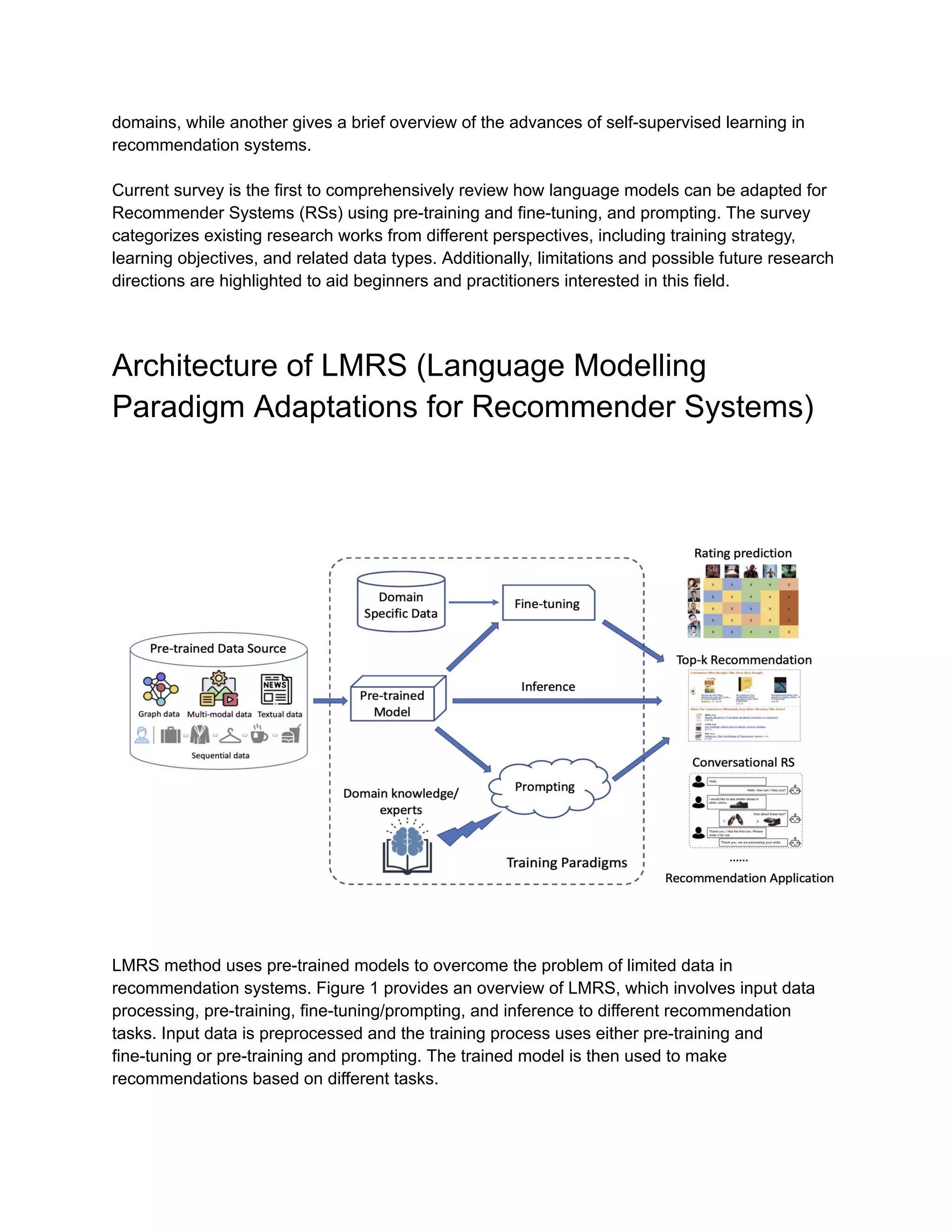
LMRS method uses pre-trained models to overcome the problem of limited data in
recommendation systems. Figure 1 provides an overview of LMRS, which involves input data
processing, pre-training, fine-tuning/prompting, and inference to different recommendation
tasks. Input data is preprocessed and the training process uses either pre-training and
fine-tuning or pre-training and prompting. The trained model is then used to make
recommendations based on different tasks.
Data Types
Recommendation systems typically start by encoding input data as embeddings. However, the
input data for recommendations is more diverse than in most natural language processing
tasks. Different encoding techniques and processes may be needed to handle different input
types. There are several input data types for recommendations, including textual data (such as
reviews and comments), sequential data (such as user-item interactions), graphs (such as
social or knowledge graphs), and multi-modal data. Each of these types of data requires specific
handling and processing during the training of recommendation models.
LMRS Training Strategies
There are mainly two classes regarding different training paradigms: pre-train, fine-tune
paradigm and prompt learning paradigm.
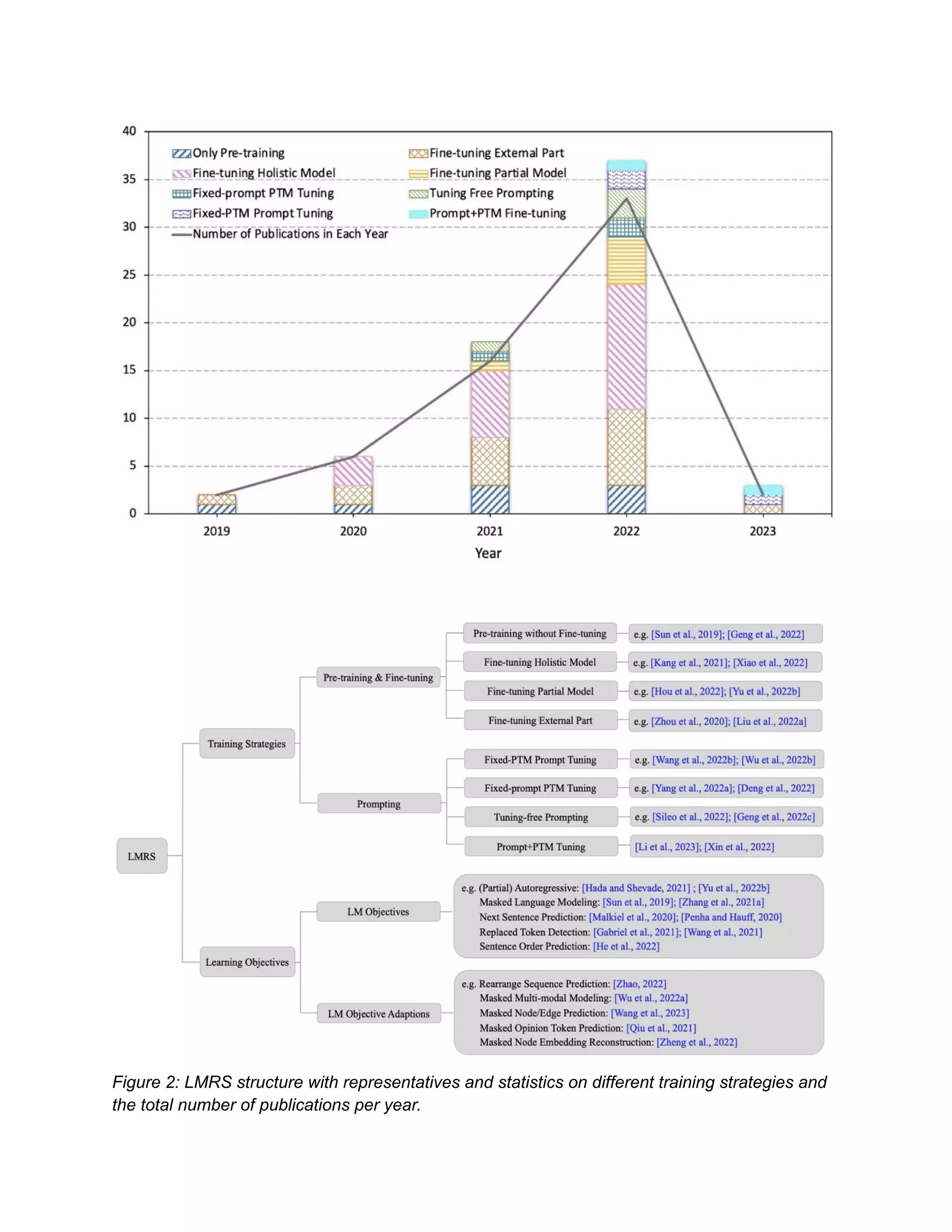
Figure 2: LMRS structure with representatives and statistics on different training strategies and
the total number of publications per year.
Pre-train,finetune Paradigm
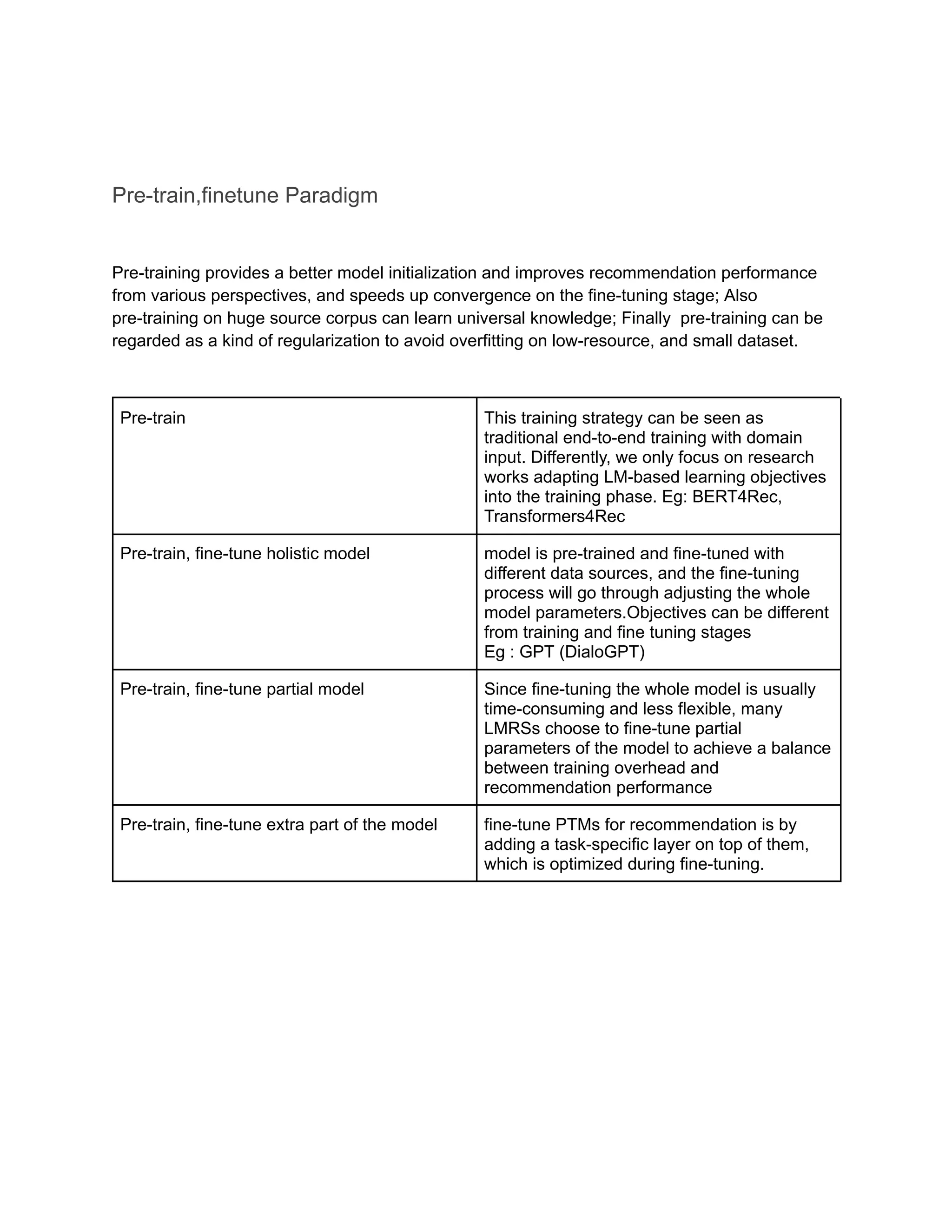
Pre-training provides a better model initialization and improves recommendation performance
from various perspectives, and speeds up convergence on the fine-tuning stage; Also
pre-training on huge source corpus can learn universal knowledge; Finally pre-training can be
regarded as a kind of regularization to avoid overfitting on low-resource, and small dataset.
Pre-train This training strategy can be seen as
traditional end-to-end training with domain
input. Differently, we only focus on research
works adapting LM-based learning objectives
into the training phase. Eg: BERT4Rec,
Transformers4Rec
Pre-train, fine-tune holistic model model is pre-trained and fine-tuned with
different data sources, and the fine-tuning
process will go through adjusting the whole
model parameters.Objectives can be different
from training and fine tuning stages
Eg : GPT (DialoGPT)
Pre-train, fine-tune partial model Since fine-tuning the whole model is usually
time-consuming and less flexible, many
LMRSs choose to fine-tune partial
parameters of the model to achieve a balance
between training overhead and
recommendation performance
Pre-train, fine-tune extra part of the model fine-tune PTMs for recommendation is by
adding a task-specific layer on top of them,
which is optimized during fine-tuning.
Prompting paradigm
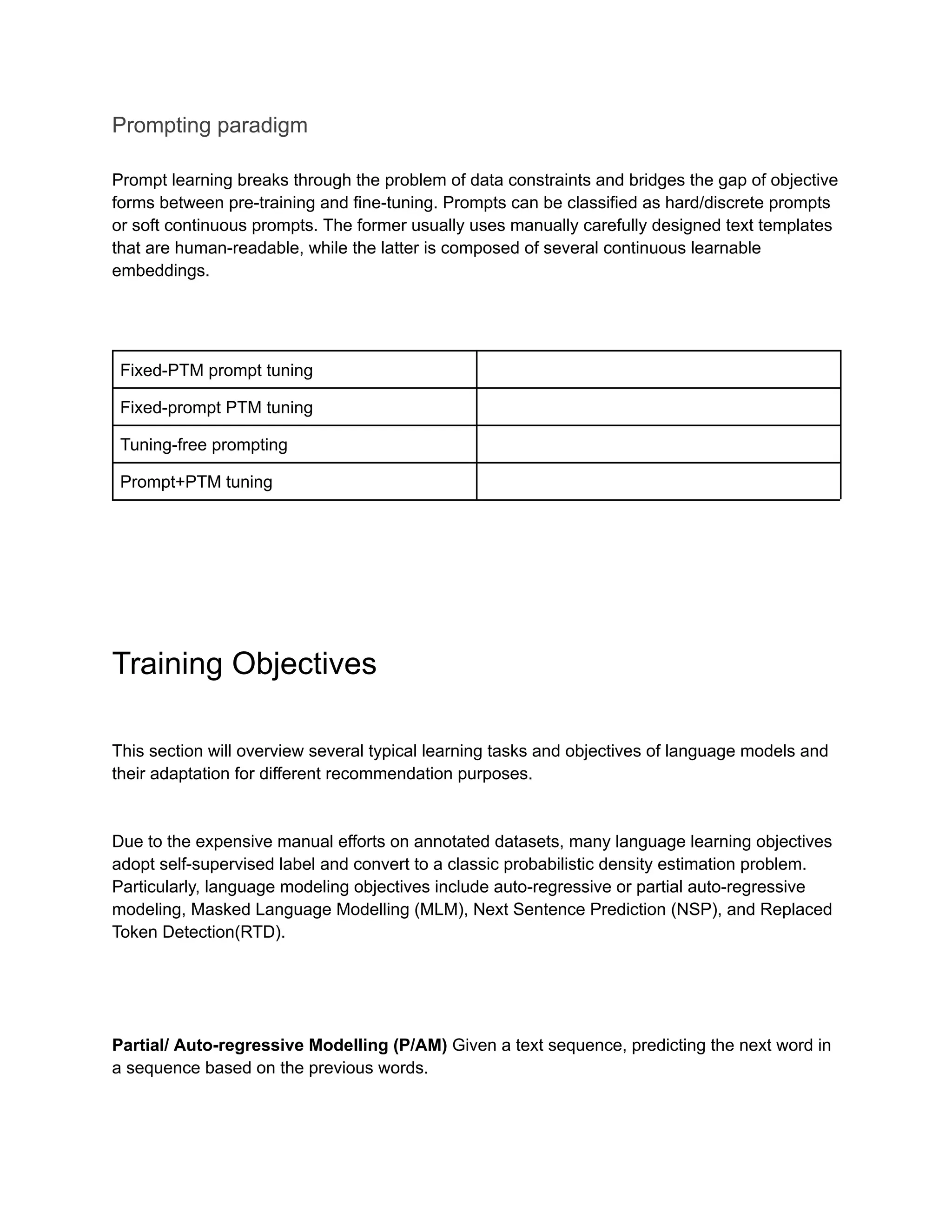
Prompt learning breaks through the problem of data constraints and bridges the gap of objective
forms between pre-training and fine-tuning. Prompts can be classified as hard/discrete prompts
or soft continuous prompts. The former usually uses manually carefully designed text templates
that are human-readable, while the latter is composed of several continuous learnable
embeddings.
Fixed-PTM prompt tuning
Fixed-prompt PTM tuning
Tuning-free prompting
Prompt+PTM tuning
Training Objectives
This section will overview several typical learning tasks and objectives of language models and
their adaptation for different recommendation purposes.
Due to the expensive manual efforts on annotated datasets, many language learning objectives
adopt self-supervised label and convert to a classic probabilistic density estimation problem.
Particularly, language modeling objectives include auto-regressive or partial auto-regressive
modeling, Masked Language Modelling (MLM), Next Sentence Prediction (NSP), and Replaced
Token Detection(RTD).
Partial/ Auto-regressive Modelling (P/AM) Given a text sequence, predicting the next word in
a sequence based on the previous words.
Masked Language Modelling (MLM) Taking a sequence of textual sentence as input, MLM first
masks a token or multi-tokens with a special token such as [MASK]. Then the model is trained
to predict the masked tokens taking the rest of the tokens as context.
Next Sentence Prediction (NSP) It is a binary classification loss for predicting whether two
segments follow each other in the original text.Another variation of the NSP is the Sentence
Order Prediction (SOP)
Replaced Token Detection(RTD) It is used to predict whether a token is replaced given its
surrounding context.
Formulating Training with Data Types
To associate different training strategies and objectives with different types of input data, in
Table 1, we summarize representative research works in this domain and list their training
paradigms according to various training inputs for different recommendation tasks. The listed
training strategies and objectives are carefully selected and are typical in existing work. For the
page limit, we only selected part of recent research on LMRS.
Conclusion
Despite the effectiveness of LM training paradigms has been verified in various
recommendation tasks, there are still several challenges that could be the direction of future
research.
Here are some areas we could invest in the future.
● Language bias and fact-consistency in language generation tasks of recommendation
● Knowledge transmission and injection for downstream recommendations.
● Scalability of pre-training mechanism in recommendation.
● Privacy issue and ethical state.
References
[Bao et al., 2020] Hangbo Bao, Li Dong, Furu Wei, Wenhui Wang, Nan Yang, Xiaodong Liu, Yu
Wang, Jianfeng Gao, Songhao Piao, Ming Zhou, et al. Unilmv2: Pseudo- masked language
models for unified language model pretraining. In ICML, pages 642–652, 2020.
[Brown et al., 2020] Tom Brown, Benjamin Mann, Nick Ryder, Melanie Subbiah, Jared D Kaplan,
Prafulla Dhariwal, Arvind Neelakantan, Pranav Shyam, Girish Sastry, Amanda Askell, et al.
Language models are few-shot learners. NeurIPS, 33:1877–1901, 2020.
[Chen et al., 2021] Lei Chen, Fajie Yuan, Jiaxi Yang, Xiangnan He, Chengming Li, and Min
Yang. User-specific adaptive fine-tuning for cross-domain recommendations. TKDE, 2021.
[Deng et al., 2022] Yang Deng, Wenxuan Zhang, Weiwen Xu, Wenqiang Lei, Tat-Seng Chua,
and Wai Lam. A unified multi-task learning framework for multi-goal conversational
recommender systems. TOIS, 2022.
[Devlin et al., 2019] Jacob Devlin, Ming-Wei Chang, Kenton Lee, and Kristina Toutanova. Bert:
Pre-training of deep bidirectional transformers for language understanding. In NAACL-HLT,
pages 4171–4186, 2019

LLM Paradigm Adaptations in Recommender Systems.pdf

  • 1.
    LLM Paradigm Adaptationsin Recommender Systems Abstract This article gives a high level understanding of adaptation of Pre-trained Language Models (PLMs) to the recommendation domain, which has shown promising results. We will investigate how to extract and transfer knowledge from pre-trained models to improve recommendation performance in terms of generality, sparsity, efficiency, and effectiveness. It proposes a taxonomy to classify existing PLM-based recommender systems and analyze their connection with different input data types and highlight open issues and future research directions in this field. Introduction Recommender Systems (RSs) play a key role in discovering users’ interests and alleviating information overload in their decision-making process.Over a period of time,recommendation systems moved from traditional ML models to deep neural network architectures using the latest computing infrastructure. But these models require a lot of data and have many different settings that need to be learned. If there isn't enough data available to train the model properly, it may become too focused on the data it does have, making it less effective in real-world situations. This is a common problem in recommendation systems when there are many new users with limited interactions. This creates data sparsity and becomes a major performance bottleneck for current deep recommendation models. The use of pre-training in natural language processing (NLP) has led to the development of language models that are pre-trained on large amounts of unlabelled data, then fine-tuned for specific tasks. This approach has been successful in improving the performance of recommendation systems, which have been struggling with data sparsity and efficiency issues. A new paradigm called prompt learning has been proposed to further unify the use of pre-trained language models in a flexible way. While there have been some surveys on pre-training paradigms in other fields, only a few literature reviews have focused on recommendation systems. One review summarizes some research on the pre-training of recommendation models and discusses knowledge transfer methods between different
  • 2.
    domains, while anothergives a brief overview of the advances of self-supervised learning in recommendation systems. Current survey is the first to comprehensively review how language models can be adapted for Recommender Systems (RSs) using pre-training and fine-tuning, and prompting. The survey categorizes existing research works from different perspectives, including training strategy, learning objectives, and related data types. Additionally, limitations and possible future research directions are highlighted to aid beginners and practitioners interested in this field. Architecture of LMRS (Language Modelling Paradigm Adaptations for Recommender Systems) LMRS method uses pre-trained models to overcome the problem of limited data in recommendation systems. Figure 1 provides an overview of LMRS, which involves input data processing, pre-training, fine-tuning/prompting, and inference to different recommendation tasks. Input data is preprocessed and the training process uses either pre-training and fine-tuning or pre-training and prompting. The trained model is then used to make recommendations based on different tasks.
  • 3.
    Data Types Recommendation systemstypically start by encoding input data as embeddings. However, the input data for recommendations is more diverse than in most natural language processing tasks. Different encoding techniques and processes may be needed to handle different input types. There are several input data types for recommendations, including textual data (such as reviews and comments), sequential data (such as user-item interactions), graphs (such as social or knowledge graphs), and multi-modal data. Each of these types of data requires specific handling and processing during the training of recommendation models. LMRS Training Strategies There are mainly two classes regarding different training paradigms: pre-train, fine-tune paradigm and prompt learning paradigm.
  • 4.
    Figure 2: LMRSstructure with representatives and statistics on different training strategies and the total number of publications per year.
  • 5.
    Pre-train,finetune Paradigm Pre-training providesa better model initialization and improves recommendation performance from various perspectives, and speeds up convergence on the fine-tuning stage; Also pre-training on huge source corpus can learn universal knowledge; Finally pre-training can be regarded as a kind of regularization to avoid overfitting on low-resource, and small dataset. Pre-train This training strategy can be seen as traditional end-to-end training with domain input. Differently, we only focus on research works adapting LM-based learning objectives into the training phase. Eg: BERT4Rec, Transformers4Rec Pre-train, fine-tune holistic model model is pre-trained and fine-tuned with different data sources, and the fine-tuning process will go through adjusting the whole model parameters.Objectives can be different from training and fine tuning stages Eg : GPT (DialoGPT) Pre-train, fine-tune partial model Since fine-tuning the whole model is usually time-consuming and less flexible, many LMRSs choose to fine-tune partial parameters of the model to achieve a balance between training overhead and recommendation performance Pre-train, fine-tune extra part of the model fine-tune PTMs for recommendation is by adding a task-specific layer on top of them, which is optimized during fine-tuning.
  • 6.
    Prompting paradigm Prompt learningbreaks through the problem of data constraints and bridges the gap of objective forms between pre-training and fine-tuning. Prompts can be classified as hard/discrete prompts or soft continuous prompts. The former usually uses manually carefully designed text templates that are human-readable, while the latter is composed of several continuous learnable embeddings. Fixed-PTM prompt tuning Fixed-prompt PTM tuning Tuning-free prompting Prompt+PTM tuning Training Objectives This section will overview several typical learning tasks and objectives of language models and their adaptation for different recommendation purposes. Due to the expensive manual efforts on annotated datasets, many language learning objectives adopt self-supervised label and convert to a classic probabilistic density estimation problem. Particularly, language modeling objectives include auto-regressive or partial auto-regressive modeling, Masked Language Modelling (MLM), Next Sentence Prediction (NSP), and Replaced Token Detection(RTD). Partial/ Auto-regressive Modelling (P/AM) Given a text sequence, predicting the next word in a sequence based on the previous words.
  • 7.
    Masked Language Modelling(MLM) Taking a sequence of textual sentence as input, MLM first masks a token or multi-tokens with a special token such as [MASK]. Then the model is trained to predict the masked tokens taking the rest of the tokens as context. Next Sentence Prediction (NSP) It is a binary classification loss for predicting whether two segments follow each other in the original text.Another variation of the NSP is the Sentence Order Prediction (SOP) Replaced Token Detection(RTD) It is used to predict whether a token is replaced given its surrounding context.
  • 8.
    Formulating Training withData Types To associate different training strategies and objectives with different types of input data, in Table 1, we summarize representative research works in this domain and list their training paradigms according to various training inputs for different recommendation tasks. The listed training strategies and objectives are carefully selected and are typical in existing work. For the page limit, we only selected part of recent research on LMRS. Conclusion Despite the effectiveness of LM training paradigms has been verified in various recommendation tasks, there are still several challenges that could be the direction of future research. Here are some areas we could invest in the future. ● Language bias and fact-consistency in language generation tasks of recommendation ● Knowledge transmission and injection for downstream recommendations. ● Scalability of pre-training mechanism in recommendation. ● Privacy issue and ethical state. References [Bao et al., 2020] Hangbo Bao, Li Dong, Furu Wei, Wenhui Wang, Nan Yang, Xiaodong Liu, Yu Wang, Jianfeng Gao, Songhao Piao, Ming Zhou, et al. Unilmv2: Pseudo- masked language models for unified language model pretraining. In ICML, pages 642–652, 2020. [Brown et al., 2020] Tom Brown, Benjamin Mann, Nick Ryder, Melanie Subbiah, Jared D Kaplan, Prafulla Dhariwal, Arvind Neelakantan, Pranav Shyam, Girish Sastry, Amanda Askell, et al. Language models are few-shot learners. NeurIPS, 33:1877–1901, 2020. [Chen et al., 2021] Lei Chen, Fajie Yuan, Jiaxi Yang, Xiangnan He, Chengming Li, and Min Yang. User-specific adaptive fine-tuning for cross-domain recommendations. TKDE, 2021.
  • 9.
    [Deng et al.,2022] Yang Deng, Wenxuan Zhang, Weiwen Xu, Wenqiang Lei, Tat-Seng Chua, and Wai Lam. A unified multi-task learning framework for multi-goal conversational recommender systems. TOIS, 2022. [Devlin et al., 2019] Jacob Devlin, Ming-Wei Chang, Kenton Lee, and Kristina Toutanova. Bert: Pre-training of deep bidirectional transformers for language understanding. In NAACL-HLT, pages 4171–4186, 2019