digital illustration + design 
project 1: design a landscape 
plainfield central – mr. lawler art + design 
1
digital illustration + design 
CREATE YOUR OWN LANDSCAPE 
plainfield central – mr. lawler art + design 
2 
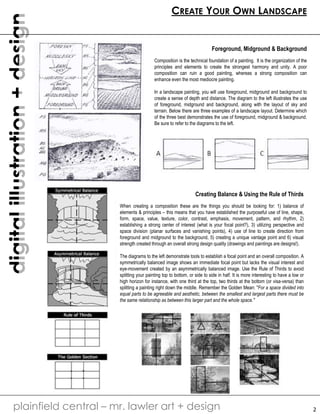
Foreground, Midground & Background 
Composition is the technical foundation of a painting. It is the organization of the 
principles and elements to create the strongest harmony and unity. A poor 
composition can ruin a good painting, whereas a strong composition can 
enhance even the most mediocre painting. 
In a landscape painting, you will use foreground, midground and background to 
create a sense of depth and distance. The diagram to the left illustrates the use 
of foreground, midground and background, along with the layout of sky and 
terrain. Below there are three examples of a landscape layout. Determine which 
of the three best demonstrates the use of foreground, midground & background. 
Be sure to refer to the diagrams to the left. 
Creating Balance & Using the Rule of Thirds 
When creating a composition these are the things you should be looking for: 1) balance of 
elements & principles – this means that you have established the purposeful use of line, shape, 
form, space, value, texture, color, contrast, emphasis, movement, pattern, and rhythm, 2) 
establishing a strong center of interest (what is your focal point?), 3) utilizing perspective and 
space division (planar surfaces and vanishing points), 4) use of line to create direction from 
foreground and midground to the background, 5) creating a unique vantage point and 6) visual 
strength created through an overall strong design quality (drawings and paintings are designs!). 
The diagrams to the left demonstrate tools to establish a focal point and an overall composition. A 
symmetrically balanced image shows an immediate focal point but lacks the visual interest and 
eye-movement created by an asymmetrically balanced image. Use the Rule of Thirds to avoid 
splitting your painting top to bottom, or side to side in half. It is more interesting to have a low or 
high horizon for instance, with one third at the top, two thirds at the bottom (or visa-versa) than 
splitting a painting right down the middle. Remember the Golden Mean: "For a space divided into 
equal parts to be agreeable and aesthetic, between the smallest and largest parts there must be 
the same relationship as between this larger part and the whole space."
digital illustration + design 
CREATE YOUR OWN LANDSCAPE 
plainfield central – mr. lawler art + design 
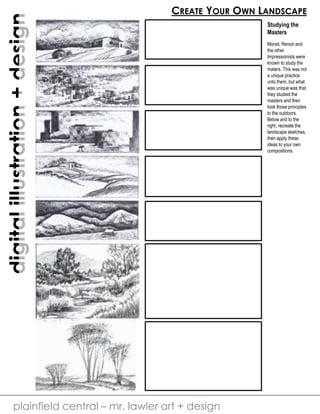
Studying the 
Masters 
Monet, Renoir and 
the other 
Impressionists were 
known to study the 
maters. This was not 
a unique practice 
unto them, but what 
was unique was that 
they studied the 
masters and then 
took those principles 
to the outdoors. 
Below and to the 
right, recreate the 
landscape sketches, 
then apply these 
ideas to your own 
compositions.
digital illustration + design 
CREATE YOUR OWN LANDSCAPE 
plainfield central – mr. lawler art + design 
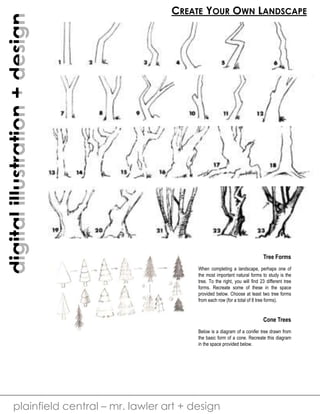
Tree Forms 
When completing a landscape, perhaps one of 
the most important natural forms to study is the 
tree. To the right, you will find 23 different tree 
forms. Recreate some of these in the space 
provided below. Choose at least two tree forms 
from each row (for a total of 8 tree forms). 
Cone Trees 
Below is a diagram of a conifer tree drawn from 
the basic form of a cone. Recreate this diagram 
in the space provided below.
digital illustration + design 
CREATE YOUR OWN LANDSCAPE 
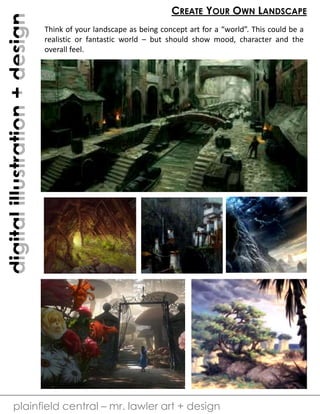
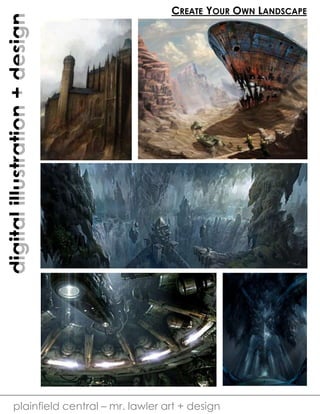
Think of your landscape as being concept art for a “world”. This could be a 
realistic or fantastic world – but should show mood, character and the 
overall feel. 
plainfield central – mr. lawler art + design
digital illustration + design 
CREATE YOUR OWN LANDSCAPE 
plainfield central – mr. lawler art + design

DID UNIT 1B: Exercises

  • 1.
    digital illustration +design project 1: design a landscape plainfield central – mr. lawler art + design 1
  • 2.
    digital illustration +design CREATE YOUR OWN LANDSCAPE plainfield central – mr. lawler art + design 2 Foreground, Midground & Background Composition is the technical foundation of a painting. It is the organization of the principles and elements to create the strongest harmony and unity. A poor composition can ruin a good painting, whereas a strong composition can enhance even the most mediocre painting. In a landscape painting, you will use foreground, midground and background to create a sense of depth and distance. The diagram to the left illustrates the use of foreground, midground and background, along with the layout of sky and terrain. Below there are three examples of a landscape layout. Determine which of the three best demonstrates the use of foreground, midground & background. Be sure to refer to the diagrams to the left. Creating Balance & Using the Rule of Thirds When creating a composition these are the things you should be looking for: 1) balance of elements & principles – this means that you have established the purposeful use of line, shape, form, space, value, texture, color, contrast, emphasis, movement, pattern, and rhythm, 2) establishing a strong center of interest (what is your focal point?), 3) utilizing perspective and space division (planar surfaces and vanishing points), 4) use of line to create direction from foreground and midground to the background, 5) creating a unique vantage point and 6) visual strength created through an overall strong design quality (drawings and paintings are designs!). The diagrams to the left demonstrate tools to establish a focal point and an overall composition. A symmetrically balanced image shows an immediate focal point but lacks the visual interest and eye-movement created by an asymmetrically balanced image. Use the Rule of Thirds to avoid splitting your painting top to bottom, or side to side in half. It is more interesting to have a low or high horizon for instance, with one third at the top, two thirds at the bottom (or visa-versa) than splitting a painting right down the middle. Remember the Golden Mean: "For a space divided into equal parts to be agreeable and aesthetic, between the smallest and largest parts there must be the same relationship as between this larger part and the whole space."
  • 3.
    digital illustration +design CREATE YOUR OWN LANDSCAPE plainfield central – mr. lawler art + design Studying the Masters Monet, Renoir and the other Impressionists were known to study the maters. This was not a unique practice unto them, but what was unique was that they studied the masters and then took those principles to the outdoors. Below and to the right, recreate the landscape sketches, then apply these ideas to your own compositions.
  • 4.
    digital illustration +design CREATE YOUR OWN LANDSCAPE plainfield central – mr. lawler art + design Tree Forms When completing a landscape, perhaps one of the most important natural forms to study is the tree. To the right, you will find 23 different tree forms. Recreate some of these in the space provided below. Choose at least two tree forms from each row (for a total of 8 tree forms). Cone Trees Below is a diagram of a conifer tree drawn from the basic form of a cone. Recreate this diagram in the space provided below.
  • 5.
    digital illustration +design CREATE YOUR OWN LANDSCAPE Think of your landscape as being concept art for a “world”. This could be a realistic or fantastic world – but should show mood, character and the overall feel. plainfield central – mr. lawler art + design
  • 6.
    digital illustration +design CREATE YOUR OWN LANDSCAPE plainfield central – mr. lawler art + design