

DDOS Detection
Using Machine Learning techniques
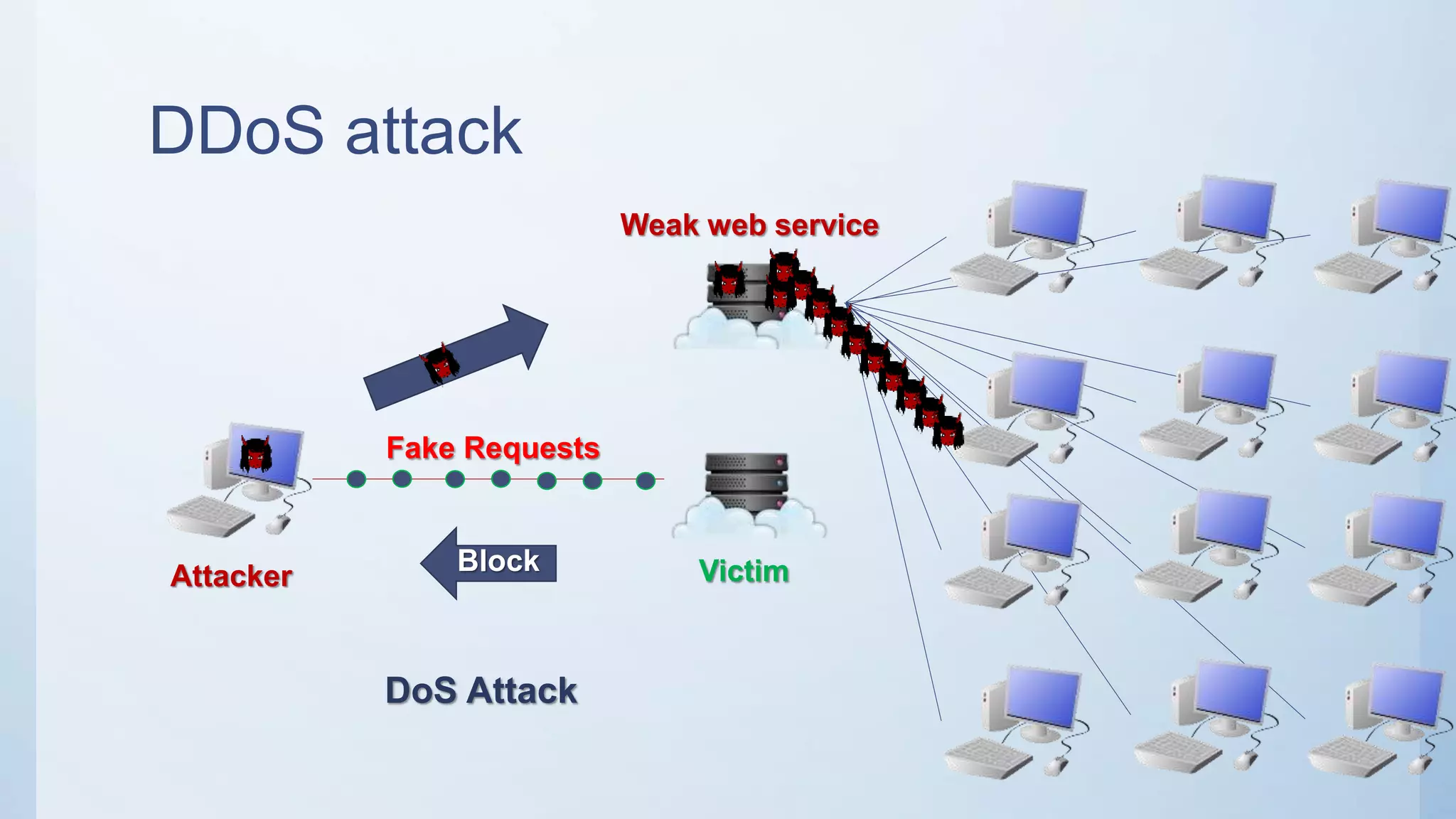
DDoS attack
Attacker
Fake Requests
Block
DoS Attack
Weak web service
Victim
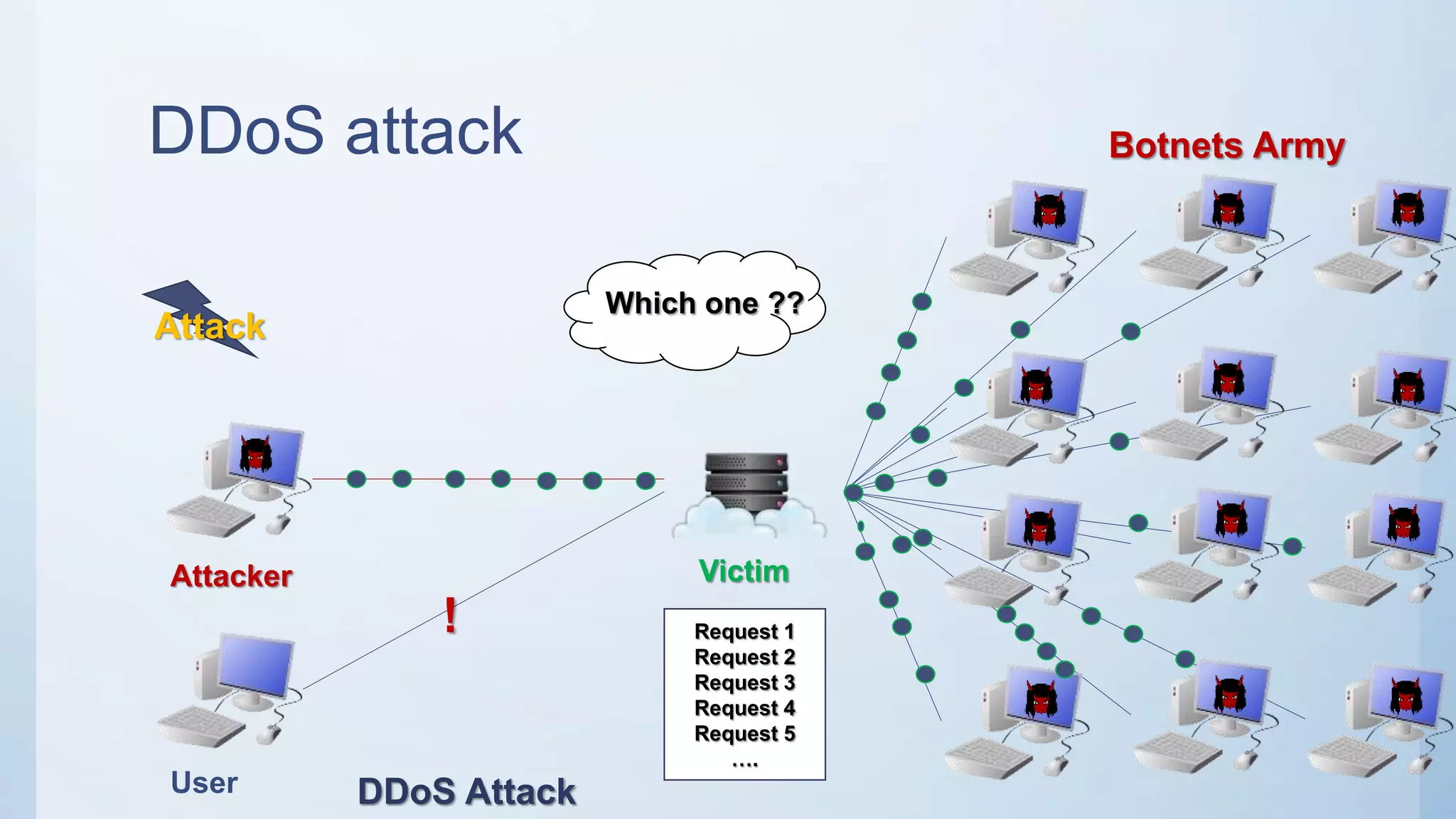
DDoS attack
Attacker Victim
Which one ??
Attack
DDoS Attack
Botnets Army
Request 1
Request 2
Request 3
Request 4
Request 5
….
User
!
Discussion
• Detection known and unknown DDoS attacks using Artificial Neural
Network (Alan Saied, Richard E. Overill, Tomasz Radzik) 2016
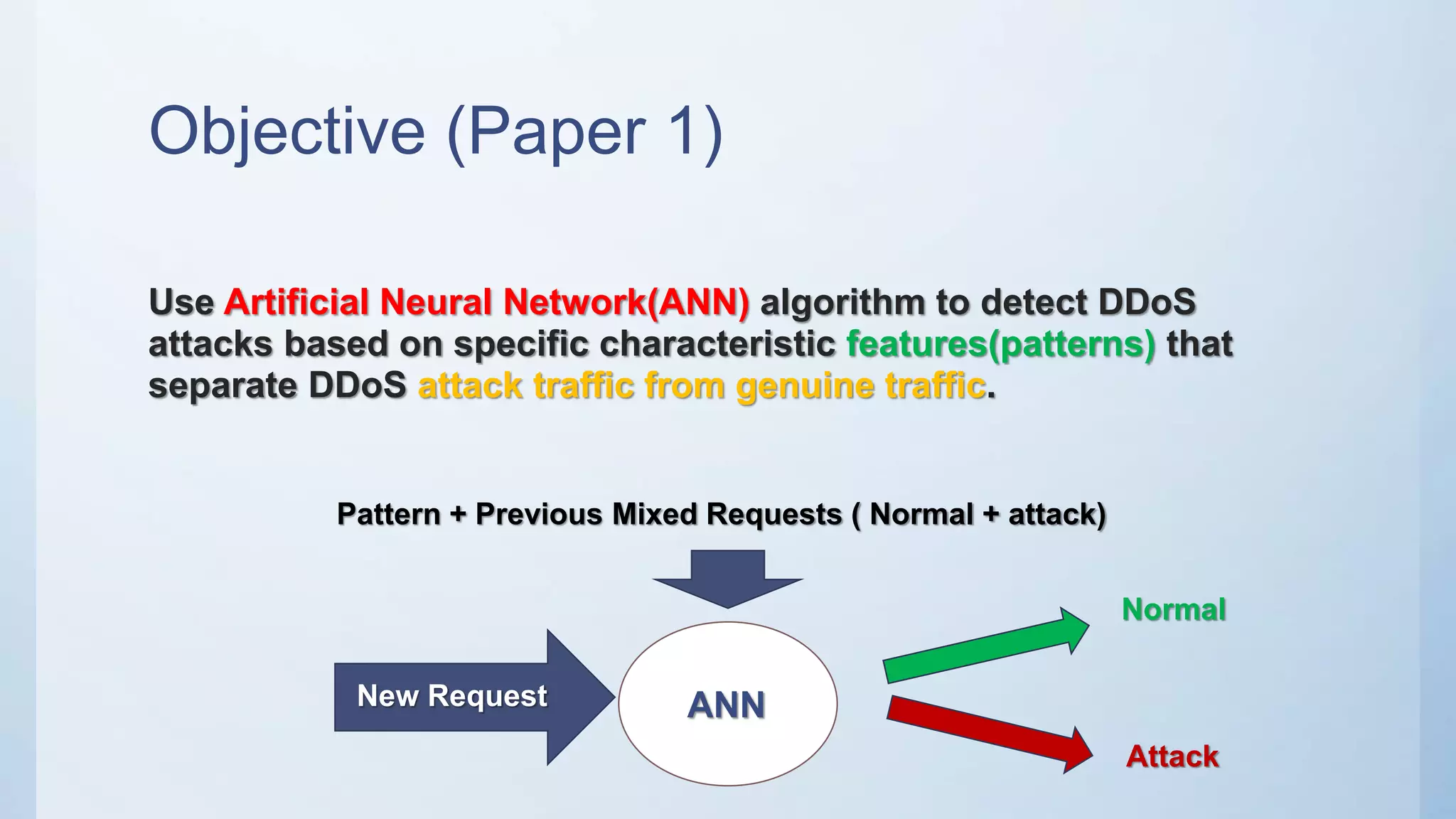
Objective (Paper 1)
Use Artificial Neural Network(ANN) algorithm to detect DDoS
attacks based on specific characteristic features(patterns) that
separate DDoS attack traffic from genuine traffic.
ANN
Pattern + Previous Mixed Requests ( Normal + attack)
New Request
Normal
Attack
Background (Paper 1)
• Using online dataset (Live) to detect known and unknown DDoS
Which means detection for up-to-date patterns
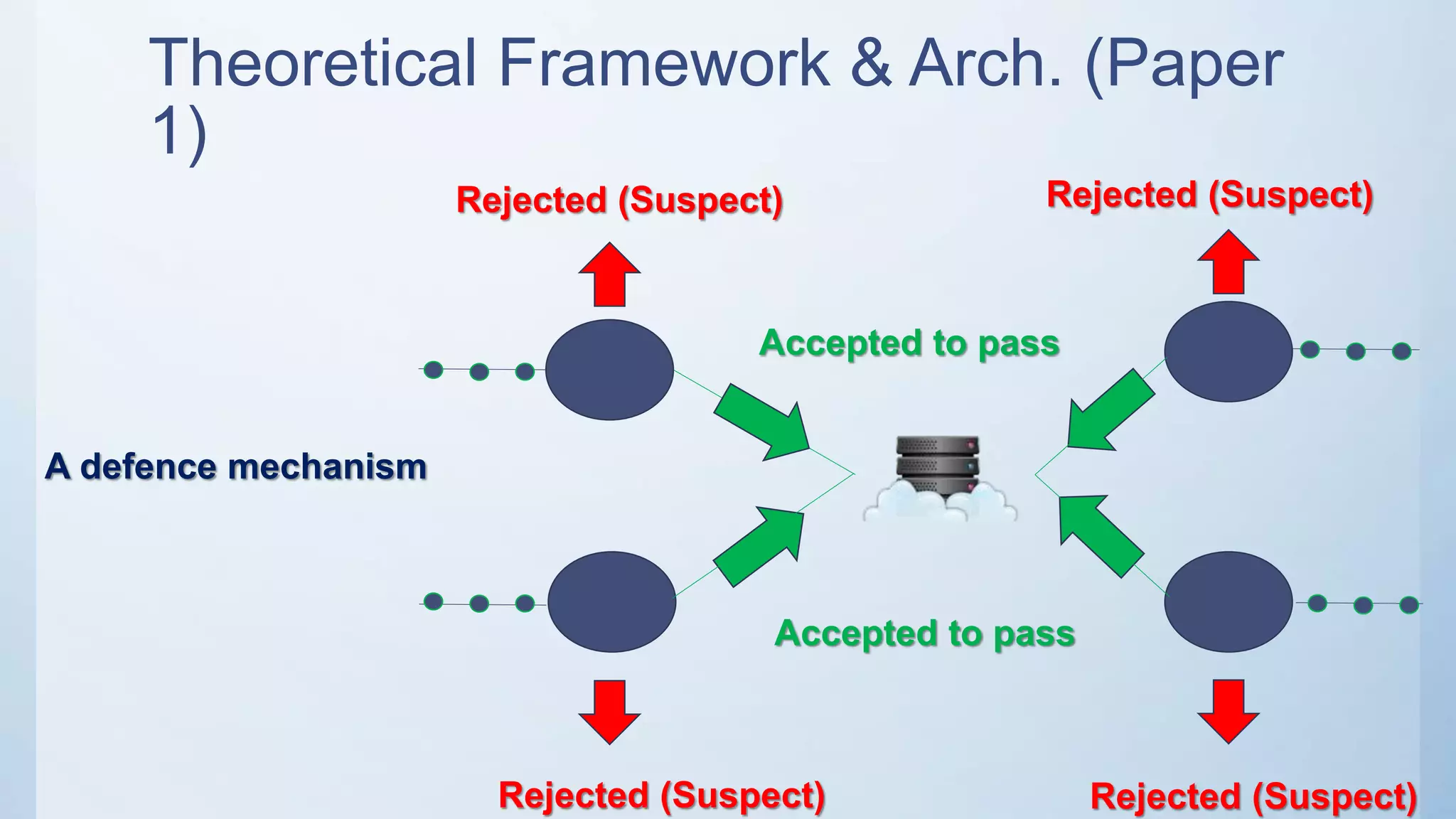
• A defence mechanism that prevents forged packets from reaching the
victim, but allows genuine packets to pass through
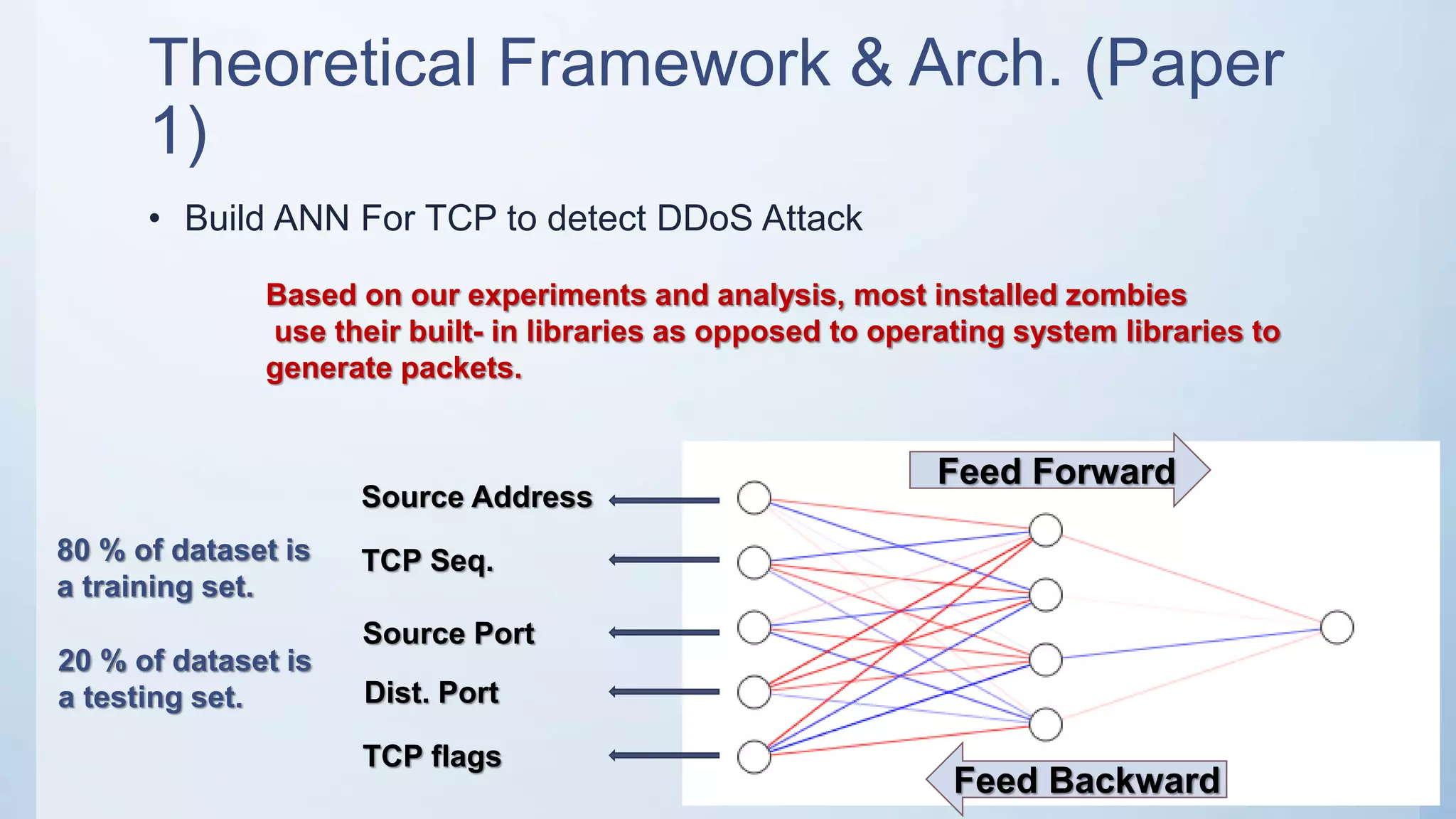
Theoretical Framework & Arch. (Paper
1)
• Build ANN For TCP to detect DDoS Attack
Feed Forward
Feed Backward
Source Address
TCP flags
TCP Seq.
Source Port
Dist. Port
Based on our experiments and analysis, most installed zombies
use their built- in libraries as opposed to operating system libraries to
generate packets.
80 % of dataset is
a training set.
20 % of dataset is
a testing set.
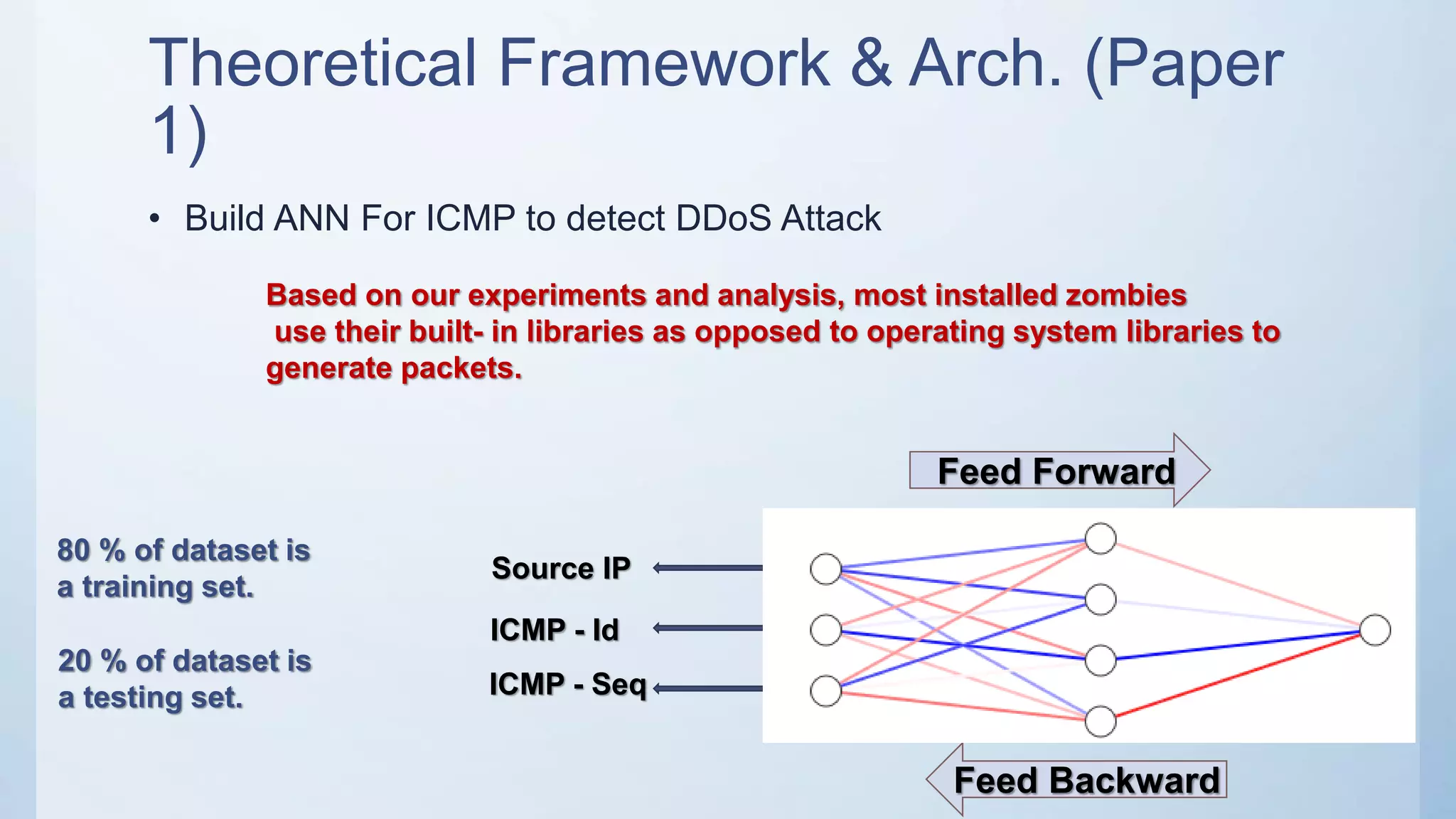
Theoretical Framework & Arch. (Paper
1)
• Build ANN For ICMP to detect DDoS Attack
Feed Forward
Feed Backward
Source IP
ICMP - Id
ICMP - Seq
Based on our experiments and analysis, most installed zombies
use their built- in libraries as opposed to operating system libraries to
generate packets.
80 % of dataset is
a training set.
20 % of dataset is
a testing set.
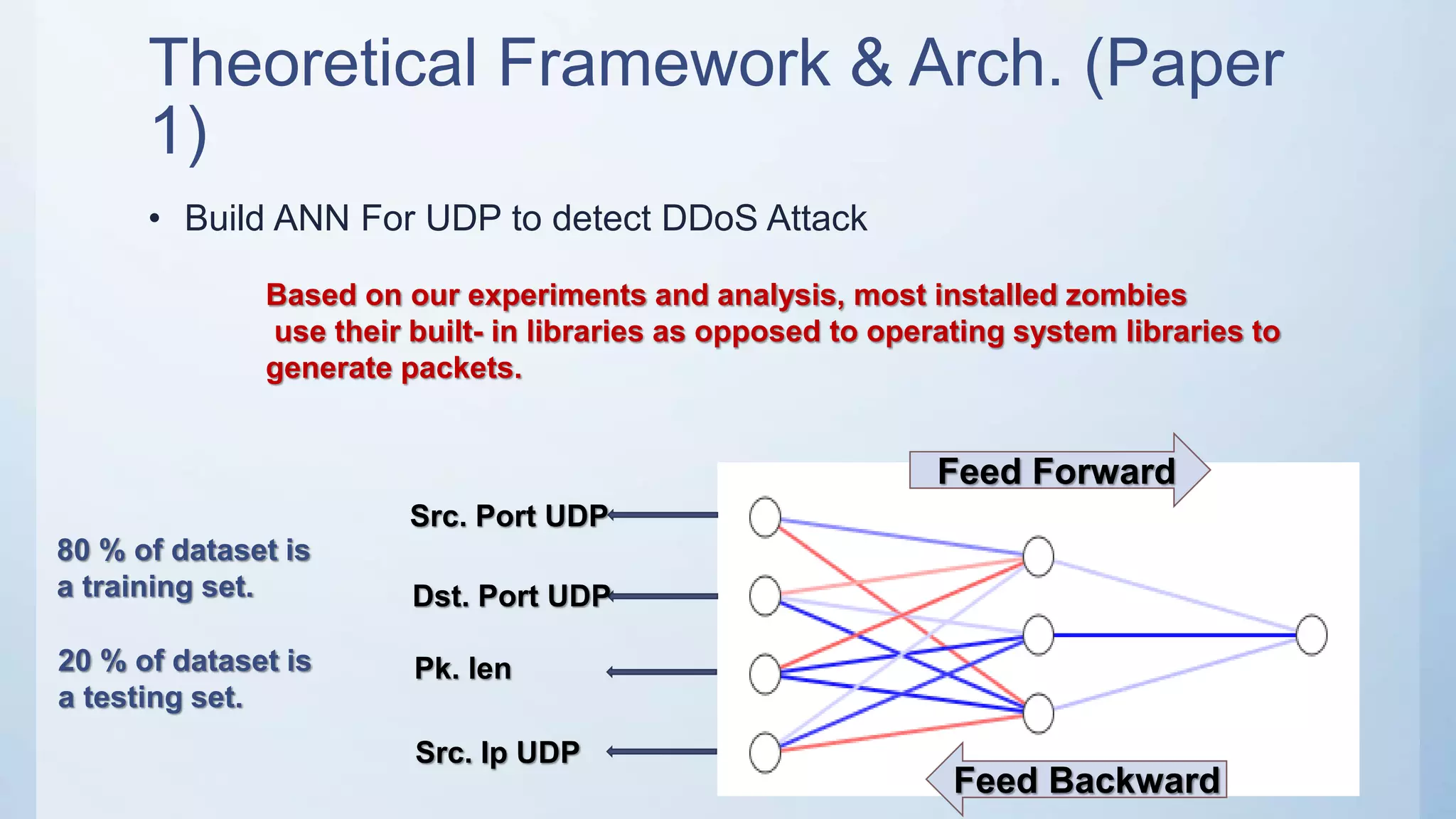
Theoretical Framework & Arch. (Paper
1)
• Build ANN For UDP to detect DDoS Attack
Feed Forward
Feed Backward
Src. Port UDP
Dst. Port UDP
Pk. len
Src. Ip UDP
Based on our experiments and analysis, most installed zombies
use their built- in libraries as opposed to operating system libraries to
generate packets.
80 % of dataset is
a training set.
20 % of dataset is
a testing set.
A defence mechanism
Accepted to pass
Accepted to pass
Rejected (Suspect) Rejected (Suspect)
Rejected (Suspect)Rejected (Suspect)
Theoretical Framework & Arch. (Paper
1)
Theoretical Framework & Arch. (Paper
1)
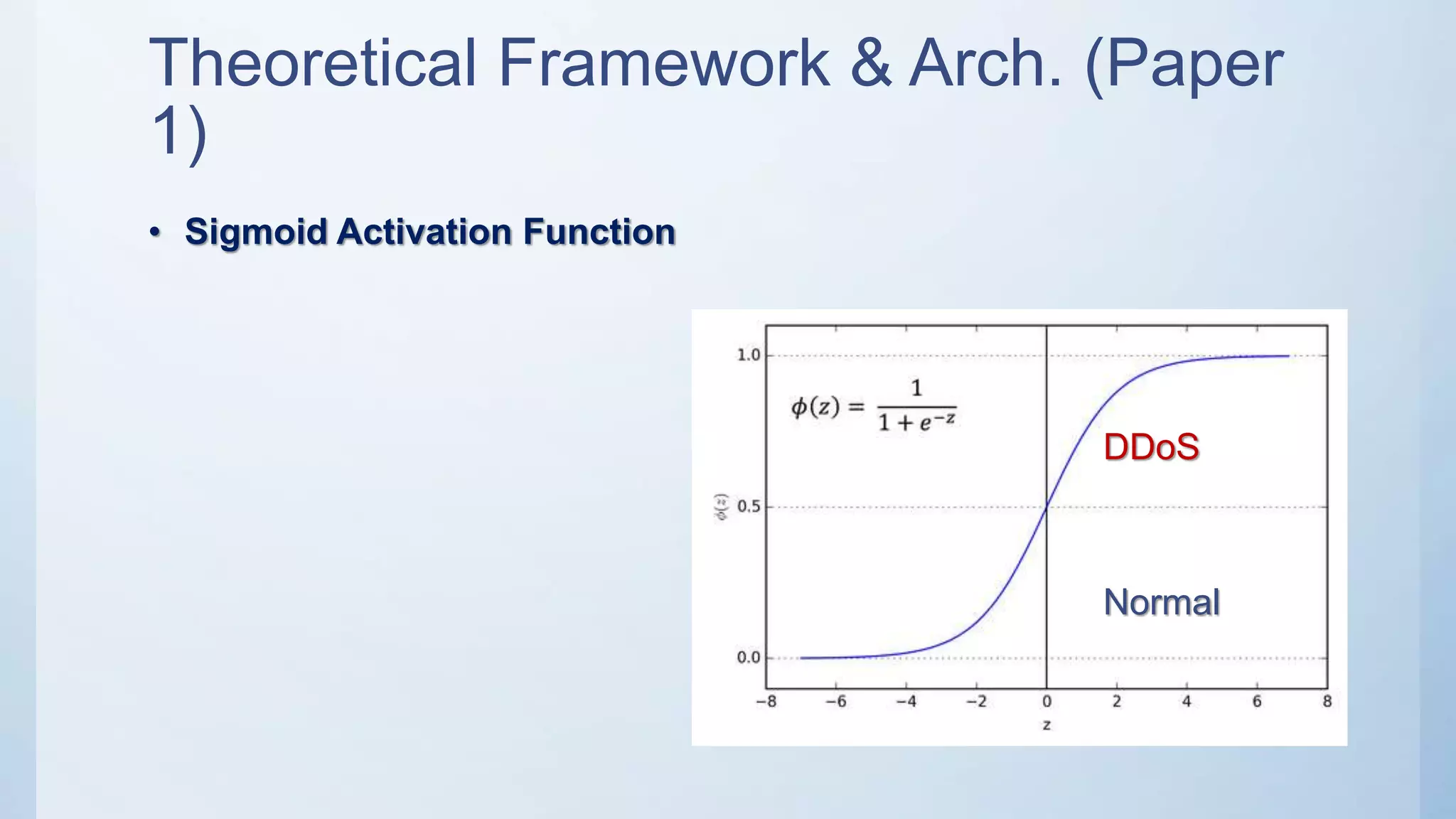
• Sigmoid Activation Function
Normal
DDoS
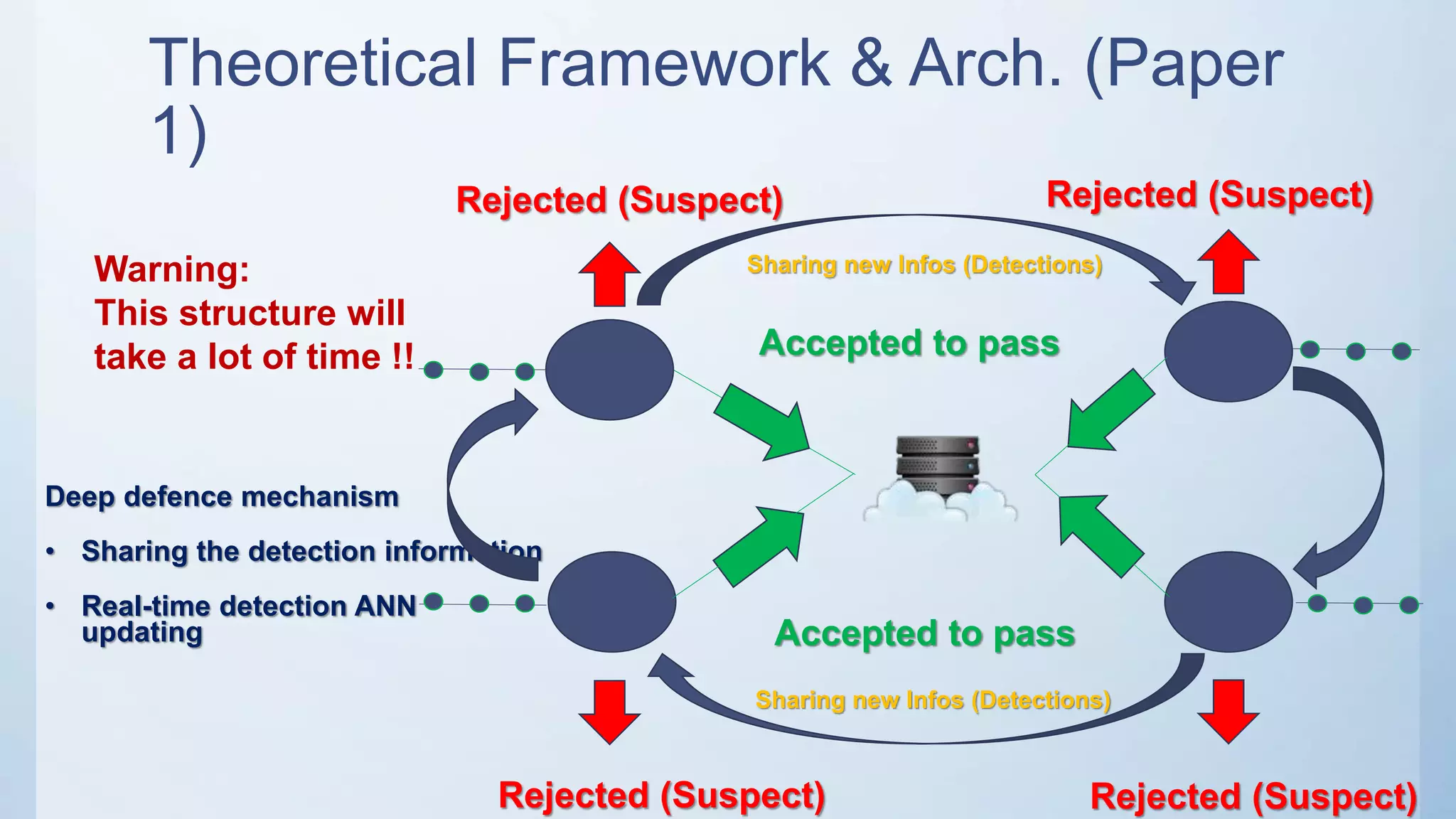
Deep defence mechanism
• Sharing the detection information
• Real-time detection ANN
updating
Accepted to pass
Accepted to pass
Rejected (Suspect) Rejected (Suspect)
Rejected (Suspect)Rejected (Suspect)
Theoretical Framework & Arch. (Paper
1)
Sharing new Infos (Detections)
Warning:
This structure will
take a lot of time !!
Theoretical Framework & Arch. (Paper
1) – Deep Defence Mech.
Tcp
IP1
IP3
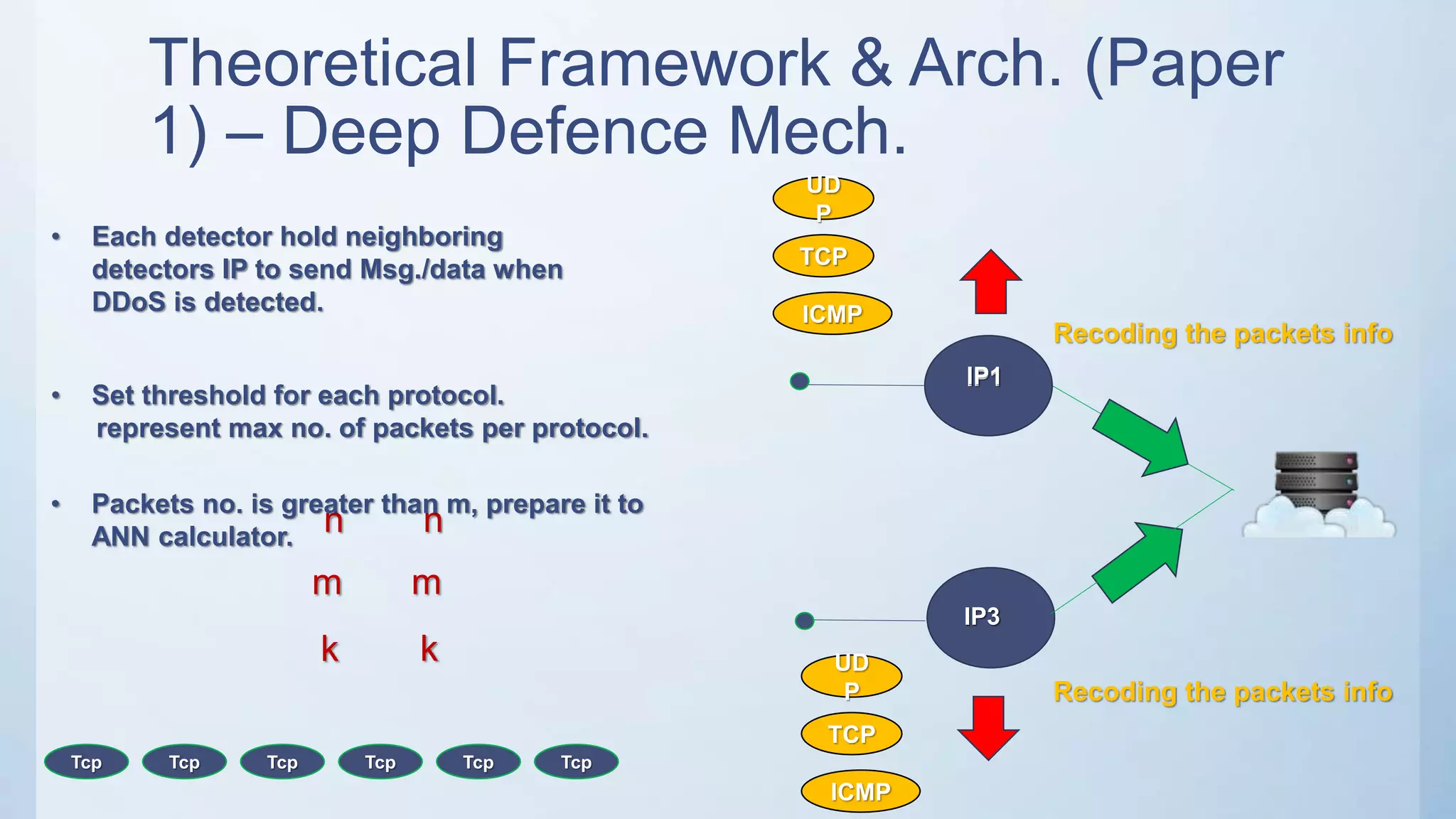
• Each detector hold neighboring
detectors IP to send Msg./data when
DDoS is detected.
IP1
IP3
Recoding the packets info
• Set threshold for each protocol.
represent max no. of packets per protocol.
TCP
ICMP
UD
P
TCP
ICMP
UD
P
n
m
k
n
m
k
TcpTcp TcpTcp Tcp
• Packets no. is greater than m, prepare it to
ANN calculator.
Theoretical Framework & Arch. (Paper
1) – Deep Defence Mech.
• Packets no. is greater than m, prepare it to
ANN calculator.
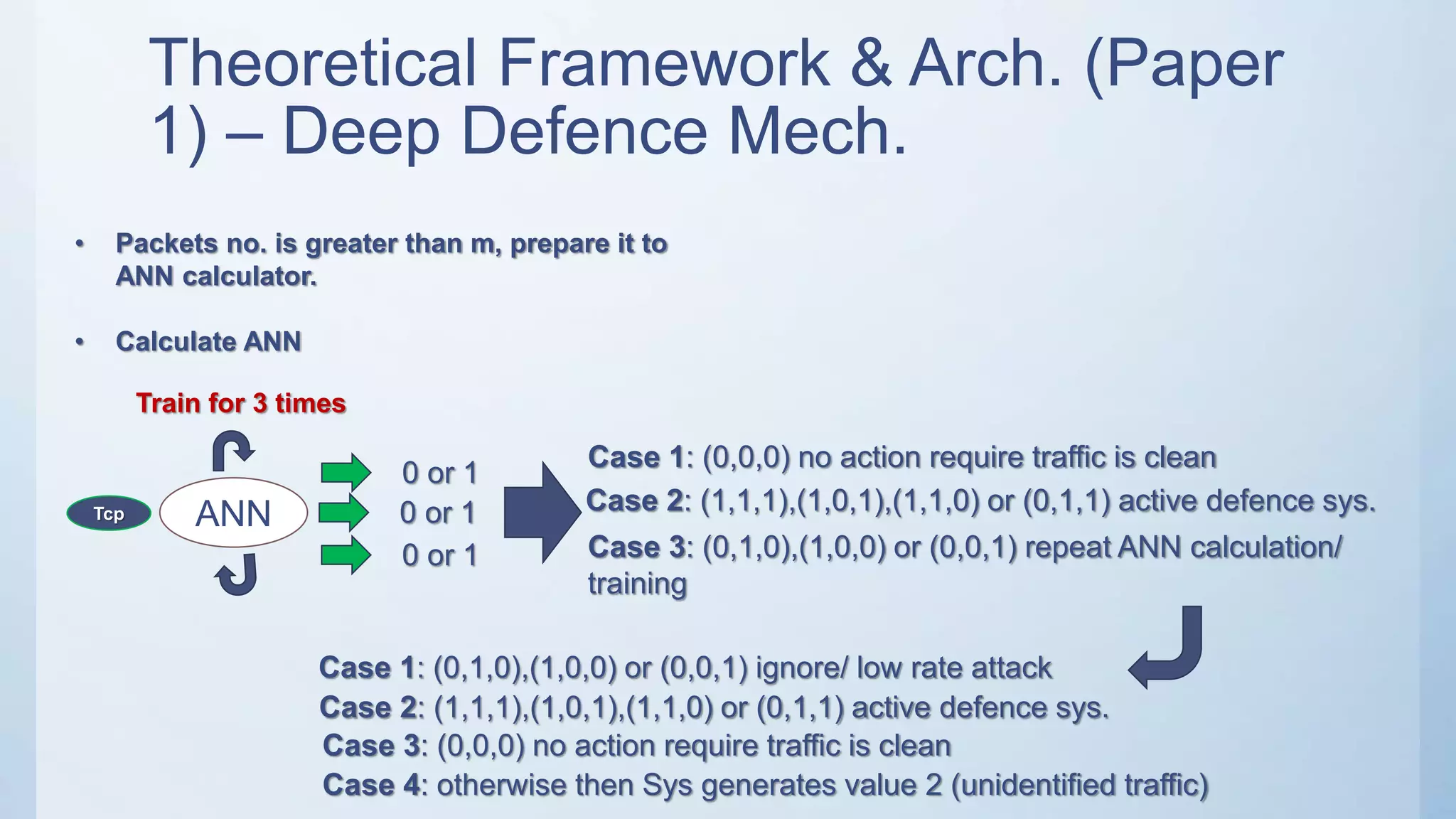
• Calculate ANN
ANNTcp 0 or 1
0 or 1
0 or 1
Train for 3 times
Case 1: (0,0,0) no action require traffic is clean
Case 2: (1,1,1),(1,0,1),(1,1,0) or (0,1,1) active defence sys.
Case 3: (0,1,0),(1,0,0) or (0,0,1) repeat ANN calculation/
training
Case 1: (0,1,0),(1,0,0) or (0,0,1) ignore/ low rate attack
Case 2: (1,1,1),(1,0,1),(1,1,0) or (0,1,1) active defence sys.
Case 3: (0,0,0) no action require traffic is clean
Case 4: otherwise then Sys generates value 2 (unidentified traffic)
Theoretical Framework & Arch. (Paper
1) – Deep Defence Mech.
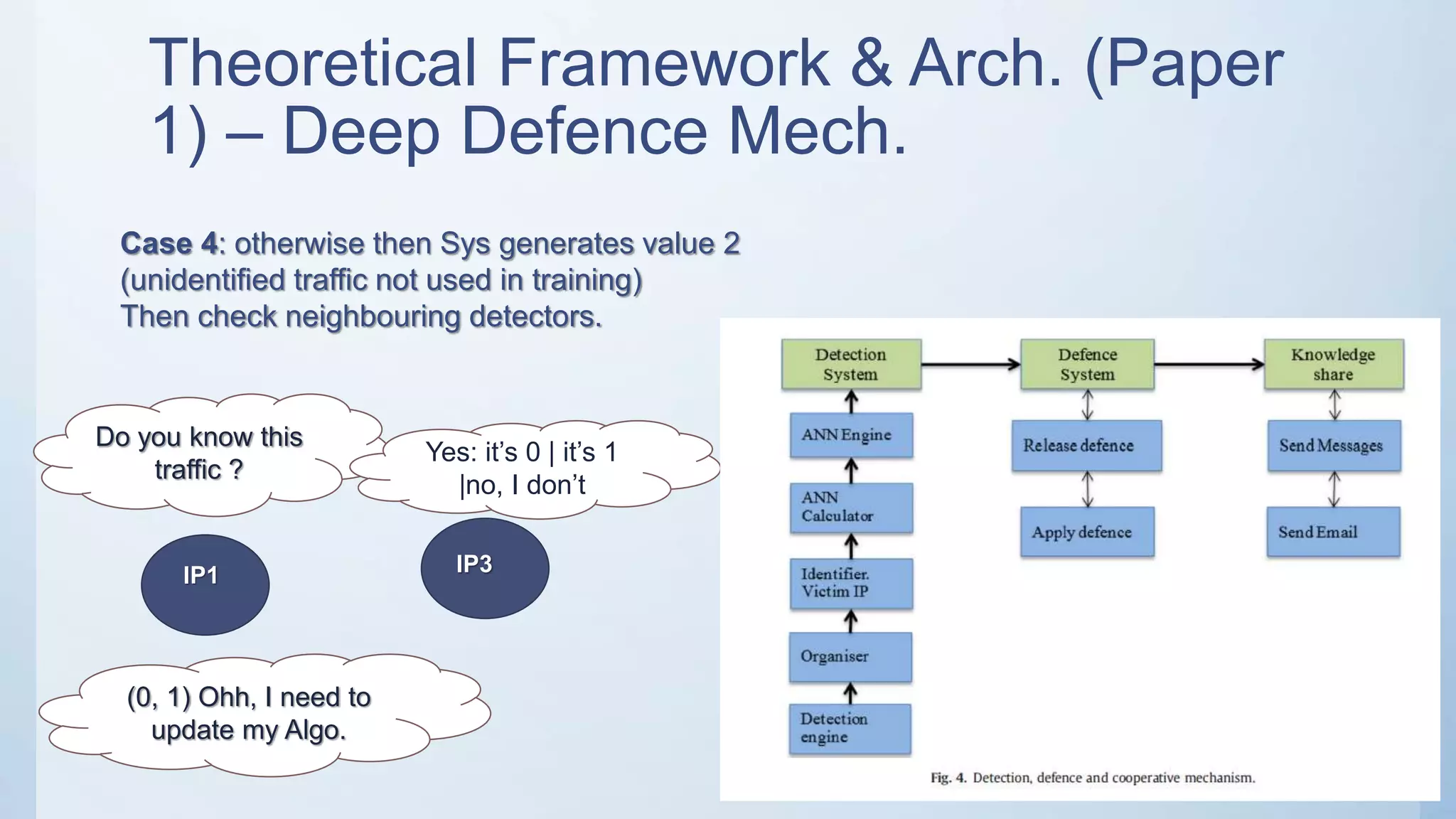
Case 4: otherwise then Sys generates value 2
(unidentified traffic not used in training)
Then check neighbouring detectors.
IP1 IP3
Do you know this
traffic ?
Yes: it’s 0 | it’s 1
|no, I don’t
(0, 1) Ohh, I need to
update my Algo.
Result
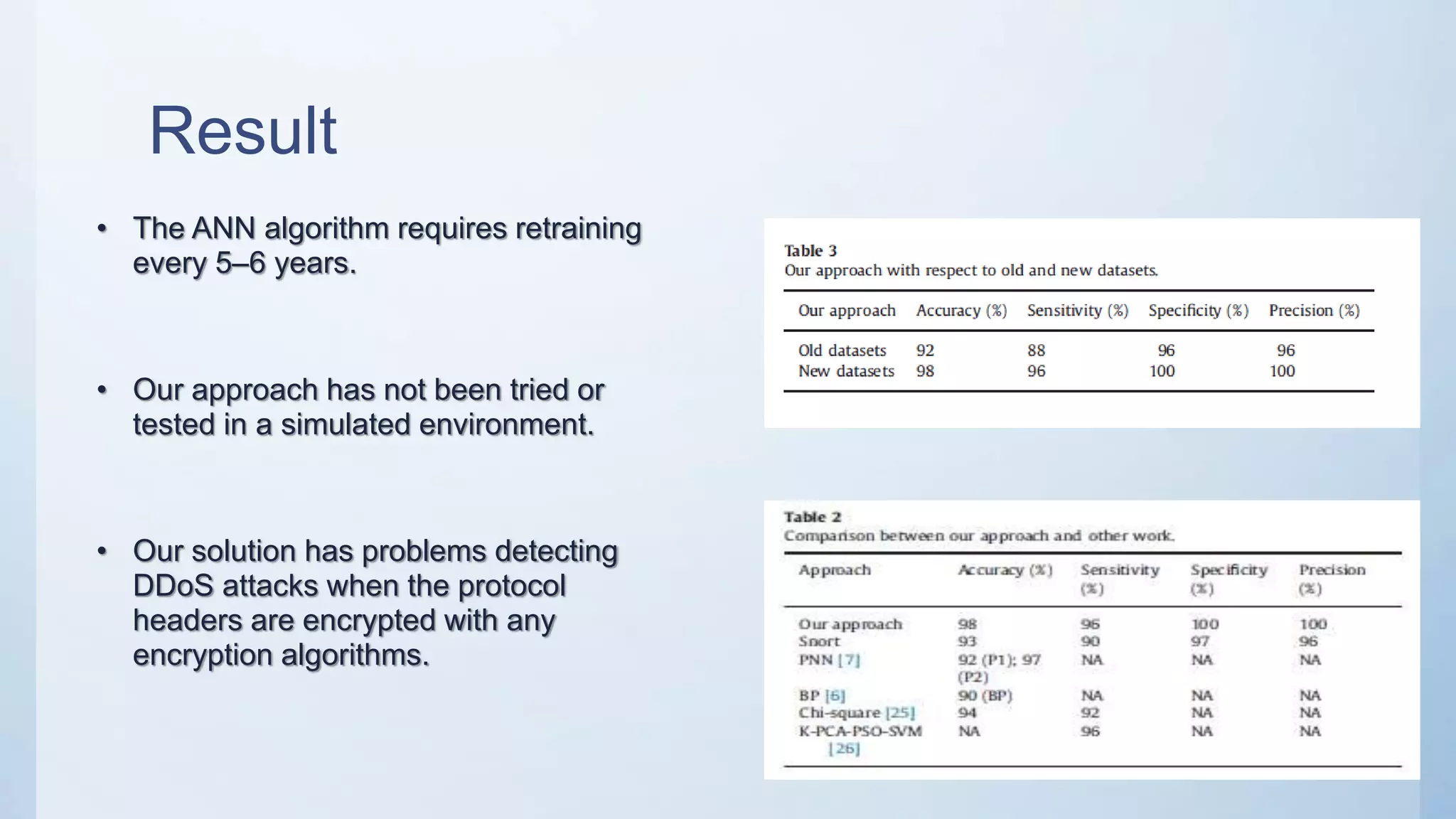
• The ANN algorithm requires retraining
every 5–6 years.
• Our approach has not been tried or
tested in a simulated environment.
• Our solution has problems detecting
DDoS attacks when the protocol
headers are encrypted with any
encryption algorithms.
Conclusion
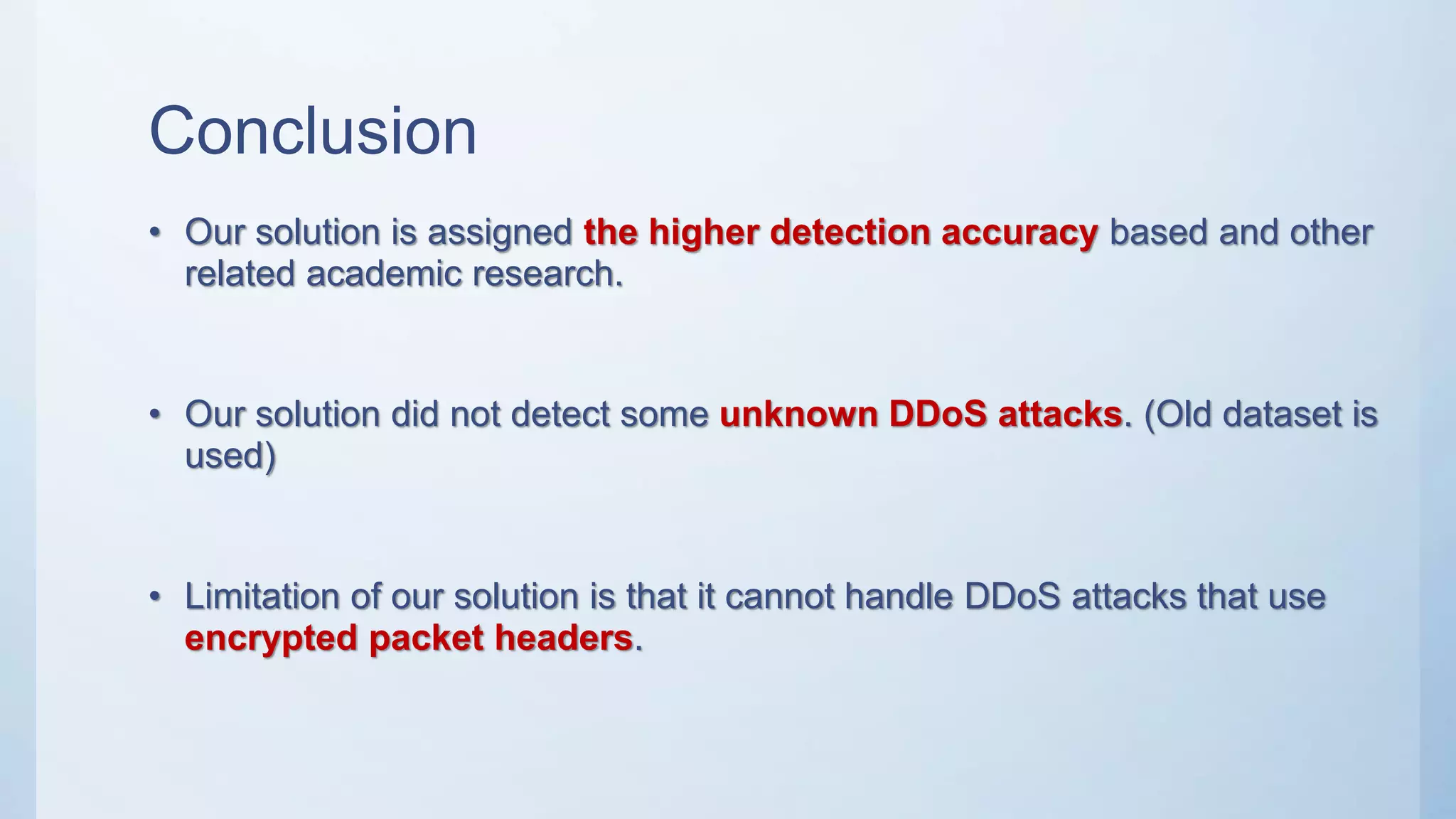
• Our solution is assigned the higher detection accuracy based and other
related academic research.
• Our solution did not detect some unknown DDoS attacks. (Old dataset is
used)
• Limitation of our solution is that it cannot handle DDoS attacks that use
encrypted packet headers.
Thanks

Detection of known and unknown DDoS attacks using Artificial Neural Networks

  • 1.
    DDOS Detection Using MachineLearning techniques
  • 2.
    DDoS attack Attacker Fake Requests Block DoSAttack Weak web service Victim
  • 3.
    DDoS attack Attacker Victim Whichone ?? Attack DDoS Attack Botnets Army Request 1 Request 2 Request 3 Request 4 Request 5 …. User !
  • 4.
    Discussion • Detection knownand unknown DDoS attacks using Artificial Neural Network (Alan Saied, Richard E. Overill, Tomasz Radzik) 2016
  • 5.
    Objective (Paper 1) UseArtificial Neural Network(ANN) algorithm to detect DDoS attacks based on specific characteristic features(patterns) that separate DDoS attack traffic from genuine traffic. ANN Pattern + Previous Mixed Requests ( Normal + attack) New Request Normal Attack
  • 6.
    Background (Paper 1) •Using online dataset (Live) to detect known and unknown DDoS Which means detection for up-to-date patterns • A defence mechanism that prevents forged packets from reaching the victim, but allows genuine packets to pass through
  • 7.
    Theoretical Framework &Arch. (Paper 1) • Build ANN For TCP to detect DDoS Attack Feed Forward Feed Backward Source Address TCP flags TCP Seq. Source Port Dist. Port Based on our experiments and analysis, most installed zombies use their built- in libraries as opposed to operating system libraries to generate packets. 80 % of dataset is a training set. 20 % of dataset is a testing set.
  • 8.
    Theoretical Framework &Arch. (Paper 1) • Build ANN For ICMP to detect DDoS Attack Feed Forward Feed Backward Source IP ICMP - Id ICMP - Seq Based on our experiments and analysis, most installed zombies use their built- in libraries as opposed to operating system libraries to generate packets. 80 % of dataset is a training set. 20 % of dataset is a testing set.
  • 9.
    Theoretical Framework &Arch. (Paper 1) • Build ANN For UDP to detect DDoS Attack Feed Forward Feed Backward Src. Port UDP Dst. Port UDP Pk. len Src. Ip UDP Based on our experiments and analysis, most installed zombies use their built- in libraries as opposed to operating system libraries to generate packets. 80 % of dataset is a training set. 20 % of dataset is a testing set.
  • 10.
    A defence mechanism Acceptedto pass Accepted to pass Rejected (Suspect) Rejected (Suspect) Rejected (Suspect)Rejected (Suspect) Theoretical Framework & Arch. (Paper 1)
  • 11.
    Theoretical Framework &Arch. (Paper 1) • Sigmoid Activation Function Normal DDoS
  • 12.
    Deep defence mechanism •Sharing the detection information • Real-time detection ANN updating Accepted to pass Accepted to pass Rejected (Suspect) Rejected (Suspect) Rejected (Suspect)Rejected (Suspect) Theoretical Framework & Arch. (Paper 1) Sharing new Infos (Detections) Sharing new Infos (Detections) Warning: This structure will take a lot of time !!
  • 13.
    Theoretical Framework &Arch. (Paper 1) – Deep Defence Mech. Tcp IP1 IP3 • Each detector hold neighboring detectors IP to send Msg./data when DDoS is detected. IP1 IP3 Recoding the packets info Recoding the packets info • Set threshold for each protocol. represent max no. of packets per protocol. TCP ICMP UD P TCP ICMP UD P n m k n m k TcpTcp TcpTcp Tcp • Packets no. is greater than m, prepare it to ANN calculator.
  • 14.
    Theoretical Framework &Arch. (Paper 1) – Deep Defence Mech. • Packets no. is greater than m, prepare it to ANN calculator. • Calculate ANN ANNTcp 0 or 1 0 or 1 0 or 1 Train for 3 times Case 1: (0,0,0) no action require traffic is clean Case 2: (1,1,1),(1,0,1),(1,1,0) or (0,1,1) active defence sys. Case 3: (0,1,0),(1,0,0) or (0,0,1) repeat ANN calculation/ training Case 1: (0,1,0),(1,0,0) or (0,0,1) ignore/ low rate attack Case 2: (1,1,1),(1,0,1),(1,1,0) or (0,1,1) active defence sys. Case 3: (0,0,0) no action require traffic is clean Case 4: otherwise then Sys generates value 2 (unidentified traffic)
  • 15.
    Theoretical Framework &Arch. (Paper 1) – Deep Defence Mech. Case 4: otherwise then Sys generates value 2 (unidentified traffic not used in training) Then check neighbouring detectors. IP1 IP3 Do you know this traffic ? Yes: it’s 0 | it’s 1 |no, I don’t (0, 1) Ohh, I need to update my Algo.
  • 16.
    Result • The ANNalgorithm requires retraining every 5–6 years. • Our approach has not been tried or tested in a simulated environment. • Our solution has problems detecting DDoS attacks when the protocol headers are encrypted with any encryption algorithms.
  • 17.
    Conclusion • Our solutionis assigned the higher detection accuracy based and other related academic research. • Our solution did not detect some unknown DDoS attacks. (Old dataset is used) • Limitation of our solution is that it cannot handle DDoS attacks that use encrypted packet headers.
  • 18.