A Shorter Work Week:
Full Employment and a Decent Life for Workers
By Mike Olszanski
Term Paper
for
L 580 Labor And Social Policy
November 10, 2004
With Revisions, 4/2018
Olszanski 1 Shorter Work Week
Workers in the United States today work more hours than they did 10, 20, or 30 years
ago, and their real wages have hardly increased. Unemployment and underemployment are
still at unacceptably high levels. I first researched the issue of work hours and overtime and
the connection with unemployment in the late 1980’s as vice president and then president of
Local 1010, United Steelworkers of America (USWA) at Inland Steel’s Indiana Harbor
Works.1 At Inland, as at other basic steel mills, management was “rationalizing” the
workforce—cutting crews, eliminating jobs, downsizing, and forcing the remaining workers
to work more and more overtime. Some accepted the overtime willingly, and indeed a few
became obsessed with getting all they could, in the face of dropping real wages and
increasing costs. Insecurity played a large role in this, as did the kind of “Work and Spend”
compulsive consumption consumerism Juliel Schor refers to in her 1992 book,
The Overworked American.2
Much top Union leadership in our union at that time parroted the long held belief—a
myth in my opinion—that any union rep who raised the issue of overtime, even forced
overtime, and tried to reduce it to save jobs, would never get reelected. Some informal
polling we did in my local strongly contradicted that idea. Since the late 1980’s the
situation—more downsizing and productivity, and longer hours of work has gotten worse.
Those of us calling for a fight for a shorter work week by the labor movement in the 1970’s
and 1980’s were largely ignored and marginalized.3
Olszanski 2 Shorter Work Week
Hours of work in the U.S. have increased since the 1960’s, though productivity or
output per hour of work has increased tremendously in the same period. Real wages among
blue collar workers have not increased during this period, and for those with no more than a
high school education, have decreased.4 Unemployment, underemployment, and poverty,
especially among certain racial and other segments of the work force, are unacceptably high.
U.S. Executive salaries have grown enormously during the same period, and are considered
by many unconscionably high. Workers—including union workers—have failed to win our
share of the productivity bonanza which has yielded tremendous profits and executive
salaries for U.S. domestic corporations. Our AFL-CIO unions made an unwritten
wages/productivity bargain with business and government during the cold war, the terms of
which included more production for business, and a share of the increased wealth for labor.
I will show that business has not kept their part of the bargain. To put it another way,
organized labor in the United States has been ineffectual in getting our share.
The labor movement in the United States, as well as in Europe, organized itself
largely around the issue of shorter work time in the 19th Century. A shorter work day was a
vital issue to workers just forming unions, who often worked dawn to dusk for low pay.
Paid by the day or the week, or often by the month rather than the hour, it was logical to
workers in the U.S. as well as other industrialized nations, and to political economist Karl
Marx, that longer work days meant more exploitation by the boss. Fixed daily wages meant,
as Schor puts it, that to the capitalist, “…each additional hour worked was free.”5 Marx
defined and measured the exploitation of the worker in terms of surplus value which the boss
got for hours worked beyond those for which the worker was paid.. As Marx put it. “The
fact that half a day’s labor is necessary to keep him alive during 24 hours does not in any
way prevent him from working a whole day.”6 If the worker produced in 6 hours a money
Olszanski 3 Shorter Work Week
value of product equal to what he was paid, but was made to work 12 hours a day for that
pay, the capitalist got 6 hours worth of what Marx called surplus value, or 6 hours worth of
product for which he did not pay the worker. The more productive the worker, the more she
got exploited, and the higher the profit margins of the capitalist.7 Under these horrible
conditions, shortening the work day, while holding the (subsistence) wage constant, was as
important to organizing workers as was raising wages. In addition, workers newly introduced
to the long days of work for the capitalist had not yet been infused with the culture of
consumerism that would later lead them to covet more and more material goods, and invest
more work hours in attaining them. Indeed, as Schor demonstrates, hours of work for
peasants and laborers prior to their introduction to capitalism were considerably less than
those demanded by their capitalist supervisors.8 Prior to the organization of guilds or unions
for industrial workers subsistence wages were the rule, as the law of supply and demand for
labor power caused wages to generally adjust themselves to a level barely sufficient to keep
the laborer and his family alive, as Adam Smith and later Karl Marx pointed out.9 The fight
was one for survival, and for sufficient time off to rest and try to get something out of lives
besides work.
In England, the Factory Acts, starting in 1833 decreed a “normal working day” of 15
hours, but limited working 13-18 year olds more than 12 hours a day. They were poorly
enforced. By 1847, the twelve hour day for women and men under 18 had become the norm
in Britain under the Factory Acts, but the employers responded by cutting daily wages in
order to win over public opinion among the workers for more hours to make up for the loss in
pay. When the 1848 law called for a reduction of hours to 10, the employers responded by
cutting wages a total of 25%. 10
Olszanski 4 Shorter Work Week
As early as 1822, Philadelphia millwrights and mechanics demanded a ten hour day,
and in 1835 carpenters, masons, and stonecutters in Boston staged a seven-month strike in
favor of a ten-hour day. The strikers demanded that employers reduce excessively long hours
worked in the summer and spread them throughout the year. Again the movement for a ten-
hour workday returned to Philadelphia, where carpenters, bricklayers, plasterers, masons,
leather dressers, and blacksmiths went on strike. The Massachusetts legislature debated the
issue of the 10 hour day, having been petitioned by workers and their unions, including those
of the textile mills in Lowell. A number of states actually enacted 10 hour day legislation, but
it had little effect as corporations found ways around it, including forcing employees to sign
contracts calling for 12 or 13 hour work days.11
Building Trades workers in London conducted a massive strike for a 9 hour work
day in 1860-1861.12 In the U.S., real wages dropped precipitously between 1860 and 1865,
just as the bosses introduced speed-up on a massive scale to increase production. An average
working day of eleven hours was often stretched to twelve or fourteen hours. Strikes for
higher wages and a shorter work day erupted across the country in 1863, in the midst of the
Civil War.13 In 1865 the San Francisco Trades’ Union publicly appealed for an 8 hour day.
Eight Hour Leagues were organized all over the Bay area, and put pressure on local
politicians. In 1867 the San Francisco Board of supervisors passed an 8 hour ordinance.
In February 22, 1868 “thousands celebrate[d]passage of a state law” declaring the 8 hour day
the standard. In 1868-1870 San Francisco bosses reacted, and broke the 8 hour day with
scabs.14 On August 20, 1886 the National Labor Union called on Congress to enact
legislation limiting the standard work day to 8 hours, and its agitation is credited with
reducing the average working day in the U.S. from 11 hours in 1865 to 10.5 in 1870.15
The depression of 1883-1885 saw increased unemployment and poverty, while those who
Olszanski 5 Shorter Work Week
managed to keep a job in a steel mill worked 12 and 14 hour days. 16 The Knights of Labor,
who under Terrance Powderly advocated an 8 hour day in the 1870’s and 1880’s, estimated
unemployment as high as 2 million in 1885. Some industrial workers worked as long as 18
hours a day, while a Minnesota law fined railroad owners who workers engineers or firemen
more than 18 hours in a day.17 It was obvious to workers that there was a direct connection
between long work hours, unemployment and poverty. On May Day, May 1 1886 Chicago
police killed workers striking for a shorter work day. Three days later on. May 4 police
attacked peaceful protesters, resulting in the infamous Haymarket tragedy. On May 5, 1886
a massacre in Milwaukee saw 7 workers killed by militia during a demonstration of 1500 for
the 8 hour day.18 In terms of its effect, the 8 hour movement of the 1880’s did succeed in
getting work hours reduced to 10 per day and 58.4 per week by 1890, with union
manufacturing workers averaging 7.8 hours per week less than unorganized workers. The
building trades unions did even better for their members, who by 1890 were averaging 9.6
hours per day, down from 9.9 in 1880.19 This “union premium”, applicable to wages and
benefits as well as hours, has been documented down to present times by Lawrence Mishal,
et al.20
As early as 1887, the AFL’s Samuel Gompers— a staunch representative of narrow
craft unionism and no Marxist by any means—saw shorter work hours as an antidote for
unemployment. “So Long as there is one who seeks employment, and cannot find it,” he said
in his characteristically high-sounding way “the hours of labor are too long”
Turn of the century Russia, ripening for the coming Bolshevik Revolution, saw
capitalist exploitation of workers at its worst. Lured from farms on which they barely
subsisted, Russian peasants took jobs in the burgeoning factories. Under the rule of the Czar,
the new capitalists were totally unregulated and starving workers—including children—were
Olszanski 6 Shorter Work Week
forced to work long hours for low pay. This “generation of permanently hungry
workers…gradually dying from starvation,” sometimes worked “as long as 17-19 hours a
day.” 21 Strikes were rampant, and the Social-Democratic Party (forerunner to the
Bolsheviks) organized by Lenin, used them to educate workers and raise consciousness. In
his “Draft Program for Our Party,” Lenin in 1899 listed nine “practical demands” of which
1) was “an eight hour working day” 2) “prohibition of night work and…the employment of
children under 24 years of age,” and 3) “uninterrupted rest periods, for every worker, of no
less than 36 hours a week.”22
The IWW (Industrial Workers of the World) supported its own 8 Hour day movement
in the early twentieth century, and continues to call for shorter work time to this day. Trade
unions succeeded in winning the 8 hour day for thousands of members by 1915, while 25
states had laws that put some limit on the hours of a work day. In 1916 congress, under threat
of a rail strike passed the Adamson Act, which mandated overtime for hours over 8 a day for
railroad workers.23
Hours of work continued to be a top issue in the Congress of Industrial Organizations
(CIO) organizing drive of the 1930’s. The San Francisco waterfront and General Strikes of
1934, led by accused communist Harry Bridges and a Rank & File caucus with Communist
and Socialist leadership, empowered longshoremen and seamen to “exert decisive control
over…the pace of the work….” and “fixed the work day at 8 hours, overtime was payable in
time off rather than cash.”24 The Sit down strikes in auto in 1936, also led primarily by
Communist Party members and Socialists were motivated by overwork as much as by pay
demands, according to strike leader and Communist Party member Henry Kraus: “It was
always the speedup, the horrible speedup…It was the speedup that organized Flint.” 25
Olszanski 7 Shorter Work Week
“Speedup,” according to United Electrical Workers (UE) scholars Richard Boyer and Herbert
Moraise, “increased unemployment, and industrial accidents.” 26 Not surprisingly, a Marxist
analysis prompted Left-led unions in the CIO to particularly emphasize a shorter work day
and/or work week as a key demand
The Walsh Healy Act of 1936 provided a 40 hour week for employees of firms
contracting with the Federal Government, and by 1938, a massive organizing drive by the
CIO, huge and effective strikes in Auto, Steel and elsewhere created a labor movement
powerful enough to pressure Congress and President Franklin Roosevelt into enacting the
Fair Labor Standards Act (FLSA). Under pressure from capital, it did not limit work hours,
but did mandate overtime pay at time and one half for hours over 40 a week.
Again, hours of work continued as a central issue for U.S. unions into the 1950’s, and
unions won contractual limits on, and/or premium pay for overtime, Sundays and Holidays
during the post-war period. By 1960, over 400,000 members of the International Ladies
Garment Workers (ILGW) were on a negotiated 35 hour week, while 30,000 rubber workers
had secured a 6 hour day and 36 hour week, and nearly 30,000 brewery workers worked
under 40 hours a week—half on a 37 ½ hour work week.27
In most industries, union contracts negotiated in the 1930’s, through the 1960’s
set the work day at 8 hours, with overtime pay for hours exceeding eight. But time and
a half for overtime, hardly an effective deterrent, from the very beginning allowed
management to bribe workers to sell their hard-won leisure time, and eliminate the
benefits of more leisure and reduced unemployment. The increase in labor cost to the
employer of overtime pay was more than offset by a reduction in the number of
workers with their benefit costs—especially as this part of the wage package grew.
Olszanski 8 Shorter Work Week
Squeezed time and again by falling real wages due to inflation outstripping hard-won
union wage gains, U.S. workers got into the habit of making up for lower wages and
wages lost to frequent lay-offs by working as much overtime as they could get when
the economy was booming. Over and over again they fell back to longer hours for less
pay and the ever-present threat of unemployment.
Marx had predicted in the 19th century that capital would consistently try to
extract more and more surplus value from fewer and fewer workers:
"It is the absolute interest of every capitalist to press a given quantity of labor
out of a smaller, rather than a greater number of labourers..." 28
The capitalists have kept true to form. Marx also argued that high levels of
unemployment benefit capital and hurt labor. Constituting an industrial reserve army, the
unemployed are willing to work for lower wages, thus tending to lower wage rates
throughout the labor market.29 In 1943, Polish economist Michal Kalecki proposed a national
policy of full employment as an antidote to the domination of labor by capital through the
reserve army of the unemployed. He warned that capitalists would oppose full employment
policy as a threat to their hegemony, and suggested that “new social and political institutions
would be needed…which will reflect the increased power of the working class.”30 His classic
argument is cited by Schor, and was important in formulating Labor Government Policy in
Britain and Australia after World War II:
[Under] a regime of permanent full employment, ‘the sack’ would cease to
play its role as a disciplinary measure. The social position of the boss would be
undermined and the self assurance and class consciousness of the working class
would grow….[The bosses’] class instinct tells them that lasting full employment is
Olszanski 9 Shorter Work Week
unsound from their point of view and that unemployment is an integral part of the
normal capitalist system.31
While capitalist economists consistently insisted that real wages could only rise with
increased productivity32, a powerful labor movement in the 1930’s, 40’s and 50’s proved that
in fact they could rise as a percentage of total revenues, by taking the difference out of profits
and executive compensation.33 The trouble was, high unemployment tended to put a damper
on wage increases in lean times, while inflation ate away at real wages in better times. And
the labor movement started a sharp decline in power after it purged its militants in the
McCarthy era. Schor, in her 1992 book The Overworked American, emphasizes Organized
Labor’s abandonment of the shorter workweek in 1956 as a direct result of the CIO purge of
alleged communists and the expulsion of 11 left-led CIO unions. Indeed, the CIO under
Steelworkers President Phillip Murray signed on to the cold war as staunch anti-communists,
with Murray announcing that “the single issue before the [1949 CIO] convention was the
expulsions.”34 “Labor’s move to the right had a profound impact on the hours question.”
Schor insists. 35 “Unions [during the cold war started] adopting the longstanding rhetoric of
management” such as the International Association of Machinists 1957 red-baiting statement,
“Will the Soviets cut THEIR Overtime?”36
In the 1940’s, British Labor Party economist William Beveridge argued for a
national full employment policy for Great Britain, and by implication, for the industrial
world. In support of the trade union movement, he insisted that “…only if there is work for
all is it fair to expect workpeople, individually and collectively in trade unions, to co-operate
in making the most of all productive resources, including labor.” 37 A Keynesian, Beveridge
emphasized the role of government in providing the “outlay” to make up for shortfalls in
Olszanski 10 Shorter Work Week
investment by private capital. With productivity rising due to technological change,
Beveridge recognized that, even accepting the classical economics of Adam Smith, and the
productivity bargain as espoused by the AFL, an ever larger pie could produce a larger slice
for labor, which could mean higher wages, shorter hours of work, or some of each. Beyond
Smith, he saw as not only possible but desirable, that the share of the pie going to labor could
be increased, owing at least in part to increased labor demand in a full employment
economy.38 Lord Beveridge defined the productivity equation thusly: “Increased
productivity per head mathematically involves either increased consumption per head [higher
wages] or idleness, which must be taken either in the form of leisure [shorter work hours] or
unemployment” 39 In simpler language, as workers get more efficient, and produce more in
fewer hours, we either get higher wages for our labor, or we get the same wages for fewer
hours, or some of us get unemployed and the capitalist gets to keep higher and higher profits.
Who gets what is determined by how well organized and powerful workers are, and whether
we can and do fight for higher wages, shorter hours, or both. Workers get what we are
powerful enough to take, and we keep what we are powerful enough to hold.
Business unionists in the American Federation of Labor (AFL), stressing labor-
management cooperation to raise productivity, articulated what has become known as the
U.S. wages/productivity bargain in their 1925 wage policy statement, which “oppose[d] all
wage reductions,” and “…urged upon management the elimination of wastes in production..”
It warned that,
Social inequality, industrial instability and injustice must increase unless the
workers’ real wages, the purchasing power of their wages, coupled with a
continuing reduction in the number of hours making up the workingday, are
progressed in proportion to man’s increasing power of production. 40
Olszanski 11 Shorter Work Week
Going against mainstream management thought, and “propelled by a vision of
Liberation Capitalism,” the paternalistic Kellogg Cereal Company of Battle Creek, Michigan
instituted a six hour day in 1930, as a tactic to cope with depression-era unemployment.
Company management found the move increased productivity 3 or 4%. Management found
“The efficiency and morale of our employees is so increased, the accident and insurance rates
are so improved, and the unit cost of production is so lowered that we can afford to pay as
much for six hours as we formerly paid for eight.” In fact, “they cut the workday to six
hours, while eliminating breaks and terminating bonuses for unpopular shift times. Workers
were given a 12.5 percent hourly raise, so standard daily pay only fell by about fifteen
percent.” The experiment was short lived, however, and the concept of increasing
productivity by shortening work hours never caught on as a strategy for business. 41
President William Green of the AFL argued in a depression-era 1935 pamphlet
entitled “The Thirty-Hour Week,” that a shorter work week with “no loss of take home pay”
would place purchasing power in the hands of workers and the formerly unemployed who
would now share jobs, thereby releasing “pent up consumer demand” and “stimulating
industrial production in business activity,” likewise “provid[ing] the material means for
higher standards of living for the American people and would make effective new and
widespread demands for goods and services.” Green reiterated the AFL call for “a reduction
in the number of hours worked per day and the number of days worked per week,” to offset
technological job loss at the 1935 AFL Convention. 42
Denouncing Green and the AFL’s “lackey-like” collaboration with business, radical
William Z. Foster considered the proffered productivity bargain as “no more than a platonic
argument of higher wages in return for more production.” 43 Left-led unions in the CIO
Olszanski 12 Shorter Work Week
likewise argued against the quid pro quo of labor peace and productivity in return for higher
wages and shorter hours, though during World war II, the Communist Party (CP) as well as
the CIO more or less accepted the deal for the duration, to be arbitered by the War Labor
Board. This compromise wages/productivity bargain was reasonably functional for business
unionists, as well as business managers. Union leaders like Phillip Murray saw it as a way to
manage conflict and satisfy, or pacify union members. In the production boom and purge of
the left that followed the war, the labor movement’s leadership cemented the deal.
Engineered by CIO and USWA general consul Arthur Goldberg (who replaced Communist
Lee Pressman as Murray’s legal brain) the postwar social contract incorporated the
wages/productivity bargain, as well as Labor’s commitment to the cold war and anti-
communism. Government, as the third party to the deal, more or less tried to use its authority
to enforce it’s terms on the other two parties. Truman, in particular, made dramatic use of the
bully pulpit and indeed moved to seize the steel mills when big steel refused to reach an
acceptable agreement on wages with the USWA in 1952.
Yale scholar William Tanzman succinctly describes the bargain:
Unions throughout American industry recognized owners’ right to manage,
and, in exchange, owners bargained with unions and raised wages and benefits.1
At the core of this idea was unions’ ability to help corporations improve
productivity, whether through guaranteeing continuous production over the life of
the contract, creating more stable and predictable labor relations, or using labor
1 “Pragmatic” labor leaders and New Deal liberals such as Sidney Hillman, Walter Reuther, and the USWA’s
Arthur Goldberg believed that “labor unions could be used to make a market systemmore stable and egalitarian
and less wasteful, rather than simply to drive up the pay of their members or form the nucleus of organizations
aimed at overthrowing the existing order.” David Stebenne, Arthur Goldberg: New Deal Liberal (New York:
Oxford University Press,1996), 9.
Olszanski 13 Shorter Work Week
leaders’ prestige to encourage workers to support management’s productivity
initiatives. Labor largely accepted the idea that wage and benefit increases should
roughly correlate with productivity improvements, which worked beautifully in the
economic boom that followed the end of World War II. The bargain helped unions
secure a powerful place in American policymaking and an increasing standard of
living for workers, while it also guaranteed to corporations that their basic
authority would remain unchallenged.44
The “powerful place in American policy making” enjoyed by U.S. unions was fleeting, at
best. The point of all this is, even the relatively conservative wages/productivity bargain was
never kept by business after the 1950’s as rapid rises in worker productivity were
accompanied by increasing hours of work and unemployment, and stagnant or falling real
wages. With the exception of World War II and the Viet Nam War era, the U.S. has never
enjoyed a sustained period of anything approaching full employment. And during these rare
times of a tight labor market, the corporate elite raised a hue and cry and went about taking
steps to get back their reserve army. 45 As Piven and Cloward and others have pointed out,
the wholesale dismemberment of the welfare state safety net under Reagan and Bush was
aimed at enforcing discipline on labor, and replenishing the reserve army.46
Progressive economist Samuel Lillie described the productivity equation thusly in 1957:
If automation…doubled productivity by 1980, logically our only problem ought
to be a choice of whether we shall all consume twice as much and work as long as
now, or consume as we do now and cut our working hours in half, or…some
compromise between the two.
Lillie warned of another, less favorable possibility, however:
Olszanski 14 Shorter Work Week
Instead of using the same number of workers to produce more or to produce as
much as now in a shorter work week (without reduction in pay) we might find
ourselves making no more than at present in the same working week and with a
growing army of unemployed.47
As it happened, a significant number of U.S. workers actually suffered a reduction in real
wages over the past 30 years. Not coincidentally, union membership dropped dramatically
during this same period.48
Under John F. Kennedy, the President’s Advisory Committee on Labor-Management
Policy heard the following statement from its labor members:
If unemployment is not reduced substantially in the near future we will have to
resort to a general shortening of the work period through collective bargaining or
law.49
Even when wage rates rise, inflation often eats away at real gains. Inflation became a
big factor in eroding real wage rates in the 1970’s. And as we steelworkers found out in the
1980’s, the bosses sometimes pacify the workers by offering overtime in place of higher
wages, or in our case to make up for actual wage cuts—just as they did in the 19th century
England of Marx.
Then they have us once more working more hours but earning less in real wages—
especially when figured, as we now have learned to do—at an hourly rate. It’s simple enough
math,. When hours increase and hourly rates decrease real wages, figured at the hourly rate,
go down. Aggravating this situation, using overtime to substitute for workers laid off or
eliminated raises unemployment even more than productivity increases alone.
Olszanski 15 Shorter Work Week
Thus profits and executive compensation rise, at the expense of workers who work more for
less, alongside more and more who can find no decent work and fall into the reserve army of
the unemployed.50
Over 40 years ago in 1962, the USWA published a pamphlet written by a Notre Dame
scholar, arguing for a shorter work week as a solution to the growing problem of
productivity-induced unemployment. Arguing that workers should share in the benefits of
automation, instead of becoming its victims, James LaVelle urged a fight for legislation
lowering the standard work week to 35 hours, at no less pay.51 He argued that, in spite of
industry claims of lowered efficiency, shorter hours of work would bring increased
employment, leading to increased consumption, which stimulates production, more time for
family life and citizenship responsibilities, less “spoiled work due to fatigue and
monotony…a lower labor turnover, improved quality of product and fewer accidents.” 52
LaVelle—and with this pamphlet the USWA’s McDonald administration—called for a two-
pronged approach to securing and implementing a shorter work week: collective bargaining
and legislation. Steelworkers president David J. McDonald, defeated by I.W. Abel in 1965,
had called for a 30 or 32 hour work week in 1960, at the Governor’s conference on
Automation. Left wing leaders like president John Sargent and grievance chair Jim Balanoff
at the USWA’s largest local, 1010, argued consistently and vigorously in negotiations and at
USWA conventions, as well as in union publications during the 1960’s for a shorter work
week to offset technological unemployment.53
While the shorter work week was seen as an issue for legislation, the USWA made
substantial progress during the 1960’s in negotiating contracts in Basic Steel which included
extended paid vacations of up to 13 weeks every 5th year for senior employees, and more
Olszanski 16 Shorter Work Week
paid Holidays. Time off taken for vacations would have to be made up by hiring more
workers—or so the theory went. Once again, however, steel bosses began to use overtime to
fill the vacation vacancies. In addition, a major flaw in the basic steel collective bargaining
agreement allowed individuals to sell much of their Vacation time, trading money for time.
Too many of us, caught up in the consumer trap, took the money. There was no bargaining
effort to limit overtime hours or increase the overtime premium.
In 1978 Congressman John Conyers (D-MI) introduced legislation to reduce the work
week to 35 hours over four years, increase overtime pay to double time and ban mandatory
overtime. It got support in congress primarily from the likes of union activist Charlie Hayes
(D-IL) and other left-wingers including the Congressional Black Caucus. But it died in
committee. In the 1980’s, United Auto Workers (UAW) regional leaders in Detroit formed a
coalition with other union leaders, including USWA 1010 president Bill Andrews, to create
the All Union Committee to Shorten the Work Week. The coalition was largely left-led, with
the Communist Party’s Fred Gaboury as a rather conspicuous organizer. It failed to gain
International Union support from the USWA and other major unions, and was marginalized
and left to fade away.
The election of Ronald Reagan in 1980 saw a major union-busting and neoliberal
offensive by the forces of reaction, and progressive union leaders found ourselves fighting
for survival once again. Even the façade of a wages/productivity bargain with labor was no
longer seen as functional for business on the offensive against a weak and no longer effective
labor movement, and was largely abandoned. New company/union participation and
“partnership” schemes served as a smokescreen to cover the dismemberment of labor’s hard
won benefits and aggressive downsizing in industries like steel.
Olszanski 17 Shorter Work Week
In the 1980’s a weakened USWA leadership, under threat of major plant closings and
lay-offs, gave back extended vacations in basic steel, along with wage cuts. Steelworkers still
on the job learned to adjust and survive by working all the overtime they could get. At the
same time aggressive advertising inculcated U.S. workers with a more and more voracious
appetite for consumer goods, and the expectation that their standard of living and
consumption must continue to rise. Caught in the middle, hooked on consumerism but faced
with shrinking real hourly wages, workers binged on credit, and paid the bill with longer and
longer hours of work. No one in organized labor’s now solidly business-oriented highest
echelons dared raise a caveat, much less an objection to this trend of more and more
consumption, individualism and greed. Only environmentalists—a group largely disdained
by most workers—began in the 1960’s raising issues of sustainable growth. Their cries
would not be taken seriously by top union leaders, until the 1990’s.54 By 1988
manufacturing workers averaged over four hours of overtime a week. In basic steel, 18% of
all hours worked were overtime—a 47 hour week for the average steelworker.55
At Local 1010 in 1989, we calculated that each additional week of vacation taken by
our 15,000 members could produce well in excess of 200 full time (40 hours per week)
jobs—if we put a halt to filling the vacancies with overtime. As I put it in a leaflet that year,
“If some of our kids could get some of those good jobs, we wouldn’t need all the overtime to
support them well into their 20’s” I was too conservative. Kids stay at home into their 30’s
these days. An informal survey done by the Rank & File Caucus at Local 1010, indicated
strong membership support for making more paid time off a priority for the union—in 1989.
In November of that year, a major news magazine would report: “Compensation per hour
isn’t much higher today than in 1979. To live better, Americans are saving less and working
more, some 40% of income gains in this decade reflect extra sweat.”56 The fight against
Olszanski 18 Shorter Work Week
forced overtime began anew in the late 1980’s when the International Association of
Machinists and Aeorspace Workers (IAM) struck Boeing Aircraft and won a ban on
mandatory overtime. Leftist IAM president William Wimpisinger was way ahead of the
pack, on this and many other social policy issues.
Make no mistake, today’s 12 hour day in basic steel, as seen by management, is one
more effort to improve productivity at the expense of workers, even when they pay overtime.
In most instances, they do so only when hours per week exceed forty—as required by law.
In fact, standardizing the 12 hour day, along with making a 48 or 56 hour week the norm for
workers on 8 hour shifts, tends to makes the term “overtime” meaningless. Workers and our
families tend to adjust our lifestyles to our average (generally weekly or bi-weekly) take
home pay. “Overtime” becomes just regular, ordinary work time, just as the pay becomes
“regular”. Many workers’ weekly and yearly take-home real wages are below what they
were in the 1970’s—though they’re working more hours. As bosses add more and more 12
hour and/or 16 hour turns to worker’s schedules to substitute for laid off and eliminated
workers, we get closer and closer to the bad old days when we lived to work, instead of the
other way around. Once again simple math should expose the underlying contradiction. With
eroding real hourly wages, a twelve hour day—even when fours hours of it are paid for a
time and one half, can end up netting the worker little or no more than a standard 8 hour day
(dare I day a 6 hour day?) at a decent hourly rate of pay commensurate with modern
productivity levels. On an optimistic note, International Steel Group (ISG) employees have
reportedly recently voted to reject 12 hour shifts in a number of departments.
It’s not just health and safety that suffers when workers put in more hours. But they
surely do. Anxiety, depression, stress are “epidemic” among the overworked in this country,
Olszanski 19 Shorter Work Week
according to Dr. Suzanne Schweikert. The doctor also lists hypertension, diabetes, heart
disease, obesity, infertility and mental health disorders as consequences of too many hours of
work—and not enough rest and leisure. “Not enough time,” to eat properly, recreate,
meditate, exercise, and recuperate cause workers to get run-down, inviting all sorts of health
problems, says Schweikert. Pregnant women are particularly at risk. Many work too many
hours “in order to gain the benefits of health insurance, although the pressure resulting from
overwork is making us sick,” a “vicious cycle,” according to Schweikert.57
Stephen Bezrucha of the University of Washington School of Public Health concurs, and
cites statistics placing the U.S. “25th, behind almost all other rich countries, and quite a few
poor ones,” [author’s italics] in terms of health indicators such as infant mortality and life
expectancy. He argues there is a direct connection between this unhealthiness and the
overwork of its middle and lower classes, competing as we are to gain ground in our
hierarchically structured society.58
European workers have largely rejected the obsessive consumerism, individualism
and “get it while you can” attitudes of their exceptionalist “American” brothers and sisters.
Class consciousness, with a preference for collective over individual solutions, has led these
union members and their leaders to seek more leisure time and share the work and divide the
productivity bonanza much more equitably than is done here in the states. Unions, like
governments in Europe are still led to a great degree, by Communists, Socialists and Social
Democrats. Once again it’s simple math, and union workers in Europe have figured it out:
shorter hours spreads available work hours around, and if you’re organized, you can force the
bosses to share the benefits of increased productivity, instead of hogging it all.
Europe’s 20th century labor movement, led by Germany’s huge metalworkers union,
IG Metall, won a 371/2 hour work week after a nation-wide strike in the 1980’s, then a 35-
Olszanski 20 Shorter Work Week
hour week for its own members in 1995. They announced the goal of a 32 hour week in
1998.59 Indeed, most European countries have a strong Labor presence in government, and
have made full employment a national priority—even though their vastly superior social
safety net makes unemployment much less a threat than it is to U.S. workers. Social-
democratic welfare states in Europe typically provide government paid—or highly
subsidized—health care, housing, transportation and education for all. Executive
compensation among European CEO’s, on the other hand, averages only 1/3 of what their
U.S. counterparts have been able to grab.60
A coalition of the ruling Socialists, Communists and Green Party in France passed
legislation in 1998 making the 35 hour work week standard as of 2001. Businesses that
reduced work hours, created jobs or avoided layoffs would get tax breaks. Unemployment
declined significantly since the announcement of the 35 hour week, and even the IMF
acknowledges a positive effect. Reaction from the French employers association was swift
and nothing short of a “declaration of war,” but the big unions, the CGT and the CFDT,
continue to strongly support a 35-hour week.. The battle appears to have been joined,
between capitalists pushing a U.S. like neo liberal agenda, and Europe’s left-led labor
movement.61 Social movement theorists Piven and Cloward argue that the dominance of
U.S.-led neoliberal ideology has “profoundly discouraged” the left in “all the countries of
advanced capitalism,” and put them on the defensive in European parliaments. Capital has
the initiative, and is “on the move” all over the developed world, they say. 62 In Germany,
workers 13 public holidays a year, including their "Day of German Unity, a public holiday
introduced in 1990 to mark the reunification of East and West Germany” and 30 days paid
vacation are in jeopardy, as capitalists argue for more hours of work to increase GDP.63
Olszanski 21 Shorter Work Week
Here in the U.S. hours of work have been going in the OTHER direction during the
same period. According to pro-business Dutch economist Jaap van Duijn, top executive at
the Dutch Robeco financial consultancy group, “The average working week in the United
States has gone up in the past ten years, whereas for us, it's gone down." Van Duign was
arguing for a stronger “work ethic” among Dutch workers, in order to increase productivity.
“They [Americans] are content with just two weeks of holidays [vacation].” The business
guru moans. 64
Dutch radio reports that European businesses and governments are screaming at workers
to adopt the work styles of their American cousins:
Longer working hours for the same pay: that's what a number of companies in
Germany, France and the Netherlands are proposing for their employees. The
employers say it's a question of pure necessity in order to stay competitive. The
trade unions are calling it blackmail.65
But the Dutch, along with most Europeans, aren’t having it.
The statistics are borne out in experience, with the Dutch rejecting the idea that
their life must correspond wholly to their work. Except in highly internationalised
areas such as law firms, people work the hours their contracts say they should work.
Even ambitious Dutchmen can leave the office on time, knowing that to do so will
not prejudice their chances of advancement. As hard as it is for those in the Anglo-
American tradition to grasp, it simply doesn't look bad to walk out the door at
5.30pm.66
Olszanski 22 Shorter Work Week
Some in Holland complain that even a 36 hour work week is too long, and leads to
stress and “burnout” among workers:
"Stress, burnout and depression are rampant. There's a 150 billion dollars spent a
year by business in the US on job stress related issues, this wouldn't have to be done
if people could start to get a handle on the issue and start to organise work in a way
that doesn't promote unhealthy behaviour." Joe Robinson. But why also burnout
problems in The Netherlands with its workweek of 36 hours and average yearly
holidays of five weeks plus? Ineke Setz: "It's not only work related but our total life
is rush, rush, rush. So you see our food chain has burnt out – it's not just people –
we had mad cow disease, poisonous chickens, everything is too stressed."67
Here in the U.S.A., a weakened labor movement has found it impossible to maintain
jobs, and the standard of living of its members at the same time, often protecting neither.
Capital, true to its bottom line principles has sought to increase the exploitation of workers,
the rate of surplus value they extract from us, by getting more hours work out of us for the
same or lower real wages. Neoliberals blame it on labor market competition engendered by
“globalization” which is in fact nothing more than capital’s continuous expansion into new
markets, recognized by Smith as well as Marx long ago, and their constant search for
cheaper labor.
Harvard Economist Juliet Schor points to statistics that clearly show workers in the
USA are working more hours today than we did 5, 10, 20, or 30 years ago. Average annual
hours in 2002 for U.S. workers were 1918 compared to 1878 in 2000, 1827 in 1995, 1783 in
1989, and 1716 in 1967. Instead of going DOWN as productivity (or output per person/hour)
has risen dramatically, average hours worked have increased. 68
Olszanski 23 Shorter Work Week
According to an organ of the International Labor Organization :
Americans work longest hours among industrialized countries, Japanese second
longest. Europeans work less Time, but register faster productivity gains.. 69
In Japan by the 1980’s, “Salarymen” by the thousands were falling victim to
karoshi—“death by overwork..” Studies by the government attributed lower productivity in
Japan part to long work hours.70
Bureau of Labor Statistics (BLS) data show Output per hour for all persons working
in the U.S. rose from an index number of 70.4 in 1967 to 107.3 in 1994, the same period
during which average annual hours worked increased from 1716 to over 1800. This year
output per hour hit 133.3 according to the BLS, and average annual hours worked topped
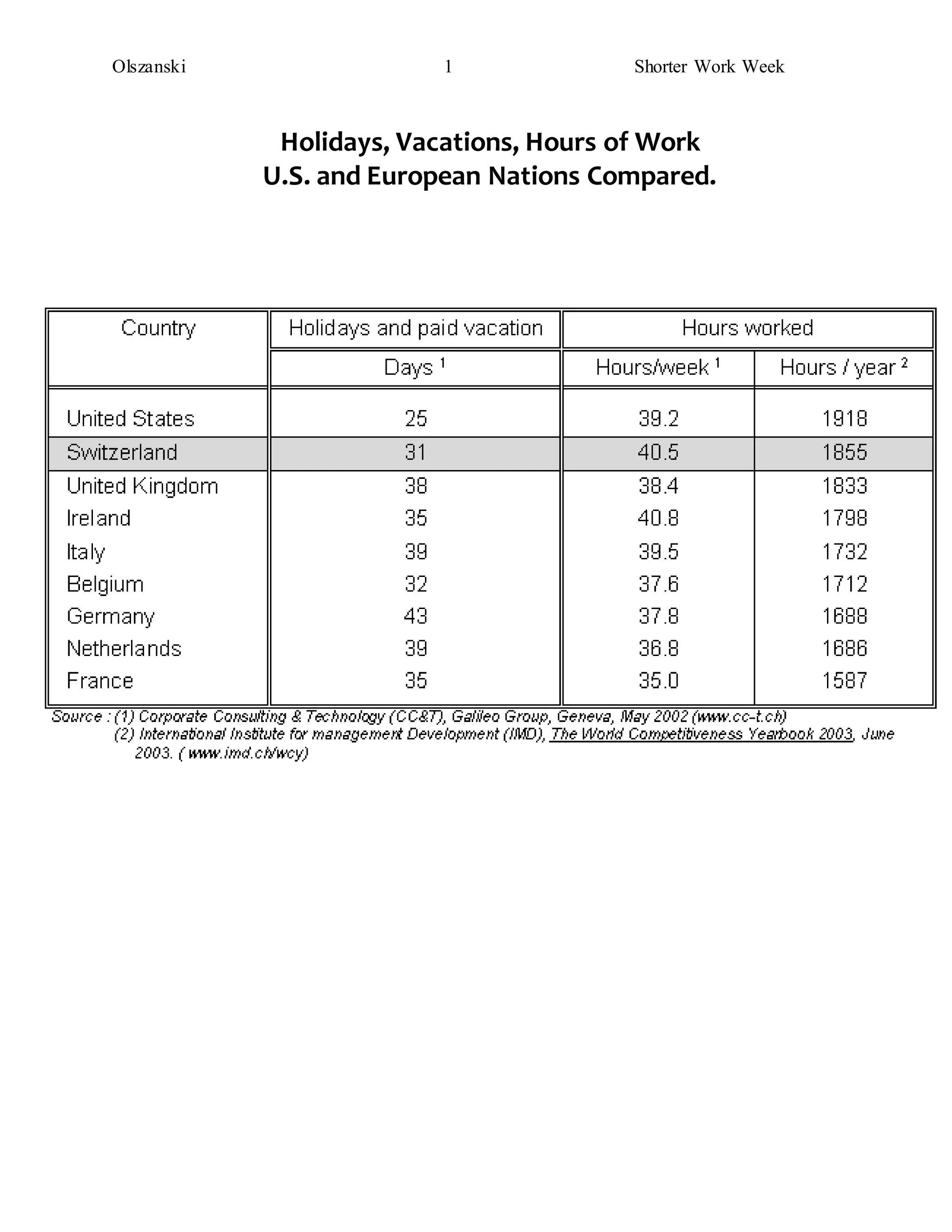
1918 71 By Contrast In France, which recently introduced legislation limiting the work week
to 35 hours, men and women workers put in 1,656 hours in 1997 versus 1,810 in the 1980s.
and this year dropped to 1587. In Germany (Western), the annual total of working hours was
just under 1,560 in 1996 versus 1,610 in 1990 and 1,742 in 1980. They’ve been reducing
hours of work at the same time U.S. work hours have been increasing, as the chart, “Hours
Worked in U.S.A., Germany, France” clearly illustrates.72
In basic steel in the U.S., the productivity improvement was much more dramatic,
rising from an output per hour of 52.4 in 1967 to 145.4 in 1995 ( the last year for which BLS
figures could be located) or nearly 2 ½ times in under 30 years! Starting back in 1947, with
an output per hour of 36.6, productivity in steel nearly tripled in under 50 years.73 Today,
according to AISI, The steel industry directly employs around 140,000 people in the United
States, and it directly or indirectly supports almost one million U.S. jobs. Labor productivity
Olszanski 24 Shorter Work Week
has seen a five-fold increase since the early 1980s, going from an average of 10.1 man-hours
per finished ton to an average of 1.9 man-hours per finished ton of steel.
By 1988 the average steelworker already put in 47 hours a week. Today (2018) it is probably
closer to 50 hours a week. We estimated then (1989) that for each hour the work week is
reduced in the U.S. 1.5 million workers could be employed, or reemployed.
Today in the U.S. a movement for shorter hours is lead by organized nurses, who are
fighting for legislation to outlaw forced overtime, which can be a disaster for patients as well
as the nurses themselves. “Mandatory overtime, often because of short-staffing, is the
norm.,” for most nurses including union nurses in the U.S. who average 6.5 hours of
overtime a week, or better than 8 weeks a year. The Joint Commission on Accreditation of
Health Care Organizations (JCAHO) reported in 1996 that perhaps 25% of 1,609 incidents of
death or injury of patients was at least partially due to short staffing, and the American
Medical association reports patients risk of dying increases dramatically with short staffing
and overtime worked by nurses. The AFL-CIO’s Karen Nussbaum, Christine Owens and
Carol Eickert argue that mandatory overtime is also chronic in other industries, and cite a
“groundbreaking” year 2000 strike by CWA workers at Verizon which won an agreement
limiting mandatory overtime to 7.5 hours per week.74 Nurses in Hawaii struck for more than
three weeks over mandatory overtime in 2002. "This is not about wages. It has never been
about wages," nurse Bill Richter said in a CNN news report, "It has always been about the
nurses' ability to care for patients and do so safely." 75
A recent CNN blog carried this story :
TRENTON, New Jersey (AP) -- After a five-year battle, New Jersey now has a state
law barring hospitals and nursing homes from forcing health care employees to
Olszanski 25 Shorter Work Week
work overtime except in emergencies….With the law that went into effect Tuesday,
New Jersey joins only Washington state in banning mandatory overtime at health
facilities. West Virginia lawmakers passed a ban that awaits the governor's
signature. At least six other states have debated such legislation, according to Mary
MacDonald, director of the AFT Healthcare union. 76
According to the Service Employees International Union (SEIU) website,
Connecticut, Main, Maryland, Minnesota, New jersey, Oregon and Washington have passed
state laws limiting mandatory overtime. This year SEIU announced a legislative initiative to
ban forced overtime for nurses through federal law. The Safe Nursing and Patient Care Act,
“ would prevent medical errors and improve patient care by limiting mandatory overtime in
the nation's hospitals.” No legislative initiatives on hours of work are planned by SEIU in
the state of Indiana.77
Beside nurses, members of the Communications Workers of America (CWA) made
mandatory overtime a central issue in contract negotiations with Verizon in August of 2000.
Demanding changes to mandatory overtime policies that “force worker to work an extra 10,
15 and in some cases 20 hours a week in overtime,” 72,000 CWA members threatened to
strike Verizon over the issue.78
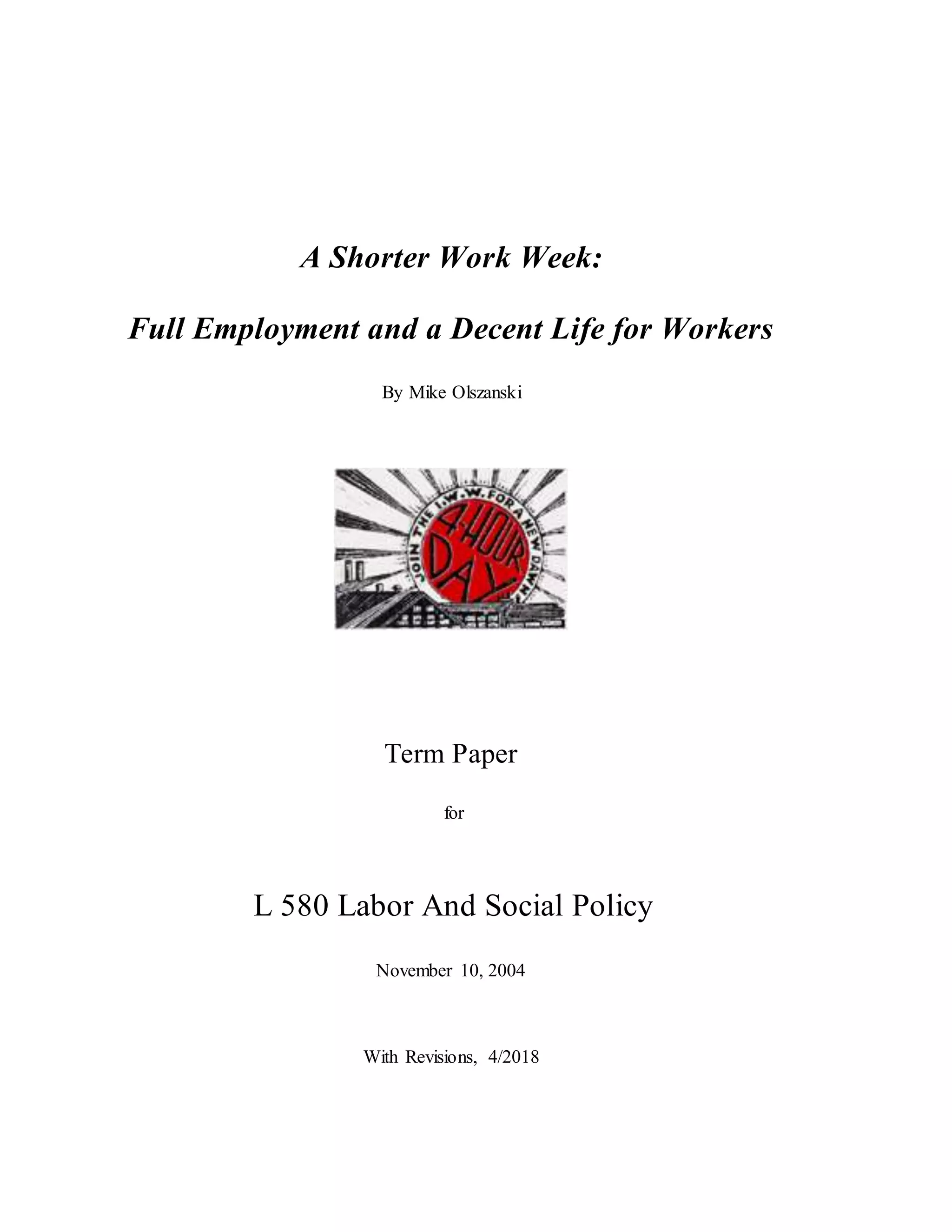
The Industrial Workers of the World (IWW) still alive and headquartered in
Chicago, is carrying on its own campaign for a Shorter Work Day .
The IWW argues that due to productivity increases over the past 50 years, a reduction
of the work day to 4 hours is both practicable and necessary to reduce or eliminate
unemployment. “The labor movement did not fight for and win the Six-Hour Day when it
Olszanski 26 Shorter Work Week
became practical sixty years ago,” the organizers state. Today, we need to organize for a
shorter work day that is, they say, “practical, it's necessary, and we've already paid for it.”79
For many years the IWW has called for a Four Hour Day. This may strike some as
drastic or utopian, but only because the labor movement did not fight for and win
the Six-Hour Day when it became practical sixty years ago. Significant cuts in the
work week - to 16 or 20 hours - would require significant reorganization of
production, and perhaps even the elimination of the host of capitalist parasites we
presently support. But such cuts could be won by a working class determined to do
so. The productive capacity exists to make a Four-Hour Day practical, though many
of the necessary workers have been diverted into low-paid, insecure and socially
useless labor. Even more modest reductions in the work week would be an
improvement over present conditions, provided only that our class was organized
well enough to ensure that we were not forced to bear the costs.
The four-hour day is reasonable. Now it's up to us to organize to take our time back
from the employers who have been robbing us of the product of our labor, our
dignity, and enormous (and growing) chunks of our lives for centuries.80
In view of present day statistics, the Wobbly view seems hardly radical. It makes
mathematical and statistical good sense.
In Canada, an organization calling itself 32 HOURS is “committed to a reduction
and redistribution of work time, in pursuit of an economically just and ecologically
sustainable society with a high quality of life for all.” 81 Ties between the group and the
progressive Canadian labor movement, if they exist, are all but invisible, but their mission
statement looks quite compatible with the goals of social unionists as well as greens and
Olszanski 27 Shorter Work Week
unorganized workers in the U.S. as well as Canada. Their website is rich with information
and links.
Perhaps the largest, best organized national group working for shorter hours in the
United States is “Take back Your Time” www.timeday.org . a project of the Center for
religion, Ethics and Social Policy (CRESP) at Cornell University. Endorsed by a number of
well known and respected individuals, including Juliet Schor, author of The Overworked
American, and Karen Nussbaunm and Chritiene Owens of the National AFL-CIO, the
group’s initiator, John de Graff edited a collection of essays in book form called Take Back
Your Time in 2003. It sponsored a nationwide “Take back Your Time Day” October 24th
2003, and plans another October 24, 2004 According to their mission statement:
TAKE BACK YOUR TIME DAY will produce a broad and non-partisan
coalition for change. This issue can unite groups who seldom talk to each other --
family values conservatives and the women's movement, labor unions and
environmentalists, clergy and doctors, advocates for social justice, enlightened
business leaders and the "slow food" and "simple living" movements. This issue
affects people across class, gender, race and ideological lines.
Their latest posting carries the banner “Breaking News..”
Take Back Your Time is partnering with several other organizations,
including Work to Live, Mothers Ought to Have Equal Rights (MOTHERS), and
Mothers Movement on-line to create the "It's About Time Coalition," and offer a
combined six-point public policy/legislative agenda for this year's election and for
the 2005/2006 Congress and state legislative sessions.
Olszanski 28 Shorter Work Week
If it is to have a serious impact, the coalition needs real labor support, beyond the
endorsement and participation of a Central Labor Council hear and there. No major union
has endorsed as yet, as far as I can determine.82 First, of course, the leaders of organized
labor in the U.S.A., as well as its members, have to decide whether we want to be once again
a social movement, or merely an aging, shrinking, exclusive institution.
What can we do in Indiana and Illinois? Last year, The Work Time Reduction
Committee of Indiana was organized by Brad Lorton of Indianapolis in 2003.
According to Lorton’s website : “The group's main focus will be encouraging workers to
contact their Congressional representatives to support a shorter work week and other work
time reduction issues.” So far, Lorton claims to have personally met with Seventh District
Indiana Congresswoman Julia Carson of Indianapolis, and given her information on work
time in Indiana and the group’s goals, in addition to a copy of Take Back Your Time. The
group did a teach-in on the IUPUI campus in October of 2003. So far as can be determined,
the group is miniscule and has no ties to the labor movement or other viable organizations.83
The Indiana legislature, as Democrat Representative Charlie Brown described it in a
recent class session, is dominated by Republicans, at least in the Senate, and no friend of
labor. Indiana Law, patterned after the Fair Labor Standards Act of 1938, requires only time
and one half for hours worked over forty per week by certain hourly workers. There is no
limit to forced overtime. State Representative John Aguilar, also a Democrat from Northwest
Indiana with strong ties to organized labor stated unequivocally that any bill to ban
mandatory overtime brought before the Indiana legislature “would die in the Senate.”84
One idea is to start with health care workers, with SEIU leading the way. Once
again, as it has throughout the history of organized labor’s attempt to secure shorter working
hours, the question of legislation versus contract negotiations is being debated. The
Olszanski 29 Shorter Work Week
experience of the labor movement with issues like health insurance and pensions may help to
inform current strategy. The tactic of “getting it in the contract” secured good health
insurance and pensions in the steel industry. Later both these benefits have come under attack
and in several instances been lost partially or completely as corporations downsize, close
plants, sell out, and file bankruptcy. I am convinced that a social unionist approach to
securing these kind of benefits for the entire class through legislation, preferably national
legislation like Medicare and Social Security makes more sense. Likewise federal legislation
to shorten the work week, increase the overtime premium, and ban mandatory overtime,
perhaps as amendments to the Fair Labor Standards Act seems the logical choice to secure
labor’s share of the productivity dividend with some degree of permanence.
Again, however, the Bush Administartion’s neo-liberal assault on working people is
moving us in the opposite direction. In August of this year, revised FLSA regulations became
effective, that exclude some categories of workers from entitlement to overtime pay. The
language is ambiguous, and labor lawyers are still sorting it out. What is clear is that on this
issue, as on other social policy issues, labor is on the defensive against continuing attacks by
the right wing. In Illinois, state legislator Barack Obama co-sponsored legislation designed
to nullify the effect of the new FLSA regulation changes on workers in that state. It is
unclear how many other state legislatures will rise to the defense of workers rights to be paid
for overtime.
Any and all local and state initiatives on shorter hours of work need to be supported
and encouraged, and incorporated into larger coalitions when possible. State campaigns
might lead the way, tactically, but unless they are part of a larger campaign to elect labor’s
own to political office nation-wide as well as state wide and to promote labor’s own political
Olszanski 30 Shorter Work Week
and social agenda, long term effectiveness seems unlikely. As I have shown, state legislation
on work hours has been enacted before—only to be ignored and or circumvented by powerful
business interests. Similarly, Workers’ Compensation Laws, enacted on a state by state basis
throughout the nation, invite competition among states and whipsawing or a “race to the
bottom” as part of competition for new business. William Roth argues that even when action
is undertaken on social issues on the local level, “local action should be informed by global
thought.” 85 Until organized labor and the working class generally mobilize politically on a
national level to win a full employment and shorter hours policy, my guess is we will
continue to hang separately in our unions and our states. I am convinced that historical
experience points to the necessity to rebuild the labor movement in this country around a
democratic, social unionism agenda. Issues like health care for all and a shorter work week
would be central to a revitalized movement for social change. Part of the rebuilding process
should include broad coalitions with other progressive elements in the country—and the
world—such as the environmental and anti-WTO movements. Only then will workers in this
country have the collective power to wring from business our fair share of the riches we have
created for them.
Labor movements in this country as well as in Europe organized around and fought
for shorter hours of work.. Unions in the U.S. dropped the issue when they cut off their left
wing. Left-led unions in Europe, as well as left wing governments there, understand the
importance of winning labor’s share of the productivity bonanza in terms of a shorter work
week. When the labor movement in the U.S.A. rises again, social policy issues like the
shorter work week need to be at the top of its agenda. State initiatives might serve as a
rallying point to rebuild a larger national movement for a shorter work week
Olszanski 31 Shorter Work Week
As always, the task for labor is: Educate, Agitate, Organize
Olszanski 32 Shorter Work Week
INDIANA
By Brad Lorton
Organizer, Work Time Reduction Committee of Indiana
The Work Time Reduction Committee of Indiana has been officially launched. The group's
main focus will be encouraging workers to contact their Congressional representatives to
support a shorter work week and other work time reduction issues.
On February 7th, I met with Seventh District Indiana Congresswoman Julia Carson of
Indianapolis to discuss work time reduction issues, including a shorter workweek. This
meeting was an important step in the Hoosier campaign for work time reduction. I drafted a
presentation for the meeting and assembled a good deal of reference material to give to
Congresswoman Carson and her staff. I gave her copies of The End of Work and The
Overworked American, and also information on TAKE BACK YOUR TIME DAY.
I did not go into the meeting with the expectation of convincing Congresswoman Carson to
sponsor legislation. Rather I presented my ideas as the beginning of a dialogue, and informed
her of planned activities for the Work Time Reduction Committee of Indiana.
Congresswoman Carson's main concern about work time reduction legislation was whether it
could be implemented without hurting the economic well being of working Americans. She
asked challenging questions, and raised important concerns that our movement must address.
I stressed that any viable full employment strategy for the 21st Century would have to
incorporate "spreading the work" and work time reduction strategies.
All-in-all, my meeting with Julia Carson was quite productive. I left with the impression that
our movement needs to spend a lot more time informing our legislators on these issues. There
Olszanski 33 Shorter Work Week
is a great deal of potential support, but right now Congress only hears about work time
reduction in regards to specific occupations, eg. nurses and hospital workers. Our task is to
create political space for broader work time reduction issues. This will require constant
organizing, networking and communication, especially with members of Congress. I only
wish more of you were blessed with Representatives as willing to listen as Julia Carson.
For more information, visit the website at www.onet.net/~hours30 or contact:
Work Time Reduction Committee of Indiana
c/o Brad Lorton
P.O. Box 361132
Indianapolis, IN 46236-1132
(317) 919-4622
shorterworkweek@netscape.net
Olszanski 34 Shorter Work Week
Bibliography
Beveridge, William H. . Full Employment in a Free Society. London: George Allen &
Unwin Ltd. 1944
Boyer, Richard O and Morais, Herbert M.. Labor’s Untold Story. New York: United
Electrical, Radio and Machine Workers of America (UE), 1965
De Graaf, John, Ed. Take Back Your Time, San Francisco: Berrett-Koehler. 2003
Foner, Phillip S. A Short History of the International Worker’ Holiday 1886-1986. New
York: International Publishers. 1986.
Kalecki, Michael. "PoliticalAspects of Full Employment." In Collected Works of Michael
Kalecki. New York: Oxford University Press. 190.
Marx, Karl. Capital. New York: International Publishers. 1967 (1867)
Mishel, Lawrence; Bernstein, Jared; Schmitt, John. The State of Working America. Armonk,
NY: Economic Policy Institute. 2003
Nussbaum, Karen and Owens, Christine and Eickert, Carol “America Needs a Break,” in
Take Back Your Time, John deGraff, ed., San Francisco: Berrett-Koehler. 2003.
Olszanski, Mike. “Time to Fight For Jobs” in The Voice of the Rank & File. East Chicago,
Indiana: Rank & File Caucus at Local 1010 USWA, December, 1989.
Piven, Frances Fox and Cloward, Richard A. The Breaking of the American Social Compact.
New York: The New Press. 1997.
Roth, William. The Assault on Social Policy. New York: Columbia University Press. 2002
Schor, Juliet B. The Overworked American. New York: Basic Books. 1992
Slichter, Sumner H. (1941) Union Policies and Industrial Management. Washington, D.C.:
Brookings Institution.
Smith, Adam. An Inquiry into the Nature and Causes of the Wealth of Nations. Chicago: The
Great Books, Encyclopedia Britannica. 1952 (1776)
Tanzman, William Partridge. “A Working-Class Version of the New Left: Rank-and-File
Steelworkers Insurgency in the 1960s and 1970s.” Senior Essay. Yale University. April 5,
2004.
United Steelworkers of America. Shorter Work Week (Pamphlet) Booklet N0. PR-137.
Pittsburg: United Steelworkers of America. Circa 1965.
Olszanski 35 Shorter Work Week
On-Line Sources:
“A Life Less Hectic,” on The Amsterdam Forum, broadcast on Radio Netherlands,
http://www.rnw.nl/amsterdamforum/html/040924af.html
Crawford, Hal. “Inside Out a Resident Foriegner’s View of Holland.” on “Dutch Horizons.”
broadcast on Radio Netherlands, October, 2004
http://www.rnw.nl/special/en/html/040817ins.html
“Eight Hour Day Movement.” www.shapingsf.org/ezine/labor/8hourday/main.html
“Europe Needs a New Work Ethic.” broadcast on Radio Netherlands. July 7, 2003.
http://www.rnw.nl/hotspots/html/eco030701.html
Federal Law (U.S. Dept. of Labor): www.dol.gov/esa/regs
“Germany’s National Holiday in Jeopardy” broadcast on DW World, German International
Radio, April 11, 2004. http://www.dw-world.de/dw/article/0,1564,1384987,00.html
Gibson , Richard. “THE HISTORIC BATTLE FOR THE SHORTER WORK WEEK” For
the Michigan State Employees Association, 1980
http://www.pipeline.com/~rgibson/ShorterWorkWeek.html
“Hawaii nurses striking over benefits, overtime” CNN.Com
http://archives.cnn.com/2002/US/West/12/23/nurses.strike.ap/
Hayden, Anders. “France's 35-Hour Week” Canadian Dimension, February, 2000.,
http://www.web.net/32hours/
History of the 8 hour day movement. http://tx.cpusa.org/mayday.htm
Hunnicutt, Benjamin Kline. “Kellogg's Six-Hour Day.”
http://www.temple.edu/tempress/titles/1155_reg.html and http://www.h-
net.org/reviews/showrev.cgi?path=9864906483241
ILO News, (ILO/99/29) Monday 6 September 1999. http://www.hartford-
hwp.com/archives/26/077.html
Industrial Workers of the World Website; http://www.iww.org/projects/4-Hours/4-
Hours.shtml
Indiana Law: http://www.state.in.us/legislative/ic/code/title22/ar2/ch2.html
Illinois Law (FLSA): www.workplacelawyer.com/whdsfs23.html
Japan’s Work Hours versus Britain & U.S. http://web-
japan.org/kidsweb/japan/economy/q10.html and http://www.japan-
press.co.jp/2395/labor4.html
Olszanski 36 Shorter Work Week
Matla, Pelle.“Work More, Earn Less.” broadcast on Radio Netherlands
July 23, 2004. http://www.rnw.nl/hotspots/html/ned040723.html
“New Jersey bans forced overtime for health care workers” CNN.Com
http://www.cnn.com/2004/HEALTH/02/21/nurses.overtime.ap/
Productivity & work hours, U.S. Versus Europe Statistics: http://www.hartford-
hwp.com/archives/26/077.html
“SHAPING San Francisco” www.shapingsf.org/ezine/labor/8hourday/main.html
REDUCING WORK HOURS: Action For Full Employment, 32 Hours
http://www.web.net/32hours/
Take back Your Time. http://www.simpleliving.net/timeday/
“REDUCING WORK HOURS: Action For Full Employment, 32 Hours”
www.web.net/32hours/germany.htm
“Today in History.” Library of Congress. http://memory.loc.gov/ammem/today/aug20.html
Why Shorter Work Time? http://www.web.net/32hours/ and
http:www.geocities.com/shorterworkweek/news
Wisconsin Labor History www.wisconsinlaborhistory.org/bayview.html
https://www.theguardian.com/business/2008/sep/01/economics John Meynard
Keynes
All Unions committee to Shorten the Work Week
https://www.nytimes.com/1978/04/16/archives/unions-meet-resistance-in-
trying-to-cut-workweek-other-priorities.html William Andrews quote “I feel
that the way to put our people back to work is the shorter workweek,” said
William Andrews, a leader of the All Unions Committee and president of Local
1010 of the United Steelworkers, the union's largest local with 17,700 members
in East Chicago.
Olszanski 37 Shorter Work Week
Olszanski 1 Shorter Work Week
Holidays, Vacations, Hours of Work
U.S. and European Nations Compared.
Olszanski 1 Shorter Work Week
End Notes
1 See, Mike Olszanski, “Time to Fight For Jobs” in The Voice of the Rank & File, East
Chicago, Indiana: Rank & File Caucus at Local 1010 USWA, December, 1989), 1-2.
2 Juliet B. Schor, The Overworked American, the Unexpected Decline of Leisure, (New York:
BasicBooks, 1991), 107-138.
3 See Jerry Flint,“Unions Meet Resistance in Trying to Cut Workweek”, New York Times,
April 16, 1978 https://www.nytimes.com/1978/04/16/archives/unions-meet-resistance-in-
trying-to-cut-workweek-other-priorities.html also
https://reuther.wayne.edu/files/LR000880.pdf
4 Lawrence Mishel, Jared Bernstein, Heather Boushey, The State of Working America,
2002/2003, (Ithaca: Cornell University Press, 2003), 153-167.
5 Schor, 53-54.
6 Karl Marx, Capital, (New York: International Publishers, 1967 [1867]), 188.
7 For a detailed explanation of surplus value and formulas by which it is computed see
Marx, 149, 201, 204, 207 and 209, and in Capital, Book II, 218. Marx defines surplus
value as "..an exact expression for the degree of exploitation of labour-power by
capital, or of the labourer by the capitalist." (p. 209)
8 Schor, 43-47.
9 See Adam Smith, Wealth of Nations, 170-171. See also Marx 168-171 “The value of labor
power resolves itself into a definite quantity of the means of subsistence.”
10 Marx, 265-269.
Olszanski 2 Shorter Work Week
11 James Lavelle, Shorter Work Week , Pamphlet PR-137 (Pittsburgh: United Steelworkers of
America, 1962) 13-15.
12 Marx, 225.
13 Richard O. Boyer and Herbert M Moraise, Labor’s Untold Story, Pittsburg: United
Electrical, Radio & Machine Workers of America, 1956), 25-26.
14 SHAPING San Francisco www.shapingsf.org/ezine/labor/8hourday/main.html
15 Boyer and Moraise, 37.
16 Boyer and Moraise, , 70.
17 Library of Congress “Today in History” http://memory.loc.gov/ammem/today/aug20.html
See also Boyer & Moraise, 79-80.
18 Wisconsin Labor History www.wisconsinlaborhistory.org/bayview.html
19. Boyer and Moraise, 107
20 Mishel, et al, 189-196.
21 V.I. Lenin. Collected Works Volume 4. (Moscow: Progress publishers, 1964), 312.
22 Lenin, 240.
23 Boyer and Moraise, 180.
24 Davis F. Selvin, A Terrible Anger, (Detroit: Wayne State University Press, 1996), 7, 240.
25 Henry Kraus, The Many and the Few, (Urbana and Chicago: University of Illinois Books,
1985), 44. See also Richard Gibson ,“THE HISTORIC BATTLE FOR THE SHORTER
WORK WEEK” For the Michigan State Employees Association, 1980
http://www.pipeline.com/~rgibson/ShorterWorkWeek.html
Olszanski 3 Shorter Work Week
26 Boyer and Moraise, 237.
27 LaVelle, 16-17.
28 Marx, 595
29 Marx, 602-603
30 Michal Kalecki, “Political Aspects of Full Employment,” in Selected Essays on the
Dynamics of the Capitalist Economy 1933-1970 (Cambridge: Cambridge University Press,
1971), 347-356.
31 See Schor, 75. See also Kalecki,140-41. See also Tim Rowse, “Full Employment and the
Discipline of Labor. A Chapter in the History of Australian Social Democracy,” in The
Drawing Board: An Australian Review of Public Affairs, Volume1, Number 1, July, 2000,
Sydney, Australia: University of Sydney. www.econ.usyd.edu.au/drawingboard/
journal/0007/rowse.pdf
32 This assertion first appears Adam Smith’s Wealth of Nations. Smith states “The demand
for those who live by wages, therefore, naturally increases with the increase of national
wealth, and cannot possibly increase without it. It is not the actual greatness of national
wealth, but its continuous increase, which occasions a rise in the wages of labor” 29. Smith
also argued that the proportional shares of wealth apportioned to profits and to wages was
fixed, and could not vary., 62. Modern capitalist economists like Milton Freedman (“No free
lunch”) perpetuate this argument, and the wages/productivity bargain espoused bythe AFL-
CIO’s business unionists accepts it as well.
33 Richard Gibson http://www.pipeline.com/~rgibson/ShorterWorkWeek.html
34 Boyer and Moraise, 359-360.
35 Schor, 77
36 Schor, 77-78.
Olszanski 4 Shorter Work Week
37 Lord William H. Beveridge, Full Employment in a Free Society, (London: Unwin Bothers
Ltd. 1944), 19.
38 Beveridge, 200
39 Beveridge, 101
40Quoted in William Z. Foster, American Trade Unionism, (New York: International
Publishers, 1947), 100.
41 Schor, 155. See also, Benjamin Hunnicutt, “The Short Life of Kellogg’s Six-Hour Day—
The Death of a Vision,” (mimeo, University of Iowa), 23.
Also, Benjamin Kline Hunnicutt “Kellogg's Six-Hour Day,”
http://www.temple.edu/tempress/titles/1155_reg.html and http://www.h-
net.org/reviews/showrev.cgi?path=9864906483241
42 James Lavelle, Shorter Work Week , Pamphlet PR-137 (Pittsburgh: United Steelworkers of
America, 1962) , 43-47.
43 Foster, 100.
44 William Partridge Tanzman, “A Working-Class Version of the New Left: Rank-and-File
Steelworkers Insurgency in the 1960s and 1970s,” (Senior Essay, Yale University, April 5,
2004)
45 Schor, 75-76.
46 See Frances Fox Piven and Richard A. Cloward, The Breaking of the American Social
Compact,(New York: The New Press, 1997). Describing capitalism’s rationale for its
neoliberal assault upon the welfare state and the “social compact” it had made with labor and
the Democratic party as a “neo-laissez faire doctrine,” Piven & Cloward discuss labor’s loss
Olszanski 5 Shorter Work Week
of power and the breakup of the old liberal-labor Democratic Party coalition as factors in the
success of capital’s ideological campaign to undue the welfare state, but largely ignore the
devastation of not only the ideological underpinnings, but much of the organizing expertise
and strategic leadership of the U.S. labor movement by the purging of its militants in the
1940’s and 1950’s.
47Samuel Lillie, quoted in LaVelle, 28-29. See also, Samuel Lillie, Automation and Social
Progress (New York: International Publishers, 1957).
48 See Chart, “U.S. percent of Workforce Union”
49 Lavelle, 44.
50 Executive compensation has become an increasingly larger part of the portion of overall
revenues apportioned to management in recent years. CEO’s in the U.S.make more than 300
times more than their typical workers, upo from 26 times more in 1965. See Mishel, et al, 7,
115, 213-215.
51 Lavelle, 17.
52 Lavelle, 46-47.
53 John Sargent, speech to Tenth Constitutional Convention of the USWA, Proceedings,
Atlantic City, NJ, 1960, 298-299. See also, James Balanoff and John Sargent, various articles
in Local 1010 Steelworker newspaper, 1962-1965.
54 There were exceptions. The first local Environmental Committee in the USWA, formed in
Local 1010 in 1972, raised issues of jobs and a sustainable environment, and was
instrumental in electing a progressive slate to top local union office in 1976, and James
Balanoff district director of the 120,000 member District 31 in 1977.
55 BLS figures. See Olszanski, Mishal, et al.
Olszanski 6 Shorter Work Week
56 U.S. News & World Reoprt, Novemeber 20, 1989.
57 Suzanne Schweikert, “An Hour a Day (Could Keep the Doctor Away)”, in Take Back Your
Time, John deGraff, ed., (San Francisco: Berrett-Koehler, Inc., 2003), 78-84.
58 Stehen Bezucha, “The (Bigger) Picture of Health,” in Take Back Your Time, John deGraff,
ed., (San Francisco: Berrett-Koehler, Inc., 2003),84-90.
59 REDUCING WORK HOURS: Action For Full Employment, 32 Hours
www.web.net/32hours/germany.htm
60 Mishal, et al, 7.
61 Anders Hayden, “France's 35-Hour Week” Canadian Dimension, February, 2000. See also,
http://www.web.net/32hours/
62 Piven and Cloward, 4-6.
63 “Germany’s National holiday in Jeopardy” broadcast on DW World, German
International Radio, April 11, 2004. http://www.dw-
world.de/dw/article/0,1564,1384987,00.html
64 “Europe Needs a New Work Ethic” broadcast on Radio Netherlands, July 7, 2003.
http://www.rnw.nl/hotspots/html/eco030701.html
65 Pelle Matla, “Work More, Earn Less,” broadcast on Radio Netherlands
July 23, 2004. http://www.rnw.nl/hotspots/html/ned040723.html
66 Hal Crawford, “Inside Out a Resident Foriegner’s View of Holland” on “Dutch Horizons,
broadcast on Radio Netherlands, October, 2004
http://www.rnw.nl/special/en/html/040817ins.html
Olszanski 7 Shorter Work Week
67 “A Life Less Hectic,” on The Amsterdam Forum, broadcast on Radio Netherlands,
http://www.rnw.nl/amsterdamforum/html/040924af.html
68 See Chart “Productivity Versus hours Worked”
69 ILO News, (ILO/99/29) Monday 6 September 1999.
http://www.hartford-hwp.com/archives/26/077.html
70 Schor, 154.
71 Shee Chart, “Productivity Versus Hours Worked
72 ILO News
73 Bureau of Labor Statistics Data, Series ID: PIUL42501, Industry: Steel SIC 331,
http://www.bls.gov/
74 Karen Nussbaum, Christine Owens, and Carol Eickert, “America Needs a Break,” in Take
Back Your Time, John deGraff, ed.,
75 “Hawaii nurses striking over benefits, overtime” CNN.Com
http://archives.cnn.com/2002/US/West/12/23/nurses.strike.ap/
76 “ New Jersey bans forced overtime for health care workers” CNN.Com
http://www.cnn.com/2004/HEALTH/02/21/nurses.overtime.ap/
77 Conversation with Alice Bush, President SEIU Local 208. See also SEIU Website
http://www.seiu.org/health/nurses/mandatory_overtime/mot_factsheet.cfm
78 “ US: Forced overtime and job security key issues in Verizon strike” World Socialist Web
Site 18 August 2000 http://www.wsws.org/articles/2000/aug2000/veri-a18.shtml
79 Industrial Workers of the World Website; http://www.iww.org/projects/4-Hours/4-
Hours.shtml
Olszanski 8 Shorter Work Week
80 IWW Website http://www.iww.org/projects/4-Hours
81 REDUCING WORK HOURS: Action For Full Employment, 32 Hours
http://www.web.net/32hours/
82 Take Back Your Time Website: www.simpleliving.net/timeday/
83 www.onet.net/~hours30
84 Class discussion L580 Labor & Social Policy IUN, ISG Learning Center, Burns Harbor,
IN, )ctober 24, 2004.
85 William Roth, The Assault on Social Policy, (New York: Columbia University Press,
2002) , 171.

A Shorter Work Week (revised 2018)

  • 1.
    A Shorter WorkWeek: Full Employment and a Decent Life for Workers By Mike Olszanski Term Paper for L 580 Labor And Social Policy November 10, 2004 With Revisions, 4/2018
  • 3.
    Olszanski 1 ShorterWork Week Workers in the United States today work more hours than they did 10, 20, or 30 years ago, and their real wages have hardly increased. Unemployment and underemployment are still at unacceptably high levels. I first researched the issue of work hours and overtime and the connection with unemployment in the late 1980’s as vice president and then president of Local 1010, United Steelworkers of America (USWA) at Inland Steel’s Indiana Harbor Works.1 At Inland, as at other basic steel mills, management was “rationalizing” the workforce—cutting crews, eliminating jobs, downsizing, and forcing the remaining workers to work more and more overtime. Some accepted the overtime willingly, and indeed a few became obsessed with getting all they could, in the face of dropping real wages and increasing costs. Insecurity played a large role in this, as did the kind of “Work and Spend” compulsive consumption consumerism Juliel Schor refers to in her 1992 book, The Overworked American.2 Much top Union leadership in our union at that time parroted the long held belief—a myth in my opinion—that any union rep who raised the issue of overtime, even forced overtime, and tried to reduce it to save jobs, would never get reelected. Some informal polling we did in my local strongly contradicted that idea. Since the late 1980’s the situation—more downsizing and productivity, and longer hours of work has gotten worse. Those of us calling for a fight for a shorter work week by the labor movement in the 1970’s and 1980’s were largely ignored and marginalized.3
  • 4.
    Olszanski 2 ShorterWork Week Hours of work in the U.S. have increased since the 1960’s, though productivity or output per hour of work has increased tremendously in the same period. Real wages among blue collar workers have not increased during this period, and for those with no more than a high school education, have decreased.4 Unemployment, underemployment, and poverty, especially among certain racial and other segments of the work force, are unacceptably high. U.S. Executive salaries have grown enormously during the same period, and are considered by many unconscionably high. Workers—including union workers—have failed to win our share of the productivity bonanza which has yielded tremendous profits and executive salaries for U.S. domestic corporations. Our AFL-CIO unions made an unwritten wages/productivity bargain with business and government during the cold war, the terms of which included more production for business, and a share of the increased wealth for labor. I will show that business has not kept their part of the bargain. To put it another way, organized labor in the United States has been ineffectual in getting our share. The labor movement in the United States, as well as in Europe, organized itself largely around the issue of shorter work time in the 19th Century. A shorter work day was a vital issue to workers just forming unions, who often worked dawn to dusk for low pay. Paid by the day or the week, or often by the month rather than the hour, it was logical to workers in the U.S. as well as other industrialized nations, and to political economist Karl Marx, that longer work days meant more exploitation by the boss. Fixed daily wages meant, as Schor puts it, that to the capitalist, “…each additional hour worked was free.”5 Marx defined and measured the exploitation of the worker in terms of surplus value which the boss got for hours worked beyond those for which the worker was paid.. As Marx put it. “The fact that half a day’s labor is necessary to keep him alive during 24 hours does not in any way prevent him from working a whole day.”6 If the worker produced in 6 hours a money
  • 5.
    Olszanski 3 ShorterWork Week value of product equal to what he was paid, but was made to work 12 hours a day for that pay, the capitalist got 6 hours worth of what Marx called surplus value, or 6 hours worth of product for which he did not pay the worker. The more productive the worker, the more she got exploited, and the higher the profit margins of the capitalist.7 Under these horrible conditions, shortening the work day, while holding the (subsistence) wage constant, was as important to organizing workers as was raising wages. In addition, workers newly introduced to the long days of work for the capitalist had not yet been infused with the culture of consumerism that would later lead them to covet more and more material goods, and invest more work hours in attaining them. Indeed, as Schor demonstrates, hours of work for peasants and laborers prior to their introduction to capitalism were considerably less than those demanded by their capitalist supervisors.8 Prior to the organization of guilds or unions for industrial workers subsistence wages were the rule, as the law of supply and demand for labor power caused wages to generally adjust themselves to a level barely sufficient to keep the laborer and his family alive, as Adam Smith and later Karl Marx pointed out.9 The fight was one for survival, and for sufficient time off to rest and try to get something out of lives besides work. In England, the Factory Acts, starting in 1833 decreed a “normal working day” of 15 hours, but limited working 13-18 year olds more than 12 hours a day. They were poorly enforced. By 1847, the twelve hour day for women and men under 18 had become the norm in Britain under the Factory Acts, but the employers responded by cutting daily wages in order to win over public opinion among the workers for more hours to make up for the loss in pay. When the 1848 law called for a reduction of hours to 10, the employers responded by cutting wages a total of 25%. 10
  • 6.
    Olszanski 4 ShorterWork Week As early as 1822, Philadelphia millwrights and mechanics demanded a ten hour day, and in 1835 carpenters, masons, and stonecutters in Boston staged a seven-month strike in favor of a ten-hour day. The strikers demanded that employers reduce excessively long hours worked in the summer and spread them throughout the year. Again the movement for a ten- hour workday returned to Philadelphia, where carpenters, bricklayers, plasterers, masons, leather dressers, and blacksmiths went on strike. The Massachusetts legislature debated the issue of the 10 hour day, having been petitioned by workers and their unions, including those of the textile mills in Lowell. A number of states actually enacted 10 hour day legislation, but it had little effect as corporations found ways around it, including forcing employees to sign contracts calling for 12 or 13 hour work days.11 Building Trades workers in London conducted a massive strike for a 9 hour work day in 1860-1861.12 In the U.S., real wages dropped precipitously between 1860 and 1865, just as the bosses introduced speed-up on a massive scale to increase production. An average working day of eleven hours was often stretched to twelve or fourteen hours. Strikes for higher wages and a shorter work day erupted across the country in 1863, in the midst of the Civil War.13 In 1865 the San Francisco Trades’ Union publicly appealed for an 8 hour day. Eight Hour Leagues were organized all over the Bay area, and put pressure on local politicians. In 1867 the San Francisco Board of supervisors passed an 8 hour ordinance. In February 22, 1868 “thousands celebrate[d]passage of a state law” declaring the 8 hour day the standard. In 1868-1870 San Francisco bosses reacted, and broke the 8 hour day with scabs.14 On August 20, 1886 the National Labor Union called on Congress to enact legislation limiting the standard work day to 8 hours, and its agitation is credited with reducing the average working day in the U.S. from 11 hours in 1865 to 10.5 in 1870.15 The depression of 1883-1885 saw increased unemployment and poverty, while those who
  • 7.
    Olszanski 5 ShorterWork Week managed to keep a job in a steel mill worked 12 and 14 hour days. 16 The Knights of Labor, who under Terrance Powderly advocated an 8 hour day in the 1870’s and 1880’s, estimated unemployment as high as 2 million in 1885. Some industrial workers worked as long as 18 hours a day, while a Minnesota law fined railroad owners who workers engineers or firemen more than 18 hours in a day.17 It was obvious to workers that there was a direct connection between long work hours, unemployment and poverty. On May Day, May 1 1886 Chicago police killed workers striking for a shorter work day. Three days later on. May 4 police attacked peaceful protesters, resulting in the infamous Haymarket tragedy. On May 5, 1886 a massacre in Milwaukee saw 7 workers killed by militia during a demonstration of 1500 for the 8 hour day.18 In terms of its effect, the 8 hour movement of the 1880’s did succeed in getting work hours reduced to 10 per day and 58.4 per week by 1890, with union manufacturing workers averaging 7.8 hours per week less than unorganized workers. The building trades unions did even better for their members, who by 1890 were averaging 9.6 hours per day, down from 9.9 in 1880.19 This “union premium”, applicable to wages and benefits as well as hours, has been documented down to present times by Lawrence Mishal, et al.20 As early as 1887, the AFL’s Samuel Gompers— a staunch representative of narrow craft unionism and no Marxist by any means—saw shorter work hours as an antidote for unemployment. “So Long as there is one who seeks employment, and cannot find it,” he said in his characteristically high-sounding way “the hours of labor are too long” Turn of the century Russia, ripening for the coming Bolshevik Revolution, saw capitalist exploitation of workers at its worst. Lured from farms on which they barely subsisted, Russian peasants took jobs in the burgeoning factories. Under the rule of the Czar, the new capitalists were totally unregulated and starving workers—including children—were
  • 8.
    Olszanski 6 ShorterWork Week forced to work long hours for low pay. This “generation of permanently hungry workers…gradually dying from starvation,” sometimes worked “as long as 17-19 hours a day.” 21 Strikes were rampant, and the Social-Democratic Party (forerunner to the Bolsheviks) organized by Lenin, used them to educate workers and raise consciousness. In his “Draft Program for Our Party,” Lenin in 1899 listed nine “practical demands” of which 1) was “an eight hour working day” 2) “prohibition of night work and…the employment of children under 24 years of age,” and 3) “uninterrupted rest periods, for every worker, of no less than 36 hours a week.”22 The IWW (Industrial Workers of the World) supported its own 8 Hour day movement in the early twentieth century, and continues to call for shorter work time to this day. Trade unions succeeded in winning the 8 hour day for thousands of members by 1915, while 25 states had laws that put some limit on the hours of a work day. In 1916 congress, under threat of a rail strike passed the Adamson Act, which mandated overtime for hours over 8 a day for railroad workers.23 Hours of work continued to be a top issue in the Congress of Industrial Organizations (CIO) organizing drive of the 1930’s. The San Francisco waterfront and General Strikes of 1934, led by accused communist Harry Bridges and a Rank & File caucus with Communist and Socialist leadership, empowered longshoremen and seamen to “exert decisive control over…the pace of the work….” and “fixed the work day at 8 hours, overtime was payable in time off rather than cash.”24 The Sit down strikes in auto in 1936, also led primarily by Communist Party members and Socialists were motivated by overwork as much as by pay demands, according to strike leader and Communist Party member Henry Kraus: “It was always the speedup, the horrible speedup…It was the speedup that organized Flint.” 25
  • 9.
    Olszanski 7 ShorterWork Week “Speedup,” according to United Electrical Workers (UE) scholars Richard Boyer and Herbert Moraise, “increased unemployment, and industrial accidents.” 26 Not surprisingly, a Marxist analysis prompted Left-led unions in the CIO to particularly emphasize a shorter work day and/or work week as a key demand The Walsh Healy Act of 1936 provided a 40 hour week for employees of firms contracting with the Federal Government, and by 1938, a massive organizing drive by the CIO, huge and effective strikes in Auto, Steel and elsewhere created a labor movement powerful enough to pressure Congress and President Franklin Roosevelt into enacting the Fair Labor Standards Act (FLSA). Under pressure from capital, it did not limit work hours, but did mandate overtime pay at time and one half for hours over 40 a week. Again, hours of work continued as a central issue for U.S. unions into the 1950’s, and unions won contractual limits on, and/or premium pay for overtime, Sundays and Holidays during the post-war period. By 1960, over 400,000 members of the International Ladies Garment Workers (ILGW) were on a negotiated 35 hour week, while 30,000 rubber workers had secured a 6 hour day and 36 hour week, and nearly 30,000 brewery workers worked under 40 hours a week—half on a 37 ½ hour work week.27 In most industries, union contracts negotiated in the 1930’s, through the 1960’s set the work day at 8 hours, with overtime pay for hours exceeding eight. But time and a half for overtime, hardly an effective deterrent, from the very beginning allowed management to bribe workers to sell their hard-won leisure time, and eliminate the benefits of more leisure and reduced unemployment. The increase in labor cost to the employer of overtime pay was more than offset by a reduction in the number of workers with their benefit costs—especially as this part of the wage package grew.
  • 10.
    Olszanski 8 ShorterWork Week Squeezed time and again by falling real wages due to inflation outstripping hard-won union wage gains, U.S. workers got into the habit of making up for lower wages and wages lost to frequent lay-offs by working as much overtime as they could get when the economy was booming. Over and over again they fell back to longer hours for less pay and the ever-present threat of unemployment. Marx had predicted in the 19th century that capital would consistently try to extract more and more surplus value from fewer and fewer workers: "It is the absolute interest of every capitalist to press a given quantity of labor out of a smaller, rather than a greater number of labourers..." 28 The capitalists have kept true to form. Marx also argued that high levels of unemployment benefit capital and hurt labor. Constituting an industrial reserve army, the unemployed are willing to work for lower wages, thus tending to lower wage rates throughout the labor market.29 In 1943, Polish economist Michal Kalecki proposed a national policy of full employment as an antidote to the domination of labor by capital through the reserve army of the unemployed. He warned that capitalists would oppose full employment policy as a threat to their hegemony, and suggested that “new social and political institutions would be needed…which will reflect the increased power of the working class.”30 His classic argument is cited by Schor, and was important in formulating Labor Government Policy in Britain and Australia after World War II: [Under] a regime of permanent full employment, ‘the sack’ would cease to play its role as a disciplinary measure. The social position of the boss would be undermined and the self assurance and class consciousness of the working class would grow….[The bosses’] class instinct tells them that lasting full employment is
  • 11.
    Olszanski 9 ShorterWork Week unsound from their point of view and that unemployment is an integral part of the normal capitalist system.31 While capitalist economists consistently insisted that real wages could only rise with increased productivity32, a powerful labor movement in the 1930’s, 40’s and 50’s proved that in fact they could rise as a percentage of total revenues, by taking the difference out of profits and executive compensation.33 The trouble was, high unemployment tended to put a damper on wage increases in lean times, while inflation ate away at real wages in better times. And the labor movement started a sharp decline in power after it purged its militants in the McCarthy era. Schor, in her 1992 book The Overworked American, emphasizes Organized Labor’s abandonment of the shorter workweek in 1956 as a direct result of the CIO purge of alleged communists and the expulsion of 11 left-led CIO unions. Indeed, the CIO under Steelworkers President Phillip Murray signed on to the cold war as staunch anti-communists, with Murray announcing that “the single issue before the [1949 CIO] convention was the expulsions.”34 “Labor’s move to the right had a profound impact on the hours question.” Schor insists. 35 “Unions [during the cold war started] adopting the longstanding rhetoric of management” such as the International Association of Machinists 1957 red-baiting statement, “Will the Soviets cut THEIR Overtime?”36 In the 1940’s, British Labor Party economist William Beveridge argued for a national full employment policy for Great Britain, and by implication, for the industrial world. In support of the trade union movement, he insisted that “…only if there is work for all is it fair to expect workpeople, individually and collectively in trade unions, to co-operate in making the most of all productive resources, including labor.” 37 A Keynesian, Beveridge emphasized the role of government in providing the “outlay” to make up for shortfalls in
  • 12.
    Olszanski 10 ShorterWork Week investment by private capital. With productivity rising due to technological change, Beveridge recognized that, even accepting the classical economics of Adam Smith, and the productivity bargain as espoused by the AFL, an ever larger pie could produce a larger slice for labor, which could mean higher wages, shorter hours of work, or some of each. Beyond Smith, he saw as not only possible but desirable, that the share of the pie going to labor could be increased, owing at least in part to increased labor demand in a full employment economy.38 Lord Beveridge defined the productivity equation thusly: “Increased productivity per head mathematically involves either increased consumption per head [higher wages] or idleness, which must be taken either in the form of leisure [shorter work hours] or unemployment” 39 In simpler language, as workers get more efficient, and produce more in fewer hours, we either get higher wages for our labor, or we get the same wages for fewer hours, or some of us get unemployed and the capitalist gets to keep higher and higher profits. Who gets what is determined by how well organized and powerful workers are, and whether we can and do fight for higher wages, shorter hours, or both. Workers get what we are powerful enough to take, and we keep what we are powerful enough to hold. Business unionists in the American Federation of Labor (AFL), stressing labor- management cooperation to raise productivity, articulated what has become known as the U.S. wages/productivity bargain in their 1925 wage policy statement, which “oppose[d] all wage reductions,” and “…urged upon management the elimination of wastes in production..” It warned that, Social inequality, industrial instability and injustice must increase unless the workers’ real wages, the purchasing power of their wages, coupled with a continuing reduction in the number of hours making up the workingday, are progressed in proportion to man’s increasing power of production. 40
  • 13.
    Olszanski 11 ShorterWork Week Going against mainstream management thought, and “propelled by a vision of Liberation Capitalism,” the paternalistic Kellogg Cereal Company of Battle Creek, Michigan instituted a six hour day in 1930, as a tactic to cope with depression-era unemployment. Company management found the move increased productivity 3 or 4%. Management found “The efficiency and morale of our employees is so increased, the accident and insurance rates are so improved, and the unit cost of production is so lowered that we can afford to pay as much for six hours as we formerly paid for eight.” In fact, “they cut the workday to six hours, while eliminating breaks and terminating bonuses for unpopular shift times. Workers were given a 12.5 percent hourly raise, so standard daily pay only fell by about fifteen percent.” The experiment was short lived, however, and the concept of increasing productivity by shortening work hours never caught on as a strategy for business. 41 President William Green of the AFL argued in a depression-era 1935 pamphlet entitled “The Thirty-Hour Week,” that a shorter work week with “no loss of take home pay” would place purchasing power in the hands of workers and the formerly unemployed who would now share jobs, thereby releasing “pent up consumer demand” and “stimulating industrial production in business activity,” likewise “provid[ing] the material means for higher standards of living for the American people and would make effective new and widespread demands for goods and services.” Green reiterated the AFL call for “a reduction in the number of hours worked per day and the number of days worked per week,” to offset technological job loss at the 1935 AFL Convention. 42 Denouncing Green and the AFL’s “lackey-like” collaboration with business, radical William Z. Foster considered the proffered productivity bargain as “no more than a platonic argument of higher wages in return for more production.” 43 Left-led unions in the CIO
  • 14.
    Olszanski 12 ShorterWork Week likewise argued against the quid pro quo of labor peace and productivity in return for higher wages and shorter hours, though during World war II, the Communist Party (CP) as well as the CIO more or less accepted the deal for the duration, to be arbitered by the War Labor Board. This compromise wages/productivity bargain was reasonably functional for business unionists, as well as business managers. Union leaders like Phillip Murray saw it as a way to manage conflict and satisfy, or pacify union members. In the production boom and purge of the left that followed the war, the labor movement’s leadership cemented the deal. Engineered by CIO and USWA general consul Arthur Goldberg (who replaced Communist Lee Pressman as Murray’s legal brain) the postwar social contract incorporated the wages/productivity bargain, as well as Labor’s commitment to the cold war and anti- communism. Government, as the third party to the deal, more or less tried to use its authority to enforce it’s terms on the other two parties. Truman, in particular, made dramatic use of the bully pulpit and indeed moved to seize the steel mills when big steel refused to reach an acceptable agreement on wages with the USWA in 1952. Yale scholar William Tanzman succinctly describes the bargain: Unions throughout American industry recognized owners’ right to manage, and, in exchange, owners bargained with unions and raised wages and benefits.1 At the core of this idea was unions’ ability to help corporations improve productivity, whether through guaranteeing continuous production over the life of the contract, creating more stable and predictable labor relations, or using labor 1 “Pragmatic” labor leaders and New Deal liberals such as Sidney Hillman, Walter Reuther, and the USWA’s Arthur Goldberg believed that “labor unions could be used to make a market systemmore stable and egalitarian and less wasteful, rather than simply to drive up the pay of their members or form the nucleus of organizations aimed at overthrowing the existing order.” David Stebenne, Arthur Goldberg: New Deal Liberal (New York: Oxford University Press,1996), 9.
  • 15.
    Olszanski 13 ShorterWork Week leaders’ prestige to encourage workers to support management’s productivity initiatives. Labor largely accepted the idea that wage and benefit increases should roughly correlate with productivity improvements, which worked beautifully in the economic boom that followed the end of World War II. The bargain helped unions secure a powerful place in American policymaking and an increasing standard of living for workers, while it also guaranteed to corporations that their basic authority would remain unchallenged.44 The “powerful place in American policy making” enjoyed by U.S. unions was fleeting, at best. The point of all this is, even the relatively conservative wages/productivity bargain was never kept by business after the 1950’s as rapid rises in worker productivity were accompanied by increasing hours of work and unemployment, and stagnant or falling real wages. With the exception of World War II and the Viet Nam War era, the U.S. has never enjoyed a sustained period of anything approaching full employment. And during these rare times of a tight labor market, the corporate elite raised a hue and cry and went about taking steps to get back their reserve army. 45 As Piven and Cloward and others have pointed out, the wholesale dismemberment of the welfare state safety net under Reagan and Bush was aimed at enforcing discipline on labor, and replenishing the reserve army.46 Progressive economist Samuel Lillie described the productivity equation thusly in 1957: If automation…doubled productivity by 1980, logically our only problem ought to be a choice of whether we shall all consume twice as much and work as long as now, or consume as we do now and cut our working hours in half, or…some compromise between the two. Lillie warned of another, less favorable possibility, however:
  • 16.
    Olszanski 14 ShorterWork Week Instead of using the same number of workers to produce more or to produce as much as now in a shorter work week (without reduction in pay) we might find ourselves making no more than at present in the same working week and with a growing army of unemployed.47 As it happened, a significant number of U.S. workers actually suffered a reduction in real wages over the past 30 years. Not coincidentally, union membership dropped dramatically during this same period.48 Under John F. Kennedy, the President’s Advisory Committee on Labor-Management Policy heard the following statement from its labor members: If unemployment is not reduced substantially in the near future we will have to resort to a general shortening of the work period through collective bargaining or law.49 Even when wage rates rise, inflation often eats away at real gains. Inflation became a big factor in eroding real wage rates in the 1970’s. And as we steelworkers found out in the 1980’s, the bosses sometimes pacify the workers by offering overtime in place of higher wages, or in our case to make up for actual wage cuts—just as they did in the 19th century England of Marx. Then they have us once more working more hours but earning less in real wages— especially when figured, as we now have learned to do—at an hourly rate. It’s simple enough math,. When hours increase and hourly rates decrease real wages, figured at the hourly rate, go down. Aggravating this situation, using overtime to substitute for workers laid off or eliminated raises unemployment even more than productivity increases alone.
  • 17.
    Olszanski 15 ShorterWork Week Thus profits and executive compensation rise, at the expense of workers who work more for less, alongside more and more who can find no decent work and fall into the reserve army of the unemployed.50 Over 40 years ago in 1962, the USWA published a pamphlet written by a Notre Dame scholar, arguing for a shorter work week as a solution to the growing problem of productivity-induced unemployment. Arguing that workers should share in the benefits of automation, instead of becoming its victims, James LaVelle urged a fight for legislation lowering the standard work week to 35 hours, at no less pay.51 He argued that, in spite of industry claims of lowered efficiency, shorter hours of work would bring increased employment, leading to increased consumption, which stimulates production, more time for family life and citizenship responsibilities, less “spoiled work due to fatigue and monotony…a lower labor turnover, improved quality of product and fewer accidents.” 52 LaVelle—and with this pamphlet the USWA’s McDonald administration—called for a two- pronged approach to securing and implementing a shorter work week: collective bargaining and legislation. Steelworkers president David J. McDonald, defeated by I.W. Abel in 1965, had called for a 30 or 32 hour work week in 1960, at the Governor’s conference on Automation. Left wing leaders like president John Sargent and grievance chair Jim Balanoff at the USWA’s largest local, 1010, argued consistently and vigorously in negotiations and at USWA conventions, as well as in union publications during the 1960’s for a shorter work week to offset technological unemployment.53 While the shorter work week was seen as an issue for legislation, the USWA made substantial progress during the 1960’s in negotiating contracts in Basic Steel which included extended paid vacations of up to 13 weeks every 5th year for senior employees, and more
  • 18.
    Olszanski 16 ShorterWork Week paid Holidays. Time off taken for vacations would have to be made up by hiring more workers—or so the theory went. Once again, however, steel bosses began to use overtime to fill the vacation vacancies. In addition, a major flaw in the basic steel collective bargaining agreement allowed individuals to sell much of their Vacation time, trading money for time. Too many of us, caught up in the consumer trap, took the money. There was no bargaining effort to limit overtime hours or increase the overtime premium. In 1978 Congressman John Conyers (D-MI) introduced legislation to reduce the work week to 35 hours over four years, increase overtime pay to double time and ban mandatory overtime. It got support in congress primarily from the likes of union activist Charlie Hayes (D-IL) and other left-wingers including the Congressional Black Caucus. But it died in committee. In the 1980’s, United Auto Workers (UAW) regional leaders in Detroit formed a coalition with other union leaders, including USWA 1010 president Bill Andrews, to create the All Union Committee to Shorten the Work Week. The coalition was largely left-led, with the Communist Party’s Fred Gaboury as a rather conspicuous organizer. It failed to gain International Union support from the USWA and other major unions, and was marginalized and left to fade away. The election of Ronald Reagan in 1980 saw a major union-busting and neoliberal offensive by the forces of reaction, and progressive union leaders found ourselves fighting for survival once again. Even the façade of a wages/productivity bargain with labor was no longer seen as functional for business on the offensive against a weak and no longer effective labor movement, and was largely abandoned. New company/union participation and “partnership” schemes served as a smokescreen to cover the dismemberment of labor’s hard won benefits and aggressive downsizing in industries like steel.
  • 19.
    Olszanski 17 ShorterWork Week In the 1980’s a weakened USWA leadership, under threat of major plant closings and lay-offs, gave back extended vacations in basic steel, along with wage cuts. Steelworkers still on the job learned to adjust and survive by working all the overtime they could get. At the same time aggressive advertising inculcated U.S. workers with a more and more voracious appetite for consumer goods, and the expectation that their standard of living and consumption must continue to rise. Caught in the middle, hooked on consumerism but faced with shrinking real hourly wages, workers binged on credit, and paid the bill with longer and longer hours of work. No one in organized labor’s now solidly business-oriented highest echelons dared raise a caveat, much less an objection to this trend of more and more consumption, individualism and greed. Only environmentalists—a group largely disdained by most workers—began in the 1960’s raising issues of sustainable growth. Their cries would not be taken seriously by top union leaders, until the 1990’s.54 By 1988 manufacturing workers averaged over four hours of overtime a week. In basic steel, 18% of all hours worked were overtime—a 47 hour week for the average steelworker.55 At Local 1010 in 1989, we calculated that each additional week of vacation taken by our 15,000 members could produce well in excess of 200 full time (40 hours per week) jobs—if we put a halt to filling the vacancies with overtime. As I put it in a leaflet that year, “If some of our kids could get some of those good jobs, we wouldn’t need all the overtime to support them well into their 20’s” I was too conservative. Kids stay at home into their 30’s these days. An informal survey done by the Rank & File Caucus at Local 1010, indicated strong membership support for making more paid time off a priority for the union—in 1989. In November of that year, a major news magazine would report: “Compensation per hour isn’t much higher today than in 1979. To live better, Americans are saving less and working more, some 40% of income gains in this decade reflect extra sweat.”56 The fight against
  • 20.
    Olszanski 18 ShorterWork Week forced overtime began anew in the late 1980’s when the International Association of Machinists and Aeorspace Workers (IAM) struck Boeing Aircraft and won a ban on mandatory overtime. Leftist IAM president William Wimpisinger was way ahead of the pack, on this and many other social policy issues. Make no mistake, today’s 12 hour day in basic steel, as seen by management, is one more effort to improve productivity at the expense of workers, even when they pay overtime. In most instances, they do so only when hours per week exceed forty—as required by law. In fact, standardizing the 12 hour day, along with making a 48 or 56 hour week the norm for workers on 8 hour shifts, tends to makes the term “overtime” meaningless. Workers and our families tend to adjust our lifestyles to our average (generally weekly or bi-weekly) take home pay. “Overtime” becomes just regular, ordinary work time, just as the pay becomes “regular”. Many workers’ weekly and yearly take-home real wages are below what they were in the 1970’s—though they’re working more hours. As bosses add more and more 12 hour and/or 16 hour turns to worker’s schedules to substitute for laid off and eliminated workers, we get closer and closer to the bad old days when we lived to work, instead of the other way around. Once again simple math should expose the underlying contradiction. With eroding real hourly wages, a twelve hour day—even when fours hours of it are paid for a time and one half, can end up netting the worker little or no more than a standard 8 hour day (dare I day a 6 hour day?) at a decent hourly rate of pay commensurate with modern productivity levels. On an optimistic note, International Steel Group (ISG) employees have reportedly recently voted to reject 12 hour shifts in a number of departments. It’s not just health and safety that suffers when workers put in more hours. But they surely do. Anxiety, depression, stress are “epidemic” among the overworked in this country,
  • 21.
    Olszanski 19 ShorterWork Week according to Dr. Suzanne Schweikert. The doctor also lists hypertension, diabetes, heart disease, obesity, infertility and mental health disorders as consequences of too many hours of work—and not enough rest and leisure. “Not enough time,” to eat properly, recreate, meditate, exercise, and recuperate cause workers to get run-down, inviting all sorts of health problems, says Schweikert. Pregnant women are particularly at risk. Many work too many hours “in order to gain the benefits of health insurance, although the pressure resulting from overwork is making us sick,” a “vicious cycle,” according to Schweikert.57 Stephen Bezrucha of the University of Washington School of Public Health concurs, and cites statistics placing the U.S. “25th, behind almost all other rich countries, and quite a few poor ones,” [author’s italics] in terms of health indicators such as infant mortality and life expectancy. He argues there is a direct connection between this unhealthiness and the overwork of its middle and lower classes, competing as we are to gain ground in our hierarchically structured society.58 European workers have largely rejected the obsessive consumerism, individualism and “get it while you can” attitudes of their exceptionalist “American” brothers and sisters. Class consciousness, with a preference for collective over individual solutions, has led these union members and their leaders to seek more leisure time and share the work and divide the productivity bonanza much more equitably than is done here in the states. Unions, like governments in Europe are still led to a great degree, by Communists, Socialists and Social Democrats. Once again it’s simple math, and union workers in Europe have figured it out: shorter hours spreads available work hours around, and if you’re organized, you can force the bosses to share the benefits of increased productivity, instead of hogging it all. Europe’s 20th century labor movement, led by Germany’s huge metalworkers union, IG Metall, won a 371/2 hour work week after a nation-wide strike in the 1980’s, then a 35-
  • 22.
    Olszanski 20 ShorterWork Week hour week for its own members in 1995. They announced the goal of a 32 hour week in 1998.59 Indeed, most European countries have a strong Labor presence in government, and have made full employment a national priority—even though their vastly superior social safety net makes unemployment much less a threat than it is to U.S. workers. Social- democratic welfare states in Europe typically provide government paid—or highly subsidized—health care, housing, transportation and education for all. Executive compensation among European CEO’s, on the other hand, averages only 1/3 of what their U.S. counterparts have been able to grab.60 A coalition of the ruling Socialists, Communists and Green Party in France passed legislation in 1998 making the 35 hour work week standard as of 2001. Businesses that reduced work hours, created jobs or avoided layoffs would get tax breaks. Unemployment declined significantly since the announcement of the 35 hour week, and even the IMF acknowledges a positive effect. Reaction from the French employers association was swift and nothing short of a “declaration of war,” but the big unions, the CGT and the CFDT, continue to strongly support a 35-hour week.. The battle appears to have been joined, between capitalists pushing a U.S. like neo liberal agenda, and Europe’s left-led labor movement.61 Social movement theorists Piven and Cloward argue that the dominance of U.S.-led neoliberal ideology has “profoundly discouraged” the left in “all the countries of advanced capitalism,” and put them on the defensive in European parliaments. Capital has the initiative, and is “on the move” all over the developed world, they say. 62 In Germany, workers 13 public holidays a year, including their "Day of German Unity, a public holiday introduced in 1990 to mark the reunification of East and West Germany” and 30 days paid vacation are in jeopardy, as capitalists argue for more hours of work to increase GDP.63
  • 23.
    Olszanski 21 ShorterWork Week Here in the U.S. hours of work have been going in the OTHER direction during the same period. According to pro-business Dutch economist Jaap van Duijn, top executive at the Dutch Robeco financial consultancy group, “The average working week in the United States has gone up in the past ten years, whereas for us, it's gone down." Van Duign was arguing for a stronger “work ethic” among Dutch workers, in order to increase productivity. “They [Americans] are content with just two weeks of holidays [vacation].” The business guru moans. 64 Dutch radio reports that European businesses and governments are screaming at workers to adopt the work styles of their American cousins: Longer working hours for the same pay: that's what a number of companies in Germany, France and the Netherlands are proposing for their employees. The employers say it's a question of pure necessity in order to stay competitive. The trade unions are calling it blackmail.65 But the Dutch, along with most Europeans, aren’t having it. The statistics are borne out in experience, with the Dutch rejecting the idea that their life must correspond wholly to their work. Except in highly internationalised areas such as law firms, people work the hours their contracts say they should work. Even ambitious Dutchmen can leave the office on time, knowing that to do so will not prejudice their chances of advancement. As hard as it is for those in the Anglo- American tradition to grasp, it simply doesn't look bad to walk out the door at 5.30pm.66
  • 24.
    Olszanski 22 ShorterWork Week Some in Holland complain that even a 36 hour work week is too long, and leads to stress and “burnout” among workers: "Stress, burnout and depression are rampant. There's a 150 billion dollars spent a year by business in the US on job stress related issues, this wouldn't have to be done if people could start to get a handle on the issue and start to organise work in a way that doesn't promote unhealthy behaviour." Joe Robinson. But why also burnout problems in The Netherlands with its workweek of 36 hours and average yearly holidays of five weeks plus? Ineke Setz: "It's not only work related but our total life is rush, rush, rush. So you see our food chain has burnt out – it's not just people – we had mad cow disease, poisonous chickens, everything is too stressed."67 Here in the U.S.A., a weakened labor movement has found it impossible to maintain jobs, and the standard of living of its members at the same time, often protecting neither. Capital, true to its bottom line principles has sought to increase the exploitation of workers, the rate of surplus value they extract from us, by getting more hours work out of us for the same or lower real wages. Neoliberals blame it on labor market competition engendered by “globalization” which is in fact nothing more than capital’s continuous expansion into new markets, recognized by Smith as well as Marx long ago, and their constant search for cheaper labor. Harvard Economist Juliet Schor points to statistics that clearly show workers in the USA are working more hours today than we did 5, 10, 20, or 30 years ago. Average annual hours in 2002 for U.S. workers were 1918 compared to 1878 in 2000, 1827 in 1995, 1783 in 1989, and 1716 in 1967. Instead of going DOWN as productivity (or output per person/hour) has risen dramatically, average hours worked have increased. 68
  • 25.
    Olszanski 23 ShorterWork Week According to an organ of the International Labor Organization : Americans work longest hours among industrialized countries, Japanese second longest. Europeans work less Time, but register faster productivity gains.. 69 In Japan by the 1980’s, “Salarymen” by the thousands were falling victim to karoshi—“death by overwork..” Studies by the government attributed lower productivity in Japan part to long work hours.70 Bureau of Labor Statistics (BLS) data show Output per hour for all persons working in the U.S. rose from an index number of 70.4 in 1967 to 107.3 in 1994, the same period during which average annual hours worked increased from 1716 to over 1800. This year output per hour hit 133.3 according to the BLS, and average annual hours worked topped 1918 71 By Contrast In France, which recently introduced legislation limiting the work week to 35 hours, men and women workers put in 1,656 hours in 1997 versus 1,810 in the 1980s. and this year dropped to 1587. In Germany (Western), the annual total of working hours was just under 1,560 in 1996 versus 1,610 in 1990 and 1,742 in 1980. They’ve been reducing hours of work at the same time U.S. work hours have been increasing, as the chart, “Hours Worked in U.S.A., Germany, France” clearly illustrates.72 In basic steel in the U.S., the productivity improvement was much more dramatic, rising from an output per hour of 52.4 in 1967 to 145.4 in 1995 ( the last year for which BLS figures could be located) or nearly 2 ½ times in under 30 years! Starting back in 1947, with an output per hour of 36.6, productivity in steel nearly tripled in under 50 years.73 Today, according to AISI, The steel industry directly employs around 140,000 people in the United States, and it directly or indirectly supports almost one million U.S. jobs. Labor productivity
  • 26.
    Olszanski 24 ShorterWork Week has seen a five-fold increase since the early 1980s, going from an average of 10.1 man-hours per finished ton to an average of 1.9 man-hours per finished ton of steel. By 1988 the average steelworker already put in 47 hours a week. Today (2018) it is probably closer to 50 hours a week. We estimated then (1989) that for each hour the work week is reduced in the U.S. 1.5 million workers could be employed, or reemployed. Today in the U.S. a movement for shorter hours is lead by organized nurses, who are fighting for legislation to outlaw forced overtime, which can be a disaster for patients as well as the nurses themselves. “Mandatory overtime, often because of short-staffing, is the norm.,” for most nurses including union nurses in the U.S. who average 6.5 hours of overtime a week, or better than 8 weeks a year. The Joint Commission on Accreditation of Health Care Organizations (JCAHO) reported in 1996 that perhaps 25% of 1,609 incidents of death or injury of patients was at least partially due to short staffing, and the American Medical association reports patients risk of dying increases dramatically with short staffing and overtime worked by nurses. The AFL-CIO’s Karen Nussbaum, Christine Owens and Carol Eickert argue that mandatory overtime is also chronic in other industries, and cite a “groundbreaking” year 2000 strike by CWA workers at Verizon which won an agreement limiting mandatory overtime to 7.5 hours per week.74 Nurses in Hawaii struck for more than three weeks over mandatory overtime in 2002. "This is not about wages. It has never been about wages," nurse Bill Richter said in a CNN news report, "It has always been about the nurses' ability to care for patients and do so safely." 75 A recent CNN blog carried this story : TRENTON, New Jersey (AP) -- After a five-year battle, New Jersey now has a state law barring hospitals and nursing homes from forcing health care employees to
  • 27.
    Olszanski 25 ShorterWork Week work overtime except in emergencies….With the law that went into effect Tuesday, New Jersey joins only Washington state in banning mandatory overtime at health facilities. West Virginia lawmakers passed a ban that awaits the governor's signature. At least six other states have debated such legislation, according to Mary MacDonald, director of the AFT Healthcare union. 76 According to the Service Employees International Union (SEIU) website, Connecticut, Main, Maryland, Minnesota, New jersey, Oregon and Washington have passed state laws limiting mandatory overtime. This year SEIU announced a legislative initiative to ban forced overtime for nurses through federal law. The Safe Nursing and Patient Care Act, “ would prevent medical errors and improve patient care by limiting mandatory overtime in the nation's hospitals.” No legislative initiatives on hours of work are planned by SEIU in the state of Indiana.77 Beside nurses, members of the Communications Workers of America (CWA) made mandatory overtime a central issue in contract negotiations with Verizon in August of 2000. Demanding changes to mandatory overtime policies that “force worker to work an extra 10, 15 and in some cases 20 hours a week in overtime,” 72,000 CWA members threatened to strike Verizon over the issue.78 The Industrial Workers of the World (IWW) still alive and headquartered in Chicago, is carrying on its own campaign for a Shorter Work Day . The IWW argues that due to productivity increases over the past 50 years, a reduction of the work day to 4 hours is both practicable and necessary to reduce or eliminate unemployment. “The labor movement did not fight for and win the Six-Hour Day when it
  • 28.
    Olszanski 26 ShorterWork Week became practical sixty years ago,” the organizers state. Today, we need to organize for a shorter work day that is, they say, “practical, it's necessary, and we've already paid for it.”79 For many years the IWW has called for a Four Hour Day. This may strike some as drastic or utopian, but only because the labor movement did not fight for and win the Six-Hour Day when it became practical sixty years ago. Significant cuts in the work week - to 16 or 20 hours - would require significant reorganization of production, and perhaps even the elimination of the host of capitalist parasites we presently support. But such cuts could be won by a working class determined to do so. The productive capacity exists to make a Four-Hour Day practical, though many of the necessary workers have been diverted into low-paid, insecure and socially useless labor. Even more modest reductions in the work week would be an improvement over present conditions, provided only that our class was organized well enough to ensure that we were not forced to bear the costs. The four-hour day is reasonable. Now it's up to us to organize to take our time back from the employers who have been robbing us of the product of our labor, our dignity, and enormous (and growing) chunks of our lives for centuries.80 In view of present day statistics, the Wobbly view seems hardly radical. It makes mathematical and statistical good sense. In Canada, an organization calling itself 32 HOURS is “committed to a reduction and redistribution of work time, in pursuit of an economically just and ecologically sustainable society with a high quality of life for all.” 81 Ties between the group and the progressive Canadian labor movement, if they exist, are all but invisible, but their mission statement looks quite compatible with the goals of social unionists as well as greens and
  • 29.
    Olszanski 27 ShorterWork Week unorganized workers in the U.S. as well as Canada. Their website is rich with information and links. Perhaps the largest, best organized national group working for shorter hours in the United States is “Take back Your Time” www.timeday.org . a project of the Center for religion, Ethics and Social Policy (CRESP) at Cornell University. Endorsed by a number of well known and respected individuals, including Juliet Schor, author of The Overworked American, and Karen Nussbaunm and Chritiene Owens of the National AFL-CIO, the group’s initiator, John de Graff edited a collection of essays in book form called Take Back Your Time in 2003. It sponsored a nationwide “Take back Your Time Day” October 24th 2003, and plans another October 24, 2004 According to their mission statement: TAKE BACK YOUR TIME DAY will produce a broad and non-partisan coalition for change. This issue can unite groups who seldom talk to each other -- family values conservatives and the women's movement, labor unions and environmentalists, clergy and doctors, advocates for social justice, enlightened business leaders and the "slow food" and "simple living" movements. This issue affects people across class, gender, race and ideological lines. Their latest posting carries the banner “Breaking News..” Take Back Your Time is partnering with several other organizations, including Work to Live, Mothers Ought to Have Equal Rights (MOTHERS), and Mothers Movement on-line to create the "It's About Time Coalition," and offer a combined six-point public policy/legislative agenda for this year's election and for the 2005/2006 Congress and state legislative sessions.
  • 30.
    Olszanski 28 ShorterWork Week If it is to have a serious impact, the coalition needs real labor support, beyond the endorsement and participation of a Central Labor Council hear and there. No major union has endorsed as yet, as far as I can determine.82 First, of course, the leaders of organized labor in the U.S.A., as well as its members, have to decide whether we want to be once again a social movement, or merely an aging, shrinking, exclusive institution. What can we do in Indiana and Illinois? Last year, The Work Time Reduction Committee of Indiana was organized by Brad Lorton of Indianapolis in 2003. According to Lorton’s website : “The group's main focus will be encouraging workers to contact their Congressional representatives to support a shorter work week and other work time reduction issues.” So far, Lorton claims to have personally met with Seventh District Indiana Congresswoman Julia Carson of Indianapolis, and given her information on work time in Indiana and the group’s goals, in addition to a copy of Take Back Your Time. The group did a teach-in on the IUPUI campus in October of 2003. So far as can be determined, the group is miniscule and has no ties to the labor movement or other viable organizations.83 The Indiana legislature, as Democrat Representative Charlie Brown described it in a recent class session, is dominated by Republicans, at least in the Senate, and no friend of labor. Indiana Law, patterned after the Fair Labor Standards Act of 1938, requires only time and one half for hours worked over forty per week by certain hourly workers. There is no limit to forced overtime. State Representative John Aguilar, also a Democrat from Northwest Indiana with strong ties to organized labor stated unequivocally that any bill to ban mandatory overtime brought before the Indiana legislature “would die in the Senate.”84 One idea is to start with health care workers, with SEIU leading the way. Once again, as it has throughout the history of organized labor’s attempt to secure shorter working hours, the question of legislation versus contract negotiations is being debated. The
  • 31.
    Olszanski 29 ShorterWork Week experience of the labor movement with issues like health insurance and pensions may help to inform current strategy. The tactic of “getting it in the contract” secured good health insurance and pensions in the steel industry. Later both these benefits have come under attack and in several instances been lost partially or completely as corporations downsize, close plants, sell out, and file bankruptcy. I am convinced that a social unionist approach to securing these kind of benefits for the entire class through legislation, preferably national legislation like Medicare and Social Security makes more sense. Likewise federal legislation to shorten the work week, increase the overtime premium, and ban mandatory overtime, perhaps as amendments to the Fair Labor Standards Act seems the logical choice to secure labor’s share of the productivity dividend with some degree of permanence. Again, however, the Bush Administartion’s neo-liberal assault on working people is moving us in the opposite direction. In August of this year, revised FLSA regulations became effective, that exclude some categories of workers from entitlement to overtime pay. The language is ambiguous, and labor lawyers are still sorting it out. What is clear is that on this issue, as on other social policy issues, labor is on the defensive against continuing attacks by the right wing. In Illinois, state legislator Barack Obama co-sponsored legislation designed to nullify the effect of the new FLSA regulation changes on workers in that state. It is unclear how many other state legislatures will rise to the defense of workers rights to be paid for overtime. Any and all local and state initiatives on shorter hours of work need to be supported and encouraged, and incorporated into larger coalitions when possible. State campaigns might lead the way, tactically, but unless they are part of a larger campaign to elect labor’s own to political office nation-wide as well as state wide and to promote labor’s own political
  • 32.
    Olszanski 30 ShorterWork Week and social agenda, long term effectiveness seems unlikely. As I have shown, state legislation on work hours has been enacted before—only to be ignored and or circumvented by powerful business interests. Similarly, Workers’ Compensation Laws, enacted on a state by state basis throughout the nation, invite competition among states and whipsawing or a “race to the bottom” as part of competition for new business. William Roth argues that even when action is undertaken on social issues on the local level, “local action should be informed by global thought.” 85 Until organized labor and the working class generally mobilize politically on a national level to win a full employment and shorter hours policy, my guess is we will continue to hang separately in our unions and our states. I am convinced that historical experience points to the necessity to rebuild the labor movement in this country around a democratic, social unionism agenda. Issues like health care for all and a shorter work week would be central to a revitalized movement for social change. Part of the rebuilding process should include broad coalitions with other progressive elements in the country—and the world—such as the environmental and anti-WTO movements. Only then will workers in this country have the collective power to wring from business our fair share of the riches we have created for them. Labor movements in this country as well as in Europe organized around and fought for shorter hours of work.. Unions in the U.S. dropped the issue when they cut off their left wing. Left-led unions in Europe, as well as left wing governments there, understand the importance of winning labor’s share of the productivity bonanza in terms of a shorter work week. When the labor movement in the U.S.A. rises again, social policy issues like the shorter work week need to be at the top of its agenda. State initiatives might serve as a rallying point to rebuild a larger national movement for a shorter work week
  • 33.
    Olszanski 31 ShorterWork Week As always, the task for labor is: Educate, Agitate, Organize
  • 34.
    Olszanski 32 ShorterWork Week INDIANA By Brad Lorton Organizer, Work Time Reduction Committee of Indiana The Work Time Reduction Committee of Indiana has been officially launched. The group's main focus will be encouraging workers to contact their Congressional representatives to support a shorter work week and other work time reduction issues. On February 7th, I met with Seventh District Indiana Congresswoman Julia Carson of Indianapolis to discuss work time reduction issues, including a shorter workweek. This meeting was an important step in the Hoosier campaign for work time reduction. I drafted a presentation for the meeting and assembled a good deal of reference material to give to Congresswoman Carson and her staff. I gave her copies of The End of Work and The Overworked American, and also information on TAKE BACK YOUR TIME DAY. I did not go into the meeting with the expectation of convincing Congresswoman Carson to sponsor legislation. Rather I presented my ideas as the beginning of a dialogue, and informed her of planned activities for the Work Time Reduction Committee of Indiana. Congresswoman Carson's main concern about work time reduction legislation was whether it could be implemented without hurting the economic well being of working Americans. She asked challenging questions, and raised important concerns that our movement must address. I stressed that any viable full employment strategy for the 21st Century would have to incorporate "spreading the work" and work time reduction strategies. All-in-all, my meeting with Julia Carson was quite productive. I left with the impression that our movement needs to spend a lot more time informing our legislators on these issues. There
  • 35.
    Olszanski 33 ShorterWork Week is a great deal of potential support, but right now Congress only hears about work time reduction in regards to specific occupations, eg. nurses and hospital workers. Our task is to create political space for broader work time reduction issues. This will require constant organizing, networking and communication, especially with members of Congress. I only wish more of you were blessed with Representatives as willing to listen as Julia Carson. For more information, visit the website at www.onet.net/~hours30 or contact: Work Time Reduction Committee of Indiana c/o Brad Lorton P.O. Box 361132 Indianapolis, IN 46236-1132 (317) 919-4622 shorterworkweek@netscape.net
  • 36.
    Olszanski 34 ShorterWork Week Bibliography Beveridge, William H. . Full Employment in a Free Society. London: George Allen & Unwin Ltd. 1944 Boyer, Richard O and Morais, Herbert M.. Labor’s Untold Story. New York: United Electrical, Radio and Machine Workers of America (UE), 1965 De Graaf, John, Ed. Take Back Your Time, San Francisco: Berrett-Koehler. 2003 Foner, Phillip S. A Short History of the International Worker’ Holiday 1886-1986. New York: International Publishers. 1986. Kalecki, Michael. "PoliticalAspects of Full Employment." In Collected Works of Michael Kalecki. New York: Oxford University Press. 190. Marx, Karl. Capital. New York: International Publishers. 1967 (1867) Mishel, Lawrence; Bernstein, Jared; Schmitt, John. The State of Working America. Armonk, NY: Economic Policy Institute. 2003 Nussbaum, Karen and Owens, Christine and Eickert, Carol “America Needs a Break,” in Take Back Your Time, John deGraff, ed., San Francisco: Berrett-Koehler. 2003. Olszanski, Mike. “Time to Fight For Jobs” in The Voice of the Rank & File. East Chicago, Indiana: Rank & File Caucus at Local 1010 USWA, December, 1989. Piven, Frances Fox and Cloward, Richard A. The Breaking of the American Social Compact. New York: The New Press. 1997. Roth, William. The Assault on Social Policy. New York: Columbia University Press. 2002 Schor, Juliet B. The Overworked American. New York: Basic Books. 1992 Slichter, Sumner H. (1941) Union Policies and Industrial Management. Washington, D.C.: Brookings Institution. Smith, Adam. An Inquiry into the Nature and Causes of the Wealth of Nations. Chicago: The Great Books, Encyclopedia Britannica. 1952 (1776) Tanzman, William Partridge. “A Working-Class Version of the New Left: Rank-and-File Steelworkers Insurgency in the 1960s and 1970s.” Senior Essay. Yale University. April 5, 2004. United Steelworkers of America. Shorter Work Week (Pamphlet) Booklet N0. PR-137. Pittsburg: United Steelworkers of America. Circa 1965.
  • 37.
    Olszanski 35 ShorterWork Week On-Line Sources: “A Life Less Hectic,” on The Amsterdam Forum, broadcast on Radio Netherlands, http://www.rnw.nl/amsterdamforum/html/040924af.html Crawford, Hal. “Inside Out a Resident Foriegner’s View of Holland.” on “Dutch Horizons.” broadcast on Radio Netherlands, October, 2004 http://www.rnw.nl/special/en/html/040817ins.html “Eight Hour Day Movement.” www.shapingsf.org/ezine/labor/8hourday/main.html “Europe Needs a New Work Ethic.” broadcast on Radio Netherlands. July 7, 2003. http://www.rnw.nl/hotspots/html/eco030701.html Federal Law (U.S. Dept. of Labor): www.dol.gov/esa/regs “Germany’s National Holiday in Jeopardy” broadcast on DW World, German International Radio, April 11, 2004. http://www.dw-world.de/dw/article/0,1564,1384987,00.html Gibson , Richard. “THE HISTORIC BATTLE FOR THE SHORTER WORK WEEK” For the Michigan State Employees Association, 1980 http://www.pipeline.com/~rgibson/ShorterWorkWeek.html “Hawaii nurses striking over benefits, overtime” CNN.Com http://archives.cnn.com/2002/US/West/12/23/nurses.strike.ap/ Hayden, Anders. “France's 35-Hour Week” Canadian Dimension, February, 2000., http://www.web.net/32hours/ History of the 8 hour day movement. http://tx.cpusa.org/mayday.htm Hunnicutt, Benjamin Kline. “Kellogg's Six-Hour Day.” http://www.temple.edu/tempress/titles/1155_reg.html and http://www.h- net.org/reviews/showrev.cgi?path=9864906483241 ILO News, (ILO/99/29) Monday 6 September 1999. http://www.hartford- hwp.com/archives/26/077.html Industrial Workers of the World Website; http://www.iww.org/projects/4-Hours/4- Hours.shtml Indiana Law: http://www.state.in.us/legislative/ic/code/title22/ar2/ch2.html Illinois Law (FLSA): www.workplacelawyer.com/whdsfs23.html Japan’s Work Hours versus Britain & U.S. http://web- japan.org/kidsweb/japan/economy/q10.html and http://www.japan- press.co.jp/2395/labor4.html
  • 38.
    Olszanski 36 ShorterWork Week Matla, Pelle.“Work More, Earn Less.” broadcast on Radio Netherlands July 23, 2004. http://www.rnw.nl/hotspots/html/ned040723.html “New Jersey bans forced overtime for health care workers” CNN.Com http://www.cnn.com/2004/HEALTH/02/21/nurses.overtime.ap/ Productivity & work hours, U.S. Versus Europe Statistics: http://www.hartford- hwp.com/archives/26/077.html “SHAPING San Francisco” www.shapingsf.org/ezine/labor/8hourday/main.html REDUCING WORK HOURS: Action For Full Employment, 32 Hours http://www.web.net/32hours/ Take back Your Time. http://www.simpleliving.net/timeday/ “REDUCING WORK HOURS: Action For Full Employment, 32 Hours” www.web.net/32hours/germany.htm “Today in History.” Library of Congress. http://memory.loc.gov/ammem/today/aug20.html Why Shorter Work Time? http://www.web.net/32hours/ and http:www.geocities.com/shorterworkweek/news Wisconsin Labor History www.wisconsinlaborhistory.org/bayview.html https://www.theguardian.com/business/2008/sep/01/economics John Meynard Keynes All Unions committee to Shorten the Work Week https://www.nytimes.com/1978/04/16/archives/unions-meet-resistance-in- trying-to-cut-workweek-other-priorities.html William Andrews quote “I feel that the way to put our people back to work is the shorter workweek,” said William Andrews, a leader of the All Unions Committee and president of Local 1010 of the United Steelworkers, the union's largest local with 17,700 members in East Chicago.
  • 39.
  • 40.
    Olszanski 1 ShorterWork Week Holidays, Vacations, Hours of Work U.S. and European Nations Compared.
  • 41.
    Olszanski 1 ShorterWork Week End Notes 1 See, Mike Olszanski, “Time to Fight For Jobs” in The Voice of the Rank & File, East Chicago, Indiana: Rank & File Caucus at Local 1010 USWA, December, 1989), 1-2. 2 Juliet B. Schor, The Overworked American, the Unexpected Decline of Leisure, (New York: BasicBooks, 1991), 107-138. 3 See Jerry Flint,“Unions Meet Resistance in Trying to Cut Workweek”, New York Times, April 16, 1978 https://www.nytimes.com/1978/04/16/archives/unions-meet-resistance-in- trying-to-cut-workweek-other-priorities.html also https://reuther.wayne.edu/files/LR000880.pdf 4 Lawrence Mishel, Jared Bernstein, Heather Boushey, The State of Working America, 2002/2003, (Ithaca: Cornell University Press, 2003), 153-167. 5 Schor, 53-54. 6 Karl Marx, Capital, (New York: International Publishers, 1967 [1867]), 188. 7 For a detailed explanation of surplus value and formulas by which it is computed see Marx, 149, 201, 204, 207 and 209, and in Capital, Book II, 218. Marx defines surplus value as "..an exact expression for the degree of exploitation of labour-power by capital, or of the labourer by the capitalist." (p. 209) 8 Schor, 43-47. 9 See Adam Smith, Wealth of Nations, 170-171. See also Marx 168-171 “The value of labor power resolves itself into a definite quantity of the means of subsistence.” 10 Marx, 265-269.
  • 42.
    Olszanski 2 ShorterWork Week 11 James Lavelle, Shorter Work Week , Pamphlet PR-137 (Pittsburgh: United Steelworkers of America, 1962) 13-15. 12 Marx, 225. 13 Richard O. Boyer and Herbert M Moraise, Labor’s Untold Story, Pittsburg: United Electrical, Radio & Machine Workers of America, 1956), 25-26. 14 SHAPING San Francisco www.shapingsf.org/ezine/labor/8hourday/main.html 15 Boyer and Moraise, 37. 16 Boyer and Moraise, , 70. 17 Library of Congress “Today in History” http://memory.loc.gov/ammem/today/aug20.html See also Boyer & Moraise, 79-80. 18 Wisconsin Labor History www.wisconsinlaborhistory.org/bayview.html 19. Boyer and Moraise, 107 20 Mishel, et al, 189-196. 21 V.I. Lenin. Collected Works Volume 4. (Moscow: Progress publishers, 1964), 312. 22 Lenin, 240. 23 Boyer and Moraise, 180. 24 Davis F. Selvin, A Terrible Anger, (Detroit: Wayne State University Press, 1996), 7, 240. 25 Henry Kraus, The Many and the Few, (Urbana and Chicago: University of Illinois Books, 1985), 44. See also Richard Gibson ,“THE HISTORIC BATTLE FOR THE SHORTER WORK WEEK” For the Michigan State Employees Association, 1980 http://www.pipeline.com/~rgibson/ShorterWorkWeek.html
  • 43.
    Olszanski 3 ShorterWork Week 26 Boyer and Moraise, 237. 27 LaVelle, 16-17. 28 Marx, 595 29 Marx, 602-603 30 Michal Kalecki, “Political Aspects of Full Employment,” in Selected Essays on the Dynamics of the Capitalist Economy 1933-1970 (Cambridge: Cambridge University Press, 1971), 347-356. 31 See Schor, 75. See also Kalecki,140-41. See also Tim Rowse, “Full Employment and the Discipline of Labor. A Chapter in the History of Australian Social Democracy,” in The Drawing Board: An Australian Review of Public Affairs, Volume1, Number 1, July, 2000, Sydney, Australia: University of Sydney. www.econ.usyd.edu.au/drawingboard/ journal/0007/rowse.pdf 32 This assertion first appears Adam Smith’s Wealth of Nations. Smith states “The demand for those who live by wages, therefore, naturally increases with the increase of national wealth, and cannot possibly increase without it. It is not the actual greatness of national wealth, but its continuous increase, which occasions a rise in the wages of labor” 29. Smith also argued that the proportional shares of wealth apportioned to profits and to wages was fixed, and could not vary., 62. Modern capitalist economists like Milton Freedman (“No free lunch”) perpetuate this argument, and the wages/productivity bargain espoused bythe AFL- CIO’s business unionists accepts it as well. 33 Richard Gibson http://www.pipeline.com/~rgibson/ShorterWorkWeek.html 34 Boyer and Moraise, 359-360. 35 Schor, 77 36 Schor, 77-78.
  • 44.
    Olszanski 4 ShorterWork Week 37 Lord William H. Beveridge, Full Employment in a Free Society, (London: Unwin Bothers Ltd. 1944), 19. 38 Beveridge, 200 39 Beveridge, 101 40Quoted in William Z. Foster, American Trade Unionism, (New York: International Publishers, 1947), 100. 41 Schor, 155. See also, Benjamin Hunnicutt, “The Short Life of Kellogg’s Six-Hour Day— The Death of a Vision,” (mimeo, University of Iowa), 23. Also, Benjamin Kline Hunnicutt “Kellogg's Six-Hour Day,” http://www.temple.edu/tempress/titles/1155_reg.html and http://www.h- net.org/reviews/showrev.cgi?path=9864906483241 42 James Lavelle, Shorter Work Week , Pamphlet PR-137 (Pittsburgh: United Steelworkers of America, 1962) , 43-47. 43 Foster, 100. 44 William Partridge Tanzman, “A Working-Class Version of the New Left: Rank-and-File Steelworkers Insurgency in the 1960s and 1970s,” (Senior Essay, Yale University, April 5, 2004) 45 Schor, 75-76. 46 See Frances Fox Piven and Richard A. Cloward, The Breaking of the American Social Compact,(New York: The New Press, 1997). Describing capitalism’s rationale for its neoliberal assault upon the welfare state and the “social compact” it had made with labor and the Democratic party as a “neo-laissez faire doctrine,” Piven & Cloward discuss labor’s loss
  • 45.
    Olszanski 5 ShorterWork Week of power and the breakup of the old liberal-labor Democratic Party coalition as factors in the success of capital’s ideological campaign to undue the welfare state, but largely ignore the devastation of not only the ideological underpinnings, but much of the organizing expertise and strategic leadership of the U.S. labor movement by the purging of its militants in the 1940’s and 1950’s. 47Samuel Lillie, quoted in LaVelle, 28-29. See also, Samuel Lillie, Automation and Social Progress (New York: International Publishers, 1957). 48 See Chart, “U.S. percent of Workforce Union” 49 Lavelle, 44. 50 Executive compensation has become an increasingly larger part of the portion of overall revenues apportioned to management in recent years. CEO’s in the U.S.make more than 300 times more than their typical workers, upo from 26 times more in 1965. See Mishel, et al, 7, 115, 213-215. 51 Lavelle, 17. 52 Lavelle, 46-47. 53 John Sargent, speech to Tenth Constitutional Convention of the USWA, Proceedings, Atlantic City, NJ, 1960, 298-299. See also, James Balanoff and John Sargent, various articles in Local 1010 Steelworker newspaper, 1962-1965. 54 There were exceptions. The first local Environmental Committee in the USWA, formed in Local 1010 in 1972, raised issues of jobs and a sustainable environment, and was instrumental in electing a progressive slate to top local union office in 1976, and James Balanoff district director of the 120,000 member District 31 in 1977. 55 BLS figures. See Olszanski, Mishal, et al.
  • 46.
    Olszanski 6 ShorterWork Week 56 U.S. News & World Reoprt, Novemeber 20, 1989. 57 Suzanne Schweikert, “An Hour a Day (Could Keep the Doctor Away)”, in Take Back Your Time, John deGraff, ed., (San Francisco: Berrett-Koehler, Inc., 2003), 78-84. 58 Stehen Bezucha, “The (Bigger) Picture of Health,” in Take Back Your Time, John deGraff, ed., (San Francisco: Berrett-Koehler, Inc., 2003),84-90. 59 REDUCING WORK HOURS: Action For Full Employment, 32 Hours www.web.net/32hours/germany.htm 60 Mishal, et al, 7. 61 Anders Hayden, “France's 35-Hour Week” Canadian Dimension, February, 2000. See also, http://www.web.net/32hours/ 62 Piven and Cloward, 4-6. 63 “Germany’s National holiday in Jeopardy” broadcast on DW World, German International Radio, April 11, 2004. http://www.dw- world.de/dw/article/0,1564,1384987,00.html 64 “Europe Needs a New Work Ethic” broadcast on Radio Netherlands, July 7, 2003. http://www.rnw.nl/hotspots/html/eco030701.html 65 Pelle Matla, “Work More, Earn Less,” broadcast on Radio Netherlands July 23, 2004. http://www.rnw.nl/hotspots/html/ned040723.html 66 Hal Crawford, “Inside Out a Resident Foriegner’s View of Holland” on “Dutch Horizons, broadcast on Radio Netherlands, October, 2004 http://www.rnw.nl/special/en/html/040817ins.html
  • 47.
    Olszanski 7 ShorterWork Week 67 “A Life Less Hectic,” on The Amsterdam Forum, broadcast on Radio Netherlands, http://www.rnw.nl/amsterdamforum/html/040924af.html 68 See Chart “Productivity Versus hours Worked” 69 ILO News, (ILO/99/29) Monday 6 September 1999. http://www.hartford-hwp.com/archives/26/077.html 70 Schor, 154. 71 Shee Chart, “Productivity Versus Hours Worked 72 ILO News 73 Bureau of Labor Statistics Data, Series ID: PIUL42501, Industry: Steel SIC 331, http://www.bls.gov/ 74 Karen Nussbaum, Christine Owens, and Carol Eickert, “America Needs a Break,” in Take Back Your Time, John deGraff, ed., 75 “Hawaii nurses striking over benefits, overtime” CNN.Com http://archives.cnn.com/2002/US/West/12/23/nurses.strike.ap/ 76 “ New Jersey bans forced overtime for health care workers” CNN.Com http://www.cnn.com/2004/HEALTH/02/21/nurses.overtime.ap/ 77 Conversation with Alice Bush, President SEIU Local 208. See also SEIU Website http://www.seiu.org/health/nurses/mandatory_overtime/mot_factsheet.cfm 78 “ US: Forced overtime and job security key issues in Verizon strike” World Socialist Web Site 18 August 2000 http://www.wsws.org/articles/2000/aug2000/veri-a18.shtml 79 Industrial Workers of the World Website; http://www.iww.org/projects/4-Hours/4- Hours.shtml
  • 48.
    Olszanski 8 ShorterWork Week 80 IWW Website http://www.iww.org/projects/4-Hours 81 REDUCING WORK HOURS: Action For Full Employment, 32 Hours http://www.web.net/32hours/ 82 Take Back Your Time Website: www.simpleliving.net/timeday/ 83 www.onet.net/~hours30 84 Class discussion L580 Labor & Social Policy IUN, ISG Learning Center, Burns Harbor, IN, )ctober 24, 2004. 85 William Roth, The Assault on Social Policy, (New York: Columbia University Press, 2002) , 171.