11/20/13 Hardness ConversionChart 3
mdmetric.com/tech/hardnessconversion.html 6/7
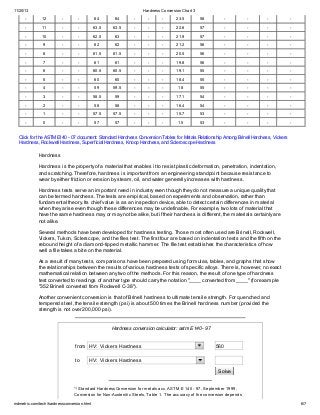
- 12 - - 64 64 - - - 23.5 58 - - - -
- 11 - - 63.5 63.5 - - - 22.6 57 - - - -
- 10 - - 62.5 63 - - - 21.9 57 - - - -
- 9 - - 62 62 - - - 21.2 56 - - - -
- 8 - - 61.5 61.5 - - - 20.5 56 - - - -
- 7 - - 61 61 - - - 19.8 56 - - - -
- 6 - - 60.5 60.5 - - - 19.1 55 - - - -
- 5 - - 60 60 - - - 18.4 55 - - - -
- 4 - - 59 59.5 - - - 18 55 - - - -
- 3 - - 58.5 59 - - - 17.1 54 - - - -
- 2 - - 58 58 - - - 16.4 54 - - - -
- 1 - - 57.5 57.5 - - - 15.7 53 - - - -
- 0 - - 57 57 - - - 15 53 - - - -
Click for the ASTM E140 - 07 document: Standard Hardness Conversion Tables for Metals Relationship Among Brinell Hardness, Vickers
Hardness, Rockw ell Hardness, Superficial Hardness, Knoop Hardness, and Scleroscope Hardness
Hardness
Hardness is the property of a material that enables it to resist plastic deformation, penetration, indentation,
and scratching. Therefore, hardness is important from an engineering standpoint because resistance to
wear by either friction or erosion by steam, oil, and water generally increases with hardness.
Hardness tests serve an important need in industry even though they do not measure a unique quality that
can be termed hardness. The tests are empirical, based on experiments and observation, rather than
fundamental theory. Its chief value is as an inspection device, able to detect certain differences in material
when they arise even though these differences may be undefinable. For example, two lots of material that
have the same hardness may or may not be alike, but if their hardness is different, the materials certainly are
not alike.
Several methods have been developed for hardness testing. Those most often used are Brinell, Rockwell,
Vickers, Tukon, Sclerscope, and the files test. The first four are based on indentation tests and the fifth on the
rebound height of a diamond-tipped metallic hammer. The file test establishes the characteristics of how
well a file takes a bite on the material.
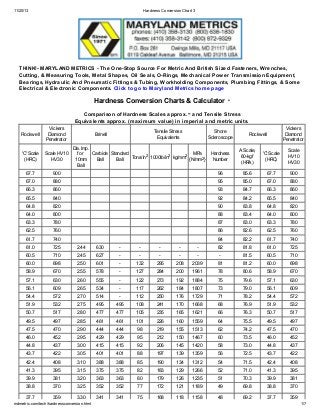
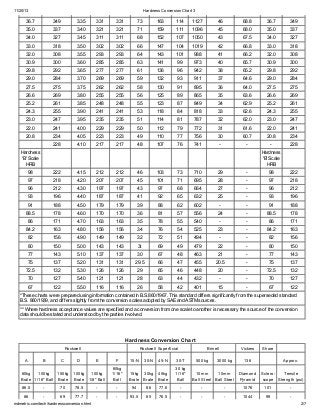
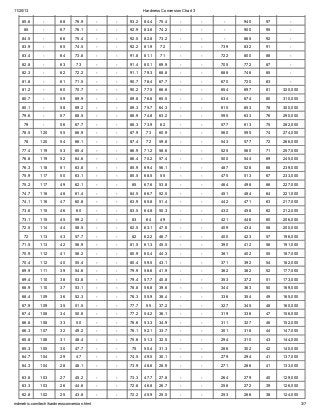
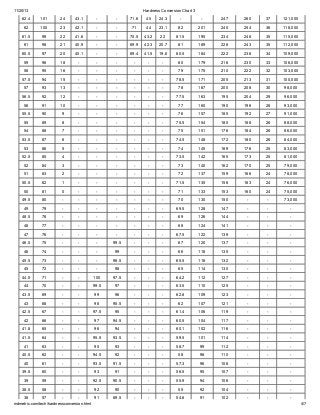
As a result of many tests, comparisons have been prepared using formulas, tables, and graphs that show
the relationships between the results of various hardness tests of specific alloys. There is, however, no exact
mathematical relation between any two of the methods. For this reason, the result of one type of hardness
test converted to readings of another type should carry the notation "____ converted from ____" (for example
"352 Brinell converted from Rockwell C-38").
Another convenient conversion is that of Brinell hardness to ultimate tensile strength. For quenched and
tempered steel, the tensile strength (psi) is about 500 times the Brinell hardness number (provided the
strength is not over 200,000 psi).
Hardness conversion calculator: astm E 140 - 97
from HV: Vickers Hardness 560
to HV: Vickers Hardness
Solve
1) Standard Hardness Conversion for metals acc. ASTM E 140 - 97, September 1999,
Conversion for Non-Austenitic Steels, Table 1. The accuracy of the conversion depends
![11/20/13 Hardness Conversion Chart 3
mdmetric.com/tech/hardnessconversion.html 7/7
on the accuracy of the provided data and the resulting curve-fits.
2)
Indentation hardness is not a single fundamental property but a combination of
properties, and varies with the type of test. The modulus of elasticity and the depth of
indentation influence conversions. Therefore separate conversion tables are neccessary
for different materials.
3) Brinell Hardness numbers in parentheses are outsite the range (HB>630) This limit is set
to avoid errors introduced by the deformation of the ball indenter itself.
This Hardness conversion calculator is © www.tribology-abc.com
THINK!- MARYLAND METRICS - The One-Stop Source For Metric And British Sized Fasteners, Wrenches,
Cutting, & Measuring Tools, Metal Shapes, Oil Seals, O-Rings, Mechanical Power Transmission Equipment,
Bearings, Hydraulic And Pneumatic Fittings & Tubing, Workholding Components, Plumbing Fittings, & Some
Electrical & Electronic Components. Click to go to Maryland Metrics home page
Phones: (800) 638-1830 or (410) 358-3130 are available Monday-Friday 8:30 AM to 5:30 PM Eastern time.
Faxes: (800) 872-9329 or (410) 358-3142 & E-mail are available anytime.
Warehouse & showroom hours are Monday-Friday 10 AM to 5:30 PM.
[ To: Maryland Metrics home page ] [ To: Maryland Metrics Product Guide ] [ e-mail to Maryland Metrics ]
Please note that all Trademarks and Tradenames are the property of their respective owners.
copyright 2002, 2008, 2011, 2013 maryland metrics -- all rights reserved -- ver jj22g hardnessconversion.html
[Enhanced for IE]](https://image.slidesharecdn.com/hardnessconversionchart3-160812211119/85/Hardness-conversion-chart-3-7-320.jpg?cb=1471036336)


