LECTURE 3
Fiat Technology
Fiat can be defined as a compulsory implementation of
debt-based, centralized ledger technology monopolizing
financial and monetary services worldwide. The fiat
standard was born out of the need for governments to
manage their de facto default on their gold obligations. It
was not designed to optimize the user experience of
currency, transactions, and banking.
1
● Modern fiat money is not conjured out of thin air through
government fiat.
Modern fiat money is far more sophisticated and
convoluted in its operation. The fundamental engineering
feature of the fiat system is that it treats future promises of
payment of money as if they were as good as present
money, so long as they are issued by the government, or
an entity guaranteed a lending license by the
government.
2
● With fiat, government credit allows non-existent tokens
from the future to be brought to life to settle transactions
in the present when a loan is made, allowing the borrower
and lender to have a larger amount of fiat tokens between
them than when they started, thus devaluing the rest of
the network’s tokens.
The fiat network creates more tokens every time a
government-licensed entity makes a loan in the local fiat
token.
3
● Having been born out of government default, the essential
characteristic of the fiat standard is that it uses government
decree as the token of value on its monetary and payment
network. Since the government can decree value on the network,
it effectively makes its own credit money.
● As the government backs the entire banking system, this makes
all credit issued by the banking system effectively the
government’s credit, and so part of the money supply. In other
words, the U.S. Congress and Federal Reserve are not the only
institutions capable of conjuring money from thin air; any lending
organization also has the capacity to increase the money supply
through lending.
4
● When a client takes out a $1 million loan to buy a house, the
lending bank does not take a preexisting mature $1 million present
in its cash reserves, or from a depositor’s balance at the bank. It
will simply issue the loan and create the dollars that are used to
pay the seller of the house. These dollars did not exist before the
loan was issued. Their existence is predicated on the borrower
fulfilling their end of the bargain and making regular payments in
the future.
No present goods are used in the home purchase; no saver had
to set the tokens aside to give to the borrower to pay the house
seller. The present good of the house is handed to the borrower
without them having to offer a present good in exchange, and the
house seller does not grant the credit to the borrower nor take on
the risk of default.
5
The bank grants the credit, and the credit risk is ultimately borne by
the central bank guaranteeing the bank, the loan, and the currency.
Had the house seller granted the credit, they would be taking on the
risk of default and giving up their present good willingly, affecting no
other parties. But by utilizing the fiat standard, the house seller
receives their payment in full up front, and the buyer receives the
house in full up front.
Both parties walk away with present goods they can use in full, even
though only one of these goods existed before the transaction took
place. The new fiat tokens created to allow this transaction place
the risk of the buyer defaulting on all holders of the currency.
6
● The transaction only works by externalizing the risk to society at
large, protecting the buyer, seller, and bank from default by
having the government’s currency holders effectively absorb the
risk premium through the inflation of the money supply.
● To create an analogy with bitcoin’s operation, we could say that
the fiat network creates or destroys a number of new tokens with
each block, equal to the amount of lending that has taken place
minus the amount of credit repaid and defaulted on. Rather than
a set new number of coins to be added with each block, as with
bitcoin’s protocol, the number of fiat tokens added in each fiat
time period is the net result of debt creation, which can vary
widely and can be positive or negative.
7
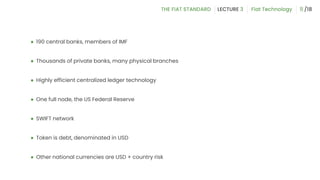
● 190 central banks, members of IMF
● Thousands of private banks, many physical branches
● Highly efficient centralized ledger technology
● One full node, the US Federal Reserve
● SWIFT network
● Token is debt, denominated in USD
● Other national currencies are USD + country risk
8
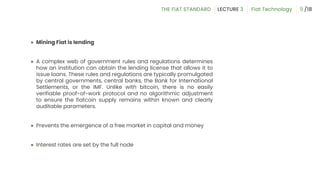
● Mining Fiat is lending
● A complex web of government rules and regulations determines
how an institution can obtain the lending license that allows it to
issue loans. These rules and regulations are typically promulgated
by central governments, central banks, the Bank for International
Settlements, or the IMF. Unlike with bitcoin, there is no easily
verifiable proof-of-work protocol and no algorithmic adjustment
to ensure the fiatcoin supply remains within known and clearly
auditable parameters.
● Prevents the emergence of a free market in capital and money
● Interest rates are set by the full node
9
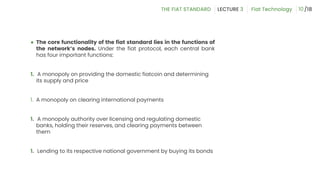
● The core functionality of the fiat standard lies in the functions of
the network’s nodes. Under the fiat protocol, each central bank
has four important functions:
1. A monopoly on providing the domestic fiatcoin and determining
its supply and price
1. A monopoly on clearing international payments
1. A monopoly authority over licensing and regulating domestic
banks, holding their reserves, and clearing payments between
them
1. Lending to its respective national government by buying its bonds
10
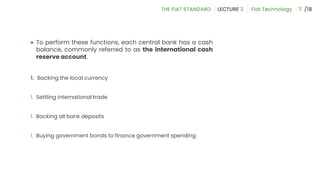
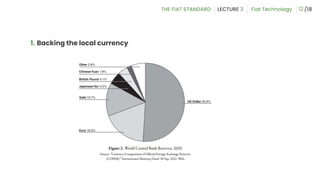
● To perform these functions, each central bank has a cash
balance, commonly referred to as the international cash
reserve account.
1. Backing the local currency
1. Settling international trade
1. Backing all bank deposits
1. Buying government bonds to finance government spending
11
1. Backing the local currency
12
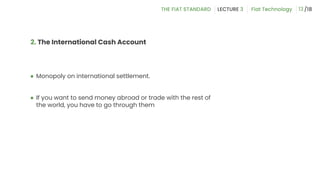
● Monopoly on international settlement.
● If you want to send money abroad or trade with the rest of
the world, you have to go through them
2. The International Cash Account
13
3. Bank Reserves
● If you want to use any bank, you have to put your money
with this monopoly
14
4. Buying Government Bonds
● Allows the government to borrow and take the entire
society's liquid wealth as collateral
15
● The intermingling of these four functions in the hands of
one monopoly entity protected from market competition is
ultimately the root cause of most economic crises
globally.
It is easy to see how these four functions can conflict with
one another, and how a monopolist will have the perverse
incentive to protect their own interests at the expense of
the long-term value of their currency and, thus, the wealth
of their citizens.
16
● The first conflict central banks face is between choosing
a monetary standard for future needs or present needs.
This dilemma would not, of course, exist in a globally
homogeneous monetary system, such as a true gold
standard, since gold would offer salability across time and
space.
17
● Governments pressure central banks to engage in inflationary
monetary
● People react by buying things from abroad and holding
foreign currencies
● Government reacts with tariffs and trade restrictions
● By putting the entire banking system, savings, and
international trade as collateral for government borrowing, the
fiat standard destroys the three drivers of economic growth:
capital accumulation, trade, and technological advancement
18

TFS-Lecture 3.pptx

  • 1.
  • 2.
    Fiat can bedefined as a compulsory implementation of debt-based, centralized ledger technology monopolizing financial and monetary services worldwide. The fiat standard was born out of the need for governments to manage their de facto default on their gold obligations. It was not designed to optimize the user experience of currency, transactions, and banking. 1
  • 3.
    ● Modern fiatmoney is not conjured out of thin air through government fiat. Modern fiat money is far more sophisticated and convoluted in its operation. The fundamental engineering feature of the fiat system is that it treats future promises of payment of money as if they were as good as present money, so long as they are issued by the government, or an entity guaranteed a lending license by the government. 2
  • 4.
    ● With fiat,government credit allows non-existent tokens from the future to be brought to life to settle transactions in the present when a loan is made, allowing the borrower and lender to have a larger amount of fiat tokens between them than when they started, thus devaluing the rest of the network’s tokens. The fiat network creates more tokens every time a government-licensed entity makes a loan in the local fiat token. 3
  • 5.
    ● Having beenborn out of government default, the essential characteristic of the fiat standard is that it uses government decree as the token of value on its monetary and payment network. Since the government can decree value on the network, it effectively makes its own credit money. ● As the government backs the entire banking system, this makes all credit issued by the banking system effectively the government’s credit, and so part of the money supply. In other words, the U.S. Congress and Federal Reserve are not the only institutions capable of conjuring money from thin air; any lending organization also has the capacity to increase the money supply through lending. 4
  • 6.
    ● When aclient takes out a $1 million loan to buy a house, the lending bank does not take a preexisting mature $1 million present in its cash reserves, or from a depositor’s balance at the bank. It will simply issue the loan and create the dollars that are used to pay the seller of the house. These dollars did not exist before the loan was issued. Their existence is predicated on the borrower fulfilling their end of the bargain and making regular payments in the future. No present goods are used in the home purchase; no saver had to set the tokens aside to give to the borrower to pay the house seller. The present good of the house is handed to the borrower without them having to offer a present good in exchange, and the house seller does not grant the credit to the borrower nor take on the risk of default. 5
  • 7.
    The bank grantsthe credit, and the credit risk is ultimately borne by the central bank guaranteeing the bank, the loan, and the currency. Had the house seller granted the credit, they would be taking on the risk of default and giving up their present good willingly, affecting no other parties. But by utilizing the fiat standard, the house seller receives their payment in full up front, and the buyer receives the house in full up front. Both parties walk away with present goods they can use in full, even though only one of these goods existed before the transaction took place. The new fiat tokens created to allow this transaction place the risk of the buyer defaulting on all holders of the currency. 6
  • 8.
    ● The transactiononly works by externalizing the risk to society at large, protecting the buyer, seller, and bank from default by having the government’s currency holders effectively absorb the risk premium through the inflation of the money supply. ● To create an analogy with bitcoin’s operation, we could say that the fiat network creates or destroys a number of new tokens with each block, equal to the amount of lending that has taken place minus the amount of credit repaid and defaulted on. Rather than a set new number of coins to be added with each block, as with bitcoin’s protocol, the number of fiat tokens added in each fiat time period is the net result of debt creation, which can vary widely and can be positive or negative. 7
  • 9.
    ● 190 centralbanks, members of IMF ● Thousands of private banks, many physical branches ● Highly efficient centralized ledger technology ● One full node, the US Federal Reserve ● SWIFT network ● Token is debt, denominated in USD ● Other national currencies are USD + country risk 8
  • 10.
    ● Mining Fiatis lending ● A complex web of government rules and regulations determines how an institution can obtain the lending license that allows it to issue loans. These rules and regulations are typically promulgated by central governments, central banks, the Bank for International Settlements, or the IMF. Unlike with bitcoin, there is no easily verifiable proof-of-work protocol and no algorithmic adjustment to ensure the fiatcoin supply remains within known and clearly auditable parameters. ● Prevents the emergence of a free market in capital and money ● Interest rates are set by the full node 9
  • 11.
    ● The corefunctionality of the fiat standard lies in the functions of the network’s nodes. Under the fiat protocol, each central bank has four important functions: 1. A monopoly on providing the domestic fiatcoin and determining its supply and price 1. A monopoly on clearing international payments 1. A monopoly authority over licensing and regulating domestic banks, holding their reserves, and clearing payments between them 1. Lending to its respective national government by buying its bonds 10
  • 12.
    ● To performthese functions, each central bank has a cash balance, commonly referred to as the international cash reserve account. 1. Backing the local currency 1. Settling international trade 1. Backing all bank deposits 1. Buying government bonds to finance government spending 11
  • 13.
    1. Backing thelocal currency 12
  • 14.
    ● Monopoly oninternational settlement. ● If you want to send money abroad or trade with the rest of the world, you have to go through them 2. The International Cash Account 13
  • 15.
    3. Bank Reserves ●If you want to use any bank, you have to put your money with this monopoly 14
  • 16.
    4. Buying GovernmentBonds ● Allows the government to borrow and take the entire society's liquid wealth as collateral 15
  • 17.
    ● The interminglingof these four functions in the hands of one monopoly entity protected from market competition is ultimately the root cause of most economic crises globally. It is easy to see how these four functions can conflict with one another, and how a monopolist will have the perverse incentive to protect their own interests at the expense of the long-term value of their currency and, thus, the wealth of their citizens. 16
  • 18.
    ● The firstconflict central banks face is between choosing a monetary standard for future needs or present needs. This dilemma would not, of course, exist in a globally homogeneous monetary system, such as a true gold standard, since gold would offer salability across time and space. 17
  • 19.
    ● Governments pressurecentral banks to engage in inflationary monetary ● People react by buying things from abroad and holding foreign currencies ● Government reacts with tariffs and trade restrictions ● By putting the entire banking system, savings, and international trade as collateral for government borrowing, the fiat standard destroys the three drivers of economic growth: capital accumulation, trade, and technological advancement 18