



























































The Affordable Care ActReporting Requirements: A Step-by-Step Guide to Form 1094-C
1
These slides were last updated on February 11, 2016.
2
First things first, this is not a basic guide.
3
This guide assumes you know how the Employer Mandate
basically works under the Affordable Care Act.
4
Which brings me to a very important point. The reporting
requirements are their own separate, free-standing requirement
under the Affordable Care Act.
5
I’ve helped hundreds of employers since the Affordable Care Act
was signed on March 23, 2010.
6
I’ve written scholarly articles for peer-reviewed legal journals on
the Affordable Care Act.
7
I’ve written three editions of a comprehensive guide on the
Affordable Care Act for employers called The Employer Mandate
Handbook. The third edition was released in September 2015.
8
When I wrote my articles and books, I tried to cite as many legal
authorities as possible so people could verify my claims. So unlike most
books, when I make seemingly outrageous (or even non-outrageous)
claims, I have endnotes so you can see that I am not a liar, liar with my
pants on fire.
9
I have spent years working on this stuff every day.
10
I have been quoted in the Houston Chronicle, Forbes, and the New
York Times.
11
But even after all of that, I don’t know everything, and you should
run (very fast) from anyone that claims they do.
12
I do know that if you were an Applicable Large Employer or an
Applicable Large Employer Member during 2014, you have a legal
duty to file the reports discussed on these slides with the IRS in
2016.
13
The reporting requirements were optional in 2015 (for the 2014
tax year); they are not optional in 2016 (for the 2015 tax year).
14
Your duty to report in 2016 exists even if you are not currently
offering insurance (during 2015) because (1) you like to live
dangerously, or (2) your lawyer, accountant, or other confidant
said you did not have to under the law.
15
Again, it does not matter if you had fewer than 99 full-time
employees or their equivalent during 2014.
16
And it does not matter if you have a non-calendar year plan that
has not yet come up for renewal in 2015.
17
Whether you are an Applicable Large Employer or Applicable
Large Employer Member, as of January 1, 2015, remains the only
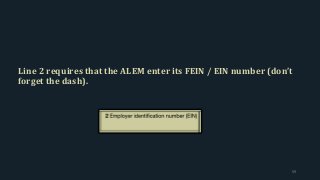
barrier standing between you and the legal duty to comply with
the ACA’s reporting requirements.
18
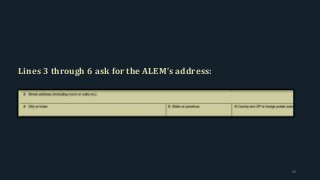
If you don’t know the answer to the last slide,
19
Stop.
Investigate.
Then Come Back.
20
Welcome back.
21
The Due Date of the Form 1094-C (and 1095-C) has changed since
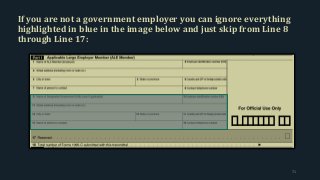
December 2015--both the delivery date to the recipient and the
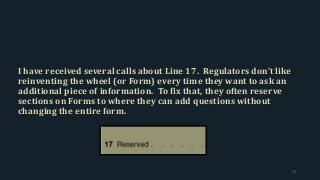
delivery date to the IRS have been extended.
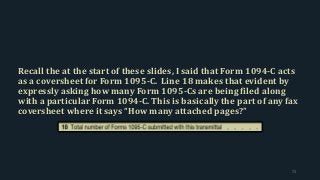
See Notice 2016 – 4 (the orange text is a direct link to the IRS)
22
The Penalties for good-faith compliance will apparently be waived by
the IRS if you can prove good faith compliance. The IRS seldom gives
people “As for Effort,” but this is one of those rare times.
As long as you can prove that you tried your best, the IRS is claiming
it will leave you alone. So if you can’t crack this riddle that you and
only I understand, just relax and try to comply in good faith.
See Notice 2015-87 (the orange text is a direct link to the IRS).
23
Why do I have to report in the first place?
The IRS will use the information reported on Form 1094-C to
determine the sum, if any, that a particular employer will pay
in penalties under the Employer Mandate.
24
Where can I find this Form?
You can find it on the IRS website, by clicking here.
25
Understandably, some people will not click links online sent by
people they don’t know.
26
I like your paranoia. Paranoia is good when dealing with IRS
forms.
27
Embrace it.
28
Please ensure you have picked up, and are completing, the correct
Form 1094-C through whatever means you are comfortable employing.
29
I know that sounds a bit silly, but I have audited employer forms
where the employer had the completely wrong form.
30
You do not want to be that employer.
31
In fact, the IRS has released several versions of Form 1094-C just
during the time I have had these slides online. If you do not visit
the IRS website every time you complete these forms, you are
probably doing it wrong. Resist the urge to print 100 of these and
shove them in a drawer.
32
Ensure you have the right IRS form by checking the top-left corner.
It should look like this:
33
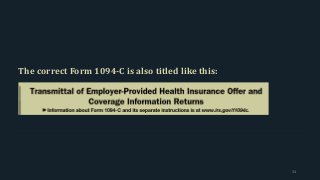
The correct Form 1094-C is also titled like this:
34
Notice the word transmittal in the name of the Form.
35
Form 1094-C is a coversheet that must accompany every Form
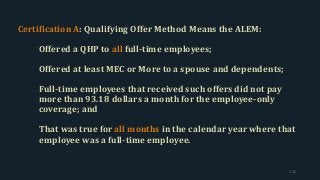
1095-C a reporting employer sends to the IRS.
36
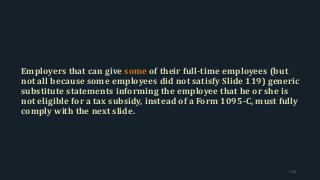
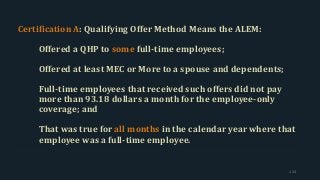
If you find yourself sending a Form 1094-C, without attaching
Forms 1095-C, to the IRS, you are doing it wrong.
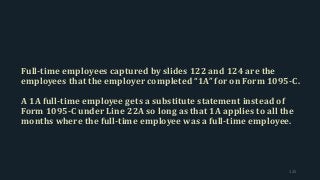
37
Also, ensure you have the right form for the right year. In 2016,
your form should have a 2015 on the top-right corner of the form
you are completing.
38
There is no Form 1094-C with 2016 in the top-right corner, stop
looking for it.
39
We checked the Form’s number.
We checked the Form’s name.
We checked the Form’s year.
40
Again, it might sound silly, but many employers complete the
wrong form. It is important that you verify everything on the last
slide every time you complete IRS forms.
41
Every Applicable Large Employer Member that employs at least
one full-time employee must file at least one Form 1094-C.
42
What the heck is an Applicable Large Employer or an Applicable
Large Employer Member (ALEM)?
43
If you don’t know what that is, you are not ready to complete Form
1094-C. The IRS provides a definition that is everything you would
expect an IRS definition to be on the 9th page of the instructions.
44
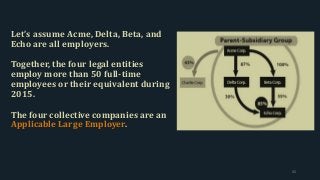
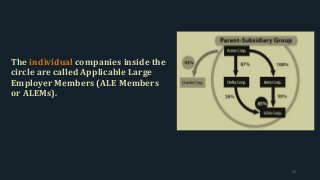
Let’s assume Acme, Delta, Beta, and
Echo are all employers.
Together, the four legal entities
employ more than 50 full-time
employees or their equivalent during
2015.
The four collective companies are an
Applicable Large Employer.
45
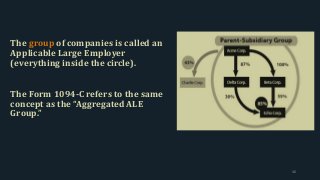
The group of companies is called an
Applicable Large Employer
(everything inside the circle).
The Form 1094-C refers to the same
concept as the “Aggregated ALE
Group.”
46
The individual companies inside the
circle are called Applicable Large
Employer Members (ALE Members
or ALEMs).
47
Every ALEM in the group (inside the circle) is responsible for filing
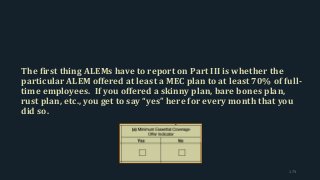
its own Form 1094-C if it employs at least one full-time employee.
48
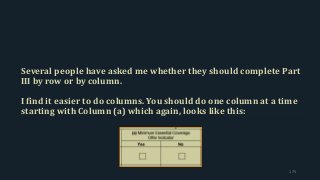
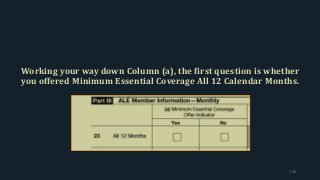
If you have 100 legal entities within an ALE, you need at least 100
Forms 1094-C completed every tax year (so long as each ALEM
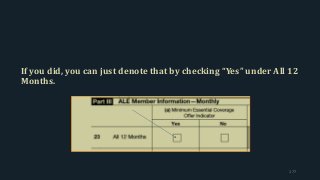
employs at least one full-time employee).
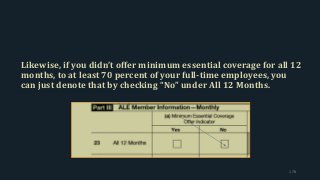
49
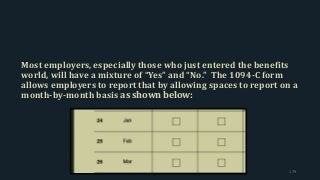
If you only have one legal entity that employs a full-time employee,
you only need to complete at least one Form 1094-C every
applicable tax year.
50
Do you know if you are part of an ALE? Do you know all the ALEMs
that are in that ALE? If you do not,
51
Stop.
Investigate.
Come Back.
52
Welcome Back.
53
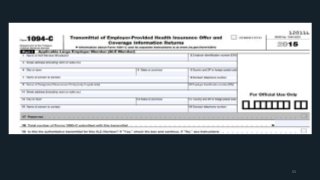
Part I just asks for information regarding the particular ALEM on
whose behalf the particular Form 1094-C is being filed and really,
Part I is the coversheet part of the Form (more on this later).
54
55
Once you know your ALEM/ALE status, Part I is relatively
straightforward (except for Line 19). The tricky part is knowing
the status to ensure you enter the right data in each line.
56
Nevertheless, let’s take it one line at a time.
57
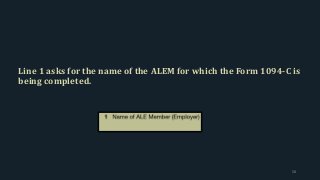
Line 1 asks for the name of the ALEM for which the Form 1094-C is
being completed.
58
Line 2 requires that the ALEM enter its FEIN / EIN number (don’t
forget the dash).
59
If I do not have an EIN number, I can just input my Social Security
Number in there, right?
60
Wrong.
Without an EIN number you cannot complete a Form 1094-C. If
you do not have one, you must get one to complete a Form 1094-C.
61
Lines 3 through 6 ask for the ALEM’s address:
62
Even the address is tricky on Form 1094-C. You want to keep track
of two issues when you are completing the address portion.
63
First. If you are completing a Form 1094-C for an ALEM you have to
decide whether to put one of three addresses (assuming they are
different): (1) the location’s address, (2) the ALEM’s corporate
address, or (3) the ALE’s corporate address.
64
Second. You must ensure that the address (whichever one you
choose) matches the address on the corresponding Forms 1095-C.
You do not want to have one address on Form 1094-C and a
different address on the Form 1095-C.
65
Lines 7 and 8 require the ALEM designate a person to contact and
a telephone number. It is very important that this person be
someone that the employer trusts to talk to the IRS.
66
Moving on to Line 9:
What the heck is a DGE?
67
Good news—if you don’t know what a DGE is, you are probably not
a DGE.
68
To make it easier on government employers, government
employers can designate a sister-agency or –department as the
go-to entity for all Form 1094-C compliance requirements.
69
That designated government entity must then complete Lines 9
through 16 to make it clear to the IRS that an intermediary was
used.
70
If you are not a government employer you can ignore everything
highlighted in blue in the image below and just skip from Line 8
through Line 17:
71
I have received several calls about Line 17. Regulators don’t like
reinventing the wheel (or Form) every time they want to ask an
additional piece of information. To fix that, they often reserve
sections on Forms to where they can add questions without
changing the entire form.
72
Recall the at the start of these slides, I said that Form 1094-C acts
as a coversheet for Form 1095-C. Line 18 makes that evident by
expressly asking how many Form 1095-Cs are being filed along
with a particular Form 1094-C. This is basically the part of any fax
coversheet where it says “How many attached pages?”
73
Ideally, you want to file one Form 1094-C per ALEM with all of that
particular ALEM’s Form 1095-Cs attached.
74
The last question (Line 19) in Part I concerns the two roles Form
1094-C plays in ACA compliance.
75
The first role Form 1094-C plays regards the Form’s status as an
authoritative transmittal of vital information the IRS needs to
administer and enforce ACA compliance for employers (these
items are requested on Lines 20 through 65) .
76
The second role Form 1094-C plays regards the Form’s
administrative use as nothing more than a cover sheet (Lines 1
through 19) for the attached Forms 1095-C.
77
Every time you sit down to fill out a Form 1094-C you have to ask
yourself a fundamental question:
78
Are all of my Form 1095-Cs attached to this Form 1094-C?
79
If the answer is Yes, then this will be your authoritative
transmittal and you have to go beyond Line 19 (and Part I).
80
If the answer is No, then you will have to file at least one Form
1094-C that goes beyond Line 19 and one that does not.
81
Either the first one, the second one, or the 99th one can be the
authoritative one, but you only need to file one authoritative
transmittal (before the applicable deadline).
82
The rest of your Forms 1094-C (whether there is one or a
hundred) are all very fancy coversheets that do not have to be
filled out beyond Line 19.
83
If you have more than one Form 1094-C for any one ALEM in any
given year that goes beyond Line 19, you are doing it wrong.
84
If you know this is not your authoritative Form 1094-C you can
stop at Line 19, sign, and file it.
85
When would I be purposefully filing a non-authoritative Form
1094-C?
86
For example, let’s say you collect all your Form 1095-Cs and file
them in February with the IRS (and send along an authoritative
Form 1094-C).
A month later, you realize that you forgot to attach one Form
1095-C to your original batch. You have to send that lone Form
1095-C with its own Form 1094-C. That second Form 1094-C is
not an authoritative version and you know it when you are
completing it.
87
Otherwise, if you know you are only filing one Form 1094-C
(because all of your 1095-Cs are attached)
OR
If you know that the form you are working on will be the
authoritative transmittal even though you will be filing other
Forms 1094-C.
88
Soldier on to Line 20.
89
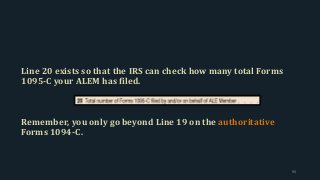
Line 20 exists so that the IRS can check how many total Forms
1095-C your ALEM has filed.
Remember, you only go beyond Line 19 on the authoritative
Forms 1094-C.
90
Ideally, again, you will only file one Form 1094-C per ALEM every
year. If you do so, Lines 18 and 20 should be the same number.
91
Also remember that Line 20 and beyond only get completed on
authoritative Form 1094-C forms.
92
If the Form 1094-C you are completing is not the authoritative
one, Line 20 should be left blank.
93
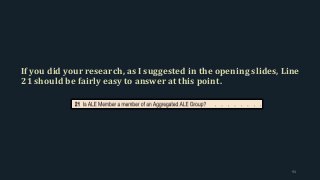
If you did your research, as I suggested in the opening slides, Line
21 should be fairly easy to answer at this point.
94
Otherwise,
Stop.
Investigate.
Then Come Back.
95
Welcome Back.
96
If you are certain that your particular ALEM is not part of a larger
ALE, then you can skip Section (d) of Part III and Part IV
altogether. Don’t worry, I’ll highlight these sections as we move
through the rest of the Form.
97
Having completed Line 21, we now arrive at what causes people
the most headaches in all of 1094-dom, Line 22. The line reads as
follows:
98
Make no mistake about it: Line 22 is the toughest section in all of
Form 1094-C.
99
Basically, Line 22 offers employers the opportunity to certify that
they are eligible for four different kinds of relief.
100
And that’s why there are four certifications on Line 22:
A, B, C, and D.
101
Lines 22A and 22B are related, while 22C and 22D are completely
different forms of relief from each other and Lines 22A and 22B.
102
Those four kinds of relief, have four different requirements, and
four different “rewards” that depend on the applicable
certification.
103
Not all employers will qualify for at least one certification of
eligibility.
104
Indeed, many employers may not qualify for any of them.
105
Conversely, notice the “select all that apply” on Line 22.
106
Some ALEMs may qualify for multiple forms of relief and you
should check to ensure you don’t leave some relief on the table.
107
Again, the first step to understanding how Line 22A, 22B, 22C, and
22D work is to appreciate that Lines 22A and 22B are closely
related to one another and only slightly different.
108
In order to understand the subtle difference between
Certifications A and B, you must appreciate what “qualifying” for
either Certification does to an ALE’s reporting requirements.
109
The default reporting requirements require ALEs to provide every
full-time employee with a copy of a Form 1095-C detailing the
ALE’s offer of coverage and other individualized specifics
regarding that particular full-time employee’s benefits (this is
called general method reporting).
110
That is a lot of work for employers with thousands of employees
(or even smaller employers that do not have the infrastructure,
payroll, or HR resources to tackle such a monumental task).
111
And for some employers, all that work is for nothing. Specifically,
remember that the entire point of Form 1094-C and Form 1095-C
(from an employer’s perspective) is to provide reports so that the
IRS can determine if the reporting employer is liable for employer
mandate penalties.
112
If a general method reporting employer offers great healthcare to
all full-time employees, at a legally affordable price, and goes
beyond the minimum requirements of the ACA, all of its work
compiling custom Forms 1095-C will be for nothing because the
IRS is unlikely to fine that employer under the circumstances.
113
So when you combine the massive amounts of work involved in
general method reporting with the likelihood that in some
circumstances those reports will never lead to employer mandate
penalties, simplified reporting method was born.
114
Certification A (Line 22A) and Certification B (Line 22B) are
simplified methods of reporting where the employer can skip
giving the full-time employee a copy of Form 1095-C by January
31 and instead can give certain full-time employees a generic, pro-
forma statement.
Important: simplified method reporting is optional. If you
understand general method reporting and are comfortable doing
so, then you should just ignore simplified method because it’s
completely optional and somewhat complicated for the
uninitiated person scrambling to comply with compliance for the
first time in 2016.
115
Unless, of course, you are a self-insured employer—then it’s not
even on the table. Self-insured employers cannot use the
“alternative method of furnishing Form 1095-C” (which is the
entire point of Line 22A and 22B).
Others may disagree, but I think that renders Certification A and
Certification B largely useless to self-insured employers and most
self-insured employer should just skip Line 22A and Line 22B.
116
Again, there are two types of Form 1095-C reporting: general
method of reporting and simplified reporting. If you barely
know what the heck you are doing in 2016, you need to focus on
general method of reporting. Otherwise, it’s like trying to do
calculus but not knowing algebra.
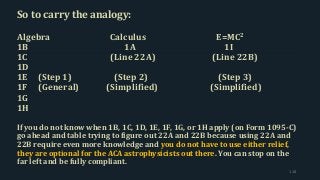
117
So to carry the analogy:
Algebra Calculus E=MC2
1B 1A 1I
1C (Line 22A) (Line 22B)
1D
1E (Step 1) (Step 2) (Step 3)
1F (General) (Simplified) (Simplified)
1G
1H
If you do not know when 1B, 1C, 1D, 1E, 1F, 1G, or 1H apply (on Form 1095-C)
go ahead and table trying to figure out 22A and 22B because using 22A and
22B require even more knowledge and you do not have to use either relief,
they are optional for the ACA astrophysicists out there. You can stop on the
far left and be fully compliant.
118
Note: ALEs that meet the requirements of Certification A or B still
have to give the IRS a Form 1095-C for any such full-time
employee, but instead of having to have Forms 1095-C ready by
January 31 (standard rule) of the applicable year for those full-
time employees, qualifying employers can wait until March 31st
(standard rule) to provide them to the IRS. For many employers,
those three months are extremely valuable, especially the first
year. But, remember that in 2016, we got some extra months (see
slide 22 of this deck for details).
119
Moving On
120
Employers that want to give all of their full-time employees
generic substitute statements (instead of Form 1095-C) informing
the employee that he or she is not eligible for a tax subsidy must
fully comply with the next slide.
121
Certification A: Qualifying Offer Method Means the ALEM:
Offered a QHP to all full-time employees;
Offered at least MEC or More to a spouse and dependents;
Full-time employees that received such offers did not pay
more than 93.18 dollars a month for the employee-only
coverage; and
That was true for all months in the calendar year where that
employee was a full-time employee.
122
Employers that can give some of their full-time employees (but
not all because some employees did not satisfy Slide 119) generic
substitute statements informing the employee that he or she is
not eligible for a tax subsidy, instead of a Form 1095-C, must fully
comply with the next slide.
123
Certification A: Qualifying Offer Method Means the ALEM:
Offered a QHP to some full-time employees;
Offered at least MEC or More to a spouse and dependents;
Full-time employees that received such offers did not pay
more than 93.18 dollars a month for the employee-only
coverage; and
That was true for all months in the calendar year where that
employee was a full-time employee.
124
Full-time employees captured by slides 122 and 124 are the
employees that the employer completed “1A” for on Form 1095-C.
A 1A full-time employee gets a substitute statement instead of
Form 1095-C under Line 22A so long as that 1A applies to all the
months where the full-time employee was a full-time employee.
125
But, I only offered a skinny, MEC, rust, barebones, something-
other-than QHP plan to my full-time employees?!
126
Or, I didn’t offer anything to my full-time employee’s dependents.
127
Or, even though I offered something, my full-time employees had
to pay more than 93.18 dollars a month.
128
Or, I did all those things on the slide, I just didn’t do it for all
months where the employee was a full-time employee because
[insert irrelevant excuse here].
129
Well then . . .
No Qualifying Offer Method for You!
130
Qualifying Offer Method (Line 22A on Form 1094-C) is unlikely to
apply in industries where full-time employees have not
traditionally had health insurance or where the employer does
not pick up an extremely generous amount of the health
insurance tab.
131
In short, Qualifying Offer Method is hard, very hard, to satisfy. So
hard, in fact, that it led to the creation of Line 22B (but more on
that later).
132
If you are not self-insured, and comply with Certification A
requirements (slide 122), you can get away with a substitute
statement that says something like the next slide for all full-time
employees instead of a Form 1095-C.
133
John Q. Taxpayer
Widgets Company, LTD
123 Internal Revenue Love
Houston, Texas 123654
Ph. (281) 555 – 3986
Dear [22A-Eligible Full-Time Employee]:
Widgets Co. records indicate that you received a qualifying offer, along with your spouse and
dependents, if any, for all months in which you qualified as a full-time employee. According to our
records, you are therefore not eligible for a premium tax credit on the individual marketplace.
However, you are directed to see IRS Pub. 974, Premium Tax Credit (PTC) for more information on your
eligibility for a premium tax credit. For information about the offer of coverage you received or
inquiries regarding what Widgets reported to the IRS on Form 1095-C, please contact, via telephone,
the person listed above.
All the best,
Widgets Company, LTD
Federal Employer Identification No. 36--12536548
134
If you are not self-insured, and comply with Certification A
requirements (slide 122) for some full-time employees, you can
get away with an substitute statement that says something like
the next slide for those particular full-time employees.
135
John Q. Taxpayer
Widgets Company, LTD
123 Internal Revenue Love
Houston, Texas 123654
Ph. (281) 555 – 3986
Dear [Full-Time Employee]:
Widgets Co. records indicate that you received a qualifying offer, along with your spouse and
dependents, if any, for all months in which you qualified as a full-time employee. According to our
records, you therefore are not eligible for a premium tax credit on the individual marketplace.
However, you are directed to see IRS Pub. 974, Premium Tax Credit (PTC) for more information on your
eligibility for a premium tax credit. For information about the offer of coverage you received or
inquiries regarding what Widgets reported to the IRS on Form 1095-C, please contact, via telephone,
the person listed above.
All the best,
Widgets Company, LTD
Federal Employer Identification No. 36--12536548
136
Go back to Slide 122. If you cannot say that you satisfied that slide
for every full-time employee, for every month such full-time
employees were full-time employees, or you operated on a self-
insured basis, you will not be able to give substitute statements to
all full-time employees. If that is what you are after, skip to Line
22B and Certification B.
137
Line 22A will be the standard rule for all full-time employees that
have a 1A offer for all 12 calendar months in the year being
reported.
Line 22B exists to give employers one last chance at sending full-
time employees a substitute statement instead of Form 1095-C
and is far more temporary than Line 22A (some speculate it will
not be available in 2017 for the 2016 tax year).
138
Certification B: Qualifying Offer Method Transition Relief
The easiest way to understand the difference between
Certification B and Certification A is to show you the 1 series
codes for a 12-month period on a Form 1095-C and how they
affect whether a particular employer uses Certification A or B.
139
Recall from Slides 122 and 124 that in order to qualify for 22A
status a particular full-time employee has to satisfy the
requirements of Slide 122 or 124 for all months where the
employee was a full-time employee (so someone that worked for
you every month in 2015, would have to have 12 1As).
140
So that begs the question: What happens when you have a 1A-
eligible full-time employee for only some instead of all months in
the calendar year where that particular full-time employee was a
full-time employee?
141
Under the standard Line 22A rules, such a full-time employee is
automatically entitled to a Form 1095-C (and the employer is not
eligible for 22A relief as regards that particular full-time
employee).
142
This is where Line 22B becomes very relevant to some employers.
143
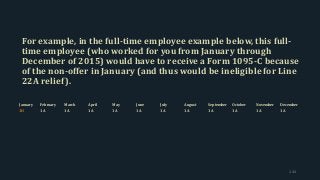
For example, in the full-time employee example below, this full-
time employee (who worked for you from January through
December of 2015) would have to receive a Form 1095-C because
of the non-offer in January (and thus would be ineligible for Line
22A relief).
144
January February March April May June July August September October November December
1H 1A 1A 1A 1A 1A 1A 1A 1A 1A 1A 1A
In 2016 (for the 2015 tax year) there is a middle ground between
1A qualification, and say, 1H non-qualification, and that is 1i.
145
The best way to think about how 1i works is as a middle-ground
between 1A and 1H.
146
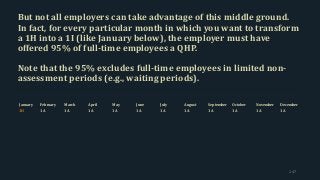
But not all employers can take advantage of this middle ground.
In fact, for every particular month in which you want to transform
a 1H into a 1I (like January below), the employer must have
offered 95% of full-time employees a QHP.
Note that the 95% excludes full-time employees in limited non-
assessment periods (e.g., waiting periods).
147
January February March April May June July August September October November December
1H 1A 1A 1A 1A 1A 1A 1A 1A 1A 1A 1A
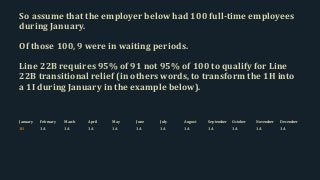
So assume that the employer below had 100 full-time employees
during January.
Of those 100, 9 were in waiting periods.
Line 22B requires 95% of 91 not 95% of 100 to qualify for Line
22B transitional relief (in others words, to transform the 1H into
a 1I during January in the example below).
148
January February March April May June July August September October November December
1H 1A 1A 1A 1A 1A 1A 1A 1A 1A 1A 1A
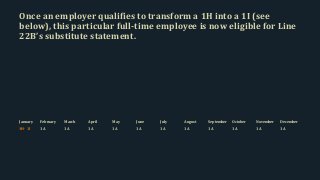
Once an employer qualifies to transform a 1H into a 1I (see
below), this particular full-time employee is now eligible for Line
22B’s substitute statement.
149
January February March April May June July August September October November December
1H 1I 1A 1A 1A 1A 1A 1A 1A 1A 1A 1A 1A
Under Line 22B, just like 22A, you also get to send a letter
(instead of the 1095-C), but you have to tweak it a bit because you
didn’t offer a qualifying offer for all the months the employee was
a full-time employee (that’s why you had to rely on Line 22B in the
first place). See the next slide for the modification.
150
John Q. Taxpayer
Widgets Company, LTD
123 Internal Revenue Love
Houston, Texas 123654
Ph. (281) 555 – 3986
Dear [22-B Full-Time Employee]:
Widgets Co. records indicate that you received a qualifying offer, along with your spouse and
dependents, if any, for some months in which you qualified as a full-time employee. According to our
records, you might be eligible for a premium tax credit on the individual marketplace for the months
that you did not receive such a qualifying offer. However, you are directed to see IRS Pub. 974, Premium
Tax Credit (PTC) for more information on your eligibility for a premium tax credit. For information
about the offer of coverage you received or inquiries regarding what Widgets reported to the IRS on
Form 1095-C, please contact, via telephone, the person listed above.
All the best,
Widgets Company, LTD
Federal Employer Identification No. 36--12536548
151
Please also appreciate that although you may qualify to send an
employee the letter described in the last slide (instead of the
Form 1095-C), the IRS still wants its Form 1095-C by March 31st
(under the standard rules, but I explained available extensions
at the start of this deck) of every year for employers that qualify
for Certification A or Certification B. All Certifications A and B
do for an employer is minimize the custom forms they give full-
time employees—the IRS still gets its Forms.
152
Thankfully, Certification C and D are much simpler.
153
Certification C: Section 4980H Transition Relief
ALEs with fewer than 100 full-time employees or their
equivalent (ALEs with 50-99), or
ALEs with more than 99 full-time employees or their equivalent
(ALEs with 100+) can get an 80-employee discount instead of a
30-employee discount during 2015 when the IRS calculates
appropriate penalties for failing to offer any medical benefits to
full-time employees.
154
Before February 12, 2014, everyone thought the employer
mandate (having to offer insurance or pay a penalty) would go in
effect on January 1, 2015.
155
On February 12, 2014, the IRS announced that ALEs with fewer
than 100 full-time employees would be given another year before
having to offer insurance or pay a penalty if certain conditions
were met by those employers.
156
One of those conditions is certifying under oath that you have
read what is required and swear, under penalty of perjury, that
you are eligible.
157
That is the point of Certification of Eligibility C—affirming that
you are eligible under oath and penalty of law.
158
If you are unsure about whether you are eligible you should find
out sooner rather than later because, forget the reporting
requirements, you could be accruing penalties for failing to offer
insurance. If you are unsure . . . .
159
Stop.
Investigate.
Then Come Back.
160
Welcome Back.
161
The second part of Certification of Eligibility C is for ALEs that had more
than 99 full-time employees or their equivalent during 2014.
162
These are often referred to as the “larger ALEs” in ACA sewing
circles.
163
Larger ALEs did not get until 2016 to comply with the
requirement to offer full-time employees medical benefits or risk
paying a penalty; these folks had to be ready to go in January 2015
under the default rules.
164
Sidebar: if a larger ALE did not offer anything to full-time
employees, under the standard rules, the particular affected
ALEM would have to share, proportionately to its full-time
employee count, in an ALE-wide 30-full-time employee discount
when the IRS calculated penalties.
165
To help these folks out, just like smaller folks got a one-year
reprieve, the IRS increased the amount of the full-time employee
discount from 30 to 80 for 2015. The second portion of
Certification of Eligibility C is for larger ALEs to take advantage of
this transition relief.
166
Certification D: 98% Offer Method
The last Certification of Eligibility, Letter D, requires an eligible
ALEM to have offered a QHP to 98% of its full-time employees and
their dependents. The bolded “its” should make it clear that the
98% rule applies on an ALEM-BY-ALEM basis.
Additionally, the full-time employee’s offer of self-only coverage
was legally affordable under the Affordable Care Act (no more
than 9.5 percent of the employee-only income).
167
The “reward” is that the employer who takes advantage of
Certification D does not have to complete “Full-Time Employee
Count” in Part III, column (b), of the authoritative Form 1094-C.
168
Don’t worry, when we get there, I’ll remind the Certification D
folks of the Lines they can skip.
169
Before we move on, don’t forget to sign the Form 1094-C right
underneath Line 22.
170
We finally arrive at Part III!
171
Part III requires ALEMs to report, typically on a month-by-month
basis, several variables for the particular ALEM.
172
The first thing ALEMs have to report on Part III is whether the
particular ALEM offered at least a MEC plan to at least 70% of full-
time employees. If you offered a skinny plan, bare bones plan,
rust plan, etc., you get to say “yes” here for every month that you
did so.
173
Likewise if you offered more robust insurance, like a QHP, you
also get to say “yes” here for every such month.
174
Several people have asked me whether they should complete Part
III by row or by column.
I find it easier to do columns. You should do one column at a time
starting with Column (a) which again, looks like this:
175
Working your way down Column (a), the first question is whether
you offered Minimum Essential Coverage All 12 Calendar Months.
176
If you did, you can just denote that by checking “Yes” under All 12
Months.
177
Likewise, if you didn’t offer minimum essential coverage for all 12
months, to at least 70 percent of your full-time employees, you
can just denote that by checking “No” under All 12 Months.
178
Most employers, especially those who just entered the benefits
world, will have a mixture of “Yes” and “No.” The 1094-C form
allows employers to report that by allowing spaces to report on a
month-by-month basis as shown below:
179
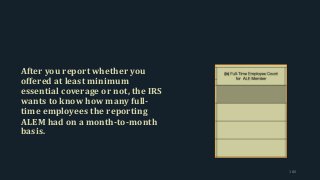
After you report whether you
offered at least minimum
essential coverage or not, the IRS
wants to know how many full-
time employees the reporting
ALEM had on a month-to-month
basis.
180
The specific boxes (Section b)
below confuse people for a few
reasons. First, the number you
put in each box, each month,
must be calculated every month.
181
No, look-back measurement
periods and all of that do not
count here. Here, every month
you have to calculate how many
full-time employees you have and
whether they are in limited non-
assessment periods.
182
Wait a second. I don’t know how
to calculate full-time employees
and I have no idea what a limited
non-assessment period is.
183
Stop.
Investigate.
Then Come Back.
184
Welcome Back.
185
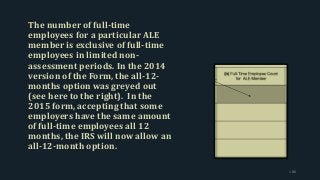
The number of full-time
employees for a particular ALE
member is exclusive of full-time
employees in limited non-
assessment periods. In the 2014
version of the Form, the all-12-
months option was greyed out
(see here to the right). In the
2015 form, accepting that some
employers have the same amount
of full-time employees all 12
months, the IRS will now allow an
all-12-month option.
186
Section (c) of Part III is relatively
straightforward. You must report
how many human beings work
for the ALEM in Section (c).
187
The only tricky part with (c) is the point at which you take the
“snap shot” to report how many human beings work for the ALEM
during any given month. On February 9, 2015, we got an answer.
Ensure you use the same method every month during the year.
1) The first day of each month;
2) The last day of each month;
3) The first day of the first payroll period that starts during
each month; or
4) The last day of the first payroll period that starts during each
month (the last day of such a payroll can’t be in another
month).
5) The 12th day of the month. 188
Section (d) is only for ALE/ALEMs
that are part of a larger group of
aggregated companies.
189
Look at your Form, did you answer “No” to Line 21?
If you did answer “No” you don’t have to complete Section (d)
of Part III.
If you answered “Yes” to Line 21, you have to complete
Section (d) of Part IV.
190
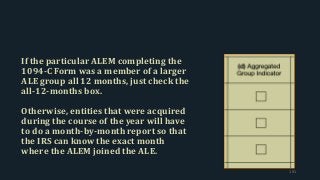
If the particular ALEM completing the
1094-C Form was a member of a larger
ALE group all 12 months, just check the
all-12-months box.
Otherwise, entities that were acquired
during the course of the year will have
to do a month-by-month report so that
the IRS can know the exact month
where the ALEM joined the ALE.
191
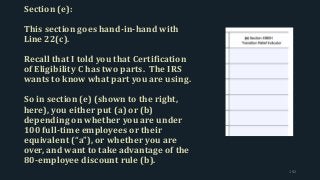
Section (e):
This section goes hand-in-hand with
Line 22(c).
Recall that I told you that Certification
of Eligibility C has two parts. The IRS
wants to know what part you are using.
So in section (e) (shown to the right,
here), you either put (a) or (b)
depending on whether you are under
100 full-time employees or their
equivalent (“a”), or whether you are
over, and want to take advantage of the
80-employee discount rule (b).
192
If you answered “No” to Line 21, you are done. Congrats!
193
If you answered “Yes” to Line 21, you have one more part to go,
Part IV.
194
195
Part IV is relatively straight-forward once you know what an ALE
is, what an ALEM is, and how they are different. If you have gotten
this far, this should be a breeze.
196
You want to list the 30 biggest ALEMs that are sister-ALEMs to the
particular ALEM for which you are filling out this authoritative
Form 1094-C.
197
By biggest, I mean, which sister-ALEMs had the largest monthly
average of Full-Time employees.
198
What if my company has more than 30 ALEMs?
199
You only have to report the 30 biggest ones.
200
Mario, I am freaking out right now because I do not know what is going on
with these reports!
201
It is going to be okay.
202
Just keep reviewing the slides, shoot me an email, and remember that this
year the IRS will waive penalties for screwing up the reports if you make a
good-faith effort to comply.
203
When people make seemingly outrageous claims (like I just did in the last
slide), you should always ask for citations. Here is the one that backs up
what I just claimed in the last slide (page 61). And this is of course is in
addition to the other document I linked to in the opening slides.
204
Still. Freaking. Out.
205
I have another set of slides that go with a webinar. Some of these slides
are on that deck, but that deck has many slides / visuals that are easier to
explain orally than via text. Consider sitting through my webinar. It’s 100
bucks for 2.5 hours of 1094-C line-by-line conversation that you can binge
watch over and over until your heart is content. And although it’s mainly
a 1094-C webinar, I crossed into 1095-C-land several times to answer
some timeless riddles like:
206
What is the difference between 1E / 1A?
Do I have to leave Line 16 blank if I put 1A in Line 14?
What is the difference between 1A and 1i?
And many more riddles that presently escape me.
207
You can sign up for that webinar here. Note, that it’s prerecorded, so you
can watch whenever it fits your schedule.
208
Boom. The End.
209
Note: I tried my best to ensure that these slides are as accurate
and informative as possible. If I made a mistake, please send
corrections to my email address which appears on the last slide.
210
Extra credit for those folks that send corrections with supporting
authority.
211
Thanks for sitting through this slide deck.
212
These slides have received thousands of views. I have also
received many emails from folks thanking me for putting them up
online (you’re welcome!).
These slides are supplementary materials to the third edition of
my book, The Employer Mandate Handbook. If you benefited
from these slides, please consider purchasing the book (or
signing up for a webinar) that led to their creation while helping
me pay off these massive student loans in the process.
213
Comments and GENERAL questions should be sent to me via email
at the following email address: theACAguy@gmail.com
Please do not send me angry emails complaining about the ACA
itself. I can’t much do anything about that one. Also, please note
that sending me an email does not create an attorney-client
relationship nor is anything you send me privileged. I reserve the
right to quote your questions and my answers on my website,
slides, etc.
These slides are also copyrighted. © 2015-2016. All Rights
Reserved (please don’t steal my stuff).
214
Finally, I do not email these slides out to anyone. I provide these
for free, and I want to keep it that way. I once went to a paid-for
seminar where someone had “borrowed” my slides and was
charging people for the privilege. Not cool and that’s why we can’t
have nice things.
I also update these slides as people send in questions so you are
better off just coming back here. Please do not email asking for
copies of the slides to be sent to you. If you want to get on my
mailing list (I give discounts for my various wares) email me at
theACAguy@gmail.com and I will email you when the slides are
updated or I release a new webinar.
215
ABOUT MARIO. Mario K. Castillo is the General Counsel of the Lone Star College System in Houston, Texas and
Board Certified in Labor and Employment Law by the Texas Board of Legal Specialization. Prior to joining the
System, he was a labor, employment, and benefits partner at the law firm of Monty & Ramirez LLP in Houston, Texas,
where he helped employers avoid or minimize liability and defended them when litigation was necessary. Mario also
completed a four-year term as briefing attorney to the Honorable Felix Recio of the Southern District of Texas prior
to joining Monty & Ramirez. Mario received a Juris Doctorate from the Maurer School of Law at Indiana University—
Bloomington. Prior to attending law school, Mario received a Bachelor of Arts in Government from the University of
Texas in Austin.
DISCLAIMER. This presentation is for informational purposes only and provides general information concerning
the Affordable Care Act to help you identify when you may need additional advice. It is not an exhaustive treatment of
the statutes, case law or regulations that are involved with the subject. Please recognize that the law is developing
rapidly in this area and you will want to obtain current legal advice on your specific situation before taking action.
216

1094-C: Reporting Requirements: A Step-by-Step Guide

  • 1.
    The Affordable CareActReporting Requirements: A Step-by-Step Guide to Form 1094-C 1
  • 2.
    These slides werelast updated on February 11, 2016. 2
  • 3.
    First things first,this is not a basic guide. 3
  • 4.
    This guide assumesyou know how the Employer Mandate basically works under the Affordable Care Act. 4
  • 5.
    Which brings meto a very important point. The reporting requirements are their own separate, free-standing requirement under the Affordable Care Act. 5
  • 6.
    I’ve helped hundredsof employers since the Affordable Care Act was signed on March 23, 2010. 6
  • 7.
    I’ve written scholarlyarticles for peer-reviewed legal journals on the Affordable Care Act. 7
  • 8.
    I’ve written threeeditions of a comprehensive guide on the Affordable Care Act for employers called The Employer Mandate Handbook. The third edition was released in September 2015. 8
  • 9.
    When I wrotemy articles and books, I tried to cite as many legal authorities as possible so people could verify my claims. So unlike most books, when I make seemingly outrageous (or even non-outrageous) claims, I have endnotes so you can see that I am not a liar, liar with my pants on fire. 9
  • 10.
    I have spentyears working on this stuff every day. 10
  • 11.
    I have beenquoted in the Houston Chronicle, Forbes, and the New York Times. 11
  • 12.
    But even afterall of that, I don’t know everything, and you should run (very fast) from anyone that claims they do. 12
  • 13.
    I do knowthat if you were an Applicable Large Employer or an Applicable Large Employer Member during 2014, you have a legal duty to file the reports discussed on these slides with the IRS in 2016. 13
  • 14.
    The reporting requirementswere optional in 2015 (for the 2014 tax year); they are not optional in 2016 (for the 2015 tax year). 14
  • 15.
    Your duty toreport in 2016 exists even if you are not currently offering insurance (during 2015) because (1) you like to live dangerously, or (2) your lawyer, accountant, or other confidant said you did not have to under the law. 15
  • 16.
    Again, it doesnot matter if you had fewer than 99 full-time employees or their equivalent during 2014. 16
  • 17.
    And it doesnot matter if you have a non-calendar year plan that has not yet come up for renewal in 2015. 17
  • 18.
    Whether you arean Applicable Large Employer or Applicable Large Employer Member, as of January 1, 2015, remains the only barrier standing between you and the legal duty to comply with the ACA’s reporting requirements. 18
  • 19.
    If you don’tknow the answer to the last slide, 19
  • 20.
  • 21.
  • 22.
    The Due Dateof the Form 1094-C (and 1095-C) has changed since December 2015--both the delivery date to the recipient and the delivery date to the IRS have been extended. See Notice 2016 – 4 (the orange text is a direct link to the IRS) 22
  • 23.
    The Penalties forgood-faith compliance will apparently be waived by the IRS if you can prove good faith compliance. The IRS seldom gives people “As for Effort,” but this is one of those rare times. As long as you can prove that you tried your best, the IRS is claiming it will leave you alone. So if you can’t crack this riddle that you and only I understand, just relax and try to comply in good faith. See Notice 2015-87 (the orange text is a direct link to the IRS). 23
  • 24.
    Why do Ihave to report in the first place? The IRS will use the information reported on Form 1094-C to determine the sum, if any, that a particular employer will pay in penalties under the Employer Mandate. 24
  • 25.
    Where can Ifind this Form? You can find it on the IRS website, by clicking here. 25
  • 26.
    Understandably, some peoplewill not click links online sent by people they don’t know. 26
  • 27.
    I like yourparanoia. Paranoia is good when dealing with IRS forms. 27
  • 28.
  • 29.
    Please ensure youhave picked up, and are completing, the correct Form 1094-C through whatever means you are comfortable employing. 29
  • 30.
    I know thatsounds a bit silly, but I have audited employer forms where the employer had the completely wrong form. 30
  • 31.
    You do notwant to be that employer. 31
  • 32.
    In fact, theIRS has released several versions of Form 1094-C just during the time I have had these slides online. If you do not visit the IRS website every time you complete these forms, you are probably doing it wrong. Resist the urge to print 100 of these and shove them in a drawer. 32
  • 33.
    Ensure you havethe right IRS form by checking the top-left corner. It should look like this: 33
  • 34.
    The correct Form1094-C is also titled like this: 34
  • 35.
    Notice the wordtransmittal in the name of the Form. 35
  • 36.
    Form 1094-C isa coversheet that must accompany every Form 1095-C a reporting employer sends to the IRS. 36
  • 37.
    If you findyourself sending a Form 1094-C, without attaching Forms 1095-C, to the IRS, you are doing it wrong. 37
  • 38.
    Also, ensure youhave the right form for the right year. In 2016, your form should have a 2015 on the top-right corner of the form you are completing. 38
  • 39.
    There is noForm 1094-C with 2016 in the top-right corner, stop looking for it. 39
  • 40.
    We checked theForm’s number. We checked the Form’s name. We checked the Form’s year. 40
  • 41.
    Again, it mightsound silly, but many employers complete the wrong form. It is important that you verify everything on the last slide every time you complete IRS forms. 41
  • 42.
    Every Applicable LargeEmployer Member that employs at least one full-time employee must file at least one Form 1094-C. 42
  • 43.
    What the heckis an Applicable Large Employer or an Applicable Large Employer Member (ALEM)? 43
  • 44.
    If you don’tknow what that is, you are not ready to complete Form 1094-C. The IRS provides a definition that is everything you would expect an IRS definition to be on the 9th page of the instructions. 44
  • 45.
    Let’s assume Acme,Delta, Beta, and Echo are all employers. Together, the four legal entities employ more than 50 full-time employees or their equivalent during 2015. The four collective companies are an Applicable Large Employer. 45
  • 46.
    The group ofcompanies is called an Applicable Large Employer (everything inside the circle). The Form 1094-C refers to the same concept as the “Aggregated ALE Group.” 46
  • 47.
    The individual companiesinside the circle are called Applicable Large Employer Members (ALE Members or ALEMs). 47
  • 48.
    Every ALEM inthe group (inside the circle) is responsible for filing its own Form 1094-C if it employs at least one full-time employee. 48
  • 49.
    If you have100 legal entities within an ALE, you need at least 100 Forms 1094-C completed every tax year (so long as each ALEM employs at least one full-time employee). 49
  • 50.
    If you onlyhave one legal entity that employs a full-time employee, you only need to complete at least one Form 1094-C every applicable tax year. 50
  • 51.
    Do you knowif you are part of an ALE? Do you know all the ALEMs that are in that ALE? If you do not, 51
  • 52.
  • 53.
  • 54.
    Part I justasks for information regarding the particular ALEM on whose behalf the particular Form 1094-C is being filed and really, Part I is the coversheet part of the Form (more on this later). 54
  • 55.
  • 56.
    Once you knowyour ALEM/ALE status, Part I is relatively straightforward (except for Line 19). The tricky part is knowing the status to ensure you enter the right data in each line. 56
  • 57.
    Nevertheless, let’s takeit one line at a time. 57
  • 58.
    Line 1 asksfor the name of the ALEM for which the Form 1094-C is being completed. 58
  • 59.
    Line 2 requiresthat the ALEM enter its FEIN / EIN number (don’t forget the dash). 59
  • 60.
    If I donot have an EIN number, I can just input my Social Security Number in there, right? 60
  • 61.
    Wrong. Without an EINnumber you cannot complete a Form 1094-C. If you do not have one, you must get one to complete a Form 1094-C. 61
  • 62.
    Lines 3 through6 ask for the ALEM’s address: 62
  • 63.
    Even the addressis tricky on Form 1094-C. You want to keep track of two issues when you are completing the address portion. 63
  • 64.
    First. If youare completing a Form 1094-C for an ALEM you have to decide whether to put one of three addresses (assuming they are different): (1) the location’s address, (2) the ALEM’s corporate address, or (3) the ALE’s corporate address. 64
  • 65.
    Second. You mustensure that the address (whichever one you choose) matches the address on the corresponding Forms 1095-C. You do not want to have one address on Form 1094-C and a different address on the Form 1095-C. 65
  • 66.
    Lines 7 and8 require the ALEM designate a person to contact and a telephone number. It is very important that this person be someone that the employer trusts to talk to the IRS. 66
  • 67.
    Moving on toLine 9: What the heck is a DGE? 67
  • 68.
    Good news—if youdon’t know what a DGE is, you are probably not a DGE. 68
  • 69.
    To make iteasier on government employers, government employers can designate a sister-agency or –department as the go-to entity for all Form 1094-C compliance requirements. 69
  • 70.
    That designated governmententity must then complete Lines 9 through 16 to make it clear to the IRS that an intermediary was used. 70
  • 71.
    If you arenot a government employer you can ignore everything highlighted in blue in the image below and just skip from Line 8 through Line 17: 71
  • 72.
    I have receivedseveral calls about Line 17. Regulators don’t like reinventing the wheel (or Form) every time they want to ask an additional piece of information. To fix that, they often reserve sections on Forms to where they can add questions without changing the entire form. 72
  • 73.
    Recall the atthe start of these slides, I said that Form 1094-C acts as a coversheet for Form 1095-C. Line 18 makes that evident by expressly asking how many Form 1095-Cs are being filed along with a particular Form 1094-C. This is basically the part of any fax coversheet where it says “How many attached pages?” 73
  • 74.
    Ideally, you wantto file one Form 1094-C per ALEM with all of that particular ALEM’s Form 1095-Cs attached. 74
  • 75.
    The last question(Line 19) in Part I concerns the two roles Form 1094-C plays in ACA compliance. 75
  • 76.
    The first roleForm 1094-C plays regards the Form’s status as an authoritative transmittal of vital information the IRS needs to administer and enforce ACA compliance for employers (these items are requested on Lines 20 through 65) . 76
  • 77.
    The second roleForm 1094-C plays regards the Form’s administrative use as nothing more than a cover sheet (Lines 1 through 19) for the attached Forms 1095-C. 77
  • 78.
    Every time yousit down to fill out a Form 1094-C you have to ask yourself a fundamental question: 78
  • 79.
    Are all ofmy Form 1095-Cs attached to this Form 1094-C? 79
  • 80.
    If the answeris Yes, then this will be your authoritative transmittal and you have to go beyond Line 19 (and Part I). 80
  • 81.
    If the answeris No, then you will have to file at least one Form 1094-C that goes beyond Line 19 and one that does not. 81
  • 82.
    Either the firstone, the second one, or the 99th one can be the authoritative one, but you only need to file one authoritative transmittal (before the applicable deadline). 82
  • 83.
    The rest ofyour Forms 1094-C (whether there is one or a hundred) are all very fancy coversheets that do not have to be filled out beyond Line 19. 83
  • 84.
    If you havemore than one Form 1094-C for any one ALEM in any given year that goes beyond Line 19, you are doing it wrong. 84
  • 85.
    If you knowthis is not your authoritative Form 1094-C you can stop at Line 19, sign, and file it. 85
  • 86.
    When would Ibe purposefully filing a non-authoritative Form 1094-C? 86
  • 87.
    For example, let’ssay you collect all your Form 1095-Cs and file them in February with the IRS (and send along an authoritative Form 1094-C). A month later, you realize that you forgot to attach one Form 1095-C to your original batch. You have to send that lone Form 1095-C with its own Form 1094-C. That second Form 1094-C is not an authoritative version and you know it when you are completing it. 87
  • 88.
    Otherwise, if youknow you are only filing one Form 1094-C (because all of your 1095-Cs are attached) OR If you know that the form you are working on will be the authoritative transmittal even though you will be filing other Forms 1094-C. 88
  • 89.
    Soldier on toLine 20. 89
  • 90.
    Line 20 existsso that the IRS can check how many total Forms 1095-C your ALEM has filed. Remember, you only go beyond Line 19 on the authoritative Forms 1094-C. 90
  • 91.
    Ideally, again, youwill only file one Form 1094-C per ALEM every year. If you do so, Lines 18 and 20 should be the same number. 91
  • 92.
    Also remember thatLine 20 and beyond only get completed on authoritative Form 1094-C forms. 92
  • 93.
    If the Form1094-C you are completing is not the authoritative one, Line 20 should be left blank. 93
  • 94.
    If you didyour research, as I suggested in the opening slides, Line 21 should be fairly easy to answer at this point. 94
  • 95.
  • 96.
  • 97.
    If you arecertain that your particular ALEM is not part of a larger ALE, then you can skip Section (d) of Part III and Part IV altogether. Don’t worry, I’ll highlight these sections as we move through the rest of the Form. 97
  • 98.
    Having completed Line21, we now arrive at what causes people the most headaches in all of 1094-dom, Line 22. The line reads as follows: 98
  • 99.
    Make no mistakeabout it: Line 22 is the toughest section in all of Form 1094-C. 99
  • 100.
    Basically, Line 22offers employers the opportunity to certify that they are eligible for four different kinds of relief. 100
  • 101.
    And that’s whythere are four certifications on Line 22: A, B, C, and D. 101
  • 102.
    Lines 22A and22B are related, while 22C and 22D are completely different forms of relief from each other and Lines 22A and 22B. 102
  • 103.
    Those four kindsof relief, have four different requirements, and four different “rewards” that depend on the applicable certification. 103
  • 104.
    Not all employerswill qualify for at least one certification of eligibility. 104
  • 105.
    Indeed, many employersmay not qualify for any of them. 105
  • 106.
    Conversely, notice the“select all that apply” on Line 22. 106
  • 107.
    Some ALEMs mayqualify for multiple forms of relief and you should check to ensure you don’t leave some relief on the table. 107
  • 108.
    Again, the firststep to understanding how Line 22A, 22B, 22C, and 22D work is to appreciate that Lines 22A and 22B are closely related to one another and only slightly different. 108
  • 109.
    In order tounderstand the subtle difference between Certifications A and B, you must appreciate what “qualifying” for either Certification does to an ALE’s reporting requirements. 109
  • 110.
    The default reportingrequirements require ALEs to provide every full-time employee with a copy of a Form 1095-C detailing the ALE’s offer of coverage and other individualized specifics regarding that particular full-time employee’s benefits (this is called general method reporting). 110
  • 111.
    That is alot of work for employers with thousands of employees (or even smaller employers that do not have the infrastructure, payroll, or HR resources to tackle such a monumental task). 111
  • 112.
    And for someemployers, all that work is for nothing. Specifically, remember that the entire point of Form 1094-C and Form 1095-C (from an employer’s perspective) is to provide reports so that the IRS can determine if the reporting employer is liable for employer mandate penalties. 112
  • 113.
    If a generalmethod reporting employer offers great healthcare to all full-time employees, at a legally affordable price, and goes beyond the minimum requirements of the ACA, all of its work compiling custom Forms 1095-C will be for nothing because the IRS is unlikely to fine that employer under the circumstances. 113
  • 114.
    So when youcombine the massive amounts of work involved in general method reporting with the likelihood that in some circumstances those reports will never lead to employer mandate penalties, simplified reporting method was born. 114
  • 115.
    Certification A (Line22A) and Certification B (Line 22B) are simplified methods of reporting where the employer can skip giving the full-time employee a copy of Form 1095-C by January 31 and instead can give certain full-time employees a generic, pro- forma statement. Important: simplified method reporting is optional. If you understand general method reporting and are comfortable doing so, then you should just ignore simplified method because it’s completely optional and somewhat complicated for the uninitiated person scrambling to comply with compliance for the first time in 2016. 115
  • 116.
    Unless, of course,you are a self-insured employer—then it’s not even on the table. Self-insured employers cannot use the “alternative method of furnishing Form 1095-C” (which is the entire point of Line 22A and 22B). Others may disagree, but I think that renders Certification A and Certification B largely useless to self-insured employers and most self-insured employer should just skip Line 22A and Line 22B. 116
  • 117.
    Again, there aretwo types of Form 1095-C reporting: general method of reporting and simplified reporting. If you barely know what the heck you are doing in 2016, you need to focus on general method of reporting. Otherwise, it’s like trying to do calculus but not knowing algebra. 117
  • 118.
    So to carrythe analogy: Algebra Calculus E=MC2 1B 1A 1I 1C (Line 22A) (Line 22B) 1D 1E (Step 1) (Step 2) (Step 3) 1F (General) (Simplified) (Simplified) 1G 1H If you do not know when 1B, 1C, 1D, 1E, 1F, 1G, or 1H apply (on Form 1095-C) go ahead and table trying to figure out 22A and 22B because using 22A and 22B require even more knowledge and you do not have to use either relief, they are optional for the ACA astrophysicists out there. You can stop on the far left and be fully compliant. 118
  • 119.
    Note: ALEs thatmeet the requirements of Certification A or B still have to give the IRS a Form 1095-C for any such full-time employee, but instead of having to have Forms 1095-C ready by January 31 (standard rule) of the applicable year for those full- time employees, qualifying employers can wait until March 31st (standard rule) to provide them to the IRS. For many employers, those three months are extremely valuable, especially the first year. But, remember that in 2016, we got some extra months (see slide 22 of this deck for details). 119
  • 120.
  • 121.
    Employers that wantto give all of their full-time employees generic substitute statements (instead of Form 1095-C) informing the employee that he or she is not eligible for a tax subsidy must fully comply with the next slide. 121
  • 122.
    Certification A: QualifyingOffer Method Means the ALEM: Offered a QHP to all full-time employees; Offered at least MEC or More to a spouse and dependents; Full-time employees that received such offers did not pay more than 93.18 dollars a month for the employee-only coverage; and That was true for all months in the calendar year where that employee was a full-time employee. 122
  • 123.
    Employers that cangive some of their full-time employees (but not all because some employees did not satisfy Slide 119) generic substitute statements informing the employee that he or she is not eligible for a tax subsidy, instead of a Form 1095-C, must fully comply with the next slide. 123
  • 124.
    Certification A: QualifyingOffer Method Means the ALEM: Offered a QHP to some full-time employees; Offered at least MEC or More to a spouse and dependents; Full-time employees that received such offers did not pay more than 93.18 dollars a month for the employee-only coverage; and That was true for all months in the calendar year where that employee was a full-time employee. 124
  • 125.
    Full-time employees capturedby slides 122 and 124 are the employees that the employer completed “1A” for on Form 1095-C. A 1A full-time employee gets a substitute statement instead of Form 1095-C under Line 22A so long as that 1A applies to all the months where the full-time employee was a full-time employee. 125
  • 126.
    But, I onlyoffered a skinny, MEC, rust, barebones, something- other-than QHP plan to my full-time employees?! 126
  • 127.
    Or, I didn’toffer anything to my full-time employee’s dependents. 127
  • 128.
    Or, even thoughI offered something, my full-time employees had to pay more than 93.18 dollars a month. 128
  • 129.
    Or, I didall those things on the slide, I just didn’t do it for all months where the employee was a full-time employee because [insert irrelevant excuse here]. 129
  • 130.
    Well then .. . No Qualifying Offer Method for You! 130
  • 131.
    Qualifying Offer Method(Line 22A on Form 1094-C) is unlikely to apply in industries where full-time employees have not traditionally had health insurance or where the employer does not pick up an extremely generous amount of the health insurance tab. 131
  • 132.
    In short, QualifyingOffer Method is hard, very hard, to satisfy. So hard, in fact, that it led to the creation of Line 22B (but more on that later). 132
  • 133.
    If you arenot self-insured, and comply with Certification A requirements (slide 122), you can get away with a substitute statement that says something like the next slide for all full-time employees instead of a Form 1095-C. 133
  • 134.
    John Q. Taxpayer WidgetsCompany, LTD 123 Internal Revenue Love Houston, Texas 123654 Ph. (281) 555 – 3986 Dear [22A-Eligible Full-Time Employee]: Widgets Co. records indicate that you received a qualifying offer, along with your spouse and dependents, if any, for all months in which you qualified as a full-time employee. According to our records, you are therefore not eligible for a premium tax credit on the individual marketplace. However, you are directed to see IRS Pub. 974, Premium Tax Credit (PTC) for more information on your eligibility for a premium tax credit. For information about the offer of coverage you received or inquiries regarding what Widgets reported to the IRS on Form 1095-C, please contact, via telephone, the person listed above. All the best, Widgets Company, LTD Federal Employer Identification No. 36--12536548 134
  • 135.
    If you arenot self-insured, and comply with Certification A requirements (slide 122) for some full-time employees, you can get away with an substitute statement that says something like the next slide for those particular full-time employees. 135
  • 136.
    John Q. Taxpayer WidgetsCompany, LTD 123 Internal Revenue Love Houston, Texas 123654 Ph. (281) 555 – 3986 Dear [Full-Time Employee]: Widgets Co. records indicate that you received a qualifying offer, along with your spouse and dependents, if any, for all months in which you qualified as a full-time employee. According to our records, you therefore are not eligible for a premium tax credit on the individual marketplace. However, you are directed to see IRS Pub. 974, Premium Tax Credit (PTC) for more information on your eligibility for a premium tax credit. For information about the offer of coverage you received or inquiries regarding what Widgets reported to the IRS on Form 1095-C, please contact, via telephone, the person listed above. All the best, Widgets Company, LTD Federal Employer Identification No. 36--12536548 136
  • 137.
    Go back toSlide 122. If you cannot say that you satisfied that slide for every full-time employee, for every month such full-time employees were full-time employees, or you operated on a self- insured basis, you will not be able to give substitute statements to all full-time employees. If that is what you are after, skip to Line 22B and Certification B. 137
  • 138.
    Line 22A willbe the standard rule for all full-time employees that have a 1A offer for all 12 calendar months in the year being reported. Line 22B exists to give employers one last chance at sending full- time employees a substitute statement instead of Form 1095-C and is far more temporary than Line 22A (some speculate it will not be available in 2017 for the 2016 tax year). 138
  • 139.
    Certification B: QualifyingOffer Method Transition Relief The easiest way to understand the difference between Certification B and Certification A is to show you the 1 series codes for a 12-month period on a Form 1095-C and how they affect whether a particular employer uses Certification A or B. 139
  • 140.
    Recall from Slides122 and 124 that in order to qualify for 22A status a particular full-time employee has to satisfy the requirements of Slide 122 or 124 for all months where the employee was a full-time employee (so someone that worked for you every month in 2015, would have to have 12 1As). 140
  • 141.
    So that begsthe question: What happens when you have a 1A- eligible full-time employee for only some instead of all months in the calendar year where that particular full-time employee was a full-time employee? 141
  • 142.
    Under the standardLine 22A rules, such a full-time employee is automatically entitled to a Form 1095-C (and the employer is not eligible for 22A relief as regards that particular full-time employee). 142
  • 143.
    This is whereLine 22B becomes very relevant to some employers. 143
  • 144.
    For example, inthe full-time employee example below, this full- time employee (who worked for you from January through December of 2015) would have to receive a Form 1095-C because of the non-offer in January (and thus would be ineligible for Line 22A relief). 144 January February March April May June July August September October November December 1H 1A 1A 1A 1A 1A 1A 1A 1A 1A 1A 1A
  • 145.
    In 2016 (forthe 2015 tax year) there is a middle ground between 1A qualification, and say, 1H non-qualification, and that is 1i. 145
  • 146.
    The best wayto think about how 1i works is as a middle-ground between 1A and 1H. 146
  • 147.
    But not allemployers can take advantage of this middle ground. In fact, for every particular month in which you want to transform a 1H into a 1I (like January below), the employer must have offered 95% of full-time employees a QHP. Note that the 95% excludes full-time employees in limited non- assessment periods (e.g., waiting periods). 147 January February March April May June July August September October November December 1H 1A 1A 1A 1A 1A 1A 1A 1A 1A 1A 1A
  • 148.
    So assume thatthe employer below had 100 full-time employees during January. Of those 100, 9 were in waiting periods. Line 22B requires 95% of 91 not 95% of 100 to qualify for Line 22B transitional relief (in others words, to transform the 1H into a 1I during January in the example below). 148 January February March April May June July August September October November December 1H 1A 1A 1A 1A 1A 1A 1A 1A 1A 1A 1A
  • 149.
    Once an employerqualifies to transform a 1H into a 1I (see below), this particular full-time employee is now eligible for Line 22B’s substitute statement. 149 January February March April May June July August September October November December 1H 1I 1A 1A 1A 1A 1A 1A 1A 1A 1A 1A 1A
  • 150.
    Under Line 22B,just like 22A, you also get to send a letter (instead of the 1095-C), but you have to tweak it a bit because you didn’t offer a qualifying offer for all the months the employee was a full-time employee (that’s why you had to rely on Line 22B in the first place). See the next slide for the modification. 150
  • 151.
    John Q. Taxpayer WidgetsCompany, LTD 123 Internal Revenue Love Houston, Texas 123654 Ph. (281) 555 – 3986 Dear [22-B Full-Time Employee]: Widgets Co. records indicate that you received a qualifying offer, along with your spouse and dependents, if any, for some months in which you qualified as a full-time employee. According to our records, you might be eligible for a premium tax credit on the individual marketplace for the months that you did not receive such a qualifying offer. However, you are directed to see IRS Pub. 974, Premium Tax Credit (PTC) for more information on your eligibility for a premium tax credit. For information about the offer of coverage you received or inquiries regarding what Widgets reported to the IRS on Form 1095-C, please contact, via telephone, the person listed above. All the best, Widgets Company, LTD Federal Employer Identification No. 36--12536548 151
  • 152.
    Please also appreciatethat although you may qualify to send an employee the letter described in the last slide (instead of the Form 1095-C), the IRS still wants its Form 1095-C by March 31st (under the standard rules, but I explained available extensions at the start of this deck) of every year for employers that qualify for Certification A or Certification B. All Certifications A and B do for an employer is minimize the custom forms they give full- time employees—the IRS still gets its Forms. 152
  • 153.
    Thankfully, Certification Cand D are much simpler. 153
  • 154.
    Certification C: Section4980H Transition Relief ALEs with fewer than 100 full-time employees or their equivalent (ALEs with 50-99), or ALEs with more than 99 full-time employees or their equivalent (ALEs with 100+) can get an 80-employee discount instead of a 30-employee discount during 2015 when the IRS calculates appropriate penalties for failing to offer any medical benefits to full-time employees. 154
  • 155.
    Before February 12,2014, everyone thought the employer mandate (having to offer insurance or pay a penalty) would go in effect on January 1, 2015. 155
  • 156.
    On February 12,2014, the IRS announced that ALEs with fewer than 100 full-time employees would be given another year before having to offer insurance or pay a penalty if certain conditions were met by those employers. 156
  • 157.
    One of thoseconditions is certifying under oath that you have read what is required and swear, under penalty of perjury, that you are eligible. 157
  • 158.
    That is thepoint of Certification of Eligibility C—affirming that you are eligible under oath and penalty of law. 158
  • 159.
    If you areunsure about whether you are eligible you should find out sooner rather than later because, forget the reporting requirements, you could be accruing penalties for failing to offer insurance. If you are unsure . . . . 159
  • 160.
  • 161.
  • 162.
    The second partof Certification of Eligibility C is for ALEs that had more than 99 full-time employees or their equivalent during 2014. 162
  • 163.
    These are oftenreferred to as the “larger ALEs” in ACA sewing circles. 163
  • 164.
    Larger ALEs didnot get until 2016 to comply with the requirement to offer full-time employees medical benefits or risk paying a penalty; these folks had to be ready to go in January 2015 under the default rules. 164
  • 165.
    Sidebar: if alarger ALE did not offer anything to full-time employees, under the standard rules, the particular affected ALEM would have to share, proportionately to its full-time employee count, in an ALE-wide 30-full-time employee discount when the IRS calculated penalties. 165
  • 166.
    To help thesefolks out, just like smaller folks got a one-year reprieve, the IRS increased the amount of the full-time employee discount from 30 to 80 for 2015. The second portion of Certification of Eligibility C is for larger ALEs to take advantage of this transition relief. 166
  • 167.
    Certification D: 98%Offer Method The last Certification of Eligibility, Letter D, requires an eligible ALEM to have offered a QHP to 98% of its full-time employees and their dependents. The bolded “its” should make it clear that the 98% rule applies on an ALEM-BY-ALEM basis. Additionally, the full-time employee’s offer of self-only coverage was legally affordable under the Affordable Care Act (no more than 9.5 percent of the employee-only income). 167
  • 168.
    The “reward” isthat the employer who takes advantage of Certification D does not have to complete “Full-Time Employee Count” in Part III, column (b), of the authoritative Form 1094-C. 168
  • 169.
    Don’t worry, whenwe get there, I’ll remind the Certification D folks of the Lines they can skip. 169
  • 170.
    Before we moveon, don’t forget to sign the Form 1094-C right underneath Line 22. 170
  • 171.
    We finally arriveat Part III! 171
  • 172.
    Part III requiresALEMs to report, typically on a month-by-month basis, several variables for the particular ALEM. 172
  • 173.
    The first thingALEMs have to report on Part III is whether the particular ALEM offered at least a MEC plan to at least 70% of full- time employees. If you offered a skinny plan, bare bones plan, rust plan, etc., you get to say “yes” here for every month that you did so. 173
  • 174.
    Likewise if youoffered more robust insurance, like a QHP, you also get to say “yes” here for every such month. 174
  • 175.
    Several people haveasked me whether they should complete Part III by row or by column. I find it easier to do columns. You should do one column at a time starting with Column (a) which again, looks like this: 175
  • 176.
    Working your waydown Column (a), the first question is whether you offered Minimum Essential Coverage All 12 Calendar Months. 176
  • 177.
    If you did,you can just denote that by checking “Yes” under All 12 Months. 177
  • 178.
    Likewise, if youdidn’t offer minimum essential coverage for all 12 months, to at least 70 percent of your full-time employees, you can just denote that by checking “No” under All 12 Months. 178
  • 179.
    Most employers, especiallythose who just entered the benefits world, will have a mixture of “Yes” and “No.” The 1094-C form allows employers to report that by allowing spaces to report on a month-by-month basis as shown below: 179
  • 180.
    After you reportwhether you offered at least minimum essential coverage or not, the IRS wants to know how many full- time employees the reporting ALEM had on a month-to-month basis. 180
  • 181.
    The specific boxes(Section b) below confuse people for a few reasons. First, the number you put in each box, each month, must be calculated every month. 181
  • 182.
    No, look-back measurement periodsand all of that do not count here. Here, every month you have to calculate how many full-time employees you have and whether they are in limited non- assessment periods. 182
  • 183.
    Wait a second.I don’t know how to calculate full-time employees and I have no idea what a limited non-assessment period is. 183
  • 184.
  • 185.
  • 186.
    The number offull-time employees for a particular ALE member is exclusive of full-time employees in limited non- assessment periods. In the 2014 version of the Form, the all-12- months option was greyed out (see here to the right). In the 2015 form, accepting that some employers have the same amount of full-time employees all 12 months, the IRS will now allow an all-12-month option. 186
  • 187.
    Section (c) ofPart III is relatively straightforward. You must report how many human beings work for the ALEM in Section (c). 187
  • 188.
    The only trickypart with (c) is the point at which you take the “snap shot” to report how many human beings work for the ALEM during any given month. On February 9, 2015, we got an answer. Ensure you use the same method every month during the year. 1) The first day of each month; 2) The last day of each month; 3) The first day of the first payroll period that starts during each month; or 4) The last day of the first payroll period that starts during each month (the last day of such a payroll can’t be in another month). 5) The 12th day of the month. 188
  • 189.
    Section (d) isonly for ALE/ALEMs that are part of a larger group of aggregated companies. 189
  • 190.
    Look at yourForm, did you answer “No” to Line 21? If you did answer “No” you don’t have to complete Section (d) of Part III. If you answered “Yes” to Line 21, you have to complete Section (d) of Part IV. 190
  • 191.
    If the particularALEM completing the 1094-C Form was a member of a larger ALE group all 12 months, just check the all-12-months box. Otherwise, entities that were acquired during the course of the year will have to do a month-by-month report so that the IRS can know the exact month where the ALEM joined the ALE. 191
  • 192.
    Section (e): This sectiongoes hand-in-hand with Line 22(c). Recall that I told you that Certification of Eligibility C has two parts. The IRS wants to know what part you are using. So in section (e) (shown to the right, here), you either put (a) or (b) depending on whether you are under 100 full-time employees or their equivalent (“a”), or whether you are over, and want to take advantage of the 80-employee discount rule (b). 192
  • 193.
    If you answered“No” to Line 21, you are done. Congrats! 193
  • 194.
    If you answered“Yes” to Line 21, you have one more part to go, Part IV. 194
  • 195.
  • 196.
    Part IV isrelatively straight-forward once you know what an ALE is, what an ALEM is, and how they are different. If you have gotten this far, this should be a breeze. 196
  • 197.
    You want tolist the 30 biggest ALEMs that are sister-ALEMs to the particular ALEM for which you are filling out this authoritative Form 1094-C. 197
  • 198.
    By biggest, Imean, which sister-ALEMs had the largest monthly average of Full-Time employees. 198
  • 199.
    What if mycompany has more than 30 ALEMs? 199
  • 200.
    You only haveto report the 30 biggest ones. 200
  • 201.
    Mario, I amfreaking out right now because I do not know what is going on with these reports! 201
  • 202.
    It is goingto be okay. 202
  • 203.
    Just keep reviewingthe slides, shoot me an email, and remember that this year the IRS will waive penalties for screwing up the reports if you make a good-faith effort to comply. 203
  • 204.
    When people makeseemingly outrageous claims (like I just did in the last slide), you should always ask for citations. Here is the one that backs up what I just claimed in the last slide (page 61). And this is of course is in addition to the other document I linked to in the opening slides. 204
  • 205.
  • 206.
    I have anotherset of slides that go with a webinar. Some of these slides are on that deck, but that deck has many slides / visuals that are easier to explain orally than via text. Consider sitting through my webinar. It’s 100 bucks for 2.5 hours of 1094-C line-by-line conversation that you can binge watch over and over until your heart is content. And although it’s mainly a 1094-C webinar, I crossed into 1095-C-land several times to answer some timeless riddles like: 206
  • 207.
    What is thedifference between 1E / 1A? Do I have to leave Line 16 blank if I put 1A in Line 14? What is the difference between 1A and 1i? And many more riddles that presently escape me. 207
  • 208.
    You can signup for that webinar here. Note, that it’s prerecorded, so you can watch whenever it fits your schedule. 208
  • 209.
  • 210.
    Note: I triedmy best to ensure that these slides are as accurate and informative as possible. If I made a mistake, please send corrections to my email address which appears on the last slide. 210
  • 211.
    Extra credit forthose folks that send corrections with supporting authority. 211
  • 212.
    Thanks for sittingthrough this slide deck. 212
  • 213.
    These slides havereceived thousands of views. I have also received many emails from folks thanking me for putting them up online (you’re welcome!). These slides are supplementary materials to the third edition of my book, The Employer Mandate Handbook. If you benefited from these slides, please consider purchasing the book (or signing up for a webinar) that led to their creation while helping me pay off these massive student loans in the process. 213
  • 214.
    Comments and GENERALquestions should be sent to me via email at the following email address: theACAguy@gmail.com Please do not send me angry emails complaining about the ACA itself. I can’t much do anything about that one. Also, please note that sending me an email does not create an attorney-client relationship nor is anything you send me privileged. I reserve the right to quote your questions and my answers on my website, slides, etc. These slides are also copyrighted. © 2015-2016. All Rights Reserved (please don’t steal my stuff). 214
  • 215.
    Finally, I donot email these slides out to anyone. I provide these for free, and I want to keep it that way. I once went to a paid-for seminar where someone had “borrowed” my slides and was charging people for the privilege. Not cool and that’s why we can’t have nice things. I also update these slides as people send in questions so you are better off just coming back here. Please do not email asking for copies of the slides to be sent to you. If you want to get on my mailing list (I give discounts for my various wares) email me at theACAguy@gmail.com and I will email you when the slides are updated or I release a new webinar. 215
  • 216.
    ABOUT MARIO. MarioK. Castillo is the General Counsel of the Lone Star College System in Houston, Texas and Board Certified in Labor and Employment Law by the Texas Board of Legal Specialization. Prior to joining the System, he was a labor, employment, and benefits partner at the law firm of Monty & Ramirez LLP in Houston, Texas, where he helped employers avoid or minimize liability and defended them when litigation was necessary. Mario also completed a four-year term as briefing attorney to the Honorable Felix Recio of the Southern District of Texas prior to joining Monty & Ramirez. Mario received a Juris Doctorate from the Maurer School of Law at Indiana University— Bloomington. Prior to attending law school, Mario received a Bachelor of Arts in Government from the University of Texas in Austin. DISCLAIMER. This presentation is for informational purposes only and provides general information concerning the Affordable Care Act to help you identify when you may need additional advice. It is not an exhaustive treatment of the statutes, case law or regulations that are involved with the subject. Please recognize that the law is developing rapidly in this area and you will want to obtain current legal advice on your specific situation before taking action. 216