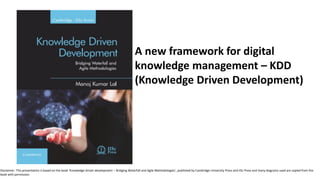
A new framework for digital
knowledge management – KDD
(Knowledge Driven Development)
Disclaimer: This presentation is based on the book ‘Knowledge driven development – Bridging Waterfall and Agile Methodologies’, published by Cambridge University Press and IISc Press and many diagrams used are copied from the
book with permission.
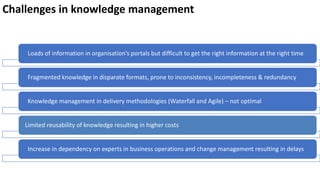
Challenges in knowledge management
Loads of information in organisation’s portals but difficult to get the right information at the right time
Fragmented knowledge in disparate formats, prone to inconsistency, incompleteness & redundancy
Knowledge management in delivery methodologies (Waterfall and Agile) – not optimal
Limited reusability of knowledge resulting in higher costs
Increase in dependency on experts in business operations and change management resulting in delays
What is Knowledge Driven Development (KDD)?
KDD (Knowledge Driven Development) - A
new framework to digitize and manage
domain, enterprise and project knowledge
that in turn accelerates execution activities
leading to producing quality output.
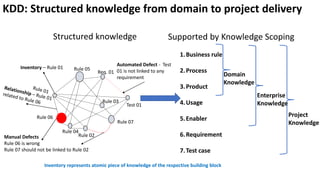
Structured knowledge
1.Business rule
2.Process
3.Product
4.Usage
5.Enabler
6.Requirement
7.Test case
Domain
Knowledge
Enterprise
Knowledge
Project
Knowledge
Supported by Knowledge Scoping
Inventory – Rule 01
Manual Defects
Rule 06 is wrong
Rule 07 should not be linked to Rule 02
Automated Defect - Test
01 is not linked to any
requirement
Req. 01
Test 01
Rule 06
Rule 07
Rule 02
Rule 03
Rule 04
Rule 05
KDD: Structured knowledge from domain to project delivery
Inventory represents atomic piece of knowledge of the respective building block
Executive Summary
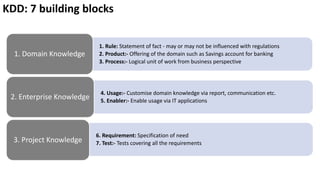
1. Rule: Statement of fact - may or may not be influenced with regulations
2. Product:- Offering of the domain such as Savings account for banking
3. Process:- Logical unit of work from business perspective
1. Domain Knowledge
4. Usage:- Customise domain knowledge via report, communication etc.
5. Enabler:- Enable usage via IT applications
2. Enterprise Knowledge
6. Requirement: Specification of need
7. Test:- Tests covering all the requirements3. Project Knowledge
KDD: 7 building blocks
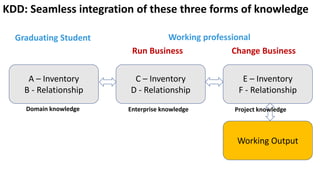
KDD: Seamless integration of these three forms of knowledge
A – Inventory
B - Relationship
C – Inventory
D - Relationship
E – Inventory
F - Relationship
Graduating Student
Run Business Change Business
Working Output
Working professional
Domain knowledge Enterprise knowledge Project knowledge
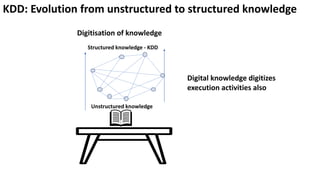
KDD: Evolution from unstructured to structured knowledge
Structured knowledge - KDD
Unstructured knowledge
Digitisation of knowledge
Digital knowledge digitizes
execution activities also
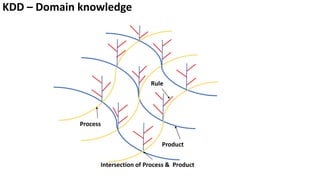
Intersection of Process & Product
Process
Rule
Product
KDD – Domain knowledge
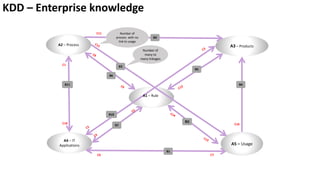
KDD – Enterprise knowledge
A2 – Process A3 – Products
A4 – IT
Applications
B9
B4
B5
B11
B1
B2
B6
B7
C10
C1
C6 C7
C16
A5 – Usage
Number of
many to
many linkages
Number of
process with no
link to usage
C11
B3
B10
A1 – Rule
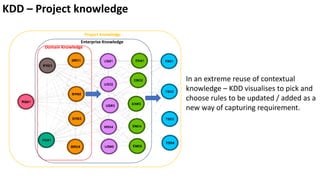
KDD – Project knowledge
Domain Knowledge
Enterprise Knowledge
Project Knowledge
In an extreme reuse of contextual
knowledge – KDD visualises to pick and
choose rules to be updated / added as a
new way of capturing requirement.
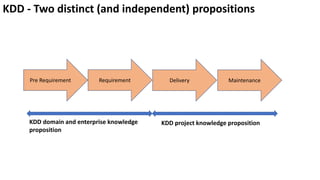
KDD - Two distinct (and independent) propositions
Pre Requirement Requirement Delivery Maintenance
KDD domain and enterprise knowledge
proposition
KDD project knowledge proposition
Test Execution
Requirement
Analysis
Solution
Design
Build
Test
Design
Application
Design
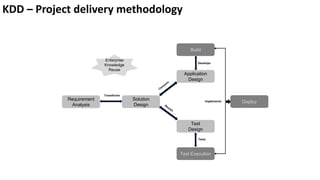
Transforms
Develops
Implements
Tests
Deploy
KDD – Project delivery methodology
Enterprise
Knowledge
Reuse
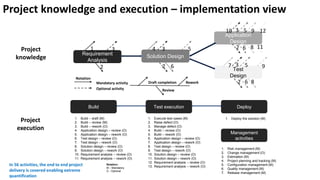
Project knowledge and execution – implementation view
Requirement
Analysis
Solution Design
Test
Design
Application
Design
1
5
5
6
3 4
2
3
7
8
93
2 6
10
11
123
2 6
5 9
8
Notation
Mandatory activity
Optional activity
Draft completion Rework
Review
2
Build Test execution Deploy
Management
activities
1. Build – draft (M)
2. Build – review (M)
3. Build – rework (O)
4. Application design – review (O)
5. Application design – rework (O)
6. Test design – review (O)
7. Test design – rework (O)
8. Solution design – review (O)
9. Solution design – rework (O)
10. Requirement analysis – review (O)
11. Requirement analysis – rework (O)
1. Execute test cases (M)
2. Raise defect (O)
3. Manage defect (O)
4. Build – review (O)
5. Build – rework (O)
6. Application design – review (O)
7. Application design – rework (O)
8. Test design – review (O)
9. Test design – rework (O)
10. Solution design – review (O)
11. Solution design – rework (O)
12. Requirement analysis – review (O)
13. Requirement analysis – rework (O)
1. Deploy the solution (M)
1. Risk management (M)
2. Change management (O)
3. Estimation (M)
4. Project planning and tracking (M)
5. Configuration management (M)
6. Quality management (M)
7. Release management (M)
Notation:
M – Mandatory
O - Optional
Project
knowledge
Project
execution
In 56 activities, the end to end project
delivery is covered enabling extreme
quantification
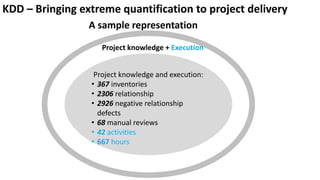
KDD – Bringing extreme quantification to project delivery
Project knowledge and execution:
• 367 inventories
• 2306 relationship
• 2926 negative relationship
defects
• 68 manual reviews
• 42 activities
• 667 hours
Project knowledge + Execution
A sample representation
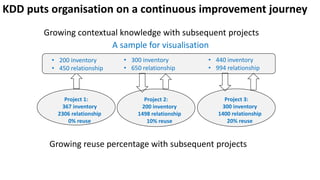
KDD puts organisation on a continuous improvement journey
Project 1:
367 inventory
2306 relationship
0% reuse
Project 2:
200 inventory
1498 relationship
10% reuse
Project 3:
300 inventory
1400 relationship
20% reuse
Growing reuse percentage with subsequent projects
Growing contextual knowledge with subsequent projects
• 200 inventory
• 450 relationship
• 300 inventory
• 650 relationship
• 440 inventory
• 994 relationship
A sample for visualisation
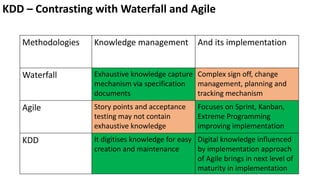
Methodologies Knowledge management And its implementation
Waterfall Exhaustive knowledge capture
mechanism via specification
documents
Complex sign off, change
management, planning and
tracking mechanism
Agile Story points and acceptance
testing may not contain
exhaustive knowledge
Focuses on Sprint, Kanban,
Extreme Programming
improving implementation
KDD It digitises knowledge for easy
creation and maintenance
Digital knowledge influenced
by implementation approach
of Agile brings in next level of
maturity in implementation
KDD – Contrasting with Waterfall and Agile
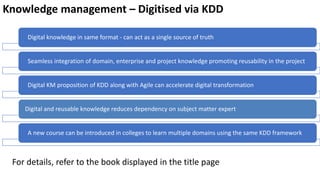
Knowledge management – Digitised via KDD
Digital knowledge in same format - can act as a single source of truth
Seamless integration of domain, enterprise and project knowledge promoting reusability in the project
Digital KM proposition of KDD along with Agile can accelerate digital transformation
Digital and reusable knowledge reduces dependency on subject matter expert
A new course can be introduced in colleges to learn multiple domains using the same KDD framework
For details, refer to the book displayed in the title page

Overview of knowledge driven development (kdd)

  • 1.
    A new frameworkfor digital knowledge management – KDD (Knowledge Driven Development) Disclaimer: This presentation is based on the book ‘Knowledge driven development – Bridging Waterfall and Agile Methodologies’, published by Cambridge University Press and IISc Press and many diagrams used are copied from the book with permission.
  • 2.
    Challenges in knowledgemanagement Loads of information in organisation’s portals but difficult to get the right information at the right time Fragmented knowledge in disparate formats, prone to inconsistency, incompleteness & redundancy Knowledge management in delivery methodologies (Waterfall and Agile) – not optimal Limited reusability of knowledge resulting in higher costs Increase in dependency on experts in business operations and change management resulting in delays
  • 3.
    What is KnowledgeDriven Development (KDD)? KDD (Knowledge Driven Development) - A new framework to digitize and manage domain, enterprise and project knowledge that in turn accelerates execution activities leading to producing quality output.
  • 4.
    Structured knowledge 1.Business rule 2.Process 3.Product 4.Usage 5.Enabler 6.Requirement 7.Testcase Domain Knowledge Enterprise Knowledge Project Knowledge Supported by Knowledge Scoping Inventory – Rule 01 Manual Defects Rule 06 is wrong Rule 07 should not be linked to Rule 02 Automated Defect - Test 01 is not linked to any requirement Req. 01 Test 01 Rule 06 Rule 07 Rule 02 Rule 03 Rule 04 Rule 05 KDD: Structured knowledge from domain to project delivery Inventory represents atomic piece of knowledge of the respective building block
  • 5.
    Executive Summary 1. Rule:Statement of fact - may or may not be influenced with regulations 2. Product:- Offering of the domain such as Savings account for banking 3. Process:- Logical unit of work from business perspective 1. Domain Knowledge 4. Usage:- Customise domain knowledge via report, communication etc. 5. Enabler:- Enable usage via IT applications 2. Enterprise Knowledge 6. Requirement: Specification of need 7. Test:- Tests covering all the requirements3. Project Knowledge KDD: 7 building blocks
  • 6.
    KDD: Seamless integrationof these three forms of knowledge A – Inventory B - Relationship C – Inventory D - Relationship E – Inventory F - Relationship Graduating Student Run Business Change Business Working Output Working professional Domain knowledge Enterprise knowledge Project knowledge
  • 7.
    KDD: Evolution fromunstructured to structured knowledge Structured knowledge - KDD Unstructured knowledge Digitisation of knowledge Digital knowledge digitizes execution activities also
  • 8.
    Intersection of Process& Product Process Rule Product KDD – Domain knowledge
  • 9.
    KDD – Enterpriseknowledge A2 – Process A3 – Products A4 – IT Applications B9 B4 B5 B11 B1 B2 B6 B7 C10 C1 C6 C7 C16 A5 – Usage Number of many to many linkages Number of process with no link to usage C11 B3 B10 A1 – Rule
  • 10.
    KDD – Projectknowledge Domain Knowledge Enterprise Knowledge Project Knowledge In an extreme reuse of contextual knowledge – KDD visualises to pick and choose rules to be updated / added as a new way of capturing requirement.
  • 11.
    KDD - Twodistinct (and independent) propositions Pre Requirement Requirement Delivery Maintenance KDD domain and enterprise knowledge proposition KDD project knowledge proposition
  • 12.
  • 13.
    Project knowledge andexecution – implementation view Requirement Analysis Solution Design Test Design Application Design 1 5 5 6 3 4 2 3 7 8 93 2 6 10 11 123 2 6 5 9 8 Notation Mandatory activity Optional activity Draft completion Rework Review 2 Build Test execution Deploy Management activities 1. Build – draft (M) 2. Build – review (M) 3. Build – rework (O) 4. Application design – review (O) 5. Application design – rework (O) 6. Test design – review (O) 7. Test design – rework (O) 8. Solution design – review (O) 9. Solution design – rework (O) 10. Requirement analysis – review (O) 11. Requirement analysis – rework (O) 1. Execute test cases (M) 2. Raise defect (O) 3. Manage defect (O) 4. Build – review (O) 5. Build – rework (O) 6. Application design – review (O) 7. Application design – rework (O) 8. Test design – review (O) 9. Test design – rework (O) 10. Solution design – review (O) 11. Solution design – rework (O) 12. Requirement analysis – review (O) 13. Requirement analysis – rework (O) 1. Deploy the solution (M) 1. Risk management (M) 2. Change management (O) 3. Estimation (M) 4. Project planning and tracking (M) 5. Configuration management (M) 6. Quality management (M) 7. Release management (M) Notation: M – Mandatory O - Optional Project knowledge Project execution In 56 activities, the end to end project delivery is covered enabling extreme quantification
  • 14.
    KDD – Bringingextreme quantification to project delivery Project knowledge and execution: • 367 inventories • 2306 relationship • 2926 negative relationship defects • 68 manual reviews • 42 activities • 667 hours Project knowledge + Execution A sample representation
  • 15.
    KDD puts organisationon a continuous improvement journey Project 1: 367 inventory 2306 relationship 0% reuse Project 2: 200 inventory 1498 relationship 10% reuse Project 3: 300 inventory 1400 relationship 20% reuse Growing reuse percentage with subsequent projects Growing contextual knowledge with subsequent projects • 200 inventory • 450 relationship • 300 inventory • 650 relationship • 440 inventory • 994 relationship A sample for visualisation
  • 16.
    Methodologies Knowledge managementAnd its implementation Waterfall Exhaustive knowledge capture mechanism via specification documents Complex sign off, change management, planning and tracking mechanism Agile Story points and acceptance testing may not contain exhaustive knowledge Focuses on Sprint, Kanban, Extreme Programming improving implementation KDD It digitises knowledge for easy creation and maintenance Digital knowledge influenced by implementation approach of Agile brings in next level of maturity in implementation KDD – Contrasting with Waterfall and Agile
  • 17.
    Knowledge management –Digitised via KDD Digital knowledge in same format - can act as a single source of truth Seamless integration of domain, enterprise and project knowledge promoting reusability in the project Digital KM proposition of KDD along with Agile can accelerate digital transformation Digital and reusable knowledge reduces dependency on subject matter expert A new course can be introduced in colleges to learn multiple domains using the same KDD framework For details, refer to the book displayed in the title page