DISSOLUTION PROFILE
COMPARISON
SUBMITTED TO SUBMITTED BY
DR JAVED ALI MOHD IMRAN
DEPARTMENT OF PHARMACEUITCS MPHARM II SEMESTER
SPER , JAMIA HAMDARD DEPARTMENT OF
PHARMACEUTICS
NEW DELHI SPER , JAMIA HAMDARD
CONTENT
 Definition
 Objectives
 Different methods used for dissolution
Comparison
 Comparison of different methods
 References
DISSOLUTION PROFILE COMPARAISON
Definition
It is graphical representation in terms of [concentration
vs. time] of complete release of A.P.I. from a dosage form
in an appropriate selected dissolution medium.
OBJECTIVE OF DISSOLUTION PROFILE
COMPARISON
Development of bioequivalent product.
Demonstrating equivalence after change in formulation of the
drug product.
To Develop in vitro-in vivo correlation which can help to reduce
the costs, speed-up product development and reduced the need
of perform costly bioavailability human volunteer studies.
To stabilize final dissolution specification for the pharmacological
For optimizing the dosage formula by comparing the dissolution
profiles of various formulas of the same A.P.I
CONTINUED….
Biowaiver of drug product of lower dose strength in proportion to
higher dose strength drug product containing same active
ingredient and excipients.
 FDA has placed more emphasis on dissolution profile
comparison in the field of post approval changes and biowaivers
(e.g. Class I drugs of BCS classification are skipped off these
testing for quicker approvalby FDA ).
The most important application of the dissolution profile is that
by knowing the dissolution profile of particular product of the
BRAND LEADER, we can make appropriate necessary change in
our formulation to achieve the same profile of the BRAND
LEADER.
METHODS TO COMPARE DISSOLUTION
PROFILE
1.Graphical method
2.Statistical method
3.Model dependent
4.Model independent
GRAPHICAL METHOD
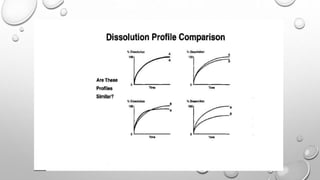
 In this method we plot graph of Time V/S concentration of solute
(drug) in the dissolution medium or biological fluid.
 The shape of two curves is compared for comparison of
dissolution pattern and the concentration of drug at each point is
compared for extent of dissolution.
If two or more curves are overlapping then the dissolution profile
is comparable.
If difference is small then it is acceptable but higher differences
indicate that the dissolution profile is not comparable.
STATISTICAL ANALYSIS
1.Student’s t-Test:
The test under the student t-Test are ;
a) One sample t-test
b) Paired t-test
c) Unpaired t-test
The equation for the t is
t = [ X – μ ] / S / √N
Where X is sample mean
N is sample size
S is sample standard deviation
µ is population standard deviations ,
ANOVA METHOD (ANAYSIS OF
VARIANCE )
• This test is generally applied to different groups of
data. Here we compare the variance of different
groups of data and predict weather the data are
comparable or not.
• Minimum three sets of data are required. Here first we
have to find the variance within each individual group
and then compare them with each other.
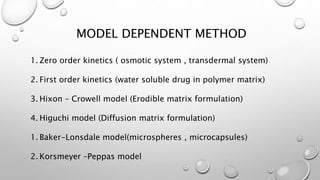
MODEL DEPENDENT METHOD
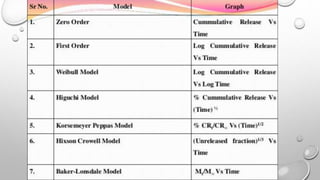
1. Zero order kinetics ( osmotic system , transdermal system)
2. First order kinetics (water soluble drug in polymer matrix)
3. Hixon – Crowell model (Erodible matrix formulation)
4. Higuchi model (Diffusion matrix formulation)
1. Baker-Lonsdale model(microspheres , microcapsules)
2. Korsmeyer –Peppas model
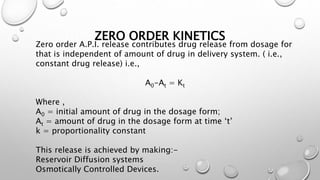
ZERO ORDER KINETICS
Zero order A.P.I. release contributes drug release from dosage for
that is independent of amount of drug in delivery system. ( i.e.,
constant drug release) i.e.,
A0-At = Kt
Where ,
A0 = initial amount of drug in the dosage form;
At = amount of drug in the dosage form at time ‘t’
k = proportionality constant
This release is achieved by making:-
Reservoir Diffusion systems
Osmotically Controlled Devices.
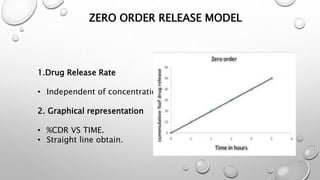
ZERO ORDER RELEASE MODEL
1.Drug Release Rate
• Independent of concentration
2. Graphical representation
• %CDR VS TIME.
• Straight line obtain.
Transdermal DDS.
Implantable depot.
Oral control release.
Matrix tablet with low solubility drug
Suspension
Oral Osmotic Pressure
Examples of Zero order
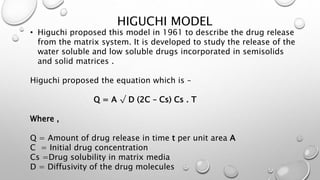
HIGUCHI MODEL
• Higuchi proposed this model in 1961 to describe the drug release
from the matrix system. It is developed to study the release of the
water soluble and low soluble drugs incorporated in semisolids
and solid matrices .
Higuchi proposed the equation which is –
Q = A √ D (2C – Cs) Cs . T
Where ,
Q = Amount of drug release in time t per unit area A
C = Initial drug concentration
Cs =Drug solubility in matrix media
D = Diffusivity of the drug molecules
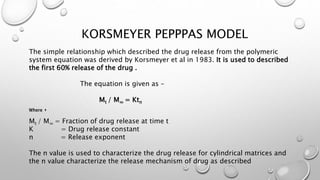
KORSMEYER PEPPPAS MODEL
The simple relationship which described the drug release from the polymeric
system equation was derived by Korsmeyer et al in 1983. It is used to described
the first 60% release of the drug .
The equation is given as –
Mt / M∞ = Ktn
Where ,
Mt / M∞ = Fraction of drug release at time t
K = Drug release constant
n = Release exponent
The n value is used to characterize the drug release for cylindrical matrices and
the n value characterize the release mechanism of drug as described
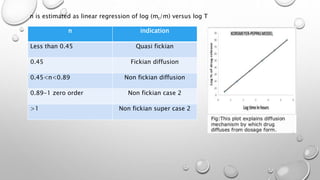
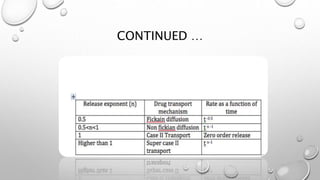
n indication
Less than 0.45 Quasi fickian
0.45 Fickian diffusion
0.45<n<0.89 Non fickian diffusion
0.89-1 zero order Non fickian case 2
>1 Non fickian super case 2
n is estimated as linear regression of log (mt/m) versus log T
CONTINUED …
MODEL INDEPENDENT METHOD
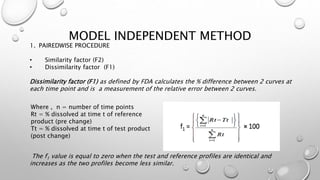
1. PAIREDWISE PROCEDURE
• Similarity factor (F2)
• Dissimilarity factor (F1)
Dissimilarity factor (F1) as defined by FDA calculates the % difference between 2 curves at
each time point and is a measurement of the relative error between 2 curves.
Where , n = number of time points
Rt = % dissolved at time t of reference
product (pre change)
Tt = % dissolved at time t of test product
(post change)
The f1 value is equal to zero when the test and reference profiles are identical and
increases as the two profiles become less similar.
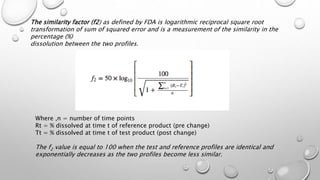
The similarity factor (f2) as defined by FDA is logarithmic reciprocal square root
transformation of sum of squared error and is a measurement of the similarity in the
percentage (%)
dissolution between the two profiles.
Where ,n = number of time points
Rt = % dissolved at time t of reference product (pre change)
Tt = % dissolved at time t of test product (post change)
The f2 value is equal to 100 when the test and reference profiles are identical and
exponentially decreases as the two profiles become less similar.
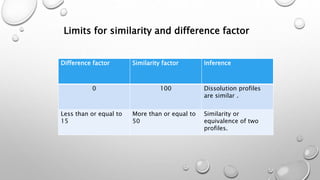
Difference factor Similarity factor Inference
0 100 Dissolution profiles
are similar .
Less than or equal to
15
More than or equal to
50
Similarity or
equivalence of two
profiles.
Limits for similarity and difference factor
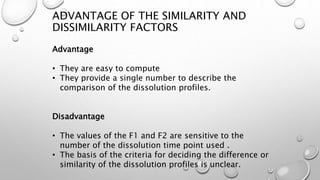
ADVANTAGE OF THE SIMILARITY AND
DISSIMILARITY FACTORS
Advantage
• They are easy to compute
• They provide a single number to describe the
comparison of the dissolution profiles.
Disadvantage
• The values of the F1 and F2 are sensitive to the
number of the dissolution time point used .
• The basis of the criteria for deciding the difference or
similarity of the dissolution profiles is unclear.
CRITERIA FOR EXEMPTIONS
FROM F2 COMPARISONS
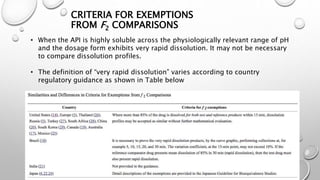
• When the API is highly soluble across the physiologically relevant range of pH
and the dosage form exhibits very rapid dissolution. It may not be necessary
to compare dissolution profiles.
• The definition of “very rapid dissolution” varies according to country
regulatory guidance as shown in Table below
MINIMUM NUMBER OF TIME
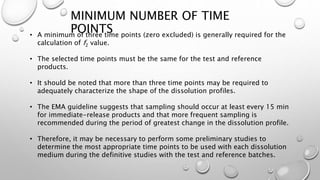
POINTS• A minimum of three time points (zero excluded) is generally required for the
calculation of f2 value.
• The selected time points must be the same for the test and reference
products.
• It should be noted that more than three time points may be required to
adequately characterize the shape of the dissolution profiles.
• The EMA guideline suggests that sampling should occur at least every 15 min
for immediate-release products and that more frequent sampling is
recommended during the period of greatest change in the dissolution profile.
• Therefore, it may be necessary to perform some preliminary studies to
determine the most appropriate time points to be used with each dissolution
medium during the definitive studies with the test and reference batches.
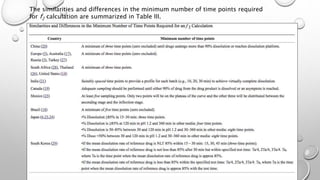
The similarities and differences in the minimum number of time points required
for f2 calculation are summarized in Table III.
IMPORTANCE OF THE SELECTION OF
THE TIME POINTS
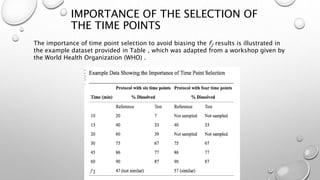
The importance of time point selection to avoid biasing the f2 results is illustrated in
the example dataset provided in Table , which was adapted from a workshop given by
the World Health Organization (WHO) .
COEFFICIENT OF VARIATION CRITERIA
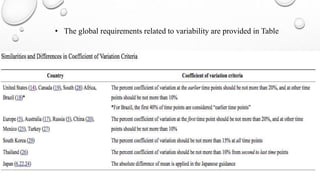
• In general, the guidelines for immediate-release products state that the coefficient of
variation (%CV) for the individual dissolution results should be not more than 20%
at the earlier time points and not more than 10% at other time points.
• Time points up to several hours could be considered as “early” time points for an
extended-release dosage form, while 15 min might be a reasonable cut-off for an
immediate-release dosage form.
• The global requirements related to variability are provided in Table
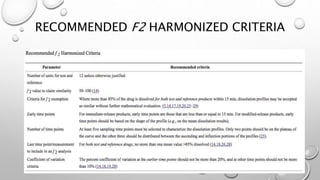
RECOMMENDED F2 HARMONIZED CRITERIA
CONCLUSION
• Graphical method is the first step to compare the dissolution
profiles and it is easy to implement but it is difficult to draw a
conclusion from this.
• Various model dependent methods are used to compare the
dissolution profile but selecting the model , interpretation of the
parameters of the models and the setting the limits of the
similarity is difficult.
• F1 and F2 comparison is very easy and this is most widely
method to compare the dissolution profiles . This is also
recommended by FDA.
THANK YOU.

Dissolution profile comparison

  • 1.
    DISSOLUTION PROFILE COMPARISON SUBMITTED TOSUBMITTED BY DR JAVED ALI MOHD IMRAN DEPARTMENT OF PHARMACEUITCS MPHARM II SEMESTER SPER , JAMIA HAMDARD DEPARTMENT OF PHARMACEUTICS NEW DELHI SPER , JAMIA HAMDARD
  • 2.
    CONTENT  Definition  Objectives Different methods used for dissolution Comparison  Comparison of different methods  References
  • 3.
    DISSOLUTION PROFILE COMPARAISON Definition Itis graphical representation in terms of [concentration vs. time] of complete release of A.P.I. from a dosage form in an appropriate selected dissolution medium.
  • 4.
    OBJECTIVE OF DISSOLUTIONPROFILE COMPARISON Development of bioequivalent product. Demonstrating equivalence after change in formulation of the drug product. To Develop in vitro-in vivo correlation which can help to reduce the costs, speed-up product development and reduced the need of perform costly bioavailability human volunteer studies. To stabilize final dissolution specification for the pharmacological For optimizing the dosage formula by comparing the dissolution profiles of various formulas of the same A.P.I
  • 5.
    CONTINUED…. Biowaiver of drugproduct of lower dose strength in proportion to higher dose strength drug product containing same active ingredient and excipients.  FDA has placed more emphasis on dissolution profile comparison in the field of post approval changes and biowaivers (e.g. Class I drugs of BCS classification are skipped off these testing for quicker approvalby FDA ). The most important application of the dissolution profile is that by knowing the dissolution profile of particular product of the BRAND LEADER, we can make appropriate necessary change in our formulation to achieve the same profile of the BRAND LEADER.
  • 6.
    METHODS TO COMPAREDISSOLUTION PROFILE 1.Graphical method 2.Statistical method 3.Model dependent 4.Model independent
  • 7.
    GRAPHICAL METHOD  Inthis method we plot graph of Time V/S concentration of solute (drug) in the dissolution medium or biological fluid.  The shape of two curves is compared for comparison of dissolution pattern and the concentration of drug at each point is compared for extent of dissolution. If two or more curves are overlapping then the dissolution profile is comparable. If difference is small then it is acceptable but higher differences indicate that the dissolution profile is not comparable.
  • 9.
    STATISTICAL ANALYSIS 1.Student’s t-Test: Thetest under the student t-Test are ; a) One sample t-test b) Paired t-test c) Unpaired t-test The equation for the t is t = [ X – μ ] / S / √N Where X is sample mean N is sample size S is sample standard deviation µ is population standard deviations ,
  • 10.
    ANOVA METHOD (ANAYSISOF VARIANCE ) • This test is generally applied to different groups of data. Here we compare the variance of different groups of data and predict weather the data are comparable or not. • Minimum three sets of data are required. Here first we have to find the variance within each individual group and then compare them with each other.
  • 11.
    MODEL DEPENDENT METHOD 1.Zero order kinetics ( osmotic system , transdermal system) 2. First order kinetics (water soluble drug in polymer matrix) 3. Hixon – Crowell model (Erodible matrix formulation) 4. Higuchi model (Diffusion matrix formulation) 1. Baker-Lonsdale model(microspheres , microcapsules) 2. Korsmeyer –Peppas model
  • 12.
    ZERO ORDER KINETICS Zeroorder A.P.I. release contributes drug release from dosage for that is independent of amount of drug in delivery system. ( i.e., constant drug release) i.e., A0-At = Kt Where , A0 = initial amount of drug in the dosage form; At = amount of drug in the dosage form at time ‘t’ k = proportionality constant This release is achieved by making:- Reservoir Diffusion systems Osmotically Controlled Devices.
  • 13.
    ZERO ORDER RELEASEMODEL 1.Drug Release Rate • Independent of concentration 2. Graphical representation • %CDR VS TIME. • Straight line obtain.
  • 14.
    Transdermal DDS. Implantable depot. Oralcontrol release. Matrix tablet with low solubility drug Suspension Oral Osmotic Pressure Examples of Zero order
  • 15.
    HIGUCHI MODEL • Higuchiproposed this model in 1961 to describe the drug release from the matrix system. It is developed to study the release of the water soluble and low soluble drugs incorporated in semisolids and solid matrices . Higuchi proposed the equation which is – Q = A √ D (2C – Cs) Cs . T Where , Q = Amount of drug release in time t per unit area A C = Initial drug concentration Cs =Drug solubility in matrix media D = Diffusivity of the drug molecules
  • 16.
    KORSMEYER PEPPPAS MODEL Thesimple relationship which described the drug release from the polymeric system equation was derived by Korsmeyer et al in 1983. It is used to described the first 60% release of the drug . The equation is given as – Mt / M∞ = Ktn Where , Mt / M∞ = Fraction of drug release at time t K = Drug release constant n = Release exponent The n value is used to characterize the drug release for cylindrical matrices and the n value characterize the release mechanism of drug as described
  • 17.
    n indication Less than0.45 Quasi fickian 0.45 Fickian diffusion 0.45<n<0.89 Non fickian diffusion 0.89-1 zero order Non fickian case 2 >1 Non fickian super case 2 n is estimated as linear regression of log (mt/m) versus log T
  • 18.
  • 20.
    MODEL INDEPENDENT METHOD 1.PAIREDWISE PROCEDURE • Similarity factor (F2) • Dissimilarity factor (F1) Dissimilarity factor (F1) as defined by FDA calculates the % difference between 2 curves at each time point and is a measurement of the relative error between 2 curves. Where , n = number of time points Rt = % dissolved at time t of reference product (pre change) Tt = % dissolved at time t of test product (post change) The f1 value is equal to zero when the test and reference profiles are identical and increases as the two profiles become less similar.
  • 21.
    The similarity factor(f2) as defined by FDA is logarithmic reciprocal square root transformation of sum of squared error and is a measurement of the similarity in the percentage (%) dissolution between the two profiles. Where ,n = number of time points Rt = % dissolved at time t of reference product (pre change) Tt = % dissolved at time t of test product (post change) The f2 value is equal to 100 when the test and reference profiles are identical and exponentially decreases as the two profiles become less similar.
  • 22.
    Difference factor Similarityfactor Inference 0 100 Dissolution profiles are similar . Less than or equal to 15 More than or equal to 50 Similarity or equivalence of two profiles. Limits for similarity and difference factor
  • 23.
    ADVANTAGE OF THESIMILARITY AND DISSIMILARITY FACTORS Advantage • They are easy to compute • They provide a single number to describe the comparison of the dissolution profiles. Disadvantage • The values of the F1 and F2 are sensitive to the number of the dissolution time point used . • The basis of the criteria for deciding the difference or similarity of the dissolution profiles is unclear.
  • 24.
    CRITERIA FOR EXEMPTIONS FROMF2 COMPARISONS • When the API is highly soluble across the physiologically relevant range of pH and the dosage form exhibits very rapid dissolution. It may not be necessary to compare dissolution profiles. • The definition of “very rapid dissolution” varies according to country regulatory guidance as shown in Table below
  • 25.
    MINIMUM NUMBER OFTIME POINTS• A minimum of three time points (zero excluded) is generally required for the calculation of f2 value. • The selected time points must be the same for the test and reference products. • It should be noted that more than three time points may be required to adequately characterize the shape of the dissolution profiles. • The EMA guideline suggests that sampling should occur at least every 15 min for immediate-release products and that more frequent sampling is recommended during the period of greatest change in the dissolution profile. • Therefore, it may be necessary to perform some preliminary studies to determine the most appropriate time points to be used with each dissolution medium during the definitive studies with the test and reference batches.
  • 26.
    The similarities anddifferences in the minimum number of time points required for f2 calculation are summarized in Table III.
  • 27.
    IMPORTANCE OF THESELECTION OF THE TIME POINTS The importance of time point selection to avoid biasing the f2 results is illustrated in the example dataset provided in Table , which was adapted from a workshop given by the World Health Organization (WHO) .
  • 28.
    COEFFICIENT OF VARIATIONCRITERIA • In general, the guidelines for immediate-release products state that the coefficient of variation (%CV) for the individual dissolution results should be not more than 20% at the earlier time points and not more than 10% at other time points. • Time points up to several hours could be considered as “early” time points for an extended-release dosage form, while 15 min might be a reasonable cut-off for an immediate-release dosage form.
  • 29.
    • The globalrequirements related to variability are provided in Table
  • 30.
  • 31.
    CONCLUSION • Graphical methodis the first step to compare the dissolution profiles and it is easy to implement but it is difficult to draw a conclusion from this. • Various model dependent methods are used to compare the dissolution profile but selecting the model , interpretation of the parameters of the models and the setting the limits of the similarity is difficult. • F1 and F2 comparison is very easy and this is most widely method to compare the dissolution profiles . This is also recommended by FDA.
  • 32.