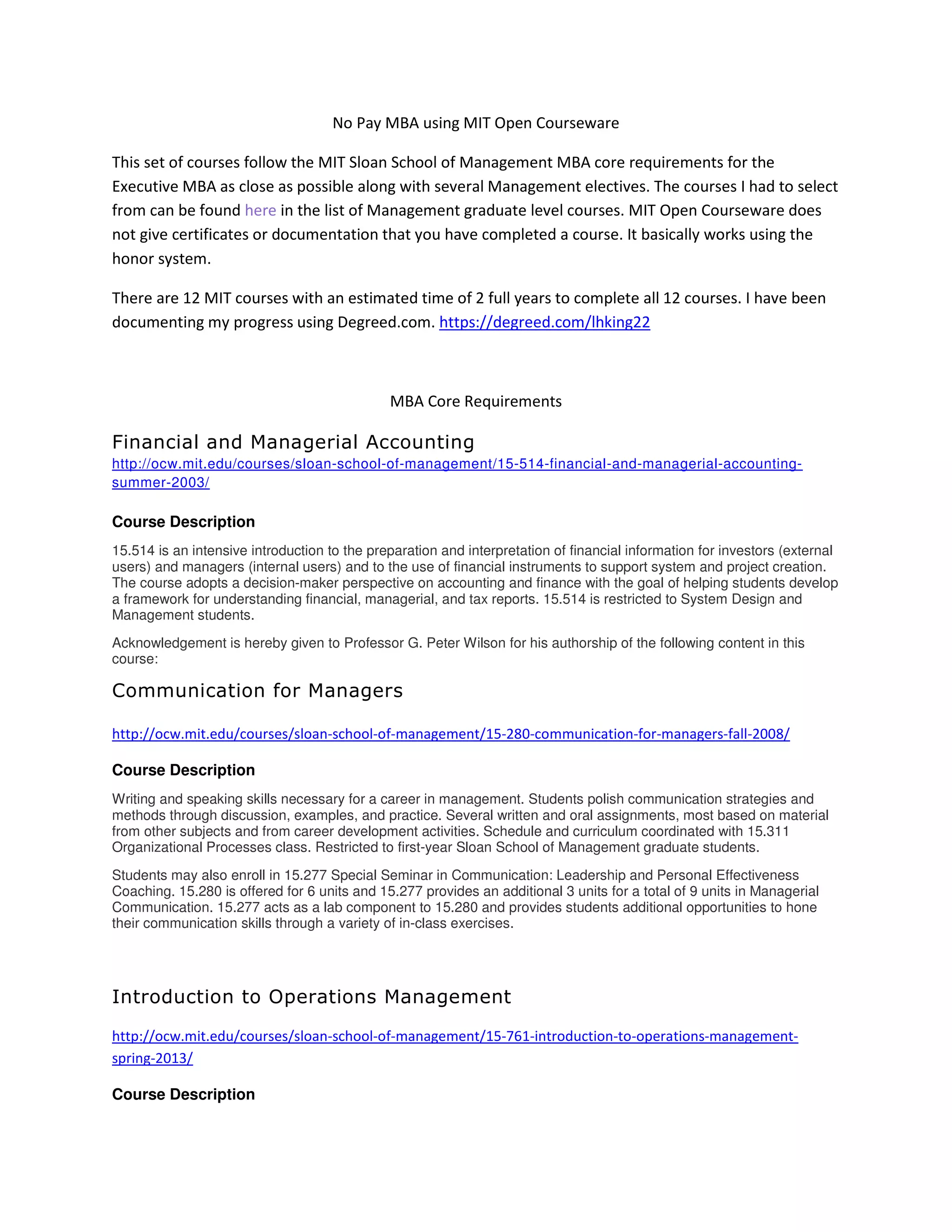
No Pay MBA using MIT Open Courseware
This set of courses follow the MIT Sloan School of Management MBA core requirements for the
Executive MBA as close as possible along with several Management electives. The courses I had to select
from can be found here in the list of Management graduate level courses. MIT Open Courseware does
not give certificates or documentation that you have completed a course. It basically works using the
honor system.
There are 12 MIT courses with an estimated time of 2 full years to complete all 12 courses. I have been
documenting my progress using Degreed.com. https://degreed.com/lhking22
MBA Core Requirements
Financial and Managerial Accounting
http://ocw.mit.edu/courses/sloan-school-of-management/15-514-financial-and-managerial-accounting-
summer-2003/
Course Description
15.514 is an intensive introduction to the preparation and interpretation of financial information for investors (external
users) and managers (internal users) and to the use of financial instruments to support system and project creation.
The course adopts a decision-maker perspective on accounting and finance with the goal of helping students develop
a framework for understanding financial, managerial, and tax reports. 15.514 is restricted to System Design and
Management students.
Acknowledgement is hereby given to Professor G. Peter Wilson for his authorship of the following content in this
course:
Communication for Managers
http://ocw.mit.edu/courses/sloan-school-of-management/15-280-communication-for-managers-fall-2008/
Course Description
Writing and speaking skills necessary for a career in management. Students polish communication strategies and
methods through discussion, examples, and practice. Several written and oral assignments, most based on material
from other subjects and from career development activities. Schedule and curriculum coordinated with 15.311
Organizational Processes class. Restricted to first-year Sloan School of Management graduate students.
Students may also enroll in 15.277 Special Seminar in Communication: Leadership and Personal Effectiveness
Coaching. 15.280 is offered for 6 units and 15.277 provides an additional 3 units for a total of 9 units in Managerial
Communication. 15.277 acts as a lab component to 15.280 and provides students additional opportunities to hone
their communication skills through a variety of in-class exercises.
Introduction to Operations Management
http://ocw.mit.edu/courses/sloan-school-of-management/15-761-introduction-to-operations-management-
spring-2013/
Course Description
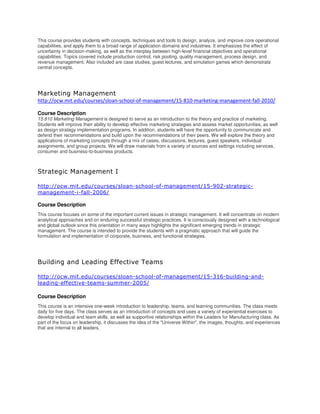
This course provides students with concepts, techniques and tools to design, analyze, and improve core operational
capabilities, and apply them to a broad range of application domains and industries. It emphasizes the effect of
uncertainty in decision-making, as well as the interplay between high-level financial objectives and operational
capabilities. Topics covered include production control, risk pooling, quality management, process design, and
revenue management. Also included are case studies, guest lectures, and simulation games which demonstrate
central concepts.
Marketing Management
http://ocw.mit.edu/courses/sloan-school-of-management/15-810-marketing-management-fall-2010/
Course Description
15.810 Marketing Management is designed to serve as an introduction to the theory and practice of marketing.
Students will improve their ability to develop effective marketing strategies and assess market opportunities, as well
as design strategy implementation programs. In addition, students will have the opportunity to communicate and
defend their recommendations and build upon the recommendations of their peers. We will explore the theory and
applications of marketing concepts through a mix of cases, discussions, lectures, guest speakers, individual
assignments, and group projects. We will draw materials from a variety of sources and settings including services,
consumer and business-to-business products.
Strategic Management I
http://ocw.mit.edu/courses/sloan-school-of-management/15-902-strategic-
management-i-fall-2006/
Course Description
This course focuses on some of the important current issues in strategic management. It will concentrate on modern
analytical approaches and on enduring successful strategic practices. It is consciously designed with a technological
and global outlook since this orientation in many ways highlights the significant emerging trends in strategic
management. The course is intended to provide the students with a pragmatic approach that will guide the
formulation and implementation of corporate, business, and functional strategies.
Building and Leading Effective Teams
http://ocw.mit.edu/courses/sloan-school-of-management/15-316-building-and-
leading-effective-teams-summer-2005/
Course Description
This course is an intensive one-week introduction to leadership, teams, and learning communities. The class meets
daily for five days. The class serves as an introduction of concepts and uses a variety of experiential exercises to
develop individual and team skills, as well as supportive relationships within the Leaders for Manufacturing class. As
part of the focus on leadership, it discusses the idea of the "Universe Within", the images, thoughts, and experiences
that are internal to all leaders.
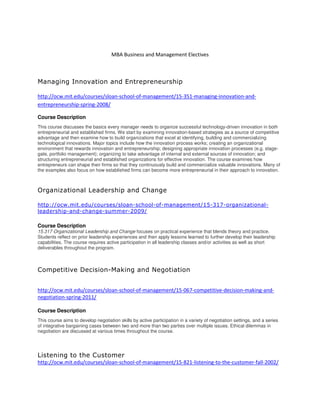
MBA Business and Management Electives
Managing Innovation and Entrepreneurship
http://ocw.mit.edu/courses/sloan-school-of-management/15-351-managing-innovation-and-
entrepreneurship-spring-2008/
Course Description
This course discusses the basics every manager needs to organize successful technology-driven innovation in both
entrepreneurial and established firms. We start by examining innovation-based strategies as a source of competitive
advantage and then examine how to build organizations that excel at identifying, building and commercializing
technological innovations. Major topics include how the innovation process works; creating an organizational
environment that rewards innovation and entrepreneurship; designing appropriate innovation processes (e.g. stage-
gate, portfolio management); organizing to take advantage of internal and external sources of innovation; and
structuring entrepreneurial and established organizations for effective innovation. The course examines how
entrepreneurs can shape their firms so that they continuously build and commercialize valuable innovations. Many of
the examples also focus on how established firms can become more entrepreneurial in their approach to innovation.
Organizational Leadership and Change
http://ocw.mit.edu/courses/sloan-school-of-management/15-317-organizational-
leadership-and-change-summer-2009/
Course Description
15.317 Organizational Leadership and Change focuses on practical experience that blends theory and practice.
Students reflect on prior leadership experiences and then apply lessons learned to further develop their leadership
capabilities. The course requires active participation in all leadership classes and/or activities as well as short
deliverables throughout the program.
Competitive Decision-Making and Negotiation
http://ocw.mit.edu/courses/sloan-school-of-management/15-067-competitive-decision-making-and-
negotiation-spring-2011/
Course Description
This course aims to develop negotiation skills by active participation in a variety of negotiation settings, and a series
of integrative bargaining cases between two and more than two parties over multiple issues. Ethical dilemmas in
negotiation are discussed at various times throughout the course.
Listening to the Customer
http://ocw.mit.edu/courses/sloan-school-of-management/15-821-listening-to-the-customer-fall-2002/
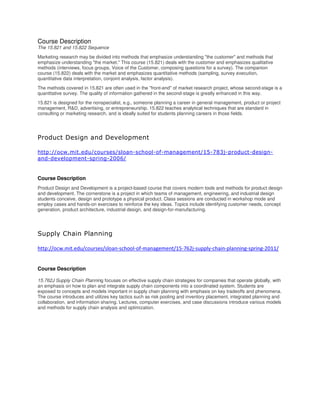
Course Description
The 15.821 and 15.822 Sequence
Marketing research may be divided into methods that emphasize understanding "the customer" and methods that
emphasize understanding "the market." This course (15.821) deals with the customer and emphasizes qualitative
methods (interviews, focus groups, Voice of the Customer, composing questions for a survey). The companion
course (15.822) deals with the market and emphasizes quantitative methods (sampling, survey execution,
quantitative data interpretation, conjoint analysis, factor analysis).
The methods covered in 15.821 are often used in the "front-end" of market research project, whose second-stage is a
quantitative survey. The quality of information gathered in the second-stage is greatly enhanced in this way.
15.821 is designed for the nonspecialist, e.g., someone planning a career in general management, product or project
management, R&D, advertising, or entrepreneurship. 15.822 teaches analytical techniques that are standard in
consulting or marketing research, and is ideally suited for students planning careers in those fields.
Product Design and Development
http://ocw.mit.edu/courses/sloan-school-of-management/15-783j-product-design-
and-development-spring-2006/
Course Description
Product Design and Development is a project-based course that covers modern tools and methods for product design
and development. The cornerstone is a project in which teams of management, engineering, and industrial design
students conceive, design and prototype a physical product. Class sessions are conducted in workshop mode and
employ cases and hands-on exercises to reinforce the key ideas. Topics include identifying customer needs, concept
generation, product architecture, industrial design, and design-for-manufacturing.
Supply Chain Planning
http://ocw.mit.edu/courses/sloan-school-of-management/15-762j-supply-chain-planning-spring-2011/
Course Description
15.762J Supply Chain Planning focuses on effective supply chain strategies for companies that operate globally, with
an emphasis on how to plan and integrate supply chain components into a coordinated system. Students are
exposed to concepts and models important in supply chain planning with emphasis on key tradeoffs and phenomena.
The course introduces and utilizes key tactics such as risk pooling and inventory placement, integrated planning and
collaboration, and information sharing. Lectures, computer exercises, and case discussions introduce various models
and methods for supply chain analysis and optimization.

No pay mba through mit open courseware

  • 1.
    No Pay MBAusing MIT Open Courseware This set of courses follow the MIT Sloan School of Management MBA core requirements for the Executive MBA as close as possible along with several Management electives. The courses I had to select from can be found here in the list of Management graduate level courses. MIT Open Courseware does not give certificates or documentation that you have completed a course. It basically works using the honor system. There are 12 MIT courses with an estimated time of 2 full years to complete all 12 courses. I have been documenting my progress using Degreed.com. https://degreed.com/lhking22 MBA Core Requirements Financial and Managerial Accounting http://ocw.mit.edu/courses/sloan-school-of-management/15-514-financial-and-managerial-accounting- summer-2003/ Course Description 15.514 is an intensive introduction to the preparation and interpretation of financial information for investors (external users) and managers (internal users) and to the use of financial instruments to support system and project creation. The course adopts a decision-maker perspective on accounting and finance with the goal of helping students develop a framework for understanding financial, managerial, and tax reports. 15.514 is restricted to System Design and Management students. Acknowledgement is hereby given to Professor G. Peter Wilson for his authorship of the following content in this course: Communication for Managers http://ocw.mit.edu/courses/sloan-school-of-management/15-280-communication-for-managers-fall-2008/ Course Description Writing and speaking skills necessary for a career in management. Students polish communication strategies and methods through discussion, examples, and practice. Several written and oral assignments, most based on material from other subjects and from career development activities. Schedule and curriculum coordinated with 15.311 Organizational Processes class. Restricted to first-year Sloan School of Management graduate students. Students may also enroll in 15.277 Special Seminar in Communication: Leadership and Personal Effectiveness Coaching. 15.280 is offered for 6 units and 15.277 provides an additional 3 units for a total of 9 units in Managerial Communication. 15.277 acts as a lab component to 15.280 and provides students additional opportunities to hone their communication skills through a variety of in-class exercises. Introduction to Operations Management http://ocw.mit.edu/courses/sloan-school-of-management/15-761-introduction-to-operations-management- spring-2013/ Course Description
  • 2.
    This course providesstudents with concepts, techniques and tools to design, analyze, and improve core operational capabilities, and apply them to a broad range of application domains and industries. It emphasizes the effect of uncertainty in decision-making, as well as the interplay between high-level financial objectives and operational capabilities. Topics covered include production control, risk pooling, quality management, process design, and revenue management. Also included are case studies, guest lectures, and simulation games which demonstrate central concepts. Marketing Management http://ocw.mit.edu/courses/sloan-school-of-management/15-810-marketing-management-fall-2010/ Course Description 15.810 Marketing Management is designed to serve as an introduction to the theory and practice of marketing. Students will improve their ability to develop effective marketing strategies and assess market opportunities, as well as design strategy implementation programs. In addition, students will have the opportunity to communicate and defend their recommendations and build upon the recommendations of their peers. We will explore the theory and applications of marketing concepts through a mix of cases, discussions, lectures, guest speakers, individual assignments, and group projects. We will draw materials from a variety of sources and settings including services, consumer and business-to-business products. Strategic Management I http://ocw.mit.edu/courses/sloan-school-of-management/15-902-strategic- management-i-fall-2006/ Course Description This course focuses on some of the important current issues in strategic management. It will concentrate on modern analytical approaches and on enduring successful strategic practices. It is consciously designed with a technological and global outlook since this orientation in many ways highlights the significant emerging trends in strategic management. The course is intended to provide the students with a pragmatic approach that will guide the formulation and implementation of corporate, business, and functional strategies. Building and Leading Effective Teams http://ocw.mit.edu/courses/sloan-school-of-management/15-316-building-and- leading-effective-teams-summer-2005/ Course Description This course is an intensive one-week introduction to leadership, teams, and learning communities. The class meets daily for five days. The class serves as an introduction of concepts and uses a variety of experiential exercises to develop individual and team skills, as well as supportive relationships within the Leaders for Manufacturing class. As part of the focus on leadership, it discusses the idea of the "Universe Within", the images, thoughts, and experiences that are internal to all leaders.
  • 3.
    MBA Business andManagement Electives Managing Innovation and Entrepreneurship http://ocw.mit.edu/courses/sloan-school-of-management/15-351-managing-innovation-and- entrepreneurship-spring-2008/ Course Description This course discusses the basics every manager needs to organize successful technology-driven innovation in both entrepreneurial and established firms. We start by examining innovation-based strategies as a source of competitive advantage and then examine how to build organizations that excel at identifying, building and commercializing technological innovations. Major topics include how the innovation process works; creating an organizational environment that rewards innovation and entrepreneurship; designing appropriate innovation processes (e.g. stage- gate, portfolio management); organizing to take advantage of internal and external sources of innovation; and structuring entrepreneurial and established organizations for effective innovation. The course examines how entrepreneurs can shape their firms so that they continuously build and commercialize valuable innovations. Many of the examples also focus on how established firms can become more entrepreneurial in their approach to innovation. Organizational Leadership and Change http://ocw.mit.edu/courses/sloan-school-of-management/15-317-organizational- leadership-and-change-summer-2009/ Course Description 15.317 Organizational Leadership and Change focuses on practical experience that blends theory and practice. Students reflect on prior leadership experiences and then apply lessons learned to further develop their leadership capabilities. The course requires active participation in all leadership classes and/or activities as well as short deliverables throughout the program. Competitive Decision-Making and Negotiation http://ocw.mit.edu/courses/sloan-school-of-management/15-067-competitive-decision-making-and- negotiation-spring-2011/ Course Description This course aims to develop negotiation skills by active participation in a variety of negotiation settings, and a series of integrative bargaining cases between two and more than two parties over multiple issues. Ethical dilemmas in negotiation are discussed at various times throughout the course. Listening to the Customer http://ocw.mit.edu/courses/sloan-school-of-management/15-821-listening-to-the-customer-fall-2002/
  • 4.
    Course Description The 15.821and 15.822 Sequence Marketing research may be divided into methods that emphasize understanding "the customer" and methods that emphasize understanding "the market." This course (15.821) deals with the customer and emphasizes qualitative methods (interviews, focus groups, Voice of the Customer, composing questions for a survey). The companion course (15.822) deals with the market and emphasizes quantitative methods (sampling, survey execution, quantitative data interpretation, conjoint analysis, factor analysis). The methods covered in 15.821 are often used in the "front-end" of market research project, whose second-stage is a quantitative survey. The quality of information gathered in the second-stage is greatly enhanced in this way. 15.821 is designed for the nonspecialist, e.g., someone planning a career in general management, product or project management, R&D, advertising, or entrepreneurship. 15.822 teaches analytical techniques that are standard in consulting or marketing research, and is ideally suited for students planning careers in those fields. Product Design and Development http://ocw.mit.edu/courses/sloan-school-of-management/15-783j-product-design- and-development-spring-2006/ Course Description Product Design and Development is a project-based course that covers modern tools and methods for product design and development. The cornerstone is a project in which teams of management, engineering, and industrial design students conceive, design and prototype a physical product. Class sessions are conducted in workshop mode and employ cases and hands-on exercises to reinforce the key ideas. Topics include identifying customer needs, concept generation, product architecture, industrial design, and design-for-manufacturing. Supply Chain Planning http://ocw.mit.edu/courses/sloan-school-of-management/15-762j-supply-chain-planning-spring-2011/ Course Description 15.762J Supply Chain Planning focuses on effective supply chain strategies for companies that operate globally, with an emphasis on how to plan and integrate supply chain components into a coordinated system. Students are exposed to concepts and models important in supply chain planning with emphasis on key tradeoffs and phenomena. The course introduces and utilizes key tactics such as risk pooling and inventory placement, integrated planning and collaboration, and information sharing. Lectures, computer exercises, and case discussions introduce various models and methods for supply chain analysis and optimization.