Protecting Your
Competitive
Advantages.
Copyright FLYNN IP LAW 2016 1
Protecting Your Competitive
Advantages.
Presented October 15, 2016
You GROW Girl
Annual Business Summit
Charlotte, North Carolina
Copyright FLYNN IP LAW 2016 2
Disclaimer
Copyright FLYNN IP LAW 2016 3
This set of slides is NOT a substitute for a consultation with an intellectual
property attorney.
The materials in these slides have been prepared for informational purposes
and are not legal advice.
The purpose of these slides is to introduce concepts to entrepreneurs so that
the entrepreneur can get fact specific legal advice.
The laws, regulations, and best practices change over time and these slides will
not be updated.
Those seeking to make a decision to seek or not seek protection for any form
of intellectual property or other business decision should seek counsel from an
attorney that has been provided with all the relevant information and
considered all the relevant laws, regulations, and the exceptions.
Thus, FLYNN IP LAW provides this slide set AS IS without any representations or
warranties that the material presented in the slides is appropriate for a
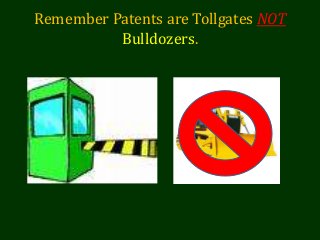
particular situation.
Objectives
• I am NOT going to make you into an Intellectual
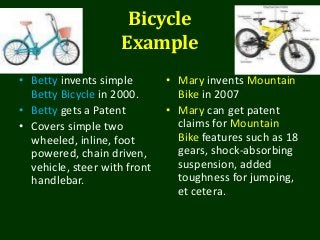
Property (“IP”) expert in 20 minutes.
• I do want to get you thinking about identifying and
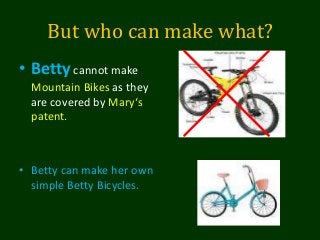
protecting
Competitive Advantages.
.
Big Picture Before the Details
Copyright FLYNN IP LAW 2016 5
What is the point of getting a:
patent,
copyright,
trademark, or
trade secret?
Copyright FLYNN IP LAW 2016 6
Copyright FLYNN IP LAW 2016 7
One way to lock in success for
a new company is moving the
supply or demand curves
to a more favorable position
than the curves for the
competitors.
Intellectual property can
protect the curve offsets.
P
R
I
C
E
Quantity
S
D
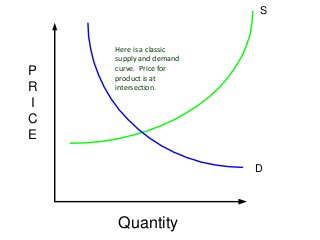
Here is a classic
supply and demand
curve. Price for
product is at
intersection.
P
R
I
C
E
Quantity
S
D
Price
Premium
D(YC)
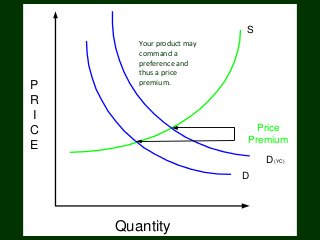
Your product may
command a
preference and
thus a price
premium.
P
R
I
C
E
Quantity
S (YC)
D
D(YC)
S (clones)
10
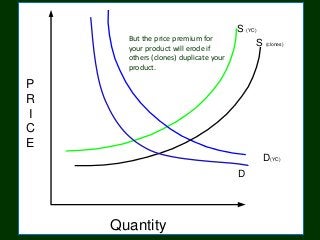
But the price premium for
your product will erode if
others (clones) duplicate your
product.
Impact of Clones
• They follow in your footsteps.
• Clones take less risk, have less R&D
• Followers, not leaders.
• Thus, they have lower overhead and a
better supply curve.
• Clones erode your profitability as they
–decrease your price premium
–but not your costs.
Impact of Clones
Summary of Impact
• Before Clones hit the market
– You Get premium prices $$$$$
• After Clones hit the market
– You Get only a fraction of what you had $$
Way to ward off Clones
• Identify your Competitive Edge
• Protect your Competitive Edge
• With protection
–clones can not create an exact
substitute for your premium product.
Competitive Edge-1st Type
• Goodwill
– Reputation based upon:
• Investments in Advertising & Social Media,
• Quality of product as you buy the best
ingredients/components & take no shortcuts,
• Excellent customer service.
– Protect Goodwill with
Trademarks, Domain Names, &
Design Patents
– So people looking to buy from YOU
do not get siphoned off
Competitive Edge-2nd Type
• Better Product
•Special Features
•Faster, smaller, lemon scented,
l o n g e r battery life…
–Consider
•Patents, Trade Secrets, and
Competitive Edge from Inventions
Often Your Competitive Edge will be a
Better Product with Novel Features
But not Always
Copyright FLYNN IP LAW 2016 16
Competitive Edge-3rd Type
SOMETIMES
(especially as markets mature)
Better = Better Process
–Better Process Yield
–Fewer Process Steps
–Less Costly Equipment or Inputs
Copyright FLYNN IP LAW 2016 17
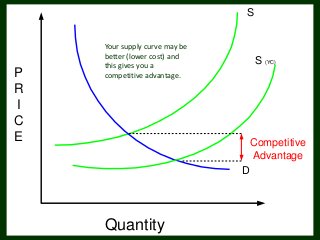
P
R
I
C
E
Quantity
S
D
S (YC)
Competitive
Advantage
Your supply curve may be
better (lower cost) and
this gives you a
competitive advantage.
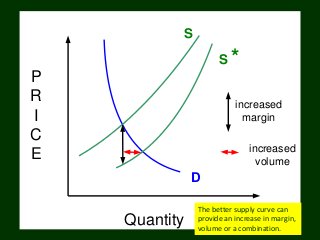
D
Quantity
P
R
I
C
E
S
S *
increased
margin
increased
volume
The better supply curve can
provide an increase in margin,
volume or a combination.
Your Competitive Advantage Won’t
Last without Protection
Protect this type of
Competitive Edge
With
Trade Secrets, Patents, ,
to keep people from duplicating
your improvements.
Your Task
• Recognize the innovations that are part of your
current or future Competitive Edge.
• Maintain contact with an IP attorney as part of
your business process.
• Protect the Competitive Edge
(where possible, in cost effective ways)
Tasks for IP Attorney
• Helps you to pick items to be protected.
• Devises strategy to optimize protection.
• Determines legal deadlines for action.
• Coordinates work of third-parties including
foreign patent firms and search services.
New Topic -
Utility Patents
Copyright FLYNN IP LAW 2016 23
Utility Patents
• The main form of patents.
• Need to have idea that is novel and
non-obvious to one of ordinary skill in the art.
• Must teach the best way you know to make
and use the invention.
• Time consuming process
– for you and the patent attorney.
• $$$ Expensive.
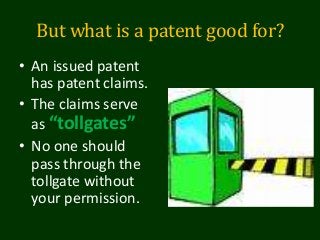
But what is a patent good for?
• An issued patent
has patent claims.
• The claims serve
as “tollgates”
• No one should
pass through the
tollgate without
your permission.
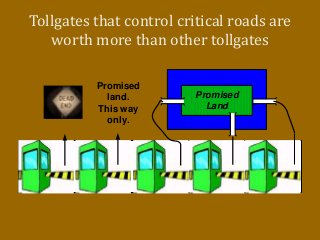
Tollgates that control critical roads are
worth more than other tollgates
Promised
land.
This way
only.
Promised
Land
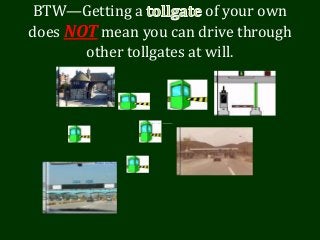
BTW—Getting a of your own
does NOT mean you can drive through
other tollgates at will.
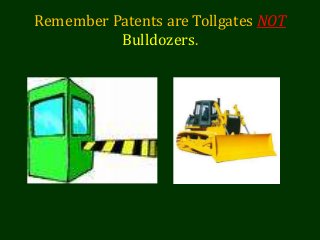
Remember Patents are Tollgates NOT
Bulldozers.
Remember Patents are Tollgates NOT
Bulldozers.
Bicycle
Example
• Betty invents simple
Betty Bicycle in 2000.
• Betty gets a Patent
• Covers simple two
wheeled, inline, foot
powered, chain driven,
vehicle, steer with front
handlebar.
• Mary invents Mountain
Bike in 2007
• Mary can get patent
claims for Mountain
Bike features such as 18
gears, shock-absorbing
suspension, added
toughness for jumping,
et cetera.
But who can make what?
• Betty cannot make
Mountain Bikes as they
are covered by Mary‘s
patent.
• Betty can make her own
simple Betty Bicycles.
But who can make what?
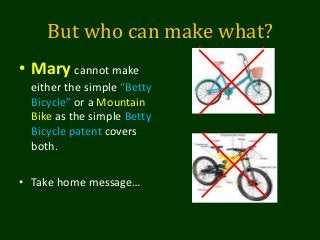
• Mary cannot make
either the simple “Betty
Bicycle” or a Mountain
Bike as the simple Betty
Bicycle patent covers
both.
• Take home message…
But who can make what?
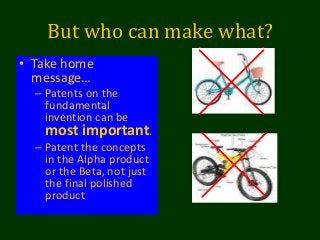
• Take home
message…
– Patents on the
fundamental
invention can be
most important.
– Patent the concepts
in the Alpha product
or the Beta, not just
the final polished
product
Mary’s Mountain Bikes
• Patentability
Yes for
Patentability.
Freedom-to-Operate
Copyright FLYNN IP LAW 2016 35
NO for
Freedom-to-Operate
Mary’s Mountain Bikes
• Patentability
Several of the
improvements in the
Mountain Bike can
obtain patent claims
over Betty’s
Bicycle.
Freedom-to-Operate
Copyright FLYNN IP LAW 2016 36
One or more claims from
the Betty’s Bicycle Patent
cover a simple two
wheeled, inline, foot
powered, chain driven
vehicle, steered by
rotating the front wheel
by a rotating a handlebar.
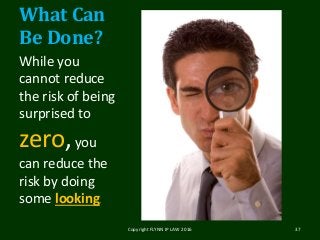
What Can
Be Done?
While you
cannot reduce
the risk of being
surprised to
zero,you
can reduce the
risk by doing
some looking.
Copyright FLYNN IP LAW 2016 37
Why Search?
• You do NOT want to spend time and money to
build a factory to sell
Mary’s Mountain Bikes and
THEN
learn of the Betty Bicycle patent.
Copyright FLYNN IP LAW 2016 38
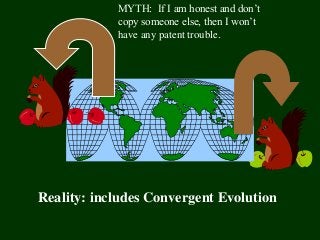
Reality: includes Convergent Evolution
MYTH: If I am honest and don’t
copy someone else, then I won’t
have any patent trouble.
Copyright FLYNN IP LAW 2016 40
Convergent evolution means
A company may “invent” something but be unlucky as some
other company invented the same solution and filed a patent
application.
The law allows for a company to be an innocent infringer
(Law hammers those who willfully infringe the rights of others
with damages that can be enhanced up to 3X.)
Many patents exist for products that never reached the market.
So a market search may not be sufficient.
Checking for freedom-to-operate makes sense even if you did
not copy anything.
Compare with copyright law where infringer must copy.
Is Mary’s Patent Worthless?
•NO
• Mary will have commercially
significant rights once Betty’s
Patent is gone.
–(But only for a few years)
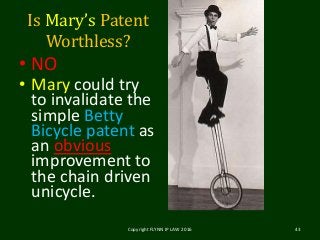
Is Mary’s Patent
Worthless?
• NO
• Mary could try
to invalidate the
simple Betty
Bicycle patent as
an obvious
improvement to
the chain driven
unicycle.
Copyright FLYNN IP LAW 2016 43
Is Mary’s Patent Worthless?
• NO
• MOST LIKELY -- Mary can seek
a cross license from Betty so
that both can sell high margin
Mountain Bikes,
but Cindy (a cloner) cannot
sell mountain bike clones.
Copyright FLYNN IP LAW 2016 44
New Topic -
Design Patents
Copyright FLYNN IP LAW 2016 45
Design Patents
• Cover the ORNAMENTAL aspects of the
product.
• I tell clients that ORNAMENTAL = where
you had options in how the product looks
– without major impacts on functionality.
• Prevents clones from making a look-alike
product to siphon off your customers.
• Cheap to get but relatively thin protection.
• Truly an anti-clone tool –
–but also gives marketing buzz.
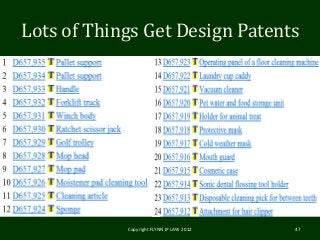
Lots of Things Get Design Patents
Copyright FLYNN IP LAW 2012 47
Design Patents are everywhere…
• From Sunglasses to Automobiles
–Oakley attempts to ward off
“Jokeleys,”
– with an array of 67 design patents
–In 2003, Ford Global Technologies
received patents on items
• as global as entire vehicle exteriors and
• as specific as a gear shift lever
Design Patents are everywhere…
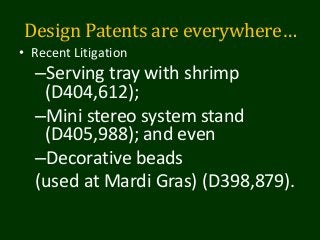
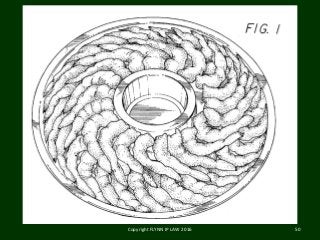
• Recent Litigation
–Serving tray with shrimp
(D404,612);
–Mini stereo system stand
(D405,988); and even
–Decorative beads
(used at Mardi Gras) (D398,879).
Copyright FLYNN IP LAW 2016 50
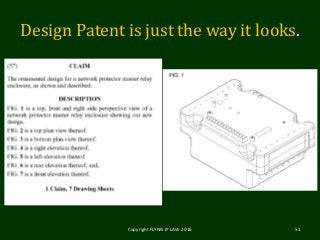
Design Patent is just the way it looks.
Copyright FLYNN IP LAW 2016 51
Design Patents
Design patents can be useful for disposable
items that might be difficult to cover with utility
patents.
As design patent protection is narrow, you
should wait until the design for the finished
product is stable.
Allows a company to say that they have a patent
pending product and then a patented design.
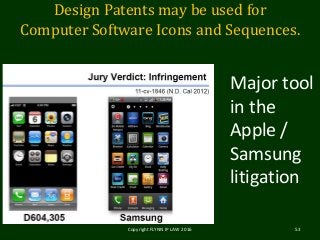
Design Patents may be used for
Computer Software Icons and Sequences.
Copyright FLYNN IP LAW 2016 53
Major tool
in the
Apple /
Samsung
litigation
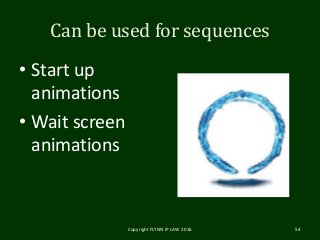
Can be used for sequences
• Start up
animations
• Wait screen
animations
Copyright FLYNN IP LAW 2016 54
New Topic -
Other Forms of
Intellectual Property
Copyright FLYNN IP LAW 2016 55
Trade Secrets—
A Possible Alternative to a Patent
• Advantages
• Can last forever vs patent that expires
after 20 years.
• Great for processes – how to put nooks &
crannies in Thomas’ English Muffin.
• No filing fees and no costs to draft a patent.
• Can cover things that would not get a patent, like
a list with the favorite restaurants and birthdays
of the key contacts at each of your clients.
Copyright FLYNN IP LAW 2016 56
Downsides
• Useless -- if the secret can be easily reverse
engineered from products you sell.
• Does not prevent someone else from
inventing the same great solution.
• Second inventor may patent the idea and you
have only limited protection for continued use
of your trade secret under 35 USC §273.
Copyright FLYNN IP LAW 2016 57
Trade Secrets
Trademark
Purpose
• This is any sort of name or
other marker that allows folks
to recognize that goods or
services come from a
particular source
(your company)
Copyright FLYNN IP LAW 2016 58
Trademark
Protects
–Name of company. (McDonalds)
–Name of product. (Big Mac)
–Slogan. (Two all beef patties…)
–Trade Dress (shape of a Coke bottle)
–Color – pink insulation – Owens
Corning.
•Tiffany Blue
–Sounds – MGM Roaring Lion
Copyright FLYNN IP LAW 2016 59
Trademark
Trademark
• State Protection
Rules vary state by state.
Fees are relatively low.
N.C.G.S § 80-1 to § 80-14
To register in NC see -
https://www.sosnc.gov/trademrk/
Copyright FLYNN IP LAW 2016 60
Trademarks—two tiers
Trademark
• Federal Protection
–Go through process with the USPTO
to get the trademark examined and
REGISTERED.
–Now you can use ®.
–Coverage throughout the US
–Get power of Federal Law to hammer
folks.
Copyright FLYNN IP LAW 2016 61
Trademarks—upper tier
Trademarks
• Critical to protecting your goodwill
• Federal Registration helps when selling goods
across the country.
• May need foreign trademarks too.
• A strong trademark helps customers
remember who you are and come to you for
sales.
• Must police the trademark.
Trademark
– Buy Kodak® film
– Buy Minute Maid® orange juice.
• Asking for trouble if you use a trademark as a noun.
– kleenex, coke, ping pong ball,
xerox, or rollerblades.
• Do NOT use your intended trademark as a noun in
patent applications.
• Do not let others use your trademark as a generic
noun.
• Nouns get put in the public domain for all to use.
A trademark is an adjective and
NOT a noun.
Copyright
Purpose
• Gives exclusive rights to the
creator for an original
expression of an idea –
But not the idea itself.
Copyright FLYNN IP LAW 2016 64
Copyright
Limitations
• Someone needs to COPY.
• If competitor develops
independently, copyright is
NOT effective.
Copyright FLYNN IP LAW 2016 65
Copyright
Copyright
Copyright is great for:
• Training manuals,
• Computer software – to protect
from copying (not the inventions)
• Books, articles, web content,
• Music, video, other non-written
items.
Copyright FLYNN IP LAW 2016 66
Copyright
Copyright
Attributes:
• Easy to get. Just write it down.
• Upgrade to Federal Registration
– more hammers.
• Federal Registration is easy too.
Copyright FLYNN IP LAW 2016 67
Copyright
Don’t choose between
Patents or Copyrights
Use both when appropriate…
violation requires that someone “copy”
the protectable expression in your work.
don’t cover ideas,
– they protect expressions of ideas.
• Patents cover ideas and are effective against
“innocent infringers”.
• Necessity is the Mother of Invention
– But she can have more than one child
(a/k/a Convergent Evolution).
• Use a combination of and Patent.
Help Build
The Next Version of this Talk
• Send an email to KEF@FLYNNipLAW.com
• Subject – Protecting Your Competitive
Advantages Talk
• Tell me what you wished I spent more time
on.
• Tell me what you wished I skipped.
• Tell me what you felt was confusing.
Copyright FLYNN IP LAW 2016 69
70
Kevin E. Flynn is a hybrid -- part engineer, part lawyer, part advocate, and part coach. He uses
all these skills to be a patent attorney. Initially trained in both Biomedical Engineering and
Mechanical Engineering, he later obtained a Master's Degree in Industrial & Systems
Engineering. After working as an engineer and earning a Professional Engineering license from
the State of North Carolina, he went back to school and earned his law degree with honors
from Duke Law School. After a few years in patent litigation, including time spent with Fish &
Neave in New York City, he moved to helping companies protect their ideas and avoid legal
problems.
With a broad engineering background, Kevin works with companies with a range of
technologies including: A) medical devices & methods; B) Internet of things (IoT); C) clean
energy/green technology; D) Consumer Goods. He helps clients decide where to spend their
money to get the most value while seeking patents in the United States and abroad. Then he
works collaboratively with the clients to create patent applications that are part required
technical disclosure and part sales pitch. In addition to helping companies obtain protection,
he works with companies to help them avoid trouble with patents owned by others.
After working at a firm that specialized in assisting start-up companies, Kevin is very
comfortable working directly with CTOs and CEOs in companies that do not have in-house
lawyers.
Kevin is a frequent speaker and commentator on intellectual property issues, especially those
issues of particular relevance to entrepreneurial companies. He has been named repeatedly to
the legal Elite for the category of Intellectual Property/Patent attorneys.

Protecting Your Competitive Advantage

  • 1.
  • 2.
    Protecting Your Competitive Advantages. PresentedOctober 15, 2016 You GROW Girl Annual Business Summit Charlotte, North Carolina Copyright FLYNN IP LAW 2016 2
  • 3.
    Disclaimer Copyright FLYNN IPLAW 2016 3 This set of slides is NOT a substitute for a consultation with an intellectual property attorney. The materials in these slides have been prepared for informational purposes and are not legal advice. The purpose of these slides is to introduce concepts to entrepreneurs so that the entrepreneur can get fact specific legal advice. The laws, regulations, and best practices change over time and these slides will not be updated. Those seeking to make a decision to seek or not seek protection for any form of intellectual property or other business decision should seek counsel from an attorney that has been provided with all the relevant information and considered all the relevant laws, regulations, and the exceptions. Thus, FLYNN IP LAW provides this slide set AS IS without any representations or warranties that the material presented in the slides is appropriate for a particular situation.
  • 4.
    Objectives • I amNOT going to make you into an Intellectual Property (“IP”) expert in 20 minutes. • I do want to get you thinking about identifying and protecting Competitive Advantages. .
  • 5.
    Big Picture Beforethe Details Copyright FLYNN IP LAW 2016 5
  • 6.
    What is thepoint of getting a: patent, copyright, trademark, or trade secret? Copyright FLYNN IP LAW 2016 6
  • 7.
    Copyright FLYNN IPLAW 2016 7 One way to lock in success for a new company is moving the supply or demand curves to a more favorable position than the curves for the competitors. Intellectual property can protect the curve offsets.
  • 8.
    P R I C E Quantity S D Here is aclassic supply and demand curve. Price for product is at intersection.
  • 9.
  • 10.
    P R I C E Quantity S (YC) D D(YC) S (clones) 10 Butthe price premium for your product will erode if others (clones) duplicate your product.
  • 11.
    Impact of Clones •They follow in your footsteps. • Clones take less risk, have less R&D • Followers, not leaders. • Thus, they have lower overhead and a better supply curve. • Clones erode your profitability as they –decrease your price premium –but not your costs.
  • 12.
    Impact of Clones Summaryof Impact • Before Clones hit the market – You Get premium prices $$$$$ • After Clones hit the market – You Get only a fraction of what you had $$
  • 13.
    Way to wardoff Clones • Identify your Competitive Edge • Protect your Competitive Edge • With protection –clones can not create an exact substitute for your premium product.
  • 14.
    Competitive Edge-1st Type •Goodwill – Reputation based upon: • Investments in Advertising & Social Media, • Quality of product as you buy the best ingredients/components & take no shortcuts, • Excellent customer service. – Protect Goodwill with Trademarks, Domain Names, & Design Patents – So people looking to buy from YOU do not get siphoned off
  • 15.
    Competitive Edge-2nd Type •Better Product •Special Features •Faster, smaller, lemon scented, l o n g e r battery life… –Consider •Patents, Trade Secrets, and
  • 16.
    Competitive Edge fromInventions Often Your Competitive Edge will be a Better Product with Novel Features But not Always Copyright FLYNN IP LAW 2016 16
  • 17.
    Competitive Edge-3rd Type SOMETIMES (especiallyas markets mature) Better = Better Process –Better Process Yield –Fewer Process Steps –Less Costly Equipment or Inputs Copyright FLYNN IP LAW 2016 17
  • 18.
    P R I C E Quantity S D S (YC) Competitive Advantage Your supplycurve may be better (lower cost) and this gives you a competitive advantage.
  • 19.
    D Quantity P R I C E S S * increased margin increased volume The bettersupply curve can provide an increase in margin, volume or a combination.
  • 20.
    Your Competitive AdvantageWon’t Last without Protection Protect this type of Competitive Edge With Trade Secrets, Patents, , to keep people from duplicating your improvements.
  • 21.
    Your Task • Recognizethe innovations that are part of your current or future Competitive Edge. • Maintain contact with an IP attorney as part of your business process. • Protect the Competitive Edge (where possible, in cost effective ways)
  • 22.
    Tasks for IPAttorney • Helps you to pick items to be protected. • Devises strategy to optimize protection. • Determines legal deadlines for action. • Coordinates work of third-parties including foreign patent firms and search services.
  • 23.
    New Topic - UtilityPatents Copyright FLYNN IP LAW 2016 23
  • 24.
    Utility Patents • Themain form of patents. • Need to have idea that is novel and non-obvious to one of ordinary skill in the art. • Must teach the best way you know to make and use the invention. • Time consuming process – for you and the patent attorney. • $$$ Expensive.
  • 25.
    But what isa patent good for? • An issued patent has patent claims. • The claims serve as “tollgates” • No one should pass through the tollgate without your permission.
  • 26.
    Tollgates that controlcritical roads are worth more than other tollgates Promised land. This way only. Promised Land
  • 27.
    BTW—Getting a ofyour own does NOT mean you can drive through other tollgates at will.
  • 28.
    Remember Patents areTollgates NOT Bulldozers.
  • 29.
    Remember Patents areTollgates NOT Bulldozers.
  • 30.
    Bicycle Example • Betty inventssimple Betty Bicycle in 2000. • Betty gets a Patent • Covers simple two wheeled, inline, foot powered, chain driven, vehicle, steer with front handlebar. • Mary invents Mountain Bike in 2007 • Mary can get patent claims for Mountain Bike features such as 18 gears, shock-absorbing suspension, added toughness for jumping, et cetera.
  • 31.
    But who canmake what?
  • 32.
    But who canmake what? • Betty cannot make Mountain Bikes as they are covered by Mary‘s patent. • Betty can make her own simple Betty Bicycles.
  • 33.
    But who canmake what? • Mary cannot make either the simple “Betty Bicycle” or a Mountain Bike as the simple Betty Bicycle patent covers both. • Take home message…
  • 34.
    But who canmake what? • Take home message… – Patents on the fundamental invention can be most important. – Patent the concepts in the Alpha product or the Beta, not just the final polished product
  • 35.
    Mary’s Mountain Bikes •Patentability Yes for Patentability. Freedom-to-Operate Copyright FLYNN IP LAW 2016 35 NO for Freedom-to-Operate
  • 36.
    Mary’s Mountain Bikes •Patentability Several of the improvements in the Mountain Bike can obtain patent claims over Betty’s Bicycle. Freedom-to-Operate Copyright FLYNN IP LAW 2016 36 One or more claims from the Betty’s Bicycle Patent cover a simple two wheeled, inline, foot powered, chain driven vehicle, steered by rotating the front wheel by a rotating a handlebar.
  • 37.
    What Can Be Done? Whileyou cannot reduce the risk of being surprised to zero,you can reduce the risk by doing some looking. Copyright FLYNN IP LAW 2016 37
  • 38.
    Why Search? • Youdo NOT want to spend time and money to build a factory to sell Mary’s Mountain Bikes and THEN learn of the Betty Bicycle patent. Copyright FLYNN IP LAW 2016 38
  • 39.
    Reality: includes ConvergentEvolution MYTH: If I am honest and don’t copy someone else, then I won’t have any patent trouble.
  • 40.
    Copyright FLYNN IPLAW 2016 40 Convergent evolution means A company may “invent” something but be unlucky as some other company invented the same solution and filed a patent application. The law allows for a company to be an innocent infringer (Law hammers those who willfully infringe the rights of others with damages that can be enhanced up to 3X.) Many patents exist for products that never reached the market. So a market search may not be sufficient. Checking for freedom-to-operate makes sense even if you did not copy anything. Compare with copyright law where infringer must copy.
  • 41.
  • 42.
    Is Mary’s PatentWorthless? •NO • Mary will have commercially significant rights once Betty’s Patent is gone. –(But only for a few years)
  • 43.
    Is Mary’s Patent Worthless? •NO • Mary could try to invalidate the simple Betty Bicycle patent as an obvious improvement to the chain driven unicycle. Copyright FLYNN IP LAW 2016 43
  • 44.
    Is Mary’s PatentWorthless? • NO • MOST LIKELY -- Mary can seek a cross license from Betty so that both can sell high margin Mountain Bikes, but Cindy (a cloner) cannot sell mountain bike clones. Copyright FLYNN IP LAW 2016 44
  • 45.
    New Topic - DesignPatents Copyright FLYNN IP LAW 2016 45
  • 46.
    Design Patents • Coverthe ORNAMENTAL aspects of the product. • I tell clients that ORNAMENTAL = where you had options in how the product looks – without major impacts on functionality. • Prevents clones from making a look-alike product to siphon off your customers. • Cheap to get but relatively thin protection. • Truly an anti-clone tool – –but also gives marketing buzz.
  • 47.
    Lots of ThingsGet Design Patents Copyright FLYNN IP LAW 2012 47
  • 48.
    Design Patents areeverywhere… • From Sunglasses to Automobiles –Oakley attempts to ward off “Jokeleys,” – with an array of 67 design patents –In 2003, Ford Global Technologies received patents on items • as global as entire vehicle exteriors and • as specific as a gear shift lever
  • 49.
    Design Patents areeverywhere… • Recent Litigation –Serving tray with shrimp (D404,612); –Mini stereo system stand (D405,988); and even –Decorative beads (used at Mardi Gras) (D398,879).
  • 50.
    Copyright FLYNN IPLAW 2016 50
  • 51.
    Design Patent isjust the way it looks. Copyright FLYNN IP LAW 2016 51
  • 52.
    Design Patents Design patentscan be useful for disposable items that might be difficult to cover with utility patents. As design patent protection is narrow, you should wait until the design for the finished product is stable. Allows a company to say that they have a patent pending product and then a patented design.
  • 53.
    Design Patents maybe used for Computer Software Icons and Sequences. Copyright FLYNN IP LAW 2016 53 Major tool in the Apple / Samsung litigation
  • 54.
    Can be usedfor sequences • Start up animations • Wait screen animations Copyright FLYNN IP LAW 2016 54
  • 55.
    New Topic - OtherForms of Intellectual Property Copyright FLYNN IP LAW 2016 55
  • 56.
    Trade Secrets— A PossibleAlternative to a Patent • Advantages • Can last forever vs patent that expires after 20 years. • Great for processes – how to put nooks & crannies in Thomas’ English Muffin. • No filing fees and no costs to draft a patent. • Can cover things that would not get a patent, like a list with the favorite restaurants and birthdays of the key contacts at each of your clients. Copyright FLYNN IP LAW 2016 56
  • 57.
    Downsides • Useless --if the secret can be easily reverse engineered from products you sell. • Does not prevent someone else from inventing the same great solution. • Second inventor may patent the idea and you have only limited protection for continued use of your trade secret under 35 USC §273. Copyright FLYNN IP LAW 2016 57 Trade Secrets
  • 58.
    Trademark Purpose • This isany sort of name or other marker that allows folks to recognize that goods or services come from a particular source (your company) Copyright FLYNN IP LAW 2016 58
  • 59.
    Trademark Protects –Name of company.(McDonalds) –Name of product. (Big Mac) –Slogan. (Two all beef patties…) –Trade Dress (shape of a Coke bottle) –Color – pink insulation – Owens Corning. •Tiffany Blue –Sounds – MGM Roaring Lion Copyright FLYNN IP LAW 2016 59 Trademark
  • 60.
    Trademark • State Protection Rulesvary state by state. Fees are relatively low. N.C.G.S § 80-1 to § 80-14 To register in NC see - https://www.sosnc.gov/trademrk/ Copyright FLYNN IP LAW 2016 60 Trademarks—two tiers
  • 61.
    Trademark • Federal Protection –Gothrough process with the USPTO to get the trademark examined and REGISTERED. –Now you can use ®. –Coverage throughout the US –Get power of Federal Law to hammer folks. Copyright FLYNN IP LAW 2016 61 Trademarks—upper tier
  • 62.
    Trademarks • Critical toprotecting your goodwill • Federal Registration helps when selling goods across the country. • May need foreign trademarks too. • A strong trademark helps customers remember who you are and come to you for sales. • Must police the trademark. Trademark
  • 63.
    – Buy Kodak®film – Buy Minute Maid® orange juice. • Asking for trouble if you use a trademark as a noun. – kleenex, coke, ping pong ball, xerox, or rollerblades. • Do NOT use your intended trademark as a noun in patent applications. • Do not let others use your trademark as a generic noun. • Nouns get put in the public domain for all to use. A trademark is an adjective and NOT a noun.
  • 64.
    Copyright Purpose • Gives exclusiverights to the creator for an original expression of an idea – But not the idea itself. Copyright FLYNN IP LAW 2016 64
  • 65.
    Copyright Limitations • Someone needsto COPY. • If competitor develops independently, copyright is NOT effective. Copyright FLYNN IP LAW 2016 65 Copyright
  • 66.
    Copyright Copyright is greatfor: • Training manuals, • Computer software – to protect from copying (not the inventions) • Books, articles, web content, • Music, video, other non-written items. Copyright FLYNN IP LAW 2016 66 Copyright
  • 67.
    Copyright Attributes: • Easy toget. Just write it down. • Upgrade to Federal Registration – more hammers. • Federal Registration is easy too. Copyright FLYNN IP LAW 2016 67 Copyright
  • 68.
    Don’t choose between Patentsor Copyrights Use both when appropriate… violation requires that someone “copy” the protectable expression in your work. don’t cover ideas, – they protect expressions of ideas. • Patents cover ideas and are effective against “innocent infringers”. • Necessity is the Mother of Invention – But she can have more than one child (a/k/a Convergent Evolution). • Use a combination of and Patent.
  • 69.
    Help Build The NextVersion of this Talk • Send an email to KEF@FLYNNipLAW.com • Subject – Protecting Your Competitive Advantages Talk • Tell me what you wished I spent more time on. • Tell me what you wished I skipped. • Tell me what you felt was confusing. Copyright FLYNN IP LAW 2016 69
  • 70.
    70 Kevin E. Flynnis a hybrid -- part engineer, part lawyer, part advocate, and part coach. He uses all these skills to be a patent attorney. Initially trained in both Biomedical Engineering and Mechanical Engineering, he later obtained a Master's Degree in Industrial & Systems Engineering. After working as an engineer and earning a Professional Engineering license from the State of North Carolina, he went back to school and earned his law degree with honors from Duke Law School. After a few years in patent litigation, including time spent with Fish & Neave in New York City, he moved to helping companies protect their ideas and avoid legal problems. With a broad engineering background, Kevin works with companies with a range of technologies including: A) medical devices & methods; B) Internet of things (IoT); C) clean energy/green technology; D) Consumer Goods. He helps clients decide where to spend their money to get the most value while seeking patents in the United States and abroad. Then he works collaboratively with the clients to create patent applications that are part required technical disclosure and part sales pitch. In addition to helping companies obtain protection, he works with companies to help them avoid trouble with patents owned by others. After working at a firm that specialized in assisting start-up companies, Kevin is very comfortable working directly with CTOs and CEOs in companies that do not have in-house lawyers. Kevin is a frequent speaker and commentator on intellectual property issues, especially those issues of particular relevance to entrepreneurial companies. He has been named repeatedly to the legal Elite for the category of Intellectual Property/Patent attorneys.