YOUTH HEALTH
PARLIAMENT
REDUCING DEMAND
THROUGH PATIENT
EMPOWERMENT
DECEMBER 2016
HANDING
BACK
CONTROL
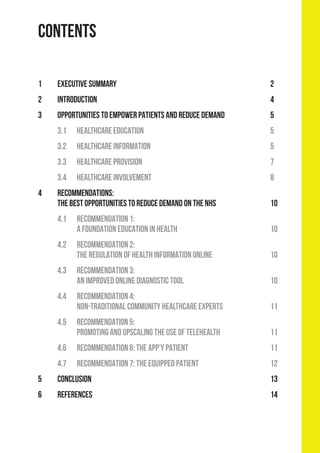
CONTENTS
1	EXECUTIVE SUMMARY								2
2	INTRODUCTION									4
3	 OPPORTUNITIES TO EMPOWER PATIENTS AND REDUCE DEMAND			 5
	3.1	HEALTHCARE EDUCATION							5
	3.2	HEALTHCARE INFORMATION							5
	3.3	HEALTHCARE PROVISION							7
	3.4	HEALTHCARE INVOLVEMENT							8
4	RECOMMENDATIONS:
	 THE BEST OPPORTUNITIES TO REDUCE DEMAND ON THE NHS			 10
	 4.1	 RECOMMENDATION 1:
		A FOUNDATION EDUCATION IN HEALTH					10
	 4.2	 RECOMMENDATION 2:
		 THE REGULATION OF HEALTH INFORMATION ONLINE			 10
	 4.3	 RECOMMENDATION 3:
		AN IMPROVED ONLINE DIAGNOSTIC TOOL					10
	 4.4	 RECOMMENDATION 4:
		NON-TRADITIONAL COMMUNITY HEALTHCARE EXPERTS			11
	 4.5	 RECOMMENDATION 5:
		 PROMOTING AND UPSCALING THE USE OF TELEHEALTH			 11
	4.6	RECOMMENDATION 6: THE APP’Y PATIENT					11
	 4.7	 RECOMMENDATION 7: THE EQUIPPED PATIENT				 12
5	CONCLUSION										13
6	REFERENCES										14
2
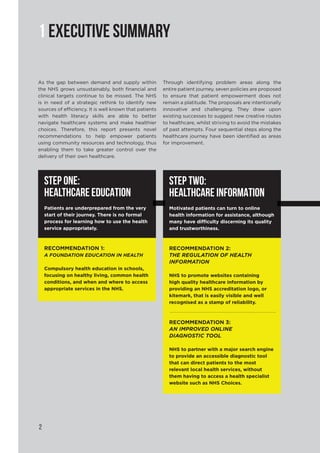
1 EXECUTIVE SUMMARY
As the gap between demand and supply within
the NHS grows unsustainably, both financial and
clinical targets continue to be missed. The NHS
is in need of a strategic rethink to identify new
sources of efficiency. It is well known that patients
with health literacy skills are able to better
navigate healthcare systems and make healthier
choices. Therefore, this report presents novel
recommendations to help empower patients
using community resources and technology, thus
enabling them to take greater control over the
delivery of their own healthcare.
Through identifying problem areas along the
entire patient journey, seven policies are proposed
to ensure that patient empowerment does not
remain a platitude. The proposals are intentionally
innovative and challenging. They draw upon
existing successes to suggest new creative routes
to healthcare, whilst striving to avoid the mistakes
of past attempts. Four sequential steps along the
healthcare journey have been identified as areas
for improvement.
STEP ONE:
HEALTHCARE EDUCATION
Patients are underprepared from the very
start of their journey. There is no formal
process for learning how to use the health
service appropriately.
RECOMMENDATION 1:
A FOUNDATION EDUCATION IN HEALTH
Compulsory health education in schools,
focusing on healthy living, common health
conditions, and when and where to access
appropriate services in the NHS.
STEP TWO:
HEALTHCARE INFORMATION
Motivated patients can turn to online
health information for assistance, although
many have difficulty discerning its quality
and trustworthiness.
RECOMMENDATION 2:
THE REGULATION OF HEALTH
INFORMATION
NHS to promote websites containing
high quality healthcare information by
providing an NHS accreditation logo, or
kitemark, that is easily visible and well
recognised as a stamp of reliability.
RECOMMENDATION 3:
AN IMPROVED ONLINE
DIAGNOSTIC TOOL
NHS to partner with a major search engine
to provide an accessible diagnostic tool
that can direct patients to the most
relevant local health services, without
them having to access a health specialist
website such as NHS Choices.
3
1 EXECUTIVE SUMMARY
Although challenging, this strategy aims to ensure
that individuals take ownership of their health,
access reliable health information and find the
most appropriate provider. Such an approach
aims to improve individual patient experience of
healthcare whilst ultimately reducing avoidable
demand for health services.
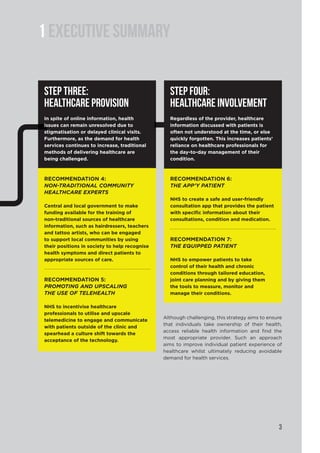
STEP THREE:
HEALTHCARE PROVISION
In spite of online information, health
issues can remain unresolved due to
stigmatisation or delayed clinical visits.
Furthermore, as the demand for health
services continues to increase, traditional
methods of delivering healthcare are
being challenged.
RECOMMENDATION 4:
NON-TRADITIONAL COMMUNITY
HEALTHCARE EXPERTS
Central and local government to make
funding available for the training of
non-traditional sources of healthcare
information, such as hairdressers, teachers
and tattoo artists, who can be engaged
to support local communities by using
their positions in society to help recognise
health symptoms and direct patients to
appropriate sources of care.
RECOMMENDATION 5:
PROMOTING AND UPSCALING
THE USE OF TELEHEALTH
NHS to incentivise healthcare
professionals to utilise and upscale
telemedicine to engage and communicate
with patients outside of the clinic and
spearhead a culture shift towards the
acceptance of the technology.
STEP FOUR:
HEALTHCARE INVOLVEMENT
Regardless of the provider, healthcare
information discussed with patients is
often not understood at the time, or else
quickly forgotten. This increases patients’
reliance on healthcare professionals for
the day-to-day management of their
condition.
RECOMMENDATION 6:
THE APP’Y PATIENT
NHS to create a safe and user-friendly
consultation app that provides the patient
with specific information about their
consultations, condition and medication.
RECOMMENDATION 7:
THE EQUIPPED PATIENT
NHS to empower patients to take
control of their health and chronic
conditions through tailored education,
joint care planning and by giving them
the tools to measure, monitor and
manage their conditions.
4
2 INTRODUCTION
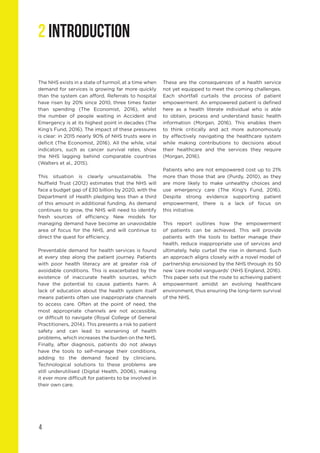
The NHS exists in a state of turmoil, at a time when
demand for services is growing far more quickly
than the system can afford. Referrals to hospital
have risen by 20% since 2010, three times faster
than spending (The Economist, 2016), whilst
the number of people waiting in Accident and
Emergency is at its highest point in decades (The
King’s Fund, 2016). The impact of these pressures
is clear: in 2015 nearly 90% of NHS trusts were in
deficit (The Economist, 2016). All the while, vital
indicators, such as cancer survival rates, show
the NHS lagging behind comparable countries
(Walters et al., 2015).
This situation is clearly unsustainable. The
Nuffield Trust (2012) estimates that the NHS will
face a budget gap of £30 billion by 2020, with the
Department of Health pledging less than a third
of this amount in additional funding. As demand
continues to grow, the NHS will need to identify
fresh sources of efficiency. New models for
managing demand have become an unavoidable
area of focus for the NHS, and will continue to
direct the quest for efficiency.
Preventable demand for health services is found
at every step along the patient journey. Patients
with poor health literacy are at greater risk of
avoidable conditions. This is exacerbated by the
existence of inaccurate health sources, which
have the potential to cause patients harm. A
lack of education about the health system itself
means patients often use inappropriate channels
to access care. Often at the point of need, the
most appropriate channels are not accessible,
or difficult to navigate (Royal College of General
Practitioners, 2014). This presents a risk to patient
safety and can lead to worsening of health
problems, which increases the burden on the NHS.
Finally, after diagnosis, patients do not always
have the tools to self-manage their conditions,
adding to the demand faced by clinicians.
Technological solutions to these problems are
still underutilised (Digital Health, 2006), making
it ever more difficult for patients to be involved in
their own care.
These are the consequences of a health service
not yet equipped to meet the coming challenges.
Each shortfall curtails the process of patient
empowerment. An empowered patient is defined
here as a health literate individual who is able
to obtain, process and understand basic health
information (Morgan, 2016). This enables them
to think critically and act more autonomously
by effectively navigating the healthcare system
while making contributions to decisions about
their healthcare and the services they require
(Morgan, 2016).
Patients who are not empowered cost up to 21%
more than those that are (Purdy, 2010), as they
are more likely to make unhealthy choices and
use emergency care (The King’s Fund, 2016).
Despite strong evidence supporting patient
empowerment, there is a lack of focus on
this initiative.
This report outlines how the empowerment
of patients can be achieved. This will provide
patients with the tools to better manage their
health, reduce inappropriate use of services and
ultimately, help curtail the rise in demand. Such
an approach aligns closely with a novel model of
partnership envisioned by the NHS through its 50
new ‘care model vanguards’ (NHS England, 2016).
This paper sets out the route to achieving patient
empowerment amidst an evolving healthcare
environment, thus ensuring the long-term survival
of the NHS.
5
3 OPPORTUNITIES TO EMPOWER
PATIENTS AND REDUCE DEMAND
3.1	 HEALTHCARE EDUCATION
Patient education is teaching individuals about
their conditions and encouraging them to have
greater understanding so they are better placed
to make decisions about their care plan while
coping better in everyday life (WHO, 2009). This
can improve decision making, promote healthy
behaviour and empower patients to participate
in the delivery of their own healthcare. Numerous
trials have demonstrated the benefits of patient
education across several chronic diseases,
including asthma (Couturaud et al., 2002) and
diabetes (Khunti et al., 2012).
Although there are education programmes for
adults with chronic illnesses, there is no formal
education on prevention and early intervention
in schools. Currently, ‘Personal, Social and Health
Education’ (PSHE), which covers the broad
topics of substance misuse, sexual health, healthy
lifestyles and mental health, is taught in some UK
primary and secondary schools. However, PSHE
is largely non-compulsory and Ofsted have noted
that ‘40% of PSHE teaching is less than good’
(Morgan, 2016).
Teaching around self-management of health
conditions and appropriate use of healthcare
services is not in the PSHE Guidance. Targeted
education in these areas, particularly around
conditions commonly seen by GPs – such as upper
respiratory tract infections, back conditions and
depression – could help to reduce the burden on
the health service.
A cultural and educational shift is required to
encourage the use of non-GP and A&E sources of
health information and support. For example, 91%
of patients think that pharmacists only dispense
medications; the majority do not appreciate that
pharmacists can also be a source of advice, a
view held particularly by younger people (East
Berkshire Primary Care: Out of Hours, 2015).
Evidence shows that well-designed and executed
programmes can lead to long term health
benefits, with examples including the ‘Friends for
Life Program’ (Briesch et al., 2010). Interactive
curricula with a similar focus have been explored in
the US (U.S. Food and Drug Administration, 2013),
and current education in the UK surrounding oral
healthcare has been successful. These could be
replicated across other healthcare domains,
and by pairing pupils’ education with parent
education, benefits may be enhanced.
3.2	 HEALTHCARE INFORMATION
People are increasingly using the internet to find
healthcare information; roughly 1% of all Google
searches globally are related to a health symptom
or concern (Pinchin, 2016). However, information
accessed online is often unregulated and a
number of studies have shown that accuracy and
reliability is poor (Lissman and Boehnlein, 2001).
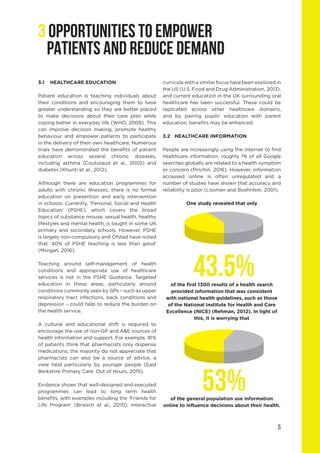
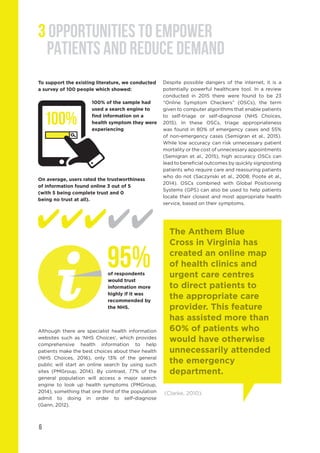
One study revealed that only
of the first 1300 results of a health search
provided information that was consistent
with national health guidelines, such as those
of the National Institute for Health and Care
Excellence (NICE) (Rehman, 2012). In light of
this, it is worrying that
of the general population use information
online to influence decisions about their health.
43.5%
53%
6
3 OPPORTUNITIES TO EMPOWER
PATIENTS AND REDUCE DEMAND
Although there are specialist health information
websites such as ‘NHS Choices’, which provides
comprehensive health information to help
patients make the best choices about their health
(NHS Choices, 2016), only 13% of the general
public will start an online search by using such
sites (PMGroup, 2014). By contrast, 77% of the
general population will access a major search
engine to look up health symptoms (PMGroup,
2014), something that one third of the population
admit to doing in order to self-diagnose
(Gann, 2012).
Despite possible dangers of the internet, it is a
potentially powerful healthcare tool. In a review
conducted in 2015 there were found to be 23
“Online Symptom Checkers” (OSCs), the term
given to computer algorithms that enable patients
to self-triage or self-diagnose (NHS Choices,
2015). In these OSCs, triage appropriateness
was found in 80% of emergency cases and 55%
of non-emergency cases (Semigran et al., 2015).
While low accuracy can risk unnecessary patient
mortality or the cost of unnecessary appointments
(Semigran et al., 2015), high accuracy OSCs can
lead to beneficial outcomes by quickly signposting
patients who require care and reassuring patients
who do not (Saczynski et al., 2008; Poote et al.,
2014). OSCs combined with Global Positioning
Systems (GPS) can also be used to help patients
locate their closest and most appropriate health
service, based on their symptoms.
The Anthem Blue
Cross in Virginia has
created an online map
of health clinics and
urgent care centres
to direct patients to
the appropriate care
provider. This feature
has assisted more than
60% of patients who
would have otherwise
unnecessarily attended
the emergency
department.
(Clarke, 2010).
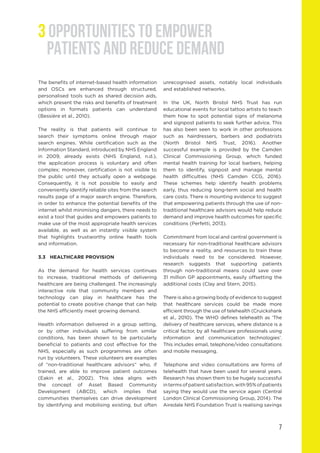
100% of the sample had
used a search engine to
find information on a
health symptom they were
experiencing
To support the existing literature, we conducted
a survey of 100 people which showed:
On average, users rated the trustworthiness
of information found online 3 out of 5
(with 5 being complete trust and 0
being no trust at all).
100%
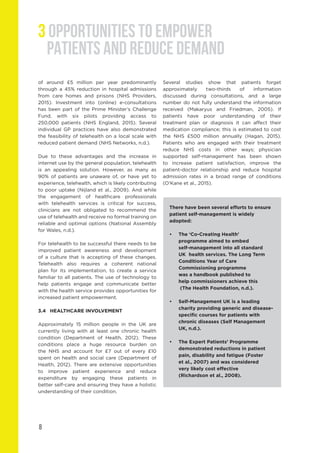
of respondents
would trust
information more
highly if it was
recommended by
the NHS.
95%
3 OPPORTUNITIES TO EMPOWER
PATIENTS AND REDUCE DEMAND
The benefits of internet-based health information
and OSCs are enhanced through structured,
personalised tools such as shared decision aids,
which present the risks and benefits of treatment
options in formats patients can understand
(Bessière et al., 2010).
The reality is that patients will continue to
search their symptoms online through major
search engines. While certification such as the
Information Standard, introduced by NHS England
in 2009, already exists (NHS England, n.d.),
the application process is voluntary and often
complex; moreover, certification is not visible to
the public until they actually open a webpage.
Consequently, it is not possible to easily and
conveniently identify reliable sites from the search
results page of a major search engine. Therefore,
in order to enhance the potential benefits of the
internet whilst minimising dangers, there needs to
exist a tool that guides and empowers patients to
make use of the most appropriate health services
available, as well as an instantly visible system
that highlights trustworthy online health tools
and information.
3.3	 HEALTHCARE PROVISION
As the demand for health services continues
to increase, traditional methods of delivering
healthcare are being challenged. The increasingly
interactive role that community members and
technology can play in healthcare has the
potential to create positive change that can help
the NHS efficiently meet growing demand.
Health information delivered in a group setting,
or by other individuals suffering from similar
conditions, has been shown to be particularly
beneficial to patients and cost effective for the
NHS, especially as such programmes are often
run by volunteers. These volunteers are examples
of “non-traditional healthcare advisors” who, if
trained, are able to improve patient outcomes
(Eakin et al., 2002). This idea aligns with
the concept of Asset Based Community
Development (ABCD), which implies that
communities themselves can drive development
by identifying and mobilising existing, but often
unrecognised assets, notably local individuals
and established networks.
In the UK, North Bristol NHS Trust has run
educational events for local tattoo artists to teach
them how to spot potential signs of melanoma
and signpost patients to seek further advice. This
has also been seen to work in other professions
such as hairdressers, barbers and podiatrists
(North Bristol NHS Trust, 2016). Another
successful example is provided by the Camden
Clinical Commissioning Group, which funded
mental health training for local barbers, helping
them to identify, signpost and manage mental
health difficulties (NHS Camden CCG, 2016).
These schemes help identify health problems
early, thus reducing long-term social and health
care costs. There is mounting evidence to suggest
that empowering patients through the use of non-
traditional healthcare advisors would help reduce
demand and improve health outcomes for specific
conditions (Perfetti, 2013).
Commitment from local and central government is
necessary for non-traditional healthcare advisors
to become a reality, and resources to train these
individuals need to be considered. However,
research suggests that supporting patients
through non-traditional means could save over
31 million GP appointments, easily offsetting the
additional costs (Clay and Stern, 2015).
There is also a growing body of evidence to suggest
that healthcare services could be made more
efficient through the use of telehealth (Cruickshank
et al., 2010). The WHO defines telehealth as ‘The
delivery of healthcare services, where distance is a
critical factor, by all healthcare professionals using
information and communication technologies’.
This includes email, telephone/video consultations
and mobile messaging.
Telephone and video consultations are forms of
telehealth that have been used for several years.
Research has shown them to be hugely successful
intermsofpatientsatisfaction,with95%ofpatients
saying they would use the service again (Central
London Clinical Commissioning Group, 2014). The
Airedale NHS Foundation Trust is realising savings
7
8
of around £5 million per year predominantly
through a 45% reduction in hospital admissions
from care homes and prisons (NHS Providers,
2015). Investment into (online) e-consultations
has been part of the Prime Minister’s Challenge
Fund, with six pilots providing access to
250,000 patients (NHS England, 2015). Several
individual GP practices have also demonstrated
the feasibility of telehealth on a local scale with
reduced patient demand (NHS Networks, n.d.).
Due to these advantages and the increase in
internet use by the general population, telehealth
is an appealing solution. However, as many as
90% of patients are unaware of, or have yet to
experience, telehealth, which is likely contributing
to poor uptake (Nijland et al., 2009). And while
the engagement of healthcare professionals
with telehealth services is critical for success,
clinicians are not obligated to recommend the
use of telehealth and receive no formal training on
reliable and optimal options (National Assembly
for Wales, n.d.).
For telehealth to be successful there needs to be
improved patient awareness and development
of a culture that is accepting of these changes.
Telehealth also requires a coherent national
plan for its implementation, to create a service
familiar to all patients. The use of technology to
help patients engage and communicate better
with the health service provides opportunities for
increased patient empowerment.
3.4	 HEALTHCARE INVOLVEMENT
Approximately 15 million people in the UK are
currently living with at least one chronic health
condition (Department of Health, 2012). These
conditions place a huge resource burden on
the NHS and account for £7 out of every £10
spent on health and social care (Department of
Health, 2012). There are extensive opportunities
to improve patient experience and reduce
expenditure by engaging these patients in
better self-care and ensuring they have a holistic
understanding of their condition.
Several studies show that patients forget
approximately two-thirds of information
discussed during consultations, and a large
number do not fully understand the information
received (Makaryus and Friedman, 2005). If
patients have poor understanding of their
treatment plan or diagnosis it can affect their
medication compliance; this is estimated to cost
the NHS £500 million annually (Hagan, 2015).
Patients who are engaged with their treatment
reduce NHS costs in other ways; physician
supported self-management has been shown
to increase patient satisfaction, improve the
patient-doctor relationship and reduce hospital
admission rates in a broad range of conditions
(O’Kane et al., 2015).
There have been several efforts to ensure
patient self-management is widely
adopted:
•	 The ‘Co-Creating Health’
	 programme aimed to embed
	 self-management into all standard
	 UK 	health services. The Long Term 	
	 Conditions Year of Care
	 Commissioning programme 		
	 was a handbook published to
	 help commissioners achieve this
	 (The Health Foundation, n.d.).
•	 Self-Management UK is a leading 		
	 charity providing generic and disease-	
	 specific courses for patients with 		
	 chronic diseases (Self Management 	
	 UK, n.d.).
•	 The Expert Patients’ Programme 		
	 demonstrated reductions in patient 	
	 pain, disability and fatigue (Foster
	 et al., 2007) and was considered
	 very likely cost effective
	 (Richardson et al., 2008).
3 OPPORTUNITIES TO EMPOWER
PATIENTS AND REDUCE DEMAND
Despite the compelling case for patient self-
management, primary and secondary care services
have not fully engaged with the programme
(Kennedy et al., 2007). For self-management to
be effective it needs to be seen as a priority by
clinicians, and implemented sensitively to avoid
unnecessary patient anxiety.
Research shows that the best methods of
delivering information to patients are designed
around their needs and change in accordance
with their situation (Mathers and Paynton, 2015).
The information should also be available at the
right time and in the correct format. Technological
progress enables patients to now receive
“tailored information that is contextualised and
personalised e.g. directly relevant and easily
comprehensible to the person’s own health
situation” (Kennedy et al., 2014). The rise in
smartphone ownership provides an opportunity
to develop a regulated, permanent and patient
specific information source. However, it is vital that
patient privacy and data protection is maintained
throughout this process in order to instil public
confidence in the system (Huckvale et al., 2015).
A systematic review of the use of mobile phone
apps by Coronary Heart Disease patients showed
significant improvements in patient outcomes
with minimal usability issues (Beatty et al., 2013).
Other technologies such as activity, heart rate
and blood pressure monitors have also been
successful in supporting self-management (Zheng
et al., 2010). Decision support systems can help
to detect abnormal activity based on monitor
readings enabling early, well informed treatment
alterations (Zheng et al., 2010). Research suggests
patients are supportive of the introduction of this
technology (Vanhoof et al., 2015).
Empowering patients to understand and co-
manage their condition, in conjunction with
their physician, has been shown to have wide-
ranging benefits. However, implementation of
these strategies has not yet been effective. NHS
England could realise savings of at least £4.4
billion a year from reduced A&E attendance,
hospital admission, and outpatient attendance if
they were fully adopted (NESTA, 2013).
9
3 OPPORTUNITIES TO EMPOWER
PATIENTS AND REDUCE DEMAND
10
4 RECOMMENDATIONS: THE BEST
OPPORTUNITIES TO REDUCE
DEMAND ON THE NHS
4.1	 RECOMMENDATION 1:
	 A FOUNDATION EDUCATION IN HEALTH
Compulsory health education in schools,
focusing on healthy living, common health
conditions, and when and where to access
appropriate services in the NHS.
There are no modules within schools that develop
the capabilities of future health service users to
navigate the NHS and assess when their needs
require specialist clinical support. We propose
that a module is introduced within schools,
possibly through PSHE, that covers topics such
as healthy living, basic health conditions and,
most importantly, when as well as where to
access appropriate services in the NHS. For
this education module to succeed it must be a
compulsory component of the curriculum and
taught throughout all school years, ensuring
that sufficient time is allocated to guarantee
accurate and continuous learning. This should be
an examinable subject to highlight its importance
and allow progress to be measured. Pooled
funding for the module should originate from the
Department of Education and the Department of
Health. The module must be run collaboratively
with universities, GPs and community healthcare
professionals to actively help develop and deliver
the programme. Teaching of pupils should be
partnered with parent health education sessions
to guarantee consistent messages are delivered
and demonstrated outside of the classroom. This
recommendation represents a sustainable and
long term solution to help reduce the growing
demand on the NHS.
4.2	 RECOMMENDATION 2:
	 THE REGULATION OF HEALTH 			
	 INFORMATION ONLINE
NHS to promote websites containing high
quality healthcare information by providing an
NHS accreditation logo, or kitemark, that is well
recognised as a stamp of reliability.
We propose that the current Information
Standard (which indicates a reliable source of
health and social care information) should be
made more visible and easily identifiable. Firstly,
the logo must be viewable on the search results
page when looking for websites rather than only
once the website has been visited. Secondly, the
Department of Health should partner with Google
to ensure that websites meeting the standard
appear at the top of the search page. This must
be combined with changes to practice whereby
healthcare professionals actively direct patients to
verified sites, and where the Information Standard
actively seeks health information sites to accredit,
especially those that have been shown to be
highly popular resources based on usage figures.
4.3	 RECOMMENDATION 3:
	 AN IMPROVED ONLINE DIAGNOSTIC TOOL
NHS to partner with a major search engine to
provide an accessible diagnostic tool that can
direct patients to the most relevant local health
services, without them having to access a health
specialist website.
The majority of online health searches are via
major search engines rather than specialist
websites like NHS choices. We propose that when
patients search symptoms online using a major
search engine, they be immediately presented
with simple follow up questions from an NHS
triage tool. This would help individuals easily
identify whether they need to access professional
support without necessarily having to visit a
specialist health website first. The triage tool
must be enhanced by global positioning systems
technology so that individuals can be directed
to appropriate local health services, for example
a pharmacist, community nurse, GP or local
patient group.
11
4.4	 RECOMMENDATION 4:
	 NON-TRADITIONAL COMMUNITY 			
	 HEALTHCARE EXPERTS			
Central and local government to make funding
available for the training of non-traditional
sources of healthcare information, such as
hairdressers, teachers and tattoo artists, who
can be engaged to support local communities
by using their positions in society to help
recognise health symptoms and direct patients
to appropriate sources of care.
We propose that ‘lay’ individuals in the community
have access to training and support related
to specific local health needs to become non-
traditional healthcare advisors. This would be
voluntary training, focused on individuals with
regular contact with the general public (such as
teachers, hairdressers, tattoo artists) or those
who themselves live with chronic conditions. The
proposed system would harness these advisors’
unique position to identify individuals who may
be experiencing health difficulties and correctly
signpost them to appropriate services. In some
instances, this would act as a form of early
intervention and would lead to clinician’s time
being used more effectively. National and local
government funding would need to be allocated
to this system.
4.5	 RECOMMENDATION 5:
	 PROMOTING AND UPSCALING
	 THE USE OF TELEHEALTH
NHS to incentivise healthcare professionals
to utilise and upscale telemedicine to engage
and communicate with patients outside of the
clinic and spearhead a culture shift towards the
acceptance of the technology.
We propose that telehealth should be expanded
and promoted by healthcare professionals
through the use of government funded incentive
programmes. These programmes must reward
healthcare providers that actively engage
patients through the use of telehealth to improve
the efficiency of healthcare delivery. The use of
telehealth must become a routine alternative
to being seen in person, thus healthcare
professionals need to take an active role in
promoting and building the capacity of patients
to utilise the technology. Telephone clinics and
video conferencing appointments already exist
and must be expanded upon to allow patients to
send data collected on a smartphone relating to
their health, such as photos of visible symptoms.
Increased use of telehealth offers the chance to
reduce the number of patients needed to be seen
in clinic, promotes regular contact with healthcare
teams and reduces disruption to work or family
life, potentially improving treatment outcomes for
patients whilst reducing the long-term burden on
the NHS.
4.6	 RECOMMENDATION 6:
	 THE APP’Y PATIENT
NHS to create a safe and user-friendly
consultation app that provides the patient
with specific information about their
consultations, condition and medication.
There is an increasing prevalence of patients with
more than one chronic condition. These patients
often require multiple forms of treatment and
are at greater risk of medical complications.
Management of their conditions must be made
simple and easy so they can take greater control
of their own health. We recommend the creation
of an NHS Choices app as a simple resource
for storing generic information about personal
conditions and medications. Specific information,
such as medication regimen, could be added onto
the app by the healthcare professional. Although
information contained in this app would not be
transmitted and remain private to the patient’s
device, patients would consent to this scheme and
the app would be password protected to ensure
privacy and data protection was maintained.
This would enable quick and secure access to
health information, while potentially increasing
medication adherence and personal knowledge
of relevant health conditions.
4 RECOMMENDATIONS: THE BEST
OPPORTUNITIES TO REDUCE
DEMAND ON THE NHS
12
4 RECOMMENDATIONS: THE BEST
OPPORTUNITIES TO REDUCE
DEMAND ON THE NHS
4.7	 RECOMMENDATION 7:
	 THE EQUIPPED PATIENT
NHS to empower patients to take control of
their health and chronic conditions through
tailored education, joint care planning and by
giving them the tools to measure, monitor and
manage their conditions.
It is well known that patients with chronic health
conditions put considerable demand on the NHS.
As such, we propose that patients with a chronic
condition should be offered the basic tools to
measure, monitor and manage their own health,
where they have suitable capacity, so they can
take a more active role in their health condition.
The healthcare professional must therefore have
dedicated time to educate the patient, to agree
goals and co-create a care plan. Education will
include how to use simple tools and available
technology that can measure vital signs and
take other condition-relevant readings. This data
should be inputted by patients into an interactive
portal that clinicians can access. Education will
be followed up by patient surveys that assess the
individual’s understanding of their condition, when
and where to seek clinical support, and whether
they would be able to give advice to a friend with
a similar condition. In the long term, this could
significantly reduce avoidable appointments.
13
The empowerment of patients is not an
overnight task. Implementing the principles of
patient education and support requires a long-
term investment of focus, and the use of new
technology will be crucial to bringing about this
change. However, it is not just technological
innovation, but cultural innovation, which
will determine the success of the policies
recommended here. The major challenge will be
ensuring that an increase in access to services
does not bring with it an increase in demand.
It is for this reason that an original combination
of policies is proposed, which are nonetheless
supported by a robust evidence base. Thus,
policy makers can build a future in which
demand for health services is more manageable,
patients are more able to take ownership of
their healthcare, and the healthcare system is
sustainable once again.
5 CONCLUSION
14
6 REFERENCES
Anthem BlueCross BlueShield. Find Urgent Care
(n.d.). Anthem BlueCross BlueShield. Available at:
https://www.anthem.com/health-insurance/quickcare/
urgentcare (Accessed: 16 September 2016).
Beatty, A. L. et al. (2013) ‘Using mobile technology
for cardiac rehabilitation: a review and framework for
development and evaluation’ (2047-9980 (Electronic)).
Bessière, K., Pressman, S., Kiesler, S. and Kraut,
R. (2010) ‘Effects of Internet Use on Health and
Depression: A Longitudinal Study’, Journal of Medical
Internet Research, 12(1), pp. e6.
Briesch, A. M. et al. (2010) ‘Reducing the Prevalence of
Anxiety in Children and Adolescents: An Evaluation of
the Evidence Base for the FRIENDS for Life Program’,
School Mental Health, 2(4), pp. 155-165.
Central London Clinical Commissioning Group. (2014)
Implementing Skype Consultations in General Practice,
Update report on the Cavendish Health Centre Remote
Consultation Service Pilot Project: Central London
Clinical Commissioning Group. Available at: http://
www.centrallondonccg.nhs.uk/media/24178/CLCCG-
Cavendish-Skype-pilot-interim-report.pdf (Accessed:
16 September 2016).
Clarke, K. (2010) Finding a Health Clinic with Google
Maps. Available at: http://googlemapsmania.blogspot.
com/2010/07/finding-health-clinic-with-google-maps.
html (Accessed: 16 September 2016).
Clay, H. and Stern, R. (2015) MAKING TIME IN
GENERAL PRACTICE Freeing GP capacity by reducing
bureaucracy and avoidable consultations, managing
the interface with hospitals and exploring new ways
of working: Primary Care Foundation. Available at:
http://www.primarycarefoundation.co.uk/images/
PrimaryCareFoundation/Downloading_Reports/PCF_
Press_Releases/Making-Time-in_General_Practice_
FULL_REPORT_28_10_15.pdf (Accessed: 16 September
2016).
Couturaud, F. et al. (2002) ‘Education and self-
management: a one-year randomized trial in stable
adult asthmatic patients’, J Asthma, 39(6), pp. 493-
500.
Cruickshank, J. et al. (2010) Healthcare without
walls, A framework for delivering telehealth
at scale. 2020Health. Available at: http://
www.2020health.org/dms/2020health/downloads/
reports/2020telehealthLOW.pdf (Accessed: 16
September 2016).
Department of Health. (2012) Long Term Conditions
Compendium of Information. Department of Health.
Available at: https://www.gov.uk/government/uploads/
system/uploads/attachment_data/file/216528/
dh_134486.pdf (Accessed: 16 September 2016).
Digital Health. (2006) Existing ICT underused, Royal
Society finds: Digital Health. Available at: http://www.
digitalhealth.net/news/22290/existing-ict-underused-
royal-society-finds (Accessed: 16 September 2016).
Eakin, E. G. et al. (2002) ‘Reaching those most in need:
a review of diabetes self-management interventions in
disadvantaged populations’. (1520-7552 (Print)).
East Berkshire Primary Care Out of Hours. ( 2015)
Poll Suggests Few People Are Aware Of Additional
Pharmacy Health Services: East Berkshire Primary
Care Out of Hours. Available at: http://ebpcooh.org.
uk/poll-suggests-few-people-are-aware-of-additional-
pharmacy-health-services/ (Accessed: 16 September
2016).
Foster, G. et al. (2007) ‘Self-management education
programmes by lay leaders for people with chronic
conditions’, (1469-493X (Electronic)).
Gann, B. (2012) ‘Giving patients choice and control:
health informatics on the patient journey’, (2364-0502
(Electronic)).
Hagan, P. (2015) The True Cost of Medication
non-adherence: Let’s Take Care of It. Available
at: http://www.letstakecareofit.com/wp-content/
uploads/2015/10/The-True-Cost-of-Medication-Non-
Adherence-Report.pdf (Accessed: 16 September 2016).
Health Foundation. Year of Care (n.d.): The Health
Foundation. Available at: http://www.health.org.uk/
programmes/year-care (Accessed: 25 October 2016).
Huckvale, K. et al. (2015) ‘Unaddressed privacy risks in
accredited health and wellness apps: a cross-sectional
systematic assessment’, BMC Medicine, 13(1), pp. 214.
Kennedy, A. et al. (2007) ‘The effectiveness and cost
effectiveness of a national lay-led self care support
programme for patients with long-term conditions: a
pragmatic randomised controlled trial’, (0143-005X
(Print)).
Kennedy, A. et al. (2014) ‘Implementation of a self-
management support approach (WISE) across a health
system: a process evaluation explaining what did and
did not work for organisations, clinicians and patients’,
(1748-5908 (Electronic)).
15
Khunti, K. et al. (2012) ‘Effectiveness of a diabetes
education and self management programme
(DESMOND) for people with newly diagnosed type
2 diabetes mellitus: three year follow-up of a cluster
randomised controlled trial in primary care’, BMJ, 344,
pp. e2333.
King’s Fund. (2016) What’s going on in A&E? The
key questions answered: The King’s Fund. Available
at: https://www.kingsfund.org.uk/projects/urgent-
emergency-care/urgent-and-emergency-care-
mythbusters (Accessed: 16 September 2016).
Lissman, T. L. and Boehnlein, J. K. (2001) ‘A Critical
Review of Internet Information About Depression’.
Psychiatric Services, 52(8), pp. 1046-1050.
Makaryus, A. N. and Friedman, E. A. (2005) ‘Patients’
understanding of their treatment plans and diagnosis
at discharge’. Mayo Clin Proc, 80(8), pp. 991-4.
Mathers, N. and Paynton, D. (2015) ‘Rhetoric and reality
in person-centred care: introducing the House of
Care framework’, British Journal of General Practice,
66(642), pp. 12.
Morgan, N. (2016) Letter to Chair of Education Select
Committee: Government Digital Services. Available
at: https://www.gov.uk/government/uploads/system/
uploads/attachment_data/file/499338/Nicky_Morgan_
to_Education_Select_Committee_-_10_Feb_2016--.pdf
(Accessed: 16 September 2016).
National Assembly for Wales. Learning the Lesson
from 3 Million Lives – Update for National Assembly
of Wales, Health and Social Care Committee (n.d.):
National Assembly for Wales. Available at: http://www.
senedd.assembly.wales/documents/s43139/ (Accessed:
16 September 2016).
NESTA. (2013) The Business Case for People Powered
Health: NESTA. Available at: https://www.nesta.org.
uk/sites/default/files/the_business_case_for_people_
powered_health.pdf (Accessed: 25 October 2016).
NHS Camden CCG. (2016) Camden’s black barbers:
supermen in mental health battle. NHS Camden CCG.
Available at: http://www.camdenccg.nhs.uk/news-
articles/Camdens-black-barbers-supermen-in-mental-
health-battle.htm (Accessed: 16 September 2016).
NHSChoices (2015) Online symptom checkers’
reliability assessed: Department of Health. Available at:
http://www.nhs.uk/news/2015/07July/Pages/Online-
symptom-checkers-reliability-assessed.aspx (Accessed:
16 September 2016).
NHSChoices (2016) Introduction to NHS Choices:
Department of Health. Available at: http://www.nhs.uk/
aboutNHSChoices/aboutnhschoices/Pages/what-we-
do.aspx (Accessed: 16 September 2016).
NHS England. How to join (n.d.): NHS England.
Available at: https://www.england.nhs.uk/tis/how-to-
join/ (Accessed: 16 September 2016).
NHS England. (2016) NEW CARE MODELS: Vanguards
- developing a blueprint for the future of NHS and
care services: NHS England. Available at: https://www.
england.nhs.uk/wp-content/uploads/2015/11/new_
care_models.pdf (Accessed: 16 September 2016).
NHS England. (2015) Prime Minister’s Challenge Fund:
Improving Access to General PracticeFirst Evaluation
Report: NHS England. Available at: https://www.
england.nhs.uk/wp-content/uploads/2015/10/pmcf-wv-
one-eval-report.pdf (Accessed: 16 September 2016).
NHS England. (n.d.) What is The Information Standard.
NHS England. Available at: https://www.england.
nhs.uk/tis/about/the-info-standard/ (Accessed: 16
September 2016).
NHS Networks. Online consultations, Rydal practice,
N London (n.d.): NHS Networks. Available at: https://
www.networks.nhs.uk/nhs-networks/releasing-
capacity-in-general-practice/documents/2-2-e-
consultations-online-consultations-rydal-practice-n-
london/view (Accessed: 16 September 2016).
NHS Providers. (2015) Telemedicine at Airedale NHS
foundation trust: better care in the community for
elderly patients: NHS Providers. Available at: https://
www.nhsproviders.org/media/1817/airedale-final-e.pdf
(Accessed: 16 September 2016).
Nijland, N. et al. (2009) ‘Increasing the use of
e-consultation in primary care: results of an online
survey among non-users of e-consultation’, (1872-8243
(Electronic)).
North Bristol NHS Trust. (2016) Skin cancer experts
educating tattooists to help save lives: North Bristol
NHS Trust. Available at: https://www.nbt.nhs.uk/news-
media/latest-news/skin-cancer-experts-educating-
tattooists-help-save-lives (Accessed: 16 September
2016).
6 REFERENCES
16
6 REFERENCES
O’Kane, M. et al. (2015) ‘Can patients use test results
effectively if they have direct access?’, BMJ : British
Medical Journal, 350.
Perfetti, R. (2013) ‘Comprehensive approach to the
management of diabetes: offering improved outcomes
for diabetics and the healthcare system’, Diabetes
Management, 3(6), pp. 505-528.
Pinchin, V. (2016) ‘I’m Feeling Yucky :( Searching
for symptoms on Google’. Available at: https://blog.
google/products/search/im-feeling-yucky-searching-
for-symptoms/ 2016].
PMGroup Worldwide Limited. (2014) The use of
search engines in health: PMGroup Worldwide Limited.
Available at: http://www.pmlive.com/pharma_news/
The_use_of_search_engines_in_health (Accessed: 16
September 2016).
Poote, A. E. et al. (2014) ‘A study of automated self-
assessment in a primary care student health centre
setting’. (1758-1109 (Electronic)).
Purdy, S. (2010) Avoiding hospital admissions, what
does the research evidence say?: The King’s Fund.
Available at: https://www.kingsfund.org.uk/sites/
files/kf/Avoiding-Hospital-Admissions-Sarah-Purdy-
December2010.pdf (Accessed: 16 September 2016).
Rehman, J. (2012) Accuracy of Medical Information on
the Internet: Scientific American. Available at: https://
blogs.scientificamerican.com/guest-blog/accuracy-of-
medical-information-on-the-internet/ (Accessed: 16
September 2016).
Richardson et al. (2009) Cost effectiveness of the
Expert Patients Programme (EPP) for patients with
chronic conditions. J Epidemiol Community Health
2008;62:361-367 doi:10.1136/jech.2006.057430
Royal College of General Practitioners. (2014) 34m
patients will fail to get appointment with a GP in 2014.
Royal College of General Practitioners. Available at:
http://www.rcgp.org.uk/news/2014/february/34m-
patients-will-fail-to-get-appointment-with-a-gp-
in-2014.aspx (Accessed: 16 September 2016).
Saczynski, J. S. et al. (2008) ‘Trends in Prehospital
Delay in Patients With Acute Myocardial Infarction
(from the Worcester Heart Attack Study)’, American
Journal of Cardiology, 102(12), pp. 1589-1594.
Self Management UK (n.d.): Self Management UK.
Available at: http://selfmanagementuk.org/ (Accessed:
25 October 2016).
Semigran, H. L. et al. (2015) ‘Evaluation of symptom
checkers for self diagnosis and triage: audit study’.
BMJ : British Medical Journal, 351.
The Economist. (2016) The National Health Service
Accident and emergency: The Economist. Available at:
http://www.economist.com/news/britain/21706563-
nhs-mess-reformers-believe-new-models-health-care-
many-pioneered (Accessed: 16 September 2016).
The Health Foundation. Co-creating Health (n.d.): The
Health Foundation. Available at: http://www.health.
org.uk/programmes/co-creating-health (Accessed: 25
October 2016).
U.S. Food and Drug Administration. (2013)
Understanding Over-the-Counter Medicines - As They
Grow: Teaching Your Children How To Use Medicines
Safely: U.S Food and Drug Administration. Available
at: http://www.fda.gov/Drugs/ResourcesForYou/
Consumers/BuyingUsingMedicineSafely/
UnderstandingOver-the-CounterMedicines/
ucm094876.htm.
Vanhoof, J. et al, (2015) Know your end-users: solid
organ transplant patients’ use and acceptance of
technology for self-management support: Center for
Health Services and Nursing Research. Available at:
https://www.medetel.eu/download/2015/parallel_
sessions/presentation/day2/Know_your_end_users_
Jasper_Vanhoof_Final.pdf (Accessed: 25 October
2016).
Walters, S. et al. (2015) ‘Is England closing the
international gap in cancer survival?’ Br J Cancer,
113(5), pp. 848-60.
World Health Organization. (2009) Health Promoting
Schools: A framework for action. World Health
Organization. Available at: http://www.wpro.who.int/
health_promotion/documents/docs/HPS_framework_
for_action.pdf (Accessed: 16 September 2016).
Zheng, H. et al. (2010) ‘Smart self-management:
assistive technology to support people with chronic
disease’, (1758-1109 (Electronic)).
Simisola Oke
(Chair)
Fredi Yates
(Vice Chair)
Litza Krause
(Researcher)
Jordan Rankin
(Researcher)
Nkem Okwonko
(Materials)
The above named have written this report in
a personal capacity and views expressed do
not necessarily reflect those of their respective
employers or partner organisations supporting
the YHP.
YHP editorial advisory board: 2020health
Design: Matt Carr Design Ltd
Infographics: Sarah Willet
HANDING BACK CONTROL
YHP SUBGROUP
Supported by:
of healthcare
spending is used for
chronic health problems
Source: Department of Health
70%
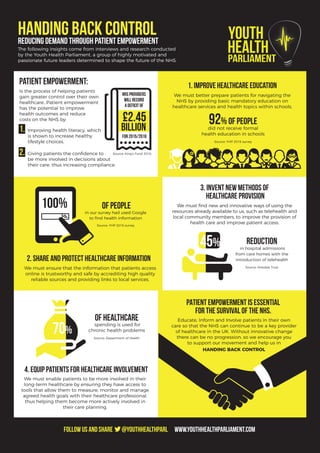
Handing Back ControlReducing demand through patient empowerment
The following insights come from interviews and research conducted
by the Youth Health Parliament, a group of highly motivated and
passionate future leaders determined to shape the future of the NHS.
Patient empowerment:
Is the process of helping patients
gain greater control over their own
healthcare…Patient empowerment
has the potential to improve
health outcomes and reduce
costs on the NHS by:
1. Improving health literacy, which
is shown to increase healthy
lifestyle choices.
2. Giving patients the confidence to
be more involved in decisions about
their care, thus increasing compliance.
Source: King’s Fund 2016
NHS providers
will record
a deficit of
£2.45
billion
for 2015/2016
1. Improve Healthcare Education
We must better prepare patients for navigating the
NHS by providing basic mandatory education on
healthcare services and health topics within schools.
92% of people
did not receive formal
health education in schools
Source: YHP 2016 survey
2. Share and protect Healthcare Information
We must ensure that the information that patients access
online is trustworthy and safe by accrediting high quality
reliable sources and providing links to local services.
3. Invent new methods of
Healthcare Provision
We must find new and innovative ways of using the
resources already available to us, such as telehealth and
local community members, to improve the provision of
health care and improve patient access.
reduction
in hospital admissions
from care homes with the
introduction of telehealth
Source: Airedale Trust
45%
4. Equip patients for Healthcare involvement
We must enable patients to be more involved in their
long-term healthcare by ensuring they have access to
tools that allow them to measure, monitor and manage
agreed health goals with their healthcare professional,
thus helping them become more actively involved in
their care planning.
PATIENT EMPOWERMENT IS ESSENTIAL
FOR THE SURVIVAL OF THE NHS.
Educate, Inform and Involve patients in their own
care so that the NHS can continue to be a key provider
of healthcare in the UK. Without innovative change
there can be no progression, so we encourage you
to support our movement and help us in
HANDING BACK CONTROL
of people
in our survey had used Google
to find health information
Source: YHP 2016 survey
Follow us and share @Youthhealthparl www.youthhealthparliament.com

YHP_Handingbackcontrol_Final

  • 1.
    YOUTH HEALTH PARLIAMENT REDUCING DEMAND THROUGHPATIENT EMPOWERMENT DECEMBER 2016 HANDING BACK CONTROL
  • 2.
    CONTENTS 1 EXECUTIVE SUMMARY 2 2 INTRODUCTION 4 3 OPPORTUNITIESTO EMPOWER PATIENTS AND REDUCE DEMAND 5 3.1 HEALTHCARE EDUCATION 5 3.2 HEALTHCARE INFORMATION 5 3.3 HEALTHCARE PROVISION 7 3.4 HEALTHCARE INVOLVEMENT 8 4 RECOMMENDATIONS: THE BEST OPPORTUNITIES TO REDUCE DEMAND ON THE NHS 10 4.1 RECOMMENDATION 1: A FOUNDATION EDUCATION IN HEALTH 10 4.2 RECOMMENDATION 2: THE REGULATION OF HEALTH INFORMATION ONLINE 10 4.3 RECOMMENDATION 3: AN IMPROVED ONLINE DIAGNOSTIC TOOL 10 4.4 RECOMMENDATION 4: NON-TRADITIONAL COMMUNITY HEALTHCARE EXPERTS 11 4.5 RECOMMENDATION 5: PROMOTING AND UPSCALING THE USE OF TELEHEALTH 11 4.6 RECOMMENDATION 6: THE APP’Y PATIENT 11 4.7 RECOMMENDATION 7: THE EQUIPPED PATIENT 12 5 CONCLUSION 13 6 REFERENCES 14
  • 3.
    2 1 EXECUTIVE SUMMARY Asthe gap between demand and supply within the NHS grows unsustainably, both financial and clinical targets continue to be missed. The NHS is in need of a strategic rethink to identify new sources of efficiency. It is well known that patients with health literacy skills are able to better navigate healthcare systems and make healthier choices. Therefore, this report presents novel recommendations to help empower patients using community resources and technology, thus enabling them to take greater control over the delivery of their own healthcare. Through identifying problem areas along the entire patient journey, seven policies are proposed to ensure that patient empowerment does not remain a platitude. The proposals are intentionally innovative and challenging. They draw upon existing successes to suggest new creative routes to healthcare, whilst striving to avoid the mistakes of past attempts. Four sequential steps along the healthcare journey have been identified as areas for improvement. STEP ONE: HEALTHCARE EDUCATION Patients are underprepared from the very start of their journey. There is no formal process for learning how to use the health service appropriately. RECOMMENDATION 1: A FOUNDATION EDUCATION IN HEALTH Compulsory health education in schools, focusing on healthy living, common health conditions, and when and where to access appropriate services in the NHS. STEP TWO: HEALTHCARE INFORMATION Motivated patients can turn to online health information for assistance, although many have difficulty discerning its quality and trustworthiness. RECOMMENDATION 2: THE REGULATION OF HEALTH INFORMATION NHS to promote websites containing high quality healthcare information by providing an NHS accreditation logo, or kitemark, that is easily visible and well recognised as a stamp of reliability. RECOMMENDATION 3: AN IMPROVED ONLINE DIAGNOSTIC TOOL NHS to partner with a major search engine to provide an accessible diagnostic tool that can direct patients to the most relevant local health services, without them having to access a health specialist website such as NHS Choices.
  • 4.
    3 1 EXECUTIVE SUMMARY Althoughchallenging, this strategy aims to ensure that individuals take ownership of their health, access reliable health information and find the most appropriate provider. Such an approach aims to improve individual patient experience of healthcare whilst ultimately reducing avoidable demand for health services. STEP THREE: HEALTHCARE PROVISION In spite of online information, health issues can remain unresolved due to stigmatisation or delayed clinical visits. Furthermore, as the demand for health services continues to increase, traditional methods of delivering healthcare are being challenged. RECOMMENDATION 4: NON-TRADITIONAL COMMUNITY HEALTHCARE EXPERTS Central and local government to make funding available for the training of non-traditional sources of healthcare information, such as hairdressers, teachers and tattoo artists, who can be engaged to support local communities by using their positions in society to help recognise health symptoms and direct patients to appropriate sources of care. RECOMMENDATION 5: PROMOTING AND UPSCALING THE USE OF TELEHEALTH NHS to incentivise healthcare professionals to utilise and upscale telemedicine to engage and communicate with patients outside of the clinic and spearhead a culture shift towards the acceptance of the technology. STEP FOUR: HEALTHCARE INVOLVEMENT Regardless of the provider, healthcare information discussed with patients is often not understood at the time, or else quickly forgotten. This increases patients’ reliance on healthcare professionals for the day-to-day management of their condition. RECOMMENDATION 6: THE APP’Y PATIENT NHS to create a safe and user-friendly consultation app that provides the patient with specific information about their consultations, condition and medication. RECOMMENDATION 7: THE EQUIPPED PATIENT NHS to empower patients to take control of their health and chronic conditions through tailored education, joint care planning and by giving them the tools to measure, monitor and manage their conditions.
  • 5.
    4 2 INTRODUCTION The NHSexists in a state of turmoil, at a time when demand for services is growing far more quickly than the system can afford. Referrals to hospital have risen by 20% since 2010, three times faster than spending (The Economist, 2016), whilst the number of people waiting in Accident and Emergency is at its highest point in decades (The King’s Fund, 2016). The impact of these pressures is clear: in 2015 nearly 90% of NHS trusts were in deficit (The Economist, 2016). All the while, vital indicators, such as cancer survival rates, show the NHS lagging behind comparable countries (Walters et al., 2015). This situation is clearly unsustainable. The Nuffield Trust (2012) estimates that the NHS will face a budget gap of £30 billion by 2020, with the Department of Health pledging less than a third of this amount in additional funding. As demand continues to grow, the NHS will need to identify fresh sources of efficiency. New models for managing demand have become an unavoidable area of focus for the NHS, and will continue to direct the quest for efficiency. Preventable demand for health services is found at every step along the patient journey. Patients with poor health literacy are at greater risk of avoidable conditions. This is exacerbated by the existence of inaccurate health sources, which have the potential to cause patients harm. A lack of education about the health system itself means patients often use inappropriate channels to access care. Often at the point of need, the most appropriate channels are not accessible, or difficult to navigate (Royal College of General Practitioners, 2014). This presents a risk to patient safety and can lead to worsening of health problems, which increases the burden on the NHS. Finally, after diagnosis, patients do not always have the tools to self-manage their conditions, adding to the demand faced by clinicians. Technological solutions to these problems are still underutilised (Digital Health, 2006), making it ever more difficult for patients to be involved in their own care. These are the consequences of a health service not yet equipped to meet the coming challenges. Each shortfall curtails the process of patient empowerment. An empowered patient is defined here as a health literate individual who is able to obtain, process and understand basic health information (Morgan, 2016). This enables them to think critically and act more autonomously by effectively navigating the healthcare system while making contributions to decisions about their healthcare and the services they require (Morgan, 2016). Patients who are not empowered cost up to 21% more than those that are (Purdy, 2010), as they are more likely to make unhealthy choices and use emergency care (The King’s Fund, 2016). Despite strong evidence supporting patient empowerment, there is a lack of focus on this initiative. This report outlines how the empowerment of patients can be achieved. This will provide patients with the tools to better manage their health, reduce inappropriate use of services and ultimately, help curtail the rise in demand. Such an approach aligns closely with a novel model of partnership envisioned by the NHS through its 50 new ‘care model vanguards’ (NHS England, 2016). This paper sets out the route to achieving patient empowerment amidst an evolving healthcare environment, thus ensuring the long-term survival of the NHS.
  • 6.
    5 3 OPPORTUNITIES TOEMPOWER PATIENTS AND REDUCE DEMAND 3.1 HEALTHCARE EDUCATION Patient education is teaching individuals about their conditions and encouraging them to have greater understanding so they are better placed to make decisions about their care plan while coping better in everyday life (WHO, 2009). This can improve decision making, promote healthy behaviour and empower patients to participate in the delivery of their own healthcare. Numerous trials have demonstrated the benefits of patient education across several chronic diseases, including asthma (Couturaud et al., 2002) and diabetes (Khunti et al., 2012). Although there are education programmes for adults with chronic illnesses, there is no formal education on prevention and early intervention in schools. Currently, ‘Personal, Social and Health Education’ (PSHE), which covers the broad topics of substance misuse, sexual health, healthy lifestyles and mental health, is taught in some UK primary and secondary schools. However, PSHE is largely non-compulsory and Ofsted have noted that ‘40% of PSHE teaching is less than good’ (Morgan, 2016). Teaching around self-management of health conditions and appropriate use of healthcare services is not in the PSHE Guidance. Targeted education in these areas, particularly around conditions commonly seen by GPs – such as upper respiratory tract infections, back conditions and depression – could help to reduce the burden on the health service. A cultural and educational shift is required to encourage the use of non-GP and A&E sources of health information and support. For example, 91% of patients think that pharmacists only dispense medications; the majority do not appreciate that pharmacists can also be a source of advice, a view held particularly by younger people (East Berkshire Primary Care: Out of Hours, 2015). Evidence shows that well-designed and executed programmes can lead to long term health benefits, with examples including the ‘Friends for Life Program’ (Briesch et al., 2010). Interactive curricula with a similar focus have been explored in the US (U.S. Food and Drug Administration, 2013), and current education in the UK surrounding oral healthcare has been successful. These could be replicated across other healthcare domains, and by pairing pupils’ education with parent education, benefits may be enhanced. 3.2 HEALTHCARE INFORMATION People are increasingly using the internet to find healthcare information; roughly 1% of all Google searches globally are related to a health symptom or concern (Pinchin, 2016). However, information accessed online is often unregulated and a number of studies have shown that accuracy and reliability is poor (Lissman and Boehnlein, 2001). One study revealed that only of the first 1300 results of a health search provided information that was consistent with national health guidelines, such as those of the National Institute for Health and Care Excellence (NICE) (Rehman, 2012). In light of this, it is worrying that of the general population use information online to influence decisions about their health. 43.5% 53%
  • 7.
    6 3 OPPORTUNITIES TOEMPOWER PATIENTS AND REDUCE DEMAND Although there are specialist health information websites such as ‘NHS Choices’, which provides comprehensive health information to help patients make the best choices about their health (NHS Choices, 2016), only 13% of the general public will start an online search by using such sites (PMGroup, 2014). By contrast, 77% of the general population will access a major search engine to look up health symptoms (PMGroup, 2014), something that one third of the population admit to doing in order to self-diagnose (Gann, 2012). Despite possible dangers of the internet, it is a potentially powerful healthcare tool. In a review conducted in 2015 there were found to be 23 “Online Symptom Checkers” (OSCs), the term given to computer algorithms that enable patients to self-triage or self-diagnose (NHS Choices, 2015). In these OSCs, triage appropriateness was found in 80% of emergency cases and 55% of non-emergency cases (Semigran et al., 2015). While low accuracy can risk unnecessary patient mortality or the cost of unnecessary appointments (Semigran et al., 2015), high accuracy OSCs can lead to beneficial outcomes by quickly signposting patients who require care and reassuring patients who do not (Saczynski et al., 2008; Poote et al., 2014). OSCs combined with Global Positioning Systems (GPS) can also be used to help patients locate their closest and most appropriate health service, based on their symptoms. The Anthem Blue Cross in Virginia has created an online map of health clinics and urgent care centres to direct patients to the appropriate care provider. This feature has assisted more than 60% of patients who would have otherwise unnecessarily attended the emergency department. (Clarke, 2010). 100% of the sample had used a search engine to find information on a health symptom they were experiencing To support the existing literature, we conducted a survey of 100 people which showed: On average, users rated the trustworthiness of information found online 3 out of 5 (with 5 being complete trust and 0 being no trust at all). 100% of respondents would trust information more highly if it was recommended by the NHS. 95%
  • 8.
    3 OPPORTUNITIES TOEMPOWER PATIENTS AND REDUCE DEMAND The benefits of internet-based health information and OSCs are enhanced through structured, personalised tools such as shared decision aids, which present the risks and benefits of treatment options in formats patients can understand (Bessière et al., 2010). The reality is that patients will continue to search their symptoms online through major search engines. While certification such as the Information Standard, introduced by NHS England in 2009, already exists (NHS England, n.d.), the application process is voluntary and often complex; moreover, certification is not visible to the public until they actually open a webpage. Consequently, it is not possible to easily and conveniently identify reliable sites from the search results page of a major search engine. Therefore, in order to enhance the potential benefits of the internet whilst minimising dangers, there needs to exist a tool that guides and empowers patients to make use of the most appropriate health services available, as well as an instantly visible system that highlights trustworthy online health tools and information. 3.3 HEALTHCARE PROVISION As the demand for health services continues to increase, traditional methods of delivering healthcare are being challenged. The increasingly interactive role that community members and technology can play in healthcare has the potential to create positive change that can help the NHS efficiently meet growing demand. Health information delivered in a group setting, or by other individuals suffering from similar conditions, has been shown to be particularly beneficial to patients and cost effective for the NHS, especially as such programmes are often run by volunteers. These volunteers are examples of “non-traditional healthcare advisors” who, if trained, are able to improve patient outcomes (Eakin et al., 2002). This idea aligns with the concept of Asset Based Community Development (ABCD), which implies that communities themselves can drive development by identifying and mobilising existing, but often unrecognised assets, notably local individuals and established networks. In the UK, North Bristol NHS Trust has run educational events for local tattoo artists to teach them how to spot potential signs of melanoma and signpost patients to seek further advice. This has also been seen to work in other professions such as hairdressers, barbers and podiatrists (North Bristol NHS Trust, 2016). Another successful example is provided by the Camden Clinical Commissioning Group, which funded mental health training for local barbers, helping them to identify, signpost and manage mental health difficulties (NHS Camden CCG, 2016). These schemes help identify health problems early, thus reducing long-term social and health care costs. There is mounting evidence to suggest that empowering patients through the use of non- traditional healthcare advisors would help reduce demand and improve health outcomes for specific conditions (Perfetti, 2013). Commitment from local and central government is necessary for non-traditional healthcare advisors to become a reality, and resources to train these individuals need to be considered. However, research suggests that supporting patients through non-traditional means could save over 31 million GP appointments, easily offsetting the additional costs (Clay and Stern, 2015). There is also a growing body of evidence to suggest that healthcare services could be made more efficient through the use of telehealth (Cruickshank et al., 2010). The WHO defines telehealth as ‘The delivery of healthcare services, where distance is a critical factor, by all healthcare professionals using information and communication technologies’. This includes email, telephone/video consultations and mobile messaging. Telephone and video consultations are forms of telehealth that have been used for several years. Research has shown them to be hugely successful intermsofpatientsatisfaction,with95%ofpatients saying they would use the service again (Central London Clinical Commissioning Group, 2014). The Airedale NHS Foundation Trust is realising savings 7
  • 9.
    8 of around £5million per year predominantly through a 45% reduction in hospital admissions from care homes and prisons (NHS Providers, 2015). Investment into (online) e-consultations has been part of the Prime Minister’s Challenge Fund, with six pilots providing access to 250,000 patients (NHS England, 2015). Several individual GP practices have also demonstrated the feasibility of telehealth on a local scale with reduced patient demand (NHS Networks, n.d.). Due to these advantages and the increase in internet use by the general population, telehealth is an appealing solution. However, as many as 90% of patients are unaware of, or have yet to experience, telehealth, which is likely contributing to poor uptake (Nijland et al., 2009). And while the engagement of healthcare professionals with telehealth services is critical for success, clinicians are not obligated to recommend the use of telehealth and receive no formal training on reliable and optimal options (National Assembly for Wales, n.d.). For telehealth to be successful there needs to be improved patient awareness and development of a culture that is accepting of these changes. Telehealth also requires a coherent national plan for its implementation, to create a service familiar to all patients. The use of technology to help patients engage and communicate better with the health service provides opportunities for increased patient empowerment. 3.4 HEALTHCARE INVOLVEMENT Approximately 15 million people in the UK are currently living with at least one chronic health condition (Department of Health, 2012). These conditions place a huge resource burden on the NHS and account for £7 out of every £10 spent on health and social care (Department of Health, 2012). There are extensive opportunities to improve patient experience and reduce expenditure by engaging these patients in better self-care and ensuring they have a holistic understanding of their condition. Several studies show that patients forget approximately two-thirds of information discussed during consultations, and a large number do not fully understand the information received (Makaryus and Friedman, 2005). If patients have poor understanding of their treatment plan or diagnosis it can affect their medication compliance; this is estimated to cost the NHS £500 million annually (Hagan, 2015). Patients who are engaged with their treatment reduce NHS costs in other ways; physician supported self-management has been shown to increase patient satisfaction, improve the patient-doctor relationship and reduce hospital admission rates in a broad range of conditions (O’Kane et al., 2015). There have been several efforts to ensure patient self-management is widely adopted: • The ‘Co-Creating Health’ programme aimed to embed self-management into all standard UK health services. The Long Term Conditions Year of Care Commissioning programme was a handbook published to help commissioners achieve this (The Health Foundation, n.d.). • Self-Management UK is a leading charity providing generic and disease- specific courses for patients with chronic diseases (Self Management UK, n.d.). • The Expert Patients’ Programme demonstrated reductions in patient pain, disability and fatigue (Foster et al., 2007) and was considered very likely cost effective (Richardson et al., 2008). 3 OPPORTUNITIES TO EMPOWER PATIENTS AND REDUCE DEMAND
  • 10.
    Despite the compellingcase for patient self- management, primary and secondary care services have not fully engaged with the programme (Kennedy et al., 2007). For self-management to be effective it needs to be seen as a priority by clinicians, and implemented sensitively to avoid unnecessary patient anxiety. Research shows that the best methods of delivering information to patients are designed around their needs and change in accordance with their situation (Mathers and Paynton, 2015). The information should also be available at the right time and in the correct format. Technological progress enables patients to now receive “tailored information that is contextualised and personalised e.g. directly relevant and easily comprehensible to the person’s own health situation” (Kennedy et al., 2014). The rise in smartphone ownership provides an opportunity to develop a regulated, permanent and patient specific information source. However, it is vital that patient privacy and data protection is maintained throughout this process in order to instil public confidence in the system (Huckvale et al., 2015). A systematic review of the use of mobile phone apps by Coronary Heart Disease patients showed significant improvements in patient outcomes with minimal usability issues (Beatty et al., 2013). Other technologies such as activity, heart rate and blood pressure monitors have also been successful in supporting self-management (Zheng et al., 2010). Decision support systems can help to detect abnormal activity based on monitor readings enabling early, well informed treatment alterations (Zheng et al., 2010). Research suggests patients are supportive of the introduction of this technology (Vanhoof et al., 2015). Empowering patients to understand and co- manage their condition, in conjunction with their physician, has been shown to have wide- ranging benefits. However, implementation of these strategies has not yet been effective. NHS England could realise savings of at least £4.4 billion a year from reduced A&E attendance, hospital admission, and outpatient attendance if they were fully adopted (NESTA, 2013). 9 3 OPPORTUNITIES TO EMPOWER PATIENTS AND REDUCE DEMAND
  • 11.
    10 4 RECOMMENDATIONS: THEBEST OPPORTUNITIES TO REDUCE DEMAND ON THE NHS 4.1 RECOMMENDATION 1: A FOUNDATION EDUCATION IN HEALTH Compulsory health education in schools, focusing on healthy living, common health conditions, and when and where to access appropriate services in the NHS. There are no modules within schools that develop the capabilities of future health service users to navigate the NHS and assess when their needs require specialist clinical support. We propose that a module is introduced within schools, possibly through PSHE, that covers topics such as healthy living, basic health conditions and, most importantly, when as well as where to access appropriate services in the NHS. For this education module to succeed it must be a compulsory component of the curriculum and taught throughout all school years, ensuring that sufficient time is allocated to guarantee accurate and continuous learning. This should be an examinable subject to highlight its importance and allow progress to be measured. Pooled funding for the module should originate from the Department of Education and the Department of Health. The module must be run collaboratively with universities, GPs and community healthcare professionals to actively help develop and deliver the programme. Teaching of pupils should be partnered with parent health education sessions to guarantee consistent messages are delivered and demonstrated outside of the classroom. This recommendation represents a sustainable and long term solution to help reduce the growing demand on the NHS. 4.2 RECOMMENDATION 2: THE REGULATION OF HEALTH INFORMATION ONLINE NHS to promote websites containing high quality healthcare information by providing an NHS accreditation logo, or kitemark, that is well recognised as a stamp of reliability. We propose that the current Information Standard (which indicates a reliable source of health and social care information) should be made more visible and easily identifiable. Firstly, the logo must be viewable on the search results page when looking for websites rather than only once the website has been visited. Secondly, the Department of Health should partner with Google to ensure that websites meeting the standard appear at the top of the search page. This must be combined with changes to practice whereby healthcare professionals actively direct patients to verified sites, and where the Information Standard actively seeks health information sites to accredit, especially those that have been shown to be highly popular resources based on usage figures. 4.3 RECOMMENDATION 3: AN IMPROVED ONLINE DIAGNOSTIC TOOL NHS to partner with a major search engine to provide an accessible diagnostic tool that can direct patients to the most relevant local health services, without them having to access a health specialist website. The majority of online health searches are via major search engines rather than specialist websites like NHS choices. We propose that when patients search symptoms online using a major search engine, they be immediately presented with simple follow up questions from an NHS triage tool. This would help individuals easily identify whether they need to access professional support without necessarily having to visit a specialist health website first. The triage tool must be enhanced by global positioning systems technology so that individuals can be directed to appropriate local health services, for example a pharmacist, community nurse, GP or local patient group.
  • 12.
    11 4.4 RECOMMENDATION 4: NON-TRADITIONAL COMMUNITY HEALTHCARE EXPERTS Central and local government to make funding available for the training of non-traditional sources of healthcare information, such as hairdressers, teachers and tattoo artists, who can be engaged to support local communities by using their positions in society to help recognise health symptoms and direct patients to appropriate sources of care. We propose that ‘lay’ individuals in the community have access to training and support related to specific local health needs to become non- traditional healthcare advisors. This would be voluntary training, focused on individuals with regular contact with the general public (such as teachers, hairdressers, tattoo artists) or those who themselves live with chronic conditions. The proposed system would harness these advisors’ unique position to identify individuals who may be experiencing health difficulties and correctly signpost them to appropriate services. In some instances, this would act as a form of early intervention and would lead to clinician’s time being used more effectively. National and local government funding would need to be allocated to this system. 4.5 RECOMMENDATION 5: PROMOTING AND UPSCALING THE USE OF TELEHEALTH NHS to incentivise healthcare professionals to utilise and upscale telemedicine to engage and communicate with patients outside of the clinic and spearhead a culture shift towards the acceptance of the technology. We propose that telehealth should be expanded and promoted by healthcare professionals through the use of government funded incentive programmes. These programmes must reward healthcare providers that actively engage patients through the use of telehealth to improve the efficiency of healthcare delivery. The use of telehealth must become a routine alternative to being seen in person, thus healthcare professionals need to take an active role in promoting and building the capacity of patients to utilise the technology. Telephone clinics and video conferencing appointments already exist and must be expanded upon to allow patients to send data collected on a smartphone relating to their health, such as photos of visible symptoms. Increased use of telehealth offers the chance to reduce the number of patients needed to be seen in clinic, promotes regular contact with healthcare teams and reduces disruption to work or family life, potentially improving treatment outcomes for patients whilst reducing the long-term burden on the NHS. 4.6 RECOMMENDATION 6: THE APP’Y PATIENT NHS to create a safe and user-friendly consultation app that provides the patient with specific information about their consultations, condition and medication. There is an increasing prevalence of patients with more than one chronic condition. These patients often require multiple forms of treatment and are at greater risk of medical complications. Management of their conditions must be made simple and easy so they can take greater control of their own health. We recommend the creation of an NHS Choices app as a simple resource for storing generic information about personal conditions and medications. Specific information, such as medication regimen, could be added onto the app by the healthcare professional. Although information contained in this app would not be transmitted and remain private to the patient’s device, patients would consent to this scheme and the app would be password protected to ensure privacy and data protection was maintained. This would enable quick and secure access to health information, while potentially increasing medication adherence and personal knowledge of relevant health conditions. 4 RECOMMENDATIONS: THE BEST OPPORTUNITIES TO REDUCE DEMAND ON THE NHS
  • 13.
    12 4 RECOMMENDATIONS: THEBEST OPPORTUNITIES TO REDUCE DEMAND ON THE NHS 4.7 RECOMMENDATION 7: THE EQUIPPED PATIENT NHS to empower patients to take control of their health and chronic conditions through tailored education, joint care planning and by giving them the tools to measure, monitor and manage their conditions. It is well known that patients with chronic health conditions put considerable demand on the NHS. As such, we propose that patients with a chronic condition should be offered the basic tools to measure, monitor and manage their own health, where they have suitable capacity, so they can take a more active role in their health condition. The healthcare professional must therefore have dedicated time to educate the patient, to agree goals and co-create a care plan. Education will include how to use simple tools and available technology that can measure vital signs and take other condition-relevant readings. This data should be inputted by patients into an interactive portal that clinicians can access. Education will be followed up by patient surveys that assess the individual’s understanding of their condition, when and where to seek clinical support, and whether they would be able to give advice to a friend with a similar condition. In the long term, this could significantly reduce avoidable appointments.
  • 14.
    13 The empowerment ofpatients is not an overnight task. Implementing the principles of patient education and support requires a long- term investment of focus, and the use of new technology will be crucial to bringing about this change. However, it is not just technological innovation, but cultural innovation, which will determine the success of the policies recommended here. The major challenge will be ensuring that an increase in access to services does not bring with it an increase in demand. It is for this reason that an original combination of policies is proposed, which are nonetheless supported by a robust evidence base. Thus, policy makers can build a future in which demand for health services is more manageable, patients are more able to take ownership of their healthcare, and the healthcare system is sustainable once again. 5 CONCLUSION
  • 15.
    14 6 REFERENCES Anthem BlueCrossBlueShield. Find Urgent Care (n.d.). Anthem BlueCross BlueShield. Available at: https://www.anthem.com/health-insurance/quickcare/ urgentcare (Accessed: 16 September 2016). Beatty, A. L. et al. (2013) ‘Using mobile technology for cardiac rehabilitation: a review and framework for development and evaluation’ (2047-9980 (Electronic)). Bessière, K., Pressman, S., Kiesler, S. and Kraut, R. (2010) ‘Effects of Internet Use on Health and Depression: A Longitudinal Study’, Journal of Medical Internet Research, 12(1), pp. e6. Briesch, A. M. et al. (2010) ‘Reducing the Prevalence of Anxiety in Children and Adolescents: An Evaluation of the Evidence Base for the FRIENDS for Life Program’, School Mental Health, 2(4), pp. 155-165. Central London Clinical Commissioning Group. (2014) Implementing Skype Consultations in General Practice, Update report on the Cavendish Health Centre Remote Consultation Service Pilot Project: Central London Clinical Commissioning Group. Available at: http:// www.centrallondonccg.nhs.uk/media/24178/CLCCG- Cavendish-Skype-pilot-interim-report.pdf (Accessed: 16 September 2016). Clarke, K. (2010) Finding a Health Clinic with Google Maps. Available at: http://googlemapsmania.blogspot. com/2010/07/finding-health-clinic-with-google-maps. html (Accessed: 16 September 2016). Clay, H. and Stern, R. (2015) MAKING TIME IN GENERAL PRACTICE Freeing GP capacity by reducing bureaucracy and avoidable consultations, managing the interface with hospitals and exploring new ways of working: Primary Care Foundation. Available at: http://www.primarycarefoundation.co.uk/images/ PrimaryCareFoundation/Downloading_Reports/PCF_ Press_Releases/Making-Time-in_General_Practice_ FULL_REPORT_28_10_15.pdf (Accessed: 16 September 2016). Couturaud, F. et al. (2002) ‘Education and self- management: a one-year randomized trial in stable adult asthmatic patients’, J Asthma, 39(6), pp. 493- 500. Cruickshank, J. et al. (2010) Healthcare without walls, A framework for delivering telehealth at scale. 2020Health. Available at: http:// www.2020health.org/dms/2020health/downloads/ reports/2020telehealthLOW.pdf (Accessed: 16 September 2016). Department of Health. (2012) Long Term Conditions Compendium of Information. Department of Health. Available at: https://www.gov.uk/government/uploads/ system/uploads/attachment_data/file/216528/ dh_134486.pdf (Accessed: 16 September 2016). Digital Health. (2006) Existing ICT underused, Royal Society finds: Digital Health. Available at: http://www. digitalhealth.net/news/22290/existing-ict-underused- royal-society-finds (Accessed: 16 September 2016). Eakin, E. G. et al. (2002) ‘Reaching those most in need: a review of diabetes self-management interventions in disadvantaged populations’. (1520-7552 (Print)). East Berkshire Primary Care Out of Hours. ( 2015) Poll Suggests Few People Are Aware Of Additional Pharmacy Health Services: East Berkshire Primary Care Out of Hours. Available at: http://ebpcooh.org. uk/poll-suggests-few-people-are-aware-of-additional- pharmacy-health-services/ (Accessed: 16 September 2016). Foster, G. et al. (2007) ‘Self-management education programmes by lay leaders for people with chronic conditions’, (1469-493X (Electronic)). Gann, B. (2012) ‘Giving patients choice and control: health informatics on the patient journey’, (2364-0502 (Electronic)). Hagan, P. (2015) The True Cost of Medication non-adherence: Let’s Take Care of It. Available at: http://www.letstakecareofit.com/wp-content/ uploads/2015/10/The-True-Cost-of-Medication-Non- Adherence-Report.pdf (Accessed: 16 September 2016). Health Foundation. Year of Care (n.d.): The Health Foundation. Available at: http://www.health.org.uk/ programmes/year-care (Accessed: 25 October 2016). Huckvale, K. et al. (2015) ‘Unaddressed privacy risks in accredited health and wellness apps: a cross-sectional systematic assessment’, BMC Medicine, 13(1), pp. 214. Kennedy, A. et al. (2007) ‘The effectiveness and cost effectiveness of a national lay-led self care support programme for patients with long-term conditions: a pragmatic randomised controlled trial’, (0143-005X (Print)). Kennedy, A. et al. (2014) ‘Implementation of a self- management support approach (WISE) across a health system: a process evaluation explaining what did and did not work for organisations, clinicians and patients’, (1748-5908 (Electronic)).
  • 16.
    15 Khunti, K. etal. (2012) ‘Effectiveness of a diabetes education and self management programme (DESMOND) for people with newly diagnosed type 2 diabetes mellitus: three year follow-up of a cluster randomised controlled trial in primary care’, BMJ, 344, pp. e2333. King’s Fund. (2016) What’s going on in A&E? The key questions answered: The King’s Fund. Available at: https://www.kingsfund.org.uk/projects/urgent- emergency-care/urgent-and-emergency-care- mythbusters (Accessed: 16 September 2016). Lissman, T. L. and Boehnlein, J. K. (2001) ‘A Critical Review of Internet Information About Depression’. Psychiatric Services, 52(8), pp. 1046-1050. Makaryus, A. N. and Friedman, E. A. (2005) ‘Patients’ understanding of their treatment plans and diagnosis at discharge’. Mayo Clin Proc, 80(8), pp. 991-4. Mathers, N. and Paynton, D. (2015) ‘Rhetoric and reality in person-centred care: introducing the House of Care framework’, British Journal of General Practice, 66(642), pp. 12. Morgan, N. (2016) Letter to Chair of Education Select Committee: Government Digital Services. Available at: https://www.gov.uk/government/uploads/system/ uploads/attachment_data/file/499338/Nicky_Morgan_ to_Education_Select_Committee_-_10_Feb_2016--.pdf (Accessed: 16 September 2016). National Assembly for Wales. Learning the Lesson from 3 Million Lives – Update for National Assembly of Wales, Health and Social Care Committee (n.d.): National Assembly for Wales. Available at: http://www. senedd.assembly.wales/documents/s43139/ (Accessed: 16 September 2016). NESTA. (2013) The Business Case for People Powered Health: NESTA. Available at: https://www.nesta.org. uk/sites/default/files/the_business_case_for_people_ powered_health.pdf (Accessed: 25 October 2016). NHS Camden CCG. (2016) Camden’s black barbers: supermen in mental health battle. NHS Camden CCG. Available at: http://www.camdenccg.nhs.uk/news- articles/Camdens-black-barbers-supermen-in-mental- health-battle.htm (Accessed: 16 September 2016). NHSChoices (2015) Online symptom checkers’ reliability assessed: Department of Health. Available at: http://www.nhs.uk/news/2015/07July/Pages/Online- symptom-checkers-reliability-assessed.aspx (Accessed: 16 September 2016). NHSChoices (2016) Introduction to NHS Choices: Department of Health. Available at: http://www.nhs.uk/ aboutNHSChoices/aboutnhschoices/Pages/what-we- do.aspx (Accessed: 16 September 2016). NHS England. How to join (n.d.): NHS England. Available at: https://www.england.nhs.uk/tis/how-to- join/ (Accessed: 16 September 2016). NHS England. (2016) NEW CARE MODELS: Vanguards - developing a blueprint for the future of NHS and care services: NHS England. Available at: https://www. england.nhs.uk/wp-content/uploads/2015/11/new_ care_models.pdf (Accessed: 16 September 2016). NHS England. (2015) Prime Minister’s Challenge Fund: Improving Access to General PracticeFirst Evaluation Report: NHS England. Available at: https://www. england.nhs.uk/wp-content/uploads/2015/10/pmcf-wv- one-eval-report.pdf (Accessed: 16 September 2016). NHS England. (n.d.) What is The Information Standard. NHS England. Available at: https://www.england. nhs.uk/tis/about/the-info-standard/ (Accessed: 16 September 2016). NHS Networks. Online consultations, Rydal practice, N London (n.d.): NHS Networks. Available at: https:// www.networks.nhs.uk/nhs-networks/releasing- capacity-in-general-practice/documents/2-2-e- consultations-online-consultations-rydal-practice-n- london/view (Accessed: 16 September 2016). NHS Providers. (2015) Telemedicine at Airedale NHS foundation trust: better care in the community for elderly patients: NHS Providers. Available at: https:// www.nhsproviders.org/media/1817/airedale-final-e.pdf (Accessed: 16 September 2016). Nijland, N. et al. (2009) ‘Increasing the use of e-consultation in primary care: results of an online survey among non-users of e-consultation’, (1872-8243 (Electronic)). North Bristol NHS Trust. (2016) Skin cancer experts educating tattooists to help save lives: North Bristol NHS Trust. Available at: https://www.nbt.nhs.uk/news- media/latest-news/skin-cancer-experts-educating- tattooists-help-save-lives (Accessed: 16 September 2016). 6 REFERENCES
  • 17.
    16 6 REFERENCES O’Kane, M.et al. (2015) ‘Can patients use test results effectively if they have direct access?’, BMJ : British Medical Journal, 350. Perfetti, R. (2013) ‘Comprehensive approach to the management of diabetes: offering improved outcomes for diabetics and the healthcare system’, Diabetes Management, 3(6), pp. 505-528. Pinchin, V. (2016) ‘I’m Feeling Yucky :( Searching for symptoms on Google’. Available at: https://blog. google/products/search/im-feeling-yucky-searching- for-symptoms/ 2016]. PMGroup Worldwide Limited. (2014) The use of search engines in health: PMGroup Worldwide Limited. Available at: http://www.pmlive.com/pharma_news/ The_use_of_search_engines_in_health (Accessed: 16 September 2016). Poote, A. E. et al. (2014) ‘A study of automated self- assessment in a primary care student health centre setting’. (1758-1109 (Electronic)). Purdy, S. (2010) Avoiding hospital admissions, what does the research evidence say?: The King’s Fund. Available at: https://www.kingsfund.org.uk/sites/ files/kf/Avoiding-Hospital-Admissions-Sarah-Purdy- December2010.pdf (Accessed: 16 September 2016). Rehman, J. (2012) Accuracy of Medical Information on the Internet: Scientific American. Available at: https:// blogs.scientificamerican.com/guest-blog/accuracy-of- medical-information-on-the-internet/ (Accessed: 16 September 2016). Richardson et al. (2009) Cost effectiveness of the Expert Patients Programme (EPP) for patients with chronic conditions. J Epidemiol Community Health 2008;62:361-367 doi:10.1136/jech.2006.057430 Royal College of General Practitioners. (2014) 34m patients will fail to get appointment with a GP in 2014. Royal College of General Practitioners. Available at: http://www.rcgp.org.uk/news/2014/february/34m- patients-will-fail-to-get-appointment-with-a-gp- in-2014.aspx (Accessed: 16 September 2016). Saczynski, J. S. et al. (2008) ‘Trends in Prehospital Delay in Patients With Acute Myocardial Infarction (from the Worcester Heart Attack Study)’, American Journal of Cardiology, 102(12), pp. 1589-1594. Self Management UK (n.d.): Self Management UK. Available at: http://selfmanagementuk.org/ (Accessed: 25 October 2016). Semigran, H. L. et al. (2015) ‘Evaluation of symptom checkers for self diagnosis and triage: audit study’. BMJ : British Medical Journal, 351. The Economist. (2016) The National Health Service Accident and emergency: The Economist. Available at: http://www.economist.com/news/britain/21706563- nhs-mess-reformers-believe-new-models-health-care- many-pioneered (Accessed: 16 September 2016). The Health Foundation. Co-creating Health (n.d.): The Health Foundation. Available at: http://www.health. org.uk/programmes/co-creating-health (Accessed: 25 October 2016). U.S. Food and Drug Administration. (2013) Understanding Over-the-Counter Medicines - As They Grow: Teaching Your Children How To Use Medicines Safely: U.S Food and Drug Administration. Available at: http://www.fda.gov/Drugs/ResourcesForYou/ Consumers/BuyingUsingMedicineSafely/ UnderstandingOver-the-CounterMedicines/ ucm094876.htm. Vanhoof, J. et al, (2015) Know your end-users: solid organ transplant patients’ use and acceptance of technology for self-management support: Center for Health Services and Nursing Research. Available at: https://www.medetel.eu/download/2015/parallel_ sessions/presentation/day2/Know_your_end_users_ Jasper_Vanhoof_Final.pdf (Accessed: 25 October 2016). Walters, S. et al. (2015) ‘Is England closing the international gap in cancer survival?’ Br J Cancer, 113(5), pp. 848-60. World Health Organization. (2009) Health Promoting Schools: A framework for action. World Health Organization. Available at: http://www.wpro.who.int/ health_promotion/documents/docs/HPS_framework_ for_action.pdf (Accessed: 16 September 2016). Zheng, H. et al. (2010) ‘Smart self-management: assistive technology to support people with chronic disease’, (1758-1109 (Electronic)).
  • 18.
    Simisola Oke (Chair) Fredi Yates (ViceChair) Litza Krause (Researcher) Jordan Rankin (Researcher) Nkem Okwonko (Materials) The above named have written this report in a personal capacity and views expressed do not necessarily reflect those of their respective employers or partner organisations supporting the YHP. YHP editorial advisory board: 2020health Design: Matt Carr Design Ltd Infographics: Sarah Willet HANDING BACK CONTROL YHP SUBGROUP Supported by:
  • 19.
    of healthcare spending isused for chronic health problems Source: Department of Health 70% Handing Back ControlReducing demand through patient empowerment The following insights come from interviews and research conducted by the Youth Health Parliament, a group of highly motivated and passionate future leaders determined to shape the future of the NHS. Patient empowerment: Is the process of helping patients gain greater control over their own healthcare…Patient empowerment has the potential to improve health outcomes and reduce costs on the NHS by: 1. Improving health literacy, which is shown to increase healthy lifestyle choices. 2. Giving patients the confidence to be more involved in decisions about their care, thus increasing compliance. Source: King’s Fund 2016 NHS providers will record a deficit of £2.45 billion for 2015/2016 1. Improve Healthcare Education We must better prepare patients for navigating the NHS by providing basic mandatory education on healthcare services and health topics within schools. 92% of people did not receive formal health education in schools Source: YHP 2016 survey 2. Share and protect Healthcare Information We must ensure that the information that patients access online is trustworthy and safe by accrediting high quality reliable sources and providing links to local services. 3. Invent new methods of Healthcare Provision We must find new and innovative ways of using the resources already available to us, such as telehealth and local community members, to improve the provision of health care and improve patient access. reduction in hospital admissions from care homes with the introduction of telehealth Source: Airedale Trust 45% 4. Equip patients for Healthcare involvement We must enable patients to be more involved in their long-term healthcare by ensuring they have access to tools that allow them to measure, monitor and manage agreed health goals with their healthcare professional, thus helping them become more actively involved in their care planning. PATIENT EMPOWERMENT IS ESSENTIAL FOR THE SURVIVAL OF THE NHS. Educate, Inform and Involve patients in their own care so that the NHS can continue to be a key provider of healthcare in the UK. Without innovative change there can be no progression, so we encourage you to support our movement and help us in HANDING BACK CONTROL of people in our survey had used Google to find health information Source: YHP 2016 survey Follow us and share @Youthhealthparl www.youthhealthparliament.com