1 | P a g e
SCHOOL OF ARCHITECTURE, BUILDING & DESIGN
Modern Architecture Studies in Southeast Asia (MASSA) Research Unit
Bachelor of Science (Honours) in Architecture
ARCHITECTURE DESIGN STUDIO 1 [ARC 60105]
____________________________________________________________________________________
Project 3: Dreamspace for the User ‘SPACE FOR THE SELF’
Project 3 Individual
LO
1-6
60% of Final
Grade
Verbal
presentation
Presentation
Panel + Scaled
Model
Introduction
In project 1, students were allowed to express oneself through their creative means; Project 2 is
meant to prepare students to be aware on the relationship between user and space, emphasizing
on the physical and non-physical requirements; Project 3 on the other hand incorporates both the
creativity and its functionality; identity of user, comfortability of user and creativity in articulating the
space, as a complete user experience.
For the final project, students are required to design a space for the self by attaching it to the
walls/surfaces of an imagined ‘city’ in an empty abandoned lot in between two buildings. The space
is to fit a specific use (as a dream space: for viewing, space for contemplating, space for self-
exploration, space for exercising, space for dreaming, space showcasing and so to speak a dream
space for the user). As the user of the space you can make your personality more interesting, an
effective well thought of theme and written narrative is essential.
This understanding is to be architecturally translated into a series of connected spaces
(2-3 spaces) that successfully establishes the quality and articulation of the interior and of exterior
design. Concept shall evidently show the experiential and spatial quality. Students are also to
consider how well design conforms to both the physical and non-physical requirements of the user.
2 | P a g e
Final project will be in 3 stages, Task 1- is narrative writing wherein it can be based in the persona, life
scenario, story and journey of the user from where or which the theme of the hideout will be extracted.
Task 2- is about exploring how to organize the 2-3 spaces which encompasses design principles in spatial
relationships and organization. In this task students will explore ways on how to explore space through
hierarchal arranging it by its meaning, significance and importance, capturing mere essence of the narrative.
Task 3-In addition to generating and exploring ideas and concept from the narrative and spatial exploration,
we will also explore the notions and experiential effects of materials and the senses in the final design.
Objectives of Project
The objectives of this assignment are as follows:
1. To further the students ability to create and develop a conceptual narrative.
2. To introduce and create awareness in understanding the dimensional requirements of the
human body (anthropometrics and ergonomics).
3. To explore and apply basic design principles and terminologies.
4. To be able to consider objective and subjective parameters in the design process to create
a space this is practical yet poetic.
5. To explore how the selection and application of materials in relation to the sensory
experience of space.
6. To be able to select and make different study models (sketch, concept, diagram, section
and development models)
Learning Outcomes of this Project
1. Generate design concepts through the process of exploring various sources and abstracting ideas.
2. Identify key architectural design elements and principles with the ability to discern how they inform
space and form.
3. Relate the idea of the individual ‘self’ and the body’ to space and its experiential qualities.
4. Articulate and apply architectural design elements, principles and materials to create an
architectural composition that demonstrates place-making.
5. Utilize a process-oriented approach involving sketching and model-making as tools for generating
and developing design ideas.
6. Produce legible orthogonal drawings and architectural models to visualize and communicate final
design.
Key Terminologies
-Persona (personae, personas) - character, role and personality
-Scenario- a collage of an event or a series of an event.
-User Story-Who? What? Why? as the user of the space
-User Journey- the stages of experiences a person encountered
-Spatial Hierarchy- refers to the rank or order of importance of various spaces. This could also be a
programming term used in adjacency diagrams and looking at function relationships when programing a
floor plan. When concerning privacy this could be related to a hierarchy as well as spatial importance, size
of volume, geometry etc. example: Hierarchy from public to private.
-Design Narrative- are accounts of critical events in a design experiment from a personal,
phenomenographic perspective. They focus on design in the sense of problem solving, describing a
problem in the chosen domain, the actions taken to resolve it and their unfolding effects. They provide an
account of the history and evolution of a design over time, including the research context, the tools and
activities designed, and the results of users’ interactions with these.
3 | P a g e
Tasks – Methodology
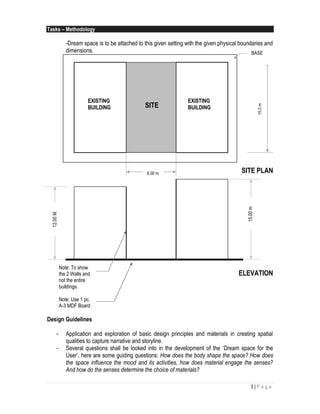
-Dream space is to be attached to this given setting with the given physical boundaries and
dimensions.
SITE PLAN
ELEVATION
Design Guidelines
- Application and exploration of basic design principles and materials in creating spatial
qualities to capture narrative and storyline.
- Several questions shall be looked into in the development of the ‘Dream space for the
User’, here are some guiding questions: How does the body shape the space? How does
the space influence the mood and its activities, how does material engage the senses?
And how do the senses determine the choice of materials?
6.00 m
15.0m
EXISTING
BUILDING
EXISTING
BUILDINGSITE
12.00M. BASE
Note: To show
the 2 Walls and
not the entire
buildings.
Note: Use 1 pc.
A-3 MDF Board
15.00m
4 | P a g e
- Student will be required to design 2-3 spaces with a gross floor area of 70-100 sq.mts.
- Hideout should not occupy more than 70% of the site.
- Should incorporate design elements and principles of design; emphasis on scale,
hierarchy, proportion, harmony and character.
- The design should either attached with at least one or both walls of the two buildings.
- Underground structure maybe allowed but provided it will not be more than 50% of the
floor area requirement. Narrative should rationalize the need to do so.
- Use of the other existing to buildings as an entry is/are not allowed.
Submission Requirements
May 25, 2016 (Week 8) – 3a: Narrative (100-200 words)
 ONE (1) A-3Butter Paper
- May use Diagrams, image maps to avoid lengthy texts.
- Persona, Scenario, Story and Journey.
- Extract Theme from personality.
June 13, 2016 (Week 11) – 3b: Interim/Mock up
 Butter Paper
- Floor Plan, Elevation, Section
- Axonometric or Interior Perspective
- Supplementary sketches
 Study Model (s) (Scale 1:50)
 A-4 Sketchbook/journal
Note:
1. All drawings are to be produced manually (hand drawn). Drawings should be properly
labelled and annotated
July 11, 2015 (Week 14)
Final Project Submission
 Narrative: ONE (1) Panel of A-2 Board, Creative layout
- May use Diagrams, Mind Maps to avoid lengthy texts.
- Should clearly stipulate the user’s body dimension, activities, personality,
occupation, needs, desires and likes.
- Sketches of drawings and studies.
- Diagram showing effective consideration for Anthropometrics.
 TWO-THREE (2-3) Panels of A-2 Board, Creative layout (1:50 Scale)
 Floor Plan(s) ) (note: to show how hideout is attached to 2 buildings)
 ONE (1)- Elevations (Front) (note: to show how hideout is attached to 2 buildings)
 ONE (1) - Section or Sectional Perspective (note: to show how hideout is attached to
the 2 buildings)
 (3) Interior Perspective (s) (most interesting area or areas) or Full Axonometric
View showing 3 spaces.
 Other supplementary drawings (sketches, diagram, and others).
5 | P a g e
 Scaled Model Final Model (1:50 m)
The final model shall clearly show design of form & spatial articulation, Consider
correct dimensions of materials such as wall thickness and others. Model must show
quality of space, either roofs can retractable or at least one side is open.
The final model should sit on ONE (1) card board base and to show the 2 walls of the
building using card board, Perspex or MDF board. For the main structure you may use any
modelling material.
Others
 Sketch Journal (Butter paper, A-4 sketch book)
 Study Model(s) (design exploration)
 Tutorial Log Sheet (properly signed by tutor)
. Submission Date
 JULY 11, 2016
FINAL PIN UP & SUBMISSION: 1:00- 3:00 PM
Venue: E3.02-05, E3.13 (studio pin-up presentation layout to be posted 1 week before)
 JULY 12, 2016
FINAL PRESENTATION/DESIGN REVIEW: 8:00 AM-1:00 PM
Venue: E3.02-E3.05, E3.13
 JULY 13, 2016
Dismantling and Taking back of work 8:00-10:00AM only
 JULY 25, 2016
E-PORTFOLIO SUBMISSION: BEFORE 12:00 Noon
Note: Any changes will be announced (2 weeks) prior to date or week of presentation.
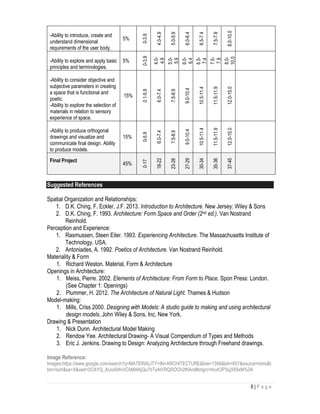
Marking criteria
Marks shall be distributed as follows:
Marking Criteria
Marks%
FAIL
(F)
POOR
(D-,D,D+)
PASS
(C)
SATISFACTORY
(C+,B-)
GOOD
(B,B+)
VERYGOO
(A-)
EXCELLENT
(A)
COMMENTS
Final Project
(3a+3b+Final Submission)
60%
0-23
24-29
30-35
36-39
40-44
45-47
48-60
Interim Submission
Project 3a- Narrative
5%
0-1.95
2-2.45
2.5-
2.95
3.0-
3.2
3.25-
3.7
3.75-
3.95
4.0-
5.0
Project 3b- Mock up /Interim 10%
0-3.9
4.0-
4.9
5.0-
59
6.0-
6.4
6.5-
7.4
7.5-
7.9
8.0-
10.0
-Ability to create and develop a
conceptual narrative. Ability to
explain work verbal and written
5%
0-1.95
2.2-2.45
2.5-2.95
3.0-3.2
3.25-3.7
3.75-3.95
4.0-5.0
6 | P a g e
-Ability to introduce, create and
understand dimensional
requirements of the user body.
5%
0-3.9
4.0-4.9
5.0-5.9
6.0-6.4
6.5-7.4
7.5-7.9
8.0-10.0
-Ability to explore and apply basic
principles and terminologies.
5%
0-3.9
4.0-
4.9
5.0-
5.9
6.0-
6.4
6.5-
7.4
7.5-
7.9
8.0-
10.0
-Ability to consider objective and
subjective parameters in creating
a space that is functional and
poetic.
-Ability to explore the selection of
materials in relation to sensory
experience of space.
15%
0.1-5.9
6.0-7.4
7.5-8.9
9.0-10.4
10.5-11.4
11.5-11.9
12.0-15.0
-Ability to produce orthogonal
drawings and visualize and
communicate final design. Ability
to produce models.
15%
0-5.9
6.0-7.4
7.5-8.9
9.0-10.4
10.5-11.4
11.5-11.9
12.0-15.0
Final Project
45%
0-17
18-22
23-26
27-29
30-34
35-36
37-45
Suggested References
Spatial Organization and Relationships:
1. D.K. Ching, F. Eckler, J.F. 2013. Introduction to Architecture. New Jersey: Wiley & Sons
2. D.K. Ching, F. 1993. Architecture: Form Space and Order (2nd ed.). Van Nostrand
Reinhold.
Perception and Experience:
1. Rasmussen, Steen Eiler. 1993. Experiencing Architecture. The Massachusetts Institute of
Technology. USA.
2. Antoniades, A. 1992. Poetics of Architecture. Van Nostrand Reinhold.
Materiality & Form
1. Richard Weston. Material, Form & Architecture
Openings in Architecture:
1. Meiss, Pierre. 2002. Elements of Architecture: From Form to Place. Spon Press: London.
(See Chapter 1: Openings)
2. Plummer, H. 2012. The Architecture of Natural Light. Thames & Hudson
Model-making:
1. Mills, Criss 2000. Designing with Models: A studio guide to making and using architectural
design models, John Wiley & Sons, Inc, New York.
Drawing & Presentation
1. Nick Dunn. Architectural Model Making
2. Rendow Yee. Architectural Drawing- A Visual Compendium of Types and Methods
3. Eric J. Jenkins. Drawing to Design: Analyzing Architecture through Freehand drawings.
Image Reference:
Images:https://www.google.com/search?q=MATERIALITY+IN+ARCHITECTURE&biw=1366&bih=657&source=lnms&t
bm=isch&sa=X&ved=0CAYQ_AUoAWoVChMI4KjQu7bTyAIVRQSOCh2tNArd#imgrc=hruK3P3cjX59xM%3A

Architecture design studio 1 project 3 brief march2016

  • 1.
    1 | Pa g e SCHOOL OF ARCHITECTURE, BUILDING & DESIGN Modern Architecture Studies in Southeast Asia (MASSA) Research Unit Bachelor of Science (Honours) in Architecture ARCHITECTURE DESIGN STUDIO 1 [ARC 60105] ____________________________________________________________________________________ Project 3: Dreamspace for the User ‘SPACE FOR THE SELF’ Project 3 Individual LO 1-6 60% of Final Grade Verbal presentation Presentation Panel + Scaled Model Introduction In project 1, students were allowed to express oneself through their creative means; Project 2 is meant to prepare students to be aware on the relationship between user and space, emphasizing on the physical and non-physical requirements; Project 3 on the other hand incorporates both the creativity and its functionality; identity of user, comfortability of user and creativity in articulating the space, as a complete user experience. For the final project, students are required to design a space for the self by attaching it to the walls/surfaces of an imagined ‘city’ in an empty abandoned lot in between two buildings. The space is to fit a specific use (as a dream space: for viewing, space for contemplating, space for self- exploration, space for exercising, space for dreaming, space showcasing and so to speak a dream space for the user). As the user of the space you can make your personality more interesting, an effective well thought of theme and written narrative is essential. This understanding is to be architecturally translated into a series of connected spaces (2-3 spaces) that successfully establishes the quality and articulation of the interior and of exterior design. Concept shall evidently show the experiential and spatial quality. Students are also to consider how well design conforms to both the physical and non-physical requirements of the user.
  • 2.
    2 | Pa g e Final project will be in 3 stages, Task 1- is narrative writing wherein it can be based in the persona, life scenario, story and journey of the user from where or which the theme of the hideout will be extracted. Task 2- is about exploring how to organize the 2-3 spaces which encompasses design principles in spatial relationships and organization. In this task students will explore ways on how to explore space through hierarchal arranging it by its meaning, significance and importance, capturing mere essence of the narrative. Task 3-In addition to generating and exploring ideas and concept from the narrative and spatial exploration, we will also explore the notions and experiential effects of materials and the senses in the final design. Objectives of Project The objectives of this assignment are as follows: 1. To further the students ability to create and develop a conceptual narrative. 2. To introduce and create awareness in understanding the dimensional requirements of the human body (anthropometrics and ergonomics). 3. To explore and apply basic design principles and terminologies. 4. To be able to consider objective and subjective parameters in the design process to create a space this is practical yet poetic. 5. To explore how the selection and application of materials in relation to the sensory experience of space. 6. To be able to select and make different study models (sketch, concept, diagram, section and development models) Learning Outcomes of this Project 1. Generate design concepts through the process of exploring various sources and abstracting ideas. 2. Identify key architectural design elements and principles with the ability to discern how they inform space and form. 3. Relate the idea of the individual ‘self’ and the body’ to space and its experiential qualities. 4. Articulate and apply architectural design elements, principles and materials to create an architectural composition that demonstrates place-making. 5. Utilize a process-oriented approach involving sketching and model-making as tools for generating and developing design ideas. 6. Produce legible orthogonal drawings and architectural models to visualize and communicate final design. Key Terminologies -Persona (personae, personas) - character, role and personality -Scenario- a collage of an event or a series of an event. -User Story-Who? What? Why? as the user of the space -User Journey- the stages of experiences a person encountered -Spatial Hierarchy- refers to the rank or order of importance of various spaces. This could also be a programming term used in adjacency diagrams and looking at function relationships when programing a floor plan. When concerning privacy this could be related to a hierarchy as well as spatial importance, size of volume, geometry etc. example: Hierarchy from public to private. -Design Narrative- are accounts of critical events in a design experiment from a personal, phenomenographic perspective. They focus on design in the sense of problem solving, describing a problem in the chosen domain, the actions taken to resolve it and their unfolding effects. They provide an account of the history and evolution of a design over time, including the research context, the tools and activities designed, and the results of users’ interactions with these.
  • 3.
    3 | Pa g e Tasks – Methodology -Dream space is to be attached to this given setting with the given physical boundaries and dimensions. SITE PLAN ELEVATION Design Guidelines - Application and exploration of basic design principles and materials in creating spatial qualities to capture narrative and storyline. - Several questions shall be looked into in the development of the ‘Dream space for the User’, here are some guiding questions: How does the body shape the space? How does the space influence the mood and its activities, how does material engage the senses? And how do the senses determine the choice of materials? 6.00 m 15.0m EXISTING BUILDING EXISTING BUILDINGSITE 12.00M. BASE Note: To show the 2 Walls and not the entire buildings. Note: Use 1 pc. A-3 MDF Board 15.00m
  • 4.
    4 | Pa g e - Student will be required to design 2-3 spaces with a gross floor area of 70-100 sq.mts. - Hideout should not occupy more than 70% of the site. - Should incorporate design elements and principles of design; emphasis on scale, hierarchy, proportion, harmony and character. - The design should either attached with at least one or both walls of the two buildings. - Underground structure maybe allowed but provided it will not be more than 50% of the floor area requirement. Narrative should rationalize the need to do so. - Use of the other existing to buildings as an entry is/are not allowed. Submission Requirements May 25, 2016 (Week 8) – 3a: Narrative (100-200 words)  ONE (1) A-3Butter Paper - May use Diagrams, image maps to avoid lengthy texts. - Persona, Scenario, Story and Journey. - Extract Theme from personality. June 13, 2016 (Week 11) – 3b: Interim/Mock up  Butter Paper - Floor Plan, Elevation, Section - Axonometric or Interior Perspective - Supplementary sketches  Study Model (s) (Scale 1:50)  A-4 Sketchbook/journal Note: 1. All drawings are to be produced manually (hand drawn). Drawings should be properly labelled and annotated July 11, 2015 (Week 14) Final Project Submission  Narrative: ONE (1) Panel of A-2 Board, Creative layout - May use Diagrams, Mind Maps to avoid lengthy texts. - Should clearly stipulate the user’s body dimension, activities, personality, occupation, needs, desires and likes. - Sketches of drawings and studies. - Diagram showing effective consideration for Anthropometrics.  TWO-THREE (2-3) Panels of A-2 Board, Creative layout (1:50 Scale)  Floor Plan(s) ) (note: to show how hideout is attached to 2 buildings)  ONE (1)- Elevations (Front) (note: to show how hideout is attached to 2 buildings)  ONE (1) - Section or Sectional Perspective (note: to show how hideout is attached to the 2 buildings)  (3) Interior Perspective (s) (most interesting area or areas) or Full Axonometric View showing 3 spaces.  Other supplementary drawings (sketches, diagram, and others).
  • 5.
    5 | Pa g e  Scaled Model Final Model (1:50 m) The final model shall clearly show design of form & spatial articulation, Consider correct dimensions of materials such as wall thickness and others. Model must show quality of space, either roofs can retractable or at least one side is open. The final model should sit on ONE (1) card board base and to show the 2 walls of the building using card board, Perspex or MDF board. For the main structure you may use any modelling material. Others  Sketch Journal (Butter paper, A-4 sketch book)  Study Model(s) (design exploration)  Tutorial Log Sheet (properly signed by tutor) . Submission Date  JULY 11, 2016 FINAL PIN UP & SUBMISSION: 1:00- 3:00 PM Venue: E3.02-05, E3.13 (studio pin-up presentation layout to be posted 1 week before)  JULY 12, 2016 FINAL PRESENTATION/DESIGN REVIEW: 8:00 AM-1:00 PM Venue: E3.02-E3.05, E3.13  JULY 13, 2016 Dismantling and Taking back of work 8:00-10:00AM only  JULY 25, 2016 E-PORTFOLIO SUBMISSION: BEFORE 12:00 Noon Note: Any changes will be announced (2 weeks) prior to date or week of presentation. Marking criteria Marks shall be distributed as follows: Marking Criteria Marks% FAIL (F) POOR (D-,D,D+) PASS (C) SATISFACTORY (C+,B-) GOOD (B,B+) VERYGOO (A-) EXCELLENT (A) COMMENTS Final Project (3a+3b+Final Submission) 60% 0-23 24-29 30-35 36-39 40-44 45-47 48-60 Interim Submission Project 3a- Narrative 5% 0-1.95 2-2.45 2.5- 2.95 3.0- 3.2 3.25- 3.7 3.75- 3.95 4.0- 5.0 Project 3b- Mock up /Interim 10% 0-3.9 4.0- 4.9 5.0- 59 6.0- 6.4 6.5- 7.4 7.5- 7.9 8.0- 10.0 -Ability to create and develop a conceptual narrative. Ability to explain work verbal and written 5% 0-1.95 2.2-2.45 2.5-2.95 3.0-3.2 3.25-3.7 3.75-3.95 4.0-5.0
  • 6.
    6 | Pa g e -Ability to introduce, create and understand dimensional requirements of the user body. 5% 0-3.9 4.0-4.9 5.0-5.9 6.0-6.4 6.5-7.4 7.5-7.9 8.0-10.0 -Ability to explore and apply basic principles and terminologies. 5% 0-3.9 4.0- 4.9 5.0- 5.9 6.0- 6.4 6.5- 7.4 7.5- 7.9 8.0- 10.0 -Ability to consider objective and subjective parameters in creating a space that is functional and poetic. -Ability to explore the selection of materials in relation to sensory experience of space. 15% 0.1-5.9 6.0-7.4 7.5-8.9 9.0-10.4 10.5-11.4 11.5-11.9 12.0-15.0 -Ability to produce orthogonal drawings and visualize and communicate final design. Ability to produce models. 15% 0-5.9 6.0-7.4 7.5-8.9 9.0-10.4 10.5-11.4 11.5-11.9 12.0-15.0 Final Project 45% 0-17 18-22 23-26 27-29 30-34 35-36 37-45 Suggested References Spatial Organization and Relationships: 1. D.K. Ching, F. Eckler, J.F. 2013. Introduction to Architecture. New Jersey: Wiley & Sons 2. D.K. Ching, F. 1993. Architecture: Form Space and Order (2nd ed.). Van Nostrand Reinhold. Perception and Experience: 1. Rasmussen, Steen Eiler. 1993. Experiencing Architecture. The Massachusetts Institute of Technology. USA. 2. Antoniades, A. 1992. Poetics of Architecture. Van Nostrand Reinhold. Materiality & Form 1. Richard Weston. Material, Form & Architecture Openings in Architecture: 1. Meiss, Pierre. 2002. Elements of Architecture: From Form to Place. Spon Press: London. (See Chapter 1: Openings) 2. Plummer, H. 2012. The Architecture of Natural Light. Thames & Hudson Model-making: 1. Mills, Criss 2000. Designing with Models: A studio guide to making and using architectural design models, John Wiley & Sons, Inc, New York. Drawing & Presentation 1. Nick Dunn. Architectural Model Making 2. Rendow Yee. Architectural Drawing- A Visual Compendium of Types and Methods 3. Eric J. Jenkins. Drawing to Design: Analyzing Architecture through Freehand drawings. Image Reference: Images:https://www.google.com/search?q=MATERIALITY+IN+ARCHITECTURE&biw=1366&bih=657&source=lnms&t bm=isch&sa=X&ved=0CAYQ_AUoAWoVChMI4KjQu7bTyAIVRQSOCh2tNArd#imgrc=hruK3P3cjX59xM%3A