Convention 1:
Short Films Are Short
From my research I have discovered that children's
cartoons/animations are very short. The reason why they are
short is to keep the children watching engaged to the short
film. An example of this is Bob The Builder, which is only 10
minutes long in length. This is to keep the young audience
(children aged 2-7) entertained.
This is a list of some
of the episode in
Bob The Builder
and as you can see
they are all around
10 minuets long. A
typical length for
short films.
This is a list of some
of the episode in
Bob The Builder
and as you can see
they are all around
10 minuets long. A
typical length for
short films.
This is a list of some
of the episode in
Bob The Builder
and as you can see
they are all around
10 minuets long. A
typical length for
short films.
This is a list of some
of the episode in
Bob The Builder
and as you can see
they are all around
10 minuets long. A
typical length for
short films.
This is a list of some
of the episode in
Bob The Builder
and as you can see
they are all around
10 minuets long. A
typical length for
short films.
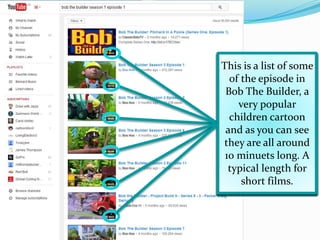
This is a list of some
of the episode in
Bob The Builder, a
very popular
children cartoon
and as you can see
they are all around
10 minuets long. A
typical length for
short films.
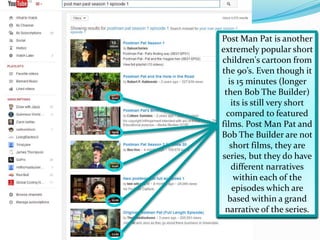
Post Man Pat is another
extremely popular short
children's cartoon from
the 90’s. Even though it
is 15 minutes (longer
then Bob The Builder)
its is still very short
compared to featured
films. Post Man Pat and
Bob The Builder are not
short films, they are
series, but they do have
different narratives
within each of the
episodes which are
based within a grand
narrative of the series.
Post Man Pat is another
extremely popular short
children's cartoon from
the 90’s. Even though it
is 15 minutes (longer
then Bob The Builder)
its is still very short
compared to featured
films. Post Man Pat and
Bob The Builder are not
short films, they are
series, but they do have
different narratives
within each of the
episodes which are
based within a grand
narrative of the series.
Post Man Pat is another
extremely popular short
children's cartoon from
the 90’s. Even though it
is 15 minutes (longer
then Bob The Builder)
its is still very short
compared to featured
films. Post Man Pat and
Bob The Builder are not
short films, they are
series, but they do have
different narratives
within each of the
episodes which are
based within a grand
narrative of the series.
Post Man Pat is another
extremely popular short
children's cartoon from
the 90’s. Even though it
is 15 minutes (longer
then Bob The Builder)
its is still very short
compared to featured
films. Post Man Pat and
Bob The Builder are not
short films, they are
series, but they do have
different narratives
within each of the
episodes which are
based within a grand
narrative of the series.
Post Man Pat is another
extremely popular short
children's cartoon from
the 90’s. Even though it
is 15 minutes (longer
then Bob The Builder)
its is still very short
compared to featured
films. Post Man Pat and
Bob The Builder are not
short films, they are
series, but they do have
different narratives
within each of the
episodes which are
based within a grand
narrative of the series.
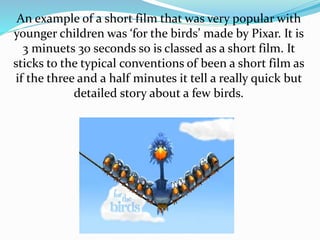
An example of a short film that was very popular with
younger children was ‘for the birds’ made by Pixar. It is
3 minuets 30 seconds so is classed as a short film. It
sticks to the typical conventions of been a short film as
if the three and a half minutes it tell a really quick but
detailed story about a few birds.
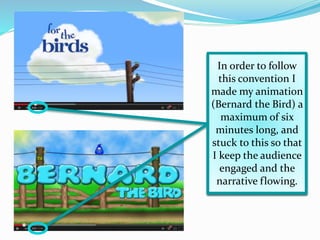
In order to follow
this convention I
made my animation
(Bernard the Bird) a
maximum of six
minutes long, and
stuck to this so that
I keep the audience
engaged and the
narrative flowing.
In order to follow
this convention I
made my animation
(Bernard the Bird) a
maximum of six
minutes long, and
stuck to this so that
I keep the audience
engaged and the
narrative flowing.
Convention 2:
Classic Narrative Structure
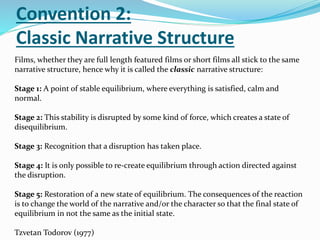
Films, whether they are full length featured films or short films all stick to the same
narrative structure, hence why it is called the classic narrative structure:
Stage 1: A point of stable equilibrium, where everything is satisfied, calm and
normal.
Stage 2: This stability is disrupted by some kind of force, which creates a state of
disequilibrium.
Stage 3: Recognition that a disruption has taken place.
Stage 4: It is only possible to re-create equilibrium through action directed against
the disruption.
Stage 5: Restoration of a new state of equilibrium. The consequences of the reaction
is to change the world of the narrative and/or the character so that the final state of
equilibrium in not the same as the initial state.
Tzvetan Todorov (1977)
Example Of his Theory:
For the Birds
(Real Media)
Bernard the Bird
(My Work)
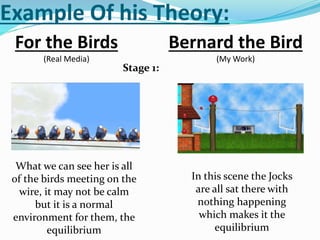
Stage 1:
What we can see her is all
of the birds meeting on the
wire, it may not be calm
but it is a normal
environment for them, the
equilibrium
In this scene the Jocks
are all sat there with
nothing happening
which makes it the
equilibrium
Example Of his Theory:
For the Birds
(Real Media)
Bernard the Bird
(My Work)
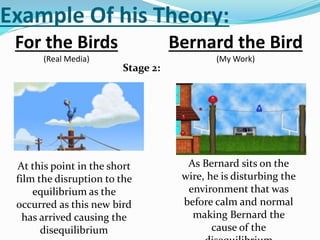
Stage 2:
At this point in the short
film the disruption to the
equilibrium as the
occurred as this new bird
has arrived causing the
disequilibrium
As Bernard sits on the
wire, he is disturbing the
environment that was
before calm and normal
making Bernard the
cause of the
Example Of his Theory:
For the Birds
(Real Media)
Bernard the Bird
(My Work)
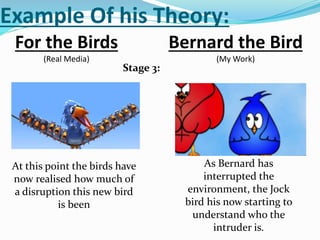
Stage 3:
At this point the birds have
now realised how much of
a disruption this new bird
is been
As Bernard has
interrupted the
environment, the Jock
bird his now starting to
understand who the
intruder is.
Example Of his Theory:
For the Birds
(Real Media)
Bernard the Bird
(My Work)
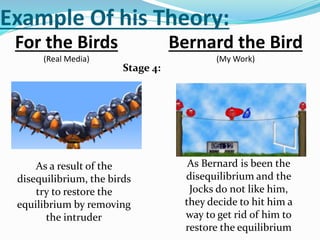
Stage 4:
As a result of the
disequilibrium, the birds
try to restore the
equilibrium by removing
the intruder
As Bernard is been the
disequilibrium and the
Jocks do not like him,
they decide to hit him a
way to get rid of him to
restore the equilibrium
Example Of his Theory:
For the Birds
(Real Media)
Bernard the Bird
(My Work)
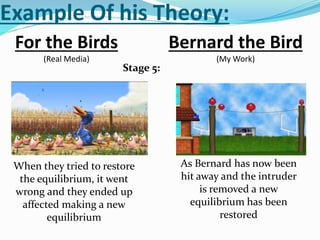
Stage 5:
When they tried to restore
the equilibrium, it went
wrong and they ended up
affected making a new
equilibrium
As Bernard has now been
hit away and the intruder
is removed a new
equilibrium has been
restored
From comparing my work to the 5 stages of Tzvetan
Todorov (1977) theory of the ‘classic narrative structure’ I
am confident to say my work fits in, therefor fits into the
conventions of the narrative structure of short films.
However, ‘Bernard the Bird’ does challenge the theory, as
the character that causes the disequilibrium's is meant to
be the protagonist.
Also in my short film all of the stages are repeated for the
Jock, Girly Girls and Nerd Scene. But you could say that the
hole story is one big classic narrative structure as Bernard
gets kicked out of his nest (disequilibrium) then tries to
find a new nest (restoring equilibrium) but gives up and
finds new friend in the end creating a new equilibrium.
Convention 3:
Characters
Characters are a clear convention of short film’s and they
tend to have around 2-3 main characters. This is because
in short films they don’t have enough time to go into
depth about the characters background. Therefore with
a smaller amount of characters, the audience will be able
to relate to them better in the shorter amount of time.
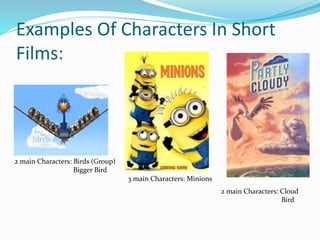
Examples Of Characters In Short
Films:
2 main Characters: Birds (Group)
Bigger Bird
3 main Characters: Minions
2 main Characters: Cloud
Bird
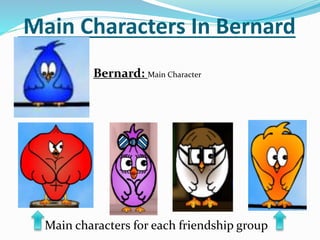
Main Characters In Bernard
Bernard: Main Character
Main characters for each friendship group
As my short film has mini narratives within a grand narrative
(when he goes to the different friendship groups). Bernard
meets 4 friends ship groups, all with a main characters and
aroud2-3 extras. Therefore within Bernard The Bird there are
5 main character's and 10 extras all together.
I chose to only have 5 main characters in my short film
because if I had more then one main character in each
friendship group you would be able to connects with any of
the main characters because you wouldn't have enough
screen time with them. So keeping it down to only 4 main
characters means the younger aged audience can relate to the
characters better.
As I have kept the main characters down to 5, I think that is
within the conventions of a short film.
Convention 4:
Protagonist, Antagonist
In all films, not just short films, you get protagonists and
antagonist (good and bad). Levi Strauss was a theorist
who came up with the idea that films contain binary
opposites. He argued that all narratives could be reduced
down to binary opposites. He suggested that this links
heavily with out ideological values. For example in most
films you get a hero/good character therefore you get a
villain/bad character.
Examples Of Protagonists &
Antagonists
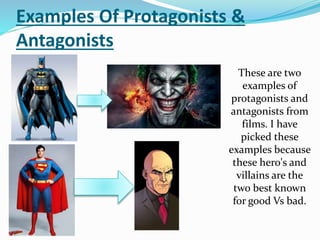
These are two
examples of
protagonists and
antagonists from
films. I have
picked these
examples because
these hero's and
villains are the
two best known
for good Vs bad.
Protagonists & Antagonists in
Bernard
Protagonists
Protagonists
Antagonists
Antagonists Antagonists
Protagonists & Antagonists in
Bernard
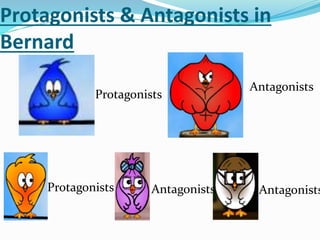
In ‘Bernard the Bird’ I have to protagonists and 3
antagonists. This is because I have 5 different friendship
groups. Bernard is the main characters and
conventionally the main character should be the
protagonist, therefore Bernard is a protagonist. When
Bernard goes to the different friendship groups to find
his friends, the other birds, the jocks, girly girls and the
nerds are mean to him making them the antagonists.
But when Bernard gives up and the misfit birds find him
as become friends with him, that makes them
protagonists as well.
Convention 5:
Genre

Conventions

  • 2.
    Convention 1: Short FilmsAre Short From my research I have discovered that children's cartoons/animations are very short. The reason why they are short is to keep the children watching engaged to the short film. An example of this is Bob The Builder, which is only 10 minutes long in length. This is to keep the young audience (children aged 2-7) entertained.
  • 3.
    This is alist of some of the episode in Bob The Builder and as you can see they are all around 10 minuets long. A typical length for short films. This is a list of some of the episode in Bob The Builder and as you can see they are all around 10 minuets long. A typical length for short films. This is a list of some of the episode in Bob The Builder and as you can see they are all around 10 minuets long. A typical length for short films. This is a list of some of the episode in Bob The Builder and as you can see they are all around 10 minuets long. A typical length for short films. This is a list of some of the episode in Bob The Builder and as you can see they are all around 10 minuets long. A typical length for short films. This is a list of some of the episode in Bob The Builder, a very popular children cartoon and as you can see they are all around 10 minuets long. A typical length for short films.
  • 4.
    Post Man Patis another extremely popular short children's cartoon from the 90’s. Even though it is 15 minutes (longer then Bob The Builder) its is still very short compared to featured films. Post Man Pat and Bob The Builder are not short films, they are series, but they do have different narratives within each of the episodes which are based within a grand narrative of the series. Post Man Pat is another extremely popular short children's cartoon from the 90’s. Even though it is 15 minutes (longer then Bob The Builder) its is still very short compared to featured films. Post Man Pat and Bob The Builder are not short films, they are series, but they do have different narratives within each of the episodes which are based within a grand narrative of the series. Post Man Pat is another extremely popular short children's cartoon from the 90’s. Even though it is 15 minutes (longer then Bob The Builder) its is still very short compared to featured films. Post Man Pat and Bob The Builder are not short films, they are series, but they do have different narratives within each of the episodes which are based within a grand narrative of the series. Post Man Pat is another extremely popular short children's cartoon from the 90’s. Even though it is 15 minutes (longer then Bob The Builder) its is still very short compared to featured films. Post Man Pat and Bob The Builder are not short films, they are series, but they do have different narratives within each of the episodes which are based within a grand narrative of the series. Post Man Pat is another extremely popular short children's cartoon from the 90’s. Even though it is 15 minutes (longer then Bob The Builder) its is still very short compared to featured films. Post Man Pat and Bob The Builder are not short films, they are series, but they do have different narratives within each of the episodes which are based within a grand narrative of the series.
  • 5.
    An example ofa short film that was very popular with younger children was ‘for the birds’ made by Pixar. It is 3 minuets 30 seconds so is classed as a short film. It sticks to the typical conventions of been a short film as if the three and a half minutes it tell a really quick but detailed story about a few birds.
  • 6.
    In order tofollow this convention I made my animation (Bernard the Bird) a maximum of six minutes long, and stuck to this so that I keep the audience engaged and the narrative flowing. In order to follow this convention I made my animation (Bernard the Bird) a maximum of six minutes long, and stuck to this so that I keep the audience engaged and the narrative flowing.
  • 7.
    Convention 2: Classic NarrativeStructure Films, whether they are full length featured films or short films all stick to the same narrative structure, hence why it is called the classic narrative structure: Stage 1: A point of stable equilibrium, where everything is satisfied, calm and normal. Stage 2: This stability is disrupted by some kind of force, which creates a state of disequilibrium. Stage 3: Recognition that a disruption has taken place. Stage 4: It is only possible to re-create equilibrium through action directed against the disruption. Stage 5: Restoration of a new state of equilibrium. The consequences of the reaction is to change the world of the narrative and/or the character so that the final state of equilibrium in not the same as the initial state. Tzvetan Todorov (1977)
  • 8.
    Example Of hisTheory: For the Birds (Real Media) Bernard the Bird (My Work) Stage 1: What we can see her is all of the birds meeting on the wire, it may not be calm but it is a normal environment for them, the equilibrium In this scene the Jocks are all sat there with nothing happening which makes it the equilibrium
  • 9.
    Example Of hisTheory: For the Birds (Real Media) Bernard the Bird (My Work) Stage 2: At this point in the short film the disruption to the equilibrium as the occurred as this new bird has arrived causing the disequilibrium As Bernard sits on the wire, he is disturbing the environment that was before calm and normal making Bernard the cause of the
  • 10.
    Example Of hisTheory: For the Birds (Real Media) Bernard the Bird (My Work) Stage 3: At this point the birds have now realised how much of a disruption this new bird is been As Bernard has interrupted the environment, the Jock bird his now starting to understand who the intruder is.
  • 11.
    Example Of hisTheory: For the Birds (Real Media) Bernard the Bird (My Work) Stage 4: As a result of the disequilibrium, the birds try to restore the equilibrium by removing the intruder As Bernard is been the disequilibrium and the Jocks do not like him, they decide to hit him a way to get rid of him to restore the equilibrium
  • 12.
    Example Of hisTheory: For the Birds (Real Media) Bernard the Bird (My Work) Stage 5: When they tried to restore the equilibrium, it went wrong and they ended up affected making a new equilibrium As Bernard has now been hit away and the intruder is removed a new equilibrium has been restored
  • 13.
    From comparing mywork to the 5 stages of Tzvetan Todorov (1977) theory of the ‘classic narrative structure’ I am confident to say my work fits in, therefor fits into the conventions of the narrative structure of short films. However, ‘Bernard the Bird’ does challenge the theory, as the character that causes the disequilibrium's is meant to be the protagonist. Also in my short film all of the stages are repeated for the Jock, Girly Girls and Nerd Scene. But you could say that the hole story is one big classic narrative structure as Bernard gets kicked out of his nest (disequilibrium) then tries to find a new nest (restoring equilibrium) but gives up and finds new friend in the end creating a new equilibrium.
  • 14.
    Convention 3: Characters Characters area clear convention of short film’s and they tend to have around 2-3 main characters. This is because in short films they don’t have enough time to go into depth about the characters background. Therefore with a smaller amount of characters, the audience will be able to relate to them better in the shorter amount of time.
  • 15.
    Examples Of CharactersIn Short Films: 2 main Characters: Birds (Group) Bigger Bird 3 main Characters: Minions 2 main Characters: Cloud Bird
  • 16.
    Main Characters InBernard Bernard: Main Character Main characters for each friendship group
  • 17.
    As my shortfilm has mini narratives within a grand narrative (when he goes to the different friendship groups). Bernard meets 4 friends ship groups, all with a main characters and aroud2-3 extras. Therefore within Bernard The Bird there are 5 main character's and 10 extras all together. I chose to only have 5 main characters in my short film because if I had more then one main character in each friendship group you would be able to connects with any of the main characters because you wouldn't have enough screen time with them. So keeping it down to only 4 main characters means the younger aged audience can relate to the characters better. As I have kept the main characters down to 5, I think that is within the conventions of a short film.
  • 18.
    Convention 4: Protagonist, Antagonist Inall films, not just short films, you get protagonists and antagonist (good and bad). Levi Strauss was a theorist who came up with the idea that films contain binary opposites. He argued that all narratives could be reduced down to binary opposites. He suggested that this links heavily with out ideological values. For example in most films you get a hero/good character therefore you get a villain/bad character.
  • 19.
    Examples Of Protagonists& Antagonists These are two examples of protagonists and antagonists from films. I have picked these examples because these hero's and villains are the two best known for good Vs bad.
  • 20.
    Protagonists & Antagonistsin Bernard Protagonists Protagonists Antagonists Antagonists Antagonists
  • 21.
    Protagonists & Antagonistsin Bernard In ‘Bernard the Bird’ I have to protagonists and 3 antagonists. This is because I have 5 different friendship groups. Bernard is the main characters and conventionally the main character should be the protagonist, therefore Bernard is a protagonist. When Bernard goes to the different friendship groups to find his friends, the other birds, the jocks, girly girls and the nerds are mean to him making them the antagonists. But when Bernard gives up and the misfit birds find him as become friends with him, that makes them protagonists as well.
  • 22.