


Safe Systems
Programming
in C# and .NET
Joe Duffy
joeduffyblog.com · @xjoeduffyx · joeduffy@acm.org
InfoQ.com: News & Community Site
• 750,000 unique visitors/month
• Published in 4 languages (English, Chinese, Japanese and Brazilian
Portuguese)
• Post content from our QCon conferences
• News 15-20 / week
• Articles 3-4 / week
• Presentations (videos) 12-15 / week
• Interviews 2-3 / week
• Books 1 / month
Watch the video with slide
synchronization on InfoQ.com!
https://www.infoq.com/presentations/
csharp-systems-programming
Presented at QCon New York
www.qconnewyork.com
Purpose of QCon
- to empower software development by facilitating the spread of
knowledge and innovation
Strategy
- practitioner-driven conference designed for YOU: influencers of
change and innovation in your teams
- speakers and topics driving the evolution and innovation
- connecting and catalyzing the influencers and innovators
Highlights
- attended by more than 12,000 delegates since 2007
- held in 9 cities worldwide
Introduction
“Systems”?
• Anywhere you’re apt to think about “bits, bytes, instructions, and cycles”
• Demanding performance and reliability requirements
• Classically meant “interacts with hardware,” requiring C and unsafe code
• Abstraction has shifted upwards thanks to concurrency and cloud; security
is more important now than ever
• Many scenarios: operating systems, drivers, tools, libraries, cloud
infrastructure, web servers, micro services and their frameworks, …
Why C#?
• Productivity and ease of use
• Built-in safety: fewer inherent security and reliability risks
• Powerful async and concurrency models
• Momentum, mature ecosystem of tools and libraries
Why Not C#?
• Garbage collection
• Allocation-rich APIs and patterns
• Error model that makes reliability challenging
• Concurrency is based on unsafe multithreading
This Talk
• We are making progress on all of the above
• New C# and library features
• Patterns that you can apply today, enforce w/ Roslyn Analyzers
• Advances in code generation technologies
• All open source, on GitHub, and developed with the community
Performance
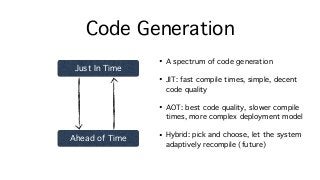
Code Generation
Just In Time
Ahead of Time
• A spectrum of code generation
• JIT: fast compile times, simple, decent
code quality
• AOT: best code quality, slower compile
times, more complex deployment model
• Hybrid: pick and choose, let the system
adaptively recompile (future)
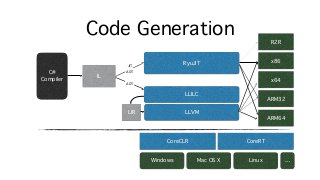
Code Generation
IL
C#
Compiler
RyuJIT
LLILC
LLVMLIR
x86
x64
ARM32
ARM64
CoreCLR CoreRT
Windows Mac OS X Linux …
R2R
AOT
AOT
JIT
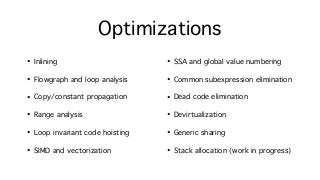
Optimizations
• Inlining
• Flowgraph and loop analysis
• Copy/constant propagation
• Range analysis
• Loop invariant code hoisting
• SIMD and vectorization
• SSA and global value numbering
• Common subexpression elimination
• Dead code elimination
• Devirtualization
• Generic sharing
• Stack allocation (work in progress)
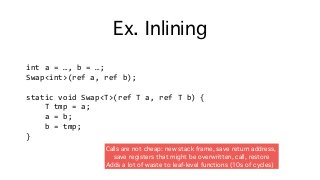
Ex. Inlining
int a = …, b = …;
Swap<int>(ref a, ref b);
static void Swap<T>(ref T a, ref T b) {
T tmp = a;
a = b;
b = tmp;
}
Calls are not cheap: new stack frame, save return address,
save registers that might be overwritten, call, restore
Adds a lot of waste to leaf-level functions (10s of cycles)
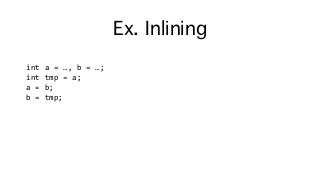
Ex. Inlining
int a = …, b = …;
int tmp = a;
a = b;
b = tmp;
Ex. Range Analysis
int[] elems = …;
for (int i = 0; i < elems.Length; i++) {
elems[i]++;
}
Loop “obviously” never goes out of bounds
But a naive compiler will do an induction check (i < elems.Length)
plus a bounds check (elems[i]) on every iteration!
Ex. Range Analysis
int[] elems = …;
for (int i = 0; i < elems.Length; i++) {
elems[i]++;
} ; Initialize induction variable to 0:
3D45: 33 C0 xor eax,eax
; Put bounds into EDX:
3D58: 8B 51 08 mov edx,dword ptr [rcx+8]
; Check that EAX is still within bounds; jump if not:
3D5B: 3B C2 cmp eax,edx
3D5D: 73 13 jae 3D72
; Compute the element address and store into it:
3D5F: 48 63 D0 movsxd rdx,eax
3D62: 89 44 91 10 mov dword ptr [rcx+rdx*4+10h],eax
; Increment the loop induction variable:
3D66: FF C0 inc eax
; If still in bounds, then jump back to the loop beginning:
3D68: 83 F8 64 cmp eax,64h
3D6B: 7C EB jl 3D58
; ...
; Error routine:
3D72: E8 B9 E2 FF FF call 2030
Ex. Range Analysis
int[] elems = …;
for (int i = 0; i < elems.Length; i++) {
elems[i]++;
} ; Initialize induction variable to 0:
3D95: 33 C0 xor eax,eax
; Compute the element address and store into it:
3D97: 48 63 D0 movsxd rdx,eax
3D9A: 89 04 91 mov dword ptr [rcx+rdx*4],eax
; Increment the loop induction variable:
3D9D: FF C0 inc eax
; If still in bounds, then jump back to the loop beginning:
3D9F: 83 F8 64 cmp eax,64h
3DA2: 7C F3 jl 3D97
Ex. Stack Allocation
string name = "Alexander Hamilton";
List<Customer> custs = …;
int index = custs.IndexOf(c => c.Name == name);
int IndexOf(Func<T, bool> p) {
for (int i = 0; i < this.count; i++) {
if (p(this[i]))
return i;
}
return -1;
}
Ex. Stack Allocation
string name = "Alexander Hamilton";
List<Customer> custs = …;
int index = custs.IndexOf(c => c.Name == name);
int IndexOf(Func<T, bool> p) {
for (int i = 0; i < this.count; i++) {
if (p(this[i]))
return i;
}
return -1;
}
Allocates up to 2 objects (lambda+captured stack frame)
Stack Heap
p
<closure>
name
<lambda>
<func>
Ex. Stack Allocation
string name = "Alexander Hamilton";
List<Customer> custs = …;
int index = custs.IndexOf(c => c.Name == name);
int IndexOf(Func<T, bool> p) {
for (int i = 0; i < this.count; i++) {
if (p(this[i]))
return i;
}
return -1;
}
Stack
p
<closure>
name
<lambda>
<func>
Allocates up to 2 objects (lambda+captured stack frame)
Automatic escape analysis can determine ‘p’ doesn’t escape IndexOf
Ex. Stack Allocation
string name = "Alexander Hamilton";
List<Customer> custs = …;
int index = custs.IndexOf(c => c.Name == name);
int IndexOf(Func<T, bool> p) {
for (int i = 0; i < this.count; i++) {
if (p(this[i]))
return i;
}
return -1;
}
Stack
p
<closure>
name
<lambda>
<func>
Allocates up to 2 objects (lambda+captured stack frame)
Automatic escape analysis can determine ‘p’ doesn’t escape IndexOf
Ex. Stack Allocation
string name = "Alexander Hamilton";
List<Customer> custs = …;
int index = custs.IndexOf(c => c.Name == name);
int IndexOf([Scoped] Func<T, bool> p) {
for (int i = 0; i < this.count; i++) {
if (p(this[i]))
return i;
}
return -1;
}
Stack
p
<closure>
name
<lambda>
<func>
Allocates up to 2 objects (lambda+captured stack frame)
Automatic escape analysis can determine ‘p’ doesn’t escape IndexOf
Ex. Stack Allocation
string name = "Alexander Hamilton";
List<Customer> custs = …;
int index = -1;
for (int i = 0; i < custs.count; i++) {
if (custs[i].Name == name) {
index = i;
break;
}
}
Stack
Allocates up to 2 objects (lambda+captured stack frame)
Automatic escape analysis can determine ‘p’ doesn’t escape IndexOf
Best case, IndexOf is inlined, zero allocations, no virtual call!
name
Memory
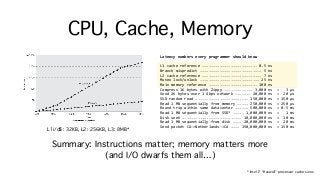
CPU, Cache, Memory
Latency numbers every programmer should know
L1 cache reference ......................... 0.5 ns
Branch mispredict ............................ 5 ns
L2 cache reference ........................... 7 ns
Mutex lock/unlock ........................... 25 ns
Main memory reference ...................... 100 ns
Compress 1K bytes with Zippy ............. 3,000 ns = 3 µs
Send 2K bytes over 1 Gbps network ....... 20,000 ns = 20 µs
SSD random read ........................ 150,000 ns = 150 µs
Read 1 MB sequentially from memory ..... 250,000 ns = 250 µs
Round trip within same datacenter ...... 500,000 ns = 0.5 ms
Read 1 MB sequentially from SSD* ..... 1,000,000 ns = 1 ms
Disk seek ........................... 10,000,000 ns = 10 ms
Read 1 MB sequentially from disk .... 20,000,000 ns = 20 ms
Send packet CA->Netherlands->CA .... 150,000,000 ns = 150 ms
Summary: Instructions matter; memory matters more
(and I/O dwarfs them all…)
L1i/d$: 32KB, L2: 256KB, L3: 8MB*
* Intel i7 “Haswell” processor cache sizes
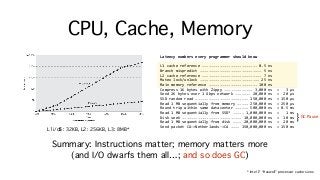
CPU, Cache, Memory
Latency numbers every programmer should know
L1 cache reference ......................... 0.5 ns
Branch mispredict ............................ 5 ns
L2 cache reference ........................... 7 ns
Mutex lock/unlock ........................... 25 ns
Main memory reference ...................... 100 ns
Compress 1K bytes with Zippy ............. 3,000 ns = 3 µs
Send 2K bytes over 1 Gbps network ....... 20,000 ns = 20 µs
SSD random read ........................ 150,000 ns = 150 µs
Read 1 MB sequentially from memory ..... 250,000 ns = 250 µs
Round trip within same datacenter ...... 500,000 ns = 0.5 ms
Read 1 MB sequentially from SSD* ..... 1,000,000 ns = 1 ms
Disk seek ........................... 10,000,000 ns = 10 ms
Read 1 MB sequentially from disk .... 20,000,000 ns = 20 ms
Send packet CA->Netherlands->CA .... 150,000,000 ns = 150 ms
Summary: Instructions matter; memory matters more
(and I/O dwarfs them all…; and so does GC)
L1i/d$: 32KB, L2: 256KB, L3: 8MB*
* Intel i7 “Haswell” processor cache sizes
GC Pause}
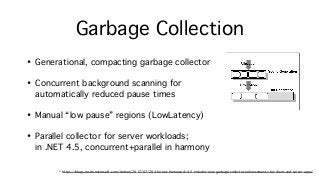
Garbage Collection
• Generational, compacting garbage collector
• Concurrent background scanning for
automatically reduced pause times
• Manual “low pause” regions (LowLatency)
• Parallel collector for server workloads;
in .NET 4.5, concurrent+parallel in harmony
* https://blogs.msdn.microsoft.com/dotnet/2012/07/20/the-net-framework-4-5-includes-new-garbage-collector-enhancements-for-client-and-server-apps/
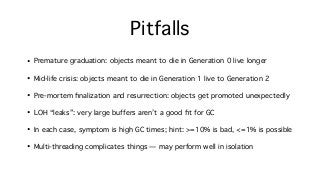
Pitfalls
• Premature graduation: objects meant to die in Generation 0 live longer
• Mid-life crisis: objects meant to die in Generation 1 live to Generation 2
• Pre-mortem finalization and resurrection: objects get promoted unexpectedly
• LOH “leaks”: very large buffers aren’t a good fit for GC
• In each case, symptom is high GC times; hint: >=10% is bad, <=1% is possible
• Multi-threading complicates things — may perform well in isolation
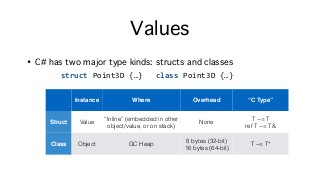
Values
• C# has two major type kinds: structs and classes
Instance Where Overhead “C Type”
Struct Value
“Inline” (embedded in other
object/value, or on stack)
None
T ~= T
ref T ~= T&
Class Object GC Heap
8 bytes (32-bit)
16 bytes (64-bit)
T ~= T*
class Point3D {…}struct Point3D {…}
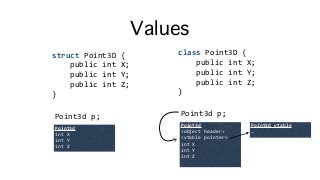
Values
class Point3D {
public int X;
public int Y;
public int Z;
}
struct Point3D {
public int X;
public int Y;
public int Z;
}
Point3d
int X
int Y
int Z
Point3d
<object header>
<vtable pointer>
int X
int Y
int Z
Point3d vtable
…
Point3d p; Point3d p;
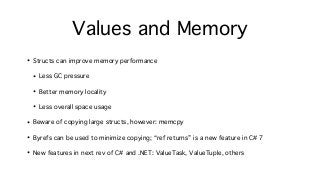
Values and Memory
• Structs can improve memory performance
• Less GC pressure
• Better memory locality
• Less overall space usage
• Beware of copying large structs, however: memcpy
• Byrefs can be used to minimize copying; “ref returns” is a new feature in C# 7
• New features in next rev of C# and .NET: ValueTask, ValueTuple, others
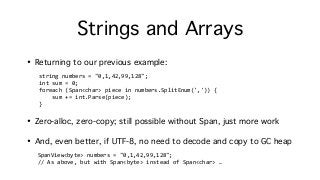
Strings and Arrays
• Strings and arrays often subject to premature graduation, especially Big Data scenarios
• Ex. parse integers from a comma-delimited string; beware code like this!
string numbers = "0,1,42,99,128";
string[] pieces = numbers.Split(',');
int[] parsed = (from piece in pieces
select int.Parse(piece)).ToArray();
long sum = 0;
for (int i = 0; i < pieces.Length; i++) {
sum += parsed[i];
}
Possibly copied UTF-8 to UTF-16
Split allocates 1 array + O(N) strings, copying data
LINQ query allocates O(2Q)+ enumer* objects
ToArray allocates at least 1 array (dynamically grows)
Span// Create over a managed array:
Span<int> ints = new[] { 0, …, 9 };
// Or a string:
SpanView<char> chars = "Hello, Span!";
// Or a native buffer:
byte* bb = …;
Span<byte> bytes = new Span<byte>(bb, 512);
// Or a sub-slice out from an existing slice:
var name = "George Washington";
int space = name.IndexOf(' ');
var firstName = name.Slice(0, space);
var lastName = name.Slice(space + 1);
// Uniform access regardless of how it was created:
void Print<T>(SpanView<T> span) {
for (int i = 0; i < span.Length; i++)
Console.Write("{0} ", span[i]);
Console.WriteLine();
}
* Currently incubating for future C#/.NET: https://github.com/dotnet/corefxlab/tree/master/src/System.Slices
• Span is a struct “slice” out of an array,
string, native buffer, or another span
• Uniform access regardless of creation
• All accesses are safe and bounds checked
Strings and Arrays
• Returning to our previous example:
• Zero-alloc, zero-copy; still possible without Span, just more work
• And, even better, if UTF-8, no need to decode and copy to GC heap
string numbers = "0,1,42,99,128";
int sum = 0;
foreach (Span<char> piece in numbers.SplitEnum(',')) {
sum += int.Parse(piece);
}
SpanView<byte> numbers = "0,1,42,99,128";
// As above, but with Span<byte> instead of Span<char> …
Packs
• Small arrays often end up on the GC heap needlessly
• Pack is a fixed size, struct-based array that interoperates with Span APIs
• Too bad it’s limited to PackN; currently incubating a “safe” stackalloc for the future
Pack8<int> pack = new Pack8<int>(0, …, 7);
pack[0] = pack[1]; // Normal indexers, just like an array.
Span<int> span = pack; // OK, we can treat a Pack like a Span!
int[] array = new int[8] { 0, …, 7 };
// Heap allocation! For short-lived arrays, this is bad!
Span<int> span = stackalloc int[8] { 0, …, 7 };
Zero Copy
• Do not copy memory needlessly
• byte[] is almost always a sign of danger ; if it’s in native memory, keep it there (common LOH pitfall)
• Span/Primitive make it convenient to work with byte* in a “safe” way
[StructLayout(...)]
struct TcpHeader {
ushort SourcePort;
ushort DestinationPort;
...
ushort Checksum;
ushort UrgentPointer;
}
void HandleRequest(byte* payload, int length) {
var span = new Span<byte>(payload, length);
// Parse the header:
var header = Primitive.Read<TcpHeader>(ref span);
… header.SourcePort …; // etc.
// Keep parsing …
for (…) {
byte b = Primitive.Read<byte>(ref span);
…;
}
}
Reliability
Bugs
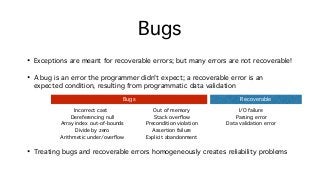
• Exceptions are meant for recoverable errors; but many errors are not recoverable!
• A bug is an error the programmer didn't expect; a recoverable error is an
expected condition, resulting from programmatic data validation
• Treating bugs and recoverable errors homogeneously creates reliability problems
Incorrect cast
Dereferencing null
Array index out-of-bounds
Divide by zero
Arithmetic under/overflow
Out of memory
Stack overflow
Precondition violation
Assertion failure
Explicit abandonment
I/O failure
Parsing error
Data validation error
Bugs Recoverable
Fail-fast
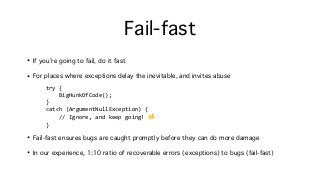
• If you’re going to fail, do it fast
• For places where exceptions delay the inevitable, and invites abuse
• Fail-fast ensures bugs are caught promptly before they can do more damage
• In our experience, 1:10 ratio of recoverable errors (exceptions) to bugs (fail-fast)
try {
BigHunkOfCode();
}
catch (ArgumentNullException) {
// Ignore, and keep going! 😞
}
Contracts and Asserts
• Contract.Requires: preconditions that
must be met before calling an API
• Contract.Assert: conditions that must
hold at a specific point in the program
• Contract.Fail: initiate an explicit fail-fast
(alternatively Environment.FailFast)
• Can be debug-only, Contract.Debug.*
(generally bad idea for preconditions)
int Read(char[] buffer, int index, int count) {
Contract.Requires(buffer != null);
Contract.Requires(
Range.IsValid(index, count, buffer.Length));
// … we know the conditions hold here …
}
// Elsewhere:
char[] buffer = …;
Contract.Debug.Assert(index >= 0 && index < count);
Contract.Debug.Assert(count <= stream.Count);
stream.Read(buffer, index, count);
// Of course, it’s better to do this by-construction:
char[] buffer = …;
SpanView<char> slice = buffer.Slice(index, count);
stream.Read(slice);
Immutability
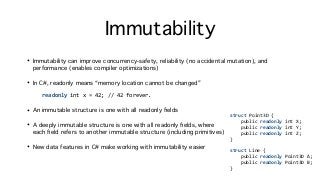
• Immutability can improve concurrency-safety, reliability (no accidental mutation), and
performance (enables compiler optimizations)
• In C#, readonly means “memory location cannot be changed”
readonly int x = 42; // 42 forever.
• An immutable structure is one with all readonly fields
• A deeply immutable structure is one with all readonly fields, where

each field refers to another immutable structure (including primitives)
• New data features in C# make working with immutability easier
struct Point3D {
public readonly int X;
public readonly int Y;
public readonly int Z;
}
struct Line {
public readonly Point3D A;
public readonly Point3D B;
}
Immutability
• Immutability can improve concurrency-safety, reliability (no accidental mutation), and
performance (enables compiler optimizations)
• In C#, readonly means “memory location cannot be changed”
readonly int x = 42; // 42 forever.
• An immutable structure is one with all readonly fields
• A deeply immutable structure is one with all readonly fields, where

each field refers to another immutable structure (including primitives)
• New data features in C# make working with immutability easier
[Immutable]
struct Point3D {
public readonly int X;
public readonly int Y;
public readonly int Z;
}
[Immutable]
struct Line {
public readonly Point3D A;
public readonly Point3D B;
}
Wrap Up
Summary
• Systems programming landscape is changing
• Safety is more important than ever, and performance bottlenecks have
largely shifted elsewhere
• C# delivers productivity and safety, while still delivering good performance
— from JIT to AOT and everything in between
• It will only get better from here
• Vibrant community, please check out GitHub and help us build this stuff!
Q&A
• Thank you!
• C# Systems Programming Pack (types+analyzers):
https://github.com/joeduffy/csysprog (later today)
• .NET GitHub repositories — where all the action is at!
https://github.com/dotnet/corefx
https://github.com/dotnet/coreclr
https://github.com/dotnet/corefxlab
https://github.com/dotnet/roslyn
joeduffyblog.com · @xjoeduffyx · joeduffy@acm.org
Backup
Security
• Borderline crisis in our industry
• “There are two kinds of companies in the world: those that know they’ve been
hacked, and those that don’t.”
• “Gartner, Inc. forecasts that 6.4 billion connected things will be in use worldwide
in 2016, up 30 percent from 2015, and will reach 20.8 billion by 2020. In 2016,
5.5 million new things will get connected every day.”
• Buffer errors >20% of all exploits in 2016, up from 18% in 2015
• It’s time to start building our most mission critical software in safe languages
* https://nvd.nist.gov/visualizations/cwe-over-time
SIMD
Ready-to-Run (R2R)
• New native image file format used by CoreCLR
• Version resilient, so (for instance) moving fields doesn’t have
cascading recompilation problems
• All standard libraries ship using it
* https://github.com/dotnet/coreclr/blob/master/Documentation/botr/readytorun-overview.md
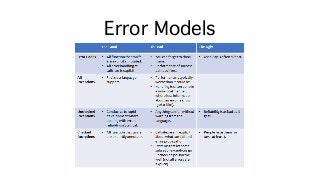
Error Models
Annotations+Analyzers
• Do not use mutable statics
• Don’t implicitly ignore expressions; use
Result.Ignore
• Don’t implicitly box; use Result.Box
• [ReadOnly] for shallow immutability
• [Immutable] for deep immutability
• [Throws] for methods that can throw
• [NoAlloc] ensures a method doesn’t
allocate
• [MustNotCopy] ensures a struct isn’t
copied
• [Scoped] ensures a value doesn’t
escape the callee
• … and more …
Watch the video with slide synchronization on
InfoQ.com!
https://www.infoq.com/presentations/csharp-
systems-programming

Safe Systems Programming in C# and .NET

  • 1.
    Safe Systems Programming in C#and .NET Joe Duffy joeduffyblog.com · @xjoeduffyx · joeduffy@acm.org
  • 2.
    InfoQ.com: News &Community Site • 750,000 unique visitors/month • Published in 4 languages (English, Chinese, Japanese and Brazilian Portuguese) • Post content from our QCon conferences • News 15-20 / week • Articles 3-4 / week • Presentations (videos) 12-15 / week • Interviews 2-3 / week • Books 1 / month Watch the video with slide synchronization on InfoQ.com! https://www.infoq.com/presentations/ csharp-systems-programming
  • 3.
    Presented at QConNew York www.qconnewyork.com Purpose of QCon - to empower software development by facilitating the spread of knowledge and innovation Strategy - practitioner-driven conference designed for YOU: influencers of change and innovation in your teams - speakers and topics driving the evolution and innovation - connecting and catalyzing the influencers and innovators Highlights - attended by more than 12,000 delegates since 2007 - held in 9 cities worldwide
  • 4.
  • 5.
    “Systems”? • Anywhere you’reapt to think about “bits, bytes, instructions, and cycles” • Demanding performance and reliability requirements • Classically meant “interacts with hardware,” requiring C and unsafe code • Abstraction has shifted upwards thanks to concurrency and cloud; security is more important now than ever • Many scenarios: operating systems, drivers, tools, libraries, cloud infrastructure, web servers, micro services and their frameworks, …
  • 6.
    Why C#? • Productivityand ease of use • Built-in safety: fewer inherent security and reliability risks • Powerful async and concurrency models • Momentum, mature ecosystem of tools and libraries
  • 7.
    Why Not C#? •Garbage collection • Allocation-rich APIs and patterns • Error model that makes reliability challenging • Concurrency is based on unsafe multithreading
  • 8.
    This Talk • Weare making progress on all of the above • New C# and library features • Patterns that you can apply today, enforce w/ Roslyn Analyzers • Advances in code generation technologies • All open source, on GitHub, and developed with the community
  • 9.
  • 10.
    Code Generation Just InTime Ahead of Time • A spectrum of code generation • JIT: fast compile times, simple, decent code quality • AOT: best code quality, slower compile times, more complex deployment model • Hybrid: pick and choose, let the system adaptively recompile (future)
  • 11.
  • 12.
    Optimizations • Inlining • Flowgraphand loop analysis • Copy/constant propagation • Range analysis • Loop invariant code hoisting • SIMD and vectorization • SSA and global value numbering • Common subexpression elimination • Dead code elimination • Devirtualization • Generic sharing • Stack allocation (work in progress)
  • 13.
    Ex. Inlining int a= …, b = …; Swap<int>(ref a, ref b); static void Swap<T>(ref T a, ref T b) { T tmp = a; a = b; b = tmp; } Calls are not cheap: new stack frame, save return address, save registers that might be overwritten, call, restore Adds a lot of waste to leaf-level functions (10s of cycles)
  • 14.
    Ex. Inlining int a= …, b = …; int tmp = a; a = b; b = tmp;
  • 15.
    Ex. Range Analysis int[]elems = …; for (int i = 0; i < elems.Length; i++) { elems[i]++; } Loop “obviously” never goes out of bounds But a naive compiler will do an induction check (i < elems.Length) plus a bounds check (elems[i]) on every iteration!
  • 16.
    Ex. Range Analysis int[]elems = …; for (int i = 0; i < elems.Length; i++) { elems[i]++; } ; Initialize induction variable to 0: 3D45: 33 C0 xor eax,eax ; Put bounds into EDX: 3D58: 8B 51 08 mov edx,dword ptr [rcx+8] ; Check that EAX is still within bounds; jump if not: 3D5B: 3B C2 cmp eax,edx 3D5D: 73 13 jae 3D72 ; Compute the element address and store into it: 3D5F: 48 63 D0 movsxd rdx,eax 3D62: 89 44 91 10 mov dword ptr [rcx+rdx*4+10h],eax ; Increment the loop induction variable: 3D66: FF C0 inc eax ; If still in bounds, then jump back to the loop beginning: 3D68: 83 F8 64 cmp eax,64h 3D6B: 7C EB jl 3D58 ; ... ; Error routine: 3D72: E8 B9 E2 FF FF call 2030
  • 17.
    Ex. Range Analysis int[]elems = …; for (int i = 0; i < elems.Length; i++) { elems[i]++; } ; Initialize induction variable to 0: 3D95: 33 C0 xor eax,eax ; Compute the element address and store into it: 3D97: 48 63 D0 movsxd rdx,eax 3D9A: 89 04 91 mov dword ptr [rcx+rdx*4],eax ; Increment the loop induction variable: 3D9D: FF C0 inc eax ; If still in bounds, then jump back to the loop beginning: 3D9F: 83 F8 64 cmp eax,64h 3DA2: 7C F3 jl 3D97
  • 18.
    Ex. Stack Allocation stringname = "Alexander Hamilton"; List<Customer> custs = …; int index = custs.IndexOf(c => c.Name == name); int IndexOf(Func<T, bool> p) { for (int i = 0; i < this.count; i++) { if (p(this[i])) return i; } return -1; }
  • 19.
    Ex. Stack Allocation stringname = "Alexander Hamilton"; List<Customer> custs = …; int index = custs.IndexOf(c => c.Name == name); int IndexOf(Func<T, bool> p) { for (int i = 0; i < this.count; i++) { if (p(this[i])) return i; } return -1; } Allocates up to 2 objects (lambda+captured stack frame) Stack Heap p <closure> name <lambda> <func>
  • 20.
    Ex. Stack Allocation stringname = "Alexander Hamilton"; List<Customer> custs = …; int index = custs.IndexOf(c => c.Name == name); int IndexOf(Func<T, bool> p) { for (int i = 0; i < this.count; i++) { if (p(this[i])) return i; } return -1; } Stack p <closure> name <lambda> <func> Allocates up to 2 objects (lambda+captured stack frame) Automatic escape analysis can determine ‘p’ doesn’t escape IndexOf
  • 21.
    Ex. Stack Allocation stringname = "Alexander Hamilton"; List<Customer> custs = …; int index = custs.IndexOf(c => c.Name == name); int IndexOf(Func<T, bool> p) { for (int i = 0; i < this.count; i++) { if (p(this[i])) return i; } return -1; } Stack p <closure> name <lambda> <func> Allocates up to 2 objects (lambda+captured stack frame) Automatic escape analysis can determine ‘p’ doesn’t escape IndexOf
  • 22.
    Ex. Stack Allocation stringname = "Alexander Hamilton"; List<Customer> custs = …; int index = custs.IndexOf(c => c.Name == name); int IndexOf([Scoped] Func<T, bool> p) { for (int i = 0; i < this.count; i++) { if (p(this[i])) return i; } return -1; } Stack p <closure> name <lambda> <func> Allocates up to 2 objects (lambda+captured stack frame) Automatic escape analysis can determine ‘p’ doesn’t escape IndexOf
  • 23.
    Ex. Stack Allocation stringname = "Alexander Hamilton"; List<Customer> custs = …; int index = -1; for (int i = 0; i < custs.count; i++) { if (custs[i].Name == name) { index = i; break; } } Stack Allocates up to 2 objects (lambda+captured stack frame) Automatic escape analysis can determine ‘p’ doesn’t escape IndexOf Best case, IndexOf is inlined, zero allocations, no virtual call! name
  • 24.
  • 25.
    CPU, Cache, Memory Latencynumbers every programmer should know L1 cache reference ......................... 0.5 ns Branch mispredict ............................ 5 ns L2 cache reference ........................... 7 ns Mutex lock/unlock ........................... 25 ns Main memory reference ...................... 100 ns Compress 1K bytes with Zippy ............. 3,000 ns = 3 µs Send 2K bytes over 1 Gbps network ....... 20,000 ns = 20 µs SSD random read ........................ 150,000 ns = 150 µs Read 1 MB sequentially from memory ..... 250,000 ns = 250 µs Round trip within same datacenter ...... 500,000 ns = 0.5 ms Read 1 MB sequentially from SSD* ..... 1,000,000 ns = 1 ms Disk seek ........................... 10,000,000 ns = 10 ms Read 1 MB sequentially from disk .... 20,000,000 ns = 20 ms Send packet CA->Netherlands->CA .... 150,000,000 ns = 150 ms Summary: Instructions matter; memory matters more (and I/O dwarfs them all…) L1i/d$: 32KB, L2: 256KB, L3: 8MB* * Intel i7 “Haswell” processor cache sizes
  • 26.
    CPU, Cache, Memory Latencynumbers every programmer should know L1 cache reference ......................... 0.5 ns Branch mispredict ............................ 5 ns L2 cache reference ........................... 7 ns Mutex lock/unlock ........................... 25 ns Main memory reference ...................... 100 ns Compress 1K bytes with Zippy ............. 3,000 ns = 3 µs Send 2K bytes over 1 Gbps network ....... 20,000 ns = 20 µs SSD random read ........................ 150,000 ns = 150 µs Read 1 MB sequentially from memory ..... 250,000 ns = 250 µs Round trip within same datacenter ...... 500,000 ns = 0.5 ms Read 1 MB sequentially from SSD* ..... 1,000,000 ns = 1 ms Disk seek ........................... 10,000,000 ns = 10 ms Read 1 MB sequentially from disk .... 20,000,000 ns = 20 ms Send packet CA->Netherlands->CA .... 150,000,000 ns = 150 ms Summary: Instructions matter; memory matters more (and I/O dwarfs them all…; and so does GC) L1i/d$: 32KB, L2: 256KB, L3: 8MB* * Intel i7 “Haswell” processor cache sizes GC Pause}
  • 27.
    Garbage Collection • Generational,compacting garbage collector • Concurrent background scanning for automatically reduced pause times • Manual “low pause” regions (LowLatency) • Parallel collector for server workloads; in .NET 4.5, concurrent+parallel in harmony * https://blogs.msdn.microsoft.com/dotnet/2012/07/20/the-net-framework-4-5-includes-new-garbage-collector-enhancements-for-client-and-server-apps/
  • 28.
    Pitfalls • Premature graduation:objects meant to die in Generation 0 live longer • Mid-life crisis: objects meant to die in Generation 1 live to Generation 2 • Pre-mortem finalization and resurrection: objects get promoted unexpectedly • LOH “leaks”: very large buffers aren’t a good fit for GC • In each case, symptom is high GC times; hint: >=10% is bad, <=1% is possible • Multi-threading complicates things — may perform well in isolation
  • 29.
    Values • C# hastwo major type kinds: structs and classes Instance Where Overhead “C Type” Struct Value “Inline” (embedded in other object/value, or on stack) None T ~= T ref T ~= T& Class Object GC Heap 8 bytes (32-bit) 16 bytes (64-bit) T ~= T* class Point3D {…}struct Point3D {…}
  • 30.
    Values class Point3D { publicint X; public int Y; public int Z; } struct Point3D { public int X; public int Y; public int Z; } Point3d int X int Y int Z Point3d <object header> <vtable pointer> int X int Y int Z Point3d vtable … Point3d p; Point3d p;
  • 31.
    Values and Memory •Structs can improve memory performance • Less GC pressure • Better memory locality • Less overall space usage • Beware of copying large structs, however: memcpy • Byrefs can be used to minimize copying; “ref returns” is a new feature in C# 7 • New features in next rev of C# and .NET: ValueTask, ValueTuple, others
  • 32.
    Strings and Arrays •Strings and arrays often subject to premature graduation, especially Big Data scenarios • Ex. parse integers from a comma-delimited string; beware code like this! string numbers = "0,1,42,99,128"; string[] pieces = numbers.Split(','); int[] parsed = (from piece in pieces select int.Parse(piece)).ToArray(); long sum = 0; for (int i = 0; i < pieces.Length; i++) { sum += parsed[i]; } Possibly copied UTF-8 to UTF-16 Split allocates 1 array + O(N) strings, copying data LINQ query allocates O(2Q)+ enumer* objects ToArray allocates at least 1 array (dynamically grows)
  • 33.
    Span// Create overa managed array: Span<int> ints = new[] { 0, …, 9 }; // Or a string: SpanView<char> chars = "Hello, Span!"; // Or a native buffer: byte* bb = …; Span<byte> bytes = new Span<byte>(bb, 512); // Or a sub-slice out from an existing slice: var name = "George Washington"; int space = name.IndexOf(' '); var firstName = name.Slice(0, space); var lastName = name.Slice(space + 1); // Uniform access regardless of how it was created: void Print<T>(SpanView<T> span) { for (int i = 0; i < span.Length; i++) Console.Write("{0} ", span[i]); Console.WriteLine(); } * Currently incubating for future C#/.NET: https://github.com/dotnet/corefxlab/tree/master/src/System.Slices • Span is a struct “slice” out of an array, string, native buffer, or another span • Uniform access regardless of creation • All accesses are safe and bounds checked
  • 34.
    Strings and Arrays •Returning to our previous example: • Zero-alloc, zero-copy; still possible without Span, just more work • And, even better, if UTF-8, no need to decode and copy to GC heap string numbers = "0,1,42,99,128"; int sum = 0; foreach (Span<char> piece in numbers.SplitEnum(',')) { sum += int.Parse(piece); } SpanView<byte> numbers = "0,1,42,99,128"; // As above, but with Span<byte> instead of Span<char> …
  • 35.
    Packs • Small arraysoften end up on the GC heap needlessly • Pack is a fixed size, struct-based array that interoperates with Span APIs • Too bad it’s limited to PackN; currently incubating a “safe” stackalloc for the future Pack8<int> pack = new Pack8<int>(0, …, 7); pack[0] = pack[1]; // Normal indexers, just like an array. Span<int> span = pack; // OK, we can treat a Pack like a Span! int[] array = new int[8] { 0, …, 7 }; // Heap allocation! For short-lived arrays, this is bad! Span<int> span = stackalloc int[8] { 0, …, 7 };
  • 36.
    Zero Copy • Donot copy memory needlessly • byte[] is almost always a sign of danger ; if it’s in native memory, keep it there (common LOH pitfall) • Span/Primitive make it convenient to work with byte* in a “safe” way [StructLayout(...)] struct TcpHeader { ushort SourcePort; ushort DestinationPort; ... ushort Checksum; ushort UrgentPointer; } void HandleRequest(byte* payload, int length) { var span = new Span<byte>(payload, length); // Parse the header: var header = Primitive.Read<TcpHeader>(ref span); … header.SourcePort …; // etc. // Keep parsing … for (…) { byte b = Primitive.Read<byte>(ref span); …; } }
  • 37.
  • 38.
    Bugs • Exceptions aremeant for recoverable errors; but many errors are not recoverable! • A bug is an error the programmer didn't expect; a recoverable error is an expected condition, resulting from programmatic data validation • Treating bugs and recoverable errors homogeneously creates reliability problems Incorrect cast Dereferencing null Array index out-of-bounds Divide by zero Arithmetic under/overflow Out of memory Stack overflow Precondition violation Assertion failure Explicit abandonment I/O failure Parsing error Data validation error Bugs Recoverable
  • 39.
    Fail-fast • If you’regoing to fail, do it fast • For places where exceptions delay the inevitable, and invites abuse • Fail-fast ensures bugs are caught promptly before they can do more damage • In our experience, 1:10 ratio of recoverable errors (exceptions) to bugs (fail-fast) try { BigHunkOfCode(); } catch (ArgumentNullException) { // Ignore, and keep going! 😞 }
  • 40.
    Contracts and Asserts •Contract.Requires: preconditions that must be met before calling an API • Contract.Assert: conditions that must hold at a specific point in the program • Contract.Fail: initiate an explicit fail-fast (alternatively Environment.FailFast) • Can be debug-only, Contract.Debug.* (generally bad idea for preconditions) int Read(char[] buffer, int index, int count) { Contract.Requires(buffer != null); Contract.Requires( Range.IsValid(index, count, buffer.Length)); // … we know the conditions hold here … } // Elsewhere: char[] buffer = …; Contract.Debug.Assert(index >= 0 && index < count); Contract.Debug.Assert(count <= stream.Count); stream.Read(buffer, index, count); // Of course, it’s better to do this by-construction: char[] buffer = …; SpanView<char> slice = buffer.Slice(index, count); stream.Read(slice);
  • 41.
    Immutability • Immutability canimprove concurrency-safety, reliability (no accidental mutation), and performance (enables compiler optimizations) • In C#, readonly means “memory location cannot be changed” readonly int x = 42; // 42 forever. • An immutable structure is one with all readonly fields • A deeply immutable structure is one with all readonly fields, where
 each field refers to another immutable structure (including primitives) • New data features in C# make working with immutability easier struct Point3D { public readonly int X; public readonly int Y; public readonly int Z; } struct Line { public readonly Point3D A; public readonly Point3D B; }
  • 42.
    Immutability • Immutability canimprove concurrency-safety, reliability (no accidental mutation), and performance (enables compiler optimizations) • In C#, readonly means “memory location cannot be changed” readonly int x = 42; // 42 forever. • An immutable structure is one with all readonly fields • A deeply immutable structure is one with all readonly fields, where
 each field refers to another immutable structure (including primitives) • New data features in C# make working with immutability easier [Immutable] struct Point3D { public readonly int X; public readonly int Y; public readonly int Z; } [Immutable] struct Line { public readonly Point3D A; public readonly Point3D B; }
  • 43.
  • 44.
    Summary • Systems programminglandscape is changing • Safety is more important than ever, and performance bottlenecks have largely shifted elsewhere • C# delivers productivity and safety, while still delivering good performance — from JIT to AOT and everything in between • It will only get better from here • Vibrant community, please check out GitHub and help us build this stuff!
  • 45.
    Q&A • Thank you! •C# Systems Programming Pack (types+analyzers): https://github.com/joeduffy/csysprog (later today) • .NET GitHub repositories — where all the action is at! https://github.com/dotnet/corefx https://github.com/dotnet/coreclr https://github.com/dotnet/corefxlab https://github.com/dotnet/roslyn joeduffyblog.com · @xjoeduffyx · joeduffy@acm.org
  • 46.
  • 47.
    Security • Borderline crisisin our industry • “There are two kinds of companies in the world: those that know they’ve been hacked, and those that don’t.” • “Gartner, Inc. forecasts that 6.4 billion connected things will be in use worldwide in 2016, up 30 percent from 2015, and will reach 20.8 billion by 2020. In 2016, 5.5 million new things will get connected every day.” • Buffer errors >20% of all exploits in 2016, up from 18% in 2015 • It’s time to start building our most mission critical software in safe languages * https://nvd.nist.gov/visualizations/cwe-over-time
  • 48.
  • 49.
    Ready-to-Run (R2R) • Newnative image file format used by CoreCLR • Version resilient, so (for instance) moving fields doesn’t have cascading recompilation problems • All standard libraries ship using it * https://github.com/dotnet/coreclr/blob/master/Documentation/botr/readytorun-overview.md
  • 50.
  • 51.
    Annotations+Analyzers • Do notuse mutable statics • Don’t implicitly ignore expressions; use Result.Ignore • Don’t implicitly box; use Result.Box • [ReadOnly] for shallow immutability • [Immutable] for deep immutability • [Throws] for methods that can throw • [NoAlloc] ensures a method doesn’t allocate • [MustNotCopy] ensures a struct isn’t copied • [Scoped] ensures a value doesn’t escape the callee • … and more …
  • 52.
    Watch the videowith slide synchronization on InfoQ.com! https://www.infoq.com/presentations/csharp- systems-programming