STORY DESIGN
50 narrative devices for non-fiction storytellers

WWW.INSIDETHESTORY.ORG
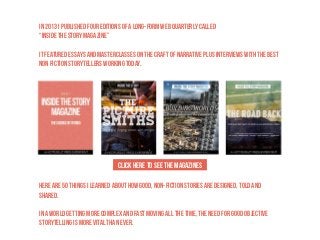
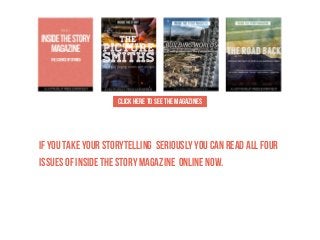
IN 2013 I PUBLISHED FOUR EDITIONS OF A LONG-FORM WEB QUARTERLY CALLED
“INSIDE THE STORY MAGAZINE”
IT FEATURED ESSAYS AND MASTERCLASSES ON THE CRAFT OF NARRATIVE PLUS INTERVIEWS WITH THE BEST
NON FICTION STORYTELLERS WORKING TODAY.

CLICK HERE TO SEE THE MAGAZINES
HERE ARE 50 THINGS I LEARNED ABOUT HOW GOOD, NON-FICTION STORIES ARE DESIGNED, TOLD AND
SHARED.
IN A WORLD GETTING MORE COMPLEX AND FAST MOVING ALL THE TIME, THE NEED FOR GOOD OBJECTIVE
STORYTELLING IS MORE VITAL THAN EVER.
BUT WAIT, WHAT’S
STORY DESIGN?
In a well designed story everything happens for a purpose: to
support the point of the story. It is intentionally deciding what
to keep in your story, and more importantly what to throw out.
It’s about intentionally giving certain narrative elements more
volume, and quietening others.
It is about taking a disciplined, methodical and objective
approach to storytelling.
1

it’s PRINCIPLES NOT RULES
There are no hard and fast rules to good storytelling,
but there are principles.
Discipline matters.
Discipline is hard.

w

WWW.INSIDETHESTORY.ORG
2

don’t be afraid to spin a yarn
Factual storytellers can and should use story design
techniques to weave more engaging narratives.
Don’t fear fables.

w

WWW.INSIDETHESTORY.ORG
3
STUDY HOW THE BRAIN REACTS TO STORIES
Scientists know our brains react to stories,
releasing neurochemicals like Oxytocin, Dopamine,
and ACTH.
Well made narratives play with these releases to
engage our brains emotionally and intellectually.

w

WWW.INSIDETHESTORY.ORG
4

TO EMPATHISE IS TO BE HUMAN
Meanwhile mirror neurones in our brains allow us to
empathise with others and their experiences.
Empathy is one of the most important powers of
story.

w

WWW.INSIDETHESTORY.ORG
5

TELL TIMELESS STORIES

The best stories are timeless and universal.

No matter what they’re about, they are told in a way
that can speak to someone on the other side of the
world, and 500 years from now.
In our real-time world, this matters even more.

w

WWW.INSIDETHESTORY.ORG
6

stories say “LIFE IS LIKE THIS!!”
The best stories say something meaningful about
the world. Not necessarily in a literal way, but in the
meaning hidden inside the narrative.
They say “life is like THIS!”
Pursue this meaning; don’t tell stories for story’s sake

w

WWW.INSIDETHESTORY.ORG
7
WHAT IF YOU HAVE NOTHING TO SAY?
Be honest, patient and live a little.
We all have something to say, but it often requires a
bit of living to figure it out.
	 “How vain is it to sit down to write, when you have 		
	 not stood up to live?”
	

HENRY DAVID THOREAU

w

WWW.INSIDETHESTORY.ORG
8
MEANING IS REVEALED IN THE CLIMAX
The meaning, theme or “controlling idea” of your
story ought to be revealed, emotionally, in the climax.
Even if your story is about the science of quantum
fluctuations this should still be the case.

w

WWW.INSIDETHESTORY.ORG
9
TELL THE UNCOMFORTABLE TRUTH
The storyteller has always told the objective truth of
the age.
This may involve being unpopular or vulnerable: it is
rare and therefore very important.

w

WWW.INSIDETHESTORY.ORG
10

STORY ≠ ESCAPISM

There’s a myth that people like stories to escape the
real world.
In fact, it is the opposite. In a such a confusing, fastchanging world, people actually pursue stories for
meaning and connection.
This is what the good storyteller provides.
w

WWW.INSIDETHESTORY.ORG
11
THE AUDIENCE ARE PART OF THE PROCESS
Books, cinema, radio then television created a world
where the audience silently consumed stories.
The days of the silent audience are over.
It was just a blip.
We’re going back to vaudeville days of noisy
interaction. Embrace it.
w

WWW.INSIDETHESTORY.ORG
12
THE “USER EXPERIENCE OF STORY” MATTERS
So our audience want to be involved in our stories
now.
That means thinking about their journey as they
consume your work.
Story needs UX design as much as an app.

w

WWW.INSIDETHESTORY.ORG
13
ALFRED HITCHCOCK: UX DESIGNER
The real masters understand the UX of their story.
“How will my audience be feeling at this moment?”
Hitchcock knew it best. He could play on the
audience’s emotions and guessing-machines to take
them on a real journey.
Non-fiction storytellers must master this too.
w

WWW.INSIDETHESTORY.ORG
14
HAVE YOU HEARD OF KITSHUTENKETSU?
Our way of storytelling is a very western one.
The three-act structure emerged from ancient Greek
individualism and has stuck around ever since.
But there are others. Have you ever heard of
KitShuTenKetsu? It’s a Japanese story form. Issue 2 of
the magazine reveals more.
w

WWW.INSIDETHESTORY.ORG
15
GET AUDIENCE FEEDBACK ON YOUR STORIES
Good storytellers test their work on colleagues,
friends & family.
The key question they ask: “where did you lose
interest?”

w

WWW.INSIDETHESTORY.ORG
16

SUBTLE SYMBOLISM

We can use symbols & codes to engage the

audience’s subconscious and connect on a deeper
level.
This is powerful but they must never be explicitly
stated. Subtlety is essential.

w

WWW.INSIDETHESTORY.ORG
17
what’s your story really about?
This comes back to meaning and the “controlling
idea”.
“Up” is not film about a floating house.
It’s really about grief. There is no house.
What’s your story really about?

w

WWW.INSIDETHESTORY.ORG
18

HEROES AND GODS REALLY EXIST
Mythical gods and superhumans are not just fictional.
They are metaphors for us mere mortals living our
fullest lives.
This is everyone’s greatest wish (and fear) which is
why it’s such a potent theme.

w

WWW.INSIDETHESTORY.ORG
19
THE BEST IDEAS: SIMPLE BUT PROFOUND
No matter the subject, you should always be able to
capture your story in a sentence or two, max.
It helps you focus.
Aim for something simple but rich in meaning.

w

WWW.INSIDETHESTORY.ORG
20

HIPSTERS NOT WELCOME
Meaningful storytelling requires vulnerability.
Don’t hide behind hipster irony, humour, or shy away
from emotion.
We use stories to connect. Don’t put a barrier
between you and your audience.

w

WWW.INSIDETHESTORY.ORG
21

character = WANTS + NEEDS
Characters are driven by wants (conscious) and
needs (subconscious).
These two desires get your character of bed each
day and are the cause of forward motion in the story.
This is true in non-fiction as much as fiction.

w

WWW.INSIDETHESTORY.ORG
22
WHAT DOES YOUR CHARACTER need?
So when people are telling you “their story”, listen.
What are they really telling you?
Their subconscious reveals itself through their words
and actions.
It’s the real-life equivalent of subtext, a core dramatic
concept.
w

WWW.INSIDETHESTORY.ORG
23

THE MASK

People in real life wear masks to protect their real
feelings and vulnerability.
Masks peeling away is a dramatic device, that can be
used in non-fiction too.
Ask yourself: what’s your character’s mask?

w

WWW.INSIDETHESTORY.ORG
24

GOOD GUYS + BAD GUYS

Protagonist & Antagonist are dramatic terms, but
they can be applied to real world if we think less
literally.

w

WWW.INSIDETHESTORY.ORG
25

darth vadar, metaphor

For example, antagonists don’t have to be evil, just

obstructive to the main character’s desire to achieve
something.
Appreciating dramatic devices as metaphors allows
non-fiction storytellers to use them as well.

w

WWW.INSIDETHESTORY.ORG
26
FALLIBLE HEROES ARE THE MOST COMPELLING
Indiana Jones was terrified of snakes. Highlight your
character’s foibles, flaws and fears to reflect the
complex nature of people.
True too: the best antagonists are the heroes in their
own story. Screenwriters know this well, and
journalists should too.
w

WWW.INSIDETHESTORY.ORG
27
character as animal, vegetable, mineral
Characters also don’t have to be human.
Animals, objects, weather, disease and technology can
all be characters.

w

WWW.INSIDETHESTORY.ORG
28
THE sEVEN circles oF HELL CONFLICT
Conflict exists on many levels, but there is one level
more universal than the others.
Every character, real or made up, is driven by inner
conflict.
Reveal it in your story and you touch your audience
more deeply.
w

WWW.INSIDETHESTORY.ORG
29
ENOUGH PSYCHO-BABBLE THANKYOU
Many are skeptical about that last idea, but it’s true
our greatest enemy is ourself.
Ever heard yourself say “I’m not good enough”?
That’s your subsconscious Resistance in conflict with
your wants and needs.
w

WWW.INSIDETHESTORY.ORG
30
snakes, spiders and commitment
Almost everyone has a deep fear of some kind.
And it drives their actions or holds them back from
acting.
It’s amazing how many conflicts come down to this.

w

WWW.INSIDETHESTORY.ORG
31

YOUR CHARACTER, THE ONION
Peeling back the layers of your character makes for a
more authentic and compelling story.
Subtlety is important again, you don’t want to make
it obvious or do it too quickly.

w

WWW.INSIDETHESTORY.ORG
32
HUMAN BEINGS: HANDLE WITH CARE
Be careful though, you’re dealing with real people, so
be sensitive. Above all, it requires an ability to listen.
“People do not seem to realize that their opinion of the
world is also a confession of character.”
RALPH WALDO EMERSON

w

WWW.INSIDETHESTORY.ORG
33

UNIVERSAL THEMES

Most Controlling Ideas of stories are universal: they
speak to everyone.
Some universal themes which widen your appeal:
hope, hate, jealousy, fear, self doubt, vulnerability, fear
of failure, death...
w

WWW.INSIDETHESTORY.ORG
34

ONE THEME TO RULE THEM ALL
What’s the most popular tag on Cowbird ?
Love.
People love love stories. It’s the universal language.

w

WWW.INSIDETHESTORY.ORG
35

THE “ALL IS LOST” MOMENT
Here’s another classic story trope people love (in fiction and non fiction): the “we almost lost everything
and gave up” moment.
Take a look at the popular story of Sugru,
the innovative British start-up. It has that moment in
spades.
w

WWW.INSIDETHESTORY.ORG
36

JUST GIVE ME TEN SECONDS
Did you know 20% of YouTube viewers click away
before 10 seconds. Of 1million views, 200,000 didn’t
watch past the first 10 seconds!
That’s all the time you have to grab ‘em. Make it
count.
w

WWW.INSIDETHESTORY.ORG
37
WHAT THE HELL JUST HAPPENED?!
A simple story tactic: put your best bit first, even if it
doesn’t make sense.
It’ll hook people in and then you can use the rest of
the story to explain what’s going on.

w

WWW.INSIDETHESTORY.ORG
38

BE THE UNPOPULAR PARTY GUEST
Here’s a good way to shorten longer, slower parts of
your stories, borrowed from screenwriters.
Arrive late, and leave early. A scene that is. Arrive
once the conversation’s started and force the
audience to piece it together.
w

WWW.INSIDETHESTORY.ORG
39
BUT THAT’s NOT HOW JOURNALISM WOrKS!
I know this strategy risks confusing your audience
- but that forces them to ask questions, and keeps
them interested.
Counterintuitive I know, that’s why it’s smart!

w

WWW.INSIDETHESTORY.ORG
40
BUT IT’S HOW GOOD STORYTELLING WORKS
And herein lies the real challenge to non-fiction
storytellers: dare you withhold information for a bit
to weave a good yarn?
If it makes you feel better, there’s a science to why it
works.
w

WWW.INSIDETHESTORY.ORG
41

WAIT FOR IT....

Which brings us to the best device in any
storyteller’s toolkit.
SURPRISE!

w

WWW.INSIDETHESTORY.ORG
42

THE MASTER OF SURPRISE

Going back to the first tips about neuroscience: we
know that surprising people releases addictive
Dopamine in their brains.
We can use another device, Intermittent
Reinforcement to create expectation for more.

w

WWW.INSIDETHESTORY.ORG
43

WITH A TWIST OF MELON

So surprise your audience early on and they’ll be
hooked waiting for the next twist.

There’s lot of interesting research into this, go seek it
out!

w

WWW.INSIDETHESTORY.ORG
44

GO on, BURY THE LEDE

For 150 years journalists have relied on the Invert-

ed Pyramid as their story structure. “Don’t bury the
lede!”
But a new world demands more engaging stories.
So go on, bury the lede, make your audience do the
work.
w

WWW.INSIDETHESTORY.ORG
45
DAYS SINCE THE LAST WORKPLACE ACCIDENT:
Oh by the way, want a lesson in good visual
storytelling?
Watch the first 30 seconds of Super8. Learn how to
show and not tell.

w

WWW.INSIDETHESTORY.ORG
46

AND NOW FOR THE BAD NEWS
Here’s the crux: there is no shortcut to good
storytelling, just years of practice, failure and study of
the discipline.
Don’t skimp on that last bit.

w

WWW.INSIDETHESTORY.ORG
47

EVERYONE’S AN AIRLINE PILOT
You might fly three times a year, but you don’t think
you’re an airline pilot do you?
You’re not a storyteller because you go to the
movies. Respect & study the principles to make
conscious narrative decisions. That is story design.
w

WWW.INSIDETHESTORY.ORG
48
AND NOW FOR THE IMPORTANT NEWS
The world is getting more complicated every day.
The need for objective truth is more important than
ever.
Stories matter.
w

WWW.INSIDETHESTORY.ORG
49
NO-oNE CARES ABOUT YOUR DEPTH-of-fIELD
Forget hipster docs about vintage printmakers.
Tell stories which shine a light on our age and make
us uncomfortable.
It’s really difficult, but so important.
w

WWW.INSIDETHESTORY.ORG
50
WHEN EVERYONE’s A STORYTELLER, BE THE BEST
Among the listicles, the real-time updates and the
monkeys in trousers there’s a huge opportunity to
tell compelling stories that reflect the truths our time.
If that excites you even a bit, make it your mission.
Now, get busy!
w

WWW.INSIDETHESTORY.ORG
CLICK HERE TO SEE THE MAGAZINES

IF YOU TAKE YOUR STORYTELLING SERIOUSLY YOU CAN READ ALL FOUR
ISSUES OF INSIDE THE STORY MAGAZINE ONLINE NOW.
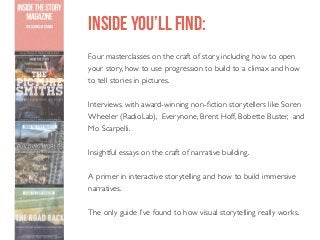
INSIDE YOU’LL FIND:
Four masterclasses on the craft of story, including how to open
your story, how to use progression to build to a climax and how
to tell stories in pictures.
Interviews with award-winning non-fiction storytellers like Soren
Wheeler (RadioLab), Everynone, Brent Hoff, Bobette Buster, and
Mo Scarpelli.
Insightful essays on the craft of narrative building.
A primer in interactive storytelling and how to build immersive
narratives.
The only guide I’ve found to how visual storytelling really works.
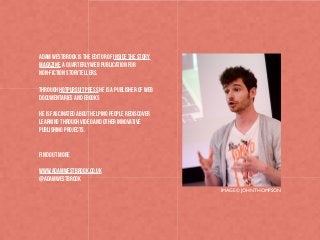
Adam Westbrook is the editor of Inside the Story
Magazine, a quarterly web publication for
non-fiction storytellers.
Through HotPursuit Press he is a publisher of web
documentaries and ebooks
He is fascinated about helping people rediscover
learning through video and other innovative
publishing projects.

Find out more
www.adamwestbrook.co.uk
@AdamWestbrook
IMAGE © JOHN THOMPSON

50 things you don't know about non-fiction storytelling (for journalists, educators and communicators of non-fiction)

  • 1.
    STORY DESIGN 50 narrativedevices for non-fiction storytellers WWW.INSIDETHESTORY.ORG
  • 2.
    IN 2013 IPUBLISHED FOUR EDITIONS OF A LONG-FORM WEB QUARTERLY CALLED “INSIDE THE STORY MAGAZINE” IT FEATURED ESSAYS AND MASTERCLASSES ON THE CRAFT OF NARRATIVE PLUS INTERVIEWS WITH THE BEST NON FICTION STORYTELLERS WORKING TODAY. CLICK HERE TO SEE THE MAGAZINES HERE ARE 50 THINGS I LEARNED ABOUT HOW GOOD, NON-FICTION STORIES ARE DESIGNED, TOLD AND SHARED. IN A WORLD GETTING MORE COMPLEX AND FAST MOVING ALL THE TIME, THE NEED FOR GOOD OBJECTIVE STORYTELLING IS MORE VITAL THAN EVER.
  • 3.
    BUT WAIT, WHAT’S STORYDESIGN? In a well designed story everything happens for a purpose: to support the point of the story. It is intentionally deciding what to keep in your story, and more importantly what to throw out. It’s about intentionally giving certain narrative elements more volume, and quietening others. It is about taking a disciplined, methodical and objective approach to storytelling.
  • 4.
    1 it’s PRINCIPLES NOTRULES There are no hard and fast rules to good storytelling, but there are principles. Discipline matters. Discipline is hard. w WWW.INSIDETHESTORY.ORG
  • 5.
    2 don’t be afraidto spin a yarn Factual storytellers can and should use story design techniques to weave more engaging narratives. Don’t fear fables. w WWW.INSIDETHESTORY.ORG
  • 6.
    3 STUDY HOW THEBRAIN REACTS TO STORIES Scientists know our brains react to stories, releasing neurochemicals like Oxytocin, Dopamine, and ACTH. Well made narratives play with these releases to engage our brains emotionally and intellectually. w WWW.INSIDETHESTORY.ORG
  • 7.
    4 TO EMPATHISE ISTO BE HUMAN Meanwhile mirror neurones in our brains allow us to empathise with others and their experiences. Empathy is one of the most important powers of story. w WWW.INSIDETHESTORY.ORG
  • 8.
    5 TELL TIMELESS STORIES Thebest stories are timeless and universal. No matter what they’re about, they are told in a way that can speak to someone on the other side of the world, and 500 years from now. In our real-time world, this matters even more. w WWW.INSIDETHESTORY.ORG
  • 9.
    6 stories say “LIFEIS LIKE THIS!!” The best stories say something meaningful about the world. Not necessarily in a literal way, but in the meaning hidden inside the narrative. They say “life is like THIS!” Pursue this meaning; don’t tell stories for story’s sake w WWW.INSIDETHESTORY.ORG
  • 10.
    7 WHAT IF YOUHAVE NOTHING TO SAY? Be honest, patient and live a little. We all have something to say, but it often requires a bit of living to figure it out. “How vain is it to sit down to write, when you have not stood up to live?” HENRY DAVID THOREAU w WWW.INSIDETHESTORY.ORG
  • 11.
    8 MEANING IS REVEALEDIN THE CLIMAX The meaning, theme or “controlling idea” of your story ought to be revealed, emotionally, in the climax. Even if your story is about the science of quantum fluctuations this should still be the case. w WWW.INSIDETHESTORY.ORG
  • 12.
    9 TELL THE UNCOMFORTABLETRUTH The storyteller has always told the objective truth of the age. This may involve being unpopular or vulnerable: it is rare and therefore very important. w WWW.INSIDETHESTORY.ORG
  • 13.
    10 STORY ≠ ESCAPISM There’sa myth that people like stories to escape the real world. In fact, it is the opposite. In a such a confusing, fastchanging world, people actually pursue stories for meaning and connection. This is what the good storyteller provides. w WWW.INSIDETHESTORY.ORG
  • 14.
    11 THE AUDIENCE AREPART OF THE PROCESS Books, cinema, radio then television created a world where the audience silently consumed stories. The days of the silent audience are over. It was just a blip. We’re going back to vaudeville days of noisy interaction. Embrace it. w WWW.INSIDETHESTORY.ORG
  • 15.
    12 THE “USER EXPERIENCEOF STORY” MATTERS So our audience want to be involved in our stories now. That means thinking about their journey as they consume your work. Story needs UX design as much as an app. w WWW.INSIDETHESTORY.ORG
  • 16.
    13 ALFRED HITCHCOCK: UXDESIGNER The real masters understand the UX of their story. “How will my audience be feeling at this moment?” Hitchcock knew it best. He could play on the audience’s emotions and guessing-machines to take them on a real journey. Non-fiction storytellers must master this too. w WWW.INSIDETHESTORY.ORG
  • 17.
    14 HAVE YOU HEARDOF KITSHUTENKETSU? Our way of storytelling is a very western one. The three-act structure emerged from ancient Greek individualism and has stuck around ever since. But there are others. Have you ever heard of KitShuTenKetsu? It’s a Japanese story form. Issue 2 of the magazine reveals more. w WWW.INSIDETHESTORY.ORG
  • 18.
    15 GET AUDIENCE FEEDBACKON YOUR STORIES Good storytellers test their work on colleagues, friends & family. The key question they ask: “where did you lose interest?” w WWW.INSIDETHESTORY.ORG
  • 19.
    16 SUBTLE SYMBOLISM We canuse symbols & codes to engage the audience’s subconscious and connect on a deeper level. This is powerful but they must never be explicitly stated. Subtlety is essential. w WWW.INSIDETHESTORY.ORG
  • 20.
    17 what’s your storyreally about? This comes back to meaning and the “controlling idea”. “Up” is not film about a floating house. It’s really about grief. There is no house. What’s your story really about? w WWW.INSIDETHESTORY.ORG
  • 21.
    18 HEROES AND GODSREALLY EXIST Mythical gods and superhumans are not just fictional. They are metaphors for us mere mortals living our fullest lives. This is everyone’s greatest wish (and fear) which is why it’s such a potent theme. w WWW.INSIDETHESTORY.ORG
  • 22.
    19 THE BEST IDEAS:SIMPLE BUT PROFOUND No matter the subject, you should always be able to capture your story in a sentence or two, max. It helps you focus. Aim for something simple but rich in meaning. w WWW.INSIDETHESTORY.ORG
  • 23.
    20 HIPSTERS NOT WELCOME Meaningfulstorytelling requires vulnerability. Don’t hide behind hipster irony, humour, or shy away from emotion. We use stories to connect. Don’t put a barrier between you and your audience. w WWW.INSIDETHESTORY.ORG
  • 24.
    21 character = WANTS+ NEEDS Characters are driven by wants (conscious) and needs (subconscious). These two desires get your character of bed each day and are the cause of forward motion in the story. This is true in non-fiction as much as fiction. w WWW.INSIDETHESTORY.ORG
  • 25.
    22 WHAT DOES YOURCHARACTER need? So when people are telling you “their story”, listen. What are they really telling you? Their subconscious reveals itself through their words and actions. It’s the real-life equivalent of subtext, a core dramatic concept. w WWW.INSIDETHESTORY.ORG
  • 26.
    23 THE MASK People inreal life wear masks to protect their real feelings and vulnerability. Masks peeling away is a dramatic device, that can be used in non-fiction too. Ask yourself: what’s your character’s mask? w WWW.INSIDETHESTORY.ORG
  • 27.
    24 GOOD GUYS +BAD GUYS Protagonist & Antagonist are dramatic terms, but they can be applied to real world if we think less literally. w WWW.INSIDETHESTORY.ORG
  • 28.
    25 darth vadar, metaphor Forexample, antagonists don’t have to be evil, just obstructive to the main character’s desire to achieve something. Appreciating dramatic devices as metaphors allows non-fiction storytellers to use them as well. w WWW.INSIDETHESTORY.ORG
  • 29.
    26 FALLIBLE HEROES ARETHE MOST COMPELLING Indiana Jones was terrified of snakes. Highlight your character’s foibles, flaws and fears to reflect the complex nature of people. True too: the best antagonists are the heroes in their own story. Screenwriters know this well, and journalists should too. w WWW.INSIDETHESTORY.ORG
  • 30.
    27 character as animal,vegetable, mineral Characters also don’t have to be human. Animals, objects, weather, disease and technology can all be characters. w WWW.INSIDETHESTORY.ORG
  • 31.
    28 THE sEVEN circlesoF HELL CONFLICT Conflict exists on many levels, but there is one level more universal than the others. Every character, real or made up, is driven by inner conflict. Reveal it in your story and you touch your audience more deeply. w WWW.INSIDETHESTORY.ORG
  • 32.
    29 ENOUGH PSYCHO-BABBLE THANKYOU Manyare skeptical about that last idea, but it’s true our greatest enemy is ourself. Ever heard yourself say “I’m not good enough”? That’s your subsconscious Resistance in conflict with your wants and needs. w WWW.INSIDETHESTORY.ORG
  • 33.
    30 snakes, spiders andcommitment Almost everyone has a deep fear of some kind. And it drives their actions or holds them back from acting. It’s amazing how many conflicts come down to this. w WWW.INSIDETHESTORY.ORG
  • 34.
    31 YOUR CHARACTER, THEONION Peeling back the layers of your character makes for a more authentic and compelling story. Subtlety is important again, you don’t want to make it obvious or do it too quickly. w WWW.INSIDETHESTORY.ORG
  • 35.
    32 HUMAN BEINGS: HANDLEWITH CARE Be careful though, you’re dealing with real people, so be sensitive. Above all, it requires an ability to listen. “People do not seem to realize that their opinion of the world is also a confession of character.” RALPH WALDO EMERSON w WWW.INSIDETHESTORY.ORG
  • 36.
    33 UNIVERSAL THEMES Most ControllingIdeas of stories are universal: they speak to everyone. Some universal themes which widen your appeal: hope, hate, jealousy, fear, self doubt, vulnerability, fear of failure, death... w WWW.INSIDETHESTORY.ORG
  • 37.
    34 ONE THEME TORULE THEM ALL What’s the most popular tag on Cowbird ? Love. People love love stories. It’s the universal language. w WWW.INSIDETHESTORY.ORG
  • 38.
    35 THE “ALL ISLOST” MOMENT Here’s another classic story trope people love (in fiction and non fiction): the “we almost lost everything and gave up” moment. Take a look at the popular story of Sugru, the innovative British start-up. It has that moment in spades. w WWW.INSIDETHESTORY.ORG
  • 39.
    36 JUST GIVE METEN SECONDS Did you know 20% of YouTube viewers click away before 10 seconds. Of 1million views, 200,000 didn’t watch past the first 10 seconds! That’s all the time you have to grab ‘em. Make it count. w WWW.INSIDETHESTORY.ORG
  • 40.
    37 WHAT THE HELLJUST HAPPENED?! A simple story tactic: put your best bit first, even if it doesn’t make sense. It’ll hook people in and then you can use the rest of the story to explain what’s going on. w WWW.INSIDETHESTORY.ORG
  • 41.
    38 BE THE UNPOPULARPARTY GUEST Here’s a good way to shorten longer, slower parts of your stories, borrowed from screenwriters. Arrive late, and leave early. A scene that is. Arrive once the conversation’s started and force the audience to piece it together. w WWW.INSIDETHESTORY.ORG
  • 42.
    39 BUT THAT’s NOTHOW JOURNALISM WOrKS! I know this strategy risks confusing your audience - but that forces them to ask questions, and keeps them interested. Counterintuitive I know, that’s why it’s smart! w WWW.INSIDETHESTORY.ORG
  • 43.
    40 BUT IT’S HOWGOOD STORYTELLING WORKS And herein lies the real challenge to non-fiction storytellers: dare you withhold information for a bit to weave a good yarn? If it makes you feel better, there’s a science to why it works. w WWW.INSIDETHESTORY.ORG
  • 44.
    41 WAIT FOR IT.... Whichbrings us to the best device in any storyteller’s toolkit. SURPRISE! w WWW.INSIDETHESTORY.ORG
  • 45.
    42 THE MASTER OFSURPRISE Going back to the first tips about neuroscience: we know that surprising people releases addictive Dopamine in their brains. We can use another device, Intermittent Reinforcement to create expectation for more. w WWW.INSIDETHESTORY.ORG
  • 46.
    43 WITH A TWISTOF MELON So surprise your audience early on and they’ll be hooked waiting for the next twist. There’s lot of interesting research into this, go seek it out! w WWW.INSIDETHESTORY.ORG
  • 47.
    44 GO on, BURYTHE LEDE For 150 years journalists have relied on the Invert- ed Pyramid as their story structure. “Don’t bury the lede!” But a new world demands more engaging stories. So go on, bury the lede, make your audience do the work. w WWW.INSIDETHESTORY.ORG
  • 48.
    45 DAYS SINCE THELAST WORKPLACE ACCIDENT: Oh by the way, want a lesson in good visual storytelling? Watch the first 30 seconds of Super8. Learn how to show and not tell. w WWW.INSIDETHESTORY.ORG
  • 49.
    46 AND NOW FORTHE BAD NEWS Here’s the crux: there is no shortcut to good storytelling, just years of practice, failure and study of the discipline. Don’t skimp on that last bit. w WWW.INSIDETHESTORY.ORG
  • 50.
    47 EVERYONE’S AN AIRLINEPILOT You might fly three times a year, but you don’t think you’re an airline pilot do you? You’re not a storyteller because you go to the movies. Respect & study the principles to make conscious narrative decisions. That is story design. w WWW.INSIDETHESTORY.ORG
  • 51.
    48 AND NOW FORTHE IMPORTANT NEWS The world is getting more complicated every day. The need for objective truth is more important than ever. Stories matter. w WWW.INSIDETHESTORY.ORG
  • 52.
    49 NO-oNE CARES ABOUTYOUR DEPTH-of-fIELD Forget hipster docs about vintage printmakers. Tell stories which shine a light on our age and make us uncomfortable. It’s really difficult, but so important. w WWW.INSIDETHESTORY.ORG
  • 53.
    50 WHEN EVERYONE’s ASTORYTELLER, BE THE BEST Among the listicles, the real-time updates and the monkeys in trousers there’s a huge opportunity to tell compelling stories that reflect the truths our time. If that excites you even a bit, make it your mission. Now, get busy! w WWW.INSIDETHESTORY.ORG
  • 54.
    CLICK HERE TOSEE THE MAGAZINES IF YOU TAKE YOUR STORYTELLING SERIOUSLY YOU CAN READ ALL FOUR ISSUES OF INSIDE THE STORY MAGAZINE ONLINE NOW.
  • 55.
    INSIDE YOU’LL FIND: Fourmasterclasses on the craft of story, including how to open your story, how to use progression to build to a climax and how to tell stories in pictures. Interviews with award-winning non-fiction storytellers like Soren Wheeler (RadioLab), Everynone, Brent Hoff, Bobette Buster, and Mo Scarpelli. Insightful essays on the craft of narrative building. A primer in interactive storytelling and how to build immersive narratives. The only guide I’ve found to how visual storytelling really works.
  • 56.
    Adam Westbrook isthe editor of Inside the Story Magazine, a quarterly web publication for non-fiction storytellers. Through HotPursuit Press he is a publisher of web documentaries and ebooks He is fascinated about helping people rediscover learning through video and other innovative publishing projects. Find out more www.adamwestbrook.co.uk @AdamWestbrook IMAGE © JOHN THOMPSON