Download free for 30 days
Sign in
Upload
Language (EN)
Support
Business
Mobile
Social Media
Marketing
Technology
Art & Photos
Career
Design
Education
Presentations & Public Speaking
Government & Nonprofit
Healthcare
Internet
Law
Leadership & Management
Automotive
Engineering
Software
Recruiting & HR
Retail
Sales
Services
Science
Small Business & Entrepreneurship
Food
Environment
Economy & Finance
Data & Analytics
Investor Relations
Sports
Spiritual
News & Politics
Travel
Self Improvement
Real Estate
Entertainment & Humor
Health & Medicine
Devices & Hardware
Lifestyle
Change Language
Language
English
Español
Português
Français
Deutsche
Cancel
Save
Submit search
EN
HG
Uploaded by
Hallan Graciano
11,178 views
Solutions chapter r1
Resolutions of chapter r1 - book Dynamics - Hibbeler - 12th
Engineering
◦
Read more
6
Save
Share
Embed
Embed presentation
Download
Downloaded 113 times
1
/ 34
2
/ 34
3
/ 34
4
/ 34
5
/ 34
6
/ 34
7
/ 34
8
/ 34
9
/ 34
10
/ 34
11
/ 34
12
/ 34
13
/ 34
14
/ 34
15
/ 34
16
/ 34
17
/ 34
18
/ 34
19
/ 34
20
/ 34
21
/ 34
22
/ 34
23
/ 34
24
/ 34
25
/ 34
26
/ 34
27
/ 34
28
/ 34
29
/ 34
30
/ 34
31
/ 34
32
/ 34
33
/ 34
34
/ 34
More Related Content
PDF
Artificial Intelligence, Data and Competition – SCHREPEL – June 2024 OECD dis...
by
OECD Directorate for Financial and Enterprise Affairs
PDF
2024 Trend Updates: What Really Works In SEO & Content Marketing
by
Search Engine Journal
PDF
How to Leverage AI to Boost Employee Wellness - Lydia Di Francesco - SocialHR...
by
SocialHRCamp
PDF
Storytelling For The Web: Integrate Storytelling in your Design Process
by
Chiara Aliotta
PDF
Everything You Need To Know About ChatGPT
by
Expeed Software
PDF
2024 State of Marketing Report – by Hubspot
by
Marius Sescu
PDF
Sistema de Injeção
by
Hallan Graciano
PDF
Solutions chapter 20
by
Hallan Graciano
Artificial Intelligence, Data and Competition – SCHREPEL – June 2024 OECD dis...
by
OECD Directorate for Financial and Enterprise Affairs
2024 Trend Updates: What Really Works In SEO & Content Marketing
by
Search Engine Journal
How to Leverage AI to Boost Employee Wellness - Lydia Di Francesco - SocialHR...
by
SocialHRCamp
Storytelling For The Web: Integrate Storytelling in your Design Process
by
Chiara Aliotta
Everything You Need To Know About ChatGPT
by
Expeed Software
2024 State of Marketing Report – by Hubspot
by
Marius Sescu
Sistema de Injeção
by
Hallan Graciano
Solutions chapter 20
by
Hallan Graciano
Recently uploaded
PDF
IPEC Presentation - Partial discharge Pro .pdf
by
waely1983
PDF
Handheld_Laser_Welding_Presentation 2.pdf
by
sinezioveluz
PDF
Basic Control system for oin and gas PART1.pdf
by
mohamedelnikeb
PDF
BE-Python-Lab.pdf taught in msrit bangalore
by
qsirius12
PDF
Hybrid Anomaly Detection Mechanism for IOT Networks
by
IJCNCJournal
PPTX
UnrealGameplayAbilitySystemPresentation.pptx
by
BenHowenstein
PDF
AI-Driven CTI for Business: Emerging Threats, Attack Strategies, and Defensiv...
by
AIRCC Publishing Corporation
PDF
Human computer Interface ppt aUNIT 3.pdf
by
Osmania University
PPTX
Assessment 4 SRS Presentation - Final (2).pptx
by
ayush445302
PPTX
How to Select the Right CMMS Software for Your Organization — A Complete Buye...
by
MaintWiz Technologies Private Limited
PPTX
The Importance of Maintenance Budgets — Maximize Reliability & Control Costs ...
by
MaintWiz Technologies Private Limited
PPTX
How to Create an Effective Monthly Maintenance Plan for Reliable Plant Operat...
by
MaintWiz Technologies Private Limited
PPTX
Step-by-step guide to designing standard a microbiology laboratory in pharmac...
by
shawkyabdo1
PPTX
Optimizing Plant Maintenance — Key Elements of a Successful Maintenance Plan ...
by
MaintWiz Technologies Private Limited
PPTX
Revolutionizing Facilities Management with MaintWiz — AI CMMS for Smart FMaaS
by
MaintWiz Technologies Private Limited
PPTX
How to Implement Kaizen in Your Organization for Continuous Improvement Success
by
MaintWiz Technologies Private Limited
PPTX
Preventive Maintenance Program for Compressors – Complete Guide
by
MaintWiz Technologies Private Limited
PPTX
Plant Performance Strategies: Enhanced Reliability & Operational Efficiency w...
by
MaintWiz Technologies Private Limited
PPTX
How to Create an Effective Monthly Preventive Maintenance Plan
by
MaintWiz Technologies Private Limited
PPTX
MODULE 1-UNIT_1.pptx MODULE 1-UNIT_1.pptx MODULE 1-UNIT_1.pptx
by
pavanscholar123
IPEC Presentation - Partial discharge Pro .pdf
by
waely1983
Handheld_Laser_Welding_Presentation 2.pdf
by
sinezioveluz
Basic Control system for oin and gas PART1.pdf
by
mohamedelnikeb
BE-Python-Lab.pdf taught in msrit bangalore
by
qsirius12
Hybrid Anomaly Detection Mechanism for IOT Networks
by
IJCNCJournal
UnrealGameplayAbilitySystemPresentation.pptx
by
BenHowenstein
AI-Driven CTI for Business: Emerging Threats, Attack Strategies, and Defensiv...
by
AIRCC Publishing Corporation
Human computer Interface ppt aUNIT 3.pdf
by
Osmania University
Assessment 4 SRS Presentation - Final (2).pptx
by
ayush445302
How to Select the Right CMMS Software for Your Organization — A Complete Buye...
by
MaintWiz Technologies Private Limited
The Importance of Maintenance Budgets — Maximize Reliability & Control Costs ...
by
MaintWiz Technologies Private Limited
How to Create an Effective Monthly Maintenance Plan for Reliable Plant Operat...
by
MaintWiz Technologies Private Limited
Step-by-step guide to designing standard a microbiology laboratory in pharmac...
by
shawkyabdo1
Optimizing Plant Maintenance — Key Elements of a Successful Maintenance Plan ...
by
MaintWiz Technologies Private Limited
Revolutionizing Facilities Management with MaintWiz — AI CMMS for Smart FMaaS
by
MaintWiz Technologies Private Limited
How to Implement Kaizen in Your Organization for Continuous Improvement Success
by
MaintWiz Technologies Private Limited
Preventive Maintenance Program for Compressors – Complete Guide
by
MaintWiz Technologies Private Limited
Plant Performance Strategies: Enhanced Reliability & Operational Efficiency w...
by
MaintWiz Technologies Private Limited
How to Create an Effective Monthly Preventive Maintenance Plan
by
MaintWiz Technologies Private Limited
MODULE 1-UNIT_1.pptx MODULE 1-UNIT_1.pptx MODULE 1-UNIT_1.pptx
by
pavanscholar123
Featured
PDF
5 Public speaking tips from TED - Visualized summary
by
SpeakerHub
PDF
Google's Just Not That Into You: Understanding Core Updates & Search Intent
by
Lily Ray
PDF
Unlocking the Power of ChatGPT and AI in Testing - A Real-World Look, present...
by
Applitools
PDF
Time Management & Productivity - Best Practices
by
Vit Horky
PDF
ChatGPT and the Future of Work - Clark Boyd
by
Clark Boyd
PDF
Trends In Paid Search: Navigating The Digital Landscape In 2024
by
Search Engine Journal
PDF
Getting into the tech field. what next
by
Tessa Mero
PDF
How Race, Age and Gender Shape Attitudes Towards Mental Health
by
ThinkNow
PDF
Product Design Trends in 2024 | Teenage Engineerings
by
Pixeldarts
PDF
Introduction to Data Science
by
Christy Abraham Joy
PDF
12 Ways to Increase Your Influence at Work
by
GetSmarter
PDF
Beginners Guide to TikTok for Search - Rachel Pearson - We are Tilt __ Bright...
by
RachelPearson36
PDF
The six step guide to practical project management
by
MindGenius
PPTX
How to Prepare For a Successful Job Search for 2024
by
Albert Qian
PDF
Social Media Marketing Trends 2024 // The Global Indie Insights
by
Kurio // The Social Media Age(ncy)
PDF
Content Methodology: A Best Practices Report (Webinar)
by
contently
PDF
How to have difficult conversations
by
Rajiv Jayarajah, MAppComm, ACC
PDF
AI Trends in Creative Operations 2024 by Artwork Flow.pdf
by
marketingartwork
PDF
PEPSICO Presentation to CAGNY Conference Feb 2024
by
Neil Kimberley
PDF
Skeleton Culture Code
by
Skeleton Technologies
5 Public speaking tips from TED - Visualized summary
by
SpeakerHub
Google's Just Not That Into You: Understanding Core Updates & Search Intent
by
Lily Ray
Unlocking the Power of ChatGPT and AI in Testing - A Real-World Look, present...
by
Applitools
Time Management & Productivity - Best Practices
by
Vit Horky
ChatGPT and the Future of Work - Clark Boyd
by
Clark Boyd
Trends In Paid Search: Navigating The Digital Landscape In 2024
by
Search Engine Journal
Getting into the tech field. what next
by
Tessa Mero
How Race, Age and Gender Shape Attitudes Towards Mental Health
by
ThinkNow
Product Design Trends in 2024 | Teenage Engineerings
by
Pixeldarts
Introduction to Data Science
by
Christy Abraham Joy
12 Ways to Increase Your Influence at Work
by
GetSmarter
Beginners Guide to TikTok for Search - Rachel Pearson - We are Tilt __ Bright...
by
RachelPearson36
The six step guide to practical project management
by
MindGenius
How to Prepare For a Successful Job Search for 2024
by
Albert Qian
Social Media Marketing Trends 2024 // The Global Indie Insights
by
Kurio // The Social Media Age(ncy)
Content Methodology: A Best Practices Report (Webinar)
by
contently
How to have difficult conversations
by
Rajiv Jayarajah, MAppComm, ACC
AI Trends in Creative Operations 2024 by Artwork Flow.pdf
by
marketingartwork
PEPSICO Presentation to CAGNY Conference Feb 2024
by
Neil Kimberley
Skeleton Culture Code
by
Skeleton Technologies
Solutions chapter r1
1.
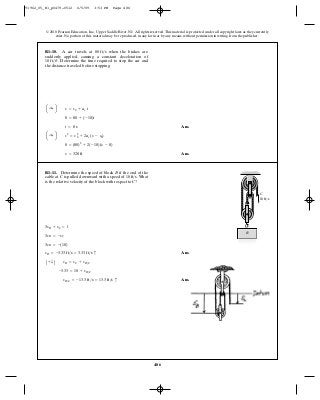
479 Horizontal Motion: The
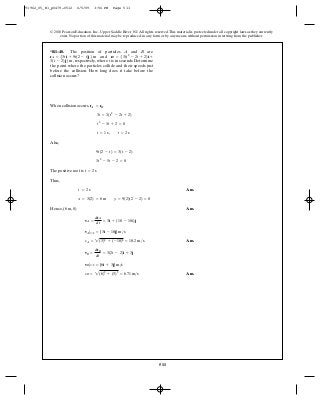
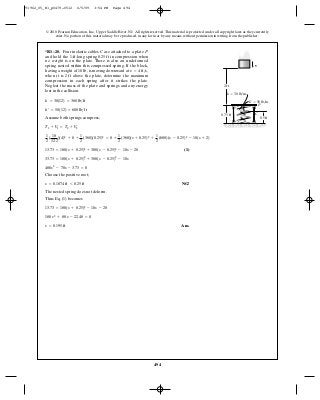
horizontal component of velocity is and the initial horizontal position is . [1] Vertical Motion: The vertical component of initial velocity and the initial vertical position are . [2] Eliminate t from Eqs. [1] and [2] yields Ans. The vertical component of velocity when is given by The magnitude and direction angle when are Ans. Ans. Since the velocity is always directed along the tangent of the path and the acceleration is directed downward, then tangential and normal components of acceleration are Ans. Ans.an = 9.81 cos 17.04° = 9.38 m>s2 at = 9.81 sin 17.04° = 2.88 m>s2 a = 9.81 m>s2 u = tan-1 yy yx = tan-1 2.4525 8 = 17.04° = 17.0° c y = 2y2 x + y2 y = 282 + 2.45252 = 8.37 m>s t = 0.25 s yy = 0 + (-9.81)(0.25) = -2.4525 m>s = 2.4525 m>s T (+ c) yy = (y0)y + (ac)y t t = 0.25 s y = -0.0766x2 y = 0 + 0 + 1 2 ( -9.81)t2 (+ c) sy = (s0)y + (y0)y t + 1 2 (ac)y t2 (s0)y = 0 (y0)y = 0 x = 0 + 8t A :+ B sx = (s0)x + (y0)x t (s0)x = 0 yx = 8 m>s R1–1. The ball is thrown horizontally with a speed of Find the equation of the path, and then determine the ball’s velocity and the normal and tangential components of acceleration when t = 0.25 s. y = f(x),8 m>s. © 2010 Pearson Education, Inc., Upper Saddle River, NJ. All rights reserved.This material is protected under all copyright laws as they currently exist. No portion of this material may be reproduced, in any form or by any means, without permission in writing from the publisher. y x vA ϭ 8 m/s A 91962_05_R1_p0479-0512 6/5/09 3:53 PM Page 479
2.
480 Ans.r = 9.32
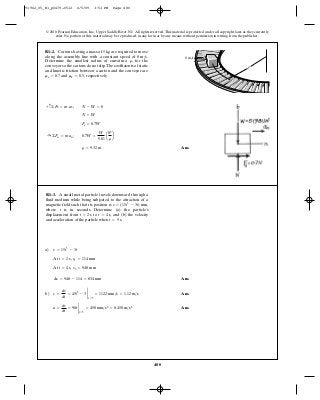
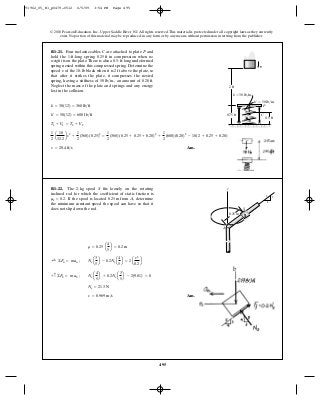
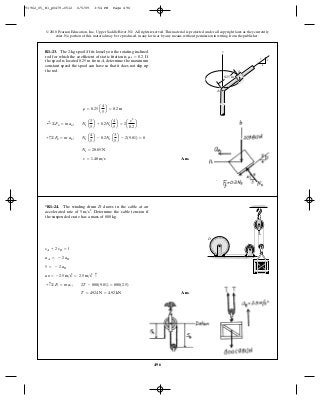
m :+ ©Fn = m an; 0.7W = W 9.81 a 82 r b Fs = 0.7W N = W + c©Fb = m ab; N - W = 0 R1–2. Cartons having a mass of are required to move along the assembly line with a constant speed of Determine the smallest radius of curvature, , for the conveyor so the cartons do not slip.The coefficients of static and kinetic friction between a carton and the conveyor are and respectively.mk = 0.5,ms = 0.7 r 8 m>s. 5 kg © 2010 Pearson Education, Inc., Upper Saddle River, NJ. All rights reserved.This material is protected under all copyright laws as they currently exist. No portion of this material may be reproduced, in any form or by any means, without permission in writing from the publisher. 8 m/s r a) Ans. b) Ans. Ans.a = dv dt = 90t 2 t=5 = 450 mm>s2 = 0.450 m>s2 v = ds dt = 45t2 - 3 2 t=5 = 1122 mm>s = 1.12 m>s ¢s = 948 - 114 = 834 mm At t = 4s, s3 = 948 mm At t = 2 s, s1 = 114 mm s = 15t3 - 3t R1–3. A small metal particle travels downward through a fluid medium while being subjected to the attraction of a magnetic field such that its position is where is in seconds. Determine (a) the particle’s displacement from to and (b) the velocity and acceleration of the particle when .t = 5 s t = 4 s,t = 2 s t s = (15t3 - 3t) mm, 91962_05_R1_p0479-0512 6/5/09 3:53 PM Page 480
3.
481 © 2010 Pearson
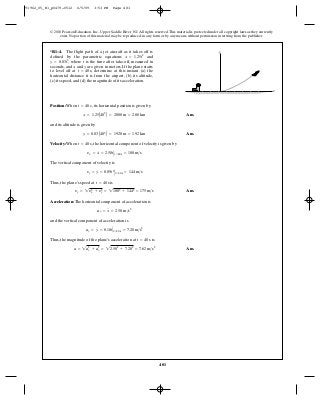
Education, Inc., Upper Saddle River, NJ. All rights reserved.This material is protected under all copyright laws as they currently exist. No portion of this material may be reproduced, in any form or by any means, without permission in writing from the publisher. Position: When , its horizontal position is given by Ans. and its altitude is given by Ans. Velocity: When , the horizontal component of velocity is given by The vertical component of velocity is Thus, the plane’s speed at is Ans. Acceleration: The horizontal component of acceleration is and the vertical component of acceleration is Thus, the magnitude of the plane’s acceleration at is Ans.a = 2a2 x + a2 y = 22.502 + 7.202 = 7.62 m>s2 t = 40 s ay = y $ = 0.18tΗt=40 s = 7.20 m>s2 ax = x $ = 2.50 m>s2 yy = 2y2 x + y2 y = 21002 + 1442 = 175 m>s t = 40 s yy = y # = 0.09t2 Ηt=40s = 144 m>s yx = x # = 2.50tΗt=40s = 100 m>s t = 40 s y = 0.03A403 B = 1920 m = 1.92 km x = 1.25A402 B = 2000 m = 2.00 km t = 40 s *R1–4. The flight path of a jet aircraft as it takes off is defined by the parametric equations and where is the time after take-off, measured in seconds, and and are given in meters. If the plane starts to level off at determine at this instant (a) the horizontal distance it is from the airport, (b) its altitude, (c) its speed, and (d) the magnitude of its acceleration. t = 40 s, yx ty = 0.03t3 , x = 1.25t2 x y 91962_05_R1_p0479-0512 6/5/09 3:53 PM Page 481
4.
482 © 2010 Pearson
Education, Inc., Upper Saddle River, NJ. All rights reserved.This material is protected under all copyright laws as they currently exist. No portion of this material may be reproduced, in any form or by any means, without permission in writing from the publisher. Relative Velocity: The horizontal component of the relative velocity of the boy with respect to the car A is . Thus, the horizontal component of the velocity of the boy is [1] Conservation of Linear Momentum: If we consider the boy and the car as a system, then the impulsive force caused by traction of the shoes is internal to the system. Therefore, they will cancel out. As the result, the linear momentum is conserved along x axis. For car A [2] Solving Eqs. [1] and [2] yields Ans. For car B Ans.yB = 0.904 ft>s A ;+ B a 60 32.2 b(2.110) = a 60 + 80 32.2 b yB mb (yb)x = (mb + mB)yB (yb)x = 2.110 ft>s yA = 1.58 ft>s A ;+ B 0 = a 60 32.2 b(yb)x + a 80 32.2 b(-yA) 0 = mb (yb)x + mAyA A ;+ B (yb)x = - yA + 3.692 (yb)x = yA + (yb>A)x (yb>A)x = 4a 12 13 b = 3.692 ft>s R1–5. The boy jumps off the flat car at with a velocity of relative to the car as shown. If he lands on the second flat car , determine the final speed of both cars after the motion. Each car has a weight of The boy’s weight is Both cars are originally at rest. Neglect the mass of the car’s wheels. 60 lb. 80 lb. B v¿ = 4 ft>s A 5 12 13 v ¿ ϭ 4 ft/s B A 91962_05_R1_p0479-0512 6/5/09 3:53 PM Page 482
5.
483 © 2010 Pearson
Education, Inc., Upper Saddle River, NJ. All rights reserved.This material is protected under all copyright laws as they currently exist. No portion of this material may be reproduced, in any form or by any means, without permission in writing from the publisher. Conservation of Energy: The datum is set at the initial position of platform P.When the man falls from a height of 8 ft above the datum, his initial gravitational potential energy is .Applying Eq. 14–21, we have Conservation of Momentum: [1] Coefficient of Restitution: [2] Solving Eqs. [1] and [2] yields Ans. Conservation of Energy: The datum is set at the spring’s compressed position. Initially, the spring has been compressed and the elastic potential energy is . When platform P is at a height of s above the datum, its initial gravitational potential energy is 60s. When platform P stops momentary, the spring has been compressed to its maximum and the elastic potential energy at this instant is . Applying Eq. 14–21, we have Ans.s = 2.61 ft 1 2 a 60 32.2 b A27.042 B + 60s + 9.00 = 100s2 + 60s + 9 T1 + V1 = T2 + V2 1 2 (200)(s + 0.3)2 = 100s2 + 60s + 9 1 2 (200) A0.32 B = 9.00 ft # lb 60 200 = 0.3 ft (yp)2 = 27.04 ft>s T = 27.0 ft>s T (yM)2 = 13.4 ft>s T (+ T) 0.6 = (yP)2 - (yP)2 22.70 - 0 e = (yP)2 - (yM)2 (yM)1 - (yp)1 (+ T) a 175 32.2 b(22.70) + 0 = a 175 32.2 b(yM)2 + a 60 32.2 b(yp)2 mM (yM)1 + mP(yP)1 = mM(yM)2 + mp (yp)2 (yH)1 = 22.70 ft>s 0 + 1400 = 1 2 a 175 32.2 b(yM)2 1 + 0 T1 + V1 = T2 + V2 175(8) = 1400 ft # lb R1-6. The man A has a weight of and jumps from rest at a height onto a platform P that has a weight of The platform is mounted on a spring, which has a stiffness Determine (a) the velocities of A and P just after impact and (b) the maximum compression imparted to the spring by the impact.Assume the coefficient of restitution between the man and the platform is and the man holds himself rigid during the motion. e = 0.6, k = 200 lb>ft. 60 lb. h = 8 ft 175 lb P A h 91962_05_R1_p0479-0512 6/5/09 3:53 PM Page 483
6.
484 © 2010 Pearson
Education, Inc., Upper Saddle River, NJ. All rights reserved.This material is protected under all copyright laws as they currently exist. No portion of this material may be reproduced, in any form or by any means, without permission in writing from the publisher. Conservation of Energy: The datum is set at the initial position of platform P.When the man falls from a height of h above the datum, his initial gravitational potential energy is 100h.Applying Eq. 14–21, we have Conservation of Momentum: [1] Coefficient of Restitution: [2] Solving Eqs. [1] and [2] yields Conservation of Energy: The datum is set at the spring’s compressed position. Initially, the spring has been compressed and the elastic potential energy is . Here, the compression of the spring caused by impact is . When platform P is at a height of 1.7 ft above the datum, its initial gravitational potential energy is . When platform P stops momentary, the spring has been compressed to its maximum and the elastic potential energy at this instant is . Applying Eq. 14–21, we have Ans.h = 4.82 ft 1 2 a 60 32.2 b A 264.4hB2 + 102 + 9.00 = 400 T1 + V1 = T2 + V2 1 2 (200)A22 B = 400 ft # lb 60(1.7) = 102 ft # lb (2 - 0.3) ft = 1.7 ft 1 2 (200) A0.32 B = 9.00 ft # lb 60 200 = 0.3 ft (yp)2 = 264.4h T (yM)2 = 0.4264.4h T (+ T) 0.6 = (yp)2 - (yM)2 264.4h - 0 e = (yp)2 - (yM)2 (yM)1 - (yp)1 (+ T) a 100 32.2 b(264.4h) + 0 = a 100 32.2 b(yM)2 + a 60 32.2 b(yP)2 mM (yM)1 + mP (yP)1 = mM (yM)2 + mP (yP)2 (yH)1 = 264.4h 0 + 100h = 1 2 a 100 32.2 b(yM)2 1 + 0 T1 + V1 = T2 + V2 R1–7. The man has a weight of and jumps from rest onto the platform that has a weight of The platform is mounted on a spring, which has a stiffness If the coefficient of restitution between the man and the platform is and the man holds himself rigid during the motion, determine the required height of the jump if the maximum compression of the spring is 2 ft. h e = 0.6, k = 200 lb>ft. 60 lb.P 100 lbA P A h 91962_05_R1_p0479-0512 6/5/09 3:53 PM Page 484
7.
485 © 2010 Pearson
Education, Inc., Upper Saddle River, NJ. All rights reserved.This material is protected under all copyright laws as they currently exist. No portion of this material may be reproduced, in any form or by any means, without permission in writing from the publisher. Ans. Ans. Ans.TC = 102.86 = 103 N :+ ©Fx = max ; TC = (300)(0.3429) TB = 205.71 = 206 N :+ ©Fx = max ; TB = 2(300)(0.3429) v = 0 + 0.3429(2) = 0.686 m>s ( :+ ) v = v0 + ac t a = 0.3429 m>s2 :+ ©Fx = max ; 480 = [800 + 2(300)]a *R1–8. The baggage truck has a mass of and is used to pull each of the 300-kg cars. Determine the tension in the couplings at and if the tractive force on the truck is What is the speed of the truck when starting from rest? The car wheels are free to roll. Neglect the mass of the wheels. t = 2 s, F = 480 N. FCB 800 kgA A BC F Ans. Ans.a = 0.436 m>s2 :+ ©Fx = max ; 480 = (800 + 300)a a = 0.3429 = 0.343 m>s2 :+ ©Fx = max ; 480 = [800 + 2(300)]a R1–9. The baggage truck has a mass of and is used to pull each of the 300-kg cars. If the tractive force on the truck is determine the acceleration of the truck. What is the acceleration of the truck if the coupling at suddenly fails? The car wheels are free to roll. Neglect the mass of the wheels. C F = 480 N, F 800 kgA A BC F 91962_05_R1_p0479-0512 6/5/09 3:53 PM Page 485
8.
486 © 2010 Pearson
Education, Inc., Upper Saddle River, NJ. All rights reserved.This material is protected under all copyright laws as they currently exist. No portion of this material may be reproduced, in any form or by any means, without permission in writing from the publisher. Ans. Ans.s = 320 ft 0 = (80)2 + 2(-10)(s - 0) a :+ b v2 = v2 0 + 2ac (s - s0) t = 8 s 0 = 80 + (-10)t a :+ b v = v0 + ac t R1–10. A car travels at when the brakes are suddenly applied, causing a constant deceleration of Determine the time required to stop the car and the distance traveled before stopping. 10 ft>s2 . 80 ft>s Ans. Ans.vB>C = -13.3 ft>s = 13.3 ft>s c -3.33 = 10 + vB>C A + T B vB = vC + vB>C vB = -3.33 ft>s = 3.33 ft>s c 3vB = -(10) 3vB = -vC 3sB + sC = l R1–11. Determine the speed of block if the end of the cable at is pulled downward with a speed of What is the relative velocity of the block with respect to ?C 10 ft>s.C B B C 10 ft/s 91962_05_R1_p0479-0512 6/5/09 3:53 PM Page 486
9.
487 © 2010 Pearson
Education, Inc., Upper Saddle River, NJ. All rights reserved.This material is protected under all copyright laws as they currently exist. No portion of this material may be reproduced, in any form or by any means, without permission in writing from the publisher. *R1–12. The skier starts fom rest at and travels down the ramp. If friction and air resistance can be neglected, determine his speed when he reaches . Also, compute the distance to where he strikes the ground at , if he makes the jump traveling horizontally at . Neglect the skier’s size. He has a mass of 70 kg. B Cs BvB A 4 m A B vB 50 m s 30ЊCPotential Energy: The datum is set at the lowest point B. When the skier is at point A, he is above the datum. His gravitational potential energy at this position is . Conservation of Energy: Applying Eq. 14–21, we have Ans. Kinematics: By considering the vertical motion of the skier, we have [1] By considering the horizontal motion of the skier, we have [2] Solving Eqs. [1] and [2] yields Ans. t = 3.753 s s = 130 m scos 30° = 0 + 30.04t A ;+ B sx = (s0)x + yx t 4 + ssin 30° = 0 + 0 + 1 2 (9.81) t2 (+ T) sy = (s0)y + (y0)y t + 1 2 (ac)y t2 yB = 30.04 m>s = 30.0 m>s 0 + 31588.2 = 1 2 (70) y2 B TA + VA = TB + VB 70(9.81) (46) = 31588.2 J (50 - 4) = 46 m 91962_05_R1_p0479-0512 6/5/09 3:53 PM Page 487
10.
488 © 2010 Pearson
Education, Inc., Upper Saddle River, NJ. All rights reserved.This material is protected under all copyright laws as they currently exist. No portion of this material may be reproduced, in any form or by any means, without permission in writing from the publisher. Velocity: The velocity expressed in Cartesian vector form can be obtained by applying Eq. 12–7. When , . Thus, the magnitude of the velocity is Ans. Acceleration: The acceleration express in Cartesian vector form can be obtained by applying Eq. 12–9. When , . Thus, the magnitude of the acceleration is Ans. Travelling Path: Here, and .Then, [1] [2] Adding Eqs [1] and [2] yields However, .Thus, (Q.E.D.) x2 25 + y2 16 = 1 (Equation of an Ellipse) cos2 2r + sin2 2t = 1 x2 25 + y2 16 = cos2 2r + sin2 2t y2 16 = sin2 2t x2 25 = cos2 2t y = 4 sin 2tx = 5 cos 2t a = 2a2 x + a2 y = 28.3232 + (-14.549)2 = 16.8 m>s2 a = -20 cos 2(1) i - 16 sin 2(1) j = {8.323i - 14.549j} m>s2 t = 1 s a = dv dt = {-20 cos 2ri - 16 sin 2rj} m>s2 y = 2y2 x + y2 y = 2(-9.093)2 + (-3.329)2 = 9.68 m>s v = -10 sin 2(1)i + 8 cos 2(1) j = (-9.093i - 3.329j} m>st = 1 s v = dr dt = {-10 sin 2ri + 8 cos 2rj} m>s R1–13. The position of a particle is defined by where t is in seconds and the arguments for the sine and cosine are given in radians. Determine the magnitudes of the velocity and acceleration of the particle when Also, prove that the path of the particle is elliptical. t = 1 s. r = 551cos 2t2i + 41sin 2t2j6 m, 91962_05_R1_p0479-0512 6/5/09 3:53 PM Page 488
11.
489 © 2010 Pearson
Education, Inc., Upper Saddle River, NJ. All rights reserved.This material is protected under all copyright laws as they currently exist. No portion of this material may be reproduced, in any form or by any means, without permission in writing from the publisher. Potential Energy: Datum is set at the final position of the platform. When the cylinder is at point A, its position is (3 + s) above the datum where s is the maximum displacement of the platform when the cylinder stops momentary. Thus, its gravitational potential energy at this position is . The initial and final elastic potential energy are and , respectively. Conservation of Energy: Applying Eq. 14–22, we have Ans.s = 0.0735 ft 1 2 a 5 32.2 b A102 B + (15 + 5s) + 112.5 = 0 + 200s2 + 300s + 112.5 ©TA + ©VA = ©TB + ©VB 1 2 (400) (s + 0.75)2 = 200s2 + 300s + 112.5 1 2 (400) (1.75 - 1)2 = 112.5 ft # lb 5(3 + s) = (15 + 5s) ft # lb R1–14. The 5-lb cylinder falls past with a speed onto the platform. Determine the maximum displacement of the platform, caused by the collision. The spring has an unstretched length of and is originally kept in compression by the 1-ft-long cables attached to the platform. Neglect the mass of the platform and spring and any energy lost during the collision. 1.75 ft vA = 10 ft>s A AvA ϭ 10 ft/s 1 ft 3 ft k ϭ 400 lb/ft Ans.vb = 0.379 m>s : vc = 0.253 m>s ; vb = 1.5ve 0 + 0 = 50 vb - 75 ve ( :+ ) ©mv1 = ©mv2 12 = 50 v2 b + 75 v2 e [0 + 0] + 1 2 (300)(0.2)2 = 1 2 (50) v2 b + 1 2 (75) v2 e T1 + V1 = T2 + V2 R1–15. The block has a mass of and rests on the surface of the cart having a mass of If the spring which is attached to the cart and not the block is compressed and the system is released from rest, determine the speed of the block after the spring becomes undeformed. Neglect the mass of the cart’s wheels and the spring in the calculation. Also neglect friction. Take k = 300 N>m. 0.2 m 75 kg. 50 kg B k C 91962_05_R1_p0479-0512 6/5/09 3:53 PM Page 489
12.
490 © 2010 Pearson
Education, Inc., Upper Saddle River, NJ. All rights reserved.This material is protected under all copyright laws as they currently exist. No portion of this material may be reproduced, in any form or by any means, without permission in writing from the publisher. Ans.vb>c = 0.632 m>s : ( :+ ) 0.379 = -0.253 + vb>c vb = vc + vb>c vb = 0.379 m>s : vc = 0.253 m>s ; vb = 1.5 ve 0 + 0 = 50 vb - 75 ve ( :+ ) ©mv1 = ©mv2 12 = 50 v2 b + 75 v2 e [0 + 0] + 1 2 (300)(0.2)2 = 1 2 (50)v2 b + 1 2 (75) v2 e T1 + V1 = T2 + V2 *R1–16. The block has a mass of and rests on the surface of the cart having a mass of If the spring which is attached to the cart and not the block is compressed and the system is released from rest, determine the speed of the block with respect to the cart after the spring becomes undeformed. Neglect the mass of the cart’s wheels and the spring in the calculation. Also neglect friction.Take k = 300 N>m. 0.2 m 75 kg. 50 kg B k C 91962_05_R1_p0479-0512 6/5/09 3:53 PM Page 490
13.
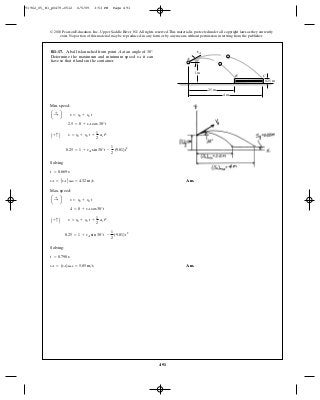
491 © 2010 Pearson
Education, Inc., Upper Saddle River, NJ. All rights reserved.This material is protected under all copyright laws as they currently exist. No portion of this material may be reproduced, in any form or by any means, without permission in writing from the publisher. Min. speed: Solving Ans. Max. speed: Solving: Ans.vA = (vA)max = 5.85 m>s t = 0.790 s 0.25 = 1 + vA sin 30° t - 1 2 (9.81) t2 A + c B s = s0 + v0 t + 1 2 ac t2 4 = 0 + vA cos 30°t a :+ b s = s0 + v0 t vA = AvABmin = 4.32 m>s t = 0.669 s 0.25 = 1 + vA sin 30°t - 1 2 (9.81)t2 A + c B s = s0 + v0 t + 1 2 ac t2 2.5 = 0 + vA cos 30°t a :+ b s = s0 + v0 t R1–17. A ball is launched from point at an angle of Determine the maximum and minimum speed it can have so that it lands in the container. vA 30°.A 1 m vA A CB 30Њ 4 m 2.5 m 0.25 m 91962_05_R1_p0479-0512 6/5/09 3:53 PM Page 491
14.
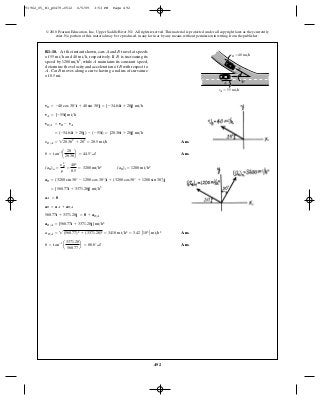
492 © 2010 Pearson
Education, Inc., Upper Saddle River, NJ. All rights reserved.This material is protected under all copyright laws as they currently exist. No portion of this material may be reproduced, in any form or by any means, without permission in writing from the publisher. Ans. Ans. Ans. Ans.u = tan-1 a 3371.28 560.77 b = 80.6° a aB>A = 2(560.77)2 + (3371.28)2 = 3418 mi>h2 = 3.42 A103 B mi>h2 aB>A = {560.77i + 3371.28j} mi>h2 560.77i + 3371.28j = 0 + aB>A aB = aA + aB>A aA = 0 = {560.77i + 3371.28j} mi>h2 aB = (3200 sin 30° - 1200 cos 30°)i + (3200 cos 30° + 1200 sin 30°)j (aB)n = y2 B r = 402 0.5 = 3200 mi>h2 (aB)t = 1200 mi>h2 u = tan-1 a 20 20.36 b = 44.5° a yB>A = 220.362 + 202 = 28.5 mi>h = (-34.64i + 20j) - (-55i) = {20.36i + 20j} mi>h vB>A = vB - vA vA = {-55i} mi>h vB = -40 cos 30°i + 40 sin 30°j = {-34.64i + 20j} mi>h R1–18. At the instant shown, cars and travel at speeds of and respectively. If is increasing its speed by while maintains its constant speed, determine the velocity and acceleration of with respect to Car moves along a curve having a radius of curvature of 0.5 mi. BA. B A1200 mi>h2 , B40 mi>h,55 mi>h BA vB ϭ 40 mi/h vA ϭ 55 mi/h B A 30Њ 91962_05_R1_p0479-0512 6/5/09 3:53 PM Page 492
15.
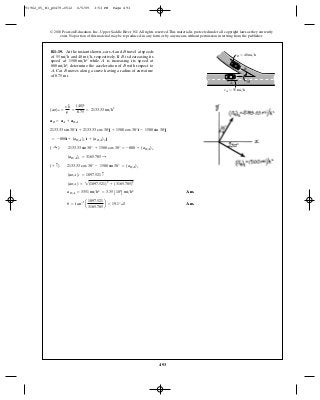
493 © 2010 Pearson
Education, Inc., Upper Saddle River, NJ. All rights reserved.This material is protected under all copyright laws as they currently exist. No portion of this material may be reproduced, in any form or by any means, without permission in writing from the publisher. Ans. Ans.u = tan-1 a 1097.521 3165.705 b = 19.1° a aB>A = 3351 mi>h2 = 3.35 A103 B mi>h2 (aB>A) = 2(1097.521)2 + (3165.705)2 (aB>A)y = 1097.521 c (+ c) 2133.33 cos 30° - 1500 sin 30° = (aB>A)y (aB>A)x = 3165.705 : ( :+ ) 2133.33 sin 30° + 1500 cos 30° = -800 + (aB>A)x = -800i + (aB>A)x i + (aB>A)y j 2133.33 sin 30°i + 2133.33 cos 30°j + 1500 cos 30°i - 1500 sin 30°j aB = aA + aB>A (aB)n = v2 B r = (40)2 0.75 = 2133.33 mi>h2 R1–19. At the instant shown, cars and travel at speeds of and respectively. If is decreasing its speed at while is increasing its speed at determine the acceleration of with respect to Car moves along a curve having a radius of curvature of 0.75 mi. BA. B800 mi>h2 , A1500 mi>h2 B40 mi>h,55 mi>h BA vB ϭ 40 mi/h vA ϭ 55 mi/h B A 30Њ 91962_05_R1_p0479-0512 6/5/09 3:53 PM Page 493
16.
494 © 2010 Pearson
Education, Inc., Upper Saddle River, NJ. All rights reserved.This material is protected under all copyright laws as they currently exist. No portion of this material may be reproduced, in any form or by any means, without permission in writing from the publisher. Assume both springs compress; (1) Choose the positive root; NG! The nested spring does not deform. Thus Eq. (1) becomes Ans.s = 0.195 ft 180 s2 + 80 s - 22.48 = 0 13.73 = 180(s + 0.25)2 - 10s - 20 s = 0.1874 ft 6 0.25 ft 480s2 - 70s - 3.73 = 0 33.73 = 180(s + 0.25)2 + 300(s - 0.25)2 - 10s 13.73 = 180(s + 0.25)2 + 300(s - 0.25)2 - 10s - 20 1 2 ( 10 32.2 )(4)2 + 0 + 1 2 (360)(0.25)2 = 0 + 1 2 (360)(s + 0.25)2 + 1 2 (600)(s - 0.25)2 - 10(s + 2) T1 + V1 = T2 + V2 k¿ = 50(12) = 600 lb>ft k = 30(12) = 360 lb>ft *R1–20. Four inelastic cables are attached to a plate and hold the 1-ft-long spring in compression when no weight is on the plate. There is also an undeformed spring nested within this compressed spring. If the block, having a weight of is moving downward at when it is above the plate, determine the maximum compression in each spring after it strikes the plate. Neglect the mass of the plate and springs and any energy lost in the collision. 2 ft v = 4 ft>s,10 lb, 0.25 ft PC C P v 0.75 ft 0.5 ft 2 ft k ϭ 30 lb/in. k¿ ϭ 50 lb/in. 91962_05_R1_p0479-0512 6/5/09 3:54 PM Page 494
17.
495 © 2010 Pearson
Education, Inc., Upper Saddle River, NJ. All rights reserved.This material is protected under all copyright laws as they currently exist. No portion of this material may be reproduced, in any form or by any means, without permission in writing from the publisher. Ans.v = 0.969 m>s Ns = 21.3 N + c©Fb = m ab ; Ns a 4 5 b + 0.2Ns a 3 5 b - 2(9.81) = 0 ;+ ©Fn = man ; Ns a 3 5 b - 0.2Nsa 4 5 b = 2a v2 0.2 b r = 0.25 a 4 5 b = 0.2 m R1–22. The 2-kg spool fits loosely on the rotating inclined rod for which the coefficient of static friction is If the spool is located from , determine the minimum constant speed the spool can have so that it does not slip down the rod. A0.25 mms = 0.2. S z S A 0.25 m 3 4 5 Ans.v = 20.4 ft>s 1 2 a 10 32.2 bv2 + 1 2 (360)(0.25)2 = 1 2 (360)(0.25 + 0.25 + 0.20)2 + 1 2 (600)(0.20)2 - 10(2 + 0.25 + 0.20) T1 + V1 = T2 + V2 k¿ = 50(12) = 600 lb>ft k = 30(12) = 360 lb>ft R1–21. Four inelastic cables are attached to plate and hold the 1-ft-long spring in compression when no weight is on the plate.There is also a 0.5-ft-long undeformed spring nested within this compressed spring. Determine the speed of the 10-lb block when it is above the plate, so that after it strikes the plate, it compresses the nested spring, having a stiffness of an amount of Neglect the mass of the plate and springs and any energy lost in the collision. 0.20 ft.50 lb>in., 2 ftv 0.25 ft PC C P v 0.75 ft 0.5 ft 2 ft k ϭ 30 lb/in. k¿ ϭ 50 lb/in. 91962_05_R1_p0479-0512 6/5/09 3:54 PM Page 495
18.
496 © 2010 Pearson
Education, Inc., Upper Saddle River, NJ. All rights reserved.This material is protected under all copyright laws as they currently exist. No portion of this material may be reproduced, in any form or by any means, without permission in writing from the publisher. Ans.v = 1.48 m>s Ns = 28.85 N + c©Fb = m ab ; Ns a 4 5 b - 0.2Ns a 3 5 b - 2(9.81) = 0 ;+ ©Fn = man ; Ns a 3 5 b + 0.2Nsa 4 5 b = 2a v2 0.2 b r = 0.25 a 4 5 b = 0.2 m R1–23. The 2-kg spool fits loosely on the rotating inclined rod for which the coefficient of static friction is If the spool is located from , determine the maximum constant speed the spool can have so that it does not slip up the rod. A0.25 m ms = 0.2. S z S A 0.25 m 3 4 5 Ans.T = 4924 N = 4.92 kN + c©Fy = may ; 2T - 800(9.81) = 800(2.5) aB = -2.5 m>s2 = 2.5 m>s2 c 5 = - 2 aB aA = - 2 aB sA + 2 sB = l *R1–24. The winding drum draws in the cable at an accelerated rate of Determine the cable tension if the suspended crate has a mass of 800 kg. 5 m>s2 . D D 91962_05_R1_p0479-0512 6/5/09 3:54 PM Page 496
19.
497 © 2010 Pearson
Education, Inc., Upper Saddle River, NJ. All rights reserved.This material is protected under all copyright laws as they currently exist. No portion of this material may be reproduced, in any form or by any means, without permission in writing from the publisher. Since the bottle is on the verge of slipping, then . Ans.y = 5.38 ft>s ©Fn = man ; 0.3W = a W 32.2 b a y2 3 b Ff = ms N = 0.3W ©Fb = 0; N - W = 0 N = W R1–25. The bottle rests at a distance of from the center of the horizontal platform. If the coefficient of static friction between the bottle and the platform is determine the maximum speed that the bottle can attain before slipping. Assume the angular motion of the platform is slowly increasing. ms = 0.3, 3 ft 3 ft Applying Eq. 13–8, we have Since the bottle is on the verge of slipping, then . [1] [2] Solving Eqs. [1] and [2] yields Ans. u = 11.95° y = 5.32 ft>s ©Fn = man ; 0.3W cos u = a W 32.2 b a y2 3 b ©Ft = mat ; 0.3W sin u = a W 32.2 b(2) Ff = ms N = 0.3W ©Fb = 0; N - W = 0 N = W R1–26. Work Prob. R1–25 assuming that the platform starts rotating from rest so that the speed of the bottle is increased at 2 ft>s2 . 3 ft 91962_05_R1_p0479-0512 6/5/09 3:54 PM Page 497
20.
498 © 2010 Pearson
Education, Inc., Upper Saddle River, NJ. All rights reserved.This material is protected under all copyright laws as they currently exist. No portion of this material may be reproduced, in any form or by any means, without permission in writing from the publisher. Ans. Ans. Note: No slipping occurs Since ms N = 138.4 lb 7 13.4 lb F = 13.4 lb +b©Fx = m(an)x ; -F + 150 sin 60° = 150 32.2 a 202 8 b cos 60° N = 277 lb +a ©Fy = m(an)y ; N - 150 cos 60° = 150 32.2 a 202 8 b sin 60° R1–27. The 150-lb man lies against the cushion for which the coefficient of static friction is Determine the resultant normal and frictional forces the cushion exerts on him if, due to rotation about the z axis, he has a constant speed Neglect the size of the man. Take u = 60°. v = 20 ft>s. ms = 0.5. z G 8 ft u Ans.u = 47.5° 0.5 cos u + sin u = 3.493 79 cos u - 1.746 89 sin u (0.5 cos u + sin u)150 (cos u - 0.5 sin u) = 150 32.2 a (30)2 8 b N = 150 cos u - 0.5 sin u + c©Fb = 0; -150 + N cos u - 0.5 N sin u = 0 ;+ ©Fn = man ; 0.5N cos u + N sin u = 150 32.2 a (30)2 8 b *R1–28. The 150-lb man lies against the cushion for which the coefficient of static friction is If he rotates about the z axis with a constant speed determine the smallest angle of the cushion at which he will begin to slip up the cushion. u v = 30 ft>s, ms = 0.5. z G 8 ft u 91962_05_R1_p0479-0512 6/5/09 3:54 PM Page 498
21.
499 © 2010 Pearson
Education, Inc., Upper Saddle River, NJ. All rights reserved.This material is protected under all copyright laws as they currently exist. No portion of this material may be reproduced, in any form or by any means, without permission in writing from the publisher. for crate to start moving Ans.v2 = 10.1 ft>s [30t + 1 3 t3 ]4 2 - 68 = 34 32.2 v2 0 + L 4 2 (30 + t2 )dt - 34(4 - 2) = 34 32.2 v2 (+ c) mv1 + © L Fdt = mv2 t = 2 s 30 + t2 = 34 R1–29. The motor pulls on the cable at with a force where is in seconds. If the 34-lb crate is originally at rest on the ground when determine its speed when Neglect the mass of the cable and pulleys. Hint: First find the time needed to begin lifting the crate. t = 4 s. t = 0, tF = (30 + t2 ) lb, A A for crate to start moving Ans.v2 = 2.13 ft>s 1 2 e 2t 2 2 1.7632 - 8.0519 = 1.0559 v2 0 + L 2 1.7632 e 2 t dt - 34(2 - 1.7632) = 34 32.2 v2 (+ c) mv1 + © L F dt = mv2 t = 1.7632 s F = e 2t = 34 R1–30. The motor pulls on the cable at with a force where is in seconds. If the 34-lb crate is originally at rest on the ground when determine the crate’s velocity when Neglect the mass of the cable and pulleys. Hint: First find the time needed to begin lifting the crate. t = 2 s. t = 0, tF = (e2t ) lb, A A 91962_05_R1_p0479-0512 6/5/09 3:54 PM Page 499
22.
500 © 2010 Pearson
Education, Inc., Upper Saddle River, NJ. All rights reserved.This material is protected under all copyright laws as they currently exist. No portion of this material may be reproduced, in any form or by any means, without permission in writing from the publisher. At Ans. Ans.F = 24.8 N N = 24.8 N ©Fu = m a u ; F sin 45° + Nu sin 45° = 2(17.5462) ©Fr = m ar ; -Nr cos 45° + F cos 45° = 2(0) c = u = 45° tan c = r Adr du B = e u >e u = 1 au = r u $ + 2 r # u # = 0 + 2(4.38656)(2) = 17.5462 m>s2 ar = r $ - r (u # )2 = 8.7731 - 2.1933(2)2 = 0 r $ = 8.7731 m>s2 r = 4.38656 m>s r = 2.1933 m u = 0 u # = 2 rad>s u = 45° r $ = e u (u # )2 + e u u # r # = e u u # r = eu R1–31. The collar has a mass of and travels along the smooth horizontal rod defined by the equiangular spiral where is in radians. Determine the tangential force and the normal force acting on the collar when if force maintains a constant angular motion u # = 2 rad>s. Fu = 45°, NF ur = (eu ) m, 2 kg F r ϭ e r u u 91962_05_R1_p0479-0512 6/5/09 3:54 PM Page 500
23.
501 © 2010 Pearson
Education, Inc., Upper Saddle River, NJ. All rights reserved.This material is protected under all copyright laws as they currently exist. No portion of this material may be reproduced, in any form or by any means, without permission in writing from the publisher. At Ans. Ans.F = 54.4 N Nt = 54.4 N ;+ ©Fu = m au ; F sin 45° + N sin 45° = 2(38.4838) + c ©Ft = m at ; -N cos 45° + F cos 45° = 2(0) c = u = 45° tan c = r Adr du B = eu >eu = 1 au = r u $ + 2 r # u # = 0 + 2(9.6210)(2) = 38.4838 m>s2 ar = r $ - r(u # )2 = 19.242 - 4.8105(2)2 = 0 r $ = 19.242 m>s2 r # = 9.6210 m>s r = 4.8105 m u # = 0 u # = 2 rad>s u = 90° r $ = eu (u # )2 + eu u $ r # = eu u # r = e u *R1–32. The collar has a mass of and travels along the smooth horizontal rod defined by the equiangular spiral where is in radians. Determine the tangential force and the normal force acting on the collar when if force maintains a constant angular motion u # = 2 rad>s. Fu = 90°, NF ur = (eu ) m, 2 kg F r ϭ e r u u 91962_05_R1_p0479-0512 6/5/09 3:54 PM Page 501
24.
502 © 2010 Pearson
Education, Inc., Upper Saddle River, NJ. All rights reserved.This material is protected under all copyright laws as they currently exist. No portion of this material may be reproduced, in any form or by any means, without permission in writing from the publisher. Note at and At , At , At , a) Ans. b) Ans. c) Ans.v|t=9 = (9)2 - 9(9) + 10 = 10 m>s stot = (7.127 - 1) + 7.127 + 36.627 + (36.627 - 30.50) = 56.0 m s = -30.5 m s = -30.50 mt = 9 s s = -36.627 mt = 7.702 s s = 7.127 mt = 1.298 s t = 7.702 st = 1.298 s t2 - 9t + 10 = 0v = 0 s = 1 3 t3 - 4.5t2 + 10t + 1 s - 1 = 1 3 t3 - 4.5t2 + 10t L s 1 ds = L t 0 At2 - 9t + 10Bdt ds = v dt v = t2 - 9t + 10 v - 10 = t2 - 9t L v 10 dv = L t 0 (2t - 9) dt dv = a dt a = (2t - 9) R1–33. The acceleration of a particle along a straight line is defined by , where is in seconds. When , and . When , determine (a) the particle’s position, (b) the total distance traveled, and (c) the velocity.Assume the positive direction is to the right. t = 9 sv = 10 m>ss = 1 mt = 0 ta = (2t - 9) m>s2 91962_05_R1_p0479-0512 6/5/09 3:54 PM Page 502
25.
503 © 2010 Pearson
Education, Inc., Upper Saddle River, NJ. All rights reserved.This material is protected under all copyright laws as they currently exist. No portion of this material may be reproduced, in any form or by any means, without permission in writing from the publisher. Ans. Also, v2 = 14.1 m>s 800 + 8533.33 - 3693.18 = 400v2 +Q 400(2) + L 2 0 3200 t2 dt - 400(9.81)(2 - 0)a 8 17 b = 400v2 mv1 + © L F dt = mv2 v = 14.1 m>s L y 2 dv = L 2 0 A8t2 - 4.616Bdt dv = adt +Q©Fx¿ = max¿ ; 3200t2 - 400(9.81)a 8 17 b = 400a a = 8t2 - 4.616 R1–34. The 400-kg mine car is hoisted up the incline using the cable and motor . For a short time, the force in the cable is where is in seconds. If the car has an initial velocity when determine its velocity when t = 2 s. t = 0,v1 = 2 m>s tF = (3200t2 ) N, M 15 8 17 M v1 ϭ 2 m/s Ans.s = 5.43 m L s 2 ds = L 2 0 A2.667t3 - 4.616t + 2Bdt v = ds dt = 2.667t3 - 4.616t + 2 L y 2 dv = L t 0 A8t2 - 4.616Bdt dv = adt ©Fx¿ = max¿ ; 3200t2 - 400(9.81)a 8 17 b = 400a a = 8t2 - 4.616 R1–35. The 400-kg mine car is hoisted up the incline using the cable and motor . For a short time, the force in the cable is where is in seconds. If the car has an initial velocity at and determine the distance it moves up the plane when t = 2 s. t = 0,s = 0v1 = 2 m>s tF = (3200t2 ) N, M 15 8 17 M v1 ϭ 2 m/s 91962_05_R1_p0479-0512 6/5/09 3:55 PM Page 503
26.
504 © 2010 Pearson
Education, Inc., Upper Saddle River, NJ. All rights reserved.This material is protected under all copyright laws as they currently exist. No portion of this material may be reproduced, in any form or by any means, without permission in writing from the publisher. Ans.s = 4(103 )(60)3 3(450)(103 ) = 640 m s = m v3 3 P Ps = m v3 3 P L s 0 ds = m L v 0 v2 dv L P ds = m L v2 dv P = F v = ma v2 dv ds b :+ ©Fx = m ax ; F = m a = ma v dv ds b *R1–36. The rocket sled has a mass of and travels along the smooth horizontal track such that it maintains a constant power output of Neglect the loss of fuel mass and air resistance, and determine how far the sled must travel to reach a speed of starting from rest.v = 60 m>s 450 kW. 4 Mg v T Ans.vC = 2.36 m>s 0 + 100 sin 60°(0.5 - 0.3) + 20(9.81)(0.5 - 0.3) - 1 2 (15)(0.5 - 0.3)2 - 1 2 (25)(0.5 - 0.3)2 = 1 2 (20)v2 C T1 + ©U1-2 = T2 R1–37. The collar has a mass of and can slide freely on the smooth rod.The attached springs are undeformed when Determine the speed of the collar after the applied force causes it to be displaced so that When the collar is at rest.d = 0.5 md = 0.3 m. F = 100 N d = 0.5 m. 20 kg 60Њ d k ϭ 25 N/m k¿ ϭ 15 N/m F ϭ 100 N 91962_05_R1_p0479-0512 6/5/09 3:55 PM Page 504
27.
505 © 2010 Pearson
Education, Inc., Upper Saddle River, NJ. All rights reserved.This material is protected under all copyright laws as they currently exist. No portion of this material may be reproduced, in any form or by any means, without permission in writing from the publisher. Ans.vC = 2.34 m>s - [ 1 2 (15)[0.4 - 0.2]2 - 1 2 (15)(0.4)2 ] = 1 2 (20)v2 C 0 + 100 sin 60°(0.5 - 0.3) + 196.2(0.5 - 0.3) - [ 1 2 (25)[0.4 + 0.2]2 - 1 2 (25)(0.4)2 ] T1 + ©U1-2 = T2 R1–38. The collar has a mass of and can slide freely on the smooth rod. The attached springs are both compressed when Determine the speed of the collar after the applied force causes it to be displaced so that When the collar is at rest.d = 0.5 md = 0.3 m. F = 100 N d = 0.5 m.0.4 m 20 kg 60Њ d k ϭ 25 N/m k¿ ϭ 15 N/m F ϭ 100 N Ans. Ans.vB = 4.62 m>s vA = 1.54 m>s (0 + 0) + (0 + 0) = 1 2 (20)(vA)2 + 1 2 (30)(-3vA)2 + 20(9.81)a 1.5 3 b - 30(9.81)(1.5) T1 + V1 = T2 + V2 3 vA = - vB 3 ¢sA = - ¢sB 3 sA + sB = l R1–39. The assembly consists of two blocks and which have masses of and respectively. Determine the speed of each block when descends The blocks are released from rest.Neglect the mass of the pulleys and cords. 1.5 m.B 30 kg,20 kg BA A B 91962_05_R1_p0479-0512 6/5/09 3:55 PM Page 505
28.
506 © 2010 Pearson
Education, Inc., Upper Saddle River, NJ. All rights reserved.This material is protected under all copyright laws as they currently exist. No portion of this material may be reproduced, in any form or by any means, without permission in writing from the publisher. Ans.sB = 5.70 m (0 + 0) + (0 + 0) = 1 2 (20)(3)2 + 1 2 (30)(-9)2 + 20(9.81)a sB 3 b - 30(9.81)(sB) T1 + V1 = T2 + V2 vB = -9 m>s 3 vA = - vB 3 ¢sA = - ¢sB 3 sA + sB - l *R1–40. The assembly consists of two blocks and , which have masses of and respectively. Determine the distance must descend in order for to achieve a speed of starting from rest.3 m>s AB 30 kg,20 kg BA A B Just before impact, the velocity of A is (1) (2) Solving Eqs. (1) and (2) for (vB)2 yields Ans.(vB)2 = 1 3 22gh (1 + e) m(vA) + 0 = m(vA)2 + 2m(vB)2 A + T B ©mv1 = ©mv2 e22gh = (vB)2 - (vA)2 A + T B e = (vB)2 - (vA)2 22gh vA = 22gh 0 + 0 = 1 2 mvA 2 - mgh T1 + V1 = T2 + V2 R1–41. Block , having a mass , is released from rest, falls a distance and strikes the plate having a mass 2 . If the coefficient of restitution between and is , determine the velocity of the plate just after collision. The spring has a stiffness .k eBA mBh mA A B k h 91962_05_R1_p0479-0512 6/5/09 3:55 PM Page 506
29.
507 © 2010 Pearson
Education, Inc., Upper Saddle River, NJ. All rights reserved.This material is protected under all copyright laws as they currently exist. No portion of this material may be reproduced, in any form or by any means, without permission in writing from the publisher. Just before impact, the velocity of A is (1) (2) Solving Eqs. (1) and (2) for (vA)3 yields Ans.(vA)3 = 0.125 m>s (vB)3 = 2.00 m>s 2(3.132) + 0 = 2(vA)3 + 3(vB)3 A + T B ©mv2 = ©mv3 1.879 = (vB)3 - (vA)3 0.6(3.132) = (vB)3 - (vA)3 A + T B e = (vB)3 - (vA)3 3.132 - 0 (vA)2 = 22(9.81)(0.5) = 3.132 m>s 0 + 0 = 1 2 (2)(vA)2 2 - 2(9.81)(0.5) T1 + V1 = T2 + V2 R1–42. Block , having a mass of is released from rest, falls a distance and strikes the plate having a mass of If the coefficient of restitution between and is determine the velocity of the block just after collision. The spring has a stiffness k = 30 N>m. e = 0.6,BA 3 kg. Bh = 0.5 m, 2 kg,A A B k h Thus, Choosing the root Ans.Fs = 14(0.5 - 0.1498) = 4.90 lb d = 0.1498 ft 6 0.5 ft d2 - 3.5d + 0.5018 = 0 1.5 - 3.5d + d2 = 0.9982 (0.5 - d)(3 - d) = 0.9982 14(0.5 - d) = 2 32.2 c (15)2 3 - d d Fs = ks ; Fs = 14(0.5 - d) ;+ ©Fn = m an ; Fs = 2 32.2 c (15)2 3 - d d R1–43. The cylindrical plug has a weight of and it is free to move within the confines of the smooth pipe. The spring has a stiffness and when no motion occurs the distance Determine the force of the spring on the plug when the plug is at rest with respect to the pipe.The plug travels in a circle with a constant speed of which is caused by the rotation of the pipe about the vertical axis. Neglect the size of the plug. 15 ft>s, d = 0.5 ft. k = 14 lb>ft 2 lb d G k ϭ 14 lb/ft 3 ft 91962_05_R1_p0479-0512 6/5/09 3:55 PM Page 507
30.
508 © 2010 Pearson
Education, Inc., Upper Saddle River, NJ. All rights reserved.This material is protected under all copyright laws as they currently exist. No portion of this material may be reproduced, in any form or by any means, without permission in writing from the publisher. After collision Impact Ans.(vB)1 = 120 m>s 0.02(vB)1 + 0 = 0.320(7.50) ©mv1 = ©mv2 v2 = 7.50 m>s 1 2 (0.320)(v2)2 - 1 2 (200)(0.3)2 = 0 T1 + ©U1-2 = T2 *R1–44. A 20-g bullet is fired horizontally into the 300-g block which rests on the smooth surface. After the bullet becomes embedded into the block, the block moves to the right before momentarily coming to rest. Determine the speed of the bullet. The spring has a stiffness and is originally unstretched.k = 200 N>m (vB)1 0.3 m k ϭ 200 N/m(vB)1 Impact After collision; Ans.x = 3 m 1 2 (0.320)(75)2 - 1 2 (200)(x2 ) = 0 T1 + ©U1-2 = T2 v2 = 75 m>s 0.02(1200) + 0 = 0.320(v2) ©mv1 = ©mv2 R1–45. The 20-g bullet is fired horizontally at into the 300-g block which rests on the smooth surface. Determine the distance the block moves to the right before momentarily coming to rest.The spring has a stiffness and is originally unstretched.k = 200 N>m (vB)1 = 1200 m>s k ϭ 200 N/m(vB)1 91962_05_R1_p0479-0512 6/5/09 3:56 PM Page 508
31.
509 © 2010 Pearson
Education, Inc., Upper Saddle River, NJ. All rights reserved.This material is protected under all copyright laws as they currently exist. No portion of this material may be reproduced, in any form or by any means, without permission in writing from the publisher. Equation of Motion: Applying Eq. 13–7, we have [1] [2] However, , , and . Substitute these values into Eqs. [1] and [2], we have [3] [4] The solution for the differential equation, Eq. [3], is in the form of [5] Thus, [6] However, at , and . Substitute these values into Eqs. [5] and [6], one obtains and . Substitute C1 into Eq. [6] and rearrange.This yields [7] The solution for the differential equation, Eq. [4], is in the form of [8] Thus, [9] However, at , and . Substitute these values into Eq. [8] and [9], one obtains and . Substitute C3 into Eq. [9] and rearrange.This yields [10] For the particle to achieve terminal speed, and .When this happen, from Eqs. [7] and [10], and .Thus, Ans.ymax = 2y2 x + y2 y = C 02 + a - mg k b 2 = mg k yy = y # = - mg k yx = x # = 0 e- k m t : 0t : q y # = e- k m t ay0 sin u0 + mg k b - mg k C4 = m k ay0 sin u0 + mg k bC3 = - m k ay0 sin u0 + mg k b y # = y0 sin u0y = 0t = 0 y # = - C3 k m e- k m t - mg k y = C3 e- k mt + C4 - mg k t x # = e- k m t (y0 cos u0) C2 = m k y0 cos u0C1 = - m k y0 cos u0 x # = y0 cos u0x = 0t = 0 x # = - C1 k m e- k mt x = C1 e- k mt + C2 d2 y dt2 + k m dy dt = -g d2 x dt2 + k m dx dt = 0 ay = d2 y dt2 yy = dy dt ax = d2 x dt2 yx = dx dt + c©Fy = may ; -mg - kyy = may ay = -g - k m yy :+ ©Fx = max ; -kyx = max ax = - k m yx R1–46. A particle of mass is fired at an angle with a velocity in a liquid that develops a drag resistance where is a constant. Determine the maximum or terminal speed reached by the particle. kF = -kv, v0 u0m y xO v0 0u 91962_05_R1_p0479-0512 6/5/09 3:56 PM Page 509
32.
510 © 2010 Pearson
Education, Inc., Upper Saddle River, NJ. All rights reserved.This material is protected under all copyright laws as they currently exist. No portion of this material may be reproduced, in any form or by any means, without permission in writing from the publisher. Equation of Motion: Applying Eq. 13–7, we have [1] [2] However, , , and . Substituting these values into Eqs. [1] and [2], we have [3] [4] The solution for the differential equation, Eq. [3], is in the form of [5] Thus, [6] However, at , and . Substituting these values into Eq. [5] and [6], one can obtain and . Substituting C1 and C2 into Eq. [5] and rearrange yields Ans. When , and .Then, Ans. The solution for the differential equation. Eq. [4], is in the form of [7] Thus, [8] However, at , and . Substitute these values into Eq. [7] and [8], one can obtain and . Substitute C3 and C4 into Eq. [7] and rearrange yields Ans.y = m k ¢y0 sin u0 + mg k ≤ a1 - e- k m t b - mg k t C4 = m k ay0 sin u0 + mg k bC3 = - m k ay0 sin u0 + mg k b y # = y0 sin u0y = 0t = 0 y # = - C3 k m e- k m t - mg k y = C3 e- k m t + C4 - mg k t xmax = m k y0 cos u0 x = xmaxe- k m t : 0t : q x = m k y0 cos u0 A1 - e- k m t B C2 = m k y0 cos u0C1 = - m k y0 cos u0 x # = y0 cos u0x = 0t = 0 x # = - C1 k m e- k mt x = C1 e- k m t + C2 d2 y dt2 + k m dy dt = -g d2 x dt2 + k m dx dt = 0 ay = d2 y dt2 yy = dy dt ax = d2 x dt2 yx = dx dt + c©Fy = may ; -mg - kyy = may ay = -g - k m yy :+ ©Fx = max ; -kyx = max ax = - k m yx R1–47. A projectile of mass is fired into a liquid at an angle with an initial velocity as shown. If the liquid develops a friction or drag resistance on the projectile which is proportional to its velocity, i.e., where is a constant, determine the and components of its position at any instant. Also, what is the maximum distance that it travels?xmax yx kF = -kv, v0u0 m y xO v0 0u 91962_05_R1_p0479-0512 6/5/09 3:56 PM Page 510
33.
511 © 2010 Pearson
Education, Inc., Upper Saddle River, NJ. All rights reserved.This material is protected under all copyright laws as they currently exist. No portion of this material may be reproduced, in any form or by any means, without permission in writing from the publisher. When collision occurs, . Also, The positive root is Thus, Ans. Hence, Ans. Ans. Ans.vB = 2(6)2 + (3)2 = 6.71 m>s vB|t=2 = {6i + 3j} m>s vB = drB dt = 3(2t - 2)i + 3j vA = 2(3)2 + (-18)2 = 18.2 m>s vA|t=2 = {3i - 18j} m>s vA = drA dt = 3i + (18 - 18t)j (6 m, 0) x = 3(2) = 6 m y = 9(2)(2 - 2) = 0 t = 2 s t = 2 s 3t2 - 5t - 2 = 0 9t(2 - t) = 3(t - 2) t = 1 s, t = 2 s t2 - 3t + 2 = 0 3t = 3(t2 - 2t + 2) rA = rB *R1–48. The position of particles and are and respectively, where is in seconds. Determine the point where the particles collide and their speeds just before the collision. How long does it take before the collision occurs? t3(t - 2)j6 m, rB = 53(t2 - 2t + 2)i +rA = 53ti + 9t(2 - t)j6 m BA 91962_05_R1_p0479-0512 6/5/09 3:56 PM Page 511
34.
512 © 2010 Pearson
Education, Inc., Upper Saddle River, NJ. All rights reserved.This material is protected under all copyright laws as they currently exist. No portion of this material may be reproduced, in any form or by any means, without permission in writing from the publisher. Ans. Ans.at = 3 cos 40° = 2.30 m>s2 v = 9.82 m>s 3 sin 40° = v2 50 an = v2 r R1–49. Determine the speed of the automobile if it has the acceleration shown and is traveling on a road which has a radius of curvature of Also, what is the automobile’s rate of increase in speed? r = 50 m. ϭ 40Њ a ϭ 3 m/s2 n t u Potential Energy: Datum is set at point B. The collar is above the datum when it is at A. Thus, its gravitational potential energy at this point is . The length of the spring when the collar is at points A and B are calculated as and , respectively. The initial and final elastic potential energy are and , respectively. Conservation of Energy: Applying Eq. 14–22, we have Ans.yB = 27.2 ft>s 0 + 20.0 + 41.82 = 1 2 a 5 32.2 by2 B + 4.550 ©TA + ©VA = ©TB + ©VB 1 2 (3)A 214 - 2B2 = 4.550 ft # lb 1 2 (3)A 253 - 2B2 = 41.82 ft # lb lOB = 212 + 32 + 22 = 214 ftlOA = 212 + 42 + 62 = 253 ft 5(4) = 20.0 ft # lb (6 - 2) = 4 ft R1–50. The spring has a stiffness and an unstretched length of If it is attached to the 5-lb smooth collar and the collar is released from rest at , determine the speed of the collar just before it strikes the end of the rod at . Neglect the size of the collar.B A 2 ft. k = 3 lb>ft z x y B A k ϭ 3 lb/ft O 6 ft 4 ft 3 ft 1 ft 1 ft 2 ft 91962_05_R1_p0479-0512 6/5/09 3:56 PM Page 512
Download
![479
Horizontal Motion: The horizontal component of velocity is and the
initial horizontal position is .
[1]
Vertical Motion: The vertical component of initial velocity and the initial
vertical position are .
[2]
Eliminate t from Eqs. [1] and [2] yields
Ans.
The vertical component of velocity when is given by
The magnitude and direction angle when are
Ans.
Ans.
Since the velocity is always directed along the tangent of the path and the
acceleration is directed downward, then tangential and normal
components of acceleration are
Ans.
Ans.an = 9.81 cos 17.04° = 9.38 m>s2
at = 9.81 sin 17.04° = 2.88 m>s2
a = 9.81 m>s2
u = tan-1
yy
yx
= tan-1 2.4525
8
= 17.04° = 17.0° c
y = 2y2
x + y2
y = 282
+ 2.45252
= 8.37 m>s
t = 0.25 s
yy = 0 + (-9.81)(0.25) = -2.4525 m>s = 2.4525 m>s T
(+ c) yy = (y0)y + (ac)y t
t = 0.25 s
y = -0.0766x2
y = 0 + 0 +
1
2
( -9.81)t2
(+ c) sy = (s0)y + (y0)y t +
1
2
(ac)y t2
(s0)y = 0
(y0)y = 0
x = 0 + 8t
A :+ B sx = (s0)x + (y0)x t
(s0)x = 0
yx = 8 m>s
R1–1. The ball is thrown horizontally with a speed of
Find the equation of the path, and then
determine the ball’s velocity and the normal and tangential
components of acceleration when t = 0.25 s.
y = f(x),8 m>s.
© 2010 Pearson Education, Inc., Upper Saddle River, NJ. All rights reserved.This material is protected under all copyright laws as they currently
exist. No portion of this material may be reproduced, in any form or by any means, without permission in writing from the publisher.
y
x
vA ϭ 8 m/s
A
91962_05_R1_p0479-0512 6/5/09 3:53 PM Page 479](https://image.slidesharecdn.com/solutionschapterr1-161028234746/85/Solutions-chapter-r1-1-320.jpg?cb=1477698534)
![482
© 2010 Pearson Education, Inc., Upper Saddle River, NJ. All rights reserved.This material is protected under all copyright laws as they currently
exist. No portion of this material may be reproduced, in any form or by any means, without permission in writing from the publisher.
Relative Velocity: The horizontal component of the relative velocity of the boy with
respect to the car A is . Thus, the horizontal
component of the velocity of the boy is
[1]
Conservation of Linear Momentum: If we consider the boy and the car as a system,
then the impulsive force caused by traction of the shoes is internal to the system.
Therefore, they will cancel out. As the result, the linear momentum is conserved
along x axis. For car A
[2]
Solving Eqs. [1] and [2] yields
Ans.
For car B
Ans.yB = 0.904 ft>s
A ;+ B a
60
32.2
b(2.110) = a
60 + 80
32.2
b yB
mb (yb)x = (mb + mB)yB
(yb)x = 2.110 ft>s
yA = 1.58 ft>s
A ;+ B 0 = a
60
32.2
b(yb)x + a
80
32.2
b(-yA)
0 = mb (yb)x + mAyA
A ;+ B (yb)x = - yA + 3.692
(yb)x = yA + (yb>A)x
(yb>A)x = 4a
12
13
b = 3.692 ft>s
R1–5. The boy jumps off the flat car at with a velocity of
relative to the car as shown. If he lands on the
second flat car , determine the final speed of both cars
after the motion. Each car has a weight of The boy’s
weight is Both cars are originally at rest. Neglect the
mass of the car’s wheels.
60 lb.
80 lb.
B
v¿ = 4 ft>s
A
5
12
13
v ¿ ϭ 4 ft/s
B A
91962_05_R1_p0479-0512 6/5/09 3:53 PM Page 482](https://image.slidesharecdn.com/solutionschapterr1-161028234746/85/Solutions-chapter-r1-4-320.jpg?cb=1477698534)
![483
© 2010 Pearson Education, Inc., Upper Saddle River, NJ. All rights reserved.This material is protected under all copyright laws as they currently
exist. No portion of this material may be reproduced, in any form or by any means, without permission in writing from the publisher.
Conservation of Energy: The datum is set at the initial position of platform P.When
the man falls from a height of 8 ft above the datum, his initial gravitational potential
energy is .Applying Eq. 14–21, we have
Conservation of Momentum:
[1]
Coefficient of Restitution:
[2]
Solving Eqs. [1] and [2] yields
Ans.
Conservation of Energy: The datum is set at the spring’s compressed position.
Initially, the spring has been compressed and the elastic potential
energy is . When platform P is at a height of s above the
datum, its initial gravitational potential energy is 60s. When platform P stops
momentary, the spring has been compressed to its maximum and the elastic
potential energy at this instant is . Applying
Eq. 14–21, we have
Ans.s = 2.61 ft
1
2
a
60
32.2
b A27.042
B + 60s + 9.00 = 100s2
+ 60s + 9
T1 + V1 = T2 + V2
1
2
(200)(s + 0.3)2
= 100s2
+ 60s + 9
1
2
(200) A0.32
B = 9.00 ft # lb
60
200
= 0.3 ft
(yp)2 = 27.04 ft>s T = 27.0 ft>s T (yM)2 = 13.4 ft>s T
(+ T) 0.6 =
(yP)2 - (yP)2
22.70 - 0
e =
(yP)2 - (yM)2
(yM)1 - (yp)1
(+ T) a
175
32.2
b(22.70) + 0 = a
175
32.2
b(yM)2 + a
60
32.2
b(yp)2
mM (yM)1 + mP(yP)1 = mM(yM)2 + mp (yp)2
(yH)1 = 22.70 ft>s
0 + 1400 =
1
2
a
175
32.2
b(yM)2
1 + 0
T1 + V1 = T2 + V2
175(8) = 1400 ft # lb
R1-6. The man A has a weight of and jumps from
rest at a height onto a platform P that has a weight
of The platform is mounted on a spring, which has a
stiffness Determine (a) the velocities of A
and P just after impact and (b) the maximum compression
imparted to the spring by the impact.Assume the coefficient
of restitution between the man and the platform is
and the man holds himself rigid during the motion.
e = 0.6,
k = 200 lb>ft.
60 lb.
h = 8 ft
175 lb
P
A
h
91962_05_R1_p0479-0512 6/5/09 3:53 PM Page 483](https://image.slidesharecdn.com/solutionschapterr1-161028234746/85/Solutions-chapter-r1-5-320.jpg?cb=1477698534)
![484
© 2010 Pearson Education, Inc., Upper Saddle River, NJ. All rights reserved.This material is protected under all copyright laws as they currently
exist. No portion of this material may be reproduced, in any form or by any means, without permission in writing from the publisher.
Conservation of Energy: The datum is set at the initial position of platform P.When
the man falls from a height of h above the datum, his initial gravitational potential
energy is 100h.Applying Eq. 14–21, we have
Conservation of Momentum:
[1]
Coefficient of Restitution:
[2]
Solving Eqs. [1] and [2] yields
Conservation of Energy: The datum is set at the spring’s compressed position.
Initially, the spring has been compressed and the elastic potential
energy is . Here, the compression of the spring caused by
impact is . When platform P is at a height of 1.7 ft above the
datum, its initial gravitational potential energy is . When
platform P stops momentary, the spring has been compressed to its maximum and
the elastic potential energy at this instant is . Applying
Eq. 14–21, we have
Ans.h = 4.82 ft
1
2
a
60
32.2
b A 264.4hB2
+ 102 + 9.00 = 400
T1 + V1 = T2 + V2
1
2
(200)A22
B = 400 ft # lb
60(1.7) = 102 ft # lb
(2 - 0.3) ft = 1.7 ft
1
2
(200) A0.32
B = 9.00 ft # lb
60
200
= 0.3 ft
(yp)2 = 264.4h T (yM)2 = 0.4264.4h T
(+ T) 0.6 =
(yp)2 - (yM)2
264.4h - 0
e =
(yp)2 - (yM)2
(yM)1 - (yp)1
(+ T) a
100
32.2
b(264.4h) + 0 = a
100
32.2
b(yM)2 + a
60
32.2
b(yP)2
mM (yM)1 + mP (yP)1 = mM (yM)2 + mP (yP)2
(yH)1 = 264.4h
0 + 100h =
1
2
a
100
32.2
b(yM)2
1 + 0
T1 + V1 = T2 + V2
R1–7. The man has a weight of and jumps from
rest onto the platform that has a weight of The
platform is mounted on a spring, which has a stiffness
If the coefficient of restitution between the
man and the platform is and the man holds himself
rigid during the motion, determine the required height of
the jump if the maximum compression of the spring is 2 ft.
h
e = 0.6,
k = 200 lb>ft.
60 lb.P
100 lbA
P
A
h
91962_05_R1_p0479-0512 6/5/09 3:53 PM Page 484](https://image.slidesharecdn.com/solutionschapterr1-161028234746/85/Solutions-chapter-r1-6-320.jpg?cb=1477698534)
![485
© 2010 Pearson Education, Inc., Upper Saddle River, NJ. All rights reserved.This material is protected under all copyright laws as they currently
exist. No portion of this material may be reproduced, in any form or by any means, without permission in writing from the publisher.
Ans.
Ans.
Ans.TC = 102.86 = 103 N
:+ ©Fx = max ; TC = (300)(0.3429)
TB = 205.71 = 206 N
:+ ©Fx = max ; TB = 2(300)(0.3429)
v = 0 + 0.3429(2) = 0.686 m>s
( :+ ) v = v0 + ac t
a = 0.3429 m>s2
:+ ©Fx = max ; 480 = [800 + 2(300)]a
*R1–8. The baggage truck has a mass of and is
used to pull each of the 300-kg cars. Determine the tension
in the couplings at and if the tractive force on the
truck is What is the speed of the truck when
starting from rest? The car wheels are free to roll.
Neglect the mass of the wheels.
t = 2 s,
F = 480 N.
FCB
800 kgA A
BC
F
Ans.
Ans.a = 0.436 m>s2
:+ ©Fx = max ; 480 = (800 + 300)a
a = 0.3429 = 0.343 m>s2
:+ ©Fx = max ; 480 = [800 + 2(300)]a
R1–9. The baggage truck has a mass of and is
used to pull each of the 300-kg cars. If the tractive force
on the truck is determine the acceleration of
the truck. What is the acceleration of the truck if the
coupling at suddenly fails? The car wheels are free to roll.
Neglect the mass of the wheels.
C
F = 480 N,
F
800 kgA
A
BC
F
91962_05_R1_p0479-0512 6/5/09 3:53 PM Page 485](https://image.slidesharecdn.com/solutionschapterr1-161028234746/85/Solutions-chapter-r1-7-320.jpg?cb=1477698534)
![487
© 2010 Pearson Education, Inc., Upper Saddle River, NJ. All rights reserved.This material is protected under all copyright laws as they currently
exist. No portion of this material may be reproduced, in any form or by any means, without permission in writing from the publisher.
*R1–12. The skier starts fom rest at and travels down
the ramp. If friction and air resistance can be neglected,
determine his speed when he reaches . Also, compute
the distance to where he strikes the ground at , if he
makes the jump traveling horizontally at . Neglect the
skier’s size. He has a mass of 70 kg.
B
Cs
BvB
A
4 m
A
B
vB
50 m
s
30ЊCPotential Energy: The datum is set at the lowest point B. When the skier is at point
A, he is above the datum. His gravitational potential energy at this
position is .
Conservation of Energy: Applying Eq. 14–21, we have
Ans.
Kinematics: By considering the vertical motion of the skier, we have
[1]
By considering the horizontal motion of the skier, we have
[2]
Solving Eqs. [1] and [2] yields
Ans.
t = 3.753 s
s = 130 m
scos 30° = 0 + 30.04t
A ;+ B sx = (s0)x + yx t
4 + ssin 30° = 0 + 0 +
1
2
(9.81) t2
(+ T) sy = (s0)y + (y0)y t +
1
2
(ac)y t2
yB = 30.04 m>s = 30.0 m>s
0 + 31588.2 =
1
2
(70) y2
B
TA + VA = TB + VB
70(9.81) (46) = 31588.2 J
(50 - 4) = 46 m
91962_05_R1_p0479-0512 6/5/09 3:53 PM Page 487](https://image.slidesharecdn.com/solutionschapterr1-161028234746/85/Solutions-chapter-r1-9-320.jpg?cb=1477698534)
![488
© 2010 Pearson Education, Inc., Upper Saddle River, NJ. All rights reserved.This material is protected under all copyright laws as they currently
exist. No portion of this material may be reproduced, in any form or by any means, without permission in writing from the publisher.
Velocity: The velocity expressed in Cartesian vector form can be obtained by
applying Eq. 12–7.
When , . Thus, the
magnitude of the velocity is
Ans.
Acceleration: The acceleration express in Cartesian vector form can be obtained by
applying Eq. 12–9.
When , . Thus,
the magnitude of the acceleration is
Ans.
Travelling Path: Here, and .Then,
[1]
[2]
Adding Eqs [1] and [2] yields
However, .Thus,
(Q.E.D.)
x2
25
+
y2
16
= 1 (Equation of an Ellipse)
cos2
2r + sin2
2t = 1
x2
25
+
y2
16
= cos2
2r + sin2
2t
y2
16
= sin2
2t
x2
25
= cos2
2t
y = 4 sin 2tx = 5 cos 2t
a = 2a2
x + a2
y = 28.3232
+ (-14.549)2
= 16.8 m>s2
a = -20 cos 2(1) i - 16 sin 2(1) j = {8.323i - 14.549j} m>s2
t = 1 s
a =
dv
dt
= {-20 cos 2ri - 16 sin 2rj} m>s2
y = 2y2
x + y2
y = 2(-9.093)2
+ (-3.329)2
= 9.68 m>s
v = -10 sin 2(1)i + 8 cos 2(1) j = (-9.093i - 3.329j} m>st = 1 s
v =
dr
dt
= {-10 sin 2ri + 8 cos 2rj} m>s
R1–13. The position of a particle is defined by
where t is in seconds and
the arguments for the sine and cosine are given in radians.
Determine the magnitudes of the velocity and acceleration
of the particle when Also, prove that the path of the
particle is elliptical.
t = 1 s.
r = 551cos 2t2i + 41sin 2t2j6 m,
91962_05_R1_p0479-0512 6/5/09 3:53 PM Page 488](https://image.slidesharecdn.com/solutionschapterr1-161028234746/85/Solutions-chapter-r1-10-320.jpg?cb=1477698534)
![489
© 2010 Pearson Education, Inc., Upper Saddle River, NJ. All rights reserved.This material is protected under all copyright laws as they currently
exist. No portion of this material may be reproduced, in any form or by any means, without permission in writing from the publisher.
Potential Energy: Datum is set at the final position of the platform. When the
cylinder is at point A, its position is (3 + s) above the datum where s is the maximum
displacement of the platform when the cylinder stops momentary. Thus, its
gravitational potential energy at this position is . The
initial and final elastic potential energy are and
, respectively.
Conservation of Energy: Applying Eq. 14–22, we have
Ans.s = 0.0735 ft
1
2
a
5
32.2
b A102
B + (15 + 5s) + 112.5 = 0 + 200s2
+ 300s + 112.5
©TA + ©VA = ©TB + ©VB
1
2
(400) (s + 0.75)2
= 200s2
+ 300s + 112.5
1
2
(400) (1.75 - 1)2
= 112.5 ft # lb
5(3 + s) = (15 + 5s) ft # lb
R1–14. The 5-lb cylinder falls past with a speed
onto the platform. Determine the maximum
displacement of the platform, caused by the collision. The
spring has an unstretched length of and is originally
kept in compression by the 1-ft-long cables attached to the
platform. Neglect the mass of the platform and spring and
any energy lost during the collision.
1.75 ft
vA = 10 ft>s
A
AvA
ϭ 10 ft/s
1 ft
3 ft
k ϭ 400 lb/ft
Ans.vb = 0.379 m>s :
vc = 0.253 m>s ;
vb = 1.5ve
0 + 0 = 50 vb - 75 ve
( :+ ) ©mv1 = ©mv2
12 = 50 v2
b + 75 v2
e
[0 + 0] +
1
2
(300)(0.2)2
=
1
2
(50) v2
b +
1
2
(75) v2
e
T1 + V1 = T2 + V2
R1–15. The block has a mass of and rests on the
surface of the cart having a mass of If the spring
which is attached to the cart and not the block is
compressed and the system is released from rest,
determine the speed of the block after the spring becomes
undeformed. Neglect the mass of the cart’s wheels and the
spring in the calculation. Also neglect friction. Take
k = 300 N>m.
0.2 m
75 kg.
50 kg
B
k
C
91962_05_R1_p0479-0512 6/5/09 3:53 PM Page 489](https://image.slidesharecdn.com/solutionschapterr1-161028234746/85/Solutions-chapter-r1-11-320.jpg?cb=1477698534)
![490
© 2010 Pearson Education, Inc., Upper Saddle River, NJ. All rights reserved.This material is protected under all copyright laws as they currently
exist. No portion of this material may be reproduced, in any form or by any means, without permission in writing from the publisher.
Ans.vb>c = 0.632 m>s :
( :+ ) 0.379 = -0.253 + vb>c
vb = vc + vb>c
vb = 0.379 m>s :
vc = 0.253 m>s ;
vb = 1.5 ve
0 + 0 = 50 vb - 75 ve
( :+ ) ©mv1 = ©mv2
12 = 50 v2
b + 75 v2
e
[0 + 0] +
1
2
(300)(0.2)2
=
1
2
(50)v2
b +
1
2
(75) v2
e
T1 + V1 = T2 + V2
*R1–16. The block has a mass of and rests on the
surface of the cart having a mass of If the spring
which is attached to the cart and not the block is
compressed and the system is released from rest,
determine the speed of the block with respect to the cart
after the spring becomes undeformed. Neglect the mass of
the cart’s wheels and the spring in the calculation. Also
neglect friction.Take k = 300 N>m.
0.2 m
75 kg.
50 kg
B
k
C
91962_05_R1_p0479-0512 6/5/09 3:53 PM Page 490](https://image.slidesharecdn.com/solutionschapterr1-161028234746/85/Solutions-chapter-r1-12-320.jpg?cb=1477698534)
![497
© 2010 Pearson Education, Inc., Upper Saddle River, NJ. All rights reserved.This material is protected under all copyright laws as they currently
exist. No portion of this material may be reproduced, in any form or by any means, without permission in writing from the publisher.
Since the bottle is on the verge of slipping, then .
Ans.y = 5.38 ft>s
©Fn = man ; 0.3W = a
W
32.2
b a
y2
3
b
Ff = ms N = 0.3W
©Fb = 0; N - W = 0 N = W
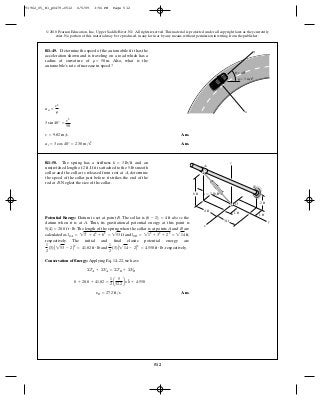
R1–25. The bottle rests at a distance of from the center
of the horizontal platform. If the coefficient of static friction
between the bottle and the platform is determine
the maximum speed that the bottle can attain before
slipping. Assume the angular motion of the platform is
slowly increasing.
ms = 0.3,
3 ft
3 ft
Applying Eq. 13–8, we have
Since the bottle is on the verge of slipping, then .
[1]
[2]
Solving Eqs. [1] and [2] yields
Ans.
u = 11.95°
y = 5.32 ft>s
©Fn = man ; 0.3W cos u = a
W
32.2
b a
y2
3
b
©Ft = mat ; 0.3W sin u = a
W
32.2
b(2)
Ff = ms N = 0.3W
©Fb = 0; N - W = 0 N = W
R1–26. Work Prob. R1–25 assuming that the platform
starts rotating from rest so that the speed of the bottle is
increased at 2 ft>s2
.
3 ft
91962_05_R1_p0479-0512 6/5/09 3:54 PM Page 497](https://image.slidesharecdn.com/solutionschapterr1-161028234746/85/Solutions-chapter-r1-19-320.jpg?cb=1477698534)
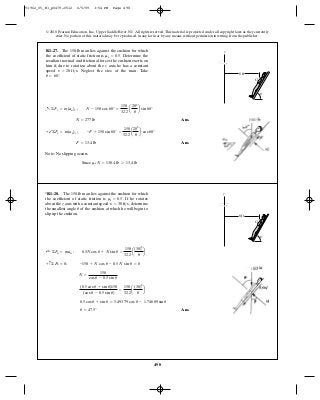
![499
© 2010 Pearson Education, Inc., Upper Saddle River, NJ. All rights reserved.This material is protected under all copyright laws as they currently
exist. No portion of this material may be reproduced, in any form or by any means, without permission in writing from the publisher.
for crate to start moving
Ans.v2 = 10.1 ft>s
[30t +
1
3
t3
]4
2 - 68 =
34
32.2
v2
0 +
L
4
2
(30 + t2
)dt - 34(4 - 2) =
34
32.2
v2
(+ c) mv1 + ©
L
Fdt = mv2
t = 2 s
30 + t2
= 34
R1–29. The motor pulls on the cable at with a force
where is in seconds. If the 34-lb crate is
originally at rest on the ground when determine its
speed when Neglect the mass of the cable and
pulleys. Hint: First find the time needed to begin lifting
the crate.
t = 4 s.
t = 0,
tF = (30 + t2
) lb,
A
A
for crate to start moving
Ans.v2 = 2.13 ft>s
1
2
e 2t 2
2
1.7632
- 8.0519 = 1.0559 v2
0 +
L
2
1.7632
e 2 t
dt - 34(2 - 1.7632) =
34
32.2
v2
(+ c) mv1 + ©
L
F dt = mv2
t = 1.7632 s
F = e 2t
= 34
R1–30. The motor pulls on the cable at with a force
where is in seconds. If the 34-lb crate is
originally at rest on the ground when determine the
crate’s velocity when Neglect the mass of the cable
and pulleys. Hint: First find the time needed to begin lifting
the crate.
t = 2 s.
t = 0,
tF = (e2t
) lb,
A
A
91962_05_R1_p0479-0512 6/5/09 3:54 PM Page 499](https://image.slidesharecdn.com/solutionschapterr1-161028234746/85/Solutions-chapter-r1-21-320.jpg?cb=1477698534)
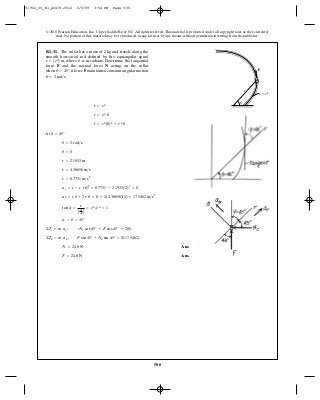
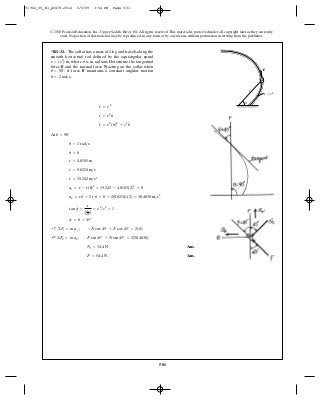
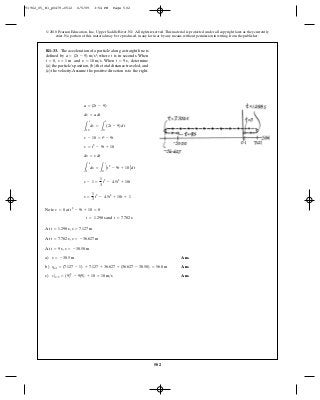
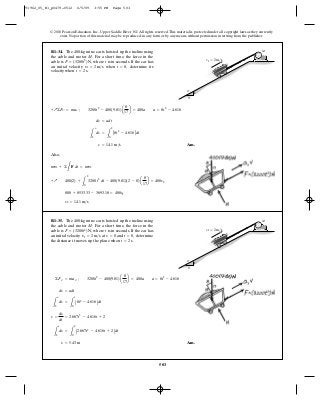
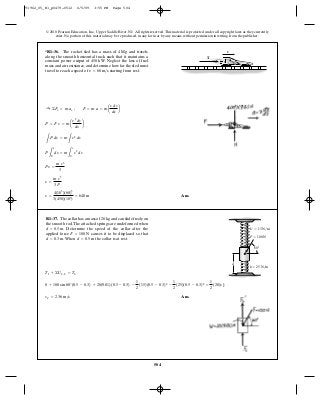
![505
© 2010 Pearson Education, Inc., Upper Saddle River, NJ. All rights reserved.This material is protected under all copyright laws as they currently
exist. No portion of this material may be reproduced, in any form or by any means, without permission in writing from the publisher.
Ans.vC = 2.34 m>s
- [
1
2
(15)[0.4 - 0.2]2
-
1
2
(15)(0.4)2
] =
1
2
(20)v2
C
0 + 100 sin 60°(0.5 - 0.3) + 196.2(0.5 - 0.3) - [
1
2
(25)[0.4 + 0.2]2
-
1
2
(25)(0.4)2
]
T1 + ©U1-2 = T2
R1–38. The collar has a mass of and can slide freely on
the smooth rod. The attached springs are both compressed
when Determine the speed of the collar
after the applied force causes it to be displaced
so that When the collar is at rest.d = 0.5 md = 0.3 m.
F = 100 N
d = 0.5 m.0.4 m
20 kg
60Њ
d
k ϭ 25 N/m
k¿ ϭ 15 N/m
F ϭ 100 N
Ans.
Ans.vB = 4.62 m>s
vA = 1.54 m>s
(0 + 0) + (0 + 0) =
1
2
(20)(vA)2
+
1
2
(30)(-3vA)2
+ 20(9.81)a
1.5
3
b - 30(9.81)(1.5)
T1 + V1 = T2 + V2
3 vA = - vB
3 ¢sA = - ¢sB
3 sA + sB = l
R1–39. The assembly consists of two blocks and which
have masses of and respectively. Determine the
speed of each block when descends The blocks are
released from rest.Neglect the mass of the pulleys and cords.
1.5 m.B
30 kg,20 kg
BA
A
B
91962_05_R1_p0479-0512 6/5/09 3:55 PM Page 505](https://image.slidesharecdn.com/solutionschapterr1-161028234746/85/Solutions-chapter-r1-27-320.jpg?cb=1477698534)
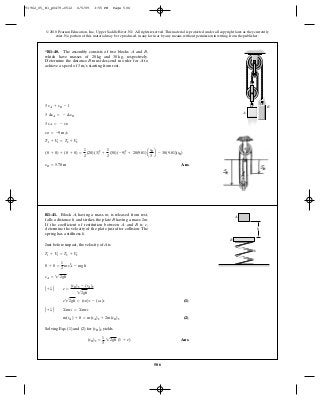
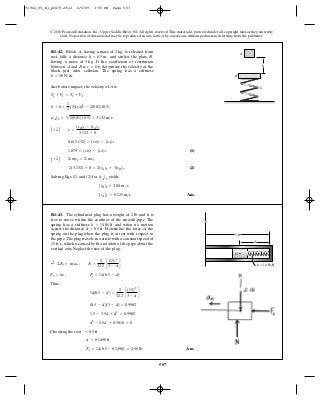
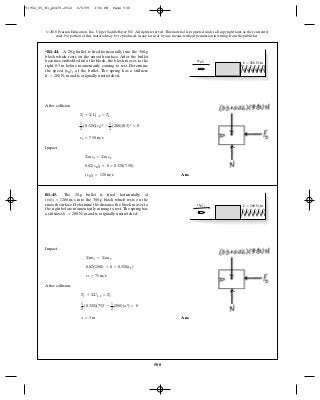
![509
© 2010 Pearson Education, Inc., Upper Saddle River, NJ. All rights reserved.This material is protected under all copyright laws as they currently
exist. No portion of this material may be reproduced, in any form or by any means, without permission in writing from the publisher.
Equation of Motion: Applying Eq. 13–7, we have
[1]
[2]
However, , , and . Substitute these values into
Eqs. [1] and [2], we have
[3]
[4]
The solution for the differential equation, Eq. [3], is in the form of
[5]
Thus,
[6]
However, at , and . Substitute these values into Eqs. [5] and
[6], one obtains and . Substitute C1 into Eq. [6]
and rearrange.This yields
[7]
The solution for the differential equation, Eq. [4], is in the form of
[8]
Thus,
[9]
However, at , and . Substitute these values into Eq. [8] and
[9], one obtains and .
Substitute C3 into Eq. [9] and rearrange.This yields
[10]
For the particle to achieve terminal speed, and .When this happen,
from Eqs. [7] and [10], and .Thus,
Ans.ymax = 2y2
x + y2
y =
C
02
+ a -
mg
k
b
2
=
mg
k
yy = y
#
= -
mg
k
yx = x
#
= 0
e- k
m t
: 0t : q
y
#
= e- k
m t
ay0 sin u0 +
mg
k
b -
mg
k
C4 =
m
k
ay0 sin u0 +
mg
k
bC3 = -
m
k
ay0 sin u0 +
mg
k
b
y
#
= y0 sin u0y = 0t = 0
y
#
= -
C3 k
m
e- k
m t
-
mg
k
y = C3 e- k
mt
+ C4 -
mg
k
t
x
#
= e- k
m t
(y0 cos u0)
C2 =
m
k
y0 cos u0C1 = -
m
k
y0 cos u0
x
#
= y0 cos u0x = 0t = 0
x
#
= -
C1 k
m
e- k
mt
x = C1 e- k
mt
+ C2
d2
y
dt2
+
k
m
dy
dt
= -g
d2
x
dt2
+
k
m
dx
dt
= 0
ay =
d2
y
dt2
yy =
dy
dt
ax =
d2
x
dt2
yx =
dx
dt
+ c©Fy = may ; -mg - kyy = may ay = -g -
k
m
yy
:+ ©Fx = max ; -kyx = max ax = -
k
m
yx
R1–46. A particle of mass is fired at an angle with a
velocity in a liquid that develops a drag resistance
where is a constant. Determine the maximum
or terminal speed reached by the particle.
kF = -kv,
v0
u0m y
xO
v0
0u
91962_05_R1_p0479-0512 6/5/09 3:56 PM Page 509](https://image.slidesharecdn.com/solutionschapterr1-161028234746/85/Solutions-chapter-r1-31-320.jpg?cb=1477698534)
![510
© 2010 Pearson Education, Inc., Upper Saddle River, NJ. All rights reserved.This material is protected under all copyright laws as they currently
exist. No portion of this material may be reproduced, in any form or by any means, without permission in writing from the publisher.
Equation of Motion: Applying Eq. 13–7, we have
[1]
[2]
However, , , and . Substituting these values into
Eqs. [1] and [2], we have
[3]
[4]
The solution for the differential equation, Eq. [3], is in the form of
[5]
Thus,
[6]
However, at , and . Substituting these values into Eq. [5]
and [6], one can obtain and . Substituting C1
and C2 into Eq. [5] and rearrange yields
Ans.
When , and .Then,
Ans.
The solution for the differential equation. Eq. [4], is in the form of
[7]
Thus,
[8]
However, at , and . Substitute these values into Eq. [7] and
[8], one can obtain and .
Substitute C3 and C4 into Eq. [7] and rearrange yields
Ans.y =
m
k
¢y0 sin u0 +
mg
k
≤ a1 - e- k
m t
b -
mg
k
t
C4 =
m
k
ay0 sin u0 +
mg
k
bC3 = -
m
k
ay0 sin u0 +
mg
k
b
y
#
= y0 sin u0y = 0t = 0
y
#
= -
C3 k
m
e- k
m t
-
mg
k
y = C3 e- k
m t
+ C4 -
mg
k
t
xmax =
m
k
y0 cos u0
x = xmaxe- k
m t
: 0t : q
x =
m
k
y0 cos u0 A1 - e- k
m t
B
C2 =
m
k
y0 cos u0C1 = -
m
k
y0 cos u0
x
#
= y0 cos u0x = 0t = 0
x
#
= -
C1 k
m
e- k
mt
x = C1 e- k
m t
+ C2
d2
y
dt2
+
k
m
dy
dt
= -g
d2
x
dt2
+
k
m
dx
dt
= 0
ay =
d2
y
dt2
yy =
dy
dt
ax =
d2
x
dt2
yx =
dx
dt
+ c©Fy = may ; -mg - kyy = may ay = -g -
k
m
yy
:+ ©Fx = max ; -kyx = max ax = -
k
m
yx
R1–47. A projectile of mass is fired into a liquid at an
angle with an initial velocity as shown. If the liquid
develops a friction or drag resistance on the projectile
which is proportional to its velocity, i.e., where
is a constant, determine the and components of its
position at any instant. Also, what is the maximum distance
that it travels?xmax
yx
kF = -kv,
v0u0
m y
xO
v0
0u
91962_05_R1_p0479-0512 6/5/09 3:56 PM Page 510](https://image.slidesharecdn.com/solutionschapterr1-161028234746/85/Solutions-chapter-r1-32-320.jpg?cb=1477698534)