Findable
OGC
Accessible
Interoperable Reusable
The world’s leading and comprehensive
community of experts making location information:

ogc.org |
Copyright © 2021 Open Geospatial Consortium
IoT technologies, architectures
and data model
Dr. Nils Hempelmann et al.
118th OGC Member Meeting
Virtual | 17. March 2021
OGC
ogc.org |
Agenda
• Introduction
Nils Hempelmann et al. 10’
• Reference Architecture of DEMETER
Ioanna Roussaki 10’
• Agricultrue Information Model
Raul Palma 10’
OGC
ogc.org | 3
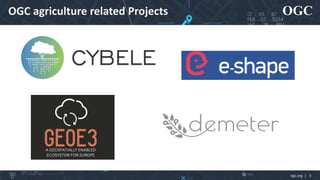
OGC agriculture related Projects
OGC
ogc.org |
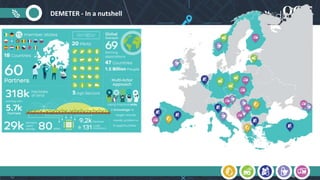
DEMETER - In a nutshell
OGC
ogc.org |
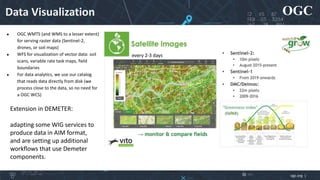
Data Visualization
● OGC WMTS (and WMS to a lesser extent)
for serving raster data (Sentinel-2,
drones, or soil maps)
● WFS for visualization of vector data: soil
scans, variable rate task maps, field
boundaries
● For data analytics, we use our catalog
that reads data directly from disk (we
process close to the data, so no need for
a OGC WCS)
Extension in DEMETER:
adapting some WIG services to
produce data in AIM format,
and are setting up additional
workflows that use Demeter
components.
OGC
ogc.org |
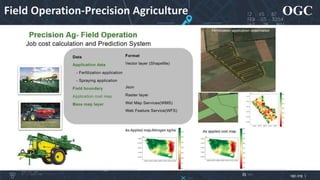
Field Operation-Precision Agriculture
OGC
ogc.org |
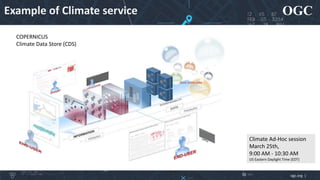
Example of Climate service
COPERNICUS
Climate Data Store (CDS)
Climate Ad-Hoc session
March 25th,
9:00 AM - 10:30 AM
US Eastern Daylight Time (EDT)
OGC
ogc.org |
EVENT FEED
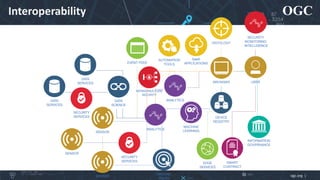
Interoperability
GROUND
TRUTH
ANALYTICS
ANALYTICS
SECURITY
MONITORING
INTELLIGENCE
INFRASTRUCTURE
SECURITY
SaaS
APPLICATIONS
Thank You!
OGC
ogc.org |
Contact info@ogc.org to schedule a meeting for an in-depth discussion with OGC staff and join our community today!
Innovation
Standards
65+ Adopted Standards
300+ products with 1000+ certified
implementations
1,700,000+ Operational Data Sets
Using OGC Standards
120+ Innovation Initiatives
380+ Technical reports
Quarterly Tech Trends monitoring
Community
500+ International Members
110+ Member Meetings
60+ Alliance and Liaison partners
50+ Standards Working Groups
45+ Domain Working Groups
25+ Years of Not for Profit Work
10+ Regional and Country Forums
9
Reference Architecture of
DEMETER
Data Driven Innovation in the Agrifood sector
Dr. Ioanna Roussaki
Assist. Professor (National Technical University of Athens, GREECE)
Institute of Communications & Computer Systems (ICCS)
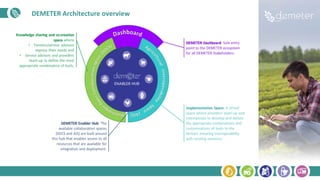
DEMETER Architecture overview
Place
Pilot
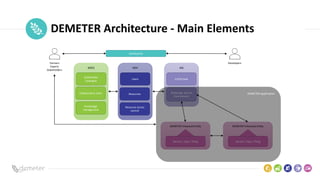
icon DEMETER Architecture - Main Elements
DEMETER Enhanced Entity
SOCS DEH AIS
Dashboards
Users
Resources
Resource access
control
Stakeholder
catalogue
CI/CD tools
Brokerage Service
Environment
Service | App | Thing
DEMETER Enhanced Entity
Service | App | Thing
Farmers
Experts
Stakeholders
Developers
DEMETER Application
Collaboration tools
Knowledge
management
Place
Pilot
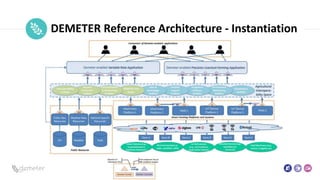
icon DEMETER Reference Architecture - Instantiation
Place
Pilot
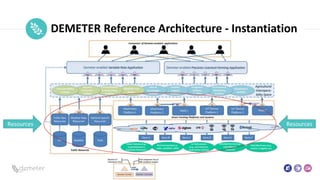
icon DEMETER Reference Architecture - Instantiation
Resources
Resources
Place
Pilot
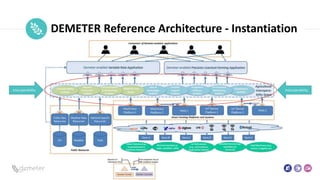
icon DEMETER Reference Architecture - Instantiation
Interoperability
Interoperability
Place
Pilot
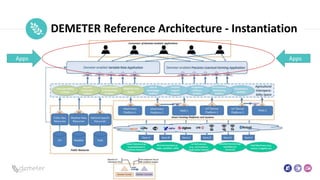
icon DEMETER Reference Architecture - Instantiation
Apps
Apps
Place
Pilot
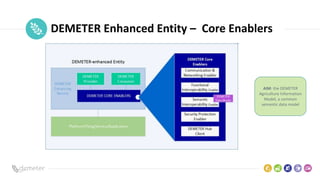
icon DEMETER Enhanced Entity – Core Enablers
AIM: the DEMETER
Agriculture Information
Model, a common
semantic data model
Place
Pilot
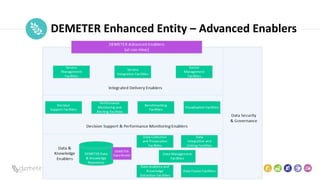
icon DEMETER Enhanced Entity – Advanced Enablers
For more information visit:
www.h2020-demeter.eu
or Email us at:
info@h2020-demeter.eu
Ioanna.roussaki@cn.ntua.gr
Agriculture
Information Model -
AIM
Dr. Raul Palma
Head of Data Analytics and Semantics Department
Poznan Supercomputing and Networking Center
The OGC Reference Architectures in
Agriculture Workshop
17th March 2021
Place
Pilot
icon
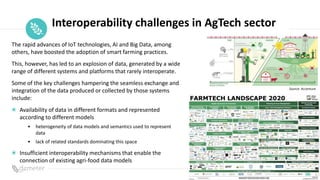
Interoperability challenges in AgTech sector
Source: Accenture
The rapid advances of IoT technologies, AI and Big Data, among
others, have boosted the adoption of smart farming practices.
This, however, has led to an explosion of data, generated by a wide
range of different systems and platforms that rarely interoperate.
Some of the key challenges hampering the seamless exchange and
integration of the data produced or collected by those systems
include:
Availability of data in different formats and represented
according to different models
• heterogeneity of data models and semantics used to represent
data
• lack of related standards dominating this space
Insufficient interoperability mechanisms that enable the
connection of existing agri-food data models
Place
Pilot
icon
DEMETER Agriculture
Information Model - AIM
AIM follows a modular approach in a
layered architecture:
realized as a suite of ontologies and
corresponding JSON-LD contexts
implemented in line with best practices,
reusing existing standards and well-scoped
models
establishes alignments between base models
to enable their interoperability and the
integration of existing data
AIM consists of 4 main parts:
Core meta-model
Cross-Domain ontology module
Domain-Specific ontology modules
Metadata Schema
AIM aims to establish the basis of a common agricultural data space, enable the interoperation of
different systems, and the analysis of data produced by those systems in an integrated manner
Place
Pilot
icon
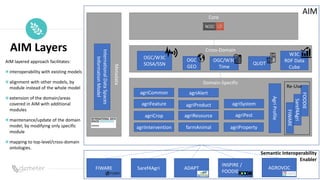
AIM Layers
Core
Cross-Domain
Domain-Specific
Metadata
AIM
Saref4Agri
FIWARE
FOODIE
OGC/W3C
SOSA/SSN
OGC
GEO
OGC/W3C
Time
QUDT
FIWARE Saref4Agri ADAPT
INSPIRE /
FOODIE
AGROVOC
Semantic Interoperability
Enabler
Agri
Profile
agriCrop
agriProduct
agriPest
agriFeature
agriAlert
agriSystem
agriCommon
farmAnimal
agriIntervention agriProperty
agriResource
Re-Use
International
Data
Spaces
Information
Model
AIM layered approach facilitates:
interoperability with existing models
alignment with other models, by
module instead of the whole model
extension of the domain/areas
covered in AIM with additional
modules
maintenance/update of the domain
model, by modifying only specific
module
mapping to top-level/cross-domain
ontologies.
W3C
RDF Data
Cube
Place
Pilot
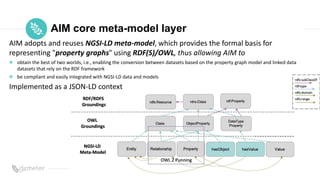
icon AIM core meta-model layer
AIM adopts and reuses NGSI-LD meta-model, which provides the formal basis for
representing "property graphs" using RDF(S)/OWL, thus allowing AIM to
obtain the best of two worlds, i.e., enabling the conversion between datasets based on the property graph model and linked data
datasets that rely on the RDF framework
be compliant and easily integrated with NGSI-LD data and models
Implemented as a JSON-LD context
Place
Pilot
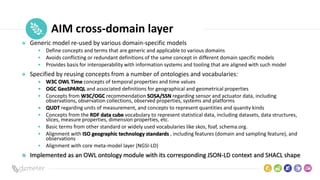
icon AIM cross-domain layer
Generic model re-used by various domain-specific models
• Define concepts and terms that are generic and applicable to various domains
• Avoids conflicting or redundant definitions of the same concept in different domain specific models
• Provides basis for interoperability with information systems and tooling that are aligned with such model
Specified by reusing concepts from a number of ontologies and vocabularies:
• W3C OWL Time concepts of temporal properties and time values
• OGC GeoSPARQL and associated definitions for geographical and geometrical properties
• Concepts from W3C/OGC recommendation SOSA/SSN regarding sensor and actuator data, including
observations, observation collections, observed properties, systems and platforms
• QUDT regarding units of measurement, and concepts to represent quantities and quanity kinds
• Concepts from the RDF data cube vocabulary to represent statistical data, including datasets, data structures,
slices, measure properties, dimension properties, etc.
• Basic terms from other standard or widely used vocabularies like skos, foaf, schema.org.
• Alignment with ISO geographic technology standards , including features (domain and sampling feature), and
observations
• Alignment with core meta-model layer (NGSI-LD)
Implemented as an OWL ontology module with its corresponding JSON-LD context and SHACL shape
Place
Pilot
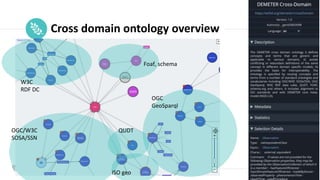
icon Cross domain ontology overview
OGC/W3C
SOSA/SSN
OGC
GeoSparql
W3C
RDF DC
Foaf, schema
QUDT
ISO geo
Place
Pilot
icon
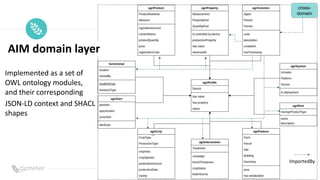
AIM domain layer
Implemented as a set of
OWL ontology modules,
and their corresponding
JSON-LD context and SHACL
shapes
cross-
domain
ImportedBy
Place
Pilot
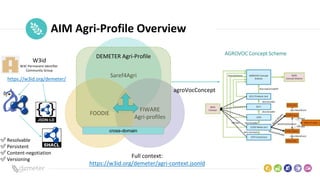
icon AIM Agri-Profile Overview
Saref4Agri
FIWARE
Agri-profiles
FOODIE
DEMETER Agri-Profile AGROVOC Concept Scheme
agroVocConcept
W3id
W3C Permanent Identifier
Community Group
https://w3id.org/demeter/
✅ Resolvable
✅ Persistent
✅ Content-negotiation
✅ Versioning
Full context:
https://w3id.org/demeter/agri-context.jsonld
cross-domain
Place
Pilot
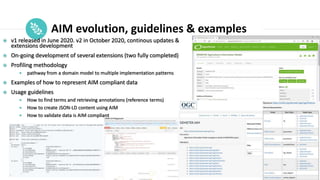
icon AIM evolution, guidelines & examples
v1 released in June 2020. v2 in October 2020, continous updates &
extensions development
On-going development of several extensions (two fully completed)
Profiling methodology
• pathway from a domain model to multiple implementation patterns
Examples of how to represent AIM compliant data
Usage guidelines
• How to find terms and retrieving annotations (reference terms)
• How to create JSON-LD content using AIM
• How to validate data is AIM compliant
Place
Pilot
icon
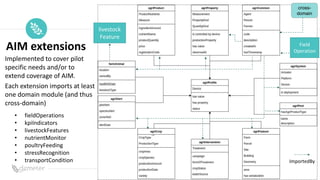
AIM extensions
Implemented to cover pilot
specific needs and/or to
extend coverage of AIM.
Each extension imports at least
one domain module (and thus
cross-domain)
cross-
domain
ImportedBy
• fieldOperations
• kpiIndicators
• livestockFeatures
• nutrientMonitor
• poultryFeeding
• stressRecognition
• transportCondition
livestock
Feature
Field
Operation
Place
Pilot
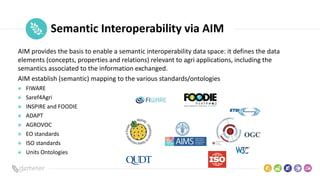
icon Semantic Interoperability via AIM
AIM provides the basis to enable a semantic interoperability data space: it defines the data
elements (concepts, properties and relations) relevant to agri applications, including the
semantics associated to the information exchanged.
AIM establish (semantic) mapping to the various standards/ontologies
FIWARE
Saref4Agri
INSPIRE and FOODIE
ADAPT
AGROVOC
EO standards
ISO standards
Units Ontologies
Place
Pilot
icon
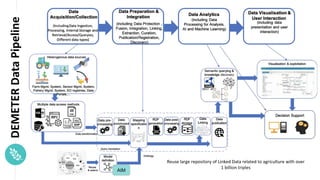
Reuse large repository of Linked Data related to agriculture with over
1 billion triples
DEMETER
Data
Pipeline
AIM
For more information visit:
www.h2020-demeter.eu
or Email us at:
info@h2020-demeter.eu
rpalma@man.poznan.pl

DEMETER at OGC Agriculture Session

  • 1.
    Findable OGC Accessible Interoperable Reusable The world’sleading and comprehensive community of experts making location information:  ogc.org | Copyright © 2021 Open Geospatial Consortium IoT technologies, architectures and data model Dr. Nils Hempelmann et al. 118th OGC Member Meeting Virtual | 17. March 2021
  • 2.
    OGC ogc.org | Agenda • Introduction NilsHempelmann et al. 10’ • Reference Architecture of DEMETER Ioanna Roussaki 10’ • Agricultrue Information Model Raul Palma 10’
  • 3.
    OGC ogc.org | 3 OGCagriculture related Projects
  • 4.
  • 5.
    OGC ogc.org | Data Visualization ●OGC WMTS (and WMS to a lesser extent) for serving raster data (Sentinel-2, drones, or soil maps) ● WFS for visualization of vector data: soil scans, variable rate task maps, field boundaries ● For data analytics, we use our catalog that reads data directly from disk (we process close to the data, so no need for a OGC WCS) Extension in DEMETER: adapting some WIG services to produce data in AIM format, and are setting up additional workflows that use Demeter components.
  • 6.
  • 7.
    OGC ogc.org | Example ofClimate service COPERNICUS Climate Data Store (CDS) Climate Ad-Hoc session March 25th, 9:00 AM - 10:30 AM US Eastern Daylight Time (EDT)
  • 8.
  • 9.
    Thank You! OGC ogc.org | Contactinfo@ogc.org to schedule a meeting for an in-depth discussion with OGC staff and join our community today! Innovation Standards 65+ Adopted Standards 300+ products with 1000+ certified implementations 1,700,000+ Operational Data Sets Using OGC Standards 120+ Innovation Initiatives 380+ Technical reports Quarterly Tech Trends monitoring Community 500+ International Members 110+ Member Meetings 60+ Alliance and Liaison partners 50+ Standards Working Groups 45+ Domain Working Groups 25+ Years of Not for Profit Work 10+ Regional and Country Forums 9
  • 10.
    Reference Architecture of DEMETER DataDriven Innovation in the Agrifood sector Dr. Ioanna Roussaki Assist. Professor (National Technical University of Athens, GREECE) Institute of Communications & Computer Systems (ICCS)
  • 11.
  • 12.
    Place Pilot icon DEMETER Architecture- Main Elements DEMETER Enhanced Entity SOCS DEH AIS Dashboards Users Resources Resource access control Stakeholder catalogue CI/CD tools Brokerage Service Environment Service | App | Thing DEMETER Enhanced Entity Service | App | Thing Farmers Experts Stakeholders Developers DEMETER Application Collaboration tools Knowledge management
  • 13.
    Place Pilot icon DEMETER ReferenceArchitecture - Instantiation
  • 14.
    Place Pilot icon DEMETER ReferenceArchitecture - Instantiation Resources Resources
  • 15.
    Place Pilot icon DEMETER ReferenceArchitecture - Instantiation Interoperability Interoperability
  • 16.
    Place Pilot icon DEMETER ReferenceArchitecture - Instantiation Apps Apps
  • 17.
    Place Pilot icon DEMETER EnhancedEntity – Core Enablers AIM: the DEMETER Agriculture Information Model, a common semantic data model
  • 18.
    Place Pilot icon DEMETER EnhancedEntity – Advanced Enablers
  • 19.
    For more informationvisit: www.h2020-demeter.eu or Email us at: info@h2020-demeter.eu Ioanna.roussaki@cn.ntua.gr
  • 20.
    Agriculture Information Model - AIM Dr.Raul Palma Head of Data Analytics and Semantics Department Poznan Supercomputing and Networking Center The OGC Reference Architectures in Agriculture Workshop 17th March 2021
  • 21.
    Place Pilot icon Interoperability challenges inAgTech sector Source: Accenture The rapid advances of IoT technologies, AI and Big Data, among others, have boosted the adoption of smart farming practices. This, however, has led to an explosion of data, generated by a wide range of different systems and platforms that rarely interoperate. Some of the key challenges hampering the seamless exchange and integration of the data produced or collected by those systems include: Availability of data in different formats and represented according to different models • heterogeneity of data models and semantics used to represent data • lack of related standards dominating this space Insufficient interoperability mechanisms that enable the connection of existing agri-food data models
  • 22.
    Place Pilot icon DEMETER Agriculture Information Model- AIM AIM follows a modular approach in a layered architecture: realized as a suite of ontologies and corresponding JSON-LD contexts implemented in line with best practices, reusing existing standards and well-scoped models establishes alignments between base models to enable their interoperability and the integration of existing data AIM consists of 4 main parts: Core meta-model Cross-Domain ontology module Domain-Specific ontology modules Metadata Schema AIM aims to establish the basis of a common agricultural data space, enable the interoperation of different systems, and the analysis of data produced by those systems in an integrated manner
  • 23.
    Place Pilot icon AIM Layers Core Cross-Domain Domain-Specific Metadata AIM Saref4Agri FIWARE FOODIE OGC/W3C SOSA/SSN OGC GEO OGC/W3C Time QUDT FIWARE Saref4AgriADAPT INSPIRE / FOODIE AGROVOC Semantic Interoperability Enabler Agri Profile agriCrop agriProduct agriPest agriFeature agriAlert agriSystem agriCommon farmAnimal agriIntervention agriProperty agriResource Re-Use International Data Spaces Information Model AIM layered approach facilitates: interoperability with existing models alignment with other models, by module instead of the whole model extension of the domain/areas covered in AIM with additional modules maintenance/update of the domain model, by modifying only specific module mapping to top-level/cross-domain ontologies. W3C RDF Data Cube
  • 24.
    Place Pilot icon AIM coremeta-model layer AIM adopts and reuses NGSI-LD meta-model, which provides the formal basis for representing "property graphs" using RDF(S)/OWL, thus allowing AIM to obtain the best of two worlds, i.e., enabling the conversion between datasets based on the property graph model and linked data datasets that rely on the RDF framework be compliant and easily integrated with NGSI-LD data and models Implemented as a JSON-LD context
  • 25.
    Place Pilot icon AIM cross-domainlayer Generic model re-used by various domain-specific models • Define concepts and terms that are generic and applicable to various domains • Avoids conflicting or redundant definitions of the same concept in different domain specific models • Provides basis for interoperability with information systems and tooling that are aligned with such model Specified by reusing concepts from a number of ontologies and vocabularies: • W3C OWL Time concepts of temporal properties and time values • OGC GeoSPARQL and associated definitions for geographical and geometrical properties • Concepts from W3C/OGC recommendation SOSA/SSN regarding sensor and actuator data, including observations, observation collections, observed properties, systems and platforms • QUDT regarding units of measurement, and concepts to represent quantities and quanity kinds • Concepts from the RDF data cube vocabulary to represent statistical data, including datasets, data structures, slices, measure properties, dimension properties, etc. • Basic terms from other standard or widely used vocabularies like skos, foaf, schema.org. • Alignment with ISO geographic technology standards , including features (domain and sampling feature), and observations • Alignment with core meta-model layer (NGSI-LD) Implemented as an OWL ontology module with its corresponding JSON-LD context and SHACL shape
  • 26.
    Place Pilot icon Cross domainontology overview OGC/W3C SOSA/SSN OGC GeoSparql W3C RDF DC Foaf, schema QUDT ISO geo
  • 27.
    Place Pilot icon AIM domain layer Implementedas a set of OWL ontology modules, and their corresponding JSON-LD context and SHACL shapes cross- domain ImportedBy
  • 28.
    Place Pilot icon AIM Agri-ProfileOverview Saref4Agri FIWARE Agri-profiles FOODIE DEMETER Agri-Profile AGROVOC Concept Scheme agroVocConcept W3id W3C Permanent Identifier Community Group https://w3id.org/demeter/ ✅ Resolvable ✅ Persistent ✅ Content-negotiation ✅ Versioning Full context: https://w3id.org/demeter/agri-context.jsonld cross-domain
  • 29.
    Place Pilot icon AIM evolution,guidelines & examples v1 released in June 2020. v2 in October 2020, continous updates & extensions development On-going development of several extensions (two fully completed) Profiling methodology • pathway from a domain model to multiple implementation patterns Examples of how to represent AIM compliant data Usage guidelines • How to find terms and retrieving annotations (reference terms) • How to create JSON-LD content using AIM • How to validate data is AIM compliant
  • 30.
    Place Pilot icon AIM extensions Implemented tocover pilot specific needs and/or to extend coverage of AIM. Each extension imports at least one domain module (and thus cross-domain) cross- domain ImportedBy • fieldOperations • kpiIndicators • livestockFeatures • nutrientMonitor • poultryFeeding • stressRecognition • transportCondition livestock Feature Field Operation
  • 31.
    Place Pilot icon Semantic Interoperabilityvia AIM AIM provides the basis to enable a semantic interoperability data space: it defines the data elements (concepts, properties and relations) relevant to agri applications, including the semantics associated to the information exchanged. AIM establish (semantic) mapping to the various standards/ontologies FIWARE Saref4Agri INSPIRE and FOODIE ADAPT AGROVOC EO standards ISO standards Units Ontologies
  • 32.
    Place Pilot icon Reuse large repositoryof Linked Data related to agriculture with over 1 billion triples DEMETER Data Pipeline AIM
  • 33.
    For more informationvisit: www.h2020-demeter.eu or Email us at: info@h2020-demeter.eu rpalma@man.poznan.pl

Editor's Notes

  • #10 If you have any questions, do not hesitate to reach out to OGC or schedule a follow-up. We’re working constantly to change the landscape of location information and want to help your organization get where it needs to go.