Reaching the Edge of 
the Joint Information 
Environment 
A Candid Survey of DoD Employees 
October 2014 
Underwritten by:
Purpose 
The Department of Defense is pursuing an ambitious initiative to develop an integrated, enterprise-wide IT 
network, the Joint Information Environment (JIE). A significant benefit of this project is a vibrant mobility 
ecosystem, wherein DoD employees and warfighters alike can securely access and effectively utilize information 
flows wherever they are. Two years on, DoD faces a pivotal period for the JIE and its mobility strategy as its 
unclassified mobility program scales to the enterprise and planners work to define final technical standards. 
Recognizing the significance of the JIE and mobility for DoD, Government Business Council (GBC) and Verizon 
Wireless undertook an in-depth research study. 
Methodology 
To assess the perceptions, attitudes, and experiences of senior DoD employees regarding the JIE and mobility, 
GBC deployed a survey to a sample of Defense One, Nextgov, and Government Executive online and print 
subscribers in August 2014. The pool of 305 respondents includes those from each of the military service 
branches and the Office of the Secretary of Defense. 
2
Table of Contents 
1 Executive Summary 4 
2 Respondent Profile 6 
3 Research Findings 9 
i. The Joint Information Environment 10 
ii. The impact of Mobility 18 
ii. Obstacles to Expanding Mobility 23 
4 Final Considerations 27 
3
4 
1 
Executive 
Summary
Executive Summary 
The Joint Information Environment faces a long and bumpy road ahead 
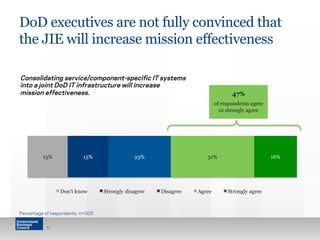
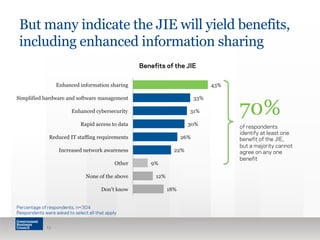
Senior DoD employees are not sold on the JIE’s vision for a joint enterprise IT infrastructure. Though 71% identify 
benefits of the JIE, less than half (47%) believe it will increase mission effectiveness for their service/component. 
Respondents also identify significant challenges to implementing the JIE: more than three-fourths (77%) of 
respondents doubt that it will be completed by its FY 2018 deadline and nearly two-thirds (63%) identify 
incompatible service/component IT systems as a significant obstacle. 
Expanded mobility would benefit DoD overall, especially on the battlefield 
The vast majority (84%) of respondents identify benefits from mobility for their service/component, with 53% 
singling out remote data entry and access. Respondents are especially convinced of mobility’s value on the 
battlefield: 77% indicate leveraging mobility at the tactical level is important to achieving mission. 
But fundamental challenges could limit expanded mobility services 
To realize the benefits of mobility, DoD must address fundamental weaknesses. Majorities of respondents 
identify expanded wireless infrastructure (53%), integration with DoD information networks (52%), and user 
support (52%) as unclassified mobility elements in need of the most improvement. Majorities also highlight 
budget constraints (64%), compatibility with legacy IT infrastructure (58%), and security (54%) as 
significant challenges. 
5
6 
2 
Respondent 
Profile
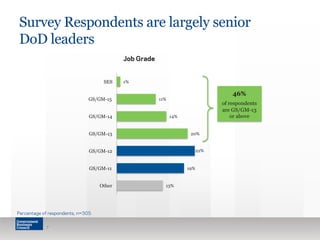
Survey Respondents are largely senior 
DoD leaders 
13% 
20% 
19% 
22% 
14% 
11% 
1% 
SES 
GS/GM-15 
GS/GM-14 
GS/GM-13 
GS/GM-12 
GS/GM-11 
Other 
7 
Job Grade 
Percentage of respondents, n=305 
46% 
of respondents 
are GS/GM-13 
or above
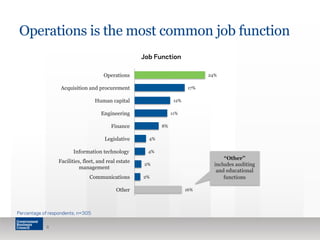
Operations is the most common job function 
16% 
4% 
4% 
2% 
2% 
8% 
12% 
11% 
17% 
24% 
Operations 
Acquisition and procurement 
Human capital 
Engineering 
Legislative 
Information technology 
Facilities, fleet, and real estate 
Communications 
Other 
management 
Finance 
Percentage of respondents, n=305 
8 
Job Function 
“Other” 
includes auditing 
and educational 
functions
9 
3 
Research 
Findings
10 
i. 
The Joint 
Information 
Environment
Building a DoD-wide information environment 
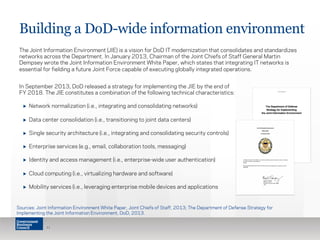
The Joint Information Environment (JIE) is a vision for DoD IT modernization that consolidates and standardizes 
networks across the Department. In January 2013, Chairman of the Joint Chiefs of Staff General Martin 
Dempsey wrote the Joint Information Environment White Paper, which states that integrating IT networks is 
essential for fielding a future Joint Force capable of executing globally integrated operations. 
In September 2013, DoD released a strategy for implementing the JIE by the end of 
FY 2018. The JIE constitutes a combination of the following technical characteristics: 
▶ Network normalization (i.e., integrating and consolidating networks) 
▶ Data center consolidation (i.e., transitioning to joint data centers) 
▶ Single security architecture (i.e., integrating and consolidating security controls) 
▶ Enterprise services (e.g., email, collaboration tools, messaging) 
▶ Identity and access management (i.e., enterprise-wide user authentication) 
▶ Cloud computing (i.e., virtualizing hardware and software) 
▶ Mobility services (i.e., leveraging enterprise mobile devices and applications 
Sources: Joint Information Environment White Paper, Joint Chiefs of Staff, 2013; The Department of Defense Strategy for 
Implementing the Joint Information Environment, DoD, 2013. 
11
DoD executives are not fully convinced that 
the JIE will increase mission effectiveness 
Consolidating service/component-specific IT systems 
into a joint DoD IT infrastructure will increase 
mission effectiveness. 
15% 15% 23% 31% 16% 
Don't know Strongly disagree Disagree Agree Strongly agree 
12 
47% 
of respondents agree 
or strongly agree 
Percentage of respondents, n=305
But many indicate the JIE will yield benefits, 
including enhanced information sharing 
18% 
9% 
12% 
33% 
31% 
26% 
22% 
30% 
43% 
Enhanced information sharing 
Simplified hardware and software management 
Enhanced cybersecurity 
Rapid access to data 
Reduced IT staffing requirements 
Increased network awareness 
Other 
None of the above 
Don't know 
Percentage of respondents, n=304 
Respondents were asked to select all that apply 
13 
Benefits of the JIE 
70% 
of respondents 
identify at least one 
benefit of the JIE, 
but a majority cannot 
agree on any one 
benefit
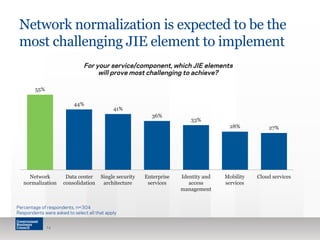
Network normalization is expected to be the 
most challenging JIE element to implement 
Percentage of respondents, n=304 
Respondents were asked to select all that apply 
14 
55% 
44% 
41% 
36% 
33% 
28% 27% 
Network 
normalization 
Data center 
consolidation 
Single security 
architecture 
Enterprise 
services 
Identity and 
access 
management 
Mobility 
services 
Cloud services 
For your service/component, which JIE elements 
will prove most challenging to achieve?
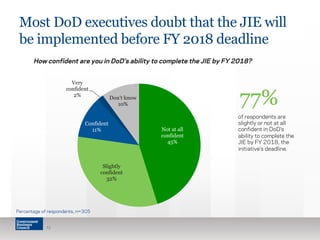
Most DoD executives doubt that the JIE will 
be implemented before FY 2018 deadline 
How confident are you in DoD’s ability to complete the JIE by FY 2018? 
Not at all 
confident 
45% 
Confident 
11% 
Slightly 
confident 
32% 
Very 
confident 
2% Don't know 
10% 
Percentage of respondents, n=305 
15 
77% 
of respondents are 
slightly or not at all 
confident in DoD’s 
ability to complete the 
JIE by FY 2018, the 
initiative’s deadline.
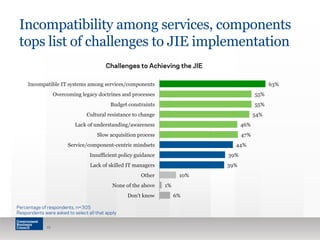
Incompatibility among services, components 
tops list of challenges to JIE implementation 
6% 
1% 
10% 
46% 
44% 
39% 
39% 
47% 
55% 
55% 
54% 
63% 
Incompatible IT systems among services/components 
Overcoming legacy doctrines and processes 
Budget constraints 
Cultural resistance to change 
Lack of understanding/awareness 
Slow acquisition process 
Service/component-centric mindsets 
Insufficient policy guidance 
Lack of skilled IT managers 
Other 
None of the above 
Don't know 
Percentage of respondents, n=305 
Respondents were asked to select all that apply 
16 
Challenges to Achieving the JIE
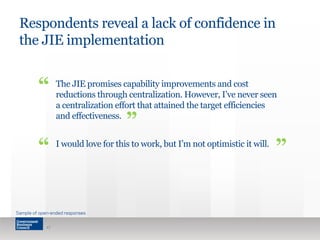
Respondents reveal a lack of confidence in 
the JIE implementation 
The JIE promises capability improvements and cost 
reductions through centralization. However, I’ve never seen 
a centralization effort that attained the target efficiencies 
and effectiveness. 
I would love for this to work, but I’m not optimistic it will. 
“ 
17 
” 
“ ” 
Sample of open-ended responses
18 
ii. 
The Impact of 
Mobility
Mobility – “the primary benefit of the JIE” 
The JIE vision embraces mobile devices as an essential 
element of DoD’s future enterprise information network. 
Defense Information Systems Agency (DISA), the agency 
charged with taking the lead on JIE technical matters, points 
to mobility as “the primary benefit of JIE” in its 2014-2019 
Strategic Plan. 
In FY 2014, DoD made significant headway building its 
mobility ecosystem. DISA rolled out a mobile device 
management (MDM) system, a mobile application store, an 
expanded approved devices list as part of its initial enterprise 
unclassified mobility capability, and expanded classified 
mobility pilot programs. However, DoD has struggled to scale 
its mobility program to planned levels and mobile device 
policies still differ significantly among 
service branches. 
Sources: DISA Strategic Plan 2014-2019, Version 2, DISA, 2014; Signal, AFCEA International, 2014 
Image source: Flick user U.S. Army (Creative Commons 2.0) 
19
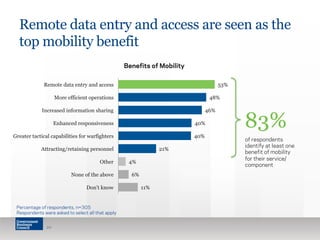
Remote data entry and access are seen as the 
top mobility benefit 
11% 
4% 
6% 
21% 
40% 
40% 
48% 
46% 
53% 
Remote data entry and access 
More efficient operations 
Increased information sharing 
Enhanced responsiveness 
Greater tactical capabilities for warfighters 
Attracting/retaining personnel 
Other 
None of the above 
Don't know 
Percentage of respondents, n=305 
Respondents were asked to select all that apply 
20 
Benefits of Mobility 
83% 
of respondents 
identify at least one 
benefit of mobility 
for their service/ 
component
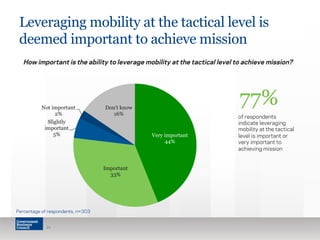
Leveraging mobility at the tactical level is 
deemed important to achieve mission 
How important is the ability to leverage mobility at the tactical level to achieve mission? 
Very important 
44% 
Important 
33% 
Not important 
2% 
Slightly 
important 
5% 
Don't know 
16% 
Percentage of respondents, n=303 
21 
77% 
of respondents 
indicate leveraging 
mobility at the tactical 
level is important or 
very important to 
achieving mission
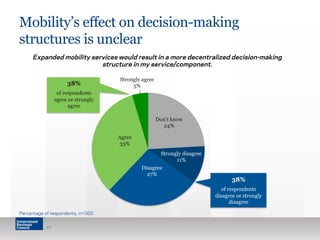
Mobility’s effect on decision-making 
structures is unclear 
Expanded mobility services would result in a more decentralized decision-making 
Don't know 
24% 
Strongly disagree 
11% 
Strongly agree 
Disagree 
27% 
38% 5% 
Agree 
33% 
of respondents 
agree or strongly 
agree 
22 
38% 
of respondents 
disagree or strongly 
disagree 
Percentage of respondents, n=305 
structure in my service/component.
23 
iii. 
Obstacles to 
Expanding 
Mobility
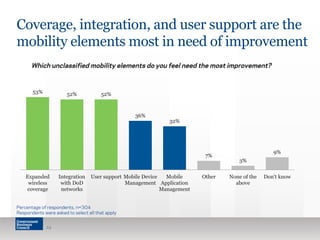
Coverage, integration, and user support are the 
mobility elements most in need of improvement 
Which unclassified mobility elements do you feel need the most improvement? 
53% 52% 52% 
Percentage of respondents, n=304 
Respondents were asked to select all that apply 
24 
36% 
32% 
7% 
3% 
9% 
Expanded 
wireless 
coverage 
Integration 
with DoD 
networks 
User support Mobile Device 
Management 
Mobile 
Application 
Management 
Other None of the 
above 
Don't know
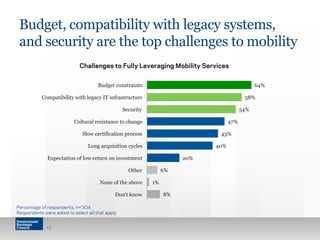
Budget, compatibility with legacy systems, 
and security are the top challenges to mobility 
8% 
1% 
6% 
20% 
43% 
40% 
47% 
58% 
54% 
64% 
Budget constraints 
Compatibility with legacy IT infrastructure 
Security 
Cultural resistance to change 
Slow certification process 
Long acquisition cycles 
Expectation of low return on investment 
Other 
None of the above 
Don't know 
Percentage of respondents, n=304 
Respondents were asked to select all that apply 
25 
Challenges to Fully Leveraging Mobility Services
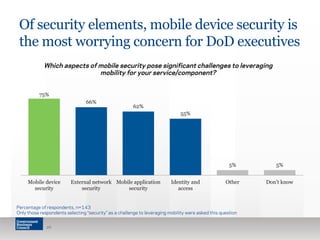
Of security elements, mobile device security is 
the most worrying concern for DoD executives 
Which aspects of mobile security pose significant challenges to leveraging 
75% 
Percentage of respondents, n=143 
Only those respondents selecting “security” as a challenge to leveraging mobility were asked this question 
26 
66% 
62% 
55% 
5% 5% 
Mobile device 
security 
External network 
security 
Mobile application 
security 
Identity and 
access 
Other Don't know 
mobility for your service/component?
27 
4 
Final 
Considerations
As DoD looks to the future of its information 
networks and mobility services… 
Sustained leadership is needed to overcome differences among services and components 
DoD leaders have identified the JIE as a critical component of the future Joint Force, but they face an uphill 
battle against entrenched differences among services and components. Senior DoD employees remain 
unconvinced that consolidating service/component-specific systems will increase mission effectiveness, see 
their service and component IT systems as incompatible, and doubt the JIE will be completed by its deadline. 
Convincing the DoD workforce to get onboard with the shift to a joint enterprise future demands determined 
and sustained attention. 
Basic enterprise IT infrastructure should be developed to move mobility services forward 
As DoD looks scale its unclassified mobility services to the enterprise, the Department can make the largest 
positive impact by improving basic IT infrastructure elements. Respondents indicate that expanding wireless 
coverage, integration with DoD networks, and user support would most improve mobility services. 
The effect on traditional workforce structures needs to be better understood 
Expanding mobility services promises to enhance DoD mission effectiveness, but it may also have 
unforeseen effects on the DoD workforce. For example, increasing access to and control of information for 
troops in-theater may upset the traditionally rigid, hierarchical chain of command. Survey respondents were 
divided on the question of decentralized decision-making, indicating further research on this topic is needed. 
28
Underwritten by 
About Verizon 
Verizon Communications Inc. (NYSE, Nasdaq: VZ), 
headquartered in New York, is a global leader in 
delivering broadband and other wireless and wireline 
communications services to consumer, business, 
government and wholesale customers. Verizon Wireless 
operates America’s most reliable wireless network, with 
more than 103 million retail connections nationwide. 
Verizon also provides converged communications, 
information and entertainment services over America’s 
most advanced fiber-optic network, and delivers 
integrated business solutions to customers in more than 
150 countries. A Dow 30 company with more than 
$120 billion in 2013 revenues, Verizon employs a 
diverse workforce of 176,900. For more information, 
visit www.verizon.com. 
29
About GBC 
Contact 
Zoe Grotophorst 
Manager 
Research & Strategic Insights 
Government Business Council 
Tel. 202.266.7335 
zgrotophorst@govexec.com 
govexec.com/GBC 
@GovBizCouncil 
Our Mission 
Government Business Council (GBC), the research arm of 
Government Executive Media Group, is dedicated to advancing the 
business of government through analysis and insight. GBC partners 
with industry to share best practices with top government decision-makers, 
understanding the deep value inherent in industry’s 
experience engaging and supporting federal agencies. 
30
Reaching the Edge of 
the Joint Information 
Environment 
A Candid Survey of DoD Employees 
September 2014 
Underwritten by:

Reach the Edge of the Joint Information Environment

  • 1.
    Reaching the Edgeof the Joint Information Environment A Candid Survey of DoD Employees October 2014 Underwritten by:
  • 2.
    Purpose The Departmentof Defense is pursuing an ambitious initiative to develop an integrated, enterprise-wide IT network, the Joint Information Environment (JIE). A significant benefit of this project is a vibrant mobility ecosystem, wherein DoD employees and warfighters alike can securely access and effectively utilize information flows wherever they are. Two years on, DoD faces a pivotal period for the JIE and its mobility strategy as its unclassified mobility program scales to the enterprise and planners work to define final technical standards. Recognizing the significance of the JIE and mobility for DoD, Government Business Council (GBC) and Verizon Wireless undertook an in-depth research study. Methodology To assess the perceptions, attitudes, and experiences of senior DoD employees regarding the JIE and mobility, GBC deployed a survey to a sample of Defense One, Nextgov, and Government Executive online and print subscribers in August 2014. The pool of 305 respondents includes those from each of the military service branches and the Office of the Secretary of Defense. 2
  • 3.
    Table of Contents 1 Executive Summary 4 2 Respondent Profile 6 3 Research Findings 9 i. The Joint Information Environment 10 ii. The impact of Mobility 18 ii. Obstacles to Expanding Mobility 23 4 Final Considerations 27 3
  • 4.
    4 1 Executive Summary
  • 5.
    Executive Summary TheJoint Information Environment faces a long and bumpy road ahead Senior DoD employees are not sold on the JIE’s vision for a joint enterprise IT infrastructure. Though 71% identify benefits of the JIE, less than half (47%) believe it will increase mission effectiveness for their service/component. Respondents also identify significant challenges to implementing the JIE: more than three-fourths (77%) of respondents doubt that it will be completed by its FY 2018 deadline and nearly two-thirds (63%) identify incompatible service/component IT systems as a significant obstacle. Expanded mobility would benefit DoD overall, especially on the battlefield The vast majority (84%) of respondents identify benefits from mobility for their service/component, with 53% singling out remote data entry and access. Respondents are especially convinced of mobility’s value on the battlefield: 77% indicate leveraging mobility at the tactical level is important to achieving mission. But fundamental challenges could limit expanded mobility services To realize the benefits of mobility, DoD must address fundamental weaknesses. Majorities of respondents identify expanded wireless infrastructure (53%), integration with DoD information networks (52%), and user support (52%) as unclassified mobility elements in need of the most improvement. Majorities also highlight budget constraints (64%), compatibility with legacy IT infrastructure (58%), and security (54%) as significant challenges. 5
  • 6.
  • 7.
    Survey Respondents arelargely senior DoD leaders 13% 20% 19% 22% 14% 11% 1% SES GS/GM-15 GS/GM-14 GS/GM-13 GS/GM-12 GS/GM-11 Other 7 Job Grade Percentage of respondents, n=305 46% of respondents are GS/GM-13 or above
  • 8.
    Operations is themost common job function 16% 4% 4% 2% 2% 8% 12% 11% 17% 24% Operations Acquisition and procurement Human capital Engineering Legislative Information technology Facilities, fleet, and real estate Communications Other management Finance Percentage of respondents, n=305 8 Job Function “Other” includes auditing and educational functions
  • 9.
    9 3 Research Findings
  • 10.
    10 i. TheJoint Information Environment
  • 11.
    Building a DoD-wideinformation environment The Joint Information Environment (JIE) is a vision for DoD IT modernization that consolidates and standardizes networks across the Department. In January 2013, Chairman of the Joint Chiefs of Staff General Martin Dempsey wrote the Joint Information Environment White Paper, which states that integrating IT networks is essential for fielding a future Joint Force capable of executing globally integrated operations. In September 2013, DoD released a strategy for implementing the JIE by the end of FY 2018. The JIE constitutes a combination of the following technical characteristics: ▶ Network normalization (i.e., integrating and consolidating networks) ▶ Data center consolidation (i.e., transitioning to joint data centers) ▶ Single security architecture (i.e., integrating and consolidating security controls) ▶ Enterprise services (e.g., email, collaboration tools, messaging) ▶ Identity and access management (i.e., enterprise-wide user authentication) ▶ Cloud computing (i.e., virtualizing hardware and software) ▶ Mobility services (i.e., leveraging enterprise mobile devices and applications Sources: Joint Information Environment White Paper, Joint Chiefs of Staff, 2013; The Department of Defense Strategy for Implementing the Joint Information Environment, DoD, 2013. 11
  • 12.
    DoD executives arenot fully convinced that the JIE will increase mission effectiveness Consolidating service/component-specific IT systems into a joint DoD IT infrastructure will increase mission effectiveness. 15% 15% 23% 31% 16% Don't know Strongly disagree Disagree Agree Strongly agree 12 47% of respondents agree or strongly agree Percentage of respondents, n=305
  • 13.
    But many indicatethe JIE will yield benefits, including enhanced information sharing 18% 9% 12% 33% 31% 26% 22% 30% 43% Enhanced information sharing Simplified hardware and software management Enhanced cybersecurity Rapid access to data Reduced IT staffing requirements Increased network awareness Other None of the above Don't know Percentage of respondents, n=304 Respondents were asked to select all that apply 13 Benefits of the JIE 70% of respondents identify at least one benefit of the JIE, but a majority cannot agree on any one benefit
  • 14.
    Network normalization isexpected to be the most challenging JIE element to implement Percentage of respondents, n=304 Respondents were asked to select all that apply 14 55% 44% 41% 36% 33% 28% 27% Network normalization Data center consolidation Single security architecture Enterprise services Identity and access management Mobility services Cloud services For your service/component, which JIE elements will prove most challenging to achieve?
  • 15.
    Most DoD executivesdoubt that the JIE will be implemented before FY 2018 deadline How confident are you in DoD’s ability to complete the JIE by FY 2018? Not at all confident 45% Confident 11% Slightly confident 32% Very confident 2% Don't know 10% Percentage of respondents, n=305 15 77% of respondents are slightly or not at all confident in DoD’s ability to complete the JIE by FY 2018, the initiative’s deadline.
  • 16.
    Incompatibility among services,components tops list of challenges to JIE implementation 6% 1% 10% 46% 44% 39% 39% 47% 55% 55% 54% 63% Incompatible IT systems among services/components Overcoming legacy doctrines and processes Budget constraints Cultural resistance to change Lack of understanding/awareness Slow acquisition process Service/component-centric mindsets Insufficient policy guidance Lack of skilled IT managers Other None of the above Don't know Percentage of respondents, n=305 Respondents were asked to select all that apply 16 Challenges to Achieving the JIE
  • 17.
    Respondents reveal alack of confidence in the JIE implementation The JIE promises capability improvements and cost reductions through centralization. However, I’ve never seen a centralization effort that attained the target efficiencies and effectiveness. I would love for this to work, but I’m not optimistic it will. “ 17 ” “ ” Sample of open-ended responses
  • 18.
    18 ii. TheImpact of Mobility
  • 19.
    Mobility – “theprimary benefit of the JIE” The JIE vision embraces mobile devices as an essential element of DoD’s future enterprise information network. Defense Information Systems Agency (DISA), the agency charged with taking the lead on JIE technical matters, points to mobility as “the primary benefit of JIE” in its 2014-2019 Strategic Plan. In FY 2014, DoD made significant headway building its mobility ecosystem. DISA rolled out a mobile device management (MDM) system, a mobile application store, an expanded approved devices list as part of its initial enterprise unclassified mobility capability, and expanded classified mobility pilot programs. However, DoD has struggled to scale its mobility program to planned levels and mobile device policies still differ significantly among service branches. Sources: DISA Strategic Plan 2014-2019, Version 2, DISA, 2014; Signal, AFCEA International, 2014 Image source: Flick user U.S. Army (Creative Commons 2.0) 19
  • 20.
    Remote data entryand access are seen as the top mobility benefit 11% 4% 6% 21% 40% 40% 48% 46% 53% Remote data entry and access More efficient operations Increased information sharing Enhanced responsiveness Greater tactical capabilities for warfighters Attracting/retaining personnel Other None of the above Don't know Percentage of respondents, n=305 Respondents were asked to select all that apply 20 Benefits of Mobility 83% of respondents identify at least one benefit of mobility for their service/ component
  • 21.
    Leveraging mobility atthe tactical level is deemed important to achieve mission How important is the ability to leverage mobility at the tactical level to achieve mission? Very important 44% Important 33% Not important 2% Slightly important 5% Don't know 16% Percentage of respondents, n=303 21 77% of respondents indicate leveraging mobility at the tactical level is important or very important to achieving mission
  • 22.
    Mobility’s effect ondecision-making structures is unclear Expanded mobility services would result in a more decentralized decision-making Don't know 24% Strongly disagree 11% Strongly agree Disagree 27% 38% 5% Agree 33% of respondents agree or strongly agree 22 38% of respondents disagree or strongly disagree Percentage of respondents, n=305 structure in my service/component.
  • 23.
    23 iii. Obstaclesto Expanding Mobility
  • 24.
    Coverage, integration, anduser support are the mobility elements most in need of improvement Which unclassified mobility elements do you feel need the most improvement? 53% 52% 52% Percentage of respondents, n=304 Respondents were asked to select all that apply 24 36% 32% 7% 3% 9% Expanded wireless coverage Integration with DoD networks User support Mobile Device Management Mobile Application Management Other None of the above Don't know
  • 25.
    Budget, compatibility withlegacy systems, and security are the top challenges to mobility 8% 1% 6% 20% 43% 40% 47% 58% 54% 64% Budget constraints Compatibility with legacy IT infrastructure Security Cultural resistance to change Slow certification process Long acquisition cycles Expectation of low return on investment Other None of the above Don't know Percentage of respondents, n=304 Respondents were asked to select all that apply 25 Challenges to Fully Leveraging Mobility Services
  • 26.
    Of security elements,mobile device security is the most worrying concern for DoD executives Which aspects of mobile security pose significant challenges to leveraging 75% Percentage of respondents, n=143 Only those respondents selecting “security” as a challenge to leveraging mobility were asked this question 26 66% 62% 55% 5% 5% Mobile device security External network security Mobile application security Identity and access Other Don't know mobility for your service/component?
  • 27.
    27 4 Final Considerations
  • 28.
    As DoD looksto the future of its information networks and mobility services… Sustained leadership is needed to overcome differences among services and components DoD leaders have identified the JIE as a critical component of the future Joint Force, but they face an uphill battle against entrenched differences among services and components. Senior DoD employees remain unconvinced that consolidating service/component-specific systems will increase mission effectiveness, see their service and component IT systems as incompatible, and doubt the JIE will be completed by its deadline. Convincing the DoD workforce to get onboard with the shift to a joint enterprise future demands determined and sustained attention. Basic enterprise IT infrastructure should be developed to move mobility services forward As DoD looks scale its unclassified mobility services to the enterprise, the Department can make the largest positive impact by improving basic IT infrastructure elements. Respondents indicate that expanding wireless coverage, integration with DoD networks, and user support would most improve mobility services. The effect on traditional workforce structures needs to be better understood Expanding mobility services promises to enhance DoD mission effectiveness, but it may also have unforeseen effects on the DoD workforce. For example, increasing access to and control of information for troops in-theater may upset the traditionally rigid, hierarchical chain of command. Survey respondents were divided on the question of decentralized decision-making, indicating further research on this topic is needed. 28
  • 29.
    Underwritten by AboutVerizon Verizon Communications Inc. (NYSE, Nasdaq: VZ), headquartered in New York, is a global leader in delivering broadband and other wireless and wireline communications services to consumer, business, government and wholesale customers. Verizon Wireless operates America’s most reliable wireless network, with more than 103 million retail connections nationwide. Verizon also provides converged communications, information and entertainment services over America’s most advanced fiber-optic network, and delivers integrated business solutions to customers in more than 150 countries. A Dow 30 company with more than $120 billion in 2013 revenues, Verizon employs a diverse workforce of 176,900. For more information, visit www.verizon.com. 29
  • 30.
    About GBC Contact Zoe Grotophorst Manager Research & Strategic Insights Government Business Council Tel. 202.266.7335 zgrotophorst@govexec.com govexec.com/GBC @GovBizCouncil Our Mission Government Business Council (GBC), the research arm of Government Executive Media Group, is dedicated to advancing the business of government through analysis and insight. GBC partners with industry to share best practices with top government decision-makers, understanding the deep value inherent in industry’s experience engaging and supporting federal agencies. 30
  • 31.
    Reaching the Edgeof the Joint Information Environment A Candid Survey of DoD Employees September 2014 Underwritten by: