CHAPTER 3
AMBIENT TEMPERATURE
PROCESSING
BY
FARIDATUL AIN, M. R.
1
CHAPTER OUTLINE
3.1 Size Reduction
3.2 Mixing
3.3 Separation
3.4 Concentration (sub topic evaporation and
freeze concentration will be covered in
Chapter 4 and 5, respectively)
3.5 Irradiation
3.6 Fermentation
3.1 SIZE REDUCTION
The concept of size reduction is to reduce the size of raw
materials by applying forces.
Common techniques: blending, shearing, grating,
cutting, slicing, grinding, chopping, dicing, flaking,
milling, beating and etc.
Various type of equipment are available however the
usage is depends on the input materials and purpose of
the process.
3
SIZE REDUCTION…(CONT.)
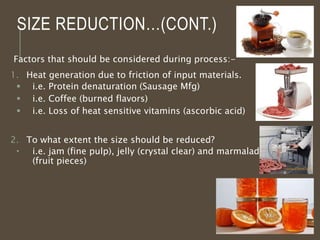
Factors that should be considered during process:-
1. Heat generation due to friction of input materials.
 i.e. Protein denaturation (Sausage Mfg)
 i.e. Coffee (burned flavors)
 i.e. Loss of heat sensitive vitamins (ascorbic acid)
2. To what extent the size should be reduced?
 i.e. jam (fine pulp), jelly (crystal clear) and marmalade
(fruit pieces)
4
SIZE REDUCTION
Size Reduction
Operation
Solid
Grinding
materials are
reduced in
size by
fracturing
them
Cutting
break down large
pieces of food into
smaller pieces
suitable for further
processing
Liquid
Emulsification
Emulsions are stable
suspensions of one
liquid in another, the
liquids being immiscible
5
ENERGY USED IN GRINDING
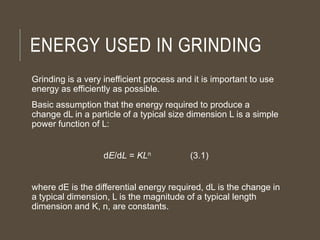
Grinding is a very inefficient process and it is important to use
energy as efficiently as possible.
Basic assumption that the energy required to produce a
change dL in a particle of a typical size dimension L is a simple
power function of L:
dE/dL = KLn (3.1)
where dE is the differential energy required, dL is the change in
a typical dimension, L is the magnitude of a typical length
dimension and K, n, are constants.
ENERGY USED IN GRINDING-
KICK’S LAW
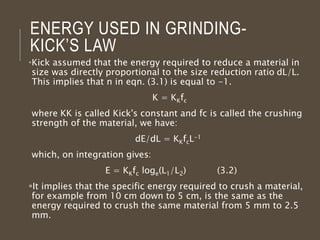
•Kick assumed that the energy required to reduce a material in
size was directly proportional to the size reduction ratio dL/L.
This implies that n in eqn. (3.1) is equal to -1.
K = KKfc
where KK is called Kick's constant and fc is called the crushing
strength of the material, we have:
dE/dL = KKfcL-1
which, on integration gives:
E = KKfc loge(L1/L2) (3.2)
It implies that the specific energy required to crush a material,
for example from 10 cm down to 5 cm, is the same as the
energy required to crush the same material from 5 mm to 2.5
mm.
ENERGY USED IN GRINDING-
RITTINGER’S LAW
Energy required for size reduction is directly
proportional, not to the change in length dimensions,
but to the change in surface area. This leads to a value of
-2 for n in eqn. (3.1) as area is proportional to length
squared.
K=KRfc
and so
dE/dL = KRfcL-2
where KR is called Rittinger's constant, and integrate the
resulting form of eqn. (3.1), we obtain:
E = KRfc(1/L2 – 1/L1) (3.3)
ENERGY USED IN GRINDING-
RITTINGER’S LAW
As the specific surface of a particle, the surface area per
unit mass, is proportional to 1/L.
Eqn. (3.3) postulates that the energy required to reduce L
for a mass of particles from 10 cm to 5 cm would be the
same as that required to reduce, for example, the same
mass of 5 mm particles down to 4.7 mm.
This is a very much smaller reduction, in terms of energy
per unit mass for the smaller particles, than that
predicted by Kick's Law.
ENERGY USED IN GRINDING-
RITTINGER’S LAW
Experimentally, that for the grinding of coarse
particles in which the increase in surface area
per unit mass is relatively small, Kick's Law is a
reasonable approximation.
For the size reduction of fine powders-in which
large areas of new surface are being created,
Rittinger's Law fits the experimental data
better.
ENERGY USED IN GRINDING-
BOND’S LAW
Bond has suggested an intermediate course, in which he
postulates that n is -3/2 and this leads to:
E = Ei (100/L2)1/2[1 - (1/q1/2)] (3.4)
Bond defines the quantity Ei by this equation: L is
measured in microns in eqn. (3.4) and so Ei is the
amount of energy required to reduce unit mass of the
material from an infinitely large particle size down to a
particle size of 100 mm. It is expressed in terms of q,
the reduction ratio where q = L1/L2.
NEW SURFACE FORMED BY
GRINDING
When a uniform particle is crushed, after the
first crushing the size of the particles produced
will vary a great deal from relatively coarse to
fine and even to dust.
As the grinding continues, the coarser particles
will be further reduced but there will be less
change in the size of the fine particles.
NEW SURFACE FORMED BY
GRINDING
The surface area of a fine particulate material is
large and can be important. Most reactions are
related to the surface area available, so the surface
area can have a considerable bearing on the
properties of the material.
Specific surface, the surface area per unit mass
To calculate specific surface in a known mass of
material it is necessary to know the particle-size
distribution and, also the shape factor of the
particles.
NEW SURFACE FORMED BY
GRINDING
The particle size gives one dimension that can be called the
typical dimension, Dp, of a particle. This has now to be related
to the surface area.
Vp = pDp
3
and
Ap= 6qDp
2
where Vp is the volume of the particle, Ap is the area of the
particle surface, Dp is the typical dimension of the particle and
p, q are factors which connect the particle geometries.
For example, for a cube, the volume is Dp3 and the surface area
is 6Dp
2; for a sphere the volume is (p/6)Dp
3 and the surface area
is pDp
2 In each case the ratio of surface area to volume is 6/Dp
NEW SURFACE FORMED BY
GRINDING
Shape factor, q/p = l
For cube and sphere, l=1
The shape factor for many materials, l=1.75
Ratio of surface area to volume;
Ap/Vp= 6l /Dp
Ap=6qVp / pDp =6l(Vp/Dp) (3.5)
If there is a mass m of particles of density rp, the number of particles is m/rpVp
each of area Ap.
At = (m/rpVp) x ( 6qVp/pDp) = 6qm/rp pDp
= 6lm /rDp (3.5)
where At is the total area of the mass of particles
THE END

Size_Reduction.pptx

  • 1.
  • 2.
    CHAPTER OUTLINE 3.1 SizeReduction 3.2 Mixing 3.3 Separation 3.4 Concentration (sub topic evaporation and freeze concentration will be covered in Chapter 4 and 5, respectively) 3.5 Irradiation 3.6 Fermentation
  • 3.
    3.1 SIZE REDUCTION Theconcept of size reduction is to reduce the size of raw materials by applying forces. Common techniques: blending, shearing, grating, cutting, slicing, grinding, chopping, dicing, flaking, milling, beating and etc. Various type of equipment are available however the usage is depends on the input materials and purpose of the process. 3
  • 4.
    SIZE REDUCTION…(CONT.) Factors thatshould be considered during process:- 1. Heat generation due to friction of input materials.  i.e. Protein denaturation (Sausage Mfg)  i.e. Coffee (burned flavors)  i.e. Loss of heat sensitive vitamins (ascorbic acid) 2. To what extent the size should be reduced?  i.e. jam (fine pulp), jelly (crystal clear) and marmalade (fruit pieces) 4
  • 5.
    SIZE REDUCTION Size Reduction Operation Solid Grinding materialsare reduced in size by fracturing them Cutting break down large pieces of food into smaller pieces suitable for further processing Liquid Emulsification Emulsions are stable suspensions of one liquid in another, the liquids being immiscible 5
  • 6.
    ENERGY USED INGRINDING Grinding is a very inefficient process and it is important to use energy as efficiently as possible. Basic assumption that the energy required to produce a change dL in a particle of a typical size dimension L is a simple power function of L: dE/dL = KLn (3.1) where dE is the differential energy required, dL is the change in a typical dimension, L is the magnitude of a typical length dimension and K, n, are constants.
  • 7.
    ENERGY USED INGRINDING- KICK’S LAW •Kick assumed that the energy required to reduce a material in size was directly proportional to the size reduction ratio dL/L. This implies that n in eqn. (3.1) is equal to -1. K = KKfc where KK is called Kick's constant and fc is called the crushing strength of the material, we have: dE/dL = KKfcL-1 which, on integration gives: E = KKfc loge(L1/L2) (3.2) It implies that the specific energy required to crush a material, for example from 10 cm down to 5 cm, is the same as the energy required to crush the same material from 5 mm to 2.5 mm.
  • 8.
    ENERGY USED INGRINDING- RITTINGER’S LAW Energy required for size reduction is directly proportional, not to the change in length dimensions, but to the change in surface area. This leads to a value of -2 for n in eqn. (3.1) as area is proportional to length squared. K=KRfc and so dE/dL = KRfcL-2 where KR is called Rittinger's constant, and integrate the resulting form of eqn. (3.1), we obtain: E = KRfc(1/L2 – 1/L1) (3.3)
  • 9.
    ENERGY USED INGRINDING- RITTINGER’S LAW As the specific surface of a particle, the surface area per unit mass, is proportional to 1/L. Eqn. (3.3) postulates that the energy required to reduce L for a mass of particles from 10 cm to 5 cm would be the same as that required to reduce, for example, the same mass of 5 mm particles down to 4.7 mm. This is a very much smaller reduction, in terms of energy per unit mass for the smaller particles, than that predicted by Kick's Law.
  • 10.
    ENERGY USED INGRINDING- RITTINGER’S LAW Experimentally, that for the grinding of coarse particles in which the increase in surface area per unit mass is relatively small, Kick's Law is a reasonable approximation. For the size reduction of fine powders-in which large areas of new surface are being created, Rittinger's Law fits the experimental data better.
  • 11.
    ENERGY USED INGRINDING- BOND’S LAW Bond has suggested an intermediate course, in which he postulates that n is -3/2 and this leads to: E = Ei (100/L2)1/2[1 - (1/q1/2)] (3.4) Bond defines the quantity Ei by this equation: L is measured in microns in eqn. (3.4) and so Ei is the amount of energy required to reduce unit mass of the material from an infinitely large particle size down to a particle size of 100 mm. It is expressed in terms of q, the reduction ratio where q = L1/L2.
  • 12.
    NEW SURFACE FORMEDBY GRINDING When a uniform particle is crushed, after the first crushing the size of the particles produced will vary a great deal from relatively coarse to fine and even to dust. As the grinding continues, the coarser particles will be further reduced but there will be less change in the size of the fine particles.
  • 13.
    NEW SURFACE FORMEDBY GRINDING The surface area of a fine particulate material is large and can be important. Most reactions are related to the surface area available, so the surface area can have a considerable bearing on the properties of the material. Specific surface, the surface area per unit mass To calculate specific surface in a known mass of material it is necessary to know the particle-size distribution and, also the shape factor of the particles.
  • 14.
    NEW SURFACE FORMEDBY GRINDING The particle size gives one dimension that can be called the typical dimension, Dp, of a particle. This has now to be related to the surface area. Vp = pDp 3 and Ap= 6qDp 2 where Vp is the volume of the particle, Ap is the area of the particle surface, Dp is the typical dimension of the particle and p, q are factors which connect the particle geometries. For example, for a cube, the volume is Dp3 and the surface area is 6Dp 2; for a sphere the volume is (p/6)Dp 3 and the surface area is pDp 2 In each case the ratio of surface area to volume is 6/Dp
  • 15.
    NEW SURFACE FORMEDBY GRINDING Shape factor, q/p = l For cube and sphere, l=1 The shape factor for many materials, l=1.75 Ratio of surface area to volume; Ap/Vp= 6l /Dp Ap=6qVp / pDp =6l(Vp/Dp) (3.5) If there is a mass m of particles of density rp, the number of particles is m/rpVp each of area Ap. At = (m/rpVp) x ( 6qVp/pDp) = 6qm/rp pDp = 6lm /rDp (3.5) where At is the total area of the mass of particles
  • 16.