Co-funded by the Asylum, Migration and Integration Fund of the European Union.
PROGRAMME
Background:
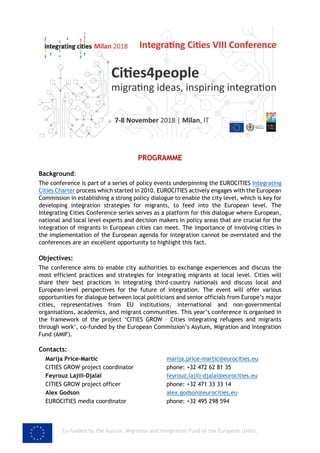
The conference is part of a series of policy events underpinning the EUROCITIES Integrating
Cities Charter process which started in 2010. EUROCITIES actively engages with the European
Commission in establishing a strong policy dialogue to enable the city level, which is key for
developing integration strategies for migrants, to feed into the European level. The
Integrating Cities Conference series serves as a platform for this dialogue where European,
national and local level experts and decision makers in policy areas that are crucial for the
integration of migrants in European cities can meet. The importance of involving cities in
the implementation of the European agenda for integration cannot be overstated and the
conferences are an excellent opportunity to highlight this fact.
Objectives:
The conference aims to enable city authorities to exchange experiences and discuss the
most efficient practices and strategies for integrating migrants at local level. Cities will
share their best practices in integrating third-country nationals and discuss local and
European-level perspectives for the future of integration. The event will offer various
opportunities for dialogue between local politicians and senior officials from Europe’s major
cities, representatives from EU institutions, international and non-governmental
organisations, academics, and migrant communities. This year’s conference is organised in
the framework of the project ‘CITIES GROW – Cities integrating refugees and migrants
through work’, co-funded by the European Commission’s Asylum, Migration and Integration
Fund (AMIF).
Contacts:
Marija Price-Martic
CITIES GROW project coordinator
marija.price-martic@eurocities.eu
phone: +32 472 62 81 35
Feyrouz Lajili-Djalaï
CITIES GROW project officer
feyrouz.lajili-djalai@eurocities.eu
phone: +32 471 33 33 14
Alex Godson
EUROCITIES media coordinator
alex.godson@eurocities.eu
phone: +32 495 298 594
Co-funded by the Asylum, Migration and Integration Fund of the European Union.
Wednesday, 7 November 2018
Venue: Fabbrica del Vapore, Via Giulio Cesare Procaccini 4, 20154 Milan
8.15 – 8.50
Welcome desk
Registration
Artistic exhibition sponsored by the European Commission Joint Research
Centre
9.00 – 9.50
Plenary room
1st
floor
Conference opening & welcome speeches
Moderator: Nathalie Guri, EUROCITIES projects director
9.00-9.15 Anna Scavuzzo, deputy mayor of Milan
9.15-9.30 Anna Lisa Boni, secretary general, EUROCITIES
9.30-9.50 Keynote speech
Olivier Onidi, deputy director-general Migration and Home Affairs,
European Commission
9.50-10.10 Integrating Cities Charter signing ceremony
Georgos Dimarelos, Thessaloniki deputy mayor for urban resilience and
development programmes
Sonia Schellino, Turin deputy mayor for welfare
10.10 – 10.30
Plenary room
1st
floor
Inspiring Data on Migration - Knowledge Centre on Migration and
Demography of the European Commission Joint Research Centre
Charlina Vitcheva, Deputy director general of the Joint Research Centre
10.30 – 10.50
Plenary room
1st
floor
The Global Compact for Migration – why it matters for cities
Colleen Thouez, Open Society Foundations – International Migration
Initiative
10.50 – 12.50 Parallel workshops - session I (please see the Workshops sheet)
(20 min coffee break inside workshop rooms)
Workshop 1
Room 3, ground
floor
Labour market integration at local level: partnerships, strategies and
practices for effective integration
Workshop 2
Room 1, ground
floor
Promoting effective labour market integration of migrants and refugees –
the OECD checklist for integration at local level
Workshop 3
Room 2, ground
floor
Minors of migrant background in cities: challenges and good practices for
integration
Workshop 4
Room 4, separate
entrance
Solidarity Cities initiative: cities as key actors of reception and early
integration
12.50 – 13.50
Plenary room
1st
floor
Lunch break
Co-funded by the Asylum, Migration and Integration Fund of the European Union.
13.55 – 14.55 Projects & best practices corner (please see the Projects Corner sheet)
The following projects and initiatives will be presented:
Plenary room
1st
floor
1. CITIES GROW (Cities integrating refugees and migrants through work),
presented by EUROCITIES
Plenary room
1st
floor
2. Milan Service Centre for Unaccompanied Migrant Minors, presented by the
city of Milan
Foyer, ground
floor
3. Data for integration, presented by the European Commission's Knowledge
Centre on Migration and Demography of the Joint Research Centre
Foyer, ground
floor
4. Masterplan for the integration of refugees, presented by the city of Munich
Foyer, ground
floor
5. MiFriendly cities, presented by Sue Lukes (MigrationWork) on behalf of three
partner cities: Coventry, Birmingham and Wolverhampton
15.00 – 17.00 Parallel workshops - session II (please see the Workshops sheet)
(20 min coffee break inside workshop rooms)
Workshop 5
Room 3, ground
floor
Funding and partnerships for integration in cities: innovative schemes and
better access to EU funds
Workshop 6
Room 1, ground
floor
Role of volunteers and civil society organisations for integration in cities –
public sector/civil society partnership
Workshop 7
Room 4, separate
entrance
Gender and migration – integration of women migrants
Workshop 8
Room 2, ground
floor
Undocumented migrants: possible solutions to ensure access to services
17.00 – 18.00
Plenary room
1st
floor
Networking & cocktail hour
19.30
Individual
transport to
the Museum
Guided Tour of the permanent collection of the Museo delle Culture di
Milano followed by the Integrating Cities cocktail dinner hosted by the
city of Milan
Venue: MUDEC MUSEUM, 56 Via Tortona, 20144 Milan
Don’t forget to tweet!
@EUROCITIEStweet
@IntegratingCTs
#IntCities2018
Wifi name: Integrating-Cities
Wifi password: Integrating-Cities-
2018
Co-funded by the Asylum, Migration and Integration Fund of the European Union.
Thursday, 8 November 2018
Venue: Fabbrica del Vapore, 4 Via Giulio Cesare Procaccini, 20154 Milan
8.15 - 8.50
Welcome desk
Registration
9.00 – 11.00
Plenary room
1st
floor
Panel debate - key challenges and possible solutions for integration at local
level
Moderator: Mark Bendeich, bureau chief, Southern Europe at Thomson Reuters
Short presentation of the workshops’ main conclusions by four rapporteurs followed by
a debate.
Pierfrancesco Majorino, deputy mayor of Milan for Social Affairs
Andreas Germershausen, Berlin Senate commissioner for integration and
migration
Lola Lopez, Barcelona commissioner for immigration, interculturality and
diversity
Asher Craig, Bristol deputy mayor with responsibility for Communities, Events
and Equalities
Michele Levoy, director, Platform for International Cooperation on
Undocumented Migrants
Namarig Abkr, European Migrant Advisory Board
11.00 - 11.30
Plenary room
1st
floor
Coffee break
11.30 – 13.30
Plenary room
1st
floor
Panel debate – European and local level perspectives on the future of
integration
Moderator: Mark Bendeich, bureau chief, Southern Europe at Thomson Reuters
Presentation of findings from the EUROCITIES Integrating Cities Charter monitoring
report:
Eleftherios Papagiannakis, deputy mayor of Athens
Panel reaction, followed by discussion
Thomas Fabian, Leipzig deputy mayor for social affairs
Anna Terron, director of the International and Ibero-American Foundation for
Administration and Public Policies and expert on migration
Laura Corrado, head of unit Legal Migration and Integration, Directorate-
General Migration and Home Affairs, European Commission
Raquel Cortes-Herrera, deputy head of unit Disability & Inclusion, Directorate-
General Employment, Social Affairs and Inclusion, European Commission
Roland Schilling, regional deputy representative, UNHCR Regional Office Italy
Andrea Pastorelli, programme coordinator, IOM Coordination Office for the
Mediterranean
13.30 – 14.30
Plenary room
1st
floor
Lunch break
Co-funded by the Asylum, Migration and Integration Fund of the European Union.
14.30 – 17.30
Meeting point:
Foyer, ground
floor
Parallel site visits hosted by the city of Milan
Site visit locations are 30 minutes away from the conference venue, which is the
departure and return point for the visits.
Site visit 1
Bus transport
Reception centres for asylum-seekers and refugees
The visit will present the Milanese reception system through two different kinds of
centres that belong to the Italian national model of CAS-Centres for Extraordinary
Reception (first level of reception of asylum seekers) and SPRAR-Protection System for
Asylum Seekers and Refugees (second level of reception for refugees, more focussed on
inclusion). We will visit:
Casa Chiaravalle is the symbol of the fight against mafia in Milan. It represents the
biggest estate confiscated from the mafia in the Lombardy region. In May 2018 it was
inaugurated to host the project called ‘Insieme Casa Chiaravalle’ (Together Casa
Chiaravalle). Thanks to this project the building has been converted into a shelter
mainly for Italian and foreign women, especially victims of violence, abuse, torture and
trafficking. Their families and their children are hosted in the same space. In Casa
Chiaravalle women are helped to start a new life. Casa Chiaravalle also hosts a section
that works as a reception centre for asylum seekers (CAS), while they are waiting for
the outcome of their asylum application.
Casa Monlué is an old school located in a park on the outskirts of Milan, now managed
by a not-for-profit organisation following a public call for tenders issued by the city of
Milan. The building has been turned into a centre that hosts refugees within the national
Protection System for Asylum Seekers and Refugees (SPRAR) run by the municipality of
Milan and funded and coordinated by the Italian Ministry of Interior.
Delegates will meet the officers of the municipality in charge of the CAS and SPRAR
centres for adults, as well as the coordinator and professionals working in Casa
Chiaravalle and Casa Monlué.
Site visit 2
Bus transport
Integration projects in schools - 1
Visit of the Muzio primary School, where the association of parents is piloting the peer-
parent tutoring program: it is a help desk, created thanks to the financial support of the
US Consulate General in Milan. Its aim is to reach children of migrant background by
helping their parents with school bureaucracy and strengthen relationships between
families, the school and the community. The underlying idea is that old time immigrant
families are knowledgeable both about their own culture’s values, beliefs, needs and
practices and about the host country systems that they have learned to navigate. They
can more effectively help newcomers to understand these systems because of their own
experience.
Participants will have the chance to meet with the teacher who started the project, Ms
Laura Sidoti, the US Consulate General in Milan, which funds the projects, and some
mothers who volunteer at the help desk. Moreover, the Education Department of the
City of Milan will explain the work the municipality of Milan is doing to fight the
increasing ‘white flight’ phenomenon.
Site visit 3
Bus transport
Integration projects in schools – 2
Visit of the ‘Home of the Sun’ primary school, a very special school located in a beautiful
park in a neighbourhood very densely populated by foreign citizens.
Participants will have a chance to meet with the principal and some teachers of the
school specialised in intercultural teaching, and the association of parents of children
attending the school, who will illustrate the various activities (cultivation of the garden,
animals, open air sports, intercultural readings).
Moreover, the Education Department of the City of Milan will explain the work the
municipality of Milan is doing to fight the increasing ‘white flight’ phenomenon.
Co-funded by the Asylum, Migration and Integration Fund of the European Union.
Site visit 4
Reserved for the WORKING GROUP MIGRATION members
Labour integration: Visit of the Centre for Job Orientation and Placement (CELAV)
of the city of Milan, Social Emergencies, Rights and Inclusion Department
The goal of CELAV is to promote the professional and socio-economic integration of
people, above all people in need of greater support. There are various specialised teams
in CELAV – the centre’s philosophy is to work on the complexity and specificity of the
different needs, avoiding standardised interventions. One of the teams focuses on
refugees and asylum seekers.
During the visit the team working for refugees’ labour integration will present the
services offered at the centre, information about its users and the results achieved thus
far. Some of the centre’s younger clients will tell their stories.
The ‘Bella Milano’ (Beautiful Milan) initiative will also be presented. Through this
initiative asylum seekers living in the reception centres volunteer together with
Milanese citizens in taking care of public spaces in the city (cleaning of green spaces,
emptying the bins, etc). These vocational activities aim to foster the culture of
integration and allow the refugees to experience life outside the centres, practice their
Italian language and establish a positive relationship with the neighbourhood they live
in.
The site visit will end with a ‘Milanese aperitivo’ (drink & some food) at Fondazione
Umanitaria, one of the partners of CELAV. The Fondazione Umanitaria (‘Humanitarian
Foundation’) is a historical not-for-profit organisation in Milan. The foundation
implements integration and professional training paths in cooperation with the CELAV.
The aperitif will be prepared by young refugees and migrants who take part in the
professional training course for bakery, pizzeria and cafeteria work placements in the
gastronomic sector. We will listen to the testimony of some of those workers. Other
partner companies will also be present, as a further possibility to learn about the
collaboration paths in progress and the services offered in cooperation with CELAV.
Don’t forget to tweet!
@EUROCITIEStweet
@IntegratingCTs
#IntCities2018
Wifi name: Integrating-Cities
Wifi password: Integrating-Cities-
2018

Final programme integrating cities VIII

  • 1.
    Co-funded by theAsylum, Migration and Integration Fund of the European Union. PROGRAMME Background: The conference is part of a series of policy events underpinning the EUROCITIES Integrating Cities Charter process which started in 2010. EUROCITIES actively engages with the European Commission in establishing a strong policy dialogue to enable the city level, which is key for developing integration strategies for migrants, to feed into the European level. The Integrating Cities Conference series serves as a platform for this dialogue where European, national and local level experts and decision makers in policy areas that are crucial for the integration of migrants in European cities can meet. The importance of involving cities in the implementation of the European agenda for integration cannot be overstated and the conferences are an excellent opportunity to highlight this fact. Objectives: The conference aims to enable city authorities to exchange experiences and discuss the most efficient practices and strategies for integrating migrants at local level. Cities will share their best practices in integrating third-country nationals and discuss local and European-level perspectives for the future of integration. The event will offer various opportunities for dialogue between local politicians and senior officials from Europe’s major cities, representatives from EU institutions, international and non-governmental organisations, academics, and migrant communities. This year’s conference is organised in the framework of the project ‘CITIES GROW – Cities integrating refugees and migrants through work’, co-funded by the European Commission’s Asylum, Migration and Integration Fund (AMIF). Contacts: Marija Price-Martic CITIES GROW project coordinator marija.price-martic@eurocities.eu phone: +32 472 62 81 35 Feyrouz Lajili-Djalaï CITIES GROW project officer feyrouz.lajili-djalai@eurocities.eu phone: +32 471 33 33 14 Alex Godson EUROCITIES media coordinator alex.godson@eurocities.eu phone: +32 495 298 594
  • 2.
    Co-funded by theAsylum, Migration and Integration Fund of the European Union. Wednesday, 7 November 2018 Venue: Fabbrica del Vapore, Via Giulio Cesare Procaccini 4, 20154 Milan 8.15 – 8.50 Welcome desk Registration Artistic exhibition sponsored by the European Commission Joint Research Centre 9.00 – 9.50 Plenary room 1st floor Conference opening & welcome speeches Moderator: Nathalie Guri, EUROCITIES projects director 9.00-9.15 Anna Scavuzzo, deputy mayor of Milan 9.15-9.30 Anna Lisa Boni, secretary general, EUROCITIES 9.30-9.50 Keynote speech Olivier Onidi, deputy director-general Migration and Home Affairs, European Commission 9.50-10.10 Integrating Cities Charter signing ceremony Georgos Dimarelos, Thessaloniki deputy mayor for urban resilience and development programmes Sonia Schellino, Turin deputy mayor for welfare 10.10 – 10.30 Plenary room 1st floor Inspiring Data on Migration - Knowledge Centre on Migration and Demography of the European Commission Joint Research Centre Charlina Vitcheva, Deputy director general of the Joint Research Centre 10.30 – 10.50 Plenary room 1st floor The Global Compact for Migration – why it matters for cities Colleen Thouez, Open Society Foundations – International Migration Initiative 10.50 – 12.50 Parallel workshops - session I (please see the Workshops sheet) (20 min coffee break inside workshop rooms) Workshop 1 Room 3, ground floor Labour market integration at local level: partnerships, strategies and practices for effective integration Workshop 2 Room 1, ground floor Promoting effective labour market integration of migrants and refugees – the OECD checklist for integration at local level Workshop 3 Room 2, ground floor Minors of migrant background in cities: challenges and good practices for integration Workshop 4 Room 4, separate entrance Solidarity Cities initiative: cities as key actors of reception and early integration 12.50 – 13.50 Plenary room 1st floor Lunch break
  • 3.
    Co-funded by theAsylum, Migration and Integration Fund of the European Union. 13.55 – 14.55 Projects & best practices corner (please see the Projects Corner sheet) The following projects and initiatives will be presented: Plenary room 1st floor 1. CITIES GROW (Cities integrating refugees and migrants through work), presented by EUROCITIES Plenary room 1st floor 2. Milan Service Centre for Unaccompanied Migrant Minors, presented by the city of Milan Foyer, ground floor 3. Data for integration, presented by the European Commission's Knowledge Centre on Migration and Demography of the Joint Research Centre Foyer, ground floor 4. Masterplan for the integration of refugees, presented by the city of Munich Foyer, ground floor 5. MiFriendly cities, presented by Sue Lukes (MigrationWork) on behalf of three partner cities: Coventry, Birmingham and Wolverhampton 15.00 – 17.00 Parallel workshops - session II (please see the Workshops sheet) (20 min coffee break inside workshop rooms) Workshop 5 Room 3, ground floor Funding and partnerships for integration in cities: innovative schemes and better access to EU funds Workshop 6 Room 1, ground floor Role of volunteers and civil society organisations for integration in cities – public sector/civil society partnership Workshop 7 Room 4, separate entrance Gender and migration – integration of women migrants Workshop 8 Room 2, ground floor Undocumented migrants: possible solutions to ensure access to services 17.00 – 18.00 Plenary room 1st floor Networking & cocktail hour 19.30 Individual transport to the Museum Guided Tour of the permanent collection of the Museo delle Culture di Milano followed by the Integrating Cities cocktail dinner hosted by the city of Milan Venue: MUDEC MUSEUM, 56 Via Tortona, 20144 Milan Don’t forget to tweet! @EUROCITIEStweet @IntegratingCTs #IntCities2018 Wifi name: Integrating-Cities Wifi password: Integrating-Cities- 2018
  • 4.
    Co-funded by theAsylum, Migration and Integration Fund of the European Union. Thursday, 8 November 2018 Venue: Fabbrica del Vapore, 4 Via Giulio Cesare Procaccini, 20154 Milan 8.15 - 8.50 Welcome desk Registration 9.00 – 11.00 Plenary room 1st floor Panel debate - key challenges and possible solutions for integration at local level Moderator: Mark Bendeich, bureau chief, Southern Europe at Thomson Reuters Short presentation of the workshops’ main conclusions by four rapporteurs followed by a debate. Pierfrancesco Majorino, deputy mayor of Milan for Social Affairs Andreas Germershausen, Berlin Senate commissioner for integration and migration Lola Lopez, Barcelona commissioner for immigration, interculturality and diversity Asher Craig, Bristol deputy mayor with responsibility for Communities, Events and Equalities Michele Levoy, director, Platform for International Cooperation on Undocumented Migrants Namarig Abkr, European Migrant Advisory Board 11.00 - 11.30 Plenary room 1st floor Coffee break 11.30 – 13.30 Plenary room 1st floor Panel debate – European and local level perspectives on the future of integration Moderator: Mark Bendeich, bureau chief, Southern Europe at Thomson Reuters Presentation of findings from the EUROCITIES Integrating Cities Charter monitoring report: Eleftherios Papagiannakis, deputy mayor of Athens Panel reaction, followed by discussion Thomas Fabian, Leipzig deputy mayor for social affairs Anna Terron, director of the International and Ibero-American Foundation for Administration and Public Policies and expert on migration Laura Corrado, head of unit Legal Migration and Integration, Directorate- General Migration and Home Affairs, European Commission Raquel Cortes-Herrera, deputy head of unit Disability & Inclusion, Directorate- General Employment, Social Affairs and Inclusion, European Commission Roland Schilling, regional deputy representative, UNHCR Regional Office Italy Andrea Pastorelli, programme coordinator, IOM Coordination Office for the Mediterranean 13.30 – 14.30 Plenary room 1st floor Lunch break
  • 5.
    Co-funded by theAsylum, Migration and Integration Fund of the European Union. 14.30 – 17.30 Meeting point: Foyer, ground floor Parallel site visits hosted by the city of Milan Site visit locations are 30 minutes away from the conference venue, which is the departure and return point for the visits. Site visit 1 Bus transport Reception centres for asylum-seekers and refugees The visit will present the Milanese reception system through two different kinds of centres that belong to the Italian national model of CAS-Centres for Extraordinary Reception (first level of reception of asylum seekers) and SPRAR-Protection System for Asylum Seekers and Refugees (second level of reception for refugees, more focussed on inclusion). We will visit: Casa Chiaravalle is the symbol of the fight against mafia in Milan. It represents the biggest estate confiscated from the mafia in the Lombardy region. In May 2018 it was inaugurated to host the project called ‘Insieme Casa Chiaravalle’ (Together Casa Chiaravalle). Thanks to this project the building has been converted into a shelter mainly for Italian and foreign women, especially victims of violence, abuse, torture and trafficking. Their families and their children are hosted in the same space. In Casa Chiaravalle women are helped to start a new life. Casa Chiaravalle also hosts a section that works as a reception centre for asylum seekers (CAS), while they are waiting for the outcome of their asylum application. Casa Monlué is an old school located in a park on the outskirts of Milan, now managed by a not-for-profit organisation following a public call for tenders issued by the city of Milan. The building has been turned into a centre that hosts refugees within the national Protection System for Asylum Seekers and Refugees (SPRAR) run by the municipality of Milan and funded and coordinated by the Italian Ministry of Interior. Delegates will meet the officers of the municipality in charge of the CAS and SPRAR centres for adults, as well as the coordinator and professionals working in Casa Chiaravalle and Casa Monlué. Site visit 2 Bus transport Integration projects in schools - 1 Visit of the Muzio primary School, where the association of parents is piloting the peer- parent tutoring program: it is a help desk, created thanks to the financial support of the US Consulate General in Milan. Its aim is to reach children of migrant background by helping their parents with school bureaucracy and strengthen relationships between families, the school and the community. The underlying idea is that old time immigrant families are knowledgeable both about their own culture’s values, beliefs, needs and practices and about the host country systems that they have learned to navigate. They can more effectively help newcomers to understand these systems because of their own experience. Participants will have the chance to meet with the teacher who started the project, Ms Laura Sidoti, the US Consulate General in Milan, which funds the projects, and some mothers who volunteer at the help desk. Moreover, the Education Department of the City of Milan will explain the work the municipality of Milan is doing to fight the increasing ‘white flight’ phenomenon. Site visit 3 Bus transport Integration projects in schools – 2 Visit of the ‘Home of the Sun’ primary school, a very special school located in a beautiful park in a neighbourhood very densely populated by foreign citizens. Participants will have a chance to meet with the principal and some teachers of the school specialised in intercultural teaching, and the association of parents of children attending the school, who will illustrate the various activities (cultivation of the garden, animals, open air sports, intercultural readings). Moreover, the Education Department of the City of Milan will explain the work the municipality of Milan is doing to fight the increasing ‘white flight’ phenomenon.
  • 6.
    Co-funded by theAsylum, Migration and Integration Fund of the European Union. Site visit 4 Reserved for the WORKING GROUP MIGRATION members Labour integration: Visit of the Centre for Job Orientation and Placement (CELAV) of the city of Milan, Social Emergencies, Rights and Inclusion Department The goal of CELAV is to promote the professional and socio-economic integration of people, above all people in need of greater support. There are various specialised teams in CELAV – the centre’s philosophy is to work on the complexity and specificity of the different needs, avoiding standardised interventions. One of the teams focuses on refugees and asylum seekers. During the visit the team working for refugees’ labour integration will present the services offered at the centre, information about its users and the results achieved thus far. Some of the centre’s younger clients will tell their stories. The ‘Bella Milano’ (Beautiful Milan) initiative will also be presented. Through this initiative asylum seekers living in the reception centres volunteer together with Milanese citizens in taking care of public spaces in the city (cleaning of green spaces, emptying the bins, etc). These vocational activities aim to foster the culture of integration and allow the refugees to experience life outside the centres, practice their Italian language and establish a positive relationship with the neighbourhood they live in. The site visit will end with a ‘Milanese aperitivo’ (drink & some food) at Fondazione Umanitaria, one of the partners of CELAV. The Fondazione Umanitaria (‘Humanitarian Foundation’) is a historical not-for-profit organisation in Milan. The foundation implements integration and professional training paths in cooperation with the CELAV. The aperitif will be prepared by young refugees and migrants who take part in the professional training course for bakery, pizzeria and cafeteria work placements in the gastronomic sector. We will listen to the testimony of some of those workers. Other partner companies will also be present, as a further possibility to learn about the collaboration paths in progress and the services offered in cooperation with CELAV. Don’t forget to tweet! @EUROCITIEStweet @IntegratingCTs #IntCities2018 Wifi name: Integrating-Cities Wifi password: Integrating-Cities- 2018