
THE NECESSITY OF
NEEDS ANALYSES
Federico Espinosa
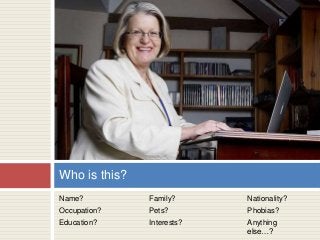
Name?
Occupation?
Education?
Who is this?
Family?
Pets?
Interests?
Nationality?
Phobias?
Anything
else…?
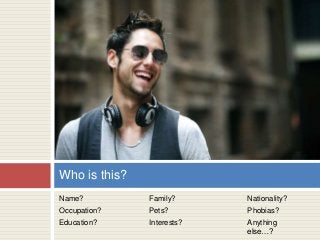
Name?
Occupation?
Education?
Who is this?
Family?
Pets?
Interests?
Nationality?
Phobias?
Anything
else…?
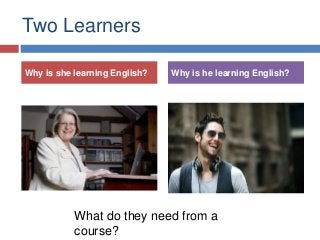
Two Learners
Why is she learning English? Why is he learning English?
What do they need from a
course?
What is a Needs Analysis?
A needs analysis is a means of
defining, as precisely as
possible, the learners’ language
needs and understanding what
they think they can obtain from
the language course.
(Source: TEFLpedia.com)
What’s the Point?
 It gives the teacher more of an idea
about how to adapt the course to the
student, rather than the student
having to adapt to the course
 It helps the student become more
aware of their role in the learning
process
(Source: TEFLpedia.com)
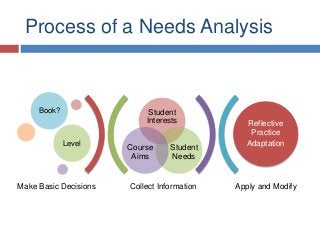
Process of a Needs Analysis
Collect Information Apply and Modify
Student
Interests
Student
Needs
Course
Aims
Book?
Level
Reflective
Practice
Adaptation
Make Basic Decisions
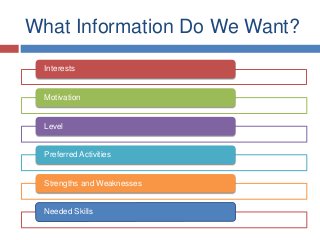
What Information Do We Want?
Interests
Motivation
Level
Preferred Activities
Strengths and Weaknesses
Needed Skills
How Do We Collect
Information?
A great first task for introducing yourself to
students, and learning a bit about each of
their lives
Personal Information
Icebreaker
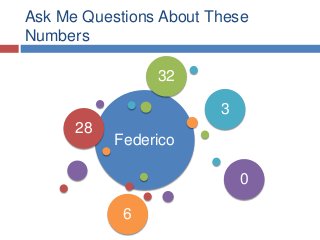
Ask Me Questions About These
Numbers
Federico
28
3
0
6
32
How it Works
 Students shout out questions, trying to get one
of the numbers as the answer (How old are
you?)
 For correct answers you write the explanation
(age, countries visited, years teaching)
 When completed, students create their own
and guess in pairs
How it Really Works
 Student questions inform their language
ability
 Complexity of Question
 Range of Vocabulary
 Student questions inform their personality
 Sense of Humor
 Boundaries
 Quiet vs. Outspoken
 Student’s own puzzles tell you about them
 Who owns three motorcycles?
 Who speaks five languages?
A communicative way to engage students in
the pros and cons of various
approaches/options for the class
Discussion Card Mingle
 Students are given a card with some statement about
language learning or classroom dynamics
 Students mingle to ask each other if they agree or
disagree with their statement
 Quick feedback is taken
 Students mingle again to attempt to convince others
to change their mind
 Full feedback is conducted to discuss what might work
best
Discussion Card Ideas
 I like to get up and move around the
classroom from time to time.
 I like to be told grammar rules.
 I find reading really useful
 I don’t like using a dictionary in class
 Writing should be done for homework
 I like to be corrected often
 I have time to do homework out of class
 I need a translation to really understand
vocabulary
 I think exam preparation
(FCE/CAE/CPE) is important.
 I don’t really enjoy discussing current
events in English
 After an activity, I like to compare my
answers to my partner.
 Games are boring
 Role plays are fun and useful.
 I learn new things best when I write
them down.
 I enjoy working out of a coursebook
 I am interested in doing work out of
class online
 Etc….
Activity Evaluation
 Gives time to talk
about various specific
points
 Encourages opinion
sharing and
discussion
 Clarifies definitions of
fuzzy concepts or
ideas
 Students may feel
there is a “right
answer”
 Requires a minimum
level of fluency
 Harder to manage in
larger groups
Advantages Disadvantages
A reflective task that more specifically
identifies group needs and interests
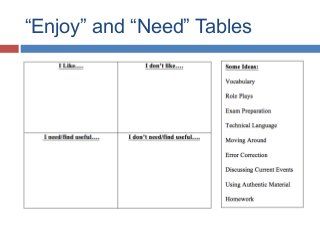
“Enjoy” and “Need” Tables
 Students individually complete the table without
consulting the teacher’s suggestions.
 Once they have written at least two things in each
box, they unfold their paper to see suggestions.
 When finished, students compare in pairs and
compromise to fill in a new table together.
 Pairs compare to a different pair and consolidate
again. Repeat until a full class table is completed.
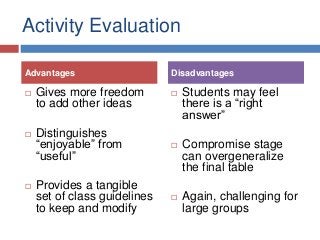
Activity Evaluation
 Gives more freedom
to add other ideas
 Distinguishes
“enjoyable” from
“useful”
 Provides a tangible
set of class guidelines
to keep and modify
 Students may feel
there is a “right
answer”
 Compromise stage
can overgeneralize
the final table
 Again, challenging for
large groups
Advantages Disadvantages
Some ideas for collecting information from
larger groups in lecture hall settings
Feedback for Large Groups
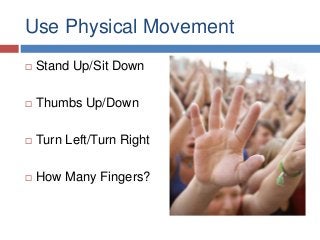
Use Physical Movement
 Stand Up/Sit Down
 Thumbs Up/Down
 Turn Left/Turn Right
 How Many Fingers?
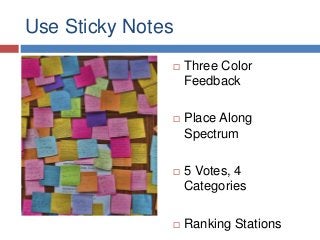
Use Sticky Notes
 Three Color
Feedback
 Place Along
Spectrum
 5 Votes, 4
Categories
 Ranking Stations
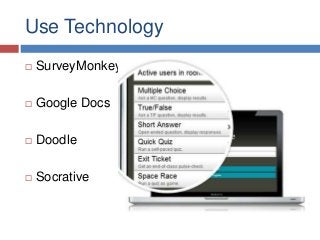
Use Technology
 SurveyMonkey
 Google Docs
 Doodle
 Socrative
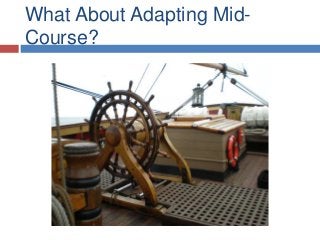
What About Adapting Mid-
Course?
Throughout the course come back to the
table and have the class make any changes
to the original Need/Don’t Need/Like/Don’t
Like topics
Revisiting Class Needs
Tables
A writing and speaking activity to assess
potential changes to a continuing course
Petitions
How it Works
 Students write a sentence or two listing a
change they want made to the class
 They mill around the room looking for
signatures to their petition from other students
 At the end the petitions get handed up to the
front and the most popular options are
discussed
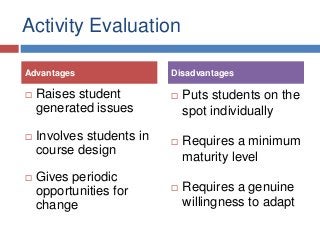
Activity Evaluation
 Raises student
generated issues
 Involves students in
course design
 Gives periodic
opportunities for
change
 Puts students on the
spot individually
 Requires a minimum
maturity level
 Requires a genuine
willingness to adapt
Advantages Disadvantages
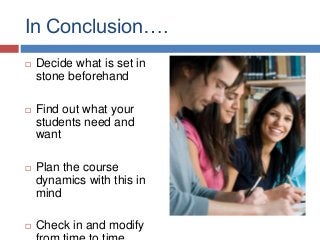
In Conclusion….
 Decide what is set in
stone beforehand
 Find out what your
students need and
want
 Plan the course
dynamics with this in
mind
 Check in and modify
Thank You!
 Slides for this presentation are
available at:
tinyURL.com/needtoanalyze
 Or through my blog at:
fedEFL.blogspot.com

The Necessity of Needs Analyses

  • 1.
    THE NECESSITY OF NEEDSANALYSES Federico Espinosa
  • 2.
  • 3.
  • 4.
    Two Learners Why isshe learning English? Why is he learning English? What do they need from a course?
  • 5.
    What is aNeeds Analysis? A needs analysis is a means of defining, as precisely as possible, the learners’ language needs and understanding what they think they can obtain from the language course. (Source: TEFLpedia.com)
  • 6.
    What’s the Point? It gives the teacher more of an idea about how to adapt the course to the student, rather than the student having to adapt to the course  It helps the student become more aware of their role in the learning process (Source: TEFLpedia.com)
  • 7.
    Process of aNeeds Analysis Collect Information Apply and Modify Student Interests Student Needs Course Aims Book? Level Reflective Practice Adaptation Make Basic Decisions
  • 8.
    What Information DoWe Want? Interests Motivation Level Preferred Activities Strengths and Weaknesses Needed Skills
  • 9.
    How Do WeCollect Information?
  • 10.
    A great firsttask for introducing yourself to students, and learning a bit about each of their lives Personal Information Icebreaker
  • 11.
    Ask Me QuestionsAbout These Numbers Federico 28 3 0 6 32
  • 12.
    How it Works Students shout out questions, trying to get one of the numbers as the answer (How old are you?)  For correct answers you write the explanation (age, countries visited, years teaching)  When completed, students create their own and guess in pairs
  • 13.
    How it ReallyWorks  Student questions inform their language ability  Complexity of Question  Range of Vocabulary  Student questions inform their personality  Sense of Humor  Boundaries  Quiet vs. Outspoken  Student’s own puzzles tell you about them  Who owns three motorcycles?  Who speaks five languages?
  • 14.
    A communicative wayto engage students in the pros and cons of various approaches/options for the class Discussion Card Mingle
  • 15.
    Discussion Card Mingle Students are given a card with some statement about language learning or classroom dynamics  Students mingle to ask each other if they agree or disagree with their statement  Quick feedback is taken  Students mingle again to attempt to convince others to change their mind  Full feedback is conducted to discuss what might work best
  • 16.
    Discussion Card Ideas I like to get up and move around the classroom from time to time.  I like to be told grammar rules.  I find reading really useful  I don’t like using a dictionary in class  Writing should be done for homework  I like to be corrected often  I have time to do homework out of class  I need a translation to really understand vocabulary  I think exam preparation (FCE/CAE/CPE) is important.  I don’t really enjoy discussing current events in English  After an activity, I like to compare my answers to my partner.  Games are boring  Role plays are fun and useful.  I learn new things best when I write them down.  I enjoy working out of a coursebook  I am interested in doing work out of class online  Etc….
  • 17.
    Activity Evaluation  Givestime to talk about various specific points  Encourages opinion sharing and discussion  Clarifies definitions of fuzzy concepts or ideas  Students may feel there is a “right answer”  Requires a minimum level of fluency  Harder to manage in larger groups Advantages Disadvantages
  • 18.
    A reflective taskthat more specifically identifies group needs and interests “Enjoy” and “Need” Tables
  • 19.
  • 20.
    “Enjoy” and “Need”Tables  Students individually complete the table without consulting the teacher’s suggestions.  Once they have written at least two things in each box, they unfold their paper to see suggestions.  When finished, students compare in pairs and compromise to fill in a new table together.  Pairs compare to a different pair and consolidate again. Repeat until a full class table is completed.
  • 21.
    Activity Evaluation  Givesmore freedom to add other ideas  Distinguishes “enjoyable” from “useful”  Provides a tangible set of class guidelines to keep and modify  Students may feel there is a “right answer”  Compromise stage can overgeneralize the final table  Again, challenging for large groups Advantages Disadvantages
  • 22.
    Some ideas forcollecting information from larger groups in lecture hall settings Feedback for Large Groups
  • 23.
    Use Physical Movement Stand Up/Sit Down  Thumbs Up/Down  Turn Left/Turn Right  How Many Fingers?
  • 24.
    Use Sticky Notes Three Color Feedback  Place Along Spectrum  5 Votes, 4 Categories  Ranking Stations
  • 25.
    Use Technology  SurveyMonkey Google Docs  Doodle  Socrative
  • 26.
    What About AdaptingMid- Course?
  • 27.
    Throughout the coursecome back to the table and have the class make any changes to the original Need/Don’t Need/Like/Don’t Like topics Revisiting Class Needs Tables
  • 28.
    A writing andspeaking activity to assess potential changes to a continuing course Petitions
  • 29.
    How it Works Students write a sentence or two listing a change they want made to the class  They mill around the room looking for signatures to their petition from other students  At the end the petitions get handed up to the front and the most popular options are discussed
  • 30.
    Activity Evaluation  Raisesstudent generated issues  Involves students in course design  Gives periodic opportunities for change  Puts students on the spot individually  Requires a minimum maturity level  Requires a genuine willingness to adapt Advantages Disadvantages
  • 31.
    In Conclusion….  Decidewhat is set in stone beforehand  Find out what your students need and want  Plan the course dynamics with this in mind  Check in and modify
  • 32.
    Thank You!  Slidesfor this presentation are available at: tinyURL.com/needtoanalyze  Or through my blog at: fedEFL.blogspot.com