






BEYOND DEMOGRAPHIC BOUNDARY:
DETERMINING GENERATIONAL VALUES BY COHORTS
MAG Scholar Conference 2014
Ernest Cyril de Run & Hiram Ting
Universiti Malaysia Sarawak,
94300 Kota Samarahan,
Sarawak, Malaysia.
Universiti Malaysia Sarawak (UNIMAS)
Acknowledgement
This paper is based on research at Universiti Malaysia Sarawak (UNIMAS)
under Fundamental Research Grant Scheme (No: FRGS/2/2013/SS05/UNIMAS/01/1).
The authors express their gratitude to Ministry of Higher Education (MOHE)
and UNIMAS for sponsoring the research carried out.
Introduction
Universiti Malaysia Sarawak (UNIMAS)
• For many years, segmentation strategies such as those based on
demographic and psychographic bases have been utilized to better meet
customers’ needs and wants (Kotler & Armstrong, 2011).
• However an innovative and highly successful profiling method utilizing
generational cohort is emerging as prominent approach and becoming
increasingly useful in tracking consumer behaviours (Meredith & Schewe,
2002).
• Despite being recognized as a demographic factor, generation unveils more
than what a population trend does. Notably, Generation X and Generation
Y, amongst others, are extensively appropriated to categorize and
characterize consumers in marketplaces, not only in the West but also in the
East.
Introduction (cont.)
Universiti Malaysia Sarawak (UNIMAS)
• Despite the complexity in diverse societies, personal value is an evident
reflection of human behaviours, including attitudes, consumption patterns,
and actual actions (Kamakura & Novak; 1992; White, 2005).
• Personal value is described as individual belief about what is more
preferable, and is thus related to inner desire (Solomon, 2011).
• While generational cohort is generally accepted as a demographic factor,
personal value is regarded as a psychographic factor (Kotler & Armstrong,
2011).
Problem Statement
Universiti Malaysia Sarawak (UNIMAS)
• Generational cohorts and their respective values from western sources are
time and again generalized in other settings, including developing countries
like Malaysia (Chuah, Marimuthu & Ramayah, 2014; Munusamy & Wong, 2007;
Ramaprasad, 1994).
• The segregation of these cohorts is conveniently adopted to profile and
understand customers, and explain their behaviours without theoretical
basis (de Run & Ting, 2013).
• Moreover, since little is known about actual generational cohort in
Malaysia, differences of personal values across cohorts still remain largely
unknown.
Purpose of Study
Universiti Malaysia Sarawak (UNIMAS)
• The present study is a part of a larger study which is aimed to investigate
personal values across different generational cohorts by using List of
Values (LOV), so as to determine generational values by cohorts.
• Instead of using western cohorts, the recently established cohorts in
Sarawak are adopted to determine generational values in the state.
Brief Literature Review
Universiti Malaysia Sarawak (UNIMAS)
Generational Cohort
• Labels of generational cohorts, such Veterans, Baby boomers, Generation X
and Generation Y from the U.S sources, have been commonly used to classify
consumers and understand their distinctive characteristics in marketing
literature (Cennamo & Gardner, 2008; Munusamy et al., 2010; Yu & Miller, 2003).
• A generational cohort is defined as an individual group, who shares about the
same age, born during the same time period, and experiences similar major
external events during the developmental stages (Edmunds & Tuner, 2005;
Kupperschmidt, 2000; Ryder, 1965; Smola & Sutton, 2002).
• The theory of historical generations proposed by Rogler (2002) emphasizes
that major societal events instill greater and more permanent marks on the
coming-of-age group than on other age-groups who live through the same
period. Their personal attachment to these events will consolidate in them
permanent orientation, thus affecting them throughout their lives (Rogler, 2002).
Brief Literature Review (cont.)
Universiti Malaysia Sarawak (UNIMAS)
Personal Values
• List of Values (LOV) is adopted in the study due to its relative ease of use yet
better predictive relevance (Goldsmith & Kilsheimer, 1993; Kahle, Beatty, & Homer, 1986).
It is composed of three dimensions.
• Internal value is generally about how a person is internally fulfilled (Jago, 1997),
and is measured by self fulfillment, self respect, sense of accomplishment, and
excitement.
• External value hinges more on exterior factors, such as peers (Homer & Kahle,
1988) and is measured by sense of security, sense of belonging, and being well
respected.
• Interpersonal value is a combination of the two former values (Kahle, 1991) and
is measured by fun and enjoyment in life, and warm relationship.
Brief Literature Review (cont.)
Universiti Malaysia Sarawak (UNIMAS)
Segmentation Approach
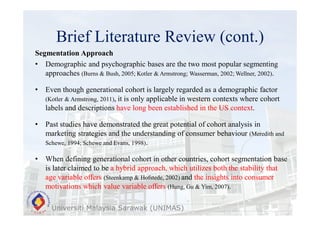
• Demographic and psychographic bases are the two most popular segmenting
approaches (Burns & Bush, 2005; Kotler & Armstrong; Wasserman, 2002; Wellner, 2002).
• Even though generational cohort is largely regarded as a demographic factor
(Kotler & Armstrong, 2011), it is only applicable in western contexts where cohort
labels and descriptions have long been established in the US context.
• Past studies have demonstrated the great potential of cohort analysis in
marketing strategies and the understanding of consumer behaviour (Meredith and
Schewe, 1994; Schewe and Evans, 1998).
• When defining generational cohort in other countries, cohort segmentation base
is later claimed to be a hybrid approach, which utilizes both the stability that
age variable offers (Steenkamp & Hofstede, 2002) and the insights into consumer
motivations which value variable offers (Hung, Gu & Yim, 2007).
Framework
Universiti Malaysia Sarawak (UNIMAS)
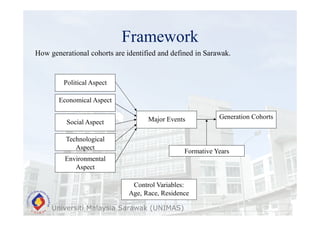
How generational cohorts are identified and defined in Sarawak.
Political Aspect
Economical Aspect
Social Aspect
Technological
Aspect
Major Events Generation Cohorts
Environmental
Aspect
Formative Years
Control Variables:
Age, Race, Residence
Methodology
Universiti Malaysia Sarawak (UNIMAS)
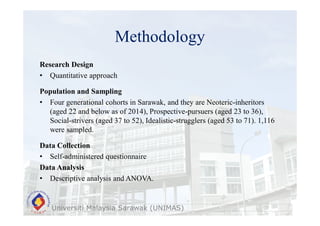
Research Design
• Quantitative approach
Population and Sampling
• Four generational cohorts in Sarawak, and they are Neoteric-inheritors
(aged 22 and below as of 2014), Prospective-pursuers (aged 23 to 36),
Social-strivers (aged 37 to 52), Idealistic-strugglers (aged 53 to 71). 1,116
were sampled.
Data Collection
• Self-administered questionnaire
Data Analysis
• Descriptive analysis and ANOVA.
Findings
Universiti Malaysia Sarawak (UNIMAS)
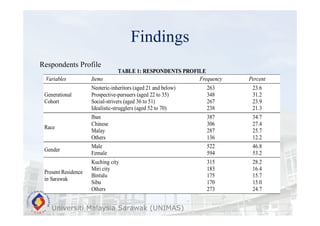
Respondents Profile
TABLE 1: RESPONDENTS PROFILE
Variables Items Frequency Percent
Generational
Cohort
Neoteric-inheritors (aged 21 and below)
Prospective-pursuers (aged 22 to 35)
Social-strivers (aged 36 to 51)
Idealistic-strugglers (aged 52 to 70)
263
348
267
238
23.6
31.2
23.9
21.3
Race
Iban
Chinese
Malay
Others
387
306
287
136
34.7
27.4
25.7
12.2
Gender
Male
Female
522
594
46.8
53.2
Present Residence
in Sarawak
Kuching city
Miri city
Bintulu
Sibu
Others
315
183
175
170
273
28.2
16.4
15.7
15.0
24.7
Findings (cont.)
Universiti Malaysia Sarawak (UNIMAS)
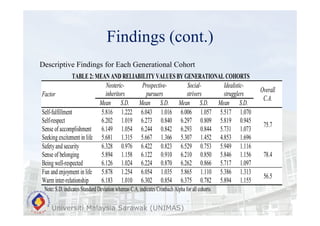
Descriptive Findings for Each Generational Cohort
TABLE 2: MEAN AND RELIABILITY VALUES BY GENERATIONAL COHORTS
Factor
Neoteric-
inheritors
Prospective-
pursuers
Social-
strivers
Idealistic-
strugglers
Overall
C.A.
Mean S.D. Mean S.D. Mean S.D. Mean S.D.
Self-fulfillment 5.816 1.222 6.043 1.016 6.006 1.057 5.517 1.070
75.7
Self-respect 6.202 1.019 6.273 0.840 6.297 0.809 5.819 0.945
Sense of accomplishment 6.149 1.054 6.244 0.842 6.293 0.844 5.731 1.073
Seeking excitement in life 5.681 1.315 5.667 1.366 5.307 1.452 4.853 1.696
Safetyand security 6.328 0.976 6.422 0.823 6.529 0.753 5.949 1.116
78.4Sense of belonging 5.894 1.158 6.122 0.910 6.210 0.850 5.846 1.156
Being well-respected 6.126 1.024 6.224 0.870 6.262 0.866 5.717 1.097
Fun and enjoyment in life 5.878 1.254 6.054 1.035 5.865 1.110 5.386 1.313
56.5
Warm inter-relationship 6.183 1.010 6.302 0.854 6.375 0.782 5.894 1.155
Note:S.D. indicates Standard Deviation whereas C.A. indicates Cronbach Alpha for all cohorts
Findings (cont.)
Universiti Malaysia Sarawak (UNIMAS)
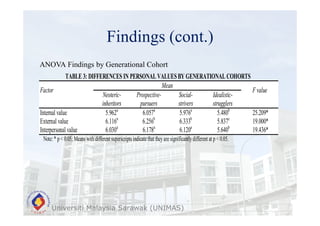
ANOVA Findings by Generational Cohort
TABLE 3: DIFFERENCES IN PERSONAL VALUESBY GENERATIONAL COHORTS
Factor
Mean
F value
Neoteric-
inheritors
Prospective-
pursuers
Social-
strivers
Idealistic-
strugglers
Internal value 5.962a
6.057a
5.976a
5.480b
25.209*
External value 6.116a
6.256b
6.333b
5.837c
19.000*
Interpersonal value 6.030a
6.178a
6.120a
5.640b
19.436*
Note:* p< 0.05; Means with different superscripts indicate that theyare significantlydifferent at p <0.05.
Discussions
Universiti Malaysia Sarawak (UNIMAS)
• Sarawakians in general are more concerned with external factors. How they
feel about the surroundings, and how people treat them are more essential
than how they regard themselves. Interpersonal value being more important
internal value also suggests that they prefer collective activities more than
individual contentment.
• Personal values of Idealistic-strugglers are significantly different from
other cohorts. Given the fact that all of them are over 50 years old, and
have experienced the insurgence of communists, curfews and even the
formation of Malaysia during their coming-of-age years, their viewpoints
and value orientations are expected to be different from others (Ting, de Run
& Fam, 2012). As they struggled to adapt to some of the major environmental
changes in the state, they hold on to many of their beliefs until today.
Discussions (cont.)
Universiti Malaysia Sarawak (UNIMAS)
• Neoteric-inheritors are the youngest among cohorts and they are still in
their formative years. While their personal values are largely similar to
Prospective-pursuers and Social-strivers, they are still learning and
inheriting things revolving around them. They pay more attention to
external factors, such as their peers and the present social trends, more than
the others, and thus are more gullible to changes (de Run & Ting, 2013).
• Personal values of Prospective-pursuers and Social-strivers are found to be
similar. While Social-strivers experienced economic and social
development in 1980s and 1990s before being struck by financial crisis in
late 1990s, Prospective-pursuers experienced financial crisis in late 1990s
and the recovery before being caught by another global economic downturn
in 2007-2008 (de Run & Ting, 2013). Other similar experiences in political and
social matters may well suggest the similarity of motivations within them.
Conclusion
Universiti Malaysia Sarawak (UNIMAS)
• As people age and go through different stages of life, their attitude and
behaviours inevitably change. Generational cohort, more than what a
demographic factor can divulge, not only gives insights into the formation
of values during formative years but also provides superior forecasting of
their future behaviours.
• When advertising and promoting products, marketers have to understand
the generations that customers belong to and come out with messages that
match well with their values.
• Nationwide studies on generational cohort are to be done not only to
identify cohorts in the Malaysian context, but also to facilitate cohort
studies in other developing countries and cross-border studies.
THANK YOU
Ernest Cyril de Run, PhD
Professor of Marketing at UNIMAS
Email: drernest@feb.unimas.my
Hiram Ting, PhD
Research Officer at UNIMAS
E-mail: hiramparousia@gmail.com

Generation Cohort

  • 1.
    BEYOND DEMOGRAPHIC BOUNDARY: DETERMININGGENERATIONAL VALUES BY COHORTS MAG Scholar Conference 2014 Ernest Cyril de Run & Hiram Ting Universiti Malaysia Sarawak, 94300 Kota Samarahan, Sarawak, Malaysia.
  • 2.
    Universiti Malaysia Sarawak(UNIMAS) Acknowledgement This paper is based on research at Universiti Malaysia Sarawak (UNIMAS) under Fundamental Research Grant Scheme (No: FRGS/2/2013/SS05/UNIMAS/01/1). The authors express their gratitude to Ministry of Higher Education (MOHE) and UNIMAS for sponsoring the research carried out.
  • 3.
    Introduction Universiti Malaysia Sarawak(UNIMAS) • For many years, segmentation strategies such as those based on demographic and psychographic bases have been utilized to better meet customers’ needs and wants (Kotler & Armstrong, 2011). • However an innovative and highly successful profiling method utilizing generational cohort is emerging as prominent approach and becoming increasingly useful in tracking consumer behaviours (Meredith & Schewe, 2002). • Despite being recognized as a demographic factor, generation unveils more than what a population trend does. Notably, Generation X and Generation Y, amongst others, are extensively appropriated to categorize and characterize consumers in marketplaces, not only in the West but also in the East.
  • 4.
    Introduction (cont.) Universiti MalaysiaSarawak (UNIMAS) • Despite the complexity in diverse societies, personal value is an evident reflection of human behaviours, including attitudes, consumption patterns, and actual actions (Kamakura & Novak; 1992; White, 2005). • Personal value is described as individual belief about what is more preferable, and is thus related to inner desire (Solomon, 2011). • While generational cohort is generally accepted as a demographic factor, personal value is regarded as a psychographic factor (Kotler & Armstrong, 2011).
  • 5.
    Problem Statement Universiti MalaysiaSarawak (UNIMAS) • Generational cohorts and their respective values from western sources are time and again generalized in other settings, including developing countries like Malaysia (Chuah, Marimuthu & Ramayah, 2014; Munusamy & Wong, 2007; Ramaprasad, 1994). • The segregation of these cohorts is conveniently adopted to profile and understand customers, and explain their behaviours without theoretical basis (de Run & Ting, 2013). • Moreover, since little is known about actual generational cohort in Malaysia, differences of personal values across cohorts still remain largely unknown.
  • 6.
    Purpose of Study UniversitiMalaysia Sarawak (UNIMAS) • The present study is a part of a larger study which is aimed to investigate personal values across different generational cohorts by using List of Values (LOV), so as to determine generational values by cohorts. • Instead of using western cohorts, the recently established cohorts in Sarawak are adopted to determine generational values in the state.
  • 7.
    Brief Literature Review UniversitiMalaysia Sarawak (UNIMAS) Generational Cohort • Labels of generational cohorts, such Veterans, Baby boomers, Generation X and Generation Y from the U.S sources, have been commonly used to classify consumers and understand their distinctive characteristics in marketing literature (Cennamo & Gardner, 2008; Munusamy et al., 2010; Yu & Miller, 2003). • A generational cohort is defined as an individual group, who shares about the same age, born during the same time period, and experiences similar major external events during the developmental stages (Edmunds & Tuner, 2005; Kupperschmidt, 2000; Ryder, 1965; Smola & Sutton, 2002). • The theory of historical generations proposed by Rogler (2002) emphasizes that major societal events instill greater and more permanent marks on the coming-of-age group than on other age-groups who live through the same period. Their personal attachment to these events will consolidate in them permanent orientation, thus affecting them throughout their lives (Rogler, 2002).
  • 8.
    Brief Literature Review(cont.) Universiti Malaysia Sarawak (UNIMAS) Personal Values • List of Values (LOV) is adopted in the study due to its relative ease of use yet better predictive relevance (Goldsmith & Kilsheimer, 1993; Kahle, Beatty, & Homer, 1986). It is composed of three dimensions. • Internal value is generally about how a person is internally fulfilled (Jago, 1997), and is measured by self fulfillment, self respect, sense of accomplishment, and excitement. • External value hinges more on exterior factors, such as peers (Homer & Kahle, 1988) and is measured by sense of security, sense of belonging, and being well respected. • Interpersonal value is a combination of the two former values (Kahle, 1991) and is measured by fun and enjoyment in life, and warm relationship.
  • 9.
    Brief Literature Review(cont.) Universiti Malaysia Sarawak (UNIMAS) Segmentation Approach • Demographic and psychographic bases are the two most popular segmenting approaches (Burns & Bush, 2005; Kotler & Armstrong; Wasserman, 2002; Wellner, 2002). • Even though generational cohort is largely regarded as a demographic factor (Kotler & Armstrong, 2011), it is only applicable in western contexts where cohort labels and descriptions have long been established in the US context. • Past studies have demonstrated the great potential of cohort analysis in marketing strategies and the understanding of consumer behaviour (Meredith and Schewe, 1994; Schewe and Evans, 1998). • When defining generational cohort in other countries, cohort segmentation base is later claimed to be a hybrid approach, which utilizes both the stability that age variable offers (Steenkamp & Hofstede, 2002) and the insights into consumer motivations which value variable offers (Hung, Gu & Yim, 2007).
  • 10.
    Framework Universiti Malaysia Sarawak(UNIMAS) How generational cohorts are identified and defined in Sarawak. Political Aspect Economical Aspect Social Aspect Technological Aspect Major Events Generation Cohorts Environmental Aspect Formative Years Control Variables: Age, Race, Residence
  • 11.
    Methodology Universiti Malaysia Sarawak(UNIMAS) Research Design • Quantitative approach Population and Sampling • Four generational cohorts in Sarawak, and they are Neoteric-inheritors (aged 22 and below as of 2014), Prospective-pursuers (aged 23 to 36), Social-strivers (aged 37 to 52), Idealistic-strugglers (aged 53 to 71). 1,116 were sampled. Data Collection • Self-administered questionnaire Data Analysis • Descriptive analysis and ANOVA.
  • 12.
    Findings Universiti Malaysia Sarawak(UNIMAS) Respondents Profile TABLE 1: RESPONDENTS PROFILE Variables Items Frequency Percent Generational Cohort Neoteric-inheritors (aged 21 and below) Prospective-pursuers (aged 22 to 35) Social-strivers (aged 36 to 51) Idealistic-strugglers (aged 52 to 70) 263 348 267 238 23.6 31.2 23.9 21.3 Race Iban Chinese Malay Others 387 306 287 136 34.7 27.4 25.7 12.2 Gender Male Female 522 594 46.8 53.2 Present Residence in Sarawak Kuching city Miri city Bintulu Sibu Others 315 183 175 170 273 28.2 16.4 15.7 15.0 24.7
  • 13.
    Findings (cont.) Universiti MalaysiaSarawak (UNIMAS) Descriptive Findings for Each Generational Cohort TABLE 2: MEAN AND RELIABILITY VALUES BY GENERATIONAL COHORTS Factor Neoteric- inheritors Prospective- pursuers Social- strivers Idealistic- strugglers Overall C.A. Mean S.D. Mean S.D. Mean S.D. Mean S.D. Self-fulfillment 5.816 1.222 6.043 1.016 6.006 1.057 5.517 1.070 75.7 Self-respect 6.202 1.019 6.273 0.840 6.297 0.809 5.819 0.945 Sense of accomplishment 6.149 1.054 6.244 0.842 6.293 0.844 5.731 1.073 Seeking excitement in life 5.681 1.315 5.667 1.366 5.307 1.452 4.853 1.696 Safetyand security 6.328 0.976 6.422 0.823 6.529 0.753 5.949 1.116 78.4Sense of belonging 5.894 1.158 6.122 0.910 6.210 0.850 5.846 1.156 Being well-respected 6.126 1.024 6.224 0.870 6.262 0.866 5.717 1.097 Fun and enjoyment in life 5.878 1.254 6.054 1.035 5.865 1.110 5.386 1.313 56.5 Warm inter-relationship 6.183 1.010 6.302 0.854 6.375 0.782 5.894 1.155 Note:S.D. indicates Standard Deviation whereas C.A. indicates Cronbach Alpha for all cohorts
  • 14.
    Findings (cont.) Universiti MalaysiaSarawak (UNIMAS) ANOVA Findings by Generational Cohort TABLE 3: DIFFERENCES IN PERSONAL VALUESBY GENERATIONAL COHORTS Factor Mean F value Neoteric- inheritors Prospective- pursuers Social- strivers Idealistic- strugglers Internal value 5.962a 6.057a 5.976a 5.480b 25.209* External value 6.116a 6.256b 6.333b 5.837c 19.000* Interpersonal value 6.030a 6.178a 6.120a 5.640b 19.436* Note:* p< 0.05; Means with different superscripts indicate that theyare significantlydifferent at p <0.05.
  • 15.
    Discussions Universiti Malaysia Sarawak(UNIMAS) • Sarawakians in general are more concerned with external factors. How they feel about the surroundings, and how people treat them are more essential than how they regard themselves. Interpersonal value being more important internal value also suggests that they prefer collective activities more than individual contentment. • Personal values of Idealistic-strugglers are significantly different from other cohorts. Given the fact that all of them are over 50 years old, and have experienced the insurgence of communists, curfews and even the formation of Malaysia during their coming-of-age years, their viewpoints and value orientations are expected to be different from others (Ting, de Run & Fam, 2012). As they struggled to adapt to some of the major environmental changes in the state, they hold on to many of their beliefs until today.
  • 16.
    Discussions (cont.) Universiti MalaysiaSarawak (UNIMAS) • Neoteric-inheritors are the youngest among cohorts and they are still in their formative years. While their personal values are largely similar to Prospective-pursuers and Social-strivers, they are still learning and inheriting things revolving around them. They pay more attention to external factors, such as their peers and the present social trends, more than the others, and thus are more gullible to changes (de Run & Ting, 2013). • Personal values of Prospective-pursuers and Social-strivers are found to be similar. While Social-strivers experienced economic and social development in 1980s and 1990s before being struck by financial crisis in late 1990s, Prospective-pursuers experienced financial crisis in late 1990s and the recovery before being caught by another global economic downturn in 2007-2008 (de Run & Ting, 2013). Other similar experiences in political and social matters may well suggest the similarity of motivations within them.
  • 17.
    Conclusion Universiti Malaysia Sarawak(UNIMAS) • As people age and go through different stages of life, their attitude and behaviours inevitably change. Generational cohort, more than what a demographic factor can divulge, not only gives insights into the formation of values during formative years but also provides superior forecasting of their future behaviours. • When advertising and promoting products, marketers have to understand the generations that customers belong to and come out with messages that match well with their values. • Nationwide studies on generational cohort are to be done not only to identify cohorts in the Malaysian context, but also to facilitate cohort studies in other developing countries and cross-border studies.
  • 18.
    THANK YOU Ernest Cyrilde Run, PhD Professor of Marketing at UNIMAS Email: drernest@feb.unimas.my Hiram Ting, PhD Research Officer at UNIMAS E-mail: hiramparousia@gmail.com