EUDAT	Summer	School,	3-7	July	2017,	Crete
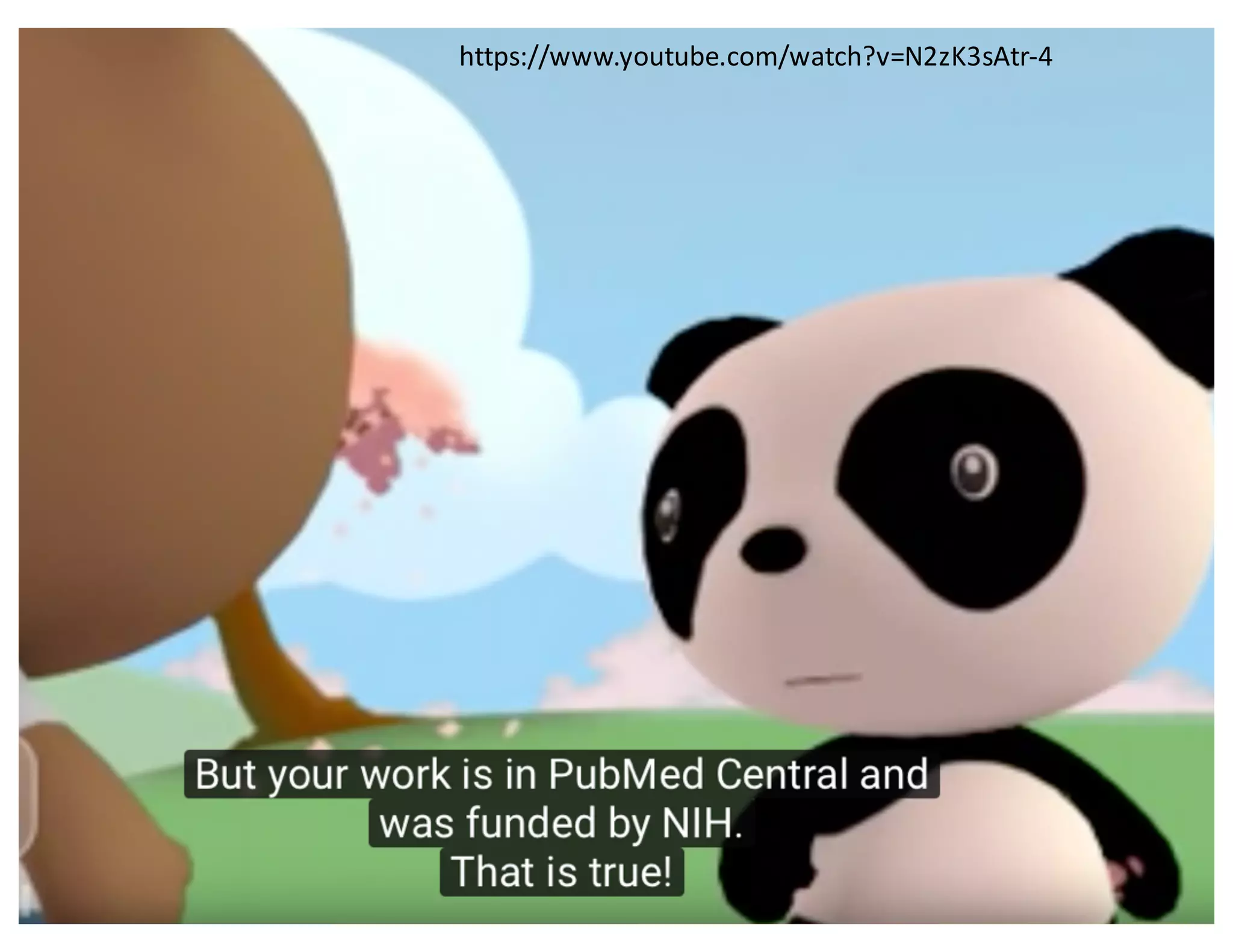
https://www.youtube.com/watch?v=N2zK3sAtr-4
EUDAT	Summer	School,	3-7	July	2017,	Crete
• Brown	Bear	performed	 research	 that	includes	data	on	B	Cell	Function
• published	in	Science
• listed	in	PubMed	Central	
• funded	by	NIH	
FAIR	Analysis:	Data	Sharing	&	Management	Snafu
EUDAT	Summer	School,	3-7	July	2017,	Crete
• Brown	Bear	performed	 research	 that	includes	data	on	B	Cell	Function
• published	in	Science
• listed	in	PubMed	Central	
• funded	by	NIH	
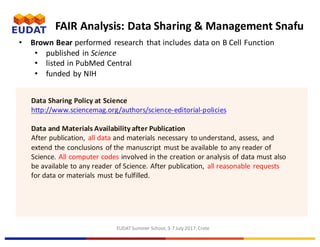
Data	Sharing	Policy	at	Science	
http://www.sciencemag.org/authors/science-editorial-policies
Data	and	Materials	Availability	after	Publication
After	publication,	all	data	and	materials	necessary	to	understand,	assess,	and	
extend	the	conclusions	of	the	manuscript	must	be	available	to	any	reader	of	
Science.	All	computer	codes	involved	in	the	creation	or	analysis	of	data	must	also	
be	available	to	any	reader	of Science.	After	publication,	all	reasonable	requests	
for	data	or	materials	must	be	fulfilled.
FAIR	Analysis:	Data	Sharing	&	Management	Snafu
EUDAT	Summer	School,	3-7	July	2017,	Crete
• Brown	Bear	performed	 research	 that	includes	data	on	B	Cell	Function
• published	in	Science
• listed	in	PubMed	Central	
• funded	by	NIH	
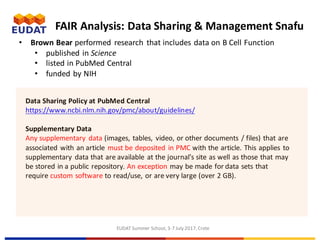
Data	Sharing	Policy	at	PubMed	Central	
https://www.ncbi.nlm.nih.gov/pmc/about/guidelines/
Supplementary	Data
Any	supplementary	data (images,	tables,	video,	or	other	documents	/	files)	that	are	
associated	with	an	article	must	be	deposited	in	PMC	with	the	article.	This	applies	to	
supplementary	data	that	are	available	at	the	journal’s	site	as	well	as	those	that	may	
be	stored	in	a	public	repository.	An	exception	may	be	made	for	data	sets	that	
require	custom	software	to	read/use,	or	are	very	large	(over	2	GB).
FAIR	Analysis:	Data	Sharing	&	Management	Snafu
EUDAT	Summer	School,	3-7	July	2017,	Crete
• Brown	Bear	performed	 research	 that	includes	data	on	B	Cell	Function
• published	in	Science
• listed	in	PubMed	Central	
• funded	by	NIH	
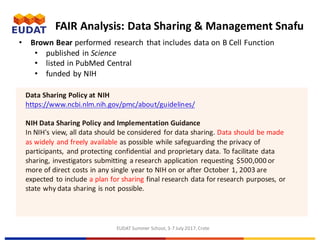
Data	Sharing	Policy	at	NIH
https://www.ncbi.nlm.nih.gov/pmc/about/guidelines/
NIH	Data	Sharing	Policy	and	Implementation	Guidance	
In	NIH's	view,	all	data	should	be	considered	for	data	sharing.	Data	should	be	made	
as	widely	and	freely	available as	possible	while	safeguarding	the	privacy	of	
participants,	and	protecting	confidential	and	proprietary	data.	To	facilitate	data	
sharing,	investigators	submitting	a	research	application	requesting	$500,000	or	
more	of	direct	costs	in	any	single	year	to	NIH	on	or	after	October	1,	2003	are	
expected	to	include	a	plan	for	sharing	final	research	data	for	research	purposes,	or	
state	why	data	sharing	is	not	possible.
FAIR	Analysis:	Data	Sharing	&	Management	Snafu
EUDAT	Summer	School,	3-7	July	2017,	Crete
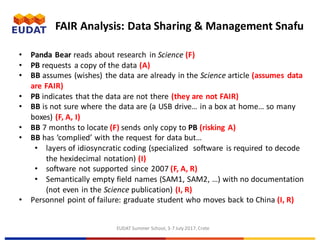
• Panda	Bear	reads	about	research	 in	Science (F)
• PB	requests	 a	copy	of	the	data	(A)	
• BB	assumes	(wishes)	 the	data	are	already	in	the	Science article (assumes	 data	
are	FAIR)
• PB	indicates	that	the	data	are	not	there	(they	are	not	FAIR)
• BB	is	not	sure	where	the	data	are (a	USB	drive…	in	a	box	at	home…	so	many	
boxes)	(F,	A,	I)
• BB	7	months	to	locate	(F)	sends	only	copy	to	PB	(risking	A)
• BB	has	‘complied’	with	the	request	for	data	but…
• layers	of	idiosyncratic	coding	(specialized	 	software	 is	required	to	decode	
the	hexidecimal notation)	(I)
• software	not	supported	since	2007 (F,	A,	R)
• Semantically	empty	field	names	(SAM1,	SAM2,	…)	with	no	documentation	
(not	even	in	the	Science publication)	(I,	R)	
• Personnel	point	of	failure:	graduate	student	who	moves	back	to	China	(I,	R)	
FAIR	Analysis:	Data	Sharing	&	Management	Snafu
EUDAT	Summer	School,	3-7	July	2017,	Crete
FAIR	Analysis:	Data	Sharing	&	Management	Snafu
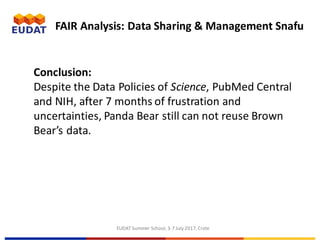
Conclusion:	
Despite	the	Data	Policies	of	Science,	PubMed	Central	
and	NIH,	after	7	months	of	frustration	and	
uncertainties,	Panda	Bear	still	can	not	reuse	Brown	
Bear’s	data.
www.eudat.eu
EUDAT receives funding from the European Union's Horizon 2020 programme - DG CONNECT e-Infrastructures. Contract No. 654065
The 15 FAIR Data Principles
& some tools for better data stewardship
Erik	Schultes,	PhD
erik.schultes@dtls.nl
Dutch TechCenter for	Life	Science
Leiden	University Medical Center	
Leiden	Center	for	Data	Science
EUDAT	Summer	School,	3-7	July	2017,	Crete
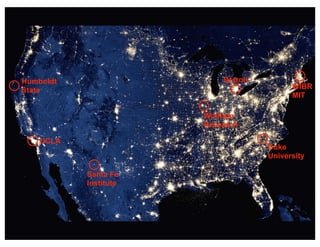
Duke
University
WIBR
MIT
DetroitHumboldt
State
UCLA
Santa Fe
Institute
Wolfram
Research
EUDAT	Summer	School,	3-7	July	2017,	Crete
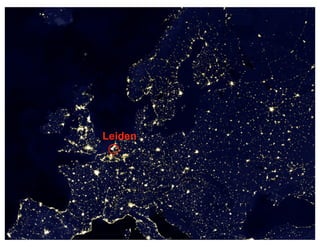
Leiden
EUDAT	Summer	School,	3-7	July	2017,	Crete
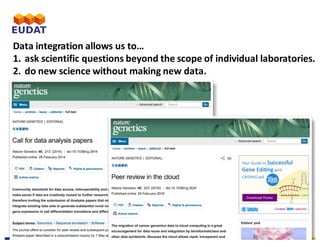
Data	integration	allows	us	to…
1. ask	scientific	questions	beyond	the	scope	of	individual	laboratories.
2. do	new	science	without	making	new	data.
EUDAT	Summer	School,	3-7	July	2017,	Crete
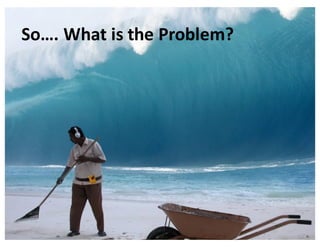
So….	What	is	the	Problem?
EUDAT	Summer	School,	3-7	July	2017,	Crete
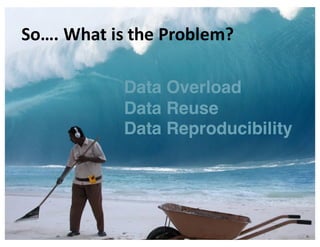
Data Overload
Data Reuse
Data Reproducibility
So….	What	is	the	Problem?
EUDAT	Summer	School,	3-7	July	2017,	Crete
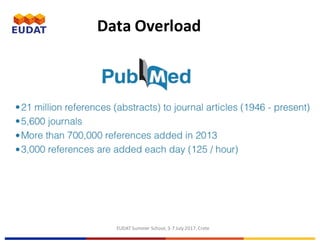
Data	Overload
EUDAT	Summer	School,	3-7	July	2017,	Crete
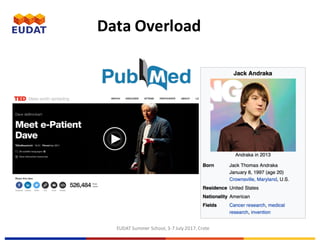
Data	Overload
EUDAT	Summer	School,	3-7	July	2017,	Crete
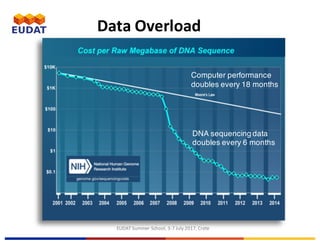
Computer performance
doubles every 18 months
DNA sequencing data
doubles every 6 months
Data	Overload
EUDAT	Summer	School,	3-7	July	2017,	Crete
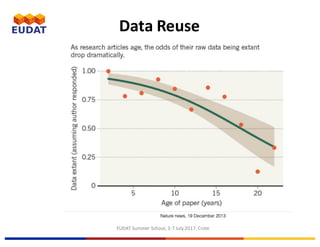
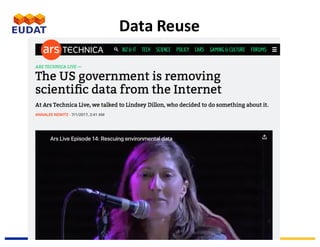
Data	Reuse
EUDAT	Summer	School,	3-7	July	2017,	Crete
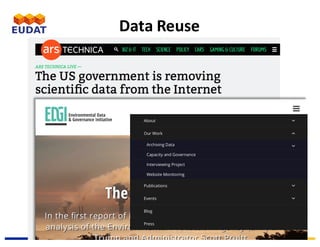
Data	Reuse
EUDAT	Summer	School,	3-7	July	2017,	Crete
Data	Reuse
EUDAT	Summer	School,	3-7	July	2017,	Crete
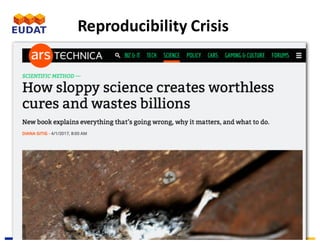
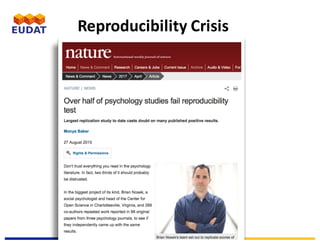
Reproducibility	Crisis
EUDAT	Summer	School,	3-7	July	2017,	Crete
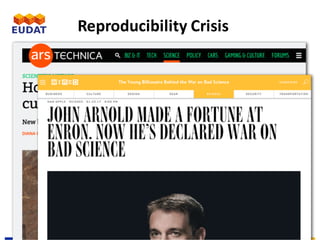
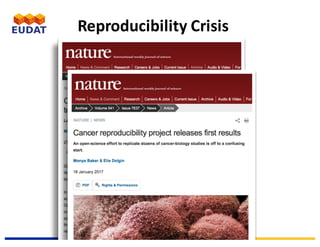
Reproducibility	Crisis
EUDAT	Summer	School,	3-7	July	2017,	Crete
Reproducibility	Crisis
EUDAT	Summer	School,	3-7	July	2017,	Crete
Reproducibility	Crisis
EUDAT	Summer	School,	3-7	July	2017,	Crete
Data	Stewardship
EUDAT	Summer	School,	3-7	July	2017,	Crete
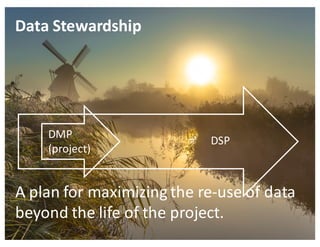
A	plan	for	maximizing	the	re-use	of	data	
beyond	the	life	of	the	project.
Data	Stewardship
EUDAT	Summer	School,	3-7	July	2017,	Crete
A	plan	for	maximizing	the	re-use	of	data	
beyond	the	life	of	the	project.
DMP
(project)
DSP
Data	Stewardship
EUDAT	Summer	School,	3-7	July	2017,	Crete
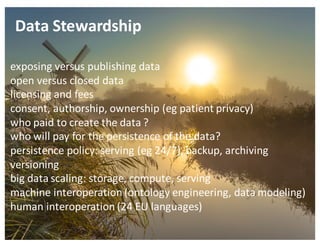
Data	Stewardship	
exposing	versus	publishing	data
open	versus	closed	data	
licensing	and	fees
consent,	authorship,	ownership	(eg patient	privacy)	
who	paid	to	create	the	data	?
who	will	pay	for	the	persistence	of	the	data?	
persistence	policy:	serving	(eg 24/7),	backup,	archiving
versioning
big	data	scaling:	storage,	compute,	serving	
machine	interoperation	(ontology	engineering,	data	modeling)
human	interoperation	(24	EU	languages)
EUDAT	Summer	School,	3-7	July	2017,	Cretedoi: 10.1038/sdata.2016.18
EUDAT	Summer	School,	3-7	July	2017,	Crete
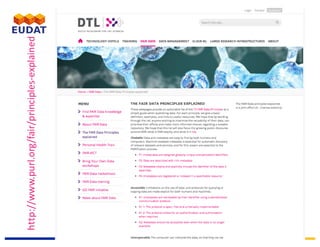
http://www.purl.org/fair/principles-explained
EUDAT	Summer	School,	3-7	July	2017,	Cretedoi: 10.3233/ISU-170824
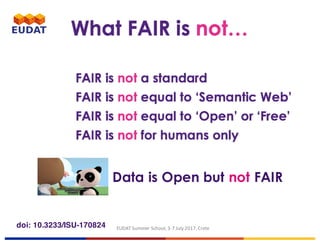
Data is Open but not FAIR
EUDAT	Summer	School,	3-7	July	2017,	Crete
The	Idea
EUDAT	Summer	School,	3-7	July	2017,	Crete
The	Idea
EUDAT	Summer	School,	3-7	July	2017,	Crete
The	Idea
EOSC
5%	
500k
EUDAT	Summer	School,	3-7	July	2017,	Crete
The	Idea
EOSC
5%	
500k
Data
Commons
EUDAT	Summer	School,	3-7	July	2017,	Crete
The	Idea
EOSC
5%	
500k
Data
Commons
EUDAT	Summer	School,	3-7	July	2017,	Crete
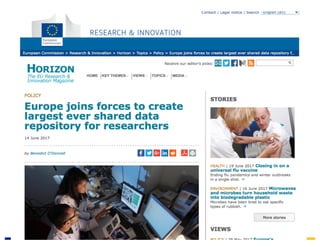
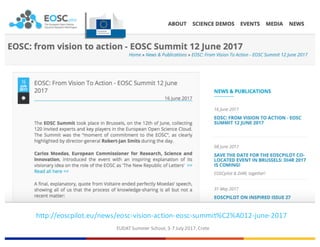
http://eoscpilot.eu/news/eosc-vision-action-eosc-summit%C2%A012-june-2017
EUDAT	Summer	School,	3-7	July	2017,	Crete
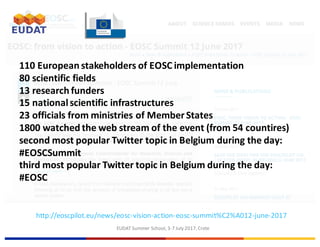
http://eoscpilot.eu/news/eosc-vision-action-eosc-summit%C2%A012-june-2017
110	European	stakeholders	of	EOSC	implementation
80	scientific	fields
13	research	funders	
15	national	scientific	infrastructures
23	officials	from	ministries	of	Member	States	
1800	watched	the	web	stream	of	the	event	(from	54	countires)
second	most	popular	Twitter	topic	in	Belgium	during	the	day:	
#EOSCSummit
third	most	popular	Twitter	topic	in	Belgium	during	the	day:	
#EOSC
EUDAT	Summer	School,	3-7	July	2017,	Crete
EUROPEAN COMMISSION
DIRECTORATE-GENERAL FOR RESEARCH & INNOVATION
Directorate A Policy Development and Coordination
A.6 Data, Open Access and Foresight
SESSION 1: DATA CULTURE, DATA STEWARDSHIP,
PRACTICAL AND POLICY TOOLS
INPUT PAPER
European Open Science Cloud (EOSC) Summit
12 June 2017 | Charlemagne Building | Brussels
RECOGNISING the challenges of data driven research in pursuing excellent science;
GRANTING that the vision of European Open Science Cloud is of a research data commons,
widely inclusive of all disciplines and Member States, sustainable in the long-term, the EC;
PROPOSES that the stakeholders present at this summit commit to share the following intents
and will actively support their implementation in the respective capacities:
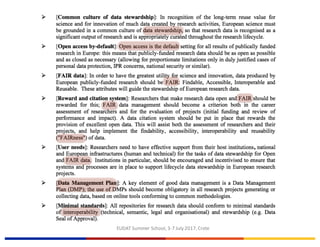
[Common culture of data stewardship]: In recognition of the long-term reuse value for
science and for innovation of much data created by research activities, European science must
be grounded in a common culture of data stewardship, so that research data is recognised as a
significant output of research and is appropriately curated throughout the research lifecycle.
[Open access by-default]: Open access is the default setting for all results of publically funded
research in Europe: this means that publicly-funded research data should be as open as possible
and as closed as necessary (allowing for proportionate limitations only in duly justified cases of
EUDAT	Summer	School,	3-7	July	2017,	Crete
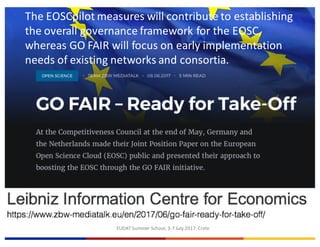
The	EOSCpilot measures	will	contribute	to	establishing	
the	overall	governance	framework	for	the	EOSC,	
whereas	GO	FAIR	will	focus	on	early	implementation	
needs	of	existing	networks	and	consortia.
EUDAT	Summer	School,	3-7	July	2017,	Crete
The	Technology
EUDAT	Summer	School,	3-7	July	2017,	Crete
The	Technology
EUDAT	Summer	School,	3-7	July	2017,	Crete
The	Technology
EUDAT	Summer	School,	3-7	July	2017,	Crete
The	Technology
EUDAT	Summer	School,	3-7	July	2017,	Crete
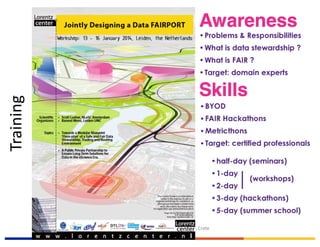
Training
EUDAT	Summer	School,	3-7	July	2017,	Crete
Training
EUDAT	Summer	School,	3-7	July	2017,	Crete
Training
EUDAT	Summer	School,	3-7	July	2017,	Crete
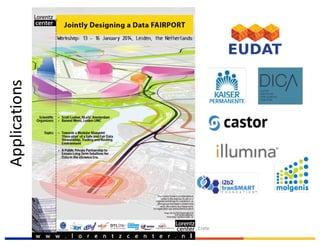
Applications
EUDAT	Summer	School,	3-7	July	2017,	Crete
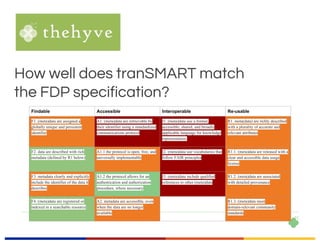
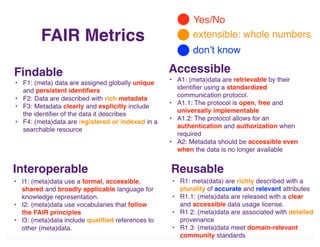
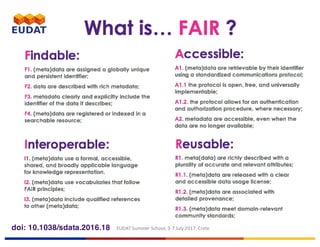
Findable Accessible Interoperable Re-usable
F1. (meta)data are assigned a
globally unique and persistent
identifier
A1. (meta)data are retrievable by
their identifier using a standardized
communications protocol
I1. (meta)data use a formal,
accessible, shared, and broadly
applicable language for knowledge
representation.
R1. meta(data) are richly described
with a plurality of accurate and
relevant attributes
F2. data are described with rich
metadata (defined by R1 below)
A1.1 the protocol is open, free, and
universally implementable
I2. (meta)data use vocabularies that
follow FAIR principles
R1.1. (meta)data are released with a
clear and accessible data usage
license
F3. metadata clearly and explicitly
include the identifier of the data it
describes
A1.2 the protocol allows for an
authentication and authorization
procedure, where necessary
I3. (meta)data include qualified
references to other (meta)data
R1.2. (meta)data are associated
with detailed provenance
F4. (meta)data are registered or
indexed in a searchable resource
A2. metadata are accessible, even
when the data are no longer
available
R1.3. (meta)data meet
domain-relevant community
standards
How well does tranSMART match
the FDP specification?
EUDAT	Summer	School,	3-7	July	2017,	Crete
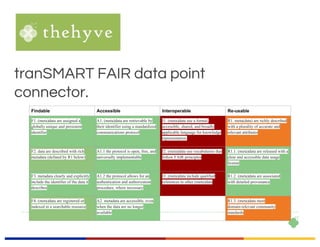
Findable Accessible Interoperable Re-usable
F1. (meta)data are assigned a
globally unique and persistent
identifier
A1. (meta)data are retrievable by
their identifier using a standardized
communications protocol
I1. (meta)data use a formal,
accessible, shared, and broadly
applicable language for knowledge
representation.
R1. meta(data) are richly described
with a plurality of accurate and
relevant attributes
F2. data are described with rich
metadata (defined by R1 below)
A1.1 the protocol is open, free, and
universally implementable
I2. (meta)data use vocabularies that
follow FAIR principles
R1.1. (meta)data are released with a
clear and accessible data usage
license
F3. metadata clearly and explicitly
include the identifier of the data it
describes
A1.2 the protocol allows for an
authentication and authorization
procedure, where necessary
I3. (meta)data include qualified
references to other (meta)data
R1.2. (meta)data are associated
with detailed provenance
F4. (meta)data are registered or
indexed in a searchable resource
A2. metadata are accessible, even
when the data are no longer
available
R1.3. (meta)data meet
domain-relevant community
standards
tranSMART FAIR data point
connector.
EUDAT	Summer	School,	3-7	July	2017,	Crete
Data Stewardship plans
Research Data Life Cycle
Data cycle step 6:
(Data Analysis), Interpretation and
Modeling
6/1 Will this step need significant
Compute capacity?
If yes, make sure that this has been
taken into account in the capacity
planning in step 2.
6/2 How will you be making sure
there is good provenance of the
Data Analysis?
Data analysis is normally hand-
driven, where processing is bulk.
How will you ensure reproducibility?6/3 Will you be doing (automated)
knowledge discovery
How are you going to interpret your
data?
Connect to text mining data?
Error modeling Significance
Effect size
LS6/1 Will you do Systems biology
modeling?
Which knowledge/model will you be
using?
How detailed will you be modeling
Will you be building pathways?
Extending existing pathways?
New pathways?
Do you have enough information to
build to pathways? Text mining
Will you use statistical modeling?
Correlation/regression analysis?
Machine Learning?
How will you make sure it will
answer your biological question?
Will you be building Kinetic
Models? Existing kinetic models?
New kinetic models?
Do you have enough information to
build the kinetic models?
LS6/2 Will you be doing structure
modeling? Model building by homology?
Enzyme activity model?
Molecular dynamics?
Data cycle step 7:
Information and insight
7/1 Will you be working with the
philosophy “as open as possible”
for your data?
7/2 Are there legal reasons why
(some of your) data can not be
completely open?
Privacy
What are the restrictions on where
the data can be stored?
Inside center?
Inside country?
Inside EU?
Pseudonymization
Use existing TTP contract for cross
linking if possible
Re-identifyable?
Can the data become open through
Anomymization?
Can some of the data be open after
aggregation?
Authentication Single signon?
Who maintains?
Authorization
Data access committee?
Auditing
Who checks?
IP
Is it clear who owns all data and
documents?
Will someone have decision power
to move documents or data to a
new place after the project has
finished?
Cf issue with time limited license for
the alfresco system after the
biomedbridges project ended.
7/3 Are there business reasons why
some of your data can not be
completely open?
Patents?
Limited embargo?
7/4 Where will you make your data
available?
Will you publish data in a domain-
specific repository?
Submit to existing db?
Will you be adding new facts to a
knowledge base?
Will you submit interpreted results
to a knowledge base?
Will you publish data in a national
repository?
Will you publish data in a repository
provided by your institute?
Will you be self-hosting the data?
What is the service level to be
offered to users of the data?
Download service?
Run search/access webservice?
Data processing service?
Financial aspects?
Technical aspects of Hosting
Who will do Sysadmin?
Who will do hardware
maintenance?
7/5 Did you work out the financial
aspects of making the data
available?
Who will pay for open access
publishing?
Who keeps data access running?
Helpdesk for data interpretation?
Capability as well as capacity!
7/6 Will you be archiving data? Will data formats be upgraded if
they grow obsolete?
7/7 Will you be adding your data
sets to Catalogs?
Add access to lists of available data
Announce availability
Document the data
Is the data understandable/re-
runnable/re-usable?
Get DOI’s where possible
All types of data to be archived
Raw
Interpreted
Will conclusions from the paper be
made available as nano-
publications?
How will you make sure that blocks
of data deposited in different
repositories can be recognized as
belonging to the same study?
7/8 Will you publish also if the
results are negative?
Data?
Paper?
7/9 Will there be Translational
returns / valorization that you can
participate in?
Will you work on New clinical
procedure?
Will there be a New diagnosis?
Will these be developed as part of
the project?
Data cycle step 3:
Data Capture (equipment phase)
3/1 Who will do the measurements?
Are there easily accessible
specialized service providers for
data capture?
Make them partner in the project
Take pictures of the equipment
Permanent link to the instruction
manual?
3/2 Is special care needed to get
the raw data ready for processing?
What is the need for (sneaker-)
network capacity from measure to
storage?
If you want to “hand carry”, make
sure there is writing/reading
capacity and enough time.
If a secured fast connection is
needed, check for the possibility to
use a lightpath.
Is data security guaranteed?
Is data integrity guaranteed during
this stage?
Data exchange format has been
settled before?
Is capacity planning needed? For
the measurement? For the data
transport?
3/3 Do you have non-equipment
data capture?
Questionnaires?
Plan to verify that questions
actually have been filled in?
Case report forms?
Electronic patient records? (Planning?) Are they accessible?
Will any data be captured on
paper?
Who will do the data entry?
Who makes the data digitally
available to you?
Will it be captured digitally?
Is the entry done by one person?
Or is there a possible difference in
interpretation?
3/4 Is there a proper data
integration tool that can handle and
combine all the data types you are
dealing with in your project
Yes
TranSMART?
or other integration tool applicable?
No
All data can be brought in the same
format, e.g. RDF?
Data cycle step 2:
Data Design and planning
2/1 (2.1) Are you using data types
used by others too?
2.1.1 What formats will you use for
the data?
(del) Archive in low-tech (text)
format (G F6)
(del) Keep explanation of the data
with the data, e.g. as column
headers (G F7)
2/2 (2.2) Will you be using new
types of data?
2/7 (new) Are all of the fields in your
data format described in a data
type registry?
2/9 Which data type registries will
you use?
2/8 (2.2.1) Are there suitable
ontologies?
(del) Use existing ontologies where
possible
2.2.1.1 Do you need to develop
ontologies?
2/10. (2.2.2) How will you design
the format for your data?
2/11 (2.2.3) How will you describe
your data format?
(del) Keep the format of the data
simple
(del) How: Use e.g. CSV, JSON or
standard XML formats where
possible
Use libraries to access it, there are
even incompatible versions of
CSV?
2/26 Will you be archiving data for
long term preservation?
2/27 Can the original data be
regenerated?
2/30 When is the raw data
archived?
As soon as the raw data comes in?
In chunks
All at once
All at once with the rest at the end
of the project?
2/28 does the archived data change
over time?
2/29 Do you need frequent
backups?
How much time can you be set
back if a backup needs to be
restored?
2/31 Are you using backups also for
restoring files that were accidentally
deleted or changed?
2/32 Will it be stored on Tape or
disc? Backups on different modality?
Same discs will break at the same
time.
Soft/firmware updates that could
break your storage..
2/33 are archives stored in a remote
location?
Fire/disaster proof?
2/34 Will the archive need to be
protected against loss or theft? 2/35 Will the data be Encrypted? 2/36 Who has the key?
2/37 Access to disc? Online or in
safe?
2/38 Will the archive need to be on-
line?
Will workflows need to be run on
the archived data?
How is this supported?
2/39 How will data integrity be
guaranteed?
Think about tampering.
2/40 Who has access to the
archived data, how fast?
2/41 During the project, who can
ask for restore?
2/42 Is it more than 10TB?
You must plan time needed for
store/restore!
Why: Complexity does not scale
linearly with scale, but progressively
2/43 Data access committee?
2/44 How long does it need to be
kept?
Is it legally permitted to throw it
away? What is the official term you
need to keep each part?
Which data types (rawness) will be
kept?
For each, how long?
2/45 Will the data be
understandable after a long time?
2/46 Will you need a shared
working space to work with your
data? 2/47 How will you work with your
data?
2/48 What kind of data will be in
your workspace?
Are your Files small or large?
Database?
Could Hadoop be used?
2/49 Do you need the storage close
to compute capacity?
See Step 4: planning of the
compute.
High speed I/O needed?
2/50 Will you keep data in work
format that is different from
archival?
Can you share the work format with
other projects?
2/51 What is the capacity profile?
Will you need the same storage
quantity during the whole project?
2/52 When will your raw data
become available?
2/53 Sometimes the raw data is
relatively large and it pays off to
clean it quickly. How much of the
raw data do you need to keep in
the work space for how long?
2/54 Do your raw data need to be
archived?
Is remeasuring possible and
cheaper?
2/55 Did you plan how much
intermediate data will you get, and
how long does each step need to
be kept?
2/56 Will you be able to store
intermediate data on another file
system?
Why: if the main archive file system
has a problem, a restore takes less
time if the temporary data does not
need to be recovered.
Will you really not need a backup of
that data?
See: https://www.csc.fi/web/blog/
post/-/blogs/the-largest-unplanned-
outage-in-years-and-how-we-
survived-it
Can intermediate data be avoided
by streaming steps together?
2/57 Will you have different
versions of intermediate data that
need to be kept?
Can it be reproduced quickly?
2/58 Will you need to temporarily
archive data sets (to tape?)
Archival will be done if you will
unlikely need it again, but must be
able to go back to it to reproduce
your results.
How frequently will you archive
data?
2/59 If you will be starting with a
high volume of data, how will that
initial data come in?
2/60 How will project partners
access the work space?
2/61 Who will arrange access
control?
2/62 Will it need to be remote
mounted?
2/63 Will it be copied for every
step?
Will they provide local storage for
intermediate data?
How is that budgeted?
2/64 Does it have/need the same
reliability and security as the main
work space?
Is the network speed sufficient?
2/65 How available must the
workspace be?
2/66 What is the acceptable risk for
“total loss”?
Can all files in the workspace be
recomputed quickly?
2/67 Is there software in the
workspace?
Is it safely archived?
Can it be restored quickly?
2/68 What percentage of time
should the data be available?
During work hours? Nights? In
weekends?
How will you act if main storage is
offline?
Keep data that you always need to
access on two independent storage
arrays (G R1)
Can you wait?
2/69 How long can you wait for a
restore if the storage fails?
2/70 How long can you wait if you
accidentally delete a file before it
can be restored?
How will you do Backups and other
Copy data management?
Remote backups
Recover from catastrophe
Speed of restore
Separate server for fast tape
restores (G F3)
Only backup raw and result data (G
F1)
Try not to backup intermediate data
Plan for restoring files deleted or
modified by human error (G H1)
Test the restore
Will a developer need a copy of
large data sets to be able to test
new versions of the software?
Will you do incremental backups?
Do you need to keep a history of all
files? How long will you keep
backups?
2/72 Do you need to backup any
data stored elsewhere related to
your project in your workspace?
Even at the Netherlands eScience
Center data was lost (and hence
computer time) when a file system
of Cartesius crashed.
Did you check the backup policy on
the external (super)computer
system you use?
2/5 Is the Risk of information loss /
leaks / vandalism acceptable?
2/74 Do project members store
data or software on computers in
the lab or external hard drives
connected to those computers?
Who has access to the labs?
Who has access to those
computers?
Are they properly backed up?
2/75 Do people carry data with
them?
On external hard drives or USB
drives?
Encrypted?
Is any data on laptops?
2/76 Are they encrypted?
Is the laptop password protected?
2/77 Are researchers using cloud
accounts?
Consider encryption
2/78 Are data or reports sent over
e-mail or other messaging
services?
Consider encryption
2/79 Do the data centers where
data is stored have Certifications?
Security for hosting
2/80 Are all project web services
used via https?
2/81 Project members have been
instructed?
Password instruction?
Not sharing accounts?
Different passwords everywhere?
Two factor authentication
Data they carry
Backups
Encryption
Passwords on laptops
Data stored in personal cloud
accounts
Data stored in their own labs
Use of Open Wifi and https
Did you do an impact analysis?
2/82 Information loss?
2/83 Information leak?
2/84 Information vandalization?
2/6 Compute Capacity Planning
2/85 Determine needs in Memory/
CPU/IO ratios
Did you run pilots to see what
capacity you need?
Did you run pilots to see if the work
scales up the right way?
e.g. Servers with exceptional
memory or disc bandwith?
2/86 Suitable system Grid/Cluster/Cloud?
Every step in the workflow may
have its own needs.
Data Transport needed?
Need to glue workflows across
architecture?
2/93 Do you have in house
experience with the used compute
architectures?
Do your people need training for
Grid/Cloud/Hadoop?
2/87 When will it be needed?
Some building and testing can be
done on local hw
Use shared infrastructure?
Purchase special needs?
Shared?
2/88 Is all Compute capacity
needed available close to the
working storage?
2/89 If not, you need to plan the
necessary network capacity
No special needs?
Delays acceptable?
Special network will be in place
2/90 If not, Can the data legally be
transported to the compute
capacity?
Will all data be collected in the
same place?
Is there a need for distributed
computation?
Will this have impact on the
efficiency
Will this allow you to get the best
answer?
Does the storage environment
provide enough compute capacity
to serve your workflow?
2/91 Will different groups work on
different parts of the workflow, and
will parts of the computing be done
on local infrastructure?
2/92 Is there sufficient network
capacity?
Do groups have local infrastructure
that can be used?
Will it scale to the size of the
problem?
Is it compatible in middleware to
central infrastructure or to
infrastructure at other sites?
2/3 (2.3) How will you be storing
Metadata?
2/12 Do suitable “Minimal Metadata
About” standards exist for you?
2/13 (2.3.1) Did you consider Re-
usability of your data beyond your
original purpose?
2/14 (2.3.1.1) How do you balance
how much meta-information you
need to store for yourself, versus
how much would be useful for
others.
Use Parelsnoer modules to collect
phenotype data
2/15 (2.3.1.2) Do you need to
exchange your data with others?
(del) Use RDF for interoperability of
data plus metadata where possible.
2/16 (2.3.2) Did you consider how
to monitor data Integrity?
How will you make sure data are
what they should be?
2/17 Will you Keep checksums of
certified/verified/correct/canonical
data (G F2)
(del) Why: data corruption or
mistakes can happen with large
amounts of files or large files.
(del) How: Keep a “true sample”
master list (G M1)
(del) How: Keep sample list under
version control (G M2)
(del) Why: You will need to know
what has changed over time
(del) How: Keep data checksum in
the master list (G M3)
2.3.2.1 Who is in control of access
to the master list? (del) Keep it as close to the data
source as possible.
2/18 Will you Define ways to detect
file/sample swaps, e.g. by
measuring something
independently (G F5)
2/20 Does all data have a license?
(del) Completely open if possible
(del) License must be computer
readable
(del) Choice of license: there should
be very few clauses
(del) License must be transitive
(del) License clauses can be more
restrictive than you really want
2/19 (2.3.3) Will you store licenses
with the data?
2/21 How will you keep
provenance?
Provenance should be rich enough
to ensure the re-usability of FAIR
Data
Method stewardship?
Will your data be changing over
time?
Will you keep proper change
provenance?
Standard methods?
2/22 How will you do file naming
and file organization?
2/23 Agree on a SOP for naming
files (G F4)
Keep an eye on file versioning
Names should not contain privacy
sensitive information
2/24 Keep relations between data
clear in the file names.
Use persistent identifiers for e.g.
lanes and samples throughout the
project (G F8)
2/25 Are all metadata that is in the
file names also available in the
proper metadata?
Data cycle step 4:
Data Processing and Curation
4/1 Workflow development
Will you be running a bulk/routine
workflow, or develop a research
analysis?
Can workflow developers work with
subset of new data? Is there pre-
existing data available for this? Timing?
Can developers start before the
data is measured?
Privacy/security?
Are developers able to take the
data they need on their own
laptops?
Can you use existing software?
Visit other expert centers to learn (G
S3)
Prefer to adapt existing sw to new
needs
Include professionalization if
needed
Develop new components where
needed
Think about Visualisation
License for availability
Do not underestimate time needed
to integrate components
Choose the workflow engine.
What features do you need?
Ease of development?
Can a workflow be edited
collaboratively?
Can you reach out to the
developers?
Is it suitable for the workflow I will
build? (data processing or
integration?)
Does it support the compute back
ends you need?
Standard tools for the
administrative operations?
Comes with your data types out of
the box?
Does it need a developer GUI?
Ease of adding new tools?
Does it support nesting of
workflows?
Ease of use?
Does it need a running GUI?
Who are the customers that use it?
Bioinformaticians?
Biologists?
Can workflows be run remotely?
Can workflows be part of a tool
(nesting)?
Are there existing nesting tools?
Durability?
Can “workflow decay” be
managed?
Will the same workflow still work
next year?
Are all tools/versions under total
control?
Can workflows be imported/
exported/shared with this engine?
Should it produce provenance? In standard form?
Can the workflow be annotated to
make it understandable?
High throughput?
Suggestions with experts in DTL
Make
Snakemake
Taverna
Galaxy
Molgenis
Moteur
Knime
Chipster
Integrity of the tools in the workflow
(G H3)
Use scrutinized (open source) tools
Let second developer check all
changes made
How do you handle/QA upgrades to
tools?
Verify repeatedly on the same data
Are all tools /versions under your
total control?
How do you deal with “workflow
decay”?
Will you follow “Best practices for
creating workflows” from
“researchobject.org”
Workflow running
4/2 How will you make sure to
know what exactly has been run?
Keep processing scripts/workflows
including the versions of the tools
that have run (G M4)
Make use of the metadata fields in
the output files (e.g. VCF) to log
how the data was obtained (G M5)
Keep a central tools directory/
repository (G S1)
Keep a central reference data
repository (G S2)
Can you use a workflow engine and
workflow that produces this data?
Is all software for steps in your work
flow properly maintained? Properly
versioned? Will you be able to find
back the exact version you used?
4/3 How do you validate the
integrity of the results?
In distributed projects, run a subset
on all infrastructures to ensure
consistency
Prevent workflow errors
Make pipelines portable (G R3)
Build pipelines for different
infrastructures automatically (G H4)
Run independently developed
workflows for critical components
to prevent human error (G H2)
Make sure different sites
responsible for part of the data set
use comparable protocols
Provide validation input/output to
detect changes in results
Contingency
4/4 What will you do if the compute
facility is down?
Have alternatives (e.g. cluster and
grid) (G R2)
Data cycle step 5:
Data Integration
5/1 What is the framework you will
use for data integration?
Will you make your output
semantically interoperable data?
Will you use a workflow e.g. with
tools for database access or
conversion?
Will you use a Linked data
approach?
Will you use linked data sources?
5/2 Will you be using common or
exchangeable units?
5/3 Will you be using common
ontologies?
if yes, Choose them before you
start…
5/4 Will there be potential issues
with statistical normalization?
If you’re using slightly different
protocols, how sure are you that
results are comparable?
5/5 Do you have all tools to couple
the necessary data types?
Detailed clinical models (Like
Parelsnoer modules). Should be
moved up…
Do you follow minimal information
standards? (Move to metadata
collection)
Data cycle step 1:
Design of experiments
1/1. (1.1) Is there pre-existing data?
1/2. (1.2) Will you use Pre-existing
data (including Other People’s
Data)?
1/3. (1.3) Will you use reference
data?
1/4 (1.4) Do you know where the reference data is available,
what the conditions for use are, and how to reference it?
1/5 (1.5) In what format is the reference data
available?
1/6 (1.6) Is the reference data
resource versioned?
1/7. Which version will you use?
1/8. Will you change version if it
updates? For new analyses? Redo
all analyses?
1/79. If no, are you sure the old
version will stay available?
1/80. How will you make sure you
and others can reproduce your
results in the future?
What level of detail/granularity do
you need?
Can you filter before downloading?
What is the volume of the level of
data that you really need?
1/9. (1.7) What existing (non-
reference) data sets will you use?
1/11 (1.8) Will owners of that data
work with you on this study?
1/10. (del) No? Will you need to
request access?
1/13. (del) Will any usage
restrictions affect your reuse?
1/12. (1.9) Is re-consent needed?
1/14. (del) Will you access the data
on your own computer? Download
it? Or use it via the network?
(del) What level of detail/granularity
do you need?
(del) Can you filter before
downloading?
(del) What is the volume of the level
of data that you really need?
Can you aggregate before
downloading?
(del) Data come to the analysis, or
analysis to the data?
1/15. (del) What format is it in?
(del) Is the concept reference based
on a proper ontology?
(del) Is it in the same language? (del) Does it need translation?
1/17. (del) Is the data set fixed or
still being updated
(del) Will you use one particular
version or export updates?
How will you make sure your results
are reproducible by others?
1/18. (del) Is all of the data usable in
its available form?
(del) Will curation be needed?
(del) Should a subset be made? (del) Is that easy to select?
19. (del) Do you know what data
already exists?
Are you confident in what you
need?
Did you ask around?
Did you check any catalogs or
search engines?
1/16. (1.10) Do you need to
Harmonize different sources of
existing data
(del) Is “harmonizing” enough, or do
we need to change procedures
and/or align formats?
1/81. Will you use any data that
needs to be made computer
readable first?
Any such data needs to be made
available to others too.
20. (1.11) What/how/who will
integrate existing data
21. (1.11.1) Will you need to add
data from literature?
22. (1.11.2) Text mining?
23. (1.11.2) Do you need integrate
or to link to a different type of data?
24. (del) Does that need a project
plan?
25. What will you do if the coupled
data is updated?
26. What will you do if the format is
changed?
27. Are conversions needed?
28. Link or Join? Allowed?
LS1/42. Will you couple existing
(biobanks) data sets?
LS1/43. Will you use deterministic
couplings?
LS1/49 Will you use probabilistic
couplings?
LS1/44. Will you be using a ttp?
What is the procedure followed?
Where will what data be sent? Did a
legal advisor look at these?
LS1/45. Is consent available for the
coupling?
LS1/46. How will you check whether
coupled data are representative of your
goal population?
LS1/47. What is the goal of the
coupling: more data about the
same subjects (intersection,
enrichment) or getting more
subjects (Union)?
LS1/48. What variable(s) will you
use for coupling?
Will the coupling potentially create
new privacy issues (e.g. Potential
for re-identification or making
personal information more
sensitive, such as adding location
data)?
Verify that you have permission for
such coupling.
1/38. (1.14) Will you be collecting
experimental data?
39. (1.14.1) How many subjects do
you need to be able to get
statistically meaningful results?
Statistical needs on size of sample
set
(1.14.1.1) How many control and
how many intervention subjects?
Statistical optimization!
TNO has a specialist
40. (del) Selection of analysis
technique
41. (del) At which level of biology
do you need data?
Why those?
(del) Which types of analyses will
you do?
49. (del) Will you conduct
intervention studies?
50, (del) Will you do challenge
tests?
51. (del) Select the proper time
points
52. (del) How many time points are
needed?
53. Phenotype Database
54. (del) Will you perform human
intervention study
55. Registration at clinicaltrial.gov
56. (del) Did you get ethical
approval?
57. (del) Which database will you
use to store the data?
58. (del) Do you need to arrange
informed consent?
59. (del) What kind of feedback to
the subjects/patients will be given?
(del) Does that data have potential
consequences for their family
members?
60. (del) Did you get separate and
explicit consent about sharing
(individual) data?
61. (del) Do you already have
enough statistical power?
(del) Does the data already exist
elsewhere?
62. (del) Do you need all the privacy
sensitive fields of data?
63. (del) Do you need to consult
your ethical committee?
64. (1.15) Are there any data format
considerations?
65 (1.15.1) What is the volume of
each anticipated data set
66. (1.15.2) What data formats do
the machines yield
67. (1.15.3) What preprocessing is needed
69. (1.15.3.1) Are there ready to use
workflows for formatting and
preprocessing?
70. (1.15.3.2) What compute is needed?
68. (1.15.4) Will you create images
71. (del) Do images need to be
pseudonymized
72. (del) Is there textual information
on photographs
73. (1.16) Are there potential issues
regarding data ownership and
access control?
74. (1.16.1) Who needs access?
75, (1.16.2) Where will servers be
placed?
76. (1.16.3) What level of data
protection is needed
77. (1.16.3.1) Is the collected data
privacy sensitive?
78. (del) Does it need to be
anonymized?
Is there Textual labels on
photographs?
(del) Does it need to be
pseudonymized?
Reversible? By whom?
Jildau: there is a list of medical data
rules
Privacy sensitive data must be
stored separately.
(del) Do you really need to collect all
those sensitive data?
(1.16.3.2 del) Should consent be
obtained?
(del) Are Followup questions to
subjects possible?
(del) How will retractions be
handled?
(del) Does Result information go
back to the subjects?
(1.16.3.3) Is your institute’s security
sufficient for storage?
(del) Do the institute have sufficient
certification?
(del) Will part of the data be
completely open?
If it can, it must
Do you provide the lowest possible
treshold for access to
unidentifyable data?
Can you strip phenotypes to make
data openable?
Can you make data openable by
Aggregation?
(1.16.4) What will the IP situation
be?
(1.18.4.1) Who will decide about
opening up data? e.g. after the
project finishes
(1.18.4.2) Shared ownership? (del) Who has first rights?
(del) How do you take care of
quality control of data capture?
(del) Are you logging what happens
exactly to samples?
(del) How will you maximise
reproducible data collection?
(del) Will different collection sites be
using comparable protocols,
formats and identifiers?
(del) Harmonize?
(del) Could there be variation
caused by demographic or other
independent variables?
Will it potentially affect your own
results?
Will you stratify? This will affect statistics?
Is there existing data about these?
Will you collect this kind of meta-
data?
Are your measurements sensitive to
batch effects?
Dependent on who analyses and
when the data is collected.
(del) Will your data be able to
answer your scientific question?
Reference data
1/29. (1.12) Will reference data be
created?
1/30. (1.12.1) What will the IP be
like?
1/31. (1.12.2) How will you maintain
it?
1/32. (1.12.3) How will the release
schedule be?
For use of reference data, see
branch in existing data
1/33. (1.13) Will you be storing
samples?
34. (1.13.1) Where will information
about samples be stored? Biobank
information system.
A34-1. (del) Will you start a new
collection?
35. (del) How will you make sure
your biobank will be properly
represented in relevant Catalogues
A34-2. (1.13.2) Will your data and
samples be added to an existing
collection?
36. (del) Do you consult the owners
of the biobank?
37. (del) Does the biobank adhere
to the FAIR principles?
For questionnaires see
“experimental data”
(del) Will you be using
questionnaires?
Use building blocks?
Are you collecting nutrition data?
Will you be using a food frequency
questionnaire?
EUDAT	Summer	School,	3-7	July	2017,	Crete
Data Stewardship plans
Research Data Life Cycle
Data cycle step 6:
(Data Analysis), Interpretation and
Modeling
6/1 Will this step need significant
Compute capacity?
If yes, make sure that this has been
taken into account in the capacity
planning in step 2.
6/2 How will you be making sure
there is good provenance of the
Data Analysis?
Data analysis is normally hand-
driven, where processing is bulk.
How will you ensure reproducibility?6/3 Will you be doing (automated)
knowledge discovery
How are you going to interpret your
data?
Connect to text mining data?
Error modeling Significance
Effect size
LS6/1 Will you do Systems biology
modeling?
Which knowledge/model will you be
using?
How detailed will you be modeling
Will you be building pathways?
Extending existing pathways?
New pathways?
Do you have enough information to
build to pathways? Text mining
Will you use statistical modeling?
Correlation/regression analysis?
Machine Learning?
How will you make sure it will
answer your biological question?
Will you be building Kinetic
Models? Existing kinetic models?
New kinetic models?
Do you have enough information to
build the kinetic models?
LS6/2 Will you be doing structure
modeling? Model building by homology?
Enzyme activity model?
Molecular dynamics?
Data cycle step 7:
Information and insight
7/1 Will you be working with the
philosophy “as open as possible”
for your data?
7/2 Are there legal reasons why
(some of your) data can not be
completely open?
Privacy
What are the restrictions on where
the data can be stored?
Inside center?
Inside country?
Inside EU?
Pseudonymization
Use existing TTP contract for cross
linking if possible
Re-identifyable?
Can the data become open through
Anomymization?
Can some of the data be open after
aggregation?
Authentication Single signon?
Who maintains?
Authorization
Data access committee?
Auditing
Who checks?
IP
Is it clear who owns all data and
documents?
Will someone have decision power
to move documents or data to a
new place after the project has
finished?
Cf issue with time limited license for
the alfresco system after the
biomedbridges project ended.
7/3 Are there business reasons why
some of your data can not be
completely open?
Patents?
Limited embargo?
7/4 Where will you make your data
available?
Will you publish data in a domain-
specific repository?
Submit to existing db?
Will you be adding new facts to a
knowledge base?
Will you submit interpreted results
to a knowledge base?
Will you publish data in a national
repository?
Will you publish data in a repository
provided by your institute?
Will you be self-hosting the data?
What is the service level to be
offered to users of the data?
Download service?
Run search/access webservice?
Data processing service?
Financial aspects?
Technical aspects of Hosting
Who will do Sysadmin?
Who will do hardware
maintenance?
7/5 Did you work out the financial
aspects of making the data
available?
Who will pay for open access
publishing?
Who keeps data access running?
Helpdesk for data interpretation?
Capability as well as capacity!
7/6 Will you be archiving data? Will data formats be upgraded if
they grow obsolete?
7/7 Will you be adding your data
sets to Catalogs?
Add access to lists of available data
Announce availability
Document the data
Is the data understandable/re-
runnable/re-usable?
Get DOI’s where possible
All types of data to be archived
Raw
Interpreted
Will conclusions from the paper be
made available as nano-
publications?
How will you make sure that blocks
of data deposited in different
repositories can be recognized as
belonging to the same study?
7/8 Will you publish also if the
results are negative?
Data?
Paper?
7/9 Will there be Translational
returns / valorization that you can
participate in?
Will you work on New clinical
procedure?
Will there be a New diagnosis?
Will these be developed as part of
the project?
Data cycle step 3:
Data Capture (equipment phase)
3/1 Who will do the measurements?
Are there easily accessible
specialized service providers for
data capture?
Make them partner in the project
Take pictures of the equipment
Permanent link to the instruction
manual?
3/2 Is special care needed to get
the raw data ready for processing?
What is the need for (sneaker-)
network capacity from measure to
storage?
If you want to “hand carry”, make
sure there is writing/reading
capacity and enough time.
If a secured fast connection is
needed, check for the possibility to
use a lightpath.
Is data security guaranteed?
Is data integrity guaranteed during
this stage?
Data exchange format has been
settled before?
Is capacity planning needed? For
the measurement? For the data
transport?
3/3 Do you have non-equipment
data capture?
Questionnaires?
Plan to verify that questions
actually have been filled in?
Case report forms?
Electronic patient records? (Planning?) Are they accessible?
Will any data be captured on
paper?
Who will do the data entry?
Who makes the data digitally
available to you?
Will it be captured digitally?
Is the entry done by one person?
Or is there a possible difference in
interpretation?
3/4 Is there a proper data
integration tool that can handle and
combine all the data types you are
dealing with in your project
Yes
TranSMART?
or other integration tool applicable?
No
All data can be brought in the same
format, e.g. RDF?
Data cycle step 2:
Data Design and planning
2/1 (2.1) Are you using data types
used by others too?
2.1.1 What formats will you use for
the data?
(del) Archive in low-tech (text)
format (G F6)
(del) Keep explanation of the data
with the data, e.g. as column
headers (G F7)
2/2 (2.2) Will you be using new
types of data?
2/7 (new) Are all of the fields in your
data format described in a data
type registry?
2/9 Which data type registries will
you use?
2/8 (2.2.1) Are there suitable
ontologies?
(del) Use existing ontologies where
possible
2.2.1.1 Do you need to develop
ontologies?
2/10. (2.2.2) How will you design
the format for your data?
2/11 (2.2.3) How will you describe
your data format?
(del) Keep the format of the data
simple
(del) How: Use e.g. CSV, JSON or
standard XML formats where
possible
Use libraries to access it, there are
even incompatible versions of
CSV?
2/26 Will you be archiving data for
long term preservation?
2/27 Can the original data be
regenerated?
2/30 When is the raw data
archived?
As soon as the raw data comes in?
In chunks
All at once
All at once with the rest at the end
of the project?
2/28 does the archived data change
over time?
2/29 Do you need frequent
backups?
How much time can you be set
back if a backup needs to be
restored?
2/31 Are you using backups also for
restoring files that were accidentally
deleted or changed?
2/32 Will it be stored on Tape or
disc? Backups on different modality?
Same discs will break at the same
time.
Soft/firmware updates that could
break your storage..
2/33 are archives stored in a remote
location?
Fire/disaster proof?
2/34 Will the archive need to be
protected against loss or theft? 2/35 Will the data be Encrypted? 2/36 Who has the key?
2/37 Access to disc? Online or in
safe?
2/38 Will the archive need to be on-
line?
Will workflows need to be run on
the archived data?
How is this supported?
2/39 How will data integrity be
guaranteed?
Think about tampering.
2/40 Who has access to the
archived data, how fast?
2/41 During the project, who can
ask for restore?
2/42 Is it more than 10TB?
You must plan time needed for
store/restore!
Why: Complexity does not scale
linearly with scale, but progressively
2/43 Data access committee?
2/44 How long does it need to be
kept?
Is it legally permitted to throw it
away? What is the official term you
need to keep each part?
Which data types (rawness) will be
kept?
For each, how long?
2/45 Will the data be
understandable after a long time?
2/46 Will you need a shared
working space to work with your
data? 2/47 How will you work with your
data?
2/48 What kind of data will be in
your workspace?
Are your Files small or large?
Database?
Could Hadoop be used?
2/49 Do you need the storage close
to compute capacity?
See Step 4: planning of the
compute.
High speed I/O needed?
2/50 Will you keep data in work
format that is different from
archival?
Can you share the work format with
other projects?
2/51 What is the capacity profile?
Will you need the same storage
quantity during the whole project?
2/52 When will your raw data
become available?
2/53 Sometimes the raw data is
relatively large and it pays off to
clean it quickly. How much of the
raw data do you need to keep in
the work space for how long?
2/54 Do your raw data need to be
archived?
Is remeasuring possible and
cheaper?
2/55 Did you plan how much
intermediate data will you get, and
how long does each step need to
be kept?
2/56 Will you be able to store
intermediate data on another file
system?
Why: if the main archive file system
has a problem, a restore takes less
time if the temporary data does not
need to be recovered.
Will you really not need a backup of
that data?
See: https://www.csc.fi/web/blog/
post/-/blogs/the-largest-unplanned-
outage-in-years-and-how-we-
survived-it
Can intermediate data be avoided
by streaming steps together?
2/57 Will you have different
versions of intermediate data that
need to be kept?
Can it be reproduced quickly?
2/58 Will you need to temporarily
archive data sets (to tape?)
Archival will be done if you will
unlikely need it again, but must be
able to go back to it to reproduce
your results.
How frequently will you archive
data?
2/59 If you will be starting with a
high volume of data, how will that
initial data come in?
2/60 How will project partners
access the work space?
2/61 Who will arrange access
control?
2/62 Will it need to be remote
mounted?
2/63 Will it be copied for every
step?
Will they provide local storage for
intermediate data?
How is that budgeted?
2/64 Does it have/need the same
reliability and security as the main
work space?
Is the network speed sufficient?
2/65 How available must the
workspace be?
2/66 What is the acceptable risk for
“total loss”?
Can all files in the workspace be
recomputed quickly?
2/67 Is there software in the
workspace?
Is it safely archived?
Can it be restored quickly?
2/68 What percentage of time
should the data be available?
During work hours? Nights? In
weekends?
How will you act if main storage is
offline?
Keep data that you always need to
access on two independent storage
arrays (G R1)
Can you wait?
2/69 How long can you wait for a
restore if the storage fails?
2/70 How long can you wait if you
accidentally delete a file before it
can be restored?
How will you do Backups and other
Copy data management?
Remote backups
Recover from catastrophe
Speed of restore
Separate server for fast tape
restores (G F3)
Only backup raw and result data (G
F1)
Try not to backup intermediate data
Plan for restoring files deleted or
modified by human error (G H1)
Test the restore
Will a developer need a copy of
large data sets to be able to test
new versions of the software?
Will you do incremental backups?
Do you need to keep a history of all
files? How long will you keep
backups?
2/72 Do you need to backup any
data stored elsewhere related to
your project in your workspace?
Even at the Netherlands eScience
Center data was lost (and hence
computer time) when a file system
of Cartesius crashed.
Did you check the backup policy on
the external (super)computer
system you use?
2/5 Is the Risk of information loss /
leaks / vandalism acceptable?
2/74 Do project members store
data or software on computers in
the lab or external hard drives
connected to those computers?
Who has access to the labs?
Who has access to those
computers?
Are they properly backed up?
2/75 Do people carry data with
them?
On external hard drives or USB
drives?
Encrypted?
Is any data on laptops?
2/76 Are they encrypted?
Is the laptop password protected?
2/77 Are researchers using cloud
accounts?
Consider encryption
2/78 Are data or reports sent over
e-mail or other messaging
services?
Consider encryption
2/79 Do the data centers where
data is stored have Certifications?
Security for hosting
2/80 Are all project web services
used via https?
2/81 Project members have been
instructed?
Password instruction?
Not sharing accounts?
Different passwords everywhere?
Two factor authentication
Data they carry
Backups
Encryption
Passwords on laptops
Data stored in personal cloud
accounts
Data stored in their own labs
Use of Open Wifi and https
Did you do an impact analysis?
2/82 Information loss?
2/83 Information leak?
2/84 Information vandalization?
2/6 Compute Capacity Planning
2/85 Determine needs in Memory/
CPU/IO ratios
Did you run pilots to see what
capacity you need?
Did you run pilots to see if the work
scales up the right way?
e.g. Servers with exceptional
memory or disc bandwith?
2/86 Suitable system Grid/Cluster/Cloud?
Every step in the workflow may
have its own needs.
Data Transport needed?
Need to glue workflows across
architecture?
2/93 Do you have in house
experience with the used compute
architectures?
Do your people need training for
Grid/Cloud/Hadoop?
2/87 When will it be needed?
Some building and testing can be
done on local hw
Use shared infrastructure?
Purchase special needs?
Shared?
2/88 Is all Compute capacity
needed available close to the
working storage?
2/89 If not, you need to plan the
necessary network capacity
No special needs?
Delays acceptable?
Special network will be in place
2/90 If not, Can the data legally be
transported to the compute
capacity?
Will all data be collected in the
same place?
Is there a need for distributed
computation?
Will this have impact on the
efficiency
Will this allow you to get the best
answer?
Does the storage environment
provide enough compute capacity
to serve your workflow?
2/91 Will different groups work on
different parts of the workflow, and
will parts of the computing be done
on local infrastructure?
2/92 Is there sufficient network
capacity?
Do groups have local infrastructure
that can be used?
Will it scale to the size of the
problem?
Is it compatible in middleware to
central infrastructure or to
infrastructure at other sites?
2/3 (2.3) How will you be storing
Metadata?
2/12 Do suitable “Minimal Metadata
About” standards exist for you?
2/13 (2.3.1) Did you consider Re-
usability of your data beyond your
original purpose?
2/14 (2.3.1.1) How do you balance
how much meta-information you
need to store for yourself, versus
how much would be useful for
others.
Use Parelsnoer modules to collect
phenotype data
2/15 (2.3.1.2) Do you need to
exchange your data with others?
(del) Use RDF for interoperability of
data plus metadata where possible.
2/16 (2.3.2) Did you consider how
to monitor data Integrity?
How will you make sure data are
what they should be?
2/17 Will you Keep checksums of
certified/verified/correct/canonical
data (G F2)
(del) Why: data corruption or
mistakes can happen with large
amounts of files or large files.
(del) How: Keep a “true sample”
master list (G M1)
(del) How: Keep sample list under
version control (G M2)
(del) Why: You will need to know
what has changed over time
(del) How: Keep data checksum in
the master list (G M3)
2.3.2.1 Who is in control of access
to the master list? (del) Keep it as close to the data
source as possible.
2/18 Will you Define ways to detect
file/sample swaps, e.g. by
measuring something
independently (G F5)
2/20 Does all data have a license?
(del) Completely open if possible
(del) License must be computer
readable
(del) Choice of license: there should
be very few clauses
(del) License must be transitive
(del) License clauses can be more
restrictive than you really want
2/19 (2.3.3) Will you store licenses
with the data?
2/21 How will you keep
provenance?
Provenance should be rich enough
to ensure the re-usability of FAIR
Data
Method stewardship?
Will your data be changing over
time?
Will you keep proper change
provenance?
Standard methods?
2/22 How will you do file naming
and file organization?
2/23 Agree on a SOP for naming
files (G F4)
Keep an eye on file versioning
Names should not contain privacy
sensitive information
2/24 Keep relations between data
clear in the file names.
Use persistent identifiers for e.g.
lanes and samples throughout the
project (G F8)
2/25 Are all metadata that is in the
file names also available in the
proper metadata?
Data cycle step 4:
Data Processing and Curation
4/1 Workflow development
Will you be running a bulk/routine
workflow, or develop a research
analysis?
Can workflow developers work with
subset of new data? Is there pre-
existing data available for this? Timing?
Can developers start before the
data is measured?
Privacy/security?
Are developers able to take the
data they need on their own
laptops?
Can you use existing software?
Visit other expert centers to learn (G
S3)
Prefer to adapt existing sw to new
needs
Include professionalization if
needed
Develop new components where
needed
Think about Visualisation
License for availability
Do not underestimate time needed
to integrate components
Choose the workflow engine.
What features do you need?
Ease of development?
Can a workflow be edited
collaboratively?
Can you reach out to the
developers?
Is it suitable for the workflow I will
build? (data processing or
integration?)
Does it support the compute back
ends you need?
Standard tools for the
administrative operations?
Comes with your data types out of
the box?
Does it need a developer GUI?
Ease of adding new tools?
Does it support nesting of
workflows?
Ease of use?
Does it need a running GUI?
Who are the customers that use it?
Bioinformaticians?
Biologists?
Can workflows be run remotely?
Can workflows be part of a tool
(nesting)?
Are there existing nesting tools?
Durability?
Can “workflow decay” be
managed?
Will the same workflow still work
next year?
Are all tools/versions under total
control?
Can workflows be imported/
exported/shared with this engine?
Should it produce provenance? In standard form?
Can the workflow be annotated to
make it understandable?
High throughput?
Suggestions with experts in DTL
Make
Snakemake
Taverna
Galaxy
Molgenis
Moteur
Knime
Chipster
Integrity of the tools in the workflow
(G H3)
Use scrutinized (open source) tools
Let second developer check all
changes made
How do you handle/QA upgrades to
tools?
Verify repeatedly on the same data
Are all tools /versions under your
total control?
How do you deal with “workflow
decay”?
Will you follow “Best practices for
creating workflows” from
“researchobject.org”
Workflow running
4/2 How will you make sure to
know what exactly has been run?
Keep processing scripts/workflows
including the versions of the tools
that have run (G M4)
Make use of the metadata fields in
the output files (e.g. VCF) to log
how the data was obtained (G M5)
Keep a central tools directory/
repository (G S1)
Keep a central reference data
repository (G S2)
Can you use a workflow engine and
workflow that produces this data?
Is all software for steps in your work
flow properly maintained? Properly
versioned? Will you be able to find
back the exact version you used?
4/3 How do you validate the
integrity of the results?
In distributed projects, run a subset
on all infrastructures to ensure
consistency
Prevent workflow errors
Make pipelines portable (G R3)
Build pipelines for different
infrastructures automatically (G H4)
Run independently developed
workflows for critical components
to prevent human error (G H2)
Make sure different sites
responsible for part of the data set
use comparable protocols
Provide validation input/output to
detect changes in results
Contingency
4/4 What will you do if the compute
facility is down?
Have alternatives (e.g. cluster and
grid) (G R2)
Data cycle step 5:
Data Integration
5/1 What is the framework you will
use for data integration?
Will you make your output
semantically interoperable data?
Will you use a workflow e.g. with
tools for database access or
conversion?
Will you use a Linked data
approach?
Will you use linked data sources?
5/2 Will you be using common or
exchangeable units?
5/3 Will you be using common
ontologies?
if yes, Choose them before you
start…
5/4 Will there be potential issues
with statistical normalization?
If you’re using slightly different
protocols, how sure are you that
results are comparable?
5/5 Do you have all tools to couple
the necessary data types?
Detailed clinical models (Like
Parelsnoer modules). Should be
moved up…
Do you follow minimal information
standards? (Move to metadata
collection)
Data cycle step 1:
Design of experiments
1/1. (1.1) Is there pre-existing data?
1/2. (1.2) Will you use Pre-existing
data (including Other People’s
Data)?
1/3. (1.3) Will you use reference
data?
1/4 (1.4) Do you know where the reference data is available,
what the conditions for use are, and how to reference it?
1/5 (1.5) In what format is the reference data
available?
1/6 (1.6) Is the reference data
resource versioned?
1/7. Which version will you use?
1/8. Will you change version if it
updates? For new analyses? Redo
all analyses?
1/79. If no, are you sure the old
version will stay available?
1/80. How will you make sure you
and others can reproduce your
results in the future?
What level of detail/granularity do
you need?
Can you filter before downloading?
What is the volume of the level of
data that you really need?
1/9. (1.7) What existing (non-
reference) data sets will you use?
1/11 (1.8) Will owners of that data
work with you on this study?
1/10. (del) No? Will you need to
request access?
1/13. (del) Will any usage
restrictions affect your reuse?
1/12. (1.9) Is re-consent needed?
1/14. (del) Will you access the data
on your own computer? Download
it? Or use it via the network?
(del) What level of detail/granularity
do you need?
(del) Can you filter before
downloading?
(del) What is the volume of the level
of data that you really need?
Can you aggregate before
downloading?
(del) Data come to the analysis, or
analysis to the data?
1/15. (del) What format is it in?
(del) Is the concept reference based
on a proper ontology?
(del) Is it in the same language? (del) Does it need translation?
1/17. (del) Is the data set fixed or
still being updated
(del) Will you use one particular
version or export updates?
How will you make sure your results
are reproducible by others?
1/18. (del) Is all of the data usable in
its available form?
(del) Will curation be needed?
(del) Should a subset be made? (del) Is that easy to select?
19. (del) Do you know what data
already exists?
Are you confident in what you
need?
Did you ask around?
Did you check any catalogs or
search engines?
1/16. (1.10) Do you need to
Harmonize different sources of
existing data
(del) Is “harmonizing” enough, or do
we need to change procedures
and/or align formats?
1/81. Will you use any data that
needs to be made computer
readable first?
Any such data needs to be made
available to others too.
20. (1.11) What/how/who will
integrate existing data
21. (1.11.1) Will you need to add
data from literature?
22. (1.11.2) Text mining?
23. (1.11.2) Do you need integrate
or to link to a different type of data?
24. (del) Does that need a project
plan?
25. What will you do if the coupled
data is updated?
26. What will you do if the format is
changed?
27. Are conversions needed?
28. Link or Join? Allowed?
LS1/42. Will you couple existing
(biobanks) data sets?
LS1/43. Will you use deterministic
couplings?
LS1/49 Will you use probabilistic
couplings?
LS1/44. Will you be using a ttp?
What is the procedure followed?
Where will what data be sent? Did a
legal advisor look at these?
LS1/45. Is consent available for the
coupling?
LS1/46. How will you check whether
coupled data are representative of your
goal population?
LS1/47. What is the goal of the
coupling: more data about the
same subjects (intersection,
enrichment) or getting more
subjects (Union)?
LS1/48. What variable(s) will you
use for coupling?
Will the coupling potentially create
new privacy issues (e.g. Potential
for re-identification or making
personal information more
sensitive, such as adding location
data)?
Verify that you have permission for
such coupling.
1/38. (1.14) Will you be collecting
experimental data?
39. (1.14.1) How many subjects do
you need to be able to get
statistically meaningful results?
Statistical needs on size of sample
set
(1.14.1.1) How many control and
how many intervention subjects?
Statistical optimization!
TNO has a specialist
40. (del) Selection of analysis
technique
41. (del) At which level of biology
do you need data?
Why those?
(del) Which types of analyses will
you do?
49. (del) Will you conduct
intervention studies?
50, (del) Will you do challenge
tests?
51. (del) Select the proper time
points
52. (del) How many time points are
needed?
53. Phenotype Database
54. (del) Will you perform human
intervention study
55. Registration at clinicaltrial.gov
56. (del) Did you get ethical
approval?
57. (del) Which database will you
use to store the data?
58. (del) Do you need to arrange
informed consent?
59. (del) What kind of feedback to
the subjects/patients will be given?
(del) Does that data have potential
consequences for their family
members?
60. (del) Did you get separate and
explicit consent about sharing
(individual) data?
61. (del) Do you already have
enough statistical power?
(del) Does the data already exist
elsewhere?
62. (del) Do you need all the privacy
sensitive fields of data?
63. (del) Do you need to consult
your ethical committee?
64. (1.15) Are there any data format
considerations?
65 (1.15.1) What is the volume of
each anticipated data set
66. (1.15.2) What data formats do
the machines yield
67. (1.15.3) What preprocessing is needed
69. (1.15.3.1) Are there ready to use
workflows for formatting and
preprocessing?
70. (1.15.3.2) What compute is needed?
68. (1.15.4) Will you create images
71. (del) Do images need to be
pseudonymized
72. (del) Is there textual information
on photographs
73. (1.16) Are there potential issues
regarding data ownership and
access control?
74. (1.16.1) Who needs access?
75, (1.16.2) Where will servers be
placed?
76. (1.16.3) What level of data
protection is needed
77. (1.16.3.1) Is the collected data
privacy sensitive?
78. (del) Does it need to be
anonymized?
Is there Textual labels on
photographs?
(del) Does it need to be
pseudonymized?
Reversible? By whom?
Jildau: there is a list of medical data
rules
Privacy sensitive data must be
stored separately.
(del) Do you really need to collect all
those sensitive data?
(1.16.3.2 del) Should consent be
obtained?
(del) Are Followup questions to
subjects possible?
(del) How will retractions be
handled?
(del) Does Result information go
back to the subjects?
(1.16.3.3) Is your institute’s security
sufficient for storage?
(del) Do the institute have sufficient
certification?
(del) Will part of the data be
completely open?
If it can, it must
Do you provide the lowest possible
treshold for access to
unidentifyable data?
Can you strip phenotypes to make
data openable?
Can you make data openable by
Aggregation?
(1.16.4) What will the IP situation
be?
(1.18.4.1) Who will decide about
opening up data? e.g. after the
project finishes
(1.18.4.2) Shared ownership? (del) Who has first rights?
(del) How do you take care of
quality control of data capture?
(del) Are you logging what happens
exactly to samples?
(del) How will you maximise
reproducible data collection?
(del) Will different collection sites be
using comparable protocols,
formats and identifiers?
(del) Harmonize?
(del) Could there be variation
caused by demographic or other
independent variables?
Will it potentially affect your own
results?
Will you stratify? This will affect statistics?
Is there existing data about these?
Will you collect this kind of meta-
data?
Are your measurements sensitive to
batch effects?
Dependent on who analyses and
when the data is collected.
(del) Will your data be able to
answer your scientific question?
Reference data
1/29. (1.12) Will reference data be
created?
1/30. (1.12.1) What will the IP be
like?
1/31. (1.12.2) How will you maintain
it?
1/32. (1.12.3) How will the release
schedule be?
For use of reference data, see
branch in existing data
1/33. (1.13) Will you be storing
samples?
34. (1.13.1) Where will information
about samples be stored? Biobank
information system.
A34-1. (del) Will you start a new
collection?
35. (del) How will you make sure
your biobank will be properly
represented in relevant Catalogues
A34-2. (1.13.2) Will your data and
samples be added to an existing
collection?
36. (del) Do you consult the owners
of the biobank?
37. (del) Does the biobank adhere
to the FAIR principles?
For questionnaires see
“experimental data”
(del) Will you be using
questionnaires?
Use building blocks?
Are you collecting nutrition data?
Will you be using a food frequency
questionnaire?
(Taylor	&	Francis	in	the	CRC	series)
EUDAT	Summer	School,	3-7	July	2017,	Crete
Data Stewardship plans
Research Data Life Cycle
Data cycle step 6:
(Data Analysis), Interpretation and
Modeling
6/1 Will this step need significant
Compute capacity?
If yes, make sure that this has been
taken into account in the capacity
planning in step 2.
6/2 How will you be making sure
there is good provenance of the
Data Analysis?
Data analysis is normally hand-
driven, where processing is bulk.
How will you ensure reproducibility?6/3 Will you be doing (automated)
knowledge discovery
How are you going to interpret your
data?
Connect to text mining data?
Error modeling Significance
Effect size
LS6/1 Will you do Systems biology
modeling?
Which knowledge/model will you be
using?
How detailed will you be modeling
Will you be building pathways?
Extending existing pathways?
New pathways?
Do you have enough information to
build to pathways? Text mining
Will you use statistical modeling?
Correlation/regression analysis?
Machine Learning?
How will you make sure it will
answer your biological question?
Will you be building Kinetic
Models? Existing kinetic models?
New kinetic models?
Do you have enough information to
build the kinetic models?
LS6/2 Will you be doing structure
modeling? Model building by homology?
Enzyme activity model?
Molecular dynamics?
Data cycle step 7:
Information and insight
7/1 Will you be working with the
philosophy “as open as possible”
for your data?
7/2 Are there legal reasons why
(some of your) data can not be
completely open?
Privacy
What are the restrictions on where
the data can be stored?
Inside center?
Inside country?
Inside EU?
Pseudonymization
Use existing TTP contract for cross
linking if possible
Re-identifyable?
Can the data become open through
Anomymization?
Can some of the data be open after
aggregation?
Authentication Single signon?
Who maintains?
Authorization
Data access committee?
Auditing
Who checks?
IP
Is it clear who owns all data and
documents?
Will someone have decision power
to move documents or data to a
new place after the project has
finished?
Cf issue with time limited license for
the alfresco system after the
biomedbridges project ended.
7/3 Are there business reasons why
some of your data can not be
completely open?
Patents?
Limited embargo?
7/4 Where will you make your data
available?
Will you publish data in a domain-
specific repository?
Submit to existing db?
Will you be adding new facts to a
knowledge base?
Will you submit interpreted results
to a knowledge base?
Will you publish data in a national
repository?
Will you publish data in a repository
provided by your institute?
Will you be self-hosting the data?
What is the service level to be
offered to users of the data?
Download service?
Run search/access webservice?
Data processing service?
Financial aspects?
Technical aspects of Hosting
Who will do Sysadmin?
Who will do hardware
maintenance?
7/5 Did you work out the financial
aspects of making the data
available?
Who will pay for open access
publishing?
Who keeps data access running?
Helpdesk for data interpretation?
Capability as well as capacity!
7/6 Will you be archiving data? Will data formats be upgraded if
they grow obsolete?
7/7 Will you be adding your data
sets to Catalogs?
Add access to lists of available data
Announce availability
Document the data
Is the data understandable/re-
runnable/re-usable?
Get DOI’s where possible
All types of data to be archived
Raw
Interpreted
Will conclusions from the paper be
made available as nano-
publications?
How will you make sure that blocks
of data deposited in different
repositories can be recognized as
belonging to the same study?
7/8 Will you publish also if the
results are negative?
Data?
Paper?
7/9 Will there be Translational
returns / valorization that you can
participate in?
Will you work on New clinical
procedure?
Will there be a New diagnosis?
Will these be developed as part of
the project?
Data cycle step 3:
Data Capture (equipment phase)
3/1 Who will do the measurements?
Are there easily accessible
specialized service providers for
data capture?
Make them partner in the project
Take pictures of the equipment
Permanent link to the instruction
manual?
3/2 Is special care needed to get
the raw data ready for processing?
What is the need for (sneaker-)
network capacity from measure to
storage?
If you want to “hand carry”, make
sure there is writing/reading
capacity and enough time.
If a secured fast connection is
needed, check for the possibility to
use a lightpath.
Is data security guaranteed?
Is data integrity guaranteed during
this stage?
Data exchange format has been
settled before?
Is capacity planning needed? For
the measurement? For the data
transport?
3/3 Do you have non-equipment
data capture?
Questionnaires?
Plan to verify that questions
actually have been filled in?
Case report forms?
Electronic patient records? (Planning?) Are they accessible?
Will any data be captured on
paper?
Who will do the data entry?
Who makes the data digitally
available to you?
Will it be captured digitally?
Is the entry done by one person?
Or is there a possible difference in
interpretation?
3/4 Is there a proper data
integration tool that can handle and
combine all the data types you are
dealing with in your project
Yes
TranSMART?
or other integration tool applicable?
No
All data can be brought in the same
format, e.g. RDF?
Data cycle step 2:
Data Design and planning
2/1 (2.1) Are you using data types
used by others too?
2.1.1 What formats will you use for
the data?
(del) Archive in low-tech (text)
format (G F6)
(del) Keep explanation of the data
with the data, e.g. as column
headers (G F7)
2/2 (2.2) Will you be using new
types of data?
2/7 (new) Are all of the fields in your
data format described in a data
type registry?
2/9 Which data type registries will
you use?
2/8 (2.2.1) Are there suitable
ontologies?
(del) Use existing ontologies where
possible
2.2.1.1 Do you need to develop
ontologies?
2/10. (2.2.2) How will you design
the format for your data?
2/11 (2.2.3) How will you describe
your data format?
(del) Keep the format of the data
simple
(del) How: Use e.g. CSV, JSON or
standard XML formats where
possible
Use libraries to access it, there are
even incompatible versions of
CSV?
2/26 Will you be archiving data for
long term preservation?
2/27 Can the original data be
regenerated?
2/30 When is the raw data
archived?
As soon as the raw data comes in?
In chunks
All at once
All at once with the rest at the end
of the project?
2/28 does the archived data change
over time?
2/29 Do you need frequent
backups?
How much time can you be set
back if a backup needs to be
restored?
2/31 Are you using backups also for
restoring files that were accidentally
deleted or changed?
2/32 Will it be stored on Tape or
disc? Backups on different modality?
Same discs will break at the same
time.
Soft/firmware updates that could
break your storage..
2/33 are archives stored in a remote
location?
Fire/disaster proof?
2/34 Will the archive need to be
protected against loss or theft? 2/35 Will the data be Encrypted? 2/36 Who has the key?
2/37 Access to disc? Online or in
safe?
2/38 Will the archive need to be on-
line?
Will workflows need to be run on
the archived data?
How is this supported?
2/39 How will data integrity be
guaranteed?
Think about tampering.
2/40 Who has access to the
archived data, how fast?
2/41 During the project, who can
ask for restore?
2/42 Is it more than 10TB?
You must plan time needed for
store/restore!
Why: Complexity does not scale
linearly with scale, but progressively
2/43 Data access committee?
2/44 How long does it need to be
kept?
Is it legally permitted to throw it
away? What is the official term you
need to keep each part?
Which data types (rawness) will be
kept?
For each, how long?
2/45 Will the data be
understandable after a long time?
2/46 Will you need a shared
working space to work with your
data? 2/47 How will you work with your
data?
2/48 What kind of data will be in
your workspace?
Are your Files small or large?
Database?
Could Hadoop be used?
2/49 Do you need the storage close
to compute capacity?
See Step 4: planning of the
compute.
High speed I/O needed?
2/50 Will you keep data in work
format that is different from
archival?
Can you share the work format with
other projects?
2/51 What is the capacity profile?
Will you need the same storage
quantity during the whole project?
2/52 When will your raw data
become available?
2/53 Sometimes the raw data is
relatively large and it pays off to
clean it quickly. How much of the
raw data do you need to keep in
the work space for how long?
2/54 Do your raw data need to be
archived?
Is remeasuring possible and
cheaper?
2/55 Did you plan how much
intermediate data will you get, and
how long does each step need to
be kept?
2/56 Will you be able to store
intermediate data on another file
system?
Why: if the main archive file system
has a problem, a restore takes less
time if the temporary data does not
need to be recovered.
Will you really not need a backup of
that data?
See: https://www.csc.fi/web/blog/
post/-/blogs/the-largest-unplanned-
outage-in-years-and-how-we-
survived-it
Can intermediate data be avoided
by streaming steps together?
2/57 Will you have different
versions of intermediate data that
need to be kept?
Can it be reproduced quickly?
2/58 Will you need to temporarily
archive data sets (to tape?)
Archival will be done if you will
unlikely need it again, but must be
able to go back to it to reproduce
your results.
How frequently will you archive
data?
2/59 If you will be starting with a
high volume of data, how will that
initial data come in?
2/60 How will project partners
access the work space?
2/61 Who will arrange access
control?
2/62 Will it need to be remote
mounted?
2/63 Will it be copied for every
step?
Will they provide local storage for
intermediate data?
How is that budgeted?
2/64 Does it have/need the same
reliability and security as the main
work space?
Is the network speed sufficient?
2/65 How available must the
workspace be?
2/66 What is the acceptable risk for
“total loss”?
Can all files in the workspace be
recomputed quickly?
2/67 Is there software in the
workspace?
Is it safely archived?
Can it be restored quickly?
2/68 What percentage of time
should the data be available?
During work hours? Nights? In
weekends?
How will you act if main storage is
offline?
Keep data that you always need to
access on two independent storage
arrays (G R1)
Can you wait?
2/69 How long can you wait for a
restore if the storage fails?
2/70 How long can you wait if you
accidentally delete a file before it
can be restored?
How will you do Backups and other
Copy data management?
Remote backups
Recover from catastrophe
Speed of restore
Separate server for fast tape
restores (G F3)
Only backup raw and result data (G
F1)
Try not to backup intermediate data
Plan for restoring files deleted or
modified by human error (G H1)
Test the restore
Will a developer need a copy of
large data sets to be able to test
new versions of the software?
Will you do incremental backups?
Do you need to keep a history of all
files? How long will you keep
backups?
2/72 Do you need to backup any
data stored elsewhere related to
your project in your workspace?
Even at the Netherlands eScience
Center data was lost (and hence
computer time) when a file system
of Cartesius crashed.
Did you check the backup policy on
the external (super)computer
system you use?
2/5 Is the Risk of information loss /
leaks / vandalism acceptable?
2/74 Do project members store
data or software on computers in
the lab or external hard drives
connected to those computers?
Who has access to the labs?
Who has access to those
computers?
Are they properly backed up?
2/75 Do people carry data with
them?
On external hard drives or USB
drives?
Encrypted?
Is any data on laptops?
2/76 Are they encrypted?
Is the laptop password protected?
2/77 Are researchers using cloud
accounts?
Consider encryption
2/78 Are data or reports sent over
e-mail or other messaging
services?
Consider encryption
2/79 Do the data centers where
data is stored have Certifications?
Security for hosting
2/80 Are all project web services
used via https?
2/81 Project members have been
instructed?
Password instruction?
Not sharing accounts?
Different passwords everywhere?
Two factor authentication
Data they carry
Backups
Encryption
Passwords on laptops
Data stored in personal cloud
accounts
Data stored in their own labs
Use of Open Wifi and https
Did you do an impact analysis?
2/82 Information loss?
2/83 Information leak?
2/84 Information vandalization?
2/6 Compute Capacity Planning
2/85 Determine needs in Memory/
CPU/IO ratios
Did you run pilots to see what
capacity you need?
Did you run pilots to see if the work
scales up the right way?
e.g. Servers with exceptional
memory or disc bandwith?
2/86 Suitable system Grid/Cluster/Cloud?
Every step in the workflow may
have its own needs.
Data Transport needed?
Need to glue workflows across
architecture?
2/93 Do you have in house
experience with the used compute
architectures?
Do your people need training for
Grid/Cloud/Hadoop?
2/87 When will it be needed?
Some building and testing can be
done on local hw
Use shared infrastructure?
Purchase special needs?
Shared?
2/88 Is all Compute capacity
needed available close to the
working storage?
2/89 If not, you need to plan the
necessary network capacity
No special needs?
Delays acceptable?
Special network will be in place
2/90 If not, Can the data legally be
transported to the compute
capacity?
Will all data be collected in the
same place?
Is there a need for distributed
computation?
Will this have impact on the
efficiency
Will this allow you to get the best
answer?
Does the storage environment
provide enough compute capacity
to serve your workflow?
2/91 Will different groups work on
different parts of the workflow, and
will parts of the computing be done
on local infrastructure?
2/92 Is there sufficient network
capacity?
Do groups have local infrastructure
that can be used?
Will it scale to the size of the
problem?
Is it compatible in middleware to
central infrastructure or to
infrastructure at other sites?
2/3 (2.3) How will you be storing
Metadata?
2/12 Do suitable “Minimal Metadata
About” standards exist for you?
2/13 (2.3.1) Did you consider Re-
usability of your data beyond your
original purpose?
2/14 (2.3.1.1) How do you balance
how much meta-information you
need to store for yourself, versus
how much would be useful for
others.
Use Parelsnoer modules to collect
phenotype data
2/15 (2.3.1.2) Do you need to
exchange your data with others?
(del) Use RDF for interoperability of
data plus metadata where possible.
2/16 (2.3.2) Did you consider how
to monitor data Integrity?
How will you make sure data are
what they should be?
2/17 Will you Keep checksums of
certified/verified/correct/canonical
data (G F2)
(del) Why: data corruption or
mistakes can happen with large
amounts of files or large files.
(del) How: Keep a “true sample”
master list (G M1)
(del) How: Keep sample list under
version control (G M2)
(del) Why: You will need to know
what has changed over time
(del) How: Keep data checksum in
the master list (G M3)
2.3.2.1 Who is in control of access
to the master list? (del) Keep it as close to the data
source as possible.
2/18 Will you Define ways to detect
file/sample swaps, e.g. by
measuring something
independently (G F5)
2/20 Does all data have a license?
(del) Completely open if possible
(del) License must be computer
readable
(del) Choice of license: there should
be very few clauses
(del) License must be transitive
(del) License clauses can be more
restrictive than you really want
2/19 (2.3.3) Will you store licenses
with the data?
2/21 How will you keep
provenance?
Provenance should be rich enough
to ensure the re-usability of FAIR
Data
Method stewardship?
Will your data be changing over
time?
Will you keep proper change
provenance?
Standard methods?
2/22 How will you do file naming
and file organization?
2/23 Agree on a SOP for naming
files (G F4)
Keep an eye on file versioning
Names should not contain privacy
sensitive information
2/24 Keep relations between data
clear in the file names.
Use persistent identifiers for e.g.
lanes and samples throughout the
project (G F8)
2/25 Are all metadata that is in the
file names also available in the
proper metadata?
Data cycle step 4:
Data Processing and Curation
4/1 Workflow development
Will you be running a bulk/routine
workflow, or develop a research
analysis?
Can workflow developers work with
subset of new data? Is there pre-
existing data available for this? Timing?
Can developers start before the
data is measured?
Privacy/security?
Are developers able to take the
data they need on their own
laptops?
Can you use existing software?
Visit other expert centers to learn (G
S3)
Prefer to adapt existing sw to new
needs
Include professionalization if
needed
Develop new components where
needed
Think about Visualisation
License for availability
Do not underestimate time needed
to integrate components
Choose the workflow engine.
What features do you need?
Ease of development?
Can a workflow be edited
collaboratively?
Can you reach out to the
developers?
Is it suitable for the workflow I will
build? (data processing or
integration?)
Does it support the compute back
ends you need?
Standard tools for the
administrative operations?
Comes with your data types out of
the box?
Does it need a developer GUI?
Ease of adding new tools?
Does it support nesting of
workflows?
Ease of use?
Does it need a running GUI?
Who are the customers that use it?
Bioinformaticians?
Biologists?
Can workflows be run remotely?
Can workflows be part of a tool
(nesting)?
Are there existing nesting tools?
Durability?
Can “workflow decay” be
managed?
Will the same workflow still work
next year?
Are all tools/versions under total
control?
Can workflows be imported/
exported/shared with this engine?
Should it produce provenance? In standard form?
Can the workflow be annotated to
make it understandable?
High throughput?
Suggestions with experts in DTL
Make
Snakemake
Taverna
Galaxy
Molgenis
Moteur
Knime
Chipster
Integrity of the tools in the workflow
(G H3)
Use scrutinized (open source) tools
Let second developer check all
changes made
How do you handle/QA upgrades to
tools?
Verify repeatedly on the same data
Are all tools /versions under your
total control?
How do you deal with “workflow
decay”?
Will you follow “Best practices for
creating workflows” from
“researchobject.org”
Workflow running
4/2 How will you make sure to
know what exactly has been run?
Keep processing scripts/workflows
including the versions of the tools
that have run (G M4)
Make use of the metadata fields in
the output files (e.g. VCF) to log
how the data was obtained (G M5)
Keep a central tools directory/
repository (G S1)
Keep a central reference data
repository (G S2)
Can you use a workflow engine and
workflow that produces this data?
Is all software for steps in your work
flow properly maintained? Properly
versioned? Will you be able to find
back the exact version you used?
4/3 How do you validate the
integrity of the results?
In distributed projects, run a subset
on all infrastructures to ensure
consistency
Prevent workflow errors
Make pipelines portable (G R3)
Build pipelines for different
infrastructures automatically (G H4)
Run independently developed
workflows for critical components
to prevent human error (G H2)
Make sure different sites
responsible for part of the data set
use comparable protocols
Provide validation input/output to
detect changes in results
Contingency
4/4 What will you do if the compute
facility is down?
Have alternatives (e.g. cluster and
grid) (G R2)
Data cycle step 5:
Data Integration
5/1 What is the framework you will
use for data integration?
Will you make your output
semantically interoperable data?
Will you use a workflow e.g. with
tools for database access or
conversion?
Will you use a Linked data
approach?
Will you use linked data sources?
5/2 Will you be using common or
exchangeable units?
5/3 Will you be using common
ontologies?
if yes, Choose them before you
start…
5/4 Will there be potential issues
with statistical normalization?
If you’re using slightly different
protocols, how sure are you that
results are comparable?
5/5 Do you have all tools to couple
the necessary data types?
Detailed clinical models (Like
Parelsnoer modules). Should be
moved up…
Do you follow minimal information
standards? (Move to metadata
collection)
Data cycle step 1:
Design of experiments
1/1. (1.1) Is there pre-existing data?
1/2. (1.2) Will you use Pre-existing
data (including Other People’s
Data)?
1/3. (1.3) Will you use reference
data?
1/4 (1.4) Do you know where the reference data is available,
what the conditions for use are, and how to reference it?
1/5 (1.5) In what format is the reference data
available?
1/6 (1.6) Is the reference data
resource versioned?
1/7. Which version will you use?
1/8. Will you change version if it
updates? For new analyses? Redo
all analyses?
1/79. If no, are you sure the old
version will stay available?
1/80. How will you make sure you
and others can reproduce your
results in the future?
What level of detail/granularity do
you need?
Can you filter before downloading?
What is the volume of the level of
data that you really need?
1/9. (1.7) What existing (non-
reference) data sets will you use?
1/11 (1.8) Will owners of that data
work with you on this study?
1/10. (del) No? Will you need to
request access?
1/13. (del) Will any usage
restrictions affect your reuse?
1/12. (1.9) Is re-consent needed?
1/14. (del) Will you access the data
on your own computer? Download
it? Or use it via the network?
(del) What level of detail/granularity
do you need?
(del) Can you filter before
downloading?
(del) What is the volume of the level
of data that you really need?
Can you aggregate before
downloading?
(del) Data come to the analysis, or
analysis to the data?
1/15. (del) What format is it in?
(del) Is the concept reference based
on a proper ontology?
(del) Is it in the same language? (del) Does it need translation?
1/17. (del) Is the data set fixed or
still being updated
(del) Will you use one particular
version or export updates?
How will you make sure your results
are reproducible by others?
1/18. (del) Is all of the data usable in
its available form?
(del) Will curation be needed?
(del) Should a subset be made? (del) Is that easy to select?
19. (del) Do you know what data
already exists?
Are you confident in what you
need?
Did you ask around?
Did you check any catalogs or
search engines?
1/16. (1.10) Do you need to
Harmonize different sources of
existing data
(del) Is “harmonizing” enough, or do
we need to change procedures
and/or align formats?
1/81. Will you use any data that
needs to be made computer
readable first?
Any such data needs to be made
available to others too.
20. (1.11) What/how/who will
integrate existing data
21. (1.11.1) Will you need to add
data from literature?
22. (1.11.2) Text mining?
23. (1.11.2) Do you need integrate
or to link to a different type of data?
24. (del) Does that need a project
plan?
25. What will you do if the coupled
data is updated?
26. What will you do if the format is
changed?
27. Are conversions needed?
28. Link or Join? Allowed?
LS1/42. Will you couple existing
(biobanks) data sets?
LS1/43. Will you use deterministic
couplings?
LS1/49 Will you use probabilistic
couplings?
LS1/44. Will you be using a ttp?
What is the procedure followed?
Where will what data be sent? Did a
legal advisor look at these?
LS1/45. Is consent available for the
coupling?
LS1/46. How will you check whether
coupled data are representative of your
goal population?
LS1/47. What is the goal of the
coupling: more data about the
same subjects (intersection,
enrichment) or getting more
subjects (Union)?
LS1/48. What variable(s) will you
use for coupling?
Will the coupling potentially create
new privacy issues (e.g. Potential
for re-identification or making
personal information more
sensitive, such as adding location
data)?
Verify that you have permission for
such coupling.
1/38. (1.14) Will you be collecting
experimental data?
39. (1.14.1) How many subjects do
you need to be able to get
statistically meaningful results?
Statistical needs on size of sample
set
(1.14.1.1) How many control and
how many intervention subjects?
Statistical optimization!
TNO has a specialist
40. (del) Selection of analysis
technique
41. (del) At which level of biology
do you need data?
Why those?
(del) Which types of analyses will
you do?
49. (del) Will you conduct
intervention studies?
50, (del) Will you do challenge
tests?
51. (del) Select the proper time
points
52. (del) How many time points are
needed?
53. Phenotype Database
54. (del) Will you perform human
intervention study
55. Registration at clinicaltrial.gov
56. (del) Did you get ethical
approval?
57. (del) Which database will you
use to store the data?
58. (del) Do you need to arrange
informed consent?
59. (del) What kind of feedback to
the subjects/patients will be given?
(del) Does that data have potential
consequences for their family
members?
60. (del) Did you get separate and
explicit consent about sharing
(individual) data?
61. (del) Do you already have
enough statistical power?
(del) Does the data already exist
elsewhere?
62. (del) Do you need all the privacy
sensitive fields of data?
63. (del) Do you need to consult
your ethical committee?
64. (1.15) Are there any data format
considerations?
65 (1.15.1) What is the volume of
each anticipated data set
66. (1.15.2) What data formats do
the machines yield
67. (1.15.3) What preprocessing is needed
69. (1.15.3.1) Are there ready to use
workflows for formatting and
preprocessing?
70. (1.15.3.2) What compute is needed?
68. (1.15.4) Will you create images
71. (del) Do images need to be
pseudonymized
72. (del) Is there textual information
on photographs
73. (1.16) Are there potential issues
regarding data ownership and
access control?
74. (1.16.1) Who needs access?
75, (1.16.2) Where will servers be
placed?
76. (1.16.3) What level of data
protection is needed
77. (1.16.3.1) Is the collected data
privacy sensitive?
78. (del) Does it need to be
anonymized?
Is there Textual labels on
photographs?
(del) Does it need to be
pseudonymized?
Reversible? By whom?
Jildau: there is a list of medical data
rules
Privacy sensitive data must be
stored separately.
(del) Do you really need to collect all
those sensitive data?
(1.16.3.2 del) Should consent be
obtained?
(del) Are Followup questions to
subjects possible?
(del) How will retractions be
handled?
(del) Does Result information go
back to the subjects?
(1.16.3.3) Is your institute’s security
sufficient for storage?
(del) Do the institute have sufficient
certification?
(del) Will part of the data be
completely open?
If it can, it must
Do you provide the lowest possible
treshold for access to
unidentifyable data?
Can you strip phenotypes to make
data openable?
Can you make data openable by
Aggregation?
(1.16.4) What will the IP situation
be?
(1.18.4.1) Who will decide about
opening up data? e.g. after the
project finishes
(1.18.4.2) Shared ownership? (del) Who has first rights?
(del) How do you take care of
quality control of data capture?
(del) Are you logging what happens
exactly to samples?
(del) How will you maximise
reproducible data collection?
(del) Will different collection sites be
using comparable protocols,
formats and identifiers?
(del) Harmonize?
(del) Could there be variation
caused by demographic or other
independent variables?
Will it potentially affect your own
results?
Will you stratify? This will affect statistics?
Is there existing data about these?
Will you collect this kind of meta-
data?
Are your measurements sensitive to
batch effects?
Dependent on who analyses and
when the data is collected.
(del) Will your data be able to
answer your scientific question?
Reference data
1/29. (1.12) Will reference data be
created?
1/30. (1.12.1) What will the IP be
like?
1/31. (1.12.2) How will you maintain
it?
1/32. (1.12.3) How will the release
schedule be?
For use of reference data, see
branch in existing data
1/33. (1.13) Will you be storing
samples?
34. (1.13.1) Where will information
about samples be stored? Biobank
information system.
A34-1. (del) Will you start a new
collection?
35. (del) How will you make sure
your biobank will be properly
represented in relevant Catalogues
A34-2. (1.13.2) Will your data and
samples be added to an existing
collection?
36. (del) Do you consult the owners
of the biobank?
37. (del) Does the biobank adhere
to the FAIR principles?
For questionnaires see
“experimental data”
(del) Will you be using
questionnaires?
Use building blocks?
Are you collecting nutrition data?
Will you be using a food frequency
questionnaire?
EUDAT	Summer	School,	3-7	July	2017,	Crete
Data Stewardship plans
Research Data Life Cycle
Data cycle step 6:
(Data Analysis), Interpretation and
Modeling
6/1 Will this step need significant
Compute capacity?
If yes, make sure that this has been
taken into account in the capacity
planning in step 2.
6/2 How will you be making sure
there is good provenance of the
Data Analysis?
Data analysis is normally hand-
driven, where processing is bulk.
How will you ensure reproducibility?6/3 Will you be doing (automated)
knowledge discovery
How are you going to interpret your
data?
Connect to text mining data?
Error modeling Significance
Effect size
LS6/1 Will you do Systems biology
modeling?
Which knowledge/model will you be
using?
How detailed will you be modeling
Will you be building pathways?
Extending existing pathways?
New pathways?
Do you have enough information to
build to pathways? Text mining
Will you use statistical modeling?
Correlation/regression analysis?
Machine Learning?
How will you make sure it will
answer your biological question?
Will you be building Kinetic
Models? Existing kinetic models?
New kinetic models?
Do you have enough information to
build the kinetic models?
LS6/2 Will you be doing structure
modeling? Model building by homology?
Enzyme activity model?
Molecular dynamics?
Data cycle step 7:
Information and insight
7/1 Will you be working with the
philosophy “as open as possible”
for your data?
7/2 Are there legal reasons why
(some of your) data can not be
completely open?
Privacy
What are the restrictions on where
the data can be stored?
Inside center?
Inside country?
Inside EU?
Pseudonymization
Use existing TTP contract for cross
linking if possible
Re-identifyable?
Can the data become open through
Anomymization?
Can some of the data be open after
aggregation?
Authentication Single signon?
Who maintains?
Authorization
Data access committee?
Auditing
Who checks?
IP
Is it clear who owns all data and
documents?
Will someone have decision power
to move documents or data to a
new place after the project has
finished?
Cf issue with time limited license for
the alfresco system after the
biomedbridges project ended.
7/3 Are there business reasons why
some of your data can not be
completely open?
Patents?
Limited embargo?
7/4 Where will you make your data
available?
Will you publish data in a domain-
specific repository?
Submit to existing db?
Will you be adding new facts to a
knowledge base?
Will you submit interpreted results
to a knowledge base?
Will you publish data in a national
repository?
Will you publish data in a repository
provided by your institute?
Will you be self-hosting the data?
What is the service level to be
offered to users of the data?
Download service?
Run search/access webservice?
Data processing service?
Financial aspects?
Technical aspects of Hosting
Who will do Sysadmin?
Who will do hardware
maintenance?
7/5 Did you work out the financial
aspects of making the data
available?
Who will pay for open access
publishing?
Who keeps data access running?
Helpdesk for data interpretation?
Capability as well as capacity!
7/6 Will you be archiving data? Will data formats be upgraded if
they grow obsolete?
7/7 Will you be adding your data
sets to Catalogs?
Add access to lists of available data
Announce availability
Document the data
Is the data understandable/re-
runnable/re-usable?
Get DOI’s where possible
All types of data to be archived
Raw
Interpreted
Will conclusions from the paper be
made available as nano-
publications?
How will you make sure that blocks
of data deposited in different
repositories can be recognized as
belonging to the same study?
7/8 Will you publish also if the
results are negative?
Data?
Paper?
7/9 Will there be Translational
returns / valorization that you can
participate in?
Will you work on New clinical
procedure?
Will there be a New diagnosis?
Will these be developed as part of
the project?
Data cycle step 3:
Data Capture (equipment phase)
3/1 Who will do the measurements?
Are there easily accessible
specialized service providers for
data capture?
Make them partner in the project
Take pictures of the equipment
Permanent link to the instruction
manual?
3/2 Is special care needed to get
the raw data ready for processing?
What is the need for (sneaker-)
network capacity from measure to
storage?
If you want to “hand carry”, make
sure there is writing/reading
capacity and enough time.
If a secured fast connection is
needed, check for the possibility to
use a lightpath.
Is data security guaranteed?
Is data integrity guaranteed during
this stage?
Data exchange format has been
settled before?
Is capacity planning needed? For
the measurement? For the data
transport?
3/3 Do you have non-equipment
data capture?
Questionnaires?
Plan to verify that questions
actually have been filled in?
Case report forms?
Electronic patient records? (Planning?) Are they accessible?
Will any data be captured on
paper?
Who will do the data entry?
Who makes the data digitally
available to you?
Will it be captured digitally?
Is the entry done by one person?
Or is there a possible difference in
interpretation?
3/4 Is there a proper data
integration tool that can handle and
combine all the data types you are
dealing with in your project
Yes
TranSMART?
or other integration tool applicable?
No
All data can be brought in the same
format, e.g. RDF?
Data cycle step 2:
Data Design and planning
2/1 (2.1) Are you using data types
used by others too?
2.1.1 What formats will you use for
the data?
(del) Archive in low-tech (text)
format (G F6)
(del) Keep explanation of the data
with the data, e.g. as column
headers (G F7)
2/2 (2.2) Will you be using new
types of data?
2/7 (new) Are all of the fields in your
data format described in a data
type registry?
2/9 Which data type registries will
you use?
2/8 (2.2.1) Are there suitable
ontologies?
(del) Use existing ontologies where
possible
2.2.1.1 Do you need to develop
ontologies?
2/10. (2.2.2) How will you design
the format for your data?
2/11 (2.2.3) How will you describe
your data format?
(del) Keep the format of the data
simple
(del) How: Use e.g. CSV, JSON or
standard XML formats where
possible
Use libraries to access it, there are
even incompatible versions of
CSV?
2/26 Will you be archiving data for
long term preservation?
2/27 Can the original data be
regenerated?
2/30 When is the raw data
archived?
As soon as the raw data comes in?
In chunks
All at once
All at once with the rest at the end
of the project?
2/28 does the archived data change
over time?
2/29 Do you need frequent
backups?
How much time can you be set
back if a backup needs to be
restored?
2/31 Are you using backups also for
restoring files that were accidentally
deleted or changed?
2/32 Will it be stored on Tape or
disc? Backups on different modality?
Same discs will break at the same
time.
Soft/firmware updates that could
break your storage..
2/33 are archives stored in a remote
location?
Fire/disaster proof?
2/34 Will the archive need to be
protected against loss or theft? 2/35 Will the data be Encrypted? 2/36 Who has the key?
2/37 Access to disc? Online or in
safe?
2/38 Will the archive need to be on-
line?
Will workflows need to be run on
the archived data?
How is this supported?
2/39 How will data integrity be
guaranteed?
Think about tampering.
2/40 Who has access to the
archived data, how fast?
2/41 During the project, who can
ask for restore?
2/42 Is it more than 10TB?
You must plan time needed for
store/restore!
Why: Complexity does not scale
linearly with scale, but progressively
2/43 Data access committee?
2/44 How long does it need to be
kept?
Is it legally permitted to throw it
away? What is the official term you
need to keep each part?
Which data types (rawness) will be
kept?
For each, how long?
2/45 Will the data be
understandable after a long time?
2/46 Will you need a shared
working space to work with your
data? 2/47 How will you work with your
data?
2/48 What kind of data will be in
your workspace?
Are your Files small or large?
Database?
Could Hadoop be used?
2/49 Do you need the storage close
to compute capacity?
See Step 4: planning of the
compute.
High speed I/O needed?
2/50 Will you keep data in work
format that is different from
archival?
Can you share the work format with
other projects?
2/51 What is the capacity profile?
Will you need the same storage
quantity during the whole project?
2/52 When will your raw data
become available?
2/53 Sometimes the raw data is
relatively large and it pays off to
clean it quickly. How much of the
raw data do you need to keep in
the work space for how long?
2/54 Do your raw data need to be
archived?
Is remeasuring possible and
cheaper?
2/55 Did you plan how much
intermediate data will you get, and
how long does each step need to
be kept?
2/56 Will you be able to store
intermediate data on another file
system?
Why: if the main archive file system
has a problem, a restore takes less
time if the temporary data does not
need to be recovered.
Will you really not need a backup of
that data?
See: https://www.csc.fi/web/blog/
post/-/blogs/the-largest-unplanned-
outage-in-years-and-how-we-
survived-it
Can intermediate data be avoided
by streaming steps together?
2/57 Will you have different
versions of intermediate data that
need to be kept?
Can it be reproduced quickly?
2/58 Will you need to temporarily
archive data sets (to tape?)
Archival will be done if you will
unlikely need it again, but must be
able to go back to it to reproduce
your results.
How frequently will you archive
data?
2/59 If you will be starting with a
high volume of data, how will that
initial data come in?
2/60 How will project partners
access the work space?
2/61 Who will arrange access
control?
2/62 Will it need to be remote
mounted?
2/63 Will it be copied for every
step?
Will they provide local storage for
intermediate data?
How is that budgeted?
2/64 Does it have/need the same
reliability and security as the main
work space?
Is the network speed sufficient?
2/65 How available must the
workspace be?
2/66 What is the acceptable risk for
“total loss”?
Can all files in the workspace be
recomputed quickly?
2/67 Is there software in the
workspace?
Is it safely archived?
Can it be restored quickly?
2/68 What percentage of time
should the data be available?
During work hours? Nights? In
weekends?
How will you act if main storage is
offline?
Keep data that you always need to
access on two independent storage
arrays (G R1)
Can you wait?
2/69 How long can you wait for a
restore if the storage fails?
2/70 How long can you wait if you
accidentally delete a file before it
can be restored?
How will you do Backups and other
Copy data management?
Remote backups
Recover from catastrophe
Speed of restore
Separate server for fast tape
restores (G F3)
Only backup raw and result data (G
F1)
Try not to backup intermediate data
Plan for restoring files deleted or
modified by human error (G H1)
Test the restore
Will a developer need a copy of
large data sets to be able to test
new versions of the software?
Will you do incremental backups?
Do you need to keep a history of all
files? How long will you keep
backups?
2/72 Do you need to backup any
data stored elsewhere related to
your project in your workspace?
Even at the Netherlands eScience
Center data was lost (and hence
computer time) when a file system
of Cartesius crashed.
Did you check the backup policy on
the external (super)computer
system you use?
2/5 Is the Risk of information loss /
leaks / vandalism acceptable?
2/74 Do project members store
data or software on computers in
the lab or external hard drives
connected to those computers?
Who has access to the labs?
Who has access to those
computers?
Are they properly backed up?
2/75 Do people carry data with
them?
On external hard drives or USB
drives?
Encrypted?
Is any data on laptops?
2/76 Are they encrypted?
Is the laptop password protected?
2/77 Are researchers using cloud
accounts?
Consider encryption
2/78 Are data or reports sent over
e-mail or other messaging
services?
Consider encryption
2/79 Do the data centers where
data is stored have Certifications?
Security for hosting
2/80 Are all project web services
used via https?
2/81 Project members have been
instructed?
Password instruction?
Not sharing accounts?
Different passwords everywhere?
Two factor authentication
Data they carry
Backups
Encryption
Passwords on laptops
Data stored in personal cloud
accounts
Data stored in their own labs
Use of Open Wifi and https
Did you do an impact analysis?
2/82 Information loss?
2/83 Information leak?
2/84 Information vandalization?
2/6 Compute Capacity Planning
2/85 Determine needs in Memory/
CPU/IO ratios
Did you run pilots to see what
capacity you need?
Did you run pilots to see if the work
scales up the right way?
e.g. Servers with exceptional
memory or disc bandwith?
2/86 Suitable system Grid/Cluster/Cloud?
Every step in the workflow may
have its own needs.
Data Transport needed?
Need to glue workflows across
architecture?
2/93 Do you have in house
experience with the used compute
architectures?
Do your people need training for
Grid/Cloud/Hadoop?
2/87 When will it be needed?
Some building and testing can be
done on local hw
Use shared infrastructure?
Purchase special needs?
Shared?
2/88 Is all Compute capacity
needed available close to the
working storage?
2/89 If not, you need to plan the
necessary network capacity
No special needs?
Delays acceptable?
Special network will be in place
2/90 If not, Can the data legally be
transported to the compute
capacity?
Will all data be collected in the
same place?
Is there a need for distributed
computation?
Will this have impact on the
efficiency
Will this allow you to get the best
answer?
Does the storage environment
provide enough compute capacity
to serve your workflow?
2/91 Will different groups work on
different parts of the workflow, and
will parts of the computing be done
on local infrastructure?
2/92 Is there sufficient network
capacity?
Do groups have local infrastructure
that can be used?
Will it scale to the size of the
problem?
Is it compatible in middleware to
central infrastructure or to
infrastructure at other sites?
2/3 (2.3) How will you be storing
Metadata?
2/12 Do suitable “Minimal Metadata
About” standards exist for you?
2/13 (2.3.1) Did you consider Re-
usability of your data beyond your
original purpose?
2/14 (2.3.1.1) How do you balance
how much meta-information you
need to store for yourself, versus
how much would be useful for
others.
Use Parelsnoer modules to collect
phenotype data
2/15 (2.3.1.2) Do you need to
exchange your data with others?
(del) Use RDF for interoperability of
data plus metadata where possible.
2/16 (2.3.2) Did you consider how
to monitor data Integrity?
How will you make sure data are
what they should be?
2/17 Will you Keep checksums of
certified/verified/correct/canonical
data (G F2)
(del) Why: data corruption or
mistakes can happen with large
amounts of files or large files.
(del) How: Keep a “true sample”
master list (G M1)
(del) How: Keep sample list under
version control (G M2)
(del) Why: You will need to know
what has changed over time
(del) How: Keep data checksum in
the master list (G M3)
2.3.2.1 Who is in control of access
to the master list? (del) Keep it as close to the data
source as possible.
2/18 Will you Define ways to detect
file/sample swaps, e.g. by
measuring something
independently (G F5)
2/20 Does all data have a license?
(del) Completely open if possible
(del) License must be computer
readable
(del) Choice of license: there should
be very few clauses
(del) License must be transitive
(del) License clauses can be more
restrictive than you really want
2/19 (2.3.3) Will you store licenses
with the data?
2/21 How will you keep
provenance?
Provenance should be rich enough
to ensure the re-usability of FAIR
Data
Method stewardship?
Will your data be changing over
time?
Will you keep proper change
provenance?
Standard methods?
2/22 How will you do file naming
and file organization?
2/23 Agree on a SOP for naming
files (G F4)
Keep an eye on file versioning
Names should not contain privacy
sensitive information
2/24 Keep relations between data
clear in the file names.
Use persistent identifiers for e.g.
lanes and samples throughout the
project (G F8)
2/25 Are all metadata that is in the
file names also available in the
proper metadata?
Data cycle step 4:
Data Processing and Curation
4/1 Workflow development
Will you be running a bulk/routine
workflow, or develop a research
analysis?
Can workflow developers work with
subset of new data? Is there pre-
existing data available for this? Timing?
Can developers start before the
data is measured?
Privacy/security?
Are developers able to take the
data they need on their own
laptops?
Can you use existing software?
Visit other expert centers to learn (G
S3)
Prefer to adapt existing sw to new
needs
Include professionalization if
needed
Develop new components where
needed
Think about Visualisation
License for availability
Do not underestimate time needed
to integrate components
Choose the workflow engine.
What features do you need?
Ease of development?
Can a workflow be edited
collaboratively?
Can you reach out to the
developers?
Is it suitable for the workflow I will
build? (data processing or
integration?)
Does it support the compute back
ends you need?
Standard tools for the
administrative operations?
Comes with your data types out of
the box?
Does it need a developer GUI?
Ease of adding new tools?
Does it support nesting of
workflows?
Ease of use?
Does it need a running GUI?
Who are the customers that use it?
Bioinformaticians?
Biologists?
Can workflows be run remotely?
Can workflows be part of a tool
(nesting)?
Are there existing nesting tools?
Durability?
Can “workflow decay” be
managed?
Will the same workflow still work
next year?
Are all tools/versions under total
control?
Can workflows be imported/
exported/shared with this engine?
Should it produce provenance? In standard form?
Can the workflow be annotated to
make it understandable?
High throughput?
Suggestions with experts in DTL
Make
Snakemake
Taverna
Galaxy
Molgenis
Moteur
Knime
Chipster
Integrity of the tools in the workflow
(G H3)
Use scrutinized (open source) tools
Let second developer check all
changes made
How do you handle/QA upgrades to
tools?
Verify repeatedly on the same data
Are all tools /versions under your
total control?
How do you deal with “workflow
decay”?
Will you follow “Best practices for
creating workflows” from
“researchobject.org”
Workflow running
4/2 How will you make sure to
know what exactly has been run?
Keep processing scripts/workflows
including the versions of the tools
that have run (G M4)
Make use of the metadata fields in
the output files (e.g. VCF) to log
how the data was obtained (G M5)
Keep a central tools directory/
repository (G S1)
Keep a central reference data
repository (G S2)
Can you use a workflow engine and
workflow that produces this data?
Is all software for steps in your work
flow properly maintained? Properly
versioned? Will you be able to find
back the exact version you used?
4/3 How do you validate the
integrity of the results?
In distributed projects, run a subset
on all infrastructures to ensure
consistency
Prevent workflow errors
Make pipelines portable (G R3)
Build pipelines for different
infrastructures automatically (G H4)
Run independently developed
workflows for critical components
to prevent human error (G H2)
Make sure different sites
responsible for part of the data set
use comparable protocols
Provide validation input/output to
detect changes in results
Contingency
4/4 What will you do if the compute
facility is down?
Have alternatives (e.g. cluster and
grid) (G R2)
Data cycle step 5:
Data Integration
5/1 What is the framework you will
use for data integration?
Will you make your output
semantically interoperable data?
Will you use a workflow e.g. with
tools for database access or
conversion?
Will you use a Linked data
approach?
Will you use linked data sources?
5/2 Will you be using common or
exchangeable units?
5/3 Will you be using common
ontologies?
if yes, Choose them before you
start…
5/4 Will there be potential issues
with statistical normalization?
If you’re using slightly different
protocols, how sure are you that
results are comparable?
5/5 Do you have all tools to couple
the necessary data types?
Detailed clinical models (Like
Parelsnoer modules). Should be
moved up…
Do you follow minimal information
standards? (Move to metadata
collection)
Data cycle step 1:
Design of experiments
1/1. (1.1) Is there pre-existing data?
1/2. (1.2) Will you use Pre-existing
data (including Other People’s
Data)?
1/3. (1.3) Will you use reference
data?
1/4 (1.4) Do you know where the reference data is available,
what the conditions for use are, and how to reference it?
1/5 (1.5) In what format is the reference data
available?
1/6 (1.6) Is the reference data
resource versioned?
1/7. Which version will you use?
1/8. Will you change version if it
updates? For new analyses? Redo
all analyses?
1/79. If no, are you sure the old
version will stay available?
1/80. How will you make sure you
and others can reproduce your
results in the future?
What level of detail/granularity do
you need?
Can you filter before downloading?
What is the volume of the level of
data that you really need?
1/9. (1.7) What existing (non-
reference) data sets will you use?
1/11 (1.8) Will owners of that data
work with you on this study?
1/10. (del) No? Will you need to
request access?
1/13. (del) Will any usage
restrictions affect your reuse?
1/12. (1.9) Is re-consent needed?
1/14. (del) Will you access the data
on your own computer? Download
it? Or use it via the network?
(del) What level of detail/granularity
do you need?
(del) Can you filter before
downloading?
(del) What is the volume of the level
of data that you really need?
Can you aggregate before
downloading?
(del) Data come to the analysis, or
analysis to the data?
1/15. (del) What format is it in?
(del) Is the concept reference based
on a proper ontology?
(del) Is it in the same language? (del) Does it need translation?
1/17. (del) Is the data set fixed or
still being updated
(del) Will you use one particular
version or export updates?
How will you make sure your results
are reproducible by others?
1/18. (del) Is all of the data usable in
its available form?
(del) Will curation be needed?
(del) Should a subset be made? (del) Is that easy to select?
19. (del) Do you know what data
already exists?
Are you confident in what you
need?
Did you ask around?
Did you check any catalogs or
search engines?
1/16. (1.10) Do you need to
Harmonize different sources of
existing data
(del) Is “harmonizing” enough, or do
we need to change procedures
and/or align formats?
1/81. Will you use any data that
needs to be made computer
readable first?
Any such data needs to be made
available to others too.
20. (1.11) What/how/who will
integrate existing data
21. (1.11.1) Will you need to add
data from literature?
22. (1.11.2) Text mining?
23. (1.11.2) Do you need integrate
or to link to a different type of data?
24. (del) Does that need a project
plan?
25. What will you do if the coupled
data is updated?
26. What will you do if the format is
changed?
27. Are conversions needed?
28. Link or Join? Allowed?
LS1/42. Will you couple existing
(biobanks) data sets?
LS1/43. Will you use deterministic
couplings?
LS1/49 Will you use probabilistic
couplings?
LS1/44. Will you be using a ttp?
What is the procedure followed?
Where will what data be sent? Did a
legal advisor look at these?
LS1/45. Is consent available for the
coupling?
LS1/46. How will you check whether
coupled data are representative of your
goal population?
LS1/47. What is the goal of the
coupling: more data about the
same subjects (intersection,
enrichment) or getting more
subjects (Union)?
LS1/48. What variable(s) will you
use for coupling?
Will the coupling potentially create
new privacy issues (e.g. Potential
for re-identification or making
personal information more
sensitive, such as adding location
data)?
Verify that you have permission for
such coupling.
1/38. (1.14) Will you be collecting
experimental data?
39. (1.14.1) How many subjects do
you need to be able to get
statistically meaningful results?
Statistical needs on size of sample
set
(1.14.1.1) How many control and
how many intervention subjects?
Statistical optimization!
TNO has a specialist
40. (del) Selection of analysis
technique
41. (del) At which level of biology
do you need data?
Why those?
(del) Which types of analyses will
you do?
49. (del) Will you conduct
intervention studies?
50, (del) Will you do challenge
tests?
51. (del) Select the proper time
points
52. (del) How many time points are
needed?
53. Phenotype Database
54. (del) Will you perform human
intervention study
55. Registration at clinicaltrial.gov
56. (del) Did you get ethical
approval?
57. (del) Which database will you
use to store the data?
58. (del) Do you need to arrange
informed consent?
59. (del) What kind of feedback to
the subjects/patients will be given?
(del) Does that data have potential
consequences for their family
members?
60. (del) Did you get separate and
explicit consent about sharing
(individual) data?
61. (del) Do you already have
enough statistical power?
(del) Does the data already exist
elsewhere?
62. (del) Do you need all the privacy
sensitive fields of data?
63. (del) Do you need to consult
your ethical committee?
64. (1.15) Are there any data format
considerations?
65 (1.15.1) What is the volume of
each anticipated data set
66. (1.15.2) What data formats do
the machines yield
67. (1.15.3) What preprocessing is needed
69. (1.15.3.1) Are there ready to use
workflows for formatting and
preprocessing?
70. (1.15.3.2) What compute is needed?
68. (1.15.4) Will you create images
71. (del) Do images need to be
pseudonymized
72. (del) Is there textual information
on photographs
73. (1.16) Are there potential issues
regarding data ownership and
access control?
74. (1.16.1) Who needs access?
75, (1.16.2) Where will servers be
placed?
76. (1.16.3) What level of data
protection is needed
77. (1.16.3.1) Is the collected data
privacy sensitive?
78. (del) Does it need to be
anonymized?
Is there Textual labels on
photographs?
(del) Does it need to be
pseudonymized?
Reversible? By whom?
Jildau: there is a list of medical data
rules
Privacy sensitive data must be
stored separately.
(del) Do you really need to collect all
those sensitive data?
(1.16.3.2 del) Should consent be
obtained?
(del) Are Followup questions to
subjects possible?
(del) How will retractions be
handled?
(del) Does Result information go
back to the subjects?
(1.16.3.3) Is your institute’s security
sufficient for storage?
(del) Do the institute have sufficient
certification?
(del) Will part of the data be
completely open?
If it can, it must
Do you provide the lowest possible
treshold for access to
unidentifyable data?
Can you strip phenotypes to make
data openable?
Can you make data openable by
Aggregation?
(1.16.4) What will the IP situation
be?
(1.18.4.1) Who will decide about
opening up data? e.g. after the
project finishes
(1.18.4.2) Shared ownership? (del) Who has first rights?
(del) How do you take care of
quality control of data capture?
(del) Are you logging what happens
exactly to samples?
(del) How will you maximise
reproducible data collection?
(del) Will different collection sites be
using comparable protocols,
formats and identifiers?
(del) Harmonize?
(del) Could there be variation
caused by demographic or other
independent variables?
Will it potentially affect your own
results?
Will you stratify? This will affect statistics?
Is there existing data about these?
Will you collect this kind of meta-
data?
Are your measurements sensitive to
batch effects?
Dependent on who analyses and
when the data is collected.
(del) Will your data be able to
answer your scientific question?
Reference data
1/29. (1.12) Will reference data be
created?
1/30. (1.12.1) What will the IP be
like?
1/31. (1.12.2) How will you maintain
it?
1/32. (1.12.3) How will the release
schedule be?
For use of reference data, see
branch in existing data
1/33. (1.13) Will you be storing
samples?
34. (1.13.1) Where will information
about samples be stored? Biobank
information system.
A34-1. (del) Will you start a new
collection?
35. (del) How will you make sure
your biobank will be properly
represented in relevant Catalogues
A34-2. (1.13.2) Will your data and
samples be added to an existing
collection?
36. (del) Do you consult the owners
of the biobank?
37. (del) Does the biobank adhere
to the FAIR principles?
For questionnaires see
“experimental data”
(del) Will you be using
questionnaires?
Use building blocks?
Are you collecting nutrition data?
Will you be using a food frequency
questionnaire?
EUDAT	Summer	School,	3-7	July	2017,	Crete
www.eudat.eu
Fini

The FAIR Data Concept - EUDAT Summer School (Erik Schultes, DTLS)

  • 1.
  • 2.
    EUDAT Summer School, 3-7 July 2017, Crete • Brown Bear performed research that includes data on B Cell Function • published in Science • listed in PubMed Central • funded by NIH FAIR Analysis: Data Sharing & Management Snafu
  • 3.
    EUDAT Summer School, 3-7 July 2017, Crete • Brown Bear performed research that includes data on B Cell Function • published in Science • listed in PubMed Central • funded by NIH Data Sharing Policy at Science http://www.sciencemag.org/authors/science-editorial-policies Data and Materials Availability after Publication After publication, all data and materials necessary to understand, assess, and extend the conclusions of the manuscript must be available to any reader of Science. All computer codes involved in the creation or analysis of data must also be available to any reader of Science. After publication, all reasonable requests for data or materials must be fulfilled. FAIR Analysis: Data Sharing & Management Snafu
  • 4.
    EUDAT Summer School, 3-7 July 2017, Crete • Brown Bear performed research that includes data on B Cell Function • published in Science • listed in PubMed Central • funded by NIH Data Sharing Policy at PubMed Central https://www.ncbi.nlm.nih.gov/pmc/about/guidelines/ Supplementary Data Any supplementary data (images, tables, video, or other documents / files) that are associated with an article must be deposited in PMC with the article. This applies to supplementary data that are available at the journal’s site as well as those that may be stored in a public repository. An exception may be made for data sets that require custom software to read/use, or are very large (over 2 GB). FAIR Analysis: Data Sharing & Management Snafu
  • 5.
    EUDAT Summer School, 3-7 July 2017, Crete • Brown Bear performed research that includes data on B Cell Function • published in Science • listed in PubMed Central • funded by NIH Data Sharing Policy at NIH https://www.ncbi.nlm.nih.gov/pmc/about/guidelines/ NIH Data Sharing Policy and Implementation Guidance In NIH's view, all data should be considered for data sharing. Data should be made as widely and freely available as possible while safeguarding the privacy of participants, and protecting confidential and proprietary data. To facilitate data sharing, investigators submitting a research application requesting $500,000 or more of direct costs in any single year to NIH on or after October 1, 2003 are expected to include a plan for sharing final research data for research purposes, or state why data sharing is not possible. FAIR Analysis: Data Sharing & Management Snafu
  • 6.
    EUDAT Summer School, 3-7 July 2017, Crete • Panda Bear reads about research in Science(F) • PB requests a copy of the data (A) • BB assumes (wishes) the data are already in the Science article (assumes data are FAIR) • PB indicates that the data are not there (they are not FAIR) • BB is not sure where the data are (a USB drive… in a box at home… so many boxes) (F, A, I) • BB 7 months to locate (F) sends only copy to PB (risking A) • BB has ‘complied’ with the request for data but… • layers of idiosyncratic coding (specialized software is required to decode the hexidecimal notation) (I) • software not supported since 2007 (F, A, R) • Semantically empty field names (SAM1, SAM2, …) with no documentation (not even in the Science publication) (I, R) • Personnel point of failure: graduate student who moves back to China (I, R) FAIR Analysis: Data Sharing & Management Snafu
  • 7.
  • 8.
    www.eudat.eu EUDAT receives fundingfrom the European Union's Horizon 2020 programme - DG CONNECT e-Infrastructures. Contract No. 654065 The 15 FAIR Data Principles & some tools for better data stewardship Erik Schultes, PhD erik.schultes@dtls.nl Dutch TechCenter for Life Science Leiden University Medical Center Leiden Center for Data Science
  • 9.
  • 10.
  • 11.
  • 12.
  • 13.
  • 14.
  • 15.
  • 16.
    EUDAT Summer School, 3-7 July 2017, Crete Computer performance doubles every18 months DNA sequencing data doubles every 6 months Data Overload
  • 17.
  • 18.
  • 19.
  • 20.
  • 21.
  • 22.
  • 23.
  • 24.
  • 25.
  • 26.
  • 27.
  • 28.
  • 29.
  • 30.
  • 31.
  • 32.
  • 33.
  • 34.
  • 35.
  • 36.
  • 37.
  • 38.
  • 39.
  • 40.
  • 41.
    EUDAT Summer School, 3-7 July 2017, Crete EUROPEAN COMMISSION DIRECTORATE-GENERAL FORRESEARCH & INNOVATION Directorate A Policy Development and Coordination A.6 Data, Open Access and Foresight SESSION 1: DATA CULTURE, DATA STEWARDSHIP, PRACTICAL AND POLICY TOOLS INPUT PAPER European Open Science Cloud (EOSC) Summit 12 June 2017 | Charlemagne Building | Brussels RECOGNISING the challenges of data driven research in pursuing excellent science; GRANTING that the vision of European Open Science Cloud is of a research data commons, widely inclusive of all disciplines and Member States, sustainable in the long-term, the EC; PROPOSES that the stakeholders present at this summit commit to share the following intents and will actively support their implementation in the respective capacities: [Common culture of data stewardship]: In recognition of the long-term reuse value for science and for innovation of much data created by research activities, European science must be grounded in a common culture of data stewardship, so that research data is recognised as a significant output of research and is appropriately curated throughout the research lifecycle. [Open access by-default]: Open access is the default setting for all results of publically funded research in Europe: this means that publicly-funded research data should be as open as possible and as closed as necessary (allowing for proportionate limitations only in duly justified cases of
  • 42.
  • 43.
  • 44.
  • 45.
  • 46.
  • 47.
  • 48.
  • 49.
  • 50.
  • 51.
  • 52.
  • 53.
  • 54.
  • 55.
  • 56.
  • 57.
  • 58.
  • 59.
  • 60.
  • 61.
  • 62.
  • 63.
  • 64.
  • 65.
  • 66.
  • 67.
  • 68.
  • 69.
    EUDAT Summer School, 3-7 July 2017, Crete Findable Accessible InteroperableRe-usable F1. (meta)data are assigned a globally unique and persistent identifier A1. (meta)data are retrievable by their identifier using a standardized communications protocol I1. (meta)data use a formal, accessible, shared, and broadly applicable language for knowledge representation. R1. meta(data) are richly described with a plurality of accurate and relevant attributes F2. data are described with rich metadata (defined by R1 below) A1.1 the protocol is open, free, and universally implementable I2. (meta)data use vocabularies that follow FAIR principles R1.1. (meta)data are released with a clear and accessible data usage license F3. metadata clearly and explicitly include the identifier of the data it describes A1.2 the protocol allows for an authentication and authorization procedure, where necessary I3. (meta)data include qualified references to other (meta)data R1.2. (meta)data are associated with detailed provenance F4. (meta)data are registered or indexed in a searchable resource A2. metadata are accessible, even when the data are no longer available R1.3. (meta)data meet domain-relevant community standards How well does tranSMART match the FDP specification?
  • 70.
    EUDAT Summer School, 3-7 July 2017, Crete Findable Accessible InteroperableRe-usable F1. (meta)data are assigned a globally unique and persistent identifier A1. (meta)data are retrievable by their identifier using a standardized communications protocol I1. (meta)data use a formal, accessible, shared, and broadly applicable language for knowledge representation. R1. meta(data) are richly described with a plurality of accurate and relevant attributes F2. data are described with rich metadata (defined by R1 below) A1.1 the protocol is open, free, and universally implementable I2. (meta)data use vocabularies that follow FAIR principles R1.1. (meta)data are released with a clear and accessible data usage license F3. metadata clearly and explicitly include the identifier of the data it describes A1.2 the protocol allows for an authentication and authorization procedure, where necessary I3. (meta)data include qualified references to other (meta)data R1.2. (meta)data are associated with detailed provenance F4. (meta)data are registered or indexed in a searchable resource A2. metadata are accessible, even when the data are no longer available R1.3. (meta)data meet domain-relevant community standards tranSMART FAIR data point connector.
  • 71.
  • 72.
  • 73.
    EUDAT Summer School, 3-7 July 2017, Crete Data Stewardship plans ResearchData Life Cycle Data cycle step 6: (Data Analysis), Interpretation and Modeling 6/1 Will this step need significant Compute capacity? If yes, make sure that this has been taken into account in the capacity planning in step 2. 6/2 How will you be making sure there is good provenance of the Data Analysis? Data analysis is normally hand- driven, where processing is bulk. How will you ensure reproducibility?6/3 Will you be doing (automated) knowledge discovery How are you going to interpret your data? Connect to text mining data? Error modeling Significance Effect size LS6/1 Will you do Systems biology modeling? Which knowledge/model will you be using? How detailed will you be modeling Will you be building pathways? Extending existing pathways? New pathways? Do you have enough information to build to pathways? Text mining Will you use statistical modeling? Correlation/regression analysis? Machine Learning? How will you make sure it will answer your biological question? Will you be building Kinetic Models? Existing kinetic models? New kinetic models? Do you have enough information to build the kinetic models? LS6/2 Will you be doing structure modeling? Model building by homology? Enzyme activity model? Molecular dynamics? Data cycle step 7: Information and insight 7/1 Will you be working with the philosophy “as open as possible” for your data? 7/2 Are there legal reasons why (some of your) data can not be completely open? Privacy What are the restrictions on where the data can be stored? Inside center? Inside country? Inside EU? Pseudonymization Use existing TTP contract for cross linking if possible Re-identifyable? Can the data become open through Anomymization? Can some of the data be open after aggregation? Authentication Single signon? Who maintains? Authorization Data access committee? Auditing Who checks? IP Is it clear who owns all data and documents? Will someone have decision power to move documents or data to a new place after the project has finished? Cf issue with time limited license for the alfresco system after the biomedbridges project ended. 7/3 Are there business reasons why some of your data can not be completely open? Patents? Limited embargo? 7/4 Where will you make your data available? Will you publish data in a domain- specific repository? Submit to existing db? Will you be adding new facts to a knowledge base? Will you submit interpreted results to a knowledge base? Will you publish data in a national repository? Will you publish data in a repository provided by your institute? Will you be self-hosting the data? What is the service level to be offered to users of the data? Download service? Run search/access webservice? Data processing service? Financial aspects? Technical aspects of Hosting Who will do Sysadmin? Who will do hardware maintenance? 7/5 Did you work out the financial aspects of making the data available? Who will pay for open access publishing? Who keeps data access running? Helpdesk for data interpretation? Capability as well as capacity! 7/6 Will you be archiving data? Will data formats be upgraded if they grow obsolete? 7/7 Will you be adding your data sets to Catalogs? Add access to lists of available data Announce availability Document the data Is the data understandable/re- runnable/re-usable? Get DOI’s where possible All types of data to be archived Raw Interpreted Will conclusions from the paper be made available as nano- publications? How will you make sure that blocks of data deposited in different repositories can be recognized as belonging to the same study? 7/8 Will you publish also if the results are negative? Data? Paper? 7/9 Will there be Translational returns / valorization that you can participate in? Will you work on New clinical procedure? Will there be a New diagnosis? Will these be developed as part of the project? Data cycle step 3: Data Capture (equipment phase) 3/1 Who will do the measurements? Are there easily accessible specialized service providers for data capture? Make them partner in the project Take pictures of the equipment Permanent link to the instruction manual? 3/2 Is special care needed to get the raw data ready for processing? What is the need for (sneaker-) network capacity from measure to storage? If you want to “hand carry”, make sure there is writing/reading capacity and enough time. If a secured fast connection is needed, check for the possibility to use a lightpath. Is data security guaranteed? Is data integrity guaranteed during this stage? Data exchange format has been settled before? Is capacity planning needed? For the measurement? For the data transport? 3/3 Do you have non-equipment data capture? Questionnaires? Plan to verify that questions actually have been filled in? Case report forms? Electronic patient records? (Planning?) Are they accessible? Will any data be captured on paper? Who will do the data entry? Who makes the data digitally available to you? Will it be captured digitally? Is the entry done by one person? Or is there a possible difference in interpretation? 3/4 Is there a proper data integration tool that can handle and combine all the data types you are dealing with in your project Yes TranSMART? or other integration tool applicable? No All data can be brought in the same format, e.g. RDF? Data cycle step 2: Data Design and planning 2/1 (2.1) Are you using data types used by others too? 2.1.1 What formats will you use for the data? (del) Archive in low-tech (text) format (G F6) (del) Keep explanation of the data with the data, e.g. as column headers (G F7) 2/2 (2.2) Will you be using new types of data? 2/7 (new) Are all of the fields in your data format described in a data type registry? 2/9 Which data type registries will you use? 2/8 (2.2.1) Are there suitable ontologies? (del) Use existing ontologies where possible 2.2.1.1 Do you need to develop ontologies? 2/10. (2.2.2) How will you design the format for your data? 2/11 (2.2.3) How will you describe your data format? (del) Keep the format of the data simple (del) How: Use e.g. CSV, JSON or standard XML formats where possible Use libraries to access it, there are even incompatible versions of CSV? 2/26 Will you be archiving data for long term preservation? 2/27 Can the original data be regenerated? 2/30 When is the raw data archived? As soon as the raw data comes in? In chunks All at once All at once with the rest at the end of the project? 2/28 does the archived data change over time? 2/29 Do you need frequent backups? How much time can you be set back if a backup needs to be restored? 2/31 Are you using backups also for restoring files that were accidentally deleted or changed? 2/32 Will it be stored on Tape or disc? Backups on different modality? Same discs will break at the same time. Soft/firmware updates that could break your storage.. 2/33 are archives stored in a remote location? Fire/disaster proof? 2/34 Will the archive need to be protected against loss or theft? 2/35 Will the data be Encrypted? 2/36 Who has the key? 2/37 Access to disc? Online or in safe? 2/38 Will the archive need to be on- line? Will workflows need to be run on the archived data? How is this supported? 2/39 How will data integrity be guaranteed? Think about tampering. 2/40 Who has access to the archived data, how fast? 2/41 During the project, who can ask for restore? 2/42 Is it more than 10TB? You must plan time needed for store/restore! Why: Complexity does not scale linearly with scale, but progressively 2/43 Data access committee? 2/44 How long does it need to be kept? Is it legally permitted to throw it away? What is the official term you need to keep each part? Which data types (rawness) will be kept? For each, how long? 2/45 Will the data be understandable after a long time? 2/46 Will you need a shared working space to work with your data? 2/47 How will you work with your data? 2/48 What kind of data will be in your workspace? Are your Files small or large? Database? Could Hadoop be used? 2/49 Do you need the storage close to compute capacity? See Step 4: planning of the compute. High speed I/O needed? 2/50 Will you keep data in work format that is different from archival? Can you share the work format with other projects? 2/51 What is the capacity profile? Will you need the same storage quantity during the whole project? 2/52 When will your raw data become available? 2/53 Sometimes the raw data is relatively large and it pays off to clean it quickly. How much of the raw data do you need to keep in the work space for how long? 2/54 Do your raw data need to be archived? Is remeasuring possible and cheaper? 2/55 Did you plan how much intermediate data will you get, and how long does each step need to be kept? 2/56 Will you be able to store intermediate data on another file system? Why: if the main archive file system has a problem, a restore takes less time if the temporary data does not need to be recovered. Will you really not need a backup of that data? See: https://www.csc.fi/web/blog/ post/-/blogs/the-largest-unplanned- outage-in-years-and-how-we- survived-it Can intermediate data be avoided by streaming steps together? 2/57 Will you have different versions of intermediate data that need to be kept? Can it be reproduced quickly? 2/58 Will you need to temporarily archive data sets (to tape?) Archival will be done if you will unlikely need it again, but must be able to go back to it to reproduce your results. How frequently will you archive data? 2/59 If you will be starting with a high volume of data, how will that initial data come in? 2/60 How will project partners access the work space? 2/61 Who will arrange access control? 2/62 Will it need to be remote mounted? 2/63 Will it be copied for every step? Will they provide local storage for intermediate data? How is that budgeted? 2/64 Does it have/need the same reliability and security as the main work space? Is the network speed sufficient? 2/65 How available must the workspace be? 2/66 What is the acceptable risk for “total loss”? Can all files in the workspace be recomputed quickly? 2/67 Is there software in the workspace? Is it safely archived? Can it be restored quickly? 2/68 What percentage of time should the data be available? During work hours? Nights? In weekends? How will you act if main storage is offline? Keep data that you always need to access on two independent storage arrays (G R1) Can you wait? 2/69 How long can you wait for a restore if the storage fails? 2/70 How long can you wait if you accidentally delete a file before it can be restored? How will you do Backups and other Copy data management? Remote backups Recover from catastrophe Speed of restore Separate server for fast tape restores (G F3) Only backup raw and result data (G F1) Try not to backup intermediate data Plan for restoring files deleted or modified by human error (G H1) Test the restore Will a developer need a copy of large data sets to be able to test new versions of the software? Will you do incremental backups? Do you need to keep a history of all files? How long will you keep backups? 2/72 Do you need to backup any data stored elsewhere related to your project in your workspace? Even at the Netherlands eScience Center data was lost (and hence computer time) when a file system of Cartesius crashed. Did you check the backup policy on the external (super)computer system you use? 2/5 Is the Risk of information loss / leaks / vandalism acceptable? 2/74 Do project members store data or software on computers in the lab or external hard drives connected to those computers? Who has access to the labs? Who has access to those computers? Are they properly backed up? 2/75 Do people carry data with them? On external hard drives or USB drives? Encrypted? Is any data on laptops? 2/76 Are they encrypted? Is the laptop password protected? 2/77 Are researchers using cloud accounts? Consider encryption 2/78 Are data or reports sent over e-mail or other messaging services? Consider encryption 2/79 Do the data centers where data is stored have Certifications? Security for hosting 2/80 Are all project web services used via https? 2/81 Project members have been instructed? Password instruction? Not sharing accounts? Different passwords everywhere? Two factor authentication Data they carry Backups Encryption Passwords on laptops Data stored in personal cloud accounts Data stored in their own labs Use of Open Wifi and https Did you do an impact analysis? 2/82 Information loss? 2/83 Information leak? 2/84 Information vandalization? 2/6 Compute Capacity Planning 2/85 Determine needs in Memory/ CPU/IO ratios Did you run pilots to see what capacity you need? Did you run pilots to see if the work scales up the right way? e.g. Servers with exceptional memory or disc bandwith? 2/86 Suitable system Grid/Cluster/Cloud? Every step in the workflow may have its own needs. Data Transport needed? Need to glue workflows across architecture? 2/93 Do you have in house experience with the used compute architectures? Do your people need training for Grid/Cloud/Hadoop? 2/87 When will it be needed? Some building and testing can be done on local hw Use shared infrastructure? Purchase special needs? Shared? 2/88 Is all Compute capacity needed available close to the working storage? 2/89 If not, you need to plan the necessary network capacity No special needs? Delays acceptable? Special network will be in place 2/90 If not, Can the data legally be transported to the compute capacity? Will all data be collected in the same place? Is there a need for distributed computation? Will this have impact on the efficiency Will this allow you to get the best answer? Does the storage environment provide enough compute capacity to serve your workflow? 2/91 Will different groups work on different parts of the workflow, and will parts of the computing be done on local infrastructure? 2/92 Is there sufficient network capacity? Do groups have local infrastructure that can be used? Will it scale to the size of the problem? Is it compatible in middleware to central infrastructure or to infrastructure at other sites? 2/3 (2.3) How will you be storing Metadata? 2/12 Do suitable “Minimal Metadata About” standards exist for you? 2/13 (2.3.1) Did you consider Re- usability of your data beyond your original purpose? 2/14 (2.3.1.1) How do you balance how much meta-information you need to store for yourself, versus how much would be useful for others. Use Parelsnoer modules to collect phenotype data 2/15 (2.3.1.2) Do you need to exchange your data with others? (del) Use RDF for interoperability of data plus metadata where possible. 2/16 (2.3.2) Did you consider how to monitor data Integrity? How will you make sure data are what they should be? 2/17 Will you Keep checksums of certified/verified/correct/canonical data (G F2) (del) Why: data corruption or mistakes can happen with large amounts of files or large files. (del) How: Keep a “true sample” master list (G M1) (del) How: Keep sample list under version control (G M2) (del) Why: You will need to know what has changed over time (del) How: Keep data checksum in the master list (G M3) 2.3.2.1 Who is in control of access to the master list? (del) Keep it as close to the data source as possible. 2/18 Will you Define ways to detect file/sample swaps, e.g. by measuring something independently (G F5) 2/20 Does all data have a license? (del) Completely open if possible (del) License must be computer readable (del) Choice of license: there should be very few clauses (del) License must be transitive (del) License clauses can be more restrictive than you really want 2/19 (2.3.3) Will you store licenses with the data? 2/21 How will you keep provenance? Provenance should be rich enough to ensure the re-usability of FAIR Data Method stewardship? Will your data be changing over time? Will you keep proper change provenance? Standard methods? 2/22 How will you do file naming and file organization? 2/23 Agree on a SOP for naming files (G F4) Keep an eye on file versioning Names should not contain privacy sensitive information 2/24 Keep relations between data clear in the file names. Use persistent identifiers for e.g. lanes and samples throughout the project (G F8) 2/25 Are all metadata that is in the file names also available in the proper metadata? Data cycle step 4: Data Processing and Curation 4/1 Workflow development Will you be running a bulk/routine workflow, or develop a research analysis? Can workflow developers work with subset of new data? Is there pre- existing data available for this? Timing? Can developers start before the data is measured? Privacy/security? Are developers able to take the data they need on their own laptops? Can you use existing software? Visit other expert centers to learn (G S3) Prefer to adapt existing sw to new needs Include professionalization if needed Develop new components where needed Think about Visualisation License for availability Do not underestimate time needed to integrate components Choose the workflow engine. What features do you need? Ease of development? Can a workflow be edited collaboratively? Can you reach out to the developers? Is it suitable for the workflow I will build? (data processing or integration?) Does it support the compute back ends you need? Standard tools for the administrative operations? Comes with your data types out of the box? Does it need a developer GUI? Ease of adding new tools? Does it support nesting of workflows? Ease of use? Does it need a running GUI? Who are the customers that use it? Bioinformaticians? Biologists? Can workflows be run remotely? Can workflows be part of a tool (nesting)? Are there existing nesting tools? Durability? Can “workflow decay” be managed? Will the same workflow still work next year? Are all tools/versions under total control? Can workflows be imported/ exported/shared with this engine? Should it produce provenance? In standard form? Can the workflow be annotated to make it understandable? High throughput? Suggestions with experts in DTL Make Snakemake Taverna Galaxy Molgenis Moteur Knime Chipster Integrity of the tools in the workflow (G H3) Use scrutinized (open source) tools Let second developer check all changes made How do you handle/QA upgrades to tools? Verify repeatedly on the same data Are all tools /versions under your total control? How do you deal with “workflow decay”? Will you follow “Best practices for creating workflows” from “researchobject.org” Workflow running 4/2 How will you make sure to know what exactly has been run? Keep processing scripts/workflows including the versions of the tools that have run (G M4) Make use of the metadata fields in the output files (e.g. VCF) to log how the data was obtained (G M5) Keep a central tools directory/ repository (G S1) Keep a central reference data repository (G S2) Can you use a workflow engine and workflow that produces this data? Is all software for steps in your work flow properly maintained? Properly versioned? Will you be able to find back the exact version you used? 4/3 How do you validate the integrity of the results? In distributed projects, run a subset on all infrastructures to ensure consistency Prevent workflow errors Make pipelines portable (G R3) Build pipelines for different infrastructures automatically (G H4) Run independently developed workflows for critical components to prevent human error (G H2) Make sure different sites responsible for part of the data set use comparable protocols Provide validation input/output to detect changes in results Contingency 4/4 What will you do if the compute facility is down? Have alternatives (e.g. cluster and grid) (G R2) Data cycle step 5: Data Integration 5/1 What is the framework you will use for data integration? Will you make your output semantically interoperable data? Will you use a workflow e.g. with tools for database access or conversion? Will you use a Linked data approach? Will you use linked data sources? 5/2 Will you be using common or exchangeable units? 5/3 Will you be using common ontologies? if yes, Choose them before you start… 5/4 Will there be potential issues with statistical normalization? If you’re using slightly different protocols, how sure are you that results are comparable? 5/5 Do you have all tools to couple the necessary data types? Detailed clinical models (Like Parelsnoer modules). Should be moved up… Do you follow minimal information standards? (Move to metadata collection) Data cycle step 1: Design of experiments 1/1. (1.1) Is there pre-existing data? 1/2. (1.2) Will you use Pre-existing data (including Other People’s Data)? 1/3. (1.3) Will you use reference data? 1/4 (1.4) Do you know where the reference data is available, what the conditions for use are, and how to reference it? 1/5 (1.5) In what format is the reference data available? 1/6 (1.6) Is the reference data resource versioned? 1/7. Which version will you use? 1/8. Will you change version if it updates? For new analyses? Redo all analyses? 1/79. If no, are you sure the old version will stay available? 1/80. How will you make sure you and others can reproduce your results in the future? What level of detail/granularity do you need? Can you filter before downloading? What is the volume of the level of data that you really need? 1/9. (1.7) What existing (non- reference) data sets will you use? 1/11 (1.8) Will owners of that data work with you on this study? 1/10. (del) No? Will you need to request access? 1/13. (del) Will any usage restrictions affect your reuse? 1/12. (1.9) Is re-consent needed? 1/14. (del) Will you access the data on your own computer? Download it? Or use it via the network? (del) What level of detail/granularity do you need? (del) Can you filter before downloading? (del) What is the volume of the level of data that you really need? Can you aggregate before downloading? (del) Data come to the analysis, or analysis to the data? 1/15. (del) What format is it in? (del) Is the concept reference based on a proper ontology? (del) Is it in the same language? (del) Does it need translation? 1/17. (del) Is the data set fixed or still being updated (del) Will you use one particular version or export updates? How will you make sure your results are reproducible by others? 1/18. (del) Is all of the data usable in its available form? (del) Will curation be needed? (del) Should a subset be made? (del) Is that easy to select? 19. (del) Do you know what data already exists? Are you confident in what you need? Did you ask around? Did you check any catalogs or search engines? 1/16. (1.10) Do you need to Harmonize different sources of existing data (del) Is “harmonizing” enough, or do we need to change procedures and/or align formats? 1/81. Will you use any data that needs to be made computer readable first? Any such data needs to be made available to others too. 20. (1.11) What/how/who will integrate existing data 21. (1.11.1) Will you need to add data from literature? 22. (1.11.2) Text mining? 23. (1.11.2) Do you need integrate or to link to a different type of data? 24. (del) Does that need a project plan? 25. What will you do if the coupled data is updated? 26. What will you do if the format is changed? 27. Are conversions needed? 28. Link or Join? Allowed? LS1/42. Will you couple existing (biobanks) data sets? LS1/43. Will you use deterministic couplings? LS1/49 Will you use probabilistic couplings? LS1/44. Will you be using a ttp? What is the procedure followed? Where will what data be sent? Did a legal advisor look at these? LS1/45. Is consent available for the coupling? LS1/46. How will you check whether coupled data are representative of your goal population? LS1/47. What is the goal of the coupling: more data about the same subjects (intersection, enrichment) or getting more subjects (Union)? LS1/48. What variable(s) will you use for coupling? Will the coupling potentially create new privacy issues (e.g. Potential for re-identification or making personal information more sensitive, such as adding location data)? Verify that you have permission for such coupling. 1/38. (1.14) Will you be collecting experimental data? 39. (1.14.1) How many subjects do you need to be able to get statistically meaningful results? Statistical needs on size of sample set (1.14.1.1) How many control and how many intervention subjects? Statistical optimization! TNO has a specialist 40. (del) Selection of analysis technique 41. (del) At which level of biology do you need data? Why those? (del) Which types of analyses will you do? 49. (del) Will you conduct intervention studies? 50, (del) Will you do challenge tests? 51. (del) Select the proper time points 52. (del) How many time points are needed? 53. Phenotype Database 54. (del) Will you perform human intervention study 55. Registration at clinicaltrial.gov 56. (del) Did you get ethical approval? 57. (del) Which database will you use to store the data? 58. (del) Do you need to arrange informed consent? 59. (del) What kind of feedback to the subjects/patients will be given? (del) Does that data have potential consequences for their family members? 60. (del) Did you get separate and explicit consent about sharing (individual) data? 61. (del) Do you already have enough statistical power? (del) Does the data already exist elsewhere? 62. (del) Do you need all the privacy sensitive fields of data? 63. (del) Do you need to consult your ethical committee? 64. (1.15) Are there any data format considerations? 65 (1.15.1) What is the volume of each anticipated data set 66. (1.15.2) What data formats do the machines yield 67. (1.15.3) What preprocessing is needed 69. (1.15.3.1) Are there ready to use workflows for formatting and preprocessing? 70. (1.15.3.2) What compute is needed? 68. (1.15.4) Will you create images 71. (del) Do images need to be pseudonymized 72. (del) Is there textual information on photographs 73. (1.16) Are there potential issues regarding data ownership and access control? 74. (1.16.1) Who needs access? 75, (1.16.2) Where will servers be placed? 76. (1.16.3) What level of data protection is needed 77. (1.16.3.1) Is the collected data privacy sensitive? 78. (del) Does it need to be anonymized? Is there Textual labels on photographs? (del) Does it need to be pseudonymized? Reversible? By whom? Jildau: there is a list of medical data rules Privacy sensitive data must be stored separately. (del) Do you really need to collect all those sensitive data? (1.16.3.2 del) Should consent be obtained? (del) Are Followup questions to subjects possible? (del) How will retractions be handled? (del) Does Result information go back to the subjects? (1.16.3.3) Is your institute’s security sufficient for storage? (del) Do the institute have sufficient certification? (del) Will part of the data be completely open? If it can, it must Do you provide the lowest possible treshold for access to unidentifyable data? Can you strip phenotypes to make data openable? Can you make data openable by Aggregation? (1.16.4) What will the IP situation be? (1.18.4.1) Who will decide about opening up data? e.g. after the project finishes (1.18.4.2) Shared ownership? (del) Who has first rights? (del) How do you take care of quality control of data capture? (del) Are you logging what happens exactly to samples? (del) How will you maximise reproducible data collection? (del) Will different collection sites be using comparable protocols, formats and identifiers? (del) Harmonize? (del) Could there be variation caused by demographic or other independent variables? Will it potentially affect your own results? Will you stratify? This will affect statistics? Is there existing data about these? Will you collect this kind of meta- data? Are your measurements sensitive to batch effects? Dependent on who analyses and when the data is collected. (del) Will your data be able to answer your scientific question? Reference data 1/29. (1.12) Will reference data be created? 1/30. (1.12.1) What will the IP be like? 1/31. (1.12.2) How will you maintain it? 1/32. (1.12.3) How will the release schedule be? For use of reference data, see branch in existing data 1/33. (1.13) Will you be storing samples? 34. (1.13.1) Where will information about samples be stored? Biobank information system. A34-1. (del) Will you start a new collection? 35. (del) How will you make sure your biobank will be properly represented in relevant Catalogues A34-2. (1.13.2) Will your data and samples be added to an existing collection? 36. (del) Do you consult the owners of the biobank? 37. (del) Does the biobank adhere to the FAIR principles? For questionnaires see “experimental data” (del) Will you be using questionnaires? Use building blocks? Are you collecting nutrition data? Will you be using a food frequency questionnaire?
  • 74.
    EUDAT Summer School, 3-7 July 2017, Crete Data Stewardship plans ResearchData Life Cycle Data cycle step 6: (Data Analysis), Interpretation and Modeling 6/1 Will this step need significant Compute capacity? If yes, make sure that this has been taken into account in the capacity planning in step 2. 6/2 How will you be making sure there is good provenance of the Data Analysis? Data analysis is normally hand- driven, where processing is bulk. How will you ensure reproducibility?6/3 Will you be doing (automated) knowledge discovery How are you going to interpret your data? Connect to text mining data? Error modeling Significance Effect size LS6/1 Will you do Systems biology modeling? Which knowledge/model will you be using? How detailed will you be modeling Will you be building pathways? Extending existing pathways? New pathways? Do you have enough information to build to pathways? Text mining Will you use statistical modeling? Correlation/regression analysis? Machine Learning? How will you make sure it will answer your biological question? Will you be building Kinetic Models? Existing kinetic models? New kinetic models? Do you have enough information to build the kinetic models? LS6/2 Will you be doing structure modeling? Model building by homology? Enzyme activity model? Molecular dynamics? Data cycle step 7: Information and insight 7/1 Will you be working with the philosophy “as open as possible” for your data? 7/2 Are there legal reasons why (some of your) data can not be completely open? Privacy What are the restrictions on where the data can be stored? Inside center? Inside country? Inside EU? Pseudonymization Use existing TTP contract for cross linking if possible Re-identifyable? Can the data become open through Anomymization? Can some of the data be open after aggregation? Authentication Single signon? Who maintains? Authorization Data access committee? Auditing Who checks? IP Is it clear who owns all data and documents? Will someone have decision power to move documents or data to a new place after the project has finished? Cf issue with time limited license for the alfresco system after the biomedbridges project ended. 7/3 Are there business reasons why some of your data can not be completely open? Patents? Limited embargo? 7/4 Where will you make your data available? Will you publish data in a domain- specific repository? Submit to existing db? Will you be adding new facts to a knowledge base? Will you submit interpreted results to a knowledge base? Will you publish data in a national repository? Will you publish data in a repository provided by your institute? Will you be self-hosting the data? What is the service level to be offered to users of the data? Download service? Run search/access webservice? Data processing service? Financial aspects? Technical aspects of Hosting Who will do Sysadmin? Who will do hardware maintenance? 7/5 Did you work out the financial aspects of making the data available? Who will pay for open access publishing? Who keeps data access running? Helpdesk for data interpretation? Capability as well as capacity! 7/6 Will you be archiving data? Will data formats be upgraded if they grow obsolete? 7/7 Will you be adding your data sets to Catalogs? Add access to lists of available data Announce availability Document the data Is the data understandable/re- runnable/re-usable? Get DOI’s where possible All types of data to be archived Raw Interpreted Will conclusions from the paper be made available as nano- publications? How will you make sure that blocks of data deposited in different repositories can be recognized as belonging to the same study? 7/8 Will you publish also if the results are negative? Data? Paper? 7/9 Will there be Translational returns / valorization that you can participate in? Will you work on New clinical procedure? Will there be a New diagnosis? Will these be developed as part of the project? Data cycle step 3: Data Capture (equipment phase) 3/1 Who will do the measurements? Are there easily accessible specialized service providers for data capture? Make them partner in the project Take pictures of the equipment Permanent link to the instruction manual? 3/2 Is special care needed to get the raw data ready for processing? What is the need for (sneaker-) network capacity from measure to storage? If you want to “hand carry”, make sure there is writing/reading capacity and enough time. If a secured fast connection is needed, check for the possibility to use a lightpath. Is data security guaranteed? Is data integrity guaranteed during this stage? Data exchange format has been settled before? Is capacity planning needed? For the measurement? For the data transport? 3/3 Do you have non-equipment data capture? Questionnaires? Plan to verify that questions actually have been filled in? Case report forms? Electronic patient records? (Planning?) Are they accessible? Will any data be captured on paper? Who will do the data entry? Who makes the data digitally available to you? Will it be captured digitally? Is the entry done by one person? Or is there a possible difference in interpretation? 3/4 Is there a proper data integration tool that can handle and combine all the data types you are dealing with in your project Yes TranSMART? or other integration tool applicable? No All data can be brought in the same format, e.g. RDF? Data cycle step 2: Data Design and planning 2/1 (2.1) Are you using data types used by others too? 2.1.1 What formats will you use for the data? (del) Archive in low-tech (text) format (G F6) (del) Keep explanation of the data with the data, e.g. as column headers (G F7) 2/2 (2.2) Will you be using new types of data? 2/7 (new) Are all of the fields in your data format described in a data type registry? 2/9 Which data type registries will you use? 2/8 (2.2.1) Are there suitable ontologies? (del) Use existing ontologies where possible 2.2.1.1 Do you need to develop ontologies? 2/10. (2.2.2) How will you design the format for your data? 2/11 (2.2.3) How will you describe your data format? (del) Keep the format of the data simple (del) How: Use e.g. CSV, JSON or standard XML formats where possible Use libraries to access it, there are even incompatible versions of CSV? 2/26 Will you be archiving data for long term preservation? 2/27 Can the original data be regenerated? 2/30 When is the raw data archived? As soon as the raw data comes in? In chunks All at once All at once with the rest at the end of the project? 2/28 does the archived data change over time? 2/29 Do you need frequent backups? How much time can you be set back if a backup needs to be restored? 2/31 Are you using backups also for restoring files that were accidentally deleted or changed? 2/32 Will it be stored on Tape or disc? Backups on different modality? Same discs will break at the same time. Soft/firmware updates that could break your storage.. 2/33 are archives stored in a remote location? Fire/disaster proof? 2/34 Will the archive need to be protected against loss or theft? 2/35 Will the data be Encrypted? 2/36 Who has the key? 2/37 Access to disc? Online or in safe? 2/38 Will the archive need to be on- line? Will workflows need to be run on the archived data? How is this supported? 2/39 How will data integrity be guaranteed? Think about tampering. 2/40 Who has access to the archived data, how fast? 2/41 During the project, who can ask for restore? 2/42 Is it more than 10TB? You must plan time needed for store/restore! Why: Complexity does not scale linearly with scale, but progressively 2/43 Data access committee? 2/44 How long does it need to be kept? Is it legally permitted to throw it away? What is the official term you need to keep each part? Which data types (rawness) will be kept? For each, how long? 2/45 Will the data be understandable after a long time? 2/46 Will you need a shared working space to work with your data? 2/47 How will you work with your data? 2/48 What kind of data will be in your workspace? Are your Files small or large? Database? Could Hadoop be used? 2/49 Do you need the storage close to compute capacity? See Step 4: planning of the compute. High speed I/O needed? 2/50 Will you keep data in work format that is different from archival? Can you share the work format with other projects? 2/51 What is the capacity profile? Will you need the same storage quantity during the whole project? 2/52 When will your raw data become available? 2/53 Sometimes the raw data is relatively large and it pays off to clean it quickly. How much of the raw data do you need to keep in the work space for how long? 2/54 Do your raw data need to be archived? Is remeasuring possible and cheaper? 2/55 Did you plan how much intermediate data will you get, and how long does each step need to be kept? 2/56 Will you be able to store intermediate data on another file system? Why: if the main archive file system has a problem, a restore takes less time if the temporary data does not need to be recovered. Will you really not need a backup of that data? See: https://www.csc.fi/web/blog/ post/-/blogs/the-largest-unplanned- outage-in-years-and-how-we- survived-it Can intermediate data be avoided by streaming steps together? 2/57 Will you have different versions of intermediate data that need to be kept? Can it be reproduced quickly? 2/58 Will you need to temporarily archive data sets (to tape?) Archival will be done if you will unlikely need it again, but must be able to go back to it to reproduce your results. How frequently will you archive data? 2/59 If you will be starting with a high volume of data, how will that initial data come in? 2/60 How will project partners access the work space? 2/61 Who will arrange access control? 2/62 Will it need to be remote mounted? 2/63 Will it be copied for every step? Will they provide local storage for intermediate data? How is that budgeted? 2/64 Does it have/need the same reliability and security as the main work space? Is the network speed sufficient? 2/65 How available must the workspace be? 2/66 What is the acceptable risk for “total loss”? Can all files in the workspace be recomputed quickly? 2/67 Is there software in the workspace? Is it safely archived? Can it be restored quickly? 2/68 What percentage of time should the data be available? During work hours? Nights? In weekends? How will you act if main storage is offline? Keep data that you always need to access on two independent storage arrays (G R1) Can you wait? 2/69 How long can you wait for a restore if the storage fails? 2/70 How long can you wait if you accidentally delete a file before it can be restored? How will you do Backups and other Copy data management? Remote backups Recover from catastrophe Speed of restore Separate server for fast tape restores (G F3) Only backup raw and result data (G F1) Try not to backup intermediate data Plan for restoring files deleted or modified by human error (G H1) Test the restore Will a developer need a copy of large data sets to be able to test new versions of the software? Will you do incremental backups? Do you need to keep a history of all files? How long will you keep backups? 2/72 Do you need to backup any data stored elsewhere related to your project in your workspace? Even at the Netherlands eScience Center data was lost (and hence computer time) when a file system of Cartesius crashed. Did you check the backup policy on the external (super)computer system you use? 2/5 Is the Risk of information loss / leaks / vandalism acceptable? 2/74 Do project members store data or software on computers in the lab or external hard drives connected to those computers? Who has access to the labs? Who has access to those computers? Are they properly backed up? 2/75 Do people carry data with them? On external hard drives or USB drives? Encrypted? Is any data on laptops? 2/76 Are they encrypted? Is the laptop password protected? 2/77 Are researchers using cloud accounts? Consider encryption 2/78 Are data or reports sent over e-mail or other messaging services? Consider encryption 2/79 Do the data centers where data is stored have Certifications? Security for hosting 2/80 Are all project web services used via https? 2/81 Project members have been instructed? Password instruction? Not sharing accounts? Different passwords everywhere? Two factor authentication Data they carry Backups Encryption Passwords on laptops Data stored in personal cloud accounts Data stored in their own labs Use of Open Wifi and https Did you do an impact analysis? 2/82 Information loss? 2/83 Information leak? 2/84 Information vandalization? 2/6 Compute Capacity Planning 2/85 Determine needs in Memory/ CPU/IO ratios Did you run pilots to see what capacity you need? Did you run pilots to see if the work scales up the right way? e.g. Servers with exceptional memory or disc bandwith? 2/86 Suitable system Grid/Cluster/Cloud? Every step in the workflow may have its own needs. Data Transport needed? Need to glue workflows across architecture? 2/93 Do you have in house experience with the used compute architectures? Do your people need training for Grid/Cloud/Hadoop? 2/87 When will it be needed? Some building and testing can be done on local hw Use shared infrastructure? Purchase special needs? Shared? 2/88 Is all Compute capacity needed available close to the working storage? 2/89 If not, you need to plan the necessary network capacity No special needs? Delays acceptable? Special network will be in place 2/90 If not, Can the data legally be transported to the compute capacity? Will all data be collected in the same place? Is there a need for distributed computation? Will this have impact on the efficiency Will this allow you to get the best answer? Does the storage environment provide enough compute capacity to serve your workflow? 2/91 Will different groups work on different parts of the workflow, and will parts of the computing be done on local infrastructure? 2/92 Is there sufficient network capacity? Do groups have local infrastructure that can be used? Will it scale to the size of the problem? Is it compatible in middleware to central infrastructure or to infrastructure at other sites? 2/3 (2.3) How will you be storing Metadata? 2/12 Do suitable “Minimal Metadata About” standards exist for you? 2/13 (2.3.1) Did you consider Re- usability of your data beyond your original purpose? 2/14 (2.3.1.1) How do you balance how much meta-information you need to store for yourself, versus how much would be useful for others. Use Parelsnoer modules to collect phenotype data 2/15 (2.3.1.2) Do you need to exchange your data with others? (del) Use RDF for interoperability of data plus metadata where possible. 2/16 (2.3.2) Did you consider how to monitor data Integrity? How will you make sure data are what they should be? 2/17 Will you Keep checksums of certified/verified/correct/canonical data (G F2) (del) Why: data corruption or mistakes can happen with large amounts of files or large files. (del) How: Keep a “true sample” master list (G M1) (del) How: Keep sample list under version control (G M2) (del) Why: You will need to know what has changed over time (del) How: Keep data checksum in the master list (G M3) 2.3.2.1 Who is in control of access to the master list? (del) Keep it as close to the data source as possible. 2/18 Will you Define ways to detect file/sample swaps, e.g. by measuring something independently (G F5) 2/20 Does all data have a license? (del) Completely open if possible (del) License must be computer readable (del) Choice of license: there should be very few clauses (del) License must be transitive (del) License clauses can be more restrictive than you really want 2/19 (2.3.3) Will you store licenses with the data? 2/21 How will you keep provenance? Provenance should be rich enough to ensure the re-usability of FAIR Data Method stewardship? Will your data be changing over time? Will you keep proper change provenance? Standard methods? 2/22 How will you do file naming and file organization? 2/23 Agree on a SOP for naming files (G F4) Keep an eye on file versioning Names should not contain privacy sensitive information 2/24 Keep relations between data clear in the file names. Use persistent identifiers for e.g. lanes and samples throughout the project (G F8) 2/25 Are all metadata that is in the file names also available in the proper metadata? Data cycle step 4: Data Processing and Curation 4/1 Workflow development Will you be running a bulk/routine workflow, or develop a research analysis? Can workflow developers work with subset of new data? Is there pre- existing data available for this? Timing? Can developers start before the data is measured? Privacy/security? Are developers able to take the data they need on their own laptops? Can you use existing software? Visit other expert centers to learn (G S3) Prefer to adapt existing sw to new needs Include professionalization if needed Develop new components where needed Think about Visualisation License for availability Do not underestimate time needed to integrate components Choose the workflow engine. What features do you need? Ease of development? Can a workflow be edited collaboratively? Can you reach out to the developers? Is it suitable for the workflow I will build? (data processing or integration?) Does it support the compute back ends you need? Standard tools for the administrative operations? Comes with your data types out of the box? Does it need a developer GUI? Ease of adding new tools? Does it support nesting of workflows? Ease of use? Does it need a running GUI? Who are the customers that use it? Bioinformaticians? Biologists? Can workflows be run remotely? Can workflows be part of a tool (nesting)? Are there existing nesting tools? Durability? Can “workflow decay” be managed? Will the same workflow still work next year? Are all tools/versions under total control? Can workflows be imported/ exported/shared with this engine? Should it produce provenance? In standard form? Can the workflow be annotated to make it understandable? High throughput? Suggestions with experts in DTL Make Snakemake Taverna Galaxy Molgenis Moteur Knime Chipster Integrity of the tools in the workflow (G H3) Use scrutinized (open source) tools Let second developer check all changes made How do you handle/QA upgrades to tools? Verify repeatedly on the same data Are all tools /versions under your total control? How do you deal with “workflow decay”? Will you follow “Best practices for creating workflows” from “researchobject.org” Workflow running 4/2 How will you make sure to know what exactly has been run? Keep processing scripts/workflows including the versions of the tools that have run (G M4) Make use of the metadata fields in the output files (e.g. VCF) to log how the data was obtained (G M5) Keep a central tools directory/ repository (G S1) Keep a central reference data repository (G S2) Can you use a workflow engine and workflow that produces this data? Is all software for steps in your work flow properly maintained? Properly versioned? Will you be able to find back the exact version you used? 4/3 How do you validate the integrity of the results? In distributed projects, run a subset on all infrastructures to ensure consistency Prevent workflow errors Make pipelines portable (G R3) Build pipelines for different infrastructures automatically (G H4) Run independently developed workflows for critical components to prevent human error (G H2) Make sure different sites responsible for part of the data set use comparable protocols Provide validation input/output to detect changes in results Contingency 4/4 What will you do if the compute facility is down? Have alternatives (e.g. cluster and grid) (G R2) Data cycle step 5: Data Integration 5/1 What is the framework you will use for data integration? Will you make your output semantically interoperable data? Will you use a workflow e.g. with tools for database access or conversion? Will you use a Linked data approach? Will you use linked data sources? 5/2 Will you be using common or exchangeable units? 5/3 Will you be using common ontologies? if yes, Choose them before you start… 5/4 Will there be potential issues with statistical normalization? If you’re using slightly different protocols, how sure are you that results are comparable? 5/5 Do you have all tools to couple the necessary data types? Detailed clinical models (Like Parelsnoer modules). Should be moved up… Do you follow minimal information standards? (Move to metadata collection) Data cycle step 1: Design of experiments 1/1. (1.1) Is there pre-existing data? 1/2. (1.2) Will you use Pre-existing data (including Other People’s Data)? 1/3. (1.3) Will you use reference data? 1/4 (1.4) Do you know where the reference data is available, what the conditions for use are, and how to reference it? 1/5 (1.5) In what format is the reference data available? 1/6 (1.6) Is the reference data resource versioned? 1/7. Which version will you use? 1/8. Will you change version if it updates? For new analyses? Redo all analyses? 1/79. If no, are you sure the old version will stay available? 1/80. How will you make sure you and others can reproduce your results in the future? What level of detail/granularity do you need? Can you filter before downloading? What is the volume of the level of data that you really need? 1/9. (1.7) What existing (non- reference) data sets will you use? 1/11 (1.8) Will owners of that data work with you on this study? 1/10. (del) No? Will you need to request access? 1/13. (del) Will any usage restrictions affect your reuse? 1/12. (1.9) Is re-consent needed? 1/14. (del) Will you access the data on your own computer? Download it? Or use it via the network? (del) What level of detail/granularity do you need? (del) Can you filter before downloading? (del) What is the volume of the level of data that you really need? Can you aggregate before downloading? (del) Data come to the analysis, or analysis to the data? 1/15. (del) What format is it in? (del) Is the concept reference based on a proper ontology? (del) Is it in the same language? (del) Does it need translation? 1/17. (del) Is the data set fixed or still being updated (del) Will you use one particular version or export updates? How will you make sure your results are reproducible by others? 1/18. (del) Is all of the data usable in its available form? (del) Will curation be needed? (del) Should a subset be made? (del) Is that easy to select? 19. (del) Do you know what data already exists? Are you confident in what you need? Did you ask around? Did you check any catalogs or search engines? 1/16. (1.10) Do you need to Harmonize different sources of existing data (del) Is “harmonizing” enough, or do we need to change procedures and/or align formats? 1/81. Will you use any data that needs to be made computer readable first? Any such data needs to be made available to others too. 20. (1.11) What/how/who will integrate existing data 21. (1.11.1) Will you need to add data from literature? 22. (1.11.2) Text mining? 23. (1.11.2) Do you need integrate or to link to a different type of data? 24. (del) Does that need a project plan? 25. What will you do if the coupled data is updated? 26. What will you do if the format is changed? 27. Are conversions needed? 28. Link or Join? Allowed? LS1/42. Will you couple existing (biobanks) data sets? LS1/43. Will you use deterministic couplings? LS1/49 Will you use probabilistic couplings? LS1/44. Will you be using a ttp? What is the procedure followed? Where will what data be sent? Did a legal advisor look at these? LS1/45. Is consent available for the coupling? LS1/46. How will you check whether coupled data are representative of your goal population? LS1/47. What is the goal of the coupling: more data about the same subjects (intersection, enrichment) or getting more subjects (Union)? LS1/48. What variable(s) will you use for coupling? Will the coupling potentially create new privacy issues (e.g. Potential for re-identification or making personal information more sensitive, such as adding location data)? Verify that you have permission for such coupling. 1/38. (1.14) Will you be collecting experimental data? 39. (1.14.1) How many subjects do you need to be able to get statistically meaningful results? Statistical needs on size of sample set (1.14.1.1) How many control and how many intervention subjects? Statistical optimization! TNO has a specialist 40. (del) Selection of analysis technique 41. (del) At which level of biology do you need data? Why those? (del) Which types of analyses will you do? 49. (del) Will you conduct intervention studies? 50, (del) Will you do challenge tests? 51. (del) Select the proper time points 52. (del) How many time points are needed? 53. Phenotype Database 54. (del) Will you perform human intervention study 55. Registration at clinicaltrial.gov 56. (del) Did you get ethical approval? 57. (del) Which database will you use to store the data? 58. (del) Do you need to arrange informed consent? 59. (del) What kind of feedback to the subjects/patients will be given? (del) Does that data have potential consequences for their family members? 60. (del) Did you get separate and explicit consent about sharing (individual) data? 61. (del) Do you already have enough statistical power? (del) Does the data already exist elsewhere? 62. (del) Do you need all the privacy sensitive fields of data? 63. (del) Do you need to consult your ethical committee? 64. (1.15) Are there any data format considerations? 65 (1.15.1) What is the volume of each anticipated data set 66. (1.15.2) What data formats do the machines yield 67. (1.15.3) What preprocessing is needed 69. (1.15.3.1) Are there ready to use workflows for formatting and preprocessing? 70. (1.15.3.2) What compute is needed? 68. (1.15.4) Will you create images 71. (del) Do images need to be pseudonymized 72. (del) Is there textual information on photographs 73. (1.16) Are there potential issues regarding data ownership and access control? 74. (1.16.1) Who needs access? 75, (1.16.2) Where will servers be placed? 76. (1.16.3) What level of data protection is needed 77. (1.16.3.1) Is the collected data privacy sensitive? 78. (del) Does it need to be anonymized? Is there Textual labels on photographs? (del) Does it need to be pseudonymized? Reversible? By whom? Jildau: there is a list of medical data rules Privacy sensitive data must be stored separately. (del) Do you really need to collect all those sensitive data? (1.16.3.2 del) Should consent be obtained? (del) Are Followup questions to subjects possible? (del) How will retractions be handled? (del) Does Result information go back to the subjects? (1.16.3.3) Is your institute’s security sufficient for storage? (del) Do the institute have sufficient certification? (del) Will part of the data be completely open? If it can, it must Do you provide the lowest possible treshold for access to unidentifyable data? Can you strip phenotypes to make data openable? Can you make data openable by Aggregation? (1.16.4) What will the IP situation be? (1.18.4.1) Who will decide about opening up data? e.g. after the project finishes (1.18.4.2) Shared ownership? (del) Who has first rights? (del) How do you take care of quality control of data capture? (del) Are you logging what happens exactly to samples? (del) How will you maximise reproducible data collection? (del) Will different collection sites be using comparable protocols, formats and identifiers? (del) Harmonize? (del) Could there be variation caused by demographic or other independent variables? Will it potentially affect your own results? Will you stratify? This will affect statistics? Is there existing data about these? Will you collect this kind of meta- data? Are your measurements sensitive to batch effects? Dependent on who analyses and when the data is collected. (del) Will your data be able to answer your scientific question? Reference data 1/29. (1.12) Will reference data be created? 1/30. (1.12.1) What will the IP be like? 1/31. (1.12.2) How will you maintain it? 1/32. (1.12.3) How will the release schedule be? For use of reference data, see branch in existing data 1/33. (1.13) Will you be storing samples? 34. (1.13.1) Where will information about samples be stored? Biobank information system. A34-1. (del) Will you start a new collection? 35. (del) How will you make sure your biobank will be properly represented in relevant Catalogues A34-2. (1.13.2) Will your data and samples be added to an existing collection? 36. (del) Do you consult the owners of the biobank? 37. (del) Does the biobank adhere to the FAIR principles? For questionnaires see “experimental data” (del) Will you be using questionnaires? Use building blocks? Are you collecting nutrition data? Will you be using a food frequency questionnaire? (Taylor & Francis in the CRC series)
  • 75.
    EUDAT Summer School, 3-7 July 2017, Crete Data Stewardship plans ResearchData Life Cycle Data cycle step 6: (Data Analysis), Interpretation and Modeling 6/1 Will this step need significant Compute capacity? If yes, make sure that this has been taken into account in the capacity planning in step 2. 6/2 How will you be making sure there is good provenance of the Data Analysis? Data analysis is normally hand- driven, where processing is bulk. How will you ensure reproducibility?6/3 Will you be doing (automated) knowledge discovery How are you going to interpret your data? Connect to text mining data? Error modeling Significance Effect size LS6/1 Will you do Systems biology modeling? Which knowledge/model will you be using? How detailed will you be modeling Will you be building pathways? Extending existing pathways? New pathways? Do you have enough information to build to pathways? Text mining Will you use statistical modeling? Correlation/regression analysis? Machine Learning? How will you make sure it will answer your biological question? Will you be building Kinetic Models? Existing kinetic models? New kinetic models? Do you have enough information to build the kinetic models? LS6/2 Will you be doing structure modeling? Model building by homology? Enzyme activity model? Molecular dynamics? Data cycle step 7: Information and insight 7/1 Will you be working with the philosophy “as open as possible” for your data? 7/2 Are there legal reasons why (some of your) data can not be completely open? Privacy What are the restrictions on where the data can be stored? Inside center? Inside country? Inside EU? Pseudonymization Use existing TTP contract for cross linking if possible Re-identifyable? Can the data become open through Anomymization? Can some of the data be open after aggregation? Authentication Single signon? Who maintains? Authorization Data access committee? Auditing Who checks? IP Is it clear who owns all data and documents? Will someone have decision power to move documents or data to a new place after the project has finished? Cf issue with time limited license for the alfresco system after the biomedbridges project ended. 7/3 Are there business reasons why some of your data can not be completely open? Patents? Limited embargo? 7/4 Where will you make your data available? Will you publish data in a domain- specific repository? Submit to existing db? Will you be adding new facts to a knowledge base? Will you submit interpreted results to a knowledge base? Will you publish data in a national repository? Will you publish data in a repository provided by your institute? Will you be self-hosting the data? What is the service level to be offered to users of the data? Download service? Run search/access webservice? Data processing service? Financial aspects? Technical aspects of Hosting Who will do Sysadmin? Who will do hardware maintenance? 7/5 Did you work out the financial aspects of making the data available? Who will pay for open access publishing? Who keeps data access running? Helpdesk for data interpretation? Capability as well as capacity! 7/6 Will you be archiving data? Will data formats be upgraded if they grow obsolete? 7/7 Will you be adding your data sets to Catalogs? Add access to lists of available data Announce availability Document the data Is the data understandable/re- runnable/re-usable? Get DOI’s where possible All types of data to be archived Raw Interpreted Will conclusions from the paper be made available as nano- publications? How will you make sure that blocks of data deposited in different repositories can be recognized as belonging to the same study? 7/8 Will you publish also if the results are negative? Data? Paper? 7/9 Will there be Translational returns / valorization that you can participate in? Will you work on New clinical procedure? Will there be a New diagnosis? Will these be developed as part of the project? Data cycle step 3: Data Capture (equipment phase) 3/1 Who will do the measurements? Are there easily accessible specialized service providers for data capture? Make them partner in the project Take pictures of the equipment Permanent link to the instruction manual? 3/2 Is special care needed to get the raw data ready for processing? What is the need for (sneaker-) network capacity from measure to storage? If you want to “hand carry”, make sure there is writing/reading capacity and enough time. If a secured fast connection is needed, check for the possibility to use a lightpath. Is data security guaranteed? Is data integrity guaranteed during this stage? Data exchange format has been settled before? Is capacity planning needed? For the measurement? For the data transport? 3/3 Do you have non-equipment data capture? Questionnaires? Plan to verify that questions actually have been filled in? Case report forms? Electronic patient records? (Planning?) Are they accessible? Will any data be captured on paper? Who will do the data entry? Who makes the data digitally available to you? Will it be captured digitally? Is the entry done by one person? Or is there a possible difference in interpretation? 3/4 Is there a proper data integration tool that can handle and combine all the data types you are dealing with in your project Yes TranSMART? or other integration tool applicable? No All data can be brought in the same format, e.g. RDF? Data cycle step 2: Data Design and planning 2/1 (2.1) Are you using data types used by others too? 2.1.1 What formats will you use for the data? (del) Archive in low-tech (text) format (G F6) (del) Keep explanation of the data with the data, e.g. as column headers (G F7) 2/2 (2.2) Will you be using new types of data? 2/7 (new) Are all of the fields in your data format described in a data type registry? 2/9 Which data type registries will you use? 2/8 (2.2.1) Are there suitable ontologies? (del) Use existing ontologies where possible 2.2.1.1 Do you need to develop ontologies? 2/10. (2.2.2) How will you design the format for your data? 2/11 (2.2.3) How will you describe your data format? (del) Keep the format of the data simple (del) How: Use e.g. CSV, JSON or standard XML formats where possible Use libraries to access it, there are even incompatible versions of CSV? 2/26 Will you be archiving data for long term preservation? 2/27 Can the original data be regenerated? 2/30 When is the raw data archived? As soon as the raw data comes in? In chunks All at once All at once with the rest at the end of the project? 2/28 does the archived data change over time? 2/29 Do you need frequent backups? How much time can you be set back if a backup needs to be restored? 2/31 Are you using backups also for restoring files that were accidentally deleted or changed? 2/32 Will it be stored on Tape or disc? Backups on different modality? Same discs will break at the same time. Soft/firmware updates that could break your storage.. 2/33 are archives stored in a remote location? Fire/disaster proof? 2/34 Will the archive need to be protected against loss or theft? 2/35 Will the data be Encrypted? 2/36 Who has the key? 2/37 Access to disc? Online or in safe? 2/38 Will the archive need to be on- line? Will workflows need to be run on the archived data? How is this supported? 2/39 How will data integrity be guaranteed? Think about tampering. 2/40 Who has access to the archived data, how fast? 2/41 During the project, who can ask for restore? 2/42 Is it more than 10TB? You must plan time needed for store/restore! Why: Complexity does not scale linearly with scale, but progressively 2/43 Data access committee? 2/44 How long does it need to be kept? Is it legally permitted to throw it away? What is the official term you need to keep each part? Which data types (rawness) will be kept? For each, how long? 2/45 Will the data be understandable after a long time? 2/46 Will you need a shared working space to work with your data? 2/47 How will you work with your data? 2/48 What kind of data will be in your workspace? Are your Files small or large? Database? Could Hadoop be used? 2/49 Do you need the storage close to compute capacity? See Step 4: planning of the compute. High speed I/O needed? 2/50 Will you keep data in work format that is different from archival? Can you share the work format with other projects? 2/51 What is the capacity profile? Will you need the same storage quantity during the whole project? 2/52 When will your raw data become available? 2/53 Sometimes the raw data is relatively large and it pays off to clean it quickly. How much of the raw data do you need to keep in the work space for how long? 2/54 Do your raw data need to be archived? Is remeasuring possible and cheaper? 2/55 Did you plan how much intermediate data will you get, and how long does each step need to be kept? 2/56 Will you be able to store intermediate data on another file system? Why: if the main archive file system has a problem, a restore takes less time if the temporary data does not need to be recovered. Will you really not need a backup of that data? See: https://www.csc.fi/web/blog/ post/-/blogs/the-largest-unplanned- outage-in-years-and-how-we- survived-it Can intermediate data be avoided by streaming steps together? 2/57 Will you have different versions of intermediate data that need to be kept? Can it be reproduced quickly? 2/58 Will you need to temporarily archive data sets (to tape?) Archival will be done if you will unlikely need it again, but must be able to go back to it to reproduce your results. How frequently will you archive data? 2/59 If you will be starting with a high volume of data, how will that initial data come in? 2/60 How will project partners access the work space? 2/61 Who will arrange access control? 2/62 Will it need to be remote mounted? 2/63 Will it be copied for every step? Will they provide local storage for intermediate data? How is that budgeted? 2/64 Does it have/need the same reliability and security as the main work space? Is the network speed sufficient? 2/65 How available must the workspace be? 2/66 What is the acceptable risk for “total loss”? Can all files in the workspace be recomputed quickly? 2/67 Is there software in the workspace? Is it safely archived? Can it be restored quickly? 2/68 What percentage of time should the data be available? During work hours? Nights? In weekends? How will you act if main storage is offline? Keep data that you always need to access on two independent storage arrays (G R1) Can you wait? 2/69 How long can you wait for a restore if the storage fails? 2/70 How long can you wait if you accidentally delete a file before it can be restored? How will you do Backups and other Copy data management? Remote backups Recover from catastrophe Speed of restore Separate server for fast tape restores (G F3) Only backup raw and result data (G F1) Try not to backup intermediate data Plan for restoring files deleted or modified by human error (G H1) Test the restore Will a developer need a copy of large data sets to be able to test new versions of the software? Will you do incremental backups? Do you need to keep a history of all files? How long will you keep backups? 2/72 Do you need to backup any data stored elsewhere related to your project in your workspace? Even at the Netherlands eScience Center data was lost (and hence computer time) when a file system of Cartesius crashed. Did you check the backup policy on the external (super)computer system you use? 2/5 Is the Risk of information loss / leaks / vandalism acceptable? 2/74 Do project members store data or software on computers in the lab or external hard drives connected to those computers? Who has access to the labs? Who has access to those computers? Are they properly backed up? 2/75 Do people carry data with them? On external hard drives or USB drives? Encrypted? Is any data on laptops? 2/76 Are they encrypted? Is the laptop password protected? 2/77 Are researchers using cloud accounts? Consider encryption 2/78 Are data or reports sent over e-mail or other messaging services? Consider encryption 2/79 Do the data centers where data is stored have Certifications? Security for hosting 2/80 Are all project web services used via https? 2/81 Project members have been instructed? Password instruction? Not sharing accounts? Different passwords everywhere? Two factor authentication Data they carry Backups Encryption Passwords on laptops Data stored in personal cloud accounts Data stored in their own labs Use of Open Wifi and https Did you do an impact analysis? 2/82 Information loss? 2/83 Information leak? 2/84 Information vandalization? 2/6 Compute Capacity Planning 2/85 Determine needs in Memory/ CPU/IO ratios Did you run pilots to see what capacity you need? Did you run pilots to see if the work scales up the right way? e.g. Servers with exceptional memory or disc bandwith? 2/86 Suitable system Grid/Cluster/Cloud? Every step in the workflow may have its own needs. Data Transport needed? Need to glue workflows across architecture? 2/93 Do you have in house experience with the used compute architectures? Do your people need training for Grid/Cloud/Hadoop? 2/87 When will it be needed? Some building and testing can be done on local hw Use shared infrastructure? Purchase special needs? Shared? 2/88 Is all Compute capacity needed available close to the working storage? 2/89 If not, you need to plan the necessary network capacity No special needs? Delays acceptable? Special network will be in place 2/90 If not, Can the data legally be transported to the compute capacity? Will all data be collected in the same place? Is there a need for distributed computation? Will this have impact on the efficiency Will this allow you to get the best answer? Does the storage environment provide enough compute capacity to serve your workflow? 2/91 Will different groups work on different parts of the workflow, and will parts of the computing be done on local infrastructure? 2/92 Is there sufficient network capacity? Do groups have local infrastructure that can be used? Will it scale to the size of the problem? Is it compatible in middleware to central infrastructure or to infrastructure at other sites? 2/3 (2.3) How will you be storing Metadata? 2/12 Do suitable “Minimal Metadata About” standards exist for you? 2/13 (2.3.1) Did you consider Re- usability of your data beyond your original purpose? 2/14 (2.3.1.1) How do you balance how much meta-information you need to store for yourself, versus how much would be useful for others. Use Parelsnoer modules to collect phenotype data 2/15 (2.3.1.2) Do you need to exchange your data with others? (del) Use RDF for interoperability of data plus metadata where possible. 2/16 (2.3.2) Did you consider how to monitor data Integrity? How will you make sure data are what they should be? 2/17 Will you Keep checksums of certified/verified/correct/canonical data (G F2) (del) Why: data corruption or mistakes can happen with large amounts of files or large files. (del) How: Keep a “true sample” master list (G M1) (del) How: Keep sample list under version control (G M2) (del) Why: You will need to know what has changed over time (del) How: Keep data checksum in the master list (G M3) 2.3.2.1 Who is in control of access to the master list? (del) Keep it as close to the data source as possible. 2/18 Will you Define ways to detect file/sample swaps, e.g. by measuring something independently (G F5) 2/20 Does all data have a license? (del) Completely open if possible (del) License must be computer readable (del) Choice of license: there should be very few clauses (del) License must be transitive (del) License clauses can be more restrictive than you really want 2/19 (2.3.3) Will you store licenses with the data? 2/21 How will you keep provenance? Provenance should be rich enough to ensure the re-usability of FAIR Data Method stewardship? Will your data be changing over time? Will you keep proper change provenance? Standard methods? 2/22 How will you do file naming and file organization? 2/23 Agree on a SOP for naming files (G F4) Keep an eye on file versioning Names should not contain privacy sensitive information 2/24 Keep relations between data clear in the file names. Use persistent identifiers for e.g. lanes and samples throughout the project (G F8) 2/25 Are all metadata that is in the file names also available in the proper metadata? Data cycle step 4: Data Processing and Curation 4/1 Workflow development Will you be running a bulk/routine workflow, or develop a research analysis? Can workflow developers work with subset of new data? Is there pre- existing data available for this? Timing? Can developers start before the data is measured? Privacy/security? Are developers able to take the data they need on their own laptops? Can you use existing software? Visit other expert centers to learn (G S3) Prefer to adapt existing sw to new needs Include professionalization if needed Develop new components where needed Think about Visualisation License for availability Do not underestimate time needed to integrate components Choose the workflow engine. What features do you need? Ease of development? Can a workflow be edited collaboratively? Can you reach out to the developers? Is it suitable for the workflow I will build? (data processing or integration?) Does it support the compute back ends you need? Standard tools for the administrative operations? Comes with your data types out of the box? Does it need a developer GUI? Ease of adding new tools? Does it support nesting of workflows? Ease of use? Does it need a running GUI? Who are the customers that use it? Bioinformaticians? Biologists? Can workflows be run remotely? Can workflows be part of a tool (nesting)? Are there existing nesting tools? Durability? Can “workflow decay” be managed? Will the same workflow still work next year? Are all tools/versions under total control? Can workflows be imported/ exported/shared with this engine? Should it produce provenance? In standard form? Can the workflow be annotated to make it understandable? High throughput? Suggestions with experts in DTL Make Snakemake Taverna Galaxy Molgenis Moteur Knime Chipster Integrity of the tools in the workflow (G H3) Use scrutinized (open source) tools Let second developer check all changes made How do you handle/QA upgrades to tools? Verify repeatedly on the same data Are all tools /versions under your total control? How do you deal with “workflow decay”? Will you follow “Best practices for creating workflows” from “researchobject.org” Workflow running 4/2 How will you make sure to know what exactly has been run? Keep processing scripts/workflows including the versions of the tools that have run (G M4) Make use of the metadata fields in the output files (e.g. VCF) to log how the data was obtained (G M5) Keep a central tools directory/ repository (G S1) Keep a central reference data repository (G S2) Can you use a workflow engine and workflow that produces this data? Is all software for steps in your work flow properly maintained? Properly versioned? Will you be able to find back the exact version you used? 4/3 How do you validate the integrity of the results? In distributed projects, run a subset on all infrastructures to ensure consistency Prevent workflow errors Make pipelines portable (G R3) Build pipelines for different infrastructures automatically (G H4) Run independently developed workflows for critical components to prevent human error (G H2) Make sure different sites responsible for part of the data set use comparable protocols Provide validation input/output to detect changes in results Contingency 4/4 What will you do if the compute facility is down? Have alternatives (e.g. cluster and grid) (G R2) Data cycle step 5: Data Integration 5/1 What is the framework you will use for data integration? Will you make your output semantically interoperable data? Will you use a workflow e.g. with tools for database access or conversion? Will you use a Linked data approach? Will you use linked data sources? 5/2 Will you be using common or exchangeable units? 5/3 Will you be using common ontologies? if yes, Choose them before you start… 5/4 Will there be potential issues with statistical normalization? If you’re using slightly different protocols, how sure are you that results are comparable? 5/5 Do you have all tools to couple the necessary data types? Detailed clinical models (Like Parelsnoer modules). Should be moved up… Do you follow minimal information standards? (Move to metadata collection) Data cycle step 1: Design of experiments 1/1. (1.1) Is there pre-existing data? 1/2. (1.2) Will you use Pre-existing data (including Other People’s Data)? 1/3. (1.3) Will you use reference data? 1/4 (1.4) Do you know where the reference data is available, what the conditions for use are, and how to reference it? 1/5 (1.5) In what format is the reference data available? 1/6 (1.6) Is the reference data resource versioned? 1/7. Which version will you use? 1/8. Will you change version if it updates? For new analyses? Redo all analyses? 1/79. If no, are you sure the old version will stay available? 1/80. How will you make sure you and others can reproduce your results in the future? What level of detail/granularity do you need? Can you filter before downloading? What is the volume of the level of data that you really need? 1/9. (1.7) What existing (non- reference) data sets will you use? 1/11 (1.8) Will owners of that data work with you on this study? 1/10. (del) No? Will you need to request access? 1/13. (del) Will any usage restrictions affect your reuse? 1/12. (1.9) Is re-consent needed? 1/14. (del) Will you access the data on your own computer? Download it? Or use it via the network? (del) What level of detail/granularity do you need? (del) Can you filter before downloading? (del) What is the volume of the level of data that you really need? Can you aggregate before downloading? (del) Data come to the analysis, or analysis to the data? 1/15. (del) What format is it in? (del) Is the concept reference based on a proper ontology? (del) Is it in the same language? (del) Does it need translation? 1/17. (del) Is the data set fixed or still being updated (del) Will you use one particular version or export updates? How will you make sure your results are reproducible by others? 1/18. (del) Is all of the data usable in its available form? (del) Will curation be needed? (del) Should a subset be made? (del) Is that easy to select? 19. (del) Do you know what data already exists? Are you confident in what you need? Did you ask around? Did you check any catalogs or search engines? 1/16. (1.10) Do you need to Harmonize different sources of existing data (del) Is “harmonizing” enough, or do we need to change procedures and/or align formats? 1/81. Will you use any data that needs to be made computer readable first? Any such data needs to be made available to others too. 20. (1.11) What/how/who will integrate existing data 21. (1.11.1) Will you need to add data from literature? 22. (1.11.2) Text mining? 23. (1.11.2) Do you need integrate or to link to a different type of data? 24. (del) Does that need a project plan? 25. What will you do if the coupled data is updated? 26. What will you do if the format is changed? 27. Are conversions needed? 28. Link or Join? Allowed? LS1/42. Will you couple existing (biobanks) data sets? LS1/43. Will you use deterministic couplings? LS1/49 Will you use probabilistic couplings? LS1/44. Will you be using a ttp? What is the procedure followed? Where will what data be sent? Did a legal advisor look at these? LS1/45. Is consent available for the coupling? LS1/46. How will you check whether coupled data are representative of your goal population? LS1/47. What is the goal of the coupling: more data about the same subjects (intersection, enrichment) or getting more subjects (Union)? LS1/48. What variable(s) will you use for coupling? Will the coupling potentially create new privacy issues (e.g. Potential for re-identification or making personal information more sensitive, such as adding location data)? Verify that you have permission for such coupling. 1/38. (1.14) Will you be collecting experimental data? 39. (1.14.1) How many subjects do you need to be able to get statistically meaningful results? Statistical needs on size of sample set (1.14.1.1) How many control and how many intervention subjects? Statistical optimization! TNO has a specialist 40. (del) Selection of analysis technique 41. (del) At which level of biology do you need data? Why those? (del) Which types of analyses will you do? 49. (del) Will you conduct intervention studies? 50, (del) Will you do challenge tests? 51. (del) Select the proper time points 52. (del) How many time points are needed? 53. Phenotype Database 54. (del) Will you perform human intervention study 55. Registration at clinicaltrial.gov 56. (del) Did you get ethical approval? 57. (del) Which database will you use to store the data? 58. (del) Do you need to arrange informed consent? 59. (del) What kind of feedback to the subjects/patients will be given? (del) Does that data have potential consequences for their family members? 60. (del) Did you get separate and explicit consent about sharing (individual) data? 61. (del) Do you already have enough statistical power? (del) Does the data already exist elsewhere? 62. (del) Do you need all the privacy sensitive fields of data? 63. (del) Do you need to consult your ethical committee? 64. (1.15) Are there any data format considerations? 65 (1.15.1) What is the volume of each anticipated data set 66. (1.15.2) What data formats do the machines yield 67. (1.15.3) What preprocessing is needed 69. (1.15.3.1) Are there ready to use workflows for formatting and preprocessing? 70. (1.15.3.2) What compute is needed? 68. (1.15.4) Will you create images 71. (del) Do images need to be pseudonymized 72. (del) Is there textual information on photographs 73. (1.16) Are there potential issues regarding data ownership and access control? 74. (1.16.1) Who needs access? 75, (1.16.2) Where will servers be placed? 76. (1.16.3) What level of data protection is needed 77. (1.16.3.1) Is the collected data privacy sensitive? 78. (del) Does it need to be anonymized? Is there Textual labels on photographs? (del) Does it need to be pseudonymized? Reversible? By whom? Jildau: there is a list of medical data rules Privacy sensitive data must be stored separately. (del) Do you really need to collect all those sensitive data? (1.16.3.2 del) Should consent be obtained? (del) Are Followup questions to subjects possible? (del) How will retractions be handled? (del) Does Result information go back to the subjects? (1.16.3.3) Is your institute’s security sufficient for storage? (del) Do the institute have sufficient certification? (del) Will part of the data be completely open? If it can, it must Do you provide the lowest possible treshold for access to unidentifyable data? Can you strip phenotypes to make data openable? Can you make data openable by Aggregation? (1.16.4) What will the IP situation be? (1.18.4.1) Who will decide about opening up data? e.g. after the project finishes (1.18.4.2) Shared ownership? (del) Who has first rights? (del) How do you take care of quality control of data capture? (del) Are you logging what happens exactly to samples? (del) How will you maximise reproducible data collection? (del) Will different collection sites be using comparable protocols, formats and identifiers? (del) Harmonize? (del) Could there be variation caused by demographic or other independent variables? Will it potentially affect your own results? Will you stratify? This will affect statistics? Is there existing data about these? Will you collect this kind of meta- data? Are your measurements sensitive to batch effects? Dependent on who analyses and when the data is collected. (del) Will your data be able to answer your scientific question? Reference data 1/29. (1.12) Will reference data be created? 1/30. (1.12.1) What will the IP be like? 1/31. (1.12.2) How will you maintain it? 1/32. (1.12.3) How will the release schedule be? For use of reference data, see branch in existing data 1/33. (1.13) Will you be storing samples? 34. (1.13.1) Where will information about samples be stored? Biobank information system. A34-1. (del) Will you start a new collection? 35. (del) How will you make sure your biobank will be properly represented in relevant Catalogues A34-2. (1.13.2) Will your data and samples be added to an existing collection? 36. (del) Do you consult the owners of the biobank? 37. (del) Does the biobank adhere to the FAIR principles? For questionnaires see “experimental data” (del) Will you be using questionnaires? Use building blocks? Are you collecting nutrition data? Will you be using a food frequency questionnaire?
  • 76.
    EUDAT Summer School, 3-7 July 2017, Crete Data Stewardship plans ResearchData Life Cycle Data cycle step 6: (Data Analysis), Interpretation and Modeling 6/1 Will this step need significant Compute capacity? If yes, make sure that this has been taken into account in the capacity planning in step 2. 6/2 How will you be making sure there is good provenance of the Data Analysis? Data analysis is normally hand- driven, where processing is bulk. How will you ensure reproducibility?6/3 Will you be doing (automated) knowledge discovery How are you going to interpret your data? Connect to text mining data? Error modeling Significance Effect size LS6/1 Will you do Systems biology modeling? Which knowledge/model will you be using? How detailed will you be modeling Will you be building pathways? Extending existing pathways? New pathways? Do you have enough information to build to pathways? Text mining Will you use statistical modeling? Correlation/regression analysis? Machine Learning? How will you make sure it will answer your biological question? Will you be building Kinetic Models? Existing kinetic models? New kinetic models? Do you have enough information to build the kinetic models? LS6/2 Will you be doing structure modeling? Model building by homology? Enzyme activity model? Molecular dynamics? Data cycle step 7: Information and insight 7/1 Will you be working with the philosophy “as open as possible” for your data? 7/2 Are there legal reasons why (some of your) data can not be completely open? Privacy What are the restrictions on where the data can be stored? Inside center? Inside country? Inside EU? Pseudonymization Use existing TTP contract for cross linking if possible Re-identifyable? Can the data become open through Anomymization? Can some of the data be open after aggregation? Authentication Single signon? Who maintains? Authorization Data access committee? Auditing Who checks? IP Is it clear who owns all data and documents? Will someone have decision power to move documents or data to a new place after the project has finished? Cf issue with time limited license for the alfresco system after the biomedbridges project ended. 7/3 Are there business reasons why some of your data can not be completely open? Patents? Limited embargo? 7/4 Where will you make your data available? Will you publish data in a domain- specific repository? Submit to existing db? Will you be adding new facts to a knowledge base? Will you submit interpreted results to a knowledge base? Will you publish data in a national repository? Will you publish data in a repository provided by your institute? Will you be self-hosting the data? What is the service level to be offered to users of the data? Download service? Run search/access webservice? Data processing service? Financial aspects? Technical aspects of Hosting Who will do Sysadmin? Who will do hardware maintenance? 7/5 Did you work out the financial aspects of making the data available? Who will pay for open access publishing? Who keeps data access running? Helpdesk for data interpretation? Capability as well as capacity! 7/6 Will you be archiving data? Will data formats be upgraded if they grow obsolete? 7/7 Will you be adding your data sets to Catalogs? Add access to lists of available data Announce availability Document the data Is the data understandable/re- runnable/re-usable? Get DOI’s where possible All types of data to be archived Raw Interpreted Will conclusions from the paper be made available as nano- publications? How will you make sure that blocks of data deposited in different repositories can be recognized as belonging to the same study? 7/8 Will you publish also if the results are negative? Data? Paper? 7/9 Will there be Translational returns / valorization that you can participate in? Will you work on New clinical procedure? Will there be a New diagnosis? Will these be developed as part of the project? Data cycle step 3: Data Capture (equipment phase) 3/1 Who will do the measurements? Are there easily accessible specialized service providers for data capture? Make them partner in the project Take pictures of the equipment Permanent link to the instruction manual? 3/2 Is special care needed to get the raw data ready for processing? What is the need for (sneaker-) network capacity from measure to storage? If you want to “hand carry”, make sure there is writing/reading capacity and enough time. If a secured fast connection is needed, check for the possibility to use a lightpath. Is data security guaranteed? Is data integrity guaranteed during this stage? Data exchange format has been settled before? Is capacity planning needed? For the measurement? For the data transport? 3/3 Do you have non-equipment data capture? Questionnaires? Plan to verify that questions actually have been filled in? Case report forms? Electronic patient records? (Planning?) Are they accessible? Will any data be captured on paper? Who will do the data entry? Who makes the data digitally available to you? Will it be captured digitally? Is the entry done by one person? Or is there a possible difference in interpretation? 3/4 Is there a proper data integration tool that can handle and combine all the data types you are dealing with in your project Yes TranSMART? or other integration tool applicable? No All data can be brought in the same format, e.g. RDF? Data cycle step 2: Data Design and planning 2/1 (2.1) Are you using data types used by others too? 2.1.1 What formats will you use for the data? (del) Archive in low-tech (text) format (G F6) (del) Keep explanation of the data with the data, e.g. as column headers (G F7) 2/2 (2.2) Will you be using new types of data? 2/7 (new) Are all of the fields in your data format described in a data type registry? 2/9 Which data type registries will you use? 2/8 (2.2.1) Are there suitable ontologies? (del) Use existing ontologies where possible 2.2.1.1 Do you need to develop ontologies? 2/10. (2.2.2) How will you design the format for your data? 2/11 (2.2.3) How will you describe your data format? (del) Keep the format of the data simple (del) How: Use e.g. CSV, JSON or standard XML formats where possible Use libraries to access it, there are even incompatible versions of CSV? 2/26 Will you be archiving data for long term preservation? 2/27 Can the original data be regenerated? 2/30 When is the raw data archived? As soon as the raw data comes in? In chunks All at once All at once with the rest at the end of the project? 2/28 does the archived data change over time? 2/29 Do you need frequent backups? How much time can you be set back if a backup needs to be restored? 2/31 Are you using backups also for restoring files that were accidentally deleted or changed? 2/32 Will it be stored on Tape or disc? Backups on different modality? Same discs will break at the same time. Soft/firmware updates that could break your storage.. 2/33 are archives stored in a remote location? Fire/disaster proof? 2/34 Will the archive need to be protected against loss or theft? 2/35 Will the data be Encrypted? 2/36 Who has the key? 2/37 Access to disc? Online or in safe? 2/38 Will the archive need to be on- line? Will workflows need to be run on the archived data? How is this supported? 2/39 How will data integrity be guaranteed? Think about tampering. 2/40 Who has access to the archived data, how fast? 2/41 During the project, who can ask for restore? 2/42 Is it more than 10TB? You must plan time needed for store/restore! Why: Complexity does not scale linearly with scale, but progressively 2/43 Data access committee? 2/44 How long does it need to be kept? Is it legally permitted to throw it away? What is the official term you need to keep each part? Which data types (rawness) will be kept? For each, how long? 2/45 Will the data be understandable after a long time? 2/46 Will you need a shared working space to work with your data? 2/47 How will you work with your data? 2/48 What kind of data will be in your workspace? Are your Files small or large? Database? Could Hadoop be used? 2/49 Do you need the storage close to compute capacity? See Step 4: planning of the compute. High speed I/O needed? 2/50 Will you keep data in work format that is different from archival? Can you share the work format with other projects? 2/51 What is the capacity profile? Will you need the same storage quantity during the whole project? 2/52 When will your raw data become available? 2/53 Sometimes the raw data is relatively large and it pays off to clean it quickly. How much of the raw data do you need to keep in the work space for how long? 2/54 Do your raw data need to be archived? Is remeasuring possible and cheaper? 2/55 Did you plan how much intermediate data will you get, and how long does each step need to be kept? 2/56 Will you be able to store intermediate data on another file system? Why: if the main archive file system has a problem, a restore takes less time if the temporary data does not need to be recovered. Will you really not need a backup of that data? See: https://www.csc.fi/web/blog/ post/-/blogs/the-largest-unplanned- outage-in-years-and-how-we- survived-it Can intermediate data be avoided by streaming steps together? 2/57 Will you have different versions of intermediate data that need to be kept? Can it be reproduced quickly? 2/58 Will you need to temporarily archive data sets (to tape?) Archival will be done if you will unlikely need it again, but must be able to go back to it to reproduce your results. How frequently will you archive data? 2/59 If you will be starting with a high volume of data, how will that initial data come in? 2/60 How will project partners access the work space? 2/61 Who will arrange access control? 2/62 Will it need to be remote mounted? 2/63 Will it be copied for every step? Will they provide local storage for intermediate data? How is that budgeted? 2/64 Does it have/need the same reliability and security as the main work space? Is the network speed sufficient? 2/65 How available must the workspace be? 2/66 What is the acceptable risk for “total loss”? Can all files in the workspace be recomputed quickly? 2/67 Is there software in the workspace? Is it safely archived? Can it be restored quickly? 2/68 What percentage of time should the data be available? During work hours? Nights? In weekends? How will you act if main storage is offline? Keep data that you always need to access on two independent storage arrays (G R1) Can you wait? 2/69 How long can you wait for a restore if the storage fails? 2/70 How long can you wait if you accidentally delete a file before it can be restored? How will you do Backups and other Copy data management? Remote backups Recover from catastrophe Speed of restore Separate server for fast tape restores (G F3) Only backup raw and result data (G F1) Try not to backup intermediate data Plan for restoring files deleted or modified by human error (G H1) Test the restore Will a developer need a copy of large data sets to be able to test new versions of the software? Will you do incremental backups? Do you need to keep a history of all files? How long will you keep backups? 2/72 Do you need to backup any data stored elsewhere related to your project in your workspace? Even at the Netherlands eScience Center data was lost (and hence computer time) when a file system of Cartesius crashed. Did you check the backup policy on the external (super)computer system you use? 2/5 Is the Risk of information loss / leaks / vandalism acceptable? 2/74 Do project members store data or software on computers in the lab or external hard drives connected to those computers? Who has access to the labs? Who has access to those computers? Are they properly backed up? 2/75 Do people carry data with them? On external hard drives or USB drives? Encrypted? Is any data on laptops? 2/76 Are they encrypted? Is the laptop password protected? 2/77 Are researchers using cloud accounts? Consider encryption 2/78 Are data or reports sent over e-mail or other messaging services? Consider encryption 2/79 Do the data centers where data is stored have Certifications? Security for hosting 2/80 Are all project web services used via https? 2/81 Project members have been instructed? Password instruction? Not sharing accounts? Different passwords everywhere? Two factor authentication Data they carry Backups Encryption Passwords on laptops Data stored in personal cloud accounts Data stored in their own labs Use of Open Wifi and https Did you do an impact analysis? 2/82 Information loss? 2/83 Information leak? 2/84 Information vandalization? 2/6 Compute Capacity Planning 2/85 Determine needs in Memory/ CPU/IO ratios Did you run pilots to see what capacity you need? Did you run pilots to see if the work scales up the right way? e.g. Servers with exceptional memory or disc bandwith? 2/86 Suitable system Grid/Cluster/Cloud? Every step in the workflow may have its own needs. Data Transport needed? Need to glue workflows across architecture? 2/93 Do you have in house experience with the used compute architectures? Do your people need training for Grid/Cloud/Hadoop? 2/87 When will it be needed? Some building and testing can be done on local hw Use shared infrastructure? Purchase special needs? Shared? 2/88 Is all Compute capacity needed available close to the working storage? 2/89 If not, you need to plan the necessary network capacity No special needs? Delays acceptable? Special network will be in place 2/90 If not, Can the data legally be transported to the compute capacity? Will all data be collected in the same place? Is there a need for distributed computation? Will this have impact on the efficiency Will this allow you to get the best answer? Does the storage environment provide enough compute capacity to serve your workflow? 2/91 Will different groups work on different parts of the workflow, and will parts of the computing be done on local infrastructure? 2/92 Is there sufficient network capacity? Do groups have local infrastructure that can be used? Will it scale to the size of the problem? Is it compatible in middleware to central infrastructure or to infrastructure at other sites? 2/3 (2.3) How will you be storing Metadata? 2/12 Do suitable “Minimal Metadata About” standards exist for you? 2/13 (2.3.1) Did you consider Re- usability of your data beyond your original purpose? 2/14 (2.3.1.1) How do you balance how much meta-information you need to store for yourself, versus how much would be useful for others. Use Parelsnoer modules to collect phenotype data 2/15 (2.3.1.2) Do you need to exchange your data with others? (del) Use RDF for interoperability of data plus metadata where possible. 2/16 (2.3.2) Did you consider how to monitor data Integrity? How will you make sure data are what they should be? 2/17 Will you Keep checksums of certified/verified/correct/canonical data (G F2) (del) Why: data corruption or mistakes can happen with large amounts of files or large files. (del) How: Keep a “true sample” master list (G M1) (del) How: Keep sample list under version control (G M2) (del) Why: You will need to know what has changed over time (del) How: Keep data checksum in the master list (G M3) 2.3.2.1 Who is in control of access to the master list? (del) Keep it as close to the data source as possible. 2/18 Will you Define ways to detect file/sample swaps, e.g. by measuring something independently (G F5) 2/20 Does all data have a license? (del) Completely open if possible (del) License must be computer readable (del) Choice of license: there should be very few clauses (del) License must be transitive (del) License clauses can be more restrictive than you really want 2/19 (2.3.3) Will you store licenses with the data? 2/21 How will you keep provenance? Provenance should be rich enough to ensure the re-usability of FAIR Data Method stewardship? Will your data be changing over time? Will you keep proper change provenance? Standard methods? 2/22 How will you do file naming and file organization? 2/23 Agree on a SOP for naming files (G F4) Keep an eye on file versioning Names should not contain privacy sensitive information 2/24 Keep relations between data clear in the file names. Use persistent identifiers for e.g. lanes and samples throughout the project (G F8) 2/25 Are all metadata that is in the file names also available in the proper metadata? Data cycle step 4: Data Processing and Curation 4/1 Workflow development Will you be running a bulk/routine workflow, or develop a research analysis? Can workflow developers work with subset of new data? Is there pre- existing data available for this? Timing? Can developers start before the data is measured? Privacy/security? Are developers able to take the data they need on their own laptops? Can you use existing software? Visit other expert centers to learn (G S3) Prefer to adapt existing sw to new needs Include professionalization if needed Develop new components where needed Think about Visualisation License for availability Do not underestimate time needed to integrate components Choose the workflow engine. What features do you need? Ease of development? Can a workflow be edited collaboratively? Can you reach out to the developers? Is it suitable for the workflow I will build? (data processing or integration?) Does it support the compute back ends you need? Standard tools for the administrative operations? Comes with your data types out of the box? Does it need a developer GUI? Ease of adding new tools? Does it support nesting of workflows? Ease of use? Does it need a running GUI? Who are the customers that use it? Bioinformaticians? Biologists? Can workflows be run remotely? Can workflows be part of a tool (nesting)? Are there existing nesting tools? Durability? Can “workflow decay” be managed? Will the same workflow still work next year? Are all tools/versions under total control? Can workflows be imported/ exported/shared with this engine? Should it produce provenance? In standard form? Can the workflow be annotated to make it understandable? High throughput? Suggestions with experts in DTL Make Snakemake Taverna Galaxy Molgenis Moteur Knime Chipster Integrity of the tools in the workflow (G H3) Use scrutinized (open source) tools Let second developer check all changes made How do you handle/QA upgrades to tools? Verify repeatedly on the same data Are all tools /versions under your total control? How do you deal with “workflow decay”? Will you follow “Best practices for creating workflows” from “researchobject.org” Workflow running 4/2 How will you make sure to know what exactly has been run? Keep processing scripts/workflows including the versions of the tools that have run (G M4) Make use of the metadata fields in the output files (e.g. VCF) to log how the data was obtained (G M5) Keep a central tools directory/ repository (G S1) Keep a central reference data repository (G S2) Can you use a workflow engine and workflow that produces this data? Is all software for steps in your work flow properly maintained? Properly versioned? Will you be able to find back the exact version you used? 4/3 How do you validate the integrity of the results? In distributed projects, run a subset on all infrastructures to ensure consistency Prevent workflow errors Make pipelines portable (G R3) Build pipelines for different infrastructures automatically (G H4) Run independently developed workflows for critical components to prevent human error (G H2) Make sure different sites responsible for part of the data set use comparable protocols Provide validation input/output to detect changes in results Contingency 4/4 What will you do if the compute facility is down? Have alternatives (e.g. cluster and grid) (G R2) Data cycle step 5: Data Integration 5/1 What is the framework you will use for data integration? Will you make your output semantically interoperable data? Will you use a workflow e.g. with tools for database access or conversion? Will you use a Linked data approach? Will you use linked data sources? 5/2 Will you be using common or exchangeable units? 5/3 Will you be using common ontologies? if yes, Choose them before you start… 5/4 Will there be potential issues with statistical normalization? If you’re using slightly different protocols, how sure are you that results are comparable? 5/5 Do you have all tools to couple the necessary data types? Detailed clinical models (Like Parelsnoer modules). Should be moved up… Do you follow minimal information standards? (Move to metadata collection) Data cycle step 1: Design of experiments 1/1. (1.1) Is there pre-existing data? 1/2. (1.2) Will you use Pre-existing data (including Other People’s Data)? 1/3. (1.3) Will you use reference data? 1/4 (1.4) Do you know where the reference data is available, what the conditions for use are, and how to reference it? 1/5 (1.5) In what format is the reference data available? 1/6 (1.6) Is the reference data resource versioned? 1/7. Which version will you use? 1/8. Will you change version if it updates? For new analyses? Redo all analyses? 1/79. If no, are you sure the old version will stay available? 1/80. How will you make sure you and others can reproduce your results in the future? What level of detail/granularity do you need? Can you filter before downloading? What is the volume of the level of data that you really need? 1/9. (1.7) What existing (non- reference) data sets will you use? 1/11 (1.8) Will owners of that data work with you on this study? 1/10. (del) No? Will you need to request access? 1/13. (del) Will any usage restrictions affect your reuse? 1/12. (1.9) Is re-consent needed? 1/14. (del) Will you access the data on your own computer? Download it? Or use it via the network? (del) What level of detail/granularity do you need? (del) Can you filter before downloading? (del) What is the volume of the level of data that you really need? Can you aggregate before downloading? (del) Data come to the analysis, or analysis to the data? 1/15. (del) What format is it in? (del) Is the concept reference based on a proper ontology? (del) Is it in the same language? (del) Does it need translation? 1/17. (del) Is the data set fixed or still being updated (del) Will you use one particular version or export updates? How will you make sure your results are reproducible by others? 1/18. (del) Is all of the data usable in its available form? (del) Will curation be needed? (del) Should a subset be made? (del) Is that easy to select? 19. (del) Do you know what data already exists? Are you confident in what you need? Did you ask around? Did you check any catalogs or search engines? 1/16. (1.10) Do you need to Harmonize different sources of existing data (del) Is “harmonizing” enough, or do we need to change procedures and/or align formats? 1/81. Will you use any data that needs to be made computer readable first? Any such data needs to be made available to others too. 20. (1.11) What/how/who will integrate existing data 21. (1.11.1) Will you need to add data from literature? 22. (1.11.2) Text mining? 23. (1.11.2) Do you need integrate or to link to a different type of data? 24. (del) Does that need a project plan? 25. What will you do if the coupled data is updated? 26. What will you do if the format is changed? 27. Are conversions needed? 28. Link or Join? Allowed? LS1/42. Will you couple existing (biobanks) data sets? LS1/43. Will you use deterministic couplings? LS1/49 Will you use probabilistic couplings? LS1/44. Will you be using a ttp? What is the procedure followed? Where will what data be sent? Did a legal advisor look at these? LS1/45. Is consent available for the coupling? LS1/46. How will you check whether coupled data are representative of your goal population? LS1/47. What is the goal of the coupling: more data about the same subjects (intersection, enrichment) or getting more subjects (Union)? LS1/48. What variable(s) will you use for coupling? Will the coupling potentially create new privacy issues (e.g. Potential for re-identification or making personal information more sensitive, such as adding location data)? Verify that you have permission for such coupling. 1/38. (1.14) Will you be collecting experimental data? 39. (1.14.1) How many subjects do you need to be able to get statistically meaningful results? Statistical needs on size of sample set (1.14.1.1) How many control and how many intervention subjects? Statistical optimization! TNO has a specialist 40. (del) Selection of analysis technique 41. (del) At which level of biology do you need data? Why those? (del) Which types of analyses will you do? 49. (del) Will you conduct intervention studies? 50, (del) Will you do challenge tests? 51. (del) Select the proper time points 52. (del) How many time points are needed? 53. Phenotype Database 54. (del) Will you perform human intervention study 55. Registration at clinicaltrial.gov 56. (del) Did you get ethical approval? 57. (del) Which database will you use to store the data? 58. (del) Do you need to arrange informed consent? 59. (del) What kind of feedback to the subjects/patients will be given? (del) Does that data have potential consequences for their family members? 60. (del) Did you get separate and explicit consent about sharing (individual) data? 61. (del) Do you already have enough statistical power? (del) Does the data already exist elsewhere? 62. (del) Do you need all the privacy sensitive fields of data? 63. (del) Do you need to consult your ethical committee? 64. (1.15) Are there any data format considerations? 65 (1.15.1) What is the volume of each anticipated data set 66. (1.15.2) What data formats do the machines yield 67. (1.15.3) What preprocessing is needed 69. (1.15.3.1) Are there ready to use workflows for formatting and preprocessing? 70. (1.15.3.2) What compute is needed? 68. (1.15.4) Will you create images 71. (del) Do images need to be pseudonymized 72. (del) Is there textual information on photographs 73. (1.16) Are there potential issues regarding data ownership and access control? 74. (1.16.1) Who needs access? 75, (1.16.2) Where will servers be placed? 76. (1.16.3) What level of data protection is needed 77. (1.16.3.1) Is the collected data privacy sensitive? 78. (del) Does it need to be anonymized? Is there Textual labels on photographs? (del) Does it need to be pseudonymized? Reversible? By whom? Jildau: there is a list of medical data rules Privacy sensitive data must be stored separately. (del) Do you really need to collect all those sensitive data? (1.16.3.2 del) Should consent be obtained? (del) Are Followup questions to subjects possible? (del) How will retractions be handled? (del) Does Result information go back to the subjects? (1.16.3.3) Is your institute’s security sufficient for storage? (del) Do the institute have sufficient certification? (del) Will part of the data be completely open? If it can, it must Do you provide the lowest possible treshold for access to unidentifyable data? Can you strip phenotypes to make data openable? Can you make data openable by Aggregation? (1.16.4) What will the IP situation be? (1.18.4.1) Who will decide about opening up data? e.g. after the project finishes (1.18.4.2) Shared ownership? (del) Who has first rights? (del) How do you take care of quality control of data capture? (del) Are you logging what happens exactly to samples? (del) How will you maximise reproducible data collection? (del) Will different collection sites be using comparable protocols, formats and identifiers? (del) Harmonize? (del) Could there be variation caused by demographic or other independent variables? Will it potentially affect your own results? Will you stratify? This will affect statistics? Is there existing data about these? Will you collect this kind of meta- data? Are your measurements sensitive to batch effects? Dependent on who analyses and when the data is collected. (del) Will your data be able to answer your scientific question? Reference data 1/29. (1.12) Will reference data be created? 1/30. (1.12.1) What will the IP be like? 1/31. (1.12.2) How will you maintain it? 1/32. (1.12.3) How will the release schedule be? For use of reference data, see branch in existing data 1/33. (1.13) Will you be storing samples? 34. (1.13.1) Where will information about samples be stored? Biobank information system. A34-1. (del) Will you start a new collection? 35. (del) How will you make sure your biobank will be properly represented in relevant Catalogues A34-2. (1.13.2) Will your data and samples be added to an existing collection? 36. (del) Do you consult the owners of the biobank? 37. (del) Does the biobank adhere to the FAIR principles? For questionnaires see “experimental data” (del) Will you be using questionnaires? Use building blocks? Are you collecting nutrition data? Will you be using a food frequency questionnaire?
  • 77.
  • 78.