External Price
Referencing in Europe
Pharma industry EPR overview, including Non-EU countries
Photo by Matt Briney on Unsplash
Dragan Cirkovic, Nov 2017
External Price Referencing
Using the price of a medicine from one or several countries as a
benchmark or reference price in own country;
Purpose
Setting or negotiating the price of a medicine in a given country.
Important elements of EPR:
Basket of reference countries
Price used for referencing/ Price published
Responsible Institution(s)
Calculation algorithm
Nov-17
DIRECT PRICING MEASURES:
Local authorities set drug prices following a defined pricing policies:
External Reference Pricing, Value Based Pricing
INDIRECT PRICING MEASURES:
Acts and activities that indirectly influence on manufacturers to reconsider price for approval:
Internal reference pricing, Parallel imports, mandatory discounts and rebates, different
forms of agreements between payers and manufacturers, Drugs interchangeability/ generic
substitution
Launch and post launch decisions
Globally:
• Launch sequence adaptation
Regionally/Locally:
• Market Access execution
• Value based pricing
• Procurement strategy
• Cost sharing agreements:
• Price-Volume Agreements
• Financial/Natural Rebates
• Price/Volume Cups
• Performance or outcome based schemes
Pre-launch decisions
• Floor price globally
• Floor price regionally
• Launch sequence strategy
Variables:
• Reimbursement / Market Access
• Demand analyses
• Distribution
• Product positioning
• Competitive intelligence/landscape
• Market Segmentation
• Patent expiration
• Parallel trade analyses
• Reference pricing impact
Basic decisions before and after Launch
EPR ELEMENTS
 Basket of reference countries
 Price used for referencing/ Price published
 Calculation algorithm
 Responsible Institution(s)
Nov-17
Basket of Reference Countries
In the beginning, two main criteria's:
 Economic comparability
 Geographic Comparability
With years, baskets became larger and larger:
Nine countries > 20 members in the basket and
some (Poland/Hungary) have 31 countries to
compare price with…
Countries with highest Reference frequency (most often in the basket):
France (20)
Germany (19)
Slovakia, Italy, Spain (18 times in the basket)
AT, Austria; BE, Belgium; BG, Bulgaria; CH, Switzerland; CY, Cyprus; CZ, Czech Republic; DE, Germany; DK, Denmark; EE, Estonia; EL, Greece; ES, Spain; FI, Finland; FR, France; HR, Croatia; HU, Hungary; IE, Ireland;
IS, Iceland; IT, Italy; LT, Lithuania; LU, Luxembourg; LV, Latvia; MT, Malta; NL, the Netherlands; NO, Norway; PL, Poland; PT, Portugal; RO, Romania; SE, Sweden; SI, Slovenia; SK, Slovakia; UK, United Kingdom; AL, Albania;
BH, Bosnia; MC, Macedonia; MG, Montenegro; RU, Russia; SR, Serbia; TR, Turkey; UKR, Ukraine.
NON
EU
N. of countries
in the basket AT BE BU CH CY CZ DE DK EE EL ES FI FR HR HU IE IS IT LT LU LV MT NL NO PL PT RO SE SI SK UK AL BH MC MG RU SR TR UKR Add. countries
AT 24
BE 26 Country of origin
BU 12
CH 6
CY 4
CZ 19
DE 15
DK 9
EE 4 Country of origin
EL 22
ES 16 Eurozone but not
FI 29 Liechtenstein
FR 4
HR 3
HU 31 Liechtenstein
IE 9
IS 4
IT 27
LT 8
LU 1 Country of origin
LV 7
MT 11 Public sector
NL 4
NO 9
PL 31 Liechtenstein
PT 3
RO 12
SE n/a
SI 3
SK 27
UK n/a
AL 3
BH 3 Austria, Italy
MC 12
MG 3
RU 21
+ Country of origin,
Belarus, Kazakhstan
SR 3 Country of origin
TR 7
+ Country of origin and
Country of relaese
UKR 5
AT BE BU CH CY CZ DE DK EE EL ES FI FR HR HU IE IS IT LT LU LV MT NL NO PL PT RO SE SI SK UK AL BH MC MG RU SR TR UKR
Ref. frequency 16 16 11 3 10 15 19 16 12 17 18 15 22 9 14 14 3 18 14 9 12 8 17 6 13 15 11 13 17 18 18 1 1 3 2 1
Price referencing, although started in EU Member states, is nowadays
accepted by most of the Non-EU countries.
EPR situation in Non-EU countries is still “fragile” and changes can be
expected, as national institutions are still in pursue of method that will
grant lowest prices and/or method that will grant special price for large
markets (e.g. Ru/Tr)
In EU countries, change comes more in a form of creative cost-sharing
agreements than changes in pricing policies.
Basket of Reference Countries
Price used for referencing/ Price published
From each reference country, price collection from Official
Price register/ catalogue/ list
Official price list: Manufacturers, Wholesaler or Retail price,
depending on the country
Products to compare either by Brand or INN, with same or
similar formulation
Price calculation based on all available referent prices: 1.
average of some or all ref. prices, 2. lowest among some or
all ref. prices, 3. other method
Price collected either my
Manufacturer / MA holder or
by authorities
Influenced by price
conversion, rebates
calculation and currency
conversions
Calculation algorithm
Basic price calculation:
1. average of some or
all ref. prices,
2. lowest among some
or all ref. prices
Other variables* in the price equation:
- Package size, dose strength, form of administration
and dispensation modalities
- Original or Generic drug
- If Generic, number of Generic substitutions
- Orphan/innovative drug
- Reimbursement status
- Domestic producer with same INN
- Currency conversion
- Other
*All listed variables are defined as special cases in local pricing
policies
Responsible institutions
Which institutions are responsible for determining “benefit” and “value” of
pharmaceuticals?
• Most usually these are Ministry (of Health, Economy, Social Affairs) and/or HIF.
• Several countries developed Institutes/working groups (independent or part of
MoH) dealing only with pricing/reimbursement
Project that is gathering most of responsible institutions – PPRI (Pharmaceutical
Pricing and Reimbursement Information) started as a an initiative in 2004.
PPRI today collects more than 70 institutions - competent authorities for
pharmaceutical pricing and reimbursement from 41 countries
Source:
WHO-Health Systems in Transition
country
Drug
Agency
Ministry SHI NHS Other country
Drug
Agency
Ministry SHI NHS Other
Albania X Lithuania X X
Austria X X X Luxemburg X X
Belgium X Macedonia X
Bulgaria X Malta X
Canada X Moldova X
Croatia X Netherlands X
Cyprus X Norway X X X
Czech Republic X X Poland X
Denmark X X Portugal X
Estonia X Romania X
Finland X X Serbia X X
France X X Slovakia X X
Germany X X Slovenia X X X
Greece X X X South Africa X
Hungary X X South Korea X X
Iceland X X Spain X X
Ireland X X X Sweden X
Israel X Switzerland X
Italy X Turkey X
Latvia X Ukraine X
United Kingdom X
NHS=National Health Service,
SHI=Social Health Insurance,
National competent authorities for pharmaceutical pricing and reimbursement represented in the PPRI network.
Ministry (Health, Economy, Social Affairs, depends from country)
Others: State-owned research institutions, HTA agencies, procurement agencies.
source: S.Vogler et al
Responsible institutions in some countries
Nov-17
Source:
WHO-Health Systems in Transition
What could possibly go wrong with
referencing?
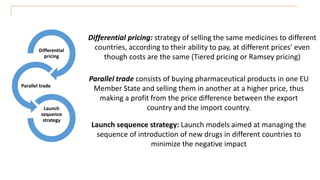
Differential
pricing
Parallel trade
Launch
sequence
strategy
Differential pricing: strategy of selling the same medicines to different
countries, according to their ability to pay, at different prices’ even
though costs are the same (Tiered pricing or Ramsey pricing)
Parallel trade consists of buying pharmaceutical products in one EU
Member State and selling them in another at a higher price, thus
making a profit from the price difference between the export
country and the import country.
Launch sequence strategy: Launch models aimed at managing the
sequence of introduction of new drugs in different countries to
minimize the negative impact
Launch sequence strategy example
Starts with Stage1 and price registration in “unregulated” markets like Germany and UK:
• Higher initial price set by manufacturer can be used as reference for second stage
• Good price for some of the biggest markets globally, no risk of parallel trade or price referencing from low price markets
Stage2 is price registrations in other markets where German
and UK price can be used either as reference or for higher
price negotiations.
Third Stage is price registration in so called “low price”
markets. Here we have two possibilities that can be used
separately or in combination:
• Use already registered higher prices as reference
• Register price for package different than package registered in
markets from first two stages
Main issue: postponed access to latest therapy for patients
on low price markets
Other possible issues
• Reduce price transparency (closed door agreements)
• Circular referencing of two or more countries lead to price decrease due to
external factors
• Inaccurate mandatory margins calculation out of reference prices
• Currency fluctuations/conversions
• “Compulsory licensing” - a legal form of patent infringement is
reconsidered in low price markets (either due to high price or missing
therapy)
CAN WE PROVIDE THERAPY ACCESS
TO ALL PATIENTS AND COMPLY WITH
LOCAL PRICING POLICIES AT THE
SAME TIME?
Nov-17
Risk sharing agreements
• Direct agreements between Manufacturers and Authorities
• Benefits:
• Providing latest therapy to all patients
• Keeping the official (visible) price on higher level
• Disadvantage
• Lack of price transparency makes Price Referencing irrational
Examples:
• Price Volume agreements with paybacks by companies (France)
• General discount system – manufacturers return % of annual sales to MoH (Spain)
• Clawback tax, MoH calculates quarterly % of sales to be returned as tax to MoH – reimbursement drugs
(Romania)
• Profit Margin regulated – not to exceed predefined level (otherwise manufacturers pay back the difference or
reduce the price for the following year (UK)
Additional resources
• The WHO Collaborating Centre for Pharmaceutical Pricing and
Reimbursement Policies
• WHO Country Policies
• Rand corporation Pharma pricing
• Pharmaceutical Market Access in Emerging markets
• WHO-Health Systems in Transition
• ISPOR global Health Care Systems Road map
Contact me:
dragan.cirkovic@gmail.com
www.linkedin.com/in/dragancirkovic

External Price Referencing in Europe, Pharma

  • 1.
    External Price Referencing inEurope Pharma industry EPR overview, including Non-EU countries Photo by Matt Briney on Unsplash Dragan Cirkovic, Nov 2017
  • 2.
    External Price Referencing Usingthe price of a medicine from one or several countries as a benchmark or reference price in own country; Purpose Setting or negotiating the price of a medicine in a given country. Important elements of EPR: Basket of reference countries Price used for referencing/ Price published Responsible Institution(s) Calculation algorithm Nov-17
  • 3.
    DIRECT PRICING MEASURES: Localauthorities set drug prices following a defined pricing policies: External Reference Pricing, Value Based Pricing INDIRECT PRICING MEASURES: Acts and activities that indirectly influence on manufacturers to reconsider price for approval: Internal reference pricing, Parallel imports, mandatory discounts and rebates, different forms of agreements between payers and manufacturers, Drugs interchangeability/ generic substitution
  • 4.
    Launch and postlaunch decisions Globally: • Launch sequence adaptation Regionally/Locally: • Market Access execution • Value based pricing • Procurement strategy • Cost sharing agreements: • Price-Volume Agreements • Financial/Natural Rebates • Price/Volume Cups • Performance or outcome based schemes Pre-launch decisions • Floor price globally • Floor price regionally • Launch sequence strategy Variables: • Reimbursement / Market Access • Demand analyses • Distribution • Product positioning • Competitive intelligence/landscape • Market Segmentation • Patent expiration • Parallel trade analyses • Reference pricing impact Basic decisions before and after Launch
  • 5.
    EPR ELEMENTS  Basketof reference countries  Price used for referencing/ Price published  Calculation algorithm  Responsible Institution(s) Nov-17
  • 6.
    Basket of ReferenceCountries In the beginning, two main criteria's:  Economic comparability  Geographic Comparability With years, baskets became larger and larger: Nine countries > 20 members in the basket and some (Poland/Hungary) have 31 countries to compare price with… Countries with highest Reference frequency (most often in the basket): France (20) Germany (19) Slovakia, Italy, Spain (18 times in the basket)
  • 7.
    AT, Austria; BE,Belgium; BG, Bulgaria; CH, Switzerland; CY, Cyprus; CZ, Czech Republic; DE, Germany; DK, Denmark; EE, Estonia; EL, Greece; ES, Spain; FI, Finland; FR, France; HR, Croatia; HU, Hungary; IE, Ireland; IS, Iceland; IT, Italy; LT, Lithuania; LU, Luxembourg; LV, Latvia; MT, Malta; NL, the Netherlands; NO, Norway; PL, Poland; PT, Portugal; RO, Romania; SE, Sweden; SI, Slovenia; SK, Slovakia; UK, United Kingdom; AL, Albania; BH, Bosnia; MC, Macedonia; MG, Montenegro; RU, Russia; SR, Serbia; TR, Turkey; UKR, Ukraine. NON EU N. of countries in the basket AT BE BU CH CY CZ DE DK EE EL ES FI FR HR HU IE IS IT LT LU LV MT NL NO PL PT RO SE SI SK UK AL BH MC MG RU SR TR UKR Add. countries AT 24 BE 26 Country of origin BU 12 CH 6 CY 4 CZ 19 DE 15 DK 9 EE 4 Country of origin EL 22 ES 16 Eurozone but not FI 29 Liechtenstein FR 4 HR 3 HU 31 Liechtenstein IE 9 IS 4 IT 27 LT 8 LU 1 Country of origin LV 7 MT 11 Public sector NL 4 NO 9 PL 31 Liechtenstein PT 3 RO 12 SE n/a SI 3 SK 27 UK n/a AL 3 BH 3 Austria, Italy MC 12 MG 3 RU 21 + Country of origin, Belarus, Kazakhstan SR 3 Country of origin TR 7 + Country of origin and Country of relaese UKR 5 AT BE BU CH CY CZ DE DK EE EL ES FI FR HR HU IE IS IT LT LU LV MT NL NO PL PT RO SE SI SK UK AL BH MC MG RU SR TR UKR Ref. frequency 16 16 11 3 10 15 19 16 12 17 18 15 22 9 14 14 3 18 14 9 12 8 17 6 13 15 11 13 17 18 18 1 1 3 2 1
  • 8.
    Price referencing, althoughstarted in EU Member states, is nowadays accepted by most of the Non-EU countries. EPR situation in Non-EU countries is still “fragile” and changes can be expected, as national institutions are still in pursue of method that will grant lowest prices and/or method that will grant special price for large markets (e.g. Ru/Tr) In EU countries, change comes more in a form of creative cost-sharing agreements than changes in pricing policies. Basket of Reference Countries
  • 9.
    Price used forreferencing/ Price published From each reference country, price collection from Official Price register/ catalogue/ list Official price list: Manufacturers, Wholesaler or Retail price, depending on the country Products to compare either by Brand or INN, with same or similar formulation Price calculation based on all available referent prices: 1. average of some or all ref. prices, 2. lowest among some or all ref. prices, 3. other method Price collected either my Manufacturer / MA holder or by authorities Influenced by price conversion, rebates calculation and currency conversions
  • 10.
    Calculation algorithm Basic pricecalculation: 1. average of some or all ref. prices, 2. lowest among some or all ref. prices Other variables* in the price equation: - Package size, dose strength, form of administration and dispensation modalities - Original or Generic drug - If Generic, number of Generic substitutions - Orphan/innovative drug - Reimbursement status - Domestic producer with same INN - Currency conversion - Other *All listed variables are defined as special cases in local pricing policies
  • 11.
    Responsible institutions Which institutionsare responsible for determining “benefit” and “value” of pharmaceuticals? • Most usually these are Ministry (of Health, Economy, Social Affairs) and/or HIF. • Several countries developed Institutes/working groups (independent or part of MoH) dealing only with pricing/reimbursement Project that is gathering most of responsible institutions – PPRI (Pharmaceutical Pricing and Reimbursement Information) started as a an initiative in 2004. PPRI today collects more than 70 institutions - competent authorities for pharmaceutical pricing and reimbursement from 41 countries Source: WHO-Health Systems in Transition
  • 12.
    country Drug Agency Ministry SHI NHSOther country Drug Agency Ministry SHI NHS Other Albania X Lithuania X X Austria X X X Luxemburg X X Belgium X Macedonia X Bulgaria X Malta X Canada X Moldova X Croatia X Netherlands X Cyprus X Norway X X X Czech Republic X X Poland X Denmark X X Portugal X Estonia X Romania X Finland X X Serbia X X France X X Slovakia X X Germany X X Slovenia X X X Greece X X X South Africa X Hungary X X South Korea X X Iceland X X Spain X X Ireland X X X Sweden X Israel X Switzerland X Italy X Turkey X Latvia X Ukraine X United Kingdom X NHS=National Health Service, SHI=Social Health Insurance, National competent authorities for pharmaceutical pricing and reimbursement represented in the PPRI network. Ministry (Health, Economy, Social Affairs, depends from country) Others: State-owned research institutions, HTA agencies, procurement agencies. source: S.Vogler et al
  • 13.
    Responsible institutions insome countries Nov-17 Source: WHO-Health Systems in Transition
  • 14.
    What could possiblygo wrong with referencing?
  • 15.
    Differential pricing Parallel trade Launch sequence strategy Differential pricing:strategy of selling the same medicines to different countries, according to their ability to pay, at different prices’ even though costs are the same (Tiered pricing or Ramsey pricing) Parallel trade consists of buying pharmaceutical products in one EU Member State and selling them in another at a higher price, thus making a profit from the price difference between the export country and the import country. Launch sequence strategy: Launch models aimed at managing the sequence of introduction of new drugs in different countries to minimize the negative impact
  • 16.
    Launch sequence strategyexample Starts with Stage1 and price registration in “unregulated” markets like Germany and UK: • Higher initial price set by manufacturer can be used as reference for second stage • Good price for some of the biggest markets globally, no risk of parallel trade or price referencing from low price markets Stage2 is price registrations in other markets where German and UK price can be used either as reference or for higher price negotiations. Third Stage is price registration in so called “low price” markets. Here we have two possibilities that can be used separately or in combination: • Use already registered higher prices as reference • Register price for package different than package registered in markets from first two stages Main issue: postponed access to latest therapy for patients on low price markets
  • 17.
    Other possible issues •Reduce price transparency (closed door agreements) • Circular referencing of two or more countries lead to price decrease due to external factors • Inaccurate mandatory margins calculation out of reference prices • Currency fluctuations/conversions • “Compulsory licensing” - a legal form of patent infringement is reconsidered in low price markets (either due to high price or missing therapy)
  • 18.
    CAN WE PROVIDETHERAPY ACCESS TO ALL PATIENTS AND COMPLY WITH LOCAL PRICING POLICIES AT THE SAME TIME? Nov-17
  • 19.
    Risk sharing agreements •Direct agreements between Manufacturers and Authorities • Benefits: • Providing latest therapy to all patients • Keeping the official (visible) price on higher level • Disadvantage • Lack of price transparency makes Price Referencing irrational Examples: • Price Volume agreements with paybacks by companies (France) • General discount system – manufacturers return % of annual sales to MoH (Spain) • Clawback tax, MoH calculates quarterly % of sales to be returned as tax to MoH – reimbursement drugs (Romania) • Profit Margin regulated – not to exceed predefined level (otherwise manufacturers pay back the difference or reduce the price for the following year (UK)
  • 20.
    Additional resources • TheWHO Collaborating Centre for Pharmaceutical Pricing and Reimbursement Policies • WHO Country Policies • Rand corporation Pharma pricing • Pharmaceutical Market Access in Emerging markets • WHO-Health Systems in Transition • ISPOR global Health Care Systems Road map
  • 21.