Seven-Step
Model of
Migration
into the
Cloud
The Seven-Step Model of Migration
into the Cloud is an effort in
understanding and leveraging the
cloud computing service offerings in
the enterprise context.
The model is as follows:
1. Conduct Cloud Migration
Assessments
2. Isolate the Dependencies
3. Map the Messaging &
Environment
4. Re-architect & Implement
the lost Functionalities
5. Leverage Cloud
Functionalities & Features
6. Test the Migration
7. Iterate and Optimize
3.
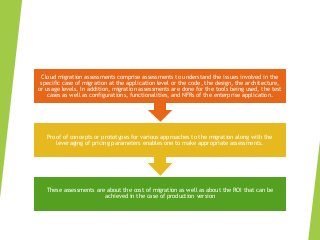
These assessments areabout the cost of migration as well as about the ROI that can be
achieved in the case of production version
Proof of concepts or prototypes for various approaches to the migration along with the
leveraging of pricing parameters enables one to make appropriate assessments.
Cloud migration assessments comprise assessments to understand the issues involved in the
specific case of migration at the application level or the code, the design, the architecture,
or usage levels. In addition, migration assessments are done for the tools being used, the test
cases as well as configurations, functionalities, and NFRs of the enterprise application.
The nextprocess step is in isolating all systemic and
environmental dependencies of the enterprise
application components within the captive data center.
This, in turn, yields a picture of the level of
complexity of the migration.
After isolation is complete, one then goes about
generating the mapping constructs between what shall
possibly remain in the local captive data center and
what goes onto the cloud.
Perhaps a substantial part of the enterprise application
needs to be rearchitected, redesigned, and
reimplemented on the cloud.
This gets in just about the functionality of the original
enterprise application.
Due to this migration, it is possible perhaps that some
functionality is lost.
6.
The nextprocess step leverages the intrinsic features of
the cloud computing service to augment enterprise
application in its own small ways.
Having done the augmentation, validation and test of
the new form of the enterprise application is done with
an extensive test suite that comprises testing the
components of the enterprise application on the cloud
as well.
These test results could be positive or mixed.
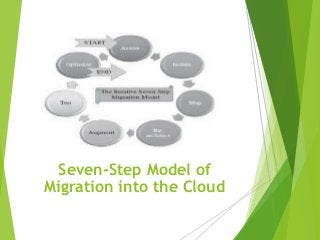
After several such optimizing iterations, the migration
is deemed successful.
Best practices indicate that it is best to iterate through
this Seven-Step Model process for optimizing and
ensuring that the migration into the cloud is both robust
and comprehensive.
Though not comprehensive in enumeration, it is
representative
7.
Challenges in SevenStep Model
The biggest challenge to any cloud migration
project is how effectively the migration risks
are identified and mitigated.
In the Seven-Step Model of Migration into
the Cloud, the process step of testing and
validating includes efforts to identify the key
migration risks.
In the optimization step, we address various
approaches to mitigate the identified
migration risks.